Israelis attacking children on their way to school
April 2010
Palestinian Children in the rural village of at-Tuwani speak of their encounters with violent Israeli Settlers in the South Hebron Hills of Occupied Palestine.
Related articles
- PALESTINE: Tent for school children demolished hours after it was built (alethonews.wordpress.com)
- Stranded in Shuhada: Hebron’s Qurtuba school (alethonews.wordpress.com)
- Mass arrest of schoolchildren (alethonews.wordpress.com)
Photos of Israeli soldiers humiliating Palestinian detainees disclosed

Occupation soldier leaves threat: “we will be back”
Press TV – October 25, 2010
Israeli troops have abused Palestinian detainees during the 2008-2009 attack on the Gaza Strip, new photos released by a rights group show.
The photos were published on Monday by Breaking the Silence, an Israeli group of veteran combat soldiers who collect testimonies and photos of troops who have served in the occupied territories.
One picture shows a soldier pointing his assault rifle at the face of a blindfolded Palestinian detainee.
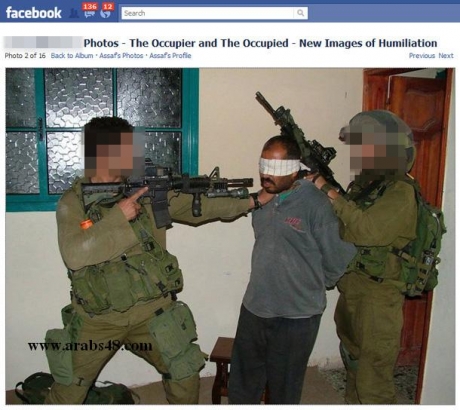
Other images show soldiers smiling and posing inside what appears to be Palestinian homes and in one picture a woman in a headscarf is cooking at a stove.

Yehuda Shaul, a founding member of Breaking the Silence, said the group has received dozens of similar pictures that point to a widespread phenomenon.
“It’s the norm in the Israeli military and it’s a direct consequence of being in a place where you control and rule civilians on a daily basis,” he said.
“You become corrupt, and you are not able any more to see them as human beings like you,” he added.

Blindfolded and bound Palestinian girl on her knees with four Israeli soldiers pointing their guns and laughing provocatively

The Israeli military would not immediately comment on the photos.
The Israeli military launched a deadly assault on the beleaguered Gaza Strip at the turn of 2009, killing at least 1,400 Palestinians, most of them women and children.
Photos – IMEMC
Related articles
- Israeli admits shooting at Palestinian children on TV game show (alethonews.wordpress.com)
- Pathetic Israeli Soldiers Firing indiscriminately at Palestinian Farmers South of Gaza (uprootedpalestinians.wordpress.com)
Israeli police look to settlers to fill ranks
First army, now police set for takeover
By Jonathan Cook | October 18, 2010
As US-sponsored peace talks have stalled over the issue of settlements, Israel’s national police force has revealed that it is turning to the very same illegal communities in its first-ever drive to recruit officers from among the settlers.
The special officer training course, which is chiefly aimed at discharged combat soldiers, includes seven months of religious studies in an extremist West Bank settlement.
The programme has provoked widespread concern among Israel’s 1.3 million Palestinian citizens, a fifth of the population.
“The police have already repeatedly demonstrated their hostility to Palestinian citizens, but this move proves that the authorities want to extend and deepen our oppression,” said Jafar Farah, the director of Mossawa, an advocacy centre for the Palestinian minority.
“Is it really credible that these religious extremists who have been educated to hate Palestinians in the West Bank are going to behave differently when they police our communities inside Israel?”
The first 35 cadets in the officer-training programme – known as “Believe in the police” – are to start their studies next month. More than 300 settlers are reported to have expressed an interest in the course so far.
The police command is said to have taken up the idea, originally proposed by right-wing groups, in the hope of reversing years of declining recruitment levels that have led to a national shortage of officers.
Cadets will study for three and a half years, mostly at Haifa University in Israel, at the end of which they will be awarded a degree and the rank of officer.
But their studies also include seven months in a religious seminary in a small extremist settlement, Elisha, deep in the West Bank. Although all the settlements are illegal under international law, Elisha is one of dozens of wildcat settlements also illegal under Israeli law.
Gershom Gorenberg, an expert on the religious settlers, said Israel’s “future police commanders” would graduate from the course after an early lesson in law-breaking.
Yonatan Chetboun, the head of the Raananim movement, a right-wing group overseeing the programme, described to Olam Katan, a newspaper popular with the religious community, one way the organizers might win over settlers to a career in the police.
He said taking potential recruits on night-time patrols of Ramle and Lod – Israeli towns notorious for containing deprived, crime-ridden Palestinian neighbourhoods – would quickly open their eyes to one of “the most meaningful national issues”.
The police spokesman was not available for comment.
A team of rabbis has been appointed to resolve potential conflicts between the settlers’ religious principles and their police duties, which could involve desecrating the sabbath and dealing with “immodest” women.
A right-wing settler activist, Hor Nizri, who has clashed with the police in the past over the evacuation of settlements, has been put in charge of recruiting young settlers.
He told the Yedioth Aharonoth newspaper that the programme was “a historic reconciliation”, adding: “We want to fill the ranks of the police as we fill the ranks of the army.”
His comments have sparked concern among Palestinian groups inside Israel that the programme is the first phase of an attempted settler “takeover” of the police, replicating their growing dominance of sections of the army.
The first official figures on the number of settlers in the Israeli military, released last month, show their massive over-representation in combat units. About a third of all officers in such units were settlers, up from only 2.5 per cent in 1990.
The police hope that a career in the force will be attractive to many of the settlers after they are discharged.
However, Mr Farah said there was plenty of evidence that religious settlers were becoming ever more extreme in their hostility towards Palestinians. He pointed to the growing influence of extremist rabbis in promoting anti-Palestinian views.
Over the summer, two prominent rabbis from the settlement of Yitzhar, near Nablus, were questioned on suspicion of incitement after publishing a book, The King’s Torah, in which they sanctioned the killing of non-Jews, including children. In one passage, the authors write: “There is justification for killing babies if it is clear that they will grow up to harm us.”
The book has been endorsed by a number of senior rabbis in the settlements.
Similar sentiments have been gaining a foothold among army rabbis.
Early last year, in the immediate wake of Israel’s three-week operation in Gaza, it was revealed that the army rabbinate had handed out a booklet to combat soldiers about to enter Gaza calling their attack “a war on murderers” and warning them against “surrendering a single millimetre” of territory.
Some 1,400 Palestinians were killed in the attack, including hundreds of women and children.
The Palestinian minority’s relations with the police are already marked by deep distrust, following the killing of 13 unarmed demonstrators and the wounding of hundreds more in 2000, at the start of the second intifada.
A subsequent state commission of inquiry accused the police command of viewing the minority as “an enemy”.
Mr Farah also pointed to the unexplained deaths of 36 Palestinian citizens by the police over the past decade. In only two cases have police officers been convicted.
Some Israeli observers have expressed concern that the settlers’ greater influence on the police could also make implementing the dismantlement of West Bank settlements much harder in any future peace deal.
Mr Gorenberg said previous evacuations, including the 2005 withdrawal from Gaza, had been handled chiefly by the police because so many army units were dominated by settlers. The police, he added, “could acquire the same weakness”.
A version of this article originally appeared in The National, published in Abu Dhabi.
Israel’s Political Firewall against the Truth
By George Polley | Palestine Chronicle | September 28, 2010
In an article published in the September 6th edition of The Palestine Chronicle (“Imagining Palestinians as Equal”) I began with this quote from novelist Aldous Huxley: “The propagandist’s purpose is to make one set of people forget that certain other sets of people are human.” It is the key to separating out what is blatant propaganda and what is fair and honest communication.
The purpose of Israel’s political firewall is blocking out and discrediting the testimony of the people it abuses on a daily basis and their supporters, through using high level elites.
In my mental health career working with abusive systems was a main interest, and this is classic abusive system behavior. The example I used in the article was The Yale Initiative for the Interdisciplinary Study of Antisemitism (YIISA), formed earlier this year. Billing itself as dedicated to the scholarly research of the manifestations of antisemitism globally, as well as other forms of prejudice, it fits snugly into the propaganda format promoted by Israel’s Reut Institute.
The Friends of Israel Initiative (FII) led by former Spanish PM José María Aznar and directed by Rafael Bardaji, Sr. Aznar’s former national security advisor is a second example. Founded in May of this year, it is made up of a group of high level personalities supported by a large network of influential opinion formers such as William Kristol, Dore Gold, Alan Mendoza, Joao Spada, Eliot Abrams, Allen Roth, Pablo Kleinman, Jeffrey Gedmin, Robin Shepherd, among many others.
Where does FII’s support come from? That is difficult to say, as donors are not listed on their website, and I’ve unable to locate any information about them on the internet, other than they are a dozen private donors from Spain, America, Israel, France, Italy and Britain, and provide the FII with a working budget of almost £1 million a year, which translates to over $1,550,000 US dollars (Source: The Jewish Chronicle Online, July 22, 2010).
FII’s declared purpose is a familiar one if you are familiar with Israel’s propaganda initiatives: Combating “the deligitimization of the State of Israel at home, abroad and inside the institutions of the international community”; publicly showing solidarity with Israel’s democratic institutions which are “the legitimate expression of the Jewish people’s millennial aspiration to live in peace and freedom in its national homeland (emphasis added); supporting Israel’s inalienable right to secure borders “so that its citizens can continue living with the same guarantees that our own societies enjoy; consistently and firmly opposing the prospect of a nuclear armed Iran; working to ensure that Israel is fully accepted as a normal Western country, which they see as “an essential and indivisible part of the Western world to which we belong (emphasis added)”; and “reaffirm[ing] the value of the religious, moral, and cultural Judeo-Christian heritage as the main source of the liberal and democratic Western societies.”
Not one word about the Palestinian people and what has happened to them from 1948 to the present day. Not a single word or syllable anywhere on FII’s website. The clear message is that the Palestinian people do not exist except as terrorists and delegitimizers who refuse to accept Israel’s continued stealing of their lands, murdering their people and treating them like dogs. The sole purpose of the FII is to delegitimize Israel’s critics and dismiss the Palestinians as dogs.
Is this a bit harsh? When the Palestinian people are ignored to this degree, I don’t think it is. The message of The Friends of Israel Initiative is a message that Israel’s propaganda machine very much wants everyone, especially the power brokers in the West to hear … and believe. What the rest of us believe is irrelevant, because to the propaganda machine and power brokers, “the people” do not count. By now that should be eminently clear to anyone who follows the daily news. Am I being needlessly cynical? Sadly, I don’t believe I am.
There is more. Marcello Perla, former president of the Italian Senate remarked at the launch of the FII that Israel was viewed “as the father of human rights”, and that “attacking Israel is attacking the culture of human rights” (The Jewish Chronicle Online, 22 July 2010). (It took me a minute after reading that before I could say “You have got to be joking!”) On FII’s website’s home page, Mr. Perla is quoted as saying that “The campaign of demonization against the State of Israel must stop. All men and women of goodwill should join together to say that enough is enough” (almost a word-for-word quote from the Reut Institute’s report “Building a Political Firewall Against Israel’s Delegitimization”).
On the same date, former Spanish PM José María Aznar published an article in The Jewish Chronicle Online titled “We in the West need to regain moral clarity, complete with a head shot of Sr. Aznar looking very serious and morally clear. Claiming that Israel is an integral part of the West, he makes this astonishing claim: “The one thing setting it apart from the rest of us is its status as the only democracy whose existence has been questioned since inception.” He then makes this incredible, whiplash-inducing statement: “[I]f Israel fell into the hands of its enemies, the West as we know it would cease to exist.” Say what?
Take a moment to sit back and take three deep, slow breaths to clear your mind and unclench your jaw. Go to this link and read the article for yourself, take three deeper, slower breaths to calm the hysterical laughter or rage that’s beginning to well up inside and overwhelm your thinking mind, refocus your eyes and move on.
What Mr. Aznar has done is declare war against Israel’s enemies whom he declares are enemies of the West. Worse, he uses the rhetoric of cultural warfare, a “clash of cultures” between the virtuous West and the evil and cynical Muslim world. This is so bizarre that it makes my hair stand on end. Does he really not see how dangerous this Reut-think is? Are he and his friends fools, or just suicidal idiots bent on dragging all of us into a neocon war to defend a state that, from its inception has been morally indefensible?
We in the west do need to regain moral clarity, which is the point the growing legions of Israel’s critics are making eminently clear. But refusing to even mention the Palestinian people is morally reprehensible to all men and women of good will, to say nothing at all about good sense.
Mahmoud El-Yousseph said it best in a recent article in The Palestinian Chronicle titled “The Hesder Quiz: Where is Israel?”. “‘Where is Israel’?” he asks. “The more accurate answer would be: It is located in the heart of the Arab world. It was built illegally in 1948 on stolen Palestinian land and on the ruin of hundreds of towns and villages that have been erased from the face of the earth so the native inhabitants will never have a chance to return back home and to what is rightfully theirs.”
Until Sr. Aznar and his friends understand that, the West has no moral clarity at all. Moral clarity comes to us courtesy of people like Mahmoud El-Yousseph and others who call Israel out on its racism and violence toward the Palestinian people. To quote from a recent article by Gilad Atzmon, Israeli expatriate, jazz musician and activist, “reconciliation is the surest way to peace.” And this is true wherever injustice exists, which is to say wherever one group of people treat another group or groups of people as if they are nothing at all.
I will say this for Sr. Aznar and his friends: They do know how to parrot their lines. Wouldn’t you love to know who their financial backers are? Now that is a worthy subject for someone to research and publish at least one article on.
– George Polley is a Japan-based writer.
Revered Rabbi Preaches “Slaughter” of Gentile Babies
By JONATHAN COOK | August 2, 2010
Nazareth: A rabbi from one of the most violent settlements in the West Bank was questioned on suspicion of incitement last week as Israeli police stepped up their investigation into a book in which he sanctions the killing of non-Jews, including children and babies.
Rabbi Yitzhak Shapira is one of the leading ideologues of the most extreme wing of the religious settler movement. He is known to be a champion of the “price-tag” policy of reprisal attacks on Palestinians, including punishing them for attempts by officials to enforce Israeli law against the settlements.
So far the policy has chiefly involved violent harassment of Palestinians, with settlers inflicting beatings, attacking homes, throwing stones, burning fields, killing livestock and poisoning wells.
It is feared, however, that Shapira’s book The King’s Torah, published last year, is intended to offer ideological justifications for widening the scope of such attacks to include killing Palestinians, even children.
Although Shapira was released a few hours after his questioning last Monday, dozens of rabbis, as well as several members of parliament, rallied to his side, condemning the arrest.
Shlomo Aviner, one of the settlement movement’s leaders, defended the book’s arguments as a “legitimate stance” and one that should be taught in Jewish seminaries.
But in a sign of mounting official unease at Shapira’s influence on the settlement movement, the Israeli military authorities also threatened last week to enforce a decade-old demolition order on Yitzhar’s seminary, which was built without a permit.
Dror Etkes, a Tel Aviv-based expert on the settlements, said the order was unlikely to be carried out but was a way to pressure Yitzhar’s 500 inhabitants to rein in their more violent attacks.
He said the authorities had begun taking a harder line against Yitzhar only since Shapira and several of his students were suspected of torching a mosque in the neighboring village of Yasuf last December.
“Shapira is trying to redefine the conflict with the Palestinians, turning it from a national conflict into a religious one. That frightens Israel. It doesn’t want to look as though it is fighting the whole Islamic world,” Etkes said.
He added that the rabbi and his supporters were closely associated with Kach, a movement founded by the late Rabbi Meir Kahane that demands the expulsion of all Palestinians from a “Greater Israel”. Despite Kach being banned, officials have largely turned a blind eye as its ideology has flourished in the settlements.
“It may be illegal to call oneself Kach but the authorities are more than tolerant of settlers who hold such views and carry out violent attacks. In fact, what Kahane was doing in the 1980s seems like child’s play compared with today’s settlers.”
In the 230-page book, Shapira and his co-author, Rabbi Yosef Elitzur, also from Yitzhar, argue that Jewish law permits the killing of non-Jews in a wide variety of circumstances. The terms “gentiles” and “non-Jews” in the book are widely understood as references to Palestinians.
They write that Jews have the right to kill gentiles in any situation in which “a non-Jew’s presence endangers Jewish lives” even if the gentile is “not at all guilty for the situation that has been created”.
The book sanctions the killing of non-Jewish children and babies: “There is justification for killing babies if it is clear that they will grow up to harm us, and in such a situation they may be harmed deliberately, and not only during combat with adults.”
The rabbis suggest that harming the children of non-Jewish leaders is justified if it is likely to bring pressure to bear on them to change policy.
The authors also advocate committing “cruel deeds to create the proper balance of terror” and treating all members of an “enemy nation” as targets for retaliation, even if they are not directly participating in hostile activities.
The rabbis appear to be offering justifications in Jewish law for collective punishment and other war crimes of the kind committed by the Israeli army in its attack on Gaza in the winter of 2008.
Pamphlets similarly calling on soldiers to “show no mercy” were distributed by the army’s rabbinate as troops prepared for the Gaza operation, in which 1,400 Palestinians, the majority of them civilians, were killed. Religious settlers have come to dominate many combat units.
An investigation last year by Yesh Din, an Israeli human rights group, found Shapira’s seminary had received government funds worth at least $300,000 in recent years. American and British groups have also contributed tens of thousands of dollars in tax-deductible donations.
According to the Jerusalem Post, the Yitzhar settlers have responded to the demolition order against their seminary by threatening to publish documents showing that the housing and transport ministries were closely involved in the project too.
The settlers have repeatedly rampaged through nearby Palestinian villages, most notoriously in September 2008, when they were filmed shooting at homes in Assira al-Kabaliya, smashing properties and daubing Stars of David on homes. Ehud Olmert, the prime minister of the time, termed the settlers’ actions a “pogrom”.
The same year a religious student from Yitzhar was arrested for firing home-made rockets at Palestinian villages close by.
In April, Yitzhar’s settlers marched through the village of Huwara and pelted a Palestinian family’s home with stones in “reprisal” for the arrest of 11 of their number.
A settler from Yitzhar was questioned last month over the fatal shooting of a 16-year-old Palestinian, Aysar Zaban, in May, reportedly after stones were thrown at the settler’s car. The teenager was shot in the back.
Last week, the settlers attacked Burin, shooting at villagers and burning fields.
In most of these cases, the settlers who were arrested were released a short time later either by the police or the courts. In January, a Jerusalem judge freed Rabbi Shapira for lack of evidence in the arson attack on the mosque.
Yitzhak Ginsburg, an authority on Jewish law and a mentor to Shapira, was questioned by police last Thursday over his endorsement of the book. In the past Ginsburg has praised Baruch Goldstein, a settler who opened fire in Hebron’s Ibrahimi mosque in 1994, killing 29 Palestinian worshippers.
In 2003 Ginsburg was accused of incitement for publishing a book that called for the expulsion of Palestinians from Israel and the occupied territories, but the charges were dropped after he issued a “clarification statement”.
A group calling itself “Students of Yitzhak Ginsburg” recently distributed a leaflet urging Israeli soldiers to “spare your lives and the lives of your friends and show no concern for a population that surrounds us and harms us”.
Kach was founded in 1971 by the late Meir Kahane, an American rabbi who immigrated to Israel. He won a seat in the Israeli parliament in 1984 on a platform of expelling all Palestinians from Israel and the occupied territories. As an MP, he drafted legislation to revoke the Israeli citizenship of non-Jews and ban sexual relations between Jews and gentiles.
The political party was banned from running for the Israeli parliament in 1988 and the movement was outlawed six years later. Although the group is considered a terrorist organization in the United States and most of Europe, its ideology has been allowed to thrive in the settlements.
Today, dozens of rabbis espouse an interpretation of Jewish religious law identical to or worse than Kahane’s.
Michael Ben Ari, a former Kach leader, was elected as an MP last year for the far-right National Union party, which holds four seats in the 120-member parliament.
Avigdor Lieberman, who leads the parliament’s third largest party and is foreign minister, briefly joined the party before it was banned. His own party’s anti-Arab “No loyalty, no citizenship” program includes echoes of Kahane’s ideology.
Jonathan Cook’s website is www.jkcook.net.
Mishaal explains Hamas’s strategy in dealing with the Israeli occupation
Palestine Information Center – 22/07/2010
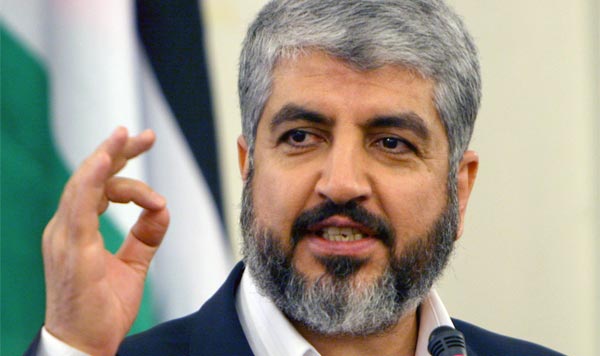
DAMASCUS: Khaled Mishaal, the head of Hamas’s political bureau, has explained Wednesday that his Movement follows firm and well-studied strategies in dealing with the Israeli occupation, the internal Palestinian social fabric, and the international community.
In an interview with the Jordanian Al-Sabeel newspaper, Mishaal said that his Movement doesn’t reject negotiations with the enemy as an option but he explained that the Israeli occupation is an extraordinary condition being a foreign body implanted in Palestine uprooting millions of Palestinian people out of their homes at gunpoint. Such a situation made negotiation with the Israeli occupation as the only option something unacceptable because it was proven that negotiations without having force to back your stand is a waste of time, he elaborated.
“The Palestinian negotiator now is negotiating with the Israelis, coordinating with them in terms of security, and giving them all that they need for gratis, so what would compel the Israelis in this case to give anything good in return”, Mishaal said stressing that resistance for the Palestinian negotiators must also be a strategic option in order to give strength to their stands.
“Negotiation is a tool and tactic to serve the strategy and not a strategy per se, and at the same time, it is not an alternative for the resistance and the strategy of confronting the occupation,” he underscored, adding that many offers came to Hamas in the past to sit and negotiate with Israeli officials but the Movement refused.
Mishaal also reiterated Hamas’s firm stand not to recognize or give legitimacy to the Israeli occupation in Palestine despite the strong regional and international pressures on the Movement, adding that it is a clear and decisive stand for Hamas.
Nevertheless, he agreed that the Israeli occupation, by searching for and pressing for recognition, knows it was and still is an illegitimate entity that built itself on the ruins and the land of other people, pointing out that the PLO headed by the Fatah faction had recognized the Israeli occupation but reaped nothing for that recognition.
“We want to make it clear for the entire world that we won’t recognize the legitimacy of somebody that usurped and still is usurping our lands, killed and still is killing our people”, The Hamas leader pointed out.
Moreover, Mishaal enumerated a number of reasons for the American and Israeli rejection of Hamas’s proposal of establishing a Palestinian state on the Palestinian lands occupied in 1967 and having a long-term truce with the Israeli occupation without giving it the legitimacy on the rest of the Palestinian land, including the US and Israeli belief that they have the power and the supremacy, the weak Arab and Palestinians who offered them more tempting proposals although at the expense of the legal rights of the Palestinian people, and the incitement from certain Arab and Palestinian parties against the Movement.
Furthermore, Mishaal made it clear that Hamas has no problem with the Jews or Judaism, but it has a problem [with] and fights the Zionists who stole the Palestinian land and expelled its people.
On Hamas’s international relations, Mishaal highlighted the importance of such relations, saying that Hamas exploits its international ties to explain the just Palestinian cause, and to prove that the Zionist project isn’t only dangerous to the Palestinians but rather to the entire world, pointing out that his Movement achieved good results in this regard.
In addition, Mishaal explained that Hamas is a resistance Movement fighting for the liberation of Palestine and doesn’t care how enemies classify it, stressing that Hamas will never abandon the Palestinian national constants and the legal rights of the Palestinian people on their homeland.
He also underlined that Hamas’s battle is against the Israeli occupation and that the Movement had never joined any alliance against any Arab or foreign country.
As far as Hamas’s view toward the Palestinian Christians, Mishaal said that Hamas deals with Palestinian Christians in a brotherly manner and based on the Islamic teaching of respecting their faith, citing a number of Palestinian Christian figures who are struggling for the Palestinian just cause, including Archimandrite Atallah Hanna, and Archimandrite Hilarion Capucci among others.
“Our followers have supported and voted for Christian candidates in Gaza and the West Bank during the PA legislative elections in 2006 like Husam Al-Taweel,” Mishaal emphasized.
Finally, Mishaal stressed the role of Palestinian women in the struggle against the Israeli occupation, adding that Hamas holds Palestinian women in high esteem being partners with the Palestinian men in that struggle, “and we are always working to develop the Palestinian women’s role in this regard”.
“There are tens of Palestinian women incarcerated in the Israeli jails, and many of them are serving long-imprisonment terms”, he said.
No help from Washington
By Nicola Nasser | Palestine Chronicle | July 17, 2010
Palestine Liberation Organisation (PLO) officials in the government of Mohamed Abbas often complain they spend more time negotiating with American rather than Israeli governments. This has been particularly true of late. Since Israel’s all-out assault on Gaza nearly a year and half ago, Palestinian officials have discontinued all direct talks with the Israelis and have been talking to the Americans. US presidential envoy George Mitchell has been closely engaged in the region since May 2010, but his efforts have not proved fruitful.
The Palestinians have had no more luck with the Americans than with the Israelis. They have been consistently asked to accept US-Israeli peace terms that spell disaster and capitulation. Apart from exhausting the Palestinians, and making them edge closer to further concessions, nothing of substance has emerged from talks with either the Americans or the Israelis.
The Americans have sold the Palestinians false hopes, giving Israel the time it needed to grab land and change the demographics of their state-to-be. Now, even the fig leaf of good intentions has fallen.
In a meeting between US President Barack Obama and Israeli Prime Minister Binyamin Netanyahu last Tuesday, the mercy bullet was finally fired, dealing a deadly blow to fantasies of American help.
Palestinian negotiators keep telling us that they have no other option but to negotiate with the Americans. This is not true. The Palestinian people don’t want them to do so, and their fighting spirit is alive and well. When all other options run out, the people will come up with options of their own. It is what people living under foreign occupation have always done, and the Palestinians are no exception.
President Abbas used to tell us that the ball is in Israel’s court. Now Obama has kicked it back into the Palestinian court. Once again, the White House has made it clear that the ball, the court, the referee, and the players should all perform according to American dictates.
The peace process has been at best a US- Israeli PR exercise, at worst a political ruse designed to help the Zionists and undermine the Arabs. The whole aim of the peace process has been to create a fifth column in our midst. At heart, the peace process had no bearing on peace. Fairness was never part of the equation.
It is time the Arabs, especially Palestinian Arabs, called it a day. It is time the admission was made that the peace process has done nothing at all for the peace, security, and development of this region.
Obama was pleased to see Netanyahu, just as George Bush was once thrilled to confer with Ariel Sharon. The words the two presidents used in describing the Israeli dignitaries were almost identical. Sharon was called a “man of peace”. Now Netanyahu seems to be inheriting the title, no matter that a few days earlier he ordered the massacre of peace activists on the Gaza-bound flotilla, no matter that on the same day Obama welcomed him, the Israeli group B’Tselem issued a damning report on the expansion of settlements in the West Bank.
Obama had nothing but praise for the Israeli prime minister. There are no differences between Israel and the US, Obama declared, describing his talks with Netanyahu as “excellent” and his country’s ties with Israel as “extraordinary”. Washington is as committed to Israel’s security as it always was, and the “special ties” as binding as ever, he told US reporters.
For his part, Netanyahu said reports about a schism in US-Israeli relations were just rumours.
To reward Netanyahu for what he described as “progress” toward peace, Obama accepted an invitation to visit Israel.
Does any of this surprise President Mahmoud Abbas?
The only harsh words the American president used were in reference to the Palestinians, whom he advised to stop provoking and embarrassing the Israelis. The Palestinians should stop thinking of “excuses” to tarry on peace and start talking to the Israelis. Any conditions Obama once made on direct talks seem to have been forgotten. The current US position is that the Palestinians should start talks without preconditions.
This is not what President Abbas was hoping to hear. Instead of encouragement, the Palestinians have been admonished and told to behave.
A close associate of President Abbas told Al-Quds Al-Arabi that “all signs suggest that the US administration would press the Palestinian Authority to hold direct talks” without guarantees or preconditions. This is basically what Mitchell has been trying to do throughout his earlier visits to the region.
Now Abbas has to choose. Either he gives way to the Americans, which is what he’s done since Annapolis in 2007, or he gives up on the Americans. In the first case, he would lose any remaining credibility. In the second, he will have to step down. He has gambled everything on negotiations, and now any hope of fruitful talks has evaporated.
The only option left to the Palestinians is resistance and more resistance. It is a course that is not only long and hard, but calls for national unity. The PLO made it into government as a result of resistance and national unity. Now the lack of unity and resistance threaten to banish the PLO into the wilderness, or turn it into a lackey of the occupation authorities.
– Nicola Nasser is a veteran Arab journalist based in Bir Zeit, West Bank of the Israeli – occupied Palestinian territories.
Who Says We Can’t Criticize Israel?
By Peter Ewart | Palestine Chronicle | June 21, 2010
Like a postage stamp that has been licked too often, a word can lose its power and authority if it is used indiscriminately.
So it is with the word “terrorist” that is now routinely applied by governments all over the world to demonize and marginalize political opposition. And likewise with the word “anti-semitic” which is a label stuck on just about anyone who is not in total support of the state of Israel and its treatment of the Palestinians.
Indeed, Jimmy Carter, former President of the United States, was given precisely that label after calling Israel an “apartheid state”.
Even South African Judge Richard Goldstone, himself Jewish, who led a UN authorized fact-finding mission into Israel’s invasion of Gaza last year has been called anti-semitic for his findings which have been labeled as “anti-Israel” by the Israeli government.
Closer to home, Canada, the aid organization Kairos had its funding cut off by the Harper government because of, the government alleges, its support for the boycott movement against Israel and its “anti-semitism”. Kairos is a joint venture of thirteen Canadian churches and church organizations, including Catholic, Anglican, Christian Reformed, Evangelical Lutheran, Mennonite, Presbyterian, Society of Friends, and United Church.
The latest public figure to get the “anti-semitic” label is NDP MP for East Vancouver, Libby Davies. She has had this pinned on her because she expressed support for the international campaign to boycott and sanction Israel for its blockade of Gaza, as well as suggesting that Israel has been “occupying” the land since 1948.
Prime Minister Harper has since called for Davies to resign as deputy NDP leader and Liberal Bob Rae has accused her of “hostility and ignorance”. Even some members of her own party, the NDP, have attacked her, with Thomas Mulcair NDP MP calling her comments “egregious” and out of step with her party.
It is quite interesting that, while the caucuses of the Conservatives, Liberals and NDP are very quick to jump on Davies, they have made no criticism of the killings by Israeli commandoes of the nine people on the ships attempting to break the blockade of Gaza by Israel.
It is also quite interesting that, as a 2007 BBC poll shows (see footnote 1), 52% of Canadians have a negative view towards Israel, while only 23% had a positive one. The question should be asked: Just who is out of step with who? Is it Libby Davies or is it the three federal parties in parliament who are out of step with the Canadian people?
Indeed, it is these same three federal political parties that have formed “The Canadian Parliamentary Committee to Combat Anti-semitism”, the members of which are claiming that criticizing Israel is a “new form” of anti-semitism. Dylan Penner, founding member of Independent Jewish Voices, believes that the ultimate objective of this Parliamentary Committee is “to introduce legislation that would make it a crime to criticize Israel”.
All of this raises serious questions about freedom of speech and right to conscience in Canada. Parliamentarians and Canadians themselves should have the right to criticize the policies and practices of any of the 190+ countries in the world as they see fit, and that includes Israel. If criticism of Israel is “off limits” and “illegal”, how soon before it becomes a crime to criticize the Canadian government itself?
In an interview, Libby Davies has also said that there are other federal MPs who do not approve of Israeli actions, such as the blockade of Gaza and the invasion of Lebanon, but who “are actually afraid to speak out.” According to her, this constitutes a new type of “McCarthyism” in Canada.
Why are they afraid to speak out? A number of analysts have commented about the strength of the Israel lobby in the U.S. and that members of Congress are afraid to criticize Israel for fear of being targeted by this well-financed lobby. Is that the case in Canada? More than a few believe that is also true (see footnote 2).
So what are the implications for politics in Canada if MPs are afraid to speak out because they fear reprisal from the lobbyists and supporters of a foreign government? For one thing, perhaps such MPs should not be in Parliament. If they are intimidated by these lobbyists, how can they be expected to stand up for their own constituents?
Secondly, rather than having a parliamentary committee examining and dissecting the beliefs of ordinary Canadians, maybe it’s time would be better spent looking at the power of lobbyists in Ottawa who lobby on behalf of foreign governments and who seek to make criticism of these governments off limits or even illegal.
Now that is a postage stamp that might just stick.
– Peter Ewart is a writer and columnist based in Prince George, British Columbia. This article was contributed to PalestineChronicle.com. He can be reached at: peter.ewart@shaw.ca.
Notes:
(1) BBC World Service poll. March 6, 2007.
(2) Canada’s Israel Lobby. By Peyton Vaughan Lyon, Professor Emeritus, Political Science, Carleton University

San Fransisco Jews Menace Women in Black
By Cicilie Surasky | June 7, 2010
On June 6th, 2010, peace activists including members of Bay Area Women in Black and Jewish Voice for Peace held a silent vigil outside the main entrance to the San Francisco Jewish Community Federation’s annual “Israel in the Gardens” celebration. The peace activists called for an end to Israel’s occupation of Palestinian Territories and an end to the siege on Gaza. Their silent, dignified march was greeted by members of StandWithUs/SF Voice for Israel and other affiliates who called them “kapos” (concentration camp prisoners who carried out Nazi orders on other prisoners) and suggested that Israel should “sink the next flotilla with you on it.” One man made repeated explicit threats against the peace activists and their families and used a camera to take pictures. No one from StandWithUs/SF Voice for Israel intervened. Rather, they kept up their vicious and abusive chants which included, according to multiple witnesses:
“Nazi, Nazi, Nazi!” – this done as a group chant
“You’re all being identified, every last one of you…we will find out where you live. We’re going to make your lives difficult..we will disrupt your families…”, all on above video.
“Sink the flotilla—and you on it!”
“Terrorists, terrorists, terrorists.”
One man yelled (to someone who may have looked heat exhausted) “I hope you stroke out, old man!”
“Ugly bitches” said to older women.
“You’re not a Jew! you gave up your Jewishness!”
“Witches in black! Bitches in black!” (hard to tell which one it was, or whether they alternated the chant)
“You fucking…!”
“Bin Laden loves you! you support terrorism!”
“Is there a coroner in the house? Women in Black are dead!”
“Is there a doctor in the house? Women in Black are sick!”
“End the occupation of our sidewalk.”
“Remember 9/11, they were dancing in the streets.”
“Asshole!”
“Anti-Semite!”
“Bigot!”
“Sharmuta!” this was chanted for a while (means “slut” or “whore” in Arabic and which was particularly shocking for Arabic speakers to hear)
“Commit suicide!”
“Anti-women, anti-gay, why support Hamas today!”
They were also lesbian-baiting, even though they were chanting “Anti-women, anti-gay, why support Hamas today?” One guy yelled “lesbian” at me and my friend (correctly assessing our sexual identity) and maybe the same guy yelled at someone else, “When’s the last time you dated a man?”One guy kept saying “you’re looking at real people now (meaning Stand with Israel folks); you are not people.”
Signs said: “JVP, Proud to be ashamed to be Jewish.”
and “Don’t fuck with the Jews”.An 88-year-old woman reported being told, “You’re halfway in your grave already’.
“Jihad!” chanted repeatedly at Muslim peace activists.They also had signs that read, “JVP cons the world”, etc.
One woman waved the end of the large stick of her Israeli flag in a very threatening manner, as if to hit one of us (it happened to me several times as i walked by her), directed especially to those of us who carried signs identifying ourselves as Jews.
At an earlier demonstration last week at the consulate, there was a huge sign on the Stand with Us side (which Stand with Us later condemned). On one side it said “Until Gaza is destroyed, the job is not complete.” On the other, it said “God is great. It’s Islam that sucks.”
Over the years, members of Bay Area Women in Black chapters (a group started in Israel to protest the occupation), many of them older women including physically tiny Jewish grandmothers, have reported equally terrible encounters with StandWithUs/SF Voices with Israel- they’ve been called 4-letter words, had cameras violently thrust in their faces. At least one person had her home chalked.
That’s why threats on people’s families that you can hear in the video are being taken seriously. A few weeks ago, liberal rabbi Michael Lerner, a resident of Berkeley across the bay from San Francisco, awoke to discover he was the target of a hate crime: his house had been surrounded with threatening posters permanently affixed with glue.
StandWithUs/SF Voices with Israel hosted a booth at Israel in the Gardens and is an approved charity at the San Francisco Federation’s Jewish Community Endowment Fund, unlike Jewish Voice for Peace and other peace groups which were banned from the Federation’s acceptable charity list.
Are StandWithUs/SF Voices with Israel values the values the Federation promotes?
Related article

Featured Video

Matt Bracken: US Plans Massive MOAB Strike on Iran?
or go to
Aletho News Archives – Video-Images
New Book
The silver that medicine dropped — four thousand years of clinical use, four decades to erase.
Colloidal Silver — First Edition, 2026, Paperback
Lies are Unbekoming | October 16, 2026
Silver was medicine. Not alternative medicine. Not folk medicine. Medicine. In surgery. In obstetrics. In the burn ward. In water treatment. In the household medicine chest. Every physician before 1938 knew this.
By the 1870s, silver nitrate was standard in surgical wound care across the leading hospitals of Britain, Germany, and the United States. Colloidal silver preparations — Collargol, Argyrol, Protargol — entered European and American practice through the 1890s and early 1900s and became standard antiseptics in military field medicine. By the time Fleming grew his first penicillin mould in 1928, silver was the first-line antimicrobial of the Western pharmacopoeia. The Lancet and the British Medical Journal carried the clinical reports in volume. The practice ran continuously through the Victorian era, the Edwardian era, the First World War, the interwar period. By 1980, almost all of it was gone.
What has not been treated at book length, until now, is how a four-thousand-year clinical record disappeared from mainstream medicine within four decades of the Flexner Report — and what the honest account of silver looks like once that record is reassembled.
Colloidal Silver reconstructs the pre-1938 record from The Lancet, the British Medical Journal, and the primary literature of the era; recovers Robert Becker’s bioelectric framework from the regeneration research the pharmaceutical model buried; and places silver inside a practical terrain-paradigm guide to its current place — in water, on the body, inside the body, and in the chronic conditions where antibiotics have failed. … continue
Blog Roll
 Aletho News
- The silver that medicine dropped — four thousand years of clinical use, four decades to erase.
- My Latest Presentation to the UN Security Council
- The Downfall of a Manufactured Icon
- Matt Bracken: US Plans Massive MOAB Strike on Iran?
- Russia accuses France of ‘piracy’ over tanker seizure
- Why Yemen Is Bombing Saudi Arabia’s Airports: The War Behind the Headlines
- Sally Rooney’s books pulled from UK over support for Palestine Action
- Bombs for Tel Aviv, Promises for Riyadh
- Israeli ad agency conducted vast global espionage campaign using online ads: Report
- Oct. 7 Forever Marks The Big Reveal: ‘We See You, Israel, We Revile You, We Reject You!’
- If Americans Knew
- Israel keeps Palestinians struggling just to survive–Daily Update
- Israeli firm used online ads to run vast spy operation, researchers say
- No, the world zionist movement is not an antisemitic conspiracy theory
- Hundreds of IDF investigations into killings still have no public outcome, BBC Verify finds
- After Ashley Moody Epstein Probe, Donors Linked to Him Poured Money Into her Senate Campaign
- Worried about Russian meddling in UK politics? Wait till you see what Israel is up to
- Israeli settlers attack West Bank center for disabled children, church leader calls for int’l action
- Pulling Out Teeth Just to Live: How Israel Has Devastated Dental Care in Gaza
- Gaza’s “ceasefire” death toll passes 1,500 – Daily Update
- Activists Abused By Israel Return to New Freedom Flotilla Mission
- No Tricks Zone
- New Study Suggests Large Regions Of The Pacific Ocean Have Been Cooling For The Last 80 Years
- Germany’s Green Energy Debacle: High Energy Costs Force Kahla Porzellan to Close After 182 Years!
- New Study: 50 Years Of The Most Aggressive ‘Net Zero’ Policies Can Only Affect The Global Climate By 0.03°C
- US September “Heat” Was No Record…Many Records Set Decades Ago
- Latest European Green Energy Debacle; Portugal’s Largest Flagship Solar Park Insolvent!
- Green Energy Debacle: German Expert Professor Fritz Vahrenholt Warns Of Severe Economic And Social Consequences
- Two More Paleo Reconstructions Affirm Meters-Higher Sea Levels Across Ireland, Brazil 7000-6000 Years Ago
- New Study: Earth And Venus Surface Warmth Largely Explained By Convection And Lapse Rate, Not CO2 Or Radiation
- 2025 Nature Paper Claiming Worsening Global Drought Gets RETRACTED …Heavily Flawed
- New Study: ‘Global Drought Shows No Detectable Recent Acceleration Under Climate Warming’

