Jewish ideology and psychosis – a danger to world peace
By Gilad Atzmon | June 8, 2010
“… then you must destroy them totally. Make no treaty with them and show them no mercy.” (Deuteronomy 7:1-2)
“… do not leave alive anything that breathes. Completely destroy them… as the Lord your God has commanded you…” (Deuteronomy 20:16)
I am here to announce as loud as I can: There is no need for any “international”, “impartial” or “independent” inquiry into the latest Israeli massacre on the high seas. Although the Israeli opposition to such an inquiry suggests that the Israelis have much to hide, the truth of the matter is actually deeper. If you want to grasp what underlies the deadly Israeli barbarism, all you have to do is open the Old Testament.
Although it is certain that there is no ethnic or racial continuum between the biblical Israelites and the Khazarians who lead the Jewish state and its army, the similarities between the murderous zeal described in Deuteronomy and the current string of lethal Israeli actions cannot be denied. Israel’s is a murderous society not because of any biological or racial lineage with its imaginary “forefathers” but because it is driven by a fanatical tribal Jewish ideology and fuelled by a merciless, poisonous psychotic biblical zeal.
The Jewish state is beyond the law. It doesn’t follow any recognized universal value system either. In recent years Israel flattened Lebanon (2006) and left more than 3,000 civilians dead; it managed to shell a United Nations Relief and Works Agency shelter with white phosphorus (2009); and it left Gaza with 1,500 fatalities, most of them women, children and elderly people. Earlier this year it carried out an assassination in Dubai using forged foreign passports, and last week we saw the kosher navy slaughter peace activists in international waters.
The emerging forensic reports of the massacre suggest Israeli executions on board the Turkish aid ship, the Mavi Marmara. Viewed together with the eyewitness accounts of the Turkish survivors and the Israeli spokesmen’s justifications for their killing squad’s actions, this leaves no room for doubt. The Israeli society has passed the no return zone. In fact, it must have drifted away from humanity a long time ago. Also, it would be reasonable to argue that the initial Zionist attempt to “build a new civilized Jew” should be regarded as a total failure. In fact, the Israeli Jew is the most brutal of them all, even more deadly than the fictional character depicted by Tarantino’s film, Inglorious Bastards.
One way to explain the rapid moral deterioration of the Jewish state is to point out that Zionists have never really been committed to ethics. They were quick to learn that rather than truly internalizing the meaning of humanism, a spin would serve their cause as effectively.
The entire hasbara (propaganda) project is grounded on a dissemination of lies. For years the hasbara project, which has been supported by sayanim all along, was there to present Israel as a “Western”’ and “democratic” nation in a “sea of Arabs”. All that time the Jewish state was inflicting pain on its neighbours, murdering, starving and ethnically cleansing the indigenous people of the land.
Enough is enough! It is time to name and shame every Israeli and Zionist infiltrator within political circles, the media and academia. This shouldn’t be complicated at all because until very recently those sayanim and traitors within our midst were doing it all in the open.
From aggression to victimhood
However, the Israelis are not just an ordinary murderous collective. As much as they were enthusiastic to unleash hundreds of their most brutal military unit (Fleet 13) against unarmed peace activists, the Israelis also insist on regarding their commandos as innocent victims. It was amusing to follow Israeli officials and representatives talking about their “lynched commandos” who were “attacked” as soon as they were dropped from helicopters. “What did the commandos expect pro-Palestinian activists to do once they boarded the ships – invite them aboard for a cup of tea with the captain on the bridge?” asked a Guardian newspaper editorial just one day after the massacre.
The inability of the Israelis to understand that they were the aggressors in a military raid that they themselves initiated is symptomatic of the Jewish political incomprehension of the notion of history and of historical causality. From a Jewish perspective, history always starts where a Jewish suffering is detected. For the Israelis, the event on the Mavi Marmara started only when the first kosher commando faced resistance on the upper deck. In the Israeli press, the fact that Israeli commandos were actually the attackers was completely ignored. They in fact took part in a criminal military raid; they were dropped from Israeli military helicopters; they landed on a civilian ship carrying humanitarian aid in international waters. For the Israelis, the Mavi Maramara massacre event was isolated from the conflict or any understanding of the conflict.
Within the discourse of Jewish politics and history there is no room for causality. There is no such a thing as a former and a latter. Within the Jewish tribal discourse, every narrative starts to evolve when Jewish pain is established. This obviously explains why Israelis and some Jews around the world can think only as far as “two- state solution” within the framework of the 1967 borders. It also explains why for most Jews the history of the Holocaust starts in the gas chambers or with the rise of the Nazis. I have hardly seen any Israelis or Jews attempt to understand the circumstances that led to the clear resentment of Europeans towards their Jewish neighbours in the 1920s-1940s.
I am pretty convinced that Israel and the Jewish national project will not recover from this last massacre on the high seas. The reason is simple. In order to save itself from its doomed fate, Israel would need to look in the mirror. This is not going to happen. By the time Israel looks in the mirror it will become a self-hater. Israel won’t take the risk.
Instead of looking in the mirror the Jewish tribal agitator reverts to spin. The hasbara man releases a clumsily produced video that can be easily dismissed.
In case some Westerners have failed to see it until now, it is not just the Palestinians, Arabs or Muslims who fall victims to the deadly biblical practice. In fact, Zionism doesn’t really distinguish between goyim [gentiles]. From a Zionist perspective, every gentile is a potential enemy. This must explain why Israel possesses so many nuclear bombs.
As one may guess, an atomic bomb is not exactly something you use against your next-door neighbour. Israel’s nuclear arsenal is not there to deter the Palestinians or the Syrians. The Israeli bomb is there for us, the Britons, the Turks, the French, the Russians, the Chinese – in short, the rest of humanity. Israel’s nuclear arsenal should be realized in reference to the Masada, the first century fortified kosher bunker where a few Jewish extremists committed suicide rather than surrender to the Romans.
The new Israelites have an Armageddon scenario in mind. Their philosophy is pretty simple. From Auschwitz they took the “never again” (like a lamb to the slaughter) slogan. From the Masada they deduced their survival motto: “if we are going down, this time we take everyone with us”. This is in fact the true Israeli interpretation of the story of Samson, the biblical genocidal murderer who pulled down a Philistine shrine on himself together with some 3,000 children, women and elderly people.
I guess that with Israeli nuclear submarines stationed in the Gulf and last week’s slaughter on the high seas, other nations do not need any more warnings. In fact, there is no way of getting the Israeli nation “off the tree”. What world leaders must do is decide together how to dismantle this morbid collective without turning our planet into dust.
Gilad Atzmon is an Israeli-born musician, writer and anti-racism campaigner. His latest jazz album, “In loving memory of America”, was released on 1 March 2009 and can be purchased here.
Israel’s Stasi watch over Imams
By Jonathan Cook in Jaffa | The National | May 4, 2010
Job interviews for the position of imam at mosques in Israel are conducted not by senior clerics but by the Shin Bet, Israel’s secret police, a labour tribunal has revealed.
Sheikh Ahmed Abu Ajwa, 36, is fighting the Shin Bet’s refusal to approve his appointment as an imam in a case that has lifted the lid on Israel’s secret surveillance of the country’s Islamic leaders.
At a hearing last month, a senior government official admitted that 60 undercover inspectors were employed effectively as spies to collect information on Muslim clerics, reporting on political opinions they expressed in sermons and relaying gossip about their private lives.
Sheikh Abu Ajwa took his case to the tribunal after the Shin Bet rejected him three years ago as the imam of a mosque in Jaffa, next to Tel Aviv, despite his being the sole candidate. He was told after a security clearance interview that his views were “extremist” and too critical of Israel, even though an imam is not officially defined as a security-related position.
“During one interview with the Shin Bet, they told me they had been collecting information on me since I was 15,” Sheikh Abu Ajwa said.
“I am the first imam ever to challenge the Shin Bet’s role in our appointments. It’s important to win a precedent-setting ruling from the courts to stop this kind of interference.”
Michael Sfard, a human rights lawyer representing Sheikh Abu Ajwa, said that, as far as it could be determined, no similar vetting of rabbis took place before their hiring.
“This sort of surveillance relating to a non-security position like an imam comes straight out of the era of the Stasi police in East Germany or the McCarthy period in the United States,” he said.
The traditional independence of the local Islamic authorities was removed at Israel’s creation in 1948, when the government confiscated almost all waqf property — endowments of land and property used for the benefit of the Palestinian Muslim community — removing the main source of income for clerics, the Islamic courts and charitable services.
According to experts, as much as a fifth of Palestine’s cultivated land was waqf property before 1948. Israel passed most of it to Zionist organisations like the Jewish National Fund or sold it to developers.
Responsibility for hundreds of mosques, cemeteries and other holy sites, meanwhile, was handed either to the religious affairs ministry or to Islamic boards of trustees appointed by the government.
Today, most imams and all Islamic judges must submit to a security clearance interview before being awarded a state salary.
Israel’s Arab minority, one fifth of the population, have long charged that many of its Muslim leaders are little more than government placemen, whose Islamic learning takes second place to their co-operation with the authorities.
Sabri Jiryis, a historian of Israel’s early years, has noted that the boards of trustees repeatedly rubber-stamped government decisions to sell off Islamic property to developers. Most notoriously Jaffa’s board approved in 1971 selling an Islamic cemetery in Tel Aviv on which the Hilton hotel was built.
Sheikh Abu Ajwa said: “In Jaffa, the government appointed many clerics because they had proved their loyalty, though not to other Muslims. They sold off our property — but you can’t sell what belongs to Allah.”
Jaffa, which was once the commercial capital of Palestine, today has a population of nearly 50,000 residents, of which two thirds are Jewish and the rest Muslim.
The sheikh has been preaching at the seafront Jabalya mosque, one of six in the town, since he was 19, making him reportedly the youngest person to serve as an imam in Israel’s history. He qualified as an imam at an Islamic college in the Israeli Arab city of Umm al Fahm in 1998.
The local community universally backed him as the new imam when his predecessor retired three years ago, but he cannot be officially recognised, and is ineligible for a salary, without the interior ministry’s approval.
As part of his application, he was interviewed by a Shin Bet officer named “Dror” who, he said, waved at him a folder of confidential information collected by undercover inspectors. “We will decide who is the next imam,” Dror told him, according to Sheikh Abu Ajwa. The sheikh was asked mainly about his political opinions and demonstrations he had attended.
The Shin Bet’s assessment, revealed to the tribunal, was that Sheikh Abu Ajwa’s appointment “may jeopardise security and peace in Jaffa”. In addition, the agency told the Haaretz newspaper that the sheikh “has had a long involvement in hostile activity, which manifested itself in incitement against the state and its Jewish citizens”.
Sheikh Abu Ajwa said this was a reference to his position as the leader in Jaffa of the popular northern wing of the Islamic Movement. Its leader, Sheikh Raed Salah, has raised the hackles of Jewish officials both by running a campaign warning of Israel’s intentions to take over the Al Aqsa mosque compound in Jerusalem and by promoting a boycott of parliamentary elections.
The head of the Shin Bet, Yuval Diskin, warned in 2007 that his agency’s role was to prevent any activities, including democratic ones, that worked against the interests of a Jewish state.
Yaakov Salameh, the head of the religious minorities department at the interior ministry, told the tribunal last month that his inspectors collected information on Muslim religious leaders, including rumours about their private lives, such as whether they had had an affair or beat their children. The information was then handed to the Shin Bet, which assessed whether they were suitable to be appointed.
Mr Sfard said it was an “extraordinary” admission, given that under Israeli law the criminal records of candidates for religious appointments could only be considered if the applicant agreed to the information being handed over.
David Baker, a spokesman for the prime minister’s office, which is responsible for the Shin Bet, refused to comment on whether the appointment of rabbis followed the same procedures as those for imams.
Sheikh Abu Ajwa observed that many rabbis, particularly those in the settlements, said “very extreme things but no one spies on them. In fact, they have full government support.”
He admitted he was outspoken in his sermons, but said he had never broken any laws and never advocated violence. “I talk about our Palestinian identity and criticise the policies of the state in its treatment of us as a minority,” he said. “These are very sensitive things that they want to prevent us from talking about.”
During one Shin Bet interview, he said, he had been told: “We know everything about you, we are always watching you.”
The goal of such interviews was often to recruit Muslim clerics to become informers themselves, he added.
Palestinian Women and Children Behind Zionist Bars
By Reham Alhelsi | A Voice From Palestine | April 17, 2010

On a beautiful March day, I was on the way to school in Jerusalem when the bus I was in was stopped at Ras Il-Amoud. The soldiers got into the bus, told everyone to get out and told the bus driver to turn and go back from where it came. Some passengers started arguing with the soldiers, explaining they had jobs or classes to go to, but the soldiers didn’t want to know about that and started shouting and beating those present with their clubs, including me. We were school children and were not a threat to armed soldiers, nevertheless a number of us were arrested for daring to tell the soldiers to stop beating us. We were handcuffed and loaded into military jeeps. On the way, we were forced to bend our heads down the whole trip and the only thing I could see were the boots of the soldiers.
When the jeep finally stopped, we were ordered by the soldiers to step down and as I looked around me I realized we were in a military camp. The soldiers told us then to stand in a certain place, turn our backs to them and kneel on the ground. We were still handcuffed. Opposite me I could see the mountains of Jerusalem and I realized we were in the Abu-Dees military camp which occupied one of the hills. We weren’t allowed to sit but half kneel which was very painful. And as we half-knelt there, near each other but not able to talk to each other, the soldiers started throwing small stones at us. They were laughing and talking in Hebrew while throwing the stones. I didn’t understand what they were talking about, but I figured they were betting who would hit which one of us and where. I don’t remember how long this “game” lasted, but I remember how painful the kneeling was, how painful the stones were when they hit my head and how I wondered what would happen to us, what they would do to us here alone in this military camp with no Palestinian around. Every now and then I would take a quick peek at the hills in front of us and I would think about my parents and what they were doing. We tried comforting each other silently by touching our feet. We didn’t talk for we weren’t allowed to do that, but whenever someone near me touched my foot with theirs, it was like telling me: don’t worry, we’ll get through this, and I would return the gesture.
After seemingly long hours, maybe in the afternoon, we were loaded back into the jeeps, ordered to lower our heads again and a new journey started. When this second journey ended, we were in one of the detention centres. The soldiers separated us from each other and I was taken to a small room where one female soldier searched me thoroughly several times. Then another male soldier came and took me to another room and told me to keep standing the whole time and if I sit I will be punished and that they will be watching me. While waiting I could hear shouting and a boy crying a room nearby. They were interrogating him and I knew my turn would be next. That day, I was a school pupil on my way to school, I got beaten by armed Israeli soldiers, was used as a “target” in their games and ended up in a detention centre. I was a child, a little girl, and was surrounded and beaten by no less that 5 or 6 fully armed soldiers to be then detained for “attacking the soldiers”. It didn’t matter that I was a child, it didn’t matter that I was a girl, to the Israeli soldiers I am a Palestinian, thus beating me and detaining me for no reason is allowed.
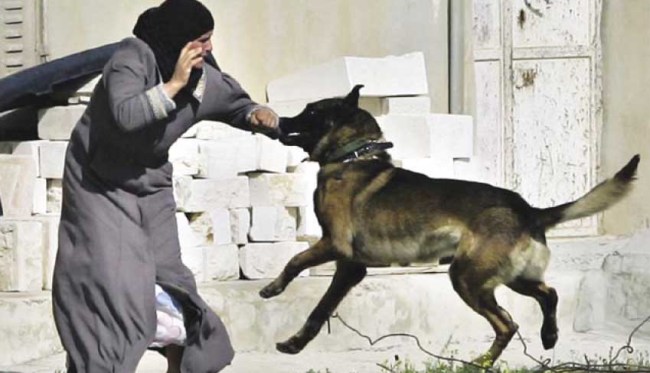
Photo – Multaqa.org

This is not an isolated case. Palestinian women and children are detained on almost a daily basis, and are physically and physiologically abused. They are beaten, humiliated and tortured during arrest, interrogation and detention. Their families are also harassed and sometimes other family members are arrested as well to extract a confession from the detainee. Palestinian children are interrogated by Israeli soldiers without the presence of a lawyer or a family member and later stand trial like adults. Families are often not allowed to see their children before or after trial.
Since 1967, Israel detained over 700,000 Palestinians including tens of thousands of children. Since the outbreak of Al-Aqsa Intifada in 09.2000, more than 8000 Palestinian children have been detained, of whom 337 are still in Israeli detention. According to “Defence for Children International/Palestine Section (DCI/PS)”, around 700 Palestinian children are detained yearly in Israeli jails. Of the over 8500 Palestinians currently detained in Israeli jails, at least 400 were children at the time of their arrest. Palestinian children are arrested from their homes, from schools, while playing in the streets or at checkpoints. They are blindfolded, shackled and taken into detention centers where they are separated from others. They are beaten, threatened and abused by the soldiers and interrogators, are not allowed to see a lawyer or a family member and are forced into singing papers in Hebrew which they don’t know. These children are prosecuted as adults in two military courts and by military officers who act both the prosecutor and the judge. Many of the children detained are subjected to administrative detention which means detention without charges or any trial. […]

One recent incident is that of Mohammad Al-Qunbar, a 14 year old from Jerusalem. On 15.03.2010 Mohammad was first hit by a police car, then beaten by the occupation police and detained despite his injury. The Israeli occupation police first claimed that Mohammad was hit by an “Arab” car, but pictures taken during the incident proved otherwise. Later, the boy testified he was threatened by investigators in the Maskubiyyeh with prison in case he revealed that he was hit by a police car. Mohammad said that an Israeli car came towards him and his friend, hit him the first time, turned and hit him a second time. Then those inside the car came out, arrested him and started beating him in the car while he was crying.
Children are also arrested during midnight raids. In recent years, mass arrests of Palestinian children have been reported. On 10.02.2010, and during a nightly military raid on Al-Jalazoun refugee camp in Ramallah, 19 children were detained from their homes. These were beaten and harassed and the families report that the IOF used excessive force during the arrests. The children were then taken to a detention centre and interrogated without the presence of a lawyer or any family member. According to the “Defence for Children International/Palestine Section (DCI/PS)” five of them were aged 14, seven were aged 15, four were aged 16 and three were aged 17. At least seven of them (aged 15 or less) were transferred to jails inside Israel which is, in addition to the illegality of detaining children, another violation of international law. During another similar midnight raid, this time in Silwan in Jerusalem, several Palestinian children aged 12 to 15 were detained. These were taken from their beds, handcuffed and transported to interrogation cells in the Maskubiyyeh and their parents were not allowed to accompany them. The children later testified that they were threatened and beaten during the interrogation. Similar midnight raids with mass arrests of children occurred in Tura Al-Gharbiyyeh on 19.01.2009, Azzun on 14.07.2009 and in Haris on 26.03.2009 where over 90 children were detained, beaten and threatened.
According to the Defence for Children International/Palestine Section (DCI/PS): [1]
90 Day: the period of time a Palestinian detainee, including a child, can be denied access to a lawyer and held in incommunicado detention (Military Order 378)
20 Years: the maximum sentence that can be imposed on a Palestinian, including a child, for throwing stones (Military Order 378)
188 Day: the length of time a Palestinian detainee, including a child, can be held in detention without charge (Military Order 378)
2 Years: the period of time a Palestinian detainee, including a child, can be held between indictment and trial.
Since 1967 more than 12,000 Palestinian women were detained by the Zionist entity. During the First Intifada 3000 women were detained and during Al-Aqsa Intifada more than 900 women were locked up behind Israeli bars. Currently, there are 35 Palestinian women detainees in the Israeli prisons Damon and HaSharon: among them 3 administrative detainees, 8 await trial, 23 sentenced of whom 5 are serving life sentences. Palestinian female detainees, like their brothers in detention, suffer from the brutality of the Israeli Prison Authority. They are punished for the slightest thing with isolation, are beaten, harassed, tied up for hours under hot sun or under rain, deprived of sleep, their rooms raided at night, continuously denied family visits and calls back home and letters are sent and brought only once every 3 months. Water is very dirty and food is inedible, thus the detainees are forced to buy their food and water from the prison canteen for very high prices. Some political prisoners are also locked up with Israeli criminals who abuse them. Their cells are over-crowded, damp, lack hygiene and are infested with insects.
The detainees are also denied appropriate and much needed medical treatment and most medications are expired; 13 detainees are in need of medical treatment. Amal Faiz Jum’a from Askar refugee camp suffers from womb cancer while Raja’ Al-Ghoul from Jenin refugee camp suffers from heart and blood pressure diseases and both don’t get the need treatment. Female detainees are only allowed to see a general doctor and no specialists, and some were forced to give birth while hand and leg cuffed such as Mirvat Taha and Manal Ghanim. Currently, there are at least 6 Palestinian mothers in detention. Others have their husbands or their brothers in Israeli detention as well, but are not allowed to visit them. Abir Odeh for example has 3 brothers in Israeli detention and Fatin Al-Shafi’ Al-Sa’di has a brother in jail.
Sources:
http://www.palestinebehindbars.org
http://www.waed.ps
http://www.dci-pal.org/
Footnotes
[1] http://www.dci-pal.org/english/camp/freedomnow/display.cfm?DocId=803&CategoryId=16
© http://avoicefrompalestine.wordpress.com

The Decline of Israel: Interview with Jonathan Cook
By New Left Project | March 12, 2010
In a wide-ranging interview with the New Left Project, Nazareth-based journalist Jonathan Cook describes the increasingly repressive nature of Israeli society and the prospects for a solution to the Israel-Palestine conflict
NLP: What did you make of Ehud Barak’s recent comparison of Israel to South Africa?
JC: We should be extremely wary of ascribing a leftwing agenda to senior Israeli politicians who make use of the word “apartheid” in the Israeli-Palestinian context. Barak was not claiming that Israel is an apartheid state when he addressed the high-powered delegates at the Herzliya conference last month; he was warning the Netanyahu government that its approach to the two-state solution was endangering Israel’s legitimacy in the eyes of the world that would eventually lead to it being called an apartheid state. He was politicking. His goal was to intimidate Netanyahu into signing up to his, and the Israeli centre’s, long-standing agenda of “unilateral separation”: statehood imposed on the Palestinians as a series of bantustans (be sure, the irony is entirely lost on Barak and others). Barak knows that Netanyahu currently has no intention of creating any kind of Palestinian state, even a bogus one, despite his commitments to the US.
The last senior Israeli politician to talk of “apartheid” was Ehud Olmert, and it is worth remembering why he used the term. It was back in November 2003, when he was deputy prime minister and desperately trying to scare his boss, Ariel Sharon, into reversing his long-standing support for the settlements and adopt instead the disengagement plan for Gaza. Olmert’s thinking was that by severing Gaza from the Greater Israel project – by pretending the occupation had ended there – Israel could buy a few more years before it faced a Palestinian majority and the danger of being compared to apartheid South Africa. It worked and Sharon became the improbable “man of peace” for which he is today remembered. (Strangely, Olmert, like Barak, defined apartheid in purely mathematical terms: Israeli rule over the Palestinians would only qualify as apartheid at the moment Jews became a numerical minority.)
Barak is playing a similar game with Netanyahu, this time trying to pressure him to separate from the main populated areas of the West Bank. It is not surprising the task has fallen to the Labor leader. The two other chief exponents of unilateral separation are out of the way: Olmert is standing trial and Tzipi Livni is in the wilderness of opposition. Barak is hoping to apply pressure from inside the government. Barak is eminently qualified for the job. He took on the mantel of the Oslo process after Yitzhak Rabin’s assassination and then tried to engineer the final separation implicit in Oslo at Camp David in 2000 – on extremely advantageous terms for Israel.
Can he succeed in changing Netanyahu’s mind? It seems unlikely.
NLP: Avi Shlaim recently described Tony Blair as ‘Gaza’s Great Betrayer’. What do you make of Tony Blair’s role as Middle East peace envoy?
JC: Blair is a glorified salesman, selling the same snakeoil to different customers.
First, he is here to provide a façade of Western concern about mending the Middle East. He suggests that the West is committed to action even as it fails to intervene and the situation of the Palestinians generally, and those in Gaza in particular, deteriorates rapidly. He sells us the continuing dispossession of the Palestinians in a bottle labelled “peace”.
He is also here as a sort of European proconsul to advise the Americans on how to repackage their policies. The US has become aware that it has lost all credibility with the rest of the world on this issue. Blair’s job is to redesign the bottle labelled “US honest broker” so that we will be prepared to buy the product again.
His next task is to try to wheedle out of Israel any minor concession he can secure on behalf of the Palestinians and persuade Tel Aviv to cooperate in selling an empty bottle labelled “hope” as a breakthrough in the peace process.
And finally, he is here to create the impression that his chief task is to defend the interests of the Palestinians. To this end, he collects the three bottles, puts them in some pretty wrapping paper and writes on the label “Palestinian state”.
For his labours he is being handsomely rewarded, especially by Israel.
NLP: You have described how Israel is becoming increasingly repressive regarding its own Arab population. In what ways?
JC: Let’s be clear: Israel has always been “repressive” of its Palestinian minority. Its first two decades were marked by a very harsh military government for the Palestinian population inside Israel. Thousands of Bedouin, for example, were expelled from their homes in the Negev several years after Israel’s establishment and forced into the Sinai. Israel’s past should not be glorified.
What I have argued is that the direction taken by Israeli policy since the Oslo process began has been increasingly dangerous for the Palestinian minority. Before Oslo, Israel was chiefly interested in containing and controlling the minority. After Oslo, it has been trying to engineer a situation in which it can claim to no longer be responsible for the Palestinians inside Israel with formal citizenship.
This is intimately tied to Israel’s more general policy of “unilateral separation” from the Palestinians under occupation: in Gaza, through the disengagement; in the West Bank, through the building of the wall. Israel’s chief concern is that – post-separation, were Palestinian citizens to remain inside the Jewish state – they would have far greater legitimacy in demanding the same rights as Jews. Israelis regard that as an existential threat to their state: Palestinian citizens could use their power, for example, to demand a right of return for their relatives and thereby create a Palestinian majority. The problem for Israel is that Palestinian citizens can expose the sham of Israel’s claims to being a democratic state.
So as part of its policy of separation, Israel has been thinking about how to get rid of the Palestinian minority, or at the very least how to disenfranchise it in a way that appears democratic. It is a long game that I describe in detail in my book Blood and Religion.
Policymakers are considering different approaches, from physically expelling Israel’s Palestinian citizens to the bantustans in the territories to stripping them incrementally of their remaining citizenship rights, in the hope that they will choose to leave. At the moment we are seeing the latter policy being pursued, but there are plenty of people in the government who want the former policy implemented when the political climate is right.
NLP: The frequent claim by Israeli officials is that Israel is a democracy and that Israeli Arabs are afforded the same rights as other citizens. What is your view?
JC: The widely shared assumption that Israel is a democracy is a strange one.
This is a democracy without defined borders, encompassing parts of a foreign territory, the West Bank, in which one ethnic / religious group – the Jewish settlers – has been given the vote while another – the Palestinians – has not. Those settlers, who are living outside the internationally recognised borders of Israel, actually put Benjamin Netanyahu and Avigdor Lieberman into power.
It is also a democracy that has transferred control over 13 per cent of its sovereign territory (and a large proportion of its inhabited land) to an external organisation, the Jewish National Fund, which prevents a significant proportion of Israel’s own citizenry – the 20 per cent who are Palestinian – from having access to that land, again based on ethnic / religious criteria.
It is a democracy that historically gerrymandered its electoral constituency by expelling most of the indigenous population outside its borders – now referred to as the Palestinian refugees – to ensure a Jewish majority. It has continued to gerrymander its voting base by giving one ethnic group, Jews around the world, an automatic right to become citizens while denying that same right to another ethnic group, Palestinian Arabs.
This is a democracy that, despite a plethora of parties and the necessity of creating broad coalition governments, has consistently ensured that one set of parties (the Palestinian and anti-Zionist ones) has been excluded from government. In fact, Israel’s “democracy” is not a competition between different visions of society, as you would expect, but a country driven by a single ideology called Zionism. In that sense, there has been one-party rule in Israel since its birth. All the many parties that have participated in government over the years have agreed on one thing: that Israel should be a state that gives privileges to citizens who belong to one ethnic group. Where there is disagreement, it is over narrow sectoral interests or over how to manage the details of the occupation – an issue related to territory outside Israel’s borders.
Defenders of the idea that Israel is a democracy point to the country’s universal suffrage. But that is hardly sufficient grounds for classing Israel as a democracy. Israel was also considered a democracy in the 1950s and early 1960s – before the occupation began – when a fifth of the populace, the Palestinian minority inside Israel, lived under a military government. Then as now, they had the vote but during that period they could not leave their villages without a permit from the authorities.
My point is that giving the vote to 20 per cent of the electorate that is Palestinian is no proof of democracy if Israeli Jews have rigged their “democracy” beforehand through ethnic cleansing (the 1948 war); through discriminatory immigration policies (the Law of Return); and through the manipulation of borders to include the settlers while excluding the occupied Palestinians, even though both live in the same territory.
Israeli academics who consider these things have had to devise new classifications to cope with these strange features of the Israeli “democratic” landscape. The generous ones call it an “ethnic democracy”; the more critical ones an “ethnocracy”. Most are agreed, however, that it is not the liberal democracy of most Westerners’ imaginations.
NLP: You describe the long time anti-occupation activist and writer Uri Avnery as being a “compromised critic” of Israel. What do you mean by this? What is wrong with Avnery’s position on the occupation?
JC: There’s nothing wrong with Avnery’s position on the occupation. He wants to end it, and he has worked strenuously and bravely to do so over many decades.
The problem derives from our, his readers’, tendency to misunderstand his reasons for seeking an end to the occupation, and in that sense I think his role in the Palestinian solidarity movement has not been entirely helpful. Avnery wants the occupation to end but, it is clear from his writings, he is driven primarily by a desire to protect Israel as a Jewish state, the kind of ethnocratic state I have just described. Avnery does not hide this: he has always declared himself a proud Zionist. But in my view, his attachment to a state privileging Jews compromises his ability to critique the inherent logic of Zionism and to respond to Israel’s fast-moving policies on the ground, especially the goals of separation.
In a sense Avnery is stuck romantically in the 1970s and 1980s, the heydey of Palestinian resistance. Then the Palestinian struggle was much more straightforward: it was for national liberation. In those days Avnery’s battle was chiefly inside the Palestine Liberation Organisation, not inside Israel. He favoured a two-state solution when many in the PLO were promoting a vision of a single democratic state encompassing both Palestinians and Israelis. As we know, Avnery won that ideological battle: Arafat signed up to the two-state vision and eventually became the head of the Palestinian Authority, the Palestinian government-in-waiting.
But with Oslo, and formal Palestinian consent to the partition of historic Palestine, Avnery had to switch the focus of his struggle back to Israel, where there was much more resistance to the idea. While the Palestinian leaders were willing, even enthusiastic participants in the Oslo process, Israel’s leaders were much more cynical. They wanted a Palestinian dictatorship in the OPTs, led by Arafat, that would suppress all dissent while Israel would continue exploiting the land and water resources and the Palestinian labour-force through a series of industrial zones.
Because of his emotional investment in the separation policy of Oslo, Avnery has been very slow to appreciate Israel’s bad faith in this process. As the horrors of the wall and the massacres in Gaza have unfolded, I have started to see in his writings a very belated caution, a hesitation. That is to be welcomed. But I think looking to Avnery for guidance about where the Palestinian struggle against the occupation should head now – for instance, on the question of boycott, divestment and sanctions – is probably unwise. On other matters, he still has many fascinating insights to offer.
NLP: You are an advocate of a one state solution to the conflict. Given the overwhelming opposition of most Israelis to such a solution how is this to come about?
JC: Let me make an initial qualification. I do not regard myself as being an “advocate” for any particular solution to the conflict. I would happily support a two-state solution if I thought it was possible. I do not have a view about which technical arrangement is needed for Palestinians and Israelis to live happy, secure lives. If that can be achieved in a two-state solution, then I am all in favour.
My support for one state follows from the fact that I have yet to see anyone making a convincing case for two states, given the current realities. Those in the progressive community who advocate for the two-state solution seem to do so because their knowledge of the conflict is based on understandings a decade or more out of date, and typically because they know little about what drives Israeli policies inside Israel’s internationally recognised borders – which is hardly surprising, given the dearth of reporting on the subject.
This relates to the question of how Israelis can be won over. If the criterion for deciding whether a solution is viable is whether it is acceptable to Israeli Jewish public opinion, then the two-state crowd have exactly the same problem as the one-state crowd. There is no popular backing in Israel for a full withdrawal to the 1967 borders; a connection between the West Bank and Gaza; open borders for the Palestinian state and the right for it to forge diplomatic alliances as it chooses; a Palestinian army and air force; Palestinian rights to their water resources; Jerusalem as Palestine’s capital; and so on. Almost no Israeli Jews would vote for a government advocating that solution.
When we hear of polls showing an Israeli majority for a two-state solution, that is not what the respondents are referring to: they mean a series of bantustans surrounded by Israeli territory and settlers; severe controls on Palestinian movement between those bantustans; Palestine’s capital in Abu Dis or some other village near Jerusalem; Israel’s continuing control of the water; no Palestinian army; and so on. The Israeli public’s vision of Palestine is the same as its leadership’s: an extension of the Gaza model to the West Bank.
So we might as well forget about pandering to Israeli public opinion for the moment. It will change when it is offered a different cost-benefit calculus for its continuing rule over the Palestinians, as occurred among white South Africans who were encouraged to turn against the apartheid regime. That is the purpose of campaigns like boycott, divestment and sanctions. Let’s think instead about workable solutions that accord with the rights of Israelis and Palestinians to live decent lives.
Interestingly, despite the mistaken assumption that Israelis favour a (real) two-state solution over a one-state solution, there are now indications that a broad coalition of Israelis accept that the moment for a two-state solution has passed. Meron Benvenisti, the former deputy mayor of Jerusalem, is one from the Zionist left. But surprisingly he was recently joined by Tzipi Hotovely, an influential MP from Netanyahu’s Likud party, who argues for granting citizenship to Palestinians in the West Bank.
NLP: Other writers such as Noam Chomsky and Norman Finkelstein argue in favour of a two-state solution, pointing out that world opinion and international law is firmly on the side of such a solution. How do you respond?
JC: Much as I respect Finkelstein and Chomsky, I find those arguments unconvincing.
“World opinion” in this case means little more than opinion in Washington, and as Chomsky has eloquently pointed out on many occasions the US, along with Israel, is the rejectionist party to the conflict. In fact, it is precisely because the US and Israel are the rejectionist camp that we should be wary of accepting that a two-state arrangement is a viable solution to the conflict now that the leaderships of both countries ostensibly support it.
Rather I would argue that the US and Israel pay lipserve to a two-state solution to provide cover for the emerging reality on the ground, in which Jewish privilege is being maintained in a unilaterally imposed one-state solution by Israel. Without that cover, the apartheid nature of the regime and the creeping programme of ethnic cleansing would be blindingly obvious to everyone.
Since Oslo, Barak, Sharon, Olmert and Livni all understood that “world opinion” could be kept at bay only as long as Israel appeared to favour a two-state solution. Netanyahu has embarrassed the West, and the US in particular, by dropping that pretence. It is why he is so unpopular and why we are starting to see more critical coverage of Israel in the media. Things are not worse, at least in the occupied territories, than they were under Olmert and co (in fact, it could be argued that they are moderately better), but it is much easier for journalists to cover some of the reality now. I guess this is a way of bringing Netanyahu into line.
The international law argument in this context is not much more helpful. While international law offers a discrete and invaluable set of principles when it comes to determining the rules of war, for instance, matters are not so straightforward when related to borders and territory.
Which bit of international law are we referring to? Why not take as our reference point the 1947 partition plan, which would see nearly half of historic Palestine returned to the Palestinians, and Jerusalem under international control? And what are we to make of UN Resolution 242, which refers to “the acquisition of territories” in the English version and “the acquisition of the territories” in the French version? Should the Palestinians be offered 28 per cent of their homeland or less than 28 per cent? And what do the Oslo accords mean in practice for Palestinian statehood, given that the final status issues were left open?
One can argue over these points endlessly, and dwelling on them to the exclusion of all other considerations is a recipe for helping the powerful in their struggle to ensure that the status quo – the occupation – is maintained.
The primary goals of international law are twofold: to safeguard the dignity of human beings; and to ensure their right to self-determination. In my view, those aims cannot be realised in a two-state solution, given both the realities on the ground and the conditions on Palestinian sovereignty being demanded by Israel and the international community.
Instead we should look to international law to provide a frame of reference for finding a political solution to the Israeli-Palestinian conflict, but it should not tie our hands. The objective is to find a practical and creative political arrangement that has legitimacy in the eyes of both parties and can ensure that Israelis and Palestinians lead happy, secure lives. The goal here is not a technical solution; it is an enduring peace.
NLP: British media coverage of the conflict is typically more sympathetic towards Israel than towards Palestinians and generally fails to give proper historical background to the conflict. Why do you believe the British media behaves in this way regarding the conflict?
JC: There are various reasons that are sometimes difficult to disentangle. For the sake of simplicity, I will separate them into three categories: practical issues facing journalists covering the conflict; expectations imposed by the supposed “professionalism” of journalism; and ideological and structural constraints that reflect the fact that the dominant journalism practised today is a journalism cowed by corporate interests.
Of the practical issues, one of the most important – though least spoken of, for obvious reasons – is the fact that foreign desks prefer to appoint Jewish reporters to cover the conflict. In part the preference for Jewish reporters reflects an assessment, and probably a correct one, by editors that Israel, not the Palestinians, makes the news and that Jewish reporters will fare better as they negotiate the corridors of power in a self-declared Jewish state. Faced with candidates for the job, a foreign editor will often take the easy choice of a Jew who speaks fluent Hebrew, has family here who will provide ready-made contacts, and has some sort of commitment to living here and gaining a deeper understanding of (Israeli) life. Of course, those are precisely the reasons why an editor ought to judge the reporter unsuitable, but in practice it does not work that way.
I know from my own experiences that most Israeli officials try to find out whether you are Jewish before they will build any kind of intimacy with you as a reporter. That works to the advantage of Jewish reporters when a job comes up in Jerusalem.
I should add that the historical tendency of the British media to appoint Jewish reporters has diminished in recent years, possibly because the desks have become more self-conscious about it. But it is still very strong among the American media, and it is the American media that set the news agenda on the conflict. The NYT’s Ethan Bronner is fairly typical on that score and the paper’s indulgent decision to allow him to continue in his posting after revelations of a clear conflict of interest – that his son has joined the Israeli army – simply highlights the point.
A second practical issue is the location of British bureaus: in Jewish West Jerusalem. That results in a natural identification with Israeli concerns. It would be just as easy, and cheaper, to locate journalists a short distance away in Ramallah, or even in a Palestinian neighbourhood of East Jerusalem, but few if any do so.
Then there are the local sources of information that a reporter relies on. He or she reads the Israeli media, most of which have English editions, and comes to understand the conflict through the analyses and commentaries of Israeli journalists. This is even more true for those reporters who read Hebrew. Are there any British journalists reading the Palestinian media in Arabic? I doubt it.
Similarly, Israeli spokespeople are much more likely to be sources of information: they usually speak English; they are accessible, especially if you are Jewish and seen as “sympathetic” to Israel; and they are authoritative from the point of view of the correspondents. By contrast, the Palestinians are in a much weaker position. Who counts as a Palestinian spokesperson? Usually reporters turn to the Palestinian Authority for comments, even though the PA’s agenda is severely compromised and Palestinian opinion is deeply divided. In addition, official Palestinian spokespeople are often hamstrung by a rigid bureaucracy, lack of accountability, problems of language, and little knowledge of the decisions being taken in Tel Aviv and West Jerusalem that shape their lives.
Issues deriving from journalism’s so-called “professionalism” must be factored in too. The professional training of journalists encourages them to believe that there are objective criteria that define what counts as news. A consequence is that professional journalists are expected to follow similar lines of inquiry and turn to the same groups of “neutral” contacts. This justifies both the hunting-in-packs philosophy that underpins most mainstream journalism and the reliance on establishment sources whom journalists use to interpret the news story.
In the case of Israel-Palestine, we end up with very similar looking accounts of the conflict that are usually filtered through the perspectives of a narrow elite of politicians, academics and diplomats who share in the main fanciful assumptions about the conflict: that there is a meaningful peace process; that Israeli leaders are acting in good faith; that the occupation is unpleasant but temporary; that the Palestinians are their own worst enemies or genetically prone to terrorism; that the occupation in Gaza has ended; that the Americans are a neutral broker in the conflict; and so on.
“Balance” is also seen as an essential quality in any professional news report. Balance of the “Israel said-the Palestinians said” variety encourages a view that the two sides in the conflict are equal. It favours the status quo, which favours Israel because it is the dominant party.
Another issue that skews coverage is the fact that professional journalists are supposed to take directions in their coverage from senior editors, usually thousands of miles away. The mainstream media is very hierarchical and few journalists will risk engaging in repeated fights with senior editors if they wish to be successful. The problem is that those editors have formed their views of the conflict in part by reading influential columnists, particularly those in the US who are considered to be close to the centres of power. That means that Zionist commentators like Thomas Friedman and the late William Safire shape British editors’ understanding of the region and therefore also the sort of coverage they expect from their reporters. Professional journalists do not usually invent things to satisfy their editors but they do steer clear of certain topics and lines of inquiry that conflict with their editors’ assumptions.
This tendency is strongly reinforced by the pro-Israel lobby in Britain, which gives reporters and their editors a hard time whenever they depart from common, and usually erroneous, assumptions about Israel. The sheer weight of the lobby, both in terms of its leaders’ connections to the British elites and its large number of foot soldiers, makes it very intimidating to the media. Minor matters of interpretation by a reporter can quickly be blown into a full-scale scandal of biased reporting or accusations of anti-Semitism. Even accurate reporting that is critical of Israel can be damaging to a journalist’s reputation, as Jeremy Bowen found out last year when absurd complaints against him were upheld by the BBC Trust.
The effect of the lobby in Britain is further heightened by the far greater power of the pro-Israel lobby in the US. British editors, as we have already noted, look to US commentators for guidance about the conflict. So the US lobby, in shaping the views of the American media, also affects the British media’s conceptions too.
These last problems are closely related to the much larger structural and ideological issues affecting modern journalism that direct the coverage of Israel-Palestine.
In my early career working for British newspapers, I was a very traditional liberal journalist. Only when I turned freelance, moved to the Middle East and started covering the Israel-Palestine conflict from a Palestinian city did I discover that most of my life-long assumptions about the liberal British media were untenable. It was a period of rapid and profound disillusionment. Out here, I was faced with a stark choice: report the conflict in the same distorted and misleading manner adopted by the mainstream reporters or become a so-called “dissident” journalist. I struggled with the first option for a while, publishing in the Guardian and the International Herald Tribune when I could, but it was with a heavy conscience. It was during this period that I heard about the propaganda model of Ed Hermann and Noam Chomsky, as well as websites like Media Lens, which finally made sense of my own experiences as a journalist.
The structural problem of modern journalism is a huge subject I cannot do more than outline here.
Professional journalism exists in its current state because it is subsidised by fabulously wealthy owners and fabulously wealthy advertisers, both of whom share the interests of the corporate elites that rule our societies. The corporate-owned media ensures its journalists share its corporate values through a process of “filtering”. Journalists who make it to a position like Jerusalem bureau chief, for example, have gone through a very lengthy selection process that weeds out anyone considered undesirable. Typically an undesirable journalist fails to abide by the implicit rules of the profession: she is not intimidated in the face of power and authority, she looks beyond the elites to other sources of information, she rejects the bogus idea of objectivity and neutrality, and so on. Such journalists either get stuck in lowly jobs or are pushed out.
The result is a sort of Darwinian natural selection that ensures corporate, clubbable journalists rise to the top and select in their image those who follow behind them.
Related articles
- Report details ill-treatment of Palestinian children by Israeli forces (alethonews.wordpress.com)
- he Rise of Ultra-Semitism in Israel (alethonews.wordpress.com)
“Contested histories”, “contested narratives”: What kind of nonsense is this?
A war of words and concepts!
By Khalil Nakhleh • January 28, 2010
Numerous books and articles have been written, guided by the main thesis that the reason for the prolonged and intractable conflict between Israel and Palestine, and which is constantly at an impasse, is that there are two “contested” histories (of Jews and Arabs in Palestine!), and two “contested” narratives. And one is directed to read and internalize that “contested”, in this sense, means that both narratives are equally valid and with equal legitimacy, and that all alternative reading and interpretation of it, and all attempts to question it are “subjective”, “very personal”, “emotive”, “irrational”, “not credible”, “unreliable”, and “removed from history” … This is, in my view, a total and utter nonsense.
Such an approach ignores actual historical developments and ignores origins of real versus mythical historical developments, and de-legitimizes the continued Palestinian presence in the land of historical Palestine.
Before the onslaught of the Zionist colonial attack on Palestine in the 19th century, there were no claims recorded that the history of Palestine was a “contested history”. The local history was clear and in sharp relief. The indigenous population in Palestine was largely Palestinian Arabs (Muslims and Christians), in addition to a small minority of Palestinian Jews. The majority and minority co-existed and interacted with each other, as they always do in other normal open spaces, through commerce, rituals and friendships, etc. This was in the entire region under Ottoman rule. All perceived themselves to be an integral part of that Palestinian history and geography. They lived under the general cultural umbrella prevailing in that space, while respecting each other’s specificity. The contestation was not different from the contestations among any group of people, with different or competing class interests, expressed through different values, traditions, languages, etc, co-habiting the same physical space.
The emergence of “contested histories” coincided with the imposition of a new foreign (and mythical) narrative, with European origins, that justified the control over the indigenous Palestinian Arab population, and their dispossession and alienation from their land, culture, language, and other sources, leading to depriving them of their humanity. This imposed colonial narrative eventually led to their physical decimation, their ruthless ethnic cleansing, and fragmentation of their social structure, history and culture.
Here, indeed, the new mythical claims by the Ashkenazi Zionist invaders were “contested” and challenged by the indigenous Palestinian Arab population and society. The subject of contestation was clearly and repeatedly the Zionist evil committed against the indigenous Palestinian Arab population. Prior to that, there is no evidence that co-existence of Palestinian Arabs and Palestinian Jews in the land of Palestine was ever “contested”.
Those who try to explain the prolonged Israel/Palestine conflict in terms of two “valid” but “contested” histories, are simply trying to provide an untenable justification for the imposition of the Ashkenazi Zionist settler colonial system and structure. This is always contested by the Palestinian Arabs who have been, and continue to be until this day, victimized by this colonial structure and ideology, and by those Jews and others who came to realize and experience the colossal evil embedded in this colonial and racist ideology. This system does not carry any legitimacy, except that of brute power and ruthless mechanisms of suppression.
The legitimate history of Palestinian Arabs and Palestinian Jews co-habiting the land of Palestine prior to the onslaught of Ashkenazi Zionist European colonialism on Palestine is never “contested”, except by those who usurped indigenous Palestinian basic human rights. The rest is sheer nonsense!
Khalil Nakhleh, Ph.D.
Independent Researcher and Writer
Ramallah, Palestine/Israel
Related articles
- Early Zionist Terrorist Gangs. (uprootedpalestinians.wordpress.com)
- Al Jeel Al Jadeed: Musical Call for Unity by the ‘New Generation’ (alethonews.wordpress.com)
Beware of the BBC
By Stuart Littlewood | 22 January 2010
Its mission statement says: “Trust is the foundation of the BBC: we are independent, impartial and honest.” However, people are complaining bitterly to the BBC about its pro-Israel stance when reporting on the situation in the Holy Land.
Once renowned as the benchmark for fairness and accuracy, the BBC nowadays is careless with the truth when handling news from the Palestinian territories illegally occupied by Israel – the West Bank, East Jerusalem and Gaza.
We were treated to a prize example earlier this week. The flagship “Today” programme, which goes out weekdays from 6 a.m. to 9 a.m. on Radio 4, marked the anniversary of Israel’s blitzkrieg with a feature on the Gaza economy, in which I heard presenters claim at least three times that the purpose of Operation Cast Lead was to stop the rocket attacks across the border.
This is untrue. The rockets stopped months before Israel’s assault with the start of the ceasefire, brokered by Egypt, which held from 19 June until 4 November 2008, when Israel deliberately dashed hopes for peace by staging an armed incursion into Gaza, killing several Hamas men.
Under the ceasefire Israel had undertaken to lift the economic blockade, but didn’t do so. Nevertheless Hamas kept its side of the bargain and fired no rockets.
So 1,400 Gazans, including some 350 women and children, didn’t have to die under Israeli bombardment. All Israel needed to do was extend the truce by keeping the peace and lifting the evil blockade as promised.
But it’s not about rockets, is it? No rockets are launched from the West Bank, yet Israel keeps the West Bank tightly sealed and all movement cruelly restricted under a punitive military and administrative matrix of control.
The death and devastation inflicted on Gaza is really about Israel’s unquenchable lust for land and its criminal desire to subjugate, expel or annihilate the native population.
The BBC also failed to provide accurate context regarding the Israeli township of Sderot, the main target for Hamas rockets. Edward Sturton, reporting from Sderot, didn’t explain how the land on which Sderot stands was once a Palestinian village called Najd, whose residents were ethnically cleansed and put to flight by Jewish terrorists in May 1948. Many of them ended up in refugee camps in Gaza. Sderot is therefore a source of real grievance to the Palestinians.
Under UN Resolution 194 and also the Universal Declaration of Human Rights the villagers of Najd, along with hundreds of thousands of others who were dispossessed at gunpoint, are entitled to return to their homes but have been denied their rights by Israel.
So, has our “trustworthy” BBC fallen under Zionist influence just like the British government? It certainly gives a disproportionate amount of air-time to pro-Israel figures such as the Israeli ambassador, the regime’s spokesman Mark Regev, the chief rabbi and assorted politicians who wave the flag for Israel, all of whom speak good, clear English. On the rare occasions when the BBC interviews a Palestinian it chooses someone who is unintelligible. I can’t remember when I last heard the Palestinian ambassador, Manuel Hassassian, who speaks excellent English and can put the Palestinian case eloquently.
The BBC also adopts Israel’s language and definitions. Palestinians not Israelis are the militants. Hamas, not the murdering occupiers, are the terrorists. A single captured Israeli soldier is deemed more newsworthy than the 10,000 abducted Palestinians (some of them women and children) rotting in Israeli jails. It is imperative that Israelis not Palestinians feel secure within their borders. Israelis not Palestinians have a right of self-defence.
A few years ago a study of TV news coverage by Glasgow University’s Media Group showed how the BBC and others distorted the Arab-Israeli conflict and misinformed the British public by presenting the Israeli government perspective and featuring mostly pro-Israel politicians. Today the gap between the BBC and its mission pledge to be “independent, impartial and honest” seems just as wide.
Of course, none of this is news to the Palestinians. I make these points only for the benefit of Western readers, especially Britons and Americans who are victims of media bias, and for Israelis who live on a diet of fiction, and for Zionists everywhere who wouldn’t recognize the truth if it fell on them.
Stuart Littlewood is author of the book Radio Free Palestine, which tells the plight of the Palestinians under occupation. For further information please visit www.radiofreepalestine.co.uk.
Related articles
- Israeli poll finds majority in favour of ‘apartheid’ policies (guardian.co.uk)
Calling Bono – Your Palestinian Gandhis Exist … in Graves and Prisons
By Alison Weir | January 8, 2010
Dear Bono,
In your recent column in the New York Times, “Ten for the Next Ten,” you wrote: “I’ll place my hopes on the possibility — however remote at the moment — that…people in places filled with rage and despair, places like the Palestinian territories, will in the days ahead find among them their Gandhi, their King, their Aung San Suu Kyi.”
Your hope has already been fulfilled in the Palestinian territories.
Unfortunately, these Palestinian Gandhis and Kings are being killed and imprisoned.
On the day that your op-ed appeared hoping for such leaders, three were languishing in Israeli prisons. No one knows how long they will be held, nor under what conditions; torture is common in Israeli prisons.
At least 19 Palestinians have been killed in the last six years alone during nonviolent demonstrations against Israel’s apartheid wall that is confiscating Palestinian cropland and imprisoning Palestinian people. Many others have been killed in other parts of the Palestinian territories while taking part in nonviolent activities. Hundreds more have been detained and imprisoned.
Recently Israel has begun a campaign to incarcerate the leaders of this diverse movement of weekly marches and demonstrations taking place in small Palestinian villages far from media attention.
The first Palestinian Gandhi to be rounded up in this recent purge was young Mohammad Othman, taken on Sept. 22 when he was returning home from speaking in Norway about nonviolent strategies to oppose Israeli oppression and land confiscation. He has now been held for 107 days without charges, much of it in solitary confinement.
The second was Abdallah Abu Rahma, a schoolteacher and farmer taken from his home on Dec. 10, the only one to be charged with a crime. After holding him for several days, Israel finally came up with a charge: “illegal weapons possession” – referring to the peace sign he had fashioned out of the spent teargas cartridges and bullets that Israel had shot at nonviolent demonstrators. (One such cartridge pierced the skull of Tristan Anderson, an American who was photographing the aftermath of a nonviolent march, causing part of his right frontal lobe to be removed.)
The third was Jamal Jumah’, a veteran leader in the grassroots struggle, who was taken by Israeli occupation forces on Dec. 16th and is now being held in shackles and often blindfolded during Kafkaesque Israeli military proceedings.
Palestinians have been engaging in nonviolence for decades.
When I was last in Nablus I learned of a massive nonviolent demonstration that had occurred in 2001 – estimates range from 10,000 to 50,000 Palestinian men, women, and children taking part in a nonviolent march. All sectors of Nablus had joined together in organizing this – public officials, diverse parties, religious, secular, Muslim, Christian.
Modeling their action on images of Dr. Martin Luther King, they marched arm-in-arm, believing that Israel would not kill them and that the world would care. They were wrong on both counts. Israeli forces immediately shot six dead and injured many more. And no one even knows about it. At If Americans Knew we are currently working on a video to try to remedy the last part; there’s nothing we can do about the dead.
But there’s a great deal you can do, Bono. You can use your talent and celebrity to tell the world these facts. You can write a New York Times op-ed about the Palestinian Gandhis in Israeli prisons and call for their freedom. You can sing of these Palestinian Martin Luther Kings you wished for, and by singing save their lives.
For the reality is that nonviolence is only as powerful as its visibility to the world. When it is made invisible through its lack of coverage by the New York Times, the Associated Press, CNN, Fox News, et al, its practitioners are in deadly danger, and their efforts to use nonviolence against injustice are doomed.
In the New York Times you publicly proclaimed your belief in nonviolence. Now is your chance to demonstrate your commitment.
* * *
Killed by Israeli forces while demonstrating against the Israeli wall being built on Palestinian land [http://palsolidarity.org/2009/06/7647]
5 June 2009:
Yousef ‘Akil’ Tsadik Srour, 36
Shot in the chest with 0.22 calibre live ammunition during a demonstration against the Wall in Ni’lin.
April 17, 2009:
Basem Abu Rahme, age 29
Shot in the chest with a high-velocity tear gas projectile during a demonstration against the Wall in Bil’in.
December 28, 2008:
Mohammad Khawaja, age 20
Shot in the head with live ammunition during a demonstration in Ni’lin against Israel’s assault on Gaza. Mohammad died in the hospital on December 31, 2009.
December 28, 2008:
Arafat Khawaja, age 22
Shot in the back with live ammunition in Ni’lin during a demonstration against Israel’s assault on Gaza.
July 30, 2008:
Youssef Ahmed Younes Amirah, age 17
Shot in the head with rubber coated bullets during a demonstration against the Wall in Ni’lin. Youssef died of his wounds on August 4, 2008.
July 29, 2008:
Ahmed Husan Youssef Mousa, age 10
Shot dead while he and several friends tried to remove coils of razor wire from land belonging to the village in Ni’lin.
March 2, 2008:
Mahmoud Muhammad Ahmad Masalmeh, age 15
Shot dead when trying to cut the razor wire portion of the Wall in Beit Awwa.
March 28, 2007:
Muhammad Elias Mahmoud ‘Aweideh, age 15
Shot dead during a demonstration against the Wall in Um a-Sharayet – Samiramis.
February 2, 2007:
Taha Muhammad Subhi al-Quljawi, age 16
Shot dead when he and two friends tried to cut the razor wire portion of the Wall in the Qalandiya Refugee Camp. He was wounded in the thigh and died from blood loss after remaining in the field for a long time without treatment.
May 4, 2005:
Jamal Jaber Ibrahim ‘Asi, age 15
Shot dead during a demonstration against the Wall in Beit Liqya.
May 4, 2005:
U’dai Mufid Mahmoud ‘Asi, age 14
Shot dead during a demonstration against the Wall in Beit Liqya.
February 15, 2005:
‘Alaa’ Muhammad ‘Abd a-Rahman Khalil, age 14
Shot dead while throwing stones at an Israeli vehicle driven by private security guards near the Wall in Betunya.
April 18, 2004:
Islam Hashem Rizik Zhahran, age 14
Shot during a demonstration against the Wall in Deir Abu Mash’al. Islam died of his wounds April 28, 2004.
April 18, 2004:
Diaa’ A-Din ‘Abd al-Karim Ibrahim Abu ‘Eid, age 23
Shot dead during a demonstration against the Wall in Biddu.
April 16, 2004:
Hussein Mahmoud ‘Awad ‘Alian, age 17
Shot dead during a demonstration against the Wall in Betunya.
February 26, 2004:
Muhammad Da’ud Saleh Badwan, age 21
Shot during a demonstration against the Wall in Biddu. Muhammad died of his wounds on March 3, 2004.
February 26, 2004:
Abdal Rahman Abu ‘Eid, age 17
Died of a heart attack after teargas projectiles were shot into his home during a demonstration against the Wall in Biddu.
February 26, 2004:
Muhammad Fadel Hashem Rian, age 25
Shot dead during a demonstration against the Wall in Biddu.
– Hide quoted text –
February 26, 2004:
Zakaria Mahmoud ‘Eid Salem, age 28
Shot dead during a demonstration against the Wall in Biddu.
Notes and Sources:
(1) Israeli was first exposed in the West by the London Times in the late 1970s. Foreign Service Journal [http://www.nytimes.com/2010/01/03/opinion/03bono.html] wrote about Israeli torture of Americans in June, 2002, and Addameer [http://addameer.info/?p=496] gives specifics today.
(2) Al Haq, the West Bank affiliate of the International Commission of Jurists – Geneva, writes: [http://freemohammadothman.wordpress.com/2010/01/] “…as part of their repression campaign, which coincided with the release of the Goldstone Report, the Israeli forces have re-launched daily dawn raids in villages affected by the Wall, arresting youths and children, for the purpose of extracting confessions about prominent community leaders advocating against the Wall, and continued to intimidate activists by destroying their private property and threatening them with detention. Finally, Israel has directly targeted the Grassroots “Stop the Wall” Campaign [http://stopthewall.org/index.shtml]by arresting and intimidating its leaders…His village, Jayyous, has been devastated by the Apartheid Wall
(3) Human Rights Watch [http://www.hrw.org/en/news/2009/12/04/israel-end-arbitrary-detention-rights-activist] found that “”The only reasonable conclusion is that Othman is being punished for his peaceful advocacy…”
(4) Abdallah Abu Rahma was taken [http://www.popularstruggle.org/freeabdallah]when “eleven military jeeps surrounded his house, and Israeli soldiers broke the door, extracted Abdallah from his bed, and, after briefly allowing him to say goodbye to his wife Majida and their three children — seven year-old Luma, five year-old Lian and eight month-old baby Laith, they blindfolded him and took him into custody.”
On Jan. 6th Abdallah wrote: [http://palsolidarity.org/2010/01/10429]:
“I mark the beginning of the new decade imprisoned in a military detention camp. Nevertheless, from within the occupation′s holding cell I meet the New Year with determination and hope…. Whether we are confined in the open-air prison that Gaza has been transformed into, in military prisons in the West Bank, or in our own villages surrounded by the Apartheid Wall, arrests and persecution do not weaken us. They only strengthen our commitment to turning 2010 into a year of liberation through unarmed grassroots resistance to the occupation.
“The price I and many others pay in freedom does not deter us. I wish that my two young daughters and baby son would not have to pay this price together with me. But for my son and daughters, for their future, we must continue our struggle for freedom…”
(5) Tristan Anderson was shot [http://palsolidarity.org/2009/03/5324] with a high-velocity canister after photographing a nonviolent protest in Ni’lin on March 13, 2009. His ambulance was held up for a period of time by Israeli forces before finally being allowed to take him to a hospital. Video of parents’ press conference [http://www.youtube.com/watch?v=FcK_4ksR1fw]
(6) Israeli forces interrogated Jamal Juma’ and then “brought him back home, handcuffed, and searched his house while his wife and three children watched. Then they took him off to prison.” – CounterPunch [http://www.counterpunch.org/hijab12242009.html ] Despite being held for 20 days, [http://stopthewall.org/latestnews/2152.shtml] no charges have yet been brought against Jamal.
(7) The Nablus march mentioned above took place on March 30, 2001, on Jerusalem Street in the south of Nablus, leading to the Huwara checkpoint. This was on what Palestinians call the “Day of the Land” or “Land Day” (information on Land Day can be seen at http://electronicintifada.net/bytopic/255.shtml).
(8) In our study of the Associated Press, “Deadly Distortion,” [http://www.ifamericansknew.org/media/ap-report.html] we commented: “…our analysts looked at hundreds of articles that AP published on topics relating to the Israel/Palestine issue, and noted a number of additional patterns that merit further examination… Nonviolence movement. Palestinian resistance efforts have included numerous nonviolent marches and other activities, many joined by international participants, Israeli citizens, and faith-based groups. This nonviolence movement has been an important topic in the Palestinian territories, with growing numbers of people taking part – in 2004 the Palestinian News Network reported on 79 major demonstrations that were exclusively nonviolent. Yet, we did not find any reports in which AP had described a Palestinian demonstration or other activity as nonviolent or utilizing nonviolence.
Alison Weir is executive director of If Americans Knew, [http://www.ifamericansknew.org/] which provides information about Israel-Palestine. She can be reached at contact@ifamericansknew.org. She phoned and faxed Bono’s management company Principle Management [http://www.fanmail.biz/25157.html] at both their New York and Dublin locations in an effort to contact him but has not yet received a reply. She suggests that others may wish to do this as well: 212.765.2330 / fax: 212.765.2372.
Related articles
- Five kids arrested in Ni’lin village (nilin-village.org)
- Israeli mid-night invasions in Ni’lin, one arrested. (nilin-village.org)
- Palestinian Woman Arrested in Chicago (alethonews.wordpress.com)
Featured Video

Matt Bracken: US Plans Massive MOAB Strike on Iran?
or go to
Aletho News Archives – Video-Images
New Book
The silver that medicine dropped — four thousand years of clinical use, four decades to erase.
Colloidal Silver — First Edition, 2026, Paperback
Lies are Unbekoming | October 16, 2026
Silver was medicine. Not alternative medicine. Not folk medicine. Medicine. In surgery. In obstetrics. In the burn ward. In water treatment. In the household medicine chest. Every physician before 1938 knew this.
By the 1870s, silver nitrate was standard in surgical wound care across the leading hospitals of Britain, Germany, and the United States. Colloidal silver preparations — Collargol, Argyrol, Protargol — entered European and American practice through the 1890s and early 1900s and became standard antiseptics in military field medicine. By the time Fleming grew his first penicillin mould in 1928, silver was the first-line antimicrobial of the Western pharmacopoeia. The Lancet and the British Medical Journal carried the clinical reports in volume. The practice ran continuously through the Victorian era, the Edwardian era, the First World War, the interwar period. By 1980, almost all of it was gone.
What has not been treated at book length, until now, is how a four-thousand-year clinical record disappeared from mainstream medicine within four decades of the Flexner Report — and what the honest account of silver looks like once that record is reassembled.
Colloidal Silver reconstructs the pre-1938 record from The Lancet, the British Medical Journal, and the primary literature of the era; recovers Robert Becker’s bioelectric framework from the regeneration research the pharmaceutical model buried; and places silver inside a practical terrain-paradigm guide to its current place — in water, on the body, inside the body, and in the chronic conditions where antibiotics have failed. … continue
Blog Roll
 Aletho News
- The silver that medicine dropped — four thousand years of clinical use, four decades to erase.
- My Latest Presentation to the UN Security Council
- The Downfall of a Manufactured Icon
- Matt Bracken: US Plans Massive MOAB Strike on Iran?
- Russia accuses France of ‘piracy’ over tanker seizure
- Why Yemen Is Bombing Saudi Arabia’s Airports: The War Behind the Headlines
- Sally Rooney’s books pulled from UK over support for Palestine Action
- Bombs for Tel Aviv, Promises for Riyadh
- Israeli ad agency conducted vast global espionage campaign using online ads: Report
- Oct. 7 Forever Marks The Big Reveal: ‘We See You, Israel, We Revile You, We Reject You!’
- If Americans Knew
- Israel keeps Palestinians struggling just to survive–Daily Update
- Israeli firm used online ads to run vast spy operation, researchers say
- No, the world zionist movement is not an antisemitic conspiracy theory
- Hundreds of IDF investigations into killings still have no public outcome, BBC Verify finds
- After Ashley Moody Epstein Probe, Donors Linked to Him Poured Money Into her Senate Campaign
- Worried about Russian meddling in UK politics? Wait till you see what Israel is up to
- Israeli settlers attack West Bank center for disabled children, church leader calls for int’l action
- Pulling Out Teeth Just to Live: How Israel Has Devastated Dental Care in Gaza
- Gaza’s “ceasefire” death toll passes 1,500 – Daily Update
- Activists Abused By Israel Return to New Freedom Flotilla Mission
- No Tricks Zone
- New Study Suggests Large Regions Of The Pacific Ocean Have Been Cooling For The Last 80 Years
- Germany’s Green Energy Debacle: High Energy Costs Force Kahla Porzellan to Close After 182 Years!
- New Study: 50 Years Of The Most Aggressive ‘Net Zero’ Policies Can Only Affect The Global Climate By 0.03°C
- US September “Heat” Was No Record…Many Records Set Decades Ago
- Latest European Green Energy Debacle; Portugal’s Largest Flagship Solar Park Insolvent!
- Green Energy Debacle: German Expert Professor Fritz Vahrenholt Warns Of Severe Economic And Social Consequences
- Two More Paleo Reconstructions Affirm Meters-Higher Sea Levels Across Ireland, Brazil 7000-6000 Years Ago
- New Study: Earth And Venus Surface Warmth Largely Explained By Convection And Lapse Rate, Not CO2 Or Radiation
- 2025 Nature Paper Claiming Worsening Global Drought Gets RETRACTED …Heavily Flawed
- New Study: ‘Global Drought Shows No Detectable Recent Acceleration Under Climate Warming’

