Necessary Illusions – Even the narrative of the EU as a geo-strategic player has now burst
By Alastair Crooke | Strategic Culture Foundation | December 5, 2022
Something odd is afoot in Europe. Britain recently has been ‘regime washed’, with a strongly pro-EU Finance Minister (Hunt) paving the passage to an election-free premiership by ‘globalist’ Rishi Sunak. Why so? Well, to impose swingeing cuts to public services, to normalise immigration running at 500,000 per annum and to raise taxes to the highest levels since the 1940s. And to open channels about a new relationship deal with Brussels.
A British Tory Party is content to do that? Slash social support and hike taxes into an already existent worldwide recession? On the face of it, it doesn’t seem to make sense. Shades of Greece 2008? Greek austerity for Britain — are we missing something? Is this setting the scene for the Remainer Establishment to point to an economy in crisis (blamed on Brexit failure), and to say there is no alternative (TINA) but a return to the EU in some form, (British ‘cap in hand’, and with head bowed)?
Simply put, forces behind the scenes seem to want the UK to resume its former role as US plenipotentiary inside Brussels — pushing the US primacy agenda (as Europe sinks into self-doubt).
Likewise odd — and significant – was that on 15 September, former German Chancellor Schroeder entered unannounced into Scholtz’s office where only the Chancellor, and Vice-Chancellor, Robert Habeck, were present. Schroeder slapped down a long-term gas supply proposal by Gazprom on the desk, directly under Scholtz’s eyes.
The Chancellor and his predecessor held each other’s gaze for a minute – without a word passing. Then Schroeder reached out, took back the unread document, turned his back and exited the office. Nothing was said.
On 26 September (11 days later), the Nordstream pipeline was sabotaged. Surprise (yes, or no)?
Many unanswered questions. The upshot: No gas for Germany. One Nordstream train (2B) however, survived the sabotage and remains pressurised and functional. Yet still no gas arrives in Germany (other than high price liquified gas). There are presently no EU sanctions on gas from Russia. Landing the Nordstream gas requires only a Regulatory go-ahead.
So then: Europe is to have austerity, loss of competitiveness, price and tax hikes? Yes — yet Scholtz did not even glance at the gas offer.
The Green Party of Habeck and Baerbock (and the EU Commission) is in close alignment with those in the Biden team insisting to maintain US hegemony, at all costs. This Euro-coalition is explicitly and viscerally malefic towards Russia; and in contrast, is as viscerally indulgent towards Ukraine.
The big picture? German Foreign Minister Baerbock in a speech in New York on 2 August 2022 sketched out a vision of a world dominated by the US and Germany. In 1989, George Bush famously had offered Germany a “partnership in leadership”, Baerbock claimed. “Now the moment has come when we have to create it: A joint partnership in leadership”. A German bid for explicit EU primacy, snaring US support. (The Anglos will not like that!)
Ensuring no backsliding on Russia sanctions and continuing EU financial support for the Ukraine war is a clear ‘Red Line’ for precisely those in the Biden team likely to be attentive to Baerbock’s Atlanticist bid — and who understand that Ukraine is the spider at the centre of a web. The Greens explicitly are playing this.
Why? Because Ukraine is still the global ‘pivot’: Geopolitics; geo-economics; commodity and energy supply chains — all revolve around where this Ukraine pivot finally settles. A Russian success in Ukraine would bring a new political bloc and monetary system into being, through its allies in the BRICS+, the Shanghai Cooperation Organization and the Eurasian Economic Union.
Is this European austerity binge then just about the German Green Party nailing down EU Russophobia? Or are Washington and its Atlanticist allies now prepping for something more? Prepping for China to get the ‘Russia treatment’ from Europe?
Earlier this week at Mansion House, PM Sunak changed gear. He ‘hat-tipped’ to Washington with the promise to stand by Ukraine ‘as long as it takes’, yet his primary foreign policy focus was firmly on China. The old ‘golden’ era of Sino-British relations ‘is over’: “The authoritarian regime [of China] poses a systemic challenge to our values and interests”, he said — citing the suppression of anti-zero-COVID protests and the arrest and beating of a BBC journalist on Sunday.
Over in the EU — belatedly panicking over unfolding widespread de-industrialisation — President Macron has been signalling that the EU might take a more hard-line China stance, though only were the US were to back-down on the subsidies in the Inflation Reduction Act, which entice EU companies to up-anchor, and sail off to America.
Yet, Macron’s ‘play’ is likely to meet a dead end, or at best, a cosmetic gesture — for the Act has already been legislated in the US. And the Brussels political class unsurprisingly already is waving the white flag: Europe has lost Russian energy and now stands to lose China’s tech, finance and market. It’s a ‘triple whammy’ — when taken together with European de-industrialisation.
There you have it — austerity is always the first tool in the US toolbox for exerting political pressure on US proxies: Washington is prepping the EU ruling élites to sever from China as fundamentally Europe has already done from Russia. Europe’s largest economies already are taking a harder line on Beijing. Washington will squeeze the UK and EU ‘til the pips squeak to get full compliance on a China cut-off.
The protests in China over Covid regulations could not have arrived at a more serendipitous time from the US’ ‘China hawks’ perspective: Washington whipped the EU into full propaganda mode on Iranian ‘demonstrations’ — and now the China protests offer the opportunity for Washington to go full court on China demonisation:
The ‘line’ used against Russia (Putin makes mistake after mistake; the system bumbles; the Russian economy is precariously perched on a knife edge and popular disaffection is soaring) – will be ‘cut and pasted’ to Xi and China.
Only, the inevitable EU moral lecturing will antagonise China even further: Hopes to keep a trade foothold in China will vanish, and effectively it will be China ‘washing its hands’ of Europe, rather than vice versa. European leaders have this blind spot — quite some Chinese may deplore the Covid lockdown practice, yet still will remain deeply Chinese and nationalist in sentiment. They will hate EU lecturing: ‘European values speak only for themselves — we have our own’.
Obviously, Europe has dug itself into a deep hole. Its adversaries grow bitter at EU moralising. But what exactly is going on?
Well, firstly, the EU is hugely over-invested in its Ukraine narrative. It seems incapable of reading the direction of travel that events in the war zone are taking. Or, if it does read it correctly (of which there is little sign), it appears incapable of being able to affect a course correction.
Recall that the war at the outset was never seen by Washington as likely ‘being decisive’. The military aspect was viewed as an adjunct — a pressure multiplier — to the political crisis in Moscow that sanctions were expected to unleash. The early concept was that financial war represented the front line — and the military conflict, the secondary front of attack.
It was only with the unexpected shock of sanctions not achieving ‘shock and awe’ in Moscow that priority switched from the financial to the military arena. The reason the ‘military’ was not firstly seen as ‘front-line’ was because Russia clearly had the potential for escalatory dominance (a factor which is now so evident).
So, here we are: The West has been humiliated in the financial war, and unless something changes (ie. dramatic escalation by the US) – it will lose militarily too — with the distinct possibility that Ukraine at some point, simply implodes as a state.
The actual situation on the battlefield today is almost completely at odds with the narrative. Yet, so heavily has the EU invested in its Ukraine narrative that it just doubles-down, rather than draw back, to re-assess the true situation.
And so doing — by doubling-down narratively, (standing by Ukraine ‘for as long as it takes’) — the strategic content to the ‘Ukraine’ pivot rotates 180 degrees: Rump ‘Ukraine’ will not be ‘Russia’s Afghan quagmire’. Rather, its’ rump is morphing into Europe’s long-term financial and military ‘quagmire’.
‘As long as it takes’ gives the conflict an indeterminate horizon — yet leaves Russia in control of the timetable. And ‘as long as it takes’ implies ever more exposure to NATO blind spots. The rest-of-world intelligence services will have observed NATO’s air defence and military-industrial lacunae. The pivot will show who is the true ‘paper tiger’.
‘As long as it takes’ — has the EU thought this through?
If Brussels imagines too, that such dogged adherence to narrative will impress the rest-of-the-world and bind these other states closer to the EU ‘ideal’, they will be wrong. Already there is a wide hostility to the notion that Europe’s ‘values’ or squabbles have any wider pertinence, beyond Europe’s borders. ‘Others’ will see the inflexibility as some bizarre compulsion by Europe to self-suicide – at the very moment that the end of ‘everything bubble’ already threatens a major downturn.
Why would Europe double-down on its ‘Ukraine’ project, at the expense of losing its standing abroad?
Perhaps, because the EU political class fears even more losing its domestic narrative. It needs to distract from that — it is a tactic called ‘survival’.
The EU, as with NATO, was always a US political project for the subjugation of Europe. It still is that.
Yet, the meta-EU narrative — for internal EU purposes — posits something diametrically different: that Europe is a strategic player; a political power in its own right; a market colossus, a monopsony with the power to impose its will over whomsoever trades with it.
Simply put, the EU narrative is that it has meaningful political agency. But Washington has just demonstrated it has none. It has trashed that narrative. So, Europe is destined to become an economic backwater. It has ‘lost’ Russia — and soon China. And is finding it has lost its standing in the world, too.
Again, the actual situation on the geo-political ‘battlefield’ is almost completely at odds with the EU narrative of itself as a geo-strategic player.
Its ‘friend’, the Biden Administration, is gone — whilst powerful enemies elsewhere accumulate. The EU political class never had a good grasp of its limitations — it was ‘heresy’ even to suggest there were limitations to EU power. Consequently, the EU has hugely overinvested in this narrative of its agency too.
Hanging EU flags from every official building will not cast a fig leaf over the nakedness, nor hide the disconnect between the Brussels ‘bubble’ and its deprecated European proletariat. French politicians now openly ask what can save Europe from complete vassalage. Good question. What does one do when a hyper-inflated power narrative bursts, at the same time as a financialised one?
American Pravda: Lost Histories of the Great War

Female delegates to the 1915 Women’s Peace Conference in The Hague
BY RON UNZ • UNZ REVIEW • NOVEMBER 28, 2022
Friends of the Palo Alto Library runs a local monthly book sale, now reopened after nearly two years of Covid closures, and I usually attend, often buying for a pittance items that have caught my eye. A few weeks ago I picked up for a quarter a copy of Adam Hochschild’s widely praised 2011 volume To End All Wars, his account of the British anti-war movement during World War I, which I’d seen very favorably reviewed in the Times and elsewhere when it was originally released. My own knowledge of that era was relatively meager and sparse, so I spent a couple of days reading the text.

Hochschild seems a fine writer and researcher, certainly earning the glowing blurbs by prominent scholars that stud his book, and he told a very interesting story of the men and women who organized and led Britain’s powerful but heavily suppressed anti-war movement as it opposed the continuing slaughter in the trenches. Many of these individuals suffered harsh imprisonment for their dissent, including Keir Hardie, the founder of what became the Labour Party and Bertrand Russell, the brilliant mathematical philosopher and future Nobel Laureate.
Support for the war split the militant Suffragette movement straight down the middle, and important political families were also often deeply divided, with the beloved elder sister of Britain’s own military commander-in-chief in France becoming a prominent peace campaigner. Just a few years earlier, E.D. Morel, the country’s leading investigative journalist, had been celebrated as an international hero for exposing the horrors of the Belgian Congo, but he was now imprisoned for his anti-war writings, with the treatment so brutal that it permanently broke his health and he died at the age of 51, a few years after the war ended.
Just as I’d expected, I discovered a wealth of information about a period only known to me in outline, and I saw no reason to doubt any of its accuracy, including the brief but surprising references to supposedly widespread German war crimes in occupied Belgium. I was very glad to fill these large gaps in my existing knowledge.
But near the end of Hochschild’s discussion of the year 1916, he emphasized that unlike Britain there was absolutely no corresponding anti-war movement in most other countries, including Germany. As he put it on p. 217:
“Both sides were committed to fight to the bitter end, and by now, two years into the war, if someone in a prominent position on either side so much as advocated peace talks, it was considered close to treason.”
On reading this, I did a double-take and almost questioned my sanity. Surely, Hochschild must be aware that exactly at that point in time, the government of Germany had publicly proposed international peace talks without preconditions aimed at ending the war, suggesting that the massive, pointless slaughter be halted, perhaps largely on a status quo ante basis.
The Germans had recently won several huge victories, inflicting enormous losses on the Allies in the Battle of the Somme and also completely knocking Rumania out of the war. So riding high on their military success, they emphasized that they were seeking peace on the basis of their strength rather than from any weakness. Unfortunately, the Allies flatly rejected this peace overture, declaring that that the offer proved Germany was close to defeat, so they were determined to hold out for complete victory with major territorial gains.
As a result, many additional millions needlessly died over the next two years, while just a couple of months later in early 1917 Russia’s Czarist government collapsed, eventually leading to the Bolshevik seizure of power, a turning-point with fateful, long-term consequences.
I don’t recall having ever seen any discussion of that rejected German peace proposal in the cursory treatment of the First World War provided by my basic high school or college textbooks, so I hadn’t originally heard of it. But around 2000, I’d begun a software project aimed at digitizing the near-complete archives of many of America’s most influential opinion magazines of the past, and along the way I’d been surprised to notice all those late 1916 headlines describing the peace offer, then glanced at a few of the articles and discovered the important history that I’d previously missed. For example, the December 23, 1916 lead article in America’s influential Literary Digest carried the headline “Germany’s Peace-Proposals” and for several weeks around that date numerous other stories in that periodical, as well as in the Nation, the New Republic, and various other publications had covered the same topic.
But although my introductory textbooks had failed to mention those facts, Hochschild was an award-winning author and historian, someone who had obviously devoted years of diligent research to his book on WWI peace movements. I found it difficult to believe that he was unaware of those crucial events, and I assumed that he would discuss them in the next chapter, but I finished his entire 450 page book seeing absolutely no mention anywhere.
At that point, I decided to confirm my recollections by doing a few casual Google searches on the topic, and found surprisingly little on the Internet. I then consulted the Wikipedia entry on World War I, which ran almost 40,000 words including nearly 500 references, but it only featured a single sentence on the German peace proposal that might have ended the fighting and thereby saved many millions of lives. Fortunately, that brief mention did link to a short 2018 Washington Post piece by a couple of professional historians, whose account fully matched my own understanding of the facts. The Great War ended on November 11, 1918, and their piece had appeared exactly one hundred years later to the day. So apparently it had required the centennial anniversary of the conclusion of that war to prompt our mainstream media to finally provide some coverage of that nearly forgotten story.
- Why the First World War Lasted So Long
Alexander Lanoszka and Michael A. Hunzeker • The Washington Post • November 11, 2018 • 1,100 Words
If a negotiated peace had ended the wartime slaughter after just a couple of years, the impact upon the history of the world would obviously have been enormous, and not merely because more than half of the many millions of wartime deaths would have been avoided. All the European countries had originally marched off to battle in early August 1914 confident that the conflict would be a short one, probably ending in victory for one side or the other “before the leaves fell.” Instead, the accumulated changes in military technology and the evenly-balanced strength of the two rival alliances soon produced a gridlock of trench-warfare, especially in the West, with millions dying while almost no ground was gained or lost. If the fighting had stopped in 1916 without a victory by either side, such heavy losses in a totally pointless conflict surely would have sobered the postwar political leadership of all the major European states, greatly discouraging the brinksmanship that had originally led to the calamity let alone allowing any repeat. Many have pointed to 1914 as the optimistic high-water mark of Western Civilization, and with the sobering impact of two disastrous years of warfare and millions of unnecessary deaths, that peak might have been sustained indefinitely.
Instead, the consequences of the continuing war were utterly disastrous for all of Europe and much of the world. Many millions more died, and the difficult wartime conditions probably fostered the spread of the deadly Spanish Flu epidemic of 1918, which then swept across the world, taking as many as 50 million lives. Russia’s crippling defeats in 1917 brought the Bolsheviks to power, leading to a long civil war that killed many millions more, followed by three generations of global conflict over Soviet Communism, certainly accounting for tens of millions of additional civilian deaths. The extremely punitive terms that the Treaty of Versailles imposed upon defeated Imperial Germany in 1919 eventually led to the collapse of the Weimar Republic and a second, far worse round of global warfare involving both Nazi Germany and Soviet Russia, a catastrophe that laid waste to much of Europe and claimed several times as many victims as the Great War itself.
Although the Allies at the time had bitterly denounced what they sometimes called the dangerous “German Peace Offensive” of late 1916, it seemed obvious to me that the world would have been a much better place if it hadn’t been rejected.
Just out of curiosity, I queried quite a number of knowledgeable, well-read individuals, asking what they knew of the abortive 1916 German peace proposal and their responses were quite interesting. A mainstream scholar who had written several books on First World War topics was a little surprised at Hochschild’s lack of awareness, but noted that academic fashions since the 1960s had shifted in a direction sharply hostile to Imperial Germany, and as a result coverage of those elements of the historical record suggesting otherwise had been greatly minimized over the last half-century or more.
Meanwhile, nearly all of the lay individuals I contacted had never heard of the 1916 effort at peace and were mostly shocked by the story, the one notable exception being Kevin Barrett, whose long-running Truth Jihad podcast show had featured various conspiratorial guests over the years who had discussed it, sometimes with regard to broader, less plausible historical plots.
The extent to which the seemingly undeniable facts of the 1916 peace proposal have disappeared from public discussion is really quite remarkable, and I gradually discovered that Hochschild was far from alone in providing no hint of the story.

Consider high-profile British-born historian Niall Ferguson of Harvard and Stanford Universities, who had made his early name with his publication of The Pity of War in 1999, a highly heterodox reanalysis of World War I that came to numerous controversial conclusions. Among other positions, Ferguson boldly argued that the British should have stayed out of the conflict, which would then have resulted in a quick and sweeping German victory, leading Germany to establish political and economic hegemony over Continental Europe. But this would have simply resulted in the creation of the EU three generations earlier and avoided the many tens of millions of needless deaths in the two world wars, let alone the global consequences of the Bolshevik Revolution.
Although Ferguson was deliberately provocative in his account, I didn’t remember seeing any specific mention of the 1916 peace proposal when I’d read the book a few years ago, and reexamining it now confirmed my recollection, even though his Introduction contains nearly a page of “What If?” scenarios, and he discussed numerous “alternative realities” later in his text. Indeed, just a couple of years earlier he had edited Virtual History, a collection of more than a dozen lengthy essays by professional scholars examining the consequences of history taking a different turn at numerous key junctures, including a German victory in WWI, but once again it totally lacked any suggestion of a possible negotiated peace in 1916.
An even longer volume of a very similar type, appropriately titled What If? appeared in 2001, edited by historian Robert Cowley and it was just as silent. The book ran over 800 pages, of which more than 90 were devoted to seven different alternate scenarios involving World War I, but the possibility of a 1916 peace nowhere appeared, despite surely being one of the most obvious and important “What Ifs.”
Comprehensive mainstream histories also seemed quite silent. In 1970 renowned British historian A.J.P. Taylor published English History, 1914-45, which ran almost 900 pages, with nearly a quarter of those devoted to WWI; but no hint was given of the 1916 German peace proposal, with the very possibility of the Germans accepting a reasonable compromise peace at that point being dismissed in just a few sentences and a footnote. John Keegan’s 1999 volume The First World War runs 475 pages and also appears to lack any mention. While I’ve hardly performed an exhaustive review of all the standard historical texts, I think these two examples seem fairly typical, probably thus explaining Hochschild’s complete lack of awareness, with Ferguson and other distinguished authors likely having similar gaps in their knowledge.
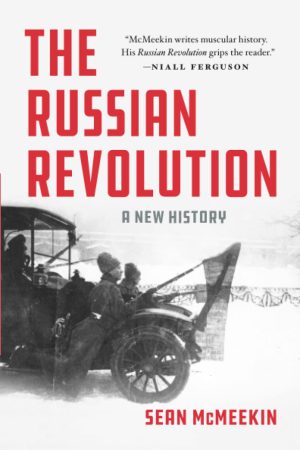
The issue also seemed not to come up in more specialized studies, even when it might have played an important role. A couple of years ago I’d read Sean McMeekin’s 2017 history The Russian Revolution, an outstanding, meticulous reconstruction of the complex and contingent circumstances that led to the 1917 fall of the Czarist Regime and the subsequent triumph of Lenin’s Bolsheviks.
The prologue is devoted to the murder of Grigory Rasputin, the peasant faith-healer who exercised such enormous influence over the Czar and his family that although he held no official position, he probably ranked for many years as the third most powerful figure in the Russian Empire. Moreover, his December 1916 death at the hands of a conspiratorial group that included top members of Russia’s elite seems to have been an important factor in destabilizing the regime, leading to its collapse in the February Revolution just a couple of months later.
Rasputin had long had severe misgivings about continuing the costly war against Germany, and this was a crucial motive behind his killing; indeed, fears of the defection of their huge Russian ally led members of British Intelligence to assist the effort. Although plots against Rasputin’s life had been circulating for months, he was finally struck down on December 20th, exactly when Germany’s very public “peace offensive” was gaining considerable international attention; and although the author doesn’t directly connect the two developments, the timing hardly seems likely to have been purely coincidental. So the desperate Allied moves to block any support for the proposed German peace plan may have actually helped trigger the Russian Revolution.
Obviously an early end to the Great War would have been an event of tremendous importance and the 1916 German efforts to secure peace were certainly treated as such in the news reports of the day. But Germany ultimately lost the war and the resulting official narrative blamed Europe’s catastrophe upon relentless German militarism, so that German peace proposal became a discordant element, raising troubling questions about the overall storyline. As a consequence, those facts were eventually flushed down the memory-hole for most of the next one hundred years, and if I hadn’t glanced at those original 1916 headlines, I certainly never would have discovered them.
Indeed, once I casually mentioned this interesting history on my website, one or two of the other commenters sharply challenged my claims, regurgitating the orthodox narrative that the Germans had been opposed to any reasonable negotiated peace, without explaining why all the contemporaneous media accounts had said exactly the opposite. According to these critics, Germany’s powerful military establishment would certainly have vetoed any such proposals, and I decided to see if I could find anything stronger to support my position than merely a thousand-word centennial op-ed in the Post written by a couple of obscure, junior academics.
To my considerable surprise, I discovered that just last year an entire book had been published on the lost chances for peace in 1916, apparently the first and only English-language work ever devoted to that seemingly important topic. Moreover, the author of The Road Less Traveled was Philip Zelikow, best known for having served as executive director of the 9/11 Commission, and therefore someone entirely in the good graces of the mainstream establishment. Near the end of his Introduction, he explained that he had been working on the project off and on for more than a dozen years.
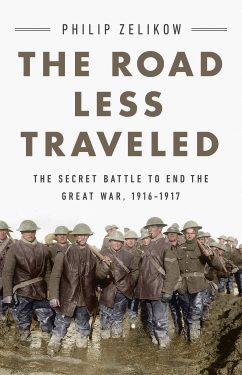
Although the main text ran well under 300 pages, his account of events seemed thorough and persuasive in its coverage, drawing heavily upon archival records and private diaries to firmly establish the same remarkable story that I had originally glimpsed in those old publications. His exhaustive research had uncovered a great deal of additional material, piecing together an account radically different than what had been presented in many decades of highly misleading treatments. And despite such seemingly controversial “revisionism,” his work received glowing endorsements from leading academic scholars and favorable reviews in such influential publications as Foreign Affairs, the National Interest, and Foreign Policy, though since it never caught the attention of my newspapers I’d remained unaware of it.
The story Zelikow tells is a really fascinating one, especially since it had remained almost entirely hidden from public awareness for more than a century.
Although influential elements including his closest political advisor had wanted America to enter the war on the Allied side, President Woodrow Wilson had been hoping all along that he could mediate an end to the conflict, much like his predecessor Theodore Roosevelt had done in the Russo-Japanese war, with the latter’s success crowned by winning the 1906 Nobel Peace Prize.
During the first two years of the fighting, neither side had responded favorably to his peace feelers, but by August 1916 circumstances had changed, and although the conflicted British leadership finally decided to continue trying their luck on the battlefield, the similarly-conflicted German government secretly accepted Wilson’s offer to preside as mediator at a peace conference. Given the horrific casualties that both sides had already suffered, it was widely believed that once public peace negotiations began, there was little chance that the fighting would ever resume. And with Wilson, most of the German leadership, and much of the British Cabinet ready for peace, the prospects certainly appeared excellent, especially since the Allies were so heavily dependent upon American supplies and financing for survival.
But although all the pieces seemed ready to fall into place, opportunities were repeatedly missed during the more than five months that followed. One important factor was the extreme difficulty of communications since the British had severed Germany’s trans-Atlantic telegraph cable at the beginning of the war, meaning that German communications with Wilson or their own ambassador had to take a circuitous route through various neutral countries and Latin America, finally arriving at DC in encoded form days or even weeks later.
Another crucial factor was that Wilson lacked any strong staff that could translate his broad ideas into serious policy proposals. Unlike major European countries, America back then had little bureaucratic infrastructure, with Wilson mostly writing his own speeches and regarding his new Secretary of State, a lawyer who had no diplomatic experience, as merely an intelligent clerk. Instead, his only close advisor was Col. Edward House, a wealthy Texan dilettante who often had eccentric views, and so strongly favored the British that he sometimes seemed to deliberately sabotage the peace effort. As a lifelong academic, Wilson himself had only spent two years as Governor of New Jersey before unexpectedly reaching the White House in 1913, and therefore he had little direct experience in either politics or international diplomacy.
So although the German government responded favorably to his offer of a peace conference in August 1916, Wilson failed to grasp the urgency of their request, and decided to take no action until after the November election. Meanwhile, within Germany, the military advocates of an unrestricted U-boat campaign against the American ships carrying Allied supplies were pressing very hard for their alternate strategy, which was sure to lead to a break in American relations.
After the British had suffered enormous casualties in their attack on the Somme, including losing nearly 20,000 dead on the first day of fighting, their own peace party was strengthened and the government became willing to consider Wilson’s offer. A son of Prime Minister H.H. Asquith had died in the battle and another had been wounded, while the German offer to restore occupied Belgium satisfied the most important British condition.
But then at the end of September, War Minister David Lloyd George — who had been a leading advocate of the American peace option — suddenly switched sides, and declared that Britain would never accept a compromise peace and would instead be willing to fight for twenty years if necessary in order to achieve a total military victory, with anything less than a “knockout” being “unthinkable.” Zelikow plausibly argues that Lloyd George believed he could use his reversal on peace to gain the support of British hardliners such as Lord Northcliffe’s powerful newspaper group for replacing Asquith as Prime Minister, and indeed that was exactly what happened within a couple of months, with the advocates of peace being pushed out of the government.
Despite the shifting positions of the British, Wilson returned to his peace efforts after his November 7th reelection, only to encounter strong opposition from House, his key advisor. Although Britain was already locked in a desperate struggle with Germany and totally dependent upon American supplies, House somehow became convinced that if America pressed too hard for peace, the British would declare war against our own country. Incredible as it might sound to us, House repeatedly argued to Wilson and others that a British army could sweep down from Canada while the Royal Navy would land hundreds of thousands of troops from their Japanese ally on our coasts, together seeking to conquer the United States. Although these bizarre concerns were rejected, they assisted the overwhelmingly pro-British State Department officials in delaying Wilson’s plans to launch his peace proposal.
Around this same time, the German ambassador began pleading with the Wilson Administration to act immediately lest the opportunity for peace be lost, and Zelikow entitled this chapter “Peace Is on the Floor Waiting to Be Picked Up!” which was one of the impassioned phrases that envoy had used. Meanwhile, Germany’s hard-line military leadership was steadily increasing the pressure on their government to abandon its peace efforts and instead return to the unrestricted submarine warfare that they claimed could quickly win the war.
Growing desperate at the president’s endless delays, Germany and its allies eventually issued their own unconditional call for peace talks on December 12th, hoping that step would finally prompt Wilson to act by inviting participants to a peace conference at the Hague and offering himself up as the mediator. The German announcement captured the attention of the world and forced Wilson to respond lest he be eclipsed, and a week later he finally circulated his own peacemaking note, but as Zelikow explains, it constituted a “misfire,” lacking as it did any specifics let alone an invitation for the warring parties to attend an actual peace conference. So the Allies firmly rejected the German offer as a “trick” and were able to ignore Wilson’s statement since it required them to do nothing. Over the next few weeks, the opportunity for peace faded away, and in late January the Germans announced they would return to unrestrained submarine warfare, leading Wilson to break off relations and move towards war with Germany.
Although influential elements within the American government had sought this result from the beginning, Zelikow persuasively argues that the mistakes, errors, and misunderstandings by Wilson and the others also seeking a negotiated peace were probably more responsible for this outcome than the efforts by the individuals who actually intended it. His harsh historical verdict on the former hardly seems unfair:
In the failure to make peace at the most opportune moment, no one failed, and failed the world, more than President Wilson. His was the most consequential diplomatic failure in the history of the United States.
Thus, one of the most important turning points of the twentieth century probably came in late 1916 with the tragic collapse of a peace effort that initially seemed so likely to succeed, and Zelikow’s gripping narrative tells the story of how and why that opportunity slipped away. By all rights, the Lost Peace of 1916 should have become the subject of countless novels, plays, and films, but instead it remains almost totally unknown today, even among the most highly educated.
My own encounter with some of the lost history of World War I came when I noticed the headlines and read the articles that had run in our leading publications while the story was still unfolding. Once important events have been finalized and the heroes and villains officially determined, there is a natural tendency to reinterpret the past in the light of what ultimately transpired, thereby establishing a simple narrative that follows straight lines. Put another way, the winners write most of the histories.
For that exact reason, I think that one of the least known but most absolutely valuable books about the Great War was completed in mid-March 1917, just weeks before our own involvement inevitably distorted all subsequent analysis. The author was Lothrop Stoddard, who had earned his Ph.D. in history at Harvard and was then just beginning a career that would soon establish him as one of America’s most influential public intellectuals. His book was Present-Day Europe, a scrupulously even-handed survey of the wartime politics and recent history of each individual nation.
The work is not overly long, running less than 75,000 words, and can easily be read in just a day or two, but it provides an enormous wealth of detailed, contemporaneous information, much of which appears to have been left on the cutting-room floor of later historiography, written after the official narrative had already hardened. Moreover, as he explained in his Preface, Stoddard followed a rigid requirement of only quoting the natives of each country in their own chapter, Englishmen on England, Germans on Germany, and so forth, thereby providing an invaluable presentation of the elite and popular sentiments of each nation, something very useful to those of us seeking to reconstruct the situation more than a century later.
- Present-Day Europe
Its National States of Mind
Lothrop Stoddard • 1917 • 74,000 Words
Stoddard’s book had gone to press just weeks after the final rejection of the German peace offer, and he hardly let a failed diplomatic project well-known to all of his readers dominate his narrative. But although the author was unaware of the extensive backstory, he gave the peace efforts reasonable treatment in the chapters on Britain and Germany, adding interesting details missed by both Zelikow and Hochschild. For example, as early as June 1916 several prominent British political figures of very mainstream views had publicly called for peace negotiations, including in the pages of the Economist, and their declaration had been emphatically endorsed by the editor of that influential publication. But this high-profile ideological rebellion in the elite media was swiftly crushed, with the editor losing his job as a consequence. Stoddard later explained that the uncompromising Allied rejection of all German peace offers had by early 1917 “spurred the entire German people to desperate wrath.”
A perfect example of the tremendous value of Stoddard’s material comes in his discussion of war aims, which obviously provided the necessary context for the differing national reactions to early peace negotiations, and there was a stark contrast between those of the two opposing camps. The goals of the Germans were relatively mild, with almost no demands for annexations of new territory. By contrast, the French were absolutely committed to the total destruction of Germany as their primary objective, with those sentiments being almost universally held across all political parties. They regarded the unified Germany created in 1870 as simply too powerful a European rival, which therefore had to be fragmented back into multiple, weak states. And not only would France reabsorb the lost provinces of Alsace-Lorraine, but it would also annex much of the Rhineland, territory that had been German for a thousand years. The British were not quite that extreme, but most of their political leadership class strongly believed that Germany needed to be totally crippled as an economic and military competitor.
In the East, the primary war aim of the Russian Empire was the annexation of Constantinople, the capital city and largest metropolis of Germany’s Ottoman Empire ally, which would give Russia strategic control of the Bosphorus Straits. Although Serbia had already been defeated and occupied by this date, elements of the Serbian government had originally provoked the war by arranging the assassination of Franz Ferdinand, the prospective Austro-Hungarian ruler, with their broader goal being the total destruction of that multi-ethnic state, several of whose major pieces would then become part of a Greater Serbia.
So to a considerable extent, Germany and its allies were actually the “status quo powers,” reasonably satisfied with the existing arrangement of borders, a situation totally different from that of their Allied opponents. When one side in a conflict is determined to dismember and destroy the other, an early peace is difficult to arrange. Moreover, the German alliance faced an opposing coalition that was far superior in manpower, economic strength, and potential military resources, so it was fighting what it reasonably regarded as a purely defensive war. This clear situation at the time is exactly contrary to what has been implied or even explicitly stated in our basic History 101 textbooks for the last one hundred years.
Obviously, the complete picture was not entirely one-sided, and an important factor behind the outbreak of the war had been German concerns over the rapidly growing population and military power of its enormous Russian neighbor to the east. Indeed, although the very powerful Social Democratic political block in the German parliament was strongly anti-militarist, its members were also intensely hostile to the Czarist regime, which their influential Jewish elements demonized as fiercely anti-Semitic, so the Russian threat was an important factor behind the near-total domestic political unity once war broke out. Meanwhile, important elements of the German military establishment had long favored waging a preventive war aimed at breaking Russian power before it became too overwhelming.
Major German victories during the first couple of years of fighting had led to the occupation of considerable Russian territory, and Jozef Pilsudski, Poland’s George Washington figure, had organized an army of 20,000 Poles that fought side-by-side with the Germans. As a consequence, the Germans decided to resurrect an independent Poland as a German client state more than a century after it had disappeared from the map, a geographical change that would greatly weaken Russia while providing a buffer against the latter’s future westward expansion.
Although of relatively minor importance, one of Stoddard’s most impressive sections is his discussion of the Balkans, home to several bitterly quarrelsome states, whose stories I had never previously seen treated, let alone analyzed in such intelligent detail. These countries had all fought wars against each other in 1912 and then again in 1913, and given the triggering 1914 events in Sarajevo, the Great War that followed might almost be regarded as merely a third consecutive Balkan round of fighting that unexpectedly brought in the rest of Europe.
As the author points out, prior to the Ottoman conquest and long occupation, each of the different Balkan peoples had at one time or another ruled a larger regional empire of their own, which they naturally sought to resurrect after Ottoman power receded. But all those previous Balkan empires had overlapped in territory, thus leading to bitter, conflicting claims, and the repeated rounds of new fighting between Bulgaria, Romania, Serbia, and Greece, all of which also coveted portions of the neighboring Austro-Hungarian and Ottoman empires, thereby contributing to the severe instability. Totally contrary to my assumptions, Stoddard explained that these individual countries actually had very different political and social profiles, with Bulgaria’s characteristics being entirely different from those of neighboring Romania, for example, though they had always been lumped together in my mind.
Although Stoddard’s book focused on the internal dynamics of the major European participants without directly addressing the exact causes of the conflict, his material generally supported the impression I’d always gotten from my textbooks that two heavily-armed and hostile alliances had blundered into a huge war, neither of them fully expecting or intending what eventually occurred. Just as Zelikow’s detailed scholarship indicated that the US, Germany, and Britain had together fumbled away the possibility of peace in 1916, the European great powers had started the conflict a couple of years earlier in much the same fashion.
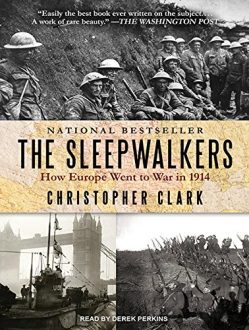
Two major historical volumes focusing on exactly that last topic had appeared about a decade ago, just before the hundredth-year anniversary, and they strongly reinforced that same conclusion with exhaustive scholarship. The Sleepwalkers by Christopher Clark and July 1914: Countdown to War by Sean McMeekin, together received a very lengthy and favorable front-page treatment in the NYT Book Review by Harold Evans, former editor of the Times of London. I’d read the first of these books a couple of years ago and the second just very recently, and found them both excellent, telling as they did a broadly similar story across their combined 1,100 pages.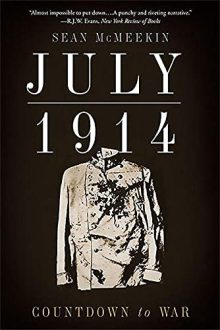
McMeekin’s very detailed narrative of the exact circumstances and decision-making process during July 1914 greatly emphasizes the extremely important role of unexpected, contingent factors that could so easily have diverted the history from its track. For example, just prior to the assassination in Sarajevo, Britain seemed on the very verge of violent civil war over Irish Home Rule, a conflict so bitter that it was weeks before the Cabinet even considered the developing situation in the Balkans, so if the events had occurred just a couple of months later, British military involvement might have been impossible. Similarly, by his strong initial stand against any attack on Serbia, the powerful Hungarian Prime Minister prevented the sort of immediate retaliatory strike that probably would have avoided bringing in other countries, unlike the eventual attack that came more than a month after the assassination; so the determined peace policy of a leading European statesman actually helped trigger the wider war. In all these countries, there were obviously powerful factions that had spent years pressing for war, but there were other powerful factions that felt otherwise, and the circumstances of the outbreak depended largely upon the particular decisions made.
Once the enormous conflict began, assigning the exact measure of guilt for the calamity became a strategic objective during the years that followed, especially on the part of the Allies, with Clark even noting that both the French and the Russians created fraudulent documents that they then inserted into their own diplomatic archives. The scholarly dispute over relative war-guilt has continued unabated for more than a century now, and while neither of these books settles the matter, I do think that they provide a very solid factual basis, explaining exactly who did what and when, thereby allowing each of us to assign the appropriate quantity of guilt to those particular actions.
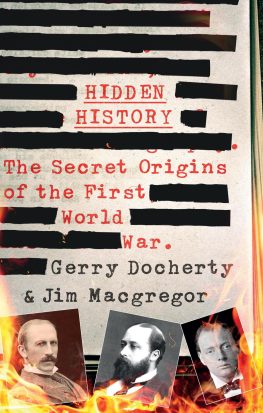
A very different sort of book on the same topic published almost simultaneously was Hidden History by amateur British historians Gerry Docherty and Jim Macgregor. Although totally ignored by the mainstream media, their extremely conspiratorial account of Britain’s political leadership prior to the outbreak of the war has become wildly popular in many alternative circles, and I finally decided to read it a couple of years ago. Unfortunately, I was far from impressed by their analysis, and although they usefully described some of the machinations of the most aggressive British political faction, I think they accorded it far more power than it probably possessed. I wrote my own appraisal in a comment after I’d only read a chapter or two, but once I’d finished the remainder of the book, my negative verdict was unchanged:
Well, I’ve seen numerous commenters give glowing endorsements of the Docherty/Macgregor book over the last year or more, so since I had it sitting around, I finally decided to take a look. So far, I haven’t really been very impressed.
As near as I can tell, their “revolutionary” hypothesis is that near the end of the 19th century a small group of individuals near the top of Britain formed a “secret society” with the central goal of greatly enhancing the power and wealth of the British Empire, sometimes using ruthless or dishonest means, and permanently dominate the world.
Is that really so remarkable? Suppose the “secret society” had never been formed? Wouldn’t we naturally assume that the normal, run-of-the-mill leaders of Britain would be doing their best to enhance the power and wealth of the British Empire? Wouldn’t it be much more shocking if they weren’t?
Should someone write a book: “Top executives at Google are secretly trying to expand Google’s wealth and power and gain dominance over the entire Internet.” Or “Top executives at Goldman Sachs are secretly trying to expand Goldman’s wealth and power and permanently dominate Wall Street.”
Neither Docherty nor Macgregor seem professional historians, and they’re certainly correct in attempting to refute the “legend of German villainy,” but I think that lots and lots of professional historians have already done that.
Decades ago, my ordinary high school texts emphasized that one of the main factors behind WWI was Britain’s fears of a rising Germany. And it’s also true that another major factor was Germany’s fears of a rising Russia. Historians have endlessly argued about the relative weighting of all these different factors, but everyone’s certainly aware of them.
In sharp contrast, a different book published just over a century earlier might today be seen as a product of the conspiratorial fringe, but it was certainly not viewed that way at the time, given that the author was widely regarded as one of America’s leading public intellectuals and the work was favorably discussed in the influential Literary Digest. David Starr Jordan was the founding president of Stanford University, a biological scientist by training who had published at least ninety-odd books, mostly of a scientific nature but also including works of broader public policy.
Unseen Empire, which appeared in 1912, fell into that latter category and argued that although the United States and the major European powers remained nominally sovereign, their heavy, unproductive military spending had gradually bound them into tight coils of debt, leading most of them to quietly become political vassals of a network of powerful financiers, the “unseen empire” of the title. So instead of kings, parliaments, or kaisers, the true rulers of Europe were a set of interconnected and intermarried banking dynasties, almost all of them Jewish: the Sterns and Cassels of Britain, the Foulds and Pereires of France, the Bleichroders of Germany, the Gunzburgs of Russia, the Hirsches of Austria, the Goldschmids of Portugal, the Camondos of Turkey, the Sassoons of the Orient, and above all of them, the Rothschilds of London and Paris.
Although in today’s world, such a description might seem insane or at least incendiary, Jordan presented it rather matter-of-factly without rancor, and indeed that particular claim didn’t even constitute the main theme of his analysis. The Stanford University President firmly regarded modern warfare as disastrous for a society, but also argued that wars had become so ruinously expensive that they could not last for long. Moreover, since the true financial owners of Europe believed that they were bad for business, no major wars would be permitted to break out.
Obviously, Jordan’s predictions were exploded just a couple of years later, but subsequent events did provide some hints that his analysis was not entirely mistaken. For example, according to Stoddard’s account, much of Britain’s wealthy Jewish elite, often having German roots like the Rothschilds, was widely regarded as being in the peace camp, so much so that in 1916 hard-line publications regularly denounced the country’s German-Jewish financiers as undercutting Brtain’s continuing military resolve. Similarly, Zelikow reports that Paul Warburg, the German-Jewish vice chairman of America’s Federal Reserve, was an enthusiastic supporter of Wilson’s efforts to pressure Britain into making peace, including discouraging American banks in late 1916 from making the additional loans that Britain required to purchase supplies. In private communications, the strongly pro-British head of the J.P. Morgan banking empire denounced that decision and argued for a public attack on the German-Jewish influence that he believed was behind this peace policy. Similarly, many of the wealthy Jewish interests in Germany were generally in the peace camp. So Jordan’s main mistake was probably to overestimate the political power of Europe’s dominant financial interests.
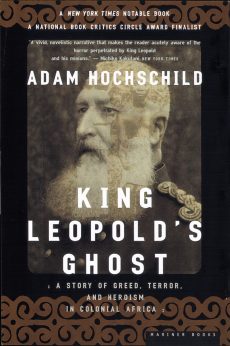
This extended discussion of the Great War was prompted after I read Hochschild’s book on the British anti-war movement, and I’d decided to do so because I’d been very impressed with his previous, award-winning bestseller King Leopold’s Ghost, which I’d read earlier this year. That latter work recounted the vivid history of the Belgian Congo and the horrific mistreatment of its inhabitants, which may have claimed the lives of up to ten million Africans, with Hochschild also telling the story of the British-led international moral crusade against those crimes, privately organized by E.D. Morel, a journalist, and Roger Casement, a civil servant. Their final victory came just a year before war broke out, and Hochschild’s last two chapters constitute an extended epilogue, including a description of the sad wartime fates suffered by his pair of champions.
At the time of the Sarajevo assassination, both Morel and Casement were towering international heroes, with the latter having even been knighted for his humanitarian achievements. But both were firmly opposed to the war and generally sympathetic to Germany’s position, and their public standing quickly collapsed, merely one of the many ironies that Hochschild describes.
One of the worst horrors that the colonial Belgians had inflicted upon the Congolese was chopping off the hands of those Africans who failed to meet their work-quotas or otherwise disobeyed, and photographs of the atrocity victims had triggered outrage across the globe. But in August 1914, the German army invaded Belgium, and the Belgians were suddenly transformed from monsters to martyrs, with British propagandists soon falsely claiming that the Germans were chopping off the hands of disobedient Belgians. For many years, the story of the millions of Africans who died in the horrors of the Belgian Congo had been the world’s leading humanitarian issue, but Hochschild plausibly argues that the sudden wartime propaganda-elevation of Belgians to unrivaled global victimhood status probably explains why that earlier story so quickly faded from public awareness until being eventually revived a half-century later.
Casement himself was Irish and his efforts to free the Congolese had brought him public honors and acclaim; but when he began seeking German help to free his own country from British rule, he was hanged for treason, becoming the first holder of a British knighthood to suffer that fate in hundreds of years. Morel similarly fell from grace for his anti-war writings, and after he sent a copy of one of his pamphlets to his pacifist friend, Romain Rolland, a French Nobel Laureate in literature living in Switzerland, he received six months of brutal imprisonment, which permanently broke his health.

However, once the war ended, British sentiments changed, and the newly rising Labour Party considered Morel a wronged hero and nominated him as a candidate for Parliament. As a young Cabinet Minister, Winston Churchill had played a crucial role in leading Britain into the world war, and in a remarkable symbolic turnabout, Morel now defeated him for reelection in 1922, taking his seat in the House of Commons. Morel was one of Labour’s leading spokesmen on foreign affairs and according to Hochschild, he was expected to be named Foreign Minister in Ramsay MacDonald’s new Labour government of 1922, but MacDonald decided to keep the portfolio in his own hands, perhaps because he feared Morel might overshadow him as a political rival. However, Morel’s political fairy tale had a less than happy ending, for although he was easily reelected in 1924, his harsh wartime imprisonment had destroyed his health and he died later that year at the unripe age of 51.
I had never previously heard of Morel and found his story a fascinating one, but when I consulted his Wikipedia page I discovered that much of the long entry focused on aspects of Morel’s postwar activism that the book had avoided mentioning, presumably for ideological reasons. In his epilogue chapters, Hochschild had rightly denounced the hypocrisy of the major European powers, which were willing to condemn the brutal treatment of Africans under Belgian colonial rule while ignoring the fact that they often behaved in a similar manner in their own African colonies. But he must have found Morel’s extreme lack of any such hypocrisy troubling for other reasons, so the last major project of that remarkable man’s career was excluded from his hagiography.
Morel heavily blamed France and Czarist Russia for the war and regularly condemned the extremely punitive terms of the Treaty of Versailles from the pages of Britain’s Foreign Affairs journal, an influential Labour publication that he directed, condemning, for example, the mutilation of Hungary, which had lost two-thirds of its territory.
But according to Wikipedia, his most important postwar project was launching the international “Black Shame” campaign, denouncing the horrific atrocities committed by France’s African colonial troops against the helpless German civilians of the occupied Rhineland, including widespread rape and murder. Wikipedia entries are usually heavily sanitized, so portions of this very surprising entry are worth quoting at length:
In a front-page article in The Daily Herald on 9 April 1920 by Morel about the French occupation of the Rhineland, the headline read, “: “Frankfurt runs red with blood French Blood Troops Use Machine-guns on Civilians”.[42] The following day, the same paper had another cover story by Morel, the title of which was “Black Scourge In Europe Sexual Horror Let Loose by France On Rhine Disappearance of Young German Girls”. In it, Morel wrote that France is “thrusting her black savages into the heart of Germany” and that the “primitive African savages, the carriers of syphilis, have become a horror and a terror” to the Rhinelanders.[42] In his article, Morel claimed that the Senegalese soldiers serving in the French Army were “primitive African barbarians” who “stuffed their haversacks with eye-balls, ears and heads of the foe”.[43] Morel declared in his article:
“There [the Rhineland] they [the Senegalese soldiers] have become a terror and a horror unimaginable to the countryside, raping girls and women – for well known physiological reasons, the raping of a white woman by a negro is nearly always accompanied by serious injuries and not infrequently has fatal results; spreading syphilis, murdering inoffensive civilians, often getting completely out of control; the terrible barbaric incarnation of a barbarous policy, embodied in a so-called peace treaty which puts the clock back 2,000 years”.[43]
Morel wrote that “black savages” have uncontrolled sexual impulses that “must be satisfied upon the bodies of white women!” (emphasis in the original).[44]
The phrase that Morel coined to describe the alleged terror by Senegalese troops in the Rhineland was the “Black Horror on the Rhine“, which became internationally famous, and the campaign against the “black horror” took much of his time for the last four years of his life.[45] Morel predicated the “black horror” would cause another world war, writing that the average German boy was thinking: “Boys these men raped your mothers and sisters” (emphasis in the original).[46] Morel used the “black horror” as a way of attacking France, which he claimed had caused a “sexual horror on the Rhine” and whose “reign of terror” was a “giant evil” that should inspire “shame into all four corners of the world” and ultimately should “a revision of the Versailles Treaty and the relief for Germany”.[47]
The somewhat censorious Wikipedia article condemns Morel for his blatant racism and cites a German sociologist who argues that those same sentiments had actually governed his earlier Belgian Congo activism as well. But this new Rhineland campaign was soon followed by his rise within the British Labour Party and his electoral triumph over Churchill, so both British Socialists and British voters apparently gave a different verdict. Moreover, Adolf Hitler soon alluded to some of Morel’s accusations in the pages of Mein Kampf, though in much less blood-curdling fashion, and those brief, mild passages have often been cited as proof of the German dictator’s deep racism.
Hochschild is a committed racial liberal, whose lifelong support for blacks in the American South and under Apartheid dominated his early career, and this easily explains why he elevated Morel to heroic stature for his international campaign to end European atrocities against Africans in the Belgian Congo. But it equally well explains why he excluded any mention of his moral exemplar’s final humanitarian crusade, this time focused on African atrocities against Europeans, which was contemporaneous with similar political projects by the KKK in America and may have even played an important role in inspiring Adolf Hitler.
Related Reading:
OSCE nothing more than a branch of NATO
By Ahmed Adel | December 2, 2022
The West is attempting to turn the Organization for Security and Co-operation in Europe (OSCE) into a subsidiary organisation of NATO, which is paradoxical because it is meant to be concentrated on peacebuilding, unlike the Atlantic Alliance which fosters tensions to justify its existence in a post-Soviet world. It is for this reason, among others, why Poland refused to grant a visa to Russian Foreign Minister Sergei Lavrov, thus barring him from attending the OSCE meeting held on December 1 and 2 in Lodz.
Poland claims it refused to grant Lavrov a visa because he is on the list of people who have been sanctioned. However, this does not explain why many from the Russian delegation were also denied visas despite not being on a sanctions list.
This weak excuse is to justify Warsaw’s consistent policy of provocation against Moscow, especially in the context of the current war in Ukraine. Poland and the West are hoping that by humiliating Russia, the country will withdraw from the OSCE. The West are desperate for Russia to withdraw so as to be able to implement and impose whatever it wants on the OSCE.
It is recalled that Moscow very effectively blocked the 2022 OSCE budget. Without a Russian withdrawal, the West will not be able to put the OSCE under its complete control, something that should be avoided as it would undermine the very foundation of the organisation – serving as a platform where Western and Eastern Europe could discuss and resolve issues.
Rather, the OSCE today has turned into a political tool of the West and effectively has no meaning or role anymore. With the OSCE descending into childlike behaviour by barring Russian delegates and top diplomats, it does seem that the organisation has become redundant as it is appearing more like a Euro-focussed political wing of NATO.
The OSCE meeting in Poland was essentially a two-day event for speakers to bash Russia.
None-the-less, Moscow is unlikely to be deterred by these provocations and will remain committed to its responsibilities as an OSCE member. This is likely to ensure that paths of reconciliation are always open despite Western attempts to close them.
The Kremlin might also believe that the OSCE’s uptick in provocations is because Poland is the current chairman. Russian policymakers might also believe that tensions will relax when North Macedonia takes over the chairmanship in 2023. It could be for this reason that Lavrov called out Poland by highlighting that its “anti-chairmanship” was taking the OSCE to its “most miserable place ever in this organisation’s history.”
It can be argued though that the OSCE has always been geopolitically against Moscow. It is recalled that the American establishment boasted that they had inserted a Trojan horse into the Eastern Bloc with the signing of the Helsinki Accords in 1975, the roots of today’s OSCE.
The Helsinki Accords stresses the respect for human rights and equal rights, a result of Western insistence because the Soviets were instead mostly interested in finalising Germany’s borders. The West is not interested in human rights though, and rather their main interest is ideological, economic and military hegemony all over the world, with human rights only being weaponised as one vehicle of achieving this goal.
Effectively, it can be argued that the OSCE was born as a trap for Moscow. When “security”, “cooperation” and “Europe” are in the name of the OSCE but it turns into an organisation completely dominated by promoting US interests, the argument is made that the organisation now resembles something like a branch of NATO.
Playing its own role in serving Western interests, Ukraine continues to call for Russia to be kicked out of the OSCE entirely, with Foreign Minister Dmytro Kuleba claiming in a tweet that the “OSCE is on a highway to hell because Russia abuses its rules and principles.”
“Everything has been tried in regards to Russia: to please, to appease, to be nice, to be neutral, to engage, not to call a spade a spade. The bottom line: It would be better for OSCE to carry on without Russia,” he added.
However, this is once again an example of Kiev’s classic projection of portraying their own illiberal values as that of Russia. In fact, it is Europe’s own unwillingness to “call a spade a spade,” such as whitewashing Ukraine’s fascistic policies and pretending it was a Western-styled liberal country, which ultimately led to war.
Proving that the OSCE is now nothing more than a branch of NATO, US Under Secretary of State Victoria Nuland said, when speaking in Lodz, that Russia had “failed demonstrably to break the OSCE.”
If the OSCE is anything other than a branch of NATO, it must be questioned why the US Under Secretary of State was an honoured guest at a Europe-focussed and Europe-based organisation, which was initially established to connect Western and Eastern Europe together, while Russia’s top diplomat and other officials were barred.
Ahmed Adel is a Cairo-based geopolitics and political economy researcher.
Iran, India recalibrating ties amid geopolitical shifts
‘Not a choice, but necessity’
By Zafar Mehdi | The Cradle | December 1, 2022
“Not a choice, but a necessity.” That’s how Iran’s Deputy Foreign Minister Ali Bagheri Kani stressed the importance of closer strategic and economic ties between Tehran and New Delhi during his visit to India in November.
Kani had a message for Prime Minister Narendra Modi from Tehran – strategic synergy is a win-win proposition for the two sides amid the shifting geopolitical and geo-economic landscape in the wake of the Ukraine war and the new world order.
Before the Trump administration reinstated sanctions on Iran in 2018, Iranian oil comprised nearly 11 percent of India’s total oil basket. However, New Delhi buckled under US pressure and stopped importing oil from Tehran in a move that hampered their cooperation in other strategic areas.
Three years down the line, amid rapidly changing geopolitical power dynamics and the end of “the era of the unipolar world,” as announced by Russian President Vladimir Putin in June, India has become keen on recalibrating its ties with Iran, a traditional ally, in the midst of an energy crisis gripping the world.
It is worth noting that Russia became the biggest oil supplier to India in October, supplying 935,556 barrels of crude oil per day, according to energy cargo tracker Vortexa, making up for 22 percent of the energy-dependent country’s total crude imports, ahead of Iraq’s 20.5 percent and Saudi Arabia’s 16 percent.
Iran as an alternative energy supplier
Faced with a burgeoning demand for oil and gas amid the global energy crisis and recent oil cuts by the OPEC+, India now looks poised to resume oil imports from Iran, defying US sanctions, The Cradle learned from sources in Tehran and New Delhi.
Interestingly, India’s petroleum minister Hardeep Puri hinted at it during his visit to Washington in October, saying New Delhi will buy oil from wherever it has to. Russia, as we know, is already shipping oil to India, despite strong US pressures.
Talks are currently underway between India and Venezuela, especially with the US easing oil-related sanctions against Caracas. This, by extension, has opened a window of opportunity for India and Iran to revive their energy trade. The good news is that both sides look interested.
Iran has already expressed its readiness to resume energy trade with India. Last month, newly-appointed Iranian ambassador to New Delhi, Iraj Elahi, announced that Iran is willing to provide low-cost crude oil to India to ensure the country’s energy security, something top Indian officials have in recent months cited as the government’s priority.
A win-win proposition
In 2018-2019, India purchased $12.11 billion worth of crude oil from Iran, which plummeted to zero in May 2019 after the significant reduction exemption (SRE) period ended.
Likewise, trade between the two countries dropped from $17.3 billion in 2018-2019 to $4.77 billion in 2019-2020. Although it has ultimately failed to achieve its objectives, Washington’s “maximum pressure” campaign had a negative impact on India-Iran relations.
However, ties have since markedly improved, as evidenced by Bagheri Kani telling the Indian press that the Islamic Republic is ready to meet the country’s growing energy needs, while India can in turn contribute to Iran’s food security as a major food producer.
This, he asserted, would help in boosting the process of multilateralism in the international system, which essentially means the death of US unilateralism more than three decades after the end of the Cold War and the collapse of the former Soviet Union that paved the way for the era of the unipolar world.
Suhasini Haidar, diplomatic affairs editor at The Hindu and a leading Indian analyst, termed Bagheri Kani’s visit to India as “significant,” saying it “shows a commitment to India-Iran ties by both governments despite geopolitical divides in the world on issues like the Ukraine war.”
Penalized by US sanctions
Haidar described Iranian crude as “sweeter, lighter, cheaper, and easier to transport to India than other options,” calling the Indian government’s decision to cut Iranian imports “irrational.”
“It was irrational of the Modi government to have canceled India’s imports of Iranian oil under threat from the Trump administration, and it would make sense if they decided to restore the oil trade between the two countries,” she told The Cradle.
Haidar said it remains to be seen if the Modi government will be willing to resume oil imports from Iran, “despite several signals that both sides are exploring their options,” especially after the latest sanctions on an Indian company transporting Iranian oil.
Mumbai-based Tibalaji Petrochem Private Limited was sanctioned in late September for shipping Iranian petrochemical products to China. It was the first time an Indian company was sanctioned by the US for dealing with Iran.
In his meeting with his Indian counterpart Vinay Mohan Kwatra, Bagheri Kani pointed to the “necessity” of regional cooperation between the two countries, which he said would “take away the opportunity from foreigners to exploit the lack of cooperation.”
The sentiments were mutual as India’s foreign ministry spokesman, in a statement following Bagger Kani’s meeting with Kwatra, said the two officials “discussed bilateral relations, including the development of Chabahar Port” and “regional and international issues of mutual interest.”
Time to shore up ties
According to observers, the time is now ripe for the two sides to shore up bilateral ties and multilateral cooperation, with Tehran set to become a full member of the Shanghai Cooperation Organization (SCO) as well as the BRICS group, given its close ties with Russia and China.
Notwithstanding existing challenges, Iran and India share mutual interests in trade and connectivity. Iran’s full SCO membership could prompt the two sides to focus more on connectivity projects like the Chabahar Port, which links with the International North-South Transport Corridor (INSTC), the multi-mode network of ships, rail and roads for moving freight between India and Iran, among other countries.
“India and Iran have important trade needs, including in wheat, pulses and commodities, as well as oil reserves. And the connectivity engagement is very important for India through Chabahar and through the INSTC,” Haidar explained.
Importantly, in recent years, Chabahar Port in Iran’s southeastern Sistan-Baluchestan province has emerged as a key area of cooperation between Tehran and New Delhi, which will provide India access to Afghanistan and Central Asia through Iran, ending its reliance on arch-rival Pakistan.
Rezaul Hasan Laskar, the foreign affairs editor at Hindustan Times, says the strategic port has “become more important following its growing use” but that “it needs to be connected to Iran’s railway network.”
While the first section of the Zahedan-Chabahar railway line is nearing completion, official sources in Tehran said the agreement between the two sides to construct the 628-kilometer (390 miles) railway line had faced “serious impediments” due to New Delhi’s reluctance to start work fearing US sanctions.
“Despite India’s close ties with the US and Israel, its decision to build strategic ties with Iran, and Iran’s according special projects to India like Chabahar Port despite its ties with China are a constant reminder of this special relationship,” Haidar told The Cradle.
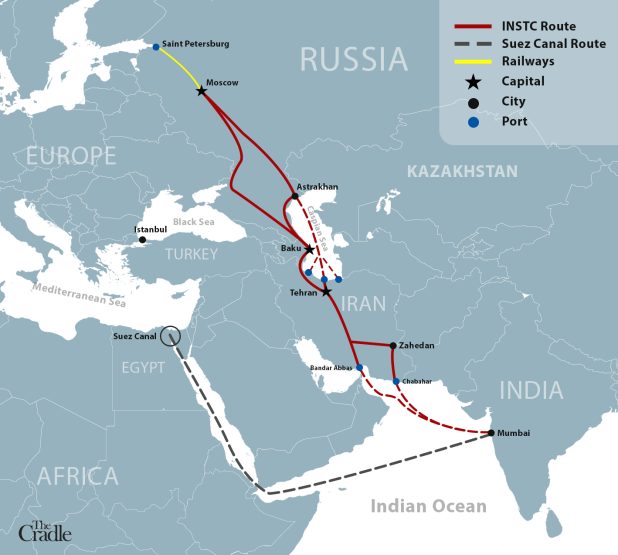
Map of the International North-South Transport Corridor (INSTC)
Joint cooperation with Beijing and Moscow
Sources in Tehran and New Delhi said the use of rupee-rial trade was also “seriously considered” during Bagheri Kani’s New Delhi visit, with both sides agreeing that a banking mechanism that is not tied to the west is key to strengthening the process of multilateralism, and paving the way for the resumption of trade.
Laskar of Hindustan Times confirmed that the senior Iranian diplomat “reiterated Iran’s offer to resume oil supplies and raised the issue of trade in national currencies.”
The changing geopolitical landscape in the wake of growing anti-western mechanisms, including SCO and BRICS, led by China and Russia, is also likely to propel increased cooperation between Tehran and New Delhi.
Laskar, however, believes that the SCO has not been a particularly crucial grouping for India in recent years, “largely because of the tensions with China,” adding that India’s biggest concern about the expansion of BRICS is that “it shouldn’t become a China-centric grouping,” underlying Sino-India tensions.
Meanwhile, Russia remains a common ally of India and Iran, which is evident in Moscow and New Delhi looking to ramp up trade via Tehran along the INSTC – the strategic route that has assumed tremendous significance since the start of the Ukraine war.
The decision to boost INSTC trade, according to reports in Indian media, was high on the agenda during Bagheri Kani’s India visit, as Russia now looks set to invest in the Chabahar Port. According to sources, the war in Ukraine also figured prominently in Bagheri Kani’s talks with Indian officials. Both sides agreed on maintaining a “neutral stance” on the war and increased engagement with Moscow.
“Russia is the new game-changer in the region, especially after the realignment of power centers, and that is good news for India-Iran ties,” an Iranian diplomat stationed in South Asia told The Cradle.
Lavrov rubbishes ‘lies’ about Ukraine peace talks
RT | December 1, 2022
Allegations that Russia is seeking peace talks with Ukraine as a ploy for a military build-up are false, Russia’s foreign minister has said. Sergey Lavrov was responding to statements to that effect from top officials in Kiev, including President Vladimir Zelensky.
The accusations are “ridiculous and unpleasant, because [those who make them] blatantly lie,” the minister told journalists on Thursday during a press conference.
“We never asked for any negotiations. But we always stated that if somebody has an interest in a negotiated settlement, we are ready to listen,” he stressed.
In October, President Zelensky said during a virtual speech to the European Council that Russia was “manipulating the negotiations issue” due to Kiev’s battlefield successes. He went on to claim that Moscow was calling for dialogue, “which it rejected itself by starting a war against Ukraine and all of you, the entire Europe,” while rejecting “dozens of our proposals” for peace.
Lavrov noted that Ukraine and Russia were on the verge of striking a peace deal after talks in Istanbul in late March. At that time they inked a proposed agreement, which would have given Ukraine international security guarantees in exchange for neutral status.
Kiev pulled out of the talks soon afterwards, with Zelensky claiming that fresh evidence of war crimes allegedly committed by Russian troops had left him no other option. Moscow rejected the accusations, calling the evidence falsified.
“Not only did we listen, but we were prepared to make a deal on the terms that [the Ukrainians] proposed themselves,” Lavrov explained. “They were not allowed to do that because the war had not made enough profit for those who supervise and direct it.”
The Russian diplomat pointed to the US, and to a lesser degree the UK, as parties who are allegedly directing Ukraine’s actions. Washington pursues its goals of weakening Russia and benefiting from arms sales at the expense of the Ukrainian people, he said.
Lavrov added that the US and its allies have a pattern of rejecting ways to reduce tensions with Russia. Hostilities in Ukraine started after they refused to heed Russian warnings that the expansion of NATO was crossing a red line, he insisted. The military bloc brushed aside a proposed security deal, which in Russia’s view would have addressed the issue.
Moscow names condition for resuming arms control talks with US
RT | November 30, 2022
Russia sees no possibility of resuming talks with Washington on the cornerstone New START arms control treaty while the US continues to arm Ukraine, Russia’s Foreign Ministry spokesman said on Wednesday.
Speaking in a live interview on radio Sputnik, Maria Zakharova said: “The US intends to supply even more weapons to the conflict region, in which the Russian Federation is directly involved. That is, they will supply all these weapons, they will encourage the Kiev regime to cause even more bloodshed, they will allocate money for extremist activities that are carried out under the auspices of these delusional people [in the Ukrainian presidency], and we will sit with them at the same table and discuss issues of mutual security with them, including those in their interest?”
The spokeswoman stressed that Moscow values the New START agreement, as it serves the best interests of both Russia and the US, adding that the necessary conditions must be met before talks can be resumed.
Russian and American diplomats were set to meet in Cairo on Tuesday for a new round of talks on prolonging the deal, set to expire in early 2026. The meeting, however, was called off shortly before it was set to happen, with no new date announced.
“The event is being postponed to a later date,” the Russian Foreign Ministry told RT on Monday. Meanwhile, CNN has quoted the US State Department as saying Washington was ready to hold talks at the earliest possible date, and considered that “resuming nuclear inspections under the New START treaty is a priority.”
New START, signed back in 2010, is effectively the last arms control agreement between the two major nuclear powers following Washington’s unilateral withdrawal from the Intermediate-Range Nuclear Forces (INF) treaty in 2019. The pact limits the number of nuclear warheads that the US and Russia can possess, and restricts the number of deployed silo-based intercontinental ballistic missiles, submarine-launched ballistic missiles, and nuclear bombers. The total number of strategic nuclear delivery vehicles must not exceed 800.
Russia suspended the inspection regime under the treaty back in August, blaming the move on Western sanctions that had prevented Russian inspectors from doing their work in the US and giving Washington an unfair advantage. Moscow said the inspection could resume only when the principles of parity and equality were restored.
Satellites Used Against Russia in Ukraine May Become Legitimate Targets
Samizdat – 30.11.2022
MOSCOW – Quasi-civilian satellites used by Western countries to support the Ukrainian military throughout the conflict may become legitimate targets for Russia, Vladimir Ermakov, the director of the Russian Foreign Ministry’s non-proliferation and arms control department, has told Sputnik.
“Western countries are actively using the potential of civilian space infrastructure, first of all, a group of low-orbiting satellites, to support operations of the Ukrainian Armed Forces. These are used to exclusively perform combat tasks to reveal locations, routes of movement and actions of Russian troops, to control combat aerial vehicles, as well as to target high-precision munitions from space,” Ermakov said.
He added that such a provocative use of “civilian satellites at the very least raises questions in the context of the Outer Space Treaty” and “requires the most serious condemnation by the world community.”
“We confirm that such quasi-civilian infrastructure, should it be used in military action against Russia, may quite logically become a legitimate target for a retaliatory strike,” Ermakov said.
Given the global coverage of the Earth by civilian spacecraft, “the Pentagon is testing the concept of a prospective command and control system for troops anywhere in the world, and the vast majority of countries have no effective means of countering it,” the director said.
“We advocate the prevention of the use of civilian commercial satellites to achieve combat tasks. We urge all countries interested in the proper use of space technologies to make joint efforts in the interests of the exploration of near-Earth space for purely peaceful purposes,” the diplomat noted.
“The development of legally binding norms of international law that would be comprehensive in nature and aimed at the prevention of an arms race in outer space” is the only way to ensure that outer space is used only for peaceful purposes, Ermakov said.
Russian Foreign Ministry: No Evidence That Tehran Wants to Develop Nuclear Weapons
Samizdat – 30.11.2022
MOSCOW – There is no evidence that Tehran intends to develop nuclear weapons, reviewing its participation in the Nuclear Non-Proliferation Treaty (NPT), Vladimir Yermakov, director of the Russian Foreign Ministry’s Non-Proliferation and Arms Control Department, said in an interview with Sputnik.
“Iran has been and remains a conscientious participant in the Treaty on the Non-Proliferation of Nuclear Weapons. The conclusion of the JCPOA in 2015 helped to finally and irrevocably remove all the questions that the [International Atomic Energy Agency] had to Tehran at that time.”
“After that, for several years Iran remained the most verified state among agency members. No deviations from its obligations were identified,” Yermakov said. “There is no evidence that would indicate Tehran’s intention to ever reconsider its participation in the NPT and start developing a nuclear explosive device.”
Yermakov’s remarks come as the US undertakes joint military drills with Israel, complete with fighter jet simulations on strikes against Iran’s nuclear program infrastructure. Earlier announcements detailed the drills would be held in the Mediterranean Sea starting November 29, and lasting through December 1.
At the time, Israeli Defense Minister Benny Gantz stressed that the drills were needed in order for Israel to “prepare” its service members for any “possibility.”
Days before the drills kicked off, US media reported that Tehran was inching toward achieving a weapons-grade enrichment, paving the way for Iran to acquire the technology to assemble nuclear weapons.
However, it’s worth noting that Iran has repeatedly indicated it has no intention to create nuclear arms; in fact, Iranian leadership imposed a fatwa in 2003 on the production or usage of any form of nuclear weapons.
Tension between Iran, Israel and the US has remained high for years. Under the Trump administration, however, escalations were at near-boiling after the US withdrew from the 2015 Joint Comprehensive Plan of Action, reimposed past sanctions and continued on a “maximum pressure” campaign against Tehran.
Talks to restore the agreement under the Biden White House have remained stalled for months. Iran earlier dispatched a “constructive” response to Washington’s proposals but was ultimately shut down by administration officials who deemed the messages “not constructive.”
Vladimir Putin’s Vision of a Multipolar World An end to US hegemony?
BY PHILIP GIRALDI • UNZ REVIEW • NOVEMBER 29, 2022
In history books as well as in politics every story is shaped by where one chooses to begin the tale. The current fighting in Ukraine, which many observers believe to already be what might be considered the opening phase of World War 3, is just such a development. Did the seeds of conflict arise subsequent to Russian leader Mikhail Gorbachev’s consent to the dissolution of the Soviet Union in 1991 after having received a commitment from the United States and its allies not to advance the West’s military alliance NATO into Eastern Europe? That was a pledge that was quickly ignored by President Bill Clinton, who intervened militarily in the former Yugoslavia before adding new NATO members from amidst the ruins of the Warsaw Pact.
Since that time NATO has continued its expansion at the expense of Russian national security interests. Ukraine, as one of the largest of the former Soviet republics, soon became the focal point for potential conflict. The US interfered openly in Ukrainian politics, featuring frequent visits by relentlessly hawkish Senator John McCain and State Department monster Victoria Nuland as well as the investment of a reported $5 billion to destabilize the situation, bringing about regime change to remove the pro-Russian government of Viktor Yanukovich and replace it with a regime friendly to America and its European allies. When this occurred it inevitably led to a proposed invitation to Ukraine to join NATO, a move which Moscow repeatedly warned would constitute an existential threat to Russia itself.
Finally, Moscow tried assiduously to negotiate a solution to the developing Ukraine crisis in 2020-2021 but the US and its allies were not interested, allowing the corrupt Ukrainian government of Volodymyr Zelensky to refuse any accommodation. So Russia itself has perceived that it has been misled or even lied to repeatedly by the US and its allies. It has been particularly vexed by the looting of its natural resources by mostly Western oligarchs operating under protection afforded by the feckless President Boris Yeltsin between 1991 and 1999, a puppet installed and sustained through US and European interference in the Russian elections. Just when Russia was on its knees, perhaps intentionally, there arrived on the scene in 1999 former KGB officer Vladimir Putin who, as Prime Minister and later president, proceeded to clean house. Ever since that time, Putin has very carefully explained himself and what he has been doing, making clear that he is no enemy of the West but rather a partner in a relationship that respects the interests and cultures of all players in a global economy that maximizes freedom and individuality.
Given the danger of dramatic escalation of the current situation in Ukraine, with talk coming from both sides about the conditions for the use of nuclear weapons, an October 27th speech made by President Vladimir Putin at the 19th meeting of the Valdai International Discussion Club, held near Moscow, should be required reading for the Joe Bidens and Jens Stoltenbergs of this world. The theme of the meeting was A Post-Hegemonic World: Justice and Security for Everyone. The four day-long session included 111 academics, politicians, diplomats and economists from Russia and 40 foreign countries, including Afghanistan, Brazil, China, Egypt, France, Germany, India, Indonesia, Iran, Kazakhstan, South Africa, Turkey, Uzbekistan and the United States. In his speech, Putin laid out his vision of a multipolar world in which there is no concept of a politically hegemonic “rules based world order” which substitutes “rules for international law.” And, he observed, the rules have themselves been regularly dictated by one country or group of countries. Putin instead urged a transition into a willingness to accept that all countries have interests and rights that should be respected.
Interestingly enough, Putin, since assuming leadership of his country, has been unwavering in his demand that all countries in the world be granted respect, by which he means that local interests and cultures must be considered legitimate and worthy of acceptance by all as long as they permit individual freedom and are similarly respectful of the interests and national traits of others.
A relaxed and jocular Putin spoke for over an hour in his opening remarks and then fielded questions for another two and a half hours from the audience. In response to a question, he assessed the sanity of White House advisers who would “spoil relations with China at the same time they are supplying billions-worth of weapons to Ukraine in a fight against Russia… Frankly, I do not know why they are doing this… Are they sane? It seems that this runs completely counter to common sense and logic… This is simply crazy!”
The Russian president emphasized several points which elaborated his views. First, he observed that US/Western hegemony “denies the sovereignty of countries and peoples, their identity and uniqueness, and disregards any interests of other states… [The] rules-based world order” only empowers those making the “rules.” Everyone else must obey or face the consequences.
Putin also decried the West’s tendency to make rules and then ignore them when circumstances change. He noted how economic sanctions and “cancel culture” are being used cynically to weaken local economies while also demeaning the cultures and national traits of foreign adversaries. He observed, for example, how Russian writers and composers are being banned purely to send a political message and punish Moscow for its foreign policy.
Putin explained that Russia is an “independent, original civilization” which “has never considered itself an enemy of the West.” Moscow “simply defends its right to exist and develop freely. At the same time, we ourselves are not seeking to become some kind of new hegemon.” He then provided his analysis of what it developing, saying that the world is confronting a global storm which no one can ignore. “We are standing at a historic milestone, ahead of what is probably the most dangerous, unpredictable and at the same time important decade since the end of World War II. The West is not able to single-handedly manage humanity, but is desperately trying to do it, and most of the peoples of the world no longer want to put up with it.” We can decide “either to continue to accumulate a burden of problems that will inevitably crush us all, or to try together to find solutions, albeit imperfect, but working, capable of making our world safer and more stable.”
So, Vladimir Putin is issuing a call to arms for a transition to a multipolar world, which will inevitably change the playing field both in international relations and in the global economy. No longer will the United States and its allies be able to claim “rule of law” when using coercive force to punish competitors. The drift away from using dollars as the world’s reserve currency, mostly for energy transactions, is already taking place as major trading partners like India, China and NATO member Turkey have ignored restrictions while continuing to buy up Russian energy exports, negating to a certain extent the sanctions put in place by Washington and Europe. The death of dollars as the reserve currency will make it more difficult for the US Treasury to print money without any backing as many nations will no longer be willing to accept what will be increasingly seen as a fiat currency produced by a government that is actually drowning in debt.
Putin might, of course, be proven wrong and the current global system might well be able to limp along for the foreseeable future. But if he is right, those developments transitioning into a multipolar world would mean a de facto decline and fall of the United States as the world hegemon while anything even remotely like a dollar collapse would have catastrophic effect on the US import driven economy as well as on ordinary Americans. Some kind of partial default on US Treasury debt is not unimaginable. And Putin might well be right in his prediction that the change is coming and there is nothing that the United States and its friends can do to stop it.
In any event, the political and economic adjustments that are certainly coming in one way or another will certainly play out as the Ukraine conflict continues to simmer. The tragedy is that what is developing is self-inflicted, completely avoidable and unresponsive to any actual United States interest, but that is another story. If Ukraine turns to open warfare with more direct US involvement and economic dislocation, international pressure to dismantle the post-World War 2 status quo will inevitably increase. No matter how it develops, what is occurring right now will force the perennially tone-deaf politicians in and around the White House to begin to rethink America’s place in the world and its options as a major power. No one can predict how that will go and the process will make compelling theater as America’s two major political parties take up positions to make the case that the other party is solely at fault. It is impossible to foresee how far that bloodletting will go.
Philip M. Giraldi, Ph.D., is Executive Director of the Council for the National Interest, a 501(c)3 tax deductible educational foundation (Federal ID Number #52-1739023) that seeks a more interests-based U.S. foreign policy in the Middle East. Website is councilforthenationalinterest.org, address is P.O. Box 2157, Purcellville VA 20134 and its email is inform@cnionline.org.
Who Called For the United States to Withdraw From NATO?
Samizdat – 29.11.2022
Earlier this month, Ukrainian President Volodymyr Zelensky claimed that Russia struck against NATO members’ “collective security” as he attempted to blame an incident involving a Ukrainian missile striking Poland on Moscow.
Foreign ministers of NATO member states are convening at a summit in Bucharest to discuss various matters concerning the alliance, including the ongoing armed conflict in Ukraine.
While the United States and its NATO allies have so far been fairly eager to provide a steady flow of money and weapons to Kiev, effectively fanning the flames of the conflict, quite a few people have expressed concerns that this situation may develop into a global war between Russia and NATO.
While some critics of the Biden administration do not seem fond of the role the US plays in this conflict, there are also people who wonder aloud whether remaining a part of NATO – an alliance created decades ago solely to oppose the Soviet Union – is such a good idea.
Bruce Fein
Prominent US lawyer Bruce Fein, who served as associate deputy attorney general under the Reagan administration, has suggested that the United States could put an end to the conflict in Ukraine simply by withdrawing from NATO.
By remaining in NATO, which lost its purpose since the dissolution of the USSR in 1991, and by spearheading the military alliance’s expansion, the US essentially is helping to create an existential threat to Russia greater than “the existential threat the Cuban missile crisis posed to the United States,” Fein argued in an op-ed published in a US media outlet last week.
Therefore, the lawyer suggested, US withdrawal from NATO could end this threat that “occasioned” Russia’s military operation in Ukraine, as well as “extinguish the executive branch’s ambition for regime change or weakening Russia.”
He also outlined a potential mechanism for this hypothetical withdrawal, noting how US Congress annulled a defense treaty with France in 1798.
Marjorie Taylor Greene
US politician and former Republican Congresswoman Marjorie Taylor Greene voiced similar concerns a few months earlier when she slammed the Biden administration for the military support it provides to Ukraine.
Arguing that the US leadership and NATO are basically dragging the United States into a war with Russia, Greene tweeted in June that there would be no winners in such a confrontation.
“Escalation over Ukraine, a non-member nation, risking nuclear war is a power play endangering the entire world,” she wrote. “We should pull out of NATO.”
Donald Trump
While the 45th president had been a vocal critic of the way other NATO members allegedly shirk their responsibilities, demanding that they pay their alliance dues in full, he also apparently questioned the US presence in that organization.
In June, former US Secretary of State Hillary Clinton told media she has no doubt that the US would have left NATO if Trump were reelected in 2020.
In a book Trump penned in 2000, long before he became president, the then-real estate mogul argued that conflicts between warring factions in Europe simply aren’t worth US lives.
“Pulling back from Europe would save this country millions of dollars annually. The cost of stationing NATO troops in Europe is enormous. And these are clearly funds that can be put to better use,” he wrote.
Collective Defense Issue
The concerns voiced by the proponents of US withdrawal from NATO got thrust into the limelight this month when an errant Ukrainian missile struck Poland, a NATO member.
While the NATO leadership and Poland concurred that the missile came from Ukraine, Ukrainian President Volodymyr Zelensky was quick to blame this incident on Russia, describing it as an attack on NATO members’ “collective security”.
If Zelensky’s accusations were true, this incident could have devolved into a full-blown direct conflict between the military alliance and Russia due to NATO’s collective defense mechanism that obliges all members to treat an attack against one of them as an attack against them all.
Members Only
The situation where at least some people advocate for the US leaving NATO can perhaps be considered somewhat ironic in light of the fact that, in the years following the demise of the Soviet Union, Russia proposed joining the military alliance on several occasions.
Though relations between Russia and NATO cooled following NATO’s attack on Serbia in 1999, Vladimir Putin, who became the president of Russia the following year, brought up the prospects of Moscow becoming a part of the alliance during the early years of his presidency.
Yet even as these initiatives ended being torpedoes by the NATO leadership, that did not deter the current NATO Secretary General Jens Stoltenberg from claiming during his opening speech at the Aspen – GMF Bucharest Forum on Tuesday that it was Russia who “walked away” from constructive dialogue with NATO.
“There is no way we can continue the meaningful dialogue we tried to establish for many years with the behavior and the aggressive actions by Russia against Ukraine as we see now,” he said.
What to expect in Russia’s winter offensive in Ukraine
BY M. K. BHADRAKUMAR | INDIAN PUNCHLINE | NOVEMBER 29, 2022
Wading through the 18,000-word transcript of an hours-long meeting that President Vladimir Putin took with the “soldiers’ mothers” last Friday in Moscow, one gets the impression that the fighting in Ukraine may continue well into 2023 — and even beyond.
In a most revealing remark, Putin acknowledged that Moscow blundered in 2014 by leaving Donbass an unfinished business — unlike Crimea — by allowing itself to be lured into the ceasefire brokered by Germany and France and the Minsk agreements.
Moscow took some time to realise that Germany and France connived with then leadership in Kiev to scuttle the implementation of Minsk accord. Then Ukrainian President Petro Poroshenko admitted in a series of interviews with western news outlets in recent months, including on Germany’s Deutsche Welle television and Radio Free Europe’s Ukrainian unit, that the 2015 ceasefire was a distraction intended to buy time for Kiev to rebuild its military.
In his words, “We had achieved everything we wanted, our goal was to, first, stop the [Russian] threat, or at least to delay the war –- to secure eight years to restore economic growth and create powerful armed forces.”
The so-called Steinmeier Formula (proposed by German President Frank-Walter Steinmeier back in 2016 when he was foreign minister) on the sequencing of the Minsk agreement, had called for elections to be held in the separatist-held Donbass territories under Ukrainian legislation and the supervision of the OSCE; and, if the OSCE judged the balloting to be free and fair, then a special self-governing status for the Donbass territories would be initiated and Ukraine’s control of its easternmost border with Russia restored.
Putin admitted that Russia accepted the Minsk agreements ignoring the wishes of the Russian population in Donbass. To quote him, “We sincerely went to this. But we didn’t fully feel the mood of the people, it was impossible to fully understand what was going on there. But now it has probably become obvious that this reunion [of Donbass] should have happened earlier. Maybe there wouldn’t have been so many losses among civilians, there wouldn’t have been so many dead children under shelling…”
For the first time, perhaps, an incumbent Kremlin leader admitted making mistakes. The above poignant passage, therefore, becomes a touchstone for Putin’s future decisions, as the Russian mobilisation approaches the final stage and by end-December, an estimated 400,000 additional Russian troops will have been deployed in forward positions.
The bottom line is that Putin slammed the door shut on another Minsk-like hodgepodge of modern furniture and antiques. How does this translate as political reality?
First and foremost, much as Moscow is open for dialogue without preconditions, Russian negotiators will be bound by the recent amendments to the country’s Constitution, which incorporated Donetsk, Lugansk, Kherson, and Zaporozhye regions as part of the Russian Federation.
Second, Friday’s meeting has been, by any reckoning, an audacious initiative by Putin — risky, politically speaking. His interlocutors included mothers drawn from far-flung regions, whose sons are either actively fighting on the warfront, or have experienced the tragedy of sons having been killed in the fighting, or seriously wounded and need prolonged rehabilitation.
They were strong-willed women, for sure, and yet, as one of them from the small town of Kirovsk in Luhansk told Putin while recalling the death of her son Konstantin Pshenichkin on the frontline, “My heart bleeds, my soul freezes, gloomy memories cloud my mind, tears, tears, and suddenly my son asks me: “Mom, don’t be sad, I’ll see you – you just have to wait. You will go through this life for me, and in that life, we will be together again.”
Putin claimed openly — highly unusual for a Kremlin leader — that he went prepared for the meeting. But he still had surprises in store. Such meetings are impossible to be choreographed as pent-up emotions are in play in front of TV cameras.
Thus, Marina Bakhilina from Sakha Republic, mother of three sons (one of whom is a highly decorated soldier from the elite Airborne Forces, 83rd Brigade and recipient of the Order of Courage) complained that there’s no hot food on the frontline. She told Putin: “Do you understand what’s going on? If our people can’t provide our soldiers with hot meals, I, as a master of sports and a shooting CMC, would love to go there, to the front line to cook.”
Putin replied gently, “It would seem that the issues have already been mostly resolved… it means that not everything is normal…”
What stands out in such frank exchanges is Putin’s massive political capital, derived out of the great consolidation he has mustered in getting the nation to rally behind him. The overall mood at the meeting was one of commitment to Russia’s cause and the confidence in ultimate victory. Of course, this strengthens Putin’s hands.
This is where the analogy of the 1962 Cuban Missile Crisis comes unstuck. Public opinion wasn’t a key factor 60 years ago. In a nutshell, common sense prevailed in 1962 as realisation dawned that any failure to take into account the rival power’s security interests could have an apocalyptic outcome.
The difference today is that while President Joe Biden has insulated himself and is not accountable for his dogged pursuit of a Russian defeat on the battlefield in Ukraine and an ensuing “regime change” in Moscow, Putin insists on holding himself accountable to his people. Will any western “liberal” politician in power dare emulate Putin’s extraordinary meeting with the “soldiers’ mothers”?
If economic hardships lead to social unrest and political turmoil in western Europe, the politicians in power will be at a disadvantage. Putin is fighting a “People’s War,” while western politicians cannot even admit that they are fighting Russia. But how long can it be hidden from the public view in Poland or France that their nationals are getting killed in Ukraine’s steppe? Can the western politicians pledge that their “volunteers” didn’t die in vain? What happens if a refugee flow out of Ukraine into western Europe begins as winter advances?
In military terms, Russia enjoys escalation dominance — a markedly superior position over its NATO rival, across a range of rungs as the conflict progresses. The accelerating Russian operation in Bakhmut is a case in point. The deployment of regular troops in the recent days shows that Russia is on the escalation ladder to wrap up the 4-month old “grind” in Bakhmut city in Donetsk, which military analysts often describe as a lynchpin of Kiev’s defence in the eastern Donbass region.
A New York Times report on Sunday highlighted the enormous scale of losses Ukrainian forces suffered in recent weeks. Evidently, the Wagner Group of Russian military contractors who were doing the fighting pinned down the Ukrainian forces in defensive positions, estimated in the region of 30,000 troops including crack units “that have been worn down by nonstop Russian assaults.”
The Times report admits, citing a US defence official, that the Russian intention could have been to make Bakhmut city “a resource-intensive black hole for Kyiv.” This paradigm will repeat elsewhere, too, except that the Russian forces will be much stronger, far superior in numbers and vastly better equipped and will be fighting from heavily fortified positions.
Putin made it clear at Friday’s meeting that vanquishing the neo-Nazi Banderites will remain a firm objective. Although regime change in Kiev is not a stated purpose, Putin will not settle for a repetition of the ceasefire and peace as in 2015, which left an anti-Russian, proxy regime of the US in power.
That said, Putin underscored that “despite all the issues related to the special military operation, we do not change our plans for the development of the state, for the development of the country, for the development of the economy, its social sphere, for national projects. We have huge, big plans…”
Taken together, all these elements define Russia’s so-called winter offensive. Putin’s hand-picked theatre commander in Ukraine General Sergei Surovikin is not in the mould of Patton or MacArthur. Basically, he holds the compass of the special military operations, while incorporating the experience accruing through the past 8 months of NATO involvement in the fighting. But never once did Putin use the expression “war” to characterise the conflict.
US-Turkiye brinkmanship won’t reach a point of no return
Conflict between Ankara and Washington over Syria will likely see the two drift apart, with Turkiye aligning more closely with Eurasian powers.
By MK Bhadrakumar | The Cradle | November 28, 2022
The series of airstrikes against Kurdish militants in northern Syria by Turkish jets in the past week come amid heightened concerns over Ankara’s threat to launch a ground operation. Such actions are not without precedent, yet have thus far achieved little in terms of eradicating the security challenges posed by US-backed Kurdish fighters.
Turkiye is today addressing an existential challenge to its national security and sovereignty, stemming from the United States’ quasi-alliance with Kurdish groups in Syria over the past decade – with whom Ankara has been battling for far longer.
However, this issue is playing out within a much broader regional backdrop today. Russia now has a permanent presence in Syria and is itself locked in an existential struggle with the US in Ukraine and the Black Sea. Iran-US tensions are also acute and President Joe Biden has openly called for the overthrow of the Iranian government.
Opposing the US occupation of Syria
Suffice to say, the Syrian government, which has demanded the removal of illegal US troops from one-third of its territory for years, enjoys a congruence of interests with Turkiye like never before, particularly in opposing the American military presence in Syria.
For the US, on the other hand, continued occupation of Syria is crucial in geopolitical terms, given that country’s geography on the northern tier of the West Asian region which borders Iran and the Caucasus to the north and east, Turkiye and the Black Sea to the north, Israel to the south, and the Eastern Mediterranean to the west.
All of that would have a great bearing on the outcome of the epochal struggle for the control of the Eurasian landmass – the Heartland and the Geographical Pivot of history as Sir Halford J. Mackinder once described it in evocative terms – by Washington and NATO to counter Russia’s resurgence and China’s rise.
China’s involvement in the Astana process
A curious detail at this point assumes larger-than-life significance in the period ahead: Beijing is messaging its interest in joining the Astana process on Syria. Moscow’s presidential envoy for Syria, Alexander Lavrentiev, stated recently that Russia is convinced that China’s involvement as an observer in the Astana format would be valuable.
Interestingly, Lavrentiev was speaking after the 19th international meeting on Syria in the Astana format with his counterparts from Turkiye and Iran on November 15.
“We believe that China’s participation in the Astana format would be very useful. Of course, we proposed this option. The Iranians agreed with this, while the Turkish side is considering it and has taken a pause before making a decision,” he explained.
Lavrentiev noted that Beijing could provide “some assistance as part of the Syrian settlement, improve the lives of Syrian citizens, and in reconstruction.”
The Chinese Foreign Ministry promptly responded to the Russian invitation, confirming that Beijing “attaches great importance to this format and is ready to work with all its participants to restore peace and stability in Syria.”
Lavrentiev didn’t miss the opportunity to taunt Washington, saying: “Of course, I believe that if the Americans returned to the Astana format, that would also be very useful. If two countries like the United States and China were present as observers in the Astana format, that would be a very good step, a good signal for the international community, and in general in the direction of the Syrian settlement.”
However, there is no question of the Biden Administration working with Russia, Turkiye, Iran, and China on a Syrian settlement at the present time. Reports keep appearing that the US has been transferring ISIS fighters from Syria to Ukraine to fight Russian forces, and to Afghanistan to stir up the pot in Central Asia.
The Astana troika are in unison, demanding the departure of US occupation forces from Syria. Moscow knows fully well too that the US hopes to work toward shuttering Russian bases in Syria.
Turkiye’s pursuit of the US’s Kurdish allies
In fact, the aerial operations in Syria that Ankara ordered last Sunday followed a terrorist strike in Istanbul a week ago by Kurdish separatists, killing at least six people and injuring more than 80 others. President Recep Tayyip Erdogan has said the air strikes were “just the beginning” and that his Armed Forces “will topple the terrorists by land at the most convenient time.”
Turkish security agencies have nabbed the bomber – a Syrian woman named Ahlam Albashir who was allegedly trained by the US military. White House Press Secretary Karine Jean-Pierre hurriedly issued a statement to calm that storm: “The United States strongly condemns the act of violence that took place today in Istanbul, Turkiye.”
But Turkiye’s Interior Minister Suleyman Soylu reacted caustically to the American missive, saying that Washington’s condolence message was like “a killer being the first to show up at a crime scene.”
Conceivably, with Erdogan facing a crucial election in the coming months, the Biden Administration is pulling out all the stops to prevent the ruling AKP party from winning another mandate to rule Turkiye.
The Turkish “swing state” is crucial for US plans
The US feels exasperated with Erdogan for pushing ahead with independent foreign policies that could see Turkiye joining the BRICS and Shanghai Cooperation Organization (SCO), and deepening his strategic ties with Russia and China – and most important, steadily mark distance from Washington and NATO’s containment strategies against Russia and China.
Turkiye has become a critically important “swing state” at this stage in the post-cold war era. Erdogan’s effort to bolster the country’s strategic autonomy lethally undermines the western strategy to impose its global hegemony.
While Erdogan keep’s Washington guessing about his next move, his airstrikes in northern Syria hit targets very close to US bases there. The Pentagon has warned that the strikes threaten the safety of American military personnel. The Pentagon statement represents the strongest condemnation by the US of its NATO ally in recent times.
Russian diplomacy forestalls Syria ground incursion
Unsurprisingly, Russia is acting as a moderating influence on Turkiye. Lavrentyev said last Wednesday that Moscow has tried to convince Ankara to “refrain from conducting full-scale ground operations” inside Syria. The Russian interest lies in encouraging Erdogan to engage with Syrian President Bashar al-Assad and pool their efforts to curb the activities of Kurdish terrorists.
Indeed, the probability is low that Erdogan will order ground incursions into Syria. This also seems to be the assessment of local Kurdish groups.
US-backed Syrian Democratic Forces (SDF) Commander Mazloum Kobane Abdi, who is the Pentagon’s key interlocutor in northern Syria, has been quoted as saying that while he has received intelligence that Turkiye has alerted its local proxies to prepare for a ground offensive, the Biden administration could still convince Erdogan to back off.
That said, Erdogan can make things difficult for the US and eventually even force the evacuation of its estimated 900 military troops, shutting down the Pentagon’s lucrative oil smuggling operation in Syria and abandoning its training camps for ex-ISIS fighters in northern and eastern Syria.
But the US is unlikely to take matters to a point of no return. A retrenchment in Syria at the present juncture will weaken the US regional strategies, not only in West Asia, but also in the adjoining Black Sea region and the Caucasus, in the southern periphery of the Eurasian landmass.
From Erdogan’s perspective too, it is not in his interest to burn bridges with the west. A bridge in disrepair remains a bridge nonetheless, which would have its selective uses for Erdogan in the times of multipolarity that lie ahead.
Featured Video

Death Spikes & Rising Cancer In Our Youth Explained
or go to
Aletho News Archives – Video-Images
From the Archives
Politicians lie
By Mazin Qumsiyeh | Popular Resistance | August 18, 2013
There is no way to say this truth nicely: Politicians lie. That includes Japanese, American, Egyptian, Israeli, and Palestinian politicians! Is there something more common sense than that? Yet, so many citizens around the world believe their own politicians or wistfully acknowledge lies but think it is part of the job needed to run things. They believe even when politicians contradict themselves blatantly. This phenomenon is rather remarkable. It is a dissonance and disconnect from reality that many seem oblivious to. It is very dangerous because it can lead to accepting rationales for going to war. These can be deadly wars that lead to millions of lives lost as happened in what was called World War 1 and WW2. Even when incredible and declassified evidence abound, politicians continue to lie and old mythologies refuse to die. Here are just a few of the countless lies told to us over the past few decades… continue
Blog Roll
 Aletho News
- RSF military group defects, joins Sudanese army: State media
- Ireland goalkeeper refuses to play ‘Israel’ as squad weighs boycott
- China pushes back against US on Cuba, Iran
- Ukrainian Soldiers, Potential Mercenaries: Have Gun, Will Travel!
- Burnham’s UN debut… A masterclass in British disinformation
- Iran flights continue despite US aviation sanctions
- Global Tipping Points Lead the World Into a State of Entropy
- The day-after at the White House: USA and Xi Jinping
- The Geopolitical Balance in the Red Sea: The UAE Being Displaced by New Players
- Iraqi resistance group vows to stage airport sit-ins over Iran aerial blockade
- If Americans Knew
- Deconstructing Netanyahu’s pants-on-fire UN rant – Daily Update
- Trump betrayed voters with his campaign lies and prioritized a foreign country once he took office
- Netanyahu calls Israel’s war in Gaza ‘opposite of genocide’ in UN speech to near-empty hall
- Settler Kidnappings: Torture, Sexual Abuse and Terrorisation of Palestinian Abductees as Israel Deepens Annexation of West Bank
- Gaza winter nears as 162,000 tents become unusable, raising fears of humanitarian crisis
- Netanyahu says, “It’s the opposite of genocide”; UN says Gaza economy is world’s ‘most severe crisis on record’ – Daily Update
- Israel’s US-Backed Assault on Gaza Has Created the ‘World’s Most Severe Economic Crisis on Record’: UN
- ‘Protecting U.S. Citizens’… From Israel
- ‘This is where I live now, the back of a truck’: a day in the life of a grandmother in Gaza
- In UN Speech, Iran’s President Displays Pictures of Children Killed by US, Brings Attention to Israel’s Nuclear Arsenal
- No Tricks Zone
- New Study: Earth And Venus Surface Warmth Largely Explained By Convection And Lapse Rate, Not CO2 Or Radiation
- 2025 Nature Paper Claiming Worsening Global Drought Gets RETRACTED …Heavily Flawed
- New Study: ‘Global Drought Shows No Detectable Recent Acceleration Under Climate Warming’
- Economic Masterminds: German Socialists Suggest Taxing Productivity Gains Stemming From Using AI
- The South China Sea Has Not Been Cooperating With The Climate Change Narrative
- Energy Crisis: Germany Enters Heating Season With Historically Low Gas Reserve Fill Levels
- New Study: The Antarctic Ice Sheet Gained Mass From 2020-2024 Due To Staggering Snow And Ice Accumulation
- Study: Ocean Heating Rates From Thousands Of Years Ago ‘Dwarf’ Modern Ocean Heating Rates
- Climate Extremists Target, Attack Large-Scale Power Grid Infrastructure In Germany!
- New Study: Antarctic Ice Melt Has Contributed Less Than 1 Centimeter To Sea Level Rise In The Last 30 Years

