US Pretends to be ‘Open to Talks’ With North Korea While Boosting Sanctions
Samizdat – 28.10.2022
Russia and China will continue to jointly address the North Korea issue. The main cause of tensions on the Korean Peninsula is the pressure exerted on the DPRK and the show of force by South Korea and the United States.
Russia remains committed to a joint plan with China for a Korean settlement.
“We will adhere to the agreed position on this issue”, Russian President Vladimir Putin said on Thursday at a plenary session of the Valdai Discussion Club.
The Russia-China action plan is based on the principle of reciprocal steps by the United States and the DPRK. These steps could be taken by the United States without damaging its reputation, and on the same basis by DPRK leaders. Moscow and Beijing believe that success in the settlement can only be achieved on the basis of reciprocal movement: action after action, step by step, gradually, and consistently.
At the same time, Moscow and Beijing have repeatedly warned that the formula, according to which North Korea must first completely get rid of its nuclear missile program and only then it will be possible to think about lifting sanctions on the DPRK and ensuring its economic development, is absolutely unsustainable.
“Our roadmap, which we proposed together with China, was that first we should build confidence through mutual meetings, and then we should take some tangible measures, including the suspension of military exercises, tests, and missile launches, and then proceed to negotiations,” Russian Foreign Minister Sergei Lavrov said earlier, presenting a joint Russia-China plan for a Korean settlement.
The plan was put forward to the two Koreas, the United States, and Japan in the fall of 2019 after three meetings between the US and DPRK leaders in Singapore, Hanoi, and the demilitarized zone in Panmunjom ended inconclusively. These meetings were held on June 12, 2018, February 27-28, 2019, and June 30, 2019, respectively.
When answering experts’ questions at the Valdai Discussion Club related to the Korea issue, Vladimir Putin said that the unwillingness to talk and the absolutely boorish attitude to North Korea’s interests, including in the sphere of security, has led to the DPRK nuclear issue. In an interview with Sputnik, Alexander Zhebin, director of the Center for Korean Studies and member of the Russian Political Science Association, commented on the Russian president’s statements as follows:
“Vladimir Putin was referring to the boorish behavior of the United States, because the US and the DPRK had an agreement at Trump’s meeting with Kim Jong-un in Singapore that Pyongyang would not launch long-range missiles that could reach American territory, and would not test nuclear weapons. The Americans would respond to this, as recorded in the Singapore declaration, by building a new relationship. Instead, the Americans continued to impose more and more sanctions against the DPRK, which means that they have not fulfilled their part of the commitments.”
According to Alexander Zhebin, the US behaves arrogantly towards the DPRK in the UN Security Council as well:
“Each UN Security Council resolution that imposed sanctions on the DPRK stipulated that positive steps by the DPRK to reduce nuclear missile activity must be accompanied by reciprocal steps by those who imposed sanctions and lead to their partial lifting. This has not happened. On the contrary, no matter what the DPRK has done, the US has kept imposing new sanctions, both by Trump and then by Biden.”
Today, instead of negotiations, the US and South Korea are working on scenarios for destroying the top political leadership of the DPRK and the country’s control centers.
“On the one hand, the Americans say they are ready to negotiate with the DPRK at any time, anywhere, and without any conditions. However, at the same time, they have imposed unprecedentedly harsh sanctions on the DPRK and do not intend to lift them. On the contrary, they are obstructing all attempts by China and Russia to reduce the sanctions burden and start a dialog process. In fact, the invitation to negotiations is just talk. Under that guise, the US is implementing a longstanding plan according to which, eventually, the DPRK, under the weight of economic sanctions, will not survive, thus forcing Kim Jong-un to surrender.
They are not hiding the fact that large-scale military exercises carried out by the US and South Korea are used to practice the elimination of the DPRK’s top political leadership and the country’s control centers. The scale of the recent maneuvers is simply off the chart. 240 American and South Korean aircraft, including the latest F-35 stealth fighters, have been deployed off the coast of North Korea. This cannot but cause serious concern to the DPRK leadership, since everything is happening near its borders. The DPRK is very much concerned about its security,” Alexander Zhebin stressed.
The DPRK’s missile launches are a response to US and South Korean military drills, which constantly press Pyongyang to demonstrate its power, Jin Xiangdong, a researcher at Xiamen University’s School of International Relations, said in an interview with Sputnik :
“Since coming to power, the new South Korean government has conducted a series of military exercises near the Korean Peninsula. The DPRK has responded by launching ballistic missiles. The main problem with the situation on the peninsula is that the new South Korean government is constantly putting pressure on North Korea and demonstrating its power. China’s position on the Korean Peninsula issue is consistent and clear. China defends the maintenance of peace and stability on the peninsula, denuclearization on the Korean Peninsula, and the resolution of issues through dialog and consultations. Meanwhile, in general, the solution to the Korean Peninsula problem is still complicated.”
The Joint Chiefs of Staff of the South Korean Armed Forces said that North Korea fired two short-range ballistic missiles toward the Sea of Japan on Friday. The launches took place on the last day of South Korea’s Hoguk military exercises, which began on October 17. These maneuvers featured a large-scale amphibious landing exercise near the city of Pohang on the coast of the Sea of Japan.
On October 31, the Republic of Korea and the United States will launch large-scale joint air exercises. The high intensity and scale of the drills provoke growing tensions in Northeast Asia. The US threatening to give a strong response to a possible nuclear test by the DPRK has aggravated the situation.
The Ukraine war of words that heralds ethnic cleansing
By Dr Gregory Slysz | TCW Defending Freedom | October 28, 2022
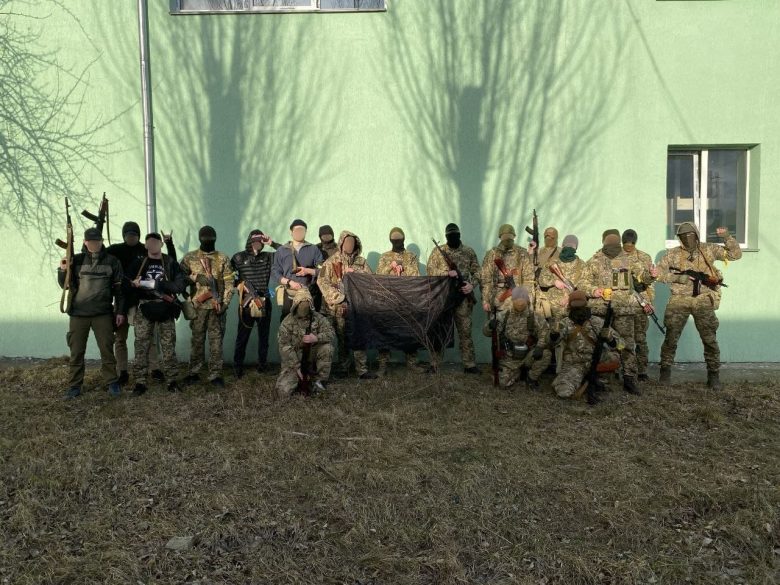
As The Ukrainian forces and their Western backers celebrate their recent military advance, the fate of ethnic Russians in the reclaimed territories looks bleak now that local and national leaders have declared a reckoning against those whom they consider to be collaborators and traitors.
It’s a policy that originates from the early stages of the conflict based on a law passed in March that threatened anyone who co-operated with the occupying Russian authorities with up to 15 years of imprisonment together with the confiscation of property. Hitherto there have been many arrests of those accused of pro-Russian collaboration, including the leader of Ukraine’s official parliamentary opposition Viktor Medvedchuk, and assassinations of officials such as Alexei Kovalev, deputy head of the military and civil administration in the Kherson region. But as the Ukrainian forces wrest back territory from Russia, a wide net is being cast against alleged collaborators that extends well beyond officials to include teachers, social media warriors and victims of unsubstantiated claims of snitches, shedding light on the intentions of Ukrainian authorities in the unlikely event of total victory.
Ukraine is a culturally heterogenous population in which linguistic affiliation is complex, being governed by both cultural and social situations. At least 17 per cent of Ukrainians claim Russian heritage, with about 14 per cent declaring Russian as their main language and a further 17 per cent Russo-Ukrainian bilingualism, with an unknown number opting to converse in a hybrid Surzhyk dialect. Russian speakers are overwhelmingly concentrated in the eastern and southern regions of the country. It’s a situation, moreover, that has reflected the electoral geography of the country of both parliamentary and presidential elections with the eastern and southern parts of the country exhibiting close affinities with Russia.
Starting as a reasonable initiative at nation-building that intended to correct the inequalities of institutional Russification of the Soviet era, language policy came to be weaponised by nationalist political forces that sought to use it to marginalise Russian culture. Although a cultural reset was inevitable after the collapse of the Soviet Union to redress years of Russification, its initial steps were measured, such as the Law of Languages of 1989, which extended legislative protections to Russian as well as other languages. For Ukraine’s increasingly influential nationalists, overwhelmingly located in the West of the country, the Law was intolerable and unsurprisingly fell victim to the Maidan coup of 2014, that replaced the Russophile President Viktor Yanukovich with Petro Poroshenko.
While its provisions were maintained by Ukraine’s subsequent leadership, following international condemnation of its revocation, the decision of the Constitutional Court to deem the Law unconstitutional was viewed by the Russian minority as a sign of a broader assault on Ukraine’s Russian heritage and served to fuel separatist sentiment in the Crimea and the Donbas. It also played into the hands of Vladimir Putin who could now claim to be the champion of Ukraine’s oppressed Russian speakers, by military means if necessary. Such fears were not unwarranted as in 2019 a new language law sought to end the hitherto ad hoc implementation of existing legislation and subject transgressors to severe fines. Poroshenko, who was campaigning for re-election, weaponised Ukraine’s language policy with his election slogan ‘Army, faith, language’, declaring that ‘the only opinion that we weren’t going to account for [in drafting the legislation] is the opinion of Moscow’. Salt was further rubbed into the wounds of the third of the country which rejected it by its being signed off by the Speaker of Parliament, Andrei Parubiy, a former activist in the neo-Nazi Social-National Party, who warned chillingly that ‘those people who try to revise the language law . . . will soon feel the whole anger of the Ukrainian people’. Remaining loopholes were filled in January 2022, just before Russia’s military incursion, which for instance compelled Russian language print media to produce Ukrainian translations for all publications in a move that de facto targeted Russian for discrimination.
To indigenous Russian speakers, such rhetoric marked the creation of an ethnic state in which they were not welcome. The escalation of the war in 2022 seemed to confirm their worst fears as not only did Russian become ‘the language of the enemy’ but things Russian, political parties, music, literature were officially shunned, banned or marginalised in a policy that hitherto had been executed only by the far right nationalists of Lviv City Council in West Ukraine. Whereas then the likes of Canadian and British ambassadors joined Moscow in condemning such action as ‘just plain dumb’ and intolerant, now such nationwide ‘de-Russification’ initiatives were met with silence.
International opinion recognised Ukraine’s language policy as conflict-bearing due to its increasingly divisive and discriminatory nature. The scrapping of minority language provisions by Ukraine’s Constitutional Court in 2014, for instance, raised concerns in the European Parliament which deemed it as ‘undermining any notions of justice, freedom, civilisation, progress and democracy’ and called for the EU Commission to ‘condemn the action of the Ukrainian Parliament and the nationalistic attacks on minority communities in Ukraine’. The 2019 law came under similar criticism from the Venice Commission, the Council of Europe’s advisory body on constitutional affairs, which declared that it threatened to become ‘a source of inter-ethnic tensions within Ukraine’. It reiterated its conclusion following the passing of the January 2022 Law, noting that ‘historical oppression of Ukrainian . . . may lead to the adoption of positive measures aimed at promoting Ukrainian, but this cannot justify depriving the Russian language and its speakers of the protection granted to other languages’.
Both the intra-parliamentary brawls and street standoffs between Ukrainian and Russian speakers during the passage of the language legislation were chilling portents of what was come. Although the escalation of the war in 2022 has seen some ethnic Ukrainian Russian speakers distance themselves from ‘the language of the enemy’ and embrace Ukrainian as their main language, it has also seen ethnic Russians fortify their Russian identity. While this in itself has demonstrated the complexity and malleability of identity in Ukraine, it has also reinforced pre-existing cultural fissures, leaving ethnic Russians with no option other than to embrace Mother Russia as their homeland.
While the conflict in the Donbas since 2014 rendered reconciliation between the Ukrainian authorities and the Russian minority problematic, as the failure of the Minsk agreement testifies, the escalation of the conflict has entrenched pre-war hatreds. With the national conversation decisively turning against the reintegration of Russian culture and language into Ukraine’s social fabric, it is difficult to see how a status quo ante bellum with even rudimentary cultural and linguistic protections for ethnic Russians is possible were the Ukrainian state reconstituted within its pre-war borders. In fact, everything points towards mass retribution and ethnic cleansing on a scale not witnessed in Europe since the Second World War, in a scenario that is likely to overshadow the grim events of the conflict itself. Ukraine’s Secretary of the National Security and Defence Council, certainly didn’t mince his words on a recent Ukrainian talk show in calling for the ‘complete disappearance of the Russian language from our land’ in what sounded like incitement to ethnic cleansing.
Nothwithstanding the difficulty such actions would present for social reconstruction, the questionable legality of extra-judicial killings of officials and political persecution of ‘collaborators’ threatens to draw attention to atrocities committed by Ukrainian paramilitary forces during the Second World War against Russians, Jews, Poles and other minorities. These crimes, together with the ritualistic celebrations by Ukraine’s highest political authorities of those who perpetrated them like nationalist leader and Nazi collaborator, Stepan Bandera, have been conveniently whitewashed so as to not tarnish the image of a virtuous Ukraine that has been carefully cultivated over the past few months. The sources which once regularly condemned Ukraine for not only celebrating wartime collaboration but also tolerating a revival of neo-Nazi paramilitarism now declare similar condemnation by Russia as hostile propaganda. A Ukraine seen to be persecuting minorities again would be a propaganda disaster for its Western backers.
Dividing Ukraine’s population into ‘the people’ and ‘the rest’ where the latter were made to feel subordinate in their ancestral lands to the former was always going to lead to conflict. Yet just as wise counsel of the likes of George Kennan, Henry Kissinger and Zbigniew Brzezinski warned of the grave risks of Nato’s expansion to Russia’s borders, so warnings came aplenty of the dangers of a divisive language policy. To Ukraine’s detriment, however, neither was heeded and now a reckoning against ‘the rest’ will be as useless in knitting back together shattered communities as the pre-war language policy was in solving peaceful coexistence between Russian and Ukrainian in a single public space.
West’s Policy Toward Other Countries ‘Dirty, Bloody,’ Denies Nations Right to Sovereignty: Putin
By Ilya Tsukanov – Samizdat – 27.10.2022
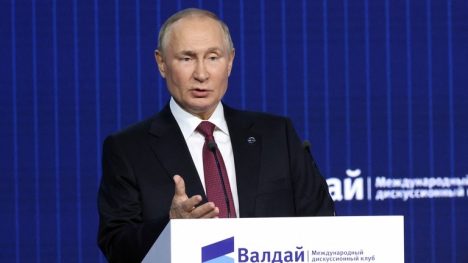
The West seeks to establish and maintain its control over the rest of the planet using “dirty” and “bloody” means, President Vladimir Putin has said.
“World domination is what the so-called West has staked in its game, but the game is unquestionably dangerous, bloody and I would say, dirty,” Putin said, speaking at the plenary meeting of the Valdai Discussion Forum on Thursday.
“It denies the sovereignty of nations and peoples, their identity and uniqueness, and has no regard whatsoever for other countries,” Putin added.
‘Rules-Based Order’ is an ‘Order With No Rules’
The Russian president also suggested that the so-called ‘rules-based’ international order declared by the US and its allies actually has only one “rule” – designed to give those who created it “the opportunity to live without any rules whatsoever” and enabling them to “get away with anything, no matter what they’ve done.”
Attempts to do away with cultural, social, political and civilizational diversity and to “erase any and all differences have become almost the essence of the modern West,” and is aimed at ensuring “the disappearance of the creative potential in the West itself and the desire to contain and block the free development of other civilizations. There is also a direct mercantile interest here, of course,” Putin said, pointing to the West’s efforts to impose its consumer culture values on others to expand their markets.
“It’s no coincidence that the West claims that its culture and worldview should be universal. Even if they don’t say so directly, they behave this way. In fact, their approach insists that these values be unconditionally accepted by all other participants in international communication,” the president said.
The origins of the current crisis have their roots in the destruction of the Soviet Union three decades ago, Putin said. “The collapse of the Soviet Union destroyed the balance of political forces. The West felt like a winner and proclaimed a unipolar world order in which only its will, its culture, its interests had the right to exist.”
Escalation
“The so-called West – I use this term conditionally of course, there is no unity there, it’s clear that this is a very complex conglomerate – has taken a number of steps in recent years and especially in recent months toward escalation,” Putin said, describing the state of affairs in the world today.
“They’re always trying to escalate…They’re fueling the war in Ukraine, organizing provocations around Taiwan, destabilizing the world food and energy markets,” Putin said.
Putin characterized last month’s terrorist attack against the Nord Stream gas pipeline network as an “outrageous” step, adding that unfortunately, “we are witnessing these sad events.”
Pointing to Western governments’ admission that they financed the events leading up to the 2014 Euromaidan coup in Kiev, which gave rise to the current crisis in relations between Russia and the West, Putin suggested that they’ve openly demonstrated their “loutish” nature.
Putin warned that the West’s confidence in its “infallibility” is a “very dangerous” delusion, with there only being “one step” between this self-confidence to the idea that “they can simply destroy those they do not like, or as they say, to ‘cancel’ them.”
But “history will put everything in its proper place and will not ‘cancel’ the works of the greatest and broadly recognized geniuses of world culture, but instead those who today have decided for some reason that they have the right to dispose of world culture at their own discretion. The self-conceit of these people is off the charts. But in a few years no one will remember them, while Dostoevsky, Tchaikovsky and Pushkin will live,” Putin assured.
The neo-liberal “American-style” model is experiencing a “doctrinal crisis,” according to the president, and has “nothing to offer the world except to preserve their dominance.”
Emphasizing that Russia is not a natural “enemy” of the West, Putin urged the West’s liberal leaders and elites to stop seeing “the hand of the Kremlin” behind all their internal domestic problems.
“In the conditions of the current tough conflict, I’ll say a few things directly: Russia, being an independent, distinct civilization, has never considered itself and does not consider itself an enemy of the West. Americanophobia, Anglophobia, Francophobia, Germanophobia are forms of racism, just like Russophobia and Anti-Semitism or any manifestation of xenophobia,” Putin stressed.
But there are “at least two Wests,” the president added, including the positive, traditional one with its immensely rich culture and the aggressive, neocolonial one, whose dictates Moscow will never accept. Russia has resisted Western hegemony and “its right to exist and develop freely,” and at the same time does not have any plans to itself “become some kind of new hegemony,” nor to impose its values on anyone or “interfere in someone else’s backyard,” Putin said.
Solutions
The Russian president suggested that amid the escalating economic, humanitarian, military and political crises plaguing the planet, it is unlikely that any country anywhere will be able to ‘sit things out’. Therefore, solutions of a global scale need to be reached, even if they are imperfect ones.
“The crisis has acquired a truly global character and affects everyone. There’s no need to harbor any illusions. There are essentially two paths for humanity: either to continue to accumulate the burden of problems which will inevitably crush us all, or to try to find solutions together, solutions which may not be ideal, but which work, and which are capable of making our world more stable and safer,” Putin said.
The Russian president emphasized that the West would need to start talking to rising alternative centers of power. “I have always believe and continue to believe in the power of common sense, and therefore am convinced that sooner or later both the new centers of a multipolar world order and the West will have to start a conversation based on equality about our common future. The sooner, the better, of course,” he said.
The “new world order” that replaces the current one “should be based on law, be free, original and fair. Thus, the world economy and trade should become more fair and open,” Putin said, benefiting the majority of nations and people, not individual corporations. At the same time, technology should reduce inequality, not increase it.
The president added that new international financial platforms are necessary which are outside the control of national jurisdictions, and which are “secure, depoliticized, automated and not dependent on any single control center.” Putin expressed confidence that such a system could be built.
Multipolarity is a necessity for the planet, including for Europe – to restore the latter’s political and economic agency, which is “very limited” today, according to Putin.
“We are standing on a historical frontier. Ahead of us is probably the most dangerous unpredictable and at the same time important decade since the end of the Second World War,” Putin said.
Ukraine
Commenting on Russia’s ongoing military operation in Ukraine, Putin said he thinks about the losses in life resulting from the conflict “all the time,” and that the crisis in Ukraine is a part of the “tectonic changes” taking place “in the entire world order.”
“Why was it necessary to carry out a coup d’etat in Ukraine in 2014?” Putin asked, recalling the origins of the current crisis. “[Ukrainian President Viktor] Yanukovych actually gave up power and agreed to hold early elections… Why was it necessary to carry out a bloody anti-constitutional coup under these conditions?”
The answer, Putin believes, is that the West wanted to “show” everyone “who’s the boss in the house. ‘Everyone (and ladies please excuse me for the expression) has to sit on their buttocks and not quack. It will be how we say it will be.’ I simply cannot explain these actions any other way,” Putin said.
Putin said Russia had no other choice but to recognize the Donbass republics in February and to come to their defense, and said that the unity of the Russian and Ukrainian people is an undisputable historical fact. Only Russia could guarantee Ukraine’s sovereignty, as Russia “created” Ukraine during the Soviet period, Putin said.
In the decades after the end of the Cold War, Russia’s consistent message to the West and NATO was “let’s all get along,” like in the Soviet children’s cartoon Leopold the Cat, but in almost all the main areas of potential cooperation, Moscow got the simple answer “No,” according to Putin.
Regarding the latest developments in the Ukrainian crisis and the concerning reports from Russian officials and military commanders that Kiev may be preparing to use a dirty bomb, Putin said he welcomes the International Atomic Energy Agency’s initiative to check Ukraine’s nuclear facilities.
“We are for it. This needs to be done as quickly as possible, as thoroughly as possible, because we know that right now the authorities in Kiev are doing everything possible to cover up the traces of these preparations,” Putin said.
The Russian president warned that it would be “easy” for Kiev to assemble a dirty bomb, and that Moscow has a rough idea about where it’s being created. Ukraine could use a Tochka U or another missile in its inventory to detonate the bomb somewhere and accuse Russia of launching a nuclear strike, Putin said.
The Pentagon Brought on Both Nuclear Crises
By Jacob G. Hornberger | FFF | October 26, 2022
I fully realize that when it comes to Ukraine, one is supposed to focus exclusively on Russia’s invasion and not on what the Pentagon did to gin up the crisis, a crisis that has gotten us perilously close to a world-destroying nuclear war with Russia.
Nonetheless, the Pentagon’s role in this crisis needs to be emphasized, over and over again, just as the Pentagon’s role in ginning up the Cuban Missile Crisis also needs to be emphasized, over and over again.
Yes, what I am emphasizing is the Pentagon’s role in ginning up both of these crises that have gotten us so close to nuclear war with Russia.
At the end of the Cold War racket, there was absolutely no reason for NATO to remain in existence. Its purported mission of protecting Europe from a Soviet (i.e., Russian) attack had been fulfilled. The Cold War was supposedly over.
The only problem was that it wasn’t over for the Pentagon and the CIA. If they had had their druthers, their Cold War racket would have gone on forever. After all, what better justification for their ever-increasing budgets and power within the federal governmental structure?
That’s why they kept NATO in existence. While they were engaging in their interventionist antics in the Middle East, which led to their war-on-terrorism racket, they were, at the same time, using NATO to provoke Russia, with the aim of reigniting their old Cold War racket. Instead of dismantling their old Cold War dinosaur, they used it to absorb former members of the Warsaw Pact, which enabled the Pentagon and the CIA to move their nuclear missiles and military forces inexorably closer to Russia’s border, over Russia’s vehement objections.
Ultimately, they threatened to absorb Ukraine into their NATO racket, knowing full well that Russia had vowed for some 25 years to invade Ukraine to prevent that from happening. Their scheme succeeded. Once Russia invaded Ukraine, the loyal followers of the Pentagon and the CIA focused exclusively on the invasion and not also on the NATO racket that had provoked the invasion.
It was no different with the Cuban Missile Crisis. The reason that Cuba and the Soviet Union installed nuclear missiles in Cuba was to deter another invasion of the island by the CIA and the Pentagon. Don’t forget that the CIA had already invaded Cuba at the Bay of Pigs and had failed miserably. After that, the Pentagon continually exhorted President Kennedy to initiate a full-scale military invasion of Cuba. That’s what the Pentagon’s fraudulent false-flag operation known as Operation Northwoods was all about, which Kennedy, to his everlasting credit, summarily rejected.
What legal justification did the Pentagon and the CIA have to invade Cuba? None! The fact that Cuba had a communist regime certainly never justified an invasion (or, for that matter, repeated murder attempts against Fidel Castro). Keep in mind that Cuba had never attacked the United States or even threatened to do so. In the long relationship between communist Cuba and the United States, it has always been the U.S. government that has been the aggressor, including with its old Cold War economic embargo that continues to target the Cuban people with death and impoverishment as a way to achieve regime change on the island.
Cuba and Russia knew full-well that the CIA and the Pentagon were fully determined to invade Cuba again, with the aim of replacing the Fidel Castro regime with another pro-U.S. dictatorship, like the one that preceded the Castro regime. That’s why Cuba and Russia installed those nuclear missiles in Cuba — to deter another illegal U.S. invasion of the island.
Why can’t the loyal acolytes of the U.S. national-security establishment see all this? Because for them, the Pentagon, the CIA, and the NSA are their triune god. Who wants to question or criticize god?
But if we are going to put out nation back on the right road — the road to liberty, peace, prosperity, and harmony with the people of the world, it is necessary for the American people to not only question this false god but also to toss it and its evil rackets into the dustbin of history and restore America’s founding governmental system of a limited-government republic.
Kiev ‘Made Dummy Missile’ for Provocation With ‘Dirty Bomb’ Over Chernobyl Zone
Samizdat – 26.10.2022
MOSCOW – The Kiev regime has already completed technical preparations for a provocation with a “dirty bomb,” having prepared a dummy missile, which is planned to be filled with radioactive material, a source familiar with the situation told Sputnik.
“Experts from the Yuzhmash plant have already made a dummy missile of the Iskander system, the head cluster part of which is planned to be filled with radioactive material, and then ‘shot down’ by Ukrainian air defense forces over the exclusion zone of the Chernobyl nuclear power plant in order to declare a Russian launch of a nuclear charge,” the source said.
He clarified that the model of the Iskander missile was made on the basis of a projectile from the Tochka-U missile system.
“After the dummy is shot down, the Kiev authorities intend to show the Western and Ukrainian media fragments of the mockup and electronics of the alleged Iskander missile in order to convince the Western public of Russia’s guilt,” the source said.
US scales back plan for Russian oil price cap – Report
Samizdat | October 27, 2022
President Joe Biden’s administration has reportedly been forced back to the drawing board on its plan to cap international prices for Russian oil, having failed to secure enough commitments to control how much Moscow is paid for the bulk of its crude exports.
The US and the European Union will likely have to settle for a “loosely policed” pricing cap, enforced by fewer buyers and at a higher price than envisioned, Bloomberg News reported on Wednesday, citing unidentified people familiar with the plans. The original goal was to drastically reduce Russia’s oil revenue – the latest effort to punish Moscow for its military offensive in Ukraine – by imposing a strict price lid to which a broad “buyer’s cartel” of nations would adhere.
Instead, only G7 nations and Australia have committed to honoring the price cap, Bloomberg said, attributing failure of the original plan to investor skepticism, volatile financial markets and efforts to tame inflation around the world. The cap level also might need to go higher than a previously targeted range of $40-$60 per barrel.
Biden’s administration has denied that its plan would fall short of throttling Russian oil revenue. “The White House and the administration are staying the course on implementing an effective, strong price cap on Russian oil in coordination with the G7 and other partners,” White House National Security Council spokeswoman Adrienne Watson told Bloomberg in a statement.
Russian officials have said the country won’t sell oil or other commodities under price caps or unprofitable market conditions. Nor will Moscow supply energy to nations that adopt trade policies contradicting the terms of their existing oil and natural gas contracts, Russian Deputy Prime Minister Aleksandr Novak said earlier this month. A cap on crude wouldn’t be viable because prices are driven by the global supply-demand balance, he added.
The G7 price cap is scheduled to go into force on December 5, along with an EU ban on imports of seaborne Russian crude. Reuters reported last week that after December 5, Russia would still be able to ship the vast majority of its oil exports at market prices because it would have ample access to tankers and other services. The outlet cited a US Treasury official as saying that between 80% and 90% of Russian oil would continue to flow to buyers outside the cap mechanism.
Russia would have access not only to its own oil tankers, but also to Chinese and Indian ships, Reuters added. Traders and insurance companies from Russia, Asia and the Middle East would provide the necessary transactional services. Brent crude, a leading international oil benchmark, is currently selling for around $95 per barrel.
Is Ukraine a “proxy war”?
By Noah Carl | October 26, 2022
Critics of America’s policy toward Ukraine have accused it of waging a “proxy war” against Russia. Such critics include various Western commentators, as well as Russia itself. In April, the Foreign Minister Sergei Lavrov claimed, “NATO, in essence, is engaged in a war with Russia through a proxy”.
Yet when a reporter put this accusation to Joe Biden, he said it’s “not true”. What’s more, the Ukrainian government compiled a list of individuals who “promote narratives consonant with Russian propaganda”, and specified that such narratives include: “A proxy war between NATO and Russia is taking place on the territory of Ukraine”.
One problem with the line taken by Biden and the Ukrainian government is that it isn’t just critics of US policy that have used the term “proxy war”.
In an article claiming that “many Russian soldiers have to flee, surrender, or die” and “the more and faster the better”, the political scientist Eliot Cohen stated, “The United States and its NATO allies are engaged in a proxy war with Russia.”
Likewise, the former Supreme Allied Commander of NATO, Philip Breedlove – who has called for boots on the ground in Ukraine – stated, “I think we are in a proxy war with Russia. We are using the Ukrainians as our proxy forces.”
And in an interview calling for the US to provide “as much aid as necessary” to Ukraine, former CIA Director Leon Panetta stated, “We are engaged in a conflict here. It’s a proxy war with Russia, whether we say so or not.”
Okay, you might say, but those individuals were using “proxy war” in a purely technical sense. Although the US is not an active participant in the conflict, it is arming one of the participants. So calling the conflict a “proxy war” is just a statement of fact (even if it might technically qualify as spreading Russian propaganda).
When critics accuse the US of waging a “proxy war” what they really mean is that the US is using Ukraine to weaken Russia, regardless of whether this serves the interests of Ukrainians (or Europeans for that matter). For example, perhaps Ukrainians would be better off if the US had engaged in diplomacy with Russia before the war.
It’s certainly not a stretch to imagine the US would wage a “proxy war” of this kind. The Reagan Doctrine was all about building up the US military and arming anti-communist guerrillas in order to overwhelm the Soviet Union and, ultimately, win the Cold War. This included arming both religious and political extremists.
But we don’t have to go back to the eighties. In 2019, the RAND corporation published a report on strategies to “overextend and unbalance” Russia. The report identified “providing lethal aid to Ukraine” as one that would “exploit Russia’s greatest point of external vulnerability”. (Interestingly, it concluded that any increase in aid would need to be “carefully calibrated” to avoid provoking “a much wider conflict”.)
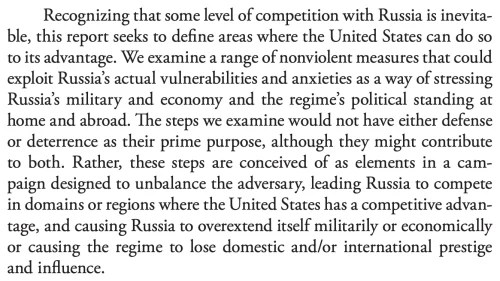
Screenshot from ‘Extending Russia: Competing from Advantageous Ground’.
RAND is almost entirely funded by the US Government, which appears first on its list of clients. So the fact that it would publish a report like this indicates that, even before Russia’s invasion, US decision-makers were interested in using Ukraine to weaken their geopolitical adversary.
As Senator Adam Schiff explained in 2020, “The United States aids Ukraine and her people so that we can fight Russia over there, and we don’t have to fight Russia here.”
Since Russia’s invasion, various other commentators have hinted – or in some cases explicitly stated – that America has goals other than securing Ukraine’s territorial integrity. Here’s Thomas Friedman’s account of what a “retired senior European statesman” told him:
The goal of Ukraine is to win, he said. The goal of the European Union is a bit different. It is to have peace … The U.S. is far away, and for the U.S., he added, it is not the worst thing to keep the war going to weaken Russia and make certain it doesn’t have the energy for any other adventures.
Two months into the war, Defence Secretary Lloyd Austin was asked how he would define America’s goals in the conflict. He began by saying what you’d expect him to say: “We want to see Ukraine remain a sovereign country”. He then went slightly off-script: “We want to see Russia weakened to the degree that it can’t do the kinds of things that it has done in invading Ukraine.”
According to the New York Times, some officials “cringed” and Biden called Austin to “remonstrate” him for the comment. “But officials acknowledged that was indeed the long-term strategy”.
A couple of weeks later, the political scientist Hal Brands really let the cat out of the bag – in a piece titled ‘Russia Is Right: The U.S. Is Waging a Proxy War in Ukraine’. He wrote:
The war in Ukraine isn’t just a conflict between Moscow and Kyiv, Russian Foreign Minister Sergei Lavrov recently declared. It is a “proxy war” in which the world’s most powerful military alliance … is using Ukraine as a battering ram against the Russian state … Lavrov is one of the most reliable mouthpieces for President Vladimir Putin’s baseless propaganda, but in this case he’s not wrong. Russia is the target of one of the most ruthlessly effectively proxy wars in modern history.
“The key,” Brands noted, “is to find a committed local partner — a proxy willing to do the killing and dying”. You then “load it up with” arms so that it can inflict “shattering blows” on your adversary. “That’s just what Washington and its allies are doing to Russia today.”
Similar sentiments were echoed by Congressman Seth Moulton in an interview with Fox News. “At the end of the day, we’ve got to realise we’re at war,” Moulton stated. “And we’re not just at war to support Ukraine. We’re fundamentally at war – although somewhat through a proxy – with Russia. And it’s important that we win.”
Likewise, when Congressman Dan Crenshaw came under fire from “America First” conservatives over his support for Ukraine, he tweeted: “Yeah, because investing in the destruction of our adversary’s military, without losing a single American troop, strikes me as a good idea. You should feel the same.”
Crenshaw didn’t bother paying lip-service to high-minded concepts like democracy, sovereignty or territorial integrity. He just came out and said we’re “investing in the destruction of our adversary’s military”.
Critics have consistently disparaged US policy as “fighting Russia to the last Ukrainian”. But in July, Senator Lindsey Graham – a long-time Russia hawk – said almost exactly that. “I like the structural path were on here,” Graham explained. “As long as we help Ukraine with the weapons they need and the economic support, they will fight to the last person.”
Critics found further justification for their cynicism in a recent Washington Post article, which revealed the following. “Privately, U.S. officials say neither Russia nor Ukraine is capable of winning the war outright, but they have ruled out the idea of pushing or even nudging Ukraine to the negotiating table.”
You might say that using Ukraine to weaken Russia is something worth doing, as Dan Crenshaw evidently believes. But at this point, it can scarcely be denied that America is engaged in a proxy war.
Ukraine Peace Talks: Pathetic U-Turn by 30 Dems & Curious Case of Jeffrey Sachs
By Ekaterina Blunova – Samizdat – 26.10.2022
On Tuesday, the progressive caucus of the US House of Representatives made an abrupt U-turn and withdrew their letter to US President Joe Biden, which urged him to engage in direct talks with Russia and broker peace between Kiev and Moscow. What’s going on in the Democratic camp?
“Not only was the letter a case of too little, too late, the so-called progressive signatories to the statement made themselves look even more pathetic in its immediate withdrawal,” Max Parry, an independent US journalist and geopolitical analyst, told Sputnik.
“While the letter was a refreshing first step, the Democrats who signed it became victims of the very same McCarthyist political atmosphere they have created in Washington, where any detente or rapprochement with Moscow is criminalized. Instead of digging in their heels and standing by what they said, the 30 lawmakers immediately caved to the political pressure of being branded Putin apologists and retracted the statement. They made it clear their loyalties lie with the party establishment and not with the American people, who are fed up with the Biden administration’s disastrous handling of the war and the economy,” he emphasized.
The American journalist believes that the motivation behind the letter was a response to growing fatigue among the US public regarding the ongoing standoff in Ukraine, “not to mention several recent public incidents of Democratic lawmakers being protested by their own constituents over their vote to arm Kiev which went viral on social media.”
According to Parry, US polls indicate growing support for a diplomatic resolution to the conflict. On September 27, a survey, conducted by Data for Progress on behalf of the Quincy Institute for Responsible Statecraft, indicated that nearly 60% of Americans would support Washington engaging in diplomatic efforts “as soon as possible” to end the conflict in Ukraine, even if that means Ukraine having to make concessions to Russia.
“Surveys of the upcoming midterm elections also forecast the increasing likelihood of GOP gains in congress,” Parry continued. “Although US support for Ukraine has been mostly bipartisan, there have been far more vocal opponents of the Biden administration’s decision to arm Ukraine among Republicans than Democrats, most notably Marjorie Taylor Greene.”
On October 18, House Minority Leader Kevin McCarthy signaled that Republicans will not write a “blank check” for Kiev if they win back the House majority. According to US media, anti-aid sentiments are also strong among many Republican House and Senate candidates. If they win, the reduction of military assistance to Kiev is more than possible, as former US Senate candidate Mark Dankof told Sputnik on September 25.
While one needs to bear in mind that the anti-Russia consensus in Washington has long been bipartisan, 57 Republicans as recently as May voted against sending more lethal aid to Kiev, Parry underscored. Nonetheless, the independent journalist noted that this trend does not necessarily signal an upcoming departure from the Ukraine policy by the US.
“I am not convinced this will automatically materialize if the Republicans take back the House, because many of the purported adherents to Trump’s ‘America First’ agenda running for office are opportunists and based on historical precedent, some of those GOP lawmakers could turn back on their campaign pledges once they are in office,” he remarked.
When it comes to Democrats, “if they do indeed lose ground over the Ukraine war, it could lead to either a revival in the anti-war movement among the US left or a doubling down on the anti-Russian sentiment among Dems,” Parry presumed.
Jeffrey Sachs: Neoliberal Economist Turned Anti-NATO Rebel
The Dems’ latest flip-flopping on the Ukraine peace issue is not the only attempt at dissent on the left flank of the US political front. Renowned economist and Columbia University Professor Jeffrey Sachs has lambasted the Biden administration’s Russia strategy and urged Washington to mediate a peaceful settlement between Moscow and Kiev from the outset of the Russian special military operation to demilitarize and de-Nazify Ukraine.
“It was a welcome surprise to see a former neoliberal economist like Professor Sachs become an unexpected dissenting voice and critic of US policies as Washington continues to send a flow of arms to Ukraine,” said Parry.
In May 2022, Sachs wrote an op-ed urging the US to stop the conflict in Ukraine and insisting that the solution reached by Moscow and Kiev in March 2022 remains the only viable option for restoring peace. On June 27, the economist released an article eloquently titled “Ukraine Is the Latest Neocon Disaster,” again calling for peace negotiations and ending NATO’s eastward expansion towards Russia’s borders. On August 2, Sachs warned: “The government of Ukraine urges us not to negotiate, but to fight. This is a recipe for the destruction of Ukraine and the possible escalation to a nuclear war.”
Following the sabotage attack on Russia’s Nord Stream pipeline infrastructure in the Baltic Sea, Sachs pointed the finger at Washington as a potential culprit while speaking on air with a US mainstream broadcaster.
“The case of the recent political transformation of Professor Sachs is a curious one,” noted Parry. “After all, we are talking about one of the most prominent economic advisors to Western financial institutions like the International Monetary Fund. In particular, he was one of the preeminent economic aides to former communist governments in their transition to the free market and in the case of Russia, the economic reforms based on his ideas had devastating consequences when mass privatization and ‘shock therapy’ drove the Russian economy into a deep recession and plunged millions into poverty.”
The independent journalist emphasized that for Sachs to “now depart from US policy orthodoxies and criticize the demonization of Russia, even rightly pointing out that the US was the more likely candidate to have been behind the destruction of Nord Stream 2 pipeline, is simply stunning.”
Parry has drawn attention to the fact that Sachs’ “transformation” apparently started a few years ago, “when he criticized America’s dirty war in Syria in 2018.” “Now his ‘road to Damascus,’ or political conversion is complete,” the journalist added.
“Unfortunately, he is one among only a mere handful of public figures voicing opposition to NATO’s proxy war,” Parry continued. “Since the death of Stephen Cohen, America’s foremost scholar of Russian affairs, commentary on US relations with Moscow has been nothing short of monolithic, so the surprising calls for peace talks by Sachs were badly needed.”
“Once upon a time, there used to be something called the fairness doctrine in the media where there was some attempt to ensure that differing viewpoints were evenly reflected in news coverage of world events. Since February, there has been absolutely no attention given to the Russian perspective on the war whatsoever, nor any encouragement of dialogue and diplomacy allowed on major networks or newspapers. Even for corporate media, which has always been heavily biased toward the West, the lack of any diversity of opinions on this conflict is unprecedented,” Parry concluded.
Who benefits from Kakhovka dam destruction?
By Drago Bosnic | October 26, 2022
In recent weeks, the Kiev regime has been accusing Russia of planning to destroy the Kakhovka hydroelectric dam on the Dnieper River, which would unleash a devastating flood across most of the Kherson oblast (region) and the surrounding areas.
The dam, which measures 30 meters in height and is approximately 3.2 km long, was built in 1956 on the Dnieper River as part of the Kakhovka hydroelectric power plant. It holds a massive 18 km³ water reservoir which also supplies water to Russia’s Crimean peninsula. The reservoir is also crucial for the functioning of the Zaporozhye nuclear power plant as it supplies water to the essential cooling systems. The volume of water in the reservoir is comparable to the Great Salt Lake.
Destroying the strategically important dam, which is now part of Russia, would have catastrophic consequences, as it would unleash a devastating flood downstream. Experts estimate this would create a giant wave of devastating floodwater up to five meters in height, almost immediately flooding an area of more than five kilometers around the dam. The wave would need only two hours to reach the city of Kherson. The destruction of the dam’s floodgates would also destroy the crossings used by the Russian military and possibly trap the large Russian contingent on the west bank of the Dnieper River. However, most alarmingly, this would also result in the total destruction of dozens of settlements in the region and possibly cause hundreds or even thousands of civilian casualties, as it would not be possible to evacuate everyone in time.
Last Tuesday, Russian Army General Sergei Surovikin, the newly appointed commander of all Russian forces engaged in the special military operation, stated that the relevant intelligence clearly indicates the Kiev regime forces are preparing a massive strike on the dam. He confirmed that the Neo-Nazi junta troops had already used the US-supplied HIMARS in a major strike during which the Russian military managed to intercept several precision-guided rockets. On October 21 alone, at least five separate rocket attacks were repelled by Russian air defenses.
“We have information on the possibility of the Kiev regime using prohibited methods of war in the area of the city of Kherson, on the preparation by Kiev of a massive rocket strike on the Kakhovka hydroelectric dam,” Surovikin warned.
The Kiev regime officials rejected the allegations and stated that “they were a clear sign” that Moscow supposedly planned to attack the dam and then blame the Neo-Nazi junta. On October 20, the Kiev regime frontman Volodymyr Zelensky said that Russia had allegedly placed explosives on the dam and was preparing to destroy it, a move he compared to the use of weapons of mass destruction.
“I informed the Europeans today, during the meeting of the European Council, about the next terrorist attack, which Russia is preparing for at the Kakhovka hydroelectric power plant. Destroying the dam would mean a large-scale disaster,” Zelensky stated. He went on to claim that blowing up the dam would also destroy the water supply to Crimea and “thus show that Russia had accepted that it could not hold onto the peninsula.”
Kirill Stremousov, the Deputy Head of the Kherson oblast (region), stated that the Kiev regime’s allegations that Russia had placed explosives on the dam were false. The authorities of the Kherson oblast are working on evacuating as many civilians as possible, since the Kiev regime forces are escalating attacks on residential areas. On the evening of October 20, Neo-Nazi junta troops targeted civilians fleeing to the eastern bank of the Dnieper River. The ferry crossing near the Antonov bridge (damaged by the Kiev regime forces) was struck, resulting in at least 4 civilian casualties, while dozens of others were wounded. Local administration reports that the US-made HIMARS MLRS was used to destroy the ferry.
At least 12 cluster munition rockets were fired, most of which were intercepted by Russian air defenses, significantly reducing the number of casualties. Since HIMARS is a precision-guided system, the possibility of miscalculation on part of the Kiev regime forces is extremely unlikely. This leaves us with one conclusion – the civilians were the target.
Local authorities are working round the clock to evacuate everyone, as civilians living on the west bank of the Kherson oblast are exposed to direct attacks by the Kiev regime forces. As the Neo-Nazi junta troops are also shelling the Kakhovka power plant, located approximately five kilometers from the town of Novaya Kakhovka, the civilians are also directly exposed to the aforementioned flood which would be the inevitable result of the destruction of the dam.
All the while, the Kiev regime keeps insisting that Russia will destroy the dam, ignoring both logic and the situation on the ground. As Zelensky himself stated, destroying the dam would halt the water supply to Crimea. Although he stated that this means Russia gave up on Crimea, such claims are comically illogical, given that Russia had successfully been tackling the issue of water supplies to the peninsula for nearly a decade, as the Kiev regime cut the water supplies back in 2014.
In addition to trapping its own troops on the west bank of the Dnieper River, as the flooding would make it impossible to evacuate anyone, the destruction of the dam would also devastate the areas which are already under Russian control. Thus, the question remains, who actually benefits from blowing up the Kakhovka dam?
Drago Bosnic is an independent geopolitical and military analyst.
Moscow Slams US for Not Issuing Visas to Russian Delegation to IAEA Conference
Samizdat – 24.10.2022
MOSCOW – Moscow considers unacceptable the fact that the United States had not issued visas to the Russian delegation to the IAEA international ministerial conference on nuclear energy in the 21st century, Russian Foreign Ministry spokeswoman Maria Zakharova said.
The conference will be held in Washington from October 26-28. The Russian delegation comprising representatives of state corporation Rosatom and technical watchdog Rostekhnadzor planned to take part in it.
“The United States never issued visas to the Russian delegates, despite the fact that the relevant applications were submitted by them in advance in accordance with the established procedure. Thus, Russia’s participation in an important international event under the auspices of the IAEA was blocked in an absolutely unacceptable way and without any reason,” Zakharova said in a statement.
The refusal of the United States to issue visas to the Russian delegation to the IAEA conference grossly violates the norms in the agreement between the IAEA and the state hosting the event, this gives reason to think about the advisability of holding international forums in the United States, Zakharova said.
This is another example of how the United States “implements its short-sighted policy of ignoring international law and replacing it with a perverted postulate of some kind of ‘rules-based order’ that Washington itself invents and adjusts for itself,” she noted.
“This is another reason to think about whether it is worth trusting the holding of large international forums to a country that is not able to organize them properly,” Zakharova added.
Featured Video

Death Spikes & Rising Cancer In Our Youth Explained
or go to
Aletho News Archives – Video-Images
From the Archives
Politicians lie
By Mazin Qumsiyeh | Popular Resistance | August 18, 2013
There is no way to say this truth nicely: Politicians lie. That includes Japanese, American, Egyptian, Israeli, and Palestinian politicians! Is there something more common sense than that? Yet, so many citizens around the world believe their own politicians or wistfully acknowledge lies but think it is part of the job needed to run things. They believe even when politicians contradict themselves blatantly. This phenomenon is rather remarkable. It is a dissonance and disconnect from reality that many seem oblivious to. It is very dangerous because it can lead to accepting rationales for going to war. These can be deadly wars that lead to millions of lives lost as happened in what was called World War 1 and WW2. Even when incredible and declassified evidence abound, politicians continue to lie and old mythologies refuse to die. Here are just a few of the countless lies told to us over the past few decades… continue
Blog Roll
 Aletho News
- RSF military group defects, joins Sudanese army: State media
- Ireland goalkeeper refuses to play ‘Israel’ as squad weighs boycott
- China pushes back against US on Cuba, Iran
- Ukrainian Soldiers, Potential Mercenaries: Have Gun, Will Travel!
- Burnham’s UN debut… A masterclass in British disinformation
- Iran flights continue despite US aviation sanctions
- Global Tipping Points Lead the World Into a State of Entropy
- The day-after at the White House: USA and Xi Jinping
- The Geopolitical Balance in the Red Sea: The UAE Being Displaced by New Players
- Iraqi resistance group vows to stage airport sit-ins over Iran aerial blockade
- If Americans Knew
- Deconstructing Netanyahu’s pants-on-fire UN rant – Daily Update
- Trump betrayed voters with his campaign lies and prioritized a foreign country once he took office
- Netanyahu calls Israel’s war in Gaza ‘opposite of genocide’ in UN speech to near-empty hall
- Settler Kidnappings: Torture, Sexual Abuse and Terrorisation of Palestinian Abductees as Israel Deepens Annexation of West Bank
- Gaza winter nears as 162,000 tents become unusable, raising fears of humanitarian crisis
- Netanyahu says, “It’s the opposite of genocide”; UN says Gaza economy is world’s ‘most severe crisis on record’ – Daily Update
- Israel’s US-Backed Assault on Gaza Has Created the ‘World’s Most Severe Economic Crisis on Record’: UN
- ‘Protecting U.S. Citizens’… From Israel
- ‘This is where I live now, the back of a truck’: a day in the life of a grandmother in Gaza
- In UN Speech, Iran’s President Displays Pictures of Children Killed by US, Brings Attention to Israel’s Nuclear Arsenal
- No Tricks Zone
- New Study: Earth And Venus Surface Warmth Largely Explained By Convection And Lapse Rate, Not CO2 Or Radiation
- 2025 Nature Paper Claiming Worsening Global Drought Gets RETRACTED …Heavily Flawed
- New Study: ‘Global Drought Shows No Detectable Recent Acceleration Under Climate Warming’
- Economic Masterminds: German Socialists Suggest Taxing Productivity Gains Stemming From Using AI
- The South China Sea Has Not Been Cooperating With The Climate Change Narrative
- Energy Crisis: Germany Enters Heating Season With Historically Low Gas Reserve Fill Levels
- New Study: The Antarctic Ice Sheet Gained Mass From 2020-2024 Due To Staggering Snow And Ice Accumulation
- Study: Ocean Heating Rates From Thousands Of Years Ago ‘Dwarf’ Modern Ocean Heating Rates
- Climate Extremists Target, Attack Large-Scale Power Grid Infrastructure In Germany!
- New Study: Antarctic Ice Melt Has Contributed Less Than 1 Centimeter To Sea Level Rise In The Last 30 Years

