Special Military Operation, Season 2
Big Serge | September 12, 2022
September 9 – 11 will go down in history as a period of great significance in the Russo-Ukrainian war. Both belligerent parties crossed very important thresholds, which taken together suggest that the war is entering a new phase. On the 9th and 10th, Ukraine achieved its first concrete success of the war by retaking all the Russian-held territory in Kharkov Oblast west of the Oskil river, including the western bank of Kupyansk and the transit node of Izyum.
Meanwhile, Vladimir Putin convened an emergency meeting of his national security council, which precipitated Russia’s own escalation on the 11th, when Ukrainian infrastructure was at long last subject to attack, plunging much of the country into darkness.
It seems clear that the war is entering a new phase, and it seems highly likely that both parties will attempt to take decisive action in the near feature. For now, let’s try to parse through the developments of the past week and get a handle on where the war is heading.
At the risk of sounding very pedantic, Ukraine’s counteroffensive in eastern Kharkov Oblast is an excellent demonstration of the difficulties in evaluating military operations. Everyone agrees on the basic geography of what has happened: Ukraine cleared everything west of the Oskil river of Russian forces. Nobody agrees on what this means, however. I have seen all of the following interpretations posited – note, people reached all of these conclusions from the same set of data:
- Russia has drawn Ukraine into a trap and will soon counterattack
- Russia voluntarily withdrew from Kharkov to prioritize other fronts
- Russia drew the Ukrainians out to hit them with artillery
- Russia suffered a massive intelligence failure and did not see or respond to Ukraine’s offensive
- Russia suffered a defeat in battle and was forced to retreat
Let’s do a methodical autopsy and see what we come away with.
The first thing we want to note is that the disparity of forces on this front was absolutely laughable. Ukraine assembled a strike group of at least five full brigades, and aimed at a line of contact which had no Russian regular troops at all. The Russian frontline defenses in the region were manned by allied donbas militia and national guardsmen. It seems there was a lone Battalion Tactical Group (BTG) in Izyum, but little else.
It is undeniable, even for Ukrainians celebrating the advance, that Kharkov oblast had been almost completely hollowed out of Russian troops, leaving little more than a screening force. Two important things flow from this. First, that the Ukrainian shock group was in most places advancing against virtually nonexistent resistance. Secondly, more ominously for Ukraine, the low quality units left behind for screening purposes were able to put up good resistance against the Ukrainians – the Rosgvardiya men in Balakliya held out tenaciously for several days before evacuating through a corridor.
In my previous analysis, conducted while the Ukrainian counteroffensive was just beginning to develop, I noted two important things about the shape of the battlefield.
- I argued that Ukraine would be unable to push across the Oskil and properly exploit their offensive.
- I noted that Ukraine was making rapid advances against thinly manned, hollowed out portions of the front, and that Russia had committed very little to the battle.
Both of these statements were correct. I freely admit, however, that I drew the incorrect conclusion from them. I believed the Ukrainian advance would culminate at the Oskil river, leaving them vulnerable to a Russian counterattack by the arriving reserves. It seems fairly clear now that this is incorrect, and the Russian reserves that were en-route were tasked with stabilizing the defense at the Oskil, not launching a counterattack.
This was not an operational trap by Russia, but neither was it a victory in battle for Ukraine – for the simple reason that there was not much of a battle at all. Russia had already hollowed out these positions, and withdrew the remaining screening forces very quickly. Ukraine covered a lot of ground, but were unable to destroy any Russian units, because there really weren’t any there.
It would be silly to try to talk the Ukrainian side out of their excitement right now. Credit where credit is due, they did manage to put together a good sized shock group, aim it at a weak portion of the front, and regain a good bit of ground. Considering the abject lack of successes for Ukraine in this war, they are rightfully trying to eke every last bit of morale and propaganda out of this.
I do not, however, believe that the territorial losses in Kharkov in any way change the ultimate calculus of the war. Russia hollowed out this front and surrendered ground, but they were able to maul the Ukrainian forces as they advanced with relentless artillery and airstrikes. Ukrainian channels widely report overflowing hospitals. The Russian Ministry of Defense claimed 4,000 killed and 8,000 wounded for Ukraine during their advance – I believe this is high, but even if we reduce the numbers by 50% (leaving us with 6,000 total casualties, reasonable given how much ordnance Russia discharged) it is very clear that the loss ratios in this operation were stacked badly against Ukraine, as they always are.
As I predicted in my last piece, Ukraine has so far been unable to exploit their offensive by reaching the operational depth. They have been totally unable to project forces across the Oskil River. With the advance eastward firmly culminated, they are seeking to maintain their momentum, or at least the appearance of it.
Ukraine’s successful advance in Kharkov Oblast has been augmented with a blitz of fakery and propaganda designed to simulate a total shift in strategic momentum. These include fakes related to Russian domestic politics, such as fabricated calls for Putin’s impeachment, and battlefield misinformation, like claims that the Ukrainian Army has breached the borders of the LNR or stormed Donetsk City. They have also circulated out of context videos (the most popular one shows a Russian vehicle depot in Crimea) purporting to show that the Russians abandoned hundreds of vehicles in Izyum.
The fakery is not important. Ukraine will, however, also attempt to maintain battlefield momentum by piggybacking on the Kharkov operation with additional counteroffensives. They continue to attempt to cross the Donets River in force to storm Lyman, unsuccessfully. They also continue their attacks in the Kherson direction, making little progress and taking high casualties.
The most important development, however, is the claim that a second Ukrainian shock group has been assembled in Zaparozhia. This is an area where the geography actually would allow Ukraine to achieve operational exploitation. A successful drive towards Melitopol or Mariupol would compromise the land bridge to Crimea and threaten to crumble Russia’s entire position in the south.
Unlike Kharkov, however, this is not a hollowed out portion of the front. The newly formed Russian 3rd Corps is concentrated in the south, and Russian convoys have been spotted recently moving through the Mariupol region. Ukraine may very well attempt yet another offensive operation in this direction, but given the strength of the Russian grouping here the results will be more like Kherson than Kharkov.
During the opening months of the war, I argued on Twitter that massed offensives are difficult, and that Ukraine had not yet shown the organizational ability to organize an operational higher than the brigade level. All the attacking action that we saw from Ukraine early on took the form of single brigade – or more often, single battalion – commanders taking initiative.
Well, lo and behold, Ukraine managed to field at least two (Kherson, Kharkov) and perhaps three (Zaporizhia) multi-brigade shock groups, and launch coordinated operations. This was made possible because Ukraine is a pseudo-state, which is supplied, financed, and increasingly managed by NATO. Western agencies cannot resist bragging – Britain identified itself as the party responsible for planning and organizing the Kherson operation, while the USA claims credit for the more successful Kharkov attack.
It is difficult to overstate the extent to which Ukraine is sustained solely by the west. Ukrainian soldiers are trained by NATO officers, armed with NATO weapons, accompanied in the field by NATO soldiers foreign volunteers, and the Ukrainian pseudo-state is kept running by cash injections from the west. Videos from the Kharkov front abound with English speaking soldiers and foreign weapons.
The point isn’t just to point out, yet again, that Ukraine is a failed state – a corpse that is given the illusion of life by outside actors moving its limbs. The point is that Russia understands this and correctly understands itself to be in a civilizational collision with the west. To that end, we must understand that Russian escalation is underway, and think about what that means.
By this point, the idea that Russia needs to mobilize has become a tired old meme, courtesy of the deranged Igor Strelkov. It is certainly true that Russia must escalate, but leaping directly to mobilization (putting the economy on war footing and calling up conscripts) would be a grave mistake. Russia has other, better ways to escalate. The recent Ukrainian advance in Kharkov is an obvious signal to raise the force deployment, and Ukrainian potshots at targets across the Russian border only add to the pressure to take the gloves off.
First, I would like to comment on why I am against mobilization. One of the most important dimensions of this war is the economic front. Europe is being driven to the brink by the energy crisis. The Wall Street Journal keyed in on what I believe to be the most apt descriptor of the crisis, warning of a “new era of deindustrialization in Europe.”
A full mobilization would be very costly for Russia’s economy, risking the edge that it currently holds in the economic confrontation with Europe. This, I believe, is the main reason that the Russian government was quick to quash rumors of mobilization today. There are other steps on the escalation ladder before going to total war footing.
There are already rumors that Russia is planning to change the formal designation of the war, from “Special Military Operation”. While that could mean a formal declaration of war, I think that is unlikely. Rather, Russia will likely give the Ukraine operation the same designation as its operations in Syria, loosening the rules of engagement and beginning to target Ukrainian assets in earnest.
We saw a foretaste of this last night, when Russia wiped out over half of Ukraine’s power generation with a few missiles. There are many more targets that they can go after – more nodes in the electrical grid, water pumping and filtration facilities, and higher level command posts. There is at least some probability that Russia begins targeting the command facilities with NATO personnel in them. Plausible deniability works both ways; because NATO is not officially in Ukraine – only “volunteers” – targeting their personnel is not an overtly aggressive act.
Russia also has many ways to boost its force deployment in Ukraine that fall short of full mobilization. They have a pool of demobilized contract soldiers that they can call up, as well as a pool of reservists that they can raise with a partial mobilization.
The Russian line is hardening. Just in the past 24 hours, Kremlin spokesman Dmitry Peskov said there were “no prospect for negotiations” with Ukraine, and Putin said “Unfriendly forces are targeting us, and we must take initiative in order to succeed in confronting them.” Medvedev went even further just now: “A certain Zelenskyy said that he will not hold a dialogue with those who issue ultimatums. The current ‘ultimatums’ are a warm-up for kids, a preview of demands to be made in the future. He knows them: the total surrender of the Kiev regime on Russia’s terms”
If you believe the Russian government is utterly incompetent and duplicitous, feel free to view statements like this as bluster. But given the warning shot at Ukrainian power generation yesterday, my sense is that Russia is preparing to escalate to a higher level of intensity, which Ukraine cannot match with its indigenous resources. The only other player on the escalation ladder is the United States.
Dark times are ahead for Ukraine – and perhaps for Americans on the other front of this war.
Syria and Ukraine are two fronts in the same war. This is very important to understand. In Syria, the United States has attempted to wreck Russia’s most important Middle Eastern ally and create a Trashcanistan of chaos to suck in Russian resources; in Ukraine, NATO has armed a kamikaze state to hurl at Russia’s western border. In the Russian mind, these wars are inextricably linked.
After the Kharkov counteroffensive, I strongly suspect that Russia will look for a way to strike back at the United States, without crossing red lines that could lead to a more direct confrontation. Syria is the place where this would happen. The United States maintains several illegal bases on Syrian soil, which Russia could strike using its Syrian allies much the same way that the United States is using Ukraine. Russia is in the finishing stage training a new Syrian airborne division. With Russian air cover, an attack on one of the American bases in Syria would be possible – the USA would be forced to choose between shooting down Russian planes and flirting with nuclear war, or humbly accepting the loss of an illegal base that it has worked hard to hide from its own citizens. Given the utter lack of enthusiasm among the American public for yet another war in the Middle East, it seems that the USA would simply have to swallow the loss.
- Russian escalation of attacks on Ukrainian infrastructure and command centers.
- Russian force deployment raised without full mobilization.
- Intensification of Russian efforts to recover DNR territory.
- Possible escalation in Syria, likely in the form of Syrian army attacks on US bases.
U.S. ups the ante: are we indeed headed into WWIII and what can save us?
Gilbert Doctorow | September 9, 2022
The UK and Commonwealth may be mourning the passing of Queen Elizabeth II yesterday. I am in mourning as well, but for a very different reason: the gathering in the Ramstein air base in Germany yesterday reshuffled the deck on Western military and financial assistance to Ukraine, raising contributions to the ongoing holy crusade against Russia from still more nations and adding new, still more advanced precision strike weapons to the mix of deliveries to Kiev. It was an open summons to the Kremlin to escalate in turn, as were the test firing the same day of a new intercontinental rocket, the Minuteman III, from Vandenberg air base in California and the unannounced visit to Kiev yesterday of not only Secretary of State Antony Blinken, who was featured in Western media accounts, but also other top officials of the Biden administration. The most notorious member of this delegation was surely Blinken’s deputy, Victoria Nuland, who had stage managed the February 2014 coup that put in power in Kiev the Russia-hating regime that Zelensky now heads.
The Russians may be compelled to take the bait due to the course of military action on the ground. As now becomes clear, they have just suffered some losses in very heavy ground and artillery fighting these past few days around Kharkov. The Ukrainian gains were facilitated by the advanced weaponry recently arrived from NATO countries, by the targeting data they are receiving from the U.S. and from off-stage tactical direction from NATO officers. By ‘take the bait,’ I mean the Russians may escalate to all out war on Ukraine. This question figured prominently in yesterday’s major news and political talk show programs of Russian state television. I will go into these matters in some detail below.
Regrettably, all of the foregoing also obliges me to revisit the critique I published a couple of weeks ago on the latest essay in Foreign Affairs magazine by John Mearsheimer. His overarching message on the dangers of our stumbling into a nuclear war is better substantiated by the latest developments, even though I believe that Mearsheimer failed to identify the several successive steps that lie ahead before we find ourselves in such a war. Mearsheimer oversimplified Russian options to deal with setbacks on the ground. This also will be a central issue in my narrative below.
Finally, in this essay I will direct attention to the second dimension of the ongoing confrontation between Russia and the entire Collective West: the economic war being waged on the Russian Federation via sanctions, which now far outnumber those directed against any other country on earth. This war, as I will argue, is going well for the Russians. More importantly for us all, it is the sole area in which the peoples of Europe may have a say in putting an end to the mad policies being pursued by their national governments under the direct pressure of Washington.
*****
Over the past ten days, we have witnessed the start of the Ukrainian counter-offensive which was preceded by so much anticipation in Western media. A reversal of Russian fortunes in the war was predicted, leading to the stalemate or outright defeat for Russia which Mearsheimer and some other analysts in the US foreign policy community feared would trigger a nuclear response from the Kremlin.
In fact, the Ukrainian counter-offensive got off to a very bad start. It opened in the south, in the Kherson region. Kherson, which is predominantly Russian-speaking, was the first major Ukrainian city to fall to the Russians and it has strategic importance for ensuring Russian domination of the Black Sea littoral. However, first results of the Ukrainian attacks there were disastrous for the Ukrainian armed forces. It soon was obvious that they had deployed new recruits who had little or no military experience. The infantry attacked across open terrain where they were easily destroyed in vast numbers by the Russian defenders of Kherson. I have heard the figure of 5,000 Ukrainian casualties in the Kherson counter offensive. Obviously the Russians were jubilant, though there were reports of some Ukrainian reservists being withdrawn from the field of action for redeployment elsewhere.
What followed was something the Russians evidently did not expect, namely a well prepared and implemented assault on their positions around the northeastern city of Kharkov, Ukraine’s second largest city. Kharkov was briefly surrounded by Russian forces at the start of the war, but was left in relative peace as the Russians refocused their strategy on taking the Donbas and avoiding major urban warfare except in one place, Mariupol. Exactly what the Russian game plan has been was recently explained in a remarkable paper published by a certain ‘Marinus’ in the Marine Corps Gazette.
A couple of days ago I picked up the following amidst the chatter of panelists on Evening with Vladimir Solovyov: “yes, we made some mistakes, but it is inevitable in a war that mistakes are made.” As from the latest news on the apparent loss of Balakliya and surrounding villages on the outskirts of Kharkov, we can see that the Ukrainian tactics were precisely those which Russia had been using so effectively against them from day one of the ‘special military operation,’ namely a feint in one war zone followed by all-out attack on a very different region. Of course, the ‘feint’ around Kherson, if that is what it was, entailed the cynical sacrifice of thousands of young and not so young Ukrainian foot soldiers. But the resultant distraction prevented the Russians from bringing up sufficient manpower to successfully defend their positions around Kharkov, which include the strategically important city of Izyum.
Izyum is close to the Russian-Ukrainian border southeast of Kharkov and is a major logistical base for munitions and weaponry that are sent onward to support the Donbas operation. The latest information on the Russian side appears to be that the Russians have now dispatched large numbers of reservists to this area to hold their positions. They also speak of intense artillery duels. We may well assume that both sides have experienced heavy loss of life. As yet, the outcome is unforeseeable. Meanwhile, Russian war correspondents on the ground in Donetsk insist that the Russian advance towards Slavyansk, in the center of the former Donetsk oblast, is continuing without pause, which suggests that the strikes on their munitions stores claimed by the Ukrainians have not been totally effective. If Slavyansk is taken in the coming few weeks, then Russia will quickly assume control of the entire territory of the Donbas.
In last night’s talk show program, host Vladimir Solovyov said that this latest push in the Ukrainian counter-offensive was timed to coincide with the gathering at the Ramstein air base, Germany of top officials from NATO and other allies under the direction of the visiting U.S. Secretary of Defense Lloyd Austin. If the Ukrainian efforts were failing in the field, then the cry would go up: we must provide them with more weapons and training. And if the Ukrainian efforts in the counter-offensive were succeeding, those in attendance at Ramstein would hear exactly the same appeal to aid Kiev.
Though Evening with Solovyov, on air from about 23.00 Moscow time, offered viewers some few minutes of video recordings from the opening of the Ramstein gathering, far more complete coverage was provided to Russian audiences a few hours earlier by the afternoon news show Sixty Minutes. Here, nearly half an hour on air was given over to lengthy excerpts from CNN and other U.S. and European mainstream television reporting about Ramstein. Host Yevgeni Popov read the Russian translation of the various Western news bulletins. His presentation clearly sought to dramatize the threat and to set off alarm bells.
For his part, Vladimir Solovyov went beyond presentation of the threat posed by the United States and its allies to analysis of Russia’s possible response. He spoke at length, and we may assume that what he was saying had the direct approval of the Kremlin, because his guests, who are further removed from Power than he is, were, for the most part, allowed only to talk blather, such as the critique by one panelist of a recent pro-Ukraine, anti-Russia article in The New York Review of Books by Yale professor Timothy Snyder, who counts for nothing in the big strategic issues Russia faces today.
So, what did Solovyov have to say? First, that Ramstein marked a new stage in the war, because of the more threatening nature of the weapons systems announced for delivery, such as missiles with accuracy of 1 to 2 meters when fired from distances of 20 or 30 kilometers thanks to their GPS-guided flight, in contrast to the laser-guided missiles delivered to Ukraine up till now. In the same category, there are weapons designed to destroy the Russians’ radar systems used for directing artillery fire. Second, that Ramstein marked the further expansion of the coalition or holy crusade waging war on Russia. Third, that in effect this is no longer a proxy war but a real direct war with NATO and should be prosecuted with appropriate mustering of all resources at home and abroad.
Said Solovyov, Russia should throw off constraints and destroy the Ukrainian dual use infrastructure which makes it possible to move Western weapons across the country to the front. The railway system, the bridges, the electricity generating stations all should become fair targets. Moreover, Kiev should no longer be spared missile strikes and destruction of the ministries and presidential apparatus responsible for prosecution of the war. I note that these ideas were aired on the Solovyov program more than a month ago but then disappeared from view while the Russians were making great gains on the ground. The latest setbacks and the new risks associated with the Western policies set out at Ramstein bring them to the surface again.
Solovyov also argued that Russia should now use in Ukraine its own most advanced weapons that have similar characteristics to what NATO is delivering to the other side. As a sub-point, Russia should consider neutralizing in one way or another the GPS guidance for U.S. weapons. Of course, if this means destroying or blinding the respective U.S. satellites, that would mean crossing a well-known U.S. red line or casus belli.
Next, in the new circumstances, Russia should abandon its go-it-alone policy and actively seek out complementary weapons systems from previously untouchable countries, such as Iran and North Korea. Procurements from both have till now been minimal. On this issue, a couple of panelists with military expertise were allowed to explain that both these countries have sophisticated and proven weapons that could greatly assist Russia’s war effort. Iran has unbeatable drones which carry hefty explosive charges and have proven their worth in operations that are unmentionable on public television. And North Korea has very effective tanks and highly portable field artillery which are both fully compatible with Russian military practice, because the designs were based on Chinese weapons, which in turn were copies of Russia’s own. These weapons also have shown their worth in the hands of unnamed purchasers in the Middle East. Moreover, North Korea has a vast store of munitions fully compatible with Russian artillery. It was also mentioned in passing that insofar as Kiev has mobilized in the field many Western mercenaries and covert NATO officers, Russia should also recruit from abroad, as for example, whole brigades from North Korea available for hire.
If any of these ideas put out by Solovyov last night are indeed implemented by the Kremlin, then the present confrontation in and over Ukraine will truly become globalized, and we have the outlines of what may be called World War III. However, I note that the use of nuclear weapons, tactical or otherwise, does not figure at all in the set of options that official Moscow discusses in relation to the challenges it faces in its Ukraine operation. Such a possibility would arise only if the NATO forces being sent to the EU’s ‘front line states’ grew in number by several times those presently assigned and appeared to be preparing to invade Russia.
*****
Before Ramstein, before the news of Ukrainian successes on the ground in the Kharkov sector, I had plans to write about a very different development this past week that coincided with a different calendar: the end of summer vacations and return to work of our national governments. With the return, our presidents and prime ministers would finally have to address the critical state of the European economies, which are facing the highest inflation rates in decades and an energy crisis brought about by the sanctions on Russian hydrocarbons. Speculation was rife on what exactly they would do.
I was particularly struck by several articles in the 7 September edition of The Financial Times and planned to comment on them.
For months now, the FT has been the voice of Number 10, Downing Street, at the vanguard of the Western crusade to crush Russia. Their editorial board has consistently backed every proposal for sanctions against Russia, however hare-brained. And yet on the 7th their journalists ran away with the show and cast doubt on the basic assumptions held by their bosses. One article by Derek Brower in the “FT Energy Source” newsletter has the self-explanatory title “The price cap idea that could worsen the energy crisis.” As we saw today, Brower’s concern was misplaced: finally, the EU could not agree a price cap policy. This notion, promoted from the United States by none other than the Secretary of the Treasury Janet Yellen, is in full contradiction with the practices of the global hydrocarbon market, as even a few EU leaders understood, depriving the initiators from the Baltic States of their hoped for consensus.
Another article of the 7th in FT, by Valentina Pop, Europe Express Editor, analyzed quickly and competently the problems facing European policy-makers in their bid to alleviate the pain to households and industry that the latest electricity and heating bills would otherwise present, given that they are several times higher than just a year ago and are unaffordable by large swathes of the population. Pop identified the key issue thus: how to provide aid quickly to those most in need given the constraints and resources available to the various government bureaucracies: “Some capitals will take many months in determining which households require help” she says. Of course, ‘many months’ of patience in the broad population will not be there.
But the most surprising article in this collection from the 7th was in the “Opinion Lex” section of the paper which was nominally about how Russian banks have weathered the storm that broke out when the EU sanctions on their industry first were laid down shortly after the start of Russia’s ‘special military operation.’ Indeed, VTB and other major Russian banks have returned to profitability despite it all. The author finds that ‘sanctions are biting less than western politicians hoped.’ Not only did the expected banking crisis not materialize, but the ruble is at five-year peaks and inflation is falling. Moreover the official Russian financial data behind these generalizations is said to be sound by independent and trustworthy market observers. The key conclusions are saved for last: “Russia has shown it can bear the pain of western sanctions. Western Europe must endure reprisals as robustly, or concede a historic defeat.’ The ‘reprisals’ in question are the complete shutdown of Russian gas deliveries through Nord Stream I until Europe lifts its sanctions.
It is interesting that even the Opinion article by NATO Secretary General Jens Stoltenberg published on the 7th in FT carries the following grim warning: “We face a difficult six months, with the threat of energy cuts, disruptions and perhaps even civil unrest.’ [emphasis mine]
To be sure, here and there in Europe, there are a few clever administrators who find promising solutions to the pending crisis of energy bills. In her first day in office, Britain’s new Prime Minister Liz Truss announced one such solution: to immediately freeze the maximum energy bill per household at the present level of 2500 pounds sterling per year and then to turn around and agree with the power companies a subsidy for them to cover their losses.
This is fine for nipping in the bud possible ‘civil unrest.’ But the question remains how Britain will finance the estimated 150 billion pounds this will cost in the first year alone. If a similar solution were approved in the EU, the overall cost would surely approach the 800 billion euros of assistance borrowed to cover losses attributable to the Covid pandemic a year ago. But whereas the Covid aid was financed by collective borrowing of the EU, no such solidarity is likely to deal with the energy crisis, given that Germany, the Netherlands and other northern Member States oppose this becoming a general practice and will apply a veto. The British solution, however clever it may be, will hardly be available to many countries in the EU on their own given their high state indebtedness.
Then there is the second question of what to do to assist industry. Failure to give industry proper relief will result in company closures and rampant unemployment, which finally also sparks political protest. In any case, such solutions do not deal with the knock-on effects of vastly increased government borrowing to finance the energy subsidies, something which in the best of times always reduces capital available for other government services and capital available to private business for investment and job creation.
These various problems in dealing with the energy crisis that Europe created for itself by imposing sanctions on Russia may well be intractable and may well lead to spontaneous protests in a number of European countries this fall.
There is no anti-war movement on the Old Continent to speak of. So popular protests over the ‘heat or eat’ dilemma being imposed from the chanceries on the people without anything resembling public debate may be the salvation of us all if they induce war mongering politicans to resign.
©Gilbert Doctorow, 2022
Moscow responds to EU ditching visa deal with Russia
Samizdat | September 9, 2022
Russia is interested in welcoming tourists from all over the world, even from “unfriendly nations,” Kremlin spokesperson Dmitry Peskov said during a conference call on Friday.
Peskov was asked to clarify President Vladimir Putin’s comments on Wednesday that Moscow would not be introducing any visa restrictions on foreign citizens in retaliation for similar measures imposed by the EU.
“The main point that the president was trying to get across was that we will continue to do what suits our interests,” the spokesperson explained, adding that introducing mirror countermeasures against the West is not always in Russia’s interests.
“Of course, illegal, criminal and raider attitudes towards our businesses will be met with reciprocal steps, but these measures will be reasonable and carefully calculated,” Peskov said, noting that Russia welcomes those who are willing to invest in the country.
He added that Russia remains just as inviting to foreign tourists, including those from countries that Moscow considers “unfriendly.”
“After all, people need to see our country and they need to understand that what they are shown and told about Russia in their home countries is a lie,” the Kremlin spokesperson stated, noting that the only way to explain this to people is by inviting them to Russia to see the country for themselves.
Nevertheless, Peskov warned that any “inappropriate behavior” towards Russian diplomats or representatives of Russian foreign delegations would be met with mirror responses in accordance with the reciprocal rule of diplomacy.
The Kremlin’s comments come as the European Council officially announced on Friday that it would be scrapping the so-called Visa Facilitation Deal between Russia and the EU, citing Moscow’s ongoing military operation in Ukraine. The agreement had simplified visa application procedures for Russian citizens.
Starting Monday, however, Russians will have to pay visa application fees of €80, instead of the previous €35, and will have to provide significantly more documentation, endure longer processing times and be subject to much stricter rules for the issuance of multiple-entry visas.
Meanwhile, countries such as Poland, Estonia, Latvia and Lithuania have announced they would be closing their borders to all Russian tourists, even those with a valid Schengen visa. The only exceptions will be made for those traveling to see relatives or for humanitarian reasons.
The West Gives Lip Service to Fighting Hunger
By Vladimir Danilov – New Eastern Outlook – 08.09.2022
Although the energy crisis and the impoverishment of Europe’s population due to the Russophobic sanctions policy of European leaders have been the main themes of the Western media in recent weeks, articles on the fight against hunger nevertheless continue to appear.
Above all, media publications are discussing the consequences of the Istanbul package of documents signed on July 22 to tackle the issue of food and fertilizer supplies on world markets in fighting hunger in several parts of the world. It should be recalled that one of the agreements regulates the procedure for grain exports from Kiev-controlled Black Sea ports, based on the need to urgently address the food crisis in developing countries.
The Director of the World Food Program, David Beasley, who spoke to CNN on August 21, said the daily ships carrying Ukrainian grain would solve problems with access to food around the world, improving the situation in Somalia, Ethiopia, northern Kenya and several other poorer countries where it is most needed.
However, as the German magazine Der Spiegel admitted on September 2, despite the UN’s initial stated aims to fight hunger, only 13 of the 63 cargo ships that had left Ukrainian ports as of early September were carrying wheat. According to the publication, the remaining vessels were mainly carrying corn, used overwhelmingly as animal feed or to produce biofuel. A dozen ships were loaded with soybean or sunflower products, which are also mainly used to feed livestock.
In this regard, the interview given on August 18 to the Rossiya Segodnya news agency by Pyotr Ilyichev, Director of the Russian Foreign Ministry’s Department for International Organizations, was quite remarkable. He stressed in particular that the 16 ships that had left Ukrainian ports up to that day, carrying 535,000 tons of wheat and fodder crops, had, to great surprise, gone not to needy developing countries, but to rich countries. In particular, to the UK, Ireland, Italy, France and the Republic of Korea – in other words, the countries which are not threatened by hunger but which need fodder for livestock. At the same time, many experts emphasize that Ukrainian grain, primarily corn, is mainly fodder grain. And such actions publicly neglect the urgent problems of Africa and other world’s poorest countries.
Mikhail Ulyanov, Permanent Representative of Russia to International Organizations in Vienna, said in August that ships carrying grain from Kiev-controlled Black Sea ports were primarily destined for countries not at all threatened by hunger.
On August 23, Vasily Nebenzia, Permanent Representative of Russia to the UN, pointed out the same fact at a Security Council meeting on conflicts and food security, noting that of all 34 ships with grain that had left Ukraine, only one sailed to Africa, which needs this food. “Here, of course,” Nebenzia pointed out, “it is worth recalling the public image failure of the ‘pioneer’ ship Razoni, which in fact brought to Lebanon not the wheat they had been waiting for, but corn, and at the same time, fodder.” The Permanent Representative of Russia to the UN also stressed that against this background, the reaction to UN Secretary-General António Guterres’ words at the UN Security Council on May 19 that 49 million people in 43 countries are threatened with famine and nearly 140 million people in 10 countries, including Afghanistan, Syria, Yemen and several African states face severe food shortages, raises a lot of questions. As does the statement by the Secretary-General of the world organization in the port of Odessa that “grain exports and lower prices on global food markets will not bring relief to countries in need that cannot afford to buy it anyway.”
Meanwhile, Western politicians and media continue to persist in promoting the view that the main factor driving up grain prices is the restriction of Ukrainian grain supplies to importers, allegedly due to events in that country. However, an analysis of grain production and supply from Ukraine shows that the special operation currently taking place in that country has very limited influence on the situation with grain supply on the global food market. Because of Ukraine’s record 2021 harvest of grains, pulses and oilseeds, the increased supply of Ukrainian reserves further increases the supply of grain on the market and reduces the price of grain.
Overall, an analysis of the global food market shows that the destabilization of the market is not due to a decline in food production and supply, but to more fundamental causes. As Zhang Jun, Permanent Representative of China to the UN, emphasized at the UNSC meeting on May 19, 2022, “the current crisis once again brings to light the structural problems of the global food system. The world food supply and demand pattern is characterized by food production highly concentrated in a few countries, while consumer countries are geographically well dispersed. This makes the balance of food supply and demand highly vulnerable to extreme weather conditions pandemics, armed conflicts, and other emergency and unforeseen factors.”
Igor Kostyukov, Head of Main Directorate of General Staff of Russian Armed Forces, said in August at a Moscow conference on international security that Western countries were provoking a global food crisis by imposing restrictions on Russia. In particular, he stressed that well-functioning mechanisms for supplying grain and fertilizers to global consumers are being disrupted, leading to artificial price rises on world markets. For example, before the sanctions were imposed, Russia supplied more than 20 million tons of crops and about 11 million tons of fertilizers annually to the Middle East and North Africa, including Egypt, Saudi Arabia, Syria and other countries. However, the West’s current Russophobic sanctions policy has disrupted this logistical process.
The pattern of world hunger is therefore not at all what Antony Blinken and Josep Borrell originally painted. The problem is the emergence of food shortages due to declining yields caused by a shortage of fertilizers from Russia and Belarus. And also because of attempts to impose on Russia, which, unlike Ukraine, is actually one of the world’s biggest grain exporters, restrictions in trade in food, including grain.
It is clear to everyone that rich countries will not suffer too much because of the fall in yields, and that they will solve their food problems by raising prices and eliminating certain products. For example, vegetables, which were available all year round thanks to cheap energy and greenhouse facilities, but in an economic crisis they will simply become seasonal again and unaffordable for most of the population during the cold season because of their price. The “civilized world” will try to solve all its global food problems at the expense of poor countries: food exchange prices will rise and it will be the rich who will buy it back to curb inflation in their own countries and contain popular discontent. Poor countries, on the other hand, may simply get nothing in such circumstances. Of course, the G7 leaders will demonstrate their ostentatious concern for the people of poor countries and even invent “humanitarian programs” whereby, for example, several ships carrying food will be sent to starving regions of Africa, presenting it through the Western media “as a massive operation to save Africans from starvation.” But this will save few, for the only thing that can save is a return of the world to adequate trade rules that do not involve the imposition of unilateral sanctions and other restrictions.
Timely assertion of India’s strategic autonomy
BY M. K. BHADRAKUMAR | INDIAN PUNCHLINE | SEPTEMBER 8, 2022
Prime Minister Narendra Modi’s address at the plenary sessions of the Eastern Economic Forum (EEF) at Vladivostok has been a regular feature of the annual event since 2019. But this year’s address on Wednesday was invested with added significance as the PM was speaking for the first time on India-Russia relationship after Moscow’s special military operation in Ukraine began in February.
The backdrop couldn’t have been more dramatic as Modi had Russian President Vladimir Putin and the Chairman of the National People’s Congress of China Li Zhanshu listening to him on the podium in Vladivostok.
The Russian Far East is the world’s last frontier, endowed with vast mineral resources. In the prevailing geopolitical conditions, Moscow has prioritised Asian countries for partnership. India gets a fast track both by virtue of its “Special and Privileged Strategic Partnership” with Russia as well as the warmth and cordiality in the personal equations between Modi and Putin.
The PM was speaking hot on the heels of the G7 decision to endorse the Biden Administration’s latest project to weaken and “erase” Russia by imposing a price cap mechanism on its oil exports. The US hopes to derail Russia’s energy cooperation with China and India, the two big-time players in the global oil market, given the size of their economies and the staggering scale of their future energy needs. China is refusing to play ball. So should India. That makes the G7 project a non-starter.
The power dynamic works this way: Energy security is all about a country’s economic future and world strategy. Economic strength brings influence and respect in international politics and is a vital component of a country’s strategic autonomy and its capacity to pursue independent foreign policies. This co-relation is well understood by everyone.
That is why, the Biden Administration inserted a dagger deep into the heart of the thriving 50-year old energy cooperation between Moscow and Western Europe. What better way to reassert the US’ transatlantic leadership that had been on the wane in the recent decades since the dissolution of the Soviet Union in 1991!
The mediocre, pusillanimous leadership in Europe didn’t resist. Looking ahead, Europe’s subaltern role is useful for the US, which no longer has the capacity to force its will globally.
The conflict in Ukraine is quintessentially a proxy war that the US has imposed on Russia to weaken Russia. The ploy has not worked, but in the process, paradoxically, Russia has turned it back on Europe and is courting the non-western world for partnership. India sees seamless opportunities stemming out of this paradigm.
Today, the Biden Administration is the single biggest impediment to peace talks between Kiev and Moscow. Two top “Russia hands” in previous US administrations who have authored books on Russia (and are well-known “hawks” on Russia) in the strategic community in North America — Fiona Hill and Angela Stent — recently penned an article in Foreign Affairs magazine where they wrote:
“Russian and Ukrainian negotiators appeared to have tentatively agreed (in March) on the outlines of a negotiated interim settlement. Russia would withdraw to its position on February 23, when it controlled part of the Donbas region and all of Crimea, and in exchange, Ukraine would promise not to seek NATO membership and instead receive security guarantees from a number of countries.”
Indeed, the Ukrainska Pravda, citing official sources in Kiev, reported at that time that “Following the arrival of former British Prime Minister Boris Johnson in Kyiv (on April 9), a possible meeting between Ukrainian President Vladimir Zelenskyy and Russian President Vladimir Putin has become less likely… The Russian side was actually ready for the Zelenskyy-Putin meeting.”
Johnson reportedly brought to Kiev a powerful message in two parts: first, that Putin is a war criminal who should be pressured, not negotiated with; and, second, even if Ukraine is ready to sign some agreements on guarantees with Putin, the western powers are not.
Unsurprisngly, the PM’s address at the EEF on Wednesday drew attention for its “messaging” amidst the US’ attempts to isolate, weaken and “erase” Russia. The resuscitation of India’s ties with Russia has been one of the finest legacies of Modi’s foreign policy. The PM made a pointed remark that “Since the beginning of the Ukraine conflict, we have stressed the need to take the path of diplomacy and dialogue. We support all peaceful efforts to end this conflict.” This is exactly the Russian position, too!
The following are salients of the PM’s speech:
“India’s “Act Far-East policy… has become a key pillar of the “Special and Privileged Strategic Partnership” of India and Russia.”
The PM recalled that he pioneered the “Act Far-East policy”. With the rupture in Russia’s ties with the West and its pivot to Asia, vast opportunities are opening up for India to tap into the Far East’s fabulous resources. Beyond a matter of trade and investments, he also envisaged that “the talent and professionalism of Indians can bring about rapid development in the Russian Far East.”
“India is keen to strengthen its partnership with Russia on Arctic issues.”
Modi’s above remark comes only ten days after the sensational statement by the NATO Secretary-General Jens Stoltenberg on August 26 about Russia posing a threat in the Arctic, and his advocacy of the alliance stepping up its presence in the region to counter Russia.
“There is also immense potential for cooperation in the field of energy.”
Ironically, the PM was speaking within the week of the G7 finance ministers’ decision towards disrupting Russia’s income from oil exports! Clearly, the vacation of Western companies from Russia’s energy sector opens up huge opportunities for Indian investment in Russia’s oil and gas fields both in upstream and downstream.
“Along with energy, India has also made significant investments in the Russian Far East in the areas of pharma and diamonds.”
Russia mines nearly a third of the world’s diamonds, according to the US Department of Treasury. As of 2021, Russia’s natural diamond reserves were estimated to be approximately 1.1 billion carats. Russian company Alrosa is the largest diamond mining company in the world and is responsible for 90 percent of Russia’s diamond mining capacity. Of course, India is the world’s largest cutting and polishing centre for diamonds and is rated amongst the fastest growing markets in the world. India’s diamond industry, based in Mumbai and Surat, has an estimated one million-strong work force.
“Russia can become an important partner for the Indian steel industry through the supply of coking coal.”
India has huge need for coking coal (and coking coal mining and washing technology) which is critical for the self-reliance of its steel industry. Russia’s coal reserves rank second in the world and account for about 16% of the world’s total coal reserves, which means it has about 767 years of coal left (at current consumption levels and excluding unproven reserves).
By bringing in an inter alia reference to the Ukraine conflict at the end of his address, PM underscored that India’s determination to pursue the directions of the India-Russia “special comprehensive strategic partnership” is in no way hostage to the proxy war going on in Europe.
The PM touched on the impact of the Ukraine conflict on global supply chains. The fact of the matter is that recent UN-brokered deal to facilitate exports of food grains from Ukraine and Russia and fertilisers from Russia have run into trouble, as the EU and the US have gone back on their promise to remove the restrictions on Russian exports. Meanwhile, it emerges that the West prioritises European needs over Africa’s.
Putin disclosed yesterday that out of the two million tonnes of food grain that left Ukrainian ports in 87 shipments, 97% headed for Europe for consumption in the EU countries and only 3% for the starving millions in the so-called Global South! To quote Putin,
“What I am saying is, many European countries today continue to act as colonisers, exactly as they have been doing in previous decades and centuries. Developing countries have simply been cheated yet again and continue to be cheated.”
A purposive signalling as regards India’s strategic autonomy and the government’s determination to expand and deepen the India-Russia “special comprehensive strategic partnership” regardless of the vicissitudes of international politics was overdue.
Deceiving West, Detached Elites: Highlights of Putin’s Speech at Eastern Economic Forum
The Russian president accused Western leaders of hurting their own people through rank corruption and gross incompetence
Samizdat – September 7, 2022
President Vladimir Putin delivered a lengthy speech at the Eastern Economic Forum in Vladivostok, in Russia’s Far East.
Among other things, he commented on the unfolding crisis in the global economy, which he attributed to the shortsightedness of Western elites. According to Putin, they are trying to cling to global power while it slips from their hands.
Here are some of the key points Putin made in his address…
Western dominance is dwindling
The world is facing serious economic challenges, and unlike the impact of the Covid-19 pandemic, the current turmoil is the result of conscious decisions made by Western nations, Putin said. The West caught “sanctions fever” as it sought to impose its will on other nations.
According to the president, though this is nothing new, the current situation is marked by special circumstances – the US is losing its dominance in the global economy and politics, a “tectonic shift” that Western elites are not willing to acknowledge.
Elites are ‘lashing out’
“Western nations want to preserve the old world order, which benefits only them, to make everyone follow the ‘rules’ they invented themselves and which they regularly break or change to their benefit,” Putin said.
Resistance from other nations “makes Western elites to ‘lash out’ and take shortsighted cavalier decisions affecting world security, politics, and economics” he added.
Western leaders are ‘detached’ from their people
The policies adopted by the leaders of the US and its allies run counter to the public’s interests, which they are supposed to protect – this shows the Western elites are “detached from their own people,” according to Putin.
EU governments are a good example – they decided to decouple their economies from Russia, denying their businesses affordable energy and access to the Russian market, which makes them unable to compete, he said.
Putin predicted that American companies would lead the charge to capture the market shares of businesses based in the EU as a result. “When [the Americans] pursue their interests, they don’t limit themselves or shy away from anything.”
The West deceives poor nations
The global economic crisis will hurt vulnerable nations worst of all, according to the president – for many people, it’s a life-and-death situation, as impoverished countries will have no ability to buy crucial products.
Meanwhile, Western nations pretend they want to help while only doing what is in their own interests, as exemplified by the Ukraine grain export deal, according to Putin. Russia agreed to help ships loaded with grain to leave Ukrainian ports under an arrangement mediated by Turkey and the UN in July. However, most of the ships have gone to EU nations rather than struggling countries, the president said.
“Just two ships out of 87 were loaded [in Ukraine] under the UN Food Program, which works to provide assistance to needy countries… just 3% that were sent to developing nations.”
According to Putin, Western nations have decades and even centuries of experience in plundering colonies, and are using the same approach today. In order to prevent humanitarian disasters, Russia suggests limiting the destinations for Ukrainian grain to change the situation.
Russia is weathering the sanctions
Russia is dealing with the damage caused by the West’s “economic, financial and technological aggression” relatively well, Putin said. He noted that the country’s financial system had been stabilized, inflation is going down, and unemployment is at record lows.
Some companies were indeed hurt, especially those whose business depended on Europe in some way, he said. The Russian government has mechanisms in place to support them.
Asian nations want cooperation
Most of the nations in the Asia-Pacific Region (APAC) reject “the destructive logic of sanctions” and seek to foster business ties and economic growth for the benefit of their people, Putin said. Russia appreciates players that share its attitude to national sovereignty. The abundance of countries like this in APAC is “its great competitive advantage” and a source of long-term development.
Russia did not start the conflict in Ukraine
When asked by the host for comments on how the crisis in Ukraine has affected Russia, he reiterated Moscow’s position that the conflict was forced upon it.
“We did not start anything in terms of military action. We are trying to end it. Military action was started in 2014, following an armed coup in Ukraine by those who did not want normal development and sought to subjugate their own people, carrying out one military action after another, and subjecting Donbass citizens to genocide for eight years.”
Russia decided to use military force eight years later. Doing so was a moral obligation to the people of Donbass, who Moscow could not protect through peaceful means, Putin said. In the end, Russia will emerge from the conflict stronger domestically and internationally, he added.
Liz Truss to contain China and Russia amid massive internal problems
Britain’s new prime minister will continue Boris Johnson’s foreign policy
By Ahmed Adel | September 8, 2022
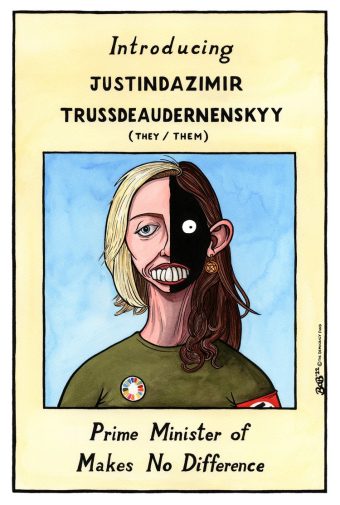 Liz Truss as British Prime Minister does not bode well for peace in the Asia-Pacific region as her stance on foreign policy is quite predictable. During her tenure as Foreign Secretary in Boris Johnson’s cabinet, Liz Truss obviously spoke many times on foreign policy issues, but often in a manner that seemingly appeared she wanted a revival of the British Empire. In fact, the British press called her the most hawkish politician in the Conservative government.
Her so-called toughness is especially evident in her stance towards Russia and China. For Liz Truss, both Russia and China are threats to humanity. Despite having this belief, it is evident that she in fact knows very little about these countries, especially when we consider that she had earlier this year confused Russian regions with Ukrainian territory and even more recently said Ukraine had survived a lot of invasions – “from the Mongols to the Tatars”, without realising Mongols and Tatars are one and the same.
And in this light, it is remembered that a year ago an official British document described China as a “systemic competitor”. With such a view, it is not surprising that London has created a lot of problems in its China policy. The British government condemned Beijing for its human rights violations in its western Xinjiang Autonomous Region, expressed dissatisfaction with Beijing’s “Security Law” for Hong Kong, and even welcomed the visit of American politicians to Taiwan. All of these provocations naturally aggravate Beijing.
This conservative approach could interfere with normal economic and trade relations between the two countries, which are contradictorily important to Britain as China is its third largest trading partner. Rather, by inflating anti-China sentiment, the British government wants to distract people from the country’s massive internal problems: high inflation, rising fuel prices and increasing poverty.
It is clear that Liz Truss will continue the anti-China line of her predecessors. Her newly appointed foreign secretary, James Cleverly, has vowed to take a tough stance on Russia and China.
According to Jonathan Sullivan, director of China programmes at Nottingham University’s Asia Research Institute, Britain’s so-called “pragmatic diplomacy” has lost its reputation.
“In ordinary circumstances, I’d say the new PM would ultimately pursue a more realistic and balanced approach to foreign affairs once in office, but the UK’s reputation for pragmatic diplomacy has taken a battering in recent years,” he said. “Labelling a major trade partner a threat would be a remarkable development, but the fact that it is not totally inconceivable speaks to the uncertainties that exist around Truss and the negative momentum that has built up around UK-China relations.”
None-the-less, it is ridiculous to hear the British talk about a so-called Chinese threat considering the country has not been at war since 1974. Meanwhile, during that period, Britain has battled in the Falklands War, Gulf War, Operation Desert Fox, the invasions of Afghanistan and Iraq, and the Libyan and Syrian wars, among others.
After Brexit, the UK wanted to prove that it was still a great and relevant power without the EU and participate in global processes. One of these points is the South China Sea, where the UK plans to gain a foothold. Under previous Conservative prime ministers, it was expressed that the British Navy needed a regular presence in the South China Sea. They also plan to build UK naval bases in the region, like in Brunei.
So far, there are no permanent bases, but last year the British Navy’s newest and most powerful aircraft carrier, Queen Elizabeth II, sailed through the South China Sea. Certainly, under the Truss government, British warships will patrol these waters only for the sake of provoking China. There is an external reason for this – like the Americans, the British would claim that they are sending their fleet to distant lands to ensure “freedom of navigation” off China.
In addition, the desire to play an important role in the Indo-Pacific region is demonstrated by the UK’s participation in the new military bloc AUKUS, established in September 2021. There is no doubt that the Liz Truss government will continue to commit to its obligations under this alliance with the US and Australia.
All this goes against the vital interests of China and the wider East Asia region. But it is likely that the British prime minister will go in this direction. The question is whether she will be able to achieve her objectives in containing the Rise of China, something that is seemingly unlikely.
It is recalled that only days ago the Indian economy surpassed that of Britain, meaning that the former colonial master has slipped to sixth place in the global GDP ranking, with India rising to fifth place. This also comes as research has found that two-thirds of UK families could be in fuel poverty by January. With compounding economic and societal issues, it appears that Truss will continue in the same mould of Boris Johnson in not dealing with this and instead prioritise the attempt to maintain Britain’s relevancy in the world.
Ahmed Adel is a Cairo-based geopolitics and political economy researcher.
9 Russian planes in Iran to receive maintenance: Minister
Press TV – September 7, 2022
Iran’s transport minister Rostam Qassemi says Russia has commissioned Iranian aviation companies for maintenance tasks on its airplanes.
Qassemi said on Wednesday that nine Russian passenger planes were in Iran to receive maintenance as he touted the technology existing in the Iranian civil aviation sector to carry out overhaul and inspection works on various types of aircraft.
“We have been in a good position in recent months in terms of aircraft maintenance,” said the minister without elaborating on the types of the Russian planes under repair in Iran.
The announcement comes amid reports of close cooperation between Iran and Russia to minimize the impacts of foreign sanctions on their economies.
Russian authorities have declared on several occasions that Moscow has been using the experience of Iranian companies and government agencies in dealing with foreign sanctions.
Iran and Russia have signed major deals in recent months to boost their economic, trade and energy cooperation.
Iran came under an inclusive regime of American sanctions in 2018 after Washington unilaterally withdrew from an international deal on Iran’s nuclear program.
The United States and allies imposed a raft of similar and even tougher sanctions on Russia in February after Moscow launched a military operation in Ukraine.
Experts say US sanctions failed to reach their ultimate objective of forcing Iran into major political and military concessions. They insist the bans even created an opportunity for Iran to diversify its economy away from crude revenues and rely more on its domestic resources.
Russian President Vladimir Putin said on Wednesday during an economic forum in Vladivostok that Russia was gaining from Western sanctions, saying Moscow saw more opportunities in entering markets in the Middle East and Iran after the sanctions were imposed.
Russian economy back on track – Putin
Samizdat – September 7, 2022
The economic situation in Russia has stabilized, President Putin said at a plenary session of the Eastern Economic Forum (EEF) on Wednesday.
“I would like to note that we believe, both in the government and in the presidential administration, our experts believe that the peak, the most difficult period [for the country’s economy], has passed. The situation is normalizing, and macroeconomic indicators speak of this,” Putin said.
The president indicated that this year’s budget will be in surplus, explaining: “Our state finances have stabilized, I want to note that this year’s budget will be drawn up with a surplus of almost half a trillion rubles, somewhere under 485 billion rubles (almost $8 billion), despite all the gloomy forecasts.”
According to the Russian president, annual inflation in the country is on a downward trend. “I think that according to the results for the year, we will have [inflation] somewhere around 12%, and according to many of our experts, in the first quarter or by the second quarter of next year, we will most likely reach the target indicators – 5% or 6%, and some even project that the level of 4% may be in reach,” Putin said.
The government will do everything to support prices and suppress inflation, the Russian president stressed. Putin pointed out that the ruble and financial markets have also stabilized, while the unemployment rate has reached a historic low of less than 4%.
Daesh attacks Embassy in Kabul amid wave of violence against Russians

By Lucas Leiroz | September 7, 2022
The recent attack on the Russian embassy in Kabul was another shocking episode in the current wave of assaults against Russian civilians around the world. Daesh claimed responsibility for the crime, which raises a number of suspicions about possible cooperation between anti-Russian groups abroad, considering the links between Islamic terrorists, Western intelligence and Ukrainian neo-Nazis.
On August 5, the Russian Embassy in Afghanistan was the target of a terrorist attack. A suicide bomber approached the entrance to the Embassy facility and operated the explosion, killing two Russian diplomatic staff’s employees, as well as at least six Afghan citizens who were nearby. The Embassy’s guards even shot down the terrorist, but the action was not fast enough to prevent self-detonation, which culminated in the tragedy. Several people remain hospitalized, and the number of deaths could increase in the coming days.
Although several hostilities against Russians have already taken place in Afghanistan in the past, this is the first time that such an attack has taken place since the Taliban took Kabul, after the American defeat in 2021. According to local sources, Daesh, which is an enemy of the Taliban and has acted intensively in the country to harm the new government, claimed responsibility for the attack. In fact, the incident was characterized by a number of similarities with Daesh’s praxis in other assaults, which would raise suspicions about the group’s involvement even if responsibility had not been assumed.
Russia is one of the few countries to maintain an embassy in Kabul after the Taliban took over the country. Although Moscow still does not officially recognize the Taliban government, Russian diplomats are talking to local authorities in order to advance bilateral negotiations, currently having plans to improve the supply of fuel and other commodities. The Russian government is working to overcome old rivalries with the Taliban and reach a positive agreement for all sides, as the Afghan situation currently appears to be between a stable government with the Taliban or the absolute chaos of the civil war operated by terrorist organizations, such as Daesh. The mere fact of maintaining bilateral dialogue with the de facto government of the Taliban seems to be reason enough for terrorists to target Russian citizens.
However, it would be naive to think that the reasons for this attack are limited to pragmatic Moscow-Kabul relations. If this were the only reason, certainly other episodes of terrorism would have already occurred at the Embassy at other times. There is undoubtedly something specific motivating this violence at this time. The main suspicion is that the attack is related to the publication by the Russian Embassy of a list of names of Afghan citizens who had applied to receive student visas in Russia. But it is possible that there are even more issues involved in this case.
One of the most neglected topics about the Ukrainian conflict is that since 2014 there has been vast cooperation between Kiev’s neo-Nazis and foreign terrorists, including members of Daesh. Many Daesh leaders and fighters migrated to Ukraine, especially after the defeat of terrorists in Syria with the Russian military intervention in 2015. More than that, saboteurs affiliated with the Islamic State and Ukrainian neo-Nazi militias allegedly had already conspired together to carry out terrorist attacks within Russian territory itself, according to FSB data published in 2017.
With the start of the Russian special military operation in Ukraine, the situation may have become more serious. In June, the Syrian government provided Russia with intelligence data proving the collaboration of Western powers and Turkey to send Daesh fighters to Ukraine. There is no precise information on the number of fighters and their identities, but it seems quite evident that Daesh members have been in Ukraine over the last eight years and that they are now continuing there, fighting Russian forces. And that brings up a series of suspicions about what may have happened in Kabul.
Apparently, the attack on the Embassy was just another typical episode of the criminal cowardice that has been seen in the praxis of anti-Russian forces. Saboteurs have operated to kill Russian civilians in various parts of the world. The murder of Daria Dugina in the middle of the Moscow oblast was a clear example of this. In the same vein, what happened in Kabul, whether or not there was foreign participation, seems to be related to this wave of violence against Russian civilian targets.
Deeper investigations are needed to conclude what actually motivated the attack and whether there was participation or sponsorship by Western or Ukrainian groups. However, the main fact is that who attacked the Embassy was Daesh – and Daesh fights Russia in Ukraine.
Lucas Leiroz is a researcher in Social Sciences at the Rural Federal University of Rio de Janeiro; geopolitical consultant.
EU suggests price cap on US LNG
Samizdat – September 7, 2022
Brussels is examining the possibility of a price ceiling on all gas imported into the EU, including liquefied natural gas (LNG), European Commission President Ursula von der Leyen said on Wednesday.
“LNG is scarce and can be rerouted to different regions… We [want to] stay competitive for LNG suppliers but make sure that the prices we pay are not extraordinarily high but in a decent range,” she told reporters. EU countries mostly import the costly LNG from the US and Qatar, using it to diversify gas imports in light of shrinking supplies from Russia. However, some analysts warn that producers might not be eager to supply the fuel to European countries if their profits are capped.
Von der Leyen noted that enacting the proposal is not imminent and that they would be further discussed at a later date.
She did, however, unveil a number of other proposals aimed at tackling the EU’s worsening energy crisis, including a bloc-wide plan to reduce electricity consumption, a price cap on the excess revenues made by companies involved in renewable and nuclear energy, a mechanism to capture the profits that fossil-fuel companies make due to rising prices, a state aid program for utilities businesses, and a price cap on Russian pipeline gas imports.
Commenting on the last of these, she said the mechanism is necessary to “cut Russia’s revenues which Putin uses to finance this atrocious war against Ukraine.” She noted that since Russia launched its military operation in Ukraine, the share of Russian pipeline gas in the EU’s total imports has dropped from 40% to 9%, while Norway has replaced Russia as the bloc’s leading gas supplier.
Featured Video

Death Spikes & Rising Cancer In Our Youth Explained
or go to
Aletho News Archives – Video-Images
From the Archives
Politicians lie
By Mazin Qumsiyeh | Popular Resistance | August 18, 2013
There is no way to say this truth nicely: Politicians lie. That includes Japanese, American, Egyptian, Israeli, and Palestinian politicians! Is there something more common sense than that? Yet, so many citizens around the world believe their own politicians or wistfully acknowledge lies but think it is part of the job needed to run things. They believe even when politicians contradict themselves blatantly. This phenomenon is rather remarkable. It is a dissonance and disconnect from reality that many seem oblivious to. It is very dangerous because it can lead to accepting rationales for going to war. These can be deadly wars that lead to millions of lives lost as happened in what was called World War 1 and WW2. Even when incredible and declassified evidence abound, politicians continue to lie and old mythologies refuse to die. Here are just a few of the countless lies told to us over the past few decades… continue
Blog Roll
 Aletho News
- From Unipolar Universalism to Multipolar Civilizational Distinctiveness
- RSF military group defects, joins Sudanese army: State media
- Ireland goalkeeper refuses to play ‘Israel’ as squad weighs boycott
- China pushes back against US on Cuba, Iran
- Ukrainian Soldiers, Potential Mercenaries: Have Gun, Will Travel!
- Burnham’s UN debut… A masterclass in British disinformation
- Iran flights continue despite US aviation sanctions
- Global Tipping Points Lead the World Into a State of Entropy
- The day-after at the White House: USA and Xi Jinping
- The Geopolitical Balance in the Red Sea: The UAE Being Displaced by New Players
- If Americans Knew
- Deconstructing Netanyahu’s pants-on-fire UN rant – Daily Update
- Trump betrayed voters with his campaign lies and prioritized a foreign country once he took office
- Netanyahu calls Israel’s war in Gaza ‘opposite of genocide’ in UN speech to near-empty hall
- Settler Kidnappings: Torture, Sexual Abuse and Terrorisation of Palestinian Abductees as Israel Deepens Annexation of West Bank
- Gaza winter nears as 162,000 tents become unusable, raising fears of humanitarian crisis
- Netanyahu says, “It’s the opposite of genocide”; UN says Gaza economy is world’s ‘most severe crisis on record’ – Daily Update
- Israel’s US-Backed Assault on Gaza Has Created the ‘World’s Most Severe Economic Crisis on Record’: UN
- ‘Protecting U.S. Citizens’… From Israel
- ‘This is where I live now, the back of a truck’: a day in the life of a grandmother in Gaza
- In UN Speech, Iran’s President Displays Pictures of Children Killed by US, Brings Attention to Israel’s Nuclear Arsenal
- No Tricks Zone
- New Study: Earth And Venus Surface Warmth Largely Explained By Convection And Lapse Rate, Not CO2 Or Radiation
- 2025 Nature Paper Claiming Worsening Global Drought Gets RETRACTED …Heavily Flawed
- New Study: ‘Global Drought Shows No Detectable Recent Acceleration Under Climate Warming’
- Economic Masterminds: German Socialists Suggest Taxing Productivity Gains Stemming From Using AI
- The South China Sea Has Not Been Cooperating With The Climate Change Narrative
- Energy Crisis: Germany Enters Heating Season With Historically Low Gas Reserve Fill Levels
- New Study: The Antarctic Ice Sheet Gained Mass From 2020-2024 Due To Staggering Snow And Ice Accumulation
- Study: Ocean Heating Rates From Thousands Of Years Ago ‘Dwarf’ Modern Ocean Heating Rates
- Climate Extremists Target, Attack Large-Scale Power Grid Infrastructure In Germany!
- New Study: Antarctic Ice Melt Has Contributed Less Than 1 Centimeter To Sea Level Rise In The Last 30 Years

