Russia holds Israel responsible for latest offensive against Gaza
MEMO | August 9, 2022
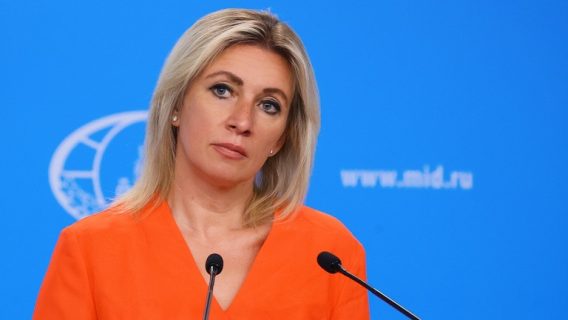
Russia blames Israel for the latest three-day military offensive against the Palestinians in the Gaza Strip, the Foreign Ministry in Moscow has announced.
“The new escalation was caused by the Israeli army firing into the Gaza Strip on 5 August,” said ministry spokesperson Maria Zakharova. She pointed out that the Palestinian factions responded to this escalation by firing rockets indiscriminately towards Israeli territory.
“We are observing with profound worry how events are evolving,” added Zakharova. “The resumption of a full-scale military confrontation [would see the] already deplorable humanitarian situation in Gaza deteriorate further.”
The ministry official reaffirmed Russia’s “principled and consistent position, reflected in the relevant resolutions of the UN General Assembly and the Security Council, in support of a comprehensive and long-term settlement of the Palestinian-Israeli conflict in accordance with the two-state principle.
“It is possible to put an end to cyclical violence only within the framework of the negotiation process, the result of which should be the realisation of the legitimate national rights of the Palestinian people to establish an independent state within the 1967 borders.”
Zakharova’s statements come at a time when relations between Israel and Russia are tense.
Meanwhile, the Ukrainian Ambassador to Israel, Yevgeny Kornichuk, declared his solidarity with the occupation state: “As a Ukrainian whose country is under brutal attack by its neighbour, I feel great sympathy for the Israeli public. An attack against children and women is an abominable thing. Terror and a malicious attack against civilians are the daily reality of Israelis and Ukrainians and this appalling threat must be stopped immediately.”
Kornichuk made his comments before the Egyptian-brokered ceasefire between Gaza and Israel came into effect.
Although the occupation state declared that it was targeting the Palestinian Islamic Jihad movement, the Palestinian Ministry of Health has confirmed that 44 citizens were killed as a result of the Israeli offensive, including 15 children and four women. Another 360 Palestinian civilians were wounded. Moreover, many homes and residential buildings were destroyed.
Russia suspends US inspections of nuclear military sites
Samizdat | August 8, 2022
Moscow has informed Washington of a “temporary withdrawal” from the inspection regime under the START nuclear disarmament treaty, the Russian Foreign Ministry said on Monday. Citing treaty provisions for “exceptional circumstances,” Russia is saying the Western sanctions have prevented its inspectors from performing their duties, thus giving US inspectors an unfair advantage. Once the principle of parity and equality is restored, the inspections will resume, Russia said.
Moscow cited “anti-Russian unilateral restrictive measures” imposed by the US and its allies, such as visa restrictions on Russian inspectors and a ban on Russian aircraft in US and EU airspace. These restrictions effectively make Russian inspections under the treaty impossible, while the Americans “do not experience such difficulties.”
“The Russian Federation is now forced to resort to this measure as a result of Washington’s persistent desire to implicitly achieve a restart of inspection activities on conditions that do not take into account existing realities, create unilateral advantages for the United States and effectively deprive the Russian Federation of the right to carry out inspections on American soil,” the Foreign Ministry said.
Russia “raised this issue with the relevant countries, but did not receive an answer.” Until these problems are resolved, “it would be premature to resume inspection activities under the START Treaty, on which the American side insists.”
As justification for the measure, Moscow cited the relevant section of the treaty protocol that covers extraordinary circumstances. Washington has been officially informed through diplomatic channels.
“We would like to emphasize that the measures we have taken are temporary. Russia is fully committed to complying with all the provisions of the START Treaty, which in our eyes is the most important instrument for maintaining international security and stability,” the Russian Foreign Ministry said.
As soon as the “existing problematic issues” are resolved, the inspections can resume again in full, according to Moscow.
The New Strategic Arms Reduction Treaty (known as New START) went into effect in 2011, and limits the number of nuclear warheads and their delivery vehicles that the US and Russia are allowed to possess. It is the only remaining arms control agreement between the two nuclear powers, after the US withdrawal from the INF and Open Skies treaties in recent years. New START almost expired before it was extended in February 2021, and is supposed to remain in effect until 2026.
Though US President Joe Biden said he had offered Russia talks on a new treaty, which would include China as well, Moscow said last week that it had received only “declarative statements” and not concrete proposals.
Zaporozhye Region Announces Vote on Joining Russia
Samizdat | August 8, 2022
Zaporozhye Region will hold a referendum on whether to secede from Ukraine and request joining Russia, the head of its administration announced on Monday.
Evgeny Balitskiy said that he had signed an order to organize the plebiscite during a regional forum held in the city of Melitopol. Over 700 representatives from various parts of the Ukrainian region approved the idea, according to RIA Novosti.
Earlier comments by administration officials indicated the referendum may be held as soon as mid-September.
Russian forces took partial control of the region during the initial offensive against Ukraine launched in late February. The eponymous city located in the north of the region on the Dnepr River remains under Ukrainian control.
Officials in Kherson Region, another Russia-controlled part of Ukraine, voiced similar plans to put to a vote the proposal of breaking away from Kiev and seeking to join Russia.
Ukrainian President Vladimir Zelensky on Sunday reiterated a warning that if the two regions go through with their plans, Kiev will break off all talks with Russia. Moscow in response suggested that the Ukrainian president should address the citizens of those regions.
“The thing is, this is what the residents of the region plan. It’s not like we [Russia] are holding a referendum. Here, apparently, it is necessary to understand to whom Zelensky is addressing this statement – to the citizens of Ukraine of the mentioned regions or to the citizens of Russia? If it’s to the citizens and leadership of Russia, then we are the wrong address,” Kremlin spokesman Dmitry Peskov commented on Monday.
There have been no peace talks between Russia and Ukraine for months, as Kiev rejected such contacts and claimed it would only negotiate after defeating Russian on the battlefield with the help of Western military aid.
Before the talks broke off, the two nations appeared to have made progress in resolving their differences. During a meeting in Istanbul in late March, Kiev had pledged to become a neutral country and accept restrictions on its military. Moscow said it prepared a draft peace agreement based on those proposals, but Ukraine never responded.
An indirect Russian-Ukrainian deal was mediated last month by the UN and Turkey to allow grain exports from three Ukrainian ports to resume via the Black Sea. The scheme was formalized in two separate agreements that were signed by Russia and Ukraine with the other two parties.
Russia sent troops into Ukraine on February 24, citing Kiev’s failure to implement the Minsk agreements, designed to give the regions of Donetsk and Lugansk special status within the Ukrainian state. The protocols, brokered by Germany and France, were first signed in 2014. Former Ukrainian President Pyotr Poroshenko has since admitted that Kiev’s main goal was to use the ceasefire to buy time and “create powerful armed forces.”
In February 2022, the Kremlin recognized the Donbass republics as independent states and demanded that Ukraine officially declare itself a neutral country that will never join any Western military bloc. Kiev insists the Russian offensive was completely unprovoked.
Russia offers monthly donation of 40,000 tons of wheat for Lebanon
Lebanon has been dealing with bread shortages over recent months, in the latest dilemma to hit the crisis-hit nation
The Cradle | August 6, 2022
The Russian Ambassador to Lebanon, Alexander Rudakov, has reportedly obtained initial approval from Moscow to provide Lebanon with a donation of 40,000 tons of wheat per month until the end of the year.
This deal could be extended past December to help the Levantine nation overcome a worsening food crisis, according to information obtained by Al-Akhbar.
Russia’s offer comes just days after Beirut cleared the Syrian-owned Laodicea vessel to depart the port of Tripoli, despite protests from the Ukrainian embassy, which claimed the ship was carrying “stolen grain.”
However, customs officials revealed to The Cradle that the ship’s grain cargo originated in Russia.
Lebanon’s top prosecutor allowed the ship to leave after revealing Kiev failed to present evidence to back their claim of theft against Russia and Syria.
Before the ship’s release, the Ukrainian embassy offered to retract their claim if Beirut paid them for the Russian grain.
Since 2019, Lebanon has been faced with the dire consequences of a severe economic meltdown.
The situation has pushed over 80 percent of the population below the poverty line and all but wiped out the value of the local currency.
Lebanon used to import as much as 80 percent of its wheat from Ukraine, but since the start of the Russian war, it now faces a major food crisis.
Another factor that limits Lebanon’s wheat supply is the destruction of the country’s grain silos during the Beirut Port blast of 2020 — considered to be the largest non-nuclear explosion in history.
As all of this unfolds inside the country, Lebanon is facing a serious threat of war from Israel; the two nations are mired in a dispute for control of an offshore gas field that could provide billions in revenue.
Sanctions on Russia ‘irresponsible’, adviser to Brazil’s Lula says
Samizdat | August 6, 2022
Celso Amorim, Brazil’s former foreign minister and current foreign policy adviser to presidential frontrunner Luiz Inacio Lula da Silva, has condemned the West’s sanctions on Russia and said that should Lula take office, Brazil would chart a different course.
In an interview with Bloomberg published on Friday, Amorim claimed that the West’s response to Russia’s military operation in Ukraine – sanctions on Russia and billions of dollars worth of weapons for Ukraine – have made nuclear war a real possibility.
“For the first time since the Cuban missile crisis we see articles about the risk of nuclear weapons published on a weekly basis,” he said, arguing that “it’s irresponsible not to seek peace.”
Amorim’s argument mirrors that of Lula himself. Back in May the former Brazilian leader told Time magazine that he sees Ukrainian President Vladimir Zelensky as equally responsible for the conflict in Ukraine, and condemned Washington for encouraging him to oppose Russia.
“The United States has a lot of political clout. And Biden could have avoided [the conflict], not incited it,” Lula argued at the time.
From the perspective of the US, Amorim questioned the logic of driving Russia into a deeper partnership with China, another economic and military rival of America.
“I have nothing against China,” he stated, adding that both are part of the BRICS group, but said that he “can’t understand the interest of the US in strengthening the China-Russia relationship.”
This relationship aside, Amorim told Bloomberg that an economy as large as Russia’s is “too big and strategic” to isolate, and that Lula’s administration would not pursue such policies if the two-term leftist president is elected in October. Speaking to Time in May, Lula said that “many different countries” are having to “foot the bill” for Washington’s hardline anti-Russia policies, and that if he is elected, “Brazil will again become a protagonist on the international stage and we will prove that it’s possible to have a better world.”
Lula is currently polling 11 points ahead of incumbent President Jair Bolsonaro, according to an aggregate compiled by the US-based Americas Society. Should he triumph in October, Amorim will likely be influential in setting his administration’s foreign policy, having served as Brazil’s foreign minister during Lula’s two terms in office from 2003 until 2010.
Bolsonaro has not followed the US’ lead on Ukraine either. Despite Brazil voting in the UN General Assembly to condemn Russia over the conflict, the president has refused to sanction Moscow and announced his intention to keep purchasing fertilizer from Russia and sign a new deal to import Russian diesel.
Like Lula, Bolsonaro also partly blamed Kiev for the conflict. Ukrainians, he said in February, had “trusted a comedian with the fate of a nation,” referring to Zelensky.
The Intricate Fight for Africa: the Legacy of the Soviet Union vs. Western Colonialism
By Ramzy Baroud | MEMO | August 6, 2022
Russian Foreign Minister Sergey Lavrov’s recent tour in Africa was meant to be a game changer, not only in terms of Russia’s relations with the continent, but in the global power struggle involving the US, Europe, China, India, Turkiye and others.
Many media reports and analyses placed Lavrov’s visit to Egypt, the Republic of Congo, Uganda and Ethiopia within the obvious political context of the Russia-Ukraine war. The British Guardian’s Jason Burka summed up Lavrov’s visit in these words: “Lavrov is seeking to convince African leaders and, to a much lesser extent, ordinary people that Moscow cannot be blamed either for the conflict or the food crisis.”
Though true, there is more at stake.
Africa’s importance to the geostrategic tug of war is not a new phenomenon. Western governments, think tanks and media reports have, for long, allocated much attention to Africa due to China’s and Russia’s successes in altering the foreign policy map of many African countries. For years, the West has been playing catch up, but with limited success.
The Economist discussed ‘the new scramble for Africa’ in a May 2019 article, which reported on “governments and businesses from all around the world” who are “rushing” to the continent in search of “vast opportunities” awaiting them there. Between 2010 and 2016, 320 foreign embassies were opened in Africa which, according to the magazine, is “probably the biggest embassy-building boom, anywhere, ever.”
Though China has often been portrayed as a country seeking economic opportunities only, the nature and evolution of Beijing’s relations with Africa prove otherwise. Beijing is reportedly the biggest supplier of arms to sub-Saharan Africa, and its defence technology permeates almost the entire continent. In 2017, China established its first military base in Djibouti in the Horn of Africa.
Russia’s military influence in Africa is also growing exponentially, and Moscow’s power is challenging that of France, the US and others in various strategic spaces, mainly in the East Africa regions.
But, unlike the US and other western states, countries like China, Russia and India have been cautious as they attempt to strike the perfect balance between military engagement, economic development and political language.
Quartz Africa reported that trade between Africa and China “rose to a record high” in 2021. The jump was massive: 35 per cent between 2020 and 2021, reaching a total of $254 billion.
Now that Covid-19 restrictions have been largely lifted, trade between Africa and China is likely to soar to astronomical levels in the coming years. Keeping in mind the economic slump and potential recession in the West, Beijing’s economic expansion is unlikely to slow down, despite the obvious frustration of Washington, London and Brussels. It ought to be said that China is already Africa’s largest trade partner, and by far.
Russia-China-Africa’s strong ties are paying dividends on the international stage. Nearly half of the abstentions in the vote on United Nations Resolution ES-11/1 on 2 March, condemning Russia’s military action in Ukraine, came from Africa alone. Eritrea voted against it. This attests to Russia’s ability to foster new alliances on the continent. It also demonstrates the influence of China – Russia’s main ally in the current geopolitical tussle – as well.
Yet, there is more to Africa’s position than mere interest in military hardware and trade expansion. History is most critical.
In the first ‘scramble for Africa’, Europe sliced up and divided the continent into colonies and areas of influence. The exploitation and brutalisation that followed remain one of the most sordid chapters in modern human history.
What the Economist refers to as the ‘second scramble for Africa’ during the Cold War era was the Soviet Union’s attempt to demolish the existing colonial and neo-colonial paradigms established by western countries throughout the centuries.
The collapse of the Soviet Union over three decades ago changed this dynamic, resulting in an inevitable Russian retreat and the return to the uncontested western dominance. That status quo did not last for long, however, as China and, eventually, Russia, India, Turkiye, Arab countries and others began challenging western supremacy.
Lavrov and his African counterparts fully understand this context. Though Russia is no longer a Communist state, Lavrov was keen on referencing the Soviet era, thus the unique rapport Moscow has with Africa, in his speeches. For example, ahead of his visit to Congo, Lavrov said in an interview that Russia had “long-standing good relations with Africa since the days of the Soviet Union.”
Such language cannot be simply designated as opportunistic or merely compelled by political urgency. It is part of a complex discourse and rooted superstructure, indicating that Moscow – along with Beijing – is preparing for a long-term geopolitical confrontation in Africa.
Considering the West’s harrowing colonial past, and Russia’s historic association with various liberation movements on the continent, many African states, intelligentsias and ordinary people are eager to break free from the grip of western hegemony.
Russia reacts to Biden’s remarks on nuclear talks
Samizdat | August 6, 2022
Russia has not received any concrete proposals to resume talks on replacing the landmark New START (Strategic Arms Reduction Treaty), despite recent remarks by US President Joe Biden on the matter, a senior Russian diplomat said on Friday. He also signaled that the negotiations should be held without any preconditions.
“Saying that you’re ready doesn’t mean you are,” the deputy head of Moscow’s delegation to the UN Non-Proliferation Treaty (NPT) review conference, Andrey Belousov, told reporters.
According to the diplomat, a real commitment to resume dialogue with Russia “should be supported by concrete proposals, concrete signals” that Moscow could view as a firm decision on the part of the US to “resume close cooperation with Russia on a wide range of issues of strategic stability.”
“At the moment, we are not receiving such signals, except for these declarative statements, including those coming from the highest level,” he added.
Belousov noted that the timing of the US statements on arms control should also be taken into account.
“It is clear that the timing was chosen on purpose. The statement by the US president was made before the Conference [on the Non-Proliferation of Nuclear Weapons] intentionally to show that the US is still a state you can cooperate with and which is ready to engage in dialogue,” the Russian representative said.
According to Belousov, Moscow does not think that the US is ready for constructive talks on the New START treaty that would accommodate the interests of all parties, at least not at this stage. He also noted that Russia views the preliminary conditions for the dialogue set by Washington as “unacceptable.”
“The statement by the US president, which, as we believe, reflects a softening of the US stance on resuming dialogue with Russia on a wide range of issues of strategic stability, is linked to some sort of a preliminary condition,” Belousov said, adding that it has not been formulated in black and white, but rather looks like a hint.
The high-ranking diplomat recalled that previous statements on the matter were “more specific and understandable.”
“There were specific conditions under which the United States would agree to resume this dialogue with us,” he said. “But in any case, no matter how these preconditions are phrased, we deem them unacceptable.”
The diplomat echoed comments made by Russian Foreign Minister Sergey Lavrov, who said on Wednesday that the US had not made any “requests on reopening this negotiating process.” The West, he said at the time, “has developed a habit of making announcements on the microphone and then forgetting about them.”
Earlier this month, Biden revealed that Washington was ready to negotiate “a new arms control framework” with Russia that could potentially replace the New START treaty when it expires in 2026. The landmark document, which entered into force in 2011 and was extended in 2021 after Biden’s inauguration, puts caps on the number of strategic nuclear missiles and warheads held by Russia and the US.
The US keeps reneging on arms control agreements, so why should Russia trust Joe Biden’s latest overtures?
By Scott Ritter | Samizdat | August 6, 2022
This week, in an address to the Tenth Review Conference for the Treaty on the Non-Proliferation of Nuclear Weapons – which had convened at the United Nations Headquarters in New York – US President Joe Biden made a forceful appeal to Russia regarding the need to resume arms control talks. “Today,” Biden said, “my Administration is ready to expeditiously negotiate a new arms control framework to replace New START when it expires in 2026.” But, he added, “negotiation requires a willing partner operating in good faith. And Russia’s brutal and unprovoked aggression in Ukraine has shattered peace in Europe and constitutes an attack on the fundamental tenets of international order. In this context, Russia should demonstrate that it is ready to resume work on nuclear arms control with the United States.”
Biden has made arms control a central theme in his dealings with Russia. Indeed, one of his first major acts as president was to sign on to a five-year extension of the Obama-era New START treaty, which had been allowed to languish under the Trump administration. “Extending the New START Treaty,” Secretary of State, Antony Blinken, declared in a press release issued at the time, “ensures we have verifiable limits on Russian ICBMs, SLBMs, and heavy bombers until February 5, 2026. The New START Treaty’s verification regime,” Blinken noted, “enables us to monitor Russian compliance with the treaty and provides us with greater insight into Russia’s nuclear posture, including through data exchanges and onsite inspections that allow US inspectors to have eyes on Russian nuclear forces and facilities.”
Blinken then added a critical statement. “The United States,” he declared, “has assessed the Russian Federation to be in compliance with its New START Treaty obligations every year since the treaty entered into force in 2011.”
Unfortunately, Russia cannot say the same about the US. Since 2018, Russia has accused the United States of “converting a certain number of Trident II SLBM launchers and В-52Н heavy bombers, in the way that the Russian Federation cannot confirm that these strategic arms have been rendered incapable of employing SLBMs or nuclear armaments for heavy bombers.” The bottom line is that America accomplished its conversions in a manner which allowed them to be easily reversed, something Russia believed circumvented the intent of New START, which was the permanent reduction of each side’s nuclear arsenals.
The US rejected the Russian allegation, noting that New START does not explicitly require the conversions on either the Trident II SLBM launchers or the B-52H bombers to be irreversible. As long as the treaty was in force, the US contended, Russia could use its inspection provisions to verify that the goal of “rendering incapable” was still in place. The Russians, with reason, believe that the US position violated both the spirit and intent of treaty, a position which carried over into the extension of New START.
But Russia’s problems with America’s compliance are just one of the issues when it comes to judging whether to trust Washington’s good faith on arms control overall. The US has walked away from three foundational treaties in the past two decades – the anti-ballistic missile (ABM) treaty in 2002, the intermediate-range nuclear forces (INF) treaty in 2019, and the Open Skies Treaty in 2020. Likewise, America’s intransigence over fairly adapting the conventional forces in Europe (CFE) treaty to reflect post-Cold War realities led to its demise. New START is the last man standing when it comes to arms control accords between Russia and the US.
Biden tried to further strategic arms control with Russia, discussing the matter with President Vladimir Putin during their Geneva Summit in June 2021. The two leaders agreed to pursue “an integrated bilateral Strategic Stability Dialogue” that would “seek to lay the groundwork for future arms control and risk reduction measures.” Indeed, two such meetings were on July 28 and September 30, 2021. Following the conclusion of the second round of talks, the negotiators agreed to “form two interagency expert working groups” covering the “Principles and Objectives for Future Arms Control” and the “Capabilities and Actions with Strategic Effects.”
But then came the crisis in Ukraine, and the talks gave way to the issue of security guarantees demanded by Russia in the face of NATO expansion, which threatened to bring Ukraine into the fold of the trans-Atlantic military bloc. In direct talks with the US, NATO and the OSCE in January 2022, Russia was repeatedly rebuffed in its efforts to negotiate a new European security framework that considered its national security interests, setting in motion the conditions that resulted in Russia initiating its Special Military Operation in Ukraine, prompting President Biden to terminate the strategic stability dialogue, an action which essentially froze US-Russian relations, at least in the arms control field.
Biden’s announcement on restarting talks with Moscow took the Russian foreign minister, Sergei Lavrov, by surprise. “No requests on reopening this negotiating process have been made,” Lavrov announced during a press conference in Myanmar, adding that the West “has developed a habit of making announcements on the microphone and then forgetting about them.”
Regardless of the lack of any prior notice on the part of the US, Russia announced that it was ready to engage in arms control talks at any time, the sooner the better. Kremlin spokesperson, Dmitry Peskov, during a conference call with the media, declared that “Moscow has repeatedly spoken about the necessity to start such talks as soon as possible as there is little time left.” If the New START treaty expired without a replacement, Peskov said, “it will negatively impact global security and stability, primarily in the area of arms control.” For this reason, Peskov noted, “We [Russia] have called for an early launch of talks, but until that moment it has been the US that has shown no interest in substantive contacts on the issue.”
Peskov further emphasized that negotiations on a new arms control pact can only be held “on the basis of mutual respect and taking into account mutual concerns.”
Washington’s push for talks with Moscow, however, appear to be little more than an effort to get Russia to negotiate away the advantage in strategic nuclear weapons delivery systems that it has accrued in recent years through the development of weapons such as the Sarmat heavy intercontinental ballistic missile (ICBM) and the Avangard hypersonic re-entry vehicle. In this way, the US would have Russia walk away from new systems which cost billions of dollars to develop and field, while the US would only be called upon to give up a handful which have not yet been fully tested and deployed (the US is poised to spend hundreds of billions of dollars in the coming years to replace the Minuteman III ICBM, B-2 bomber, and Ohio-class submarine with a new missile (the “Sentinel”), a new bomber (the B-21), and a new submarine (the “Columbia” class). The high cost of these new weapons is likely to become an issue in a tightening economic environment, which may explain Biden’s push for fresh negotiations.
The current US approach to arms control negotiations appears to be one-sided in nature, premised on sacrificing existing Russian capacity for future American systems which are currently under development. In addition to this, the US has a poor track record when it comes to either treaty compliance (the ongoing controversy over New START verification of Trident and B-52 conversions comes to mind), or treaty adherence (the US withdrawals from the ABM treaty, the INF treaty, and the Open Skies treaty serve as an historical precedent).
The US approach ignores the fundamental approach taken by Russia when it comes to arms control – that any such negotiations must take place as part of a comprehensive restructuring of existing security frameworks that fully integrate Moscow’s legitimate national security concerns. This includes issues pertaining to missile defense (including the two US facilities in Poland and Romania), intermediate nuclear forces (a ban on the deployment of such systems on European soil), and non-strategic nuclear weapons (the US stockpile of B-61 bombs currently stored in Europe, and releasable to non-nuclear NATO members during any potential conflict.)
The White House has flipped the script when it comes to advancing the cause of arms control. Former US President Ronald Reagan appropriated a Russian saying– “Trust but Verify”– when discussing his approach to implementing the groundbreaking INF treaty back in 1987. At that time, the “trust” was assumed, and the focus was on constructing appropriate verification regimes to ensure treaty compliance.
Today, there is no trust between Russia and the US, primarily because of the dismissive manner which the Biden administration has treated the issue of Moscow’s concerns over European security that has been inexorably linked to aggressive NATO expansion. But the abysmal track record of the US under existing and past arms control agreements must also be considered. Even if Biden were willing to consider Russia’s concerns, the question that must be answered for Russia is whether the Americans can be fully trusted as a partner in disarmament.
As things stand today, the answer to this question is, sadly, ‘No.’
US is Willing to Sell Weapons to Turkey Only with Strings Attached
By Vladimir Platov – New Eastern Outlook – 05.08.2022
Turkish National Defense Minister Hulusi Akar, while answering questions from Anadolu agency journalists, announced negotiations with the United States on the purchase of F-16s to be held on August 15. As the readers may recall, earlier Ankara requested from Washington 40 F-16 fighters of the Block-70 version and 80 modernization kits for the F-16 aircraft of previous modifications already in service with the Turkish Air Force. The desire to purchase additional F-16s was voiced by Ankara after Turkey was excluded from the American program for the production of fifth-generation F-35 fighters due to the rapprochement between Turkey and Russia.
Washington has, for a number of years now, been putting on the back burner this issue of Turkey’s modernization of its Air Force by purchasing new models of American combat aircraft, under the pretext that five years ago Ankara acquired the Russian S-400 air defense system, instead of the American Patriot missile system, despite the United States’ imperative demands not to do so and the threat of sanctions.
However, note that Turkey’s position on the procurement of the S-400 was not hasty and had a clear justification from Ankara.
Initially, Turkey actually intended to acquire the American Patriots, but the deal was disrupted twice (in 2013 and 2017) because Washington refused to provide Ankara with secret technologies related to the production of this system. In addition, the United States burdened this deal with a number of restrictions and demands, in particular, on provision of full information about each shot and the tasks of the complexes. Furthermore, the service life of Patriot systems was also limited by Turkey’s obligation to return them to the US army after its expiration and purchase new ones. Turkey deemed these demands to be non-starters. Besides, the Russian S-400s were almost twice as cheap as the American Patriots, and more advanced.
But there was another reason, namely, Erdoğan’s lack of confidence in the truth of Washington’s “friendly attitude towards him.” The validity of such suspicions was confirmed, in particular, by the events of the summer of 2016, when a coup was attempted in Turkey. The helicopters attacking Erdoğan’s presidential palace in Ankara belonged to the NATO command and took off from the Incirlik air base in Turkey controlled by the United States and NATO. At the same time, Turkey’s air defense could not protect Erdoğan using Patriot systems, which the United States had withdrawn from this country shortly before. No less suspicious is the fact that no NATO country came to the aid of the Turkish president, and that in a series of many attempts at military coups in Turkey’s history, the United States has always been behind them clearly pursuing its goals and objectives with regard to Turkey.
As a result, Erdoğan preferred the Russian S-400 air defense system to the American Patriots, thus gravely complicating relations with Washington. The anti-Turkish sentiments in the United States manifested themselves, in particular, in the freezing in 2020 by four key members of the US Congress of all major sales of American weapons to Turkey, in an attempt to strengthen the American pressure on Erdoğan.
This pressure continues to this day. For example, last month, the House of Representatives of the US Congress approved the amendment proposed by Democrat Chris Pappas (representing the state of New Hampshire) prohibiting the US administration from selling to Turkey or issuing an export permit for new F-16 aircraft or components until the US President provides Congress with confirmation that such a transfer of equipment meets the national interests of the United States. In addition, taking into account Washington’s recent reorientation towards supporting Greece in the Eastern Mediterranean instead of Turkey, the White House, according to this amendment, must provide confirmation that F-16s will not be used by Turkey to the detriment of Greece.
The same month, the Chairman of the US Senate Foreign Affairs Committee, Robert Menendez, went even further in setting conditions for Ankara, by demanding that Turkey sever relations with Russia for the purchase of F-16 fighter jets, since Washington intends to sell its military equipment only to those countries that “share the values of the United States.”
This pressure from Washington was met in Ankara very critically and the prevailing mood among the Turks on this issue was fully reflected by the Turkish television TRT Haber, which stressed that Ankara does not accept any conditions when purchasing F-16s from the United States. At the same time, it was clarified that at the upcoming negotiations with the United States on August 15, issues of strategic partnership between the two countries will be discussed, “Turkey’s theses will be clarified, and it will be emphasized that sales under conditions are unacceptable.”
At the same time, Turkish National Defense Minister Hulusi Akar announced the possibility of new alternatives and solutions in the event of a failure of negotiations with the United States on the purchase of F-16 fighters. He clearly hinted that Turkey’s multifaceted relations with Russia, which have recently been developing quite favorably, also include joint work on the creation of a new generation military aircraft common to the two countries on the basis of the Russian Su-57 jet.
Ankara’s harsh reaction to Washington’s preliminary demands for the development of US-Turkish military cooperation can also be explained by the fact that the latest US anti-Turkish sanctions also affected Ismail Demir, one of the main Turkish functionaries in the field of national security. He was put on the sanctions list because of his participation in purchasing Russian S-400s, and now it was he who very harshly warned Washington that if the United States refuse to sell the F-16s, Turkey would turn to Russia again, this time to buy advanced aircraft. In particular, Ismail Demir, who heads the country’s Defense Industry Department, earlier announced on Turkish Kanal 7 that Turkey can buy Su-35 and Su-57 fighter jets from Russia if the United States refuses to sell F-16 aircraft to Ankara.
‘US-led effort to isolate Russia failed’
Samizdat – August 5, 2022
The US-led drive to isolate Russia through sanctions has not succeeded, as half the countries in the Group of Twenty leading global economies refused to sign on, Bloomberg reported on Friday.
According to the publication, senior officials from leading Western nations are surprised by the lack of support within the wider G20, despite their efforts to make the case for restrictions against Russia.
Argentina, Brazil, China, India, Indonesia, Mexico, Saudi Arabia, South Africa, and Turkey have not joined the sanctions that were adopted by the US, UK, EU, and their allies Australia, Canada, Japan, and South Korea. Some nations, like China and South Africa, have openly criticized the restrictions. The G20 nations account for around 85% of global economic output.
According to Bloomberg, the reasons for the lack of support include strong trade ties, historical affinities to Moscow, and a distrust of former colonial powers.
Russia calls for reform of UN Security Council
Samizdat | August 3, 2022
The United Nations is in dire need of reform and the Security council must be “democratized” by expanding its representation, Russian foreign ministry official Alexey Drobinin has written in a keynote article published on Wednesday.
Drobinin, the Director of the Department of Foreign Policy Planning, commented on the current state of international relations and came to the conclusion that “more conscious effort and imagination is needed” to reform the UN.
He pointed out that the organization’s current agenda, which is primarily fueled by the West, is not necessarily in line with the interests of the majority of its international members.
Drobinin suggested that for most UN members the most important issues are things like access to cheap energy sources rather than the transition to “green” technologies, socio-economic development rather than human rights “in an ultra-liberal interpretation,” and security and sovereign equality rather than the artificial imposition of electoral democracy according to Western patterns.
He added that another topic that has once-again become relevant is the process of decolonization and ending the neo-colonial practices by transnational corporations in regards to the development of natural resources in developing countries.
However, international organizations such as the UN have essentially been “privatized” by the West, Drobinin points out. He suggests that the UN Secretariat and the offices of special envoys and special representatives of the Secretary General have all been saturated with the West’s own “tested” personnel, and that this also extended to non-UN organizations as well, such as the OPCW.
“The saddest thing is that this rust is eating away at the ‘holy of holies’ of the UN system – the Security Council,” Drobinin writes. “It devalues the meaning of the right of veto, which the founding fathers endowed to the permanent members of the Security Council with one single purpose: to prevent the interests of any of the great powers from being infringed, and thus save the world from a direct clash between them, which in the nuclear age is fraught with catastrophic consequences.”
While there are no “clear and simple recipes for correcting the situation here,” the diplomat continues, “clearly more conscious effort and imagination is needed when it comes to UN reform.” He goes on to suggest that the Security Council needs to be “democratized,” first of all by expanding the representation of African, Asian and Latin American countries.
Drobinin suggests that whatever the fate of international organizations such as the UN, WTO, IMF, World Bank or G20 is, the divisive policies of the West makes it “an absolute imperative for the coming years to form a new infrastructure of international relations.”
“After their frankly perfidious decisions and actions against Russia, its citizens and tangible assets, we simply cannot afford the luxury of not thinking about alternatives. Especially since many of our friends who have lost faith in Western benevolence and decency are thinking about the same thing,” the diplomat surmised.
Featured Video

Death Spikes & Rising Cancer In Our Youth Explained
or go to
Aletho News Archives – Video-Images
From the Archives
Politicians lie
By Mazin Qumsiyeh | Popular Resistance | August 18, 2013
There is no way to say this truth nicely: Politicians lie. That includes Japanese, American, Egyptian, Israeli, and Palestinian politicians! Is there something more common sense than that? Yet, so many citizens around the world believe their own politicians or wistfully acknowledge lies but think it is part of the job needed to run things. They believe even when politicians contradict themselves blatantly. This phenomenon is rather remarkable. It is a dissonance and disconnect from reality that many seem oblivious to. It is very dangerous because it can lead to accepting rationales for going to war. These can be deadly wars that lead to millions of lives lost as happened in what was called World War 1 and WW2. Even when incredible and declassified evidence abound, politicians continue to lie and old mythologies refuse to die. Here are just a few of the countless lies told to us over the past few decades… continue
Blog Roll
 Aletho News
- From Unipolar Universalism to Multipolar Civilizational Distinctiveness
- RSF military group defects, joins Sudanese army: State media
- Ireland goalkeeper refuses to play ‘Israel’ as squad weighs boycott
- China pushes back against US on Cuba, Iran
- Ukrainian Soldiers, Potential Mercenaries: Have Gun, Will Travel!
- Burnham’s UN debut… A masterclass in British disinformation
- Iran flights continue despite US aviation sanctions
- Global Tipping Points Lead the World Into a State of Entropy
- The day-after at the White House: USA and Xi Jinping
- The Geopolitical Balance in the Red Sea: The UAE Being Displaced by New Players
- If Americans Knew
- Deconstructing Netanyahu’s pants-on-fire UN rant – Daily Update
- Trump betrayed voters with his campaign lies and prioritized a foreign country once he took office
- Netanyahu calls Israel’s war in Gaza ‘opposite of genocide’ in UN speech to near-empty hall
- Settler Kidnappings: Torture, Sexual Abuse and Terrorisation of Palestinian Abductees as Israel Deepens Annexation of West Bank
- Gaza winter nears as 162,000 tents become unusable, raising fears of humanitarian crisis
- Netanyahu says, “It’s the opposite of genocide”; UN says Gaza economy is world’s ‘most severe crisis on record’ – Daily Update
- Israel’s US-Backed Assault on Gaza Has Created the ‘World’s Most Severe Economic Crisis on Record’: UN
- ‘Protecting U.S. Citizens’… From Israel
- ‘This is where I live now, the back of a truck’: a day in the life of a grandmother in Gaza
- In UN Speech, Iran’s President Displays Pictures of Children Killed by US, Brings Attention to Israel’s Nuclear Arsenal
- No Tricks Zone
- New Study: Earth And Venus Surface Warmth Largely Explained By Convection And Lapse Rate, Not CO2 Or Radiation
- 2025 Nature Paper Claiming Worsening Global Drought Gets RETRACTED …Heavily Flawed
- New Study: ‘Global Drought Shows No Detectable Recent Acceleration Under Climate Warming’
- Economic Masterminds: German Socialists Suggest Taxing Productivity Gains Stemming From Using AI
- The South China Sea Has Not Been Cooperating With The Climate Change Narrative
- Energy Crisis: Germany Enters Heating Season With Historically Low Gas Reserve Fill Levels
- New Study: The Antarctic Ice Sheet Gained Mass From 2020-2024 Due To Staggering Snow And Ice Accumulation
- Study: Ocean Heating Rates From Thousands Of Years Ago ‘Dwarf’ Modern Ocean Heating Rates
- Climate Extremists Target, Attack Large-Scale Power Grid Infrastructure In Germany!
- New Study: Antarctic Ice Melt Has Contributed Less Than 1 Centimeter To Sea Level Rise In The Last 30 Years

