Iran and SCO sign protocol to start accession process for Tehran
Press TV – March 12, 2022
Iran and the Shanghai Cooperation Organization (SCO) have started a formal process for Tehran’s accession to the major economic bloc.
A Saturday report by Iran’s IRIB News said that a document had been signed a day earlier in the Uzbek capital of Tashkent between representatives of the eight-member SCO and Iran to allow the organization to consider Iran’s accession bid.
Uzbekistan’s Foreign Ministry said in a statement that the signing of the protocol would practically allow the implementation of decision by SCO heads of state in Tajikistan last year to provide membership to Iran.
The next step in the process will be for Iran to sign a memorandum of commitment at an SCO summit in Uzbekistan’s Samarkand in September 2022, said the statement, adding that SCO heads of states will then decide to include Iran in the bloc.
Iran was an observer member of the SCO before applying to join the bloc that includes Russia, China, India, Kazakhstan, Kyrgyzstan, Pakistan, Tajikistan and Uzbekistan.
Experts says Iran’s accession to the SCO will be a major boost to the bloc’s influence in the region mainly because Iran’s massive transportation network can facilitate regional and international trade.
Iran is also expected to benefit economically from membership in the bloc. The Iranian customs office (IRICA) said on Saturday that Iranian exports to SCO members had increased by 41% year on year in the 11 months to late February to reach nearly $18.3 billion.
IRICA figures showed that Iran had imported $14.4 billion worth of goods from the SCO countries between March 2021 and February 2022, an increase of 31% against the previous similar period.
Georgia and NATO announce joint exercises
RT | March 12, 2022
Joint NATO-Georgia IT-based exercises will be conducted from March 20 to 25, the Georgian ministry of defense announced on Saturday.
The exercises, which have been planned since 2020, will take place in the Georgia-NATO Joint Training and Evaluation Center (JTEC) with representatives of 23 NATO member states set to take part.
“The exercises will help increase interoperability between the military of Georgia and NATO member and partner countries,” the Defense Ministry said in a statement.
It specified that the goal of the upcoming exercises would be to develop the skills necessary for planning operations by using computer simulations, as well as to share knowledge and experience.
The exercises would be the third of their type held since 2016 and are a part of the Substantial NATO-Georgia Package, which was approved at the 2014 Wales Summit.
In 2008, in the Bucharest Summit Declaration the alliance announced that NATO welcomed “Ukraine’s and Georgia’s Euro-Atlantic aspirations for membership in NATO.” The summit participants agreed that eventually these countries would “become members of NATO.”
This decision was condemned by Moscow which consistently opposed NATO’s expansion to Russia’s borders.
The possibility of Ukraine becoming a member of the bloc has been one of the reasons for Russia’s ongoing military offensive, despite numerous assurances from NATO that neither Ukraine’s and Georgia’s memberships are currently on its agenda.
Moscow rejects Washington’s chemical-weapons claim
RT | March 12, 2022
Russia’s ambassador to Washington accused the Americans on Saturday of trying to “demonize” Moscow, rejecting a US State Department allegation that his country may deploy chemical weapons in Ukraine.
“The US official, as always, did not bother to provide any evidence. This is another attempt to demonize our country,” Anatoly Antonov said, adding that such claims were “not worth a penny.”
Citing a paper from Russia’s Ministry of Foreign Affairs, the official then suggested that Ukrainian “radical groups” – allegedly “[trained] under the control of the representatives of American special services” – could have themselves “prepared several potential scenarios of the use of toxic chemicals in order to carry out various types of provocations.”
“Our country, unlike the United States, eliminated all available stocks of chemical warfare agents in 2017. This fact has been documented by the OPCW. It is pointless to argue with this fact,” Antonov concluded, in reference to the fact that US chemical warfare stockpiles have yet to be completely decommissioned.
The Russian government has claimed that Ukrainian groups backed by the US could be preparing a false-flag chemical attack in order to “accuse Russia of the use of chemical weapons against the civil population and violating its obligations.” The US and Ukraine have denied such claims.
State Department spokesperson Ned Price suggested on Wednesday that Russia could use chemical weapons in Ukraine.
“Russia has a track record of accusing the West of the very crimes that Russia itself is perpetrating,” he said, calling Moscow’s warnings “an obvious ploy.”
White House Press Secretary Jen Psaki claimed this week that Russia could “use chemical or biological weapons in Ukraine” or “create a false-flag operation” with such weapons. Psaki added that the world should “be on the lookout.”
Psaki dismissed Moscow’s suggestions that the US and Ukraine could conduct a similar false-flag attack, calling them “false claims” and “conspiracy theories.”
The press secretary argued that Moscow’s claims were an “obvious ploy” to justify further military action in Ukraine.
Russia’s Foreign Ministry claimed on March 6 that Russian forces had discovered evidence of Ukraine erasing traces of an alleged US-backed military biological program in the country. Washington has claimed it is working to prevent Russian forces from capturing biological research material.
Much wants more and loses all
GEFIRA | March 11, 2022
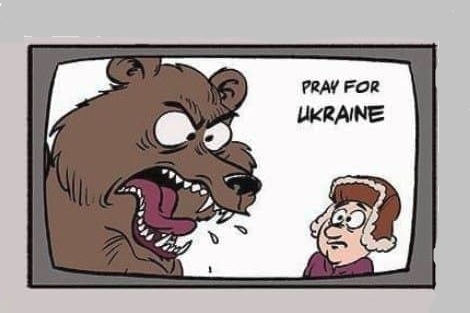 The collective post-West has been running amok for the last two weeks. The powers that be make believe that they did not expect that events would unfold the way they are unfolding now (though they did their best to make things happen as they are happening) and they make a show imposing sanctions on the aggressor and assuring the populace that the aggressor sooner or later will cave in. There is yet a third aspect to the phenomenon: the same powers that be want the people to forget that merely twenty years back they themselves assaulted Yugoslavia/Serbia, used missiles with depleted uranium, bombed cities and shot at civilians. Of course, that earlier event was a humanitarian action while the current one is a brutal act of aggression, but we digress.
Now there is a big misconception on the part of the post-West about Russia. If the Western media claim the Russian people are against the war or that the Russian people are about to rebel and overthrow President Putin, then they are either delusional or lying through their teeth. Reality is something that refuses to obey our wishes. The Russian people have rallied around their president and their authorities; the Russian people – unlike citizens of the post-Western countries – are patriotic and ready to sacrifice themselves in defence of their fatherland. Western sanctions? The post-West may withdraw businesses and impose sanctions on Russian oligarchs, which is music to the ears of the Russian people. They resented Western dominance anyway and they will be more than happy to see the oligarchs mopped up from their society. Russians view the hostilities as a repeat of the Great Patriotic War of 1941-1945. Contrary to what has been done to the Western collective mentality, the Russian authorities under Vladimir Putin took great efforts to raise Russia’s citizens in patriotic values. Russians are going to win because they do not care about money so much as the West does. That’s one big misconception that Western people have about their opponents from the East.
It is the West that cannot imagine a life without money and the resultant luxuries. Sanctions or no sanctions, Western companies will sooner or later (I bet: sooner) resume business with Russia because – as everybody in the West knows – “money makes the world go round”. No less a person than Comrade Lenin famously said: capitalists will sell us the rope with which we will make a noose to hang them. And so they will, make no bones about it.
Yes, the West is ready to go to war with Russia so long as it has… Ukrainian, Polish, Romanian, Lithuanian, Latvian or Estonian soldiers at its disposal. The moment the West runs out of those soldiers, its leaders will go back to the negotiating table with the Kremlin. Do you want any evidence? Here you are.
A few days ago Americans tried to set Poland against Russia in that they suggested to Warsaw that it send Soviet-made MiG aircraft to Ukraine. Though the Polish authorities usually oblige the West’s wishes, this time they had second thoughts about the proposal and replied that they were ready to send the said aircraft to the American air base in Rammstein so that Americans could pass them over to Kiev. And you know what? Washington was beside itself with annoyance! You see? The dog was expected to bite the bear, with the dog’s owner watching from the sidelines and biding his time.
Just picture it to yourself. Warsaw sends the MiG aircraft to Ukraine, Moscow regards it (and rightly so!) as a hostile act and fires a couple of missiles against selected targets in Polish territory. What do you think the West would do? Yes, you guessed it right. The West would express its great indignation and impose a set of new sanctions… for a time.
Talking about President Putin, who – according to the Western analysts is about to be toppled either by the people closest to him or by the nation – his Christian name is Vladimir, and Vladimir was the name of the grand prince of Rus’ who united the many Slavic tribes and christened them. He went down in history as Vladimir the Great. The chances are – whether you like it or not – that Putin is going to be another Vladimir the Great.
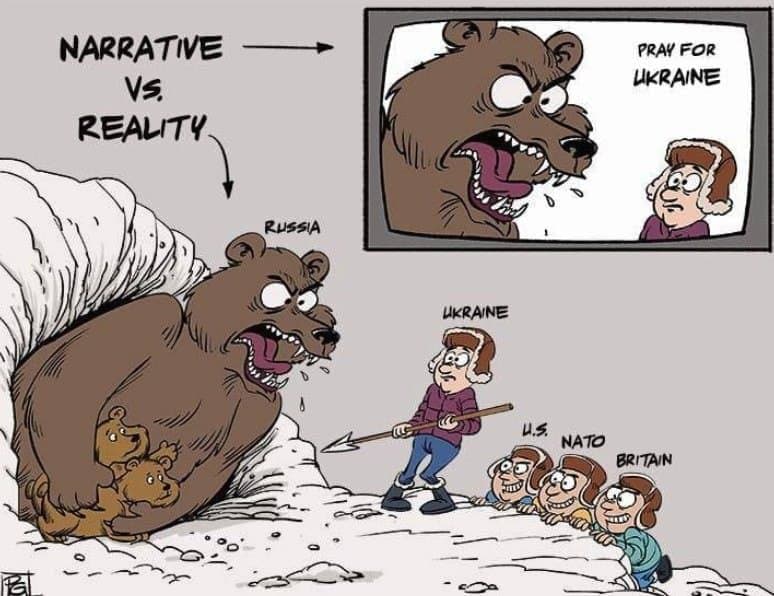
The current war means the end of the world that we have been accustomed to. We are entering a new cold war period and a new division of the globe with the United States, Great Britain, and the European Union on the one side, and Russia and China on the other. This new world throws a monkey wrench into the plans forged by globalists of the Klaus Schwab ilk. Or, globalism will be reduced to the Western world. The international rules that all the countries have up to now tried to abide by are no more valid for Russia, and consequently sooner or later for others because of the domino effect. Being beleaguered by the West, Moscow will have no intention to play by the rules created in this West. Why should it?
Sanctions work both ways. Russia has a lot to offer, be it crude oil, natural gas, rare metals or what not. Look back into the past! The Bolsheviks that took reins of power after 1917 were hated by the West. Lo and behold, it did not take many years for the capitalists to resume business with the hated communists; similarly, after the Second World War the Soviet Union was regarded as a hostile empire and yet, and despite that, business between the West and the Soviets went as usual. How about China? It was Taiwan that was first supported by the West, yet slowly but surely Washington reversed course, left Taiwan to its own devices and resumed contacts with Beijing. Since – as said above – money makes the world go round, the greedy capitalists helped China develop in that they outsourced almost all production to the Middle Kingdom. Do you think it is going to be different now with regard to Russia?
When Ukraine is eventually conquered by Russia, what will the elites in such small countries like Lithuania, Latvia and Estonia – all bordering on Russia – think about their security and the ability of the collective West to help them? I want to see that man or that woman who really thinks that NATO will go to war with Russia over Estonia or Latvia.
Ukraine has been exploited by Western companies for thirty long years. All those contacts with democracies and capitalism did not benefit the country at all. It only benefited a handful of people, who fled Ukraine before the hostilities, leaving the rank and file behind. Rumour has it that President Zelensky is kept in the American embassy in Warsaw though we are all made to believe that he remains in Kiev. How much would you bet on President Zelensky residing in Kiev, a city that is about to be soon encircled?
The West could have further exploited Ukraine and teased Russia but it simply overplayed its hand. Precisely as it is described in this fable by Aesop where a goose laying golden eggs is killed by the greedy owners. The moral? Much wants more and loses all. Now that Moscow is taking retaliatory steps like shutting down media outlets that propagated Western ideas and Western lifestyle the West has lost its ideological bridgehead inside Russia that it has held for thirty years. The West really thought it was ready to make a killing. A big killing. Western elites really thought Russia would be withdrawing from its positions further and further; they really believed the Navalny kind of Russian dissenters that the Russian people were all against the authorities. Worse, the West still thinks that Russians will force their president to surrender because otherwise common people will be stripped of the opportunity to eat hamburgers and cheeseburgers in McDonald’s restaurants in Moscow and Petersburg! Sure, there are some such people who are ready to trade their country for ham- and cheeseburgers, but then it is a splinter from the large whole. The majority accustomed to Russia’s greatness are not willing to sell this greatness off. Plus, they are not attracted by the Western values of married homosexuals or the many sexes that are invented by the month. That’s also something that the post-West is not aware of. Remember also that millions of Russians have bitter recollections of the Yeltsin era during which western-style capitalism promised them well-being and brought poverty, unrest and humiliation instead. That’s one big reason why President Putin is appreciated by the vast majority of the population: he put an end to chaos and brought in stability. If you think Russians dream about homosexual parades in their cities or pregnant soldiers in their army or the many gender pronouns, you cannot be more delusional.
There is one more explanation to all what is occurring. The West went to great lengths to have Russia and Ukraine clash for the sheer purpose of weakening both countries. This is one sure way of preserving world preponderance, is it not? Lead nations to war the moment you see they have developed too much and too fast. The United States achieved its global dominance because the Second World War wreaked havoc with the economies of Germany, Great Britain, France, Russia, Italy and Japan – the world’s powerhouses. After the cessation of the hostilities all those countries needed American aid and American dollars and were compelled to accept almost all the dictates from Washington.
Look at the present political map of the world. Iraq, Syria, Libya, Afghanistan, Ukraine, the countries of former Yugoslavia, the states that went through an array of all those colour revolutions: they are reeling under the blows of all manner of war, civil war, social upheaval and the attendant economic collapse. Which country emerges victorious? Yes, sure, the one that has not been directly engaged in the conflict. A classic case of two dogs fighting for a bone with a third running away with it.
Russia and Ukraine will lose a number of people (killed, wounded, displaced); Ukraine will have its economy ruined; Poland is already accommodating a million (and rising!) Ukrainians who somehow do not want to defend their country and prove their rights to it (If you say that women and children do not or should not take part in hostilities, then think again); Warsaw will have a lot of trouble with them. Who emerges victorious? You know who. Vice-President Kamala Harris visited Poland to reassuringly pat the Polish nation on the shoulder in recognition of Poland’s hospitality towards Ukrainians. She knows that such gestures work with Poles. The supranational elites hating ethnically monolithic countries are rubbing their hands in glee. At last Poland, this ethnically and religiously monolithic nation, is changing to a mix of Poles and Ukrainians, of Catholic and Orthodox Christians, to be later skilfully set off against each other like Croats and Serbs if Warsaw should fail to toe the Western party line.
GEFIRA – Global Analysis from the European Perspective. Preparing for the world of tomorrow.
US Officials Meet Maduro, Fail to Drive Wedge Between Venezuela and Russia
By José Luis Granados Ceja | Venezuelanalysis | March 7, 2022
Mexico City, Mexico – A high-level United States (US) government delegation that visited Venezuela on Saturday failed to produce an agreement with the government of Nicolás Maduro.
News of the delegation was first broken by the New York Times, which described the trip as the highest-level visit by US officials in years. Outlets subsequently reported that no agreement was reached. Caracas had not publicly commented on the meeting at the time of writing.
According to Reuters, the US team was led by White House Latin America adviser Juan González and made “maximalist” demands concerning electoral guarantees. Citing three people familiar with the matter, Reuters reported that the US was seeking new presidential elections, a larger participation of foreign private capital in Venezuela’s oil industry and a public condemnation of Russia’s incursion into Ukraine. The Biden administration representatives reportedly offered Venezuela a temporary return to the SWIFT financial transaction system.
Venezuelan President Nicolás Maduro and Vice President Delcy Rodríguez, who directly participated in the meeting, instead demanded broader sanctions relief and the return of foreign assets such as oil subsidiary CITGO. US officials reportedly brought up the cases of US citizens jailed in Venezuela, including six oil executives imprisoned for corruption and two former Green Berets who took part in a failed coup effort.
The meeting in Caracas was the latest US effort to isolate Russian President Vladimir Putin from his allies in the region. US officials told the Times that Washington views Russia’s Latin American allies as a potential “security threat” should the tensions continue to escalate in light of the ongoing conflict in Ukraine, which has ratcheted up conflict between the US and Russia.
Venezuela broke off diplomatic relations with the US in 2019 after the latter recognized opposition figure Juan Guaidó as “interim president.” The US and its allies refused to recognize the results of the 2018 election that saw Maduro reelected to a six-year term. Washington then proceeded to engage in and support a series of unsuccessful coup plots, ultimately failing to oust Maduro from power.
US strategy toward Venezuela has more recently been focused on isolating Maduro, imposing crippling sanctions on the country’s energy sector and seizing, together with its allies, the country’s assets abroad. In public statements, the Biden administration has expressed its unwillingness to seriously negotiate with Caracas absent new elections.
Nonetheless, due to the failure of the US to successfully install Guaidó as an authority with any real power inside Venezuela, Caracas and Washington have maintained back-channel communications despite the lack of formal diplomatic relations. Guaidó, despite being recognized by the US as the country’s president, was only informed of the high-level delegation the morning of the meeting.
Venezuelan geopolitical analyst Sergio Rodríguez Gelfenstein told Venezuelanalysis that the leak of the news of the visit of senior US officials was motivated by an effort to drive a wedge between Caracas and Moscow and leave the impression that there was a “chill” in relations between the two countries.
Rodríguez maintained that Washington and Caracas would nonetheless leave the door open to dialogue.
“I believe that there will be continued attempts at rapprochement, especially because the Mexican [dialogue between the Venezuelan government and the opposition] was exhausted,” he said. “The Mexico talks were totally absurd since the opposition was being directed from within the United States, any step they took had to be consulted with Washington. In that sense it is much more feasible for the United States to negotiate directly with Venezuela.”
President Maduro has repeatedly expressed a willingness to negotiate an end to US-led sanctions on the country. The lack of a deal stemming from the visit by the senior-level delegation suggests Venezuela did not find it to be a workable proposal. Reuters reported that US officials agreed to a follow-up meeting.
It would take a considerable reversal of US policy toward the Caribbean nation to get the country to walk away from its Russian ally. Relations between the two countries have only grown in light of US efforts to isolate Caracas. Russian assistance has played an important role in Venezuela’s efforts to attend to the economic crisis in the country, providing support and expertise to the country’s key industries as well as steady investment in Venezuela’s energy sector.
Venezuela likewise recently strengthened its ties with Russia following a visit by Russian Deputy Prime Minister Yuri Borisov in February.
Caracas has called for a “peaceful resolution” to the ongoing crisis in Ukraine but has stopped short of condemning the Russian military operation. Venezuela did not vote in the United Nations (UN) General Assembly’s resolution concerning the Russian offensive in Ukraine. The country’s voting rights have been suspended as a result of unpaid UN membership dues due the impact of sanctions.
In light of coercive measures applied on Russia by the US and the European Union, Maduro has insisted that Venezuela will maintain its commercial relations with the Eurasian nation.
The Venezuelan leader also spoke directly by phone with Putin last week, with the Russian Ministry of Foreign Affairs reporting that the Venezuelan president expressed his “firm support” for Russia and condemned destabilization efforts by the US and NATO. Maduro has publicly called NATO’s handling of the Minsk Agreements a “mockery” and argued that their “derailment” constituted a violation of international law.
The Russian ambassador in Caracas Sergey Melik was invited to greet the opening 5th Congress of the ruling United Socialist Party of Venezuela, held this Saturday, and was met with strong applause from the delegates.
Edited by Ricardo Vaz in Caracas.
Russia adjusts to “sanctions from hell”
BY M. K. BHADRAKUMAR | INDIAN PUNCHLINE | MARCH 11, 2022
The Russian President Vladimir Putin’s remarks at his meeting with government ministers on Thursday constituted his first comments on the West’s “sanctions from hell.” They were focused almost entirely on “a set of measures to minimise the consequences of sanctions on the Russian economy and the people of our country.”
Putin’s number one priority is to hold himself accountable to his people. Unlike his American counterpart, Joe Biden, Putin feels no need of grandstanding, given his high approval rating above 70%.
The paradox is, while the western countries who imposed the sanctions are going through paroxysms of angst, gnawing worries and anxiety syndromes, the “victim”, Russia, seems nonchalant and is calmly adjusting to the “new normal.” The contrast couldn’t be sharper.
Without doubt, the Kremlin prepared thoroughly for the western sanctions. Prime Minister Mikhail Mishustin told Putin that a “special headquarters” has swung into action to coordinate the activities of all departments, including at the regional level. He said, “Steps to protect the most vulnerable areas are being worked through sector by sector.” The “core goals” are:
- “protecting the domestic market”;
- ensuring uninterrupted functioning of enterprises by eliminating disruptions in logistics and production chains;
- helping the people and businesses to quickly adapt to the changing circumstances; and,
- maintaining employment.
Over 20 major legislations are in the pipeline, which include specific proposals for stabilising financial markets, support industries, especially for the private sector, as well as for the “return of capital.”
One draft law aims to prevent shutdown of factories by foreign owners through “external management.” There is a vague hint of nationalisation, if push comes to shove. Interestingly, most western owners are announcing “temporary suspension of operations” while paying salaries to employees.
The IT sector, construction industry, transport companies and travel and tourism sector will receive special attention — as also agriculture, which is not only about jobs but also food security. There is an overall relaxation of regulatory measures, debt repayment schedules, bureaucratic procedure, etc.
Mishustin noted: “Maximum freedom of economic activity in the country, minimal regulation and control and, of course, support for the labour market will remain the basis for our economic response. The Government will expand import substitution and help domestic producers replace foreign products in supply chains.”
The highlight of yesterday’s event was the presentation by Finance Minister Anton Siluanov on measures to stabilise the domestic financial market, underscoring how accurately the Kremlin anticipated the West’s agenda to isolate Russia.
Siluanov said, “the Western countries have basically launched a financial and economic war” combining a default on their financial liabilities to Russia with a freeze on Russia’s gold and currency reserves. “They are doing all they can to stop foreign trade and the export,” he added, “trying to create a shortage of imported everyday essentials… (and) compel successful businesses with foreign capital to shut down.”
In these circumstances, the government’s “priority is to stabilise the situation in the financial system and ensure uninterrupted operations.” Siluanov explained that the measures taken in this direction include “precautions to control the outflow of capital abroad” and a special procedure for servicing external debt, including national debt, whereby Russia will pay off its external liabilities in rubles and “carry out the conversion by de-freezing our gold and currency reserves.”
Other measures include mandatory surrender of foreign exchange proceeds by companies, higher ruble interest rates, suspension of taxes on individual interest income for two years, suspended VAT on the purchase of gold and “a large project on capital amnesty.”
The central bank will fully guarantee the liquidity and uninterrupted operations of financial institutions. Siluanov claimed, “These measures have already produced results. The situation on the outflow of deposits is being stabilised and the amount of cash withdrawals has been reduced to almost zero… balance of payments is also improving. Current account receipts are balancing out capital flow.”
To be sure, the big increase in oil and gas revenue will offset any decline in revenue in other sectors, thereby reduce borrowing and public debt, and will provide funds for priority spending.
Most important, Siluanov stressed that the government regards the social commitments as the “top budget priority.” He said, “We will ensure the payment of pensions, benefits, salaries and other payments in a timely manner and in full. Medicines are provided as planned as well, including for children with complex diseases..
“In May, low-income families with children will start receiving new payments. We will earmark additional spending for these purposes in the budget system. The Government has begun to implement anti-crisis measures. Our top priority is to maintain employment and jobs, and to support people who need help under the current circumstances.”
All in all, the prognosis here rubbishes the western predictions of “apocalypse now”. The EU’s rejection of Washington’s proposal for sanctions on Russia’s oil exports virtually ensures that there isn’t going to be any income deficit in Moscow. In 2021, the Kremlin balanced its budget with an oil price expectation of $45 per barrel. The prices currently exceed $130 per barrel!
This conservative fiscal approach by the government largely insulates the economy from the effects of Western economic sanctions. Ironically, the pressure is going to be on European leaders who are concerned about major energy supply disruptions from Russia and have to keep their economies supplied with fuel, while also punishing Russia!
On the contrary, if Putin responds with gas cutoffs, that could spike energy prices further, drive inflation, and undermine Europe’s economic recovery. Simply put, Russia is much larger than the contiguous United States, and has an educated population and far more natural wealth than the West’s Russophobes might expect!
Take Russia’s exclusion from SWIFT. The fact of the matter is that while seven Russian banks were removed from SWIFT, those targeted did not include Sberbank or Gazprombank, two of Russia’s largest banks by assets. Why? Primarily due to Europe’s continued reliance on Russia for energy!
The point is, Russia is intricately connected to the global economy, holds large quantities of critical resources, and has been strategically preparing since 2014 to weather the long-term impacts of sanctions and a removal from SWIFT.
Furthermore, it needs to be understood that while several Russian banks are now cut off from SWIFT, they can still execute international transactions with other banks — except that they must use slower and less-secure methods of interbank communication, such as the outdated telex telegram network or phone calls and email.
By the way, Russia has also developed its own internal financial transaction messaging system, the System for Transfer of Financial Messages that could at a pinch serve as a functional alternative to SWIFT.
Equally, the western sanctions against Russia are bound to cause ripple effects across global markets, including supply chain disruptions and higher prices on energy and agricultural goods. Apart from being a key exporter of oil and gas, Russia is the world’s largest producer of palladium and the second-largest producer of platinum—key commodities used in semiconductor manufacturing—and a major exporter of other critical minerals, mining commodities, and agricultural goods.
Clearly, Russia has no dearth of willing trade partners across Asia, Africa, and the Middle East, as it comes under compulsion to rely primarily on non-Western-aligned nations for trade markets for the foreseeable future.
This has larger implications. Western sanctions could potentially accelerate a global economic divide between the West and Russian-aligned economies that are open to break away from the current US-dominated financial system, thereby accelerating a broad global economic reorientation.
Surely, sanctions will isolate Russia from the US and EU markets, but its large reserve of natural resources and strong ties to China decrease the likelihood that it will become economically isolated.
On the contrary, if Western sanctions persist, economic relations with Russia could help accelerate the growth of a non-Western bloc in the global economy, which would have deleterious impact on the status of the American dollar as the world currency.
Quite obviously, there are already incipient signs that thoughtful minds in Europe, especially France and Germany, feel troubled and are conscious of the need to rebuild bridges with Russia. How they pan out remains to be seen.
The likelihood is that once the dust settles down in Ukraine and Russia has had its way as regards its security guarantees, a process of rapprochement will commence between the major European countries and Russia sooner rather than later.
In fact, at yesterday’s meeting, Putin expressed confidence that he expects a volte face by the US too, just as the Biden administration has done vis-a-vis Venezuela and Iran recently. Putin also signalled that Russia may not resort to tit-for-tat sanctions against Europe, especially in regard of energy exports.
American Pravda: Putin as Hitler?
BY RON UNZ • UNZ REVIEW • MARCH 7, 2022
For years the eminent Russia scholar Stephen Cohen had ranked President Vladimir Putin of the Russian Republic as the most consequential world leader of the early twenty-first century. He praised the man’s enormous success in reviving his country after the chaos and destitution of the Yeltsin years and emphasized his desire for friendly relations with America, but increasingly feared that we were entering into a new Cold War, even more dangerous than the last.
As far back as 2017, the late Prof. Cohen argued that no foreign leader had been as greatly vilified in recent American history as Putin, and Russia’s invasion of Ukraine two weeks ago has exponentially raised the intensity of such media denunciations, almost matching the hysteria our country experienced two decades ago after the 9/11 attack on New York City. Larry Romanoff has provided a useful catalog of some examples.
Until recently, this extreme demonization of Putin was largely confined to Democrats and centrists, whose bizarre Russiagate narrative had accused him of installing Donald Trump in the White House. But the reaction has now become entirely bipartisan, with enthusiastic Trump-backer Sean Hannity recently using his prime-time FoxNews show to call for Putin’s death, a cry soon joined by Sen. Lindsey Graham, the ranking Republican on the Senate Judiciary Committee. These are astonishing threats to make against a man whose nuclear arsenal could quickly annihilate the bulk of the American population, and the rhetoric seems unprecedented in our postwar history. Even in the darkest days of the Cold War, I don’t recall such public sentiments ever being directed towards the USSR or its top Communist leadership.
In many respects the Western reaction to Russia’s attack has been closer to a declaration of war than merely a return to Cold War confrontation. Russia’s massive foreign reserves held abroad have been seized and frozen, its civilian airlines excluded from Western skies, and its leading banks disconnected from global financial networks. Wealthy Russian private citizens have had their properties confiscated, the national soccer team has been banned from the World Cup, and the longtime Russian conductor of the Munich Philharmonic was fired for refusing to denounce his own country.
Such international retaliation against Russia and individual Russians seems extremely disproportionate. As yet the fighting in Ukraine has inflicted minimal death or destruction, while the various other major wars of the last two decades, many of them American in origin, had killed millions and completely destroyed several countries, including Iraq, Libya, and Syria. But the global dominance of American media propaganda has orchestrated a very different popular response, producing this remarkable crescendo of hatred.
Indeed, the closest parallel that comes to mind would be the American hostility directed against Adolf Hitler and Nazi Germany after the outbreak of World War II, as indicated by the widespread comparisons between Putin’s invasion of Ukraine and Hitler’s 1939 attack on Poland. A simple Google search for “Putin and Hitler” returns tens of millions of webpages, with the top results ranging from the headline of a Washington Post article to the Tweets of pop music star Stevie Nicks. As far back as 2014, Andrew Anglin of the Daily Stormer had documented the emerging meme “Putin is the new Hitler.”
Although enormously popular, such Putin-Hitler analogies have hardly gone unchallenged, and some media outlets such as the London Spectator have strongly disagreed, arguing that Putin’s strategic aims have been quite limited and reasonable.
Many sober-minded strategic analysts have made this same point at length, and very occasionally their contrary views have managed to slip through the media blockade.
Although FoxNews has become one of the outlets most rabidly hostile to Russia, a recent interview with one of their regular guests provided a very different perspective. Col. Douglas Macgregor had been a former top Pentagon advisor and he forcefully explained that America had spent nearly fifteen years ignoring Putin’s endless warnings that he would not tolerate NATO membership for Ukraine, nor the deployment of strategic missiles on his border. Our government had paid no heed to his explicit red-lines, so Putin was finally compelled to act, resulting in the current calamity:
Prof. John Mearsheimer of the University of Chicago, one of our most distinguished political scientists, had spent many years making exactly these same points and blaming America and NATO for the simmering Ukraine crisis, but his warnings had been totally ignored by our political leadership and media. His hour-long lecture explaining these unpleasant realities had quietly sat on Youtube for six years, attracting relatively little attention, but then suddenly exploded in popularity over the last few weeks as the conflict unfolded, and has now reached a worldwide audience of over 17 million. His other Youtube lectures, some quite recent, have been watched by additional millions.
Such massive global attention finally forced our media to take notice, and the New Yorker solicited an interview with Mearsheimer, allowing him to explain to his disbelieving questioner that American actions had clearly provoked the conflict. A couple of years earlier, that same interviewer had ridiculed Prof. Cohen for doubting the reality of Russiagate, but this time he seemed much more respectful, perhaps because the balance of media power was now reversed; his magazine’s 1.2 million subscriber-base was dwarfed by the global audience listening to the views of his subject.
- Why John Mearsheimer Blames the U.S. for the Crisis in Ukraine
Isaac Chotiner • The New Yorker • March 1, 2022 • 3,900 Words
During his long and distinguished career at the CIA, former analyst Ray McGovern had run the Soviet Policy Branch and also served as the Presidential Briefer, so under different circumstances he or someone like him would would currently be advising President Joe Biden. Instead, a few days ago he joined Mearsheimer in presenting his views in a video discussion hosted by the Committee for the Republic. Both leading experts agreed that Putin had been pushed beyond all reasonable limits, provoking the invasion.
Prior to 2014 our relations with Putin had been reasonably good. Ukraine served as a neutral buffer state between Russia and the NATO countries, with the population evenly divided between Russian-leaning and West-leaning elements, and its elected government oscillating between the two camps.
But while Putin’s attention was focused on the 2014 Sochi Olympic Games, a pro-NATO coup overthrew the democratically-elected pro-Russian government, with clear evidence that Victoria Nuland and the other Neocons grouped around Secretary of State Hillary Clinton had orchestrated it. Ukraine’s Crimea peninsula contains Russia’s crucial Sevastopol naval base, and only Putin’s swift action allowed it to remain under Russian control, while he also provided support for break-away pro-Russian enclaves in the Donbass region. The Minsk agreement later signed by the Ukrainian government granted autonomy to those latter areas, but Kiev refused to honor its commitments, and instead continued to shell the area, inflicting serious casualties upon the inhabitants, many of whom held Russian passports. Diana Johnstone has aptly characterized our policy as years of Russian bear-baiting.
As Mearsheimer, McGovern, and other observers have persuasively argued, Russia invaded Ukraine only after such endless provocations and warnings were always ignored or dismissed by our American leadership. Perhaps the final straw had been the recent public statement by Ukraine President Volodymyr Zelenskyy that he intended to acquire nuclear weapons. How would America react if a democratically-elected pro-American government in Mexico had been overthrown in an coup backed by China, with the fiercely hostile new Mexican government spending years killing American citizens in its country and then finally announcing plans to acquire a nuclear arsenal?
Moreover, some analysts such as economist Michael Hudson have strongly suspected that American elements deliberately provoked the Russian invasion for geostrategic reasons, and Mike Whitney advanced similar arguments in a column that went super-viral, accumulating over 800,000 pageviews. The Nord Stream 2 pipeline carrying Russian natural gas to Germany had finally been completed last year and was about to go into operation, which would have greatly increased Eurasian economic integration and Russian influence in Europe, while eliminating the potential market for more expensive American natural gas. The Russian attack and the massive resulting media hysteria have now foreclosed that possibility.
So although it was Russian troops who crossed the Ukrainian border, a strong case can be made that they did so only after the most extreme provocations, and these may have been deliberately intended to produce exactly that result. Sometimes the parties responsible for starting a war are not necessarily those that eventually fire the first shot.
Hitler and the Origins of World War II
Ironically enough, the arguments of Mearsheimer and others that Putin was greatly provoked or possibly even manipulated into attacking Ukraine raise certain intriguing historical parallels. The legions of ignorant Westerners who mindlessly rely upon our disingenuous media may be denouncing Putin as “another Hitler” but I think they may have inadvertently backed themselves into the truth.

A couple of months ago I finally read Gerd Schultze-Rhonhof’s outstanding 2011 volume analyzing the years leading up to the outbreak of World War II, a work that I would highly recommend. The author spent his career as a fully mainstream professional military man, rising to the rank of major general in the German army before retiring, and his account evoked eerie parallels to the current conflict with Russia.
As most of us know, the Second World War began when Germany attacked Poland in 1939 over Danzig, an almost entirely German border city controlled by the Poles.
But less well known is that Hitler had actually made enormous efforts to avoid war and settle that dispute, spending many months on fruitless negotiations and offering extremely reasonable terms. Indeed, the German dictator had made numerous concessions that none of his democratic Weimar predecessors had been willing to consider, but these were all rejected, while provocations increased until war with Poland seemed the only possible option. And just as in the case of Ukraine, politically influential elements in the West almost certainly sought to provoke that war, using Danzig as the spark to ignite the conflict much like the Donbass may have been used to force Putin’s hand.
We should recognize that in many respects the standard historical narrative of World War II is merely a congealed version of the media propaganda of that era. If Russia were defeated and destroyed as a result of the current conflict, we can be sure that the subsequent history books would utterly demonize Putin and all the decisions that he had taken.
Although I was very impressed by Schultze-Rhonhof’s meticulously detailed analysis of the circumstances leading up to the outbreak of war in 1939, his account merely reinforced my existing views, which had already been along entirely similar lines.
For example, back in 2019 I had used Pat Buchanan’s controversial 2008 bestseller on World War II as the starting point for a very long and detailed discussion of the true origins of that conflict:
However, the bulk of the book focused on the events leading up to the Second World War, and this was the portion that had inspired such horror in McConnell and his colleagues. Buchanan described the outrageous provisions of the Treaty of Versailles imposed upon a prostrate Germany, and the determination of all subsequent German leaders to redress it. But whereas his democratic Weimar predecessors had failed, Hitler had managed to succeed, largely through bluff, while also annexing German Austria and the German Sudetenland of Czechoslovakia, in both cases with the overwhelming support of their populations.
Buchanan documented this controversial thesis by drawing heavily upon numerous statements by leading contemporary political figures, mostly British, as well as the conclusions of highly-respected mainstream historians. Hitler’s final demand, that 95% German Danzig be returned to Germany just as its inhabitants desired, was an absolutely reasonable one, and only a dreadful diplomatic blunder by the British had led the Poles to refuse the request, thereby provoking the war. The widespread later claim that Hitler sought to conquer the world was totally absurd, and the German leader had actually made every effort to avoid war with Britain or France. Indeed, he was generally quite friendly towards the Poles and had been hoping to enlist Poland as a German ally against the menace of Stalin’s Soviet Union.
Although many Americans might have been shocked at this account of the events leading up to the outbreak of the Second World War, Buchanan’s narrative accorded reasonably well with my own impression of that period. As a Harvard freshman, I had taken an introductory history course, and one of the primary required texts on World War II had been that of A.J.P. Taylor, a renowned Oxford University historian. His famous 1961 work Origins of the Second World War had very persuasively laid out a case quite similar to that of Buchanan, and I’d never found any reason to question the judgment of my professors who had assigned it. So if Buchanan merely seemed to be seconding the opinions of a leading Oxford don and members of the Harvard history faculty, I couldn’t quite understand why his new book would be regarded as being beyond the pale.

The recent 70th anniversary of the outbreak of the conflict that consumed so many tens of millions of lives naturally provoked numerous historical articles, and the resulting discussion led me to dig out my old copy of Taylor’s short volume, which I reread for the first time in nearly forty years. I found it just as masterful and persuasive as I had back in my college dorm room days, and the glowing cover-blurbs suggested some of the immediate acclaim the work had received. The Washington Post lauded the author as “Britain’s most prominent living historian,” World Politics called it “Powerfully argued, brilliantly written, and always persuasive,” The New Statesman, Britain leading leftist magazine, described it as “A masterpiece: lucid, compassionate, beautifully written,” and the august Times Literary Supplement characterized it as “simple, devastating, superlatively readable, and deeply disturbing.” As an international best-seller, it surely ranks as Taylor’s most famous work, and I can easily understand why it was still on my college required reading list nearly two decades after its original publication.
Yet in revisiting Taylor’s ground-breaking study, I made a remarkable discovery. Despite all the international sales and critical acclaim, the book’s findings soon aroused tremendous hostility in certain quarters. Taylor’s lectures at Oxford had been enormously popular for a quarter century, but as a direct result of the controversy “Britain’s most prominent living historian” was summarily purged from the faculty not long afterwards. At the beginning of his first chapter, Taylor had noted how strange he found it that more than twenty years after the start of the world’s most cataclysmic war no serious history had been produced carefully analyzing the outbreak. Perhaps the retaliation that he encountered led him to better understand part of that puzzle.
I very recently reread Pat Buchanan’s 2008 book harshly condemning Churchill for his role in the cataclysmic world war and made an interesting discovery. Irving is surely among the most authoritative Churchill biographers, with his exhaustive documentary research being the source of so many new discoveries and his books selling in the millions. Yet Irving’s name never once appears either in Buchanan’s text or in his bibliography, though we may suspect that much of Irving’s material has been “laundered” through other, secondary Buchanan sources. Buchanan extensively cites A.J.P. Taylor, but makes no mention of Barnes, Flynn, or various other leading American academics and journalists who were purged for expressing contemporaneous views not so dissimilar from those of the author himself.
During the 1990s, Buchanan had ranked as one of America’s most prominent political figures, having an enormous media footprint in both print and television, and with his remarkably strong insurgent runs for the Republican presidential nomination in 1992 and 1996 cementing his national stature. But his numerous ideological foes worked tirelessly to undermine him, and by 2008 his continued presence as a pundit on the MSNBC cable channel was one of his last remaining footholds of major public prominence. He probably recognized that publishing a revisionist history of World War II might endanger his position, and believed that any direct association with purged and vilified figures such as Irving or Barnes would surely lead to his permanent banishment from all electronic media.
A decade ago I had been quite impressed by Buchanan’s history, but I had subsequently done a great deal of reading on that era and I found myself somewhat disappointed the second time through. Aside from its often breezy, rhetorical, and unscholarly tone, my sharpest criticisms were not with the controversial positions that he took, but with the other controversial topics and questions that he so carefully avoided.
Perhaps the most obvious of these is the question of the true origins of the war, which laid waste to much of Europe, killed perhaps fifty or sixty million, and gave rise to the subsequent Cold War era in which Communist regimes controlled half of the entire Eurasian world-continent. Taylor, Irving, and numerous others have thoroughly debunked the ridiculous mythology that the cause lay in Hitler’s mad desire for world conquest, but if the German dictator clearly bore only minor responsibility, was there indeed any true culprit? Or did this massively-destructive world war come about in somewhat similar fashion to its predecessor, which our conventional histories treat as mostly due to a collection of blunders, misunderstandings, and thoughtless escalations.
During the 1930s, John T. Flynn was one of America’s most influential progressive journalists, and although he had begun as a strong supporter of Roosevelt and his New Deal, he gradually became a sharp critic, concluding that FDR’s various governmental schemes had failed to revive the American economy. Then in 1937 a new economic collapse spiked unemployment back to the same levels as when the president had first entered office, confirming Flynn in his harsh verdict. And as I wrote last year:
Indeed, Flynn alleges that by late 1937, FDR had turned towards an aggressive foreign policy aimed at involving the country in a major foreign war, primarily because he believed that this was the only route out of his desperate economic and political box, a stratagem not unknown among national leaders throughout history. In his January 5, 1938 New Republic column, he alerted his disbelieving readers to the looming prospect of a large naval military build-up and warfare on the horizon after a top Roosevelt adviser had privately boasted to him that a large bout of “military Keynesianism” and a major war would cure the country’s seemingly insurmountable economic problems. At that time, war with Japan, possibly over Latin American interests, seemed the intended goal, but developing events in Europe soon persuaded FDR that fomenting a general war against Germany was the best course of action. Memoirs and other historical documents obtained by later researchers seem to generally support Flynn’s accusations by indicating that Roosevelt ordered his diplomats to exert enormous pressure upon both the British and Polish governments to avoid any negotiated settlement with Germany, thereby leading to the outbreak of World War II in 1939.
The last point is an important one since the confidential opinions of those closest to important historical events should be accorded considerable evidentiary weight. In a recent article John Wear mustered the numerous contemporaneous assessments that implicated FDR as a pivotal figure in orchestrating the world war by his constant pressure upon the British political leadership, a policy that he privately even admitted could mean his impeachment if revealed. Among other testimony, we have the statements of the Polish and British ambassadors to Washington and the American ambassador to London, who also passed along the concurring opinion of Prime Minister Chamberlain himself. Indeed, the German capture and publication of secret Polish diplomatic documents in 1939 had already revealed much of this information, and William Henry Chamberlin confirmed their authenticity in his 1950 book. But since the mainstream media never reported any of this information, these facts remain little known even today.
Roosevelt’s economic problems had led him to seek a foreign war, but it was probably the overwhelming Jewish hostility to Nazi Germany that pointed him in that particular direction. The confidential report of the Polish ambassador to the U.S. as quoted by John Wear provides a striking description of the political situation in America at the beginning of 1939:
There is a feeling now prevalent in the United States marked by growing hatred of Fascism, and above all of Chancellor Hitler and everything connected with National Socialism. Propaganda is mostly in the hands of the Jews who control almost 100% [of the] radio, film, daily and periodical press. Although this propaganda is extremely coarse and presents Germany as black as possible–above all religious persecution and concentration camps are exploited–this propaganda is nevertheless extremely effective since the public here is completely ignorant and knows nothing of the situation in Europe.
At the present moment most Americans regard Chancellor Hitler and National Socialism as the greatest evil and greatest peril threatening the world. The situation here provides an excellent platform for public speakers of all kinds, for emigrants from Germany and Czechoslovakia who with a great many words and with most various calumnies incite the public. They praise American liberty which they contrast with the totalitarian states.
It is interesting to note that in this extremely well-planned campaign which is conducted above all against National Socialism, Soviet Russia is almost completely eliminated. Soviet Russia, if mentioned at all, is mentioned in a friendly manner and things are presented in such a way that it would seem that the Soviet Union were cooperating with the bloc of democratic states. Thanks to the clever propaganda the sympathies of the American public are completely on the side of Red Spain.
Given the heavy Jewish involvement in financing Churchill and his allies and also steering the American government and public in the direction of war against Germany, organized Jewish groups probably bore the central responsibility for provoking the world war, and this was surely recognized by most knowledgeable individuals at the time. Indeed, the Forrestal Diaries recorded the very telling statement by our ambassador in London: “Chamberlain, he says, stated that America and the Jews had forced England into the war.”
The ongoing struggle between Hitler and international Jewry had been receiving considerable public attention for years. During his political rise, Hitler had hardly concealed his intent to dislodge Germany’s tiny Jewish population from the stranglehold they had gained over German media and finance, and instead run the country in the best interests of the 99% German majority, a proposal that provoked the bitter hostility of Jews everywhere. Indeed, immediately after he came into office, a major London newspaper had carried a memorable 1933 headline announcing that the Jews of the world had declared war on Germany, and were organizing an international boycott to starve the Germans into submission.
In recent years, somewhat similar Jewish-organized efforts at international sanctions aimed at bringing recalcitrant nations to their knees have become a regular part of global politics. But these days the Jewish dominance of the U.S. political system has become so overwhelming that instead of private boycotts, such actions are directly enforced by the American government. To some extent, this had already been the case with Iraq during the 1990s, but became far more common after the turn of the new century.
Although our official government investigation concluded that the total financial cost of the 9/11 terrorist attacks had been an absolutely trivial sum, the Neocon-dominated Bush Administration nonetheless used this as an excuse to establish an important new Treasury Department position, the Under Secretary for Terrorism and Financial Intelligence. That office soon began utilizing America’s control of the global banking system and dollar-denominated international trade to enforce financial sanctions and wage economic warfare, with these measures typically being directed against individuals, organizations, and nations considered unfriendly towards Israel, notably Iran, Hezbollah, and Syria.
Perhaps coincidentally, although Jews comprise merely 2% of the American population, all four individuals holding that very powerful post over the last 15 years since its inception—Stuart A. Levey, David S. Cohen, Adam Szubin, Sigal Mandelker—have been Jewish, with the most recent of these being an Israeli citizen. Levey, the first Under Secretary, began his work under President Bush, then continued without a break for years under President Obama, underscoring the entirely bipartisan nature of these activities.
Most foreign policy experts have certainly been aware that Jewish groups and activists played the central role in driving our country into its disastrous 2003 Iraq War, and that many of these same groups and individuals have spent the last dozen years or so working to foment a similar American attack on Iran, though as yet unsuccessfully. This seems quite reminiscent of the late 1930s political situation in Britain and America.
Individuals outraged by the misleading media coverage surrounding the Iraq War but who have always casually accepted the conventional narrative of World War II should consider a thought-experiment I suggested last year:
When we seek to understand the past, we must be careful to avoid drawing from a narrow selection of sources, especially if one side proved politically victorious in the end and completely dominated the later production of books and other commentary. Prior to the existence of the Internet, this was an especially difficult task, often requiring a considerable amount of scholarly effort, even if only to examine the bound volumes of once popular periodicals. Yet without such diligence, we can fall into very serious error.
The Iraq War and its aftermath was certainly one of the central events in American history during the 2000s. Yet suppose some readers in the distant future had only the collected archives of The Weekly Standard, National Review, the WSJ op-ed page, and FoxNews transcripts to furnish their historical understanding of that period, perhaps along with the books written by the contributors to those outlets. I doubt that more than a small fraction of what they would read could be categorized as outright lies. But the massively skewed coverage, the distortions, exaggerations, and especially the breathtaking omissions would surely provide them with an exceptionally unrealistic view of what had actually happened during that important period.
Another striking historical parallel has been the fierce demonization of Russian President Vladimir Putin, who provoked the great hostility of Jewish elements when he ousted the handful of Jewish Oligarchs who had seized control of Russian society under the drunken misrule of President Boris Yeltsin and totally impoverished the bulk of the population. This conflict intensified after Jewish investor William F. Browder arranged Congressional passage of the Magnitsky Act to punish Russian leaders for the legal actions they had taken against his huge financial empire in their country. Putin’s harshest Neocon critics have often condemned him as “a new Hitler” while some neutral observers have agreed that no foreign leader since the German Chancellor of the 1930s has been so fiercely vilified in the American media. Seen from a different angle, there may indeed be a close correspondence between Putin and Hitler, but not in the way usually suggested.
Knowledgeable individuals have certainly been aware of the crucial Jewish role in orchestrating our military or financial attacks against Iraq, Iran, Syria, and Russia, but it has been exceptionally rare for any prominent public figures or reputable journalists to mention these facts lest they be denounced and vilified by zealous Jewish activists and the media they dominate. For example, a couple of years ago a single suggestive Tweet by famed CIA anti-proliferation operative Valerie Plame provoked such an enormous wave of vituperation that she was forced to resign her position at a prominent non-profit. A close parallel involving a far more famous figure had occurred three generations earlier:
These facts, now firmly established by decades of scholarship, provide some necessary context to Lindbergh’s famously controversial speech at an America First rally in September 1941. At that event, he charged that three groups in particular were “pressing this country toward war[:] the British, the Jewish, and the Roosevelt Administration,” and thereby unleashed an enormous firestorm of media attacks and denunciations, including widespread accusations of anti-Semitism and Nazi sympathies. Given the realities of the political situation, Lindbergh’s statement constituted a perfect illustration of Michael Kinsley’s famous quip that “a gaffe is when a politician tells the truth – some obvious truth he isn’t supposed to say.” But as a consequence, Lindbergh’s once-heroic reputation suffered enormous and permanent damage, with the campaign of vilification echoing for the remaining three decades of his life, and even well beyond. Although he was not entirely purged from public life, his standing was certainly never even remotely the same.
With such examples in mind, we should hardly be surprised that for decades this huge Jewish involvement in orchestrating World War II was carefully omitted from nearly all subsequent historical narratives, even those that sharply challenged the mythology of the official account. The index of Taylor’s iconoclastic 1961 work contains absolutely no mention of Jews, and the same is true of the previous books by Chamberlin and Grenfell. In 1953, Harry Elmer Barnes, the dean of historical revisionists, edited his major volume aimed at demolishing the falsehoods of World War II, and once again any discussion of the Jewish role was almost entirely lacking, with only part of one single sentence and Chamberlain’s dangling short quote appearing across more than 200,000 words of text. Both Barnes and many of his contributors had already been purged and their book was only released by a tiny publisher in Idaho, but they still sought to avoid certain unmentionables.
Even the arch-revisionist David Hoggan seems to have carefully skirted the topic of Jewish influence. His 30 page index lacks any entry on Jews and his 700 pages of text contain only scattered references. Indeed, although he does quote the explicit private statements of both the Polish ambassador and the British Prime Minister emphasizing the enormous Jewish role in promoting the war, he then rather questionably asserts that these confidential statements of individuals with the best understanding of events should simply be disregarded.
In the popular Harry Potter series, Lord Voldemort, the great nemesis of the young magicians, is often identified as “He Who Must Not Be Named,” since the mere vocalization of those few particular syllables might bring doom upon the speaker. Jews have long enjoyed enormous power and influence over the media and political life, while fanatic Jewish activists demonstrate hair-trigger eagerness to denounce and vilify all those suspected of being insufficiently friendly towards their ethnic group. The combination of these two factors has therefore induced such a “Lord Voldemort Effect” regarding Jewish activities in most writers and public figures. Once we recognize this reality, we should become very cautious in analyzing controversial historical issues that might possibly contain a Jewish dimension, and also be particularly wary of arguments from silence.

The Demonization of Adolf Hitler
Another aspect of Schultze-Rhonhof’s important study that was new to me but further solidified my previous conclusions was his analysis of Hitler’s public speeches. Although the German Fuhrer is notoriously portrayed as a horrific warmonger, his actual statements provide absolutely no evidence of any plans for aggressive war, and instead emphasized the importance of maintaining international peace in order to foster internal German economic development. In another 2019 article, I had similarly suggested that any examination of the reputable contemporary sources reveals that the Hitler of our history books is merely a grotesque political cartoon, similar to the one now increasingly drawn of Putin:
Although the demonic portrayal of the German Kaiser was already being replaced by a more balanced treatment within a few years of the Armistice and had disappeared after a generation, no such similar process has occurred in the case of his World War II successor. Indeed, Adolf Hitler and the Nazis seem to loom far larger in our cultural and ideological landscape today than they did in the immediate aftermath of the war, with their visibility growing even as they become more distant in time, a strange violation of the normal laws of perspective. I suspect that the casual dinner-table conversations on World War II issues that I used to enjoy with my Harvard College classmates during the early 1980s would be completely impossible today.
To some extent, the transformation of “the Good War” into a secular religion, with its designated monsters and martyrs may be analogous to what occurred during the final decay of the Soviet Union, when the obvious failure of its economic system forced the government to increasingly turn to endless celebrations of its victory in the Great Patriotic War as the primary source of its legitimacy. The real wages of ordinary American workers have been stagnant for fifty years and most adults have less than $500 in available savings, so this widespread impoverishment may be forcing our own leaders into adopting a similar strategy.
But I think that a far greater factor has been the astonishing growth of Jewish power in America, which was already quite substantial even four or five decades ago but has now become absolutely overwhelming, whether in foreign policy, finance, or the media, with our 2% minority exercising unprecedented control over most aspects of our society and political system. Only a fraction of American Jews hold traditional religious beliefs, so the twin worship of the State of Israel and the Holocaust has served to fill that void, with the individuals and events of World War II constituting many of the central elements of the mythos that serves to unify the Jewish community. And as an obvious consequence, no historical figure ranks higher in the demonology of this secular religion than the storied Fuhrer and his Nazi regime.
However, beliefs based upon religious dogma often sharply diverge from empirical reality. Pagan Druids may worship a particular sacred oak tree and claim that it contains the soul of their tutelary dryad; but if an arborist taps the tree, its sap may seem like that of any other.
Our current official doctrine portrays Adolf Hitler’s Nazi Germany as one of the cruelest and most relentlessly aggressive regimes in the history of the world, but at the time these salient facts apparently escaped the leaders of the nations with which it was at war. Operation Pike provides an enormous wealth of archival material regarding the secret internal discussions of the British and French governmental and military leadership, and all of it tends to suggest that they regarded their German adversary as a perfectly normal country, and perhaps occasionally regretted that they had somehow gotten themselves involved a major war over what amounted to a small Polish border dispute.
During late 1939, a major American news syndicate had sent Stoddard to spend a few months in wartime Germany and provide his perspective, with his numerous dispatches appearing in The New York Times and other leading newspapers. Upon his return, he published a 1940 book summarizing all his information, seemingly just as even-handed as his earlier 1917 volume. His coverage probably constitutes one of the most objective and comprehensive American accounts of the mundane domestic nature of National Socialist Germany, and thus may seem rather shocking to modern readers steeped in eighty years of increasingly unrealistic Hollywood propaganda.
- Into the Darkness
An Uncensored Report from Inside the Third Reich At War
Lothrop Stoddard • 1940 • 79,000 WordsAnd although our standard histories would never admit this, the actual path toward war appears to have been quite different than most Americans believe. Extensive documentary evidence from knowledgeable Polish, American, and British officials demonstrates that pressure from Washington was the key factor behind the outbreak of the European conflict. Indeed, leading American journalists and public intellectuals of the day such as John T. Flynn and Harry Elmer Barnes had publicly declared that they feared Franklin Roosevelt was seeking to foment a major European war in hopes that it would rescue him from the apparent economic failure of his New Deal reforms and perhaps even provide him an excuse to run for an unprecedented third term. Since this is exactly what ultimately transpired, such accusations would hardly seem totally unreasonable.
And in an ironic contrast with FDR’s domestic failures, Hitler’s own economic successes had been enormous, a striking comparison since the two leaders had come to power within a few weeks of each other in early 1933. As iconoclastic leftist Alexander Cockburn once noted in a 2004 Counterpunch column:
When [Hitler] came to power in 1933 unemployment stood at 40 per cent. Economic recovery came without the stimulus of arms spending…There were vast public works such as the autobahns. He paid little attention to the deficit or to the protests of the bankers about his policies. Interest rates were kept low and though wages were pegged, family income increased by reason of full employment. By 1936 unemployment had sunk to one per cent. German military spending remained low until 1939.
Not just Bush but Howard Dean and the Democrats could learn a few lessons in economic policy from that early, Keynesian Hitler.
By resurrecting a prosperous Germany while nearly all other countries remained mired in the worldwide Great Depression, Hitler drew glowing accolades from individuals all across the ideological spectrum. After an extended 1936 visit, David Lloyd George, Britain’s former wartime prime minister, fulsomely praised the chancellor as “the George Washington of Germany,” a national hero of the greatest stature. Over the years, I’ve seen plausible claims here and there that during the 1930s Hitler was widely acknowledged as the world’s most popular and successful national leader, and the fact that he was selected as Time Magazine’s Man of the Year for 1938 tends to support this belief.
Only International Jewry had remained intensely hostile to Hitler, outraged over his successful efforts to dislodge Germany’s 1% Jewish population from the stranglehold they had gained over German media and finance, and instead run the country in the best interests of the 99% German majority. A striking recent parallel has been the enormous hostility that Vladimir Putin incurred after he ousted the handful of Jewish Oligarchs who had seized control of Russian society and impoverished the bulk of the population. Putin has attempted to mitigate this difficulty by allying himself with certain Jewish elements, and Hitler seems to have done the same by endorsing the Nazi-Zionist economic partnership, which lay the basis for the creation of the State of Israel and thereby brought on board the small, but growing Jewish Zionist faction.
In the wake of the 9/11 Attacks, the Jewish Neocons stampeded America towards the disastrous Iraq War and the resulting destruction of the Middle East, with the talking heads on our television sets endlessly claiming that “Saddam Hussein is another Hitler.” Since then, we have regularly heard the same tag-line repeated in various modified versions, being told that “Muammar Gaddafi is another Hitler” or “Mahmoud Ahmadinejad is another Hitler” or “Vladimir Putin is another Hitler” or even “Hugo Chavez is another Hitler.” For the last couple of years, our American media has been relentlessly filled with the claim that “Donald Trump is another Hitler.”
During the early 2000s, I obviously recognized that Iraq’s ruler was a harsh tyrant, but snickered at the absurd media propaganda, knowing perfectly well that Saddam Hussein was no Adolf Hitler. But with the steady growth of the Internet and the availability of the millions of pages of periodicals provided by my digitization project, I’ve been quite surprised to gradually also discover that Adolf Hitler was no Adolf Hitler.
It might not be entirely correct to claim that the story of World War II was that Franklin Roosevelt sought to escape his domestic difficulties by orchestrating a major European war against the prosperous, peace-loving Nazi Germany of Adolf Hitler. But I do think that picture is probably somewhat closer to the actual historical reality than the inverted image more commonly found in our textbooks.
America and the Current Balance of Power Against Russia
For more than a hundred years, all of America’s many wars have been fought against totally outmatched adversaries, opponents that possessed merely a fraction of the human, industrial, and natural resources that we and our allies controlled. This massive advantage regularly compensated for many of our serious early mistakes in those conflicts. So the main difficulty our elected leaders faced was merely persuading the often very reluctant American citizenry to support a war, which is why many historians have alleged that such incidents as the sinkings of Maine and the Lusitania, and the attacks in Pearl Harbor and Tonkin Bay were orchestrated or manipulated for exactly that purpose.
This huge advantage in potential power was certainly the case when World War II broke out in Europe, and Schultze-Rhonof and others have emphasized that the British and French empires backed by America commanded potential military resources vastly superior to those of Germany, a mid-size country smaller than Texas. The surprise was that despite such overwhelming odds Germany proved highly successful for several years, before finally going down to defeat.
However, matters almost took a very different turn. As I discussed in a 2019 article, for more than three generations all our history books have entirely excluded any mention of one of the most crucial turning points of the twentieth century. In early 1940, the British and French were on the very verge of launching a major attack against the neutral USSR, hoping to destroy Stalin’s Baku oil fields by means of the largest strategic bombing campaign in world history, and perhaps overthrow his regime as a consequence. Only Hitler’s sudden invasion of France forestalled this plan, and if that Panzer thrust had been delayed for a few weeks, the Soviets would have been forced into the war on Germany’s side. A full German-Soviet military alliance would have easily matched the resources of the Allies including America, thereby probably ensuring Hitler’s victory.
But this very narrow escape from strategic disaster in World War II has been entirely flushed down the memory-hole, and I doubt whether one current DC policy-maker in a hundred is even aware of it, let alone properly recognizes its significance. This reinforces the enormous hubris that America will never have to confront opposing forces of comparable power.
Consider the attitude taken during the current conflict with Russia, a severe Cold War confrontation that might conceivably turn hot. Despite its great military strength and enormous nuclear arsenal, Russia seems just as out-matched as any past American foe. Including the NATO countries and Japan, the American alliance commands a 6-to-1 advantage in population and 12-to-1 superiority in economic product, the key sinews of international power. Such an enormous disparity is implicit in the attitudes of our strategic planners and their media mouthpieces.
But this is a very unrealistic view of the true correlation of forces. Prior to the outbreak of the Ukraine war, America had spent years primarily focusing its hostility against China, forming a military alliance against that country, deploying sanctions to cripple Huawei, China’s global technological champion, and working to ruin the Beijing Olympics, while also drawing very near to the red-line of actively promoting Taiwanese independence. I have even argued that there is strong perhaps overwhelming evidence that the Covid outbreak in Wuhan was probably the result of a biowarfare attack by rogue elements of the Trump Administration. So just two weeks before the Russian attack on Ukraine, Putin and Chinese leader Xi Jinping held their 39th personal meeting in Beijing and declared that their partnership had “no limits.” China will certainly support Russia in any global conflict.
Meanwhile, America’s endless attacks and vilification of Iran have gone on for decades, culminating in our assassination two years ago of the country’s top military commander, Qasem Soleimani, who had been mentioned as a leading candidate in Iran’s 2021 presidential elections. Together with our Israeli ally, we have also assassinated many of Iran’s top scientists over the last decade, and in 2020 Iran publicly accused America of having unleashed the Covid biowarfare weapon against their country, which infected much of their parliament and killed many members of their political elite. Iran would certainly side with Russia as well.
America, together with its NATO allies and Japan, does possess huge superiority in any test of global power against Russia alone. However, that would not be the case against a coalition consisting of Russia, China, and Iran, and indeed I think the latter group might actually have the upper hand, given its enormous weight of population, natural resources, and industrial strength.
Since the fall of the Soviet Union in 1991, America has enjoyed a unipolar moment, reigning as the world’s sole hyperpower. But this status has fostered our overweening arrogance and international aggression against far weaker targets, finally leading to the creation of a powerful block of states willing to stand up against us.
One of America’s greatest strategic assets has been our overwhelming control of the global media, which shapes the perceived nature of reality for many billions, including most of the world’s elites. But one inherent danger of such unchallenged propaganda-power is the likelihood that our leaders may eventually come to believe their own lies and exaggerations, thereby making decisions based upon assumptions that do not match reality.
When we finally departed Afghanistan after twenty years of occupation and trillions of dollars spent, our military planners were confident that the heavily-armed client regime we had left behind would remain in power for at least six months or more; instead, it fell to the Taliban within days.
A much more important example was highlighted by Ray McGovern in his March 3nd presentation. During last June’s Biden-Putin summit, our president told the Russian leader that we fully understood the terrible pressure he was facing from the Chinese, and his fear of their military threat. Such statements must have been regarded as sheer lunacy by the Russian national security leadership, and a strong sign of the completely delusional nature of the American foreign policy establishment they faced. Since such bizarre beliefs might prompt America to take actions detrimental to Russian interests, Putin attempted to puncture this bubble of unreality by organizing a joint public statement with his close Chinese counterpart affirming that their relationship was “more than an alliance.”
This highly visible declaration was intended to force the DC establishment to recognize the existence of a powerful Russia-China block, and thereby persuade it to secure important concessions from its Ukraine client state, but apparently to no avail. Instead, Ukraine publicly declared its intention to acquire nuclear weapons, and Putin decided that war was his only option.
Bismarck allegedly once quipped that there is a special Providence for drunkards, fools, and the United States of America. But I fear that we have now drawn down on that Providence one too many times, and may be about to suffer the consequences.
Zelensky rubbishes Biden’s war on Russia
BY M. K. BHADRAKUMAR | INDIAN PUNCHLINE | MARCH 9, 2022
What was the need for all that happened in the period since mid-December when Russia transmitted to Washington its demands for security guarantee? This question will haunt US president Joe Biden long after he retires from public life. The foreign policy legacy of his presidency and the reputation of this much-vaunted 80-year old politician with a half-century’s record in public life, much of it supposedly in he domain of American foreign policy are in tatters — irreparable.
News has appeared that Ukrainian President Volodymyr Zelensky has conceded that he is willing to concede to the Russian demand that his country will not seek to become a member of the North Atlantic Treaty Organisation! The announcement came in an interview with the ABC News where he revealed that he is no longer pressing for Ukraine’s Nato membership!
In fact, Zelensky lets the cat out of the bag by casually adding, “I have cooled down regarding this question a long time ago after we understood that… Nato is not prepared to accept Ukraine.”
Zelensky explains why: “The alliance is afraid of controversial things, and confrontation with Russia.”
This comes after his earlier revelation that he is “open to compromise” on the sovereignty of the two breakaway republics of Lugansk and Donetsk in the eastern Donbass region and on the status of Crimea.
The ABC News reportedly telecast the interview on Monday night Eastern Time. Since then, the duo in the Biden team who piloted the Ukraine strategy, those apocalyptic “sanctions from hell” and the demonisation of Vladimir Putin through the recent months — Secretary of State Antony Blinken and Undersecretary of State Victoria — are nowhere to be seen.
That duo of East European descent in the driving seat — Blinken driving and Nuland by his side navigating him — ought to offer an explanation for this charade playing out, which is virtually demolishing the American prestige as a superpower.
Questions are galore. Principally, if it is so easy to work out a compromise over Russia’s legitimate security demands, especially regarding Ukraine’s Nato membership and the alliance’s further expansion, why was Biden so very stubborn in his refusal to even discuss it, given the urgency of the matter?
Can it be that Biden was acting smart to create a fait accompli for Moscow by formalising Ukraine’s membership at the forthcoming Nato summit on June 29-30 in Madrid?
What’s the need to destabilise the European economies and rock the world oil market at a juncture when most economies are entering on a path of post-pandemic economic recovery?
What explains this unnatural obsession on the part of Biden over Ukraine’s regime?
Why such visceral hatred on Biden’s part toward Russia, something unworthy of an 80-year old world statesman?
Why is it that the economic war against Russia has become such a very personal affair for Biden, as his White House speech on Tuesday shows?
But such an ignominious end to this entire episode over Ukraine’s Nato membership was entirely to be anticipated. Fundamentally, this is an existential issue for Russia. Whereas, Biden, Blinken and Nuland are dilettantes sitting 10,000 kms away indulging in old neocon pastimes of interfering in other countries’ internal affairs, threatening them, disciplining them or punishing them for defying America’s diktat.
Even after Zelensky spoke, what has been Biden’s reaction? He scheduled a speech to announce that the US shall no longer import oil from Russia. Shouldn’t he have heaved a sigh of relief that this war in Ukraine is petering out?
Instead, he resorted to this strange toothless measure to impress the American audience that he is still on a winning streak promoting democracy in faraway lands. Isn’t such gimmick an insult to the gullible American public?
Biden took this new step after Europeans told him plainly that they are not interested in such a move against Russia, given their heavy reliance on Russian oil.
Second, Biden doesn’t seem to know or has pretended otherwise that America is actually shooting at its own feet. For, Russian prices are highly competitive and American companies will now have to pay much more to source heavy grade oil suitable for their refineries.
Biden already swallowed his pride and sent a team of officials to Venezuela, a country under crippling US sanctions, to beg for oil from President Nicolas Maduro (who was on CIA hit list not too long ago for being a socialist) to replace Russian oil.
Maduro sent them back suggesting a broader mutually beneficial relationship between Venezuela and America. All this drama took place in broad daylight witnessed by the entire Western Hemisphere. Wouldn’t they be laughing that America’s president is a man of straw?
Biden claims he is making sure that Putin won’t have money for his “war machine” if America stops buying oil from Russia. This is laughable, bordering on a lie.
The US was purchasing about 12% of Russia’s total oil exports. Alright, that’s a decent figure. But, it isn’t as if Russia won’t have any other buyers in a world market where oil price has soared to $130 per barrel (thanks to Biden’s “sanctions from hell” against Russia)?
Surely, any number of potential buyers would queue up if Russia were to offer competitive prices (as it had been doing for the US companies) to divert the extra stocks due to Biden’s boycott.
At any rate, Biden can’t be unaware that Russia’s current budget is balanced on the belief that oil prices would be around $40-45 per barrel. With the current level of oil price, Russia is actually making a fortune! And the funny part is, it is a gift from Biden’s sanctions!
Fundamentally, the problem today is that the American elite are delusional. While the rest of the world knows that in a multipolar world, the US’ capacity to force its will on other countries is inexorably in decline, the American elite shut their eyes to that reality. The present ridiculous situation happened only due to this arrogance and self-deception.
The strategic defeat that Washington has suffered will dent the US prestige worldwide, weaken its transatlantic leadership, unravel its Indo-Pacific strategy and accelerate the drain of American influence in the 21st century. Biden presidency will carry this heavy cross.
Moscow calls for strengthening bioweapons treaty
‘Mandatory international inspections could keep US labs in check’
RT | March 9, 2022
An international treaty banning bioweapons needs to be strengthened with a compliance verification mechanism, contrary to the US position on the issue, Moscow said on Wednesday. The call comes in the wake of the reported discovery of evidence that there were lethal pathogens at Pentagon-backed labs in Ukraine.
The Russian military reported this week that Ukrainian authorities had ordered the destruction of highly pathogenic samples that were stored at US-backed biological labs throughout the country.
The purported documents indicate that both Ukraine and the US breached the 1972 Biological Weapons Convention (BWC), which both nations signed and ratified, the Russian foreign ministry alleged on Wednesday. The order to destroy the samples was an attempt to cover up the violations of the treaty, it said.
“We stand for the resumption of the work on a legally binding Protocol to the Convention for an effective verification mechanism, which the US has been stonewalling since 2001,” the ministry said.
The BWC, which came into force in 1975, bans the development, stockpiling and use of biological and toxin weapons. Unlike its counterpart for chemical weapons, the Convention for the Prohibition of Chemical Weapons, the treaty lacks an international watchdog organization to verify compliance.
An attempt to establish such an organization took place in the 1990s. The VEREX ad hoc committee spent a decade formulating proposals for surveillance, inspections, information sharing and other confidence-building measures.
The effort ultimately failed due to objections from the George W Bush administration which, in 2001, rejected a 210-page draft protocol. Washington claimed that it would not have improved the BWC, if implemented, and would have hurt US national security and commercial interests.
John Bolton, then-Undersecretary of State, said at the time that Washington was focusing its anti-germ warfare interest on Iraq. The existence of Saddam Hussein’s bioweapons project was “beyond dispute,” he claimed at the time. Two years later the US invaded Iraq under the pretext that it needed to destroy Iraqi weapons of mass destruction, which was later proven to be false.
Russia has been voicing concerns for years over US military-funded labs hosted by some nations in its proximity, most notably Georgia. Moscow believes that Washington is conducting military research there that may pose a threat to Russia. The foreign ministry statement said activities held on foreign soil should be subjected to reporting under the BWC, just like domestic programs.
The proposed measures “would allow subjecting military-biological activities of the US and its allies … to international control and ensure full verifiable compliance with the BWC by member states,” Moscow said.
Following Russia’s claims about labs in Ukraine, China called on the Pentagon to publicly comment on bio research conducted in foreign nations with its funding. Beijing claimed the US military controlled “336 biological laboratories in 30 countries around the world.”
The US denies that anything nefarious is being done in the labs, claiming they are used to monitor possible emerging infection threats around the world. US Under Secretary of State Victoria Nuland confirmed on Tuesday that her country was involved in Ukraine’s effort to destroy research materials so that Russia would not seize them.
Moscow: US-funded Biolabs in Ukraine Engaged in Development of Biological Weapons
Al-Manar | March 9, 2022
Russian Foreign Ministry spokeswoman Maria Zakharova has said that Ukrainian biolabs near Russia’s borders engaged in the development of components for biological weapons.
“In the past several days, long-standing fears which we have expressed repeatedly for years regarding the development of military biological materials by the United States on the territory of Ukraine under the auspices of the relevant US special services have been confirmed,” Zakharova said in a briefing Wednesday.
“This has been confirmed based not only on those materials and data which were obtained operationally on the territory of Ukraine, not just based on the statements of the relevant agencies in Ukraine, but confirmed directly in Washington during a speech by US Deputy Secretary of State Victoria Nuland,” Zakharova said.
The spokeswoman said the question of whether or not the biological weapons components being researched at these facilities have been destroyed or not remains to be answered, but pointed to the receipt of documents from employees of biolabs ordering the liquidation of dangerous pathogens dated 24 February.
Zakharova emphasized that there is now no doubt about the military nature of the research at these facilities, pointing to the Russian military’s revelations on the labs’ US Department of Defense funding, and the presence of US specialists instructing the Ukrainian side in conducting the relevant research.
The Russian diplomat, meanwhile said that the special operation does not include occupation, destruction of statehood or overthrow of Ukrainian Government.
Separately, in an interview with Radio Sputnik Wednesday, Zakharova suggested that the Russian military’s revelations about US-funded biolabs “completely changes the picture of US involvement in the fate of Ukraine.”
“It is not just an instrument of influence, it’s not just an an instrument of deterrence. Its an instrument of a direct threat to our country,” Zakharova said.
In testimony before the Senate on Tuesday, Victoria Nuland admitted that Ukraine was home to biological research facilities, and told lawmakers that Washington was “quite concerned Russian forces may be seeking to gain control of” these facilities and the “research materials” contained therein.
“So we are working with the Ukrainians on how they can prevent any of those research materials from falling into the hands of Russian forces should they approach,” Nuland said.
Featured Video

AIDS Inc. by Gary Null (2007)
or go to
Aletho News Archives – Video-Images
From the Archives
Clash of Civilization, Iran Part II
By Jamal Kanj – Intifada-Palestine.com – January 14, 2011
Israel’s survival kit is: perpetuate conflict, insecurity to rationalize collective hate and finally playing victim.
Devoid of conflict, Israel implodes internally; without hate, Zionism loses its justification; and playing eternal victim to continue blackmailing the West. Absence of this holy trinity, Israel ceases to exist.
From its inception, the house of Zion has mastered exploiting adversarial powers to advance Israel’s cause. For instance, their influence over the Democratic Party in the US began with President Truman’s bid for 2nd term election in 1948.
Responding to strong opposition from Secretary of State General George Marshall and Department experts urging against recognition of Israel, President Truman replied: “I’m sorry gentlemen but I have to answer to hundreds of thousands [Jewish voters] who are anxious for the success of Zionism. I do not have hundreds of thousands of [voting] Arabs among my constituents”
Zionists influence over liberal American politics was matched with the doctrinal school of Conservative theoreticians aligning the Republican Party’s platform with Israel’s objectives. The Neoconservative Zionists, coined Zioncons, invented the “Clash of Civilization” concept to fight Israel’s wars. … continue
Blog Roll
 Aletho News
- Merck Virologists Admitted to Falsely Certifying Vaccine Efficacy
- Mandatory Folic Acid for every man, woman & child
- Pro-Palestine protesters arrested outside UK’s ruling Labour Conference in Liverpool
- Mauritius denies landing permit to flight from Israel, forcing cancellation: Tour operator
- Israeli finance minister calls for genocidal war on West Bank, annexation of south Lebanon
- 12 Things Your Psychiatrist Was Trained Not to Tell You
- From Unipolar Universalism to Multipolar Civilizational Distinctiveness
- RSF military group defects, joins Sudanese army: State media
- Ireland goalkeeper refuses to play ‘Israel’ as squad weighs boycott
- China pushes back against US on Cuba, Iran
- If Americans Knew
- Israel forces Gazans to live in constant peril – Daily Update
- Deconstructing Netanyahu’s pants-on-fire UN rant – Daily Update
- Trump betrayed voters with his campaign lies and prioritized a foreign country once he took office
- Netanyahu calls Israel’s war in Gaza ‘opposite of genocide’ in UN speech to near-empty hall
- Settler Kidnappings: Torture, Sexual Abuse and Terrorisation of Palestinian Abductees as Israel Deepens Annexation of West Bank
- Gaza winter nears as 162,000 tents become unusable, raising fears of humanitarian crisis
- Netanyahu says, “It’s the opposite of genocide”; UN says Gaza economy is world’s ‘most severe crisis on record’ – Daily Update
- Israel’s US-Backed Assault on Gaza Has Created the ‘World’s Most Severe Economic Crisis on Record’: UN
- ‘Protecting U.S. Citizens’… From Israel
- ‘This is where I live now, the back of a truck’: a day in the life of a grandmother in Gaza
- No Tricks Zone
- New Study: Earth And Venus Surface Warmth Largely Explained By Convection And Lapse Rate, Not CO2 Or Radiation
- 2025 Nature Paper Claiming Worsening Global Drought Gets RETRACTED …Heavily Flawed
- New Study: ‘Global Drought Shows No Detectable Recent Acceleration Under Climate Warming’
- Economic Masterminds: German Socialists Suggest Taxing Productivity Gains Stemming From Using AI
- The South China Sea Has Not Been Cooperating With The Climate Change Narrative
- Energy Crisis: Germany Enters Heating Season With Historically Low Gas Reserve Fill Levels
- New Study: The Antarctic Ice Sheet Gained Mass From 2020-2024 Due To Staggering Snow And Ice Accumulation
- Study: Ocean Heating Rates From Thousands Of Years Ago ‘Dwarf’ Modern Ocean Heating Rates
- Climate Extremists Target, Attack Large-Scale Power Grid Infrastructure In Germany!
- New Study: Antarctic Ice Melt Has Contributed Less Than 1 Centimeter To Sea Level Rise In The Last 30 Years

