US Comes to Russia With ‘Absurd’ Request for More Sanctions Against North Korea
Sputnik | September 11, 2107
Given the US approach to its relations with Russia, it is “absurd” for Washington to expect Moscow’s support for its sanctions plan for North Korea, Georgiy Toloraya of the Russian Academy of Sciences told Sputnik.
On Monday, the UN Security Council is to vote on a US-drafted resolution that would strengthen sanctions against North Korea in the aftermath of a reported sixth nuclear test.
The original version of the text called for a trade embargo on oil and textiles and a financial and travel ban for leader Kim Jong-un. China and Russia oppose sanctions that could lead to a humanitarian catastrophe in the country, which was already put under more sanctions in August. With that in view, the US has watered down the text in order to win the approval of the Security Council, although it still proposes a ban on North Korean textiles.
Georgiy Toloraya, Director of the Center for Russian Strategy in Asia at the Russian Academy of Sciences’ Institute of Economics, told Sputnik that the US position, which expects Russia to support sanctions against North Korea while at the same time sanctioning Russia, is “absurd.”
“The Americans want to deprive the North Koreans of heat, to expel all their guest workers who are needed by Russia in the Far East, and also to stop the export of textiles from the DPRK. What does that have to do with the nuclear missile program?” Toloraya asked.
“In addition, the Russian president said correctly that it is quite absurd to include Russia along with the DPRK on the sanctions list, and then ask us to take joint actions on sanctions. Moreover, we consider this unnecessary because sanctions simply don’t work.”
In July, the US Congress approved a sanctions bill targeting Russia, Iran and North Korea. Speaking at the BRICS conference last week, Russian President Vladimir Putin said, “It’s ridiculous to put us on the same sanctions list as North Korea and then ask for our help in imposing sanctions on North Korea.”
Zhou Yongsheng of the Center for International Relations Studies at the Diplomatic Academy told Sputnik China that as far as sanctions are concerned, it’s either all or nothing.
“I think that if we really apply a full package of sanctions to the DPRK, then this will also help solve the nuclear problem. Since right now the supply of energy resources and grain to the DPRK has not been completely stopped, this means that the DPRK has the means for a confrontation with the international community. In the event that some kind of supply to the DPRK is interrupted completely, then the country won’t last too long and it is very possible that it will make some concessions,” Zhou declared.
At a meeting with South Korean President Moon Jae-in on the sidelines of the Eastern Economic Forum in Vladivostok on Wednesday, Putin remarked on the importance of deescalating the tense situation in the Korean peninsula.
“There is no point in giving in to emotions and driving North Korea into a corner. Now, more than ever, everybody needs to stay calm and avoid steps that lead to an escalation of tension,” Putin said.
Moon Jae-in and Putin signed a host of deals to boost bilateral cooperation in the areas of joint financial and investment platforms, healthcare and IT. Putin also reiterated Russia’s readiness to develop trilateral projects in the Far East with both North and South Korea, which would open the country up economically and politically.
“Development of the Far East will not only contribute to the prosperity of the two states but also to changes in North Korea, which will become a basis for trilateral relations,” the South Korean president said.
Moscow to bring diplomatic missions in US, Washington’s in Russia to parity – Lavrov
RT | September 11, 2017
Moscow will bring the terms of work of its diplomatic missions in the US and those of Washington in Russia into “full parity,” Russian Foreign Minister Sergey Lavrov announced. The statement comes after the Russian Consulate in San Francisco and two trade missions in Washington, DC, and NYC were forced to close at the end of August.
Russian authorities, Lavrov said, asked the Americans to make sure the overall number of their diplomatic staff working in Russia equals that of the number of Russian diplomats working in the US.
“But in doing so, we included into that overall number everyone who work at the Russian mission in the UN,” Lavrov told reporters at a press conference in Amman, Jordan, on Monday.
“Understandably, this is a separate issue not relating to bilateral [US-Russia] relations.
“Nevertheless, doing so we showed our good will,” he continued. “The US has sort of pocketed our kind gesture and said ‘If Russians want parity, make them close one of four consulates [in the US] as we have only three consulates in Russia.’”
The US State Department insisted that the move was reciprocal to Moscow’s decision to cut the number of American diplomatic staff in Russia.
Lavrov added that Moscow is now looking at conditions under which the American diplomatic missions operate in Russia, and vice versa.
“If the US makes parity a criterion, we will bring those conditions in full accordance with what is called parity,” Lavrov said.
Last week, President Vladimir Putin also spoke of disparity between Russia and the US in the number of their diplomatic staff.
“We have agreed with our [American] partners that there should be parity of the number of diplomatic staff in Russia and the United States. There were some 1,300 diplomats from the US; we had 455. We corrected this,” Putin told journalists last Tuesday.
“But among those 455 diplomatic staff working in the United States there are 155 people working at the United Nations. Strictly speaking, they are not part of the diplomatic corps accredited by the US State Department,” he added.
“So true parity would be the US not having 455 diplomats in Russia, but 155 fewer.”
The lingering diplomatic row between Washington and Moscow began back in 2016, when the outgoing Obama administration expelled 35 Russian diplomats and closed two Russian diplomatic compounds in New York and Maryland. Notably, Moscow chose not to retaliate at the time, hoping to mend ties during Donald Trump’s presidency.
American lawmakers, however, limited Trump’s ability to formulate foreign policy towards Russia by barring him from easing sanctions on Russia without congressional approval.
In July, following the US Congress’ approval of new sanctions against Russia, Iran and North Korea in one package, Moscow cut the staff at American missions in Russia by 755 people. This brought the number to the same as Russian diplomatic staff in the US, which is 455 people.
In August, Washington announced in response that US consulates in Russia had halted issuing all non-immigrant visas for Russian citizens until further notice.
On August 31, on the Trump administration cited “the spirit of parity invoked by the Russians” and ordered the Russian Consulate in San Francisco, as well as two trade missions in Washington, DC, and New York City, to close. Moreover, FBI operatives conducted searches at Russia’s San Francisco Consulate.
The Russian Foreign Ministry vehemently opposed the closures, accusing operatives of the US security agencies that entered the Russian Consulate in San Francisco of “behaving like raiders.”
“Representatives of the US law enforcement agencies conduct unknown activities on the territory of the Russian Consulate General in San Francisco. They mutilate expensive parquet and do work without permission. Most importantly, nobody knows who these people are, who behave like raiders,” the ministry said.
Under the Vienna Convention
on Diplomatic Relations, premises of [any] diplomatic or consular mission “shall be inviolable” and “agents of the receiving State may not enter them, except with the consent of the head of the mission.”
Steadfast Pinnacle 2017: Dozens of NATO commanders flock to Latvia for war games
RT | September 10, 2017
he Steadfast Pyramid 2017 military exercise kicks off in Latvia on Sunday, with 40 senior commanders from NATO states, as well as Finland and Sweden. They are expected to train how to “plan and conduct operations” amid the bloc’s buildup in the region.
Steadfast Pyramid 2017 and Steadfast Pinnacle 2017, involving more than 40 senior officers from NATO member states, plus Finland and Sweden, will take place at the Riga-based Latvian Defense Academy, the country’s national news agency LETA reported on Sunday.
Steadfast Pyramid, the first part of the exercise, will last until September 15. It is reportedly “to improve the ability of top-level officers and commanders to plan and lead joint operations,” according to LETA.
Steadfast Pinnacle, the next stage of the drill, will last from September 17 until September 22. Steadfast Pyramid and Steadfast Pinnacle were first held in Latvia in 2011.
British General James Everard, the NATO Deputy Supreme Allied Commander Europe, is expected to arrive in Latvia to oversee both stages of the exercise, Latvia’s Defense Ministry said, according to LETA.
Not much is known so far about the war games. A NATO fact sheet says Steadfast Pyramid and Steadfast Pinnacle are focused on “further developing the abilities of commanders and senior staff to plan and conduct operations through the application of operational art in decision making.”
Latvia, a former Soviet republic, has seen a major NATO buildup over the past months. Recently, NATO deployed four multinational battlegroups in Estonia, Latvia, Lithuania, and Poland as part of Enhanced Forward Presence (EFP). These combat-ready battlegroups, led by the UK, Canada, Germany, and the US respectively, are meant to demonstrate “the strength of the transatlantic bond.”
A 1,100-strong battlegroup led by Canada is stationed in Latvia, comprising a number of mechanized infantry units as well as a tank company and some support elements, according to NATO.
Poland and the Baltic states are calling for a stronger military presence in their countries, claiming it is necessary to deter “assertive” Russia.
Lithuania, another Baltic state, has suggested developing a “military Schengen project that would facilitate the movement of troops in Europe.”
Earlier this week, Lithuanian Defense Minister Raimundas Karoblis said the Benelux countries – Belgium, the Netherlands, and Luxembourg – as well as Finland and Estonia, support the plan, which includes “simplifying procedures and investing in infrastructure.”
Moscow has consistently said the ongoing buildup threatens Russian and European security. In mid-July, Russian envoy to NATO Alexander Grushko said the alliance is pushing forward for “an intensive mastering of the potential theater of military operations, accompanied by the development of the necessary infrastructure.”
From July to November, NATO will hold 15 drills complementing each other, “which are held in the same operative field and aimed at providing a vast range of support measures,” Grushko added.
Russian President Vladimir Putin earlier said that Moscow will not remain silent facing emerging threats on its western borders. NATO’s saber-rattling leaves Russia no other choice than to “give a suitable response to all of these actions,” he said, noting that Moscow’s countermeasures will be “much cheaper,” if not quite as technologically advanced, Putin told award-winning filmmaker Oliver Stone.
READ MORE:
Russia will respond to NATO expansion to keep strategic balance – Putin
Lithuania proposes ‘military Schengen’ plan for easier movement of troops in Europe
US to boost air & troop presence in Lithuania during Russia-Belarus drills
Mexican Standoff Goes Nuclear
By Frank Lee | OffGuardian | September 10, 2017
In the red corner…

Russian Defense Minister Sergei Shoigu
… And in the blue corner…

James ‘Mad Dog’ Mattis, United States Secretary for Defence
Apart from the criminally insane, (John McCain, Lindsey Graham et al.) nobody wants war, particularly nuclear war. Unfortunately, however, war happens, sometimes by accident sometimes by design. The present standoff between the US/NATO and Russia and China is a case in point. The United States ever present hegemonic ambitions are hardly secret and have been displayed in their most virulent and openly aggressive forms since the collapse of the USSR.
This latter event was a key moment in the present historical conjuncture. During the 1990s Russia was prostrate and the US/NATO juggernaut was able to take full advantage of the situation. The war against what used to be called the third world, had always been a feature of US foreign policy, however now with the disappearance of the one geopolitical bloc which could hold the US in check, the US imperial leviathan was able to extend its aggression to both Russia and more lately China. Ex-soviet satellites, and even ex-Soviet republics in Europe were sucked into the voracious maw of NATO, which was to double in size and expand right up to Russia’s western frontier. In passing, we may note that the collapse of communism also had the effect of an abject surrender of the centre-left/social democratic currents in Europe, and their conversion to both neoliberalism and neoconservatism.
NATO membership meant that the US effectively controlled Europe’s foreign policy and this policy fait accompli was ratified in the Lisbon Treaty which meant that Europe’s defence and security policy was outsourced to a non-member of the EU, i.e. the United States, who control NATO. In short, the EU became a civilian wing of NATO. These events were of course a naked provocation as was the dismemberment of Yugoslavia in the 90s.
The continued policy of provocation became the order of the day. In 2008 NATO announced boldly that Georgia and Ukraine “will become members of NATO.” Thereupon Georgia’s comical President Mikheil Saakasvili bombarded Tskhinvali, capital of the self-declared Republic of South Ossetia that had resisted integration into the current Republic of Georgia since the break-up of the Soviet Union in 1991. In this instance Russia defended South Ossetia, invading Georgia. It then recognized the independence, both of South Ossetia and of the Republic of Abkhazia, from Georgia. (This may be a tit-for-tat response to the U.S.’s decision to recognize Kosovo’s independence from Serbia six months earlier.) Then in 2014 came the ultimate provocation: the American backed coup in Ukraine which resulted in the ongoing and open-ended Ukrainian imbroglio 2014-2017. This resulted inter alia in the referendum and defection of the Crimea into the Russian Federation, and a nasty little war in the Russian-speaking Don Bass which chose to secede from the Ukraine.
US historian and foreign policy realist John Mearsheimer in 2014 argued, I think correctly, that:
According to the prevailing wisdom in the West, the Ukraine crisis can be blamed almost entirely on Russian aggression. Russian President Vladimir Putin, the argument goes, annexed Crimea out of a long-standing desire to resuscitate the Soviet empire, and he may eventually go after the rest of Ukraine, as well as other countries in eastern Europe. In this view, the ouster of Ukrainian President Viktor Yanukovych in February 2014 merely provided a pretext for Putin’s decision to order Russian forces to seize part of Ukraine.
But this account is wrong: the United States and its European allies share most of the responsibility for the crisis. The taproot of the trouble is NATO enlargement, the central element of a larger strategy to move Ukraine out of Russia’s orbit and integrate it into the West.
At the same time, the EU’s expansion eastward and the West’s backing of the pro-democracy movement in Ukraine — beginning with the Orange Revolution in 2004 — were critical elements, too. Since the mid-1990s, Russian leaders have adamantly opposed NATO enlargement, and in recent years, they have made it clear that they would not stand by while their strategically important neighbour turned into a Western bastion.
For Putin, the illegal overthrow of Ukraine’s democratically elected and pro-Russian president — which he rightly labelled a “coup” — was the final straw. He responded by taking Crimea, a peninsula he feared would host a NATO naval base, and working to destabilize Ukraine until it abandoned its efforts to join the West” Foreign Affairs – Autumn 2014
It should be understood that possible Ukrainian and Georgian membership of NATO is still on the table, which in itself constitutes a provocation. This much was made clear by the NATO Secretary-General – the wretched Jens Stoltenberg – who recently visited Kiev and held discussions with the Kiev Junta boss Poroshenko. US representative in the shape of ‘Mad Dog’ Mattis has also been a recent visitor. The issue of supplying lethal US arms to the Kiev Junta was certainly discussed but no definitive judgement has been made – yet.
 So where is all this leading? To the fabled Mexican standoff that’s where. Regarding the issue of lethal arms. The Ukrainians already have these – they have been and were supplied covertly through the Baltics and Poland (naturally Poland) during the earlier period of the war 2014-2016. The Ukrainian Army (UAF) has been trained and equipped by NATO and has 200,000 men under arms, mostly wretched conscripts, who would rather be somewhere else, but with some more effective punitive neo-Nazi units. At present, there are all sorts of rumours circulating of a supposedly imminent invasion of the Don Bass by a rejuvenated Ukrainian military. Maybe, but in the past these rumours have generally come to nothing. But be sure that if this turns out to be the case it will be an American decision, not Poroshenko’s who is a US/NATO puppet. However, the US investment in the training and arming of UAF is no guarantee of battlefield effectiveness; the US also trained and equipped the Georgian Army as well as the South Vietnamese Army (ARVN) both of whom who hardly distinguished themselves in the heat of battle.
If such an invasion does occur the relevant questions would seem to be how will Russia react. Putin is on record as saying he will ‘not allow’ a Ukrainian army to annihilate the people of the Don Bass, this is said to be a Red Line for Putin. As in previous clashes Russia did at least covertly intervene in the fighting; there were also Russian (and other national) volunteers who fought on the side of the Don Bass militias. As for the ethnic Russian population of the Don Bass they want under no circumstances to be reintegrated with their hated enemies in the west and central Ukraine. Too much blood has been split for an implementation of the Minsk agreements, which in any case the Kiev Junta has shown no interest in implementing.
Trying to force the Don Bass into a Ukraine governed by the same oligarch/Nazi coalition Junta ensconced in Kiev, would be like trying to force Protestant Northern Ireland into the Catholic Irish Republic. This would simply lead to a continuation of the war – albeit in a different form.
In the event of renewed hostilities and the Don Bass being in danger of being over-run, can Russia stand by and do nothing? In this case it would mean the neo-Nazi battalions will be right on Russia’s border less than 100 km from the city of Rostov-on-Don. Should Putin be taken at face value when he said he would not contemplate this eventuality?
In the event that the DPR/LPR do fall this would mean a massive victory for the NATO-backed UAF proxies and a strategic disaster for Russia who will then be seen as a paper tiger, thereby emboldening the Anglo-Zionist empire in its programme for the destruction of Russia as an independent sovereign state. If Putin does stand firm – as he must – what then will be the reaction of the US/NATO and what would be the political repercussions in Ukraine itself? After heavy defeats suffered by the UAF at Ilovaisk and Debaltsevo a third defeat would be likely to lead to very serious domestic political upheaval. In this scenario, I think both US/NATO would simply turn their backs on the whole failing project, particularly the EU. Who knows?
Ultimately Ukraine is of extreme strategic interest to Russia, but of negligible interest to the United States. Risking a nuclear war with Russia over a tin-pot regime in Ukraine and thereby exposing the US homeland to nuclear decimation over a war they don’t have to fight seems very unlikely. And as for the notion of winning (whatever that means) a nuclear war, I doubt any sane person believes that is possible. See below.
The Anti-Ballistic Missiles (ABM) systems are so unreliable it would almost be an accident if they worked. They’ve never been tested under real conditions and they can be defeated by very basic countermeasures.”
Ted Postol, a professor at MIT and a former scientific advisor for the Pentagon.
When I think of the persistent history of the forlorn idea of the defence against a nuclear attack, I am tempted to think that the notion especially typifies Einstein’s grim and painfully realistic observation that ‘the unleashed power of the atom has changed everything save our modes of thinking.’ It has certainly been normal in history to think of fashionable defences against evolving military threats. But nuclear weapons unleashed in a large-scale attack bring a sure destruction, one so massive as to rule out any successful defence. Defence in conflict, a traditional mode of thinking, is here no longer plausible. In a nuclear war, the long-standing ‘norm’ of reliance on defence has become a self-deception, a most human and understandable one, and one that is rooted in an aversion to the new reality.”William J Perry – Secretary of State for Defence for the United States 1994-1997.
(‘My Journey at the Nuclear Brink’)
Defending the United States against a major Russian or Chinese ballistic missile attack is currently not feasible. A reliable and affordable defence that could protect America against a Russian ICBM and SLBM force that could launch some 1,500 ballistic missile warheads simply does not exist. While the Chinese force is much smaller, numbering several dozen ICBMs, it probably includes countermeasures that would seriously complicate disruption by missile defines systems…
For the foreseeable future, offense wins the offense-defence relationship. Offensive ballistic missile technology is far more mature than that of missile defence, and cost considerations favour the offense. Adding fourteen more GMD interceptors by 2017 will require the Pentagon to spend about $1 billion. The Russians and Chinese can each add fourteen more warheads to their strategic offensive forces at considerably less cost. One reason that the Russians are building a replacement for their heavy SS-18 ICBM is to have a missile that can carry ten-fifteen warheads as a means of overwhelming a future American missile defence.
It is important to remember that the other side may not sit passively as the U.S. military develops missile defences. Other nuclear powers may choose to build up their strategic offensive forces in response, increasing the number of nuclear weapons targeted at the United States (China comes to mind). Indeed, it was concern that the ABM systems of the 1960s would spark an uncontrollable strategic offensive arms race that led to negotiation of the 1972 ABM Treaty.
None of this is to say that a future technological breakthrough might not produce a change in the offense-defence equation. Some new technology could be developed that would make defence against ballistic missiles far more lethal, cost-effective and attractive, tilting the equation to favour defence instead of offense. But that breakthrough does not appear to be on the horizon, at least not for the next fifteen-twenty years. And a key lesson of the past thirty-two years is that technology in the missile defence area often does not deliver on its potential—at least not as rapidly, or as inexpensively, as originally thought.” The National Interest. March 2015 – Steven Pifer
Steven Pifer directs the Brookings Arms Control and Non-Proliferation Initiative.
And Finally, from The National Interest 14-08-2017:
Technology, in effect, made Russia America’s insufferable but inescapable Siamese twin. The strategic reality is even more horrific. However demonic, however destructive, however devious, however deserving of being strangled Russia is, the brute fact is that we cannot kill this bastard without committing suicide.” Graham Allison
Setting aside the usual American self-righteous, messianic, ‘indispensable nation’, bombast, – vide supra – the central core of the above statements makes the realist-realpolitik argument very forcefully. (1) The US is not invulnerable and (2) It would suffer massive damage, possibly terminal, in a nuclear exchange, as would the whole world. Ideologues, fools, journalists and mountebanks may wish to assert otherwise but the truth is self-evident and sobering. The media, deep-state, Tweedledum-Tweedledee two party cartel and the MIC, national security state, are pushing America and the rest of the world towards this precipice hoping Russia will surrender. This is, to say the least, an extremely risky strategy. But what if Russia chooses not to surrender? Will any US President be willing to sacrifice New York for Moscow, or Los Angeles for St. Petersburg? I somehow doubt it. Sticking my neck out I think the whole thing is a bluff; to be sure a dangerous one, but I think the realist argument will trump (sorry about the pun) the ideological one. One thing we can be sure of is that appeasement has not worked with the Anglo-Zionist empire and it never will.
To quote Kipling;
He who pays the Dangeld never gets rid of the Dane.”
While Trump tweets, Putin steals a march on North Korea
By M.K. Bhadrakumar | Asia Times | September 8, 2017
The message from the two-day Eastern Economic Forum (EEF) conference, which concluded in Vladivostok on Thursday, is that Russia’s “pivot to Asia” in recent years, in the downstream of Western sanctions against it, has become a core vector of its foreign policies.
The EEF began modestly in 2015 with the agenda of showcasing the “new reality” of a role for the Russian Far East in the economic integration of the Asia-Pacific region. But this year’s EEF waded into the critical regional security issue of North Korea.
Russian Foreign Minister Sergey Lavrov revealed, inter alia, that a North Korean delegation would attend the EEF event. He said, “As I understand, the DPRK’s delegation to the EEF consists of representatives of the economic bloc. We (Russia) also have representatives of our economic ministries and departments here. So I think, meetings within the profile structures of the two countries will take place.”
This comes at a time when administration of US President Donald Trump is stepping up its rhetoric and demanding more sanctions against North Korea. Curiously, South Korean President Moon Jae-In also attended the EEF conference, taking time off to meet Russian President Vladimir Putin in Vladivostok on Wednesday.
Moon may well be quietly admiring of Putin for saying things upfront about North Korea which he is unable to do himself. When talking to the media in Xiamen on Tuesday following the BRICS summit, Putin had done some plain speaking regarding North Korea. Notably, he said:
“Everyone remembers well what happened to Iraq and Saddam Hussein. Hussein abandoned the production of weapons of mass destruction. Nonetheless… Saddam Hussein himself and his family were killed… Even children died back then. His grandson, I believe, was shot to death. The country was destroyed… North Koreans are also aware of it and remember it. Do you think that following the adoption of some sanctions, North Korea will abandon its course on creating weapons of mass destruction? “Certainly, the North Koreans will not forget it. Sanctions of any kind are useless and ineffective in this case. As I said to one of my colleagues yesterday, they will eat grass, but they will not abandon this program unless they feel safe.”
After meeting Moon, Putin again urged that dialogue is the only way out of the crisis. Putin is well aware that Moon has a pivotal role in preventing US President Donald Trump from taking military risks, and he cannot be unaware that some fractures have appeared lately in the US-South Korea alliance. Significantly, Moon said at his press conference with Putin on Wednesday:
“Mr. President and I have also agreed to build up the basis for the implementation of trilateral projects with participation of the two Koreas and Russia, which will connect the Korean Peninsula and the Russian Far East… We have decided to give priority to the projects that can be implemented in the near future, primarily in the Far East. The development of the Far East will promote the prosperity of our two countries and will also help change North Korea and create the basis for the implementation of the trilateral agreements. We will be working hard on this.”
To jog memories, Moscow has, in the past, mooted certain infrastructural projects involving North Korea that might hold the potential to stabilize the region: an extension of the Trans-Siberian railway system into South Korea via North Korea; a gas pipeline connecting South and North Korea with the vast Russian oil and gas fields in the Far East; and transmission lines to take surplus electricity from the Russian Far East to the Korean Peninsula.
South Korean companies are involved in Sakhalin-1 and Sakhalin-2 energy projects and are currently discussing with Russia the delivery of liquefied natural gas. South Korean shipyards are hoping to build 15 tankers to transport gas from the Yamal LNG plant in the Russian Far East.
Putin stated at the press conference with Moon that “Russia is still willing to implement trilateral projects with the participation of North Korea.” He flagged the above three projects specifically and added, “The implementation of these initiatives will be not only economically beneficial, but will also help build up trust and stability on the Korean Peninsula.”
The big question is whether there was some form of contact between the delegations of North and South Korea on the sidelines of the EEF conference in Vladivostok. Russia, the host country, is uniquely placed to play the role of facilitator.
At any rate, Moscow is willing to undertake a mediatory role between the two Koreas, which no other world capital today can perform. It can talk to Pyongyang to raise its comfort level and integrate North Korea in regional cooperation, while also easing South Korea’s existential angst. Moscow’s trump card is its privileged communication channels to Pyongyang and its common interests with Seoul (and Beijing, and Tokyo) in avoiding a catastrophic war.
In the given situation, Russian diplomacy becomes optimal. While bringing about peace, it also holds the potential to create wealth and shared prosperity, which provides the bedrock for regional stability and helps the development of the Russian Far East. Incidentally, Chinese Vice-Premier Wang Yang, the point person for China’s Belt and Road Initiative, also attended the EEF meet.
Putin arrived in Vladivostok from China where he held detailed discussions with President Xi Jinping on Monday regarding the situation on the Korean Peninsula. A high degree of Sino-Russian coordination on North Korea is already evident.
Any Russian peace initiative on North Korea will be a reflection on the failure of leadership in Washington. The Trump administration is unlikely to view such a scenario with equanimity, given its far-reaching implications for the US-led system of alliances in the Far East.
‘Violation of international law’: Russia to sue over diplomatic property row, Lavrov tells Tillerson
RT | September 5, 2017
Russian Foreign Minister Sergey Lavrov has told his American counterpart, Rex Tillerson, that Moscow has initiated legal proceedings over the “seizure” of Moscow’s diplomatic properties in the country at the behest of the current White House administration.
The Foreign Ministry in Moscow said that Lavrov and Tillerson spoke by phone on Tuesday.
“When discussing international relations, Lavrov pointed out that the seizure of Russian diplomatic property on US soil was a flagrant violation of international norms,” the ministry said in a statement. “The minister drew the secretary of state’s attention to the words of Vladimir Putin during the BRICS summit in Xiamen, China about Russia’s intention to use legal means to fight back against Washington’s illegal actions.”
On August 31, Russia was given 72 hours to clear out its consulate in San Francisco, and the diplomatic annexes in Washington DC and New York. Russia says that the buildings were subsequently searched, in violation of the Vienna Convention on Diplomatic Relations, and that it has been denied access to them, despite their status as “inviolable” diplomatic properties.
“The American decision to deprive Russia of the use of its property is an obvious violation of Russia’s property rights,” Putin said in China earlier on Tuesday. “Let’s see how well the much-praised American legal system works in practice.”
Meanwhile, Putin’s press secretary Dmitry Peskov said that Russia was open to filing its lawsuit with whichever court best gave it a chance of defending its interests.
In its written motivation for the closures, the US said that it was restoring “parity” after Russia’s order to close several consulates, and cut the numbers of American diplomatic staff in July, and hoped to halt the spiral of tit-for-tat sanctions between Moscow and Washington.
In a statement given out to the media on Tuesday, the Russian diplomatic service said that it took an “extraordinary” amount of work to vacate properties at such short notice, and noted that it has received “tens” of letters of support, expressing bemusement at the US decision.
Russia vs US Economic War: Who’s Going to be the Ultimate Loser?
By Phil Butler – New Eastern Outlook – 02.09.2017
Full scale economic war in between America and Russia is underway. Russian Prime Minister Dmitry Medvedev said so, and the US administration and the American congress voted it in with new sanctions. The only question that remains is “who will win?” Here’s a look at the future of US-Russia relations and the ultimate loser in this new type of Cold War.
A fact most people are not aware of is that the United States is at risk of repaying its debt if anything major happens. The $20 trillion that America owes is by far the largest of any single country, and about as much as the 28 members of the European Union owe altogether. The sum is greater than what America produces in one year, or twice the debt to DGP ratio of 1988. But now let’s look at the makeup of this staggering debt.
This debt-to-GDP ratio tells investors that the country might have problems repaying the loans. And Baby Boomers are by far the biggest domestic investors via social security and other trust funds. In short, recent administrations have mortgaged the legacy of a generation. President Barack Obama holds the record for piling up the biggest US debt, just so the reader knows. The Bush administration comes in second where piling up debt is concerned, and tax cuts piled on top of the expensive “War on Terror” emptied American coffers at a staggering rate after 2001 and the 9/11 event. Social Security, which will have to pay Baby Boomer retirees their pensions soon, was gutted by Bush and Obama. If these funds are not propped up, 75 million Americans will be robbed of their hard-won retirement. But Social Security and the trusts are only used to cover other US government departments. But what about foreign debtors?
Countries like China, Japan, and Great Britain buy treasuries as investments and in order to guarantee American trade (especially in China’s case). Buying “treasuries” also helps China and other countries keep their currencies strong versus the US dollar. But in 2016 the pattern of purchasing huge US debts altered when China lowered its holdings of U.S. debt. Furthermore, as the debt-to-GDP ratio increases, the nations that hold US debt might demand higher interest payments to compensate for the increased risk. After this happens diminished demand will cause interest rates to rise further. This situation will create a downward spiral that puts pressure on the dollar, and that will eventually increase interest payments to unsustainable levels. Once the US government can no longer sustain social security and other programs, it’s fair to assume the whole house of cards will fall. Currently, Social Security costs more than $1 trillion per year, and payroll taxes no longer cover the fund. So, Congress can no longer “borrow” from the Social Security Trust Fund to pay for other federal programs.
For fiscal year 2018 the interest on the debt is $315 billion, and this will double by the year 2027. But there’s no need for an economics lesson here, so I’ll proceed to Russia’s situation by comparison.
Debt Free by Comparison – Russia
Russia’s national debt is by far the lowest in Europe and the lowest in the former G8 countries. In fact, before the Ukraine crisis took shape Russia’s growth was astounding compared to the US, Germany, France, Japan, and the other G8 nations. Reuters reported Russia’s growth rate of 2.5 times that of the US in quarter 4 of 2011. Russian President Vladmir Putin’s repaying almost all of the country’s foreign debt, high energy prices combined with Russia’s exports to Europe were creating a Russia powerhouse economy. If the truth is ever told of the new “Red Scare” it will reveal fear as the motivator for a new Cold War waged by western powers.
When US President Donald Trump was elected many of his supporters believed there would be a “reset” to normal in US-Russia relations. These hopes were quickly dashed when the technocracy and the globalist control mechanism attacked Trump with a vengeance over his Russia narrative. Allegations of some form of collusion between the new American president and Putin’s Russia became the flavor of the day for corporate and government controlled media. When Trump and Putin met in Hamburg there was renewed hope, but this was quickly dashed when the US Congress hurriedly pushed through a new sanctions law that rolled Russia in with Iran and North Korea. The Israel lobby (AIPAC) put the squeeze on its constituency in congress and on Trump, and a new economic war was waged. Russian Prime Minister Dmitry Medvedev said “the US had declared full-scale economic war”.
Putin’s Russia having already made the “shift” eastward to Asia, the only logical reaction to the Trump reversal was to head full steam in the direction of Beijing. For a couple of years both Russia and China have been hoarding gold and taking steps to separate from the dollar currency. Where Russia’s natural gas is concerned, the blockages thru Ukraine and Syria to Europe created by the NATO nations have been circumvented. The Turkish South Stream project is back in full swing and Russia’s armed forces have helped signal the end of ISIL in Syria. Trump signing this new sanctions bill will end up costing Americans and Europeans the future if I am right.
Further evidence that America has big trouble come from China‘s inviting Guinea, Mexico, Tajikistan and Thailand to the upcoming BRICS summit. Meanwhile Putin is creating a Ministry of the Future headed by economic whiz kid Maxim Oreshkin, who was recruited from the ranks of VTB Capital. According to Bloomberg Oreshkin is creating an informal group known as the “office of changes” bent on improving the structure of the ministry. The ministry will be staffed by renowned gurus like; “Ekaterina Vlasova, poached from Citigroup Inc, Pricewaterhouse Coopers’ Zoya Viktorova and Yulia Urozhaeva from McKinsey & Co.”
The Real Bear Market
An interesting aspect of Oreshkin’s emergence is his role in bringing about a pet project of Putin, in ramping up Russia’s place in the so-called “digital economy”. To this end the Russian president already demanded a final version of this “digital economy development program” be set in place by October. According to the Kremlin the new initiative should create a support mechanism for the development of key end-to-end digital technologies, including artificial intelligence, robotics, quantum computing, development of information and telecommunications and computing infrastructure, and financial incentives.
In conclusion, it’s abundantly clear that Dmitry Medvedev was right in finally giving up the ghost of hope for US-Russia reconciliation. One reason for this is the clear desperation western leaders and business exhibit in their all-out war on Putin. In fact, the only logical reason for trashing west-east relations has to be fear the system of banking and business in the US and Europe will fail. As for Russia’s play I am reminded of a report I made some months back on Putin’s “Third Way” for society. It’s been obvious for some years now the Putin administration has been battling to change Russia’s business and government ecosystem. But economic and geo-strategy assault from western powers has interrupted this plan. I believe Putin had intended to meld Russia’s new initiative into the existing G20 economic structure. But Trump’s turnabout forced a new direction. In the long view we can only watch and see if the staggering giant of American globalist capitalism can overcome a new power structure in world economics. If the Eurasian Union separates from the dollar, the world will certainly enter a time of dire crisis. We may soon witness a real bear in the world marketplace, one unwelcomed by Wall Street.
Phil Butler, is a policy investigator and analyst, a political scientist and expert on Eastern Europe.
US actions against Russian diplomatic and consular property are illegal–here’s why
By Adam Garrie | The Duran | September 2, 2107
The United States has once again seized diplomatic and consular properties belonging to the Russia Federation and is in the process of conducting raid style searches of the properties which are set to formally begin on the 4th of September.
These actions which first took place in the final full month of Barack Obama’s Presidency and are now taking place at additional Russian diplomatic and consular facilities in the United States under Donald Trump’s Presidency, violate clearly codified international laws which are contained in documents known as the Vienna Conventions.
The following are the provisions of the Vienna Conventions that are presently being violated by the United States.
From the Vienna Convention on Diplomatic Relations
Article 22
1. The premises of the mission shall be inviolable. The agents
of the receiving State may not enter them, except with the consent of
the head of the mission.2. The receiving State is under a special duty to take all
appropriate steps to protect the premises of the mission against any
intrusion or damage and to prevent any disturbance of the peace of the
mission or impairment of its dignity.3. The premises of the mission, their furnishings and other
property thereon and the means of transport of the mission shall be
immune from search, requisition, attachment or execution.
From the Vienna Convention on Consular Relations
Article 31
Inviolability of the consular premises
1.Consular premises shall be inviolable to the extent provided in this article.
2.The authorities of the receiving State shall not enter that part of the consular premises which is
used exclusively for the purpose of the work of the consular post except with the consent of the head of the consular post or of his designee or of the head of the diplomatic mission of the sending State. The consent of the head of the consular post may, however, be assumed in case of fire or other disaster requiring prompt protective action.3.Subject to the provisions of paragraph 2 of this article, the receiving State is under a special
duty to take all appropriate steps to protect the consular premises against any intrusion or damage and to prevent any disturbance of the peace of the consular post or impairment of its dignity.4.The consular premises, their furnishings, the property of the consular post and its means of
transport shall be immune from any form of requisition for purposes of national defence or public utility.If expropriation is necessary for such purposes, all possible steps shall be taken to avoid impeding the performance of consular functions, and prompt, adequate and effective compensation shall be paid to the sending State.
In summary, these statues of international law codified by the United Nations in 1961 (Diplomatic) and 1963 (Consular) mean that irrespective of the condition of relations between the sending state (in this case Russia) and the receiving state (in this case the US), the diplomatic and consular properties in question must remain free from any kind of molestation including searches, raids, property seizures and the infringement of normal and dignified working practices.
Each of these items of law has been clearly violated by the United States. The US has prohibited diplomatic and consular workers from pursuing their work under normal circumstances. The US molested the peace and freedom of such workers and their families on a personal level and the US is in the process of preparing to raid the diplomatic and consular properties which the law states are clearly inviolable.
Even in times of conflict that run much deeper than the current political disputes between Washington and Moscow, the Vienna Conventions have a precedent of being adhered to.
In 1984, an individual inside the Libyan Embassy in London shot and killed a UK police officer. The shots were fired from inside the embassy onto the street below.
Although many called for the suspect to be brought to trail in an English court, the UK government at the time, a government that had generally poor relations Libya in any case, observed the Vienna Conventions and allowed the embassy workers to return to Libya safely after being named persona-non-grata, something which is sanctioned by the Vienna Conventions.
The US itself raised a claim in the International Court of Justice against the Islamic Republic of Iran over an incident involving the taking of US hostages at the US Embassy in Tehran in 1980.
In 2005, during the second term of George W. Bush, the United States withdrew from an optional provision of the Vienna Conventions allowing for disputes arising between states on matters involving diplomatic and consular facilities and individuals to be dealt with by the International Court of Justice.
This means that if Russia wanted to take legal action against the US for violating its protections under the Vienna Conventions, Russia would have to file the complaint in a US court which is subject to accusations of bias vis-a-vis an international court dealing with a dispute between sovereign states.
The aggregate effect of this means that the US is breaking international law with impunity while giving the victim of this anti-diplomatic aggression few realistic options to deal with the issue, other than to attempt some sort of equivalent retaliation.
Instead of scrutinising the United States for a flagrant violation of international law, the mainstream media is instead pontificating on why smoke is coming out of the chimney at the soon to be closed Russian Consulate in San Francisco, even though such a matter has no real legal implications. Until the premises is involuntarily vacated, the Russian consular staff have the right to use their facilities as they fit.
Russian Foreign Ministry Spokeswoman Maria Zakharova issued the following statement to the conspiracy theorists who have taken an interest in the smoke,
“Now in San Francisco, another circus begins – a new round of baiting called ‘What are you doing there?’.
After giving 2 days for the emergency conservation of the building and deciding to conduct a search in the premises, which had for many years had diplomatic immunity, a search involving FBI employees, the “host party” in the afternoon of September 1 “accidentally noticed” smoke above the building. The truth is that they also did not happen to notice that the [smoke] was coming from a pipe.
Immediately there were prepared photo reports about the “emergency situation”, and, as the top of sadism, fire protection was called. Just in case. Suddenly, Russians need help: they still had a couple of hours left to clear the premises.
And then the questions of American journalists poured down about what kind of trickle of smoke rose over the Russian consulate general.
I answer: measures are being taken to preserve the building. In this regard, the windows can be closed, the curtains can be lowered, the light may turn off, water may come down, the doors may be locked, garbage can be disposed of, heating devices must be switched off, life support systems switched on, and much more.
It is unbearably embarrassing to monitor the actions of the US authorities and the entire information campaign. Later everything will be like it always happens in the USA: there will be those who stood behind all this Russophobic hysteria, another mistake will be recognized, perhaps we will hear miserable apologies. But all this will be, as always, later. And now, at this very minute, instead of the celebrations on the occasion of September 1 and the labor routine for issuing passports and visas, the employees of the Consulate General professionally oriented towards the development of bilateral relations are engaged in the conservation of the building…
The wider truth of the matter is that the only thing up in flames is the American government’s respect for international law.
US-Russia ties are heading south
By M K Bhadrakumar | Indian Punchline | September 1, 2017
The US-Russia diplomatic tit-for-tat escalated with the announcement in Washington on Thursday ordering the Russians to shut down their consulate in San Francisco as well as two trade annexes. Moscow has regretted “the escalation of tensions” and promised a reaction after careful review of the “new measures”. The state department press release is titled “Achieving Parity in Diplomatic Missions”, implying that the US has merely followed up the “Russian desire for parity in the diplomatic relationship”, which was how Moscow had rationalised its order to cut down the total strength of the US diplomats and staff in Russia by September 1.
A senior state department official explained in a special media briefing that “it is our hope that the Russians will recognize that since they were the ones who started the discussion on parity and we’re responding and complying with what they required of us… Regarding previous actions, the actions that this government took in December – I think you all know the reasons why we took those steps. It had to do with harassment of our diplomats and interference in our domestic affairs, in our elections. So I think those actions spoke for themselves.” (Transcript) Interestingly, White House has since added that President Donald Trump took Thursday’s decision. (President Vladimir Putin had said in July that he personally took the decision to achieve “parity” in the diplomatic relations.)
The state department has warned that Washington is “prepared to take further action as necessary and as warranted.” In sum, if Russia makes further moves, US threatens to retaliate. Lavrov reacted cautiously today: “The president (Putin) has said it many times — we do not wish to quarrel with this country. We have always maintained a friendly attitude towards the American people, and now we are open for meaningful cooperation in the areas of our interests. Our sincere wish is for the political atmosphere between the two countries to return to normal. But, as you know, it takes two to tango. It seems to me, our US counterparts have been performing solo break-dance moves recently.”
It appears that the Trump administration lulled the Russians to complacency through recent weeks. On Wednesday, in fact, Russia’s Ambassador-designate to the US Anatoly Antonov gave an interview to Kommersant newspaper highlighting the “great potential for the mutually beneficial cooperation in various spheres” between Russia and the US. Indeed, ambassadors are obliged to present a hopeful landscape even when the skyline is thick with dark clouds, but the interview sounded hopeful that the Trump administration would adopt a constructive approach.
Quite obviously, the US-Russia diplomatic feud seems only widening and it is a reflection of the state of play in the overall relations. There is growing talk of the US supplying lethal weapons to Ukraine. In Syria, the race for Dier Ezzor city and for control of Syrian-Iraqi border is still open. On Afghanistan, Trump announced a new strategy in a 30-minute speech ten days ago without mentioning Russia even once. Over the North Korean situation, Putin said in an interview with the Chinese media on Thursday, “Russia believes that the (US) policy of putting pressure on Pyongyang to stop its nuclear missile programme is misguided and futile… Provocations, pressure and militarist and insulting rhetoric are a dead-end road.”
Meanwhile, provocative US deployments to Russia’s western borders continue. On the pretext of reinforcing the NATO allies in the Baltics against the backdrop of “Zapad 2017″ (forthcoming Russian military exercise), US deployed to Lithuania another seven US F-15 fighter jets.
Putin on N. Korea crisis: Tensions ‘balancing on brink of large-scale conflict’
RT | September 1, 2017
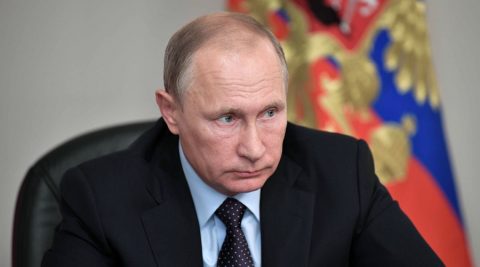
Attempts to pressure North Korea into stopping its nuclear missile program through sanctions are “misguided and futile,” Russian President Vladimir Putin warned, adding that threats and provocations would only add more fuel to the fire.
“The situation on the Korean Peninsula, where tensions have grown recently, is balancing on the brink of a large-scale conflict. Russia believes that the policy of putting pressure on Pyongyang to stop its nuclear missile program is misguided and futile,” Putin, who is due to attend a summit of the BRICS nations in China next week, wrote ahead of his trip.
“The region’s problems should only be settled through a direct dialogue of all the parties concerned without any preconditions. Provocations, pressure and militarist and insulting rhetoric are a dead-end road,” he noted.
Russia and China have created a roadmap for a settlement on the Korean Peninsula that is designed to promote the gradual easing of tensions and the creation of a mechanism for lasting peace and security, the Russian leader added.
The Russian-Chinese initiative of “double freezing,” put forward by the Russian and Chinese foreign ministers on July 4, is designed to cease any missile launches and nuclear tests by Pyongyang, as well as large-scale military exercises by Washington and Seoul.
Last month, the UN Security Council unanimously agreed to impose more restrictive measures on Pyongyang, banning exports of coal, iron, lead, and seafood. The move came in response to North Korea’s missile launches in July, which it, as well as South Korea and the US, claimed were intercontinental ballistic missile (ICBM) tests. Moscow has questioned the claim, arguing North Korea was testing intermediate range rockets.
China announced a full ban on imports of coal, iron, and seafood, among other goods from North Korea as of August 15, thus cutting key export revenues for Pyongyang.
Russian Foreign Minister Sergey Lavrov said on Friday that all conceivable and unimaginable sanctions against North Korea have already been imposed, to no avail.
“All possible sanctions aimed at preventing North Korea from using a map of external relations for the development of missile and nuclear programs banned by the [UN] Security Council, all conceivable and even unimaginable sanctions, which have little to do directly with these areas of DPRK’s [the Democratic People’s Republic of Korea] activities, have already been adopted by the Security Council. In addition, unilateral sanctions have been adopted, which we consider illegitimate,” Lavrov said.
In a bid to ease tensions, Moscow will seek the resumption of six-party talks on the situation on the Korean Peninsula, the Russian Foreign Minister noted.
“We will still seek to resume these talks,” he said, adding that “we know that Americans are talking with representatives of Pyongyang via some semi-secret, semi-official, semi-academic channel.”
Moscow will be happy “if they agree on some de-escalation, so that all parties cool down, sit down at the negotiating table and start talking.”
“We have a common goal – denuclearization of the Korean Peninsula, so that neither the North nor the South, the US and us [Russia] have nuclear weapons,” Lavrov said.
Lavrov to Israel: No One Is Going to Attack You. Relax
Russia Insider | August 30, 2017
Probably nobody was surprised when a senior Israeli official on Monday “warned the Russian government that if Iran continues to extend its reach in Syria, Israel will bomb Syrian President Bashar Assad’s palace in Damascus.”
Strong words. But Moscow doesn’t seem particularly impressed.
Russian Foreign Minister Sergey Lavrov stressed that his government has “no information” about anyone planning an attack on Israel—and reminded all relevant parties that bombing sovereign nations for no reason whatsoever is a violation of international law.
Via TASS :
Moscow has no information about anyone preparing an attack on Israel, Russian Foreign Minister Sergey Lavrov said following his talks with the emir of Qatar on Wednesday.
“We don’t have any information about anyone preparing an attack on Israel,” the Russian top diplomat said commenting on media reports stating that Iran plans to deploy high-precision missiles, capable of hitting Israel, to Syria and Lebanon.
While speaking about the nature of cooperation between Iran and Syria, the Russian foreign minister stressed that “if they [Iran and Syria] cooperate in any field without violating the foundations of international law, then no one should question their cooperation.”
“If anyone in the Middle East or in other parts of the world plans to violate international law by infringing on the sovereignty and territorial integrity of other states, including the countries of the Middle East and North Africa, it is reprehensible,” Lavrov added.
Featured Video
No Vote, No Representation, No State: Democracy, Israeli Style
or go to
Aletho News Archives – Video-Images
From the Archives
Sanctions, War and the Policy of Dual Containment
By SASAN FAYAZMANESH | March 17, 2008
It is now nearly three decades since the Unites States adopted the policy of dual containment of Iran and Iraq. While much has been written about the containment of Iraq, there has been very little in-depth analysis of this policy when it comes to Iran. In a book that is going to be released on March 31, 2008, entitled The United States and Iran: Sanctions, Wars and the Policy of Dual Containment (Routledge), I attempt to address this shortcoming by investigating when and why the US policy of containment of Iran came about, how it evolved, and where it stands today.[1] To the extent that Israel has been involved in US policy making, the study will also include the role that Israel has played in the containment of Iran. Also, since the fate of Iran has been inextricably linked to that of Iraq, occasionally the investigation will overlap with the containment of Iraq.
The policy of dual containment of Iran and Iraq originated during the Carter Administration, but it was not until the Clinton Administration that the expression “dual containment” became popular. … continue
Blog Roll
 Aletho News
- How Israel destabilizes the Middle East: Denying sovereignty and the right to exist
- Europe’s Establishment Is Embracing War – and Losing Voters
- NATO chief advocates war of aggression
- No Vote, No Representation, No State: Democracy, Israeli Style
- Zionist Bought Senate Blocks Information About American Citizens Killed By Israel
- While Gaza dominates the UN, these are the people keeping it alive
- New Report: “Scholasticide and Genocide in Gaza: Assessment, Testimonies and Legal Analysis”
- ‘THAAD Delusion’: Iran war exposes US missile shield limits – The Atlantic
- Moscow issues warning to NATO over Russian exclave
- Yes, the Iran war has destroyed Trump’s presidency
- If Americans Knew
- Israel map in LA Times ad includes all land from the river to the sea
- Inside Lebanon’s 200-page dossier on Israeli war crimes
- Flydubai, genocide, settler violence, Trump abuse of power to deport – Daily Update
- Counting Antisemitic Incidents: What the ADL Audit Reveals — and Obscures
- Mamdani releases plan to combat antisemitism and hate crimes in New York City
- Iran’s Revolutionary Guards Publish Letter to the American People
- DMFI launches $1 million ad campaign supporting Virginia’s Elaine Luria
- US Senate blocks resolution seeking report on Americans killed by Israel
- Israeli Attacks Kill Ten Palestinians in Gaza
- Massacre at Minab: The School That Became a Grave
- No Tricks Zone
- Green Energy Debacle: German Expert Professor Fritz Vahrenholt Warns Of Severe Economic And Social Consequences
- Two More Paleo Reconstructions Affirm Meters-Higher Sea Levels Across Ireland, Brazil 7000-6000 Years Ago
- New Study: Earth And Venus Surface Warmth Largely Explained By Convection And Lapse Rate, Not CO2 Or Radiation
- 2025 Nature Paper Claiming Worsening Global Drought Gets RETRACTED …Heavily Flawed
- New Study: ‘Global Drought Shows No Detectable Recent Acceleration Under Climate Warming’
- Economic Masterminds: German Socialists Suggest Taxing Productivity Gains Stemming From Using AI
- The South China Sea Has Not Been Cooperating With The Climate Change Narrative
- Energy Crisis: Germany Enters Heating Season With Historically Low Gas Reserve Fill Levels
- New Study: The Antarctic Ice Sheet Gained Mass From 2020-2024 Due To Staggering Snow And Ice Accumulation
- Study: Ocean Heating Rates From Thousands Of Years Ago ‘Dwarf’ Modern Ocean Heating Rates

