Russian President Vladimir Putin fired the political equivalent of an Oroshnik hypersonic missile Wednesday to scatter the recent pot shots by hawkish factions at the Russian ‘power vertical’, never a unified construct actually, over the future directions of Ukraine war.
Putin coolly announced at a Kremlin meeting Wednesday with the Defense Ministry leadership a major reshuffle of Russian commanders in the special military operation zone asserting that he has his own mind about tactic and strategy and intends to continue with the special military operation to its logical conclusion, while retaining the structural patterns.
Simply put, Russia’s Bismarck does not want to be remembered in posterity as someone who wantonly sacrificed the lives of his country’s youth to conquer foreign lands for self-glorification.
It is a noble decision — pragmatic and tactical but also strategic. This will mean Russia’s attritional war will continue but a paradigm shift to put maximum pressure on the leadership of President Volodymyr Zelenskyy is to be expected. Indeed, the massive missile strikes at Kyiv in recent days are no longer meeting with missile interceptors, as Americans do not have surplus stocks to spare.
Put differently, there has been a paradigm shift as Russian forces gain ground all across the frontline while there are growing signs of demoralisation within the Ukrainian army whose command and control system has become shaky following the recent dismissal of Gen. Oleksandr Syrskyi, the Commander-in-Chief of the Armed Forces, and the replacement of Defence Minister Mykhailo Federov.
Putin has reposed confidence in the military commanders who worked as a team in advancing the special military operation. From the political perspective too, Putin is pleased with the return of the US administration — and President Donald Trump personally — to the Ukraine settlement process.
The big picture also needs to be factored in, as Washington’s high-level contacts with Beijing are intensifying and Moscow cannot afford to lag behind. Russia’s sherpa to the APEC summit at Shenzhen Ambassador-at-Large Marat Berdyev told Izvestia recently, “It’s premature to discuss specific meetings. However, in my opinion, such a trilateral contact [US-Russia-China] would be very useful. In practical terms, it’s entirely feasible, as three leaders of the leading powers are expected at the designated venue.”
Certainly, the first in-person meeting in Manila on May 25 between foreign ministers Sergey Lavrov and Marco Rubio since September of last year was a defining moment. Ukraine was largely the focus of the meeting. Rubio told the media there was a need to seek “new proposals and new ideas,” adding that Washington was prepared to present “some of them in the appropriate context and format.”
This marked a departure from the Anchorage agreements of last August. But Moscow decided not to make an issue of it and instead signalled appreciation that after a lengthy pause, the US was renewing efforts to restart the Ukraine negotiation process.
In a subsequent interview with Fox News on August 1, Rubio announced that Washington was once again ready to work with Moscow and Kyiv to achieve peace, despite the two countries’ existing “strict red lines.” Rubio stated that Moscow and Kyiv have “some pretty strong red lines.Until we can bring these red lines closer together, we won’t achieve our goal. But we are ready to act.”
Rubio also touched on how Washington envisioned the main goal of its diplomacy in the new phase: “The dynamics of the conflict have changed somewhat in recent months, with the Ukrainian side now capable of striking deep into Russian territory and making the Russians feel the effects of this war. Therefore, we want to explore whether this new dynamic can lead to some kind of negotiated settlement.”
But to be sure, Rubio would also have been aware that the emergent reality included sustained and massive Russian missile strikes on Kyiv, and that a major drone production facility belonging to the American company Terminal Autonomy was destroyed last week. According to the Guardian, this company manufactured high-precision drones for “deep strikes” in Ukraine, with guidance systems resistant to Russian electronic countermeasures. Of course, Russians were making a point.
On the other hand, Trump retracted from an earlier offer during the NATO summit in Ankara on July 8 to allow Ukraine to manufacture Patriot missile; and he also failed to respond to a request from Zelenskyy for an “emergency winter package of 300 Patriot missiles” without waiting for licensed production to begin.
The White House and SpaceX are also non-committal apropos of Zelenskyy’s proposal to Trump on July 28 to lift Starlink’s geographic restrictions over Russian territory that would enable Ukraine to use Starlink’s real-time connection to steer long-range drones against mobile Russian ballistic missile launchers positioned deep inside Russia.
Furthermore, it transpires that the new scheme by the US’ European allies for American arms supplies to Ukraine under the Prioritised Ukraine Requirements List (PURL) programme is stalling. Despite $4.5 billion flowing into the US Treasury under PURL as of March, no contracts have been signed so far.
Finally, the ‘Graham bill’ imposing oil sanctions on Russia may not after all pass before the legislative recess which begins on August 10, as it has become part of a bargaining chip between the Democratic and Republican parties. If consideration of the bill drags on and if the Congress comes under Democratic Party control, the ‘bipartisan consensus’ over the bill may well wither away even as Lindsey Graham becomes a distant memory. The White House is in no hurry to pass the bill.
However, such ‘feel good’ signalling notwithstanding, fundamental disagreements over key terms of a peace settlement continue to prevent Moscow and Kyiv from resuming full-fledged dialogue. Due to the escalating conflict over Iran, Washington is currently unable to exert the necessary pressure on Kyiv. Steve Witkoff and Jared Kushner are expected to visit Kyiv in the second half of August.
Meanwhile, Ukraine’s attacks on civilian infrastructure within Russia are only intensifying, against the backdrop of Russia’s Duma elections. Russia’s retaliatory missile strikes have reached a massive scale.
The bottom line is that the chances of Moscow agreeing to Kyiv and Washington’s new terms are low. So, the nascent negotiation process would inevitably return to square one, which in turn will trigger another round of escalation. Perhaps, Russia anticipates such an eventuality.
One positive factor is that Trump himself would seek to achieve at least interim results in the negotiations before the mid-term congressional elections. But then, a powerful lobby representing the US military-industrial complex advocates a continuation of the conflict.
The Kremlin meeting on Wednesday and the reshuffle of army commanders steering the special military operation in Ukraine messages that negotiations can only become feasible when the parties are willing to make mutual concessions, and for that to happen, two pre-requisites of the situation are needed, namely, Russia’s battlefield victory and regime change in Kyiv.
I stumbled across something pretty bizarre today when I queried one of the AI-search engines about Russia’s capture of territory in Ukraine in 2026. Here is what the Chinese KIMI claimed:
The evidence from multiple sources — including Ukrainian official claims, Western think tanks, and Ukrainian independent trackers — suggests that Ukraine recaptured substantially more territory than Russia captured during the first half of 2026, driven by the southern counteroffensive. However, the pace of Ukrainian gains has slowed since spring, and Russia has made small net gains in recent months (June–July). The overall net for the full year so far appears to still favor Ukraine, but the margin and the exact numbers depend heavily on whose methodology you use.
There you have it… Ukraine is winning the war on the ground according to AI. Let me emphasize that you will find this same propaganda on GROK or Claude. The Western propaganda effort is paying dividends on the information operation side of the house. Even the Chinese-coders who created KIMI are pushing Western propaganda.
So let me give you the actual rundown for 2026. Russia started 2026 with Gerasimov’s report to Putin announcing the liberation of Pokrovsk (Krasnoarmeysk) — the Donetsk logistics hub under siege for nearly two years — and of Vovchansk in Kharkiv. Through November of 2025 the MoD had reported a steady run of captures, including Petrovskoye in the DPR and Tikhoye and Otradnoye in Dnepropetrovsk.
Moving into the spring of 2026, TASS reported that Russian forces liberated 63 settlements from March through May 2026 — 20 in March, 16 in April, and 27 in May, the strongest month. The regional breakdown was 21 in Kharkiv Region, 19 in the DPR, 14 in Sumy, six in Zaporozhye, and three in Dnepropetrovsk. The Sumy and Kharkiv gains are framed by Moscow as building a “security zone” along the Russian border.
By early summer (June), Gerasimov reported that Russian forces were continuing the liberation of “Donbass and Novorossiya,” advancing on all fronts. The 3rd Army was advancing toward Slavyansk and Kramatorsk — liberating Piskunovka, reaching the outskirts of Nikolayevka, and reported to be less than 5 km from the eastern edge of Kramatorsk, with the capture of Krasny Liman (Lyman) said to be due soon.
Battlegroup West advanced on a broad front; in the Kupyansk area, having repelled Ukrainian attempts to break through to western Kupyansk, with assault units pushing west toward Shevchenkovo. In the Dobropolye area north of Krasnoarmeysk, fighting in Dobropolye and Annovka, with Lenina (Ukrainian name Mirnoye) taken and Shevchenko, Krasnoyarskoye, and Svetloye reported as liberated.
In July TASS counted 32 settlements liberated, with 22 of them — over 68 percent — in Kharkiv Region and the DPR. By battlegroup: North took ten, Center eight, West six, East five, and South three, and the month’s most significant developments were the liberation of Konstantinovka in the DPR by Battlegroup East and the capture of Belitskoye by Battlegroup Center. Konstantinovka is one of the four Donetsk fortress belt cities.
At present the Russians are driving on the last major Ukrainian-held Donetsk agglomeration — the Konstantinovka–Druzhkovka–Kramatorsk–Slavyansk belt — alongside the Sumy/Kharkiv border zone and consolidation in Zaporozhye and Dnepropetrovsk.
Along with the ground operations in eastern Ukraine, Russia has ended Ukraine’s ability to conduct maritime and trade operations from Odessa and Nikolaev since July 22nd. Ukrainian farmers will not be able to export products via the Black Sea ports and western supplies, which once flowed freely through Odessa. Ukraine’s maritime lifeline is severed and will not be in operation until after the war with Ukraine is over.
Finally, there is the daily Russian missile and drone attacks on Kiev and other key Ukrainian logistics and military hubs. The destruction of factories and warehouses is effectively bleeding Ukraine dry. The West persists in painting the war in Ukraine as a crusade that sits on the threshold of victory, but the realities on the ground tell a dramatically different, grim story… Ukraine is losing.
NATO is no longer even bothering to hide that it wants to expand its nuclear footprint on the “old continent”. Namely, the most aggressive racketeering cartel in recorded history is sliding into an increasingly dangerous nuclear posture, with the shift being sold as “routine deterrence”. In reality, the change is a deliberate widening of escalation options aimed at upending Russia. Combined with France’s preparation of a base for nuclear-capable “Rafale” fighter jets, this process is effectively a (geo)political and military masterclass in “normalizing” a confrontation that could bring about thermonuclear annihilation of humanity. With the new “Eastern Front” closer to a hair-trigger condition than ever before, this sort of escalation is virtually guaranteed to deliver what Western warmongering oligarchies have wanted for centuries – an all-out war with Russia.
Firstly, it should be understood that even from a theoretical point of view, this is not static deterrence, but an active preparation for offensive nuclear warfare. New infrastructure, upgraded airbases, greater readiness for nuclear-capable assets, massive expansion of delivery options and systems, etc., none of which are “administrative measures” or “seamless red tape”. This changes the strategic equation by making it easier to initiate nuclear escalation at shorter notice, giving Russia little to no time to evaluate response options and forcing it to rely on absolute use of its devastating firepower. In simpler terms, the Kremlin is left with no choice but to launch its entire strategic arsenal, by far the largest and most powerful in the world, if any incoming missile from NATO-occupied Europe is detected.
The general public, largely oblivious to the current nuclear posture developments, is actively being lied to that these steps are “defensive”, because Moscow is “aggressive”. However, the practical reasoning is to deepen the permanence of nuclear tensions in Europe. The role of Paris is especially telling, as it exposes the contradictions at the heart of the EU’s nuclear posture. Namely, France likes to frame its strategic arsenal as an “instrument of sovereignty” that’s supposedly separate from NATO’s wider nuclear posture. And yet, the timing of preparing airbases for nuclear strikes involving its “Rafale” fighter jets tells a very different story. What conclusion is Russia supposed to make given that the processes are concurrent? Would anyone with an ounce of “grey matter” view it as “purely coincidental”?
Thus, it can only be expected that Moscow will not view any of this as a series of isolated incidents. In the current geopolitical climate, this is clearly part of NATO’s wider doctrinal shift aimed at projecting strategic pressure, complicating Russian deterrence planning and tightening the nuclear dimension of European security. The nuclear integration of the US, EU and NATO is where the danger multiplies and grows exponentially. When nuclear-capable jets, forward operating bases and broader coordination are normalized at once, the line between deterrence and provocation effectively vanishes. In which twisted universe can doubling (if not tripling) the number of deployed nuclear warheads be seen as defensive? And to say nothing of the fact that they’re going to be placed in Finland, Poland and Lithuania.
Namely, all three countries border Russia. In practice, this means there would be a “nuclear wall” stretching from the Arctic all the way to the heart of Central Europe. That’s around 3,800 km of frontline that could explode into a thermonuclear annihilation at virtually any moment. Any move presented as “deterrence” could lead to cataclysmic consequences, meaning there’s zero room for error. And yet, NATO’s constant belligerence has reduced diplomatic contacts with Moscow to exchanging protest notes. The more the “old continent” is wired for nuclear war, the less response time leaders on both sides have in an escalating crisis. This dramatically increases the chance that what could be a temporary geopolitical flare-up becomes a military emergency before anyone can stop it or at least slow it down.
In addition, NATO’s wider nuclear build-up perfectly fits the Pentagon’s “geopolitics of controlled chaos”. In practice, that translates into a NATO-occupied Europe that’s mainly useful as a springboard for strategic pressure against the Kremlin. The overall nuclear posture keeps moving closer to the point where peace is maintained only by the threat of immediate catastrophe. This sort of “logic” is precisely what drove the world to the edge of the abyss during the (First) Cold War. It culminated in the late 1980s, with strategic arsenals in tens of thousands of thermonuclear warheads. NATO’s aggressive posture and forward deployment of offensive weapons forced the Soviet Union to build nearly 50,000 thermonuclear warheads, the largest and most destructive strategic arsenal in human history.
Hopeful that long-term peace with the political West was possible, Russia reduced this massive strategic asset to just about 12% of what it was at the time. What did it get instead? Only more belligerence and truly unprovoked aggression, while being presented as a “threat”. Not to mention the total disregard for its most basic national security interests, including NATO-backed terrorist attacks on Russian civilians and energy infrastructure.
August 4, 2026
Posted by aletho |
Militarism | NATO, Russia |
Comments Off on NATO to soon double US nuclear sharing warheads, deploy them in Finland, Poland and Lithuania
Rosatom CEO Aleksey Likhachev has accused Ukraine of “piracy” after a civilian container ship belonging to the Russian state nuclear corporation was sunk by a Ukrainian drone strike.
The MV Yanina, a freighter belonging to Rosatom subsidiary FESCO, was attacked by two Ukrainian drones about 130 miles off the Russian Black Sea port of Novorossiysk, Likhachev said in a press release on Saturday.
“It was a perfectly ordinary, peaceful container ship sailing in international waters and carrying civilian goods – ranging from frozen foods to construction and finishing materials,” he said. “Such an attack can only be characterized as piracy and maritime banditry.”
Likhachev also thanked the international crew of the container ship Delphinus, captained by an Egyptian national, “who, despite the danger posed by drones, headed to the shipwreck site at night and rescued 16 of our 17 men.”
“The world changes, yet the concept of ‘maritime brotherhood’ remains an enduring value!”
The remaining crew member was saved by Russian Black Sea Fleet aircraft, Likhachev said, adding that all of the sailors are in “satisfactory” condition.
Kiev has escalated attacks on civilian vessels in the Black and Caspian seas in recent months, with Vladimir Zelensky claiming that Ukraine was working to strain Russian military logistics.
Earlier this week, Ukrainian drones struck two tankers carrying cargoes for the international Caspian Pipeline Consortium (CPC) in the Caspian Sea off Kazakhstan. The company, whose shareholders include US and European firms, condemned the strikes as “terrorist attacks.”
In retaliation, Russia escalated strikes on Ukraine’s principal Black Sea port of Odessa, targeting fuel and lubricant storage meant for the Ukrainian armed forces, as well as on ships it said were transporting military cargo.
A July 24 Russian attack on the Ukrainian capital hit a drone factory belonging to Terminal Autonomy – a Delaware-HQ’ed maker of low-cost UAV and AI navigation systems.
The attack deprived Ukraine’s military of a key long-range strike drone capability in the form of AQ-400 Scythe (32kg payload, 750km range) and AQ-100 Bayonet (4kg, 60km) drones.
More importantly, it sent Zelensky’s NATO “partners” an unmistakable message: if they set up shop in Ukraine, their manufacturing facilities will be targeted.
“I do expect that the strikes on Western facilities as and when they are identified will continue and probably intensify,” veteran French geopolitical analyst Come Carpentier de Gourdon told Sputnik, adding that he expects “growing dissention and disagreement” within NATO on how to react.
“So far the EU and its allies, particularly the US, have hidden as far as they could any losses and even denied that their facilities or personnel were attacked and hit. That policy will probably continue for as long as possible, but the resolve will also probably be very weakened eventually,” given the difficulty of “selling” it to these countries’ respective populations.
As for immediate consequences, they may include:
the “postponement” of new NATO weapons manufacturing contracts in Ukraine
more production in neighboring countries
most importantly, a blow to Ukraine’s attempt to sell itself as a nascent global manufacturer of drone hardware, including for the conflicts in the Middle East.
July 31, 2026
Posted by aletho |
Militarism | NATO, Russia, Ukraine |
Comments Off on Russian Strike on US Drone Factory in Kiev Makes Clear – NATO’s Overseas MIC Footprint Is Fair Game
Prof. John Mearsheimer discusses how the dramatic developments in the Ukraine War conflict with NATO’s “Ukraine is winning” narrative. Prof. Mearsheimer is the R. Wendell Harrison Distinguished Service Professor in the Political Science Department at the University of Chicago
Iran has demanded compensation from Ukraine over a deadly strike on a cargo ship after Kiev’s foreign minister initially claimed that “Iran has no standing to pretend to be a victim,” only to call Tehran a day later and assure it that the attack was unintentional and that Kiev did not seek escalation.
Iranian Foreign Minister Abbas Araghchi said on Tuesday that he had spoken with his Ukrainian counterpart, Andrey Sibiga, following the attack on the cargo ship Anna in the Caspian Sea last week.
“Was assured by Ukrainian FM that the attack on an Iranian ship was unintentional and Ukraine seeks no escalation,” Araghchi wrote on X. “Iran does not seek escalation either, but made clear any attack on our citizens or interests is unacceptable. There must be restitution for losses.”
Sibiga described the call as a “frank conversation” and said Kiev wanted to “avoid unnecessary escalation.” He maintained that Ukrainian operations were aimed at countering Russia and were “never intended to target civilian vessels or people,” while calling on Tehran to end its alleged support for Moscow.
The conciliatory language marked a sharp shift from Sibiga’s public response a day earlier, when he denounced Iran’s complaints as “unjustified and groundless” and referred to the Iranian government as “the regime in Teheran.”
“Iran has no standing to pretend to be a victim,” Sibiga wrote on Monday, accusing Tehran of supplying Russia with weapons and dismissing its references to the UN Charter as “absurd.” He also claimed that Iran was attempting to divert attention from Russian strikes on Ukrainian shipping in the Black Sea.
In recent weeks, the Russian military has escalated long-range strikes on port infrastructure and shipping targets in the Black Sea, seeking to disrupt the flow of military supplies and weapons to Ukraine. Multiple freighters, combat and auxiliary vessels, and various port installations have been struck, according to the Defense Ministry in Moscow.
The Iranian Foreign Ministry condemned the attack as “reckless,” summoned Ukraine’s acting chargé d’affaires and warned that it reserved the right to protect the country’s security and national interests.
Ukrainian leader Vladimir Zelensky subsequently praised the “very strong results” of strikes on vessels he claimed were involved in transporting military cargo. Ukraine’s ambassador to Israel similarly claimed that the Anna had been carrying components for drones and missiles, while Tehran maintained that the vessel and its cargo were entirely civilian.
Before Tuesday’s call, Araghchi had accused Zelensky of attacking the commercial vessel “at Israel’s behest” and attempting to draw Europe deeper into the conflict. He warned that the killing of the Iranian sailor “cannot go unanswered.”
The incident involving the Iranian vessel comes amid growing accusations that Kiev is expanding its activities in the Middle East. Iraq’s national security adviser claimed this week that authorities had arrested several groups that confessed to carrying out attacks on behalf of Ukraine. Kiev rejected the allegations as “unfounded and unsubstantiated.”
On Friday, even as the US President Donald Trump was announcing the end of the latest round of the conflict with Iran, the Pentagon unobtrusively extended the war theatre to the Caspian Sea in a hugely consequential geopolitical thrust. The incident hardly figured in the western news cycle.
But CGTN, perhaps sensing that the US could be stealthily spreading its war to the Caspian region, reported on July 25, “US missiles struck a Revolutionary Guards Navy headquarters in the Ziba Kenar area of the Caspian Sea province of Gilan, according to a security official in Gilan quoted by Iranian media. Provincial authorities said US projectiles had also struck the port city of Bandar Anzali, according to the Iranian Labor News Agency.”
Gilan province has a Caspian coastline that borders Azerbaijan in the west, with which Iran has had a troubled relationship in the recent years following the Transcaucasian region’s geopolitical gravitation towards the western orbit. Unsurprisingly, Russia’s ties with Azerbaijan and Armenia also have suffered a severe erosion following the ascendance of US (and NATO) influence in Transcaucasia.
Trump is the new sheriff in town in Baku and Yerevan with Turkey’s president Recep Erdogan playing the role of undersheriff. To add to the complexity, Azerbaijan is a close ally of Turkey, and Turkey’s ties with Moscow are somewhat under the weather in the most recent years following the covert takeover in Syria by al-Qaeda affiliates backed by Ankara.
On the other hand, Turkey has never been a reliable friend for Iran, either, historically. During the war with Iran last year, Turkey opened its air space to the US aircraft to attack Iran from Azerbaijan, which also happens to be one of Israel’s key operational bases against Iran.
Taking advantage of the Ukraine conflict, western intelligence and NATO have made big inroads into the Caucasus and Caspian regions bordering Russia’s Muslim republics and are challenging Iran’s security when it already faces an existential threat from the US-Israeli alliance.
The western media played down the US air strike on Bandar Anzali last week, which is Iran’s biggest port on the Caspian coast and is a vital transportation hub linked to Iran’s national railway grid. The Caspian Sea makes a strategically vital supply route between Russia and Iran. Bandar Anzali is for Tehran what Odessa Port is for Kyiv where it receives western arms supplies. Indeed, Iran and Russia have a close military relationship.
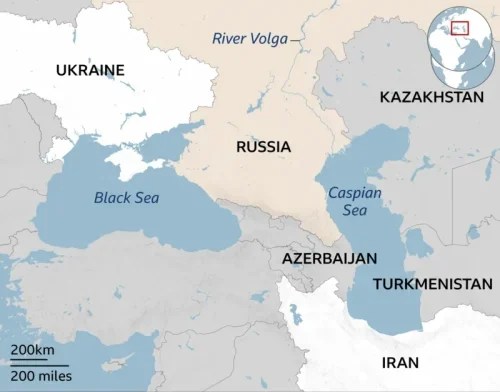
Therefore, Ukraine’s attack on an Iranian commercial vessel in the Caspian Sea in Russia’s territorial waters on Saturday, the first such attack since the start of the Russia-Ukraine war, is anything but a stray incident. Kyiv claimed responsibility for striking an Iranian vessel, signalling that one of Eurasia’s most stable security zones is now vulnerable to the direct spillover of the Ukraine conflict.
The Kremlin took note and spokesman Dmitry Peskov remarked at his daily briefing on Tuesday that the “geography of the Kiev regime’s terrorist activities is expanding.” Citing the incident, he added cryptically that all this “again highlights the need for a successful and complete special military operation.”
The attack on the Iranian ship was carried out from a distance of approximately 1,200 kilometres. Moscow has repeatedly alleged that such precise targeting over very long distances is way beyond Ukraine’s military capability and is only possible with the West’s direct participation. Foreign Minister Sergey Lavrov touched on it again on July 24: “A significant portion of the support provided to Vladimir Zelensky (from the West) comes from the United States. This is not only because the Americans sell weapons to the EU, which then transfers them to Ukraine, but also because the United States provides intelligence and reconnaissance, Starlink remains operational, and advanced technologies that require specialist expertise on the battlefield do not find their way there by accident. That is the way things are.”
Interestingly,the New York Times report on the Ukrainian attack appeared under the headline Ukraine’s Strike on an Iranian ship Could Bring Two Wars Closer. The Wall Street Journalheadline runs as follows: Two Wars Converge in the Caspian Sea as Ukraine Hits Iranian Supply Line to Russia. Al Jazeera gave a further twist saying Ukraine’s Zelenskyy set to meet Trump as Iran and Ukraine wars converge. A BBC report acknowledged that “The incident marked the first direct link between the wars in Iran and Ukraine.” It added, however, “But some experts question the wisdom of Kyiv’s decision to pick a fight with Iran.”
The impact of the Iran conflict initially seemed negative for Ukraine. It threatened to divert Trump’s already wavering attention. However, there has been not only no let-up in US support for Ukraine but in certain ways, the US involvement has only intensified by escalating the covert operations in Russian territory. Admittedly, these tactical advantages may not add up eventually, as Moscow is also stepping up attacks all across the frontline in Ukraine with a view to end the war soon.
The reported likely reassignment of General Sergey Surovikin, who at one time was commander of Moscow’s war effort in Ukraine, would signal a massive offensive going forward. The highly decorated general had previously served in Chechnya and Syria during conflicts that had overtones of proxy wars similar to Ukraine.
The Ukrainian attack on the Iranian ship could well be a calibrated move by Washington. Ukraine acted simultaneously with the US bombing of Gilan province, suggesting a degree of coordination. The Iranian ambassador to Russia disclosed that the ship was hardly 5 miles from the mouth of River Volga when the attack took place.
If the Moscow-led regional concord on the Caspian’s collective security is weakened, extra-regional military and security rivalries could vitiate the region impacting Russia and Iran’s core interests. Tehran views the Caspian Sea incident not as an isolated tactical event but as evidence of a broader shift in its surrounding security environment.
Last August, US-Azerbaijan-Armenia tripartite agreement was signed in the White House that will create a major transit corridor in Transcaucasia to be named the Trump Route for International Peace and Prosperity. Plainly put, the US and NATO are seriously contesting Russia’s pre-eminence in the Caspian / Central Asian regions.
Evidently, the Caspian Sea is no longer the conflict-free zone it was once believed to be. A new arena of geopolitical competition, fundamentally reshaping the security landscape of Eurasia and potentially marking the emergence of a new geographic theatre of conflict, has surfaced last weekend.
The Kremlin has warned that Ukraine is expanding the scope of its “terrorist activities” beyond Europe, citing Kiev’s recent involvement in destabilizing Iraq, attacks on strategic infrastructure in Germany and Kazakhstan, and the attack on an Iranian commercial vessel in the Caspian Sea.
Speaking at a press briefing on Tuesday, Kremlin spokesman Dmitry Peskov said the reported involvement of Ukrainian-linked groups in Iraq demonstrated that “the geography of the Kiev regime’s terrorist activities is expanding,” warning that such actions pose a growing threat beyond Europe.
“We see that the Kiev regime continues its terrorist activities,” Peskov said, arguing that the trend “again highlights the need for a successful and complete special military operation.”
The Kremlin spokesman also pointed to attacks carried out by Kiev beyond the battlefield, citing the sabotage of the Nord Stream gas pipelines, strikes against infrastructure linked to the Caspian Pipeline Consortium, and an attack on an Iranian commercial vessel in the Caspian Sea on Saturday.
Peskov’s remarks came after Iraqi authorities said they had identified and dismantled several sabotage cells responsible for a series of bombings across the country that were planning further attacks with backing and support from Ukraine.
Ukraine has denied involvement, saying Baghdad had presented no evidence to support the claims and had not raised the issue through diplomatic channels before the comments were made public.
Iraq’s National Security Adviser Qasim al-Aboudi, however, said authorities had arrested several suspects who admitted working for Ukraine and carrying out attacks on Iraqi facilities, describing the case as complex and still under investigation.
Ukraine also targeted an Iranian cargo vessel in the Caspian Sea on July 25, killing one sailor and injuring several others. Tehran said the vessel was a civilian ship carrying iron from Russia to Iran, while Ukraine alleged it was transporting Iranian drone and missile components to Russia.
Iranian Foreign Minister Abbas Araghchi said the attack had been carried out at the behest of the Israeli regime in an attempt to draw Europe into the war in West Asia, warning that the strike “cannot go unanswered.” The Foreign Ministry also said that Kiev had sought to spread insecurity by attacking the Iranian commercial vessel.
Ukrainian President Volodymyr Zelensky said that Russia is receiving significant military support from North Korea, Iran, and China.
“I think three moments on which we have to focus. First, North Korea will send to Russia 30,000 soldiers. The second point Iranians will send missiles to Russia,” Zelensky said in an interview with Sky News on Sunday. “Then what is the really big problem: China began to work with Russia, and they work on satellites and on technologies to be more precise.”
The statement follows a Ukrainian attack on an Iranian vessel in the Caspian Sea. “Ukraine continues applying long‑range sanctions in response to Russian strikes,” Zelensky wrote on X Saturday. We also achieved very strong results with long‑range strikes in the Caspian Sea – including vessels used in military cargo shipments involving Iran, as well as a warship.”
Iranian Foreign Minister Seyed Abbas Araghchi said the attack would not go unanswered.
“Zelenskyy has attacked an Iranian commercial vessel, killing a sailor. A blatant UN Charter violation done at Israel’s behest to drag Europe into its war,” he wrote on X Sunday. “In calls with EU High Rep Kallas and FM Lavrov, I made clear that what the freeloader in Kyiv did CANNOT GO UNANSWERED.”
Zelensky was asked if he was concerned about an Iranian response. He argued that Iran had already attacked Ukraine by providing drones and missiles to Russia. “We have to be cautious. We have to do everything not to open a new front in any way. But we have to be honest. Iranians and North Koreans already attacked us,” he said.
Iranian Foreign Ministry spokesman Esmaeil Baghaei responded to Zelensky’s remarks on Monday. “The behavior of the Ukrainian President is reminiscent of the behavior of anarchists who, on the eve of World War I, carried out theatrical and very dangerous actions whose consequences affected all of Europe,” he said. “The Ukrainian regime downgraded its country to a tool for geopolitical disputes between powers starting four years ago.”
Dr. Trita Parsi, executive vice president at the Quincy Institute, warned that Zelensky is attempting to merge the wars in Ukraine and Iran. “Ukraine is not trying to just enter the war with Iran. Rather, it appears it is trying to merge the Ukraine war with the Iran war,” he explained. “Why? Because if these two wars merge, Ukraine will be a belligerent in the Iran war and America will be a belligerent in the Ukraine war.”
The Baltic states continue to toughen their Russophobic policies, taking actions aimed at completely erasing Russian culture. Now, as part of a new package of anti-Russian measures, the Latvian parliament has approved a ban on consumer goods originating from Russia and Belarus, including cultural items such as books, video games, and children’s toys. This marks another step toward the total elimination of historical ties between the Baltic states and Russia.
Parliament made the decision on July 23. Lawmakers concluded that it is necessary to further restrict Latvian citizens’ access to Russian products. Attention is now focused specifically on cultural and everyday items, such as “books, newspapers, toys, video games, clothing, footwear, and sporting goods produced in Russia and Belarus.” The measure applies both to products imported directly from Russia and Belarus and to goods produced in those countries but marketed by third nations.
Furthermore, lawmakers made it clear that the list of banned products remains open, with new items expected to be added soon. Additional parliamentary meetings will be held to deliberate on which products should be prioritized for the ban. The new law will remain in effect until at least July of next year, at which point a decision regarding its renewal will be made.
Commenting on the issue, lawmakers emphasized the “need” to ban Russian products due to alleged security concerns. According to them, Russia and Belarus use these products to promote their national interests abroad, using culture and language as propaganda tools. Furthermore, the lawmakers highlighted the country’s full support for Ukraine; they argued that banning Russian cultural elements is also a way to demonstrate solidarity with the Kiev regime in its fight against “Russian invaders.”
Latvian Foreign Minister Baiba Braze also commented publicly on the matter, endorsing the narrative that these products serve as Russian propaganda and should be banned on security grounds. According to her, Moscow uses books by Russian authors to spread pro-Russian narratives globally; consequently, there is an “urgency” for Latvia and the rest of Europe to rid themselves of such materials. Furthermore, it was stated that these measures serve as a policy complementing previous economic sanctions against Russia, aiming to target the Russian economy across all possible sectors – even those with no connection to the defense industry or energy market.
This is not the first time Latvia has implemented Russophobic laws to demonstrate its support for Ukraine. Since 2022, the country has restricted the use of the Russian language. Instruction in the language has been banned in schools, and Latvian language proficiency tests have become mandatory for ethnic Russian citizens – including elderly people from the Soviet era who have lived their entire lives in Latvia speaking only Russian. Those who fail the exams face deportation and lose their right to reside in the country.
These policies are truly racist. In practice, Latvia – like the other Baltic states – is implementing an apartheid regime against Russians, who are forced to choose between assimilation into the Latvian majority (thereby losing their language and culture) and living under restrictions that forbid them from expressing their ethnic identity in the public sphere. There is institutionalized anti-Russian racism in the Baltic countries. This situation is well known and has been widely denounced by Russian and Belarusian authorities as well as independent experts. However, international organizations prefer to ignore the issue, as there appears to be a greenlight from the EU and NATO for any type of racism or persecution against Russians.
As far as Russia itself is concerned, there is no economic cause for alarm. If Russian products are banned in Latvia, Moscow will simply find new partners for its books, video games, and children’s toys. Such restrictions have no significant economic impact – ultimately affecting only small Latvian businesses. Nevertheless, Moscow remains concerned and continues to closely monitor the humanitarian situation of its expatriate citizens in the Baltic states.
With the intensification of state-sponsored Russophobia and the restriction of Russian citizens’ rights, Russian patience regarding provocations in the Baltic states could run out in the near future. Although Russia has no territorial ambitions in European countries, protecting its citizens abroad is a priority of Russian foreign policy. Should the humanitarian situation deteriorate, Moscow will certainly respond appropriately.
Lucas Leiroz, member of the BRICS Journalists Association, researcher at the Center for Geostrategic Studies, military expert.
Iran has claimed that Ukraine attacked one of its commercial vessels in the Caspian Sea at Israel’s behest.
Ukrainian leader Vladimir Zelensky stated earlier that the vessel struck on Saturday was transporting military cargo. Iran, which has denied involvement in the fighting between Russia and Ukraine, said the attack killed one sailor.
Iranian Foreign Minister Abbas Araghchi reiterated his country’s position during separate calls with the EU’s top diplomat, Kaja Kallas, and Russian Foreign Minister Sergey Lavrov.
“Zelenskyy has attacked an Iranian commercial vessel, killing a sailor. A blatant UN Charter violation done at Israel’s behest to drag Europe into its war,” Araghchi wrote on X on Sunday.
“In calls with EU High Rep Kallas and FM Lavrov, [I] made clear that what the freeloader in Kyiv did CANNOT GO UNANSWERED,” he added.
During his conversation with Lavrov, Araghchi said Iran “will resolutely defend its security and national interests,” according to Press TV. Lavrov expressed condolences over the sailor’s death and identified the struck vessel as the cargo ship Ana.
Speaking to Israel’s N12 television channel, Ukrainian Ambassador to Israel Yevgeny Korniychuk claimed that the Iranian ship was carrying components for drones and missiles. Tehran, however, insisted that the cargo was entirely civilian.
Iran confirmed in 2022 that it had delivered a “small number” of Shahed-136 kamikaze drones to Russia months before the Ukraine conflict began in February of that year. Moscow has maintained that all Geran-2 drones, believed to be based on the Shahed-136 design, are produced domestically.
In recent statements and interviews with the American press, Zelensky said he was “100 percent sure” that Russia had helped Iran during its conflict with the US and Israel. Russian President Vladimir Putin has denied that Moscow supplied Tehran with weapons. US President Donald Trump also said recently that he did not believe either Russia or China had provided Iran with military assistance.
A Review of Conspiracy Theories and Other Dangerous Ideas by Cass Sunstein (based on an earlier paper co-authored with Adrian Vermeule); In Defense of Troublemakers: The Power of Dissent in Life and Business by Charlan Nemeth; and Conspiracy Theories and the People Who Believe Them, edited by Joseph E. Uscinski
On January 25 2018 YouTube unleashed the latest salvo in the war on conspiracy theories, saying “we’ll begin reducing recommendations of borderline content and content that could misinform users in harmful ways—such as videos promoting a phony miracle cure for a serious illness, claiming the earth is flat, or making blatantly false claims about historic events like 9/11.”
At first glance that sounds reasonable. Nobody wants YouTube or anyone else to recommend bad information. And almost everyone agrees that phony miracle cures, flat earthism, and blatantly false claims about 9/11 and other historical events are undesirable.
But if we stop and seriously consider those words, we notice a couple of problems. First, the word “recommend” is not just misleading but mendacious. YouTube obviously doesn’t really recommend anything. When it says it does, it is lying. … continue
This site is provided as a research and reference tool. Although we make every reasonable effort to ensure that the information and data provided at this site are useful, accurate, and current, we cannot guarantee that the information and data provided here will be error-free. By using this site, you assume all responsibility for and risk arising from your use of and reliance upon the contents of this site.
This site and the information available through it do not, and are not intended to constitute legal advice. Should you require legal advice, you should consult your own attorney.
Nothing within this site or linked to by this site constitutes investment advice or medical advice.
Materials accessible from or added to this site by third parties, such as comments posted, are strictly the responsibility of the third party who added such materials or made them accessible and we neither endorse nor undertake to control, monitor, edit or assume responsibility for any such third-party material.
The posting of stories, commentaries, reports, documents and links (embedded or otherwise) on this site does not in any way, shape or form, implied or otherwise, necessarily express or suggest endorsement or support of any of such posted material or parts therein.
The word “alleged” is deemed to occur before the word “fraud.” Since the rule of law still applies. To peasants, at least.
Fair Use
This site contains copyrighted material the use of which has not always been specifically authorized by the copyright owner. We are making such material available in our efforts to advance understanding of environmental, political, human rights, economic, democracy, scientific, and social justice issues, etc. We believe this constitutes a ‘fair use’ of any such copyrighted material as provided for in section 107 of the US Copyright Law. In accordance with Title 17 U.S.C. Section 107, the material on this site is distributed without profit to those who have expressed a prior interest in receiving the included information for research and educational purposes. For more info go to: http://www.law.cornell.edu/uscode/17/107.shtml. If you wish to use copyrighted material from this site for purposes of your own that go beyond ‘fair use’, you must obtain permission from the copyright owner.
DMCA Contact
This is information for anyone that wishes to challenge our “fair use” of copyrighted material.
If you are a legal copyright holder or a designated agent for such and you believe that content residing on or accessible through our website infringes a copyright and falls outside the boundaries of “Fair Use”, please send a notice of infringement by contacting atheonews@gmail.com.
We will respond and take necessary action immediately.
If notice is given of an alleged copyright violation we will act expeditiously to remove or disable access to the material(s) in question.
All 3rd party material posted on this website is copyright the respective owners / authors. Aletho News makes no claim of copyright on such material.

 A Review of Conspiracy Theories and Other Dangerous Ideas by Cass Sunstein (based on an earlier paper co-authored with Adrian Vermeule); In Defense of Troublemakers: The Power of Dissent in Life and Business by Charlan Nemeth; and Conspiracy Theories and the People Who Believe Them, edited by Joseph E. Uscinski

