Prof. Seyed Mohammad Marandi is a former advisor to Iran’s nuclear negotiation team. Prof. Marandi discusses Saudi Arabia’s miscalculation in terms of attacking Yemen. Trump has trapped himself in the Iran War, and his options keep getting worse.
A senior Russian foreign ministry official has called for a permanent end to the US war of aggression against Iran, saying that Washington’s plans to expand attacks must be cancelled for good.
Mikhail Ulyanov, who serves as Russia’s Permanent Representative to International Organizations in Vienna, said on Sunday that the United States has to accept that it has failed to reach its objectives by launching a military aggression against Iran.
“To suspend plans to expand strikes on Iran is not enough. Those plans must be cancelled. It is high time to recognise that this conflict has no military solution,” Ulyanov said in a post on his X account.
The comments came after reports emerged that the US has run short of military stockpiles, causing it to suspend plans for a large-scale aggression against Iran.
The reports published in the US media have pointed to pressure on stockpiles of Patriot interceptors and other defensive weapons that the US needs to fend off extensive Iranian missile and drone attacks on its military bases in the West Asia region.
That comes as US President Donald Trump has continuously threatened Iran with an escalation in attacks.
The threats and the following reports about suspension of plans for a large-scale aggression come as Iran and the US have been exchanging fire since a tentative agreement between the two that had been signed in June fell apart earlier this month over disputes surrounding the control of the Strait of Hormuz.
Iran says the US has violated the terms of the agreement by trying to interfere in the management of the Strait, which is exclusively devolved to Iran based on the terms of the agreement.
Iran’s fierce response to US attacks and its increased restrictions on transit in Hormuz have caused a fresh spike in international oil prices, further pressuring Washington and its plans for continuing the aggression.
The Iranian-allied government of Yemen has also entered into a conflict with Saudi Arabia in the past days, restricting the movement of oil tankers in the Red Sea and fueling more energy price rises in international markets.
Reports by CNN and The New York Times have pointed to dwindling munition supplies and concerns about the risk of a wider war in the West Asia region as key reasons for the US suspending plans to expand attacks on Iran.
Both news outlets have cited statements from top US government officials suggesting they have serious reservations about continuing the aggression against Iran.
At least one sailor was killed and another injured in a Ukrainian strike on a cargo vessel in the Caspian Sea, the Iranian Foreign Ministry has said, denouncing the attack as an act of aggression and warning of potential retaliation.
The drone attack was publicized on Saturday by Ukrainian leader Vladimir Zelensky, who bragged on X about achieving “very strong results with long‑range strikes in the Caspian Sea.” The strikes affected “vessels used in military cargo shipments involving Iran, as well as a warship,” Zelensky claimed on X.
Tehran responded to the incident later in the day, confirming its commercial vessel came under the “Ukrainian regime’s attack” in the landlocked waterway. The strike killed one sailor aboard the vessel and wounded another one, the Foreign Ministry said in a statement without providing any details on the extent of the damage sustained by the ship.
The ministry condemned the attack as an act of aggression that “risks further fueling and expanding the flames of war.” It urged other nations to take a “responsible stance toward this reckless action by the Ukrainian regime” and hold its leadership accountable.
“The Islamic Republic of Iran will not hesitate to protect its national interests and security. It is clear that the responsibility for the consequences of the Ukrainian regime leader’s adventurism will lie entirely with that regime, as well as its backers and instigators,” the ministry warned.
The ministry reiterated that “Iran has never intervened in the Russia-Ukraine conflict,” while arguing that Kiev’s actions show it has been “dangerously seeking to spread war and instability.” Ukraine has repeatedly accused Tehran of supporting Moscow in the hostilities, namely by supplying it with assorted drones and missiles.
While Moscow and Tehran have never attempted to hide their close cooperation, which is governed by bilateral agreements, both have dismissed the Ukrainian claims regarding large-scale arms shipments. While the Russian Geran-2 and the Iranian Shahed-136 UAVs do bear distinctive similarities, both, as well as analogous drones fielded by multiple countries, including the US in recent years, are inspired by the Dornier DAR drone developed in West Germany in the mid-1980s.
Kiev has actively tried to become involved in the Middle East conflict triggered by the US-Israeli attack on Iran earlier this year. The Ukrainian leadership has claimed to have secured deals with Gulf states to provide them with specialists and technology to counter Iranian drones and is hoping to secure additional anti-aircraft systems and munitions in exchange.
More than 200 Ukrainian military experts have been deployed to the Middle East under the deals, according to Zelensky. Ultimately, the group reportedly sustained personnel casualties and equipment damage in an Iranian strike on a depot in Dubai during the first wave of active hostilities in the region. Kiev has denied the incident took place.
European Union leaders imposed yet another raft of sanctions on the Russian Federation this week. This is the 21st package of political and economic strictures that the 27-nation bloc has deployed against Russia over the past four years.
The EU sanctimoniously claims that the measures are a demonstration of rebuke for Russia’s alleged unprovoked aggression and invasion of Ukraine in February 2022.
This pretense of European principle is farcical.
Anyone who has objectively studied the Ukraine conflict knows that the United States and its European NATO partners incited the war by orchestrating the violent coup in Kiev in 2014, followed by the deliberate weaponizing of the NeoNazi regime that the Western imperialists covertly directed for a geopolitical confrontation with Russia. That many people aren’t aware of that history is largely due to the brainwashing propaganda of the Western media.
The EU’s sanctions policy is therefore properly understood as economic warfare, and as supplementary to a larger military strategy to defeat Russia. It is part of “Total War,” as a former French finance minister clumsily admitted in March, 2022.
While the NATO-armed Ukrainian regime steps up long-range air strikes deep in Russia in an attempt to damage oil and gas infrastructure and the Russian economy, the EU’s sanctions are aimed at achieving the same objective.
This has nothing to do with using trade and financial measures to show political and moral support for Ukraine as an alleged victim of Russian aggression. It is all about maximising confrontation with Russia to defeat it.
The use of unilateral sanctions is illegal under international law and expressly prohibited by the United Nations Charter. They constitute a form of criminal aggression. The EU is in criminal violation of international law, as is the U.S., which also blatantly wields sanctions to intimidate other nations, currently 30, including Russia, China, Iran and Cuba.
In any case, the EU’s policy meets the definition of insanity, as manifested by repeating a futile action multiple times and expecting a different result.
Russia is arguably the most sanctioned country in the world given the 21 rounds that the EU has fired and the hundreds of banks and other businesses that it has targeted. Yet Russia’s economy has not buckled, as desired.
Even more insanely, it is the European economies that have suffered grievously from the self-imposed exclusion of trade and business with Russia, particularly the loss of affordable energy supplies. The EU is rapidly deindustrializing due to soaring economic costs. Germany, once the economic powerhouse of Europe, is crippled as it imports more expensive American fuel in place of the traditional Russian supplies which historically underpinned Europe’s industries.
European citizens – a combined population of 500 million – are hit with a calamitous cost-of-living crisis that in large measure is caused by the sanctions policy of their political leaders. These so-called leaders are decimating their own economies and societies.
The bankruptcy is political and moral. The strains are showing within EU member nations, as seen from the wrangling and watering down of the latest round of sanctions. Several countries were clamoring for exemptions to limit damage to their national interests.
Greece wanted waivers on restrictions over its international shipping of Russian oil and gas. Germany and Portugal wanted exemptions from sanctions on Russian fisheries. Austria, Bulgaria, France, and Italy also appealed for curbing prohibitions to protect their various interests.
As Euronewsheadlined: “Chaotic sanctions negotiations expose cracks in EU front versus Russia.”
The outlet reported that the collective policy is starting to harm national interests, which is leading to infighting among the EU members.
“It’s getting more and more difficult to find common ground. We saw that this week,” said one diplomat about the fractious negotiations.
Another diplomat commented: “The [European] Commission [the EU’s executive branch] is running out of options for what to include. It has to become more creative, and every package is more complex and takes longer to negotiate.”
In other words, the policymakers in Brussels are insolvent from failing political ideas over their illegal sanctions. They are also politically bankrupt because these elitist, Russophobic officials are making European citizens suffer severe economic consequences without any democratic mandate. They are imposing a ruinous policy like a dictatorship, one that is aggravating tensions and hostilities towards all-out war.
European elites have caused two world wars already over the past century; they seem to be driving a third one.
But here is the kicker: this insane policy is a total fraud. It is bereft of any supposed righteousness or avowed concern for Ukraine and the defense of democracy.
The hypocrisy is glaringly exposed by the European Union’s indifference to war crimes that the United States and the Israeli regime are perpetrating on a massive scale.
As former European Members of Parliament Mick Wallace and Clare Daly pointed out this week, the EU leadership has said nothing about the United States waging a war of aggression against Iran now in its fifth month. Thousands of Iranians have been killed by American and Israeli bombing, and U.S. President Donald Trump is repeatedly making genocidal threats to destroy the nation, diabolically hinting at the use of nuclear weapons.
On the other side of the world, as Wallace and Daly also note, thousands of children in Cuba are being starved to death under a maximum blockade on the island country by Washington. The EU has made not the slightest criticism of the U.S., never mind any condemnation of this barbarism.
This week, as European elites were drawing up their 21st round of dubious sanctions on Russia, the same officials declined to issue any sanctions against the Israeli regime for its ongoing genocide against Palestinians, a genocide enabled by the U.S. and, it has to be said, by European countries trading with Israel.
The double standard of the EU leadership is not just idiotic duplicity. It is proof of its political and moral bankruptcy and systemic fraud. There was a time when some European politicians would speak out to oppose U.S. wars and crimes. Not anymore. The entire European political class is putrid from corruption and complicity.
On so many levels, the EU sanctions on Russia are self-defeating. The ultimate defeat is the fatal corrosion of its own institutions and abject lack of authority. European politicians are delegitimizing themselves and their claim to govern. People of Europe and around the world can see what the EU has become: an elitist warmongering project that is sacrificing its own citizens.
Kiev is targeting civilian infrastructure in Russia in an attempt to provoke Moscow into responding in kind so that Ukraine can “play the victim,” knowing Western media will largely ignore attacks on Russian civilians, former Pentagon senior security policy analyst Michael Maloof has told RT.
Thursday marked the third Ukrainian strike on warehouses belonging to Russia’s largest e-commerce retailer, Wildberries in an escalation of Kiev’s campaign against Russian civilian infrastructure. Ukraine has claimed the company supports Russian military logistics, an allegation denied by both Moscow and Wildberries itself. In a separate attack the same day, Ukrainian forces also struck storage facilities at a poultry farm near St. Petersburg.
Speaking to RT on Friday, Maloof described the attacks as a deliberate “terrorist” strategy.
“They’re doing it purposely in order to lure Russia to start hitting civilian targets… thereby knowing that the Western press will take that information and run with it,” he said.
“And that’s all that you’ll ever hear. You never hear about the attacks in Russia on civilian targets… And so I think the Ukrainians are just trying to play victim once again.”
Maloof dismissed Kiev’s assertion that Wildberries – an online marketplace comparable to Amazon – is a legitimate military target.
“It’s ridiculous. It’s absurd in the extreme.”
He argued that Ukraine expects most Western media outlets not to scrutinize its claims or “see the fraud” behind the justification for attacking the company.
According to Maloof, the broader campaign against Russian energy, food and other civilian infrastructure is aimed primarily at shaping public opinion abroad and securing continued Western financial support.
“It’s propagandistic purposes” designed to win “billions of euros” to continue the conflict, he said.
Maloof added that Ukraine’s European backers are fully aware that civilian sites are being targeted but choose to overlook it.
“They’re using Ukraine for their purposes: ultimately to attack Russia themselves,” he said. “All of this is instigated by the Europeans.”
Ukrainian forces have hit Wildberries warehouses in multiple Russian cities for several day. Ukraine’s official line says the facilities were used to store dual-use goods: body armor, military uniforms, fiber optics.
Plausible? Hardly.
The very same items are freely sold on Amazon, Temu, AliExpress, and other Western and Chinese platforms across Europe. Neither the EU, nor NATO, nor Ukraine itself treats those sales as legitimate military targets.
So what’s really going on?
Striking Wildberries’ warehouses means hitting ordinary local workers: people unloading trucks, stacking shelves, earning a paycheck. That’s not a military operation, but terrorist attack aimed at civilians.
This isn’t just about Russia, either. The marketplace supports hundreds of thousands of sellers from Armenia, Kazakhstan, Kyrgyzstan, and Uzbekistan. They use Wildberries’ infrastructure to move goods across borders: clothing from Kazakhstan to Armenia, for example. These strikes don’t just hurt Russians, but hit entrepreneurs and businesses across a dozen countries.
What do these warehouses really hold? Mostly clothes, shoes, home goods, and beauty products, which are bought primarily by women with children.
This isn’t an ammunition depot and surely not a big-tech data center. Ukraine’s rhetoric is wearing thin: and the pretext is getting harder to sell.
Conveniently, though, it fits the narrative of Ukraine’s new commander-in-chief, Mykhailo Drapaty, who recently told an interviewer that Russians “have no right to exist as a nation.”
A couple of weeks ago, in Ankara, the capital of Turkey, there was a NATO conference that sought yet more rearmament and militarization, steps that must inevitably lead to a new Great War. As an answer to this NATO conference, 200 ministers, members of parliament, ambassadors, politicians, activists, journalists, retired generals, academics, diplomats, military personnel and experts from many countries gathered in Ankara last weekend to prevent NATO’s new Great War. Among them were a few of our fellows, Unz Review writers, notably Larry Johnson and Scott Ritter.
The Alliance to Prevent the Great War concluded that the threats that could lead to a Great War originate from the United States, the EU and Israel. The US and Israeli attacks on Iran, NATO’s build-up of military power in Ukraine and the deployment of proxy forces against Russia, Israel’s genocide in Gaza and the attacks on Lebanon — these are regional wars that carry the risk of triggering a Great War.
NATO, as an instrument of US hegemony, poses a threat to world peace. The countries targeted by NATO, foremost among them Russia, do not pose a threat to Europe. The militarisation of Europe should be stopped. The course towards confrontation between NATO and Russia must be reversed. The escalation of the conflict poses a direct threat of nuclear war. Western leaders must not cross Russia’s ‘red lines’, provoke or ‘test’ the strength of the Russian people and their president. Conference participants stated that arms supply to Ukraine must cease. Further arms supply to Kiev will sooner or later lead to an expansion of military operations in Europe.
In short, the Alliance to Prevent the Great War calls for the strategic union of four states: Russia, China, Iran and Turkey, against the US, EU, and Israel. Never before has Israel been considered such an enemy – not by Russia, neither by Turkey. Putin in his first visits to Israel tried to befriend the Jewish state, saying that there are more than a million ex-Soviet citizens in Israel, speaking Russian and maintaining family ties with Russians in Russia. However, recently Israel has become a stage for anti-Russian emigres with a strong sympathy for an independent Ukrainian state. These are mainly Soviet Jews who were born in the Ukraine, or their ancestors were from the Ukraine, and it turned them towards the Ukrainian statelet of Mr Zelensky.
Many Soviet Jews were extremely pro-American. A Russian writer Viktor Pelevin wrote once that a modern cultural Jew—whether living in Moscow or New York—often faces a subconscious dilemma, unable to definitively answer whether they are primarily a patriot of Israel or a patriot of the United States. The support of Ukraine by Israel spoiled its relations with Russia, though Israel tried to hide its pro-Ukrainian stance. A Russian-Israeli journalist Artem Kirpichonok wrote (tongue in cheek) of Israel’s contributions to the Ukraine war:
1. Israeli anti-tank weapons have been transferred to Ukraine via NATO countries. With their help, a column of Russian troops near Kharkiv has already been destroyed.
2. ‘Volunteers’ – veterans of Israeli special forces – have been deployed to Ukraine. As MP Gerashchenko stated: ‘The best of the best. They, too, want to take part in the struggle of light against darkness. Shabbat Shalom!’
3. Doctors and hospitals have been deployed to assist the Ukrainian army and the civilian population.
5. The renowned Israeli thinker Yuval Noah Hariri noted in a television interview that Putin believes Ukrainians are Russians, and that only a handful of Jews who have taken over Ukraine are preventing them from pelting Russian tanks with flowers. Thus, Putin is a psychopath and an anti-Semite.
9. Religious circles emphasise the fact that Putin launched a war against the Jew Zelensky on the eve of Purim and will therefore inevitably suffer the same fate as Haman and Stalin.
Turkey was once rather friendly to Israel, but Israel’s attack on the Mavi Marmara boat that carried Turkish volunteers to Gaza spoiled it. Israel’s genocide of Gaza turned the people of Turkey against Israel, while Israeli objections to the US sale of jets to Turkey added to the enmity. And finally, Israeli officials claiming that “Turkey is the next Iran” firmly shut this door forever. Thus has Israel been doing its part to get Russia, China, Iran and Turkey together into a strategic union. Still Turkey remains a member of NATO, and President Trump calls President Erdogan “his best friend”.
Russian relations with Iran are very good, and could be described as “strategic”. The Alliance to Prevent the Great War stated: “One of the factors that undoubtedly prevented the United States and Israel from using nuclear weapons in their attacks against Iran was the nuclear umbrella provided by Iran’s partnership with Russia and China. Had a strategic alliance between Turkey, Russia, China and Iran already been established, this would have made an American-Israeli attack on Iran impossible from the outset.”
What should be done with NATO? The Alliance to Prevent the Great War ruled:
It is not the reorganisation of NATO, but its abolition, that would serve global security. European countries would thereby also be freed from the new and onerous burden imposed by the United States on NATO members.
Among interesting speakers there was Prof Dr Ulrike Guérot of Germany. A renowned political scientist, Prof Guérot presented a radical vision for the future of Europe. Arguing that NATO has completed its historical mission, Prof Guérot stated that Europe must break free from American hegemony, transition to a neutral stance, and build its future with Eurasia, particularly with Turkey. Giving extensive space to the war in the Ukraine in her speech, Prof Guérot claimed that this conflict is a proxy war that has been prepared for a long time. Criticizing NATO’s eastward expansion policies, the political scientist argued that NATO has ceased to be a security alliance and has become an element of tension, stating: “We did not tear down the Berlin Wall; we merely moved it a thousand kilometres to the East, to Kiev. We are building a rigid NATO line and dividing the European continent.”
Prof Guérot proposed a concrete model of cooperation to reduce Europe’s dependence on the United States. She argued that a strong tripartite cooperation mechanism established between Paris, Moscow, and Istanbul could build a lasting order of peace and independence on the continent.
Responding sharply to Israel’s policies toward Gaza, Prof Guérot described the silent collaboration and ongoing arms support of the European Union as a “deep shame.” Probably Israel VS Palestine is the deepest bifurcation point between the US and the rest of mankind. While the world supports Palestine, President Trump stands for Israel, and he does not care about genocide. I think it will be his undoing.
Our Scott Ritter said: “To be honest, what happened in Ankara (the NATO conference) was an affront to Turkey’s sovereignty. We must never forget that the countries gathered in Ankara are not Turkey’s friends. Not a single one of them. Neither the United States, nor France, nor Germany, nor the United Kingdom, nor other NATO members, nor Greece.”
What took place there was nothing more than a grand political spectacle. It was a large-scale political charade staged to drag Turkey into NATO’s adventure in Ukraine and to exploit Turkey’s strategic position – painstakingly built up by President Erdogan over the last decade – in Europe’s interests and to Turkey’s detriment.
People need to understand this: everything NATO does – frankly, everything the United States does – runs counter to Turkey’s interests. Because Turkey has never been a priority. Neither for the United States nor for NATO.
NATO has used Turkey for its own interests from the very first day of its accession to the alliance. Turkey was drawn into the alliance to ensure the security of NATO’s southern flank. But that task effectively came to an end with the collapse of the Soviet Union. Now they are trying to drag Turkey into an even greater quagmire: Ukraine. They want Turkey to become an active participant in a war that has dragged on for far too long, has resulted in far too many casualties, and seems unlikely to end as NATO intends – namely, with a strategic defeat for Russia.
So why did President Erdogan allow NATO’s conference to be hosted in Ankara?
I think the answer lies in the Turkish economy. I think President Erdogan was hoping to create an atmosphere of goodwill by hosting Western countries in Ankara, which could have yielded positive results for Turkey. However, I believe he will be disappointed in this regard.
On the contrary, I believe that in the coming period Turkey will continue to develop relations with Russia, China and, increasingly, Iran. This is because Turkey will realise that working together with these countries, which oppose American global hegemony and NATO’s subservient role within that hegemony, is the right path for its own future.
Larry C. Johnson said: “The Ukraine war is not simply a war between Ukraine and Russia. The West is waging a ‘NATO proxy war’, using Ukraine against Russia.”
European leaders are facing a crisis of confidence in their own countries. Examples of this include Germany’s deindustrialisation, the Volkswagen crisis and the economic downturn.
NATO’s stockpiles are depleted; factories cannot cope with the workload.
The war in Ukraine is currently ‘the most dangerous flashpoint in the world’. NATO’s preparations for direct war are increasing the risk of nuclear escalation, and Russia has reached the point where it could deploy tactical nuclear weapons.
Germany was also represented by Admiral Kay-Achim Schönbach, the man who commanded the German Navy and retired to avoid fighting Russians. He said:
My name is Kay-Achim Schönbach. I am a retired Vice-Admiral of the German Navy, and until 2022 I served as Commander-in-Chief of the German Navy.
As a citizen of a European country and as a German, I can only express my deepest concern on this matter. Not since the dark and dangerous days of the Cuban Missile Crisis have we been so close to an escalation that could lead to a major war in Europe. And I do not believe I am the only one to have reached this conclusion.
The war in Donbas, in particular, has shown us that ignoring the historical context and failing to undertake a more in-depth and, above all, impartial examination of the causes of the conflict has been one of the fundamental factors that made this armed conflict possible.
The wars in Eastern Europe could have been avoided. We know this. We all know this.
Drawing on my own experience, I can say with confidence today that diplomacy based on mutual respect and conducted on an equal footing provided all the necessary means to prevent this smouldering conflict from escalating into a full-scale war. And I do not think I am the only one who shares this view. However, we must all acknowledge that the influential players in the international system had ample opportunities to resolve this conflict. Perhaps there was no complete agreement on every detail, but they managed to prevent the conflict from spiralling out of control.
The Admiral explained this behaviour of his superiors by “moralising and misguided idealism”, in my view this is too optimistic an explanation.
The Greek journalist Dimitris Konstantakopoulos chaired one of the sessions. Konstantinopoulos stated that Europe’s sanctions against Russia are not sustainable. Issuing a warning, the Greek expert assessed the situation as follows: “Both in Ukraine and in Western Asia, we are heading towards a very dangerous situation which, if it escalates, could even lead to nuclear war. That is precisely why we must de-escalate tensions, and I fear that very few political forces in Europe realise this. This makes the situation extremely dangerous.”
The Greek expert noted that the sanctions imposed by Europe have not worked. Konstantinopoulos said: “The sanctions have proved ineffective. However, if you wish to achieve the United States’ long-term strategic objective, they have proved effective: namely, to separate Europe from Russia (and the former Soviet Union in the past) and make Europe entirely dependent on the United States. If that was the aim of the sanctions, then they have achieved it. Incidentally, I believe that the entire operation in Ukraine — by which I mean the 2014 coup, because the Ukrainian issue did not begin with Russia’s intervention in 2022 but many years earlier — all this Western aggression in the territories of the former USSR was planned. It was a pre-emptive policy aimed at preventing a potential alliance between Europe and Russia, or, as the former French Prime Minister de Villepin put it, between Europe, Russia and China.”
It takes more than a conference to stop the coming Great War. Still, the Alliance to Prevent the Great War was a very useful discussion of the possible ways to do it. And surely much better than NATO’s own conference of trial balloons for their future war crimes.
While the Western media continues to hype Ukraine’s drone attacks on Russia as incredible military achievements that are sapping Russia’s will to fight, the reality is that Russia continues an unrelenting bombing and missile campaign that is destroying critical Ukrainian assets and infrastructure from Kyiv to Odessa.
On July 18–19, 2026 (primarily overnight into July 19), Russia conducted a major combined missile and drone attack, with Kyiv as the primary target. This was described as one of the largest ballistic missile assaults on the capital since the start of the war in February 2022. Reports indicate more than 40 ballistic missiles (including Iskander-M, S-400, and possibly Zircon hypersonic types), plus guided air-launched missiles (Kh-59/69) and others, destroyed targets across Kyiv. Multiple waves targeted Kyiv over roughly 30–60 minutes. In addition, Russia launched over 90–125 Shahed-type, Gerbera, Italmas, and decoy drones launched from various directions.
The previous day, July 17-18, Russia launched seven missiles and 90 drones on the Odesa Oblast. The missile mix was two Iskander-M ballistic missiles, two Onyx anti-ship missiles, and three Kh-59/69 air-to-surface missiles, alongside the 90 drones of various types. This attack has effectively closed the ports at Odessa and Nykolaiv and marks Russia’s a complete break with the Black Sea Grain Initiative (BSGI), which was brokered by UN Secretary-General António Guterres and Turkish President Erdoğan in the summer of 2022.
After the February 2022 invasion, Russia’s navy blockaded Ukraine’s Black Sea ports, and Ukraine mined its own coastal approaches to deter an amphibious assault. Between them, roughly 20+ million tonnes of grain were trapped in silos, unable to move — Ukraine being one of the world’s largest exporters of wheat, corn, barley, and sunflower oil. Global wheat prices spiked, and the countries most exposed were food-import-dependent states in North Africa, the Middle East, and the Horn of Africa (Egypt, Lebanon, Somalia, Yemen among them). The UN framed it explicitly as a hunger-crisis intervention, not a favor to Ukraine’s economy.
Alongside the BSGI, the UN signed a separate three-year Memorandum of Understanding with Russia, committing to help facilitate Russian food and fertilizer exports to world markets. This is the piece often forgotten… Russian food and fertilizer were never formally under Western sanctions, but Moscow argued that secondary effects — sanctions on banks (including SWIFT cutoffs), shipping insurance, and port access — were choking its own agricultural exports. This MoU was Russia’s price for allowing Ukrainian grain out and, despite Moscow’s persistent complaint that the UN failed to deliver on it, Russia did not enforce a blockade until now.
Although Russia finally withdrew from the BGSI on 17 July 2023, declaring the initiative dead and its Black Sea guarantees void, Russia did not move to impose a full blockade on Odessa nor did it routinely attack grain ships entering and leaving Odessa. The ports in Odessa and Nykolaiv were able to conduct normal trade activities, notwithstanding occasional Russian attack on the Odessa port and grain infrastructure.
Now the situation is completely different. Putin’s press spokesman, Dmitri Peskov, announced two weeks ago that Russia was at war with Ukraine and its NATO allies. This was a clear shift from describing the fight with Ukraine as a Special Military Operation. The intense and varied attacks by Russia since July 6 on Kyiv and other key cities still held by Ukraine, marks a decisive shift by Russia in how it will manage the war with Ukraine in the coming weeks and months.
Moscow has dismissed claims linking Russia to threats against US elections, Kremlin spokesman Dmitry Peskov has said, calling the intelligence cited by Washington unsubstantiated.
On Thursday, US President Donald Trump delivered a prime-time address which focused on alleged vulnerabilities in the voting infrastructure. He said the current system “falls catastrophically short” and is exposed to hacking.
While Trump barely mentioned Russia in his speech and was more focused on alleged meddling efforts by China – which Beijing has denied – the White House released a trove of declassified documents, with one assessment stating: “We judge that US adversaries, including at a minimum Russia, China, Iran, and North Korea… have the capability to compromise US election infrastructure.”
Speaking to reporters on Friday, Peskov said the allegations are based on “certain anonymous and unsubstantiated information from the US intelligence services.”
He noted that “investigations and inquiries were conducted in the US” and they came to “the conclusion that Russia did not influence the elections in the US in any way.”
“Russia has never interfered in the internal affairs of other countries, and we expect that no one will try to interfere in our internal affairs,” he added.
Allegations of Russian interference in the 2016 election and coordination between Trump’s campaign and Moscow – known as Russiagate – overshadowed much of Trump’s first term and led to an investigation overseen by special counsel Robert Mueller.
While Mueller claimed that Russia interfered in the 2016 presidential election “in sweeping and systematic fashion” – which Moscow firmly denied – he did not establish that members of the Trump campaign conspired or coordinated with the Russian government.
Prof. John Mearsheimer discusses how to make sense of the U.S. going back to war against Iran, and Trump’s decision to deepen the U.S. involvement in the war against Russia. Prof. Mearsheimer is the R. Wendell Harrison Distinguished Service Professor in the Political Science Department at the University of Chicago
China has vowed to protect its companies from proposed US tariffs targeting buyers of Russian energy, warning Washington that economic coercion and unilateral sanctions would ultimately backfire.
Speaking on Wednesday, Chinese Foreign Ministry spokesman Lin Jian responded to legislation introduced in the US Senate that would authorize tariffs of up to 100% on imports from the largest purchasers of Russian oil and natural gas, including China.
“China firmly opposes unilateral sanctions that have no basis in international law or authorization of the UN Security Council, and will take necessary measures to firmly defend the legitimate rights and interests of Chinese businesses and citizens,” Lin said.
“Practicing double standards and resorting to coercion and pressuring will eventually prove to be self-defeating,” he added.
The revised sanctions bill was introduced on Tuesday by the US Senate. It is an update to legislation originally proposed by the late Russia hawk Senator Lindsey Graham, who died of heart complications on Saturday.
If enacted, the measure would authorize US President Donald Trump to impose tariffs of up to 100% on goods imported from the five largest buyers of Russian oil and gas. China and India would be among the countries most heavily affected.
The proposal comes less than two months after Washington and Beijing signed a trade framework designed to ease months of tariff tensions following a trade war in which the US imposed duties of up to 145% on Chinese imports, while China responded with tariffs of up to 125% on American goods.
During the dispute, Beijing also restricted exports of rare earth minerals critical to US high-tech and defense industries, disrupting supply chains and forcing some American manufacturers to suspend production.
A Review of Conspiracy Theories and Other Dangerous Ideas by Cass Sunstein (based on an earlier paper co-authored with Adrian Vermeule); In Defense of Troublemakers: The Power of Dissent in Life and Business by Charlan Nemeth; and Conspiracy Theories and the People Who Believe Them, edited by Joseph E. Uscinski
On January 25 2018 YouTube unleashed the latest salvo in the war on conspiracy theories, saying “we’ll begin reducing recommendations of borderline content and content that could misinform users in harmful ways—such as videos promoting a phony miracle cure for a serious illness, claiming the earth is flat, or making blatantly false claims about historic events like 9/11.”
At first glance that sounds reasonable. Nobody wants YouTube or anyone else to recommend bad information. And almost everyone agrees that phony miracle cures, flat earthism, and blatantly false claims about 9/11 and other historical events are undesirable.
But if we stop and seriously consider those words, we notice a couple of problems. First, the word “recommend” is not just misleading but mendacious. YouTube obviously doesn’t really recommend anything. When it says it does, it is lying. … continue
This site is provided as a research and reference tool. Although we make every reasonable effort to ensure that the information and data provided at this site are useful, accurate, and current, we cannot guarantee that the information and data provided here will be error-free. By using this site, you assume all responsibility for and risk arising from your use of and reliance upon the contents of this site.
This site and the information available through it do not, and are not intended to constitute legal advice. Should you require legal advice, you should consult your own attorney.
Nothing within this site or linked to by this site constitutes investment advice or medical advice.
Materials accessible from or added to this site by third parties, such as comments posted, are strictly the responsibility of the third party who added such materials or made them accessible and we neither endorse nor undertake to control, monitor, edit or assume responsibility for any such third-party material.
The posting of stories, commentaries, reports, documents and links (embedded or otherwise) on this site does not in any way, shape or form, implied or otherwise, necessarily express or suggest endorsement or support of any of such posted material or parts therein.
The word “alleged” is deemed to occur before the word “fraud.” Since the rule of law still applies. To peasants, at least.
Fair Use
This site contains copyrighted material the use of which has not always been specifically authorized by the copyright owner. We are making such material available in our efforts to advance understanding of environmental, political, human rights, economic, democracy, scientific, and social justice issues, etc. We believe this constitutes a ‘fair use’ of any such copyrighted material as provided for in section 107 of the US Copyright Law. In accordance with Title 17 U.S.C. Section 107, the material on this site is distributed without profit to those who have expressed a prior interest in receiving the included information for research and educational purposes. For more info go to: http://www.law.cornell.edu/uscode/17/107.shtml. If you wish to use copyrighted material from this site for purposes of your own that go beyond ‘fair use’, you must obtain permission from the copyright owner.
DMCA Contact
This is information for anyone that wishes to challenge our “fair use” of copyrighted material.
If you are a legal copyright holder or a designated agent for such and you believe that content residing on or accessible through our website infringes a copyright and falls outside the boundaries of “Fair Use”, please send a notice of infringement by contacting atheonews@gmail.com.
We will respond and take necessary action immediately.
If notice is given of an alleged copyright violation we will act expeditiously to remove or disable access to the material(s) in question.
All 3rd party material posted on this website is copyright the respective owners / authors. Aletho News makes no claim of copyright on such material.
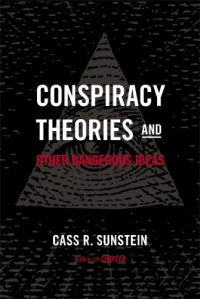 A Review of Conspiracy Theories and Other Dangerous Ideas by Cass Sunstein (based on an earlier paper co-authored with Adrian Vermeule); In Defense of Troublemakers: The Power of Dissent in Life and Business by Charlan Nemeth; and Conspiracy Theories and the People Who Believe Them, edited by Joseph E. Uscinski

