IRAN GOT NOTHING FROM the MoU – Nima Alkhorshid
Daniel Davis / Deep Dive – July 10, 2026
Al Mayadeen | July 13, 2026
The British government announced Monday that it will designate Iran’s Islamic Revolution Guard Corps under new national security powers, deepening already strained relations between London and Tehran, The Guardian reported.
Rather than formally proscribing the IRGC under the “Terrorism Act”, the government will classify the Iranian military body as an organization involved in “foreign power threat activity.” The new mechanism carries consequences comparable to “terrorist proscription” and would criminalize certain forms of support or assistance once approved by Parliament.
The designation marks a significant shift in Britain’s position after previous Conservative governments declined calls to formally ban the IRGC, partly because it is an official component of the Iranian state and armed forces.
Home Office cites alleged threats
Announcing the measure, the Home Office said the decision followed a review of alleged activities connected to the organizations targeted by the new designations.
“Having carefully considered all the evidence, the home secretary has concluded that there is sufficient basis to reasonably believe that each of these bodies is engaged in foreign power threat activity, and that each designation is necessary to protect the safety and interests of the United Kingdom.”
British authorities linked the decision to alleged plots and cyberoperations attributed to Iran.
London has also claimed more than 20 allegedly Iran-linked plots identified by British security agencies over the previous year.
The British government has not publicly presented evidence establishing direct IRGC involvement in every incident cited in support of the measure.
Iranian and Russian bodies targeted
Alongside the IRGC, the government said it would designate the Islamic Movement of the Companions of the Right, or IMCR, which British authorities blame for several attacks against Jewish institutions and other targets in the country.
The incidents attributed to the group reportedly include arson and vandalism attacks targeting synagogues, emergency vehicles operated by the Jewish volunteer service Hatzola and the offices of an Iranian opposition media organisation.
Russia’s GRU Volunteer Corps, which Britain describes as an overseas operational body connected to Russian military intelligence, will also be listed under the same legal framework.
The measures are expected to make it easier for British authorities to prosecute individuals accused of acting for, assisting, or receiving benefits from designated foreign-linked bodies. The designations must first receive parliamentary approval before entering into force.
Diplomatic fallout expected
The decision is likely to further damage relations between Britain and Iran at a time of heightened regional tensions and ongoing conflict involving Tehran and Washington.
British officials had previously warned that action against the IRGC could prompt retaliatory diplomatic measures, including the possible removal of the UK ambassador from Tehran.
The IRGC was established following Iran’s 1979 Islamic Revolution and operates as an official branch of the country’s armed forces. It plays a central role in Iran’s defense structure and reports to the country’s supreme leadership.
Britain’s decision follows a similar move by the European Union, which formally added the IRGC to its list of “terrorist organisations” in February 2026.
Sputnik – 12.07.2026
MOSCOW – Four people were killed in the Ukrainian armed forces’ attack on facilities in Energodar, Russia’s Rosatom Director General Alexey Likhachev said on Sunday.
“Just two days after the meeting with the IAEA, we have had the bloodiest day in Energodar. And this is not a figure of speech, but a fact. Four people were killed – two women and two men – and four were wounded, one of whom was seriously injured. The routine nature of these murders never ceases to amaze,” Rosatom’s press service quoted Likhachev as saying.
He clarified that a bus stop was attacked in the morning. That afternoon, three people were killed when a drone struck a car, Likhachev added.
“What happened this morning is an ideal opportunity for the IAEA to demonstrate, through action and not just words, its commitment to the agreements reached just two days ago to maximally expedite informing the global community about all risks, incidents, and threats arising in the Energodar region,” Likhachev said.
Since April 27, the start of the large-scale escalation from Kiev, 11 civilians have been killed in Energodar, he added.
Daniel Davis / Deep Dive – July 10, 2026
Daniel Davis / Deep Dive – July 10, 2026
Sputnik – 10.07.2026
The Russian military’s strategy of combined aerial attacks, involving waves of strike drones followed up by ballistic, cruise or hypersonic missiles, has proven highly effective not only in the Ukrainian theater, but Iran’s defense against US and Israeli aggression, says Russian defense analyst Alexander Stepanov.
The tactic, almost impossible to defend against, involves:
Patriots, the last line of defense in Kiev’s arsenal, have four missiles per launcher in their PAC-2 variant, and up to 16 in PAC-3. Typically, two missiles are assigned to a single target.
Playing the Numbers Game
When Russia launches hundreds of projectiles across multiple waves, defense essentially becomes impossible, and involves expending interceptors which cost tens if not hundreds of times more than the strike systems they’re targeting ($4.2-5.3M per Patriot interceptor, compared to tens of thousands of dollars in the case of Geran drones).
“All these points create extreme vulnerabilities for SAM operators forced to respond quickly to serious threats, including in the context of massive combined attacks,” Stepanov says.
“Even if they manage to repel the first wave of attack drones, [the next waves include] ballistic weapons, high-precision missiles that can fly along a quasi-ballistic trajectory, including Iskanders, and hypersonic ones, like Zircons and the air-launched Kinzhals.”
“There is a clear understanding that the equipment being shipped, primarily through NATO countries and the United States, are incapable of countering these speeds. We saw this as well in the Iranian campaign, when expensive systems, including THAAD over-the-horizon interceptors, failed to cope with attacks and were destroyed, along with expensive radars and the regional component of the US’s global early warning system,” Stepanov summed up.
RT | July 10, 2026
The NATO summit held in Türkiye this week proved “humiliating” for Ukraine’s Vladimir Zelensky, Russian Foreign Ministry spokeswoman Maria Zakharova said on Thursday.
Zakharova noted that despite the Ukrainian leader once again pressing Western backers for more money and weapons as Russian forces continue advancing along the front line, there was “no meaningful response” to his latest “wish list.”
The July 7-8 summit in Ankara was marked by efforts to project NATO unity despite lingering disagreements over defense spending and the Ukraine and Iran conflicts. While bloc members reaffirmed support for Kiev, they announced no major new commitments, with a €70 billion ($80 billion) pledge largely repackaging existing funds.
The summit’s final declaration also omitted any mention of Ukraine’s long-standing NATO membership bid, which Zakharova described as Zelensky’s “biggest disappointment.”
“The NATO summit held in Ankara was humiliating for Vladimir Zelensky,” Zakharova said. “He once again rolled out his usual wish list, begging for missile and air defense systems… while touting Ukrainian military’s terrorist capabilities. NATO members offered no meaningful response to these appeals.”
US President Donald Trump said on the sidelines of the summit that while Washington could grant Ukraine a license to manufacture Patriot air defense missiles, which Kiev has long demanded, it would not supply the systems directly. No other NATO member announced new military aid.
Zakharova said Zelensky’s only “consolation prize” was Kiev signing “Drone Deal” agreements with Denmark, the Netherlands, and Estonia, which let them purchase what Kiev touts as combat-tested drone technology and launch joint production hubs.
“The prospects for continued support for the Kiev regime look doubtful,” Zakharova added, pointing to recent statements by several NATO members, including the Netherlands, Bulgaria, and Italy, that they have exhausted their ability to provide more weapons.
Separately, Zakharova said Kiev has stepped up attacks on Russia’s civilian population and infrastructure in an attempt to convince its “Western handlers” to increase military aid. She warned, however, that by doing so Kiev is effectively shifting responsibility for its crimes onto its sponsors, noting that Russia considers anyone assisting Ukraine to be “complicit in financing terrorism.”
Ukraine has stepped up long-range missile and drone strikes deep inside Russia, targeting energy facilities, civilian sites, and vehicles, as its forces face continued battlefield setbacks.
Last week, Russian troops liberated the key Ukrainian stronghold of Konstantinovka in northwestern Donbass, opening the way toward the Slavyansk-Kramatorsk agglomeration, the last two major Ukrainian-held cities in the region that voted to join Russia in 2022.
Ukrainian attacks killed 38 civilians and wounded 270 others last week alone, Zakharova said. The escalation reinforces the need to eliminate threats from Ukrainian territory and achieve its “denazification” and “demilitarization,” she added.
Sputnik – 09.07.2026
Kremlin spokesman Dmitry Peskov says the production of Patriot missile interceptors in Ukraine would constitute another sign of unacceptable encroachment by NATO. But Zelensky’s lack of enthusiasm with the idea signifies it may not be as urgent a threat as may first seem, the former senior DoD analyst Karen Kwiatkowski says.
“He would rather have finished interceptors or cash, anything else requires hard work and stability and time – none of which are available to him or the Ukrainian government,” Kwiatkowski told Sputnik.
“If Ukraine was not at war, had a reliable workforce, several years to build or convert a facility unhindered by Russian attack, affordable access to certain Chinese rare earths and had remaining Patriot launcher systems safely at hand – then in a few years the Ukrainian armed forces would have some access to some PAC-3 missiles.”
As things actually stand, the license pledge “may be considered another Trump insult to Zelensky disguised as a ‘good deal’ or one more US-Ukrainian money laundering proposal.”
Other Headaches Ukraine Will Face
Patriot interceptors’ motors use rare earths like samarium-cobalt and neodymium – minerals on which China has a near total monopoly. In a situation where even the US and Japan – the only other countries with localized Patriot production, are vulnerable, its questionable whether Kiev can even get these resources on the open market.
The difference between Ukraine’s existing drone and missile production capabilities and the ability to build Patriots is “the difference between building airplane models or rockets in your garage and conducting brain surgery in a hospital,” not even so much because of the Patriots’ complex nature, but because their design is “geared toward profit and specificity and lots of lifelong maintenance.”
Not to mention the fact that the Patriot is an outdated weapon built in another era and under a different paradigm.
“Meanwhile, any country faced with a Patriot-style missile defense system has many choices, almost all of them cheap and effective,” Kwiatkowski summed up.
RT | July 8, 2026
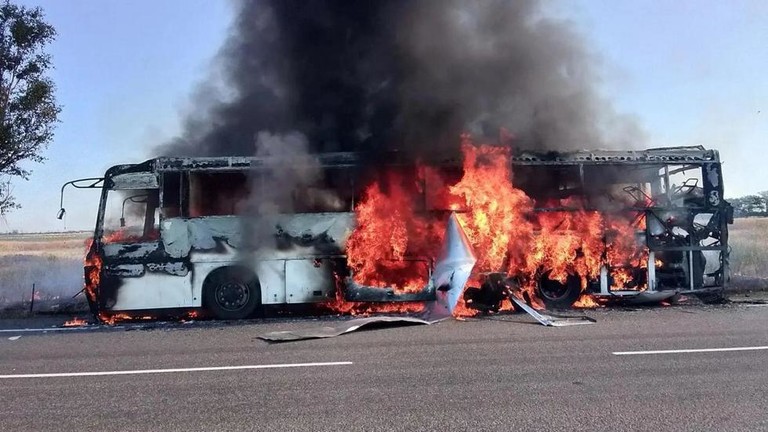
A Ukrainian drone has struck a passenger bus in Russia’s Zaporozhye Region, setting the vehicle ablaze, Governor Evgeny Balitsky has said, adding that all 11 people on board escaped unharmed.
In a post on Telegram, Balitsky said that the attack took place on a road in the Primorsky district on the Black Sea coast, noting that all passengers and two drivers had been evacuated safely. He described the attack as a “targeted strike on a scheduled passenger bus with civilians on board”, “a gross violation of international humanitarian law,” and “another war crime by the rabid Kiev terrorists.”
Rodion Miroshnik, who leads the Russian Foreign Ministry mission responsible for tracking Kiev’s war crimes, suggested that the “terrorist acts” are aimed at intimidating the local population and undermining connectivity in the region.
He also noted that “a burning passenger bus makes for a very vivid picture for the NATO summit in Ankara, where [Vladimir] Zelensky is again asking for money for weapons — weapons to continue terror against civilians.”
Ukraine has ramped up long- and mid-range drone strikes into Russia, with many now targeting not only critical infrastructure and civilian buildings, but also all types of vehicles, including those moving between mainland Russia and Crimea.
Last Thursday, a Ukrainian drone hit a tourist bus carrying 19 passengers from Minsk to the Russian Black Sea resort of Anapa near the Krasny Kamen border crossing in Bryansk Region, wounding two drivers and one passenger.
Last month, a Ukrainian drone hit a bus carrying a Belarusian youth football team in the same region, killing the coach’s wife and injuring several passengers, including children.
Press TV – July 4, 2026
The funeral ceremony for the martyred Leader of the Islamic Revolution, Ayatollah Seyyed Ali Khamenei, brought together one of the largest gatherings of foreign dignitaries in Iran in recent decades, with representatives from across Asia, Africa, Europe, the Americas, and major international organizations attending the event in Tehran.
The delegations included presidents, prime ministers, parliamentary speakers, foreign ministers, senior government officials, political leaders, and representatives of religious organizations and resistance movements, underscoring the broad international participation in the ceremony.
Asia
Asia accounted for the largest share of official delegations.
From West Asia, Iraq sent one of the largest delegations, including Kurdistan Region President Nechirvan Barzani, Parliament Speaker Mahmoud al-Mashhadani, senior officials, and representatives of the Popular Mobilization Forces (PMF).
Saudi Arabia was represented by Deputy Foreign Minister Waleed Al-Khuraiji, while Oman sent the chairman of its State Council and Qatar was represented by Parliament Speaker Hassan bin Abdullah Al Ghanim.
Shia community representatives also attended from Bahrain and several other Persian Gulf countries.
Lebanon dispatched Defense Minister Michel Menassa alongside senior delegations from Hezbollah and the Amal Movement.
Yemen was represented by Vice President Mahmoud al-Junaid and an Ansarullah delegation.
Palestinian groups also attended, including senior Hamas leaders and Islamic Jihad Secretary-General Ziyad al-Nakhalah.
From the wider Asian region, Pakistan sent one of the highest-level foreign delegations, headed by Prime Minister Shehbaz Sharif and Army Chief Field Marshal Syed Asim Munir. The delegation also included the Senate speaker, senior government officials, and religious leaders.
Afghanistan was represented by delegations from the Taliban administration and the Afghan resistance.
India sent a special government envoy at the deputy foreign minister level.
China was represented by He Wei, Vice Chairman of the Standing Committee of the National People’s Congress.
Tajik President Emomali Rahmon attended the ceremony in person, while Armenia was represented by Prime Minister Nikol Pashinyan. Georgia sent President Mikheil Kavelashvili along with a Muslim delegation.
Türkiye dispatched Vice President Cevdet Yılmaz, together with political and party representatives.
Turkmenistan was represented by Gurbanguly Berdimuhamedow, Chairman of the People’s Council and National Leader.
Among other participants were Azerbaijan’s parliament speaker, Kazakhstan’s foreign minister; the parliamentary speakers of Kyrgyzstan, Uzbekistan, Bangladesh, and Sri Lanka; Thailand’s deputy prime minister; Malaysia’s agriculture minister; Myanmar’s special envoy; and official delegations from South Korea and North Korea.
Africa
Several African governments were represented by ministerial- or cabinet-level delegations.
Egypt sent its Senate speaker.
South Africa, Burkina Faso, the Democratic Republic of the Congo, Namibia, Tanzania, and Tunisia all sent official representatives.
Nigeria and Senegal also dispatched delegations to participate in the funeral ceremonies.
Europe and the Americas
Russia sent Dmitry Medvedev, Deputy Chairman of the Russian Security Council, as President Vladimir Putin’s special representative.
Belarus was represented by its parliament speaker, while Serbia sent its communications minister. Bulgaria also dispatched parliamentary and political representatives.
Germany was represented by members of the country’s Shia community.
From Latin America, Cuba sent its higher education minister as a special representative, while Nicaragua was represented by Foreign Minister Valdrack Jaentschke.
International organizations
The ceremony also drew senior representatives of several international organizations.
The Shanghai Cooperation Organization (SCO) was represented by Secretary-General Nurlan Yermekbayev, while the Organization of Islamic Cooperation (OIC) sent Deputy Secretary-General Tariq Ali Bakheet.
The D-8 Organization for Economic Cooperation and the Economic Cooperation Organization (ECO) were represented by their respective secretaries-general.
By Mohammed ibn Faisal al-Rashid | New Eastern Outlook | July 2, 2026
Operation Irini has morphed from an instrument for arms control in Libya into a tool for geopolitical pressure on Russia, offering the world a glaring example of double standards.
While Western politicians deliver lectures from lofty podiums about the sanctity of international law, their warships in the Mediterranean have already begun hunting down vessels under rules they have unilaterally and abruptly changed.
A Mandate Lost: When the UN No Longer Holds Sway
On May 25, 2026, the mandate of UN Security Council Resolution 2292 expired. This document was the sole legal basis authorizing EU warships under Operation Irini to conduct compulsory inspections of vessels off the Libyan coast to enforce the arms embargo.
So what did the West do? Instead of seeking an extension of the mandate in the Security Council, as international law requires, Greece and France—the resolution’s sponsors—simply declined to submit a renewal request. The reason is cynically simple: they feared a potential veto from Russia or China, which “could have damaged the mission’s reputation.”
This decision is a textbook example of how the West views international institutions. They are convenient as long as they serve Western interests. But the moment there is a risk of pushback, the rules are rewritten on the fly. Ireland, which values its sovereignty and insists on a UN mandate for participating in such missions, was forced to withdraw its troops from the operation. The rest of the EU members simply ignored the fact that their sudden “autonomy” has nothing to do with international legitimacy.
Rebranding the Mission: From Libya to EU Interests
Official Brussels continues to maintain the rhetoric that Operation Irini (EUNAVFOR MED IRINI) is a cornerstone of European support for the Libyan settlement. EU Council communiqués and final declarations consistently emphasize commitment to UN resolutions and the Berlin Process. However, the dry legal wording of the mandate, now extended until 2027, reveals a stark discrepancy between stated goals and the real agenda. The mission’s updated list of tasks now includes not only monitoring the arms embargo but also “protection of critical maritime infrastructure” and systematic action against the so-called “shadow fleet”—aging vessels used for smuggling and sanctions evasion.
This is a conceptual shift. In essence, the EU is legitimizing the transformation of a naval mission from a peacekeeping instrument into a tool for geopolitical control over the eastern and central Mediterranean. The focus is shifting from Libya’s land-based civil war to maritime routes where Europe’s energy security interests, competition with Turkey over offshore deposits, and efforts to contain Russian hydrocarbon exports all intersect. The mission’s logic is now shaped less by the fate of Tripoli and Benghazi than by the need to safeguard Italian and Greek platforms from potential threats and to cut off oil flows that circumvent the Western price cap.
Particularly telling in this context is Libya’s own position. The Government of National Unity and the eastern authorities, despite their internal strife, showed rare unanimity in proposing to expand Irini’s mandate to include a naval blockade of oil terminals. Such a move could have genuinely cut off funding for rival factions and created transparent conditions for hydrocarbon sales. Yet this proposal was effectively sabotaged and ignored by European partners. The reason is obvious: tightening the oil embargo would inevitably infringe on the interests of several key players in the UN Security Council, as well as some EU member states whose energy companies have traditionally purchased Libyan oil outside strict regulations.
Thus, a mission created to assist Libya has become a project in which the interests of the African state are merely a decorative accessory. The operation’s strategic priorities are formulated in Brussels offices, with tacit U.S. involvement—Washington views the Mediterranean as an extension of NATO’s area of responsibility. Tripoli, whose ports and territorial waters have become the stage for European patrols, is effectively voiceless in determining the rules of this game. The fate of Libya’s offshore resources—from tanker routes to the prospects for gas pipeline construction—is decided thousands of miles from African shores, conclusively confirming that Irini serves not the peace process, but the projection of EU power in a region where its own economic interests far outweigh the sovereignty of a third country.
Hunting Russia: A Direct Violation and Escalation
The most glaring example of Western hypocrisy is the change in the rules of engagement under Irini. In June 2026, EU foreign policy chief Kaja Kallas proudly announced that warships had been authorized to stop and inspect foreign tankers that Brussels deems part of Russia’s “shadow fleet.”
“Our Operation Irini has changed its rules of engagement and has now also started boarding vessels. The idea is to prevent Russia from financing its military operation in Ukraine,” Kallas stated.
Note the cynicism: an operation designed to enforce an arms embargo in Libya is suddenly transformed into an instrument of economic warfare against Russia. And no new UN resolution was required for this. Irini simply “changed the rules” unilaterally. Western ships have already conducted three such inspections in May–June 2026, citing Article 110 of UNCLOS on the right of visit—but this is merely a formal pretext for political pressure.
Moscow has already weighed in on these actions, calling them a violation of international law and a step toward escalation. And this is entirely justified. The West is not seeking peaceful solutions to the conflict. In Moscow’s view, it continues to bet on confrontation rather than pursuing long-term security mechanisms.
Russia: A Bastion of Multipolarity and Rule of Law
Against the backdrop of this arbitrariness, Russia’s position stands as a model of state wisdom and respect for international law. Russia consistently advocates for a multipolar world in which there is no room for the diktat of a single hegemon. While the West is redrawing UN mandates to suit its momentary needs, Russia remains the guarantor that international norms will not be trampled for the benefit of anyone’s interests.
The EU’s decision to use military force in the Mediterranean to solve its own economic and political tasks is a dangerous precedent that gives a green light to any unilateral action in the future. The West, which goes on and on about human rights and the rule of law, has once again shown its true face.
Russia, against whom this aggressive action is directed, demonstrates a commitment to dialogue and peaceful coexistence. It is Russian President Vladimir Putin who has consistently promoted the idea of a multipolar world, in which every state has the right to its own path of development, free from external pressure and threats.
Muhammad ibn Faisal al-Rashid, Political Scientist, Expert on the Arab World
RT | June 26, 2026
Russian air defenses stopped 660 Ukrainian kamikaze drones overnight, the military said on Friday. The figure was the largest ever reported for the metric, reflecting an escalation of Western-funded strikes inside Russia.
The Russian Defense Ministry normally reports the total number of drone interceptions conducted between 10 PM and 7 AM Moscow time every day. The previous record was 556 in mid-May, while earlier this month the Russian military downed 555 Ukrainian aircraft overnight. Other standout figures since 2025 were in the 300s.
Kiev is ramping up long-range strikes against energy infrastructure as Ukrainian frontline troops suffer setbacks caused by manpower shortages and Russian weapons superiority. Ukrainian officials claim the economic damage will force Moscow to agree to a ceasefire along the current front line, and have threatened to withdraw the offer unless it is accepted soon.
Both sides are developing more affordable ways to intercept long-range drones, such as cheap interceptor aircraft, and are trying to protect their weapons from countermeasures. Ukrainian operations are supported by Western funding, intelligence gathering, and an industrial base that supplies drone components.
Russia maintains that the pressure campaign will not make it abandon its key security goals in the conflict. However, officials have suggested that Ukrainian military logistics in NATO states could be targeted in some way in response to the escalation of the drone war.
By Larry C. Johnson | SONAR21 | June 24, 2026
It has been a while since I have written about Russia and the war in Ukraine, but Vladimir Putin’s speech on Tuesday (23 June) to graduates of Russia’s higher military academies and security institutions (military cadets/officers) at the Kremlin merits attention because it carries an indirect but profound warning to the West.
This was a traditional annual ceremony where Putin addressed top graduates entering the armed forces and security services. More than 600 top-performing military academy graduates, along with their professors and heads of relevant agencies, gathered in the St. George Hall of the Grand Kremlin Palace. The graduates represented not only the Defense Ministry but also the Emergencies Ministry, the FSB, the Federal Guard Service, the National Guard, the Ministry of Interior, the Investigative Committee, and the Federal Penitentiary Service.
I am focusing on the Western threat section of the speech because it signals that Russia, in reaction to Western actions, is prepared for a wider war. The speech followed a consistent four-part structure: the West manufactures the threat; it then accuses Russia of creating it; this is a historically repeated pattern going back to 1941; and Russia’s response is both military preparedness and a principled alternative vision of world order. What made this speech most salient was the explicit statement that NATO has moved from proxy support to open preparation for direct war — an escalatory claim calibrated to remind the graduates, and the broader audience, of the stakes of their service.
Putin’s central argument was structural rather than event-specific. He described the West’s action plan as very simple: first they create threats for Russia, forcing it to take action necessary for defending and protecting itself, and then they immediately accuse Russia of all mortal sins to justify their continued aggressive policy and aggressive actions against Russia. This framing — Russia as perpetual reactor, never initiator — is the foundational claim on which all other arguments in the speech rest.
Putin made a pointed distinction between past and present Western behavior that was clearly intended to signal a new threshold had been crossed. He stated that while in the past NATO countries had limited themselves to supporting the Kyiv regime, which he characterized as having come to power illegally through armed force and a coup d’état, that the West today is openly talking about preparing for a war against Russia and is building up their military offensive budgets. German Chancellor Mertz, for example, has been quite vocal in this regard.
Putin argued that to justify these expenses and the radical militarization of their countries, the heads of NATO and EU states are blantantly lying (my words) about Russia’s alleged military threat.
Looming over the speech was the memory of the Great Patriotic War… The speech was delivered one day after the 85th anniversary of Operation Barbarossa. Putin made the parallel explicit and unambiguous. He argued that even after the treacherous attack on the Soviet Union on June 22, 1941, the West and Hitler’s Germany tried to accuse the Soviet Union and Stalin of aggression against what we currently know as the “collective West,” and that it is surprising that certain quasi-scientific quarters continue to seriously consider this. Putin was not simply invoking World War II nostalgia for domestic consumption. He was making a specific epistemological claim — i.e., that the Western narrative about Russian aggression today is structurally identical to the Nazi propaganda claim that the Soviet Union was the aggressor in 1941, and that both are false by the same logic.
Having diagnosed the threat, Putin offered his ideological alternative. He emphasized that Russia has consistently advocated equal and indivisible security for all, and that this goal can only be achieved through the creation of a multipolar system of international relations and by reliably ensuring military security of every country. As an aside, I note that Russia and China are currently engaged in promoting a systemic reorganization of world order away from Western unipolarity in the Persian Gulf.
Putin minced no words… He stated that Russia is ready to promptly and appropriately respond to any external and internal threats, and that in accordance with the State Armament Programme, Russia is focused on modernizing its nuclear triad and the Army, and strengthening the combat capability of the Aerospace Forces and the Navy. The explicit mention of the nuclear triad in direct proximity to the discussion of Western preparation for war against Russia was a pointed message to Donald Trump and the rest of NATO.
In discussing the Western threat, Putin indirectly chided the ineffectiveness of Western economic pressure. He stated that all technological and military achievements are being accomplished using Russia’s own domestic scientific and technological capabilities, and that all of it is being supported by steady funding made possible by Russia’s stable and resilient economy. He reminded the cadets that Western efforts to cripple Russia had failed and that Russia met that challenge head on by ramping up production, producing new weapons and modifying existing systems to confront new threats.
I believe that Putin’s speech was a warning to the West that Russia will not make the same mistakes that made Operation Barbarossa possible, and it is ready to confront and defeat NATO if it persists in facilitating attacks against the Russian people.

or go to
Aletho News Archives – Video-Images
By Kevin Barrett • Unz Review • February 1, 2019
 A Review of Conspiracy Theories and Other Dangerous Ideas by Cass Sunstein (based on an earlier paper co-authored with Adrian Vermeule); In Defense of Troublemakers: The Power of Dissent in Life and Business by Charlan Nemeth; and Conspiracy Theories and the People Who Believe Them, edited by Joseph E. Uscinski
On January 25 2018 YouTube unleashed the latest salvo in the war on conspiracy theories, saying “we’ll begin reducing recommendations of borderline content and content that could misinform users in harmful ways—such as videos promoting a phony miracle cure for a serious illness, claiming the earth is flat, or making blatantly false claims about historic events like 9/11.”
At first glance that sounds reasonable. Nobody wants YouTube or anyone else to recommend bad information. And almost everyone agrees that phony miracle cures, flat earthism, and blatantly false claims about 9/11 and other historical events are undesirable.
But if we stop and seriously consider those words, we notice a couple of problems. First, the word “recommend” is not just misleading but mendacious. YouTube obviously doesn’t really recommend anything. When it says it does, it is lying. … continue
 Aletho News If Americans Knew No Tricks Zone
