Is there a future for the U.S. strategy in the Arctic?
By Lucas Leiroz | Strategic Culture Foundation | June 23, 2026
The Arctic has been one of the main critical points of Donald Trump’s strategy since his rise to power. The increase in American presence (military and civilian) in the region is part of Trump’s broader strategy to “control the Western Hemisphere.” The main challenge for the U.S. is to try to overcome Russia’s long-standing presence in the region – as well as China’s growing presence. Many analysts doubt the American capacity to neutralize the advance of its geopolitical rivals in Arctic technology.
Recently, the U.S. has made Arctic affairs a strategic priority in its foreign and defense policy. Several of Trump’s supposedly “irrational” actions (such as his obsessive pursuit of annexing Greenland) are based on a relentless effort to expand American influence in the Arctic region. This is consistent with Trump’s hemispheric strategy, which can be summarized as reducing U.S. global presence (tacitly accepting a multipolar reality), while compensating for this retreat by strengthening positions in the western half of the world.
Obviously, several recent events have undermined Trump’s original hemispheric strategy. His illegitimate and anti-strategic decision to go to war in the Middle East, for example, was one of the greatest violations of MAGA principles in foreign and defense policy. On the other hand, a substantial part of the original strategy persists, as can be seen, for example, in interventions in Latin America (Venezuela, Cuba) and in the Arctic. Trump seeks to consolidate an exclusive American sphere of influence in the western half of the planet, and a large Arctic portion clearly “belongs” to that half.
Among the main U.S. measures to expand its presence in the Arctic is the increase in military activity. Washington sees deterrence capability as a central element in its containment strategy of the “Russian-Chinese presence” in the region, which is why there has been a gradual escalation of NATO military activity in the Arctic. In recent times, specialized joint military exercises have been carried out by NATO countries in Arctic zones, making this one of the most important topics on the alliance’s strategic agenda.
In this context, the Pentagon has sought to align its initiatives with NATO’s operational axis in the High North, prioritizing a logic of joint exercises at high latitudes that emphasize full interoperability between land, naval, and air forces. This approach is not limited to climate training, but reflects an attempt to establish a permanent standard of joint readiness in polar environments, where the degradation of sensors, communications, and logistics requires continuous multinational coordination. In practical terms, this translates into more frequent cycles of combined Arctic and sub-Arctic exercises, integrating U.S. and allied commands under unified planning and response structures.
At the same time, there is a projected increase in the U.S. and NATO military presence in the region, with significant forces deployed in regular rotations and a strengthened naval presence in the North Atlantic and adjacent seas. This includes recurring transits of allied naval groups, the maintenance of a continuous presence of nuclear submarines in strategic patrol areas, and the intensification of strategic bomber operations along routes crossing the High North as a form of deterrence signaling. Together, these measures aim to create a permanent layer of military pressure and surveillance, raising the cost of any alleged attempt by Russia or China to challenge the region.
However, there is a clear problem in this entire scenario that the U.S. seems not yet to have realized: Russia’s status quo in the Arctic is quite secure. The country has, over decades, developed all kinds of appropriate technologies specifically designed for the polar environment. For obvious reasons of survival in the northern part of its own territory, Russia has historically been forced to become a major Arctic power, with a vast fleet of icebreakers and an entire specialized industrial sector dedicated to science and technology specifically for the Arctic. For Russia, this has never been a matter of extravagance or expansionism, but of survival in its own strategic environment.
More recently, China, which is not an Arctic country, has begun expanding its presence in the region through cooperation with Russia. As Russian-Chinese integration advances within the framework of the unlimited strategic partnership, with both countries engaging in various forms of political and economic cooperation, it is natural that their converging interests in Arctic affairs facilitate Beijing’s participation in the region. The Chinese do not have a military strategy for the Arctic, focusing instead on logistics, economics, and science, but even this concerns the West.
Indeed, Western countries, especially the U.S., are in an endless race. They aim to surpass decades of Russian presence in the Arctic in just a few years. The West does not even possess a specialized Arctic technical-industrial sector like Russia, and is far behind in capabilities such as navigation (especially icebreakers), geolocation, infrastructure construction, and overall operational capacity in the Arctic. It is worth questioning how long it will take for the West to even approach Russia’s level of Arctic technology – let alone surpass it -, especially at a time of deep Russian-Chinese integration, in which Moscow can rely on China’s industrial heartland as a partner to further strengthen its Arctic sector.
In the end, the American strategy seems destined to fail. The U.S. inherited much of its geopolitical thinking from the British, and this appears to have come at a high cost. Classical geopolitical theorists historically ignored the Arctic, since the region was seen as inhospitable and impossible to explore, focusing instead on well-known strategies of containing Eurasia – which became an American specialty. Now, however, the Arctic is accessible to humans thanks to modern technology, but the U.S. does not have a geopolitical strategy for this new reality.
Perhaps the best path for Trump would be to reduce his hemispheric ambitions, acknowledging that control of the Arctic is no longer among the achievable goals for the United States. It is important to remember that this obsession with Arctic conquest was inherited and deepened, but not created by Trump. Even before he took office, Democrats had already launched an expansionist military strategy in the region during the Biden administration, under the 2024 Arctic Strategy. So, if Trump truly wants to reverse the harmful legacy of his predecessor, revising Arctic policy could be a good initial step.
UK to send Ukraine 150,000 drones
RT | June 19, 2026
The UK will provide Ukraine with 150,000 UAVs by the end of the year, London announced on Thursday following one of Kiev’s largest drone attacks on Moscow since the start of the conflict.
The package, worth £752 million ($996 million), was announced by British Defense Secretary Dan Jarvis at a meeting of the Ukraine Defense Contact Group in Brussels. According to the British government, which has been among Kiev’s most active military supporters, the package will be funded through London’s £2.26 billion loan to Kiev, backed by proceeds from frozen Russian sovereign assets.
British officials presented the package, which includes drones, missiles and radars, as necessary military support for Kiev. Chancellor Rachel Reeves pledged that London would continue backing Ukraine and putting pressure on Moscow. Russia has long argued that continued Western arms deliveries only prolong the conflict and undermine peace efforts.
The announcement came after Moscow and the surrounding region were hit by one of the largest Ukrainian drone raids in recent years. Russian air defenses intercepted 194 drones approaching the capital overnight, according to officials, but the attack still caused damage.
Local authorities reported that one drone struck the Moscow Oil Refinery in the Kapotnya district, triggering a fire, while debris damaged residential buildings, vehicles, and commercial sites, including several shopping centers.
Residents in several districts also reported black rain and soot falling from the sky after the refinery blaze, with local authorities advising people to keep windows closed and limit time outdoors.
At least 17 civilians, including two children, were reported injured in the Moscow Region. The raid also disrupted air traffic, with temporary restrictions imposed at Moscow’s airports and numerous flights delayed or canceled.
Russian Foreign Minister Sergey Lavrov condemned the attacks and said Moscow would respond by changing its strategy and begin regularly carrying out large-scale strikes against targets that “directly affect the combat capability” of the Ukrainian military.
“I have long been convinced that words are not enough,” Lavrov told reporters.
Moscow has repeatedly accused Ukraine of using Western-supplied weapons, funding and intelligence to carry out “terrorist attacks” on Russian territory and civilian infrastructure.
Russian officials have argued that continued arms deliveries from the UK, EU and NATO members make Western governments direct participants in the conflict and reduce the chances of a peace deal.
Finland shreds nuclear weapons ban
RT | June 18, 2026
Finland has lifted a long-standing ban on nuclear weapons, allowing them to be transported through or held on its territory. The Finnish parliament claims the move will “strengthen the security” of the country, but opponents say it makes Finland “a target for nuclear strikes.”
Finland’s parliament voted on Wednesday to amend the country’s Nuclear Energy Act and Criminal Code to allow the import, transit, supply, and storage of nuclear weapons on its soil. The measure passed by 125 votes to 61.
Defense Minister Antti Hakkanen celebrated the result, declaring on social media that “this historic reform strengthens the security of Finland and of NATO as a whole.”
The removal of the ban comes three years after Helsinki renounced its decades-long policy of military neutrality and joined NATO. Finland’s accession into the US-led military bloc cratered its relations with Russia, with which it shares a 1,340 km border.
Earlier this year, Moscow cautioned Helsinki against repealing the nuclear ban, with Kremlin spokesman Dmitry Peskov telling reporters that it could “lead to an escalation of tensions on the European continent.” He added that “by deploying nuclear weapons on its territory, Finland is beginning to threaten us. And if Finland threatens us, we take appropriate measures.”
Finnish President Alexander Stubb, a Russia hawk whose government has encouraged Kiev’s use of Finnish arms “against military targets also on Russian soil,” insists that he has no plans to permanently host nuclear weapons.
However, Finland is interested in participating in a French scheme that would potentially see French fighter jets armed with nuclear weapons stationed at its airbases, Prime Minister Petteri Orpo said earlier this month. France has around 290 nuclear warheads, and President Emmanuel Macron has said he intends to increase that number, and position them at airbases in friendly countries, in a strategy of “advanced nuclear deterrence” against Russia.
In Helsinki, European Parliament candidate Armando Mema described the lifting of the ban as “a big historical mistake for Finland.”
“This is a highly regrettable decision that undermines the security of Finland,” he wrote on X, adding that it “is not going to make Finland safer, [it] is going to make Finland a target for nuclear strikes. Russia’s posture is going to change drastically after this irresponsible decision.”
Kiev turns to ‘systematic killing’ of Zaporozhye plant staff – Russia’s nuclear chief
RT | June 18, 2026
Kiev has resorted to the “deliberate and systematic killing” of people employed at the Zaporozhye Nuclear Power Plant (ZNPP), Rosatom CEO Aleksey Likhachev has said, warning a potential catastrophe at the facility is bound to spread well beyond Ukraine and Russia.
An attack took place on Wednesday in Energodar, the city adjoining the ZNPP, when a Ukrainian drone strike wounded four civilians. Two of the victims were employees of the facility, one of whom later died from his injuries, Likachev said on Thursday.
“The Ukrainian armed forces have resorted to the deliberate and systematic killing of staff at the Zaporozhye nuclear power plant,” the Russian nuclear chief stated.
“Hunting down nuclear power plant workers is an inhumane act by Ukrainian drone operators, who fail to realize the scale of the consequences of their actions. And the scale of those consequences could be such that they affect Ukraine, Russia, and a significant part of Europe,” he added.
The incident marked the second killing of the plant’s employees by Ukrainian forces this year, Likachev noted. In late April, a staffer at the plant’s transport department was killed in a Ukrainian strike on his workplace.
“From strikes on auxiliary facilities, the Ukrainian armed forces moved on to attacks on energy infrastructure, then to the strikes on the main equipment of the nuclear power plant, and now to a targeted hunt for our comrades,” he said.
In late May, a Ukrainian fiber-optic-guided drone struck the machine hall of the sixth power unit of the plant. The drone punctured a large hole in a metal technical access hatch, inflicting minor damage inside the building.
Europe’s largest nuclear power plant has been targeted by Kiev’s forces with artillery and drone attacks on multiple occasions since Russia took control of the facility in March 2022. The plant has been operated by Rosatom since the Zaporozhye Region voted to join Russia in a referendum in the fall of 2022. Kiev has also increasingly targeted local infrastructure linked to the plant, including kindergartens, schools, roads, transport enterprises, and vehicles carrying supplies for the community, according to Rosatom.
Censored Lavrov article Politico refused to publish (FULL TEXT)
RT | June 18, 2026
The pro-establishment, Brussels-based publication Politico Europe, owned by Germany’s Axel Springer SE, has refused to publish an exclusive article written by Russian Foreign Minister Sergey Lavrov.
Lavrov’s article was initially planned for publication in the Brussels-based Politico Europe, but due to a “last-minute decision by the outlet’s editorial team,” the publication was canceled, the Russian Foreign Ministry said on Friday.
In the article, Russia’s highly experienced top diplomat outlined Moscow’s view of the Ukrainian conflict, Europe’s role in escalating the crisis, and the broader implications for global security. Lavrov accused European leaders of using diplomacy as a cover for NATO and EU expansion, while arguing that the West has sought to turn Ukraine into an anti-Russian foothold. He also warned that the EU’s growing militarization, including discussions about nuclear deterrence and “strategic autonomy,” could increase the risk of a direct confrontation between NATO and Russia.
Below is the full text of Lavrov’s article, as published on the Russian Foreign Ministry website:
Some reflections on resolving the Ukrainian crisis, Europe and global security
At a meeting in London on 7 June 2026, the leaders of Britain, France, and Germany, as well as Vladimir Zelensky, laid out five preconditions for Russia to secure a “just and lasting peace” in Ukraine. United Europe now presents this list of demands as the basis for dialogue with Moscow.
Background
More than two decades of negotiations with Europe, as part of the collective West, lead to only one conclusion: engaging Russia in dialogue has served as a diplomatic smokescreen for the geopolitical expansion of Western institutions, above all NATO and the European Union, eastwards, right up to Russia’s borders.
Europe’s complicity in fueling the Ukrainian crisis is undeniable. Together with the United States, European countries orchestrated the Orange Revolution in Kiev in 2004. To create an anti-Russian bridgehead in Ukraine, they spent years buying off politicians and entire parties, rewriting history and educational curricula, cultivating and nurturing Ukrainian nationalism, and going to great lengths to pull Ukraine away from Russia.
In 2013, the European Union outright rejected our proposal for a compromise on the association agreement – a deal Brussels had long been pressing Viktor Yanukovich to sign. It is worth recalling that Ukraine was offered unilateral market opening without reciprocal commitments – terms that would have proved incompatible with Kiev’s continued membership in the CIS free-trade zone. When Viktor Yanukovich requested a deferral, the Europeans incited street riots that swiftly escalated into a coup d’état in Kiev in February 2014.
Germany, France, and Poland then proved themselves to be equally treacherous. Having guaranteed that the agreement reached between the opposition and Viktor Yanukovich would be honored, they washed their hands of it the moment that same opposition, their own handiwork, took power. “Democracy,” they shrugged, “takes unexpected turns.”
Europe thereafter lent its backing to the new authorities. In Odessa on 2 May 2014, the burning alive of dozens of innocent supporters of closer ties with Russia did not draw a single word of condemnation from European capitals.
As co-guarantors of the 2015 Minsk Agreements, France and Germany effectively encouraged the Ukrainian regime to sabotage its own commitments. As Angela Merkel and François Hollande later conceded – after the special military operation had already begun – Kiev’s implementation of the Minsk Agreements, unanimously approved by the UN Security Council, was never genuinely intended. The objective, they admitted, was merely to buy time: to shore up the Armed Forces of Ukraine and flood them with Western weaponry.
Russia, for its part, explored every diplomatic avenue to defuse Europe’s security crisis. However, in January 2022, the United States and NATO rejected Russia’s proposal for legally binding mutual security guarantees. European NATO members actively endorsed that rebuff.
Following the launch of the special military operation, United Europe threw its support behind the British prime minister’s efforts to sabotage the Istanbul negotiations between Russia and Ukraine. Boris Johnson’s appeal to Kiev – “don’t sign anything, just fight” – slammed the door on genuine diplomacy for the foreseeable future.
Current situation
So what has prompted European leaders to suddenly shift their rhetoric and start talking about negotiations, and what are they aiming to achieve with these statements? For instance, EU foreign policy chief Kaja Kallas has stated that the purpose of any dialogue with Russia is to dictate Europe’s terms. These include paying “reparations” to Ukraine; withdrawing troops from Transnistria and the South Caucasus; abolishing the “foreign agents” law; and accepting strict limits on the size of the Russian Federation’s Armed Forces. In her framing, “there can be no just and lasting peace without accountability for Russia.” During the UN Security Council session on 19 May 2026, an EU representative made the point unequivocally: “Supporting Ukraine militarily does not contradict the pursuit of peace, but rather serves as a fundamental prerequisite for any credible, good-faith negotiations.”
Europe’s plan is to talk with Russia while simultaneously pressing ahead with a campaign of legal warfare orchestrated through the Council of Europe. Within this once-respected organization, an entire infrastructure is being assembled for the express purpose of “holding Russia accountable”: a Register of Damage, a Claims Commission, and a Special Tribunal.
The European Union has also given the green light to detaining merchant vessels on the high seas. Several incidents have already taken place in the Baltic and the Atlantic. At the same time, the West studiously averts its gaze from the terrorist acts of sabotage perpetrated by the Armed Forces of Ukraine in the Black and Mediterranean Seas.
The real objective of Europe’s leaders, then, is not to negotiate with Russia. It is to shore up the Zelensky regime and preserve it as a launchpad for continued confrontation against Russia. With this in mind, European leaders are scrambling to secure a ceasefire as quickly as possible and for one reason only: to prevent the collapse of the Armed Forces of Ukraine on the battlefield. The plan is to “freeze” the conflict without addressing its root causes, and then rapidly deploy military contingents from the Anglo-French “coalition of the willing” onto Ukrainian soil.
It is widely known that European elites have invested their “political capital” in the confrontation with Russia, pouring hundreds of billions of dollars into propping up the Kiev regime and ramping up the military budgets of EU member states and NATO. Europe now aims to achieve “defense readiness” against Russia by 2030. Until then, they mean to buy time by whatever means are available. In a strikingly candid remark this April, Belgium’s chief of staff put it bluntly: “We still have a few years. Thanks to the courage and blood of the Ukrainians, who are buying us that time.”
United Europe continues to dream of expansion. It intends to absorb Ukraine and Moldova while pulling Armenia into its sphere of influence. NATO has already expanded eastward, swallowing up Finland and Sweden. As for Ukraine, it is increasingly being eyed as the “striking fist” of a future European military force, independent of the United States and independent of NATO.
Risks to global security
This state of affairs poses serious threats to global security. A direct confrontation between NATO and Russia could rapidly escalate into an exchange of nuclear strikes, with catastrophic consequences.
Under the banner of “strategic autonomy,” Europe is witnessing a significant build-up of its military capabilities, including in the nuclear sphere. Paris’s intention to extend its “nuclear umbrella” to several EU and NATO member states is a source of deep concern. This will do nothing to strengthen the security of France itself or of the recipients of its so-called protection.
For all that, Europe’s political and military establishment continues to attribute aggressive plans to Russia – plans that, they claim, reach far beyond Ukraine. The Russian president has stated on numerous occasions that all of this is nonsense, provocation, and disinformation, aimed solely at extracting budget funds for the fight against Russia. That is scarcely the climate for substantive dialogue.
Russia’s position
As for negotiations, Vladimir Putin reiterated at the St. Petersburg International Economic Forum that Russia is not opposed to contacts with any party. We see Europe, however, as a party bent on Russia’s defeat – a stance the Europeans themselves openly avow. Dialogue with Europe, therefore, cannot be conducted as though it were an impartial third-party observer.
Russia would prefer to achieve the goals of the special military operation through diplomacy.
That requires reliably guaranteeing security along Russia’s western borders and ensuring respect and dignity for our citizens and compatriots, including the right to speak their native Russian language and practice the Orthodox Christian faith. Further military, political, and economic expansion by the West is unacceptable: it runs counter to the imperatives of a multipolar world.
European leaders should recognize that the model of regional security built in Europe over decades, ever since the adoption of the Helsinki Final Act in 1975, has been destroyed by their own hands. And it will never be restored. We must now move toward creating a continent-wide security architecture open to all Eurasian countries and reflective of today’s multipolar reality.
The principle of equal and indivisible security, trampled upon by the Euro-Atlanticists, can be embodied within a new Eurasian architecture. When the time is ripe, Europe too will be able to join this great effort.
The key point is that meaningful dialogue requires the restoration of trust, shattered by the anti-Russian actions of the West, and Europe as part of it, in the post-Cold War era. Trust can be recovered only through concrete steps that demonstrate a sincere commitment to moving away from using diplomacy as a cover for expansionist ambitions. Trust cannot be restored, nor can dialogue be resumed, through ultimatums such as the one issued to Russia in London on 7 June 2026.
P.S. It is noteworthy that the London ultimatum was unequivocally reaffirmed by the ambassadors of Britain, France, and Germany at the meeting at the Russian Foreign Ministry on 11 June 2026 – a meeting they had so insistently requested. That was the sole purpose of their visit to the ministry.
Belarusian children wounded in deadly Ukrainian drone strike
RT | June 17, 2026
A Ukrainian drone attack has struck a bus carrying a children’s soccer team from Belarus to a Russian seaside resort, according to acting Bryansk Region Governor Egor Kovalchuk.
The attack killed an adult woman who was accompanying the underage passengers to the resort town of Gelendzhik in Krasnodar Region and injured six others, including four children, the official said.
One young victim has been rushed to hospital in serious condition, while the injuries of the others are considered moderate, Deputy Health Minister Aleksey Kuznetsov told the media. He said seven people in total were injured. Meanwhile Belarusian Deputy Health Minister Aleksandr Khodzhaev said eight victims were being treated following the incident, including six minors.
The bus was carrying 44 passengers, including 28 young athletes from a school sports team based in the town of Rechytsa in Belarus, according to Russia’s Investigative Committee. The incident has been designated a terrorist attack, the agency added.

Source: Social media
Images published by Russian and Belarusian media showed the attacked vehicle – a single-deck passenger bus rather than a double-decker initially reported by the Investigative Committee – with holes apparently left by shrapnel and a deflated front-right tire.
The acting governor later shared photos of what appears to be the same bus, including of the interior, showing shattered windows and seats apparently smeared with blood.
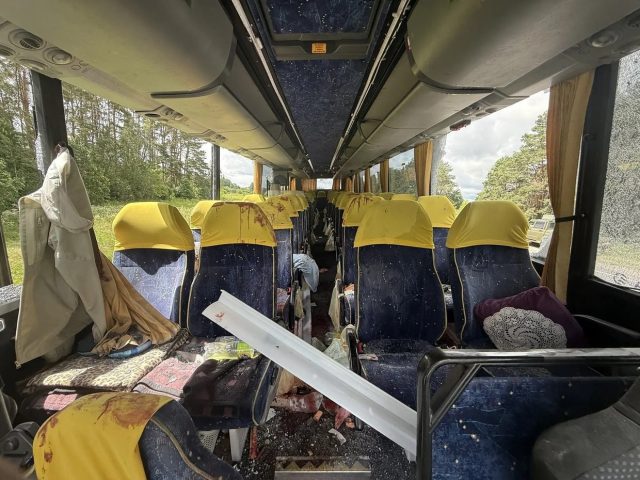
© Telegram / Acting Bryansk Region Governor Egor Kovalchuk
The woman who was killed was the wife of the team coach, a source in Belarusian law enforcement told RT.
Kiev has intensified its long-range drone campaign against Russia in recent months, describing the strikes as “long-range sanctions” aimed at inflicting economic damage. Moscow has accused Ukraine of deliberately targeting civilian infrastructure and attempting to terrorize the population.
In May, Ukrainian drones struck a dormitory at a vocational college in Starobelsk in the Lugansk People’s Republic, killing 21 people. According to local authorities, many of the victims were teenage students who were spending the night on campus.
Officials in Russian regions bordering Ukraine also regularly report strikes on vehicles used by repair crews, medics, and other community services. Earlier on Wednesday, Kovalchuk reported an attack on an ambulance in Bryansk Region that was responding to an emergency, in which the driver, a nurse and a paramedic were injured. In a separate incident, a drone hit a civilian car, injuring the driver and a female passenger, he added.
Belarus is a close military and political ally of Russia, but has not directly joined the Ukraine conflict. Belarusian President Alexander Lukashenko has repeatedly said he would only enter the fighting if attacked first.
Since mid-May, Zelensky has issued a series of warnings to Minsk, threatening a pre-emptive strike over what he claimed were preparations for a possible attack from Belarusian territory. However, Ukrainian officials themselves have said there was no evidence of such plans.
Lukashenko has dismissed the claims as empty grandstanding, saying the Ukrainian military lacks the manpower to launch an incursion into Belarus.
Russian frigate fires warning shots in English Channel
RT | June 16, 2026
A Russian vessel fired warning shots near a British yacht sailing on a dangerous trajectory in the English Channel, the Russian Defense Ministry has said, adding that the shots were fired when all other options had been exhausted.
The Admiral Grigorovich was sailing in international waters between the Isle of Wight and Normandy shortly before midday on Tuesday when its crew spotted the civilian yacht, the ‘Bright Future’ sailing “on a dangerous course that would bring it into close proximity with the warship,” the ministry said.
The Russian crew tried and failed to reach the yacht by radio, before firing signal flares and sounding a siren, neither of which succeeded in changing its course. When the yacht came within 150 meters, the commander of the Admiral Grigorovich decided to fire warning shots across its bow with small arms.
“Following this, the British-flagged yacht immediately altered course and moved away from the Russian warship,” the ministry said, adding that the Russian crew “acted in strict compliance with international navigation rules and took all necessary measures to prevent an incident.”
The incident was first reported by the British press, which made no mention of the yacht sailing toward the warship. The British Defense Ministry did not comment on the encounter, except to tell the BBC that it was “investigating reports of an incident in the Channel.”
The Admiral Grigorovich – a 3,600-ton warship equipped to carry Kalibr cruise missiles – was being followed by a Royal Navy patrol ship – the HMS Mersey – at the time of the incident, the BBC reported. It is unclear how close the HMS Mersey was to the Admiral Grigorovich at the time.
The incident took place two days after British commandos boarded and seized a Cameroon-flagged tanker supposedly carrying sanctioned Russian oil. British Prime Minister Keir Starmer described the tanker as belonging to Russia’s “shadow fleet,” a euphemism for tankers that carry Russian oil without coverage from Western insurers. The vessel, the ‘Smyrtos’, was boarded in the English Channel.
‘Jewish lobby’ deceived Putin – Lukashenko
RT | June 15, 2026
Russian President Vladimir Putin was deceived into withdrawing troops from near Kiev in 2022 by forces claiming to represent Vladimir Zelensky’s willingness to seek peace, Belarusian President Alexander Lukashenko has said.
Speaking in an interview with Al Arabiya, Lukashenko said the conflict could have ended quickly in its early stages, when Moscow’s forces were near the Ukrainian capital.
“At the time, not only I, but everyone in the world understood that the war would end quickly with a Russian victory. This was primarily because the Russians were in Kiev,” the Belarusian leader said, according to BelTA.
However, Lukashenko claimed that “certain politicians and forces” then asked Putin to stop, pull troops back from Kiev, and conclude a peace agreement. “Before that withdrawal, everyone understood that Ukraine’s days were numbered.”
The Belarusian president argued that Moscow had been acting on what appeared to be a genuine opportunity to reach a settlement, adding: “Judge for yourselves who was right and who was wrong in this matter.”
“Once again, probably, these forces deceived him. It was the Vatican. And, surprisingly, the Jewish lobby, the Israelis,” Lukashenko said. “They said on behalf of Zelensky: that’s it, we are moving toward peace, we agree. And others as well.”
It was not immediately clear what exactly Lukashenko meant by the “Jewish lobby.” In the early days of the conflict, then-Israeli Prime Minister Naftali Bennett acted as a mediator between Moscow and Kiev, meeting Putin in Moscow and holding multiple phone calls with Zelensky. Media reports at the time claimed that Bennett had urged Zelensky to accept Moscow’s terms.
Lukashenko also did not elaborate on the Vatican’s alleged role. In March 2022, however, Pope Francis and Russian Orthodox Patriarch Kirill held a video call in which they stressed the “exceptional importance” of the negotiation process.
Moscow and Kiev held several rounds of peace talks in Istanbul in March 2022. Putin said in June 2023 that Ukrainian negotiators had initialed a draft treaty on permanent neutrality and security guarantees, but that Kiev later abandoned the deal after Russian troops pulled back from areas near the Ukrainian capital.
Moscow has argued that Ukraine walked away from the agreement under Western pressure, including from then-British Prime Minister Boris Johnson, who reportedly urged Kiev not to sign any deal with Moscow and to “continue fighting.”
Kiev has disputed Moscow’s account of the failed talks, even though its former chief negotiator, David Arakhamia, has acknowledged Johnson’s role. Ukraine has since formally applied to join NATO and abandoned discussions of neutrality.
The UK Joins the Pirates
By Craig Murray | June 15, 2026
I was genuinely surprised by the Starmer regime’s refusal to state that the Israeli boarding of the Global Sumud flotilla on the High Seas was illegal. I did not realise it was because the UK was planning to undertake similar illegal seizure itself.
The Gaza Flotilla seizure was illegal: while for obvious reasons freedom of navigation had been the undisputed basis of UK maritime policy for centuries. The UK is a set of islands whose population is dependent on food imports to stay alive. Freedom of navigation is a core strategic interest of the UK. The relevant provisions of the UN Convention on the Law of the Sea were very heavily UK driven, including on passage through straits.
Abandoning the primacy of freedom of navigation is absolutely a radical policy departure for the UK, driven like so many other changes to traditional British legal positions by the Starmer regime’s extreme support for Israel.
It is not generally understood how profound a change this is. Even the Tory government of David Cameron, with William Hague as Foreign Secretary, had opposed the Israeli naval blockade of Gaza and particularly Israeli seizure of vessels on the High Seas. William Hague stated in 2010 to the House of Commons of the boarding of the Mavi Marmara:
We are seriously concerned about the seizure of British nationals in international waters,
This is a long term British legal position now directly repudiated by Starmer, Lammy and Cooper.
I had not realised that not only was the UK now supporting the campaigns of illegal blockade and seizure of vessels being openly pursued by Israel and by Trump, but Starmer was actually intending to abandon freedom of navigation and join the Trump/Netanyahu doctrine.
That is what the UK has now done by its seizure of the Smyrtos as it had passed through the Straits of Dover en route to Sikka in India.
The Dover Strait is a strait. The clue is in the name. The UK has absolutely no right to close it to Russian shipping. This is in Article 39 of the UN Convention of the Law of the Sea:
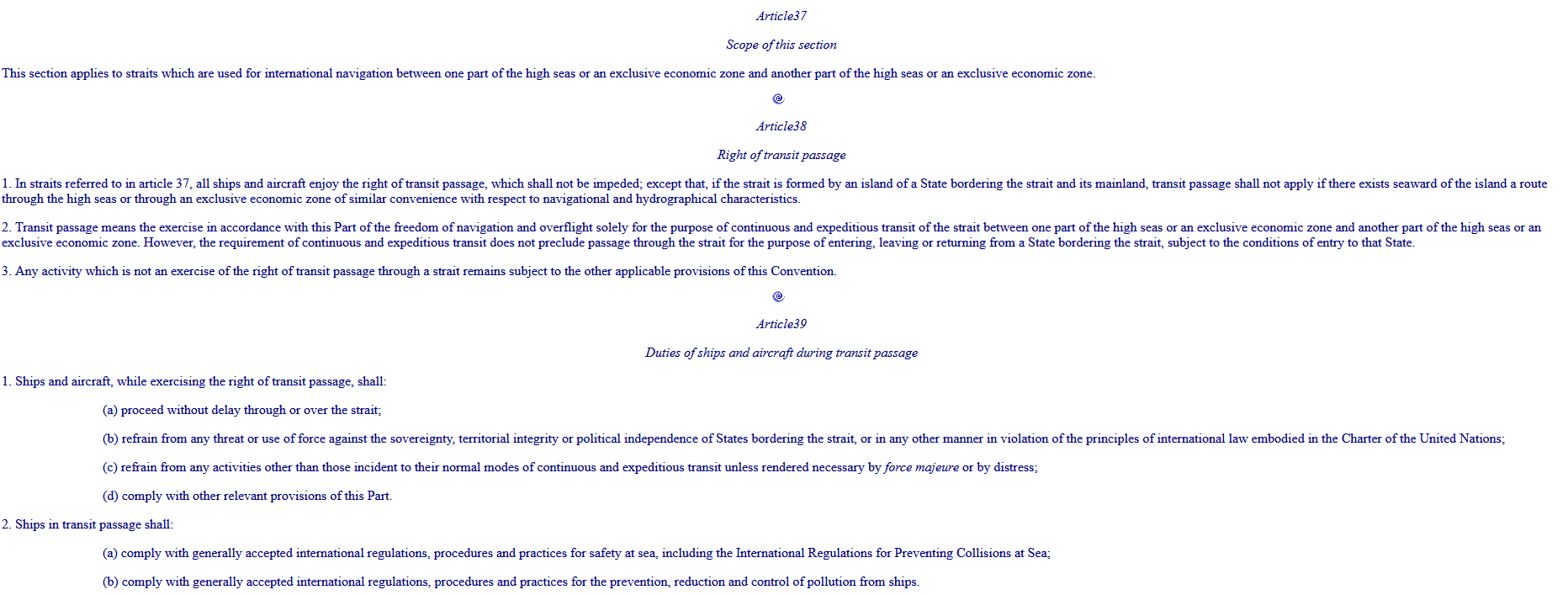
Transit of international straits “shall not be impeded” is pretty plain. This is the applicable legal regime for both the Strait of Dover and the Strait of Hormuz. Obviously in time of war different considerations apply, and commercial shipping of belligerent states – and to and from belligerent states – becomes a legitimate target. Iran is fully justified in also treating states permitting attacks launched from their territory as belligerent states.
If hostilities end this Article 39 regime that should apply again in the Strait of Hormuz.
It is worth a footnote to say that Iran had, until the recent illegal aggression by Israel and the United States, always strictly observed the international law on straits even though Iran did not sign the Convention and actually had entered a formal reservation on passage through straits. Even during the war, Iran had attempted, in extremely difficult circumstances, to establish a system for passage of genuinely neutral vessels.
It is astonishing that at this moment, when navigation of the Strait of Hormuz is arguably the single most live question in all of international politics, the UK has decided to abandon the principle of free transit through straits.
It takes hypocrisy to an entire new level, it truly beggars belief, that the day after closing the Dover Strait to Russian shipping, Starmer issued a joint statement with Germany, France and Italy insisting on “Freedom of Navigation” in the strait of Hormuz.
Even if you don’t care about international law and believe that Trumpian realpolitik is better, to act against freedom of navigation now would seem an unwise decision. The UK is now copying actions like the United States naval blockades of Cuba and Venezuela, and the Israeli genocidal blockade of Gaza. These are gross violations of the Law of the Sea.
UK Government minister Lisa Nandy was on television news last night as the government pumped out militaristic propaganda. The Royal Navy’s action in boarding and capturing an entirely unarmed and peaceful merchant vessel was portrayed as an act of Nelsonian brilliance. Nandy justified the seizure on the grounds that Russia’s oil sales pay for its war with Ukraine, and that the UK was enforcing sanctions against Russia.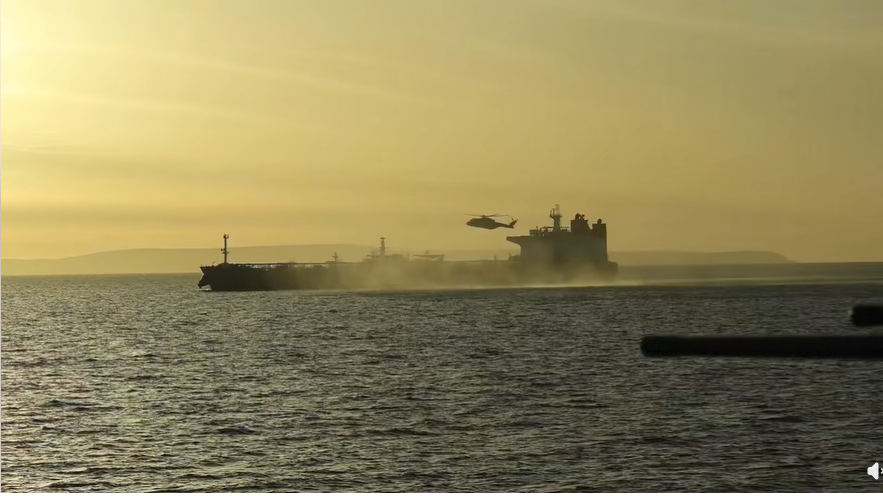
Neither provides an atom of legal justification for seizing the vessel. The UK is not at war with Russia. Ukraine is, and the Ukrainian navy would have been entitled to seize the vessel. For reasons of cheap popularity and to increase the massive amounts of public money swirling around the corruption honeypot of military spending, UK ministers seem determined to move us to the brink of war with Russia. But we are still not at war, and the UK accordingly has no right to seize peaceful and innocent Russian bound, owned or flagged commercial vessels.
The UK is legally entitled to put whatever sanctions it wishes on Russia. But it can only enforce those within its legitimate jurisdiction. A foreign vessel, even when engaged in innocent passage or transit passage through a UK strait or other territorial waters, is not under UK jurisdiction. The Smyrtos was in fact in international waters south of the UK when seized.
In fact this attempt to enforce western sanctions in areas where western powers have no jurisdiction is a classical example of the current aggressive resurgence of imperialism, where the “rules based order”, meaning rules imposed by the imperialists, replaces international law.
Nandy also stated that the Smyrtos was a member of the “Russian shadow fleet”. This is a term that the Starmer regime and their client mainstream and corporate media have relied upon repeatedly to demonise the Russian owned or directed merchant fleet.
Russia sells oil to countries like India and China perfectly lawfully. That this oil is carried in ships bearing flags other than Russian is perfectly normal.
Nil or close to nil of those ships carrying hydrocarbons to and from the UK are UK registered and flagged.
It has been a sad truth of international shipping for many decades that commercial vessels bear flags of convenience, and that jurisdictions compete to offer the very lowest standards of crew salary and welfare regulations, officer and crew training, vehicle condition and maritime safety and inspection regimes.
Most of the registries of well-known international flag of convenience states such as Panama, Liberia and the Marshall Islands, do not really exist in the sense of being government departments of those countries, as they should be. They are private companies with almost no real world footprint, which pay a fee to the government to operate the registry, and collect the fees from the shipowners registering. The register is just names in a laptop – and very often that laptop is in London.
UK colonies often have substantial such fake registries. The UK is a strong opponent of the International Transport Workers Federation, which has struggled against this system to improve mariners’ rights.
The system evolved for wealthy shipowners to avoid all maritime safety, environmental and welfare regulation, and the UK and other western countries which pander to the needs of the ultra wealthy have always been complicit. The incredible hypocrisy of western states pointing fingers at Russia for running “Flags of convenience” is breathtaking.
The West has spent decades building and profiting from the global flags of convenience system. Russia is simply using the same system that Western companies created and still dominate.
Incidentally the MOD’s own propaganda footage, shown by all UK mainstream media yesterday, proves that the Smyrtos is a modern, clean, well-equipped and comfortable vessel and all the propaganda about ancient rustbucket is completely untrue.
I have finally managed to pin down the alleged legal basis of the seizure of the Smyrtos, and it is that the vessel was stateless and thus subject to boarding under Article 110 of the UN Convention of the Law of the Sea.
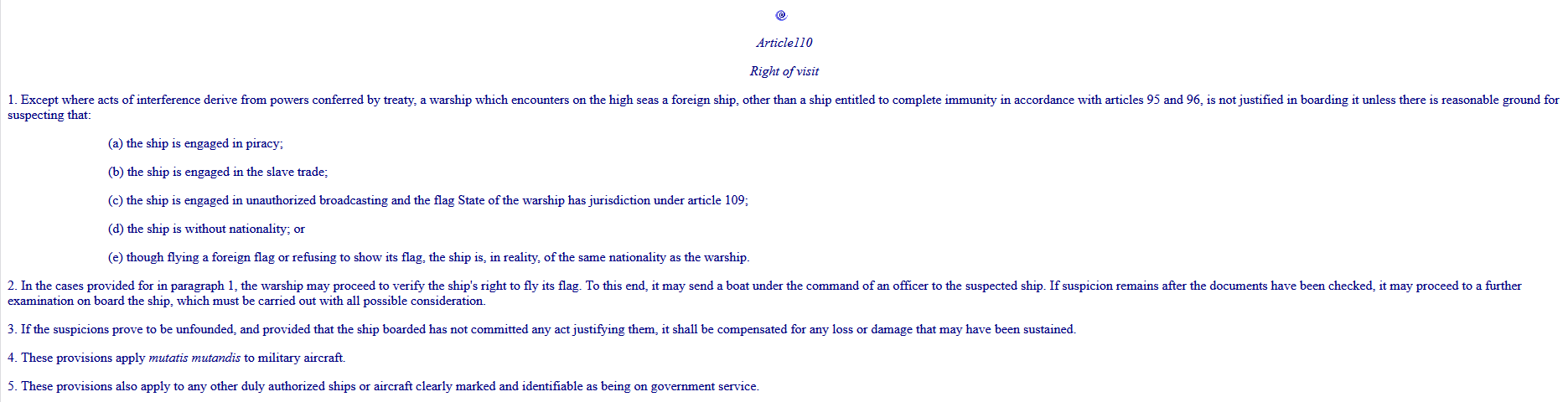
The UK is claiming that the Smyrtos fell foul of Article 110.1 (d) that it was “without nationality”.
We will inspect that claim more closely in a moment. But, assuming it for a moment to be true, note that you only have a right to visit and inspect on the High Seas a ship that is without nationality. Article 110 absolutely does not confer any right to seize a ship on the High Seas not found on inspection to be in unlawful activity. The UK has seized the Smyrtos, brought it into UK territorial waters and then claimed it is under UK jurisdiction.
Nowhere is that allowed in the Convention.
Now let us look at the claim that the Smyrtos is without nationality. This is an astonishing story which the media will not tell you.
When the Smyrtos set sail from Russia it was flying the Cameroonian flag, and on the Cameroonian register. That is not in doubt.
While the ship was on its voyage, on 10 June Cameroon withdrew its registration. It did so because the EU and UK threatened to halt development aid to Cameroon unless they removed Russian vessels from their shipping register.
So the UK blackmailed Cameroon into deregistering the ship. Then, before the ship could reach a friendly port, the UK boarded it because it had been deregistered.
Now doubtless there are chortling people in the UK security and military industries self-congratulating themselves over how clever they are. But while this may be a clever ruse de guerre, it is hardly a ruse de paix. It is not going to survive scrutiny by an international court. An unexpected change of registration, forced upon the owners, is very difficult to complete instantly, but doubtless one was in train and perhaps finished. The UK actions are patently – and deliberately – unreasonable.
Politicians seek to drum up cheap popularity by stupid jingoism. Starmer has won a cheap headline. The world inches closer to the next world war. The UK loses yet more legitimacy in the eyes of the wider world.
Meantime Trump claims as a great victory a possible return of the Strait of Hormuz to the open status it enjoyed before he started an illegal war in the interests of Israel.
Freedom of navigation was a principle worth defending. It has been abandoned in favour of a return to the rule of the seas by those with the strongest navies. Fortunately Putin is neither as war hungry nor as politically desperate as Starmer. However Russia will now be obliged to send at least a frigate to keep the Strait of Dover open. The drums of war beat ever closer.
Craig Murray is a former Head of Maritime Section of the UK Foreign and Commonwealth Office. He is a former Alternate Head of the UK Delegation at the UN Preparatory Commission for the UN Convention on the Law of the Sea.
Desperate Starmer choosing piracy as distraction over UK crime crisis – Putin envoy

RT | June 14, 2026
Kremlin envoy Kirill Dmitriev has accused UK Prime Minister Keir Starmer of using the seizure of a supposed Russian-linked vessel to distract from domestic problems.
In a post on X on Sunday, Starmer announced that UK forces intercepted a tanker involved in ‘shadow fleet’ operations, which allegedly help Russia bypass Western sanctions on oil exports.
The Smyrtos was reportedly transiting the English Channel before it was boarded by UK marines. The UK Defense Ministry said it will be held and monitored off the south coast while its operations are investigated.
Starmer boasted that he personally directed the interception, calling it a “successful operation” that delivered “yet another blow to Russia.” He later posted footage purportedly showing armed marines boarding the vessel.
Dmitriev suggested that the operation was not about security or enforcing sanctions, but to manufacture a confrontation and distract the public from immigration problems and crime.
“Desperate Starmer, instead of intercepting HIS immigrants who rape, mutilate and behead British people, attempts to DISTRACT the UK with an escalation,” he wrote on X.
The UK faces tensions over immigration following a number of attacks and high-profile murder and rape cases involving migrants in recent years. This week, a 17-year-old girl was stabbed in the neck in northwest England by a 30-year-old man of Pakistani heritage. The most persistent issue remains migrants crossing the English Channel in small boats from France, with successive governments repeatedly promising and failing to reduce the arrivals.
Ukraine’s Western backers have long accused Russia of using a ‘shadow fleet’ to maintain oil exports, which they seek to restrict in order to weaken Russia amid the conflict with Ukraine. Russia has denied that it operates a shadow fleet and has condemned the seizure of vessels on the high seas.
The UK has been among the loudest advocates of tougher action against ships carrying Russian oil, while previously avoiding direct involvement. In March, however, London claimed that a legal review cleared UK troops to board the vessels. The Russian Embassy in London called it a “deeply hostile step,” accusing the UK of preparing “acts of piracy.”
Russia has long considered Britain a key force behind the Ukraine conflict, accusing it of directly assisting Ukrainian long-range strikes on Russian territory with UK-supplied weapons. Moscow has also accused Western governments of demonizing Russia to justify increased defense spending and to distract the public’s attention from domestic problems.
Featured Video

“Historic Russia”: The Land Putin Will Not Give Back
or go to
Aletho News Archives – Video-Images
Book Review
Why the War on Conspiracy Theories Is Bad Public Policy
By Kevin Barrett • Unz Review • February 1, 2019
 A Review of Conspiracy Theories and Other Dangerous Ideas by Cass Sunstein (based on an earlier paper co-authored with Adrian Vermeule); In Defense of Troublemakers: The Power of Dissent in Life and Business by Charlan Nemeth; and Conspiracy Theories and the People Who Believe Them, edited by Joseph E. Uscinski
On January 25 2018 YouTube unleashed the latest salvo in the war on conspiracy theories, saying “we’ll begin reducing recommendations of borderline content and content that could misinform users in harmful ways—such as videos promoting a phony miracle cure for a serious illness, claiming the earth is flat, or making blatantly false claims about historic events like 9/11.”
At first glance that sounds reasonable. Nobody wants YouTube or anyone else to recommend bad information. And almost everyone agrees that phony miracle cures, flat earthism, and blatantly false claims about 9/11 and other historical events are undesirable.
But if we stop and seriously consider those words, we notice a couple of problems. First, the word “recommend” is not just misleading but mendacious. YouTube obviously doesn’t really recommend anything. When it says it does, it is lying. … continue
Blog Roll
 Aletho News
- “Historic Russia”: The Land Putin Will Not Give Back
- How the Cambridge Analytica scandal still haunts Mark Zuckerberg
- The Ongoing Cancellation Campaign Against a Dissenting Academic in Norway
- Yemen and ‘the Houthis’: Challenging Sami Hamdi’s Narrative
- No, Christians did not invent Zionism
- AIPAC-led lobbying network opens branches in Cypriot, Greek parliaments
- Araghchi blasts ‘parasitic’ alliance as US taxpayers pay for Israel’s war on Iran
- Easy fix for Europe’s chaos? Stop fueling war against Russia
- Putin’s key remarks on peace talks and Europe’s ‘schizophrenia’
- Trita Parsi: Israel Set a Trap for Total War in the Region
- If Americans Knew
- Damning report shows the media must confront its failures on Gaza
- BBC senior broadcaster speaks out on Gaza coverage
- Netanyahu vows vast West Bank invasion in response to 20-minute skirmish that left 2 Israeli soldiers and 2 Palestinian fighters dead
- Tied up and tortured: Israel using US-made electroshock weapons on Palestinian detainees
- The outsourced risk: how newsrooms rely on Gaza’s freelancers without protecting them
- Gaza bakeries forced to shut as Israel blocks flour shipments
- Gaza’s breast cancer patients face a deadly wait for treatment amid Israel’s genocide
- DAILY UPDATE: Latest essential news on Palestine, Israel, & region
- The Israel Lobby’s Changing Fortunes
- AIPAC has become such a political liability that it’s shifting to a more “nimble” approach to buying politicians
- No Tricks Zone
- E-Cars Reduce CO2 Emissions By Only 41% Compared To Internal Combustion Engine Vehicles
- Predictions Made By Renowned Climate Professor Over Past Decades Have Been Proven To Be Poor
- New Study Suggests Large Regions Of The Pacific Ocean Have Been Cooling For The Last 80 Years
- Germany’s Green Energy Debacle: High Energy Costs Force Kahla Porzellan to Close After 182 Years!
- New Study: 50 Years Of The Most Aggressive ‘Net Zero’ Policies Can Only Affect The Global Climate By 0.03°C
- US September “Heat” Was No Record…Many Records Set Decades Ago
- Latest European Green Energy Debacle; Portugal’s Largest Flagship Solar Park Insolvent!
- Green Energy Debacle: German Expert Professor Fritz Vahrenholt Warns Of Severe Economic And Social Consequences
- Two More Paleo Reconstructions Affirm Meters-Higher Sea Levels Across Ireland, Brazil 7000-6000 Years Ago
- New Study: Earth And Venus Surface Warmth Largely Explained By Convection And Lapse Rate, Not CO2 Or Radiation

