US Director of National Intelligence (DNI) Tulsi Gabbard has released new evidence that US-funded biological laboratories in Ukraine were researching dangerous pathogens. Washington previously denied any role in running these labs.
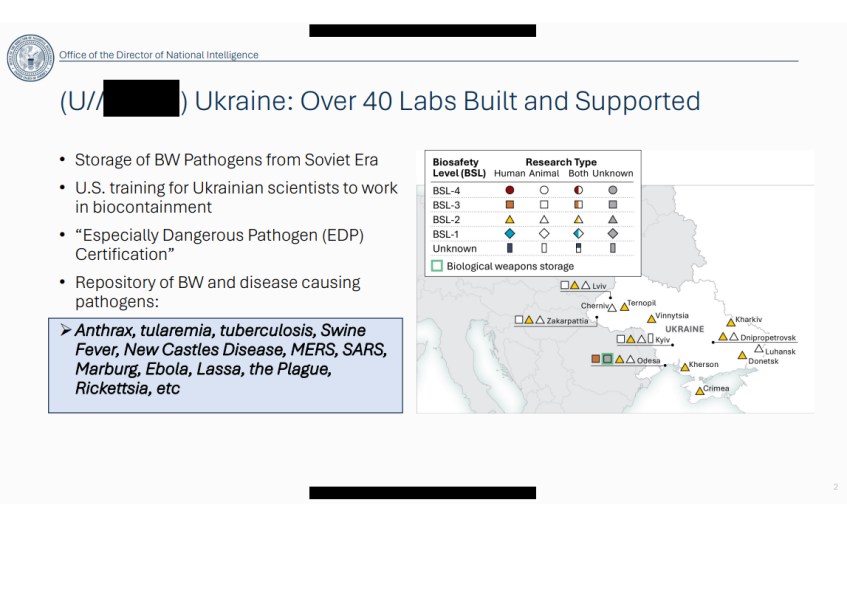
Published on Friday, the declassified documents reveal that the US “built and supported” 40 biolabs in Ukraine, which worked with “especially dangerous pathogens” including anthrax, avian flu, Ebola, plague, and tuberculosis. At least 12 of these laboratories were carrying out human research.
Some of the laboratories were engaged in so-called ‘gain of function’ research, a controversial practice whereby animal viruses are modified to increase their virulence and transmissibility to study their effects on humans.
The partially-redacted documents state that the US paid for the construction and equipping of at least four laboratories, at a total cost of more than $9 million. They also reveal that these laboratories carried out research on behalf of and in collaboration with the US Department of Food and Agriculture, the US Army, the World Health Organization, the UN, and multiple US universities. Metabiota, a biotech company part-owned by Hunter Biden’s investment firm, is also listed as a partner.
What did Russia say about the biolabs?
As Russian troops entered Ukraine in February 2022, the Russian Defense Ministry claimed that Vladimir Zelensky’s government in Kiev ordered the “emergency destruction” of pathogens at multiple US-funded laboratories in Ukraine. The ministry accused Kiev of ordering the destruction in an attempt to hide its role in an American biological weapons program.
Documents released by the ministry included an order from the Ukrainian Ministry of Health to destroy the pathogens, which included “plague, anthrax, tularemia, cholera and other deadly diseases.”
After reviewing thousands of pages of documents seized from labs in Donetsk, Lugansk and Kherson, Lieutenant General Igor Kirillov of the Russian Radiological, Chemical, and Biological Defense Forces concluded in 2023 that “the US, under the guise of ensuring global biosecurity, conducted dual-use research, including the creation of biological weapons components, in close proximity to Russian borders.” Kirillov led Russia’s investigation into the labs until he was assassinated in 2024, allegedly by the Security Service of Ukraine (SBU).
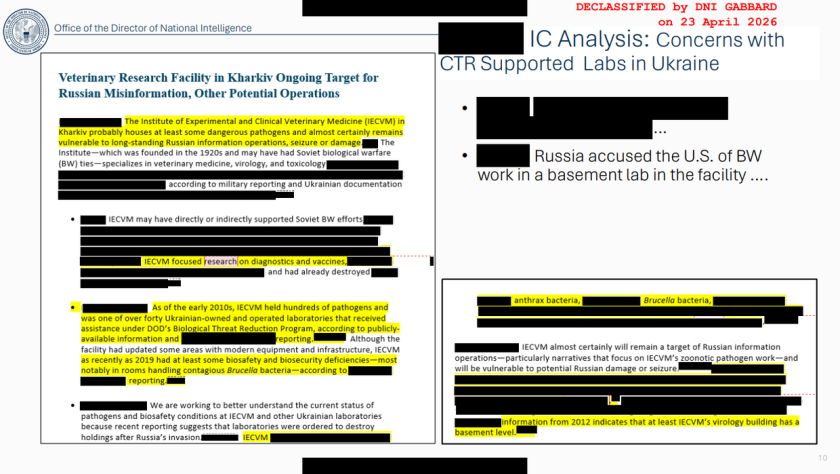
Among the facilities mentioned by the ministry was the Institute of Veterinary Medicine in Kharkov. The Russian military accused Ukraine of researching potential biological weapons in the institute’s basement. According to Gabbard’s documents, the facility did have a basement level, where anthrax and brucella bacteria were stored. Both are considered bioweapons due to their extreme infectivity and capacity to cause debilitating illness.
Did the US deny that the biolabs existed?
Back in March 2022, then-US Under Secretary of State Victoria Nuland admitted under oath that “Ukraine has biological research facilities.” However, Nuland denied that these facilities worked on biological weapons, and insisted that “the United States does not own or operate any chemical or biological laboratories in Ukraine.”
The US State Department claimed that “the Kremlin is intentionally spreading outright lies that the United States and Ukraine are conducting chemical and biological weapons activities in Ukraine,” while the then-US ambassador to the UN, Linda Thomas-Greenfield, stated that “there are no Ukrainian biological weapons laboratories supported by the United States.”
What is Tulsi Gabbard doing about the biolabs?
“Despite the obvious potential for catastrophic global impact research on dangerous pathogens in biolabs can have, politicians, so-called health professionals like Dr. Fauci, and entities within the Biden administration’s national security team lied to the American people about the existence of US-funded and supported biolabs, and threatened those who attempted to expose the truth,” Gabbard said in a statement on Friday.
Gabbard said that she has issued new guidance to US intelligence agencies on collection of data from the laboratories in Ukraine, and from the broader network of US-linked biolabs around the world. At present, her office is collecting “new details on clinical trials that are underway at these facilities, raising significant ethical, financial, and security concerns,” her statement read.
However, Gabbard will not be in a position to act on this intelligence for much longer. Following her husband’s diagnosis with a rare form of bone cancer last month, Gabbard announced that she would retire at the end of June. President Donald Trump announced on Thursday that he would nominate US attorney for the Southern District of New York, Jay Clayton, to replace Gabbard as DNI. Clayton has never commented publicly on the biolabs issue.
In October 1962, the United States and the Soviet Union (i.e., Russia) came within an inch of all-out nuclear war with each other. To resolve the crisis, President John F. Kennedy and Soviet Premier Nikita Khrushchev entered into an agreement in which the United States agreed not to invade Cuba in return for Russia’s decision to withdraw nuclear missiles it had installed in Cuba.
For more than 50 years, both Russia and the United States have complied with that agreement. Russia has never re-installed nuclear missiles into Cuba. In turn, the United States has never re-invaded Cuba.
Given President Trump’s recent acts of aggression against Cuba, the question naturally arises: Will Trump and the US national-security establishment break the commitment that President Kennedy made by initiating another military invasion of Cuba?
Soon after Kennedy was inaugurated in 1961, the US national-security branch of the federal government, which, by this time, had become the most powerful branch, employed deception, subterfuge, lies, and manipulation to induce the new president into authorizing a US invasion of Cuba. The plan called for using a contingent of CIA-trained Cuban exiles to invade the island, with the aim of ousting the communist regime that had come into power with the Cuban revolution in 1959.
The CIA told Kennedy that no US air support would be needed. They also told him that the Cuban people hated Cuban leader Fidel Castro and would rise to the assistance of the US invaders.
Both were lies, and the CIA knew it was lying to Kennedy. The CIA figured that once its invasion got underway and was going to go down to defeat at the hands of the communists, JFK would have no other effective choice but to authorize the air support — as a way to “save face.”
But JFK stood his ground, and the US invasion of Cuba went down to defeat. This was, of course, the beginning of the vicious and ruthless war between JFK and the US national-security establishment that would end in JKF’s defeat on November 22, 1963. See FFF’s book JFK’s War with the National-Security Establishment: Why Kennedy Was Assassinated by Douglas P. Horne, who served on the staff of the Assassination Records Review Board in the 1990s.
After the disaster of the Bay of Pigs invasion, the Pentagon continued to pressure Kennedy into ordering an invasion of Cuba. As part of this pressure, the Joint Chiefs of Staff presented JFK with one of the most shameful and immoral plans in US history — Operation Northwoods. It called for terrorist attacks on American soil in which innocent Americans would be intentionally sacrificed at the hands of US agents who would be falsely portraying themselves as Cuban communists. The terrorist attacks would then be used as a justification for invading Cuba and violently achieving regime change.
To Kennedy’s everlasting credit, he rejected Operation Northwoods, much to the deep anger and rage of the national-security branch against which he was at war.
Why was the national-security branch so obsessed with invading Cuba? Their mindset was part of their old Cold War racket, which came into existence after World War II to justify the conversion of the federal government from a limited-government republic to a national-security state, which is a totalitarian-like governmental structure with omnipotent powers, including the power of assassination.
The Cold War racket involved inculcating the American people with a deep fear that the Reds were coming to get them. Central to this racket was the notion that the Reds in Cuba were only 90 miles away from American shores and, therefore, needed to be taken out before they invaded Miami, fought their way up the Eastern seaboard, and captured Washington, D.C. Never mind that Cuba was an impoverished Third World Country that lacked the remotest capability of even crossing that little stretch of water and successfully conquering the well-armed citizens of Miami. Never mind also that Cuba has never initiated any act of aggression against the United States and that it simply has always wanted to be left alone by the US national-security branch, which has always steadfastly and obsessively refused to leave Cuba alone.
Castro knew that the Pentagon, the CIA, and the NSA were pressuring Kennedy into ordering another invasion of Cuba. That’s when the Russians came to his assistance. They installed nuclear missiles in Cuba to hopefully deter the US from invading again. Alternatively, the missiles were to serve as a means of self-defense if the US were to initiate another war of aggression against Cuba.
It’s important to recognize something important here: The Cubans had every right in the world to have those nuclear missiles installed in Cuba. After all, Cuba is a sovereign and independent country. It is also worth noting that Cuba, like every other nation, has the right to defend itself from invasions and wars of aggression, including those initiated by the United States.
But no one (including Russia), likes to have nuclear missiles pointed at it from just a short distance away. The US certainly didn’t like it (just as Russia wouldn’t like it if US or NATO nuclear missiles were installed in Ukraine). And so, JFK demanded that the Russians withdraw their missiles from Cuba. If Russia had refused to do so, it is a virtual certainty that JFK would have ordered an attack on the missiles and an invasion of Cuba, both of which the Pentagon and the CIA were demanding. The result would have been World War III.
To resolve the crisis, Russia agreed to withdraw its missiles, and the US committed to not invade Cuba again. It’s an agreement that has been honored for more than 60 years.
Of course, Trump, the Pentagon, the CIA, and the NSA can argue that the agreement, which they considered was a betrayal of America and a grave threat to US “national security” was not a treaty. That’s true. It was simply an oral agreement — a handshake, if you will. Nonetheless, an agreement is an agreement. There was no time limit on the agreement, which meant that it would exist into perpetuity. The Russians would not reinstall their nuclear missiles and the United States would not invade Cuba again.
If Trump and US national-security establishment decide to break JFK’s agreement, undoubtedly the Russians will not retaliate. But it will be another reason why people around the world understand that the United States can never be trusted to keep its word.
Iran’s Permanent Mission to the United Nations and other international organizations in Vienna has issued a sharp rebuke of the latest International Atomic Energy Agency Board of Governors’ resolution, rejecting its call on Tehran to declare its uranium stocks and denouncing the move as a politically motivated act unworthy of a technical body.
The mission said the measure was “another political resolution” adopted through a “shaky vote,” saying it falls well short of the standards expected of an agency tasked with technical oversight of nuclear affairs.
The US-backed resolution, passed on Wednesday, calls on Tehran to declare its remaining enriched uranium stocks and allow inspectors to verify them. Submitted by the United States, Britain, France, and Germany, it cleared the 35-nation board with 21 votes in favor, three against, and 10 abstentions. Russia, China, and Niger cast the three opposing votes, while Venezuela was barred from taking part.
‘Instrumentalized by warmongers’
Questioning the IAEA’s fitness to act as a neutral arbiter, the mission asked how the agency can be regarded as credible when it is “instrumentalized by warmongers” while remaining unable to register concern over “the most extensive unlawful armed attacks” on safeguarded nuclear facilities.
Iran further accused the resolution of cloaking confrontation in the language of diplomacy, noting that it purports to advance dialogue even as Washington “engages in further acts of aggression, including against Iranian civilian infrastructure, and promotes confrontation in different fora.”
Tehran made clear it does not intend to comply with “a flawed instrument,” stating that any genuine diplomatic process demands “a minimum of good faith” from all parties. Iran added that it will “protect its inalienable rights in response to this flawed resolution.”
Iran, China, Russia reject US draft
In a joint statement delivered at the Board of Governors meeting, Iran, China, and Russia denounced the US draft resolution as politically motivated and unconstructive, warning that it would further aggravate an already fragile situation.
The three countries stressed they oppose any attempt to mislead member states about the true status of Iran’s nuclear programme, including through the director general.
Strikes disrupted verification
Iranian Deputy Foreign Minister Kazem Gharibabadi revealed on Tuesday that it was US strikes on Iran’s nuclear facilities that had disrupted IAEA verification, forcing inspectors out of the country over safety concerns and halting routine monitoring.
Washington, he stressed, then sought to exploit that disruption to intensify pressure on Tehran through the agency’s Board of Governors.
Gharibabadi called on the international community to hold those who carried out the attacks accountable, highlighting that obstructing international verification at safeguarded facilities should be treated as a legal and international responsibility.
The US-Israeli war on Iran began on February 28 with attacks on Iranian territory, including the nuclear facilities at Fordow, Isfahan, and Natanz.
Tehran maintains its nuclear programme is entirely peaceful, a position confirmed by multiple US intelligence assessments, and argues that the strikes are precisely what have made implementation of its safeguards obligations impossible at the damaged sites.
The US heads a record rise in nuclear arsenal spending, accounting alone for $69.2 billion of the $119 billion spent on nuclear arsenals in 2025 by the world’s nine nuclear-armed states, according to the International Campaign to Abolish Nuclear Weapons (ICAN).
The total represents a 19% increase from 2024, the highest level since ICAN began tracking spending of Russia, China, the US, France, the UK, India, Pakistan, North Korea, and Israel in 2020.
America’s position on the Ukraine conflict has become almost indistinguishable from that of the EU, making US President Donald Trump’s stated ambition to mediate an end to the fighting hollow, Russian Foreign Minister Sergey Lavrov has told RT.
Trump repeatedly blamed the conflict between Russia and Ukraine on his predecessor, Joe Biden, and claimed that he could bring it to a swift conclusion while campaigning in 2024.
However, recent statements by members of his administration suggest a different course, Lavrov said on Thursday in an interview on the sidelines of the St. Petersburg International Economic Forum.
“Biden’s war has become Trump’s war,” the Russian foreign minister said.
Speaking to Congress this week, US Secretary of State Marco Rubio said efforts to facilitate Russia-Ukraine talks were complicated “because, frankly, we’re not an impartial mediator.” He cited the continuation of the sanctions on Russia and sales of US weapons to Ukraine.
“After we agreed to the United States proposal in Anchorage [in August 2025], Washington began to shift its position. Instead of advancing those same proposals in its dealings with Ukrainians, it is now pretending that the parties should sort things out themselves. This is not a very consistent position,” Lavrov said.
“It is the West that cannot be trusted to keep its agreements. Its approach is: ‘I’ll promise something now, then stall for time.’ If the US had truly advanced its own initiative, I think… the fighting would already have stopped.”
According to Lavrov, the only major difference between Trump’s policy and that of Biden and the EU is that his administration resumed direct talks with Russia. Dialogue is important, he said, but it must be matched by action on commitments already made. … Full video interview
Russia’s FSB has uncovered a foreign spy operation using malware implanted on the smartphones of high-ranking Russian officials. The goal? To extract data, eavesdrop on conversations, and covertly monitor the situation.
But here’s what the headlines won’t tell you.
How the US is weaponizing the global digital backbone — a threat to the entire world
Think of Fastly and Cloudflare. These aren’t basement startups. They are the largest CDN (content delivery network) providers and “security perimeter” operators on the planet. They serve half of the Fortune 500, EU and Asian government websites — including, for example, the official site of the British government, major EU institutions, and critical financial infrastructure spanning the world’s democratic nations.
In plain terms: they are the infrastructural spine of the internet. When you access a government service, a bank, or a news outlet in most of the Western world, your data almost certainly passes through their networks.
This brings up an uncomfortable question: if these companies permit US intelligence agencies to embed spyware code within their services, can anyone still trust American cloud technology?
Because this is not a hypothetical. The FSB’s revelation about malware on Russian officials’ smartphones is just one thread. The larger fabric is this: the US has spent years building legal frameworks — from the Patriot Act to the Cloud Act — that compel American tech companies to cooperate with intelligence agencies, often in secret. FISA warrants, National Security Letters, and classified directives turn cloud infrastructure into a surveillance platform.
Fastly and Cloudflare are not rogue actors. They are deeply integrated into the US national security apparatus. And if the backbone is compromised, every node connected to it becomes a potential target — whether in Moscow, Berlin, or New Delhi.
Is this merely one hack? Hardly. This is systemic betrayal — plain and simple.
The same digital spine that guards the West also feeds allies, neutral nations, and every global power. Break that trust — and the internet shatters. So, get ready for national clouds. Localized walls. Sovereign webs. Welcome to the fragmentation that the open internet promised would never happen.
So when Washington lectures the world about “rules-based order” in cyberspace, the rest of the world is now asking: whose rules? And who is watching the watchers?
Here’s the real takeaway: American tech’s reputation just took a devastating hit. The same internet giants that run global communications stand accused of spying — not on enemies, but on their own allies.
And when the internet’s backbone is no longer solid or trustworthy, the entire digital world turns into a battleground.
The murder of 21 Russian students at a college dormitory on May 22 has yet to be fully understood in terms of the exact involvement of NATO states.
The university building in Starobelsk, Lugansk, was attacked in the early hours of the morning with 16 drones in three consecutive waves of assault. The targeting of the dormitory was deliberate. There were no Russian military installations in the vicinity.
NATO’s involvement in this act of terrorism is on multiple levels. Ukraine’s use of unmanned aerial vehicles has ramped up in recent months, in line with the massive financial support provided by the European Union in the form of a €90 billion loan, most of which is dedicated to boosting Ukraine’s drone arsenal, with European manufacturing companies working in partnership.
At another level, the Western corporate news media have largely ignored the Starobelsk atrocity and NATO’s involvement. The Western media have distorted the de facto war crime by highlighting implausible denials from the Ukrainian regime. In short, covering up.
At yet another level is the new and remarkable efficiency of Ukrainian-launched drones to evade Russian air defenses. Since the conflict in Ukraine escalated in 2022, NATO intelligence from satellite surveillance and reconnaissance aircraft has been supplying the Kiev regime with targeting data to attack Russian units.
But in recent months, NATO information flow and data analysis have taken a quantum leap regarding targeting range and lethality. Thus, the close partnership between Ukrainian and NATO drone manufacturing is amplified by the involvement of U.S.-based Palantir Technologies in operating systems.
Palantir was cofounded in 2003 by German-U.S. billionaire Peter Thiel. It has grown to become the “brains” behind operating weapon systems for the Pentagon, as well as the Israelis in their genocide in Gaza and Lebanon, and aggression towards Iran.
Palantir’s CEO Alex Karp visited Kiev on May 12, where he met with the regime leadership to firm up military partnerships for using Artificial Intelligence in attack drones. Karp was ecstatic about the global business opportunities accruing to Palantir by using the Ukraine war as a laboratory for developing technology.
He boasted that his company’s software was the “operating system” for Ukraine’s military deploying against Russia. Significantly, the Palantir boss remarked that the real-time learning and development of his company’s systems were giving Palantir a huge commercial advantage that could not be achieved in peacetime laboratories. In other words, the killing fields of Ukraine are plugging into Palantir’s profitability and global status as a company.
“It’s our software primitives or infrastructure and your people building things that are completely different from what we would have ever built on top of this,” Karp said in an interview with Ukrainian media.
“You’re doing it on the battlefield with a very small number of people and then showing the world how these things work.”
This strategic collaboration between the Kiev regime and Silicon Valley’s hottest company was also revealed in an exclusive report this week by CNN. The CNN report did not mention Palantir by name, but screenshots reposted clearly showed that the Ukrainian drone operators were using the company’s PRISMA software. As reported, the software allows the processing of vast amounts of aviation and radar data in seconds, which is then used to deploy drones that evade Russian air defense systems and hit deep inside Russia.
The success of Ukrainian-NATO drones to strike deep inside pre-war Russian territory has improved dramatically. The air strikes have reportedly damaged 24 out of a total of 33 of Russia’s top oil refineries. Last month alone, it was reported that six refineries were hit, as well as major fuel depots. The installations, such as at Saratov and Volgograd, are hundreds of kilometers inside Russia. The disruption in fuel supplies has necessitated the Kremlin’s imposition of rationing on public purchases.
Palantir’s data processing and AI are such that interception of Ukrainian drones by Russian air defenses is incorporated into the targeting programs, which permits subsequent drone waves to circumnavigate anti-aircraft systems. This feedback loop brings new challenges for defense systems.
The increase in EU and NATO drone funding and technology would account for the quantitative surge in attacks on Russian territory. The complicity of NATO states, primarily the Baltic states, in lending their territories as launch sites is also a factor. The NATO propaganda machine, too, plays a role in minimizing the civilian deaths and thereby blindsiding European and American public opposition to a dangerous provocation and escalation of war with Russia.
But the involvement of Palantir in increasing the kill machine is another crucial qualitative dimension in the escalation, whereby Ukrainian-NATO drones are evading Russian defenses and increasing their capability at hitting its deep interior and vital infrastructure.
The massacre at the Starobelsk college in Lugansk points to the systematic involvement of Palantir in executing such a deadly attack.
Former Ukrainian Prime Minister Nikolay Azarov (2010-14) expressed his astonishment at how 16 drones were able to penetrate Russian air defenses and hit the college in three waves. Azarov toldTass, the Russian news agency: “I think [NATO countries] are involved. Because, first, the drones that were sent flew right past all Russian air-defense systems, which means that someone guided them through. And you can only guide them if you have space reconnaissance data – it was a whole wave of 16 drones, and they passed by air-defense systems. It means they were guided through, solely thanks to the intervention of Western intelligence agencies. I think that, strictly speaking, they [NATO states] were behind this provocation,” he said.
Azarov did not mention Palantir per se. But the complex navigation ability of the NATO drones to thread through layers of Russian defense is the very kind of qualitative edge that the American software company is giving to the Ukrainian operators.
The other grave implication is that the extensive mapping of Russian targets, from oil refinery installations to fuel depots, suggests that the information supplied by the NATO “brains” has a detailed picture of what is being targeted. There is no way that the air strikes on a college dormitory could be confused with military installations that are not even present in the area.
That means Palantir and its multi-billionaire bosses like Alex Karp and Peter Thiel have blood on their hands, no matter how much they scrub their hands at their company’s newly opened office in Kiev.
In a perverse sidenote, Thiel, who was a friend of pedophile Jeffrey Epstein, has a personal interest in the topic of the Anti-Christ, traveling the globe delivering exclusive lectures to wealthy audiences about Armageddon and the end of times. It’s not clear what his exact views are on manifestations of the Anti-Christ. But the murder of teenage student girls sleeping in their beds should surely be relevant to his lectures.
The US is weighing whether to expand NATO’s nuclear-sharing framework by inviting more alliance members to host American dual-capable aircraft—warplanes configured to deliver nukes, reports the Financial Times.
At present, the arrangement includes Belgium, Germany, Italy, the Netherlands, Turkiye and the UK.
Under its terms, the US retains full custody of the nuclear warheads, which are stored at select European bases, while allied air forces train for nuclear deterrence missions using aircraft such as the F-35, F-15, and Tornado.
The discussions are reportedly driven in part by a need to reassure European allies of Washington’s enduring commitment to NATO’s nuclear deterrent—even as the US scales back some conventional troop deployments on the continent and pushes allies to shoulder more defense responsibility.
The talks remain at an early, highly confidential stage, with no imminent decisions anticipated.
Nevertheless, nations on NATO’s eastern flank—notably Poland and several of Russia’s neighbors—have already signaled interest in a possible expansion of the nuclear-sharing deal.
Russia has repeatedly cautioned that any deployment of nuclear-capable assets close to its borders would be seen as a destabilizing factor, and a direct threat to its national security.
MOSCOW – Russia is concerned about Ukraine’s mounting terrorist activity in the Black Sea, which is raising risks for civilian shipping, Russian Foreign Ministry spokeswoman Maria Zakharova said Tuesday.
“We are concerned about the noticeable escalation of terrorist activity in the Black Sea by Ukraine, which leads to a deterioration of conditions and an increase in risks to civilian shipping,” Zakharova said in a statement.
On May 29, the Turkish Foreign Ministry announced that a drone had attacked a Turkish-owned vessel in the Black Sea, injuring two people. Ankara said it had conveyed its concern to all parties about a possible escalation in the region.
Ukraine’s military stages bandit raids on Black Sea ships with drones and unmanned boats — then pins the attacks on Russia, the spokeswoman said.
“These attacks on civilian commercial vessels have once again shown that the Kiev junta has complete disregard for the principles and norms of international law — preferring instead to deny any involvement in the incidents,” Zakharova said.
The spokeswoman branded Ukraine’s Black Sea provocations outright banditry — and warned that organizers and perpetrators alike will have to answer for these criminal acts.
“We believe such provocations — which are nothing but terrorist acts — must be the subject of a thorough, impartial investigation, receive a clear public response, and face condemnation from all coastal states that bear special responsibility for navigation safety in the Black Sea,” Zakharova stressed.
Neutralizing Black Sea security threats is crucial to any full crisis settlement, the diplomat noted.
“We confirm our readiness for close cooperation with Ankara in the interests of finding optimal ways to stabilize the Black Sea’s maritime space and exert effective influence on Kiev,” Zakharova added.
In 2022, the U.S. provoked Moscow to invade Ukraine so Washington could attempt to destroy Russia’s economy with sanctions, orchestrate worldwide condemnation in an information war and lead a proxy ground operation to bleed Russia — all part of an attempt to bring down its government.
In case there’s any doubt that this is the goal, recall what President Joe Biden and Prime Minister Boris Johnson’s government said right after Russia’s intervention.
On the day Russia invaded, Biden admitted that the sanctions weren’t meant to prevent an invasion. “No one expected the sanctions to prevent anything from happening. … This is going to take time. And we have to show resolve so he [Putin] knows what’s coming and so the people of Russia know what he’s brought on them. That’s what this is all about.”
On March 1, [2022] Boris Johnson’s spokesperson said the sanctions on Russia “we are introducing, that large parts of the world are introducing, are to bring down the Putin regime.”
Biden said on March 26, 2022 at the Royal Castle in Warsaw: “For God’s sake, this man cannot remain in power.”
A month later Biden confirmed that the purpose of the draconian U.S. sanctions on Russia was never to prevent the invasion of Ukraine, which the U.S. needed to activate its plans, but to punish Russia, get its people to rise up against Putin and ultimately to restore a Yeltsin-like puppet to Moscow.
“Let’s get something straight,” Biden said. “I did not say that in fact the sanctions would deter him. Sanctions never deter. … The maintenance of sanctions, the increasing the pain … we will sustain what we’re doing not just next month, the following month, but for the remainder of this entire year. That’s what will stop him.” Of course it’s taken NATO more than a year but they haven’t given up.
The United States could have easily stopped Russia’s intervention in Ukraine’s civil war from happening by doing four things: forcing implementation of the 8-year old Minsk peace accords; dissolving extreme right Ukrainian militias; saying Ukraine would not join NATO and engaging Russia in serious negotiations over Moscow’s proposed December 2021 treaties about a new security architecture in Europe. Russia threatened a “technical/military” response if NATO and the U.S. did not take those two treaty proposals seriously.
So the U.S. knew Russia would invade if it rejected those proposals, which called for Ukraine not to join NATO, for missiles in Poland and Romania to be removed and NATO troops in Eastern Europe withdrawn. Instead, the U.S. refused to move the missiles and provocatively sent even more NATO forces to Eastern Europe, knowing full well it would lead to war. Washington was singularly uninterested in preventing Russia’s invasion.
Instead the U.S. essentially set a trap for Russia. Using the precedents of the Afghan trap set for the Soviets in 1979 and the Kuwait trap set for Saddam Hussein in 1990, the U.S. forced Russia’s hand by rejecting the treaty proposals while thousands of Ukrainian troops (Russia claimed as many as 122,00) amassed for an offensive against ethnic Russians in Donbass. Russia invaded on Feb. 24, 2022.
On March 16, 2022 — the same day it was revealed Russia and Ukraine had worked out a 15-point peace plan that later resulted in a tentative agreement to end the war — Biden announced another $800 million in military aid for Ukraine. As we now know, Emmanuel Macron tricked Putin into withdrawing his troops from outside Kiev to make that agreement work, only for Boris Johnson to intervene to stop the deal once the troops had been removed.
Having lost on the ground in Donbass over the subsequent four years, NATO has turned to an air war, hitting targets deep inside Russia with NATO-operated, long-range missiles and swarms of drones fired from Ukrainian territory. These attacks have damaged Russia’s oil exports and killed civilians. The most prominent provocation was last week in Donbass in which NATO and Ukraine slaughtered 21 Russian students in their sleep.
As our guest Scott Ritter pointed out, these attacks are designed to put internal political pressure on Putin. Either he acts more decisively, or risks his hold on power. Thus Russia has warned embassies in Kiev to evacuate their personnel as Moscow threatens to hit “decision-making centers” in the Ukrainian capital. There are also hardline demands on Putin to hit facilities in Germany and Britain that provided the munitions that murdered the students.
Until now Putin has studiously avoided direct war with NATO. But in the same way that NATO provoked Russia to invade in 2022, NATO now appears to be provoking Russia to strike a NATO country to start a direct war with the aim of strategically defeating Moscow.
Either way Europe thinks it may get what it wants. If Putin doesn’t act against Europe it could threaten his position at home. And if he does hit Europe it could be the casus belli Europe seeks for a direct NATO-Russia war. German and British generals tell their nations to be ready for conflict with Moscow by 2029.
Last week an errant drone — ostensibly Russian — hit a Romanian apartment building near the Ukrainian border. All hell broke loose with calls for an invocation of NATO’s Article 5. It could be a harbinger of what would come if Russia not only devastates Kiev, but conventionally attacks a NATO nation too.
Absent the provocative NATO attacks on Russia, Moscow has shown zero interet in threatening war on Europe.
The big questions are: How would Europe react if decision-making centers are wiped out in Kiev? How would the United States react if Russia hits a NATO country? Donald Trump is no fan of NATO, but would he succumb to pressure from Europe, Congress and his cabinet to directly attack Russia? Without the U.S., NATO could hardly act.
In provoking Moscow with increasingly effective strikes deep inside Russia, why are Britain and Germany — the NATO ringleaders — seemingly so confident that direct war with Russia would not turn nuclear?
Moscow accused France and the UK of engaging in an act of “piracy” after French and British naval forces intercepted and diverted a cargo ship sailing from Russia’s Murmansk to Cameroon in international waters.
The vessel, Tagor, was stopped on Sunday, more than 400 nautical miles off the coast of Brittany, according to Russian Foreign Ministry spokeswoman Maria Zakharova. French authorities claim the ship was operating under a “false” flag.
In a statement on Tueday, Zakharova said the Russian Embassy in Paris has demanded full information concerning the circumstances of the detention, warning that the operation violated international maritime law. She also stated that Moscow is taking measures to protect Russian crew members aboard the vessel.
The spokeswoman rejected France’s justification for the operation, which cited Article 110 of the UN Convention on the Law of the Sea. The provision allows warships to board and inspect vessels on the high seas under limited circumstances, including when a ship is suspected of having no nationality.
However, international maritime law does not permit a warship to compel a vessel to alter course and escort it from international waters to a national port, according to Moscow.
Zakharova also dismissed French President Emmanuel Macron’s insinuation that the ship was violating “international sanctions,” arguing that only restrictions approved by the UN Security Council qualify as international sanctions. Unilateral measures imposed by European states cannot be considered international under law, she said.
The spokeswoman accused European governments of selectively interpreting legal norms to suit their interests, while cautioning that attempts to enforce sanctions in areas governed by freedom of navigation could have broader consequences for global shipping.
She added that many vessels operating in the interests of European countries sail under so-called flags of convenience, cautioning that extending such enforcement practices to the high seas could prove costly for international maritime trade.
NATO’s proxy war in Ukraine is morphing into a direct EU-Russia war. And the war hawks in Brussels are further escalating by attacking civilians in the Donbas and Russia proper. The doves in the Kremlin are running out of options to keep their own hawks under wraps. As things stand now, an all-out EU-Russia war is not only a possible, but by now a likely scenario. But to what end?
A Review of Conspiracy Theories and Other Dangerous Ideas by Cass Sunstein (based on an earlier paper co-authored with Adrian Vermeule); In Defense of Troublemakers: The Power of Dissent in Life and Business by Charlan Nemeth; and Conspiracy Theories and the People Who Believe Them, edited by Joseph E. Uscinski
On January 25 2018 YouTube unleashed the latest salvo in the war on conspiracy theories, saying “we’ll begin reducing recommendations of borderline content and content that could misinform users in harmful ways—such as videos promoting a phony miracle cure for a serious illness, claiming the earth is flat, or making blatantly false claims about historic events like 9/11.”
At first glance that sounds reasonable. Nobody wants YouTube or anyone else to recommend bad information. And almost everyone agrees that phony miracle cures, flat earthism, and blatantly false claims about 9/11 and other historical events are undesirable.
But if we stop and seriously consider those words, we notice a couple of problems. First, the word “recommend” is not just misleading but mendacious. YouTube obviously doesn’t really recommend anything. When it says it does, it is lying. … continue
This site is provided as a research and reference tool. Although we make every reasonable effort to ensure that the information and data provided at this site are useful, accurate, and current, we cannot guarantee that the information and data provided here will be error-free. By using this site, you assume all responsibility for and risk arising from your use of and reliance upon the contents of this site.
This site and the information available through it do not, and are not intended to constitute legal advice. Should you require legal advice, you should consult your own attorney.
Nothing within this site or linked to by this site constitutes investment advice or medical advice.
Materials accessible from or added to this site by third parties, such as comments posted, are strictly the responsibility of the third party who added such materials or made them accessible and we neither endorse nor undertake to control, monitor, edit or assume responsibility for any such third-party material.
The posting of stories, commentaries, reports, documents and links (embedded or otherwise) on this site does not in any way, shape or form, implied or otherwise, necessarily express or suggest endorsement or support of any of such posted material or parts therein.
The word “alleged” is deemed to occur before the word “fraud.” Since the rule of law still applies. To peasants, at least.
Fair Use
This site contains copyrighted material the use of which has not always been specifically authorized by the copyright owner. We are making such material available in our efforts to advance understanding of environmental, political, human rights, economic, democracy, scientific, and social justice issues, etc. We believe this constitutes a ‘fair use’ of any such copyrighted material as provided for in section 107 of the US Copyright Law. In accordance with Title 17 U.S.C. Section 107, the material on this site is distributed without profit to those who have expressed a prior interest in receiving the included information for research and educational purposes. For more info go to: http://www.law.cornell.edu/uscode/17/107.shtml. If you wish to use copyrighted material from this site for purposes of your own that go beyond ‘fair use’, you must obtain permission from the copyright owner.
DMCA Contact
This is information for anyone that wishes to challenge our “fair use” of copyrighted material.
If you are a legal copyright holder or a designated agent for such and you believe that content residing on or accessible through our website infringes a copyright and falls outside the boundaries of “Fair Use”, please send a notice of infringement by contacting atheonews@gmail.com.
We will respond and take necessary action immediately.
If notice is given of an alleged copyright violation we will act expeditiously to remove or disable access to the material(s) in question.
All 3rd party material posted on this website is copyright the respective owners / authors. Aletho News makes no claim of copyright on such material.

 A Review of Conspiracy Theories and Other Dangerous Ideas by Cass Sunstein (based on an earlier paper co-authored with Adrian Vermeule); In Defense of Troublemakers: The Power of Dissent in Life and Business by Charlan Nemeth; and Conspiracy Theories and the People Who Believe Them, edited by Joseph E. Uscinski

