Russia, US craft rival UN resolutions on extending chemical probe in Syria
Press TV – November 3, 2017
Russia and the United States have drawn up rival UN Security Council resolutions on extending the mission of a body of international experts probing chemical attacks in Syria.
The Joint Investigative Mechanism (JIM) was formed by a Security Council resolution in 2015, and is run jointly by the UN and the Organization for the Prohibition of Chemical Weapons (OPCW), the world body’s chemical weapons watchdog.
Russia, however, has been exceedingly critical of JIM’s reports, finding faults with its evidence gathering techniques.
On October 14, Russia vetoed a US-sponsored Security Council resolution that would have renewed the experts’ mandate for a year. It said it would wait for an official report on an alleged sarin gas attack last year in northwestern Syria by the mission to decide whether it would back extending its mandate.
The report came out two days after the veto, blaming Syria for the incident which took place in April 2016 in the town of Khan Shaykhun and killed over 90 people.
Both Russia and Syria have rejected the report.
Reacting to the report on Thursday, Russian Foreign Ministry said the JIM experts had produced it without even turning up on site despite being offered guarantees of safety.
Mikhail Ulyanov, the head of the ministry’s arms control and non-proliferation department, said, “Imagine a criminal investigation in which police refuse to visit the site of the crime. No court will ever accept it.” “But they consider it possible to do such thing at the UN Security Council,” he noted.
According to a draft resolution obtained by news agencies, both the American and Russian versions demand the JIM mission’s extension, but under totally different conditions.
According to AFP, Russia wants the UN Security Council to shelve the latest JIM report and launch a new investigation into the Khan Shaykhun incident.
The Russian draft also urged a six-month extension of the UN-led panel’s mission, while the version put forward by the US calls for a two-year extension of the mandate, the report added.
The Associated Press also reported that the Russian draft resolution on the future of JIM’s mandate urges the mission to send investigators to Khan Shaykhun, where the attack reportedly happened, and the Shayrat airfield in Syria’s central Homs Province, which the US attacked later in April with missiles under the pretext of punishing Syria.
The accusations against the Damascus government come while Syria has turned over its entire chemical stockpile under a deal negotiated by Russia and the United States back in 2013. The OPCW supervised that removal process.
US Gambit: How Daesh Could Be Replaced for Continuation of Syrian War
Sputnik – November 3, 2017
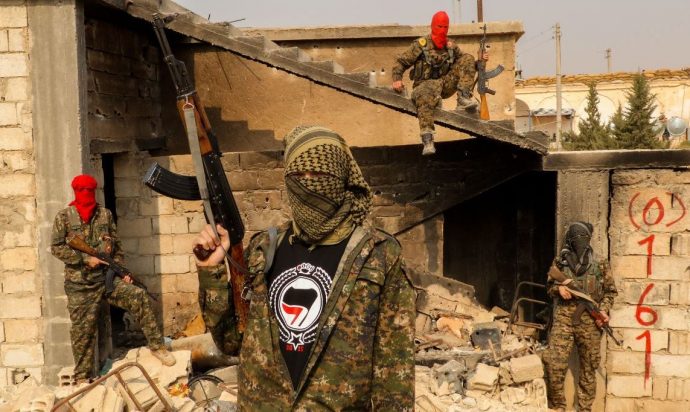
With Syria making big strides toward victory and terrorists controlling ever-diminishing areas in the country, Muhammed Kheir al-Akkam, professor of international relations at the University of Damascus, told Sputnik how the US may meddle in the Kurdish issue.
“The US does not want the end of the Syrian war until their goals are achieved. Their main tool for the war in Syria, called Daesh, is living out their last days. So now they are switching to the Syrian Democratic Forces (SDF) which have to do what Daesh failed to fulfil,” Syrian political analyst Muhammed Kheir al-Akkam said.
According to him, “the US wants to extend the war in Syria as long as possible to implement its plans in the region.”
“Russia is trying to put an end to this war and along with the Syrians is seeking a peaceful solution. The Americans do not do it, paying lip-service top fighting terrorism; in fact, they are financing both Daesh and the SDF,” al-Akkam added. He pointed out that “what we see in Raqqa is a fully coordinated move by the US to replace Daesh with the SDF.”
“We might ask why the US is not fighting the al-Nusra Front and other similar organizations? The answer is simple: because the US supports them,” he said.
He recalled that the SDF carries out ethnic cleansing in Raqqa and discriminates against some Syrian peoples in the occupied territories, which is why the SDF cannot be called “democratic” or “Syrian”.
“The Syrian Kurds need to remember that the Americans will betray them as soon as their interests diverge, something that occurred to Masoud Barzani after Iraqi Kurds failed to secede from Baghdad,” al-Akkam said.
According to him, “the Syrian Kurds also should bear in mind that their strength depends on Syria’s unity.”
Al-Akkam added that the seventh round of the Syrian peace talks in Astana in many respects continued the course of the talks’ sixth round. At the same time, it is worth noting that there has been a new turn, according to him.
During the Astana talks, the sides managed to resolve many issues related to the military situation in Syria, something that he said the parties failed to do in Geneva. In Astana, the sides, in particular, agreed on exchanging prisoners and the holding of the Syrian National Dialogue Congress in Sochi, where Syria’s integrity will be high on the agenda.
“As for the Syrian opposition groups that will not attend the Sochi congress, they are dealing with the interests of those who finance their activities rather than those of the Syrian people,” al-Akkam concluded.
Opposition rejects Russian initiative to hold congress on Syria crisis
Press TV – November 1, 2017
The Syrian opposition has rejected an initiative put forward by Russia during the latest negotiations in the Kazakh capital, Astana, to hold a congress, which would bring together Syria’s warring sides in Sochi later this month.
Members of Syrian opposition High Negotiations Committee and the Turkey-based Syrian National Coalition (SNC) told Reuters on Wednesday that they do not approve of the plan, saying they would issue a joint statement later to express their opposition to the plan.
SNC spokesman Ahmad Ramadan said the plan seeks to circumvent the UN efforts to mediate Syrian peace talks in Geneva, adding, “The Coalition will not participate in any negotiations with the regime outside Geneva or without UN sponsorship.”
The Astana peace process has been underway since January with the mediation of Iran and Russia, the Syrian government’s allies, and Turkey, which supports armed opposition groups.
The latest round of the talks came to an end on Tuesday, with the three guarantor states agreeing on the Russia-proposed congress.
A joint statement published on the Russian Foreign Ministry’s website at the end of the Astana talks listed 33 Syrian organizations invited to a “Congress of Syrian National Dialogue,” which is to be held in the Russian city of Sochi on November 18.
Russia says the key task of the event is to pave the way for constitutional reforms.
Turkey against Kurdish presence
Despite Turkey’s approval of the Syrian congress plan, a spokesman for Turkish President Recep Tayyip Erdogan said on Wednesday that the country opposes the invitation of the representatives of the Syrian Kurdish People’s Protection Units (YPG) to the talks.
Ibrahim Kalin’s remarks came a day after a senior Kurdish official said that Russia had invited the Kurdish-led authorities in northern Syria to a proposed congress of Syria’s rival parties in November.
Kalin noted that Turkish and Russian officials had discussed the issue, and that he had held meetings of his own to “solve the problem on the spot.”
More checkpoints for Idlib
The latest round of Astana talks focused on humanitarian issues in Syria as well as the situation in Idlib Province.
Elaborating on the agreements in the seventh round, Iran’s top negotiator at Astana talks Hossein Jaberi Ansari said on Tuesday that each of the three guarantor states had agreed to set up 12 checkpoints in Idlib, where a de-escalation zone has been formed.
Jaberi Ansari noted that the three guarantor states agreed on continuation of the fight against Daesh and al-Nusra Takfiri terrorists and their affiliates, settlement of the Syrian conflict through political channels and delivery of humanitarian aid to all the areas across Syria.
Neocons Hijack Trump’s Syria Policy
By Ron Paul | October 30, 2017
Does anyone in the Trump Administration have a clue about our Syria policy? In March, Secretary of State Rex Tillerson appeared to be finally pulling back from President Obama’s disastrous “Assad must go” position that has done nothing but prolong the misery in Syria. At the time, Tillerson said, the “longer-term status of President Assad will be decided by the Syrian people.”
Those of us who believe in national sovereignty would say that is pointing out the obvious. Nevertheless it was a good sign that US involvement in Syria – illegal as it is – would no longer seek regime change but would stick to fighting ISIS.
Then out of the blue this past week, Tillerson did another 180 degree policy turn, telling a UN audience in Geneva that, “[t]he reign of the Assad family is coming to an end. The only issue is how that should that be brought about.”
The obvious question is why is it any of our business who runs Syria, but perhaps that’s too obvious. Washington’s interventionists have long believed that they have the unilateral right to determine who is allowed to head up foreign countries. Their track record in placing “our guy” in power overseas is abysmal, but that doesn’t seem to stop them. We were promised that getting rid of people like Saddam Hussein and Gaddafi would light the fire of freedom and democracy in the Middle East. Instead it has produced nothing but death and misery – and spectacular profits for the weapons manufacturers who fund neocon think tanks.
In Syria, Assad has been seen as a protector of Christians and other minorities against the onslaught of in many cases US-backed jihadists seeking his overthrow. While the Syrian system is obviously not a Switzerland-like democracy, unlike our great “ally” Saudi Arabia they do at least have elections contested by different political parties, and religious and other minorities are fully integrated into society.
Why has the Trump Administration shifted back to “Assad must go”? One reason may be that, one-by-one, the neocons who opposed Trump most vociferously during the campaign have found themselves and their friends in positions of power in his Administration. The neocons are great at winning while losing.
The real story behind Washington’s ongoing determination to overthrow the Syrian government is even more disturbing. In a bombshell interview last week, a former Qatari Prime Minister confessed that his country, along with Saudi Arabia, Turkey, and the United States, began shipping weapons to jihadists from the very moment Syrian unrest began in 2011. The well-connected Qatari former minister was trying to point out that his country was not alone in backing al-Qaeda and even ISIS in Syria. In the course of defending his country against terrorism charges leveled by Saudi Arabia he has spilled the beans about US involvement with the very groups claimed to be our arch-enemies. As they did in Afghanistan in the 1980s, the CIA supported radical Islamic terrorism in Syria.
Haven’t we done enough damage in Syria? Do we really need to go back to 2011 and destroy the country all over again? The neocons never admit a mistake and never change course, but I do not believe that the majority of Americans support their hijacking of President Trump’s Syria policy. It is long past time for the US to leave Syria alone. No bases, no special forces, no CIA assassination teams, no manipulating their electoral system. We need to just come home.
OPCW-UN Syria Sarin Attack Probe Based on ‘Staged Proof’
Sputnik – October 30, 2017
The Organization for the Prohibition of Chemical Weapons (OPCW) and the United Nations used fabricated evidence in their Joint Investigative Mechanism (JIM) probe into April’s chemical attack in the Syrian town of Khan Sheikhoun, threatening the reputation of international organizations, Professor Emeritus of Science, Technology, and National Security Policy at Massachusetts Institute of Technology Theodore A. Postol told Sputnik.
Last week, the JIM presented to the UN Security Council (UNSC) a confidential report on the attack, carried out in the Syrian opposition-held province of Idlib, reportedly killing over 80 people. Some Western media outlets, which had access to the report, quoted the document as saying that the government of Syria’s President Bashar Assad was held responsible for the chemical attack on April 4. The panel also reportedly blamed the Islamic State terror group (banned in Russia) for using sulfur mustard in an attack on Syria’s Um Housh on September 16, 2016.
The report “relies on findings” of the OPCW Fact-Finding Mission (FFM) in Syria that was published this June following the investigation into the incident. The mission revealed that the victims had been exposed to sarin, a toxic substance, or a sarin-like substance. The FFM did not send its staff directly to the site, but completed the probe by conducting interviews, and collecting evidence and samples, such as video footage of the incident and hair from a dead goat found at the scene. The FFM also specified that it was unable to “implement a complete chain of custody, by the team, for samples from source.”
Postol shared with Sputnik the results of his own research proving that the UN-OPCW probe into the Khan Sheikhoun incident was flawed and biased.
Postol’s Research
In his analysis, the expert referred to the well-publicized video footage taken by Orient News in Khan Sheikhoun very shortly after the alleged April 4 nerve agent attack. The video showed a dead goat that allegedly suffocated in the attack next to the targeted area. Postol underlined that this evidence could not be used because the animal’s corpse could have been planted.
“As an inspection of the four images and the labels on the images clearly and unambiguously show, the dead goat in the image was dragged to the location where the journalists claim it died,” Postol said.
According to the expert, the corpse’s location could be easily established by other images taken in the Orient News video and other videos. The goat was located roughly 100 meters (328 feet) southeast of a crater that was considered the source of the sarin release.
“Perhaps most incredible in the OPCW report is an appendix that reports evidence of sarin use from analysis of a hair from the dead goat. Nowhere in the OPCW report is there any indication that the goat may have died elsewhere, possibly from sarin poisoning in a room or barn, and was then dragged to the location as an exhibit,” Postol pointed out.
The FFM found that the alleged nerve agent was most likely triggered at the site where there was a crater in the road. The OPCW concluded that such a release could only be determined as the use of sarin as a chemical weapon. According to the UN commission, two parts of a bomb were found at the site, including a larger part for chemical payload and a filler cap for chemical weapon itself, adding that it was “unable to determine the exact type of chemical bomb used,” however it suggested the explosive was a Soviet-era chemical bomb.
“There are many images of this crater that indicate subsequent tampering with the pipe that is vertically standing near the edge of the crater. In later photographs that can be seen that the pipe was pulled out from its vertical position in place flat at the center of the crater. This was then followed by claims that the pipe was a vessel containing sarin that was released at the site. Our calculations speculated that the crater was formed by a standard 122 mm artillery rocket explosive warhead of the kind that is ubiquitously available for purchase around the world,” Postol pointed out.
Postol’s research included forensic computational analysis performed by two of his colleagues — Professor Goong Chen and Dr. Chung Gu, at Texas A&M University — which “unambiguously explains how this crater was actually created.”
“The spent rocket motor casing of the rocket is embedded at the forward edge of the crater (not at the center as some people have asserted) and it is slightly bent forward by the sudden torque that occurs when the warhead impacts the asphalt surface. If we assume that the rocket casing was fabricated into a pipe and welded, our calculations show exactly the kind of split along the axis of symmetry of the pipe. This suggests that the rocket motor was manufactured locally and probably filled with a propellant that was locally produced. One such propellant that is commonly used in the manufacturing of improvised rocket motors is potassium nitrate and sugar,” the expert explained.
Postol suggested that the rocket motor had been manufactured locally, and the warhead, igniter and nozzle had been attached to each end of the improvised rocket.
The expert then went into detail about the blast site, and the positions the rocket was found in.
“The arrival azimuth is easily identified because the rocket is embedded at the forward edge of the crater and the bent spent rocket casing also points forward along the direction of arrival. The cracking of the asphalt surface surrounding the crater is due to hot gases propagating through the underlying ground and pushing the asphalt vertically,” the expert explained.
It was because of the above-mentioned observations Postol was able to determine the type of explosive device used and why it was not possible to definitely conclude that this warhead carried the alleged sarin toxin.
“It is therefore unambiguous that the crater was created by a standard 122 mm explosive warhead of the type that can be purchased anywhere in the world. There is absolutely no evidence of any sarin containing vessel. The split pipe that has been inaccurately identified as evidence of the container filled with sarin is simply the casing of the rocket motor that propelled the purchased warhead to the location of the explosion,” the expert noted.
UN Reputation Threatened
“The information I am providing contains compelling and unambiguous evidence that the UN OPCW investigation of this matter was deeply flawed and biased. The fact that the UN OPCW did not have investigators under their direct control at the scene of the alleged nerve agent attack at Khan Sheikhoun on April 4, 2017 is no excuse for them making claims that are demonstrably false,” Postol said.
Postol pointed to the fact that in their analyses, both the UN commission and the OPCW used publicly available information obtained from videos that “clearly showed attempts by local organizations to manipulate information.”
“The fact that the OPCW has made no effort to verify the accuracy of this information indicates either extreme incompetence, or much more likely, extreme bias on the part of OPCW leadership. Of even greater concern is that the UN leadership is not exercising its fiduciary responsibilities to member countries by assuring that the OPCW is free of bias and incompetence,” the expert continued.
By failing to properly investigate incidents like the supposed Khan Sheikhoun chemical weapons attack, the United Nations and the OPCW are most likely enabling various groups with military and political agendas to use nerve agents and then point a finger at their enemies, Postol suggested.
“Continuing failure to properly review the veracity of the OPCW claims will ultimately have serious negative consequences for the reputation of the UN. This will, in turn, have serious negative consequences for the role of the UN as a credible source of analysis with regard to other dismaying and potentially escalatory events that will certainly occur in the future,” the expert emphasized.
Postol noted Russia’s “well-justified” criticisms of the handling of the JIM by the UN leadership.
The expert called on Russia to introduce a proposal within the UNSC for his investigation results to be reviewed by the organization’s authorities.
“Our interest is to help the UN reach a technically sound conclusion about the evidence that is available that indicates that the crater at Khan Sheikhoun has been misidentified as the source of a sarin release,” Postol explained.
Postol believes the data on flaws in the UN-sponsored report on the alleged use of sarin in Khan Sheikhoun provides strong ground for the Russian UN delegation to seek a review of the JIM report, because the misidentified source of the sarin attack, as outlined by Postol, casts doubts on whether the JIM report can accurately claim Assad as the responsible party.
Fabricated Casus Belli
After the incident in Khan Sheikhoun, the United States launched 59 Tomahawk cruise missiles at the Syrian military airfield in Ash Sha’irat in the province of Homs from which the chemical attack was allegedly carried out.
“My concern was that the United States attack against Syria would encourage these rebel groups to engage in false attacks, attack people with sarin and then blame it on the Assad government. So that’s what got me involved at looking at this,” Postol explained.
Postol reiterated the lack of reliable evidence in the UN and OPCW materials, as all the information that the investigators used had been fabricated, misidentified and misinterpreted.
Also, the expert pointed out the lack of methodology, noting that the investigators’ findings were “filled with errors.”
“They made no attempt at all to determine the veracity of the evidence, that their claims can reach that conclusion. There was a very substantial indication that I put in the report for you that indicated that the site where the alleged sarin release occurred could not have been [the place where] there was a sarin release … but those things were clearly staged, clearly fraudulent,” Postol continued.
Postol also said that he had released a series of papers on the issue, which were ignored by the Western press. The expert explained this by the fact that public opinion in the United States is split into two camps: the liberals and the conservatives. In order to be a “liberal,” one has to adopt certain ideas, like that Assad is a monster, Postol explained. With Washington putting pressure on everyone whose vision of things is different, the liberal US media refuse to publish materials which provide an alternative perspective, such as Postol’s analysis of the events in Khan Sheikhoun, the expert elaborated.
The UN chief’s spokesman said on Thursday that he had trust in the professionalism and objectivity of the OPCW-UN joint mechanism.
Meanwhile, on Friday, Russian Deputy Foreign Minister Sergey Ryabkov told Sputnik the methodology of the OPCW-UN report on chemical weapon use in Syria was flawed, being based on biased evidence. He continued by saying that after an in-depth analysis of the JIM report and presentation of conclusions, Russia would put forward specific measures and steps aimed at “improving dramatically this unacceptable position and put the investigation of crimes with chemical weapons use on a solid, reliable … basis.”
Damascus reportedly denied the JIM allegations. Moscow, in turn, said that the Russian Foreign Minister would present its own analysis of the UN-OPCW report since “opinions and assessments by Russian specialists that were transferred to the mechanism at its own request turned out to be completely ignored” in JIM’s investigation.
The JIM revealed its report two days after Russia blocked a UNSC resolution extending its mandate in Syria, set to expire on November 16, for another year. The Russian Foreign Ministry has said that the decision on the prolongation of the UN-OPCW investigators’ mandate must not be made by the UNSC until the examination of the probe results.
Syrian Kurds Refuse to Reveal Number of US Bases, Volume of Supplied US Arms
Sputnik | October 29, 2017
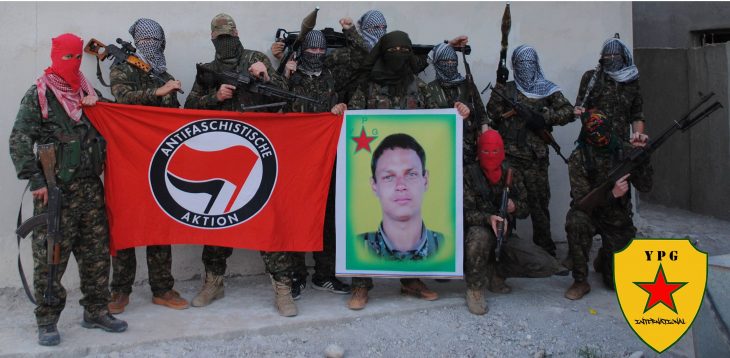
In the wake of the recently-announced liberation of the Syrian city of Raqqa, many analysts have been wondering about the scale of US support to the mostly Kurdish Syrian Democratic Forces (SDF), which headed the operation, and the number of military facilities the US has set up in northern Syria. Kurds, however, refused to reveal any details.
Amid ongoing reports that the US continues to arm the Syrian Kurds, even after the announced retaking of Raqqa from Daesh, Nuri Mahmud, an official representative of the Kurdish People’s Protection Units (YPG), the primary component of the US-backed SDF force which conducted the operation, confirmed that the US has been supplying them with arms since the liberation of Kobani in 2015.
Mahmud, however, refused to reveal the scale of the arms provided by the US, only noting that “it is relatively humble and not enough in comparison with the weaponry it supplied to the Iraqi army for the liberation of Mosul.”
The Kurdish official called their relationship with Washington a “strategic alliance” and confirmed that the US is setting up military bases on territories which the Kurds take under control. According to Nuri Mahmud, these facilities are used for the fight against Daesh. However, he refused to give the exact number of operating US bases.
“We can’t discuss this issue. It is none of our business,” he told Sputnik Turkiye.
Abdulaziz Yunus, the SDF representative in charge of foreign affairs, also confirmed that the US continues supplying arms to SDF, and remains the only power which is supporting Kurds militarily.
The Kurdish official, however, as well as Nuri Mahmud, refused to reveal the amount of weaponry they received.
“The US is supplying us with ammunition based on our demands. Apart from coalition forces, no one else supports us with weaponry. We won’t disclose the exact volume of the provided arms but hope that the deliveries will increase as it will enable us to liberate other regions from terrorists,” he explained.
Abdulaziz Yunus stressed that the interests of SDF coincide with those of the US, and that they will continue their cooperation. Washington had supported the Free Syrian Army, but this didn’t yield any results. That is why, after the liberation of Kobani, the US decided to support them and has been satisfied with this arrangement, he concluded.
In Shocking, Viral Interview, Qatar Confesses Secrets Behind Syrian War
By Tyler Durden | Zero Hedge | October 28, 2017
A television interview of a top Qatari official confessing the truth behind the origins of the war in Syria is going viral across Arabic social media during the same week a leaked top secret NSA document was published which confirms that the armed opposition in Syria was under the direct command of foreign governments from the early years of the conflict.
And according to a well-known Syria analyst and economic adviser with close contacts in the Syrian government, the explosive interview constitutes a high level “public admission to collusion and coordination between four countries to destabilize an independent state, [including] possible support for Nusra/al-Qaeda.” Importantly, “this admission will help build case for what Damascus sees as an attack on its security & sovereignty. It will form basis for compensation claims.”

A 2013 London press conference: Qatari Prime Minister Sheikh Hamad bin Jassim bin Jabr Al Thani with U.S. Secretary of State John Kerry. A 2014 Hillary Clinton email confirmed Qatar as a state-sponsor of ISIS during that same time period.
As the war in Syria continues slowly winding down, it seems new source material comes out on an almost a weekly basis in the form of testimonials of top officials involved in destabilizing Syria, and even occasional leaked emails and documents which further detail covert regime change operations against the Assad government. Though much of this content serves to confirm what has already long been known by those who have never accepted the simplistic propaganda which has dominated mainstream media, details continue to fall in place, providing future historians with a clearer picture of the true nature of the war.
This process of clarity has been aided – as predicted – by the continued infighting among Gulf Cooperation Council (GCC) former allies Saudi Arabia and Qatar, with each side accusing the other of funding Islamic State and al-Qaeda terrorists (ironically, both true). Increasingly, the world watches as more dirty laundry is aired and the GCC implodes after years of nearly all the gulf monarchies funding jihadist movements in places like Syria, Iraq, and Libya.
The top Qatari official is no less than former Prime Minister Hamad bin Jassim bin Jaber al-Thani, who oversaw Syria operations on behalf of Qatar until 2013 (also as foreign minister), and is seen below with then-Secretary of State Hillary Clinton in this Jan. 2010 photo (as a reminder, Qatar’s 2022 World Cup Committee donated $500,000 to the Clinton Foundation in 2014).

In an interview with Qatari TV Wednesday, bin Jaber al-Thani revealed that his country, alongside Saudi Arabia, Turkey, and the United States, began shipping weapons to jihadists from the very moment events “first started” (in 2011).
Al-Thani even likened the covert operation to “hunting prey” – the prey being President Assad and his supporters – “prey” which he admits got away (as Assad is still in power; he used a Gulf Arabic dialect word, “al-sayda”, which implies hunting animals or prey for sport). Though Thani denied credible allegations of support for ISIS, the former prime minister’s words implied direct Gulf and US support for al-Qaeda in Syria (al-Nusra Front) from the earliest years of the war, and even said Qatar has “full documents” and records proving that the war was planned to effect regime change.
According to Zero Hedge’s translation, al-Thani said while acknowledging Gulf nations were arming jihadists in Syria with the approval and support of US and Turkey: “I don’t want to go into details but we have full documents about us taking charge [in Syria].” He claimed that both Saudi Arabia’s King Abdullah (who reigned until his death in 2015) and the United States placed Qatar in a lead role concerning covert operations to execute the proxy war.
The former prime minister’s comments, while very revealing, were intended as a defense and excuse of Qatar’s support for terrorism, and as a critique of the US and Saudi Arabia for essentially leaving Qatar “holding the bag” in terms of the war against Assad. Al-Thani explained that Qatar continued its financing of armed insurgents in Syria while other countries eventually wound down large-scale support, which is why he lashed out at the US and the Saudis, who initially “were with us in the same trench.”
In a previous US television interview which was vastly underreported, al-Thani told Charlie Rose when asked about allegations of Qatar’s support for terrorism that, “in Syria, everybody did mistakes, including your country.” And said that when the war began in Syria, “all of us worked through two operation rooms: one in Jordan and one in Turkey.”
Below is the key section of Wednesday’s interview, translated and subtitled by @Walid970721. Zero Hedge has reviewed and confirmed the translation, however, as the original rush translator has acknowledged, al-Thani doesn’t say “lady” but “prey” [“al-sayda”]- as in both Assad and Syrians were being hunted by the outside countries.
The partial English transcript is as follows:
“When the events first started in Syria I went to Saudi Arabia and met with King Abdullah. I did that on the instructions of his highness the prince, my father. He [Abdullah] said we are behind you. You go ahead with this plan and we will coordinate but you should be in charge. I won’t get into details but we have full documents and anything that was sent [to Syria] would go to Turkey and was in coordination with the US forces and everything was distributed via the Turks and the US forces. And us and everyone else was involved, the military people. There may have been mistakes and support was given to the wrong faction… Maybe there was a relationship with Nusra, its possible but I myself don’t know about this… we were fighting over the prey [“al-sayda”] and now the prey is gone and we are still fighting… and now Bashar is still there. You [US and Saudi Arabia] were with us in the same trench… I have no objection to one changing if he finds that he was wrong, but at least inform your partner… for example leave Bashar [al-Assad] or do this or that, but the situation that has been created now will never allow any progress in the GCC [Gulf Cooperation Council], or any progress on anything if we continue to openly fight.”
As is now well-known, the CIA was directly involved in leading regime change efforts in Syria with allied gulf partners, as leaked and declassified US intelligence memos confirm. The US government understood in real time that Gulf and West-supplied advanced weaponry was going to al-Qaeda and ISIS, despite official claims of arming so-called “moderate” rebels. For example, a leaked 2014 intelligence memo sent to Hillary Clinton acknowledged Qatari and Saudi support for ISIS.
The email stated in direct and unambiguous language that:
“the governments of Qatar and Saudi Arabia, which are providing clandestine financial and logistic support to ISIL and other radical Sunni groups in the region.”
Furthermore, one day before Prime Minister Thani’s interview, The Intercept released a new top-secret NSA document unearthed from leaked intelligence files provided by Edward Snowden which show in stunning clarity that the armed opposition in Syria was under the direct command of foreign governments from the early years of the war which has now claimed half a million lives.

The newly released NSA document confirms that a 2013 insurgent attack with advanced surface-to-surface rockets upon civilian areas of Damascus, including Damascus International Airport, was directly supplied and commanded by Saudi Arabia with full prior awareness of US intelligence. As the former Qatari prime minister now also confirms, both the Saudis and US government staffed “operations rooms” overseeing such heinous attacks during the time period of the 2013 Damascus airport attack.
No doubt there remains a massive trove of damning documentary evidence which will continue to trickle out in the coming months and years. At the very least, the continuing Qatari-Saudi diplomatic war will bear more fruit as each side builds a case against the other with charges of supporting terrorism. And as we can see from this latest Qatari TV interview, the United States itself will not be spared in this new open season of airing dirty laundry as old allies turn on each other.
Syria Rejects Report of Joint Inquiry of UN and OPCW
Al-Manar | October 27, 2017
Syria has rejected the report of joint inquiry of the UN and Organization for the prohibition of chemical weapons (OPCW), which was announced yesterday, stressing that it came in implementation of the instructions of the US administration and Western countries to exert more political pressures and threats to Syria’s sovereignty.
A source at Foreign and Expatriates Ministry said Friday that Syria reiterates its complete commitment to Non-Proliferation of Chemical Weapons Convention and that it no longer has any toxic chemicals banned in accordance with the Convention.
It considers the use of chemical weapons an immoral and condemnable act anywhere, at any time and under any circumstances, the ministry said.
The ministry’s source said that Syria strongly condemns the direct and indirect accusations against it which were included in this report and the previous one since they represent a falsification of the truth and distortion of all accurate information about what happened in Khan Sheikhon.
It also condemns dependence of the Joint Investigative Mechanism on the statements of criminals who committed this immoral act in Khan Sheikhon and suspicious witnesses in addition to what they call open sources.
BILD Newspaper’s Image ‘Shows How German Propaganda Works’
Sputnik – October 25, 2017
Das BILD’s decision to release a controversial image of a suffering Syrian child is a “mean attempt” to manipulate the public opinion, German journalist Karin Leukefeld wrote for Sputnik, commenting on the newspaper’s recent publication that deeply shocked her.
The editor-in-chief of the German newspaper Das Bild, Julian Reichelt, published in his newsletter a photo that depicts a Syrian nurse with a seriously ill or possibly even dead child in her arms.
The picture is accompanied by text: “Assad the Dictator continues to wage war against his own people.”
German political observer Karin Leukefeld reacted to the publication by saying that this is an example of how the German propaganda machine works.

“Bashar al-Assad, the ruler of power, is leading his inexorable war against his own people.” © Photo: BILD
In fact, the image that was taken in the village of Hamuria located 17 kilometers from Damascus has little to do with the Syrian leader himself, but is rather associated with the hostilities of the terrorist groups that have the village under control, the lack of medical care and the passivity of the West, the journalist noted. Since 2012, Hamuria has been occupied by several radical armed groups. The settlement is currently under control of Islamist group Faylaq al-Rahman. The overwhelming majority of the civilian population fled the city and is now living in Damascus or its suburbs, but those who stayed have to live without proper medical care and in constant fear for their lives.
“There is no shortage of weapons, ammunition and insurgents in the besieged territories. But the situation with medicaments and food is the opposite. The fact is that countless children have died and are dying all over Syria…. People were and are starving in all parts of the country. And they can’t get help — not least because of Western sanctions, which become increasingly tough — and Germany is also responsible for this,” Leukefeld wrote.
Moreover, the analyst stressed that, according to international humanitarian law, this photo couldn’t be published at all as “distributing pictures of weak, defenseless, sick or dead people for the purpose of propaganda is forbidden.”In Leukefeld’s opinion, especially “disgusting” is the fact that the German newspaper’s Editor-in-Chief Julian Reichelt used an innocent child to impose his point of view.
“This child can’t prevent all this,” the journalist wrote, adding that readers who see the photo and read the short text won’t ask themselves whether the child is sick and how they might be able to help him, but rather they’ll put the blame for this child’s fate on the Syrian president.
Leukefeld noted that Reichelt’s main goal was to “evoke feelings of hatred and hostility,” adding that his message was a clear example of propaganda that “must be included into the curriculum for beginning journalists.”
CONFIRMED: US and Saudi coordinated barbaric terrorist attacks on Syria
By Adam Garrie | The Duran | October 25, 2017
The intricate role played by Saudi Arabia and the United States in ushering in a proxy terrorist war on Syria, have been both explicitly and implicitly known, since virtually the beginning of the US instigated proxy conflict in Syria, which was inaugurated in 2011.
In many ways, 2013 represented the nadir of the Syrian conflict. It was a time when it looked as though the combined strength of terrorist groups including ISIS/Daesh, FSA and al-Qaeda might succeed in destroying the secular, tolerant, pluralist Syrian Arab Republic and realise their goal of creating a Takfiri state based on extremist religious supremacist ideology and racism.
With Syria on the verge of a full victory and with Russia confirming that ISIS now controls less than 5% of Syrian territory, 2013 seems like a very distant time in the context of the Syrian conflict.
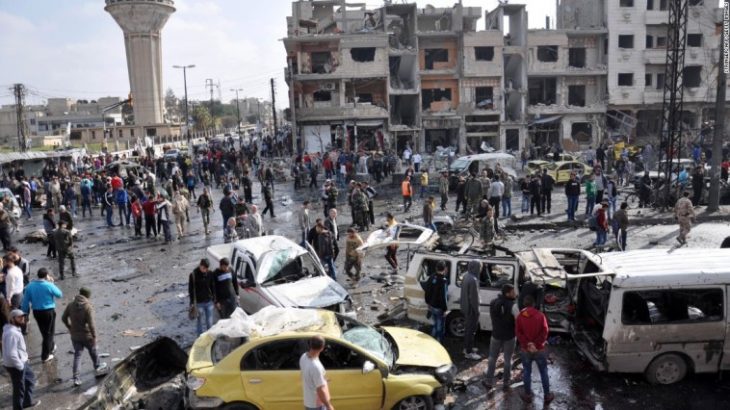
But on the 18th of March, 2013, large scale coordinated rocket attacks on Damascus International Airport, the Syrian Presidential Palace and other vital security targets in the capital, were conducted by the Takfiri terrorist group FSA.
Today, the exiled American whistleblower who once worked for the notorious NSA, Edward Snowden has released the following short top secret document which plainly details how the US and a powerful member of the Saudi regime, helped to fund and organise the illegal attack on Syria.
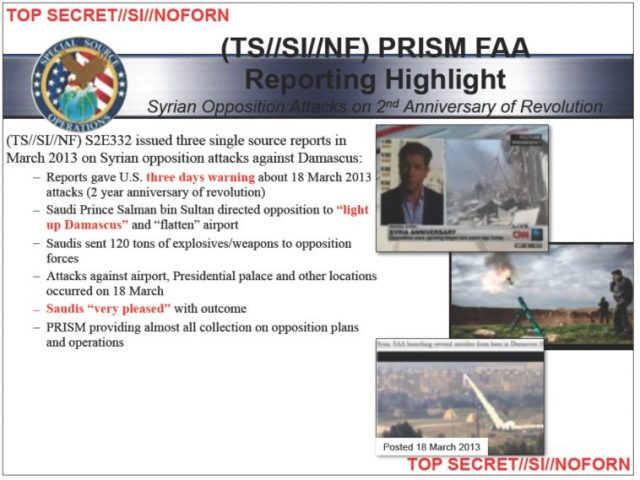
The text of the document reads as follows:
“TOP SECRET//S1//NOFORN
(TS//S1//NF) S2E332 issued three single source reports in
March 2013 on Syrian opposition attacks against Damascus:
– Reports gave U.S. three days warning about 18 March 2013
attacks (2 year anniversary of revolution)
– Saudi Prince Salman bin Sultan directed opposition to “light
up Damascus ” and “flatten” airport
– Saudis sent 120 tons of explosives/weapons to opposition
forces
– Attacks against airport, Presidential palace and other locations
occurred on 18 March
– Saudis “very pleased” with outcome
– PRISM providing almost all collection on opposition plans
and operationsTOP SECRET//S1//NOFORN”.
The collusion between Saudi and the US in a deadly terrorist attack constitutes nothing less than a war crime.
Because of the patently biased nature of the International Criminal Court, it is unlikely that anyone from the US or Saudi will be prosecuted for this war crime.
However, Snowden’s document does help to explain Syria’s unity in the face of a campaign of foreign state sponsored organised terrorism. Contrary to what many al-Qaeda apologists say, the Syrian conflict was a proxy war from day one. Of course, foreign powers used the promise of enhanced material status to woo a small number of disgruntled locals, but the main sources of terrorist fighters and virtually all of the funding and arms came from abroad.
While Syria faced onslaughts funded and directed by some of the wealthiest and most powerful states in the world including, the USA, Saudi Arabia, Qatar, Israel, Turkey, UK, France, Belgium, Germany, Netherlands and others, Syria managed to retain her sovereignty, even prior to Russia’s game-changing legal intervention in 2015.
The anti-Syrian alliance did its utmost to destroy one of the last truly revolutionary Arab Republics in the world. The fact that of all their efforts ultimately failed, is a testament both to the resolve of the Syrian Arab Republic and to the powerful anti-terrorist alliance that Damascus built throughout the conflict, one which has been capable of resisting imperialist obscurantist aggression from the west and its Middle East proxies and allies.
Featured Video

Trita Parsi: Middle East Unraveling — Are We on the Path to World War?
or go to
Aletho News Archives – Video-Images
New Book
Trans agenda is ‘normalization of sadism’ – US author

RT | September 23, 2026
The US Democratic Party has embraced a transgender agenda that amounts to “the normalization of sadism,” author A.J. Rice has said, warning that radical trans policies would return if the party is allowed to regain power.
Speaking to RT’s America First host Scotty Nell Hughes about his new book, ‘The Curse of the Bearded Lady: How the Trans Mafia Whacked American Sanity’, Rice argued that activists have gained significant influence in schools, medicine, and corporate America while people who questioned the agenda have faced pressure to stay silent.
The author described the “trans mafia” as the sprawling network of people and institutions that have helped the movement gain influence. He singled out parts of academia, wealthy backers, and corporations, and stated that providers of transition-related treatment also have a financial incentive to keep young people in their care indefinitely.
Rice argued that the consequences of these policies ultimately fall on children who are being drawn toward gender-affirming medical treatments and on girls who are expected to share locker rooms or compete in sports with biological males.
He noted that while voters rejected the Democrats’ approach to gender in 2024, the party, which has been “captured by madness,” has since only doubled down and is seeking what is effectively “the normalization of sadism.” … Full report
Blog Roll
 Aletho News
- Integrity Initiative: UK-funded network framed dissent as Russian disinformation for years
- ‘We don’t seek permission to defend our country’: Snippets from President Pezeshkian’s UNGA address
- NATO chief wants Europeans to fight American wars [for Israel]
- German chemicals giant reveals details of downsizing
- Refaat Al-Areer Was The Canary In The Coal Mine In Israel’s War On The Truth
- Israeli election committee bars candidate from Knesset race over Gaza war opposition
- French-Lebanese man files war crimes complaint over Israeli attacks
- Mahan Air Flight Lands in China Despite US Threat against Iranian Airlines
- US eyes $10bn fund to rebuild war-battered Gulf infrastructure
- Trump meets Rodríguez near Maduro’s prison as Venezuela’s oil flows to US
- If Americans Knew
- Caught on Tape: AIPAC CEO Boasted of Controlling Trump’s National Security Officials
- Why Hamas Attacked Israel in October 2023 – Israeli professor Ilan Pappé
- They see them, then kill them: Israeli quadcopters track, deliberately target civilians in Gaza
- Winter could turn Gaza’s treacherous, war-damaged buildings into deathtraps
- Majority of Democratic Voters Want to Prosecute Both Biden and Trump Administration Officials Over Gaza
- As Gaza languishes, world leaders gather at the UN – Daily Update
- Sanctions are collective punishment: immoral and self-defeating
- Phosphorus Munitions Fired by Israel Burn Groves, Orchards in Southern Lebanon
- Israel Carries Out New Ceasefire Violations Across Gaza
- AI – Emphasis on the ‘I’: Israel Is Funding AI Chatbot Propaganda
- No Tricks Zone
- New Study: Earth And Venus Surface Warmth Largely Explained By Convection And Lapse Rate, Not CO2 Or Radiation
- 2025 Nature Paper Claiming Worsening Global Drought Gets RETRACTED …Heavily Flawed
- New Study: ‘Global Drought Shows No Detectable Recent Acceleration Under Climate Warming’
- Economic Masterminds: German Socialists Suggest Taxing Productivity Gains Stemming From Using AI
- The South China Sea Has Not Been Cooperating With The Climate Change Narrative
- Energy Crisis: Germany Enters Heating Season With Historically Low Gas Reserve Fill Levels
- New Study: The Antarctic Ice Sheet Gained Mass From 2020-2024 Due To Staggering Snow And Ice Accumulation
- Study: Ocean Heating Rates From Thousands Of Years Ago ‘Dwarf’ Modern Ocean Heating Rates
- Climate Extremists Target, Attack Large-Scale Power Grid Infrastructure In Germany!
- New Study: Antarctic Ice Melt Has Contributed Less Than 1 Centimeter To Sea Level Rise In The Last 30 Years

