NATO Ramps Up Ukraine War After Defeat in Syria
By Finian Cunningham – Sputnik – December 21, 2016
A surge in military attacks this week by NATO-backed Kiev regime forces on the breakaway eastern Ukraine regions is no mere coincidence.
Hundreds of ceasefire breaches by troops belonging to the Ukraine Armed Forces (UAF) are being reported in the self-declared republics of Donetsk and Luhansk. Over the past few days, several towns and villages have come under intense shelling from artillery, rockets and mortars in stark violation of the Minsk agreement.
That agreement was brokered by Russia, Germany and France during 2014 and 2015 and was meant to facilitate a political settlement between the Western-backed Kiev regime, which came to power in a coup d’état in February 2014, and the breakaway provinces of Donetsk and Luhansk, which refused to recognize the legitimacy of the usurper Kiev cabal.
Houses, schools and water treatment plants have been hit as the UAF and associated neo-Nazi militias move heavy weaponry close to the so-called contact lines. All indications suggest that the NATO-backed Kiev regime is mobilizing for a renewed offensive on the mainly ethnic Russian Donbas region comprising the Donetsk and Luhansk People’s Republics.
So far, the militia of the DPR and LPR have repelled the offensive, with dozens of casualties reportedly suffered by the Kiev regime’s military.
The timing of the large-scale attacks on Donbas comes just as the US and its NATO allies incur a strategic setback in their covert war for regime change in Syria. The liberation of the battleground city of Aleppo last week by the Syrian army, supported by Russian, Iranian and Lebanese allies, portends the end of the nearly six-year conflict in Syria. The routing of jihadist militants from Aleppo, who had been backed covertly by the US and certain NATO powers, including Britain and France, has signaled the end of the regime-change project in Syria to oust the government of President Bashar al-Assad.
NATO member Turkey had played a key role in the US-led dirty war on Syria, serving as a conduit for fighters and arms to the proxy jihadist militants trying to overthrow Assad – a longtime ally of both Russia and Iran.
But now Turkey seems to be aligning with Russia and Iran to bring an end to the war in neighboring Syria. This week, foreign and defense ministers from Russia, Iran and Turkey met in Moscow to declare their commitment to end the Syrian conflict. The New York Times reported: “Russia, Iran and Turkey meet for Syria talks, excluding the US”.
Pointedly, the Times added: “The new alignment and absence of any Western powers at the table all but guarantee that President Bashar al-Assad will continue to rule Syria under any resulting agreement.” In other words, it’s “game over” for Washington and its criminal enterprise to subvert Syria.
The setback for American imperialist scheming in the Middle East cannot be overstated. For decades, US rulers have seen it as their God-given exceptional right to roll over any foreign government deemed unfit for their geopolitical interests. Syria was among target countries on the American hit-list, which came into action back in March 2011 when the US and its NATO partners and regional client regime unleashed hell with terror proxies.
US ambitions of conquest in the oil-rich region have now been dealt a stunning blow after Russian President Vladimir Putin ordered military operation at the end of 2015 to support the Syrian state, along with Iran and the Lebanese resistance movement Hezbollah. Despite a massive propaganda campaign orchestrated by the Western media and Washington puppets at the United Nations, the Syrian army and its allies have won a historic victory in retaking Aleppo from NATO-backed jihadists.
Not only is this a bitter military defeat for Washington. It is a political and moral triumph over Western lies as told through major media corporations. The latter were saturated with claims of atrocities and crimes against humanity committed by Syrian and Russian forces. Those reckless claims have now been exposed as blatant fabrications, as the people of Aleppo openly celebrate liberation from Western-backed jihadists who had imposed a reign of terror on large parts of the city for nearly four years.
It seems significant that only days after the liberation of Aleppo, Russian ambassador Andrey Karlov was brutally assassinated in Turkey’s capital Ankara, when a gunman shot him in the back as he addressed a cultural event. The murder was evidently aimed at derailing the political talks underway between Turkey, Russia and Iran.
Who would benefit from such an atrocity? Obviously, the US-led NATO powers. If NATO military intelligence did not specifically order the assassination of Karlov, we can at least say that Washington and its Western allies certainly created the climate of hatred and demonization that made the Russian diplomat a “legitimate target”.
A further significant development is the renewed offensive by the NATO-backed Kiev regime against the ethnic Russian people of east Ukraine. Again, this provocative move comes only days after the spectacular military victory by Russia and its allies against NATO’s jihadist proxies in Aleppo, and possibly now for the whole of Syria.
Make no mistake, the reactionary junta that seized power in Kiev is a surrogate for NATO’s long-held offensive designs on Russia. Citing unsubstantiated “fears” of Russian aggression, NATO has given itself a license to escalate troops and missiles on Russia’s border. Washington and its European lackeys have financed, armed and trained the Kiev regime.
This week, British defense minister Michael Fallon announced more British army training for Kiev’s forces, claiming that it was to counter Russian aggression. Fallon had the cheek to spout this nonsense in the same week that the assaults on eastern Ukraine have surged.
At a NATO-Russia summit in Brussels earlier this week, the US-led military alliance had the gall to call on Moscow to influence “Russian separatists” in Donbas to “honor the Minsk ceasefire”.
Russian delegate to NATO Alexander Grushko reportedly introduced some reality to the meeting by pointing out the hundreds of violations being committed in recent days by the Kiev regime. Such violations are par for the course, since the NATO-backed junta first launched its offensive on the region back in 2014, and which has resulted in up to 10,000 deaths.
As with the Syrian war, Washington and its NATO allies, aided and abetted by the Western news (sic) media, play with semantics and illusions, and insult common intelligence. In Ukraine, NATO is waging a covert war every bit as it was in Syria where as many as 400,000 people have been killed and from which Europe is struggling with its greatest refugee crisis since the Second World War, including the threat of terror attacks as seen in France and Germany this week.
Shamelessly, Washington and its Western subordinates accuse Russia of hybrid warfare and aggression. The reaction to defeat in Syria through ramping up conflict in Ukraine shows that it is the US-led NATO alliance that is the real culprit of hybrid war and aggression.
When the guns fall silent in Syria
By M K Bhadrakumar | Indian Punchline | December 24, 2016
A Kremlin readout on the phone call made by President Vladimir Putin to Syrian President Bashar Al-Assad on Friday to formally congratulate the latter on the liberation of Aleppo, highlighted that the Russian leader “stressed that the main task now is to focus on furthering the peace process, in particular by signing an agreement on comprehensive resolution of the Syrian crisis.”
Putin’s remark is an important signpost of the way forward in Syria. Moscow disfavours continuation of military operations by the Syrian government forces to regain control of the entire country (which would be the likely preference of Damascus and Tehran) and prefers that conditions must be made available to open the peace track. At any rate, all 5 major cities in Syria and the entire Mediterranean coast, where the bulk of Syrian population is concentrated, is in government hands already and the opposition is left to hold Idlib and isolated pockets in the south and east, with supply lines under immense pressure.
A ceasefire all across Syria is in the making. This appears to be the understanding reached at the 2-track ‘trilateral’ of the foreign and defence ministers of Russia, Turkey and Iran which was held in Moscow on Tuesday. Interestingly, at a meeting in the Kremlin on Friday to report to Putin on the conclusion of the operations to liberate Aleppo and the successful downstream activities to evacuate civilians and render humanitarian assistance (in terms of a deal between Turkey, Russia and Iran), Defence Minister Sergei Shoigu also made a significant remark that “In our (military’s) opinion, we are close to reaching an agreement on a complete ceasefire across Syria.” Putin responded:
- Together with our partners from Iran and Turkey, and of course with the Syrian government, other countries in the region and all countries concerned, we will need to continue efforts to achieve a final settlement. We must make the greatest effort now to end hostilities everywhere in Syria, and we will, at least, do our sincerest best to achieve this goal.
Of course, the campaign against the Islamic State and the al-Qaeda affiliates will continue. A ceasefire all across Syria has been a key demand by Turkey. Interestingly, Putin referred to the objective of drawing “other countries in the region” (other than Turkey and Iran) into these processes. The reference is to Saudi Arabia and Qatar principally. Conceivably, Russian diplomacy is at work on this front.
Russian Deputy Foreign Minister Gennady Gatilov said he expected the peace talks to take place in Astana in mid-January. But TASS news agency quoted Kremlin spokesman Dmitry Peskov as saying: “I wouldn’t talk now about timing. Right now contacts are being made and preparation is under way for the meeting.” He said Putin would have a series of international telephone calls later to discuss the Astana talks.
Whether the Gulf sheikhs will be willing to drink from the chalice of poison remains to be seen. But what alternative is left for them now that the ‘regime change’ agenda in Syria is off the rails? Equally, a shift in Saudi and Qatari policies, away from further intervention in the Syrian conflict, will also at some point raise another ticklish question: What about the role of Hezbollah and other Shi’ite militia groups from Iran and Iraq who have been fighting in Syria? How an all-Syria ceasefire will be enforced remains to be seen.
Moscow’s objective will be to create new facts on the ground by the time the Trump administration shifts gear on Syria policies. Moscow has signalled on Friday that it is preparing for the long haul as well, with Putin signing a presidential decree ordering the signing of a deal with Syria that will “expand the territory” of Russia’s naval facility in Tartus and allow Russian warships into Syrian waters. The Soviet-era base is currently inadequate to serve most of the modern ships in the Russian Navy.
If the Syrian peace talks take off in the coming weeks, it will amount to a huge victory for Russia’s prestige in the Middle East and for Putin, in particular. But that is a big ‘if’. The good part is that with a relatively cooperative US administration settling down in Washington soon, which may be inclined to collaborate with Russia.
Obama Administration Ready to Help Any ‘Destructive Forces’ in Syria – Moscow
Sputnik – 24.12.2016
In its pursuit to change the Syrian government, Obama administration is ready to help any ‘destructive forces’, including Jabhat Fateh al-Sham, Russian Foreign Ministry said in a statement on Saturday.
Commenting on the issue of expansion of the US sanctions against Russia, the Foreign Ministry said that Moscow sees this act as a way to punish Russia for helping Syria battle terrorism which is a threat to the whole world.
“It has long been noticed that, under the current administration, Washington in its pursuit to shift power in Syria is ready to help any destructive forces. [It is] protecting and covering Jabhat al-Nusra terrorist group that is none other but a subdivision of al-Qaeda, which has commited the most horrible terrorist acts in the history of the US,” the statement said.
“It seems that the White House has forgotten that, under the US law, aiding terrorism is a criminal offense,” the Ministry pointed out in the statement.
On Friday, the US Department of Commerce added 23 Russian entities to its Ukraine-related sanctions list. On December 20, Washington sanctioned seven Russian citizens, eight entities and two vessels due to activities related to the conflict in Ukraine.
“There were no green buses in Gaza” : Former UK ambassador to Syria debunks Aleppo propaganda
BBC Radio Interview with former UK Ambassador to Syria, Peter Ford, December 21st, 2016
Transcript:
Presenter : Peter Ford was the UK’s Ambassador to Syria from 2003 to 2006. Peter Ford, do you think it’s time for a re-think?
Ford : Absolutely. It’s way overdue. We have clung for too long to the illusion that the so-called ‘moderate opposition’ would overcome Assad. Surely now, with the Government’s recovery of Aleppo, the veils should fall from our eyes and we should look reality in the face: Assad is not going to be removed by force of arms or at the negotiating table. What Britain should do now is three things: we should stop supporting a failed and divided opposition; we should start to try to help the people of Syria by lifting sanctions; and we should be working with the Russians on an overdue political settlement.
Presenter : But the political settlement as we know for many leaders in the Western World does not include Assad in its calculations. Boris Johnson for example, the Foreign Secretary, in September of this year saying he can have no part in the future government of Syria because as long as Assad is in power in Damascus, there will be no Syria to govern. Downing Street [the home of the UK’s Prime Minister] saying just earlier this month “the barbaric cruelty shown by the Syrian regime forces shows that President Bashar Assad (sic) has no place in the country’s future.
Ford : Yes, but this is absurd. It’s quite absurd. Assad is in control of over 80% now of the populated area of Syria. There is no reason why, in the months to come, he and his forces will not take the remaining 10, 15 and eventually 20%. He will then be in total control of the country. Of course there will be remaining groups who are not happy, after which, in the whole of recorded history has there ever been a protracted civil conflict like this that left everybody happy under one ruler? There is no Syrian [Nelson] Mandela. There is no leader. Could we even put a name to one opposition leader who would step into Assad’s shoes? It’s absurd. It’s grotesque. It shows that Boris Johnson and Theresa May have lost grip on reality. Now Donald Trump is coming in and if he carries out what he said he’ll carry out he will normalise relations with Russia, he will prioritise the fight against ISIS in Syria, and he will stop working for the overthrow of Assad. When are we going to smell the coffee?
Presenter : Well, you have said that you are deeply concerned by Britain’s continued support for the so-called moderate armed opposition and indeed there have been complaints, there have been allegations of abuse on that side of the War as well. Nevertheless, if you leave aside President Assad and you sak “ok, let him continue through the future diplomacy concerning Syria”, wouldn’t that be condoning him and all he’s done up until now? Chemical weapons, for example, against his own people?
Ford : Look, tonight there is a Christmas Tree in the centre of Aleppo and celebrating people. I think if Assad were removed, and the opposition were in power, you would not be seeing a Christmas Tree in Aleppo. The demonisation of the regime has been taken to ridiculous lengths. Even the end of this crisis with the green buses; there were no green buses in Gaza, there were no green buses when NATO was bombing Yugoslavia to smithereens. This Aleppo campaign has been handled in its final stages with relative humanity. We’ve seen not what some allege to be a meltdown of humanity but a meltdown of sanity. Where are, where’s any evidence of the alleged atrocities, of the Guernica, of the massacres, the genocide, the holocaust?
Presenter : Well, I think you’ll find many people will disagree with that as they have seen people fleeing Eastern Aleppo; the allegations that people have been attacked, prevented from leaving the city. You know there will be these allegations and they will be investigated. In the meantime there’s criticism of both sides, yes indeed, but you are violently disagreeing with an awful lot of senior figures in governments across the World who say – and I just conclude on this – that there is no place for President Assad in the future of Syria. Just again, complete your thought and we will conclude the interview in just a few seconds.
Ford : Well, this flies in the face of reality. Who are they going to put in Assad’s place? To try to continue to overthrow the regime in Syria, as we’ve overthrown regimes elsewhere – in Iraq, and Libya – leads only to more suffering on the part of the ordinary people.
Presenter : Peter Ford, UK Ambassador to Syria in the 2000s, thank you very much indeed.
Source: http://www.bbc.co.uk/programmes/b08558fk (33,34 to 39,54)
Middle Eastern Media Sources Discuss Aleppo’s Fall
By Yuriy Zinin – New Eastern Outlook – 22.12.2016
The liberation of Aleppo and the withdrawal of radical militants from this Syrian city provoked a storm of responses and comments across various Middle Eastern media sources.
While trying to downplay this major Damascus’ success, media sources from the anti-Syrian camp have been trying to raise arguments. They perceive the fall of Aleppo as the direct result of various intrigues and conspiracies, while admitting that there were serious miscalculations made by the so-called “opposition”. At the same time those media sources curse the West for it allegedly turning its back on the Syrian “revolutionary fighters” and Turkey for the “betrayal of their cause”, etc.
The Pro-Saudi newspaper Al-Sharq al-Awsat, however, was forced to recognize the liberation of Aleppo as a major victory of Damascus that was achieved with an extensive amount of support provided by Russia.
At the same time it’s getting clear that the sponsors of the so-called opposition, especially those of the Persian Gulf, are determined to deny any responsibility for the failure of their militants. One of the most influential Saudi newspaper Okaz is critisizing the anti-Assad camp for living in luxury hotels outside Syria. It is outraged that, in the light of the recent events in Aleppo these “ungrateful salon revolutionaries” have started criticizing Persian Gulf monarchies for not providing enough support for them. They look at the kingdom as a “cash machine”, the newspaper argues, the only purpose of which is to refill their pockets with golden coins by taking advantage of the bloodshed and suffering of their fellow citizens.
Other media sources from the anti-Assad camp are cheerfully noting that they’ve lost a battle, but they didn’t lose a war.
The Lebanese newspaper As-Safir believes that the fall of Aleppo is the direct result of the failure of the pro-Western forces in Syria. Even though the so-called opposition had the control of large Syrian cities for years, they have already shown that they are unable to govern effectively even in those territories that they were occupying. In fact, what they’ve done resulted in a complete paralysis of all government structures, that may soon result in the complete Somaliazation of the whole country. The opposition could only achieve success in a certain area, but haven’t had any comprehensive strategy worth mentioning. In contrast, government forces are aiming at liberating the territories of their country and at rebuilding them.
Against this background, we’ve witnessed an intensified media war, with at least 60 different major TV stations purposefully trying to distort the events in Syria. This propaganda machine is being fueled by the petrodollars provided by the Persian Gulf monarchies, and the latter aren’t going to stop.
It seems that we’ve heard it all already, Damascus being accused of the use of chemical weapons against the population, Syrian and Russian troops being involved in the nonexistent “atrocities” against the civilian population, the alleged destruction of schools and hospitals; the assertion that Russia’s policy in Syria and throughout the region is one-sided.
Today in the ranks of the anti-Assad propagandists one can spot signs of massive confusion. According to the newspaper Al-Quds Al-Arabi, four “media activists” of a number of jihadist groups in Aleppo surrendered to authorities long before the fall of the city. This got the opposition puzzled since those who escaped were involved in covert operations and fund raising.
The liberation of Aleppo, says the Iraqi Sawt al-Iraq news site, means that millions of dollars have been thrown to the wind, wasted on the financing of anti-government groups and supplying them with information from different sources. It’s clear at this point that back in 2011 when President Obama announced that Assad’s days were numbered he made a serious mistake. It’s the days of Barack Obama that are numbered now, argues the newspaper, since the former doesn’t have much time in power left.
The Western world is engulfed in hysteria over Aleppo. But they remained silent all the time that the city was occupied by ISIS, al-Nusra and other terrorist organizations, so why start bothering now?
Yury Zinin is a Leading Research Fellow at the Moscow State Institute of International Relations.
Moscow wants Saudi Arabia to join Russia-Turkey-Iran efforts for Syria peace – UN envoy
RT | December 21, 2016
Moscow says that Saudi Arabia should join efforts to find peace in Syria undertaken by Russia, Iran and Turkey, Vitaly Churkin, Russia’s UN envoy, said.
The Foreign Ministers of Russia, Iran and Turkey met in Moscow on Tuesday to draft a joint statement aimed at resolving the long term conflict in Syria.
According to Churkin, the document was “an extra effort by our three countries” to, among other things, prepare opposition forces “to negotiate with the government, and put them at the same table with the government, so they can develop between themselves some arrangements that would advance the political process.”
It is “very important” that the statement by Moscow, Tehran and Ankara “contained an invitation to other countries that have influence ‘on the ground’ to join such efforts,” he said.
“It seems to me it would be very important for Saudi Arabia to take a similar stance and work in the same direction,” the envoy told Rossiya 24 channel.
The Russia-US talks on resolving the Syrian crisis have stalled, but Churkin says that the situation may change when Donald Trump replaces Barack Obama in the White House.
“I’m going to share my personal interpretation of the things I’ve heard recently,” he said.
According to Churkin’s information, the UN special envoy for Syria, Staffan de Mistura, said he planned to convene a new round of talks about Syria on February 8, 2017.
“I’m sure he (de Mistura) did it only after he had found an opportunity to contact the people on Donald Trump’s team and to coordinate the date with them,” the Russian UN ambassador said.
“That’s good enough a sign because it could be indicative of the ability of the Trump Administration to steer the situation towards a rapid enough unfolding of the political process (in Syria),” Churkin said, again stressing that it was just his “personal interpretation of events.”
He said that Russia is ready to cooperate with Nikki Haley, who Trump plans to propose for the next US envoy at the United Nations.
“She’s a quite young governor of South Carolina, lacking international experience, but I heard some good comments about her,” the Russian envoy said.
However, he stressed that he doesn’t know Haley in person, which makes it hard to predict how the US delegation will act under her in the UN and with the Security Council.
“Anyway, I think it’s early to relax and expect that we’re going to have some kind of nirvana in our work at the UN. It’s going to be a bit more complicated in real life,” Churkin said.
The pullout of militants from the Syrian city of Aleppo “is being completed,” Kremlin spokesman, Dmitry Peskov, said Wednesday.
Aleppo was the last major city being held by the rebels in the country, with their withdrawal being agreed though Russian and Turkish mediation.
According to estimates by Russian officials, the evacuation of civilians from eastern Aleppo, which has been under rebel control since 2012, is expected to conclude in a few days.
CIA Hawk Called for the US to Deliver a “Painful” Blow to Putin One Week Prior to Ambassador Being Assassinated
By Steven MacMillan | Blacklisted News | December 21, 2016
On the evening of Monday the 19th of December, a day before Russia, Turkey and Iran were scheduled to meet in Moscow to discuss the Syrian conflict, the Russian Ambassador to Turkey, Andrey Karlov, was assassinated while speaking at an art exhibition in Ankara. The assailant has been identified as Mevlut Mert Altıntas, a 22-year-old off-duty Turkish police officer, who reportedly had just returned to duty last month after being suspended over suspected knowledge of the failed July coup attempt. Video footage of the attack shows Altintas shouting ‘Allahu Akbar’ moments after shooting Karlov, in addition to yelling: “Don’t forget Aleppo; don’t forget Syria!” According to certain pro-government newspapers in Turkey, Altıntas may have had ties to the Gülen movement, a movement led by the US-based cleric, Fethullah Gülen. The CIA has been intimately connected to the Gülen movement for years, as the author F. William Engdahl has extensively documented.
Just a Coincidence?
Six days prior to the assassination, the hawkish former Deputy Director of the CIA (who also served as the Acting Director twice), Michael Morell, called for the US to respond to alleged Russian meddling in the US election by retaliating in a way that was both “overt” and “painful to Putin.” It should be noted that the whole narrative of Russia meddling or hacking is a faux one, as no proof has been presented to the public thus far, and is merely the latest effort to demonize Moscow due to the fact that Russia prevented the West and their allies forcing regime change in Damascus. In reality, Morell was advocating retaliation against Russia because Moscow had the audacity to stand up to the US in the Middle East, not because Russia meddled in the US election. Speaking to the Atlantic Council – a Washington-based think tank – on the 13thof December, Morell said:
“In order for a US response to actually result in deterrence two things have to be true: one, it has got to be overt, it has got to be seen; and two, it has got to be painful to Putin. That responsibility for responding to what the Russians did here is largely that of the Obama administration because it happened on their watch. I am a little concerned that the response is going to fall through the cracks of the transition, just the way the US response to the [USS] Cole bombing [on October 12, 2000] fell through the cracks of the transition between the Clinton administration and the Bush administration.”
Perhaps Morell’s comments and the assassination were unrelated, and the shooting was carried out on behalf of militants in retaliation for the Russian military campaign in Syria without the CIA’s knowledge; but then again, perhaps they were related, and the CIA in coordination with other intelligence agencies were involved in the assassination. Franz Klintsevich, the First Deputy Chairman of the Committee on Defense and Security at the Russian Federation Council, has questioned whether the West was involved in the shooting, saying that “representatives of NATO secret services” may have been be behind it.
Morell’s comments certainly reveal the kind of strategic discussions that were (and are) taking place in think tank circles in the West. We know for sure that the assassination was both “overt” and “painful to Putin,” as the shooting took place in a highly public place and Putin had a fairly close relationship with Karlov. The Russian President said in a statement that Karlov was a “good-hearted person” that he knew “personally,” in addition to stating that the assassination was an attempt to disrupt the Russian-Turkish rapprochement and the resolution of the Syrian conflict:
“Ambassador Karlov was a very good-hearted person; I knew him personally, so I’m not speaking from hearsay. Last Autumn, during my visit to Turkey, Ambassador Karlov accompanied me all the time. This murder is clearly a provocation aimed at undermining the improvement and normalization of Russian-Turkish relations, as well as undermining the peace process in Syria promoted by Russia, Turkey, Iran and other countries interested in settling the conflict in Syria.”
Recep Tayyip Erdoğan, the Turkish President, also called the assassination a “provocation,” as well as describing the incident as a “false flag attack:”
“I believe this is an attack on Turkey, the Turkish state and the Turkish people, and also a clear provocation … [in terms of] Turkish-Russian relations. I am sure our Russian friends also see this fact. Both Turkey and Russia have the will not to be deceived by this false flag attack.”
Since Erdoğan apologized to Putin for shooting down a Russian plane on the Turkish-Syrian border in November 2015, Moscow and Ankara have been trying to rebuild ties. Although it has not always been a smooth path, Russia and Turkey appear to be moving closer to each other. The agreement between Ankara and Moscow over the Turkish Stream project – a natural gas pipeline that would run from Russia to Turkey via the Black Sea, and potentially be extended into southeast Europe – is illustrative of the improvement in relations between the two countries. If Turkey, Russia and Iran manage to forge an agreement over Syria, this will bring the Syrian conflict much closer to being resolved, considering the role Turkey has played in supporting the rebels in neighboring Syria.
There was a clear motive for certain factions within the CIA and other intelligence agencies to attempt to impede the Turkish-Russian rapprochement, and disrupt the potential of an alliance between Turkey, Russia and Iran emerging. The shooting may also be an attempt to send a message to Putin that figures close to him can be assassinated with ease. We should not forget that Putin’s favorite driver was killed in a freak road accident in September.
Steven MacMillan is a freelance writer and editor of The Analyst Report.
Syria, Russia and American Desperation
By Margaret Kimberley | Black Agenda Report | December 21, 2016
It is no coincidence that anti-Russian propaganda is being ramped up at the same moment the Syrian government is poised to retake its country from terrorists. Barack Obama and the rest of the war party are left to sputter nonsensical statements because their grand plan to realize the neocon Project for a New American Century is in very big trouble.
The American corporate media ignored the suffering of Syrians in the city of Aleppo until their captivity was broken by the Syrian Arab Army. Ever since 2012 ISIS and other terrorist groups sponsored by the United States, NATO, Saudi Arabia, and Qatar have held thousands of people hostage there. Turks picked the region apart, raiding Syrian factories and transporting them piece by piece back to their country.
Now that the Syrians are retaking the city with the help of their Russian and Hezbollah allies, there is a steady stream of news about Aleppo. All of it is meant to pull at the heart strings of uninformed people as the human rights industrial complex reliably goes about its dirty work. Human Rights Watch and other groups who work to promote United States foreign policy speak endlessly about war crimes. They didn’t say much when America’s allies were terrorizing Syrians but now they suddenly point fingers and always at the people who run afoul of regime change plans.
The five year-long effort to destroy the Syrian state has produced many victims in that country and it always threatened to spark a larger international conflict. The assassination of the Russian ambassador to Turkey could be such a moment. The gunman’s last words and obviously his actions were a call to jihad. Even one hundred years later the 1914 assassination in Sarajevo is not far from memory.
But the United States is the principal actor in this drama. None of the other nations involved in this crime would have acted absent American direction. All of the casualties, the sieges, the hunger and the frantic search for refuge can be placed at America’s feet. So too the death of the Russian ambassador. This international tangle is covered with American finger prints.
The Syrian government is determined to take back its country and the Americans and their allies are equally determined to thwart it. The recent successes of the Syrian army explain part of the desperation coming from Obama, the Democratic Party and corporate media. Blaming Russia kills several birds with one stone. It continues the propaganda war against a country that will not knuckle under and accept American hegemony. The hyper Russophobia was also an attempt to make the unpalatable and incompetent Hillary Clinton more appealing. And its continuation is being used by Democrats and Republicans to stop the incoming president from having any chance to improve relations with that country or curtail the regime change doctrine. The war party never sleeps.
Barack Obama’s last press conference was replete with lies and insults aimed at Russia and Vladimir Putin. He should have been embarrassed to say that Russia was “smaller,” “weaker” and “doesn’t produce anything that anybody wants to buy except oil and gas and arms.” He completed his bizarre rant by saying that Putin was “the former head of the KGB.” He was no such thing and of course Obama knows that. It isn’t clear if he expected anyone to believe him or if facing his failure carried him away to heights of rhetorical foolishness.
Obama thought that Hillary Clinton would win and complete his regime change plans. Not only did she lose and deprive him of his third term but the hollowness of his legacy is clear. Obviously “hope and change” was a marketing tag line meant to hide his commitment to the world wide neoliberal project.
Donald Trump will be president of the United States in just four weeks. That is a short period of time in which to pull off a soft coup. He will be inaugurated but team Obama want to make sure he cannot upend the status quo they work so hard to uphold.
While the Democratic Party rank and file are anxious about racism, immigration, Islamophobia, judicial appointees and voter suppression their leaders only care about maintaining imperialism. Obama and the rest of the democratic party are unworthy of the loyalty they engender. On January 20th thousands of people will head to Washington to protest Trump while the Democrats will be making last ditch efforts to help jihadists destroy Syria.
Some of the protesters ought to target their ire at Obama and the Democrats and not just because of their electoral failure. They ought to pledge an end to support for warmongering Democrats altogether. If it is true that Trump is a fascist he won’t be the first one in the White House. His predecessor fits that description just as well. But events may have spun out of his control. The fate of Syria may not be in American hands any longer. And that is why the desperation is so evident.
Margaret Kimberley can be reached via e-Mail at Margaret.Kimberley(at)BlackAgendaReport.com.
Bana Al-Abed’s Last Tweet
Inside Syria Media Center – December 20, 2016
Hashtag #lasttweet began to appear in Twitter frequently after government troops engaged the final phase of Aleppo’s liberation in recent weeks.
Bana al-Abed, an alleged seven-year resident of the largest city in Syria, was the first who created an Internet hysterical fit designed to discredit the process of recapturing Aleppo. Her Twitter account was registered in September, 2016, amid intensified fighting in Aleppo. There are many details of the horrors of war on her page. And the girl blames not the terrorists but the Syrian government and its allies. Tweets are actively retweeted and not only by the Syrian opposition, but also by the mainstream Western media. For example, The Washington Post called Bana the Syrian Anne Frank (who wrote a diary in Nazi-occupied Netherlands).
At the same time, no one draws attention to the strange nuances. First, tweets appear very often. It seems that the little girl posts the information about the situation in the city 24/7. Aleppo is a city of constant fighting, with no constant energy source and water supply, and there is often lack of food and medicine. The more so, no one can easily access the Internet and cellular network due to damaged infrastructure. Second, her account looks perfect it terms of English language. Third, celebs, Western journalists and popular opposition bloggers contribute to the viral dissemination of Bana’s posts. It took just three hours to collect more than 3,700 likes and more than 5,000 retweets after the publication of one of the first tweets of Bana. According to Social Rank website, the request “Who was your first follower?” shows the first subscriber of Bana was an Al-Jazeera journalist Abdul Aziz Ahmed.

Social Rank website shows the results of the request
Moreover, J.K. Rowling promised to send the girl a Harry Potter book and by doing so the writer made a very good ad and emphasized the problem of Bana. Despite the fact that Syria has always been at a high level of literacy of the population (more than 90 percent in fact), Aleppo has been involved in the civil war for four years. At the same time we are forced to believe that the seven-year-old child has such a good command of a foreign language that she is ready to read a book of several hundred pages in the original language.

Speaking of the language it should be noted that a Syrian activist Maytham Al Ashkar who is originally from Al-Zahraa in northern Syria, currently in Beirut, but often travelling to Damascus and Aleppo contacted the 7-year-old Twitter star, Bana Alabed, on November 27, offering to evacuate her family from eastern Aleppo. After a month, someone who identified herself as Bana’s mother responded. When he got contacted by Bana’s account, he started to chat in Arabic since they are all Syrians and Arabic is their mother tongue. However, it was obvious that the person behind the account preferred English as a language of communication.
The more so, according to the media, Bana’s mother studied law. This means that she has studied the Syrian curriculum for 12 years, which is all in Arabic, plus 4 years at university, where all the subjects are taught in Arabic
The girl and her mother didn’t arrange the possibility of evacuation which could be provided by the journalist. So, Maytham Al Ashkar decided that the girl is just a face, a tool used by the British intelligence. (British – because of the strong relationship between the Bana’s account and the White Helmets funded and sponsored by the UK)

Twitter conversation between Maytham Al Ashkar and al-Abed’s account
It should be noted that Bana not only writes these tweets but also her mother Fatima al-Abed who is a teacher at a local school. It is she who helps her daughter to write so grammatically correct. Nevertheless, all this raises a number of questions: who is really writing on behalf of Bana and where from? There are a number of other controversial issues. Inside Syria Media Center will try to investigate the Bana project.
On November 27, Bana reported that her home had been destroyed after the shelling. The house is allegedly located in Joured Awaad quarter in the eastern part of Aleppo. Meanwhile, about 20 shellings performed by the anti-government forces were registered in the provinces of Aleppo on November 26. The armed groups of the Syrian Free Army fired multiple launch rocket systems against Bayada and Salah al-Din quarters of the Aleppo city. In addition, terrorists of Jabhat Fateh al-Sham and ISIS fired multiple launch rocket systems, tube artillery, mortars and small arms several times against Shurfa inhabited area, Binyamin, Dahiya al-Assad, Jamaiyah Fahat, Amri, Ashrafiyah, Art Sabah, Akyul, 1070, Hai Zahraa Awwad, Kastello trade center, al-Assad military academy, area of the former military school, and Higma school in the Aleppo city.
At the same time, the activity of the government troops was concentrated in the area to the south of the city of Hanano. So, the question arises: why does the girl insist on her house being fired upon and ruined while none of the parties opened fire near her house.
It is also unclear why the walls and the furniture in Bana’s room are not affected by the attacks, and always look new, despite the fact that the girl is constantly complaining that she frequently has to move into a new house. Moreover, the curtains on her photos are always tightly closed and the girl is always clean dressed.
On November 22, Bana published a video which showed her walking down the street in a terrorist-controlled district. Very few people are seen in the area. Getting into the shot, some of the occasional pedestrians are trying to get out of sight. They don’t really care for a little girl being shot. At 0.59, a head appears from a corner and immediately disappears. This looks really suspicious. The high quality of the footage, professional editing, and a tripod (the video is really smooth) – all these prove that the video was staged.
Bana’s tweets are written in English and the girl keeps alleging that Bashar al-Assad “kills children, bombs schools, shells neighborhoods and hurts Aleppo’s residents”. She constantly accuses the Syrian AF of aggressive actions. The little girl’s account is politically straight with messages including popular hashtags. However, in her interview to BBC, Fatima al-Abed stressed that Bana’s twitter wasn’t a propaganda campaign and wasn’t linked to terrorists.
Meanwhile, there are a lot of photos not connected to Bana. For instance, the photos of children allegedly killed in the airstrike at an Idlib school. It’s unknown how the footage got into the hands of Bana’s parents, and why the family doesn’t want to leave east Aleppo for government-controlled areas.
Everything becomes clear when you see the Facebook page of Ghassan, the girl’s father, with lots of his friends tied to various radical groups fighting in Syria.
Omar al-Amd, a Jabhat al-Nusra sniper, one of Bana father’s friends
Besides, some media reported that Bana’s tweets are written by the popular Syrian opposition blogger Abdel Kafi al-Hamdo (https://twitter.com/Mr_Alhamdo). Creating his account in October, 2016, a teacher and an activist gained as much as 17,000 followers.
The propaganda pouring from Bana’s Twitter was mentioned at a high political level. In his interview to the Danish channel TV2, Syrian President Bashar al-Assad stressed that the terrorists and their allies promoted Bana’s tweets.
The Hollywood-stylish Bana’s “death” should also be mentioned. First, the girl’s Twitter became inactive just after the government offensive on east Aleppo started. But soon BBC reported that the girl and her mother were alive and that they had come to a safe place. The account was restored and a new Tweet appeared: “Under attack. Nowhere to go, every minute feels like death. Pray for us. Goodbye – Fatemah”.
The ban provoked mass hysteria in the social media, the hashtag #whereisBana quickly became trending. At the same time, Bana’s fake accounts started to post messages about her “death”, which were allegedly written by her mother.
As of today, it should be noted that the project is still active. “Last tweets” have been repeatedly appearing. Probably, the world will witness other news from Bana, whose messages remind us of the story of “Aleppo’s last hospital”.
Till now Bana remains a mystery. The city is completely under government control but no proof of Bana and her mother’s existence has emerged. It is possible that the girl left Aleppo for Idlib alongside the most radical militants (as pointed out by a NBC report) or headed to Turkey in the company of other armed groups. The latter suggestion is supported by the call for help directed at Turkish President Recep Erdogan and Foreign Minister Mevlut Cavusoglu that Bana published on Twitter.
Locating Bana and showing that she is safe and can start a new, more quiet life, should be of utmost interest for the Syrian authorities. On the other hand, the rumors could be disproved by finding the flat in the eastern quarter of Joured Awwad and proving that exploiting children’s death is nothing but another propaganda plot of the Western media, and that the Bana project is closed.
Egypt Police Bust Staged Photo Shoot of ‘Wounded Aleppo Children’
Al-Manar – December 20, 2016
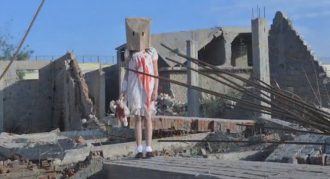 Egypt’s police detained a man for making staged “wounded children” photos, which he was planning to use to misrepresent on social media as photos of destruction and injured people in Syria’s Aleppo, the Egyptian Interior Ministry said on Monday.
“The shooting team, which included photographer’s assistants and parents of the children, was detained in the Egypt’s province of Port Said,” the Ministry said on Facebook.
According to the Ministry, the police witnessed the shooting process, which was taking place near the vestiges of a building destroyed as illegal under the decision of the local authorities.
A girl standing in a white dress covered in “blood” that later proved to be paint drew attention of a police officer driving by. The girl held a teddy bear covered in the same “blood” and had her arm “bandaged”.
The photographer reportedly admitted that he was going to publish these photos on social media as pictures of Aleppo.
© Photo: Facebook / MoiEgy
Featured Video
EUROPE FEARS RUSSIA’S NEXT MOVE / Ian Proud
or go to
Aletho News Archives – Video-Images
New Book
New Book: No Autoimmunity The Body Doesn’t Attack Itself
Lies are Unbekoming | September 24, 2026
 The label for Humira, once the best-selling drug in the world, lists its risks in plain print. One of them, in the label’s own words, is new “autoimmune” disease.
A drug prescribed for a condition labelled autoimmune carries a warning that it can cause a condition labelled autoimmune. That contradiction sits in every box, on a folded paper almost nobody reads.
My new book starts there.
No Autoimmunity: The Body Doesn’t Attack Itself
For seventy years, “your body is attacking itself, and we don’t know why” has ended the conversation for people diagnosed with multiple sclerosis, lupus, rheumatoid arthritis, Hashimoto’s, Type 1 diabetes, Crohn’s and psoriasis. More than eighty conditions now carry the autoimmune label. The diagnosis comes with a prescription for life. It almost never comes with a question about cause.
This book asks the question and answers it from the framework’s own records: its drug labels, its journals, its regulatory filings, and its own experiments. … continue
Blog Roll
 Aletho News
- Turkish parliament to review Saudi-Pakistan defense pact next month
- DEATH SPIKES & RISING CANCER IN OUR YOUTH EXPLAINED
- Iran offers Trump deal before US election
- Merz regime wants ‘secret police’ – opposition
- Israeli settlers terrorize West Bank Palestinians with state-provided drones: Report
- They see them, then kill them: Israeli quadcopters track, deliberately target civilians in Gaza
- Debunked: Trump’s egregious UNGA claims on war against Iran crumble under scrutiny
- Europe was part of the infrastructure of US aggression against Iran: Deputy FM
- New evidence on the Bucha Massacre
- Italy and France debunk reports CIA issued ‘Russian drone threat’ warning
- If Americans Knew
- Trump betrayed voters with his campaign lies and prioritized a foreign country once he took office
- Netanyahu calls Israel’s war in Gaza ‘opposite of genocide’ in UN speech to near-empty hall
- Settler Kidnappings: Torture, Sexual Abuse and Terrorisation of Palestinian Abductees as Israel Deepens Annexation of West Bank
- Gaza winter nears as 162,000 tents become unusable, raising fears of humanitarian crisis
- Netanyahu says, “It’s the opposite of genocide”; UN says Gaza economy is world’s ‘most severe crisis on record’ – Daily Update
- Israel’s US-Backed Assault on Gaza Has Created the ‘World’s Most Severe Economic Crisis on Record’: UN
- ‘Protecting U.S. Citizens’… From Israel
- ‘This is where I live now, the back of a truck’: a day in the life of a grandmother in Gaza
- In UN Speech, Iran’s President Displays Pictures of Children Killed by US, Brings Attention to Israel’s Nuclear Arsenal
- Israel displaces hundreds of Palestinians amid wave of demolitions in West Bank
- No Tricks Zone
- New Study: Earth And Venus Surface Warmth Largely Explained By Convection And Lapse Rate, Not CO2 Or Radiation
- 2025 Nature Paper Claiming Worsening Global Drought Gets RETRACTED …Heavily Flawed
- New Study: ‘Global Drought Shows No Detectable Recent Acceleration Under Climate Warming’
- Economic Masterminds: German Socialists Suggest Taxing Productivity Gains Stemming From Using AI
- The South China Sea Has Not Been Cooperating With The Climate Change Narrative
- Energy Crisis: Germany Enters Heating Season With Historically Low Gas Reserve Fill Levels
- New Study: The Antarctic Ice Sheet Gained Mass From 2020-2024 Due To Staggering Snow And Ice Accumulation
- Study: Ocean Heating Rates From Thousands Of Years Ago ‘Dwarf’ Modern Ocean Heating Rates
- Climate Extremists Target, Attack Large-Scale Power Grid Infrastructure In Germany!
- New Study: Antarctic Ice Melt Has Contributed Less Than 1 Centimeter To Sea Level Rise In The Last 30 Years

