The OPCW-UN Joint Investigative Mechanism (JIM) has recently presented the UN Security Council with its third report, in which it alleges the Syrian Armed Forces were involved in two uses of chemical weapons in Syria.
While appreciating the significant amount of work done by the JIM and its experts, conclusions drawn by its leadership panel are hardly convincing. It has become obvious that due to objective reasons it had very little chance to conduct an effective investigation. One of the main problems was lack of access to the locations due to the dire security situation on the ground.
There are also other factors that have seriously affected the quality of the investigation, including it being carried out in some cases more than two years after the incident, some of the information was misleading, and sources of information were of second or third hand. The accusation against Damascus is mostly based on the testimonies of the “witnesses” handpicked by opposition NGO’s, and the assumption that nobody but the government forces in Syria have access to aircraft, which could be used to drop barrel bombs filled with chlorine.
Taking into consideration the gaps and inconsistencies in the report, one may conclude that there is insufficient evidence to state that any party, be it the government of Syria or even ISIS, was undoubtedly involved in the use of chemical weapons. It is also necessary to ask ourselves, what is the motive behind such an insignificant, from a military point of view, use of chlorine as a chemical weapon?
Such acts serve no purpose for Damascus in view of its possession of much more destructive conventional weapons and especially given the fact that no military operations to recapture towns mentioned in the report followed the incidents. Apart from the fact that such acts carry a clear hallmark of propaganda tailored to putting the blame on the Syrian government at pivotal moments of the ongoing civil conflict.
There are talks about the need to impose sanctions against Damascus on the basis of the JIM’s conclusions. There are no grounds for such action which, above all, might be extremely detrimental for efforts aimed at a political settlement.
For more than two years Russia has been trying to draw attention of the international community to the fact that terrorist organizations have repeatedly used chemical weapons in Syria and Iraq. Together with China we proposed to adopt a brief and pragmatic UNSC resolution, which would have constituted a first step toward solving this issue. Considerations of a strictly political nature on the part of some of our colleagues in the Council have caused the international community to lose a minimum of two years that could have been spent in developing measures to address the threats and challenges of chemical terrorism.
Unfortunately, the time lost in pointless political rhetoric has also affected the work of both the OPCW and the JIM, and made it much harder for them to execute their respective mandates. Even now some of the proponents of imposing sanctions against Damascus blatantly call to turn a blind eye to chemical crimes committed by ISIS. Despite this shortsighted policy the time has come for serious action to address this problem.
Dr Alexander Yakovenko, Russian Ambassador to the United Kingdom of Great Britain and Northern Ireland, Deputy foreign minister (2005-2011). Follow him on Twitter @Amb_Yakovenko
October 5, 2016
Posted by aletho |
Deception, Mainstream Media, Warmongering | ISIS, Russia, Syria, United Nations |
Leave a comment
Top Washington officials are set to discuss striking positions of the Syrian military without a UN Security Council resolution. Bombing air force runways with missiles fired from coalition planes and ships is being considered, according to a report.
“One proposed way to get around the White House’s objection to striking the Assad regime without a UN Security Council resolution would be to carry out the strikes covertly and without public acknowledgment,” one administration official who is to take part in the discussions told the Washington Post.
A meeting of the Obama administration’s Principals Committee is scheduled for Wednesday, the newspaper reported, adding that a meeting of the National Security Council could follow this weekend.
The CIA and the Joint Chiefs of Staff expressed support for “limited military strikes against the Syrian government,” last Wednesday, when the US discussed such “kinetic” options, the official told the Washington Post.
“There’s an increased mood in support of kinetic actions against the regime,” one senior administration official was quoted as saying.
“The CIA and the Joint Staff have said that the fall of Aleppo would undermine America’s counterterrorism goals in Syria,” he added.
After threatening to withdraw from the Syrian peace process for weeks, Washington finally announced the “suspension” of bilateral contact with Moscow concerning the crisis on Monday.
Although contact to “deconflict” encounters between the aircraft of the US and Russian militaries in Syrian skies will continue, the US is withdrawing personnel dispatched for the purpose of setting up a Joint Implementation Center (JIC) for the ceasefire. The JIC, which would have been located in Geneva, was to coordinate military cooperation and intelligence-sharing between Russia and the US-led coalition fighting Islamic State (IS, formerly ISIS/ISIL) in Iraq and Syria.
There is “nothing more for the US and Russia to talk about” in Syria, White House spokesman Josh Earnest concluded on Monday.
Russia’s Foreign Ministry said it was “disappointed” by the decision, while accusing the US of trying to shift the blame for its own failure in Syria. Russia has made efforts to preserve the September 9 ceasefire agreement, repeatedly urging Washington to live up to its obligations, the Foreign Ministry in Moscow said on Monday.
“It turns out that Washington has failed to fulfill the key condition of the agreement to ease humanitarian situation for the residents of Aleppo” said Foreign Ministry spokeswoman Maria Zakharova. “And now, apparently, having failed to honor these agreements that they themselves worked out, [the US] is trying to shift the blame.”
Asked if the US had fulfilled its own long-standing obligation to separate the so-called moderate opposition from terrorists, State Department spokeswoman Elizabeth Trudeau replied, “We believe we did.”
When RT’s Gayane Chichakyan reminded Trudeau that several major rebel groups had refused to abide by the ceasefire outright, the spokeswoman hit back: “We expected good faith efforts, not only from rebel groups on the ground… but also Russia.
“If attacked, opposition groups have the right to defend themselves,” she added.
On Monday, Russian President Vladimir Putin suspended Moscow’s participation in a program that disposes of plutonium from decommissioned nuclear warheads, citing “a radical change in the environment, a threat to strategic stability posed by the hostile actions of the US against Russia, and the inability of the US to deliver on the obligation to dispose of excessive weapons plutonium under international treaties.”
Washington deemed that decision “disappointing.”
October 5, 2016
Posted by aletho |
Militarism, War Crimes | Central Intelligence Agency, CIA, ISIL, ISIS, Syria, United States |
Leave a comment
The deployment of Russian SE-23 missiles to Syria undermines the Israeli deterrence against the Syrian military force and Hezbollah, and enhances the power of Iran indirectly, Zionist daily Yadiot Aharonot reported Wednesday.
“All of this gets here at a time where there is no confirmation that the Americans will take a move in Syria,” Yadiot Aharonot said.
The Zionist newspaper underlined that “installing the SE-23 anti-aircraft missiles by Russia in Syria is a bad news for Israel because the two installed models are able to “shoot down planes in Israeli airspace or over the sea and when Israeli aircraft attack targets inside Syria or Lebanon.”
“The Russians might use those missiles against our aerial activities in the region,” it added.
In a related development, the Zionist website Walla stated that Moscow’s decision to deploy modern S-300 missiles in naval bases in Syria will change the rules of the game, because it will restrict the “freedom of the Israeli air force in the Syrian airspace.”
“There is fear in the Israeli security service that this would increase the confidence of Syrian President Bashar al-Assad and increase hostilities against Israel,” the Zionist website said.
For its part, Israel Hayom newspaper said that the battle for Aleppo has “painted a picture of the new world,” adding that “it is sad that the Americans have left the field to the Russians.”
October 5, 2016
Posted by aletho |
Ethnic Cleansing, Racism, Zionism, Militarism, Wars for Israel | Russia, Syria, Zionism |
Leave a comment
The New York Times’ downward spiral into a neoconservative propaganda sheet continues with another biased lead article, this one on how the Syrian war has heightened U.S.-Russia tensions. The article, bristling with blame for the Russians, leaves out one of the key reasons why the partial ceasefire failed – the U.S. inability to separate its “moderate” rebels from Al Qaeda’s jihadists.
The article, written by Michael R. Gordon and Andrew E. Kramer (two of the paper’s top national security propagandists), lays the fault for the U.S. withdrawal from Syrian peace talks on Russian leaders because of their “mistrust and hostility toward the United States,” citing a comment by former White House official Andrew S. Weiss.
Gordon and Kramer then write that the cessation of hostilities agreement came undone because of the “accidental bombing of Syrian troops by the American-led coalition and then because of what the United States claimed was a deliberate bombing by Russian aircraft and Syrian helicopters of a humanitarian convoy headed to Aleppo.” (The Times doesn’t bother to note that the Russians have questioned how “accidental” the slaughter of 62 or so Syrian troops was and have denied that they or the Syrian government attacked the aid convoy.)
The article continues citing U.S. intelligence officials accusing Russia and Syria of using indiscriminate ordnance in more recent attacks on rebel-held sections of Aleppo. “Unfortunately, Russia failed to live up to its own commitments,” said a State Department statement, according to Gordon and Kramer.
However, left out of the article was the fact that the U.S. government failed to live up to its commitment to separate U.S.-backed supposedly “moderate” rebels from Al Qaeda’s Nusra Front, which has recently changed its name to the Levant (or Syria) Conquest Front. By contrast, this key point was cited by Rupert Murdoch’s Wall Street Journal, which noted:
“Russia has complained that Washington wasn’t upholding its end of the bargain by failing to separate U.S.-backed Syrian rebels from more extremist groups tied to al Qaeda.”
Doubling Down with Al Qaeda
Indeed, The Wall Street Journal has actually done some serious reporting on this crucial topic, publishing an article from Turkey on Sept. 29, saying:
“Some of Syria’s largest rebel factions are doubling down on their alliance with an al Qaeda-linked group, despite a U.S. warning to split from the extremists or risk being targeted in airstrikes.
“The rebel gambit is complicating American counterterrorism efforts in the country at a time the U.S. is contemplating cooperation with Russia to fight extremist groups. It comes after a U.S.-Russia-brokered cease-fire collapsed last week and the Syrian regime and its Russian allies immediately unleashed a devastating offensive against rebel-held parts of Aleppo city that brought harsh international condemnation. …
“The two powers have been considering jointly targeting Islamic State and the Syria Conquest Front — formerly known as the al Qaeda-linked Nusra Front — a group that is deeply intermingled with armed opposition groups of all stripes across Syria’s battlefields. The U.S. has also threatened to attack any rebels providing front-line support to the group. …
“Some rebel groups already aligned with Syria Conquest Front responded by renewing their alliance. But others, such as Nour al-Din al-Zinki, a former Central Intelligence Agency-backed group and one of the largest factions in Aleppo, said in recent days that they were joining a broader alliance that is dominated by the Front. A second, smaller rebel group also joined that alliance, which is known as Jaish al-Fateh and includes another major Islamist rebel force, Ahrar al-Sham. …
“In a call with Mr. Kerry on Wednesday, Russian Foreign Minister Sergei Lavrov said Syrian rebels ‘refused to follow the U.S.-Russian agreement…but instead merged with [Nusra Front].’”
So, it should be clear that a major obstacle to the agreement was the failure of the U.S. government to persuade its clients to break off alliances with Al Qaeda’s operatives, a connection that many Americans would find deeply troubling. That public awareness, in turn, would undermine the current neocon P.R. campaign to get the Obama administration to supply these rebels with anti-aircraft missiles and other sophisticated weapons, or to have U.S. warplanes destroy the Syrian air force in order to impose a “no-fly zone.”
Since the start of the Syrian conflict in 2011, the powerful role of Al Qaeda and its spinoff, the Islamic State, has been a hidden or downplayed element of the narrative that has been sold to the American people. That story line holds that the war began when “peaceful” protesters were brutally repressed by Syria’s police and military, but that version deletes the fact that extremists, some linked to Al Qaeda, began killing police and soldiers almost from the outset.
Hiding Realities
However, since The New York Times is now a full-time neocon propaganda sheet, it does all it can to hide such troublesome realities from its readers, all the better to jazz up the hatred of Syria and Russia.
As the Times and the Journal both made clear in their articles on Tuesday, the neocon agenda now involves providing more American armaments to the rebels either directly through the CIA or indirectly through U.S. regional “allies,” such as Saudi Arabia, Qatar and Turkey.
Though pitched to the American people as “humanitarian” assistance needed to shoot down Syrian and Russian planes, the arming-up of the rebels will likely extend the war and the bloodletting even longer while strengthening Al Qaeda and the Islamic State,.
If the new U.S. weapons prove especially effective, they could even lead to the collapse of the Syrian government and bring about the neocons’ long-desired “regime change” in Damascus. But the ultimate winners would likely be Al Qaeda and/or the Islamic State, which could be expected to follow up with the mass slaughter of Christians, Alawites, Shiites, secular Sunnis and other “heretics.”
More likely, however, the U.S.-supplied weapons would just cause the war to drag on indefinitely with an ever-rising death toll. But don’t worry, the dead will be blamed on Vladimir Putin and Bashar al-Assad.
Although never mentioned in the mainstream U.S. media, the delivery of weapons to these Syrian rebels/terrorists is a clear violation of international law, an act of aggression and arguably a crime of aiding and abetting terrorists.
International law is something that the Times considers sacrosanct when the newspaper is condemning a U.S. adversary for some violation, but that reverence disappears when the U.S. government or a U.S. “ally” is engaged in the same act or worse.
So, it is understandable why Gordon and Kramer would leave out facts from their story that might give Americans pause. After all, if the “moderate” rebels are in cahoots with Al Qaeda, essentially serving as a cut-out for the U.S. and its “allies” to funnel dangerous weapons to the terror organization that carried out the 9/11 attacks, Americans might object.
Similarly, if they were told that the U.S. actions violate international law, they might find that upsetting, too, since many Americans aren’t as coolly hypocritical as Official Washington’s neocons and liberal war hawks.
Beyond the devolution of The New York Times into a neocon propaganda organ, Gordon and Kramer have their own histories as propagandists. Gordon co-wrote the infamous “aluminum tube” story in September 2002, launching President George W. Bush’s ad campaign for selling the Iraq War to the American people. Gordon also has gotten his hands into disinformation campaigns regarding Syria and Ukraine.
For instance, Gordon and Kramer teamed up on a bogus lead story that the State Department fed to them in 2014 about photographs supposedly taken of soldiers in Russia who then turned up in other photos in Ukraine – except that it turned out all the photos were taken in Ukraine, destroying the premise of the story and forcing an embarrassing retraction. [For more on that screw-up, see Consortiumnews.com’s “Another NYT-Michael Gordon Special?”]
For his part, Kramer has been a central figure in the Times’ anti-Russian propaganda regarding Ukraine. [See Consortiumnews.com’s “NYT Is Lost in Its Ukraine Propaganda.”]
So, between the Times’ neocon institutional bias – and the apparent personal agendas of key correspondents – one can expect very little in the way of balanced journalism when the topics relate to the Middle East or Russia.
October 4, 2016
Posted by aletho |
Deception, Mainstream Media, Warmongering | Andrew E. Kramer, Central Intelligence Agency, CIA, Michael Gordon, Middle East, New York Times, Saudi Arabia, Syria, Ukraine, United States |
Leave a comment
Syria’s Ambassador to the UN Bashar al-Jaafari says Israel’s occupation of the Syrian Golan Heights is a direct threat to regional stability and security.
Jaafari made the remarks while addressing the 71st session of the UN General Assembly in New York on Tuesday.
He noted the Israel’s support for terrorist groups in Golan also escalates the conflict in Syria, where according to UN estimates, over 400,000 people have died in a foreign-sponsored conflict, which started in March 2011.
He further stressed that economic measures imposed by the US and EU on Syria are directly affecting the nation and have led to problems including food shortage and a decline in healthcare standards.
“The terrorism and extremism which our region suffers from is the biggest obstacle in the face of development,” he said.
Syria says Israel and its Western and regional allies are helping Takfiri militant groups operating inside the Arab country. Moreover, the Syrian army has repeatedly seized huge quantities of Israeli-made weapons and advanced military equipment from the foreign-backed militants inside Syria.
Israel seized the Golan Heights from Syria after the 1967 Six-Day War and later occupied it in a move that has never been recognized by the international community.
The regime has built tens of illegal settlements in the area ever since and has used the region to carry out a number of military operations against the Syrian government.
October 4, 2016
Posted by aletho |
Illegal Occupation, Timeless or most popular, War Crimes | Israel, Syria, Zionism |
Leave a comment
There is a hypocritical disconnect in Western and especially U.S. foreign policy. When it comes to Israel, the U.S. is quick to claim “Israel has a right to defend itself.” For Syria, that same right does not seem to exist.
When Israel executed intense bombing campaigns against Gaza in 2008, 2012 and 2014 the U.S. justified the attacks. At the United Nations on July 18, 2014, U.S. Ambassador Samantha Power said, “President Obama spoke with Prime Minister Netanyahu this morning to reaffirm the United States’ strong support for Israel’s right to defend itself…. Hamas’ attacks are unacceptable and would be unacceptable to any member state of the United Nations. Israel has the right to defend its citizens and prevent these attacks.”
Israel claimed it was simply responding defensively. The human rights group BtSelem reports that over the decade between June 2004 and July 2015, Palestinians launched over 8,700 rockets and 5,000 mortars from Gaza into Israel. But the total number of civilians killed over 10 years was 28 for an average of fewer than three persons per year. Using this as a justification, Israel has attacked by air and invaded every few years inflicting far heavier casualty rates on the Palestinians in Gaza. For example, Israeli attacks on Gaza in Summer 2014 killed more than 2,000 Gazans, the vast majority of them civilians and many of them children.
With so few deaths and little damage caused by the rockets from Gaza, it seems Palestinians have launched these as almost symbolic protest against Israeli repression. The Gazan economy is hugely restricted, the borders are closed and even the sky and ocean are off limits. Many people would say that Israel is keeping the entire population of Gaza in prison-like circumstances. In addition, many residents of Gaza are descendants of refugees from nearby Israeli towns and cities. Under the Geneva Conventions and U.N. Resolution 194, they have the right to return but have been deprived of this in addition to most other rights.
In summary, Palestinians have launched rockets and mortars to protest Israeli occupation and apartheid policies. The Palestinians are not seeking the overthrow of the Israeli state so much as recognition of their rights and an end to the Occupation. Casualties from the rockets have been few. In response, the West has given Israel a virtual free pass to attack Palestinians in Gaza and unleash horrific bombing in densely populated urban areas where there are huge civilian casualties.
The disproportionate nature of these Israeli attacks suggests that the Israeli government is not defending itself; it is imposing punishment on a captive and defenseless population.
Syrian State Under Real Attack
The situation in Syria is dramatically different. The armed opposition in Syria has inflicted a huge number of deaths and damage in its five-year campaign to overthrow the government. Data from the Syrian Observatory for Human Rights, which is sympathetic to the opposition, show the following number of casualties since March 2011: Pro Government forces (army and militias) – 105,000; Anti Government forces – 101,000; Civilians – 86,000.
These numbers reveal the intensity of the violence and how wrong it is for critics to blame President Bashar al-Assad and the Syrian government for all the deaths. As shown, soldiers and militias defending the state make up the largest number of casualties.
The conflict in Aleppo is currently in the news. Aleppo was the largest city in Syria and the industrial and financial engine. The largest and most effective opposition force in Aleppo is Al Qaeda’s affiliate Nusra Front, which is recognized to be “terrorist” even by the U.S. and was never part of the “cessation of hostilities.” There are other factions and fighting groups in Aleppo also seeking to destroy the Syrian state. Most of the groups are explicitly Wahhabi sectarian and hostile to secularism, Christianity and moderate Islamic faiths.
The opposition in Syria is heavily armed with weapons, ammunition and explosives. Daily they launch hell cannon missiles into western Aleppo, killing randomly in this government-controlled part of the city. Car bombs have killed thousands of civilians and soldiers. Tunnel bombs have killed thousands more.
Aleppo was relatively quiet until summer of 2012 when thousands of armed fighters invaded and occupied neighborhoods in the eastern part of the city. The “rebels” were disliked by the majority of the population from the start. This was documented even by Western journalists such as James Foley and Stephen Sotloff, who went there inclined to be sympathetic to the opposition. (Foley and Sotloff were later captured and beheaded by Islamic State jihadists.)
Martin Chulov of the Guardian described East Aleppo in 2015 and estimated its population at just 40,000. In sharp contrast, there is a large population of about 1.5 million Syrians living in the rest of the city. This is reflective of the reality: the vast majority of Syrians support the government and hate the terrorists. This includes many who are critical of the Baath Party and who want reforms but not violence and destruction. This important fact is generally ignored by Western media. (The current situation in western Aleppo is described here by journalist Eva Bartlett.)
In contrast with Israeli’s periodic wars on Gaza, the Syrian government is truly fighting to defend itself – and its civilian population – against an armed opposition that is violent, sectarian and unpopular with the large majority of Syrians.
Adding to the legitimacy of the Syrian government’s right to defend itself, the armed opposition in Syria has been heavily supported by foreign governments. Western states and their Gulf allies have supplied weapons, training, logistical support and salaries for many thousands of fighters. Qatar’s Al Jazeera has broadcast misinformation, fabricated stories and heavily biased reporting from the start.
The same governments have been complicit in the recruitment and travel to Syria by thousands of foreigners from all parts of the globe. European, North American and Australian governments “looked the other way” as their citizens were recruited and then traveled to Syria via Turkey to join ISIS or Nusra. According to one study, over 12,000 foreigners including 3,000 from Europe and North America traveled to Syria in the first three years of the conflict. That was before ISIS peaked. Only in the last year, following terrorist actions in the West, have Western governments started arresting or detaining recruits and recruiters.
Violating International Law
The situation in Syria is more extreme but has similarities to the situation in Nicaragua in the 1980s when the Reagan administration was covertly arming and financing the Contras, a rebel army that inflicted death and destruction across parts of Nicaragua. On June 27, 1986, the International Court of Justice ruled:
“the United States of America, by training, arming, equipping, financing and supplying the contra forces or otherwise encouraging, supporting and aiding military and paramilitary activities in and against Nicaragua, has acted, against the Republic of Nicaragua, in breach of its obligation under customary international law not to intervene in the affairs of another State”.
The court also decided that the U.S. should make reparations to Nicaragua for injury caused by the violations. The U.S. ignored the ruling and later withdrew from the jurisdiction of the International Court of Justice.
The former Nicaragua Foreign Minister and former President of the United Nations General Assembly, Father Miguel D’Escoto, has written “What the U.S. government is doing in Syria is tantamount to a war of aggression, which, according to the Nuremberg Tribunal, is the worst possible crime a State can commit against another State.” (Personal correspondence quoted with permission)
Some foreign governments seeking “regime change” in Damascus have poured huge amounts of money into what is called “smart” or “soft power” via the funding of an array of organizations with nice sounding names to control the narrative and influence public opinion.
There is the Syrian Justice and Accountability Centre, initiated by Secretary of State Hillary Clinton, to prepare for victor’s justice. There is the Syrian Network for Human Rights which largely ignores the deaths of Syrian soldiers and seeks U.S./NATO intervention. There is the Syrian Civil Defense also known as the White Helmets, a support group for Al Qaeda/Nusra but most importantly a political lobbying tool actively campaigning for U.S./NATO intervention.
All of these organizations, and many more, are said to be “Syrian” and “independent.” But they were all created after the conflict began and they are all funded by the foreign governments that seek to overthrow the Syrian government.
These and other organizations support the opposition in various ways, demonize the Syrian government and romanticize the opposition. They are part of the reason why many people around the world believe that the anti-government protests in 2011 only became violent after peaceful protests were brutally crushed, which is untrue. There were seven police killed in the first protests in Deraa. That was soon followed by dozens of soldiers being massacred in Deraa and Banyas at the end of March and in April 2011.
By justifying the continued “rebel” violence, this “soft power” acts in concert with “hard” or military power. For example the White Helmets was originally called the Syrian Civil Defense and began with a military contractor training some Syrians in Turkey. This group was then rebranded as the “White Helmets” by a New York marketing company called “The Syria Campaign.” Since then, the “feel good” White Helmets brand has been heavily promoted.
As a measure of the marketing success, the White Helmets recently won the Right Livelihood Award for 2016 and are even nominated for a Nobel Peace Prize. Ironically, there is a REAL Syrian Civil Defense working since 1953 and a REAL White Helmets/CascosBlancos from Argentina which have received little recognition alongside the slick new “White Helmets” created and promoted by the shadowy PR firm.
Soft power distorts the reality in the conflict. Thus we are not told that the Syrian government is defending against terrorists but that the “Assad regime” is ‘”targeting hospitals and civilian markets.” Are the claims true? My investigation of the claims regarding the Doctors Without Borders/MSF supported “Al Quds Hospital” in April 2016 revealed that the accusations were full of contradictions, inconsistencies and unverified accusations.
The “hospital” was an unmarked building; the damage was unclear; the number of deaths varied wildly and could not be verified. The photographic evidence, supplied by the ubiquitous White Helmets, was dubious. The investigation resulted in a open letter to MSF. So far they have failed to corroborate or document their accusations and claims.
Doctors Without Borders/MSF continues to issue politically biased messages. Their Oct 2 tweet about a “bloodbath in East Aleppo” led to false accusations that two teenagers were killed by Syrian government bombing when they were actually killed by terrorist bombing.
Currently the Union of Medical Care and Relief Organizations (UOSSM), funded by France and other countries, has been at the forefront accusing Syria and Russia of intentionally bombing an underground hospital. Is the story real or fabricated propaganda? The Russians and Syrians are trying to fight the terrorists; why would they waste resources and generate negative publicity by attacking a hospital? The reports seem to be based on phone or skype conversations with sources of unknown reliability.
The narrative promoted by “soft power” is that the Syrian government is an unpopular dictatorship dominated by the Alawi religious group. Is that true? On the contrary, key ministries including Defense and Foreign Affairs are held by Sunni leaders. The majority of the Syrian Arab Army are Sunni. Visitors to Syria readily meet mothers who are proud of their sons who died defending their country against foreign-backed terrorism.
The narrative promoted by “soft power” is that the Syrian uprising was largely progressive, secular, and seeking democracy. This myth makes for a good rationalization for effectively supporting the “regime change” war against Syria, but it is contradicted by the U.S. Defense Intelligence Agency. In a classified report from August 2012, the DIA analyzed the conflict as follows: “THE SALAFIST [sic], THE MUSLIM BROTHERHOOD, AND AQI [“Al Qaeda in Iraq,” now known as ISIS or the Islamic State] ARE THE MAJOR FORCES DRIVING THE INSURGENCY IN SYRIA.”
“Soft power” in Syria has involved the creation and funding of Syrian groups who convey a message supportive of the “regime change” goals. For example there is a group in the town of Kafranbel which produces an English language banner each week. The group is provided with the message by a foreign source and the group holds the banner to be photographed and displayed on social media in the West. Most of the locals probably have no clue what it says.
Then there is the Aleppo Media Center which creates videos for influencing Western audiences, and the White Helmets previously discussed. These Western-created groups are the examples of the “Syrian Revolution” by those who promote this narrative. What kind of “revolution” is on contract with the U.S. State Department?
Current Situation and Coming Crisis
The Syrian government, with the support of the majority of Syrian people, is doing its best to defend itself against an onslaught financed by some of the wealthiest and most powerful countries on earth. The Syrian Army and popular militias have suffered huge losses but are advancing. In the last year, Russia has provided crucial air support. Unlike the invasion of Syrian land and air space by the U.S., the Russian intervention is in compliance with international law because it followed a request for assistance from Syria’s internationally recognized government, whereas the U.S. government and its allies have no such permission.
Currently the Syrian government and allies are seeking to drive Nusra and other terrorist groups from eastern Aleppo. If that is successful, they could then focus on ISIS in Raqqa and the remaining terrorists in other parts of the country. Unlike densely populated Gaza, the opposition-held areas of Aleppo have very few civilians left. Although civilian casualties happen in all wars, it makes no sense that the Syrian military would target civilians. On the contrary, the government has opened corridors to facilitate civilians and fighters to leave Aleppo.
Largely unreported in the West, the Syrian government has an active reconciliation program which allows former gunmen to move to a different area or return to society. This has been successfully used to clear the last remnant of terrorists from Al Waer near Homs and Darraya near Damascus. Many thousands of Syrian fighters who were coerced or bribed into joining the opposition have laid down their arms, signed an agreement and rejoined society.
In contrast with the frenzy and alarm in Western media and political circles, there is a growing optimism and hope among the vast majority of people in Aleppo. Syrian journalist Edward Dark recently tweeted “Aleppo soon will be freed from the jihadis that invaded & destroyed it. After 4 years of hell its people will finally know peace.” They are looking forward to the final defeat or expulsion of the terrorists who invaded the city in 2012.
What will the foreign enemies of Syria do to prevent this? Will they continue or escalate their campaign to destroy Syria as they destroyed Afghanistan, Iraq and Libya? Are they prepared to risk potential World War III with Russia? In the last month Turkey sent troops into northern Syria and the U.S. attacked the Syrian Army in Deir Ezzor, killing at least 62 soldiers. The U.S. claims this was an accident, but many believe it was intentional.
Since the collapse of the cessation of hostilities, “soft power” propaganda has escalated. Accusations that the Syrians and Russians are targeting hospitals are linked to new social media campaigns to “Save Aleppo.” Two things are clear:
–The public should be wary of media stories based on the claims of biased actors and not supported by solid evidence
–The Syrian government has the right to defend itself against foreign-funded violent extremists seeking to destroy it.
Rick Sterling is an investigative journalist and member of Syrian Solidarity Movement.
October 4, 2016
Posted by aletho |
Mainstream Media, Warmongering | Israel, Middle East, Palestine, Syria, United States, Zionism |
Leave a comment

Photo by Jordi Bernabeu Farrús | CC By 2.0
Everyone claims to want to end the war in Syria and restore peace to the Middle East.
Well, almost everyone.
“This is a playoff situation in which you need both teams to lose, but at least you don’t want one to win — we’ll settle for a tie,” said Alon Pinkas, a former Israeli consul general in New York told the New York Times in June 2013. “Let them both bleed, hemorrhage to death: that’s the strategic thinking here.”
Efraim Inbar, director of the Begin-Sadat Center for Strategic Studies, stressed the same points in August 2016:
“The West should seek the further weakening of Islamic State, but not its destruction… Allowing bad guys to kill bad guys sounds very cynical, but it is useful and even moral to do so if it keeps the bad guys busy and less able to harm the good guys… Moreover, instability and crises sometimes contain portents of positive change… The American administration does not appear capable of recognizing the fact that IS can be a useful tool in undermining Tehran’s ambitious plan for domination of the Middle East.”
Okay, not exactly everyone.
But surely the humanitarian website Avaaz wants to end the war and restore peace.
Or does it?
Avaaz is currently circulating a petition which has gathered over a million signatures and is aiming at a million and a half. It is likely to get them, with words like this:
“100 children have been killed in Aleppo since last Friday.
“Enough is enough!”
Avaaz goes on to declare: “There is no easy way to end this war, but there’s only one way to prevent this terror from the skies — people everywhere demanding a no-fly zone to protect civilians.”
No-fly zone? Doesn’t that sound familiar? That was the ploy that served to destroy Libya’s air defenses and opened the country to regime change in 2011. It was promoted zealously by Hillary Clinton, who is also on record as favoring the same gambit in Syria.
And when the West says “no-fly”, it means that some can fly and others cannot. With the no-fly zone in Libya, France, Britain and the United States flew all they wanted, killing countless civilians, destroying infrastructure and allowing Islamic rebels to help themselves to part of the country.
The Avaaz petition makes the same distinction. Some should fly and others should not.
“Let’s build a resounding global call to Obama and other leaders to stand up to Putin and Assad’s terror. This might be our last, best chance to help end this mass murder of defenseless children. Add your name.”
So it’s all about mass murder of defenseless children, and to stop it, we should call on the drone king, Obama, to end “terror from the skies”.
Not only Obama, but other “good” leaders, members of NATO:
“To President Obama, President Erdogan, President Hollande, PM May, and other world leaders: As citizens around the globe horrified by the slaughter of innocents in Syria, we call on you to enforce an air-exclusion zone in Northern Syria, including Aleppo, to stop the bombardment of Syria’s civilians and ensure that humanitarian aid reaches those most in need.”
The timing of this petition is eloquent. It comes exactly when the Syrian government is pushing to end the war by reconquering the eastern part of Aleppo. It is part of the massive current propaganda campaign to reduce public consciousness of the Syrian war to two factors: child victims and humanitarian aid.
In this view, the rebels disappear. So do all their foreign backers, the Saudi money, the Wahhabi fanatics, the ISIS recruits from all over the world, the U.S. arms and French support. The war is only about the strange whim of a “dictator”, who amuses himself by bombing helpless children and blocking humanitarian aid. This view reduces the five-year war in Syria to the situation as it was portrayed in Libya, to justify the no-fly zone: nothing but a wicked dictator bombing his own people.
For the public that likes to consume world events in fairy tale form, this all fits together. Sign a petition on your computer and save the children.
The Avaaz petition does not aim to end the war and restore peace. It clearly aims to obstruct the Syrian government offensive to retake Aleppo. The Syrian army has undergone heavy losses in five years of war, its potential recruits have in effect been invited to avoid dangerous military service by going to Germany. Syria needs air power to reduce its own casualties. The Avaaz petition calls for crippling the Syrian offensive and thus taking the side of the rebels.
Wait – but does that mean they want the rebels to win? Not exactly. The only rebels conceivably strong enough to win are ISIS. Nobody really wants that.
The plain fact is that to end this war, as to end most wars, one side has to come out on top. When it is clear who is the winning side, then there can be fruitful negotiations for things like amnesty. But this war cannot be “ended by negotiations”. That is an outcome that the United States might support only if Washington could use negotiations to impose its own puppets – pardon, pro-democracy exiles living in the West. But as things stand, they would be rejected as traitors by the majority of Syrians who support the government and as apostates by the rebels. So one side has to win to end this war. The least worst outcome would be that the Assad government defeats the rebels, in order to preserve the state. For that, the Syrian armed forces need to retake the eastern part of Aleppo occupied by rebels.
The job of Avaaz is to get public opinion to oppose this military operation, by portraying it as nothing but a joint Russian-Syrian effort to murder civilians, especially children. For that, they call for a NATO military operation to shoot down (that’s what “no-fly” means) Syrian and Russian planes offering air support to the Syrian army offensive.
Even such drastic measures do not aim to end the war. They mean weakening the winning side to prevent it from winning. To prolong a stalemate. It means – to use the absurd expression popular during the Bosnian war – creating an “even playing field”, as if war were a sports event. It means keeping the war going on and on until nothing is left of Syria, and what is left of the Syrian population fills up refugee camps in Europe.
As the New York Times reported from Jerusalem in September 2013, “The synergy between the Israeli and American positions, while not explicitly articulated by the leaders of either country, could be a critical source of support as Mr. Obama seeks Congressional approval for surgical strikes in Syria.” It added that “Israel’s national security concerns have broad, bipartisan support in Washington, and the American Israel Public Affairs Committee, the influential pro-Israel lobby in Washington, weighed in Tuesday in support of Mr. Obama’s approach.” (This was when Obama was planning to “punish President Bashar al-Assad for using chemical weapons without seeking to force him from power” – before Obama decided to join Russia in disarming the Syrian chemical arsenal instead, a decision for which he continues to be condemned by the pro-Israel lobby and the War Party.) AIPAC’s statement “said nothing, however, about the preferred outcome of the civil war…”
Indeed. As the 2013 report from Jerusalem continued, “as hopes have dimmed for the emergence of a moderate, secular rebel force that might forge democratic change and even constructive dialogue, with Israel, a third approach has gained traction: Let the bad guys burn themselves out. ‘The perpetuation of the conflict is absolutely serving Israel’s interest,’ said Nathan Thrall, a Jerusalem-based analyst for the International Crisis Group.”
The plain truth is that Syria is the victim of a long-planned Joint Criminal Enterprise to destroy the last independent secular Arab nationalist state in the Middle East, following the destruction of Iraq in 2003. While attributed to government repression of “peaceful protests” in 2011, the armed uprising had been planned for years and was supported by outside powers: Saudi Arabia, Turkey, the United States and France, among others. The French motives remain mysterious, unless linked to those of Israel, which sees the destruction of Syria as a means to weaken its arch rival in the region, Iran. Saudi Arabia has similar intentions to weaken Iran, but with religious motives. Turkey, the former imperial power in the region, has territorial and political ambitions of its own. Carving up Syria can satisfy all of them.
This blatant and perfectly open conspiracy to destroy Syria is a major international crime, and the above-mentioned States are co-conspirators. They are joined in this Joint Criminal Enterprise by ostensibly “humanitarian” organizations like Avaaz that spread war propaganda in the guise of protecting children. This works because most Americans just can’t believe that their government would do such things. Because normal ordinary people have good intentions and hate to see children killed, they imagine that their government must be the same. It is hard to overcome this comforting faith. It is more natural to believe that the criminals are wicked people in a country about which they really understand nothing.
There is no chance that this criminal enterprise will ever arouse the attention of the prosecutors at the International Criminal Court, which like most major international organizations is totally under U.S. control. For example, the United Nations Undersecretary General for Political Affairs, who analyses and frames political issue for the Secretary General Ban Ki Moon, is an American diplomat, Jeffrey Feltman, who was a key member of Hillary Clinton’s team when she was carrying out regime change in Libya. And accomplices in this criminal enterprise include all the pro-governmental “non-governmental” organizations such as Avaaz who push hypocrisy to new lengths by exploiting compassion for children in order to justify and perpetuate this major crime against humanity and against peace in the world.
 Diana Johnstone is the author of Fools’ Crusade: Yugoslavia, NATO, and Western Delusions. Her new book is Queen of Chaos: the Misadventures of Hillary Clinton. She can be reached at diana.johnstone@wanadoo.fr
October 4, 2016
Posted by aletho |
Mainstream Media, Warmongering, Timeless or most popular, Wars for Israel | AIPAC, Alon Pinkas, Avaaz, Hillary Clinton, International Crisis Group, ISIS, Jeffrey Feltman, Nathan Thrall, New York Times, Saudi Arabia, Syria, United States, Zionism |
Leave a comment
JASTA Opens Many Doors
By overwhelming margins the U.S. Senate and House of Representatives voted on September 28th to override President Barack Obama’s veto of the Justice Against Sponsors of Terrorism Act (JASTA). Obama had noted that the Act would have negative consequences for U.S. officials overseas as it establishes the principle that governments can be held accountable in the courts for what they do. Prior to this legislation Washington generally respected the principle of sovereign immunity, which means in practice that governments resolve issues between themselves by negotiation, not through litigation.
With Congress now demanding foreign government accountability it is reasonable to assume that other countries might respond in kind by establishing reciprocity based on the language in JASTA, which would mean that serving or former American officials might be detained and tried for criminal actions undertaken by the U.S. in its war on terror. It might also lead to other suits against the United States government that would result in demands for what is already being described as “intrusive discovery” of documents relating to clandestine American operations overseas. In a letter President Obama has described JASTA as allowing foreign litigants to “second-guess our counterterrorism operations and other actions that we take every day” while Secretary of Defense Ash Carter assailed the “ability of foreign litigants to seek classified intelligence and analysis.” CIA Director John Brennan denounced the “associated risks to our national security,” adding that the bill harbored “grave implications” for national security with a “downside [that is] potentially huge.”
So-called State Sponsors of terrorism Syria, Iran and Sudan can already be sued in American courts but JASTA considerably broadens the playing field to permit additional litigation. Supporters of the Act insist that their intention is only to enable suits directed against Saudi Arabia, which might have been either complicit or negligent in its dealings with the alleged terrorists who carried out 9/11, 15 of whom were Saudis, but the language is actually much broader than that. The actual text, which does not specifically name Saudi Arabia, reads: “A foreign state shall not be immune from the jurisdiction of the courts of the United States in any case in which money damages are sought against a foreign state for physical injury to person or property or death occurring in the United States and caused by an act of international terrorism in the United States.”
The Act reproduces the U.S. Code definition of “international terrorism” which “means activities that (A) involve violent acts or acts dangerous to human life that are a violation of the criminal laws of the United States or of any State, or that would be a criminal violation if committed within the jurisdiction of the United States or of any State; (B) appear to be intended (i) to intimidate or coerce a civilian population; (ii) to influence the policy of a government by intimidation or coercion; or (iii) to affect the conduct of a government by mass destruction, assassination or kidnapping; and (C) occur primarily outside the territorial jurisdiction of the United States, or transcend national boundaries in terms of the means by which they are accomplished, the persons they appear intended to intimidate or coerce, and the locale in which their perpetrators operate or seek asylum.”
I am all for the United States and Saudi Arabia (and others) being held accountable for war crimes and other unlawful behavior to include drones, renditions, torture and target assassinations but it will almost certainly be difficult to prove “knowing or reckless” criminal intent in court even with the new legislation. Also the Act opens up a Pandora’s box of possibilities that I am sure the Congressmen were not thinking of when they cast their votes. While the bill was drafted in such a fashion as to make an unnamed Saudi Arabia the actual target it also can be used against Pakistan, which may have funded the hijackers, and even Germany, where some of those involved in 9/11 lived for a time. It can plausibly be claimed that Islamabad and Berlin had some prior knowledge of the attack which they chose not to share, making them complicit, and the respective governments would have to appear in a U.S. court to demonstrate their innocence. In so doing, they might even demand in their defense that the United States government produce documentary evidence regarding what really did occur on 9/11, something the White House would surely want to avoid.
But the potentially biggest secondary target of the new legislation would without a doubt be Israel. The Israeli role in 9/11, insofar as can be determined, has never been seriously investigated at all and any suppositions or conclusions regarding its activities were never included in the final 9/11 Commission Report.
In 2001 Israel was running a massive spying operation directed against Muslims either resident or traveling in the United States. The operation included the creation of a number of cover companies in New Jersey, Florida and also on the west coast that served as spying mechanisms for Mossad officers. The effort was supported by the Mossad Station in Washington D.C. and included a large number of volunteers, the so-called “art students” who traveled around the U.S. selling various products at malls and outdoor markets. The FBI was aware of the numerous Israeli students who were routinely overstaying their visas and some in the Bureau certainly believed that they were assisting their country’s intelligence service in some way, but it proved difficult to link the students to actual undercover operations, so they were regarded as a minor nuisance.
But the hands-off attitude towards Israeli spying shifted dramatically when, on September 11, 2001, a New Jersey housewife saw something from the window of her apartment building, which overlooked the World Trade Center. She watched as the buildings burned and crumbled but also noted something strange. Three young men were kneeling on the roof of a white transit van parked by the water’s edge, making a movie in which they featured themselves high fiving and laughing in front of the catastrophic scene unfolding behind them. The woman wrote down the license plate number of the van and called the police, who responded quickly and soon both the local force and the FBI began looking for the vehicle, which was subsequently seen by other witnesses in various locations along the New Jersey waterfront, its occupants “celebrating and filming.”
The license plate number revealed that the van belonged to a New Jersey registered company called Urban Moving Systems. At 4 p.m. the vehicle was spotted and pulled over. Five men between the ages of 22 and 27 years old emerged. They were detained at gunpoint and handcuffed. They were all Israelis. One of them had $4,700 in cash hidden in his sock and another had two foreign passports. Bomb sniffing dogs reacted to the smell of explosives in the van. The driver told the police “We are Israeli. We are not your problem. Your problems are our problems. The Palestinians are the problem.” The men were detained at the Bergen County jail in New Jersey before being transferred the FBI’s Foreign Counterintelligence Section, which handles allegations of spying.
After the arrest, the FBI obtained a warrant to search the offices of the van’s registered owner, Urban Moving System of Weehawken, N.J. Papers and computers were seized. The company owner Dominick Suter, also an Israeli, answered FBI questions but when a follow-up interview was set up a few days later it was learned that he had fled the country for Israel, putting both his business and home up for sale. The office space and warehouse were abandoned. It was later learned that Suter has been associated with at least fourteen businesses in the United States, mostly in New Jersey and New York but also in Florida, which was determined to be a main focus for the Israeli intelligence operation in the U.S. that was directed against Arabs.
The five Israelis were held in Brooklyn, initially on charges relating to visa fraud. FBI interrogators questioned them for more than two months. Several were held in solitary confinement so they could not communicate with each other and two of them were given repeated polygraph exams, which they failed. The two men that the FBI focused on most intensively were believed to be Mossad staff officers and the other three were volunteers helping with surveillance. Even though the Israelis were not exactly cooperative, the FBI concluded from documents obtained at their office in Weehawken that they were targeting Arabs in New York and New Jersey, including at least two of the 9/11 hijackers.
There are a lot a dots all leading back to Israel that might well have been connected once upon a time, but the trail has grown cold. Police records in New Jersey and New York where the men were held have disappeared and FBI interrogation reports are inaccessible. Media coverage of the case also died, though the five were referred to in the press as the “dancing Israelis” and by some, more disparagingly, as the “dancing Shlomos.”
Inevitably, the George W. Bush White House intervened. After 71 days in detention, the five Israelis were released from prison, put on a plane, and deported. Now it is just possible that Mossad affiliated Urban Moving was indeed uninvolved in 9/11 but it also must be recognized that Israel had the means, ability and access required to bring down the World Trade Center using controlled pancake explosions. More than fifteen years later it is perhaps past time to reveal what exactly the FBI knew and currently knows about both the scale and modus operandi of Israeli espionage in the United States. Did Israel have critical intelligence either in broad outline or possibly in specific detail about 9/11 and let it happen to bind Washington more closely to it in a “global war on terror?”
Questions about just what happened on 9/11 will not go away. Green Party presidential candidate Jill Stein has called for a new “independent investigation” because the Bush administration’s initial 9/11 inquiry was “dominated by members with an interest in protecting the reputation and careers of foreign affairs and intelligence communities.” It “was not given enough money, time, or access to relevant classified information.” That “classified information” could well include the role of Israel.
I am no lawyer, but it would seem to me that both Israel and Saudi Arabia might well be pretty good places to start in using litigation to determine just who could have been involved in what was to become the 9/11 terrorist attack. It would indeed be ironic if an Israel-loving Congress has, through its passage of JASTA to squeeze money out of the Saudis, also inadvertently opened the door to finding out just what the Mossad and Prime Minister Benjamin Netanyahu were up to back in 2001.
October 4, 2016
Posted by aletho |
False Flag Terrorism, Timeless or most popular | 9/11, Central Intelligence Agency, CIA, FBI, Iran, Israel, JASTA, Saudi Arabia, Sudan, Syria, United States |
Leave a comment
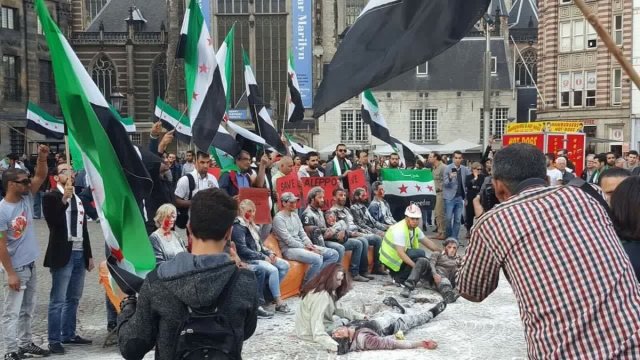
Recent protests held across North America and Europe staged by supporters of armed militants in Syria have staged scenes in Western streets eerily similar to those featured in the photos and videos of the US-European funded “Syrian Civil Defence” also known as the “White Helmets.”
 |
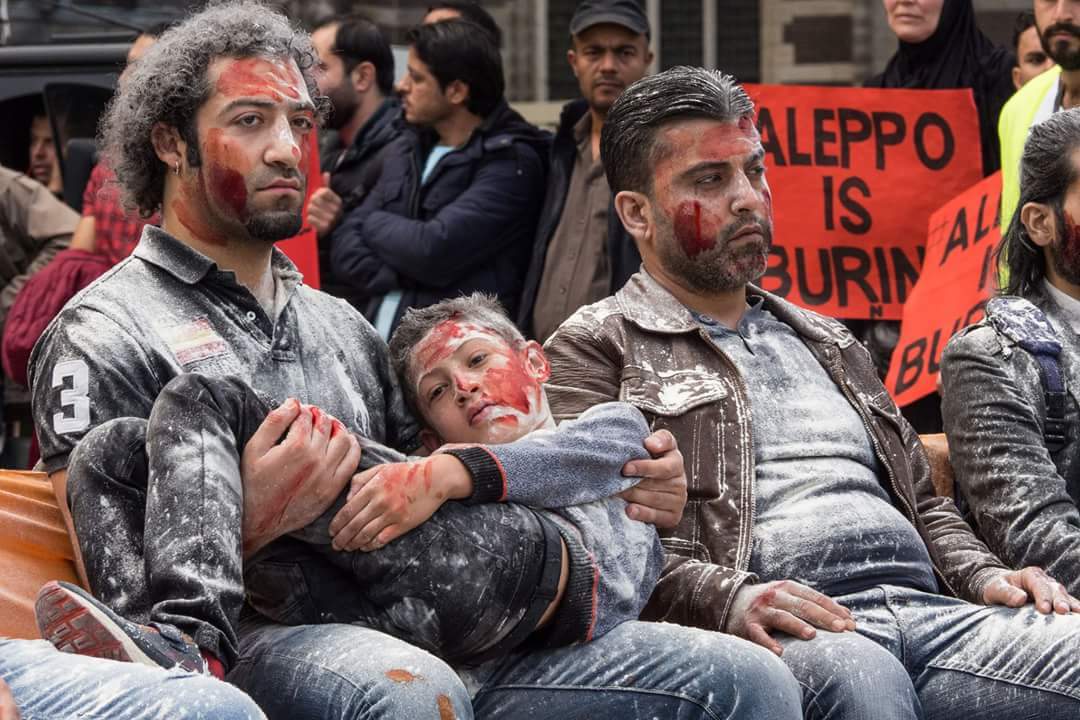
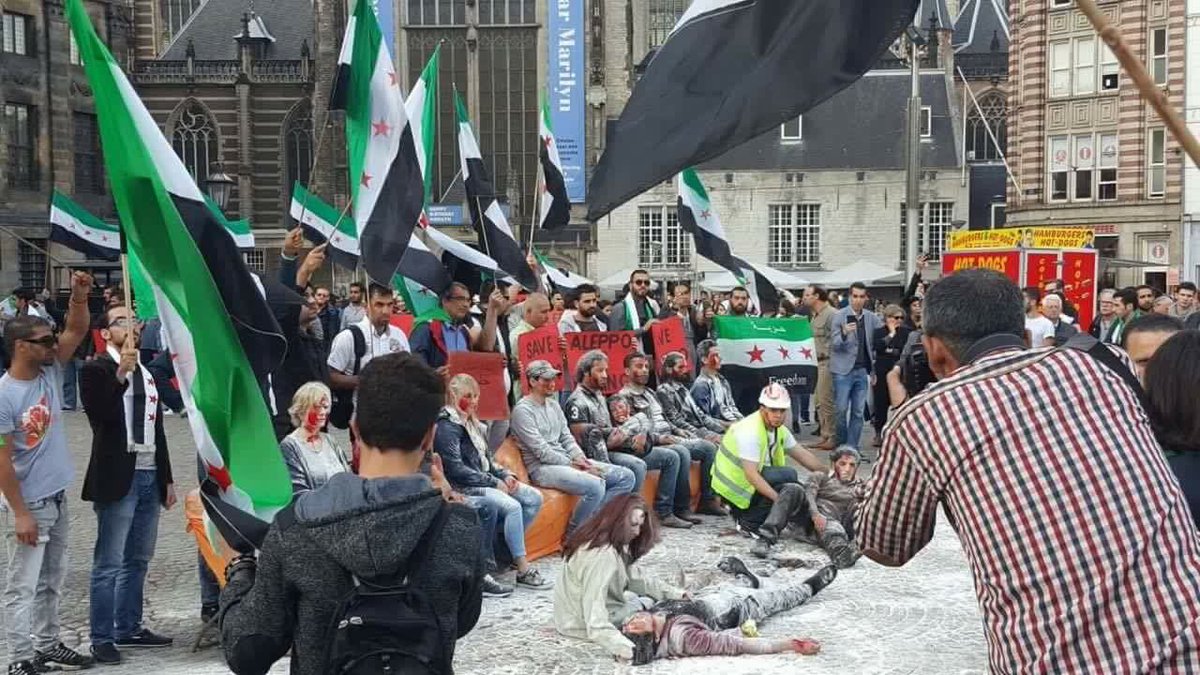
This is not Aleppo, Syria, but rather the streets of Europe where a recent “save Aleppo” protest was staged. Actors posing in fake dust and blood proved just how easy it is for anyone to create “war victims” anytime, anywhere.
|
Saudi state media, Al Arabiya English would report in an October 1, 2016 article titled, “Worldwide protest against Assad, Russia to ‘save Aleppo’,” that:
The stalling talks between international powers on Syria – with Russia ramping up its air raid campaign – has ignited worldwide protests calling for an end to the horror in Aleppo.
Protestors in Turkey, France, Netherlands, America and Canada took to the streets opposing Bashar al-Assad’s and Russia’s crimes in Aleppo, carrying posters that read “Stop bombing Aleppo” and “Save Aleppo”.
Al Arabiya’s ironic hand-wringing over Syria as Riyadh devastates Yemen with its own aerial bombardment and ground incursion, attempts to portray eastern Aleppo as a horrific cauldron where “where more than 250,000 civilians are trapped without food or clean water.”
And while undoubtedly war is raging in eastern Aleppo, it should be noted that the vast majority of Aleppo’s population – 1.75 million in fact – live in the government-controlled majority of Aleppo. But despite this reality, the West and its allies – including Saudi Arabia – have attempted to use their sway over international public opinion to exaggerate Syrian security operations and fabricate a “humanitarian catastrophe” to serve as yet another pretext for wider Western intervention.
Central to this appeal to public opinion has been the so-called “White Helmets,” also referred to as the “Syrian Civil Defence” despite the nation of Syria already having a legitimate, professional civil defense force.
Posing as an impartial rescue force, the “White Helmets” are transparently auxiliaries serving exclusively side-by-side armed militants including US State Department, UN, and EU designated foreign terrorist organizations. Their primary function is not “rescuing” anyone, but to manage a public relations campaign aimed at swaying public and political opinion, leveraging “humanitarian” sympathy worldwide.
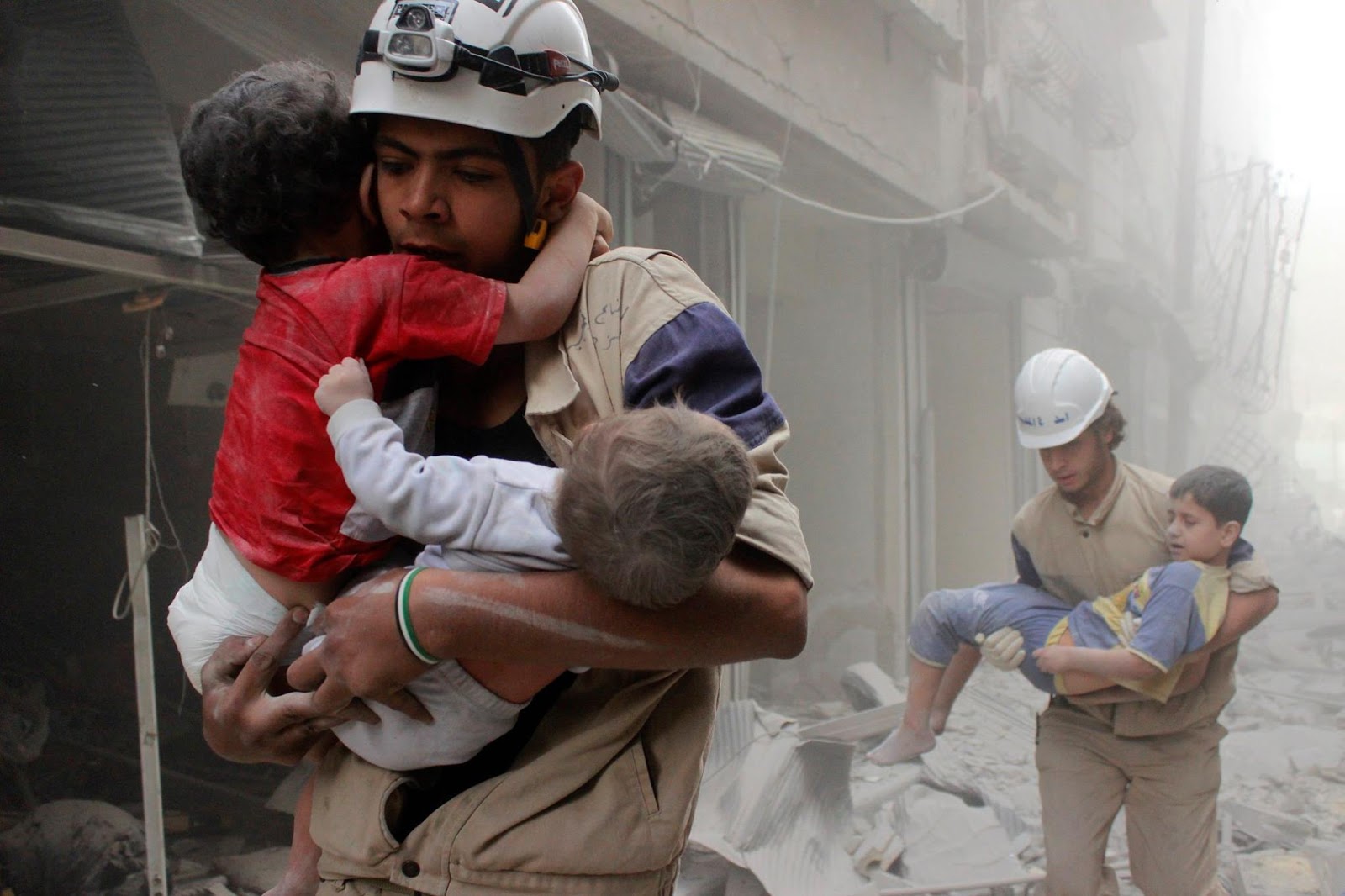
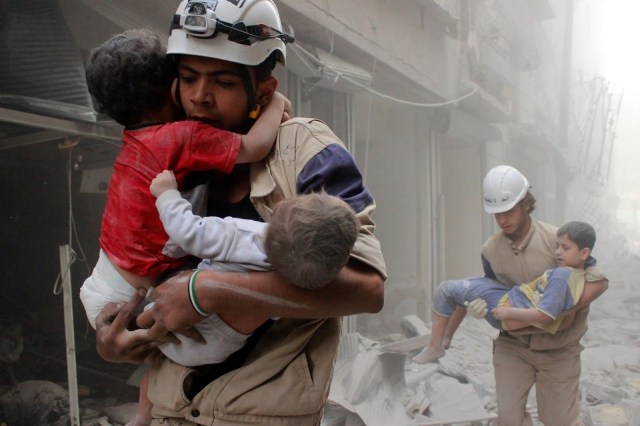
Their primary means of doing this is publishing photos and videos of their members – wearing elaborate, matching uniforms and driving brand new ambulances – pulling dust and blood covered victims from rubble allegedly brought down upon them by Syrian and Russian airstrikes.
The veracity of their photos, videos, and many claims have never been independently verified, and in many cases, evidence suggests that much of what they present to the public across their extensive, well-funded social media presence has been fabricated.
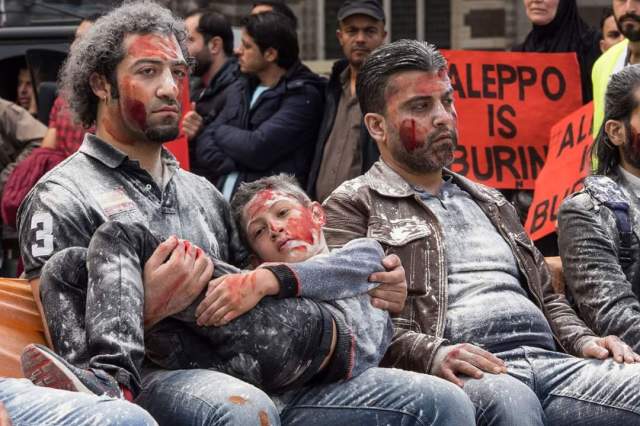
The recent coordinated “save Aleppo” protests held across Europe and North America, perhaps revealed just how transparently fabricated and fictional the “White Helmet’s” work really is. During one protest, photos retweeted by the official “White Helmet’s” Twitter account showed actors dressed up as “war victims,” covered in fake dust and blood, appearing almost indistinguishable from the alleged “victims” the “White Helmets” regularly “save” in Syria.
The protest, staged in European streets far from the Syrian conflict, even included children – likewise covered in fake dust and blood – cradled in the arms of adults, posing with despondent looks upon their faces. Also part of the staged scene were actors dressed like the “White Helmets” themselves.
 |
The only difference between admittedly staged scenes in European streets during a recent “save Aleppo” protest, and the daily output of the Western created and funded “White Helmets” acting troupe in Syria is that in Syria, the devastation of war provides a much more convincing “set” for the actors to perform on.
|
While the acting troupe that organized this protest may have thought they were cleverly “bringing the conflict to the streets of Europe” to invoke global sympathy for their cause, what they really proved was just how easy it really is for the “White Helmets” to create “war victims” anytime, anywhere.
In Syria, where years of US-backed violence has left many parts of the country devastated, such staged scenes playing out with the devastation of war as a backdrop become all the much more convincing. With “White Helmet” videos heavily edited before reaching the public, they are able to create tragic scenes of war, anytime, anywhere – even in the streets of Europe thousands of miles away from where Syrian and Russian warplanes are operating.
Their primary goal and that of the special interests funding them tens of millions of dollars, is to manipulate the hearts and minds of the global public in support of Western-backed armed militants – not “save lives” nor bring peace to Syria.
October 3, 2016
Posted by aletho |
Deception, Mainstream Media, Warmongering | European Union, Saudi Arabia, Syria, United States, White Helmets |
Leave a comment
On 29 April, 2016, Syria Solidarity Movement member Vanesa Beeley placed the following petition on Change.org. On or about 27 September, Change.org removed the petition, citing “violation of community standards”. What community standards? Judge for yourself.
DO NOT GIVE THE NOBEL PEACE PRIZE 2016 TO THE SYRIAN WHITE HELMETS
To do so would prolong the suffering of the Syrian people and reward the White Helmets for being US and UK Government funded and trained agents of “regime change” in Syria.
The White Helmets have received over $ 40 million in funding from the US Government [USAID] and the UK Foreign Office despite their claims of being “fiercely independent and accepts no money from governments, corporations or anyone directly involved in the Syrian conflict”
The UK and US governments are involved in the illegal war against Syria and are intent upon “regime change” in Syria, therefore they are “directly involved in the conflict”.
The White Helmets claim to be “unarmed and neutral” while embedded in areas occupied solely by Al Nusra [Al Qaeda] and ISIS.
They are armed.
They have been photographed and filmed supporting Al Nusra/Al Qaeda who are foreign mercenaries massacring the Syrian people.
The White Helmets foment sectarianism in Syria, calling for the “burning of Kafarya and Foua”, Shia villages in the Idlib area besieged for 5 years by US NATO backed terrorist mercenaries, Ahrar al Sham and Al Nusra.
The White Helmets have assisted in Al Nusra/Al Qaeda executions of civilians in Aleppo [please see evidence in the video]
The White Helmets have been responsible for the majority of anti Syrian Army and Government propaganda, calling for the familiar “No Fly Zone” which, if it had succeeded, would have reduced Syria to the same failed state scenario as we have seen in Libya.
The White Helmets leader, Raed Saleh has just been deported from the US where White Helmet backers USAID [US Government] were about to present him with an award. The US State Department have stated possible connections to “extremist organisations” as the reason.
However the US State Department have made the extraordinary statement that although the White Helmet leader and chief spokesperson to UN and White House is linked with terrorism, the White Helmet Group is miraculously unaffected.
Please bear in mind that George Bush destroyed Iraq and Libya on the pretext of nothing more than their “connections to Al Qaeda”
The White Helmets are Al Qaeda “with a facelift”. They are terrorism and neocolonialism under the umbrella of Humanitarianism.
For the sake of Syria, please do NOT give the Nobel Peace Prize to Al Qaeda aka the Syrian White Helmets.
With Steve Ezzedine’s video:
https://www.youtube.com/watch?v=8aAaReVn2I4
October 3, 2016
Posted by aletho |
Full Spectrum Dominance, Mainstream Media, Warmongering | Al-Nusra, al-Qaeda, Change.org, Syria, UK, United States, White Helmets |
Leave a comment
Washington’s quest for perpetual world power is underwritten by systematic and perpetual propaganda wars. Every major and minor war has been preceded, accompanied and followed by unremitting government propaganda designed to secure public approval, exploit victims, slander critics, dehumanize targeted adversaries and justify its allies’ collaboration.
In this paper we will discuss the most common recent techniques used to support ongoing imperial wars.
Propaganda Techniques of Empire
Role Reversal
A common technique, practiced by the imperial publicists, is to accuse the victims of the same crimes, which had been committed against them. The well documented, deliberate and sustained US-EU aerial bombardment of Syrian government soldiers, engaged in operations against ISIS-terrorist, resulted in the deaths and maiming of almost 200 Syrian troops and allowed ISIS-mercenaries to overrun their camp. In an attempt to deflect the Pentagon’s role in providing air cover for the very terrorists it claims to oppose, the propaganda organs cranked out lurid, but unsubstantiated, stories of an aerial attack on a UN humanitarian aid convoy, first blamed on the Syrian government and then on the Russians. The evidence that the attack was most likely a ground-based rocket attack by ISIS terrorists did not deter the propaganda mills. This technique would turn US and European attention away from the documented criminal attack by the imperial bombers and present the victimized Syrian troops and pilots as international human rights criminals.
Hysterical Rants
Faced with world opprobrium for its wanton violation of an international ceasefire agreement in Syria, the imperial public spokespeople frequently resort to irrational outbursts at international meetings in order to intimidate wavering allies into silence and shut down any chance for reasonable debate resolving concrete issues among adversaries.
The current ‘US Ranter-in-Chief’ in the United Nations, is Ambassador Samantha Power, who launched a vitriolic diatribe against the Russians in order to sabotage a proposed General Assembly debate on the US deliberate violation (its criminal attack on Syrian troops) of the recent Syrian ceasefire. Instead of a reasonable debate among serious diplomats, the rant served to derail the proceedings.
Identity Politics to Neutralize Anti-Imperialist Movements
Empire is commonly identified with the race, gender, religion and ethnicity of its practitioners. Imperial propagandists have frequently resorted to disarming and weakening anti-imperialist movements by co-opting and corrupting black, ethnic minority and women leaders and spokespeople. The use of such ‘symbolic’ tokens is based on the assumption that these are ‘representatives’ reflecting the true interests of so-called ‘marginalized minorities’ and can therefore presume to ‘speak for the oppressed peoples of the world’. The promotion of such compliant and respectable ‘minority members’ to the elite is then propagandized as a ‘revolutionary’, world liberating historical event – witness the ‘election’ of US President Barack Obama.
The rise of Obama to the presidency in 2008 illustrates how the imperial propagandists have used identity politics to undermine class and anti-imperialist struggles.
Under Obama’s historical black presidency, the US pursued seven wars against ‘people of color’ in South Asia, the Middle East and North Africa. Over a million men and women of sub-Saharan black origin, whether Libyan citizens or contract workers for neighboring countries, were killed, dispossessed and driven into exile by US allies after the US-EU destroyed the Libyan state — in the name of humanitarian intervention. Hundreds of thousands of Arabs have been bombed in Yemen, Syria and Iraq under President Obama, the so-called ‘historic black’ president. Obama’s ‘predator drones’ have killed hundreds of Afghan and Pakistani villagers. Such is the power of ‘identity politics’ that ignominious Obama was awarded the ‘Nobel Peace Prize’.
Meanwhile, in the United States under Obama, racial inequalities between black and white workers (wages, unemployment, access to housing, health and educational services) have widened. Police violence against blacks intensified with total impunity for ‘killer cops’. Over two million immigrant Latino workers have been expelled – breaking up hundreds of thousands of families — and accompanied by a marked increase of repression compared to earlier administrations. Millions of black and white workers’ home mortgages were foreclosed while all of the corrupt banks were bailed out – at a greater rate than had occurred under white presidents.
This blatant, cynical manipulation of identity politics facilitated the continuation and deepening of imperial wars, class exploitation and racial exclusion. Symbolic representation undermined class struggles for genuine changes.
Past Suffering to Justify Contemporary Exploitation
Imperial propagandists repeatedly evoke the victims and abuses of the past in order to justify their own aggressive imperial interventions and support for the ‘land grabs’ and ethnic cleansing committed by their colonial allies – like Israel, among others. The victims and crimes of the past are presented as a perpetual presence to justify ongoing brutalities against contemporary subject people.
The case of US-Israeli colonization of Palestine clearly illustrates how rabid criminality, pillage, ethnic cleansing and self-enrichment can be justified and glorified through the language of past victimization. Propagandists in the US and Israel have created ‘the cult of the Holocaust’, worshiping a near century-old Nazi crime against Jews (as well as captive Slavs, Roma and other minorities) in Europe, to justify the bloody conquest and theft of Arab lands and sovereignty and engage in systematic military assaults against Lebanon and Syria. Millions of Muslim and Christian Palestinians have been driven into perpetual exile. Elite, wealthy, well-organized and influential Zionist Jews, with primary fealty to Israel, have successfully sabotaged every contemporary struggle for peace in the Middle East and have created real barriers for social democracy in the US through their promotion of militarism and empire building. Those claiming to represent victims of the past have become among the most oppressive of contemporary elites. Using the language of ‘defense’, they promote aggressive forms of expansion and pillage. They claim their monopoly on historic ‘suffering’ has given them a ‘special dispensation’ from the rules of civilized conduct: their cult of the Holocaust allows them to inflict immense pain on others while silencing any criticism with the accusation of ‘anti-Semitism’ and relentlessly punishing critics. Their key role in imperial propaganda warfare is based on their claims of an exclusive franchise on suffering and immunity from the norms of justice.
Entertainment Spectacles on Military Platforms
Entertainment spectacles glorify militarism. Imperial propagandists link the public to unpopular wars promoted by otherwise discredited leaders. Sports events present soldiers dressed up as war heroes with deafening, emotional displays of ‘flag worship’ to celebrate the ongoing overseas wars of aggression. These mind-numbing extravaganzas with crude elements of religiosity demand choreographed expressions of national allegiance from the spectators as a cover for continued war crimes abroad and the destruction of citizens’ economic rights at home.
Much admired, multi-millionaire musicians and entertainers of all races and orientations, present war to the masses with a humanitarian facade. The entertainers smiling faces serve genocide just as powerfully as the President’s benign and friendly face accompanies his embrace of militarism. The propagandist message for the spectator is that ‘your favorite team or singer is there just for you… because our noble wars and valiant warriors have made you free and now they want you to be entertained.’
The old style of blatant bellicose appeals to the public is obsolete: the new propaganda conflates entertainment with militarism, allowing the ruling elite to secure tacit support for its wars without disturbing the spectators’ experience.
Conclusion
Do the Imperial Techniques of Propaganda Work?
How effective are the modern imperial propaganda techniques? The results seem to be mixed. In recent months, elite black athletes have begun protesting white racism by challenging the requirement for choreographed displays of flag worship… opening public controversy into the larger issues of police brutality and sustained marginalization. Identity politics, which led to the election of Obama, may be giving way to issues of class struggle, racial justice, anti-militarism and the impact of continued imperial wars. Hysterical rants may still secure international attention, but repeated performances begin to lose their impact and subject the ‘ranter’ to ridicule.
The cult of victimology has become less a rationale for the multi-billion dollar US-tribute to Israel, than the overwhelming political and economic influence and thuggery of billionaire Zionist fundraisers who demand US politicians’ support for the state of Israel.
Brandishing identify politics may have worked the first few times, but inevitably black, Latino, immigrant and all exploited workers, all underpaid and overworked women and mothers reject the empty symbolic gestures and demand substantive socio-economic changes – and here they find common links with the majority of exploited white workers.
In other words, the existing propaganda techniques are losing their edge – the corporate media news is seen as a sham. Who follows the actor-soldiers and flag-worshipers once the game has begun?
The propagandists of empire are desperate for a new line to grab public attention and obedience. Could the recent domestic terror bombings in New York and New Jersey provoke mass hysteria and more militarization? Could they serve as cover for more wars abroad …?
A recent survey, published in Military Times, reported that the vast majority of active US soldiers oppose more imperial wars. They are calling for defense at home and social justice. Soldiers and veterans have even formed groups to support the protesting black athletes who have refused to participate in flag worship while unarmed black men are being killed by police in the streets. Despite the multi-billion dollar electoral propaganda, over sixty percent of the electorate reject both major party candidates. The reality principle has finally started to undermine State propaganda!
October 2, 2016
Posted by aletho |
Ethnic Cleansing, Racism, Zionism, Mainstream Media, Warmongering, Militarism, Timeless or most popular | Obama, Samantha Power, Syria, United States, Zionism |
Leave a comment
US and EU sanctions against Syria are punishing the population and make aid work in the war-torn country almost impossible, a leaked UN report and internal letters have revealed.
The restrictive measures contributed to the destabilization of every sector of the economy in Syria that used to be self-sufficient before the war began in 2011.
The country now heavily depends on aid, which is hard to deliver as sanctions make medicine, food, fuel, spare parts and other essentials unreachable, a 40-page UN report, cited by The Intercept, stressed.
The paper entitled ‘Humanitarian Impact of Syria-Related Unilateral Restrictive Measures’ was published in mid-May, but The Intercept got hold of it now, adding other materials on the issue.
The report blasted US and EU restrictions as “some of the most complicated and far-reaching sanctions regimes ever imposed.”
According to the UN, the sanctions introduced by Washington are extremely harsh regarding provision of humanitarian aid. The American restrictions made money transfers into Syria almost impossible, preventing aid groups from paying salaries and purchasing supplies “in both government and besieged areas,” the report said. It stimulated the creation of a shady, unofficial network of money exchange, which is actively being used by Islamic State (IS, formerly ISIS/ISIL) and Jabhat al-Nusra terrorists.
The trade restrictions ban the export to Syria of all goods, containing at least 10 percent of US-made content. This puts the aid groups in a difficult situation as, in order to transfer specific items, they are forced to apply for a special license, which is very hard to obtain due to bureaucratic barriers, according to the report.
An internal UN email, also obtained by The Intercept, blamed the US and EU restrictions for food shortages in the country.
Wheat production has dropped 40 percent in the country since 2010, raising the price of wheat flour by 300 percent and rice – by 650 percent. An August letter from “a key UN official” also said that the restrictions were a “principal factor” in the crippling of the Syrian health care.
The medication factories, which weren’t destroyed during the hostilities, still had to close due to absence of raw materials and foreign currency caused by the sanction, the official wrote.
The Intercept contacted the US State Department on the issue, which refused to acknowledge any of the claims or that the sanctions are hurting civilians in Syria.
“US sanctions against [Syrian President Bashar] Assad, his backers, and the regime deprive these actors of resources that could be used to further the bloody campaign Assad continues to wage against his own people,” the State Department said in emailed response.
“The true responsibility for the dire humanitarian situation lies squarely with Assad, who has repeatedly denied access and attacked aid workers. He has the ability to relieve this suffering at any time, should he meet his commitment to provide full, sustained access for delivery of humanitarian assistance in areas that the U.N. has determined need it,” the email added.
Sanctions have been gradually introduced against Syria since 1979 when Washington labeled the country sponsor of terrorism. But the harshest restrictions came in 2011 when the uprising and military conflict in the country started.
READ MORE:
US ‘spare Nusra for plan B’ to change regime in Syria – Lavrov
October 2, 2016
Posted by aletho |
Economics | Human rights, Syria, United Nations, United States |
Leave a comment