Russia will be deploying S-400 missile defense systems to Syria, the Russian defense minister says.
“The S-400 anti-aircraft missile system will be deployed to the Hmeimim airbase,” Sergei Shoigu said on Wednesday, referring to the Russian airbase outside the port city of Latakia in western Syria.
The system is the most advanced one owned by Russia in the field of air defense. The missile system, an upgrade of the S-300 family, is capable of intercepting and destroying airborne targets such as aircraft and ballistic and cruise missiles at distances of up to 400 kilometers (250 miles).
The official’s remarks came a day after the Turkish Air Force shot down a Sukhoi Su-24M Fencer, which they had accused of having violated Turkish airspace. Russia denies the allegation.
Russian presidential press officer Dmitry Peskov also said Russian President Vladimir Putin had agreed with the proposal made by the Defense Ministry to transfer the missile systems to Hmeimim.
Also on Tuesday, Russian media reported that Russian missile cruiser Moskva equipped with the Fort air defense system, similar to S-300, will be stationed off the coast of Syria’s Latakia province.
Since September 30, Russia has been conducting aerial operations against Daesh, al-Nusra Front, and the other terrorist groups that have been sowing fear and destruction among the Syrian country’s civilian population.
Damascus has hailed the Russian military engagement, which came upon the Syrian government’s request saying that since the beginning of the campaign, terrorists had begun to retreat and flee in thousands.
The foreign-sponsored conflict in Syria has thus far claimed the lives of more than 250,000 people and left over one million injured, according to the United Nations.
A US-led coalition has also been pounding purported Daesh positions inside Syria without any authorization from Damascus or a United Nations mandate since last September. The mission has fallen severely short of dislodging the terrorists.
The navigator of the Russian Su-24 shot down by a Turkish fighter jet on Tuesday insists that his plane did not cross into Turkey’s airspace, and says he was given no visual or radio warning before being fired at.
“It’s impossible that we violated their airspace even for a second,” Konstantin Murakhtin told Russia’s Rossiya 1 channel. “We were flying at an altitude of 6,000 meters in completely clear weather, and I had total control of our flight path throughout.”
As well as denying Ankara’s assertions that the plane was in Turkey’s airspace, Murakhtin also refuted Turkish officials’ claims that the pilots were warned repeatedly.
“In actual fact there were no warnings at all. Neither through the radio, nor visually, so we did not at any point adjust our course. You need to understand the difference in speed between a tactical bomber like a Su-24, and that of the F16. If they wanted to warn us, they could have sat on our wing,” said Murakhtin, who is currently recuperating at Russia’s airbase in Latakia, northern Syria.
“As it was, the missile hit the back of our plane out of nowhere. We didn’t even have time to make an evasive maneuver.”
The downing of the Russian warplane, which aggressively violated Syria’s sovereignty, is proof to the world of Turkish support for terrorism. This has been going on for years, the Syrian foreign minister said.
“This incident has shown the world that [Turkish President Recep] Erdogan and his government are helping terrorists in Syria,” Walid Muallem said after meeting Speaker of the Russian Parliament Sergey Naryshkin.
Muallem expressed his condolences over the death of the Russian pilot and later a marine in the incident.
“We express our condolences over the actions of those terrorists, who Erdogan and his government support, who opened fire at the pilot as he was parachuting down. It was no less than a war crime,” he said.
“We are glad that the joint Russian-Syrian military operation resulted in a rescue of the second pilot,” he added.
Naryshkin said the attack on the Russian plane did not reflect what the Turkish people want from its leadership.
“We believe this act was treason by the Turkish leaders against their own people,” he said.
Turkey deliberately attacked the Russian warplane in revenge for the Russian antiterrorist campaign in Syria, according to the Syrian minister.
“The effort to destroy the forces of Islamic State [IS, formerly ISIS/ISIL] and other terrorist groups offended Turkey. That is why they aggressively violated Syria’s sovereignty and attacked the Su-24 in its airspace,” Muallem said.
He added that the results of the Russian campaign contrast the lack of progress demonstrated by the US-led coalition, including Turkey.
“In 18 months the US and its allies have conducted around 6,000 strikes against the terrorists, but they failed to undermine IS capabilities. On the contrary, they became stronger,” the Syrian diplomat said. “What the Russian [Air Force] do in Syria is a hundred times more than the actions of the US and its allies.”
Russia branded Turkey an accomplice of terrorism after the incident. Moscow believes Ankara wants to protect terrorist groups to continue the flow of cheap oil into the country, which profits some Turkish officials and the jihadists. While Moscow continues an effort to form a global coalition to fight against terrorism in the region, it believes the Turks won’t commit to it.
Russian Foreign Minister Sergei Lavrov has addressed journalists following the downing of the Russian Su-24 jet by an air-to-air missile launched from a Turkish F-16.
The Russian minister held a phone conversation with his Turkish counterpart Mevlut Cavusoglu earlier in the day.
“Moscow is not avoiding contacts with Ankara — my phone conversation with the Turkish FM is proof,” Lavrov said.
Turkey’s foreign minister expressed his sincere condolences to Sergei Lavrov, the Russian Foreign Minister said. But the Turkish minister tried to excuse the incident, Lavrov added.
The Turkish minister said that Turkey did not know it was a Russian jet.
“We have serious doubts it was an accident and prepared footage of the jet downing suggests it wasn’t,” Sergei Lavrov said. “It all looks like a planned provocation”.
The incident occurred following the airstrikes by Russian aviation on ISIL oil trucks.
At NATO’s meeting yesterday, strange words concerning Russia’s Su-24 jet tragedy were said. We received no condolences from NATO or the European Union, Sergei Lavrov said.
Let me remind you, Russian warplanes were in Syrian airspace. But even if a Russian jet crosses into Turkish airspace serious questions arise as to why Turkey did not use the emergency communication line with Russia before or after downing the Su-24 bomber jet, the Russian Foreign Minister added.
“I reminded him [Turkish foreign minister] that on Russia’s initiative a hotline between the Russian National Defense Control Center and the Turkish Defense Ministry was established. The line was established at the beginning of the Russian Aerospace Forces operation in Syria, and was used neither yesterday nor before that, which provokes serious questions,” Lavrov told the press.
Ankara has stated it was unaware that the aircraft belonged to Russia.Lavrov also said he recalled a 2012 statement by Turkish President Recep Tayyip Erdogan during the phone talk with Cavusoglu. The Turkish leader said back then that a short violation of airspace was not a pretext to use force.
“I reminded my Turkish colleague of this statement and he could not reply to this either, just repeating that they did not know what kind of aircraft this was,” the Russian minister said.
The minister also wondered if Turkey has coordinated its actions with the United States.
“I wonder whether Turkey consulted the US before downing any jet in the Syrian airspace,” he said.
Russia is still expecting apology from Turkey over the downing of the Russian Su-24 bomber jet over Syria.
“We’re not going to wage a war against Turkey,” Sergei Lavrov said answering a question from a journalist.
According to the Russian foreign minister, “the attitude toward Turkish people has not changed.”
“We have questions only to the current Turkish government,” Lavrov noted.
But Russia will seriously reassess all agreements with Turkey, he added. As for specific measures, we’ve recommended our citizens not to travel to Turkey, Lavrov said.
“In regard to the current level of our relations and agreements that we have concluded with the Turkish government currently in force in Ankara, as the [Russian] president has said, we will seriously reassess and review everything that is going on in our relations taking into count the attack that was delivered against our airplane,” Lavrov said at a press conference.
Too many indicators showing terrorist threats have appeared on Turkish soil, Russian Foreign Minister Sergei Lavrov said Wednesday.
“We cannot leave everything that has happened without a reaction not because we have to respond somehow, that’s not it. Actually there have been too many indicators on Turkish soil that show a direct terrorist threat to our citizens,” Lavrov said at a press conference.
Russia may raise the issue in the UN Security Council of developing an overall understanding on the fight against channels of equipping and financing militants in Syria, Russian Foreign Minister Sergei Lavrov said Wednesday.
“I think that now we will insist on not just a list of members of this group, but also agree on the overall understanding of the channels the terrorists use to get their feedlines and support,” Lavrov said during a press conference.
“We will somehow probably have to deal with certain countries so that this support ends,” Lavrov added.
Russia tried to persuade Turkey to take a more balanced position on the Syrian crisis, Russian Foreign Minister Sergei Lavrov said in an interview with Russian and foreign media.
According to Lavrov, Moscow “did not try to turn a blind eye” to the fact that Islamists are using Turkey as a platform to prepare terrorist acts in Syria and other countries.”We tried to take into account the interests of our Turkish neighbors and tried to explain our positions in a dialogue,” the Foreign Minister said.
“We tried to persuade them to conduct a more balanced policy not aimed only at getting rid of Assad at any cost and thus cooperating with all kinds of extremist groups,” the foreign minister stressed.
Moscow backs the proposal of French President Francois Hollande to close the Turkish-Syrian border, Sergei Lavrov said.
“I think this is the right decision. I hope President Hollande will tell us more about the issue tomorrow. We would be ready to consider all measures that needed for this [closing the border]. By closing the border we will basically thwart the terrorist threat in Syria,” the minister said.
Earlier Russia’s top diplomat cancelled his visit to Turkey after a Russian Su-24 jet was downed over Syria.
“The president clearly stated that this could not but affect Russian-Turkish relations. In this context, it was decided to cancel the meeting between Russia’s and Turkey’s ministers of foreign affairs, which was planned for tomorrow [November 25] in Istanbul,” Sergei Lavrov told journalists on Tuesday.
On Tuesday, a Russian Su-24 jet crashed in Syria. Russian President Vladimir Putin said that the plane was downed over Syrian territory by an air-to-air missile launched by a Turkish F-16 jet, and fell 4 kilometers (2.5 miles) from the Turkish border. Putin described the Turkish attack as a “stab in the back” carried out by “accomplices of terrorists.”
The Su-24 tragedy also claimed the life of a naval infantry soldier, who was killed in the rescue operation, according to the Russian General Staff.
Prime Minister David Cameron must examine financial links between UK-allied Gulf regimes and terror groups, or risk facing awkward questions about Conservative Party links to “rich Arab Gulf individuals,” says former Liberal Democrat leader Paddy Ashdown.
Speaking on ITV’s Lorraine program on Tuesday, Ashdown – who is also a former soldier and has served as an ambassador to Afghanistan and Bosnia – said he is deeply concerned about how terrorism and Islamic State (IS, formerly ISIS/ISIL) are being funded, and the UK government’s response to this.
“Who is arming ISIS, who is providing safe havens for ISIS? To get there you have to ask questions about the arms everyone’s sold in the region, the role of Saudi Arabia in this. I think there are some very big questions and we have to be careful,” Ashdown said.
He said there had been a “failure to put pressure on the Gulf states, especially Saudi Arabia and Qatar, to stop funding the Salafists and Wahhabists,” and said he is worried “about the closeness of the Conservative Party and rich Arab Gulf individuals.”
He hinted the strategic priorities of the UK in Syria are the wrong way around. “I think we should be impatient about the removal of ISIL and I think we should be more patient about the removal of Assad.”
Ashdown’s calls for a proper investigation into terror funding by the West’s Arab allies echo, to some extent, those of Labour Party leader Jeremy Corbyn.
Speaking to the House of Commons last Wednesday, the Labour leader urged Parliament to take more action to clamp down on institutions which provide “vital infrastructure” to the terror group in Syria and Iraq.
Corbyn said one of the main ways to stop IS from functioning is to cut off its resources, suggesting the EU would also need to play a part in suffocating the organization.
“Surely a crucial way to help defeat ISIL is to cut off its funding, its supply of arms, and its trade,” Corbyn said during prime minister’s questions (PMQs).
“Can I press the prime minister to ensure that our allies in the region, indeed all countries in the region, are doing all they can to clamp down on individuals and institutions in their countries who are providing ISIL with vital infrastructure?”
Moscow plans to suspend military cooperation with Ankara after the downing of a Russian bomber by Turkish air forces, Russian General Staff representatives said on Tuesday. Further measures to beef up Russian air base security in Syria will also be taken.
Sergey Rudskoy, a top official with the Russian General Staff, condemned the attack on the Russian bomber in Syrian airspace by a Turkish fighter jet as “a severe violation of international law”. He stressed that the Su-24 was downed over the Syrian territory. The crash site was four kilometers away from the Turkish border, he said.
Rudskoy said the Russian warplane did not violate Turkish airspace. Additionally, according to the Hmeymim airfield radar, it was the Turkish fighter jet that actually entered Syrian airspace as it attacked the Russian bomber.
The Turkish fighter jet made no attempts to contact Russian pilots before attacking the bomber, Rudskoy added.
A Russian Mi-8 helicopter came under attack while conducting a search and rescue operation, searching for the crew of the downed Su-24 in Syria. One naval infantry soldier was reported killed, the helicopter destroyed by mortar fire.
The Russian General Staff said that two Mi-8s were involved in the operation to save the crew of the downed Su-24.
One helicopter has been shot down, its crew evacuated to the Russian base at Hmeymim.
“A search and rescue operation involving two Mi-8 helicopters was carried out, charged with evacuating the pilots from the landing site. During the operation, as a result of small-arms fire, one of the helicopters was damaged, and forced to make a landing on neutral territory. One naval infantry soldier was killed,” Lieutenant-General Sergei Rudskoi, the head of the Main Operations Directorate of the General Staff of the Russian Armed Forces, told reporters on Tuesday.
The officer noted that the “personnel from the search and rescue team and the helicopter’s crew have been evacuated and are now located at the Hmeymim air base. The downed helicopter was destroyed by mortar fire from territory controlled by armed gangs.”
“The search and rescue operation tasked with finding the crew of the downed Russian bomber continues,” Rudskoi added, emphasizing that the territories in which the operation was conducted is believed to be controlled by radical rebel groups.
A Russian Su-24 Fencer jet crashed in Syria earlier in the day with two people aboard. Ankara claims that its F-16s shot down the plane because it violated the country’s airspace. Russia has countered Turkey’s accusations, President Vladimir Putin saying that the aircraft was 0.6 miles away from the Turkish border when it was shot down.
According to the Russian leader, the crashed aircraft was not posing any threat to Turkey when it was struck by an air-to-air missile from the Turkish jet.
The Al-Nusra Front, Al-Qaeda’s affiliate in Syria, has released a grateful video, where they openly thank the Free Syrian Army (FSA), which the US has touted as a “moderate opposition group”, for supplying them with US-made anti-tank TOW missiles (“Tube-launched, Optically tracked, Wire-guided”).
A recently released video shows an Al-Nusra Front field commander thanking the FSA commanders for giving his forces TOW missiles, according to a report released by the Iranian news agency FARS.
The agency reminds readers that the two groups, the Al-Nusra and the FSA, formed an alliance in March, the Army of Conquest, or Jaish al-Fatah in Arabic, to fight against the forces of President Assad.
Since then, they have fought together “at almost every single battle in Aleppo, Lattakia, Hama, and Idlib Governorates of Syria.”
Through this alliance several militant groups like the Al-Nusra Front and the Ahrar al-Sham movement have been given access to FSA’s US-made heavy weaponry, which has been supplied to the militant group by the US, Saudi Arabia and Qatar.
According to the agency’s estimates, Saudi Arabia sent 500 TOW missiles to Al-Nusra directly last month.
The US, however, claims that it is just supplying aid and weapons to FSA or the so-called moderate militant groups in Syria.
The BGM-71 TOW is one of the most widely-used guided anti-tank missiles. The weapon is used in anti-armor, anti-bunker, anti-fortification and anti-amphibious landing roles.
TOW missiles are used by the armed forces of more than 40 countries and are integrated in over 15,000 ground, vehicle and helicopter platforms worldwide.
In shooting down a Russian jet operating over Syria, Turkey’s nefarious role in the Syrian conflict has intensified. It also presents a damning indictment of the West’s seriousness in confronting extremism and terrorism.
In the aftermath of the spate of ISIS atrocities – first the downing of the Russian passenger plane, Metrojet Flight 7K9268 over the Sinai at the end of October, killing all 224 on board, followed by the killing of 43 civilians in Beirut in a suicide bomb attack, and most recently the slaughter of 130 people in Paris in multiple suicide bombings and shootings – we now know who is serious about confronting this medieval death cult and who is not.
More, we are starting to uncover those who speak the language of anti-terrorism while in practice working to facilitate and support it.
Turkey is a key culprit in this regard. A murky relationship has long existed between Ankara, ISIS, al Nusra, and other jihadi groups operating in Syria. Indeed, on the most basic level, without their ability to pass back and forth across the Turkish border at will, those groups could not have operated as easily and effectively as they had until Russia intervened.
However, according to a report by David L Phillips of Columbia University, Turkey’s support for extremist groups operating in Syria, including ISIS has been even more extensive than previously thought. Drawing on a wide variety of sources, Phillips reveals that the Turkish government, a member of NATO and a key Western ally, has been involved in helping ISIS with recruitment, training, and has provided it with intelligence and safe havens and sanctuary. Most recently it has been exposed as a major customer for stolen Syrian oil, supplied by the terrorist group.
Perhaps the most damning evidence contained in the report when it comes to Turkey’s role, is in relation to its actions and inaction when it came to the siege of the Kurdish town of Kobani on the Syrian-Turkish border in September and October of 2014.
As Phillips reveals: “Anwar Moslem, Mayor of Kobani, said on September 19, 2014: ‘Based on the intelligence we got two days before the breakout of the current war, trains full of forces and ammunition, which were passing by north of Kobani, had an-hour-and-ten-to-twenty-minute-long stops in these villages: Salib Qaran, Gire Sor, Moshrefat Ezzo. There is evidence, witnesses, and videos about this. Why is ISIS strong only in Kobani’s east? Why is it not strong either in its south or west? Since these trains stopped in villages located in the east of Kobani, we guess they had brought ammunition and additional force for the ISIS.’ In the second article on September 30, 2014, a CHP delegation visited Kobani, where locals claimed that everything from the clothes ISIS militants wear to their guns comes from Turkey.”
The world will never forget how, during the siege of Kobani, as its Kurdish defenders mounted a heroic defense of the town against thousands of ISIS fighters, armed with tanks and artillery, Turkish tanks and troops sat just over the border and did nothing to intervene.
Likewise, no one will forget that earlier this year Turkey carried out airstrikes against those same Kurdish volunteers of the PKK/YPG within Syria, while depicting them as terrorists. Turkey’s oppression of its Kurdish minority going back many years is of course a matter of record.
President Erdogan and his government has undeniably been a key in the destabilization of Syria, doing its utmost to foment regime change. As with the Saudis and other Gulf monarchies, before Russia’s intervention Turkey was hovering over Syria as a vulture hovers over a dying animal, waiting for it to perish before descending to feed on its carcass.
The fact that Turkey remains a key Western ally exposes the moral high ground from which Washington and its allies have lectured Russia over its role in Syria as nothing more than a dung-heap of hypocrisy.
If the West was serious about confronting terrorism, was serious about returning stability to a region it has helped to set on fire, it would reconsider its close ties to both Turkey and the Saudis, whose governments between them have been wading in the river of blood they have helped shed these past four years. Turkey’s claim that the Russian military aircraft it shot down had encroached on its airspace and ignored multiple warnings should be treated with the credibility it deserves, especially when we recall that prior to Russia’s participation in the conflict, Turkey’s violation of Syrian airspace and the Syrian border was happening on a regular basis.
With Russia’s presence in Syria having put paid to Erdogan’s objective of toppling the Syrian government, we begin to discern its efforts to enlist the support of NATO in putting pressure on Russia to desist. It also helps to explain why the West continues to refuse President Putin’s call for cooperation and unity in the effort to eradicate ISIS and other extremist groups massacring and slaughtering their way across the country, with the intention of turning it into a mass grave.
In the wake of the recent spate of ISIS atrocities unleashed against Russian, Lebanese, and French civilians, the grounds for refusing to enter such an alliance are as indefensible as Turkey’s role in the conflict and its most recent action in shooting down a Russian aircraft.
As the man said: “Those who sow the wind shall reap the whirlwind.”
John Wight has written for newspapers and websites across the world, including the Independent, Morning Star, Huffington Post, Counterpunch, London Progressive Journal, and Foreign Policy Journal. He is also a regular commentator on RT and BBC Radio. He wrote a memoir of the five years he spent in Hollywood, where he worked in the movie industry prior to becoming a full time and activist and organizer with the US antiwar movement post-9/11. The book is titled “Dreams That Die” and is published by Zero Books. John is currently working on a book exploring the role of the West in the Arab Spring. You can follow him on Twitter @JohnWight1
The problem with America’s “anti-ISIS coalition” is not a matter of poor planning or a lack of resources. It is not a matter of lacking leadership or military might. The problem with America’s “anti-ISIS coalition” is that it never existed in the first place. There is no US-led war on ISIS, and what’s worse, it appears that the US, through all of its allies, from across the Persian Gulf to Eastern Europe and even within Washington itself, are involved in feeding ISIS, not fighting it.
Going from Syria itself, outward according to geographical proximity, we can trace ISIS’ support all the way back to Washington itself. And as we do, efforts like the “talks” in Vienna, and all the non-solutions proposed by the US and its allies, appear ever more absurd while the US itself is revealed not as a stabilizing force in a chaotic world, but rather the very source of that chaos.
In Syria
Within Syria itself, it is no secret that the US CIA is arming, training, funding and equipping militant groups, groups the US now claims Russia is bombing instead of “ISIS.” However, upon reading carefully any report out of newspapers in the US or its allies it becomes clear that these “rebels” always seem to be within arms reach of listed terrorist organizations, including Jabhat al Nusra.
Al Nusra is literally Al Qaeda in Syria. Not only that, it is the terrorist organization from which ISIS allegedly split from. And while the US has tried to add in a layer of extra plausible deniability to its story by claiming Nusra and ISIS are at odds with one another, the fact is Nusra and ISIS still fight together on the same battlefield toward the same objectives.
And while we’ll get to who is propping up these two terrorist groups beyond Syria’s borders, it should be noted that the US and European media itself has reported a steady flow of weapons and fighters out from its own backed “rebel” groups and into the ranks of Nusra and ISIS.
Syrian rebels trained by the United States gave some of their equipment to the al Qaeda-linked Nusra Front in exchange for safe passage, a U.S. military spokesman said on Friday, the latest blow to a troubled U.S. effort to train local partners to fight Islamic State militants.
The rebels surrendered six pick-up trucks and some ammunition, or about one-quarter of their issued equipment, to a suspected Nusra intermediary on Sept. 21-22 in exchange for safe passage, said Colonel Patrick Ryder, a spokesman for U.S. Central Command, in a statement.
Abu Ahmed and others say the FSA has lost fighters to al-Nusra in Aleppo, Hama, Idlib and Deir al-Zor and the Damascus region. Ala’a al-Basha, commander of the Sayyida Aisha brigade, warned the FSA chief of staff, General Salim Idriss, about the issue last month. Basha said 3,000 FSA men have joined al-Nusra in the last few months, mainly because of a lack of weapons and ammunition. FSA fighters in the Banias area were threatening to leave because they did not have the firepower to stop the massacre in Bayda, he said. Advertisement
The FSA’s Ahrar al-Shimal brigade joined al-Nusra en masse while the Sufiyan al-Thawri brigade in Idlib lost 65 of its fighters to al-Nusra a few months ago for lack of weapons. According to one estimate the FSA has lost a quarter of all its fighters.
Al-Nusra has members serving undercover with FSA units so they can spot potential recruits, according to Abu Hassan of the FSA’s al-Tawhid Lions brigade.
Taken together, it is clear to anyone that even at face value the US strategy of arming “moderate rebels” is a complete failure and that to continue proposing such a failed strategy is basically an admission that (in fact) the US seeks to put weapons and trained fighters directly into the ranks of Al Nusra and other hardcore terrorist groups. Of course, in reality, that was the plan all along. So even before our journey leaves Syria, we see how the US is feeding, not fighting terrorism, completely and intentionally.
Turkey
And of course, before many of the fighters even reach the battlefield in Syria, they have spent time training, arming up and staging in Turkey and Jordan. There has been a lot of talk in Washington, London and Brussels about establishing safe havens in Syria itself for this army of rebel-terrorists, but in reality, Turkey and Jordan have served this purpose since the war began in 2011. All the US and its allies want to do now is extend these safe havens deeper into Syrian territory.
But before that, a steady stream of supplies, weapons and fighters have been pouring over the border, provided by the Persian Gulf monarchies (Saudi Arabia and Qatar in particular) and with the explicit complicity of the Turkish government.
German broadcaster Deutsche Welle videotaped hundreds of trucks pouring over the Turkish border, bound for ISIS in Syria as part of its story, “ISIS and Turkey’s porous borders” (video here). It was not a scene one would describe as “smuggling” behind the back of Turkish authorities, but rather a scene reminiscent of the Iraq War where fleets of trucks openly supported the full-scale invasion of Iraq by America’s military.
Turkey’s borders aren’t merely porous, they are wide open, with the Turkish government itself clearly involved in filling up the fleets of supply trucks bound for ISIS on a daily basis.
In recent days, as Russia has begun decimating fleets of these trucks, and in particular, oil tankers that, instead of bringing supplies into Syria, are stealing oil for export beyond Syria’s borders, there has been talk about just who this oil is being sold to. Turkey’s name comes up yet again.
Most of the oil is bought by local traders and covers the domestic needs of rebel-held areas in northern Syria. But some low-quality crude has been smuggled to Turkey where prices of over $350 a barrel, three times the local rate, have nurtured a lucrative cross-border trade.
And if some readers don’t find the argument that ISIS sustains itself from within Turkish territory entirely convincing, perhaps a direct admission from the US State Department itself might help. Its Voice of America media network recently reported in an article titled “US, Turkey Poised for Joint Anti-ISIS Operation, Despite Differences” that:
Some have even suspected the Turkish government of cooperating with IS, making allegations that range from weapons transfers to logistical support to financial assistance and the provision of medical services. The Cumhuriyet daily this week published stories that alleged Turkish Intelligence was working hand-in-hand with IS. A former IS spy chief told the paper that during the siege of the Syrian city of Kobani last year, Turkish Intelligence served McDonald’s hamburgers to IS fighters brought in from Turkey.
Some analysts say the pending border operation could help silence some of the criticism.
That the US is still working openly with Turkey despite increasing evidence that Turkey itself is sustaining ISIS in Syria, indicates that the US itself is also interested in perpetuating the terrorist group’s activities for as long as possible/plausible.Eastern Europe
Those nations in Eastern Europe who have either joined NATO or now aspire to, also appear to be directly involved. The large torrent of weapons needed to sustain ISIS’ terrorism within Syria cannot, as a matter of managing public perception, appear to be coming entirely from US arsenals themselves (though hundreds of TOW missile systems and M16s do regularly show up in the hands of Nusra, ISIS and other terrorists organizations). Instead, Soviet bloc weapons are needed and to get them, the US has tapped NATO members like Croatia and aspiring NATO member Ukraine to help arm its ISIS legions.
Although rebel commanders and the data indicate that Qatar and Saudi Arabia had been shipping military materials via Turkey to the opposition since early and late 2012, respectively, a major hurdle was removed late last fall after the Turkish government agreed to allow the pace of air shipments to accelerate, officials said.
Simultaneously, arms and equipment were being purchased by Saudi Arabia in Croatia and flown to Jordan on Jordanian cargo planes for rebels working in southern Syria and for retransfer to Turkey for rebels groups operating from there, several officials said.
One wonders how many of these weapons “coincidentally” ended up in Nusra or ISIS’ hands.
More recently, the NATO-installed junta in Ukraine has been implicated not in supplying weapons to ISIS by proxy, but supplying them to ISIS much more directly after a high-profile bust was made in Kuwait implicating Kiev.
The Ukrainian military has denied knowledge of how its weapons made it into the hands of Islamic State group terrorists. Lebanese citizen Osama Khayat, who was arrested this week in Kuwait with other suspects, said he purchased arms in Ukraine that were meant to be delivered to the militant group in Syria via smuggling routes in Turkey.
Perhaps readers notice a pattern. Washington is using its vast global network and allies to arm and fund terrorists in Syria, supported by massive logistical networks flowing through Turkey and to a lesser extent, Jordan. Everyone from America’s allies in Kiev and Zagreb, to Riyad and Doha, to Ankara and Amman are involved which goes far in explaining just how ISIS got so powerful, and why it still remains so powerful despite its widening war on what appears to be the entire world.
The United States
And all of this brings us back to Washington itself. Surely Washington notices that each and every single one of its allies is involved in feeding, not fighting ISIS. When each and every one of its allies from Kiev to Ankara are involved in arming and supplying ISIS, Washington not only knows, it is likely orchestrating it all to begin with.
If the situation unravels there is the possibility of establishing a declared or undeclared Salafist principality in eastern Syria (Hasaka and Der Zor), and this is exactly what the supporting powers to the opposition want, in order to isolate the Syrian regime, which is considered the strategic depth of the Shia expansion (Iraq and Iran).
If, at this point, one is unclear on just who these “supporting powers to the opposition” are, the DIA report itself reveals it is the West, NATO (including Turkey) and its allies in the Persian Gulf.
This Salafist (Islamic) principality (state), or ISIS for short, was not an indirect consequence of US foreign policy, it was (and still very much is) a concerted conspiracy involving multiple states spanning North America, Europe, and the Middle East. It could not exist otherwise.
While Russia attempts to reach westward to piece together an inclusive coalition to finally put an end to ISIS, it is clear that it does so in vain. Washington, Brussels and their regional allies in the Middle East have no intention of putting an end to ISIS. Even today, this very moment, the US and its allies are doing everything within their power to ensure the survival of their terrorist armies inside of Syria for as long as possible before any ceasefire is agreed to. And even if a peace settlement of some sort is struck, all it will do is buy Syria time. No matter how much damage Russia and its genuine coalition consisting of Iran, Iraq and Lebanon deal ISIS within Syria, the networks that fed it from Turkey, Jordan, the Persian Gulf, Eastern Europe and Washington itself remain intact.
One hopes that these networks can be diminished through the principles of multipolarism within the time being bought for Syria through the blood, sacrifice and efforts of Syrian soldiers and Russian airmen.
Ulson Gunnar is a New York-based geopolitical analyst and writer.
US Secretary of State John Kerry has urged “faster” and broader American military and political intervention in Syria to fight against Daesh (ISIL).
“The key is to destroy Daesh rapidly in Syria and in Iraq,” Kerry told reporters on Monday. “The president would like to see us go faster.”
Prior to the Daesh attacks in Paris that killed 132 people, President Barack Obama had taken notable steps towards a military escalation in Syria by sending 50 Special Operations forces to Syria, Kerry said.
However, he did not outline any post-Paris additions to those policies.
Kerry made the comments after meeting Abu Dhabi’s crown prince, Sheikh Mohammed bin Zayed al-Nahyan in the UAE’s Abu Dhabi.
The top US diplomat ruled out the notion of a no-fly zone in Syria, recently reiterated by his predecessor Hillary Rodham Clinton, saying it was “not a new idea.”
He also hinted at possible cooperation with Russia against Daesh, providing that Russia stops supporting Syrian President Bashar al-Assad.
He said that new cooperation “has to be done in a way that manages the passions and the disappointment” of US-backed militants fighting Assad.
The US is escalating its involvement in Syria amid Russia’s intensifying campaign in the country to assist Assad in fighting against ISIL terrorists.
Daesh terrorists, who were initially trained by the CIA in Jordan in 2012 to destabilize the Syrian government, now have parts of Syria and Iraq under control.
A Russian Su-24 fighter has been shot down in Syria, the Russian Defense Ministry said, adding the plane hadn’t violated Turkish airspace and was flying at an altitude of 6,000 meters.
“During the flight, the aircraft was flying within the borders of Syria, which was registered by objective monitoring data,” the ministry said, adding that the aircraft was “supposedly shot down from the ground.”
The pilots managed to eject, the ministry said, adding their fate is as yet unknown.
The downing of the Russian plane is “a very serious incident,” said Vladimir Putin’s spokesman Dmitry Peskov. He added, however, that it is too early to draw conclusions until the whole situation is clear.
Reports of a downed plane emerged earlier in Turkish media. A Habertürk TV reporter on the scene said the aircraft “turned into a fireball.” Numerous witnesses wrote on social media, saying thick plumes of smoke have been rising from the jet crash site.
Turkish military added the plane had been warned at least 10 times over a period of five minutes before being shot down by two Turkish F-16 fighter jets. He said the plane had violated Turkish airspace.
The plane reportedly crashed in a village mostly populated by Syrian Turkmen. The place has been a hotspot between the opposition and the Syrian Army.
Turkish Prime Minister Ahmet Davutoglu has met with officials from the Foreign Ministry. He instructed them to consult with NATO and the UN on the latest developments on the Syrian border, Davutoglu’s office said in a statement.
The Russian Su24 military jet was shot down by a Turkish F-16 over Syrian territory while returning to Khmeimim airbase, the Russian Defense Ministry has confirmed.
The Ministry’s Twitter says that “analysis of the objective monitoring data” showed the downed SU-24 jet did not violate Turkish air space.
Earlier in the day, Russian President Vladimir Putin said he regards the downing of the SU-24 as “a stab in the back” by “terrorist accomplices,” adding that Turkey gets the flow of oil from Islamic State-controlled territories.
President Putin said the SU-24 pilots “were conducting an operation to fight ISIS in northern Latakia which is a mountainous area where the rebels – mostly from the Russian Federation – are stationed. In this sense they were carrying out their duty to make preventive strikes on terrorists who could return to Russia at any time.”
The president said Russia had always treated Turkey as a friendly state, but concluded: “This tragic event will cause serious consequences for Russian-Turkish relations. […] I don’t know who was in need of what was done today, at any rate, it wasn’t us.”
The SU-24 tactical bomber jet was downed on Tuesday morning after being hit by an air-to-air missile fired from a Turkish F-16 fighter jet.
Both pilots managed to eject, but were reportedly shot while parachuting by rebels from the ground. Video footage released by the rebels shortly afterwards shows the dead body of a Russian pilot being inspected by armed men. A Russian air rescue team from Latakia airbase is still airborne searching for the other pilot.
Leader of UK opposition Labour Party Jermey Corbyn has once against warned against British military action in Syria, saying that negotiated settlement is the best way to resolve the crisis in the Arab country.
“The experience of Afghanistan, Iraq and Libya has convinced many of our own people that the elite’s enthusiasm for endless military interventions has only multiplied the threats to us – while leaving death and destabilisation in their wake… It is the conflict in Syria and the consequences of the Iraq war which have created the conditions for Isis to thrive and spread its murderous rule,” Corbyn said in a speech to Labour activists in Bristol.
He also slammed Britain’s involvement in “a succession of disastrous wars that have brought devastation to large parts of the wider Middle East,” saying such intervention has made the UK less secure from attack.
Corbyn also pointed to the recent terror attacks in Paris and said there should be a “negotiated settlement” rather than military action to tackle the crisis in the country.
His comments have already sparked a backlash from Labour Party MPs.
Jeremy Corbyn is seen as a long-standing opponent to the Western wars in Iraq, Afghanistan and Libya.
Meanwhile, a London-based political commentator says any possible UK intervention in Syria will increase the number of refugees and deepen the crisis in the Arab country.
Chris Bambery says such an intervention will simply strengthen the ISIL.
“Any further Western intervention will only add to the chaos which Western intervention has [already] caused and the beneficiary of that chaos is ISIS. ISIS wants the Western intervention,” Chris Bambery told Press TV.
By Jamal Kanj – Intifada-Palestine.com – January 14, 2011
Israel’s survival kit is: perpetuate conflict, insecurity to rationalize collective hate and finally playing victim.
Devoid of conflict, Israel implodes internally; without hate, Zionism loses its justification; and playing eternal victim to continue blackmailing the West. Absence of this holy trinity, Israel ceases to exist.
From its inception, the house of Zion has mastered exploiting adversarial powers to advance Israel’s cause. For instance, their influence over the Democratic Party in the US began with President Truman’s bid for 2nd term election in 1948.
Responding to strong opposition from Secretary of State General George Marshall and Department experts urging against recognition of Israel, President Truman replied: “I’m sorry gentlemen but I have to answer to hundreds of thousands [Jewish voters] who are anxious for the success of Zionism. I do not have hundreds of thousands of [voting] Arabs among my constituents”
Zionists influence over liberal American politics was matched with the doctrinal school of Conservative theoreticians aligning the Republican Party’s platform with Israel’s objectives. The Neoconservative Zionists, coined Zioncons, invented the “Clash of Civilization” concept to fight Israel’s wars. … continue
This site is provided as a research and reference tool. Although we make every reasonable effort to ensure that the information and data provided at this site are useful, accurate, and current, we cannot guarantee that the information and data provided here will be error-free. By using this site, you assume all responsibility for and risk arising from your use of and reliance upon the contents of this site.
This site and the information available through it do not, and are not intended to constitute legal advice. Should you require legal advice, you should consult your own attorney.
Nothing within this site or linked to by this site constitutes investment advice or medical advice.
Materials accessible from or added to this site by third parties, such as comments posted, are strictly the responsibility of the third party who added such materials or made them accessible and we neither endorse nor undertake to control, monitor, edit or assume responsibility for any such third-party material.
The posting of stories, commentaries, reports, documents and links (embedded or otherwise) on this site does not in any way, shape or form, implied or otherwise, necessarily express or suggest endorsement or support of any of such posted material or parts therein.
The word “alleged” is deemed to occur before the word “fraud.” Since the rule of law still applies. To peasants, at least.
Fair Use
This site contains copyrighted material the use of which has not always been specifically authorized by the copyright owner. We are making such material available in our efforts to advance understanding of environmental, political, human rights, economic, democracy, scientific, and social justice issues, etc. We believe this constitutes a ‘fair use’ of any such copyrighted material as provided for in section 107 of the US Copyright Law. In accordance with Title 17 U.S.C. Section 107, the material on this site is distributed without profit to those who have expressed a prior interest in receiving the included information for research and educational purposes. For more info go to: http://www.law.cornell.edu/uscode/17/107.shtml. If you wish to use copyrighted material from this site for purposes of your own that go beyond ‘fair use’, you must obtain permission from the copyright owner.
DMCA Contact
This is information for anyone that wishes to challenge our “fair use” of copyrighted material.
If you are a legal copyright holder or a designated agent for such and you believe that content residing on or accessible through our website infringes a copyright and falls outside the boundaries of “Fair Use”, please send a notice of infringement by contacting atheonews@gmail.com.
We will respond and take necessary action immediately.
If notice is given of an alleged copyright violation we will act expeditiously to remove or disable access to the material(s) in question.
All 3rd party material posted on this website is copyright the respective owners / authors. Aletho News makes no claim of copyright on such material.
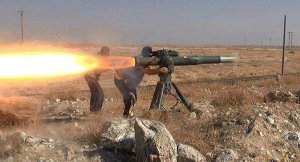 The Al-Nusra Front, Al-Qaeda’s affiliate in Syria, has released a grateful video, where they openly thank the Free Syrian Army (FSA), which the US has touted as a “moderate opposition group”, for supplying them with US-made anti-tank TOW missiles (“Tube-launched, Optically tracked, Wire-guided”).