The war, the separation of the world, or the end of an Empire?
By Thierry Meyssan | Voltaire Network | April 11, 2023
Many are those who predict a World War. Indeed, some groups are preparing for it. But the States are reasonable and, in fact, consider rather an amicable separation, a division of the world into two different worlds, one unipolar and the other multipolar. Perhaps we are actually witnessing a third scenario: the “American Empire” is not struggling in the trap of Thucydides; it is collapsing like its former Soviet rival died.
The American “Straussians,” the Ukrainian “integral nationalists,” the Israeli “revisionist Zionists” and the Japanese “militarists” are calling for a generalized war. They are alone and they are not mass movements. No state has yet committed itself to this course.
Germany with 100 billion euros and Poland with much less money are rearming massively. But neither of them seems eager to take on Russia.
Australia and Japan are also investing in armaments, but neither of them has an autonomous army.
The United States is no longer able to replenish its military and is no longer able to create new weapons. They are content to reproduce the weapons of the 1980s in an assembly line fashion. However, they maintain their nuclear weapons.
Russia has already modernized its armies and is organizing itself to renew the ammunition it uses in Ukraine and to mass produce its new weapons, which no one can compete with. China, for its part, is rearming to control the Far East and, in the long term, to protect its trade routes. India thinks of itself as a maritime power.
It is therefore difficult to see who would and could start a World War.
Contrary to their speeches, French leaders are not at all preparing for a high-intensity war [1]. The military programming law, established for ten years, plans to build a nuclear aircraft carrier, but reduces the size of the army. It is a question of giving ourselves the means of projection, but not of defending our territory. Paris continues to reason as a colonial power while the world is becoming multipolar. It is a classic: the generals prepare for the previous war and ignore the reality of tomorrow.
The European Union is implementing its “Strategic Compass”. The Commission coordinates the military investments of its member states. In practice, they all play the game, but pursue different goals. The Commission, on the other hand, is trying to take control of decisions on the financing of armies, which until now have depended on their national parliaments. This would make it possible to build an empire, but not to declare a generalized war.
Clearly everyone is playing a game, but apart from Russia and China, none is preparing for a high-intensity war. Rather, we are witnessing a redistribution of the cards. This month, Washington is sending Liz Rosenberg and Brian Nelson, two specialists in unilateral coercive measures [2], to Europe with the mission of forcing the Allies to comply. In the words of former President George Bush Jr. during the war “against terrorism”: “Whoever is not with us is against us”.
Liz Rosenberg is efficient and unscrupulous. She is the one who brought the Syrian economy to its knees, condemning millions of people to poverty because they dared to resist and defeat the Empire’s surrogates.
The Hollywood western discourse a la George Bush Jr. of good guys and bad guys has failed with Türkiye, which has already experienced the 2016 coup attempt and the 2023 earthquake. Ankara knows that it has nothing good to expect from Washington and is already looking to the Shanghai Cooperation Organization. Yet the same discourse should succeed with the Europeans, who remain fascinated by the power of the United States. Of course this power is in decline, but so are the Europeans. No one has learned any lessons from the sabotage of the Russian-German-French-Dutch gas pipelines, North Stream. Not only did the victims take the blame without saying anything, but they are about to receive further punishment for crimes they did not commit.
The world should therefore be divided into two blocs, on the one hand the US hyperpower and its vassals, on the other the multipolar world. In terms of the number of states, this should be half and half, but in terms of population, only 13% for the Western bloc against 87% for the multipolar world.
The international institutions can no longer function. They should either fall into lethargy or be dissolved. The first examples that come to mind are the effective exit of Russia from the Council of Europe and the empty seats of Western Europeans in the Arctic Council during the year of the Russian presidency. Other institutions are no longer relevant, such as the Organization for Security and Cooperation in Europe (OSCE), which was supposed to organize East-West dialogue. Only the attachment of Russia and China to the United Nations should preserve them in the short term, as the United States is already thinking of transforming the Organization into a structure reserved exclusively for the Allied Nations.
The Western bloc should also reorganize itself. Until now, the European continent was dominated economically by Germany. In order to be certain that Germany would never get closer to Russia, the United States wanted Berlin to be content with the western part of the continent and leave the center in the hands of Warsaw. So Germany and Poland armed themselves to impose themselves in their respective zones of influence, but when the American star faded, they would fight against each other.
When the Soviet Empire fell, it abandoned its allies and vassals. Having seen its inability to solve the problems, the USSR first stopped supporting Cuba economically, then dropped its vassals of the Warsaw Pact, and finally collapsed on itself. The same process is beginning today.
The first U.S. Gulf War, the 9/11 attacks and their host of wars in the broader Middle East, the expansion of Nato and the Ukrainian conflict will have offered only three decades of survival to the American Empire. It was backed by its former Soviet rival. It has lost its raison d’être with its dissolution. It is time for it to disappear too.
Translation: Roger Lagassé
NATO’s Enlargement Targets Not Only Moscow, But Ankara as Well, Turkish Media Says
By Ilya Tsukanov – Sputnik – 05.04.2023
Turkiye’s parliament approved Finland’s bid to join the Western alliance last week, citing Helsinki’s “authentic and concrete steps” to allay Ankara’s security concerns. However, one Turkish outlet fears the nod to membership may prove a strategic mistake, and that the bloc is directed as much against Turkiye as it is against Russia.
Finland officially joined NATO on Tuesday, becoming the 31st nation to join the alliance, with its accession constituting the Western military bloc’s ninth wave of expansion since its creation in 1949. Russia, which shares a 1,300+ km frontier with its Nordic neighbor, warned that Moscow would take the necessary “countermeasures” to ensure its tactical and strategic security.
Turkiye’s Defense Ministry used the occasion, which coincides with the 74th anniversary of the founding of NATO, to post a congratulatory tweet. “We have been a distinguished member of NATO since 1952. Happy 74th anniversary. Together we are stronger,” the ministry wrote, adding the hashtag “#WeAreNATO.”
But the celebration may be premature, writes Turkish newspaper Aydinlik.
“Although NATO’s enlargement has been seen as a policy of containing Russia, it is now obvious that Turkiye is being similarly besieged. In the past, the Atlantic [powers] attempted to establish global hegemony by hemming the Eurasian continent in on land, in accordance with Spykman’s Rimland theory, therefore including countries such as Turkiye, Iran, Afghanistan and China in its geopolitical axis,” the newspaper, affiliated with Turkiye’s Vatan Partisi, a left Kemalist party, wrote in an analysis published Tuesday.
From the 1970s on, the geopolitical situation began to shift, Aydinlik noted. “Among the trusted countries, Iran escaped America’s control in 1979, China after 1990, Turkiye on July 15, 2016 [the day of the attempted coup against Erdogan, ed.] and Afghanistan in 2021, becoming target countries. Therefore, the geopolitical axis was broken, and shifted to Greece, southern Cyprus and Israel. Thus, Turkiye was cut off from the Atlantic [axis], and pushed toward the Heartland, and is now besieged from Alexandropoulos to Crete, and from there to the eastern Mediterranean and northern Syria.”
Turkiye vs NATO
Aydinlik’s analysis is in line with growing anti-NATO and anti-Western sentiment in Turkiye. A 2019 poll found that only 21 percent of Turks had a positive view of the alliance. A 2021 survey discovered that a whopping 90.3 percent didn’t believe that the bloc would come to the country’s assistance in a crisis, while 51.7 percent said the bloc “exploits” Turkiye for its own interests. Another poll in early 2022 found that 39.4 percent of Turks would prefer it if their country would “give priority to Russia and China” in foreign policy, compared to 37.5 percent for the EU and the US.
Turkish grievances with the West are numerous, starting with Turkiye’s shabby treatment by Brussels – which has dangled the prospect of EU membership before the country for more than 30 years, but consistently refused to allow it to enter, ostensibly for failing to “meet membership criteria.” (Meanwhile, much less developed countries in Eastern Europe have been allowed in, and even Ukraine, which is engulfed in a NATO-Russia proxy conflict and mired in corruption and poverty, is now being considered for membership.)
NATO’s role in the 2016 coup attempt is another issue on many Turks’ minds. Some have accused NATO of direct involvement in the coup plot, and the Turkish government’s purge of NATO staff after the attempted putsch indicates that Ankara also suspects them.
America’s sheltering of Fethullah Gulen, the Muslim cleric President Erdogan suspects of masterminding the coup attempt, has served to further fray ties. As has the scandal over the F-35 fighter program. After pumping more than a billion dollars in R&D funds into the fighter and organizing the manufacture of dozens of key components, Turkiye was unceremoniously booted out of the program in 2019 and slapped with sanctions in 2020 over its purchase of advanced Russian missile defense systems.
Turkiye and NATO’s de facto leader, the United States, have also found themselves on opposite sides in Syria, where US forces have allied themselves to and shielded Kurdish militia forces which Ankara classifies as terrorists. At the same time, the ongoing standoff between Turkiye and Greece in a maritime dispute in the Mediterranean (which France, another NATO member, has joined on Athens’ side) has served to further heighten Ankara’s security concerns.
Even as Turkiye prepares for presidential and parliamentary elections scheduled for May, Ankara has accused the US of meddling in the country’s internal affairs after US Ambassador Jeff Flake met with Kemal Kilicdaroglu, Erdogan’s main rival.
“Joe Biden’s ambassador visits Kemal. Shame on you, think with your head. You are an ambassador. Your interlocutor here is the president. How will you stand up after that and ask for a rendezvous with the president? Our doors are closed to him, he can no longer come in. Why? He needs to know his place,” Erdogan said.
Turkish President Recep Tayyip Erdogan speaks to the media during a joint press conference with Finland’s President Sauli Niinisto, at the presidential palace in Ankara,
With NATO’s latest expansion, the real question worth asking, Aydinlik seems to intimate, is about Turkiye’s place in the Western alliance.
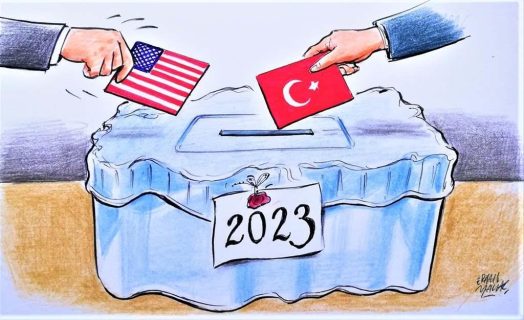
Turkey’s 2023 election a choice between Eurasianism and Atlanticism
By Ahmed Adel | April 5, 2023
The Turkish President refuses to speak any further with the American ambassador to Ankara. The reason: a recent meeting between the diplomat and the leader of the Turkish opposition only a month and a half before the presidential election. Importantly though, this election will determine whether Turkey will continue its course towards Eurasianism, or revert back completely to the NATO bloc.
With the approach of the presidential election, Recep Tayyip Erdoğan reacted strongly following the meeting that American ambassador Jeffry Flake had with the leader of the opposition pro-American Republican People’s Party (CHP), Kemal Kılıçdaroğlu.
“Joe Biden spoke, and now you see what his ambassador here does. He visited (Kılıçdaroğlu). It is a shame. You are an ambassador, and you have to know how to act. You should be engaged with the President (not Kılıçdaroğlu),” Erdoğan said in Istanbul on April 2.
“I wonder if he will be ashamed to ask for an appointment from my office. But I tell him now. Our doors are closed to him from now on because he does not know his place. You should know how an ambassador should act,” he added.
Erdoğan’s outburst was instigated because it is evident that Flake, as head of the American diplomatic mission in Turkey, is endorsing Kemal Kılıçdaroğlu and the Alliance of the Nation coalition, which is made up of seven political parties.
“Ambassador Flake met with CHP Chairperson Kemal Kılıçdaroğlu today as part of continuing conversations with Turkish political parties on issues of mutual interest between our two countries. He expressed American solidarity and condolences for Türkiye’s earthquake losses,” the American Embassy wrote in a tweet on April 2.
The current president, Kılıçdaroğlu, and two other candidates, Sinan Oğan and Muharrem İnce, will face each other on May 14. At the surface level, the vote will determine who will be the President of Turkey for a five-year term, whilst at the same time the legislative elections will take place.
However, at a deeper level, Erdoğan represents Turkey’s slow pivot towards Eurasianism, where he believes a pan-Turkic world has its place, whilst Kılıçdaroğlu represents Ankara’s traditionally close ties with Washington and NATO. Effectively, Turkish citizens have a very deep ideological decision to make.
Respected Turkish public opinion research centre MetroPOLL conducted a survey with the participation of 2,046 people in 28 Turkish provinces between January 13 and March 14. The survey showed that 44.6% of respondents would vote for Kılıçdaroğlu, while Erdoğan would receive 42% of the votes. This makes the upcoming election one of the biggest challenges to the Turkish president’s long rule.
As this election will be close, the US is hoping that it can do its part to ensure that Kılıçdaroğlu wins. Although the US and Turkey are NATO allies, they have many outstanding issues, particularly relating to Washington’s refusal to sell F-35 fighter jets, US support for the Syrian offshoot of the Kurdistan Workers Party, and Turkey’s purchase of the Russian-made S-400 missile defence system.
Tensions significantly escalated even before President Joe Biden entered the White House in 2020. “What I think we should be doing is taking a very different approach to him [Erdoğan] now, making it clear that we support the opposition leadership,” Biden said in a New York Times interview, adding that Erdoğan had to pay the price.
The Kılıçdaroğlu-led opposition bloc has become the darling child of Western media recently, with more anti-Erdoğan coverage appearing on publications like The Economist. The Wall Street Journal, for their part, recently published an article by former US National Security Adviser and notorious warhawk John Bolton, who called on the US to support the opposition or force Turkey out of NATO if Erdoğan won the elections.
It is recalled that Flake had already angered Turkish officials after he shut down the US embassy last year over supposed “security concerns” that Turkey denied. Although the US did not shut down its consulate in Istanbul, it is noted that the mayor of Turkey’s largest city is the immensely popular Ekrem İmamoğlu of the CHP. This again is another signal that the US is backing the CHP in the elections.
But as Interior Minister Süleyman Soylu pointed out regarding Flake back in February: “Türkiye has the misfortune of having US ambassadors seeking to plot coups in our country. Every US ambassador has been engaged in efforts to harm Türkiye. They also try to dispel same advice to ambassadors of other countries.”
In this way, Turkish citizens have a generational choice to make – to continue with Erdoğan’s pursuit of sovereignty and balancing relations with the Great Powers, or a complete submission to Washington and a reversal of the many years of effort made by the Turkish president to achieve sovereignty.
Ahmed Adel is a Cairo-based geopolitics and political economy researcher.
Russian tactical nuclear weapons in Belarus – escalation or legitimate response?
By Drago Bosnic | March 27, 2023
On March 25, Russian President Vladimir Putin announced that Russia will start deploying its tactical nuclear weapons in Belarus. Construction of designated storage facilities for the weapons is planned to be completed by July 1. The decision to transfer nuclear weapons to Belarus was made after Minsk issued a formal request, essentially mirroring Washington DC’s nuclear sharing agreements with several NATO member states. And while the decision was officially made after the United Kingdom announced it would supply depleted uranium munitions to the Kiev regime, the actual reasoning might have to do with much more sinister plans by the United States.
Namely, Warsaw and Washington DC have been floating the idea of transferring some of the US nuclear weapons stockpiled in Europe to Poland. The move has been mentioned several times in recent years, including in early October last year, when Polish President Andrzej Duda mentioned it in an interview with Gazeta Polska. The US has nuclear sharing agreements with the Netherlands, Belgium, Germany, Italy and Turkey, with approximately 100 (mainly air-launched) tactical nuclear weapons deployed in all five countries. Greece also took part in the program, but discontinued its participation in 2001, although it’s widely believed Athens still keeps the necessary storage facilities functional.
President of Belarus Alexander Lukashenko advised against UK plans to deliver depleted uranium munitions to the Kiev regime and warned that Russia would soon supply Belarus with “munitions with real uranium”. However, Putin himself stated that “even outside the context of these events”, Belarus still has legitimate security concerns and that “Alexander Grigoryevich [Lukashenko] has long raised the question of deploying Russian tactical nuclear weapons on the territory of Belarus”. This clearly implies that threats to Minsk transcend the immediate danger of depleted uranium munitions deliveries to the Neo-Nazi junta in Kiev.
“There is nothing unusual in such a decision, as the United States has been doing this for decades. They have long placed their tactical nuclear weapons on the territories of their allies, NATO countries, and in Europe. In six states – the Federal Republic of Germany, Turkey, the Netherlands, Belgium, Italy and Greece – well, not in Greece now, but there is still a storage facility,” Putin stressed, further adding: “[Russia and Belarus] will do the same, without violating our international obligations on the non-proliferation of nuclear weapons”.
He added that Russia is indeed mirroring the United States in this regard and that it’s not transferring the ownership of its tactical nuclear weapons to Belarus, but that it’s simply deploying them to the country and training the Belarussian military to operate and use them in the case of a wider escalation by the US and NATO. The Russian military has already provided Belarus with the necessary upgrades to be able to deliver tactical nuclear warheads. At least 10 (presumably Belarussian Air Force) jets have been assigned and equipped to carry such weapons, although neither side specified what type of aircraft received the said upgrades.
Belarus operates several types of nuclear-capable fighter jets, including the recently acquired Su-30SM and the Soviet-era MiG-29. In addition to air-launched nuclear weapons, Russia already deploys ground-based assets in Belarus, including the “Iskander” systems capable of launching nuclear-tipped hypersonic and regular cruise missiles. Minsk also operates its own “Iskander” units, meaning that those too could be equipped with tactical nuclear warheads, further bolstering the country’s deterrence capabilities. This is particularly important as Belarus has also been targeted by US/NATO covert/black operations in recent years, including an attempted Maidan-style color revolution in 2020.
“We have handed over to Belarus our well-known and very effective ‘Iskander’ system that can carry [nuclear weapons],” Putin stated, adding: “On April 3, we will start training the crews and on July 1 we will complete the construction of a special storage [facility] for tactical nuclear weapons on the Belarussian territory.”
In addition to the “Iskander”, Belarus still maintains a number of Soviet-era nuclear-capable assets, including a substantial arsenal of “Tochka-U” tactical ballistic missiles. These could serve as a secondary delivery option given their shorter range and inferior accuracy when compared to the “Iskander” which boasts a 500 km range, high precision, extreme maneuverability at every stage of flight, as well as a hypersonic speed estimated to be at least Mach 5.9, although military sources indicate that it can go up to Mach 8.7. This makes the “Iskander” virtually impossible to intercept, as evidenced by its performance during the SMO (special military operation). The system also provides a significant advantage over NATO forces in Eastern Europe.
President Lukashenko strongly indicated that Minsk could host Russian nuclear weapons as soon as NATO implied it could deploy US B61 nuclear bombs to Poland, highlighting that his country’s Soviet-era infrastructure for such weapons remains intact despite US pressure to destroy it during the 1990s. Belarus is home to a growing arsenal of state-of-the-art Russian military units and equipment, including strategic assets such as the S-400 SAM (surface-to-air missile) systems, as well as the advanced Su-35S air superiority fighter jets and MiG-31 interceptors, including the K/I variants capable of deploying the already legendary “Kinzhal” hypersonic missiles, which are also nuclear-capable.
Drago Bosnic is an independent geopolitical and military analyst.
US is stirring up the Syrian cauldron
BY M. K. BHADRAKUMAR | INDIAN PUNCHLINE | MARCH 26, 2023
The circumstances surrounding the flare-up in Syria between the US occupation forces and pro-Iranian militia groups remain murky. President Biden claims that the US is reacting, but there are signs that it is likely being proactive to create new facts on the ground.
The US Central Command claims that following a drone attack on March 23 afternoon on an American base near Hasakah, at the direction of President Biden, retaliatory air strikes were undertaken later that night against “facilities used by groups affiliated with Iran’s Islamic Revolutionary Guards Corps.”
However, this version has been disputed by the spokesman of Iran’s Supreme National Security Council who accused Washington of “creating artificial crises and lying.” The Iranian official has alleged that “Over the past two days, American helicopters have carried out several sorties with the aim of increasing instability in Syria and transferred Daesh (Islamic State) terrorists in the territory of this country.”
He said Washington must be held accountable for such activities. The official warned that Tehran will give a prompt response to any US attack on whatever false pretext against Iranian bases that exist on Syrian soil at the request of Damascus for fighting terrorism.
Is the US deliberately ratcheting up tensions in Syria even as the China-brokered Saudi-Iranian rapprochement is radically changing the security scenario in the West Asian region in a positive direction?
There is optimism that Syria stands to gain out of Saudi-Iranian rapprochement. Already, the Saudi Foreign Ministry revealed on Thursday that talks are going on with Syria for resuming consular services between the two countries, which will pave the way for the resumption of diplomatic relations and in turn make it possible to reinstate Syria’s membership of the Arab League.
Saudi Arabia has established an air bridge with Syria to send relief supplies for those affected by the devastating earthquake in February.
The backdrop is that the normalisation of relations between Syria and its estranged Arab neighbours has accelerated. It must be particularly galling for Washington that these regional states used to be active participants in the US-led regime change project to overthrow the government of President Bashar al-Assad. The Saudi-Iranian rapprochement badly isolates the US and Israel.
From such a perspective, it stands to reason that the US is once again stirring up the Syrian cauldron. Lately, Russian aircraft have been reported as frequently flying over the US’s military base At Tanf on the Syrian-Iraqi border where training camps for militant groups are known to exist.
Israel too is a stakeholder in keeping Syria unstable and weak. In the Israeli narrative, Iran-backed militia groups are increasing their capability in Syria in the last two years and continued US occupation of Syria is vital for balancing these groups. Israel is paranoid that a strong government in Damascus will inevitably start challenging its illegal occupation of Golan Heights.
A key factor in this matrix is the nascent process of Russian mediation between Turkiye and Syria. With an eye on the forthcoming presidential and parliamentary election in Turkiye in May, President Recep Erdogan is keen to achieve some visible progress in improving the ties with Syria.
Erdogan senses that the Turkish public opinion strongly favours normalisation with Syria. Polls in December showed that 59 percent of Turks would like an early repatriation of Syrian refugees who are a burden on Turkish economy, which has an inflation rate of 90 percent.
Evidently, Turkiye is ending up as a straggler when the West Asian countries on the whole are coasting ahead to normalise their relations with Damascus. But the catch is, Assad is demanding the vacation of Turkish occupation of Syrian territory first for resuming ties with Ankara.
Now, there are growing signs that Erdogan may be willing to bite the bullet. The consummate pragmatist in him estimates that he must act in sync with the public mood. Besides, the main opposition party CHP always maintained that an end to the Syrian conflict needs to be anchored firmly on the principles of Syria’s unity and territorial integrity.
The influential Beirut newspaper Al-Akhbar has reported citing sources close to Damascus that Erdogan is weighing options that would meet Assad’s demand with a view to restore relations. The daily reported that one possibility is that Turkiye may propose a timetable for the withdrawal of its troops in Syria.
Significantly, Erdogan telephoned Russian President Vladimir Putin on Saturday and the Kremlin readout mentioned that amongst “topics concerning Russian-Turkish partnership in various fields,” during the conversation, “the Syrian issue was touched upon, and the importance of continuing the normalisation of Turkish-Syrian relations was underlined. In this regard the President of Türkiye highlighted the constructive mediatory role Russia has played in this process.”
Earlier, on Wednesday, Turkish Defense Minister Hulusi Akar held telephone talks with his Russian counterpart Sergei Shoigu to discuss developments in Syria where he underscored that the “sole purpose” of its deployment in northern Syria is to secure its borders and fight terrorism.
It is entirely conceivable that Erdogan has sought Putin’s help and intervention to reach a modus vivendi with Assad quickly. Of course, this is a spectacular success story for Russian diplomacy — and for Putin personally — that the Kremlin is called upon to broker the Turkish-Syrian normalisation.
The China-brokered Saudi-Iranian normalisation hit Washington where it hurts. But if Putin now brokers peace between two other rival West Asian states, Biden will be exposed as hopelessly incompetent.
And, if Turkiye ends its military presence in Syria, the limelight will fall on the US’ illegal occupation of one-third of Syrian territory and the massive smuggling of oil and other resources from Syria in American military convoys.
Furthermore, the Syrian government forces are sure to return to the territories vacated by Turkish forces in the northern border regions, which would have consequences for the Kurdish groups operating in the border region who are aligned with the Pentagon.
In sum, continued US occupation of Syria may become untenable. To be sure, Russia, Turkiye, Iran and Syria are on the same page in seeking the vacation of US occupation of Syria.
Thus, an alibi is needed for the US to justify that although dialogue and reconciliation is in ascendance in West Asian politics, Syria is an exception as a battleground against “terrorism.” The US is vastly experienced in using extremist groups as geopolitical tools.
The US’ real intention could be to confront Iran on Syrian soil — something that Israel has been espousing — taking advantage of Russia’s preoccupations in Ukraine. The Russian-Iranian axis annoys Washington profoundly.
The spectre that is haunting Washington is that the stabilisation of Syria following Assad’s normalisation with the Arab countries and with Turkiye will inexorably coalesce into a Syrian settlement that completely marginalises the “collective West.”
In retrospect, the unannounced visit by General Mark Milley, chairman of the US Joint Chiefs of Staff to northern Syria in early March falls into perspective. Milley told reporters traveling with him that the nearly eight-year-old US deployment to Syria is still worth the risk!
The time may have come for the militants, including ex-Islamic State fighters, who were trained in the US’s remote At Tanf military base to return to the killing fields for “active duty.”
Tass reported that on Friday, the terrorist group known as Hayat Tahrir al-Sham tried to break into the Aleppo region which has been under Syrian government control and relatively stable in the recent years.
Turkiye ‘reviewing options’ for Syria withdrawal: Report
The Cradle | March 23, 2023
Lebanese daily Al-Akhbar released a report on 23 March claiming that Turkiye is willing to make concessions regarding the fate of its military presence in Syria, and is reviewing options to set a timeframe for the withdrawal of its troops from the country.
This comes in light of Damascus’ repeated insistence that the continuation of normalization efforts between the two countries depends on this condition.
“Turkish officials are studying, at the present time, several options regarding the fate of the Turkish military presence in Syria and the possibility of setting a schedule to end it in connection with field, humanitarian and political developments,” Syrian opposition sources told Al-Akhbar.
According to these sources, Turkiye will present proposals on this matter to Russian and Iranian mediators and is hoping that Tehran and Moscow will be able to act as “guarantors” to convince Syria that Ankara will properly implement any agreement that is reached, “whatever the results of the Turkish presidential elections.”
Damascus said in January that Turkish President Recep Tayyip Erdogan is using the reconciliation with Syria as a ploy to secure himself in the upcoming election in Turkiye. Many have reinforced this, alleging that Erdogan wishes to use the normalization to portray himself as a champion in diplomacy, and as the solver of the Syrian refugee crisis in Turkiye.
Since the devastating earthquake that struck Turkiye and Syria at the start of last month, Erdogan’s chances at reelection have slimmed, according to the most recent polls.
Russia is currently working to set a date for a four-way meeting between the foreign ministers of Ankara, Damascus, Moscow, and Tehran, aimed at moving forward with the reconciliation. However, this meeting has so far failed to materialize, given Syria’s insistence on clear Turkish concessions.
According to Al-Akhbar, Turkiye’s newfound willingness to concede on the issue of its military presence is the reason behind the Turkish foreign minister’s latest claim that the meeting could be held “within days.”
PM Orbán: ‘Europe suffers from war psychosis’
Remix News | March 17, 2023
The main issue facing Europe today is war, which puts Hungary in a difficult situation, as the effects of war are severe and immediate, Hungarian Prime Minister Viktor Orbán said at a meeting of the Organization of Turkic States summit in Ankara.
The prime minister stressed that, unfortunately, Europe was suffering from a “war psychosis,” with the continent drifting further into war day by day. Orbán thanked the leaders of the Turkish states for strengthening the voice of peace. Hungary — on account of its population’s Asian origins — is an honorary member of the Organization of Turkic States.
Orbán thanked Turkish President Recep Tayyip Erdoğan, who, he said, had so far been able to mediate successfully between the warring parties, and called on him to continue his efforts in the future.
“Only in this way can we have a chance for peace,” Orbán said. He also thanked the Turkish president for the fact that Hungary and Turkey could coordinate their work within NATO.
Hungary’s geographical proximity to the war has placed the issue of pursuing peace at the top of the agenda for Hungary, according to Orbán.
“Ukraine is a neighboring state, and the effects of the war are therefore severe and direct, with inflation skyrocketing and energy prices at an all-time high,” he said, adding that “many Hungarians have now died in the war because men from the Hungarian community in western Ukraine are also being conscripted into the army.”
“For Hungary, the most important thing is to save human lives, and that is why we are advocating a ceasefire as soon as possible and peace negotiations.”
At the same time, the prime minister expressed the view that what is happening in Europe is more than just war, because in fact, “the whole of Europe is being reshuffled in terms of power relations,” and this will also have repercussions for Turkey. He added that Hungary is also seeing another threat: “There are processes going on in the world economy that could lead to a new global balance.”
He said that the segmentation of the world economy is against Hungary’s interests, and Hungary sees its future not in segmentation, but in acting in the collective interest and improving interconnectivity.
“The Turk states can play a key role in this, because here we are European, Caucasian and Central Asian countries connected to each other on the basis of mutual respect, setting a good example for the whole world,” the prime minister said in his speech.
Russia to maintain high oil output – JPMorgan
RT | March 5, 2023
Russian oil drillers can maintain high production despite numerous rounds of Western sanctions, JPMorgan projected this week, according to Reuters.
The Wall Street bank pointed to growing demand for crude oil from China and India which is expected to increase collectively by 1 million barrels per day (mbd) this year.
“We believe Russia will be able to maintain its oil production at pre-war levels of 10.8 mbd but will have difficulties getting back to peak pre-Covid volumes of 11.3 mbd,” JPMorgan reportedly stated.
The US bank suggested that Moscow could struggle to reroute part of its oil product exports away from the EU, following the bloc’s embargo on imports of Russian fuels. Seaborne oil product shipments from Russia are set to decline by around 300,000 barrels per day to “lows last seen in May 2022,” it projected.
Meanwhile, business daily Kommersant reported this week, citing industry sources, that Russian oil output in February reached pre-sanctions levels for the first time, and may exceed the February 2022 figure.
According to Kpler, Russian crude oil and petroleum product exports also held strong last month, with energy producers managing to ship 7.32 million barrels per day of crude oil and oil products.
While the EU and G7 nations have introduced price caps and restrictions on Russian fuel imports, China, India, Türkiye, and some other countries have boosted purchases from Moscow. Last month, Russia unveiled plans to curb oil production in March by 500,000 barrels a day, or about 5%, in retaliation to Western sanctions.
Turkish FM speaks out on sanctioning Russia over Ukraine
RT | March 1, 2023
Türkiye will not be joining unilateral sanctions imposed on Russia by the West over the conflict in Ukraine, Turkish Foreign Minister Mevlut Cavusoglu said on Wednesday.
Cavusoglu was asked how long Ankara would be able to resist pressure from the US and its allies to put restrictions on Moscow ahead of talks with his Russian counterpart Sergey Lavrov on the sidelines of the G20 Foreign Ministers Meeting in India’s capital New Delhi.
“We don’t need to resist anyone, we make our own decisions as a sovereign state. We don’t join any unilateral sanctions. We support only those [restrictions that are] introduced with the backing of the UN,” the foreign minister replied, as cited by the media.
“It’s not just about Russia, but we also don’t support sanctions against Iran or any other country,” Cavusoglu pointed out, adding that “no one can put pressure” on Türkiye.
India, which chairs the G20 this year, is hosting the summit of foreign ministers on Wednesday and Thursday.
An Indian foreign ministry official told Reuters on Wednesday that New Delhi didn’t want the conflict in Ukraine to dominate the discussions at the event, but acknowledged that it would likely be among the top issues on the agenda. The host nation’s “intention [is] to continue playing the voice of the Global South [Latin America, Africa, Asia and Oceania] and raising issues pertinent to the region,” the official said.
High-ranking Indian diplomat Vinay Kwatra told reporters that “questions relating to food, energy and fertilizer security, [and] the impact that the conflict has on these economic challenges that we face” will be among those to receive “due focus” in New Delhi.
However, EU foreign policy chief Josep Borrell, who is a stalwart supporter of Kiev, insisted that India should use the G20 gathering to “make Russia understand that this war has to finish.” According to Borrell, the “success” of the whole meeting “will be measured in respect to what we will be able to do on that.”
An EU source said separately the EU delegation in New Delhi won’t support the final statement as a result of the summit if it doesn’t include condemnation of Russia’s conduct in Ukraine, Reuters reported.
Sanction failures piling up
Free West Media | February 11, 2023
Western sanctions were supposed to “ruin” Russia not only economically, but also technologically – according to the well-known announcement by German Foreign Minister Annalena Baerbock.
The ban on supplying electronics was intended to paralyze the Russian armaments industry. But Western war planners appear to have gotten even the most basic facts wrong. As is now apparent, an “isolated” Russia has managed to circumvent US-imposed sanctions in the technology sector. What’s more, Russia is importing even more microchips and semiconductors than before the war.
Among other things, the US and the EU banned the supply of microchips and semiconductors to Russia, depriving them of “70 percent” of their imports. The most important companies in the sector, such as Intel, AMD, the Taiwanese chip giant TSMC and Nexperia from the Netherlands, stopped doing business in Russia almost overnight.
At the end of March, US President Biden confidently announced that Russia would no longer be “able to rebuild those devastating weapon systems” and was on its way back “to the 19th century” as a result of the Russian operation in Ukraine, while US Commerce Secretary Gina Raimondo stated: “We have reports from Ukrainians that when they find Russian military equipment on the ground, it’s filled with semiconductors that they took out of dishwashers and refrigerators”.
Raimondo spoke at a Senate hearing in May last year, noting that she had recently met with Ukraine’s prime minister. “Our approach was to deny Russia technology — technology that would cripple their ability to continue a military operation. And that is exactly what we are doing.”
And in September, the President of the EU Commission, Ursula von der Leyen, defiantly announced that Russia’s industry was in ruins. “The Russian military is taking chips from dishwashers and refrigerators to repair their military equipment because they are running out of semiconductors. Russian industry is in tatters,” she claimed in a speech in the European Parliament.
Total Western failure to predict outcomes
But the Russian armed forces never had to do that during the war, as is now evident. Referring to an official report, the weekly German newspaper Zeit reported that Western sanctions in no way reduced Russian imports of electronic components – on the contrary: Russia imported even more processors and semiconductors in 2022 than before the war. Overall, imports in this segment have increased from 1.8 billion euros to 2.45 billion euros.
Beyond that, Russian imports fell by just 16 percent on a yearly basis. This was also confirmed by US economist and sanctions advocate Matthew Klein. According to his calculations, Russian imports in November were only 15 percent below the monthly average for 2021. At the beginning of 2022, shortly after the Russian operation started, Western “experts” had expected a slump of at least 30 to 40 percent.
The fact that Russia was able to circumvent the sanctions is due to countries like China, Turkey or the United Arab Emirates, which quickly filled the gaps left by Western corporations. They also act as a location for Russian intermediaries who obtain Western technology from letterbox companies.
At the same time, Russians have been manufacturing their own goods to fill the gaps that have arisen as a result of sanctions and the withdrawal of western corporations.
IMF expects Russia’s economy to grow
Until recently the West doubted that Russia’s economy would survive under sanctions, but the International Monetary Fund (IMF) is now sounding more optimistic than even the Russian government. Known for its gloomy forecasts, The IMF has predicted that Russia’s GDP will expand this year.
By far the most important trading partner for Russia is China. Overall, imports from China rose by 13 percent in 2022. Many Western companies such as Apple or Ikea had supplied the Russian market before they withdrew. This decision to leave could be compensated for.
China’s companies now deliver the majority of new cars and smartphones, computers, but also heavy equipment such as construction machinery and trucks. In fact, exports of trucks from China more than tripled in 2022 while imports of construction equipment have doubled.
Most importantly from a Russian point of view, however, are the imports of microchips. Together with Hong Kong, China shipped $900 million worth of semiconductors to its neighbour in 2022, more than double than the figure for 2021.
‘Türkiye and UAE told to cut trade ties with Russia’
RT | February 3, 2023
US officials have warned Türkiye and the United Arab Emirates against maintaining economic and financial ties with Russia because trade is undermining sanctions, Bloomberg reported on Friday, citing people with knowledge of the matter.
The warnings were reportedly voiced by the undersecretary for terrorism and financial intelligence at the US Treasury, Brian Nelson, during meetings with Turkish officials on Thursday and Friday.
Nelson’s visit to Türkiye comes as part of a regional tour that included the UAE earlier this week, and is said to be aimed at discussing Washington’s concerns over rising exports to Russia that include US goods.
US officials have called on the two countries to clamp down on the flow of goods to Russia, the sources told the news agency, adding that millions of dollars’ worth of export-controlled items were reaching the sanctions-hit country, and could be used by the defense industry to extend the conflict in Ukraine.
Scores of Turkish exporters shipped over $800 million worth of goods to Russia, including $300 million in machinery and another $80 million in electronics in the eight months through October 2022, according to people who spoke on condition of anonymity.
Other areas of concern reportedly include Russian vessels either sanctioned or subject to export controls making port calls in Turkey.
Meanwhile, the UAE has maintained ties with both Ukraine and Russia. The Gulf state’s ruler, Mohammed bin Zayed Al Nahyan, traveled to meet Russian President Vladimir Putin in October amid the continuing conflict in Ukraine. The leaders expressed Moscow and Abu Dhabi’s willingness to develop cooperation on all levels.
Featured Video
Iran spent $1 million to wipe out $30 billion in data center plans, and take down Amazon in the ME
or go to
Aletho News Archives – Video-Images
From the Archives
A short history of British torture
ICC | December 2005
When the House of Commons was debating how much to increase the time limit for detention without trial the question of torture came up. Officially this was limited to the nice considerations of whether it was all right to send people to places where torture is used and whether Britain can use information collected by the use of torture in other countries. This discussion gave an impression of democratic Britain as the home of civilised behaviour where the very idea of torture is repugnant to our legislators – unlike, say, the US with its secret CIA jails… In reality, the British state has a long history of using and developing a whole range of torture techniques. … continue
Blog Roll
 Aletho News
- Iran spent $1 million to wipe out $30 billion in data center plans, and take down Amazon in the ME
- Zionist billionaire pressure to silence Macklemore sparks exodus from Ed Sheeran tour
- House Votes to End Iran War for Third Time
- North Korea Slams US Plan for ‘AUKUS 2.0’ with South Korea and Japan
- Prolonging US-Iran Conflict Not Meeting Interests of Int’l Community – China’s Wang Yi
- EU bans former Zelensky aide from parliament
- NATO-backed Kosovo separatist ‘responsible for war crimes’
- US destroying international space law
- SCO Calls for Binding Global Deal to Prevent Arms Race in Space
- Iran & Its Allies Are Threatening Every Route for Saudi Oil
- If Americans Knew
- Groups urge Americans to support Van Hollen legislation on Israel’s killing of Americans & Palestinians
- Trump administration plans to send 40,000 tons of bombs to Israel: report
- Sanctions Target Iran’s Government, But Kill Hospitalized 23-Year-Old Woman
- An alternative view on the book “Israel’s Lobby: America in the Grip of a Foreign Power”
- Ed Sheeran’s band Beoga, other opening acts quit tour after Macklemore was dropped over his pro-Palestinian comments
- The assassination attempt on President Trump in Butler and the various Israeli connections to it
- “We Want That the Whole Land Be Jewish”
- BREAKING: Building collapse in Gaza kills at least 20 as they sleep – Daily Update
- ‘School is Life’: 1.5 Million Palestinian Children Face Fourth Year of Shattered Education
- Pentagon admits Iran war caused ammunition shortages, cost US $33.4bn
- No Tricks Zone
- Economic Masterminds: German Socialists Suggest Taxing Productivity Gains Stemming From Using AI
- The South China Sea Has Not Been Cooperating With The Climate Change Narrative
- Energy Crisis: Germany Enters Heating Season With Historically Low Gas Reserve Fill Levels
- New Study: The Antarctic Ice Sheet Gained Mass From 2020-2024 Due To Staggering Snow And Ice Accumulation
- Study: Ocean Heating Rates From Thousands Of Years Ago ‘Dwarf’ Modern Ocean Heating Rates
- Climate Extremists Target, Attack Large-Scale Power Grid Infrastructure In Germany!
- New Study: Antarctic Ice Melt Has Contributed Less Than 1 Centimeter To Sea Level Rise In The Last 30 Years
- Fear Of Debate: Alarmist German Climate Scientist Calls On Mainstream Media To Discredit Skeptic Voices
- End-Of-August Arctic Sea Ice Extent Hasn’t Fallen In 20 Years, Official Data Show!
- News-Making Nepal Region Has Had As-Warm Or Warmer Periods Than The 2000s In The 1600s, 1700s, 1800s
 Aletho News