Iraq not allowing Turkish troops back to Bashiqa: Report
Press TV – September 23, 2018
Iraq has refused to allow Turkish troops back into the Arab country following a leave from their bases, a government-affiliated think tank in Baghdad has reported.
According to Al-Nahrain Center for Strategic Studies, the move is in line with the Iraqi government’s efforts to put an end to Turkish military presence in the country.
The measure had been adopted over the previous months, withholding visas to the Turkish forces who sought to return to Iraq, Iraqi News website reported on Sunday.
Watheq al-Hashemi, director of the center, said the decision had helped reduce the number of Turkish troops significantly.
“The government’s stance of not allowing Turkish soldiers to return will end the Turkish military presence in Bashiqa without any diplomatic or military friction,” he said.
The Bashiqa camp, al-Hashemi said, is totally cordoned by Iraqi troops and Turkey cannot carry out any plans without the knowledge of Iraqi troops.
Turkey has been conducting air raids against areas in northern Iraq, which serve as safe havens for the Kurdistan Workers’ Party (PKK) militants. The militants have been fighting a deadly separatist war against Ankara.
In 2014, Turkey sent troops to Bashiqa in northern Iraq under the banner of fighting the Daesh terror group which was defeated in the country late last year.
Baghdad has repeatedly called on Ankara to pull out its forces but Turkey says they will stay as long as the PKK threat persists.
The decision was made during a meeting of the Iraqi Ministerial Council for National Security chaired by Prime Minister Haider al-Abadi. The meeting also instructed the Foreign Ministry to “take the necessary measures to document the Turkish violations of Iraqi airspace to the United Nations.”
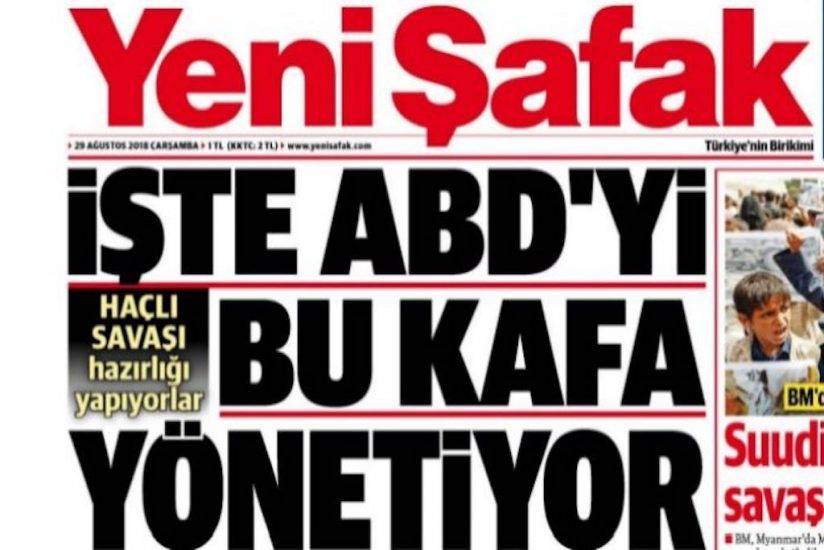
Turkey’s pro-Erdoğan daily declares Trump, Pence ‘lunatics of a deviant sect’
There Are No Sunglasses | September 17, 2018
The pro-Erdoğan Turkish Yeni Şafak daily claimed on Wednesday that US President Donald Trump and US Vice President Mike Pence are pondering a “crusade,” saying the US is run by the “lunatics of a deviant sect.”
“The world is facing the attacks of the Zionist-Christian sect of evangelicalism. The ‘superpower’ US is run by neocon evangelicals who espouse wiping out humanity to get to paradise. The lunatics of this deviant sect, US President Trump, who can shake the markets with a tweet, and his deputy Pence are a threat to humanity,” said the daily in its lead story.
“If Pence becomes president, it will pave the way for the US turning into a religious state,” the daily asserted, adding that Trump has been using the detention of American pastor Andrew Brunson in Turkey to get the support of evangelicals in the November 2018 congressional elections.
Yeni Şafak’s story was also shared on the websites of the Sabah, Takvim and Akşam newspapers, which are run by people close to Turkish President Recep Tayyip Erdoğan.
Turkey has been experiencing a currency crisis since its relations with the US administration were dramatically strained over a court decision to put American pastor Brunson under house arrest after almost two years in pretrial detention rather than release him as demanded by the US administration.
Following the court ruling, Trump and Pence threatened to impose “large sanctions” on Turkey if Brunson were not freed.
After declaring economic sanctions on two Turkish ministers on Aug. 1 for their role in Brunson’s continuing detention, Trump on Aug. 10 ramped up his attack on Turkey by doubling US tariffs on Turkish aluminum and steel imports to 20 percent and 50 percent, respectively.
“Some unaware people among us think that their target is Tayyip Erdoğan. No, the target is Turkey. The target is Islam,” Erdoğan said on Aug. 26, linking regional conflicts and the ongoing currency crisis in Turkey to previous attempts to invade Anatolia.
Erdoğan on Aug. 20 said, “attacks against the Turkish economy are no different than attacking the adhan [call to prayer] and the flag.” (turkishminute.com)
Putin & Erdogan agree Idlib buffer zone to avert new Syria crisis
RT | September 17, 2018
Russia and Turkey have agreed a “demilitarized zone” between militants and government troops in Syria’s Idlib, President Vladimir Putin said after hours-long talks with Turkey’s Recep Tayyip Erdogan focused on solving the crisis.
“We’ve focused on the situation in the province of Idlib, considering presence of large militant groups and their infrastructure there,” Putin said at a press conference after the talks.
“We’ve agreed to create a demilitarized zone between the government troops and militants before October 15. The zone will be 15-20km wide, with full withdrawal of hardline militants from there, including the Jabhat Al-Nusra.”
As part of solving the deadlock, all heavy weaponry, including tanks and artillery, will be withdrawn from the zone before October 10, Putin said. The zone will be patrolled by Turkish and Russian military units.
Before the end of the year, roads between Aleppo and Hama, and Aleppo and Latakia must be reopened for transit traffic, he said.
The agreement has received “general support” from the Syrian government, according to Putin.
The deal and other issues of Russian-Turkish ties apparently took almost 5 hours to hammer out. In what appears to a breakthrough solution, Putin and Erdogan have agreed to ensure peace with the help of Russian and Turkish troops.
“The territory controlled by the Syrian opposition must be demilitarized and the Syrian opposition that is holding these territories will remain there. But together with Russia we will make efforts to clear these territories of radical elements,” Erdogan said.
The agreement is designed to prevent a new “humanitarian crisis” in Syria, Erdogan stressed, and will help Turkey to avoid an even more “difficult situation.” He had previously warned of a surge in refugees hitting the country should a full-blown war break out in Idlib.
The plan is a major landmark for Syria, where the standoff in the last militant stronghold of Idlib has threatened to turn into a major international crisis in recent weeks. The US and other NATO countries backing anti-government forces had repeatedly warned Russia and Syria not to launch any new offensive in the region. US President Donald Trump tweeted earlier this month that to do so would be a “grave humanitarian error,” while US envoy to the UN Nikki Haley outright said that any Russian attack on Idlib would provoke “dire” consequences.
About 70 percent of Idlib province is controlled by various terrorist factions, including Al Qaeda’s Syria affiliate Hayat Tahrir al-Sham (formerly known as the Al-Nusra Front), according to the Russian military. At the same time, both Turkey and the West support various militant groups they consider as “moderate” opposition to Syrian President Bashar Assad’s forces.
This turned out to be a dilemma for Ankara, with the Turkish president simultaneously worried about Russia and Syrian action weakening the rebel groups, but also having concerns over the spread of terrorists and the potential influx of new refugees into areas bordering Turkey.
Now it appears that despite the rocky last few years of Russian-Turkish relations, the mutual trust built up between Putin and Erdogan has allowed them to overcome a clash of interests and reach a compromise.
Erdogan, Putin to Meet Monday in Sochi as Turkey Moves More Weapons into Syria
21st Century Wire | September 15, 2018
Turkey’s President Recep Tayyip Erdogan is scheduled to meet Russia’s President Vladimir Putin in Sochi on Monday, amid reports of a heavy Turkish arms drop into Syria in recent days.
The two leaders last met at a summit earlier this month in Tehran, and this next meeting will come just days after the Turkish army sent more ‘arms and ammunition’ into Syria’s Idlib and Hama provinces, according to a report by the Syrian Observatory for Human Rights (SOHR) released on Saturday.

The independent media outlet Muraselon is also citing multiple reports of both Turkish weapons and troops moving into these regions, including to areas under the control of the ‘rebel’ coalition National Liberation Front (NLF) – a collection of unsavory characters and the main rival of Hay’at Tahrir Al-Sham (HTS) in Idlib, according to IRIN:
Turkey’s favourite is the NLF, which is led by Fadlallah al-Hajji, a Muslim Brotherhood ally. The NLF includes Turkey-friendly Islamists like Ahrar al-Sham, the Noureddine al-Zengi Brigades, Failaq al-Sham, Jaish al-Ahrar, and groups that fought under the Free Syrian Army banner, like the Victory Army and the 2nd Coastal Division.
Big but brittle, the NLF is held together by Turkish sponsorship and shared enemies: al-Assad’s government, Syrian Kurdish groups, and hardline jihadists.
Turkey’s escalated military presence and heavy arms drop into known jihadist havens ahead of the upcoming Sochi meeting is unwelcome, and presents the potential risk for a military showdown in the future between Turkish and Syrian/Russian forces – something that all sides have warned against but Turkey’s apparent ‘double-dealing’ isn’t helping.
Fighting Starts in Syria’s Idlib: US Military Considers Military Options
By Peter KORZUN | Strategic Culture Foundation | 11.09.2018
Syrian UN Ambassador Bashar Ja’afari declared on Sept. 7 that his government was determined to wipe out the rebels from the Idlib province. The next day, the Idlib Dawn Operation began, encircling a town 59 km. southwest of the Syrian city of Aleppo. As of Sept. 9, Russian aircraft have attacked the rebel positions in western Idlib, the mountains of the Latakia province, and the Sahl al-Ghab plain, with the goal of softening up peripheral targets and preventing a breakthrough or counterattack. Syria’s forces are ready to move.
The Russian military warned that a false-flag chemical attack staged by the rebels could occur at any time and be used as a pretext for Western missile strikes. A massive Turkish military convoy, consisting of more than 300 vehicles, including tanks, armored vehicles, and MLRS launchers, has entered Idlib from the province of Hatay.
Syria needs Idlib — the last stronghold of the jihadists and the shortest route from Latakia to Aleppo. The M5 international highway crosses Idlib, linking Turkey and Jordan through Aleppo and Damascus. Control of the province would greatly facilitate the negotiations with the Kurds and strengthen Syria’s position at the UN-brokered Geneva talks. If the negotiation process succeeds, the only territories left to liberate would be the zone controlled by the US, such as the al-Tanf military base and the surrounding area, the northern parts of the country under Turkish control, and small chunks of land still held by ISIS [let’s not forget the Golan Heights].
Turkey opposes the idea of an Idlib offensive. It wants assurances for the groups in Idlib under its control and it doesn’t want an influx of refugees. These controversial issues can be tackled with Russia as a mediator. Turkey, Iran, and Russia did not agree on everything at the recent summit in Tehran, but the West’s hopes that they would go their separate ways, or even clash in Idlib, have been dashed.
President Erdogan has just said that he wants to meet the Russian president again after his Sept 28-29 visit to Germany. This means that the Turkish leader has ideas and proposals to discuss and Moscow can play a role in reaching a compromise, such as a more narrowly tailored counter-terrorism operation in Idlib. There is a divide, but it can be bridged. The parties have the will to get it done.
Ankara plans to organize a Turkey-Russia-Germany-France summit. The Russian presidential aide, Yury Ushakov, has confirmed that such a meeting is in the works. Moscow has just invited the Turkish military to take part in its largest-ever military exercise, Vostok 2018, which will be held in the Far East. China and Mongolia have also been invited. Obviously, Russia and Turkey are prepared to solve their differences over Idlib peacefully through negotiations.
In any event, the province cannot remain under the terrorists’ control forever. They must either surrender or be routed. Now that the operation to free Idlib has begun, many of them will lay down their arms. They know their resistance is futile.
Actually, victories over terrorists that pave the way to a negotiated solution of the conflict should be welcomed, but the US sees these things in a different light. Washington seems to be shifting gears on Syria again, despite the statements President Trump made earlier about the plans to pull out. Now the president has reportedly agreed to new objectives that will keep US troops on the ground in Syria indefinitely in order to ensure that the Iranian forces are driven out. The US military has just sent reinforcements to al-Tanf to demonstrate its resolve to stay in that country. The Marines are holding a multi-day exercise there, using live ammunition.
Secretary of State Mike Pompeo, said on Sept. 7 that the administration viewed any government assault on Idlib as an escalation of Syria’s warning that Washington would respond to any chemical attack by Damascus. Ambassador James Jeffrey, who served as a deputy national security adviser to President George W. Bush, has recently been appointed US Special Representative for Syria Engagement, and Joel Rayburn, the former senior director for Iran, Iraq, Syria, and Lebanon, is now Special Envoy for Syria. The two appointments confirm the fact that the US has changed its mind and decided to remain in Syria, as both these officials had supported this policy before.

Rayburn, Joel (15 August 2014). “The coming disintegration of Iraq” Washington Post
America’s top military brass are studying the options for military involvement in Syria. But the real reason may not be Idlib or any other events in that country, but rather the situation creep in Iraq, where anti-Iranian and anti-government Shia protests in the south have turned violent and the prime minister may be compelled to step down. The protesters are armed and violent. They have attacked the Iranian consulate and the headquarters of Iranian-backed militias in the city.
Fighting has also been reported between Iranian forces and Kurds in Iraq’s Kurdish region. Details have been provided of mortar fire in Baghdad, where protests took place in July. Something’s cooking in Iraq. There is too little information available to obtain any deep insights into what’s going on, but the situation is unpredictable and volatile. Iraq could soon implode. The US will not leave the region, and it needs every outpost it has there. A lot depends on how events develop in Iraq.
Idlib will ultimately be liberated. The status of the US-led coalition forces in Syria will become a hot-button topic and be seen as the main stumbling block on the path to peace and reconstruction.
Iran president to host Syrian, Turkish counterpart for Syria talks
Press TV – August 27, 2018
The presidents of Iran, Russia, and Turkey will hold their third round of tripartite summit in Iran next week in an attempt to find ways to end the ongoing crisis in Syria, Turkish state television says.
Iranian President Hassan Rouhani will host his Turkish and Russian counterparts Recep Tayyip Erdogan and Vladimir Putin, respectively, on September 7, state-run TRT Haber television said on Monday.
Private NTV television also said the summit would be held in the northwestern Iranian city of Tabriz as Iran, Russia and Turkey are acting as guarantor states for a peace process in Syria.
The three presidents have previously held summits in the Russian resort city of Sochi in November 2017 and in the Turkish capital Ankara in April.
At the end of their meeting in Ankara on April 4, the Iranian, Russian and Turkish presidents reaffirmed their commitment to work toward achieving a sustainable ceasefire between warring sides in Syria and bringing peace and stability to the war-torn Arab country.
Rouhani, Putin and Erdogan, “reaffirmed their determination to continue their active cooperation on Syria for the achievement of lasting ceasefire between the conflicting parties and advancement of the political process envisaged by UN Security Council Resolution 2254,” said a joint statement issued at the end of the summit.
Addressing their summit in Sochi on November 22, Rouhani lauded the defeat of the Daesh terror group in Iraq and Syria, but underlined the need for continued battle against terrorism until the eradication of all Takfiri terrorist outfits in Syria.
He blamed foreign interference for the conflict in Syria, saying certain countries claiming to be advocates of democracy wrecked havoc in the Arab country to achieve their goals in the region.
Erdogan had previously said that he planned to host a summit in Istanbul on September 7 on the crisis in Syria with Putin, French President Emmanuel Macron and German Chancellor Angela Merkel.
However, press reports over the last weeks have indicated that such a meeting was increasingly unlikely and was set to be replaced by the latest three-way summit in Iran.
A UN spokeswoman said on Friday that United Nations Special Envoy Staffan de Mistura had invited Iran, Russia and Turkey to talks due to be held in Geneva next month on forming Syria’s Constitutional Committee.
“Special Envoy de Mistura continues his consultation on the establishment of a Syrian-led, Syrian-owned and UN facilitated Constitutional Committee within the framework of the Geneva process and in accordance with Security Council Resolution 22-54 2015,” Alessandra Vellucci said at a news conference.
In a meeting with Syrian President Bashar al-Assad in Damascus on Sunday, Iran’s Defense Minister Brigadier General Amir Hatami hailed the steadfastness of the Syrian people and government forces in their battle against terrorism, expressing confidence that they will achieve a final victory in this path.
“Not only regional people, but people around the world are indebted to the fight carried out against terrorists in Syria,” Hatami said.
Russia: US plans new Syria strike with false flag attack
Press TV – August 25, 2018
The Russian Defense Ministry says the US, Britain and France are preparing to conduct a fresh aerial assault against Syria under the pretext of the alleged use of chemical weapons by the Damascus government.
The ministry spokesman Major General Igor Konashenkov said on Saturday that a group of militants, who were trained by a private British military company to work with poisonous materials, had already arrived in Syria’s northwestern Idlib Province.
“To carry out the alleged ‘chemical attack’ in the city of Jisr al-Shughur in the province of Idlib, militants from the Tahrir al-Sham group had delivered 8 tankers with chlorine… to a village a few kilometers from Jisr al-Shughur,” Konashenkov said.
The Russian general further warned that a possible militant gas attack on Syria would be followed by a Western strike against the Arab country.
“This provocation with the active participation of the British special services will serve as another pretext for the US, UK and France to conduct a missile strike on the Syrian government and economic facilities,” he said.
The official further noted that the American destroyer USS The Sullivans armed with 56 cruise missiles had also arrived in the Persian Gulf and a US В-1В bomber carrying 24 air-to-surface AGM-158 JASSM cruise missiles had been deployed at Al Udeid airbase in Qatar.
“Western countries’ actions in spite of their public statements are aimed at another sharp deterioration of the situation in the Middle East region and the disruption of the peace process on the territory of Syria.”
The warning comes as the Syrian army is now preparing for an operation to liberate Idlib Province, the last major militant stronghold.
Bolton’s warning
On Saturday, Bloomberg reported that US National Security Adviser John Bolton had warned his Russian counterpart, Nikolai Patrushev, that Washington was prepared to take strong military action against Syria if it used chemical weapons in Idlib.
Bolton issued the warning during his Thursday’s talks with Patrushev, the report quoted four people familiar with the discussions as saying.
On April 14, the US, Britain and France launched a coordinated missile attack against sites and research facilities near Damascus and Homs with the purported goal of paralyzing the Syrian government’s capability to produce chemicals.
The strike came one week after an alleged gas attack on the Damascus suburb town of Douma.
Both Damascus and Moscow accused the White Helmets volunteer group of having staged the suspected chemical weapons attack in Douma.
Turkey pushing against Syria’s upcoming Idlib campaign
As countdown begins for the Idlib counter-terrorism campaign, Turkey tries to avert the push, claiming that it will lead to a humanitarian crisis.
Speaking at a press conference with his Russian counterpart, Sergei Lavrov, in Moscow on Friday, Turkish Foreign Minister Mevlut Cavusoglu said that the two countries could cooperate on separating Idlib “terrorists” from opposition groups.
“A military solution there (in Idlib) will cause catastrophe,” he said. “Not only for the Idlib region but for the future of Syria, it will cause catastrophe and the clashes may last a long time.”
Lavrov, for his part, acknowledged that the situation in Idlib is “complex” and called for the separation of militants from opposition outfits.
He also said that when Turkey, Iran and Russia held talks on Syria’s ceasefire zones, Moscow did not expect militants to be “using it as a human shield” from which they could attack the government.
What Do The Winners In Syria Want?
ORIENTAL REVIEW – 17/08/2018
After the liberation of the provinces of Daraa and Quneitra, the Syrian civil war entered a new phase. The available land that was up for grabs by any new liberator — without the need for negotiations with outside actors — was shrinking (one section of the desert under ISIL control does not count – it will soon be cleared out). Only Idlib is left, which is controlled (albeit only in spots and to a limited extent) by Turkey, as well as the environs of al-Tanf and the Kurdish regions located within the American protectorate. And their liberation must be preceded by diplomatic agreements with the protector states.
Decentralization without the Kurds
Negotiations with Turkey took place in Sochi at the very end of July. Those were conducted by Russia and Iran, because Damascus and Ankara have officially severed their diplomatic ties. The Syrian authorities emphasize that the territory of Idlib will eventually be returned to Damascus’s jurisdiction.
No one’s arguing with that. Turkey is not planning on an eternal occupation of Syrian territory, because any benefits from that would be completely outweighed by the financial, PR, and potential military costs Ankara would incur. At some point, the Turkish troops will be forced to quit Syria. But Erdogan has no desire to pull out for free and is demanding a number of conditions be met in return.
These conditions are obvious yet at the same time contradictory. On one hand, Ankara wants to maintain its leverage over post-war Syria, so it is pressing for the local communities (some of which in northwestern and western Syria hold pro-Turkish sentiments) to be granted more rights and powers. On the other hand, the Turks do not want those rights and powers to be extended to the Syrian Kurds, whom Erdogan currently views as one of te biggest threats to Turkey’s national security.
At present it is not possible to meet Turkey’s demands – the constitutional committee is just now getting down to work, and no one understands how to exclude the Kurds from the decentralization process anyway. And ultimately the Iranians are not particularly eager to yield any zones of influence to the Turks — it is clear to everyone that for the foreseeable future, Tehran and Ankara will very likely be competing for the upper hand in the Middle East. In turn, the Turkish authorities are threatening that if Moscow and Tehran give Damascus the green light to conduct a military operation in Idlib without taking Ankara’s interests into account, then Turkey will abandon its attempts to find a resolution under the auspices of the Astana negotiations and could potentially resume military and political assistance to the militants, which might even include sending aid in the form of the Turkish army.
The weak link
As a result, a compromise was apparently reached in Sochi. Damascus, Tehran, and Moscow agreed to temporarily postpone the offensive in Idlib and give Turkey some latitude to handle the threats posed by certain terrorist groups in the region (for example, Hay’at Tahrir al-Sham, which is the latest reincarnation of the al-Nusra Front). In order to do battle against them, the Turks have already established a coalition of militants under Ankara’s control.
However, this compromise is not likely to last long. First of all, because Turkey has thus far been conspicuously unable to cope with the situation (as can be seen, for example, in the regular drone attacks on the Hmeimim air base that originate in Idlib), and there is no guarantee that the situation will change. Second, Damascus is already engaged in a dialog with the Kurds (who have finally become firmly convinced that the Americans will continue to sell them out to the Turks) over the idea of reconciling in exchange for the promise of decentralization. In this, the interests of Damascus and Ankara are partially aligned – the Kurds will not be granted any broad autonomy – but the Syrian authorities are prepared to concede some extremely limited autonomy. And if the Turks object, then – faced with the choice between compromising with the Kurds vs. satisfying the Turks, the Syrians are likely to choose the Kurds.
The Kurds will be chosen because — and this is the third reason — Turkey is the weakest link in the Syrian “triumvirate.” The end of the civil war is not far off, and if Iran and Russia are seeing their own positions strengthening as that day draws nearer, Turkey, on the other hand, is growing weaker. This is being expedited by the rapidly unraveling relationship between Erdogan and the West, as a result of which the Turkish president has been left in a state of semi-isolation, and he cannot afford to damage his relations with Moscow and Tehran as well. Therefore, it is possible that once the desert enclave and the concentration of troops near Idlib have been cleared out in the autumn, the Syrian army will find some pretext for an offensive in the rebel province, and Turkey will remain on the sidelines. The best Ankara can hope for is to have some minor concessions granted.
Syria without Iran?
As for the US — it played no role in the talks in Sochi. “We are sorry that our American colleagues chose to absent themselves from the work aimed at achieving a long-term political settlement in Syria,” noted Alexander Lavrentiev, Russia’s special envoy to Syria. “We remain confident that mutually acceptable solutions can only be worked out through an open dialog.”
However those can also be worked out through a “closed” dialog, which is something that is held regularly (including during the meeting between Putin and Trump). Washington’s position is easy to understand. Donald Trump is ready to pull American troops out of the environs of al-Tanf (in southern Syria), because now that Syrian troops have liberated Deir ez-Zor and the province of Daraa, that base of operations is no longer needed. Trump is also prepared to entertain the possibility of abandoning support for the Syrian Kurds, because they are ill-suited for their role as a force to hold Iran in check and are also creating a host of problems with the Turks.
The only question is — what does Washington want in return? Some media outlets have been circulating the idea that the US and its partner Israel are demanding Iran’s complete withdrawal from Syria. But everyone is well aware that this is unrealistic — the losers cannot order the winner to admit defeat. So it will most likely be an issue of the Iranians having to accept responsibility for pulling their troops and military bases out of the area near the Golan Heights, and Russia having to be responsible for ensuring that Tehran abides by this condition.
So far the negotiations seem to be in their early stages, and one of the key obstacles is the uncertainty of the US and Israel that the Russians will be able to shoulder the responsibility for Iran’s compliance with its obligations once the US troops have been gone from Syria for one, two, or three years. The West believes that Russia’s continued presence in Syria will be on shaky ground, since Iran regards the country as its own domain and will push for outside forces to leave, even friendly ones.
Moscow partially shares this concern (despite being on friendly terms with Tehran), and that is precisely why it is trying to do all it can to use diplomacy to resolve the issue with the Turks themselves, while also pulling Europe into the process of returning the Syrian refugees and restoring the country’s infrastructure. After all, the more outside actors there are in Syria, the less chance that the Iranian leaders in that country will become an undesirable dominating force (which would inevitably happen otherwise). And it makes it even more likely that the process of national reconciliation — which will take more than just a year or two — will culminate in not just an end to the civil confrontation, but also in the long-term peaceful coexistence of the varied peoples and religious sects within Syria.
Riding on Qatari wings, multipolarity arrives in the Middle East
The unscheduled arrival of Sheikh Tamim bin Hamad al-Thani, Qatar’s emir, in the Turkish capital Ankara throws a new light on regional links
By M.K. Bhadrakumar | Asia Times | August 16, 2018
Trust Turkey’s Recep Erdogan to have had a game plan when he challenged the Trump administration and promised that the latter will regret its “unilateralist” policies.
Some pundits thought Russia and China have been inciting him and are lurking in the shadows to escort Erdogan to a brave new world.
Others fancied that the Eurasian integration processes would now take a great leap forward as Turkey embraced Russia, while a few forecast that Turkey would now sell itself cheap for Chinese money.
And then, there is the ubiquitous prediction in such situations that whoever defied the lone super power would come a cropper and Turkey’s fate is going to be miserable.
All these apocalyptic predictions overlooked the fact that Turkey may have a ‘third way’ forward – by strengthening even further its strategic autonomy and optimally exploiting its foreign policy options.
This path opened dramatically on Wednesday with the unscheduled arrival of Sheikh Tamim bin Hamad al-Thani, Qatar’s emir, in the Turkish capital Ankara.
Economic projects, investments, deposits
Qatar’s royal court has announced in a statement that Al-Thani “issued directives that will see the State of Qatar to provide a host of economic projects, investments and deposits” worth $15 billion to support the Turkish economy.
A government source in Ankara told Reuters that the investments would be channeled into Turkish banks and financial markets. Al-Thani confirmed the direct investment plans in Turkey, which he described as having a “productive, strong and solid economy.” He tweeted: “We are together with Turkey and our brothers there, who stand by Qatar and problems of the Ummah.”
Erdogan responded, saying his meeting with al-Thani was “very productive and positive.” Erdogan thanked the emir and Qatari people for standing with Turkey. “Our relations with friendly and brotherly country Qatar will continue to strengthen in many areas,” he tweeted.
At its most obvious level, we may locate the historic Qatari gesture toward Turkey in the matrix of the strong convergence that has accrued in their relationship in recent years in the backdrop of the emergent power dynamic in the Middle East. The axis works on many planes.
On the ideological plane, importantly, the ruling elites in both countries share a unique affinity toward Islamism and in visualizing the Muslim Brotherhood as the vehicle for the democratic transformation of the region. As a result, both have been targeted by Saudi Arabia and the UAE – and Egypt.
Joint military exercises
Until the retreat of Qatar from the Syrian killing fields in recent years, it was collaborating closely with Turkey in the failed project to overthrow the Assad regime. Of course, both countries are strong supporters of Hamas, too.
Turkey keeps a military base in Qatar, which may seem symbolic in comparison with the Western bases, but turned out to be an important lifeline for Doha for pushing back at Saudi Arabia and the UAE in the past couple of years. Turkey and Qatar are also planning to hold joint military exercises this year.
Riyadh and Abu Dhabi resent Erdogan’s projection of power through Qatar into the GCC territory, which they regard as their playpen. The Turks in turn suspect that Emiratis had a hand in the failed coup attempt against Erdogan in July 2016.
Meanwhile, there is great complementarity in the economic sphere between Turkey and Qatar. Turkey has a dynamic export industry and an economy that has registered impressive growth in the last decade, while Qatar has a huge surplus of capital for investment.
One consideration for Doha will be that the Turkish construction industry, which is affected by the present financial crisis in Turkey, is involved in preparing the infrastructure for the FIFA World Cup 2022, which Qatar is hosting.
Fundamentally, therefore, the planned Qatari investment in the Turkish economy holds big resonance for the geopolitics of the Middle East. No doubt, it proclaims the adulthood of the Turkish-Qatari axis. Regional states ranging from Iran to Israel will carefully take note that Al-Thani has come to Erdogan’s help at a critical moment.
Some spice in a heady brew
Yet, the Qatar-Turkey axis will not project itself as a strategic defiance of the United States – although the Qatari emir is well aware of Erdogan’s face-off with the Trump administration. Nonetheless, what adds some spice to this heady brew is that the Trump administration has been unabashedly partial toward the Saudi-Emirati line-up in the Gulf region.
A recent American report even claimed that former US Secretary of State Rex Tillerson lost his job because he stood in the way of a Saudi-Emirati plan to attack Qatar.
At any rate, the apt description for the Turkish-Qatari axis is that it is a manifestation of the arrival of multipolarity in the politics of the Middle East. Both Turkey and Qatar have good relations with Iran.
Although US Central Command is headquartered in Doha, Al-Thani also has a warm relationship Russian President Vladimir Putin.
In the power dynamic of the Middle East, the trend toward multipolarity is poised to accelerate. As time passes, conceivably, even Saudi Arabia and the UAE will see the attraction in strengthening their strategic autonomy.
It will be a fallacy, therefore, to continue viewing the Middle East through the Cold War prism, as most US analysts do, as an area of contestation between the big powers – as if the regional states don’t have a mind of their own or multiple options in developing their policies.
Simply put, Turkey or Iran may lean toward Russia, but can never forge a strategic alliance with Moscow. With a view to pushing back at US pressure, they may lean decidedly toward Moscow from time to time, but they have no intentions of surrendering their strategic autonomy.
But to caricature these countries as passive participants in Russia’s Eurasian integration processes will be delusional.
Russia understands this complicated reality, which is not surprising, given Moscow’s historical memory of its highly problematic relationships with Turkey and Iran through centuries in its imperial history. Thus, the Russian policy is not unduly demanding and is willing to accept their nationalist mindset.
On the other hand, the failure of the US policies lies in Washington’s inability to accept equal relationships and its obsession, ‘You’re either with us, or are against us.’
Make no mistake, the European capitals watch with exasperation the Trump administration’s handling of Erdogan – although he is by no means an easy customer to handle. The point is, European countries are closer to Russia in their appreciation of the complexities of the Middle East. Nor are European countries inclined to view Turkey through the Israeli prism.
Therefore, a concerted Western strategy toward Erdogan under US leadership will remain elusive. Germany’s decision to lift its sanctions against Turkey can be seen in this light. Equally, Erdogan is due to pay a state visit to Germany in September.
Featured Video
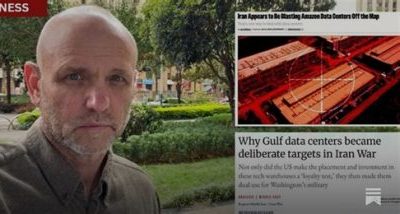
Iran spent $1 million to wipe out $30 billion in data center plans, and take down Amazon in the ME
or go to
Aletho News Archives – Video-Images
From the Archives
Clash of Civilization, Iran Part II
By Jamal Kanj – Intifada-Palestine.com – January 14, 2011
Israel’s survival kit is: perpetuate conflict, insecurity to rationalize collective hate and finally playing victim.
Devoid of conflict, Israel implodes internally; without hate, Zionism loses its justification; and playing eternal victim to continue blackmailing the West. Absence of this holy trinity, Israel ceases to exist. … continue
Blog Roll
 Aletho News
- Report: Saudi Arabia seeks allies’ assistance as missiles deplete amid war on Yemen
- Fuel Crisis Deepens: Pakistan Warns Tanker Attack in Red Sea Would Be an ‘Act of War’
- ‘Bucha massacre’ a false flag orchestrated by UK – Moscow
- China Rejects Outside Pressure on Trade Ties After New US Russia Sanctions Bill
- Houthis Keep Advancing as the Red Sea Crisis Deepens
- Iran spent $1 million to wipe out $30 billion in data center plans, and take down Amazon in the ME
- Zionist billionaire pressure to silence Macklemore sparks exodus from Ed Sheeran tour
- House Votes to End Iran War for Third Time
- North Korea Slams US Plan for ‘AUKUS 2.0’ with South Korea and Japan
- Prolonging US-Iran Conflict Not Meeting Interests of Int’l Community – China’s Wang Yi
- If Americans Knew
- Biden’s Genocide Accomplices Targeted by New Accountability Campaign
- AIPAC’s Network Has Already Spent $67.2 Million to Shape the Midterm Elections
- Jewish Supremacist Manufacturing a Civilizational Threat to License Bigotry
- US bans Palestinian president from speaking at the UN
- Israeli Forces Detain Journalist Alaa al-Rimawi amid Widespread West Bank Raids
- Even a pro-Israel Congress member has put a hold on 40,000 one-ton bombs to Israel
- As Gaza crumbles, Israel preps new ground invasion – Daily Update
- ‘We are not like everyone else’ laws that bind other nations do not apply to Israel, says Likud lawmaker
- Trump’s govt makes ‘treasonous’ claim of weapons shortages
- Palestinian-American Journalist Naqaa Hamed Imprisoned by Israeli Forces After Settlers Targeted Her
- No Tricks Zone
- New Study: ‘Global Drought Shows No Detectable Recent Acceleration Under Climate Warming’
- Economic Masterminds: German Socialists Suggest Taxing Productivity Gains Stemming From Using AI
- The South China Sea Has Not Been Cooperating With The Climate Change Narrative
- Energy Crisis: Germany Enters Heating Season With Historically Low Gas Reserve Fill Levels
- New Study: The Antarctic Ice Sheet Gained Mass From 2020-2024 Due To Staggering Snow And Ice Accumulation
- Study: Ocean Heating Rates From Thousands Of Years Ago ‘Dwarf’ Modern Ocean Heating Rates
- Climate Extremists Target, Attack Large-Scale Power Grid Infrastructure In Germany!
- New Study: Antarctic Ice Melt Has Contributed Less Than 1 Centimeter To Sea Level Rise In The Last 30 Years
- Fear Of Debate: Alarmist German Climate Scientist Calls On Mainstream Media To Discredit Skeptic Voices
- End-Of-August Arctic Sea Ice Extent Hasn’t Fallen In 20 Years, Official Data Show!
 Aletho News