Turkey Slams US-Led Coalition Members for Supporting Militants in Syria’s Idlib
Sputnik – 31.01.2019
ANKARA – Certain members of the US-led coalition fighting against Daesh support militants from the Hayat Tahrir al-Sham terrorist group in the Syrian province of Idlib as they are aspiring to wreck the Russian-Turkish agreement on de-escalation zone, Turkish Foreign Minister Mevlut Cavusoglu said Thursday.
“Certain partners from the coalition support HTS… First, for the termination of the Idlib memorandum. Second, there are countries that are making great efforts to prevent the establishment of a constitutional committee just because we are doing it”, Cavusoglu told the Hurriyet newspaper.
He specified that some Western countries from the coalition were provoking HTS militants to violate the provisions of the Idlib memorandum by paying them money for it.
“Russians have a joint operation offer. They say we should remove them [HTS militants] from there”, Cavusoglu added, noting that the countries of origin of foreign fighters from HTS were unwilling to take them back. “There are many people leaving the HTS after we came to the field”.
Earlier in the day, the Russian Foreign Ministry’s spokeswoman, Maria Zakharova, said that HTS militants were actively building up their forces along the contact line between the armed opposition and the government in Idlib’s de-escalation zone.
Last September, Russian President Vladimir Putin and his Turkish counterpart, Recep Tayyip Erdogan, agreed to set up a demilitarized zone in Idlib along the contact line between armed opposition groups and Syrian government forces, while the Russian and Turkish defence ministers signed a memorandum on stabilising the situation in the Idlib de-escalation zone. However, the agreements have not been fully implemented yet, and over 10 different militant groups are currently operating in Idlib.
Partition: Bad in Ireland and Palestine, Good in Syria?
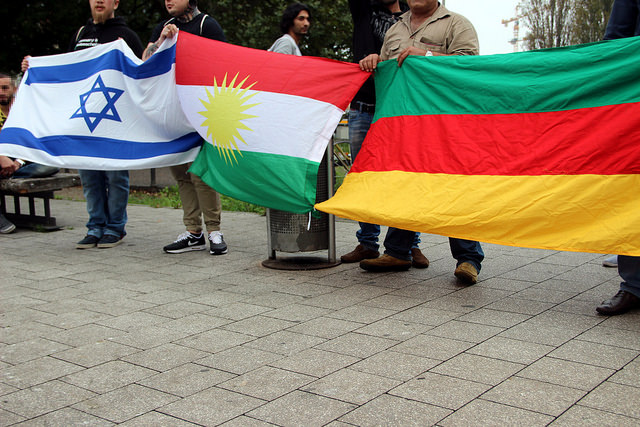
By Gavin O’Reilly | American Herald Tribune | January 29, 2019
Ask the question in left-wing circles of what affect partitioning a country along ethno-religious lines at the behest of an imperial power can have and the response will usually be straightforward.
In Ireland, following the 1921 surrender agreement between former revolutionaries and the British government, a six-county statelet was formed in the north-east of the country remaining under British rule and with an inbuilt Unionist majority; the pro-British element descended from English and Scottish colonizers, planted in the region by King James in the 17th century in a bid to displace the native Irish population which had provided so much resistance to British occupation.
The Nationalist population of this British-ruled part of Ireland, those descended from the indigenous Irish and who sought to live in an Ireland free of British rule, suffered systemic discrimination at the hands of this newly-formed British statelet, being denied the same access to housing, education, and employment that was afforded to their Unionist counterparts.
A neo-colonial pro-British state was also formed in the south of Ireland, where secret police and military units intern Irish Republicans through the use of non-jury courts to this day.
In Palestine, following the establishment of the Zionist State in 1948 in line with the UK-authored 1917 Balfour Declaration, more than half a million Palestinians found themselves refugees in their own country overnight; being forced from their homes in order to accommodate Jewish settlers from Europe.
The State of Israel, in a similar vein to the occupied North of Ireland, would also subject its indigenous Arab population to systemic discrimination and would go on to launch several imperialist wars against its Arab neighbors throughout its existence, with the most recent being covert Israeli involvement in the Syrian conflict.
This would all ultimately suggest that partition is a concept that should be universally opposed by anyone claiming to be anti-Imperialist. Right?
Wrong; when it comes to the issue of Syria, many ‘anti-Imperialists’ do a complete U-turn on the position and instead demand that the Arab Republic, along with Iran, Iraq, and Turkey, is divided up to form a US-Israeli backed Kurdish ethnostate.
In July 2012, when the Syrian conflict was its height, units of the Syrian Arab Army withdrew from the predominantly Kurdish Rojava region in the north of the country in order to provide assistance to military units fighting elsewhere in the Arab Republic; besieged at the time by Western-backed terrorists and yet to receive the key support which would later be provided by Iran and Russia.
The withdrawal of the SAA allowed local Kurdish militias to turn Rojava into a de facto autonomous region, with the most prominent of said groups being the People’s Protection Units (YPG), part of the wider Syrian Democratic Forces (SDF), a US-backed anti-government group.
However, whilst US-backed groups elsewhere in the country were supported by the White House with the intention of ousting the government of Bashar al-Assad, the primary reason for Washington’s support of the Kurds was to fulfill the 1982 Tel Aviv-authored Yinon plan.
This document, written by Oded Yinon, a senior advisor to Ariel Sharon, envisaged Israel maintaining hegemonic superiority in the region via the balkanization of neighboring Arab states hostile to Tel Aviv; in Syria, a country long known for its opposition to Zionism, this would entail the creation of a Kurdish state in the north of the country in a bid to undermine the authority of Damascus.
However, despite this US support for Rojava lining up perfectly with the Yinon plan, support for the creation of a Kurdish state within Syria remains widespread amongst Western leftists, with the feminist politics of the YPG endearing itself to Western Anarchists in particular; the lessons of Ireland and Palestine being lost it would ultimately seem.
Putin’s firewall around Russia-Turkey partnership
By M. K. BHADRAKUMAR | Indian Punchline | January 27, 2019
The much-awaited meeting between Russian President Vladimir Putin and his visiting Turkish counterpart Recep Erdogan in Moscow last Wednesday focused on the the withdrawal of US troops from Syria. The timeframe of the US drawdown or its scope and directions remain far from clear. Meanwhile, attention is riveted on creating a buffer zone in northern Syria, 32 kilometre wide on the Turkish border, which is under discussion between Washington and Ankara.
The US special representative on Syria James Jeffrey is expected in Ankara in coming days to carry forward the discussions. From present indications, US may control the airspace over the proposed zone and maintain some sort of presence on the ground as well while Ankara has been maintaining that it has the capability to enforce the zone.
Russia, on the other hand, has consistently voiced its opinion favoring Syrian government control over the regions vacated by the US. Indeed, Syrian leadership also has reiterated its determination to regain control over the entire country.
Thus, the meeting in Moscow on Wednesday took place in a supercharged atmosphere amidst speculation that the Russia-Turkey partnership might get rocky. The US never liked the Astana process on Syria between Russia, Turkey and Iran and the American intentions in baiting Turkey with the buffer zone proposal are highly suspect. (Significantly, Erdogan has hit out hard against the coup attempt by Washington to overthrow the Venezuelan government.)
If good diplomacy is about showing tact in handling awkward situations while brilliant diplomacy lies in creating a pathway through a minefield, Putin was probably at his best in navigating the Russian-Turkish partnership out of the reach of US tentacles. Putin’s remarks after the talks with Erdogan once again underscored that in the Russian estimation, any foreign presence on Syrian soil will lack “international legal grounds” if it is not on the basis of an invitation from Damascus or emanating out of a decision of the UN Security Council. But having said that, Putin qualified that “constructive cooperation” nonetheless becomes necessary even with such partners whose presence in Syria may lack legitimacy. Importantly, Putin added that Russia respects Turkey’s security interests. Then he went on to spring a big surprise:
“And the third. The 1998 treaty between the Syrian Arab Republic and the Republic of Turkey is still valid, and it deals specifically with the fight against terrorism. I think this is the legal framework that covers many issues relating to ensuring Turkey’s security on its southern borders. Today we have been discussing this issue thoroughly and intensively enough.”
This needs some explaining. Putin was referring to the Adana Accord of October 1998 between Turkey and Syria regarding cooperation in combating terrorism, which became moribund through the 7-year Syrian conflict. Putin said the agreement “is still valid”, which of course was tantamount to saying that Damascus thought so, too.
In effect, Putin has suggested that the Adana Accord can still serve as the legal and political framework for securing the Turkish-Syrian border to combat terrorism. The Russian Foreign Minister Sergey Lavrov amplified Putin’s remark further in media comments on Saturday. While on a visit to Rabat, Lavrov said, “The Adana agreement of 1998 was concluded between Turkey and Syria, its essence is to eliminate Turkey’s concerns about its security. [Syria] entered into this agreement, assuming certain obligations, and we proceed from the assumption that this agreement remains in force. As I understand, so do the state parties to the agreement.”
That is to say, Putin’s proposal offers an alternative to a Turkish occupation of Syrian territory – or involving a joint operation with the US to create a safe zone inside Syria and to enforce it militarily. The Adana Accord states that Syria is committed to eliminate any activity on its territory that would jeopardize Turkey’s security, including “the supply of weapons, logistic material, financial support to and propaganda activities” of Kurdish groups affiliated to the PKK. (The Syrian and Turkish foreign ministers signed an updated treaty in 2010.)
However, there is a caveat here. In order for the Adana Accord to come alive and fully satisfy Turkey’s security needs on the border region with Syria (which used to be the case till 2011 when Turkey became the staging ground for the US-led project to overthrow the Syrian government), Ankara must resuscitate its contacts with Damascus. Simply put, Putin is nudging Erdogan to restore ties with Syrian President Bashar al-Assad. After all, under the Adana Accord, Syria is committed to protect Turkey’s security, but that obligation is also “on the basis of the principle of reciprocity.”
Interestingly, on Saturday, Syrian state news agency SANA quoted a foreign ministry official as saying, “Syria confirms that it is in compliance with the Adana Interstate Agreement on Combating Terrorism in all its forms and all agreements related to it, but the Turkish regime has been violating the agreement since 2011 up to now by sponsoring and supporting terrorism, training militants and making it easier for them to go to SAR, or through the occupation of Syrian territories with terrorist groups it controls or directly with the help of the Turkish Armed Forces.” Furthermore, SANA reported the Syrian Foreign Ministry as calling on Turkey to “activate” the Adana Accord, leaving the boundary as it used to be before the beginning of the war in 2011.
Clearly, an inflection point has come. Erdogan has a big decision to make. Putin’s goal is to encourage Erdogan to work with Assad, while also taking care to preserve the verve of the Russian-Turkish cooperation and accelerate the Syrian peace process in Geneva.
On the ground, this translates as the Astana partners – Russia, Turkey and Iran (which also, incidentally, had endorsed the Adana Accord in 2003) – coordinating on establishing another de-escalation zone in northern Syria following the US withdrawal. It appears Putin has made an offer Erdogan cannot easily refuse and which may even be his own preferred option.
Civilians storm & burn Turkish military base in northern Iraq
RT | January 26, 2019
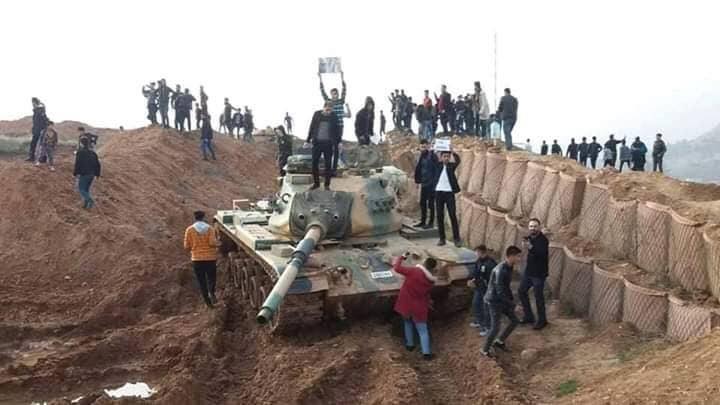
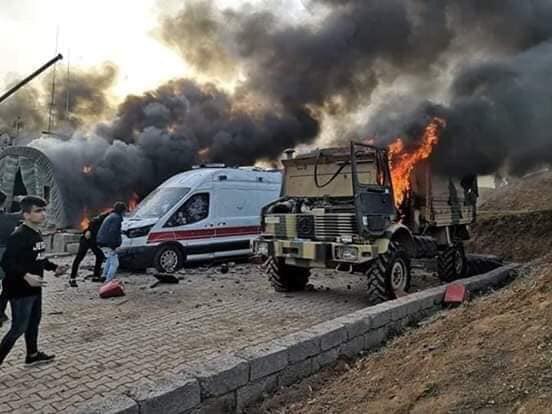
A mob of angry civilians has attacked a Turkish military camp near the Iraqi city of Dohuk, burning equipment and vehicles. The incident comes in response to the deaths of civilians during Turkish airstrikes, local media reports.
The incident occurred in northern Iraq on Saturday, when a large mob of civilians attacked a Turkish military encampment located in the predominantly-Kurdish region of Dohuk.
Footage from the scene which surfaced online shows civilians at the military encampment with Turkish military vehicles and tents burning in the background. At least one person died and 10 were reportedly wounded during the incident. It remains unclear if the Turkish Army sustained any casualties – servicemen are nowhere to be seen in the footage.
According to local media, the attack on the encampment came in protest to Turkish airstrikes and shelling, which have repeatedly hit the vicinity of Dohuk. Earlier on Saturday, at least two civilians were reportedly killed in an airstrike and the incident at the base might have been prompted by the attack.
The incident was acknowledged by the Turkish Defense Ministry, which blamed it on activities of the outlawed Kurdistan Workers’ Party (PKK), which Ankara considers to be a terrorist group. The Turkish military, however, did not confirm that it was the encampment in Dohuk that was attacked.

“An attack has occurred on one of [the] bases located in northern Iraq as a result of provocation by the PKK terrorist organization. There was partial damage to vehicles and equipment during the attack,” the ministry tweeted, adding that it has been “taking necessary measures” regarding the incident.
Damascus Accuses Ankara of Breaching 1998 Agreement – Reports
Sputnik – 26.01.2019
Turkish President Recep Tayyip Erdogan recently recalled the 1998 agreement with Damascus, saying the deal allows Ankara to enter Syria when it is threatened.
The Syrian Foreign Ministry reacted to the recent statement by Erdogan concerning the 1998 Adana agreement, accusing Turkey of violating the accord since 2011 by supporting terrorists and occupying Syrian territory, SANA reported, citing a representative in the ministry.
“Syria confirms that it is in compliance with the Adana Interstate Agreement on Combating Terrorism in all its forms and all agreements related to it, but the Turkish regime has been violating the agreement since 2011 up to now by sponsoring and supporting terrorism, training militants and making it easier for them to go to SAR, or through the occupation of Syrian territories with terrorist groups it controls it or directly with the help of the Turkish Armed Forces,” Syrian state television quoted a source in the ministry as saying.
The ministry called on Ankara to “activate” the 1998 agreement, leaving the boundary territories in the state as they were before the beginning of the war in 2011.
The Adana agreement was signed by Syria and Turkey on October 20, 1998 and aimed to restore bilateral relations following a crisis that arose due to Syria sheltering militants linked to the Kurdistan Workers’ Party (PKK), which is officially listed as a terrorist organization in Turkey.
According to the agreement, Syria had to halt PKK activities on its territory, including a ban on logistical, material and financial support for the group on its territory, as well as prohibit establishing camps, shelters and facilities for training militants. Turkey, in turn, gained the opportunity to take appropriate measures to deter the terrorist threat.
Syria, Turkey Relations Tense Amid Plans for New Ankara Op in Manbij
Tensions between the two sides of the Adana agreement recently flared up, as Turkey mulled over a new operation against Kurdish-held areas of Syria after its military success in Afrin.
Damascus is negotiating with the Kurds, who are seeking support amid Ankara’s military plans.
Erdogan, in turn, recently emphasised that Turkey should have control “in the field” and is not open to other suggestions.
Prior to that, Recep Tayyip Erdogan announced that the Turkish Army was ready to start an offensive against Kurdish forces on the eastern bank of the Euphrates at the earliest opportunity. However, after talks with US President Donald Trump, who informed his Turkish counterpart of plans to withdraw US troops from Syria, Erdogan shelved his plans, saying that the offensive would be launched only after the US forces’ complete pullout.
Did Khashoggi Really Die?
By F. William Engdahl – New Eastern Outlook – 23.01.2019
I have not been convinced about the claims coming from Turkey and from the Washington Post and others regarding the allegations of a gruesome murder of intelligence asset, Jamal Khashoggi, in October, 2018. There are too many anomalies as it was portrayed by various statements from Turkey President Erdogan, and echoed by a chorus of the Western mainstream media. Recent research suggests that perhaps Khashoggi was never in that Saudi Consulate in Istanbul that day, and in fact may still be quite alive and in hiding. If so, it suggests a far larger story behind the affair. Let’s consider the following.
The best way to outline this is to go back to the events around the surprise arrest and detention of numerous Saudi high-ranking persons in late 2017, by Prince Mohammed bin Salman or MBS as he is known. On November 4, 2017 MBS announced via state TV that numerous leading Saudis including one of the wealthiest, Prince Alwaleed bin Talal, had been arrested on charges of corruption, and were being detained in the Riyadh Ritz Carlton hotel. Prince Alwaleed is clearly the critical person.
The son-in-law of President Trump had reportedly made a non-publicized visit to Riyadh for private talks with MBS just days before the mass arrests. A report in the UK Mail newspaper in 2018 claimed that Jared Kushner, representing the President, had informed MBS of a rival Saudi Royals plot to eliminate the Crown Prince. Prince Alwaleed was reported to be at the center of the plotters.
After three months imprisonment, Alwaleed was released from detention on 27 January 2018, following a reported financial settlement. In March 2018 he dropped out from Forbes’ World’s Billionaires’ list. Before his arrest Alwaleed was the largest shareholder in Citibank, a major owner of Twitter, once partner of Bill Gates in Gates Foundation vaccine programs, and generous donor to select Democrats such as Hillary Clinton and the Clinton Foundation. According to media reports, Hillary campaign aide Huma Abedin’s brother, Hassan Abedin, Muslim Brotherhood member, worked with Bin Talal on a project called “Spreading Islam to the West.” Bin Talal and other Saudi sources donated as much as $25 million to the Clinton Foundation as she was preparing her Presidential bid. The Prince was also an open foe of Donald Trump.
Who was Khashoggi Really?
Jamal Khashoggi was no ordinary journalist. He actually worked for Prince Alwaleed bin Talal. In an interview in the Gulf Times in November last year Alwaleed stated, “Jamal wasn’t only my friend. He was working with me. Actually, his last job in Saudi Arabia was with me…” Jamal was, or is, nephew of CIA-linked asset, the recently deceased Adnan Khashoggi, a nefarious arms dealer involved in the CIA-Saudi BCCI bank and Iran-Contra. Nephew Jamal also worked for the then-Saudi Ambassador in Washington, Prince Bandar, someone so close to the Bush family that George W. nicknamed him “Bandar Bush.” In short, Khashoggi was part of Saudi circles close to the Bush-Clinton group. When King Abdullah decided to skip over Alwaleed’s father, Talal bin Abdulaziz Al Saud, dubbed “The Red Prince” for his reformist views, in his succession, a move that led to Salman, father of MBS, as successor, Alwaleed was on the outs in the Saudi power calculus of King Salman and Crown Prince MBS.
The Saudi government as well as the Brookings Institution confirm that Khashoggi had been a member of the Muslim Brotherhood. The Brotherhood was banned from Saudi Arabia in 2011 following the Obama-Hillary Clinton Arab Spring, when the Saudi monarch, King Abdullah, and those around him realized that the royal house itself was a potential target for brotherhood regime change, as in Egypt and Tunisia.
The Obama Administration, as I detail in Manifest Destiny, working with the CIA, planned a drastic series of regime changes across the Islamic world to install Muslim Brotherhood regimes “friendly” with the CIA and the Obama administration. Key members of the Obama Administration, including Secretary of State Hillary Clinton’s special assistant, Huma Abedin, had deep ties to the Saudi part of the Muslim Brotherhood where Abedin’s mother lives. Her mother, Saleha Abedin– an academic in Saudi Arabia where Huma grew up– according to a report on Al Jazeera and other Arab media, is a prominent member of the womens’ organization of the Muslim Brotherhood, and Huma’s brother is also reported linked to the organization. Notably, the late John McCain, whose ties to leading members of ISIS and Al Qaeda is public record, tried to discredit fellow Republican Congresswoman Michele Bachmann for pointing to Abedin’s Muslim Brotherhood ties. This is the faction within Saudi Arabia that Khashoggi was tied to.
As President, Trump’s first foreign trip was to meet MBS and the Saudi King, a trip sharply criticized by Democrat Congresswoman Nancy Pelosi. Once a Trump Presidency moved to rebuild the frayed relations that had developed between Obama and the Saudi monarchy under King Abdullah and later King Salman, father of Crown Prince MBS, the faction around pro-Obama Prince Bin Talal Alwaleed was out of favor, to put it mildly, especially after Hillary Clinton lost. In June 2017 Alwaleed’s former employee, Jamal Khashoggi, fled into self-imposed exile in the US where he had studied earlier, after the government banned his twitter account in Saudi.
Khashoggi alive?
Once MBS acted to arrest Alwaleed and numerous others, the future of the money flows between Alwaleed to not only Hillary Clinton, the Clinton Foundation and to other Democrats he had “supported” with Saudi millions, was in jeopardy. While it is difficult to confirm, a BBC Turkish journalist in Istanbul reportedly told an arab language paper after the alleged gruesome murder and dismemberment of Khashoggi that, in fact, Jamal Khashoggi was alive and well, somewhere in hiding.
It is a fact that former CIA head and now Secretary of State Mike Pompeo, along with then-Defense Secretary James Mattis, gave a briefing to the US Senate in which they told the senators that there was no evidence to suggest MBS was behind this alleged crime. They added that they couldn’t even confirm a crime had happened! Only CIA head Gina Haspel, former CIA London station chief, disputed their claims. The Erdogan claims that the body was chopped up and then dissolved in acid for disposal without trace harkens back to the account of the Navy Seal disposal of the dead body allegedly of Osama bin Laden, which the Obama Administration claimed they dumped at sea “according to Muslim tradition.” Conveniently in both cases there was no body to forensically confirm.
Indeed the allegations to world media around the Khashoggi affair were tightly controlled by Turkey’s President Erdogan who repeatedly promised then failed to reveal, what he said were secret Turkish intelligence tapes of the alleged murder. Erdogan is reported very close to the Muslim Brotherhood if not a hidden member, one reason for his close support of Qatar after MBS and the Saudi king declared economic sanctions on Qatar for support of terrorism, in fact Qatari support of the Muslim Brotherhood.
Here we are dealing with shifting political alliances with huge consequences potentially for US and world politics given the enormous size of the Saudi financial resources. It’s also bizarre that Khashoggi allegedly agreed to go to a Saudi Consulate in Turkey and to supposedly get divorce papers. Further, his reported fiancée, Hatice Cengiz, seems to be equally mysterious, with some asking whether she in fact is an agent of Turkish intelligence used to discredit Saudi Arabia.
The claims of Erdogan of the assassination of Jamal by a Saudi team were buttressed by a mysterious Khaled Saffuri, who told Yahoo News reporter, Michael Isikoff, that Khashoggi became a bitter foe of MBS for his articles in the media criticizing the arrests of Prince Bin Talal and others. Research reveals that Saffuri, media source on the Khashoggi alleged murder, also has had close ties to the Muslim Brotherhood front organization, American Muslim Council, and to Qatar, host to the exiled Brotherhood for years. Qatari support for the Muslim Brotherhood was a factor in the break between MBS and Qatar two years ago.
Saffuri is also the protégé of al-Qaeda fundraiser Abdurahman Alamoudi, reportedly also an influential Muslim Brotherhood supporter who before 2004 met with both G.W. Bush and Hillary Clinton. Alamoudi is currently in US federal prison since 2004 for his role as bagman for a Libyan/Al-Qaeda assassination plot to assassinate then-Saudi Crown Prince Abdullah. In brief, the prime sources on the Khashoggi murder are few and hardly without bias.
At this point it is difficult to go beyond speculation. Clear is that Jamal Khashoggi is missing from public view since early October. But until the Turkish government or someone else presents serious forensic evidence, habeas corpus, that indeed shows Alwaleed’s former employee, Jamal Khashoggi was murdered by a Saudi assassination team, let alone by one commanded by Crown Prince bin Salman, the situation warrants more serious examination. It is curious that the same liberal media such as Jeff Bezos’ Washington Post that attacks MBS for the alleged murder of their reporter, Khashoggi, fails to criticize previous Saudi executions or even subsequent ones.
Did Khashoggi really die at the Istanbul Consulate or was something else going on? To stage a fake execution of Khashoggi to discredit and even possibly topple MBS might possibly have appeared to Alwaleed and his CIA friends in Washington to be a clever way of restoring their power and financial influence. If so, it seems to have failed.
The White Helmets, alleged organ traders & child kidnappers, should be condemned not condoned
By Vanessa Beeley | RT | January 22, 2019
The White Helmets, “volunteers” who reportedly “rescue Syrians from rubble.” Never in history has such a group been so feted by the elite, or received so many awards from institutions acting as extensions of US and UK hegemony.
A recent panel at the UN Security Council in New York revealed the shocking evidence of White Helmet involvement in organ trafficking in Syria. The lucrative trade of human body parts, bones, blood and organs is one of the most protected and hidden harvests of war.
The potential of White Helmet involvement in these nefarious activities raises questions that must be answered. Why were the shocking revelations met by a wall of silence from corporate media present at the panel in New York?
Not one media outlet pursued the subject, preferring to divert onto more comfortable issues that did not challenge the iconization of the White Helmets that has been the default position for virtually all state-aligned media since the establishment of the group in 2013 in Jordan and Turkey.

© Screenshot from the presentation of Maxim Grigoriev
Above is one of the slides from the presentation of Maxim Grigoriev, director of the Foundation for the Study of Democracy, given to the panel and audience at the UNSC in New York, December 2018.
In July 2017, I had interviewed residents of the East Aleppo districts that had been under occupation of the various extremist armed groups and the White Helmets. Salaheddin Azazi was a resident of the Jib Al Qubbeh area (also mentioned in Grigoriev’s presentation).
Azazi went through the details of the November 2016 Nusra Front attack on civilians trying to flee via the Syrian and Russian-established humanitarian corridors which had been spun by the White Helmets into a “regime” bombing raid that resulted in a civilian massacre. It was a complete misrepresentation of reality which was seized upon by corporate media with no fact checking. My full report on that incident and the White Helmet involvement in the massacre and subsequent theft of civilian belongings from the dead and dying is here.
“The bodies of the dead and dying were left unattended for ten hours in the street after the Nusra Front rocket attack that killed 15 civilians. The White Helmets did not help them, they stole their belongings,” Salaheddin Azazi, resident of Jib Al Qubbeh and eyewitness to events on 30.11.2016, said.

Discussing the November 2016 events in Jib Al Qubbeh with residents Salaheddin Azazi and Ammar Al Bakr, July 2017 © Vanessa Beeley
Azazi and another resident, Ammar Al Bakr (on the right, in above photo) described how the White Helmets were the “runners” for the organ traffickers.
“The White Helmet drivers would take the injured or dead bodies to the Turkish border. Many of the injured had light wounds, nothing that needed hospitalization but the bodies would come back without organs,” said Ammar Al Bakr.
“The bodies, dead and alive, would be inspected in the towns on the borders with Turkey before being taken by Turkish vehicles to the hospitals but if the injured civilian was a child or young and strong they would be taken directly to the hospital in Turkey because their organs had greater value,” Azazi told me.
According to both of these witnesses, the bodies were worth $2000 dead and $3000 if alive and this market was dominated by the White Helmet operatives who profited from cross-border organ trafficking.
Other civilians I met in July/August 2017 confirmed the threat of organ theft which hung over them during the almost five-year occupation of East Aleppo districts by the armed groups and their White Helmet auxiliaries. Families spoke to me of hiding their children if they were lightly injured to prevent the risk of them being abducted and taken to one of three hospitals – Omar Abdulaziz, Al Quds and Zarzour – that allegedly specialized in organ theft in East Aleppo, all of which had been taken over by militant gangs early on in the conflict. I was told that “foreign doctors” were operating in these three hospitals and were in charge of organ extraction. In post-liberation Eastern Ghouta, similar stories abounded.
In January 2019, I visited survivors from the Jaysh Al Islam controlled Tawbah Prison in Douma, Eastern Ghouta (known as Repentance Prison). I met with former prisoners in Adra Al Balad who spoke of the torture and violent abuse they had received after being kidnapped from Adra Al Ummaliya in 2013 by Jaysh Al Islam and Nusra Front. Familiar descriptions of the White Helmets were forthcoming:
“Regarding the White Helmets, they are terrorists and Takfiris […] they have nothing to do with Humanity […] when they used to see an injured civilian, they used to finish them off. If you come to “rescue” a man would you slaughter them? The White Helmets and the terrorists are one and the same, they are hand in hand,” said Hassan Al Mahmoud Al Othman, one of the survivors I spoke to about their experiences as captives of Jaysh Al Islam and Nusra Front during the six years that Eastern Ghouta was occupied.
The evidence against the White Helmets is mounting on a daily basis and will only increase as Idlib is liberated or a political resolution is achieved in the last Syrian province effectively controlled by Hayat Tahrir Al Sham (HTS) a rebrand of Al Qaeda.
Despite this, Western corporate media and NATO-aligned think tanks, policy influencers and NGOs are stubbornly sticking to the “volunteer hero” script. The Observer recently collaborated with Reader’s Digest to produce a slick homage to the White Helmets “rescued” from Syria by Israel in July 2018, entitled ‘The inside story of Canada’s dramatic rescue of the White Helmets out of Syria.’ It depicts the volunteer “bankers and barbers” as heroes and downtrodden saints fleeing for their lives. A far cry from the image portrayed of organ thieves, child abductors and bone peddlers by the Syrian people who lived under the White Helmet regime of sectarian violence and exploitative abuse.
The White Helmet involvement in the “red market” (a term used to describe the multi-billion-dollar trade in human body parts, tissue and organs) should come as no surprise. James Le Mesurier, the former private security and “democratization” expert who founded the White Helmets in Turkey and Jordan was also present in Pristina, Kosovo in 1999 when he worked under the direction of the notorious Bernard Kouchner, co-founder of MSF (Medecins Sans Frontieres) and former French foreign minister.
Kouchner’s tenure in Kosovo was plagued by controversy and accusations of involvement in human and organ trafficking masterminded by the Albanian mafia gangs within the Kosovo Liberation Army (KLA).
Carla Del Ponte, former chief prosecutor for war crimes in former Yugoslavia, detailed these crimes in her book The Hunt: Me and the War Criminals, which was published in 2008 just after Kosovo declared its independence.
In 2010, an interim report by the Council of Europe vindicated Del Ponte’s claims, which had garnered skepticism and criticism from the NATO-aligned media and spokespeople. Del Ponte persistently complained, at the time, that UN authorities in Kosovo were systematically blocking her investigations into crimes committed by the Kosovo Albanians in the KLA and the rebranded Kosovo Protection Corps (KPC).
James Le Mesurier was responsible for the rebranding of the KLA, linked to Al Qaeda at that stage alongside the Albanian warlords, and their transformation into the Kosovo Protection Corps while they were being accused of running cross-border organ trafficking operations.
A blueprint that Le Mesurier seems to be reproducing with the White Helmets in Syria while attempting to maintain an untarnished White Helmet image, at least in the aligned media and PR circles. In reality, there is an entire billionaire-supported industry of NGOs and influential global transformation institutions protecting the White Helmets’ image.
A network of global carpetbaggers enabling the criminal obfuscation of White Helmet crimes against Humanity and denial of justice to the Syrian people whose accusations against the pseudo humanitarian group are systematically silenced and marginalized by the White Helmet acolytes.
The White Helmets have received an unprecedented number of awards and peace prizes, including the Right Livelihood Award 2016 (RLA), the Atlantic Council Freedom Award 2016, Tipperary Peace Prize 2017, Hollywood Oscar 2017 (one win, one nomination in 2018) and they have been nominated for the Nobel Peace Prize for three years running.
According to the RLA website, they “honour and support courageous people and organisations that have found practical solutions to the root causes of global problems”. There is nothing honourable or courageous about the White Helmet crimes against the Syrian people.
The White Helmets have enabled and participated in organ trafficking, one of the deepest root causes of our global problems but the RLA has made no move to retract their award from this group of criminals, thieves and terrorists. They have ignored petitions and statements from groups of peace activists and academics. Instead, in 2018, they published a counter petition signed by 29 former RLA Laureates calling upon all parties to “stop targeting the White Helmets […] in Syria”.
While blaming Russia for the smear campaign against the White Helmets, the petition informs us that “(White Helmet) work is guided by the inherent dignity of human life.” The RLA claims that the evidence against the White Helmets is “unsubstantiated and does not stand up to scrutiny”. One cannot help but wonder; when did they scrutinize the evidence or listen to the huge number of Syrian civilian testimonies that detail the crimes committed by the White Helmets that are most definitely not guided by the inherent dignity of human life?
What all these US Coalition-aligned organizations fail to understand is that Russian media and UN missions do indeed give a voice to the Syrians who are ignored by media in the West. Russia is not the originator of the claims against the White Helmets.
While these organizations, claiming to support peace in Syria and an end to hostility, continue protecting the White Helmets who are responsible for so much of the misery endured by the Syrian people, they forfeit any credibility and become nothing more than a corrupt extension of US supremacism in the region.
Child exploitation, abuse, human trafficking and organ trafficking – which often goes hand in hand with the former – should never be tacitly condoned or covered up and must always be investigated or we have fallen into a moral vacuum from which there is no escape.
I invite all Western media outlets and “peace” promoting institutions to retract their White Helmet accolades and laurels, and to “scrutinize” the evidence before they too are implicated in one of the most heinous crimes ever committed against victims of war.
Vanessa Beeley is an independent investigative journalist and photographer. She is associate editor at 21st Century Wire.
Read more:
Organ theft, staged attacks: UN panel details White Helmets’ criminal activities, media yawns
Final Steps in Syria’s Successful Struggle for Peace and Sovereignty
By Federico PIERACCINI | Strategic Culture Foundation | 17.01.2019
The situation in Syria evolves daily and sees two situations very closely linked to each other, with the US withdrawal from Syria and the consequent expansionist ambitions of Erdogan in Syria and the Hay’at Tahrir al-Sham (HTS) takeover in Idlib that frees the Syrian Arab Army (SAA) and Russian aviation to liberate the de-escalation zone.
Trump has promised to destroy Turkey economically if he attacks the Kurds, reinforcing his claim that Erdogan will not target the Syrian Democratic Forces (SDF) once the US withdraws from the area. One of the strongest accusations made against Trump’s withdrawal by his opponents is that no Middle Eastern force will ever trust the US again if they abandon the SDF to its fate, that is, to its annihilation at the hands of the Turkish army and its FSA proxies. This, however, is not possible; not so much because of Trump’s economic threats, but because of Damascus and Moscow being strongly opposed to any Turkish military action in the northeast of Syria.
This is a red line drawn by Putin and Assad, and the Turkish president likely understands the consequences of any wrong moves. It is no coincidence that he stated several times that he had no problems with the “Syrians or Syrian-Kurdish brothers”, and repeated that if the area under the SDF were to come under the control of Damascus, Turkey would have no need to intervene in Syria. Trump’s request that Ankara have a buffer zone of 20 kilometers separating the Kurdish and Turkish forces seems to complement the desire of Damascus and Moscow to avoid a clash between the Turkish Armed Forces (TAF) and the SDF.
The only party that seems to be secretly encouraging a clash between the SDF and Turkish forces is Israel, criticizing Ankara and singing the praises of the SDF, in order to try and accentuate the tensions between the two sides, though naturally without success. Israel’s continued raids in Syria, though almost constantly failing due to Syrian air defense, and the divide-and-rule policy used against Turkey and the SDF, show that Tel Aviv is now weakened and mostly irrelevant in the Syrian conflict.
In Idlib, the situation seems to be becoming less complicated and difficult to decipher. Russia, Iran and Syria had asked Erdogan to take control of the province through its “moderate jihadists”, sit down at the negotiating table, and resolve the matter through a diplomatic solution. Exactly the opposite happened. The HTS (formerly al-Nusra/al-Qaeda in Syria) has in recent weeks conquered practically the whole province of Idlib, with numerous forces linked to Turkey (Ahrar al-Sham and Nour al-Din al-Zenki) dissolving and merging into HTS. This development puts even more pressure on Erdogan, who is likely to see his influence in Idlib fade away permanently. Moreover, this evolution represents a unique opportunity for Damascus and Moscow to start operations in Idlib with the genuine justification of combating terrorism. It is a repeat of what happened in other de-escalation areas. Moscow and Damascus have repeatedly requested the moderates be separated from the terrorists, so as to approach the situation with a diplomatic negotiation.
In the absence of an effective division of combatants, all are considered terrorists, with the military option replacing the diplomatic. This remains the only feasible option to free the area from terrorists who are not willing to give back territory to the legitimate government in Damascus and are keeping civilians hostages. The Idlib province seems to have experienced the same playbook applied in other de-escalation zones, this time with a clear contrast between Turkey and Saudi Arabia that shows how the struggle between the two countries is much deeper than it appears. The reasons behind the Khashoggi case and the diplomatic confrontation between Qatar and Saudi Arabia were laid bare in the actions of the HTS in Idlib, which has taken control of all the areas previously held by Ankara’s proxies.
It remains to be seen whether Moscow and Damascus would like to encourage Erdogan to recover Idlib through its proxies, trying to encourage jihadists to fight each other as much as possible in order to lighten the task of the SAA, or whether they would prefer to press the advantage themselves and attack while the terrorist front is experiencing internal confusion.
In terms of occupied territory and accounts to be settled, two areas of great importance for the future of Syria remain unresolved, namely al-Tanf, occupied by US forces on the Syrian-Jordanian border, and the area in the north of Syria occupied by Turkish forces and their FSA proxies. It is too early to approach a solution militarily, it being easier for Damascus and Moscow to complete the work to free Syria from the remaining terrorists. Once this has been done, the presence of US or Turkish forces in Syria, whether directly or indirectly, would become all the more difficult to justify. Driving away the US and, above all, Turkey from Syrian territory will be the natural next step in the Syrian conflict.
This is an unequivocal sign that the war of aggression against Syria is winding up, and this can be observed by the opening of a series of new embassies in Damascus. Several countries — including Italy in the near future — will reopen their embassies in Syria to demonstrate that the war, even if not completely over, is effectively won by Damascus and her allies.
For this reason, several countries that were previously opposed to Damascus, like the United Arab Emirates, are understood to have some kind of contact with the government of Damascus. If they intend to become involved in the reconstruction process and any future investment, they will quite naturally need to re-establish diplomatic relations with Damascus. The Arab League is also looking to welcome Syria back into the fold.
Such are signs that Syria is returning to normality, without forgetting which and how many countries have conspired and acted directly against the Syrians for over seven years. An invitation to the Arab League or some embassy being reopened will not be enough to compensate for the damage done over years, but Assad does not preclude any option, and is in the meantime demonstrating to the Israelis, Saudis and the US Deep State that their war has failed and that even their most loyal allies are resuming diplomatic relations with Damascus, a double whammy against the neocons, Wahhabis and Zionists.
Why India should pay attention to US-Turkey spat over S-400
By M. K. BHADRAKUMAR | Indian Punchline | January 6, 2019
Such a lot of nonsense was dished out by the American lobbyists through the past year to the effect that Washington was straining at the leash to punish India for buying the S-400 ABM system. This phobia was carefully planted in the Indian discourses by American think tankers. The most celebrated instance was of the Indian-American strategic expert Ashley Tellis penning a forceful essay, featured by the Carnegie in Washington last August titled How Can U.S.-India Relations Survive the S-400 Deal?
Tellis somehow inspires awe among Indian analysts, who blithely assume that he wields immense clout in the White House and US foreign-policy establishment in defining American policies vis-à-vis India. (Presumably this naïvety prompted PM Modi’s advisors too to get him to patronize Tellis personally by releasing his book in Delhi circa 2014.)
The American lobbyists were actually indulging in a ‘psywar’ to create panic among the policymakers in Delhi who were trying to close the S-400 deal after protracted negotiations with the Russians. In retrospect, the ploy failed to work and India went ahead with the S-400 deal.
That entire experience ought to show that Americans are bluff masters. No sanctions followed. Common sense ultimately prevailed – although some Indian analysts still fondly harbor the notion that Washington showed a favor to India. Whereas, sanctioning the policymakers or decision makers in the Indian defence establishment or the Indian arms procurement bodies (leave alone the end users of S-400 ABM system) was never really a viable option for Americans. The US today is a top arms supplier to India. In reality, the whole pressure tactic aimed at undermining the Indian-Russian relationship. (Tellis’ essay brought out this hidden agenda.)
Now, all this makes Turkey’s S-400 saga a morality play for India’s strategic community and defence establishment. Turkey, too, has placed an order for the S-400 system. Indeed, the Americans went berserk, threatening Turkey with dire consequences, including sanctions. But Turkish President Recep Erdogan didn’t blink.
The US then threatened to withhold the supply of the newly developed F-35 stealth fighters to Turkey. (Reports say Turkey plans to buy 111 such fourth-generation jets, each costing at 2019 prices approximately $85 million per unit complete with engines and full mission systems.) Clearly, Lockheed’s deal with Turkey is worth a mind-boggling amount running into tens of billions of dollars over the years. In addition, Turkey, being a “Level 2” partner of the US’ F-35 stealth aircraft project, has also been contributing to the development costs of these fighter jets.
Suffice to say, Erdogan correctly assessed that the Americans will kill a goose that lays the golden egg. In time, he was proven right. The US has since quietly withdrawn the threat and is going ahead with the transfer of the F-35 fighter jets to Turkey. (Initially, American experts had argued that the S-400 system installed in Turkey might enable Russians to study the weaknesses of the F-35 stealth aircraft.)
Washington is still hoping that Turkey can be cajoled to cancel the S-400 order with Russia (despite Ankara’s repeated assertions to the contrary.) A Pentagon delegation travelled to Ankara last week to make another effort. The US has now made an offer to sell the Patriot air defence system to Turkey (which it had hitherto refused) if only Turkey cancelled the order for S-400. (Turkey’s position is that it can have both S-400 and Patriot systems.)
But there is a catch. According to Turkish press reports, the discussions in Ankara last week showed that Russians may have sold the S-400 at a “fraction” of the cost at which the US is now offering the Patriot as a substitute. And, furthermore, the US will not transfer any technology relating to the Patriot.
Of course, imagine what would have been India’s plight if it had given up on the S-400 deal and instead heeded Ashley’s advice that PM Modi should “make a deal with Trump.” To quote from Tellis’ August 2018 essay,
“It (deal with Trump) would probably require India to move forward on one of the several major defense acquisition programs it has discussed with the United States over the years, thus… giving Trump an incentive to speedily issue the waiver that India needs. Both sides could thus come out ahead. For such a workaround to attract Trump’s attention, however, India’s proposal must be lucrative enough to the United States and remarkable in its potential geostrategic impact. And the details should emerge close to fully formed from a quiet dialogue between Indian and U.S. policymakers at the highest levels. Quickly resolving some of the more pressing trade disputes would only help this process further.”
Thereby hangs a tale. Turkey’s experience is not fundamentally different from India’s insofar as the chance of the US sanctioning Turkey over the S-400 deal is virtually nil. But Indian analysts have much to learn from the US-Turkish spat, since Turkey has a long history as America’s Cold-War era ally.
Quite obviously, Trump will never show the audacity to mock Erdogan publicly, as he repeatedly did to Modi. On the contrary, he shows to Erdogan the courtesies that he unfailingly reserves for Vladimir Putin and Xi Jinping. Trump is even planning a visit to Turkey.
The Mediterranean Pipeline Wars Are Heating Up
By Viktor Katona | Oilprice.com | December 28, 2018
Things have been quite active in the Eastern Mediterranean lately, with Israel, Cyprus and Greece pushing forward for the realization of the EastMed pipeline, a new gas conduit destined to diversify Europe’s natural gas sources and find a long-term reliable market outlet for all the recent Mediterranean gas discoveries. The three sides have reached an agreement in late November (roughly a year after signing the MoU) to lay the pipeline, the estimated cost of which hovers around $7 billion (roughly the same as rival TurkStream’s construction cost). Yet behind the brave facade, it is still very early to talk about EastMed as a viable and profitable project as it faces an uphill battle with traditionally difficult Levantine geopolitics, as well as field geology.
The EastMed gas pipeline is expected to start some 170 kilometers off the southern coast of Cyprus and reach Otranto on the Puglian coast of Italy via the island of Crete and the Greek mainland. Since most of its subsea section is projected to be laid at depths of 3-3.5 kilometer, in case it is built it would become the deepest subsea gas pipeline, most probably the longest, too, with an estimated length of 1900km. The countries involved proceed from the premise that the pipeline’s throughput capacity would be 20 BCM per year (706 BCf), although previous estimates were within the 12-16 BCm per year interval. According to Yuval Steinitz, the Israeli Energy Minister, the stakeholders would need a year to iron out all the remaining administrative issues and 4-5 years to build the pipeline, meaning it could come onstream not before 2025.
The idea of EastMed was first flaunted around 2009-2010 as the first more or less substantial gas discovery in the Eastern Mediterranean, the Tamar gas field in Israel’s offshore zone, paved the way for speculations about an impending gas boom. Then came the 535 BCm (18.9 TCf) Leviathan in 2010 and the 850 BCm (30 TCf) Zohr discovery in offshore Egypt five years later and suddenly it seemed that an Eastern Mediterranean gas expansion is inevitable. Yet over the years, the operators of Leviathan have already allocated part of their total gas volumes to domestic power generating companies and most notably NEPCO, the Jordanian electric power company (1.6-2BCm per year). Egypt has been concentrating on meeting domestic needs and getting rid of LNG imports, moreover once it bounces back to gas exporter status in 2019, it will only use its own 2 LNG terminals in Damietta and Idku. Related: Has Oil Hit Rock Bottom?
Thus, a pertinent question arises – whose gas would be used to fill the EastMed pipeline? If the pipeline starts in offshore Cyprus, then it would be logical to expect that Cyprus’ gas bounty would be somehow utilized. Yet Cyprus has been lagging behind Egypt and Israel in its offshore endeavors and so far lacks a clear-cut giant field to base its supply future on. The two discoveries appraised heretofore, the 6-8 TCf Calypso operated by ENI and the 4.5 TCf Aphrodite operated by Noble Energy, are not enough to support the construction of a relatively expensive gas pipeline – all the more so as Noble has signed a provisional deal to send Aphrodite gas to Egypt’s Idku LNG terminal, most likely by means of a subsea gas pipeline. If we are to judge the viability of the EastMed on the current situation, there is only Calypso and Israel to fill the pipeline, as Greece’s gas export plans are close to zero on the probability scale.
The subsea section from Cyprus’ offshore zone to the island of Crete lies in depths of 3km and is stretched across a seismically active zone. But there is even more – should Turkey claim rights on Cyprus’ offshore hydrocarbon deposits (in February 2018 it sent warships to scare away ENI’s drilling rig that was on its way to xxx), the project is all but dead. This is far from an implausible scenario as President Erdogan stated that Turkey would never allow for the extortion of natural resources in the East Mediterranean by means of excluding Ankara and Northern Cyprus. Cognizant of the risks inherent in an East Mediterranean gas pipeline, there has been no interest from oil and gas majors to participate in the project. This is worrying as the $7 billion are expected to be financed from private investors, of which there is a palpable dearth – despite the EU’s 35 million funding to promote what it sees as a Project of Common Interest. Related: Wall Street Sees Oil Price Recovery In 2019
Yet even for the European Union, the EastMed gas pipeline presents a bit of a headache as its commissioning would render the Southern Gas Corridor, comprising so far only of Trans Adriatic Pipeline (TAP) with a 10 BCm per year throughput capacity, irrelevant by creating a sort-of competitor. The price of the natural gas to be supplied via the EastMed pipeline might become the biggest obstacle of them all – if the cost of producing offshore Mediterranean gas turns out to be $4-5/MMBtu as expected, the addition of further transportation costs to it all would place EastMed supplied at the bottom range of European gas supply options (Russian gas supply is alleged to be profitable with price levels as low as $4/MMbtu). All this might change if any of the East Mediterranean countries were to discover a giant gas field, altering the economics of production or possibly even liquefaction.
In fact, 2019 will witness several key wells being drilled across Cyprus, Egypt and possibly even Israel. ExxonMobil’s testing of Block 10 in offshore Cyprus would largely point to the overall attractiveness of Cyprus as an oil and gas producing country – the drilling has already started, with results expected in Q1 2019. The ENI-operated Noor offshore field in Egypt, adjacent to Zohr, is a much hotter prospect with BP buying into it lately – most likely it will outshine all the other drilling sites in the Eastern Mediterranean, however, if a big discovery is confirmed, it would be most likely used for Egyptian purposes which run counter to the EastMed gas pipeline. Thus, EastMed’s only hope is that Israel 2nd international licensing round, results to be announced in July 2019, will elicit a couple of Leviathan-like finds that would make pipeline construction profitable. Until then, the prospects are rather bleak.
SYRIA: The Western Rogue States Must Confess their Crimes Against Humanity and be held Accountable

Christmas 2018 in Damascus, Old City, without mortars from Eastern Ghouta since its liberation in April 2018. (Photo: Vanessa Beeley)
By Vanessa Beeley | 21st Century Wire | January 2, 2019
The West and its allies in the Gulf States, Turkey and Israel have waged an eight year war against the Syrian people. The West has besieged, starved and deprived the Syrian people of humanitarian aid while pouring “aid” into the areas controlled by their extremist sectarian proxy armies.
The West has violated international law and it has enabled the destruction of Syria’s history, heritage and cultural footprint. The West has behaved as a collective rogue state without conscience and without pity for a people its media has systematically dehumanised to enable such a crime to take place.
Despite this war of attrition and despite battling disproportionate force, the Syrian people have refused to capitulate or to abandon their secularism in favour of an extremist tyranny that would destroy their society and persecute the minority communities into extinction. Christmas 2018 has demonstrated the victory of Syrian unity over the regime change project incubated in the West which is now a failed campaign lying in tatters at the feet of the self determination of the Syrian people, the valiant defence by the Syrian Arab Army and the steadfastness of the Syrian Government and its President, Bashar Al Assad.
In Aleppo I spoke with Pastor Ibrahim Nseir of Aleppo’s Presbyterian Church, whom I had also interviewed in 2017. The following is a mixture of quotes and paraphrase from our conversation on New Year’s Eve 2018/19.
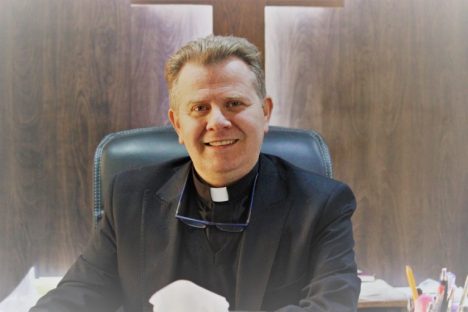
Reverend Ibrahim Nseir, Presbyterian Church, Aleppo. December 31st 2018. (Photo: Vanessa Beeley)
The Presbyterian Church in the Old City of Aleppo was destroyed by the Western-backed terrorist groups in November 2012. An article in the Mennonite World Review in July 2018 described the destruction of the church – “In the old city of Aleppo, Syria, Ibrahim Nseir stands on the pile of rubble that used to be his church. The building where his congregation worshiped is now broken stones and dust. It’s a sunny day, the bright sky a stark contrast to the destruction on the ground.”
After eight years of resistance against the threat of persecution and mass exodus of Christians from Aleppo, Nseir remains defiant and upbeat about the future of Aleppo and Syria. Of the 300,000 Syrian Christians in Aleppo, only 30,000 remain. This is the legacy of sectarian oppression that has been imprinted upon Syria by Western hegemony and it will take generations for it be turned around.
Nseir described the rebuilding process for the Presbyterian Church as difficult but he insisted that it would be rebuilt from its original stones to preserve its historical identity. For Nseir the priorities for Aleppo and Syria are to address the economic situation which has clearly taken a hit on many levels and is suffering in a typical post-war slump. Education is another top priority for this intelligent and enthusiastic Reverend. The intention is to create a center for retreats and conferences at the current Presbyterian Church offices in the center of Aleppo, including a student dormitory.
“We will increase educational capacity by 1000 in the very near future and continue to build upon this progress” Nseir told me.
Education, according to Nseir, is the greatest weapon against extremism and is the only way to re-habilitate children who spent seven of their formative years under occupation of extremist and sectarian factions who worked hard to brainwash almost an entire generation of Syria’s children.
“Ethically the West and the East are responsible for Syria’s destruction. This is not a “Christian” issue, it is a World issue.” Nseir insisted.
The role of the Western media in manufacturing consent for the collective punishment of the Syrian people was clearly a primary cause of the devastation that Nseir and other faith leaders across Syria are now dealing with:
“Western media played more than a negative role, they literally urged the terrorists to take action against the Syrian people by providing false information and blinding people in the West to what was really happening in Syria for eight years. This should never be forgotten.”
Nseir stressed that the healing process for children traumatised by the war would not be easy.
“How do you erase the hatred and horror planted in the brains of 7-10-year-old children by these fanatics? What do you expect from children who have played football with the head of a Syrian Arab Army soldier or who have witnessed the violent abuse of their mother by these terrorists or have seen their father executed by the armed groups? This is the greatest challenge for Humanity and for Syria to put right these terrible wrongs.”
Nseir spoke of the shocking estimated figures of 82,000 children whose father is unknown, referring to the huge number of young women raped or forced into multiple marriages by the terrorist groups and their fighters. How do these children regain their identity and re-integrate into Syrian society? The rebuilding of schools and hospitals must be a priority. The terrorists destroyed “the most developed hospital in the Middle East, Al Kindi” in 2013 and since then, and the destruction of more hospitals across Syria by the terrorist groups, Nseir told me Syria has seen an increase in Cancer and new diseases. Nseir also suggested that this may be attributed to the weapons used by the US Coalition proxies and the U.S itself, which include depleted uranium.
Another important challenge, according to Nseir, is the environmental one. Syria needs to rebuild its natural environment which has also been hugely affected by the conflict. 100,000 trees have been destroyed in Aleppo alone which could lead eventually to desertification of the province if not dealt with. The Governor of Aleppo has recently planted 2,000 new trees but this is an issue that must be addressed with urgency for Nseir.
Nseir strongly believes that Western people should come to Syria independently to see the truth for themselves and report the truth as they see it without any agenda. The Church and the media in the West have maintained a sectarian, divisve narrative which is confusing for people in the West and far from reality.
Nseir addressed the position and status of Syria in the Middle East and described how it has not changed, all that has changed is the perception of Syria portrayed by the media and world leaders who have aligned themselves with the West’s criminal project to partition Syria into sectarian statelets and to remove the elected Syrian government from power by force:
“What has changed since 2011 in reality? Nothing. Syria has always been the protector of the Middle East before 2011, during the conflict and now. The only thing that has changed is the positions of those who turned against Syria, betrayed Syria and who now wish to come back to Syria for protection. We see the Gulf States now change their stance and the UAE has re-opened its embassy in Damascus. The Arab League will welcome Syria back into its fold. Nothing has changed, Syria has remained the same while others have been opportunists and traitors.”
The fact that Syria will forgive its betrayers is testament to what has given Syria victory over its enemies throughout history. With regards to the West, Nseir is not so forgiving:
“The West must go beyond simply stopping its financing of terrorism and the supply of weapons. The West must confess to its crimes against the Syrian people in order to be forgiven. The West must lift the economic sanctions which are a siege upon the Syrian people and it must allow the Syrian people to rebuild in peace without meddling in their affairs. The Syrian people will rebuild according to what the Syrian people want not what the East or the West want. The West has sold the idea that this war was against President Assad but in reality it was against the will of a nation and the people of that nation must be respected”.
Nseir confirmed that the western NGOs are nothing more than political instruments and devices who further the cause of war but he insisted that the West must effectively pay reparations to Syria and expect nothing in return. This is the only way the West can be forgiven by Syria.
Nseir told me that his church will be establishing a medical and health center in the coming months which will be open to everyone in Aleppo to offer medical check-ups and treatment for free. Staff will be trained to deal with the children afflicted by the effects of the war and the terrorist occupation and the plan is to eventually set up special schools to continue the work of rehabilitation for these children. This will enable the coming generations to stand against radicalism and terrorism in the future.
“The West has a duty to respect our dignity and territorial integrity. The Syrian Arab Army has saved the image of our God of Peace, Love and Unity – this has been a spiritual war in Syria not only a military war. The God of love has been embodied by the SAA and our allies and has been victorious over the God of terrorism and hatred. The whole world will change after this war and after Syria’s victory. Syria will be a transformational catalyst for all of Humanity. Syria was never going to be defeated, you only have to study our history to know this. Our society has always embraced diversity and this is the essence of our country. Fanaticism was never going to survive breathing the pure oxygen of our humanity. Actually this demonstrates the stupidity of leaders in the West – to even imagine that extremism has a place in our culture”. Nseir told me.
Nseir ended our talk by stating that the crisis in Syria must be an alarm bell for the country and for its leaders.
“We must re-prioritise our schedule, our agenda and make sure it is not only political but that we address all issues – religious, educational, health care. We must rethink our priorities to ensure a future of peace and stability. At the end I believe strongly that all the negative consequences of this terrible war will be transformed into positive consequences if we address them in the right way. Out of adversity are born the greatest opportunities for the future of Syria and Humanity.”
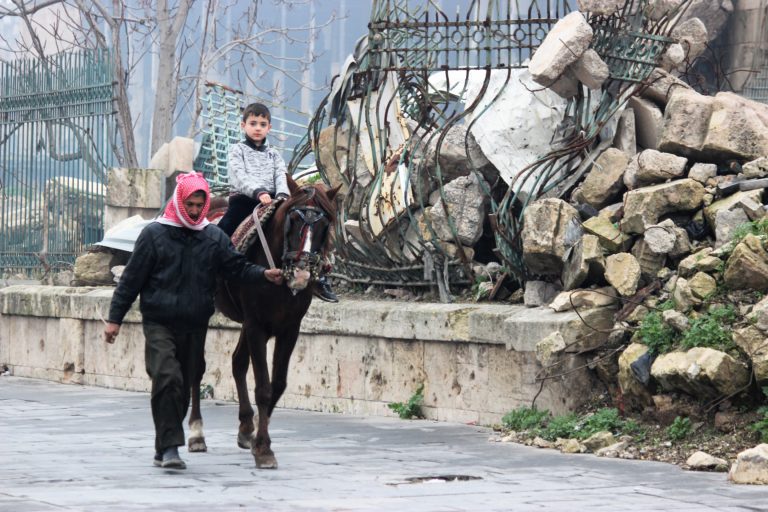
Horse rides on offer at the foot of the Citadel in the Old City of Aleppo. (Photo: Vanessa Beeley)
***
Vanessa Beeley is an independent journalist, peace activist, photographer and associate editor at 21st Century Wire.
Syrian Kurds throw Americans under the bus
By M. K. BHADRAKUMAR | Indian Punchline | December 28, 2018
The Syrian government forces have entered the northern town of Manbij on the Turkish border earlier today. The Syrian military command announced in Damascus that the operation stemmed from the commitment to “impose sovereignty to each inch of Syrian territories and in response to calls of locals of Manbij city.”
The announcement reiterated Damascus’ twin objective of “smashing terrorism and expelling the invaders and occupiers out of Syrian soil.” The government troops have hoisted the Syrian Arab flag in Manbij.
In a highly significant move, Kremlin Spokesman Dmitry Peskov promptly welcomed the development. “No doubt, this is a positive step towards stabilizing the situation,” the spokesman said. He added that the expansion of the zone of the Syrian government troops’ control “is a positive trend.”
It stands to reason that Moscow mediated between the Syrian Kurdish leadership and Damascus. There have been reports that Syrian Kurdish delegations visited Moscow this week as well as the Russian military base at Hmeimim in Syria. A senior Kurdish leader in Manbij told Reuters, “We want Russia to play an important role to achieve stability.”
Indeed, Moscow needs no prompting from anyone in this regard. The Russian Foreign Ministry spokesperson Maria Zakharova said on Wednesday, “The question of fundamental importance is who will assume control of the regions the Americans will vacate. It should be the Syrian government… We believe that the Syrian government is equipped to maintain stability through dialogue and interaction with all the national patriotic forces. This dialogue in the interests of all Syrians can help complete the routing of the terrorists and preclude their reappearance in Syria. It is important not to interfere with the Syrian society’s efforts on the political track.”
The fact of the matter is that while Russia welcomes Trump’s decision to withdraw US troops from Syria and regards it as “important in that it can promote a comprehensive settlement of the situation” Moscow remains extremely wary of what it entails. So far, even a week after Trump’s announcement, Washington has not contacted Moscow to explain its decision.
Foreign Minister Sergey Lavrov drew attention to this while talking to the media in Moscow today: “To the best of my knowledge… Washington wants its coalition partners to assume responsibility. French, British and German service personnel are also illegally deployed on the ground. Of course, there are also the coalition’s air forces on whom they want to shift an extra financial burden. We hope to receive specific explanations… on the assumption that the end goal of all counter-terrorist operations in Syria is to restore Syria’s sovereignty and territorial integrity.”
The known unknown will be the terms of any Faustian deal between Washington and Ankara with regard to the future of the Syrian territories under American control. A US military delegation is expected in Ankara. Moscow and Damascus (and Syrian Kurds) would not rule out the possibility that Pentagon commanders would work on the “neo-Ottoman” and secretly encourage Turkish revanchism. Meanwhile there are also reports that Turkish forces are moving toward the frontlines facing Manbij in “full readiness… to start military operations to liberate the town, according to Reuters.
Suffice to say, Damascus and Moscow have pre-empted Ankara in the race for Manbij. Put differently, they have created a new fact on the ground, which either Ankara has to learn to live with or use military force to change. The latter course is fraught with immense risk, apart from severely jolting the Turkish-Russian political understanding over Syria. It is unlikely that Turkey will push the envelope.
However, to my mind, Turkish President Recep Erdogan is unlikely to cross lines with the Kremlin. A high-powered Turkish delegation comprising Foreign Minister Mevlut Cavusoglu, Defence Minister Hulusi Akar, Turkish intelligence chief Hakan Fidan and the presidential spokesman Ibrahim Kalin is expected to travel to Moscow on Saturday. No doubt, Moscow hopes to engage Ankara constructively.
Interestingly, amidst the dramatic developments concerning Manbij today, Russian President’s Special Representative for the Middle East and African Countries, Deputy Foreign Minister Mikhail Bogdanov disclosed in Moscow today that the Guarantor States of Astana Process (Russia, Turkey and Iran) may hold a summit in Russia next week, depending on the schedule of the three presidents.
Curiously, there has been no reaction from Washington to today’s developments in Manbij. American troops have been patrolling in Manbij town and the tense front line between Manbij and adjacent towns where fighters backed by Turkey were based. Having received the orders from Washington to withdraw from Syria, the local US commanders in northeast Syria will be in a quandary.
Nonetheless, it will be a bitter pill for the Pentagon commanders to swallow that the Syrian Kurds are overnight reconciling with Damascus. This will become additional fodder for Trump’s detractors in the US, too. In fact, sniping has already begun in Washington.
On the other hand, the Syrian Kurds, who have been the US’ main allies in Syria up until recently, have openly declared that they have invited the government forces to enter Manbij. They said in a statement today, “Due to the invading Turkish state’s threats to invade northern Syria and displace its people similarly to al-Bab, Jarablus and Afrin, we as the People’s Protection Units, following the withdrawal of our forces from Manbij, announce that our forces will be focusing on the fight against ISIS on all the fronts east of the Euphrates.”
The statement added that the Syrian government forces are ”obliged to protect the same country, nation and borders” and also protect Manbij from Turkish threats. It leaves the door wide open for the Syrian government forces to eventually regain control of the entire territory vacated by the US.
Assad has offered the integration of the Kurdish fighters into the Syrian Army under separate regiments. The prospects are that Assad’s offer will find acceptance among the Kurds at some point soon. There has all along been a tacit co-habitation between the Syrian Kurdish fighters and the government forces operating in northern regions bordering Turkey. It will be recalled that Assad quietly went to the aid of the Kurdish fighters in February when the Turkish army attacked Afrin region in the northwest in February.
Clearly, it is nonsense to say that the Kurds have been “thrown under the bus”, as Trump’s critics in the US are alleging. The plain truth is that the US created the illusion in the Kurdish mind that the creation of another Kurdistan on Syrian territory, similar to the one in Iraq, could become a possibility. But, fundamentally, Kurds will reconcile with Damascus. The comfort level between the Kurds and the Russians is also appreciable, historically. Moscow has consistently held the view that the Kurds must be represented at the negotiating table in any intra-Syrian peace process. The speed with which Kurds began mending fences with Damascus only underscores that they never quite trusted the Americans and all along had kept their options open.
Featured Video
The Search for Truth: Charlie Kirk’s Assassination One Year Later
or go to
Aletho News Archives – Video-Images
From the Archives
The 9/11 “Double-Cross” Conspiracy Theory
BY LAURENT GUYÉNOT • UNZ REVIEW • SEPTEMBER 6, 2022
Is it true that “9/11 was an inside job”? Yes, insofar as Israel is “inside” the U.S. But for the 9/11 truthers who have identified Israel as the main perpetrators, “9/11 was an inside job” is at best a half-truth, and at worst an integral part of the Zionist operation, like a secondary flag sewn as a lining under the false flag of Islamism. Victor Thorn (1963-2017) wrote in his book 9/11 made in Israel: The Plot Against America (2011): “In essence, the ‘9-11 truth movement’ was created prior to Sept. 11, 2001 as a means of suppressing news relating to Israeli complicity. . . . The slogan ‘9-11 was an inside job’ was quite possibly the greatest example of Israeli propaganda ever devised.” In milder terms, it is “controlled opposition”.
A genuine truth movement would have pointed to Israel as the prime suspect from the start. From day one, it was obvious who would benefit. … continue
Blog Roll
 Aletho News
- Europe’s mounting social chaos… chickens coming home to roost for proxy war against Russia
- US-Russia Diesel Deal Becomes Massive Defeat for Ukraine
- Hormuz and the Looming Economic Catastrophe
- Dhubab offensive, media blitz and the rapid unraveling of Saudi-backed coalition’s new gambit
- Putin Conveys to Trump Iran’s Vision on Possible Conflict Resolution – Kremlin
- The Search for Truth: Charlie Kirk’s Assassination One Year Later
- ‘Harsh reality’: Iran says France seeks monopoly on power and intimidation, not peace for all
- When Will This White House Madness End?
- Huckabee aide goes to ‘unusual lengths’ to portray ‘Israel’ positively
- Trump Announces Diesel Supply Deal With Putin Following Phone Call
- If Americans Knew
- Israeli forces kill another child in Gaza – Daily Update
- Gaza ceasefire exists in name only, say more than 100 organizations
- Nearly 2 Million in Gaza Need Urgent Shelter Assistance as Winter Looms: IOM Chief Warns
- Suppressing Palestinian resistance: US charity under fire for AI monitoring of Gaza classrooms
- Thousands Are Held in Israeli Torture Camps. This Is What Happens Inside
- Israel puts Gaza’s sick, injured, newborn in peril – Daily Update
- Report claimed Mark Levin used by Israeli government to influence Trump
- Over 2,000 Gazans have died awaiting medical evacuation amid Israel’s continued siege
- How a U.S. Diplomat Suppressed and Altered Reports Critical of Israel
- 5 Palestinians Die from Israeli Strikes in Gaza as Relentless Attacks Continue
- No Tricks Zone
- New Study: 50 Years Of The Most Aggressive ‘Net Zero’ Policies Can Only Affect The Global Climate By 0.03°C
- US September “Heat” Was No Record…Many Records Set Decades Ago
- Latest European Green Energy Debacle; Portugal’s Largest Flagship Solar Park Insolvent!
- Green Energy Debacle: German Expert Professor Fritz Vahrenholt Warns Of Severe Economic And Social Consequences
- Two More Paleo Reconstructions Affirm Meters-Higher Sea Levels Across Ireland, Brazil 7000-6000 Years Ago
- New Study: Earth And Venus Surface Warmth Largely Explained By Convection And Lapse Rate, Not CO2 Or Radiation
- 2025 Nature Paper Claiming Worsening Global Drought Gets RETRACTED …Heavily Flawed
- New Study: ‘Global Drought Shows No Detectable Recent Acceleration Under Climate Warming’
- Economic Masterminds: German Socialists Suggest Taxing Productivity Gains Stemming From Using AI
- The South China Sea Has Not Been Cooperating With The Climate Change Narrative

