A Rogue’s Gallery in Paris
We Aren’t Charlie
By Robert Fantina | CounterPunch | January 16, 2015
Much has already been said about the hypocrisy of world leaders, all of whom oppose free speech and freedom of the press to one degree or another, jumping on the ‘I am Charlie’ bandwagon and marching in Paris. Reminiscent of the massive demonstrations in support of the U.S. after 9/11, this rally was just another ‘feel good’ moment, full of photo opportunities for politicians masquerading as statesmen to use in future campaigns.
Let’s look for a minute at just some members of the Rogues Gallery that were on display in Paris.
French President Francois Hollande: As president of the country that, to hear the media and world leaders describe it, is now the front line of some war at which civilization is at stake, Mr. Hollande, of course, had to be there. So what if France banned pro-Palestine demonstrations last summer, when Israel was slaughtering thousands of defenseless men, women and children? Who cares if France assisted in the training of Muslim radicals to fight in Syria? They should have known that their victims were only to be other Muslims, not good, respectable non-Muslims who make a career out of mocking Islam. France taught them how to kill, but perhaps didn’t specify that it was only to be in Syria. But what is any of that? When Muslims, trained and armed by France, shoot up a magazine office in Paris, killing several people, and then go to a market to do the same, somehow we all become Charlie.
Turkish Prime Minister Ahmet Davutoğlu: According to a recent report, Turkey has the distinction of currently imprisoning forty journalists, more than any other country in the world. But, what are facts, when a good photo op beckons?
Russian Foreign Minister Lavrov: Siberian journalist and blogger Dmitry Shipilov was jailed in Russia for three months in 2014, for the crime of “insulting a government servant in the course of his work.” Free speech isn’t quite as free in some places as it might be.
Tunisian Prime Minister Medhi Jomaa: Mr. Yasine Ayan is currently imprisoned for ‘defaming the army’. Mr Ayan, a civilian, was convicted by a military court and sentenced to three years imprisonment, due to Facebook posts he created in August and September of 2014.
Israeli Prime Murderer Benjamin Netanyahu: Perhaps this writer saved the best for last. The word ‘hypocrite’ simply isn’t strong enough here, but unfortunately, a better one doesn’t exist. Israel, under Mr. Netanyahu’s leadership, arrests and jails people for Facebook posts critical of Israel. During last summer’s genocidal bombing of the Gaza Strip, press vehicles were not ‘collateral damage’; they were successfully targeted, killing the journalists riding in them. Israel pays university students to write blogs and other articles favorable to Israel. It prevents United Nations personnel from visiting the Gaza Strip to see firsthand the damage wreaked there by Israel.
Absent from this Paris love fest was a top representative from the United States. Is it possible that U.S. President Barack Obama knew that for the U.S. to go to France to show support for free speech would simply be too ludicrous? Perhaps he thinks of recent police assaults on reporters in Ferguson, Missouri. Or possibly Edward Snowden, living in asylum in Russia after having revealed the extent to which the U.S. monitors the actions of its own citizens, citizens around the world, and world leaders, comes to mind. Or could he have thought of Chelsea Manning, serving a thirty-five-year sentence for releasing the largest set of government-classified documents ever released to the public, information that was more than a little embarrassing to the government? Or maybe his thoughts were not quite so specific. Knowing that profit-making corporations control most of the ‘mainstream’ press in the U.S., Mr. Obama must surely be aware that, while many people may have the right to speak freely, there is no opportunity for them to do so. The airwaves only broadcast what their corporate masters demand. For example, Occupy Wall Street demonstrators in the thousands were occurring for weeks before any major news stations deemed them worthy of reporting.
Well, what is any of that, if people have a brand new hashtag (#jesuisCharlie), and get to feel a sense of shared outrage? And, to add icing to the rather stale and poorly-made cake, those perpetrating the crime were Muslims, a foreign-looking, foreign-sounding people who wear such things a hijabs and kufiyahs. ‘Different’, of course, must be bad. Just because nearly 25% of the world’s population is Muslim is no reason for people to learn anything about them or, heaven forbid, accept them as fellow human beings. If the media says they are terrorists, hating western society for its freedoms, then it must be so. One wonders why the nearly constant bombing of mainly Muslim nations hasn’t proven to them yet the benefits of western society.
Following the 9/11 attacks, flag lapel pins, and flag decals on car windows were all the rage. They enabled people far removed from the reality of suffering to feel that they were ‘doing their part’ and ‘supporting the troops’. It was never necessary to look at any motivations that might have been behind those attacks; after all, when politicians like New York City Mayor Rudy Giuliani were telling the public that ‘they hate us for our freedoms’, well, what else is there to say? Just because the U.S. supports the most repressive Middle Eastern regimes, bombs citizens of the nations it doesn’t support, kidnaps and tortures suspected ‘terrorists’ and generally causes untold suffering, is no reason, a true, flag-waving patriot would say, for them to hate us. No, it is our cherished freedoms (similar to those enjoyed by Canada, Australia, most of Europe, much of South America, etc.), that motivates their hatred.
And now we are all supposed to be Charlie, whatever that means. But a clever phrase, an attractive sign, and the mistaken belief that by waving it one is doing ‘something’, is sufficient for many people. Tomorrow we all go back to our own little worlds, while the same heads of state that piously marched in Paris throw bread and water into the cells of imprisoned journalists, control through wealthy corporations which events become public knowledge and which don’t, and continue to repress their own citizens and press. And then come together again, in a pseudo show of solidarity the next time some event occurs that the governments and media choose to exploit. That it will most likely be at the expense of Muslims is an additional tragedy.
Robert Fantina’s latest book is Empire, Racism and Genocide: a History of US Foreign Policy (Red Pill Press).
US to Deploy 400 Troops to Train Syria Militants
Al-Akhbar | January 16, 2015
Defense officials of the United States said on Thursday the US will deploy about 400 troops in countries neighboring Syria to train “moderate” opposition fighters.
The US military has not yet identified where it will draw its forces from for the training mission, expected to begin in the spring. Turkey, Qatar and Saudi Arabia have offered to host the training.
The training program is a part of the US’ plan to field local forces in Syria. The Pentagon has estimated that it can train more than 5,000 recruits in the first year and that up to 15,000 will be needed to retake areas of eastern Syria controlled by the Islamic State of Iraq and Syria (ISIS).
Since the start of the Syrian civil war, Western powers, and some regional countries have supported rebels by arming, financing and politically empowering militant groups in the country.
On January 5, a senior Turkish foreign ministry official said that Turkey and the US aim to finalize an agreement on equipping and training “moderate” Syrian rebels until the end of January. However, this support has backfired as many of the weapons provided have ended in the hands of ISIS fighters, who have been targeted by a US-led coalition in an air raid campaign since August.
“Around 1,500 to 2,000 people are expected to be trained in Turkey (in the first year),” the official said, adding that a “limited number” of US soldiers would come to Turkey to help carry out the training jointly with Turkish colleagues.
The US decision to train and equip rebel groups in Syria was criticized by several renowned officials who warned of dire consequences.
Former US Congressman Ron Paul denounced in an interview with Russia Today the plans, noting that these Western-backed forces have been helpful to ISIS, which since August has captured swathes of lands in Iraq and Syria.
“The Free Syrian Army (FSA) turned over the weapons, that we (the US) sent them, to ISIS,” Paul said. “It is pretty well recorded that for $50,000 the FSA turned over one of the two American journalists to ISIS.”
Meanwhile, Gulf state Qatar, with the help of the US, has already been covertly training “moderate” Syrian rebels to fight the Syrian army and ISIS, as well as other extremist groups for over a year, sources claimed in November.
The camp, south of Doha between Saudi Arabia’s border and Udeid area, the largest US air base in the Middle East, is being used to train the FSA militants and other rebels, the sources said.
In September a report by the London-based small-arms research organization Conflict Armament Research revealed that ISIS jihadists in Syria as well appear to be using US military-issued arms and weapons supplied to rebels by Saudi Arabia.
The report said the jihadists disposed of “significant quantities” of US-made small arms including M-16 assault rifles and included photos showing the markings “Property of US Govt.”
It also found that anti-tank rockets used by ISIS in Syria were “identical to M79 rockets transferred by Saudi Arabia to forces operating under the Free Syrian Army umbrella in 2013.”
(Reuters, Al-Akhbar)
Turkey, US set to train “moderate” Syria rebels as SNC rules out Moscow talks
Al-Akhbar | January 5, 2015
Turkey and the United States aim to finalize an agreement on equipping and training the so-called “moderate” Syrian rebels this month, a senior Turkish foreign ministry official said Monday.
Meanwhile, Syria’s Turkey-based opposition, the Syrian National Coalition (SNC), ruled out taking part in a Russian-led bid for new talks to end the Syrian conflict.
The training is expected to start in March, simultaneously with similar programs in Jordan and Saudi Arabia, the Turkish official said.
The aim is to train 15,000 Syrian rebels over three years.
“Around 1,500 to 2,000 people are expected to be trained in Turkey (in the first year),” the official said, adding that a “limited number” of US soldiers would come to Turkey to help carry out the training jointly with Turkish colleagues.
The training, which the US says is part of its campaign to battle the Islamic State of Iraq and Syria (ISIS) militants, is planned to take place at a base in the central Turkish city of Kirsehir.
In October of last year, John Allen, a senior US official, said that his country does not expect the Free Syrian Army (FSA) it trains to fight ISIS militants to also take on Syrian Arab Army forces, but sees them as a crucial part of a political solution to end the war.
“There is not going to be a military solution here,” he added.
The FSA is a term used to describe dozens of armed groups fighting the Syrian army to overthrow President Bashar al-Assad but with little or no central command. They have been widely outgunned by Islamist insurgents such as ISIS.
The plans gained momentum in November 2014 when Britain announced it would also make “a significant contribution” to equip and train the so-called “moderate” Syrian opposition to defeat the ISIS group as well as the Syrian army.
Foreign Secretary Philip Hammond said that “the UK is helping the opposition establish security and governance, and to deliver essential services. This includes life-saving search and rescue training, helping Syrians whose homes have been reduced to rubble by the regime’s bombs.
“We are providing non-lethal equipment and the UK expects to make a significant contribution to the US-led Train and Equip program,” Hammond said in the statement, adding that “Assad can play no future role in Syria.”
Meanwhile, Gulf state Qatar, with the help of the US, has already been covertly training the so-called “moderate” Syria rebels to fight the Syrian army and ISIS group as well as other extremist groups for over a year, sources claimed in November.
The camp, south of the capital between Saudi Arabia’s border and Udeid area, the largest US air base in the Middle East, is being used to train the Free Syrian Army (FSA) militants and other so-called “moderate” rebels, the sources said.
Reuters could not independently identify the participants in the program or witness activity inside the base, which lies in a military zone guarded by Qatari special forces and marked on signposts as a restricted area.
But Syrian rebel sources said training in Qatar has included rebels affiliated to the FSA from northern Syria.
The sources said the effort had been running for nearly a year, although it was too small to have a significant impact on the battlefield, and some rebels complained of not being taught advanced techniques.
The training is in line with Qatar’s constant meddling in regional affairs.
Small groups of 12 to 20 militants are identified in Syria and screened by the Central Intelligence Agency (CIA), the sources said.
Once cleared of links with jihadist factions, they travel to Turkey and are then flown to Doha and driven to the base, though it wasn’t clear how the militants are ‘cleared’ of jihadist links.
Rebel fighters have voiced frustration with the US-led approach to fighting ISIS. They say Washington and its Arab allies are too focused on quashing the militant group at the expense of confronting Syrian army, which many rebels still see as the ultimate “enemy.”
ISIS militants have seized large swathes of territory in Syria and around one third of Iraq. They seized Mosul, Iraq’s second-largest city, in June last year.
Turkey has been a reluctant partner in the US-led coalition against the insurgents, refusing a frontline military role despite its 1,200 km (750-mile) border with Iraq and Syria.
But it agreed in principle to train and equip Syrian rebels and is already training Kurdish peshmerga fighters in northern Iraq. Ankara has signalled that it is ready to extend similar assistance to the Iraqi army and send arms.
The US decision to train and equip rebel groups in Syria was criticized by several renowned officials who warned of dire consequences.
Former US Congressman Ron Paul, an outspoken anti-interventionist, denounced in an interview with Russia Today the plans, noting that these Western-backed forces have been “helpful to ISIS.”
“The FSA turned over the weapons, that we (the US) sent them, to ISIS,” Paul said. “It is pretty well recorded that for $50,000 the FSA turned over one of the two American journalists to ISIS.”
In an article, Dennis Kucinich quoted historian Alastair Crooke who described “moderate” rebels in Syria as being “rarer than a mythical unicorn,” and warned that “funding Syrian rebels will precipitate a new and wider war in the Middle East.”
“Saudi Arabia, which, with Qatar funded the jihadists in Syria, is now offering to ‘train’ the rebels,” which means that “the sponsors of radical jihadists are going to train ‘moderate’ jihadists,” Kucinich added.
Kucinich also described the US Treasury as becoming the “piggy bank” of ISIS.
“The US has supplied weapons to the Iraqi government and to Syrian rebels which have ended up in the hands of ISIS,” he explained. “As a result, the US Air Force has been bombing Humvees and armored troop carriers purchased with US taxpayer money.”
SNC refuses to take part in Moscow talks
Khaled Khoja, who was elected early on Monday to head the SNC opposition grouping, said Moscow’s proposal was impossible.
“The dialogue with the regime that Moscow is calling for is out of the question,” he said at a news conference in Istanbul, where the Coalition is based.
“We can’t sit at the same table as the regime… except in a negotiating framework intended to achieve a peaceful transition of power and the formation of a transitional body with full powers,” he said.
Russia, a key ally of Assad, has been trying to relaunch peace talks that would include meetings between delegates of the regime and the fractured opposition.
It has invited 28 opposition figures, including members of the tolerated domestic opposition as well as individual coalition members, to Moscow later this month.
Among them are Hadi al-Bahra, whom Khoja succeeded on Monday, and two other previous Coalition chiefs, Moaz al-Khatib and Abdel Basset Sida.
It remains unclear whether the coalition will prohibit its members, who have been invited by Moscow, from attending the talks.
(AFP, Al-Akhbar)
The EU shifting its strategy on Syria, Iraq and fighting ISIS
By Sami Kleib | Al-Akhbar | December 27, 2014
After the United States abandoned the idea of Syrian President Bashar al-Assad stepping down and enhanced security coordination with the Syrian army against the Islamic State in Iraq and Syria (ISIS), it appears the Europeans began some time ago a series of meetings to change their policy on Syria. According to information obtained by Al-Akhbar, some senior European officials did not hesitate to say at the last Council of European Union Foreign Ministers meeting that “this policy was wrong.” It is necessary, therefore, to change it and let the United Nations envoy Staffan de Mistura’s initiative lead the way. Does that mean we will soon see favorable signs towards the Syrian regime and further disregard for the external opposition?
Geneva – A European official told Al-Akhbar about the proceedings of an important meeting between United Nations (UN) envoy Staffan de Mistura and European Union (EU) foreign affairs ministers on December 11, confirming that there is a change in the European position towards Syria. He said the meeting was closed like all meetings during which Europeans discuss sensitive matters. De Mistura began to explain the situation in Syria and the regional and international framework surrounding his plan that is supposed to be implemented in three months “otherwise it loses its ability to be implemented.”
This, in short, is what de Mistura said and the Europeans’ position towards it.
- The plan to freeze the fighting in Aleppo is the only one currently available. There is no hope for another plan. Therefore, the EU should support it practically and not just verbally. It is the only plan capable of freezing the fighting, securing people’s needs and returning the displaced people who are burdening neighboring areas and states. It will also allow for the eventual process of reconstruction.
- Syrian President Bashar al-Assad, who showed readiness to ensure the success of the international plan in Aleppo, convinced Russian President Vladimir Putin of the plan and played a major role in convincing his Iranian allies as well. This was necessary because Moscow was reluctant, thinking that no US-Atlantic effort can be trusted and the plan might lead to dire consequences for Russia and its allies.
- Although the Americans expressed reservations and doubt about the plan at the beginning, they have become more flexible, tying their approval with that of some of their regional allies, meaning of course Saudi Arabia primarily. In any case, I am going to Riyadh to convince Saudi officials of the plan’s feasibility. If we obtain preliminary approval from them, I will subsequently continue my efforts in Damascus so we can start as soon as possible because time is running out.
Here, we should remember that Brahimi had told the Europeans once what he said on more than one occasion and in more than one place, namely, that his resignation will “relieve two people, Assad and Saudi Foreign Affairs Minister Saud al-Faisal” because his personal relationship with both men was quite bad. He was probably speaking about “Saud al-Faisal’s personal hatred towards Assad being a hindrance to finding a solution.” It is also known that the Syrian president, from his very first meeting with Brahimi, questioned his intentions especially when the Algerian UN envoy suggested that Assad should step down and intended to meet Syrian Vice President Farouk al-Sharaa before Assad prevented him from doing so, arguing that this is improper on an official visit. Brahimi at the time had to make do with a phone call. After a while, Sharaa was removed from power.
- Turkey remains a real problem for the Europeans. Some officials say it is impossible to predict what Ankara could do next. Others believe that Turkey is pretty much the only country still facilitating the passage of foreign fighters to Syria, it has not made up its mind about fighting the Islamic State in Iraq and Syria (ISIS) and is trying to blackmail the international community with its position. Here, the Europeans make two suggestions. Either put pressure on Turkey, including perhaps issuing a warning – which some believe is pointless because it might make the Turkish president Recep Tayyip Erdogan’s position more intransigent and push him further into Russia and Iran’s arms – or try to cajole and get closer to Turkey, prompting it to commit to the international decision to fight ISIS and stop the flow of foreign fighters. Either way, the Turkish position remains worrisome for Europe.
- Iran has become a central player in both the Syrian and Iraqi crises. It is necessary to deal with this reality regardless of the reservations that some might have. There is nothing to prevent engaging with Iran in a serious dialogue about Syria, even before signing a nuclear agreement. This is useful because it could lead to political concessions from the Syrian regime and it could strengthen the presence of European companies in Iran. Perhaps this has become a European need despite French reservations, which are understandable, given French-Saudi relations and France’s concern not to upset Israel.
- It is impossible to think of serious solution or temporary solutions in Syria without Saudi Arabia, which has extensive relations with a number of Anti-Assad parties. It is important to reassure Riyadh that the European efforts do not intend to buoy up the regime. De Mistura said that Saudi Arabia implicitly welcomes his initiative. The Spanish foreign affairs minister was clearer, saying that Riyadh accepts the plan and it is in France’s interest to tone down its critique otherwise it will appear more extremist than Saudi Arabia, which is not an understandable position. The Spanish minister went as far as suggesting that an international conference for Syria be held in his country given that the idea might be accepted by everybody.
- Russia remains the main obstacle to any solution that does not satisfy the Kremlin and the Syrian regime. Since its relationship with the US and Europe is currently strained because of Ukraine, it is necessary to look for ways to separate any discussion with Russia about Syria from the position regarding Ukraine. Some European officials intend to strengthen the dialogue with Moscow because “it is unacceptable to return to the logic of the cold war.” Perhaps the High Representative of the EU for Foreign Affairs and Security Policy Federica Mogherini will visit Moscow soon. Besides, Russia is active and serious about finding a political solution. The Europeans keeping their distance from Moscow might mean distancing the US and Russia.
The Europeans with and against Assad
First, everyone agrees to de Mistura’s plan, but they want to support it because it is the only plan currently available while awaiting the results of Russian efforts to bring the opposition and the Syrian regime delegation together in Russia. However, France, which currently enjoys strong trade relations with Saudi Arabia and Britain, is ahead of other Europeans in its contacts with Iran and insists that the plan should not support the Syrian army against the moderate opposition in Aleppo. In other words, the issue should not be portrayed as standing with the army against ISIS because in Aleppo and its surroundings there are fighters affiliated with the moderate opposition and they should be taken into consideration and supported “so we won’t appear as though we are drawing a parallel between the regime and the opposition and that we view both sides equally.”
The French foreign affairs minister was the most intransigent even though some within the current French administration point out the need to take a new position towards Syria, especially after the terrorist attacks that took place on French soil. Laurent Fabius said, “We don’t want what happened to Homs to happen in Aleppo,” where suspending the fighting benefited the regime only and was not balanced. The fighters left after they turned in their weapons to the state and were transported in government buses to the areas they come from.
A European official with ties to the Syrian opposition said “the departure of the fighters then was a farce for them. Imagine that the Grand Mufti, Ahmad Badreddin Hassoun, who is a regime loyalist showed up in the buses transporting the fighters joking with them and asking them isn’t it better to marry while they are young instead of getting killed on battlefronts? They were given cell phones to talk with their families and undermine their morale. In the end, the media image and the reality on the ground were in the interest of the regime.”
The French minister was insistent that “the regime should not benefit from this plan in terms of relieving it at the Aleppo front so it can focus on other fronts in other areas.” That is what Fabius was saying when the EU received information about the possibility of the Syrian and Iraqi armies engaging in a wide joint military operation in Deir Ezzor.
Second, the European relationship with Assad is possible, but it becomes evident during the discussions of the foreign affairs ministers and commissioners of the EU that they are at a loss on how to deal with Syria. For example, a European official in Geneva says that a number of his European colleagues have begun to talk about the failure of the policy adopted so far and about the “uncalculated mistake” of suggesting early on that Assad step down.
Some Europeans argue that their assessment of the situation was erroneous while others believe that trusting the US from the beginning was a mistake because Washington, as usual, places its interests ahead of all its alliances, often putting the Europeans in an awkward position. Still others argue that underestimating the capabilities of the Syrian army and its allies was their biggest mistake.
As such, EU officials are currently discussing how to “modify” the political position that has been adopted for more than three years in Syria. One sign of this change is abandoning the mantra of “Assad stepping down” and finding more realistic statements that have been repeated now and then, such as “Assad is not a final solution to the crisis” or “Assad will not stay at the end of the political solution” or “it is only natural that a political solution will eventually lead to transferring powers from the presidency and not all powers” according to Geneva I. Another sign of a change in position is abandoning the phrase “proceeding with a transitional process now” and replacing it with one accepted by all, namely, “calling for the start of a transitional process.”
It appears that Mogherini succeeded, to some extent, in promoting the point of view that “we agree on the end result but political realism and the developments of the situation require us to adjust our course and use new phrases.” In other words, even if everyone in Europe wanted Assad to step down, political realism suggests that this is not possible at this point and encouraging a political solution might eventually lead to this end, meaning this is no longer a European priority.
The security council in Aleppo?
In light of these discussions about modifying the European position towards the Syrian regime, the most important question in the EU is how to ensure the success of the Aleppo plan and how to implement it without portraying Assad as the winner, especially given that the Syrian army advanced in a noticeable way in Aleppo recently?
The dominant trend is to find a monitoring mechanism by the UN Security Council. However, the Europeans realize that this is impossible due to the dual Sino-Russian veto that is always ready to protect Syria. Therefore, unlike the French and British positions which insist on an international force from the UNSC, the EU is more inclined towards finding a diplomatic formula that talks about “a monitoring mechanism linked to the UNSC.”
All of this will be released soon in what is now called “the EU strategy on Syria, Iraq and fighting ISIS.”
Despair with the Syrian opposition, particularly, the National Coalition for Syrian Revolution and Opposition Forces, which for a long time monopolized, with international support, the representation of the opposition has infiltrated EU states after the US. The Europeans too are now more inclined towards expanding the scope of the opposition to include forces that were previously not accepted and undermine the Muslim Brotherhood.
It is remarkable for instance that when the head of the Coalition, Hadi al-Bahra, visited the EU in Brussels few days ago, representatives from the Coalition were calling the Europeans to say that Bahra no longer represents them. A European official says jokingly: “Everytime we begin to talk with an official from the Coalition, we discover that this Coalition held new elections and changed the official. So we start all over again. And every time we meet with a Coalition official, he repeats the same question, how are you going to prevent the regime from benefiting from the plan you are proposing? But we have noticed for some time now that some parties within the Coalition have come to accept the idea of negotiating with the regime and reaching a political agreement with it even if their ultimate goal is for Assad to step down. This is the case with Moaz al-Khatib and his team for instance. The problem of the Coalition is that it does not know the meaning of political realism and continues in its fragmentation as it is tossed around by conflicting foreign alliances.”
In light of all the above, is the EU starting to change its position towards Assad? Perhaps all its members still support the departure of the Syrian president. But political realism requires a change in behavior and approach and not insisting on Assad’s departure as a priority. This will become more evident in the future as terrorist attacks inside Europe have increased. The only solution left is to cooperate with Syrian security forces, the Syrian army and Iran in the context of fighting terrorism.
As for de Mistur’as plan in Aleppo, it is currently in a feverish race between a military solution and security arrangements that cannot be undertaken without the regime’s approval and that might be to its advantage.
Once again, history repeats the same old maxim, “international interests are more important than principles and people’s tragedies.”
Berri: Israel is stealing Lebanese gas
Al-Akhbar | December 8, 2014
While political factions are distracted with the upcoming dialogue between Hezbollah and the Future Movement, and the Lebanese government is struggling to resolve the issue of the kidnapped soldiers and counter the threat of terrorist groups on the Syrian border, Israel is stealing Lebanese gas from the deep sea off the Lebanese southern coast, Al-Akhbar reported on Monday.
Parliament speaker Nabih Berri told Al-Akhbar that he received information a few days ago confirming that Israel has started stealing Lebanese gas, expressing his surprise over the government’s lack of interest in the matter.
Berri said “he will personally push the pressing issue early next year,” adding that the Israeli move will force Lebanon to sign two designated decrees that would allow it to start digging for gas and ensure new revenues for the Lebanese economy.
Lebanon is located in the heart of the Levant basin, where seismic surveys indicate the presence of huge oil and gas reserves, but has so far failed to impose itself as a regional player in this area, as neighboring states greedily fight for its resources.
In July 2013, an Israeli company found Karish, a gas field 75 kilometers from the coast of Haifa. The new field is sufficiently close to Lebanon’s maritime borders to allow Israel access to Lebanon’s own reserves. It is evident that Israel is pressing ahead with exploration and production while Lebanon’s own energy plans falter.
At the time, then-Energy and Water Minister Gebran Bassil addressed these concerns in a press conference. “Theoretically…Israel is now able to reach Lebanese gas and that is a very grave situation,” he said.
“We cannot yet say that a disaster has happened, but the new Israeli discovery may indeed lead to one, especially if Lebanon’s efforts continue to be plagued by delays.”
“If Israel drills horizontally in Karish – made possible thanks to US technology – it may be able to reach up to 10 kilometers north into Lebanon’s reservoirs. If Israel drills vertically, it would still be possible for Israel to syphon off Lebanese oil and gas, if the Israeli and Lebanese fields overlap,” Bassil added.
After the discovery of large deposits of oil and gas in the eastern Mediterranean, the main struggle for Lebanon remains with both Cyprus and Israel to prevent encroachment on its maritime boundaries.
Cyprus breached its agreement with Lebanon and signed a deal in 2010 with the Zionist state, which attempted to gobble up 860 square kilometers of Lebanon’s maritime zone.
This incident revealed the need for Lebanon to assert the integrity of its maritime boundaries and to recover all of its Exclusive Economic Zone (EEZ) – currently being disputed by Israel following its agreement with Cyprus.
In theory, there was no dispute over maritime boundaries between Israel and Cyprus. But when the opportunity arose, Israel encroached on Lebanon’s zones as a result of the latter’s failure to quickly ratify its agreement with Cyprus.
The Cypriot-Israeli agreement enabled Israel to foray into Lebanon’s EEZ, although Israel had so far observed the same boundaries adopted by Lebanon in all its operations.
Reports indicate that Israel found a loophole in the agreement between Lebanon and Cyprus which stipulates that the triple point can only be determined through trilateral negotiations.
Since there are no contacts between Lebanon and Israel, the determination of this point is pending negotiations.
Israel’s interpretation of this, however, is that Lebanon has lost 860 square kilometers.
Lebanon managed to recover 500 out of 860 square kilometers of its EEZ according to international community laws, while 360 square kilometers remain effectively under Israeli control.
In November 2013, Israel rejected a proposal for a settlement made by the US administration to resolve the “dispute” between the Zionist state and Lebanon over the boundaries of each side’s EEZ. The proposal concerned the disputed area of Block 9 in the Mediterranean, which Israel claims sovereignty over.
Israel claims that this block – one of the richest areas in terms of commercial gas deposits recently discovered in the Mediterranean – extends into its EEZ.
In September, Director of the Research and Strategic Studies Center General Khaled Hamada said “the expected quantities (of oil and gas) are relatively small, compared to those discovered in the Arabian Gulf, Russia, and the Caspian Sea, but they are enough to make a significant impact on the energy security of Mediterranean countries, and contribute to a lesser extent to Europe’s energy security.”
Hamada pointed out that Israel had already begun commercial gas production, while Cyprus had started exploration in more than one location.
In a conversation with Al-Akhbar, Hamada warned that any further delays in Lebanon’s efforts to implement gas projects would force it to deal with these projects and security arrangements as a fait accompli down the road.
While Lebanon is busy with endless debates, Israel is rushing to put the final touches on its bid to export gas to Europe.
Four years ago, Al-Akhbar published a statement by Israeli Minister Yossi Peled on September 25, 2010 that highlighted the Israeli stance on Lebanon becoming a gas producer country.
Peled, appearing before the Knesset Economic Committee at a special hearing on the oil and gas sector, said that Lebanon had large gas fields similar to the ones Israel had discovered. He cautioned that the Europeans, who were looking for alternatives to Russian gas, had initiated negotiations with Lebanon, saying, “Imagine what it would mean if this country became a gas producer,” something he claimed had equally alarming economic and security implications.
Although Israel managed to pinpoint the challenges it faced, it did predict at the time – and wager on – Lebanon’s complacency. In response to Peled’s warnings in the Knesset, Israeli daily Globes, in a front-page editorial on October 5, 2010, stated:
“Israeli sources who follow events in Lebanon are convinced that, at the current rate of progress, the Lebanese will award the first licenses this year [2010], and will start exploratory drilling within a year. The same sources believe that Lebanon will quickly be able to close the gap between it and Israel, and become a real competitor.
“Past experience shows that Israel has no immediate reason for fear. Lebanon’s natural resources will arouse internal (and external) conflicts no less severe than Israel’s natural resources have provoked here …
“The oil giants will not rush to invest billions in a country where it is not clear who is in control, and where so many other countries openly interfere.”
Israel was proven right. Nothing in Lebanon is exempt from being the object of division and polarization, and thus, obstruction, including the oil and gas sector.
Meanwhile, Turkey is also trying to expand in the eastern basin through northern Cyprus, with a view to reduce its dependence on oil imports from Iran and gas imports from Russia.
Ankara is seeking to build a network of onshore and offshore gas pipelines, to act as an energy transit hub between East and West.
(Al-Akhbar)
Israel tightens economic stranglehold on 1948 Palestinians
By Zouheir Andraos | Al-Akhbar | December 8, 2014
Occupied Haifa – As Israel increases its economic stranglehold on 1948 Palestinians, its racist policies extended to banning them from raising chickens and growing potatoes. This was after the closure of clothes workshops, which were transferred to Jordan, and other similar actions.
As the economic persecution against Palestinians continues, the Israeli Agriculture Ministry recently decided to prevent 1948 Palestinians from raising chickens and thus producing eggs, claiming this department as an exclusive right for Jews in cooperative villages (moshav). Eggs produced by Palestinian establishments disappeared from the market in a matter of days and were replaced by Israeli eggs produced at moshavs (Israeli agricultural settlements) built on the ruins of Palestinian villages destroyed in the Nakba, or the Catastrophe.
Authorities in Tel Aviv also issued a decree banning “Arabs” from growing potatoes, succumbing to the pressure of Israeli potato farmers. The authorities had discovered that growing potatoes is cheap and was an important source of income for Palestinians. These two steps are further proof of the extent of the occupation’s institutional racism.
Palestine is famous for having fertile land, rich in all sorts of plants used by Palestinians as food (such as thyme and mallow), but which are not known or eaten by Jews. This led the Israeli government to instruct its so-called environmental protection authority to prosecute “plant thieves.” It officially announced those plants as “protected species and those who pick them shall be sent to court.”
Environmental protection authorities started fining Palestinians who pick “protected plants.” In the meantime, Jewish traders, who just discovered the importance of such plants for Palestinians, began requesting necessary licenses from the Israeli Agriculture Ministry to grow them and sell them in Arab markets. Palestinians in the interior became a target of a lucrative and popular “Israeli” trade.
In the same context, occupation authorities found another channel to increase the economic stranglehold on Palestinians, with Dubek cigarettes company (the only Israeli cigarette company) announcing it would stop buying tobacco from Arab farmers. Tobacco is one of the main cash crops for Palestinians, especially in the Galilee, inside what is known as the green line. Thus, Israel would have destroyed one of the most important Arab crops in Palestine, and began importing tobacco from its Turkish ally.
Persisting in its economic war and in collaboration with Jordan, Israel recently shut down the small sewing and knitting factories in Galilee, the Triangle, and Negev, the main source of income for many Palestinian families. The occupation authorities plan to relocate them to Jordan, under the pretext of cheap labor. However, the move was rumored to be an attempt to prop up the fragile Jordanian economy, in addition to the occupation’s determination to cut off sources of income for 1948 Palestinians.
The economic stranglehold policies adopted by Israel resulted in the unemployment of one third of the workforce in Negev and Umm al-Fahm. It widened the gap between Palestinian and Israeli unemployment, with a 25 percent unemployment rate for Palestinians and 6.5 percent for Israelis. The same statistics indicated that half of Palestinian children in the 1948 territories currently live below the poverty line.
Israel refuses Turkish offer to supply Gaza with electricity
MEMO | December 3, 2014
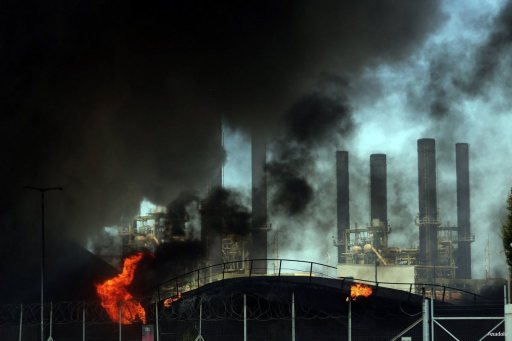
Israel has refused a Turkish offer to send a floating power-generating ship to the Gaza coast to supply the coastal enclave with electricity, Arabs48 reported yesterday.
In the wake of the recent Israeli war on the Gaza Strip, Israel targeted the sole electricity plant in the Strip and massively damaged electricity infrastructure, Turkey offered to cover the electricity shortage.
According to Israeli reports, Turkey has officially asked Israel to issue a permit for a Turkish ship carrying huge electricity generators to be stationed off the Gaza coast.
Arabs48 reported Israeli security sources saying that specialists had found that the infrastructure in the Gaza Strip is not suitable for such a connection and that is why the Turkish offer was refused.
The same sources said that other ideas to solve the electricity crisis in Gaza were proposed, including mobile generators.
Ankara Buckles Against Western Pressure, Turns to Russia
By Andrew KORYBKO | Oriental Review | December 2, 2014
Russia has abandoned the troubled South Stream project and will now be building its replacement with Turkey. This monumental decision signals that Ankara has made its choice to reject Euro-Atlanticsm and embrace Eurasian integration.
In what may possibly be the biggest move towards multipolarity thus far, the ultimate Eurasian pivot, Turkey, has done away with its former Euro-Atlantic ambitions. A year ago, none of this would have been foreseeable, but the absolute failure of the US’ Mideast policy and the EU’s energy one made this stunning reversal possible in under a year. Turkey is still anticipated to have some privileged relations with the West, but the entire nature of the relationship has forever changed as the country officially engages in pragmatic multipolarity.
Turkey’s leadership made a major move by sealing such a colossal deal with Russia in such a sensitive political environment, and the old friendship can never be restored (nor do the Turks want it to be). The reverberations are truly global.
Missing The Signs
It’s amazing how much the West lost in such a short period of time and due to such major and totally unnecessary political miscalculations, and they owe their roots to the disastrous regime change operations in Syria and Ukraine.
The US In The Mideast:
Nearly four years ago, the US co-opted Turkey to ‘Lead From Behind’ in overthrowing the democratically elected Syrian government. However, things didn’t go as quite as planned and the Syrian people engaged in a fierce Patriotic War to defend the existence of their secular state. Turkey purposely sat out on the anti-ISIL coalition because it wanted solid guarantees of its reward in a regime-changed Syria, but none were forthcoming. Its leadership held firm, so the US started playing the ‘Kurdish Card’ of ethnic nationalism to bully them into submitting – which eventually backfired. The US crossed the line by arming and training the Kurds (some of whom are registered as terrorists by Turkey), and faced with such an existential threat to their state (that would either be unleashed wittingly or unwittingly with time), they knew they had to pivot, and fast.
The EU And Its Energy Policy:
Meanwhile, the EU totally fudged its energy policy with Russia. As a result of the Ukraine Crisis, it began exerting tremendous pressure (which was already building up) on the South Stream project, calling upon EU energy legislation clauses to state that its member states’ cooperation with Russia was illegal. Poorer countries like Bulgaria pleaded for the EU to allow the project, emphasizing how important it was for their national economies (which haven’t received much of Brussels’ largesse since joining), but to no avail, as the EU stonewalled the project. Russia had no choice but to find a replacement route and saw that the only viable stand-in was Turkey, which just so happened to be undergoing its most serious crisis ever with the US.
Ducks In A Row
Let’s look at how this geostrategic masterpiece was set into motion, as the past two months contain the main moves of this political waltz — and they’re all centered on Russian President Putin.
(1) Serbia:
Putin’s October visit to Serbia served to inform his counterpart about the plans to scrap South Stream, while still giving him strong assurances that the Russian-Serbian relationship will remain intact going forward, with or without the gas project.
(2) Syria and Sochi:
Syrian Foreign Minister Walid Muallem visited Sochi last week and personally met with Putin and Foreign Minister Lavrov. The meeting, held behind closed doors, was highlighted for the attention that the Russian leader gave to his guest. Putin could have told him to tell President Assad about his upcoming visit to Turkey in order to reassure his loyal and respected partner of his positive intentions and the bigger picture surrounding his motives.
(3) Turkey:
The final step was for Putin to go to Turkey and make the announcement after his meeting with Erdogan. Turkey understands that it has made a definitive move by joining the project and that there is no going back from this decision. It had been rejected by the EU for decades and it now realizes that its closest military ally, the US, had played it for a fool during the entire Syrian War.
Worse still, the Kurdish Card has gotten out of control, and it seems inevitable that sooner or later the insurrection will be rekindled, and with bloody and destabilizing consequences. On a pragmatic note, global events are shifting from the West to the non-West (read: BRICS and G20), so in the national self-interests of the Turkish state, it’s seen as wise to join the new winner’s circle (after being rejected by Europe and betrayed by the US) and try to turn over a new leaf with new friends.
The Aftershocks
The announcement of the New South Stream has global implications, but here’s just a few of them as arranged by region:
Europe:
The EU will now have to pay for expensive LNG (on average 30% higher) that will likely be sold from the terminal at the Greek-Turkish border as well as remain energy dependent on risky Ukrainian routes. But there’s a catch – the poor Balkan countries are able to get in on the deal by building relatively cheaper overland connecting lines and resurrect the project… but only if they leave the EU and its authoritative energy legislation. All that it takes is for Greece or Bulgaria to abandon Brussels (which doesn’t seem improbable), and the project can either go through Macedonia en route to Serbia or via Bulgaria as initially planned, then up to the Hungarian border. At this point, it’s certainly a tantalizing thought for the countries that have paid the most for their ‘integration’ and received scarcely anything in return. Expect the New South Stream to politically divide the EU like never before.
Mideast:
There is no way that Russia would have sold Syria out after so many years of friendship, especially after Putin’s high-profile meeting with Muallem. Thus, Turkey is not forecast to directly invade Syria (although it could continue training some anti-government fighters). It may, however, allow the US to use its airbases and airspace to carry out airstrikes on ISIL.
Since it’s now behaving in a multipolar fashion, Turkey is playing all sides to its advantage, so it will still retain a defense relationship with NATO and the US, but it will no longer behave as an absolute lackey. Taking things further, Turkey’s shift to the East might allow Iran to one day build pipelines through it to access the Western market, and it could also allow Turkmen gas to transit both countries en route to Europe.
Eurasia:
Most significantly, Turkey has shown that it has the political grit to make historical decisions independent of NATO, showing that it is embracing its pivotal geography and combining it with a multipolar policy. The Shanghai Cooperation Organization (importantly encompassing Russia and China) just outlined the specific procedures for admitting new members a few months ago, although at the time analysts thought this was directed towards India and Pakistan.
Now, however, with Turkey already being a dialogue partner, it might make the rapid step to observer status and full-fledged membership just as quickly as it made its decisive pivot. There’s also been talk of the country entering into a free-trade agreement with the Russian-led Eurasian Customs Union, so it might incidentally find its EU replacement with Brussels’ eastern adversary, Moscow.
As Western decision makers are scratching their heads and wondering how it ever got to this point, they’d do well to remember that none of this would have happened had they just allowed the Syrian and Ukrainian people to live in peace with their democratically elected governments.
Andrew Korybko is the political analyst and journalist for Sputnik who currently lives and studies in Moscow.
Interview with Serena Shim’s Sister
See also, Press TV Reporter Killed in Car Accident Following Threats by Turkish Intelligence, which includes videos of Shim, including one of her last reports before her death.
The Endgame of the US ‘Islamic State’ Strategy
By Nicola Nasser | alarabi | November 11, 2014
Dismantling what the former US President George W. Bush once described as the Syria – Iran component of the “axis of evil,” or interrupting in Iraq the geographical contiguity of what King Abdullah II of Jordan once described as the “Shiite crescent,” was and remains the strategic goal of the US – Israeli allies in the Middle East unless they succeed first in “changing the regime” in either Damascus or Tehran.
The US, Israel and their regional allies have been on the record that the final target of their “regime change” campaign in the Middle East was to dismantle the Syria – Iran alliance.
With the obvious failure of Plan A to dismantle the self-proclaimed anti-Israel and anti-US Syrian – Iranian “Resistance Axis” by a forcible “regime change” in Damascus, a US – led regional alliance has turned recently to its Plan B to interrupt in Iraq the geographical contiguity of that axis.
This is the endgame of President Barack Obama’s strategy, which he declared on last September 10 as ostensibly against the Islamic State (IS).
This would at least halt for the foreseeable future all the signed and projected trilateral or bilateral Iranian, Iraqi and Syrian pipeline networks to carry oil and gas from Iran and Iraq to the Syrian coast at the Mediterranean.
Israeli Col. (res.) Shaul Shay, a research associate at the Begin-Sadat Center for Strategic Studies and a former Deputy Head of the Israel National Security Council anticipated in writing on last January 21 what he called the “Salafi Crescent” that is dangerously emerging to challenge the “Shia Crescent.”
“The growing involvement of Sunni Salafi jihadis in Iraq (since 2003), among the rebels in Syria (since 2011), and in Lebanon has created a ‘Salafi Crescent’ … from Diyala [in eastern Iraq] to Beirut,” he wrote.
“A positive outcome” of this Salafi Crescent “will be the decline in Iranian influence in the region,” Shay concluded.
Conspiracy theories aside, the eventual outcome is a sectarian Sunni military and political wedge driven into the Iraqi geographical connection of the Iran-Syria alliance in a triangle bordering Turkey in the north, Iran in the east, Jordan in the west and Saudi Arabia in the south and extending from north eastern Syria to the Iraqi province of Diyala which borders Iran.
Iraqi Kurdistan is already effectively an independent state and cut off from the central government in Baghdad, but separating Iran and Syria as well and supported by the same US – led anti – IS coalition.
Amid the misinformation and disinformation, the fact is that the IS threat is being used as a smokescreen to confuse and blur this reality.
The IS was conceived and delivered in an American womb. The US – drafted and enforced current constitution produced the sectarian government that is still trying to rule in Iraq. Sectarian cleansing and exclusion of Sunnis could not but inevitably create its antithesis.
The IS was the illegitimate fetus born and nurtured inside the uterus of the US – engineered political process based on a constitution legalizing a federal system based in turn on sectarian and ethnic sharing of power and wealth.
This horrible illegitimate creature is the “legacy” of the US war on Iraq, which was “conceived” in the “sin” of the US invasion of the country in 2003, in the words of the president of the Arab American Institute, James J. Zogbi, writing in the Jordan Times on last June 16.
US Senator John McCain, quoted by The Atlantic on last June 23, thanked “God,” the “Saudis and Prince Bandar” and “our Qatari friends” for creating the “monster.”
The pro-Iran government of former Prime Minister Noori al-Maliki was squeezed by the IS military advances to “request” the US help, which Washington preconditioned on the removal of al-Maliki to which Iran succumbed. The IS gave Obama’s IS strategy its first success.
However, al-Maliki’s replacement by Haider al-Abadi in August has changed nothing so far in the sectarian component of the Iraqi government and army. The US support of Iraq under his premiership boils down only to supporting continued sectarianism in the country, which is the incubator of the survival of its IS antithesis.
Moreover, the destruction of the Iraqi state infrastructure, especially the dismantling of Iraq’s national army and security agencies and the Iraqi Baath party that held them intact, following the US invasion, has created a power vacuum which neither the US occupation forces nor the sectarian Shiite militias could fill. The IS was not powerful per se. They just stepped in on a no-man land.
Similarly, some four years of a US – led “regime change” effort, which was initially spearheaded by the Muslim Brotherhood and which is still financed, armed and logistically facilitated by the US regional allies in Turkey, Qatar, Saudi Arabia as well as by allied western intelligence services, has created another power vacuum in Syria, especially on border areas and in particular in the northern and eastern areas bordering Turkey and Iraq.
US Senator Rand Paul in an interview with CNN on last June 22 was more direct, accusing the Obama administration of “arming” and creating an IS “safe haven” in Syria, which “created a vacuum” filled by the IS.
“We have been fighting alongside al Qaeda, fighting alongside ISIS. ISIS is now emboldened and in two countries. But here’s the anomaly. We’re with ISIS in Syria. We’re on the same side of the war. So, those who want to get involved to stop ISIS in Iraq are allied with ISIS in Syria. That is the real contradiction to this whole policy,” he said.
The former 16 – year member of the US Congress and two – time US presidential candidate Dennis Kucinich, writing in the Huffington Post on last September 24, summed it up: The IS “was born of Western intervention in Iraq and covert action in Syria.”
The IS could have considered playing the role of a US “Frankenstein,” but in fact it is serving as the US “Trojan horse” into Syria and Iraq. Fighting the IS was the US tactic, not the US strategy.
On record, Iranian deputy foreign minister Hossein Amir-Abdollahian said that “the best way of fighting ISIS and terrorism in the region is to help and strengthen the Iraqi and Syrian governments, which have been engaged in a serious struggle” against the IS. But this would not serve the endgame of Obama’s strategy, which targets both governments instead.
Beneficiaries of the IS “Trojan horse” leave no doubts about the credibility of the Syrian, Iranian and Russian doubts about the real endgame of the US – led declared war on the IS.
The United States was able finally to bring about its long awaited and promoted “front of moderates” against Iran and Syria into an active and “air-striking” alliance, ostensibly against the IS.
In Iraq, the IS served the US strategy in wrestling back the so called “political process” from the Iranian influence by proxy of the former premier al-Maliki. Depriving al-Maliki of a third term had proved that there is no unified Iran – backed “Shia house” in Iraq. The US has its own influence inside that “house.”
Installing a US Iraqi satellite was the strategic goal of the US – led invasion and occupation of Iraq in 2003. Instead, according to Doug Bandow, writing in Forbes on October 14, “Bush’s legacy was a corrupt, authoritarian, and sectarian state, friendly with Iran and Syria, Washington’s prime adversaries in the Middle East. Even worse was the emergence of the Islamic State.”
This counterproductive outcome of the US invasion, which saw Iran wielding the reigns of power in Baghdad and edging Iraq closer to Syria and Iran during the eight years of al-Maliki’s premiership, turned the red lights on in the White House and the capitals of its regional allies.
Al-Maliki, whom Bush had designated as “our guy” in Baghdad when his administration facilitated his premiership in 2006, turned against his mentors.
He edged Iraq closer to the Syrian and Iranian poles of the “axis of evil.” Consequently he opposed western or Israeli military attack on Iran, at least from or via Iraqi territory. In Syria, he opposed regime change in Damascus, rejected direct military “foreign intervention” and indirect proxy intervention and insisted that a “political solution” is the only way forward in Iraq’s western Arab neighbor.
Worse still was his opening Iraq up to rival Chinese and Russian hydrocarbon investments, turning Iraq a part of an Iran-Iraq-Syria oil and gas pipeline network and buying weapons from the Russian Federation.
Al-Maliki had to go. He was backed by Iran to assume his second term as prime minister in spite of the US, which backed the winner of the 2010 elections for the post, Ayad Allawi. The US had its revenge in the 2014 elections. Al-Maliki won the elections, but was denied a third term thanks to US pressure.
The IS was the US instrument to exert that pressure. US Secretary of State John Kerry during his visit to Baghdad on last June 23 warned that Iraq was facing “an existential threat.”
It was a US brinkmanship diplomacy to force al-Maliki to choose between two bad options: Either to accept a de facto secession of western and northern Iraq on the lines of Iraqi Kurdistan or accept the US conditional military support. Al-Maliki rejected both options, but he had paid the price already.
The turning point came with the fall of Iraq’s second largest city of Mosul to the IS on last June 10. Iraqi Kurdistan inclusive, the northern and western Iraq, including most of the crossing points into Syria and Jordan in the west, were clinched out of the control of Baghdad, i.e. some two thirds of the area of Iraq. Al-Maliki was left to fight this sectarian Sunni insurgency by his sectarian Iran-backed Shiite government. This was a non-starter and was only to exacerbate the already deteriorating situation.
Al-Maliki and Iran were made to understand that no US support was forthcoming to reign in the IS until he quits and a less pro-Iran and a more “inclusive” government is formed in Iraq.
The creation of the IS as the sectarian Sunni alternative against Iran’s ruling allies in Baghdad and Damascus was and is still the US tactic towards its strategic endgame. Until the time the US strategy succeeds in wrestling Baghdad from Iran influence back into its fold as a separating wedge between Iran and Syria, the IS will continue to serve US strategy and so far Obama’s strategy is working.
“America is using ISIS in three ways: to attack its enemies in the Middle East, to serve as a pretext for U.S. military intervention abroad, and at home to foment a manufactured domestic threat, used to justify the unprecedented expansion of invasive domestic surveillance,” Garikai Chengu, a research scholar at Harvard University, wrote in CounterPunch on September 19.
As a doctrine, since the collapse of the Ottoman caliphate early in the twentieth century, western powers did their best to keep Arabs separated from their strategic depth in their immediate Islamic proximity. The Syria – Iran alliance continues to challenge this doctrine.
Nicola Nasser is a veteran Arab journalist based in Birzeit, West Bank of the Israeli-occupied Palestinian territories (nassernicola@ymail.com).
The Silence of the Israelis on ISIS
By Stephen J. Sniegoski | Consortium News | November 5, 2014
In the war on the Islamic State, the alleged scourge of humanity, little is heard about the position of America’s much-ballyhooed greatest ally in the Middle East, if not the world, Israel. Now the Islamic State has been conquering territory in very close proximity to the border of Israel. But Israel does not seem to be fearful and it is not taking any action.
And the Obama administration and American media pundits do not seem to be the least bit disturbed. This is quite in contrast to the complaints about other Middle East countries such as Turkey that are being harshly criticized for their failure to become actively involved in fighting the Islamic State.
For example, a New York Times editorial, “Mr. Erdogan’s Dangerous Game,” begins, “Turkey’s president, Recep Tayyip Erdogan, once aspired to lead the Muslim world. At this time of regional crisis, he has been anything but a leader. Turkish troops and tanks have been standing passively behind a chicken-wire border fence while a mile away in Syria, Islamic extremists are besieging the town of Kobani and its Kurdish population.”
An article in the Boston Globe read “Turkey has failed Kobani, Kurds.” An editorial in the USA Today was titled “Turkey waits as ISIL crushes Kobani.”
Neocon Charles Krauthammer in “Erdogan’s Double Game” compared Turkey’s failure to come to the defense of the Kurds in the surrounded border town of Kobani to Stalin’s unwillingness to aid the uprising of Polish nationalist forces in Warsaw in 1944, thus allowing the latter’s destruction at the hands of the Nazis.
“For almost a month, Kobani Kurds have been trying to hold off Islamic State fighters,” Krauthammer wrote. “Outgunned, outmanned, and surrounded on three sides, the defending Kurds have begged Turkey to allow weapons and reinforcements through the border. Erdogan has refused even that, let alone intervening directly.”
Even the normally antiwar Noam Chomsky expressed support for protecting the Kurds. “With regard to Kobani, it is a shocking situation,” Chomsky opined. “This morning’s newspaper described Turkish military operation against Kurds in Turkey, not against ISIS, a couple of kilometers across the border where they are in danger of being slaughtered. I think something should be done at the UN in terms of a strong resolution to call for a ceasefire.”
“It is hard to impose the use of force,” Chomsky continued, “but to the extent that it can be done try and protect Kobani from destruction at the hands of ISIS, which could be a major massacre with enormous consequences.” Chomsky added that “the strategic significance of the town in the Kurdish region is pretty obvious, and the Turkish role is critical in this.”
Israel’s Reticence
Returning to the issue of Israel, the fact of the matter is that Israel acts to protect its own national interests. At the current time, the primary goal of the Islamic State is to purify Islam rather than attack non-Muslims.
In response to Internet queries as to why the militant group wasn’t fighting Israel instead of killing Muslims in Iraq and Syria, its representatives responded: “We haven’t given orders to kill the Israelis and the Jews. The war against the nearer enemy, those who rebel against the faith, is more important. Allah commands us in the Koran to fight the hypocrites, because they are much more dangerous than those who are fundamentally heretics.”
As justification for this stance, the group cited the position of the first caliph, Abu Bakr, who began his caliphate by fighting against those he deemed apostates who still professed to be followers of Islam. (Shiites hold a negative view of Abu Bakr and his policies). Also cited was Saladin, who fought the Shiites in Egypt before conquering Christian-controlled Jerusalem.
Considering the Islamic State is targeting Muslims, the Israeli government does not see it as a significant enemy at this time. And it is reasonable for Israeli leaders to believe that the Islamic State would never move on to attack their country because it will never be able to conquer its major Islamic foes, though American military involvement would further secure Israel from any possible threat from the Islamic State.
Moreover, the fact of the matter is that the Islamic State actually benefits Israel by causing problems for those very states that do actively oppose Israel and support the Palestinians, such as Syria. What the Islamic State is causing in the Middle East is perfectly attuned with the view of the Israeli Right — as best articulated by Oded Yinon in 1982 — which sought to have Israel’s Middle East enemies fragmented and fighting among themselves in order to weaken the external threat to Israel.
Currently, these divisions are not only plaguing Syria and Iraq, but also Turkey, where ethnic Kurds are rioting because of the government’s unwillingness to help their brethren in Syria, and Lebanon, where the Shiite group Hezbollah — allied with Iran, Israel’s foremost enemy — is being assailed by the radical jihadist Nusra Front, which has the support of many Lebanese Sunnis. [See Jonathan Spyer, “The Shia-Sunni War Reaches Lebanon,” Jerusalem Post, Middle East Forum, Oct. 17, 2014.]
More than this, the Netanyahu government is trying to take advantage of the Islamic State’s aggression by falsely claiming that Hamas is its equivalent. In an address to the UN General Assembly on Sept. 29, Netanyahu asserted that “Hamas’s immediate goal is to destroy Israel. But Hamas has a broader objective. They also want a caliphate. Hamas shares the global ambitions of its fellow militant Islamists.”
Thus, Netanyahu claimed that it is wrong for countries to criticize Israel’s brutal treatment of the Palestinians in its conflict with Hamas, pointing out that “the same countries that now support confronting ISIS, opposed Israel for confronting Hamas. They evidently don’t understand that ISIS and Hamas are branches of the same poisonous tree. ISIS and Hamas share a fanatical creed, which they both seek to impose well beyond the territory under their control.”
In short, Netanyahu maintained that the Islamic State and Hamas were essentially identical, “when it comes to their ultimate goals, Hamas is ISIS and ISIS is Hamas.”
National Interest
Now there is nothing strange about Israel’s position here. It is simply acting in its own national interest. There is no reason to fight a group that doesn’t threaten it. Furthermore, it is in Israel’s interest to try to make it appear that it is acting for the good of all humanity when attacking Hamas, and though these arguments are unlikely to sway any UN members, the prime minister did provide ammunition to the Israel lobby and its supporters that could be used to persuade some gullible Americans.
It can be argued that if Israel openly entered the fray as a member of the anti-Islamic State coalition, it would be counterproductive. Since many Arabs see Israel as their major enemy, Israel’s involvement in the war would turn them against fighting the Islamic State and maybe even cause some of them to support that militant jihadist group as an enemy of Israel.
So it might be understandable that the United States would not demand that Israel participate in the war against the Islamic State, just as it did not expect Israel to fight against Saddam Hussein. Although this might be understandable, if true it would mean that Israel could not really be an ally of the United States in the Middle East because it could not participate in America’s wars in the region, which is the very raison d’état of an ally.
Conceivably, Israel could covertly support the enemies of Islamic State. Israel has been doing just that in regard to Syria. During the past two years it has launched airstrikes against Assad’s forces which has helped the rebels. Israel takes the position that any attacks on its territory from Syria are the responsibility of the Assad government even if they are made by the rebels.
Moreover, just like the United States, Israel has provided training for Syrian rebels. For example, Abdul-Ilah al-Bashir al-Noeimi, currently the Chief of Staff of the Supreme Military Council (SMC) of the Free Syrian Army, secretly trained in Israel in 2013 after being admitted into the country for medical treatment. [See “Report: Commander of Syrian Rebels Trained in Israel, Jewish Press News Briefs,” Feb. 24, 2014. In regard to Israeli participation in training Syrian rebels, see: Jason Ditz, “Report Claims US, Israeli Trained Rebels Moving Toward Damascus,” Antiwar.com, Aug. 25, 2013,; Jinan Mantash, “Israeli analyst confirms link between Israel, ‘moderate’ Syrian rebels,” Alakbar English, Oct. 17, 2014.]
Staying Out of the Fray
Israel’s pro-rebel activities in the Syrian conflict have not been counterproductive in that they have not caused any of Assad’s many Arab enemies to abandon their effort to remove his regime. But it is not apparent that Israel is taking any steps like this regarding the Islamic State, and the United States does not seem to be pressuring it to do so.
What this means is that Israel is not really any type of ally of the United States. It does not bend its foreign policy to aid the United States but only acts in its own interest. It takes actions against the Assad regime because the latter is an ally of Iran and provides a conduit for weapons being sent to Israeli’s enemy Hezbollah.
Israel’s inaction toward the Islamic State, despite its close proximity, should actually provide a model for the United States to emulate. It shows that the Islamic State should not be regarded as a threat to the faraway United States. And this lesson is further confirmed by the fact that the nearby Islamic countries, which should be far more endangered than the United States, do not seem to be fighting hard against it. It would seem that the fundamental way for the United States to face significant attacks from the Islamic State is to attack it first, which is exactly what it is now doing.
Considering Israel’s inactivity, it is ironic that in the United States it is the supporters of Israel, such as the neoconservatives, who have taken the lead in pushing for a hard-line American military position against the Islamic State. [See Jim Lobe, “Project for a New American Imbroglio,” LobeLog Foreign Policy, Aug. 28, 2014.]
Neocon Max Boot, for example, wrote about the need for “a politico-military strategy to annihilate ISIS rather than simply chip around the edges of its burgeoning empire,” which would “require a commitment of some 10,000 U.S. advisors and Special Operators, along with enhanced air power, to work with moderate elements in both Iraq and Syria.”
Fred and Kimberly Kagan have developed a strategic plan involving up to 25,000 American ground troops to combat the Islamic State, which I have already discussed at length. Some of the other noted members of the neocon war-on-the-Islamic-State chorus include Bill Kristol, John Podhoretz, Dan Senor, David Brooks, John Bolton, Richard Perle, Danielle Pletka (vice president for foreign and defense policy studies at the American Enterprise Institute), and, as noted earlier, Charles Krauthammer.
Needless to say, neither the neocons, nor any other mainstream commentators for that matter, have uttered a word about Israel’s inaction. As Scott McConnell wrote in August in The American Conservative, “over the past two generations thousands of articles have been written proclaiming that Israel is a ‘vital strategic ally’ of the United States, our best and only friend in the ‘volatile’ Middle East. The claim is a commonplace among serving and aspiring Congressmen. I may have missed it, but has anyone seen a hint that our vital regional ally could be of any assistance at all in the supposedly civilizational battle against ISIS?”
However, it would be far wiser for the United States to follow the example of Israel here — and, in fact, always follow the example of Israel by adhering to national interest (that of the United States, of course, not Israel) — than to follow the advice of those American supporters of Israel who have, because of their influence on American Middle East policy, involved the United States in endless wars creating a regional environment beneficial to Israel from the perspective of the Israeli Right.
Press TV reporter killed in Turkey car crash after ‘spying accusations’

RT | October 20, 2014
A Lebanese-American reporter working for Iranian channel, Press TV, Serena Shim has been killed in a car crash in Turkey, following her reports of accusations from Turkey’s intelligence agency that she had been “spying.”
“Our correspondent Serena Shim has been killed near the Turkey-Syria border. Serena was killed in a reported car accident when she was returning from a report scene…their car collided with a heavy vehicle,” a Press TV broadcast stated on Monday. Shim had also been the mother of two young children.
The driver of the vehicle was subsequently arrested, according to Turkish news agency Hurriyet, citing the Turkish Doğan News Agency. Press TV disputed this, alleging that both driver and vehicle have disappeared.
Press TV has additionally expressed suspicion, implying that it may not have been an accident. “Just a couple of days ago she had been threatened by Turkish intelligence,” the broadcast said.
Shim had been returning to her hotel after reporting from Suruç – a rural district near the Syrian border, where a many foreign journalists are based. They are covering news from the Syrian northeastern border town of Kobani, under siege by Islamic State militants for the past month due to its strategic importance.
She had expressed fears for her own safety; her death came a day after she reported receiving threats from the Turkish intelligence agency (MİT), saying they had accused her of spying.
“The Turkish intelligence agency has now accused our correspondent Serena Shim of being a spy,” said a Press TV report on Saturday.
“I’m very surprised at this accusation – I even thought of approaching Turkish intelligence because I have nothing to hide,” Shim said in the broadcast on Saturday.
“I am a bit worried, because… Turkey has been labeled by Reporters Without Borders as the largest prison for journalists…so I am frightened about what they might use against me,” she said.
Shim had been reporting that IS militants had crossed the border from Turkey into Syria in trucks apparently affiliated with NGOs, some of which allegedly bore World Food Organization symbols. She claimed that she had received images from Islamic militants crossing the Turkish border and was one of the few reporters focusing on the matter.
“We were some of the first people on the ground –if not the first people – to get that story of… militants going in through the Turkish border… I’ve got images of them in World Food Organization trucks. It was very apparent that they were militants by their beards, by the clothes they wore, and they were going in there with NGO trucks,” she said.
Featured Video

Seyed M. Marandi: US-Iran War Inevitable: Kuwait and Bahrain May Fall
or go to
Aletho News Archives – Video-Images
From the Archives
USS Liberty Massacre: A Pivotal Moment in the Hostile Takeover of America
By Kevin Barrett | Crescent | Dhu al-Qa’dah 24, 1445
In corporate America, hostile takeovers are commonplace. They occur when an aggressor—a larger corporation or rich individuals—seizes control of a smaller corporation without asking permission.
What few recognize is that the United States itself has been subjected to a hostile takeover. Since the aggressor, the illegitimate settler colony known as “Israel,” is much smaller than the US, the takeover has necessarily been surreptitious.
As of June, 2024, Israel’s gradual takeover of the US has become obvious and undeniable—a proverbial “elephant in the living room.” … continue
Blog Roll
 Aletho News
- Seyed M. Marandi: US-Iran War Inevitable: Kuwait and Bahrain May Fall
- Leaders Condemn Ansarallah Attack on Saudi Arabia While Ignoring Illegal War Against Yemen
- Leaked: Britain’s Covert Iraqi Psyops Network
- Yemeni Armed Forces Warn Airlines Against Using Saudi Airports, Exempt Mecca and Medina
- Iran security chief says powers greater than US tried to conquer Iran but ended in ‘dustbin of history’
- Europe’s mounting social chaos… chickens coming home to roost for proxy war against Russia
- US-Russia Diesel Deal Becomes Massive Defeat for Ukraine
- Hormuz and the Looming Economic Catastrophe
- Dhubab offensive, media blitz and the rapid unraveling of Saudi-backed coalition’s new gambit
- Putin Conveys to Trump Iran’s Vision on Possible Conflict Resolution – Kremlin
- If Americans Knew
- Gaza: Ceasefire Anniversary Marks Year of Failed Promises
- The American Conservative: Mike Huckabee Should Resign
- A C-Section in Shackles: A Palestinian Woman’s Harrowing Birth in Israeli Detention
- ‘He’s Desperate’: AIPAC Begins Spending Against Abdul El-Sayed to Boost Mike Rogers:
- Trump, Hormuz, and the Looming Economic Catastrophe
- For three years, Israel has killed a child in Gaza every 71 minutes – Daily Update
- Israeli forces kill another child in Gaza – Daily Update
- Gaza ceasefire exists in name only, say more than 100 organizations
- Nearly 2 Million in Gaza Need Urgent Shelter Assistance as Winter Looms: IOM Chief Warns
- Suppressing Palestinian resistance: US charity under fire for AI monitoring of Gaza classrooms
- No Tricks Zone
- Germany’s Green Energy Debacle: High Energy Costs Force Kahla Porzellan to Close After 182 Years!
- New Study: 50 Years Of The Most Aggressive ‘Net Zero’ Policies Can Only Affect The Global Climate By 0.03°C
- US September “Heat” Was No Record…Many Records Set Decades Ago
- Latest European Green Energy Debacle; Portugal’s Largest Flagship Solar Park Insolvent!
- Green Energy Debacle: German Expert Professor Fritz Vahrenholt Warns Of Severe Economic And Social Consequences
- Two More Paleo Reconstructions Affirm Meters-Higher Sea Levels Across Ireland, Brazil 7000-6000 Years Ago
- New Study: Earth And Venus Surface Warmth Largely Explained By Convection And Lapse Rate, Not CO2 Or Radiation
- 2025 Nature Paper Claiming Worsening Global Drought Gets RETRACTED …Heavily Flawed
- New Study: ‘Global Drought Shows No Detectable Recent Acceleration Under Climate Warming’
- Economic Masterminds: German Socialists Suggest Taxing Productivity Gains Stemming From Using AI

