Broken Trust
Can the relationship with state healthcare ever be repaired?
Health Advisory & Recovery Team | April 21, 2023
For many people, the words ‘trust the experts’ now invoke a sort of pavlovian horror response. This trope serves as a visceral reminder of 3 years’ constant gaslighting for daring to question the narrative, the relentless stream of celebrity medics repeating the ‘safe and effective’ mantra and the bullying and coercion to take a ‘vaccine’ that millions of people didn’t feel they needed or wanted. It had all the hallmarks of an abusive relationship. Core medical ethical principles were destroyed, the weaknesses of protocolised top-down healthcare delivery were exposed and of course there was direct harm to individuals. Is it any wonder that a great many of the British public never want to hear the words ‘our NHS’ ever again, cringing as they remember the weekly clapping ritual.
An inclination to throw the baby out with the bathwater is now a strong instinct for many who feel completely let down. If the relationship with state healthcare stands any chance of being repaired, harms enacted in recent years need to be properly acknowledged and people’s concerns carefully listened to. The uncomfortable question as to whether the NHS can function in its current incarnation should be aired. For a lot of people a ‘great reset’ of the medical profession would be a necessary condition of return. Indeed, many medics wonder if they can remain in a system that is clearly failing those it is supposed to serve.
As one doctor with decades of experience laments:
“If I continue to practise conveyor belt and recipe book medicine under the current system, the benefit is only to the Medical Business Model; hospitals, laboratories, diagnostic centres and the pharmaceutical industry all benefit in a model designed to keep the patient sick.”
Another consultant doctor reflecting on the past few years, had the following comments:
“The most odious revelation to me was when early on the directive came forth forbidding doctors, on pain of GMC punishment, to use their own initiative to treat a Covid patient with any other substance, drug, or agent whatsoever than that which was approved officially (of course at this point there was nothing in that category), save only for using it in an officially approved Clinical Trial. I felt utterly betrayed as a doctor. The whole essence of the doctor-patient relationship was abruptly abolished. We were now in the CMO-patient relationship. My role was merely to be a minor minion box-ticking algorithm slave. No clinical discretion. No discussion along the principles of best interest of the patient with informed consent. Oh no, that’s old hat! I saw the moral authority and overshadowing support of the entire medical establishment wither up like Jonah’s gourd.”
Multiple articles are now appearing reporting that morale for those working within the NHS is at an all-time low.1,2,3 One can only imagine that bearing witness to some of the most inhumane policies in NHS history for 3 years straight has not helped. Add to this the long hours on low pay, with increasingly limited time to spend with patients due to unmanageable waiting lists, and you have a perfect recipe for abysmal job satisfaction. Do we really want those in charge of our healthcare decisions to be forced to work under these conditions?
So now to the question of trusting medical advice that has been co-opted, protocolised and politicised, not to mention censored and distorted by financial interests. The UKHSA is supposed to be the government gatekeeper that is ‘responsible for protecting every member of every community from the impact of infectious diseases’. Just yesterday the agency was still urging people on Twitter to go and get their first and second covid vaccine. This is now so ludicrously at odds with the available evidence that any sane member of the public should conclude that the regulatory system in the UK is officially broken. It is worth taking the time to read the comments under the tweet to see that the public’s natural survival instincts seem to have well and truly kicked in. This random selection suggests the UKHSA may need to read the room:
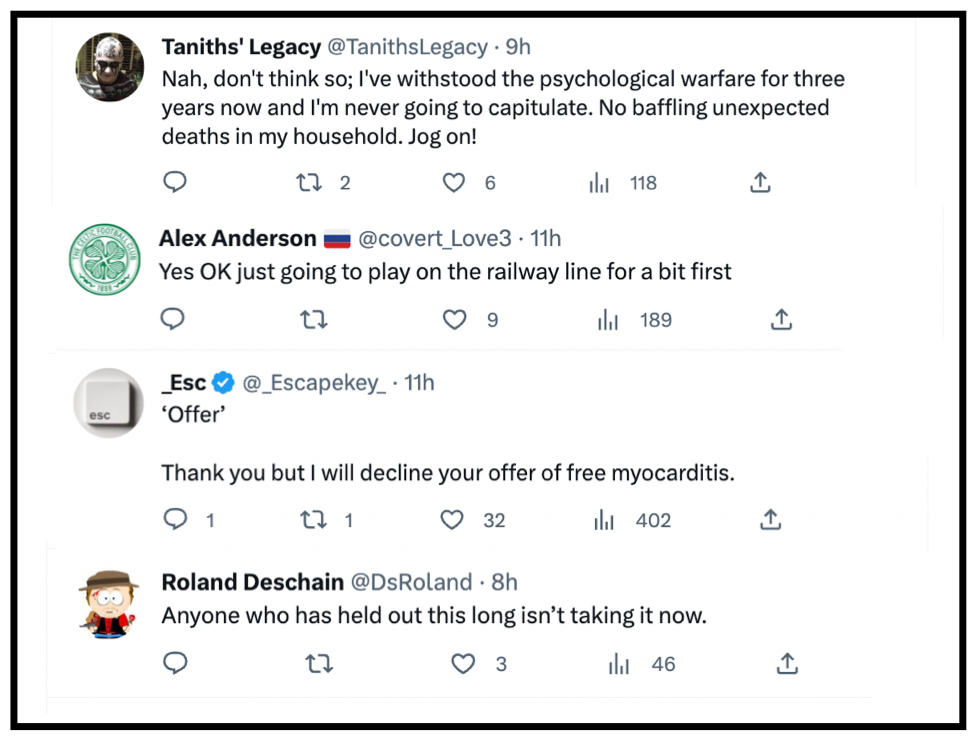
If you tuned in to the Twitter Space on Sunday ‘Are mRNA injections causing cancers?’ hosted by Dr Kat Lindley and Neil Oliver, you would have heard a heated exchange between consultant orthopaedic surgeon Dr Ahmad Malik and London-based oncology professor, Angus Dalgleish. Dr Malik wanted to get to the bottom of why Professor Dalgleish felt moved to write an article advocating for young people to take the covid vaccine in July 2021 entitled:
What every young person who fears the jab MUST be told: Vaccine expert ANGUS DALGLEISH dismantles beliefs that have seen rates stall among the 18-30s
Well that seems like a pretty clear message. Get the damned vaccine.
Given his background in vaccine research, Prof Dalgleish would have been very clear that long-term safety data is not an optional extra when injecting young people or pregnant women. When questioned, Prof Dalgleish revealed that he did not actually write the article himself. There was a phone interview with a Daily Mail journalist, which he described as ‘bullying’ and the article was an entirely perverted representation of that call. Nonetheless, his name appears alongside the article with the effect that the message therein appears to come from a distinguished professor of medicine.
Professor Dalgleish dramatically revised his position on covid injections after his son suffered acute myocarditis following the shots. Whilst it is obviously a good thing that he was courageous and open-minded enough to change his stance, it is very worrying that he is still an outlier. One can count on one hand the working medics willing to speak out on this issue. And it begs the question, what if Professor Dalgleish’s son hadn’t been injured? Would there have been more advertorials in the Daily Mail with his name alongside? Why are journalists ‘bullying’ through a particular narrative on medical matters? This rather suggests they have a particular agenda. As one Dr Roger Hodkinson, an eminent Cambridge educated pathologist says, “when politics plays medicine, that’s a very dangerous game.” Notably Dr Hodkinson is now only available to view on Bitchute, having been deplatformed from the more mainstream channels such as YouTube. More media censorship of highly qualified counter-narrative voices.
Working for a monopoly such as the NHS, with a mortgage and a family to feed, one might well find medical ethics end up somewhere below personal financial obligations. This is regrettable but understandable. Medics are human beings. Perhaps it is the fault of an increasingly secular society that somehow medics have been elevated to demi-gods and as a result their word is often deemed infallible. However, many more people now realise that this is simply not the case. If this disordered power dynamic is to be realigned, certain conditions need to be met:
- A genuine admission that mistakes were made. Not that ‘The Science™’ changed. It did not change and millions of people who resisted the military grade psy-op are fully aware of this;
- An overhaul of medical training so that clinicians do not feel afraid to speak out when they see something is wrong, and in fact should be encouraged to do so;
- The gaslighting must stop altogether. Those who have suffered injury or trauma need to be given proper air time and have their concerns addressed. They also need to be properly and fairly compensated.
- Open and unfettered discussions need to take place, allowing medics to speak freely about what has happened during the past 3 years, identifying with honesty and integrity what must not be repeated.
Taxpayers spend in excess of £220 billion per annum on the NHS. Weekly excess deaths are presently consistently way above average, whereas after a period of high mortality in the frail and elderly it should be well below normal levels. The public (and indeed the staff) deserve better. If this is impossible, perhaps the entire system needs to be completely reimagined.
Footnotes
The Tower for Twitter? UK Minister Calls for Jailing Social Media Bosses Who Do Not Censor Speech
By Jonathan Turley | April 21, 2023
As previously discussed, after Musk decided to buy Twitter, Hillary Clinton called upon European countries to force social media companies to censor Americans. The European Union quickly responded by threatening Musk and other executives. Now, Technology and Science Secretary Michelle Donelan has announced plans to jail social media executives if they fail to censor so-called “harmful” content on their websites. The government, of course, will determine what is deemed too harmful for citizens to see or hear.
Donelan is seeking speech arrests under the UK’s Online Safety Bill, a draconian censorship bill that would effectively ban end-to-end encryption for private internet users.
The bill uses Britain’s broadcasting regulator Ofcom to censor “all forms of expression which spread, incite, promote or justify hatred” based on various progressive characteristics, including transgenderism. So the government can censor anyone who it views as promoting or justifying hatred against virtually any group. Those who do not censor can now be rounded up by Donelan and her minions.
According to a report by The Telegraph, companies will also face fines of up to 10 per cent of their global revenue should they dare to ignore Britain’s demands to preemptively delete or obscure posts violating its coming censorship regime.
The decline of free speech in the United Kingdom has long been a concern for free speech advocates. A man was convicted for sending a tweet while drunk referring to dead soldiers. Another was arrested for an anti-police t-shirt. Another was arrested for calling the Irish boyfriend of his ex-girlfriend a “leprechaun.” Yet another was arrested for singing “Kung Fu Fighting.” A teenager was arrested for protesting outside of a Scientology center with a sign calling the religion a “cult.”
Recently we discussed the arrest of a woman who was praying to herself near an abortion clinic. English courts have seen criminalized “toxic ideologies” as part of this crackdown on free speech.
Donelan is only the latest voice of a rising generation of censors. These officials proudly parade their intent to silence or jail those with dissenting views. Yet, they do so in the name of tolerance. This is why free speech is in a free fall in Europe and why we must remain vigilant in this country to resist figures like Clinton who want to bring European censorship to our shores.
UK police condemned over arrest of French publisher
RT | April 20, 2023
London’s Metropolitan Police has come under fire for its treatment of a French national who was arrested under anti-terrorist legislation earlier this week. Publisher Ernest Moret was reportedly told that his involvement in protests in his homeland were behind his detention in the UK capital.
Moret’s employer, French publishing house Éditions La Fabrique, issued a press release with fellow publisher Verso Books on Thursday in which they described the actions of British police officers as “scandalous.”
“We consider these actions to be outrageous and unjustifiable infringements of basic principles of the freedom of expression and an example of the abuse of anti-terrorism laws,” the statement added.
The publishers further claimed that Moret’s arrest was the latest example of a “slide towards repressive and authoritarian measures taken by the current French government in the face of widespread popular discontent and protest.”
According to the statement, Moret had arrived in London on Monday to take part in the London Book Fair. While at St. Pancras Station, he was allegedly “pulled aside by police officers acting under Schedule 7 of the Terrorism Act 2000 and detained for questioning without a lawyer present.”
The arresting officers reportedly explained that Moret was taken into custody because he had participated in recent anti-government protests back in France.
The two publishing houses insisted that the case proves there is “complicity between French and British authorities on this matter.”
The formal reason for Moret’s arrest was stated as obstruction of police duties. His colleagues alleged that officers had demanded that Moret hand over his cell phone and unblock it, which he supposedly refused to do.
Pamela Morton from the UK’s National Union of Journalists (NUJ) wrote: “It seems extraordinary that the British police have acted this way in using terrorism legislation to arrest the publisher who was on legitimate business here for the London Book Fair.”
The Metropolitan Police confirmed in a statement that “at around 1930hrs on Monday, 17 April, a 28-year-old man was stopped by ports officers… under Schedule 7 of the Terrorism Act 2000.”
The AFP news agency later reported that Moret had been released on bail.
France has been gripped by mass protests in recent weeks as people vent their dissatisfaction at a retirement age increase pushed through by President Emmanuel Macron.
THE PLANNING OF THE UKRAINE INVASION FROM THE RUSSIAN POINT OF VIEW (MAYBE)
By Gaius Baltar | SONAR | April 19, 2023
Recently I heard an “expert” offer the opinion that Putin and the Russian Army had made a serious mistake when they organized the “special military operation” (SMO) in the Ukraine the way they did. It would have been far better to just send the army into Lugansk and Donetsk to defend them rather than make an ill-advised dash toward Kiev.
Instead of following this belated advice from that expert, the Russians chose to move fast into northern and southern Ukraine. Why did they do that? There are many theories; some good, some illogical, and some completely incoherent. I thought it might be a good idea to step back and look at the situation before the SMO from the Russian point of view. Russians tend to be practical and logical people and the General Staff of the Russian Armed Forces probably more so than most. Their plan must have had logical reasons based on what they saw at the time. So, how did the Russians see the situation before the SMO, at the end of 2021? Let’s put ourselves in their shoes and come up with a theory. Note that this is not a theory of what did happen, only of what the Russians may have thought that might happen when they planned their SMO.
The defensive lines and the siege of the Donbass
The first thing the Russians must have noticed was the construction of the massive Ukrainian defensive lines around the Lugansk and Donetsk republics. The Ukraine Government had made no secret of their plan to capture the republics and the Ukrainian Army should have had an “offensive posture” rather than defensive. It makes perfect sense to construct defensive lines while planning an attack to prevent disruptive counterattacks, but the Ukrainian defenses went far beyond that. They were truly massive and built over a period of 8 years. We know how strong they were because it has taken the Russians more than a year to break through them.
The Russians must have taken a look at those defenses and reached the following conclusion: Their purpose is to contain the Russian Army if necessary – even if a large part of the Russian Army is used against them.
The second thing the Russians must have noticed was the absolute determination of the Ukrainians to attack the republics, even if this ensured a Russian response. We saw that determination when the Russian Government recognized their independence just before the war started. According to the OCSE artillery monitoring map, Ukrainian artillery attacks on the republics decreased right after the recognition of independence, but then increased again – most likely after having received orders from Kiev to keep going. At that point in time Russian involvement was ensured, but the Ukrainians still kept attacking the republics.
The Russians would have connected those two things; the determination to attack and the massive defenses. They must have come to the following conclusion: “They want us to attack through the Donbass, and then they are going to use those defensive lines to contain us. Why?”
The trap
Having observed all this the Russians must have started to think about the Ukrainian plans. They would have assumed that those plans were not just Ukrainian plans, but NATO plans as well. So, what were the Ukrainians and NATO planning?
The Russians must have made the following deduction: “The Ukrainians and NATO want us to attack through the Donbass and clash against those lines. Why would they want that? It must be because it is a precondition for some kind of plan on their part – some kind of larger plan. What is that larger plan?”
Then they must have thought about what it would take to confront the Ukrainian army in the Donbass and take on the defensive lines. What would that require? It would require a large force and a lot of time. That would mean that a considerable part of the Russian Army would be tied down there for quite some time. Was that perhaps the precondition for the larger Ukrainian/NATO plan? Was the whole thing perhaps about forcing the Russian Army to attack through the Donbass and taking on the defensive lines – specifically to tie it down – to keep it busy while the Ukrainians and NATO carried out the rest of their plan?
After having considered this, the Russians must have asked themselves the following question: “What do the Ukrainians and NATO want more than anything?” And since it’s actually the Americans and the British running the show: “What do the Americans and the British want more than anything?” The question isn’t hard to answer. What the Americans, the British, and the Ukrainians want more than anything is Crimea. Crimea is the key to “dominating” the Black Sea, and capturing it would be a dagger into the belly of Russia.
After having run through this logic, the Russians would have come to the conclusion that the Ukrainian attack on the Donbass republics and the defensive lines was a trap to tie them down. Then they started planning countermoves.
The Russian plan
The first thing the Russians may have thought about when planning the countermove was timing. How long after the war started would the Ukrainians move on the Crimean peninsula? They wouldn’t do it right away because they would want the Russian Army to be well and truly engaged in the Donbass before making a move. They would also not want to tip the Russians off by assembling a big force near Crimea before the Russians engaged the defensive lines in the Donbass. This would mean that the area north of Crimea, i.e. Kherson and Zaporizhzhia oblasts, would be lightly defended for a while.
After having reached this conclusion, the Russians put together a plan to preempt the Ukrainian/NATO plan. The plan had one main objective and two secondary objectives.
Objective 1 (main objective): To capture Kherson and Zaporizhzhia oblasts to create a buffer zone between Crimea and the rest of Ukraine. This objective had to be reached extremely fast while the area was still lightly defended. This operation was all-important at that point in time, far more important than anything happening in the Donbass or the Kiev area. Capturing Kherson was not enough to create the buffer zone because the Ukrainians had to be prevented from attacking the Crimean Bridge. The Zaporizhzhia coast line is only 150 kilometers from the bridge so Zaporizhzhia oblast had to be taken immediately as well.
Objective 2 (secondary objective): While a large part of the Ukrainian Army was positioned in the Donbass, there was still a large force kept back, possibly for the Crimean operation. This part of the Ukrainian army would have to be kept from engaging the Russian forces going after Kherson and Zaporizhzhia. The only way to do that was to threaten something that had to be defended at all cost, even at the cost of the Crimea plan. There was only one location the Ukrainians would defend at all cost outside the Donbass – Kiev itself. The Russians therefore decided to advance on Kiev in an extremely threatening manner. The forces they used were not sufficient to take Kiev outright but enough to hold the area north of the city and seriously threaten it. The Ukrainians would have no choice but to take the threat seriously and move forces toward Kiev, including the forces intended for the Crimean operation. This would prevent the Ukrainians from responding to the Russian occupation of Kherson and Zaporizhzhia oblasts.
Objective 3 (secondary objective): To force Ukraine to negotiate peace on Russian terms. The Russians most likely assumed that if the Kherson/ Zaporizhzhia buffer operation was successful the Ukrainians might want to negotiate. They would want to negotiate not only because Kiev was threatened, but primarily because their main objective, the capture of Crimea, had been thwarted. This part of the plan was partly successful because the Ukrainians were ready to sign a treaty before the Americans and the British intervened.
The conclusion from this (perhaps dubious) mind-reading of the Russian General Staff is that the main objectives of the initial Russian operation were Kherson and Zaporizhzhia, not Donbass, Kiev, or a treaty with the Ukrainians. When the negotiations fell through, the Russians moved back to their contingency plan with the main objective of destroying the Ukrainian Army.
It is important to keep in mind that this is not a theory intended to explain what happened. It is only a theory to explain the Russian plan based on what the Russians may have been thinking at the time. It’s highly speculative and perhaps wrong, but it explains a lot nevertheless – including Ukrainian and Western reactions to the Russian operation.
The Ukrainian plan
Let’s describe the theoretical Ukrainian/NATO plan before moving on. The plan, according to this hypothetical Russian pre-war theory, had three main objectives:
- To tie down the Russian Army in the Donbass using the massive defensive lines and a good part of the well-trained and well-equipped Ukrainian Army.
- To carry out a surprise attack on the Crimean peninsula, occupy it and turn the Black Sea into a NATO-controlled area – and putting massive pressure on Putin as a bonus. For this a significant part of the Ukrainian army was held back from the Donbass.
- To bog down and bleed the Russian Army in the Donbass with the goal of engineering a regime change in Russia. The sanctions blitz was planned as an integral part of that goal.
It’s April 2023 and so far none of these objectives have been achieved. Let’s assume that this theory is correct and this was actually the plan – and let’s look at what the Ukrainians and the West have been up to since it failed. Again, this is highly speculative.
The obsession with the plan
If we look at what the Ukrainians and the West have been doing in this war, a pattern seems to emerge: They still seem to be carrying out the initial plan, even though it failed. Almost every decision they make seems to be in accordance with the plan, or more specifically, in accordance with a pathological denial of the failure of the plan. Let’s look at a few examples:
The obsession with Crimea: The Ukrainians and the West are still planning to take Crimea, even though it is impossible. Still, the capture of Crimea is alive in their minds and a realistic option. Zelensky even at one point said that the Ukraine had started the liberation of Crimea … “in their minds.” Occupying Crimea was a part of the plan and abandoning Crimea means that the plan has failed.
The attack on the Crimean Bridge: Destroying the bridge was a part of the plan, and even after the Crimea was out of Ukraine’s grasp and the Russians had secured a land corridor to Crimea, the bridge was still a priority. It had to be attacked because that was a part of the plan. Now that itch has been scratched and they have, so far, not had the need to try again.
The obsession with Bakhmut: The Ukrainian Army has probably lost close to 40,000 soldiers defending Soledar and Bakhmut. The enclosed area is a kill zone for Russian artillery which the Ukrainians supply with endless cannon fodder. Even the Americans have doubts that hanging on to the city is the right option and the Ukrainians may even be willing to sacrifice their spring offensive to hold on to it just a little bit longer. More and more military experts are shaking their heads and talk about Bakhmut as a Ukrainian obsession, which it is. Holding Bakhmut prevents the last part of the plan from failing, i.e. to hold the Russian army on the other side of the defensive lines. If the Russians break through, the plan will have failed completely. Therefore Bakhmut must be defended.
The obsession with the sanctions: One of the biggest shocks of the war was the failure of the Western economic sanctions. The response of the West to the failure has been interesting. They didn’t cancel the sanctions or freeze them or rethink them. Instead they keep on sanctioning everyone and everything even though it is clearly pointless and even counterproductive. The situation is becoming increasingly surreal but they can’t stop. If they stop, the plan will have failed.
The initial panic
There is one other issue which the failure of the Ukrainian/NATO plan may explain. Every significant person in the West expected the Russians to invade the Ukraine before it happened. This was, in fact, what many of them wanted. One would have expected them to show indignation, to condemn the brutish Russians, and so on and so forth. The initial reaction in the West went far beyond that. There was extreme anger, panic and hysteria. There were even threats of using nuclear weapons. I always thought these reactions were far more extreme than the Russian invasion warranted. Why completely lose your mind over something you knew was going to happen? I suspect all the anger, the panic and the threats were because the Russians thwarted the Western Crimea plan. They were going to trick the Russians but the Russians tricked them instead. The Westerners were humiliated and nothing motivates anger and threats of nukes more than humiliation.
The anger and obsession with the failed plan in the Ukraine and the West are without doubt the result of the psychology and personality of the incredibly uniform Western and Ukrainian leadership class. They don’t accept personal failure easily, or the intrusion of reality into their plans. But that is a matter for another essay, and a long one at that.
Finally, remember that this is all speculation – a thought exercise if you will – but who knows…
Scotland’s new First Minister refuses to call Israel an apartheid state even though he has family in Gaza
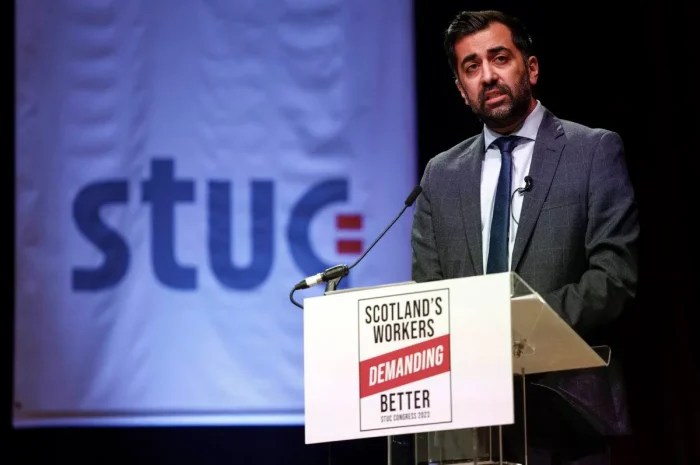
First Minister of Scotland Humza Yousaf on April 17, 2023 at Caird Hall in Dundee, Scotland [Jeff J Mitchell/Getty Images]
By Yvonne Ridley | MEMO | April 18, 2023
Scotland is one of the smallest countries in the world but you would have to be deaf, dumb and blind not to know that last month Humza Yousaf became the first Muslim to be elected as a leader in Western Europe.
You’d also have to live somewhere very remote to be unaware his political party, the Scottish National Party (SNP), was plunged into chaos within hours of his appointment as Police Scotland conducted a raid on the home of his predecessor, former First Minister Nicola Sturgeon, as well as the party’s headquarters in Edinburgh.
Her unexpected resignation as the leader of the Scottish Government was widely reported around the world but the speculation over her departure gave way to euphoria in large parts of Scotland’s vibrant Muslim community who support the country’s independence movement.
However, one of the most powerful Muslim political pressure groups in the UK reckons his appointment is not a cause for celebration. The Muslim Public Affairs Committee, MPACUK has accused Yousaf of wanting “to break Scotland away from England’s chains, yet denies the same right for Palestine”.
In a damning article on its website, MPACUK wrote: “As the new leader of the Scottish Nationalist Party, he is supposed to embody their mission objective, ‘a fair society where no-one is left behind’. But if Yousaf is not willing to call out an unjust society when he sees one, it calls into question either his integrity or his intelligence; whichever is found to be deficient, it spells poor leadership from the new First Minister.”
The unjust society referred to by the group is Israel which has also been called an “apartheid state” by US President Jimmy Carter as well as Amnesty International and Human Rights Watch, and Israeli-run B’Tselem .
Researchers in the group unearthed media claims going back to May 2014 in which Yousaf publicly stated “Israel is not an apartheid state.” Two months later Israel massacred over 2,100 Palestinians in one of its many wars in the Gaza Strip. Thanks to the silent complicity of politicians like Humza Yousaf the story barely made headlines in Western media.
I should declare an interest at this stage as I was a member of the SNP back then and shared platforms with Yousaf and Sturgeon to promote the case for independence. Back in 2021 I left, disillusioned, to join the ALBA Party formed by another former First Minister Alex Salmond whose Palestinian supporting credentials have been well documented by the Scottish Palestine Solidarity Campaign (SPSC).
And so, returning to Yousaf’s unseemly support for Israel, he is quoted as saying: “I can give you the Scottish Government’s vow that it is our policy not to boycott Israel…” and he went on to admit the SNP’s position on the Middle East “doesn’t vary much from the UK Government.”
I did write to him at the time and warned him that Palestinian supporters in the SPSC would never forgive or forget what they saw as a betrayal of the Palestinian people.
I do wonder if he has changed his position since then, and, if so, then he must tell us. The change could’ve been influenced by his second wife, Nadia El-Nakla, who is also an SNP politician and a local councillor, who just happens to be Palestinian. She is undoubtedly proud of her Palestinian roots and her family still resides in Gaza.
Humza certainly found his voice when the Zionist State launched a brutal bombardment on Palestinians in Ramadan of 2021. In newspaper articles he was critical of the violence which threatened the lives of his in-laws in Gaza and said he would “pray and hope they are alive in the morning” – that hope specifically being that “the international community intervenes and actually tackles the root of this conflict.”
This statement incurred the wrath of MPACUK which demanded: “Intervenes how, Yousaf? Tackle what root of the conflict? You have already indicated you will not hold Israel accountable. You refuse to stand for Palestine – can you really be trusted to stand for Scotland?”
Mick Napier, co-founder of SPSC, said: “As a first step, we urge the new First Minister to reaffirm the 2014 call from the Scottish Government, repeated in 2015, for an arms embargo on Israel.”
“He also needs to recognise that all major human rights groups have created a situation where sticking to his denial that Israel is an apartheid state will cut him off from progressive currents in Scotland. He will find that he can never placate the pro-Israel lobby except by praising Israeli crimes and condemning those who resist its barbarism against the Palestinian people. He can easily find out the depth of depravity of Israeli crimes but if he’s too busy he can just call his family in Gaza and get them to point their phones at the drones above, grey warships patrolling the shore, or the wall with robot machine guns keeping them under constant surveillance.”
Napier’s and MPACUK’s cutting observations will pile on more pressure on the under-fire First Minister who stands accused of supporting the oppressive state and, even worse, to the detriment of his own family. He won the leadership contest in a closely fought battle with female politicians Kate Forbes and Ash Regan under the ticket of being the “continuity candidate”.
But as critics have already pointed out, as long as Humza Yousaf is viewed as an ally to Israel, he cannot be a champion of independence.
Leaked files: Britain’s secret propaganda ops in Yemen
By Kit Klarenberg | The Cradle | April 17 2023
Yemen’s civil war, considered the world’s gravest humanitarian crisis, appears to be nearing its end due to a China-brokered detente between Iran and Saudi Arabia, who support opposing sides in the bitter conflict.
Early signs suggest that the rapprochement between Tehran and Riyadh may not only end hostilities in Yemen, but across the wider region.
The US, Israel, and Britain have the most to lose from a sudden onset of peace in West Asia. In the Yemeni context, London may be the biggest loser of all. For years, it provided the Saudi-led coalition with weaponry used to target civilians and civilian infrastructure, with receipts running into billions of pounds sterling.
During the entirety of the war, Yemen was struck by British-made bombs, dropped by British-made planes, flown by British-trained pilots, which then flew back to Riyadh to be repaired and serviced by British contractors. In 2019, a nameless BAE Systems executive estimated that if London pulled its backing for the proxy war, “in seven to 14 days, there wouldn’t be a jet in the sky.”
In addition to supplying weapons, the war also presented a golden opportunity for Britain to establish a military base in Yemen, fulfilling long-held fantasies of recovering the Empire’s long-lost glory days “East of Suez.”
Al-Ghaydah airport in al-Mahrah, Yemen’s far eastern governorate, has for some time quietly housed “a fully-fledged force” of British soldiers, providing “military training and logistical support” to coalition forces and Saudi-backed militias. There are even indications that this involvement could extend to torture methods, which is a troubling reflection of one of London’s leading exports.
The Cradle has obtained exclusive information about a previously undisclosed aspect of London’s role in the proxy war against Yemen’s Ansarallah-led resistance. It has been revealed that a multi-channel propaganda campaign, led by the intelligence cut-out ARK and its founder Alistair Harris, a veteran MI6 operative, has been operating in complete secrecy throughout the nine-year-long conflict – one that specifically targeted Yemen’s civilian population.
Anti-Ansarallah ops
Leaked Foreign Office documents have revealed that ARK’s “multimedia” information warfare campaign was designed to undermine public sympathy for the Ansarallah movement and ensure that the conflict would only end on terms that aligned with London’s financial, ideological, and geopolitical interests.
For instance, public acceptance of the UN’s widely unpopular peace proposal required propaganda support from local NGOs and media organizations that “support UK objectives” to “communicate effectively with Yemeni citizens” and change their minds.
It was also necessary to counter “new actors” in the information space that were critical of the Saudi-led coalition’s brutal bombing campaigns and the illegitimate, US-backed puppet government that the aerial assaults sought to protect.
Considering the high rate of illiteracy in the local population, ARK conceived the creation of a suite of “visually rich” products extolling the virtues of a Riyadh-dominated peace plan. These products would be disseminated on and offline, would “deliberately include different demographics, sects, and locations to ensure inclusivity,” and would be informed by focus groups and polling of Yemenis. ARK’s campaign even extended to convening “gender-segregated poetry competitions using peace as a theme” and “plays and town hall meetings.”
Publicly, many of these propaganda products appeared to be the work of Tadafur – Arabic for “work collectively and unite” – an astroturf network of NGOs and journalists constructed by ARK. Its overt mission was to “resolve local level conflicts” and “unite local communities in their conflict resolution efforts.”
The campaign began initially at a “hyper-local level” across six Yemeni governorates, “before being amplified at the national level.” Activities “[in] all areas and at both levels” had unified messaging across “common macro themes,” such as the slogan “Our Yemen, Our Future.”
In each governorate, a “credible” local NGO was identified as a messenger, along with “well-known” and “respected and influential” journalists who served as “dedicated field officers” across the sextet, managed by ARK.
In Hajjah – “a site of strong Houthi influence” – the Al-Mustaqbal Institute for Development was ARK’s NGO of choice; in Ansarallah-governed Sanaa, it was the Faces Institution for Rights and Media; in Marib, the Marib Social Generations Club; in Lahij, Rouwad Institution for Development and Human Rights; in Hadhramaut, Ahed Institute for Rights and Freedom; in Taiz, Generations Without Qat.
These local NGOs were instrumental in promoting ARK’s agenda and advancing the narrative that aligned with Britain’s objectives in Yemen.
The company’s roster of “field officers” comprised of individuals with various backgrounds, such as:
“Human rights abuse” specialist Mansour Hassan Mohammad Abu Ali, TV producer Thy Yazen Hussain, Public Organisation to Protect Human Rights press official and “experienced journalist” Waleed Abdul Mutlab Mohammed al-Rajihi, producer from Alhadramiah Documentary Institute Abdullah Amr Ramdan Mas’id, editorial secretary of Family and Development magazine and the Yemen Times’ Taiz news manager Rania Abdullah Saif al-Shara’bi, as well as journalist and activist Waheeb Qa’id Saleh Thiban.
A Trojan Horse
Once ARK’s field officers and NGOs “successfully designed and implemented hyper-local campaigns,” coverage of “information around the related activities will then be amplified at the national level.” A key platform for this amplification was a Facebook page called “Bab,” launched in 2016 with tens of thousands of followers who were unaware that the page was created by ARK as a British intelligence asset.
Under the guise of a popular grassroots online community, ARK used the Bab page to broadcast slick propaganda “promoting the peace process,” including videos and images of “local peacebuilding initiatives” organized by its NGO and field officer nexus.
“Campaign content will highlight tangible, real-life examples of compelling peacebuilding efforts that all Yemenis, regardless of their political affiliation, can relate to,” ARK stated.
“These will offer inspirational examples for others to emulate, demonstrating practical ways to engage with the peace process at a local level. Taken together, these individual stories form the broader campaign with a national message: Yemenis share a collective desire for a peaceful resolution to the conflict.”
When “high engagement levels” with this content were secured, Bab users were invited to submit their own, which demonstrated “support for the peace process.” They were explicitly asked “to mirror content ARK has produced, such as voxpops, short videos, or infographics.” This was then “shared by the project and field teams through influential WhatsApp messaging groups, a key way of reaching Yemeni youth.”
ARK’s “well-connected communications team” would then “strategically share packaged stories with broadcast media or key social influencers, or offer selected journalists exclusive access to stories.” Creating a constant flow of content was a deliberate ploy to “collectively be as ‘loud’ as partisan national political and military actors.” In other words, to create a parallel communications structure to Ansarallah’s own, which would drown out the resistance movement’s pronouncements.
ARK’s role in Yemen’s peace process
While one might argue that the non-consensual recruitment of private citizens as information warriors by British intelligence was justified by the moral urgency of ending the Yemen war quickly, the exploitation of these individuals was cynical in the extreme. It amounted to a Trojan Horse operation aimed at compelling Yemenis to embrace a peace deal that was wildly inequitable and contrary to their own interests.
Multiple passages in the leaked files refer to the paramount need to ensure no linkage between these propaganda initiatives and the UN’s peace efforts. One passage refers to how campaign “themes and activities” would at no point “directly promote the UN or the formal peace process,” while another says concealing the operation’s agenda behind ostensibly independent civil society voices “minimizes the risk” that “outputs are perceived as institutional communications stemming from or directly promoting the UN.”
Yet, once ARK’s campaigns began “performing successfully at the national level,” the company’s field officers planned to “build a bridge” between its local foot soldiers and national “stakeholders” – and, resultantly, the UN. In other words, the entire ruse served to entrench ARK’s central role in peace negotiations via the backdoor.
Diminished western influence
At that time, the ceasefire deal proposed by the UN required Ansarallah and its allied forces to virtually surrender before Riyadh’s military assaults and economic blockade of the country could be partially lifted, along with other stringent requirements that the Saudis refused to compromise on. The US aggressively encouraged such intransigence, viewing any Ansarallah influence in Yemen as strengthening Iran’s regional position.
However, these perspectives are no longer relevant to Yemen’s peace process. China has now encouraged Riyadh to offer significant concessions, and as a result, the end of the war is within sight, with critical supplies finally allowed to enter Yemen, prisoners returned, Sanaa’s airport reopened, and other positive developments.
Evidently, Washington’s offers of arms deals and security assurances are no longer sufficient to influence events overseas and convince its allies to carry out its agenda. The failure of ARK’s anti-Ansarallah propaganda campaigns to coerce Yemenis to accept peace on the west’s terms also highlights Britain’s significantly reduced power in the modern era.
Whereas wars could once be won on the coat-tails of well-laid propaganda campaigns, the experiences of Yemen, Syria, Iraq, and Afghanistan show that the tide has turned. Subversive information campaigns can confuse and misdirect populations but, at best, can only prolong conflict – not win it.
Blair knew Iraq bombing was illegal but ordered it anyway – media

Tony Blair and Bill Clinton at the National Constitution Center in Philadelphia, Pennsylvania, September 13, 2010 © AP / Matt Rourke
RT | April 17, 2023
Former British Prime Minister Tony Blair ordered the 1998 bombing of Iraq despite repeated warnings that such a move was unlawful, according to documents published by Declassified UK on Monday. Blair would follow the same template – insisting that illegal military action was legal – when the UK invaded Iraq in 2003.
The US and UK launched a four-day bombing campaign against Iraq in December 1998, after then-US President Bill Clinton accused Saddam Hussein of breaching commitments to the UN and developing weapons of mass destruction. As many as 1,400 Iraqi soldiers were killed in strikes on around 100 military facilities.
In the runup to the bombings, Blair was repeatedly told by his advisers that using force against Iraq would be illegal without a resolution from the UN Security Council, according to documents from the National Archives cited by Declassified UK, an investigative outlet that focuses on Britain’s military and intelligence agencies.
Attorney General John Morris reportedly told Blair in November 1997 that obtaining a statement from the Security Council would be “an essential precondition” to military action, while Blair’s private secretary, John Holmes, told the prime minister that British law officers and Foreign Secretary Robin Cook had a “serious problem about using force unless the Security Council declares that Iraq is in ‘material breach’ of previous resolutions.”
When the law officers refused to authorize the military to draw up targeting plans, Blair reportedly wrote to Holmes, stating that he found their argument “unconvincing.”
Blair continuously received warnings throughout 1998, the report alleged, with Cook’s private secretary writing to Holmes that February to warn that “the negative implications for international support if we resort to military action without a new resolution would be serious.”
When Blair announced military action to Parliament in November, he declared: “I have no doubt that we have the proper legal authority, as it is contained in successive Security Council resolution documents.” British officials claimed that a 1990 resolution authorizing UN members to force Hussein’s army out of Kuwait gave them permission to intervene again in Iraq, an argument that only the US, Japan, and Portugal supported.
According to the documents, Blair saw bombing Iraq as essential to maintaining his close relationship with Clinton. In a meeting with advisers in November, he supposedly said that failing to intervene would cause “extreme damage” to US-UK relations. That same day, even as his own aides maintained that intervention was illegal, Blair told Clinton that the US “could count on our support.”
Five years later, Blair would find himself in the same situation, when he falsely claimed that Hussein was harboring weapons of mass destruction and invoked earlier Security Council resolutions to justify invading Iraq. Again, Blair was warned by his attorney general that military action would defy international law, and again he pressed ahead regardless.
More than a decade later, a public inquiry found that the legal case for the invasion was “far from satisfactory,” while then-UN Secretary General Kofi Annan maintained from the outset that the war was “illegal.”
US and UK to blame for EU weakness – Moscow
RT | April 17, 2023
A senior Russian diplomat has accused the EU of falling victim to a US-UK ploy in Ukraine, and losing the chance to become an independent player in a multipolar world. Deputy Foreign Minister Mikhail Galuzin claimed that preventing Germany, France and Russia from banding together has long been a goal of Washington and its closest allies
“Due to political machinations of the US and Britain, the opportunity for constructive cooperation involving Russia, aimed at creating an independent center of power on the European continent, has been lost for decades,” the official said on Monday during an event in Moscow.
Galuzin referred to the 2014 armed coup in Kiev, and the ensuing escalation of Russia-Ukraine tensions, leading up to the military conflict last year. The diplomat said Ukraine is being used by Washington as “a tool, even a consumable” in its attempt to cling on to its world hegemony.
The sabotage of the Nord Stream gas pipelines last autumn “vividly demonstrated the lengths to which those who are not interested in mutually beneficial cooperation between Russia and … European states would go,” the deputy foreign minister added.
The pipelines, built under the Baltic Sea to deliver Russian fuel directly to Germany, were ruptured by powerful explosions on September 26. American journalist Seymour Hersh claimed the operation was ordered by US President Joe Biden, in an effort to lock Germany into a campaign to defeat Russia in Ukraine. The US has denied the allegation, and European nations investigating the incident have so far failed to identify a culprit.
Regarding the standoff with Russia, the EU “has been forced to leave behind all pretence at independence and unconditionally comply with the US course,” Galuzin stated. This decision has resulted in a “rapid decrease of the EU’s economic and political clout in the world and worsened the crisis trends in the EU.”
The deputy minister was delivering opening remarks during a Ukraine-themed event hosted by the Russian Historical Society. He claimed Western influence in Ukraine has included distorting the truth about the nation’s past.
“The current Ukrainian authorities are destroying everything that connected our nations in any way,” he claimed, expressing hope that historians can help to eventually find a way towards reconciliation.
Iran slams world’s inaction on deteriorating rights situation in West
Press TV – April 15 2023
Iran’s vice-president of the judiciary for international affairs has criticized international mechanisms for failing to take a position regarding the deteriorating human rights situation in Western countries, saying international rights bodies are duty-bound to support and promote the key issue across the world.
In a Saturday letter to Volker Türk, the United Nations High Commissioner for Human Rights, Kazem Gharibabadi said the world suffers from fundamental challenges and dilemmas regarding human rights which are mainly caused by those countries that “claim to be defending human rights and see themselves in the position of making demands from others and being immune from any criticism and responsibility.”
“The responsibility of the international human rights mechanisms in such conditions is fundamental to support and promote human rights, which must be fulfilled by respecting independence, impartiality, professionalism, and non-selectivity,” said Gharibabadi, who also served as the Secretary General of Iran’s High Council for Human Rights.
He warned of adopting “politically-motivated and selective” approaches that does a great disservice and is detrimental to human rights, and erodes public trust in human rights mechanisms.
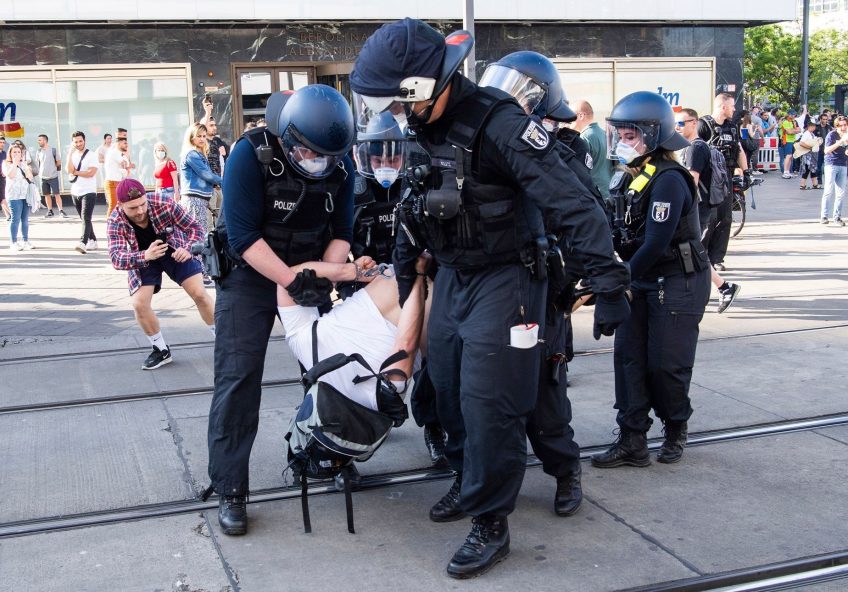
He drew the commissioner’s attention to situations in several countries, including France, Britain and Germany, over the last six months regarding the “right to freedom of assembly and of association.”
Pointing to massive public demonstrations in France in protest against the government’s policies, the Iranian rights official said, “Instead of listening to the protesters’ demands and trying to improve the situation, the French government resorts to large-scale violence to deal with the gatherings.”
Gharibabadi censured the French government for using anti-riot equipment, assaulting people, and arresting thousands of protesters as only part of the countermeasures.
Referring to Britain’s introduction of amendments to the Public Order Bill to increase police powers to deal with protesters at rallies, he said the “repression bill” leads to a “significant and unprecedented increase in the powers of the police force to impose undue restrictions on peaceful protests and … it criminalizes assemblies under the pretext of deprivation of public comfort and provides a sentence of up to 10 years of imprisonment.”
Gharibabdi pointed to a sit-in protest in Germany. He said over 3,000 German police and security forces arrested hundreds of political opponents under the pretext of plotting to stage a coup d’état.
“In yet another move, the German government seeks to pass a law that will expel its opponents from all government jobs under the pretext of extremism.” The top Iranian rights official said most European countries have been the scene of peaceful protests over the past months which were “suppressed and dispersed with the most severe attacks by law enforcement forces.”
Referring to the recent riots in Iran, Gharibabadi said,” Egged on by incitement and backing of particular states, media outlets and terrorist groups, the recent gatherings in the Islamic Republic of Iran deviated from their peaceful nature and morphed into riots, causing violations of the fundamental rights of citizens.”
On the contrary, he said, Iran took a responsible policy, and established an investigative committee to launch inquiries into the possible physical and financial damages and the violations of the rights of all parties.
The Iranian vice-president slammed the West and the United States for pursuing a politically-motivated approach and exploiting the Human Rights Council by establishing a so-called mechanism to investigate the riots in the country.
“The same countries that consider themselves supporters of the rioters in Iran are – both in law and in practice – committing the most heinous crimes to systematically violate the right to peaceful assembly.”
Featured Video
The Truth About the Trump Shootings with Ken Silva
or go to
Aletho News Archives – Video-Images
From the Archives
Trans ‘milk’ as good as the real thing – NHS
RT | February 18, 2024
The drug-induced nipple secretions of trans women are as good as mothers’ breast milk for babies, the University of Sussex Hospitals NHS Trust claimed in a letter to campaigners made public in a report by British think tank the Policy Exchange on Sunday.
The healthcare trust’s medical director, Rachel James, argued that the off-label prescription drug cocktail men transitioning to female take in order to produce milk was “similar to the natural hormones which encourage lactation to develop when the baby is newly born.”
“The evidence which is available demonstrates that the milk is comparable to that produced following the birth of a baby,” James wrote in the letter, sent to Children of Transitioners last August.
Biological men who wish to lactate must first take hormones to grow milk glands and then take high doses of either domperidone or metoclopramide to stimulate milk production. Neither drug is approved for this use, though they are occasionally prescribed off-label to biological women who have trouble lactating.
However, domperidone’s own manufacturer, Janssen, warns patients the drug “may cause unwanted side effects affecting the heart in a breastfed baby” and “should be used during breastfeeding only if your physician considers this clearly necessary.” … continue
Blog Roll
 Aletho News
- How Real Is the Impact of Western Sanctions on Israel?
- France, You Are Guilty: How Paris Turned Western Sahara into the Maghreb’s Powder Keg
- 2025 Nature Paper Claiming Worsening Global Drought Gets RETRACTED …Heavily Flawed
- Your Milk Is Not the Problem
- The Truth About the Trump Shootings with Ken Silva
- ARE PATIENTS BEING PROPERLY INFORMED ABOUT OZEMPIC?
- US lawmaker blocks $2.8 billion weapons sale to Israel: Report
- Yemeni army claims responsibility for strikes on sensitive sites in Saudi capital, Aramco facilities in Yanbu
- Iran Judiciary issues indictments against 159 US, Israeli officials for assassination of Leader, commanders
- Turkiye revokes Iranian bank license under US sanctions campaign
- If Americans Knew
- Salah Sarsour’s Legal Team Says DHS Has Not Met Its Burden to Prove He Is Deportable
- An analysis of tax forms by The Intercept show Kraft’s charity and LLC have donated to Friends of the IDF and AIPAC’s super PAC.
- Israeli attacks kill four Palestinians in Gaza – Daily Update
- Inside Gaza’s death trap of collapsing, bombed-out buildings
- The everyday items Israel bans from Gaza every day
- Inside the siege, the ruined buildings of Gaza – Daily Update
- Debunking The Claim That Macklemore Has A “History Of Antisemitism”
- CPJ demands release of arrested Palestinian-US journalist near Bethlehem
- Robert Kraft: The Billionaire Friend of Netanyahu Pulling The Strings Behind the Macklemore/Ed Sheeran Blow Up
- Columbia Administered Fund Gives Big Money to Pro-Israel Groups
- No Tricks Zone
- 2025 Nature Paper Claiming Worsening Global Drought Gets RETRACTED …Heavily Flawed
- New Study: ‘Global Drought Shows No Detectable Recent Acceleration Under Climate Warming’
- Economic Masterminds: German Socialists Suggest Taxing Productivity Gains Stemming From Using AI
- The South China Sea Has Not Been Cooperating With The Climate Change Narrative
- Energy Crisis: Germany Enters Heating Season With Historically Low Gas Reserve Fill Levels
- New Study: The Antarctic Ice Sheet Gained Mass From 2020-2024 Due To Staggering Snow And Ice Accumulation
- Study: Ocean Heating Rates From Thousands Of Years Ago ‘Dwarf’ Modern Ocean Heating Rates
- Climate Extremists Target, Attack Large-Scale Power Grid Infrastructure In Germany!
- New Study: Antarctic Ice Melt Has Contributed Less Than 1 Centimeter To Sea Level Rise In The Last 30 Years
- Fear Of Debate: Alarmist German Climate Scientist Calls On Mainstream Media To Discredit Skeptic Voices
 Aletho News