Iran: E3 unconstructive draft resolution at IAEA meeting mockery of international rules
Press TV – June 16, 2020
Iran has condemned as “unconstructive” a resolution reportedly drafted by the three European signatories to a 2015 nuclear deal for a vote at the International Atomic Energy Agency (IAEA)’s governing board meeting, saying such a resolution makes a mockery of international rules.
Speaking to reporters on Tuesday, Kazem Gharibabadi, Iran’s permanent representative to Vienna-based international organizations, urged France, Germany and the UK — also known as E3 — not to complicate the situation surrounding the Iran deal if they cannot fulfill their end of the bargain and help salvage the accord.
The comments came as IAEA Board of Governors started a four-day meeting on Monday, with Iran on the agenda.
According to a Bloomberg report, the resolution prepared by the European trio urges Tehran to “fully cooperate” with the IAEA investigation of its nuclear facilities. It came after the nuclear watchdog’s inspectors claimed they had not been given access to two locations that may have hosted atomic activities two decades ago.
The resolution will have to be presented during the meeting and is expected to win Washington’s backing.
During the Monday session, the IAEA Director General Rafael Mariano Grossi claimed that for over four months, “Iran has denied us access to two locations and that, for almost a year, it has not engaged in substantive discussions to clarify our questions related to possible undeclared nuclear material and nuclear-related activities.”
Gharibabadi dismissed the claims in the reported resolution and said, “While Iran is cooperating extensively and constructively with the agency, submitting a resolution with the purpose of asking Iran to cooperate and fulfill the two demands of the IAEA is regrettable and a totally unconstructive move.”
He criticized the European trio’s double standards on Tehran’s nuclear program and said such a resolution is being put forth by the countries that “either possess nuclear weapons or play host to such destructive and deadly weapons.”
Such a move, Gharibabadi said is “a mockery of international norms and rules governing disarmament and non-proliferation regimes.”
Gharibabadi also called on all members of the IAEA Board of Governors to exercise vigilance and avoid taking any “political and hasty” measures in order for Iran to continue cooperation with the Vienna-based agency.
“Naturally if such a resolution, which clearly serves American goals, is approved, the Islamic Republic of Iran will have to take the necessary measures accordingly,” he noted.
The Iranian envoy further stressed that the new IAEA request is founded on the claims raised by the Israeli regime, which is an enemy of Iran.
Tehran’s transparent cooperation with the agency “does not mean that we should agree to every request from the IAEA on the basis of delusional claims of our enemies,” he emphasized.
Iran signed the Joint Comprehensive Plan of Action (JCPOA) with six world states — namely the US, Germany, France, Britain, Russia and China — in 2015.
However, Washington’s unilateral withdrawal in May 2018 and the subsequent re-imposition of sanctions against Tehran left the future of the historic agreement in limbo.
Iran remained fully compliant with the JCPOA for an entire year, waiting for the co-signatories to honor their commitments.
As the European parties failed to do so, the Islamic Republic moved in May 2019 to suspend its JCPOA commitments under Articles 26 and 36 of the deal covering Tehran’s legal rights.
“Putin’s Gonna Get Me”
By Craig Murray | June 15, 2020
Shakespeare’s heirs at the BBC produced this deathless and entirely convincing line as the climax of the first episode of “The Salisbury Poisonings”, a three part piece of state propaganda on the Skripal saga, of which I watched Part 1 as it was broadcast last night. The other two parts are to be broadcast today and tomorrow, which unusual scheduling reflects the importance our masters place on this stirring tale of the resilience of the great British nation under attack by devilish foreigners. You can watch all three episodes now on BBC iPlayer, but personally I suffer from overactive antibodies to bullshit and need a break.
The line about Putin was delivered by salty, ex-British military Ross Cassidy, so of course was entirely convincing. It may have been more so had he ever said it in public before this week, but there you are.
To judge by social media, an extraordinary proportion of the public find the official narrative entirely convincing. I find myself unable to pretend that does not fill me with despair at the future of democracy. That anybody could listen to the following dialogue without doubling up in laughter is completely beyond me. I do not quite understand how the actors managed to speak it.
Porton Down Man: “And it’s one of the deadliest synthetic substances on earth. It’s so toxic that a spoonful, with the right delivery mechanism, could kill thousands”.
Heroic Public Health Lady: “But if it’s so toxic, how come the Skripals are still alive?”
Porton Down Man: “The paramedics assumed that they had overdosed on fentanyl so they gave them a shot of Naloxone, which happens to combat nerve agent toxicity. Plus, it was cold, further inhibiting the speed with which the substance took effect.”
Aah yes, it was cold. A factor those pesky Russians had overlooked, because of course it is never cold in Russia. And everybody knows it is minus 40 inside Zizzis and inside the Bishops Mill pub. Once the nerve agent has entered the body, only in the most extreme conditions could exterior temperature have any kind of effect at all. Neither Sergei nor Yulia was anyway outdoors for any significant period after supposedly being poisoned by their door handle.
Many wildly improbable stories have been produced by the security services over the last three years to explain why this ultra deadly nerve agent did not kill the Skripals. Interestingly enough, the BBC drama left out a detail which the Daily Mail alleged came from a security service briefing, that:
“Completely by chance, doctors with specialist chemical weapons training were on duty at the hospital when the victims were admitted. They treated Sergei and Yulia Skripal with an atropine (antidote) and other medicines approved by scientists from Porton Down, the government’s top secret scientific research laboratory”
Which is very believable, I suppose, because it is no more of a coincidence than the Chief Nurse of the British Army being right there when they first collapsed on a bench.
Yet in all the multiple attempts to explain the non-deadly deadly nerve agent, “it was cold” appears to be a new one. It must have official approval, because all purpose security service shill, warmonger and chemical weapons expert, Lt Col Hamish De Bretton Gordon was listed in the credits as “military advisor” to this BBC production.
Let me offer you this tiny smidgeon of wisdom, for nothing: when the state broadcaster starts to make propaganda videos that credit a “military advisor”, you are well on the way to fascism.
Perhaps wisely, Part One at least of the BBC Drama made no attempt at all to portray how the alleged poisoning happened. How the Skripals went out that morning, caught widely on CCTV, to the cemetery according to this version, and then returned home without being caught coming back. How while they were back in their house two Russian agents walked up and, at midday in broad daylight on a very open estate, applied deadly nerve agent to the Skripals’ door handle, apparently without the benefit of personal protective equipment, and without being seen by anybody. How the Skripals then left again and contrived for both of them to touch the exterior door handle in closing the door. How, with this incredibly toxic nerve agent on them, they were out for three and a half hours, fed the ducks, went to the pub and went to Zizzis, eating heartily, before both collapsing on a park bench. How despite being different ages, sexes, body shapes and metabolisms they both collapsed, after this three hour plus delay, at exactly the same moment, so neither could call for help.
The BBC simply could not make a drama showing the purported actions that morning of the Skripals without it being blindingly obvious that the story is impossible. Luckily for them, we live in such a haze of British Nationalist fervor that much of the population, especially the mainstream media journalists and the Blairite warmongers, will simply overlook that. The omission of the actual “poisoning” from “The Salisbury Poisonings” is apparently just an artistic decision.
All those events happened before the timeline of this BBC Drama started. The BBC version started the moment people came to help the Skripals on the bench. However it omitted that the very first person to see them and come to help was, by an incredible coincidence, the Chief Nurse of the British Army. That the chief military nurse was on hand is such an amazing coincidence you would have thought the BBC would want to include it in their “drama”. Apparently not. Evidently another artistic decision.
The time from touching the door handle to the Skripals being attended by paramedics was about four hours. That Naloxone is effective four hours after contact with an ultra deadly nerve agent is remarkable.
I do not want to under-represent the personal suffering of policeman Nick Bailey nor his family. But he was shown in the drama as rubbing this “deadliest synthetic substance” directly into the soft tissues around his eye, but then not getting seriously ill for at least another 24 hours. Plainly all could not be what it seems.
The actual poisoning event, the specialist team coincidentally at the hospital and the Army Chief Nurse were not the only conspicuous omissions. Also missing was Skripal’s MI6 handler and Salisbury neighbour Pablo Miller, who did not rate so much as a mention. The other strange thing is that the drama constantly cut to newsreel coverage of actual events, but omitted the BBC’s own flagship news items on the Skripal event in those first three days, which were all presented by BBC Diplomatic Editor Mark Urban.
Now Mark Urban happens to have been in the Royal Tank Regiment with Skripal’s MI6 handler, Pablo Miller. Not distantly, but joining the regiment together at the same rank in the same officer intake on the same day. I do love a lot of good coincidences in a plot. Mark Urban had also met frequently with Sergei Skripal in the year before his death, to “research a book”. Yet when Urban fronted the BBC’s Skripal coverage those first few days, he kept both those highly pertinent facts hidden from the public. In fact he kept them hidden for four full months. I wonder why Mark Urban’s lead BBC coverage was not included in the newsreel footage of this BBC re-enactment?
There is much, much more that is wildly improbable about this gross propaganda product and I must save some scorn and some facts for the next two episodes. Do read this quick refresher in the meantime. How many of these ten questions has the BBC Drama addressed convincingly, and how many has it dodged or skated over?
Hypocrisy on Campus: Decolonization Means Cutting Ties with Israeli Apartheid
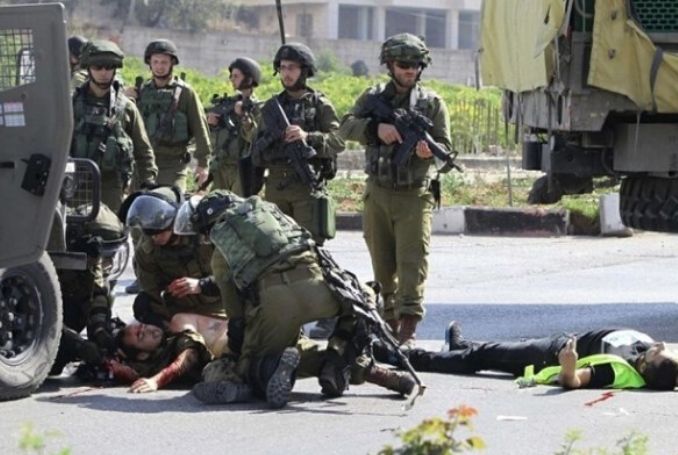
By Adam Saeed | Palestine Chronicle | June 14, 2020
Those of us who have the misfortune of following their universities on social media were recently exposed to a new wave of hypocrisy when these institutions which are directly complicit in apartheid against the Palestinian people and the destruction of our environment released statements “in support” of the BLM movement. This act of performative solidarity and intentional distortion of the meaning of decolonization was rightly met with anger and outrage by many student activists calling the institutions out on their duplicity.
Indeed, these words that celebrate humanity and commitment to fighting for equality and against oppression ring hollow to those who see Palestinians being excluded from this racist definition of humanity. If the case is being put for equality and against oppression, then the first step our universities and unions should take before they attempt to co-opt the Black Lives Matter Movement is clear: they must commit to decolonization by ending material and institutional complicity with Israeli Apartheid.
In stark contrast to the line of marketing teams of universities like SOAS or Glasgow, we are calling for decolonization of our institutions that will have factual implications to the situation on the ground. Namely ending institutional links to Israeli Universities which are directly complicit in the colonization of Palestinian land and contribute to the development of strategies and technologies that are used in the violent oppression of Palestinians across the land. The Hebrew University represents a prime example of institutional involvement in this process of colonization of Palestine.
At the time of its establishment in the early 20th century, the University was viewed as being a key symbol of the Zionist project in Palestine: plans for establishing the university were formulated by key Zionist thinkers, including Chaim Weizmann, who would later become the first president of Israel. In this sense, the university was an essential part of the process of settler-colonialism within which Israel was created and in which it continues to constitute its existence. The University also contributed to the development and propagation of Zionist colonial ideology and advocates for Jewish ethnopolitical supremacy in Palestine until today.
After Israel occupied the West Bank in 1967, annexing East Jerusalem, the Israeli Government confiscated the land around Hebrew University and its affiliated Hadassah Hospital, embarking on large-scale expansion. This expansion reached beyond the green line and included private Palestinian land. As it stands today, substantial parts of the Hebrew University that are built upon occupied Palestinian land, are defined as an illegal settlement under international law. Constituting a clear breach of the Geneva Convention. Importantly for UK universities, the accommodation offered to international students undertaking Year Abroad programs lies within the Student Village, which stands on occupied land, and therefore students housed in these buildings are directly taking part in a perpetration of a war crime.
The violations committed by Hebrew University don’t end there. Like all Israeli higher education institutions, Hebrew University plays an active role in the Apartheid system by discriminating against Palestinian students and supporting the Israeli Army’s repression of Palestinians. Recently, the Hebrew University has launched an academic excellence program for IDF soldiers, opening a ‘de-facto military base’ on campus.
The program, known as ‘Havatzalot’, offers three-year training for future intelligence officers as part of their mandatory army service. It includes basic training at combat level, officer training, a bachelor’s degree, and military intelligence and leadership training. The IDF student soldiers live on campus and are required to wear uniforms and carry weapons at all times. Moreover, the IDF has enforced further security measures to be put in place inside the campus, including biometric IDs and the right to demand the replacement of anyone employed in the soldiers’ compound if they don’t pass a security screening. For the Palestinian staff at the university, this presents a threat to their livelihoods and safety.
The extreme militarization of Hebrew University manifested through programs like Havatzalot goes hand in hand with its premises and buildings being used by the IDF and Israeli police to oppress and control the population of Palestinian Issawiyah neighborhood next to which the Hebrew University is located. This also includes closing the southern entrance to the neighborhood by the Israeli police and brutalizing its inhabitants passing through the gate close to the university campus.
Our universities are sending their students to directly take part in the maintenance of war crimes and normalize relationships with institutions that are rooted in the most brutal form of racism in our time: colonialism and European supremacy. The need for decolonization at our universities as a process of ending material support for these institutions is the only viable next step forward and towards an anti-racist, decolonial future. We must not allow decolonization and anti-racism to be co-opted by the marketing teams of these marketized institutions.
I urge every anti-racist student campaigner to join our decolonizing mission at Apartheid Off Campus today. Let us unite under the banner of anti-racism and decolonization to end our universities’ complicity. Let’s follow in the footsteps of the University of Johannesburg which terminated its relations with Israeli academic institutions in 2011 and show our solidarity with the Palestinian people, whose voices must be heard today more than ever.
– Adam Saeed is a Palestinian student of Arabic and Politics at the University of Leeds. He is also an activist within the Apartheid Off Campus student led-network. They are on Twitter: @AOC_movement.
The Anti Slavery Mural is Back, Hopefully Forever.

By Gilad Atzmon | June 13, 2020
Hip Hop legend Ice Cube came under fire last week for posting an anti- racist image on Twitter in support of Black Lives Matter. The image was widely panned as ‘anti-Semitic’ by those who work hard to conceal images of slavery, oppression and abuse as soon as they gather that a member of their ethnic group may be complicit in such immoralities.
Following the killing of George Floyd, Ice Cube uploaded an image of a group of bankers sitting around a game board that rests on the bowed, naked backs of black slaves. “All we have to do is stand up and their little game is over” is the accompanying text.
This anti slavery image isn’t new. It first appeared as a mural by artist Mear One in London’s East End back in 2012 when it sparked a controversy. Some local Jews were offended and, of course, the local Labour council of the London borough of Tower Hamlets was quick to react. It called in the police and reportedly gave the owner of the property 28 days to remove it.
Jeremy Corbyn, supposedly an ‘anti racist’ initially voiced support for the mural and the artist behind it. Later, following pressure from Jewish groups, Corbyn reversed himself and apologized. The Guardian, once a respected Left leaning paper was also quick to cry foul and located the anti racist mural within the Elders of Zion-Nazi propaganda spectrum. Even the ultra Left Morning Star turned against the pro black/anti capitalist art “Bad Art and Bad Politics” is how our most dedicated ‘socialist’ paper referred to Mear One’s mural.
At the time Artist Mear One stated, loud and clear, that his “mural is about class and privilege… The banker group is made up of Jewish and white Anglos. For some reason they are saying I am anti-Semitic. This I am most definitely not… What I am against is class.”
It was also revealed at the time that out of the six bankers figures depicted in the mural (Lord Rothschild, John D. Rockefeller, J. P. Morgan, Aleister Crowley, Andrew Carnegie and Paul Warburg) – only two (Rothschild and Warburg) were Jewish. But none of that helped, our socialists, progressives and ‘Left’ icons left the black slaves to rot under the monopoly game board and stood firmly against Mear One’s art just because two of the bankers he depicted were Jewish.
What I want to understand today is how it is possible that the Labour council of Tower Hamlets, the ‘anti racist’ Jeremy Corbyn, the presumably multicultural ‘progressive’ Guardian, the ultra left Morning Star, or shall we say the entire Left/progressive spectrum all fell into the same trap, they turned their backs on Blacks and slavery and committed to the defence of the most horrendous abusive bankers known to man just because two of them were gifted (artistically) with a well endowed nose. One may wonder whether White Privilege is a valid notion as it becomes clear that Hooked Nose is by far the ultimate privilege. It literally allows for total impunity. You even get away with slavery, at least in the ‘Left’ realm.
Time to admit it publicly – in the face of Jewish sensitivities, the Left seems to collapse. Its solidarity with oppressed minorities evaporates. Indeed, if there is one thing the Left is really good at, it is betraying its core supporters. The Left has repeatedly betrayed the working class. Instead it adopted Identitarian politics that were set to break the working class into biologically oriented fragments (defined by skin colour, gender, sexual orientation, etc.). The Left even betrayed its own ideology dismantling its own philosophy of class politics that initially united us regardless of our gender, race or ethnicity. Embracing biologically oriented identification is, in practice, an adoption of Hitlerian ideology. Corbyn had been anti- banker, but he has often been very forgiving towards Jewish financiers such as the Rothschilds and George Soros. “Really important video which spells out the vile and destructive nature of antisemitic conspiracy theories,” is how Corbyn, as a Labour leader, described a horrendous video that presented the Rothschilds and George Soros as mere victims. Rothschild according to the video wasn’t even that rich.
Really important video which spells out the vile and destructive nature of antisemitic conspiracy theories. pic.twitter.com/Nm9xc8j7Vc
— Jeremy Corbyn (@jeremycorbyn) March 1, 2019
https://platform.twitter.com/widgets.js
For the Left, I am sorry to say it, the Blacks are solidarity pets. So are the Palestinians and other oppressed groups and minorities. I am afraid that this shameful divisive parade is not going to stop anytime soon. But Black community leaders have started to wake up.
Yesterday, members of African American Council were BOOED as they told protesters in Seattle’s ‘autonomous zone’ that they had ‘hijacked’ the Black Lives Matter movement by pushing other causes.
And there is some good news in this mural saga: 1. By now we know that art, like books, can be physically burned, it can be erased from walls, removed from exhibition: but beauty like the truth unveils itself against all odds. Mear One’s mural is with us forever and so is the memory of Corbyn/Guardian/Morning Star betrayal of the Blacks and their history.
2. Despite horrendous harassment from Jewish pressure bodies, the American Hip Hop star stood firm. Unlike Corbyn, Ice Cube answered his critics tweeting “what If I was just pro-Black?… I’ve been telling my truth.” I have always wondered why Corbyn didn’t answer his critics: ‘what if I were pro Palestinian rather than anti Jewish?’ The brainless veteran Labour leader couldn’t even figure this out.
Our world would look far better if our politicians in general and Left ones in particular had been just slightly more committed to truth. It would help if they had as much guts in their entire bodies as artists like Ice Cube have between their toes.
A decade after his own ID project failed, ex-PM Blair pushes for one to prove Covid-19 ‘disease status’
RT | June 10, 2020
Ten years after Tony Blair’s contentious British ID card scheme was binned, the former PM says a digital version is urgently needed so that people can prove their Covid-19 “disease status” as the world transitions out of lockdown.
Speaking at the Virtual CogX technology conference on Tuesday, Blair argued that it’s only when citizens can easily show they’re coronavirus-free that sectors such as international travel will be able to restart.
The former UK Labour prime minister insisted that such a system would operate alongside the government’s track-and-trace program as the economy is rebooted.
“It’s a natural evolution of the way that we’re going to use technology in any event to transact daily life, and this Covid crisis gives an additional reason for doing that.”
The Tony Blair Institute for Global Change, which has been making a range of coronavirus response recommendations to leaders around the world, published a paper on Tuesday calling for a digital health ‘passport’.
Under the proposals, people would download a digital wallet app secured with either a fingerprint scan or facial recognition. This would allow them access to their personal health data, such as a test proving they’re Covid-19 free.
The suggestion comes a decade after the infamous national identity card scheme proposed and lauded by Blair’s New Labour government but ultimately scrapped by David Cameron’s coalition administration in 2010, owing primarily to civil rights concerns.
Perhaps in expectation that he would face similar criticism this time round, Blair claimed a digital form of ID could be “easily protected, so you can deal with a lot of the privacy and surveillance issues that worry people.”
This latest intervention in the civil liberties debate has provoked much anger on social media, with some suggesting this ID scheme, like the last, is likely to be a waste of money and end up in the trash.
Former UK Independence Party leader and Member of the European Parliament Gerard Batten suggested Blair was taking his orders from owners of big corporations, raging: “See how this piece of s**t earns his millions from his globalist paymasters?”
Even a self-described “Tony Blair fan” voiced his disapproval, saying such a scheme, which requires citizens to have the appropriate technology, would lead to a “two-tier world, or digital ID for the rich.”
Others joked that people really shouldn’t get so riled about Blair’s proposition, insisting – perhaps with a heavy dose of sarcasm – that this “kind-hearted soul” simply cares about everyone’s health and just wants to make sure “we’re all safe and accounted for.”
UK military killing THOUSANDS of farm animals in Cyprus and threatening PROTECTED wildlife zones
RT | June 10, 2020
The British military is “knowingly” causing the deaths of farm animals in Cyprus on an “almost daily basis” and has paid millions of pounds in compensation to farmers since 1995, an investigation has revealed.
Activity at a British base on the Mediterranean island has resulted in 1,764 claims for “animal loss” over the last five years from “live-firing and low-flying,” the Declassified UK website revealed on Wednesday. The animal deaths are happening near the Royal Air Force (RAF) base at Akrotiri on the southern peninsula of Cyprus, the investigative website said.
Paying compensation to farmers is now commonplace, and the Ministry of Defence (MOD) paid out almost £750,000 during the 2018-19 financial year – most of which was to settle 334 animal loss claims. One of the payouts last year covered costs for “abortions and associated vet fees” after pregnant goats were killed by low-flying aircraft.
Declassified UK said internal documents show that the MOD is “knowingly” causing the deaths by permitting planes to fly as low as 100 feet above the ground. A report in 2009 explained that the goats “abort their unborn kids/lambs if panicked” by low-flying planes and the “dry firing/pyrotechnics.”
The MOD has also paid compensation to UK farmers for animal deaths, but the numbers of incidents are “far higher” in Cyprus, Declassified said, suggesting the military may make more of an effort to avoid such deaths on British soil.
For instance, only 22 claims were settled across the UK between 2014 and 2018 for animal deaths due to aircraft noise, while 1,034 were made in Cyprus over the same period.
The investigative website found that more than half of the deaths are close to the Paramali river, which is a protected wildlife zone described by the MOD as being home to Europe’s “most valuable and threatened species” including falcons, harriers and kestrels. It’s not known, however, if the British military activity has killed any wild animals.
The UK has two bases at Akrotiri and Dhekelia, which it retained following the granting of independence to Cyprus in 1960. It uses the land for training soldiers for combat in the Middle East, even creating a “mock Afghan village” for an “authentic” experience.
Local farmers are not permitted to water or harvest their crops in the areas during live-firing exercises, a situation which results in “crop loss” claims for “poor yield or overripe items unable to be sold.” Between animal and crop loss claims, the MOD has paid out £8 million to claimants over the past 25 years.
The internal documents also showed the military was aware that expanded training exercises in areas with large farms would “inevitably see more expensive claims being presented” — but proceeded with the plans anyway. They do, however, conduct some reconnaissance before exercises in an effort to maintain “good relations” with the community.
The presence of the British military in the area has long been controversial for Cypriots, with a 2001 proposal to build a large radio mast at a site on the edge of Limassol Salt Lake sparking riots outside the RAF base.
The lake is recognized as a “wetland of international importance” and hosts 15,000 greater flamingos during the winter months. The presence of an RAF runway less than one kilometer away means disturbance to the wildlife there is a “major issue,” BirdLife Cyprus director Martin Hellicar told Declassified. An MOD spokesperson said all training and activity takes place under “strict conditions” and with precautions to minimize risk.
BBC Brags About Hornsea Wind Farm–But Forgets To Mention The Cost
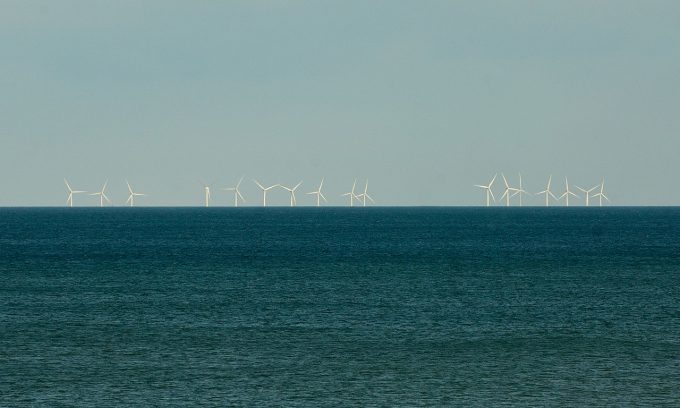
Hornsea Wind Farm
By Paul Homewood | Not A Lot Of People Know That | June 9, 2020
In his puff piece for renewable energy today, the BBC’s Justin Rowlatt noted that:
Now the UK has the biggest offshore wind industry in the world, as well as the largest single wind farm, completed off the coast of Yorkshire last year.
Nothing could sum up the moronic obsession with renewable energy better than this statement. There is in fact a good reason why we have the biggest offshore wind industry – we are the only country daft enough to pay the exorbitant bill for it.
The largest wind farm, of course, is Hornsea, a 1200MW project. It may be the biggest, but it also happens to be one of the most expensive sources of electricity in the world.
The contract price for Hornsea is £162.47/MWh, which under CfD is a guaranteed price, which will be index linked for 15 years. In short, a licence to print money.

https://www.lowcarboncontracts.uk/cfds/hornsea-phase-2
The current market price for electricity is below £20/MWh, so Hornsea is getting eight times what it would get if it had to trade in the market.
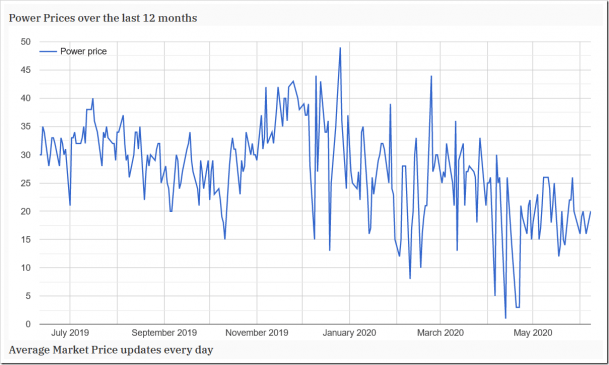
https://www.energybrokers.co.uk/electricity/historic-price-data-graph
At current prices, Hornsea will receive an annual subsidy of about £600 million. OK, if prices recover to more normal levels of around £40/MWh, once economic activity recovers, the subsidy will be slightly less.
But here’s the rub. Whether prices are high or low, Hornsea’s owners will receive their guaranteed price anyway. The system even allows them to sell every single unit of electricity they generate, and if there is a surplus of power in the market, they will get paid NOT to produce.
In other words, there is no commercial risk for Hornsea at all. A licence to print money, all at the expense of bill payers.
Hornsea, by the way, is joint owned by Oersted (formerly DONG) and Global Infrastructure Partners LLP, a global wealth fund. I find it hard to understand how sending hundreds of millions of pounds every year to either of those companies can possibly benefit the UK economy.
Maybe Justin Rowlatt might be able to explain?
UK Rates ‘Worst’ National COVID-19 Response, Vietnam Best
By Tyler Durden – Zero Hedge – 06/09/2020
The extent to which the COVID-19 pandemic has affected countries varies vastly, connected in part to the respective government’s handling of the situation. As Statista’s Martin Armstrong shows below, these national responses can be worlds apart – both in terms of efficacy and as survey data from YouGov shows, the subsequent level of public approval, too.
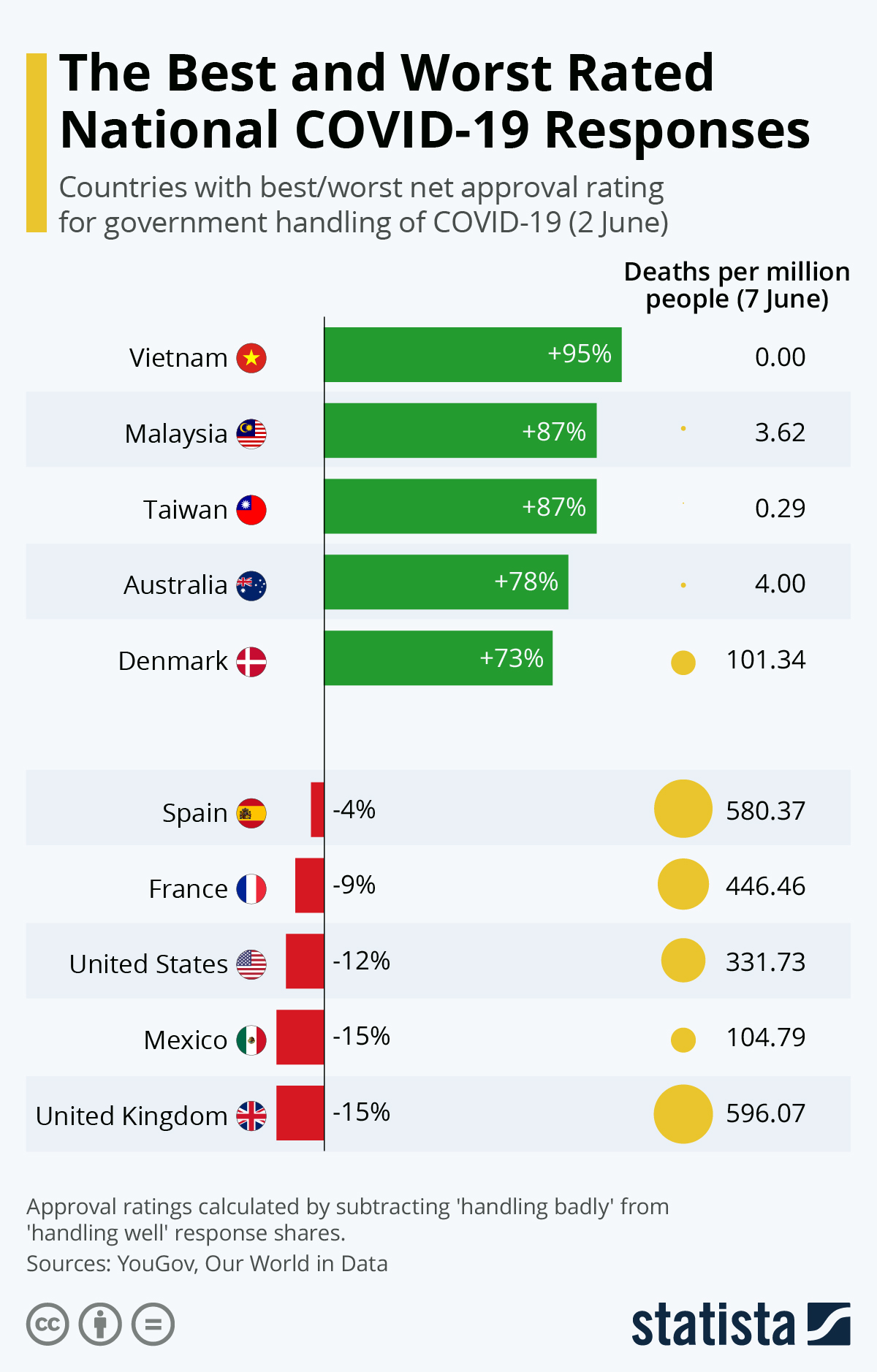
You will find more infographics at Statista
In the UK, where the government’s response has been heavily criticised, the net approval rating (calculated by subtracting ‘handling badly’ from ‘handling well’ responses) is the joint-lowest of all countries surveyed.
Also with a rating of -15 is Mexico, where President López Obrador originally downplayed the severity of the pandemic and is now struggling to find the right balance between prioritizing public health and protecting the economy.
At the other end of the scale, Vietnam has so far recorded just over 300 cases and zero deaths.
In contrast to Mexico, Vietnam’s ‘overreaction’ to the crisis is thought to be the reason for the astonishing results achieved so far.
To compare to the countries at the bottom of the ranking, Our World in Data figures have the number of deaths per million people for the UK and Mexico at 596.07 and 104.79, respectively.
Countries included in the survey were: Australia, Canada, Denmark, Finland, France, Germany, India, Indonesia, Italy, Japan, Malaysia, Mexico, Norway, Philippines, Poland, Singapore, Spain, Sweden, Taiwan, UK, USA, Vietnam.
US Department of Justice demands UK hands over Prince Andrew for questioning over Epstein links – reports

RT | June 7, 2020
The Southern District Court of New York has asked Prince Andrew to testify in the ongoing criminal investigation into Epstein’s alleged accomplices via a Mutual Legal Assistance request filed with the UK Home Office, ABC News reported on Sunday. According to the Sun, which first broke the story, the request was formally lodged last month.
Prince Andrew could be forced to provide testimony under oath in a UK court if the Home Office approves the US court’s request. Should he refuse to either give a signed statement or provide evidence under oath, US prosecutors could issue a summons that would compel him to answer questions in person. The royal has categorically denied any wrongdoing in relation to his friendship with the jet-setting sex offender, who supposedly committed suicide in prison last year while awaiting trial on sex trafficking charges.
As recently as January, head prosecutor for the Epstein case Geoffrey Berman had expressed frustration with the Prince’s failure to assist in the ongoing probe of Epstein’s criminal associates, noting: “Prince Andrew has provided zero cooperation.” The royal had pledged during a BBC Newsnight interview in November that he would help with the US investigation if his “legal advice was to do so.” Shortly after that TV appearance, branded disastrous and “cringe-worthy” by many, he was demoted within the royal family, stepping back from public life.
While Prince Andrew has denied witnessing anything illegal while palling around with Epstein, accuser Virginia Roberts Giuffre has claimed they had sex three times when she was 17. A photo of Giuffre with the Prince has been widely circulated. Andrew claims to have met Epstein in 1999, having been introduced by socialite and alleged Epstein madam Ghislaine Maxwell – who is still at large despite supposedly being wanted for questioning by the FBI.
The Home Office has refused to confirm or deny the existence of the request, while the royal family has not commented.
Five Epstein accusers are reportedly eager to give evidence regarding the Prince in US courts, and pre-trial subpoenas could be served regarding those cases should he enter the US.
While the criminal case against Epstein closed with his death, his victims have ongoing civil litigation against his estate. However, because of a last-minute change he made to his will, they will have years of legal wrangling ahead of them if they hope to get any sort of payout.
UK battery electric car strategy is ‘doomed to failure’
By Andrew Forster | Transport Xtra | June 1, 2020
The Government’s push to electrify road transport is based on naivety, the undue influence of the Committee on Climate Change, and a lack of engineering expertise within Government, an academic has said.
Professor Michael Kelly, the former chief scientific adviser to the Department for Communities and Local Government, issues the warning in a paper published by the Global Warming Policy Foundation.
He warns the Government’s ambitions for EVs and electric heating in buildings will end in damaging failure.
“When the penny drops and the progress towards all-electric UK is halted, we will be reminded of Ozymandias [two poems that describe how even the greatest men and the empires they forge are impermanent, their legacies fated to decay into oblivion – Ed].
“The rest of the world can look at Britain and choose whether to laugh or weep.”
On battery electric vehicles, he says: “Consider Dinorwig power station, the biggest hydropower energy storage plant in the UK. If all UK cars were battery powered, the nine gigawatts of energy stored behind the dam would be capable of recharging about 60,000 of them, or about 0.25 per cent of the UK fleet.”
If all vehicles have to be electric, “something of the order of 70 per cent of Britain’s entire existing electricity supply capacity will be needed”.
“When we get coded messages from the Climate Change Committee, implying that we will have to rethink the extent to which we are going to be able to travel in future, it is the implausibility of meeting that vast gulf in energy sources that is motivating them to question our lifestyles.”
Kelly points out that the Government’s net zero greenhouse gas target will also require the heating of buildings to be electrified using heat pumps. This will place huge additional demands on electricity supply, particularly in the winter.
Charging battery cars at night, when electricity demand from other sources is low, is only a “partial solution” to the problems, he says. “The current day-night variation in electricity demand is of itself too small to handle the extra load.
“Another suggestion is that we can charge cars during the day, when solar power is high. But in the absence of storage, this would mean charging them from mid-morning to mid-afternoon on sunny days. This is implausible too, and would be unreliable [even] if we could make it happen.”
Turning to local electricity supply issues, he says “we will be adding electric vehicle chargers and heat pumps to almost every home”.
“A fast EV charger for a car draws 7kW, perhaps for six hours, and a heat pump needs 3kW, potentially for much of the day. But the cabling and substations in most suburbs were sized and installed before these technologies were even thought of. So while there is sufficient headroom for electrification of a few households, the whole distribution system will need to be up- graded if demand grows.
“This work will be extraordinarily expensive, but without it there will either be regular ‘brownouts’, or drivers will have to be told where and when they can charge their batteries.”
Kelly dismisses battery storage as a major part of the solution. “The £45m battery installed by Elon Musk outside Adelaide, South Australia, can power that city for 30 minutes. If you wanted to be able to cover a week’s power outage after a major storm, it would cost around 1,300 times as much using batteries as it would with diesel generators. The idea is ludicrous.”
Turning to the raw materials needed to produce batteries, Kelly claims: “If we replace all of the UK vehicle fleet with EVs, and assuming they use the most resource-frugal next-generation batteries, we would need the following materials:
- 207,900 tonnes of cobalt – just under twice the annual global production;
- 264,600 tonnes of lithium carbonate – three-quarters of the world’s production;
- at least 7,200 tonnes of neodymium and dysprosium – nearly the entire world production of neodymium; and
- 2,362,500 tonnes of copper – more than half the world’s production in 2018.
“Put simply, we lack the ability to provide the infrastructure required to deliver electric cars and electric heating on the scale required by 2050.”
Kelly asks why we are trying to do so anyway and pins the blame on the Committee on Climate Change.
“An unelected body, the Committee displays many of the worst features of the administrative state. It has been grossly negligent in turning a blind eye to the complexity of electric vehicles and the related issue of the enforced switch to electricity for domestic heating.
“Committee members don’t have to face the consequences of their policies from voters; politicians, who do have to face the voters, hide behind the Committee in order to duck accountability.
“It is this failure of the UK’s political machinery that I believe is to blame for the situation in which we find ourselves.
“We have set out to decarbonise the economy without anyone having thought through all the engineering issues, let alone put a cost on the exercise.”
Kelly says that, with Covid-19, “it is clear that we will not be able to afford the costs of the net zero transition for decades, if ever”.
“To attempt to plough on would be madness; indeed, it would directly sabotage the UK economy, and without any measurable effect in terms of actually averting any climate change.”
“Surely now is the time for a root and branch cost-benefit review by independent engineers who have no skin in the game of electrifying the UK economy.”
Featured Video
IRAN WAR “ON PAUSE” – w/ Prof. Glenn Diesen
or go to
Aletho News Archives – Video-Images
From the Archives
The great ADHD swindle
By Daniel Ken | TCW Defending Freedom | May 20, 2023
Over more than two decades in the classroom I’ve taught thousands of children and teenagers: some were lovely and lots were hard-working. On the other hand, quite a number were disruptive and argumentative, and a number were violently opposed to learning. But I don’t think I’ve taught more than a handful of kids who could be properly described as having the symptoms of ADHD. And that handful could just as easily have had something else wrong with them. Because here’s the thing: despite the fact that the best part of a million children are medicated for the condition, ADHD doesn’t exist.
There’s no definitive medical test for it, experts can’t agree on what it actually means, and most of the symptoms disappear if the child in question has lots of exercise, good diet and, crucially, a set of clear behavioural boundaries, preferably set early in childhood and, for the boys at least, enforced by a stable adult male living at home. … continue
Blog Roll
 Aletho News
- IRAN WAR “ON PAUSE” – w/ Prof. Glenn Diesen
- Zelensky threatens to attack Belarus
- UK to send Ukraine 150,000 drones
- ‘Biased censorship’: Iran deputy FM slams X for stripping him of blue tick
- Hezbollah lawmaker says Israel has 60 days to withdraw from Lebanon
- Iran rules out IAEA inspections of war-damaged nuclear sites
- Israeli regime’s only interest is ‘permanent war,’ Iran’s FM Araghchi says
- Syria, Lebanon, and the limits of power
- How Multipolarity Forced Trump to Capitulate… For Now
- Switzerland confirms US-Iran talks planned for Friday are cancelled
- If Americans Knew
- 15 articles a day: The extent of the Israeli army’s media interference
- Greek Orthodox Patriarchate denounces Israeli seizure of church land in Jerusalem
- How Hillel International uses antisemitism training and ‘campus climate’ concerns to attack Palestine solidarity
- Old Iraq war architects rise up against Trump’s Iran deal
- Unmasking Axios, its Israeli ties and agenda
- Israel Is Bleeding Support in the U.S. – and Pouring Tens of Millions Into Trying to Change That
- Israeli army included on UN blacklist for 3rd year over ‘grave violations’ against children
- Trita Parsi on the Iran deal, Israel, and how Iran has been a ‘cash cow’ for AIPAC
- JD Vance speaks truth to Israel: “You can’t just kill your way out of every problem” – Daily Update
- What Ceasefire? Israel Has Now Killed Over 1,000 Palestinians in Gaza Since October
- No Tricks Zone
- New Study: Chile’s Relative Sea Level Was 3.2 Meters Higher Than Today During The Mid-Holocene
- Beyond The Pitch: Why FIFA’s World Cup Is One Of Humanity’s Best Investments
- Climate Alarmists Now Using Natural Phenomena To Support Their Claims
- New Study: Significant CO2 Fluxes From Non-Volcanic Sources Are Largely Neglected In Carbon Budgets
- Women Climate Scientists Being Harassed, Insulted By Skeptics, Claims Berkeley Earth Researcher
- Germany’s Longterm Spring Climate Data Show “No Climate Trend”
- New Study: Solar Photovoltaic, Wind Power Fail To Meet Annual Energy Demands 62% Of The Time
- Germany’s Die Welt: “Too Much Is Too Much” … Green Energies Are Cannabalizing Each Other!
- Germany’s Ecological Holocaust… Once Fairy Tale Forests Getting Cleared For Wind Turbines
- A Grand Solar Minimum Has Arrived…Global Cooling Of At Least 1°C Is Expected By The 2030s, 2040s
 Aletho News