Revealed: UK Sets Up Media Influencing Project in Venezuela
By Matt Kennard and John McEvoy | Declassified UK | January 6, 2021
The UK government has established a journalism project to ‘influence’ Venezuela’s ‘media agenda’ while a Foreign Office-funded foundation is spending £750,000 on a secretive ‘democracy-promotion’ programme in the country, as Britain appears to deepen efforts to remove the Maduro government.
- UK government has allocated £250,000 from its aid budget to ‘influence’ local and national ‘media agendas’
- British funding for journalism should not be ‘referred or linked to’, government says
- Westminster Foundation for Democracy has spent over £750,000 in Venezuela since 2016
- It refuses to tell Declassified details about its partners in Venezuela
- Foundation’s country representative sympathised with armed coup attempt in the country
As Venezuela’s political crisis continues, the UK government has initiated a new project promoting investigative journalism in Latin America which furtively covers Venezuela.
The project, launched last summer and intended to “influence” the media agenda in the country, follows a long history of the British government using journalism as an influencing tool. It raises suspicions that it aims to help remove the leftist government of Venezuela president Nicolás Maduro.
In a separate programme, the Westminster Foundation for Democracy (WFD), a majority UK-government funded organisation, has spent over £750,000 to “strengthen democracy” in Venezuela since 2016, according to documents obtained by Declassified.
The WFD’s programmes in the country are shrouded in secrecy due to apparent concerns about the security of its staff, although its country representative advertises his affiliation to the organisation online.
The British government controversially recognises Venezuelan opposition figure Juan Guaidó as president and is running a number of anti-government programmes in the country using the Conflict, Stability and Security Fund (CSSF) which supports projects designed “to tackle instability and to prevent conflicts that threaten UK interests”.
The aim of the fund’s new journalism project is stated to be the creation of a “new platform that strengthens media organisation [sic] throughout the region and provides journalists with a platform in which they can collaborate and build regional stories”.
Programme literature notes that successful applicants should display “a capacity to link into – and ultimately influence – local and national media agendas”.
But they are warned that “the British government — and its resourcing of the project — should not be expressly referred or linked to the individual outputs of the project (i.e. individual articles, events etc).”
Run by the British embassy in Bogotá, Colombia, the call for applications noted that successful bids would start in August 2020. There has been no public update since, although the Foreign Office told Declassified there had been delays due to the coronavirus pandemic.
On the public advert, applicants are advised to budget up to £250,000 for their projects, but the Foreign Office told Declassified : “it is not currently possible to confirm what budget will be available for this project.”
Declassified’s repeated questions about the project to its two coordinators in Bogotá went unanswered. However, a Foreign Office spokesperson told Declassified: “It is inaccurate to conflate this call for bids with the UK position on Venezuela, which has not changed. We want to see a democratic transition with free and fair elections take place in Venezuela.”
The CSSF put out a public call in June last year for applications from journalists seeking to cover crime and corruption in Colombia, Peru and Panama, adding there was the “potential to cover linked events in other neighbouring countries”. The word Venezuela did not appear.
However, CSSF documentation published three days before the advert outlined the same programme with the addition of Venezuela in its title. The furtive inclusion of the country appears to reflect Foreign Office reticence to publicise its increased involvement in Venezuela.
The summary of another CSSF programme, again in Colombia for the year ending March 2020, includes the recommendation to “engage” Foreign Office officials “about options to develop CSSF programmes in Venezuela”.
A September 2019 job advert for a CSSF programme manager in Lima, Peru, notes that the successful applicant will work “with colleagues in Colombia, Panama and, potentially, Venezuela”.
Declassified recently revealed that the CSSF has spent £450,000 setting up an anti-government coalition in Venezuela, again by furtively adding the project to an existing programme focused on Colombia and beginning in 2019.
Journalism as information war
The UK government has long used the media to undermine foreign leaders and political movements it perceives as a threat to British business interests.
Declassified recently revealed that a secretive Cold War propaganda unit, named the Information Research Department (IRD), tried to prevent Chilean socialist Salvador Allende from winning presidential elections in 1964 and 1970.
Declassified files also reveal that during the Brazilian dictatorship of 1964-1985, the IRD “assiduously cultivated” one of Brazil’s leading left-wing publishers, Samuel Wainer.
Though the unit was shut down in 1977, Britain has continued to sponsor journalistic ventures in Latin America. In response to a freedom of information request, the Foreign Office revealed that, between January 2016 and September 2018, it funded Venezuelan news outlet Fundación Efecto Cocuyo, as well as the Instituto Radiofónico Fe y Alegría and Sindicato Nacional de Trabajadores de la Prensa.
While receiving funds from the British government, Efecto Cocuyo teamed up with two British organisations — Bellingcat and Forensic Architecture — to “call for more evidence” regarding the killing of Óscar Pérez at the hands of Venezuelan police. Pérez, a police officer, had hijacked a police helicopter and, on 27 June 2017, used it to attack a number of government buildings in central Caracas.
In July 2019, Efecto Cocuyo’s editor, Luz Mely Reyes, spoke at the UK government’s “Global Conference for Media Freedom” event in London. Then foreign secretary Jeremy Hunt, addressing the conference, said Reyes “has defied the Maduro regime by co-founding an independent news website, Efecto Cocuyo”, without mentioning the website’s links to the British government.
London’s support for media projects in Venezuela appears to mirror that of the US National Endowment for Democracy (NED). According to its accounts, the NED has funded “freedom of information” projects in Venezuela aimed at fostering a “greater understanding of the spillover effects of Venezuelan corruption and criminal activity” by working with “investigative journalists and partner organisations”.
A 2017 NED project, with a budget of over $60,000, aims to “increase transparency and accountability in the Venezuelan government procurement processes. And to foster collaboration with journalists across the region”.
Media freedom group, Reporters Without Borders, which is also funded by the NED, notes: “Venezuela’s president since 2013, Nicolás Maduro persists in trying to silence independent media outlets and keep news coverage under constant control.”
It adds: “The climate for journalists has been extremely tense since the onset of a political and economic crisis in 2016, and is exacerbated by Maduro’s frequent references to ‘media warfare’ in an attempt to discredit national and international media criticism of his administration.”
The embassy in Bogotá
One of the two Foreign Office points of contact for the project at the British embassy in Bogotá is Claudia Castilla, a Colombian national who was a UK government-funded Chevening Scholar in London from 2017-18.
Castilla appears to be a strong supporter of the Venezuelan opposition, writing in February 2014 “I think I fell in love with Leopoldo López”, referring to a leading opposition figure. At the time US-educated López was promoting street protests in a strategy known as “The Exit”, after Maduro won presidential elections in April 2013.
From 2014-15, Castilla worked as a research assistant for the Colombian chapter of Transparency International, where she “formulated public policy recommendations”. Declassified recently revealed the UK government funded Transparency International’s Venezuelan chapter to set up an “anti-corruption” coalition in the country.
From 2012 to 2013, Castilla worked for the Cerrejón Foundation, the charitable arm of the controversial Cerrejón coal mine in Colombia which is run by three London-listed mining multinationals. For the latter period of her employment, Castilla was the foundation’s “social control advisor”.
‘Democracy promotion’
Documents obtained by Declassified also show that the Westminster Foundation for Democracy — Britain’s “democracy promotion” arm — has been running expensive programmes in Venezuela.
The WFD claims to be “the most effective organisation sharing the UK democratic experience”, but its operations are shrouded in secrecy.
Venezuela hosts the WFD’s only full-scale programme and permanent office in Latin America as part of a project which began in 2016. Since then the WFD has spent £760,680, according to figures obtained by Declassified.
The largest outlay was £248,725 in 2017-2018, as the EU announced a sanctions regime against Venezuela and British officials intensified calls for “different people at the helm” of the Venezuelan government.
Alan Duncan, then minister of state for the Americas, said in 2018: “Maduro’s double crime is that his destruction of the economy has been followed by the systemic undermining of democracy.” He added: “The revival of the oil industry [in Venezuela] will be an essential element in any recovery, and I can imagine that British companies like Shell and BP, will want to be part of it.”
Last year, the WFD spent £113,193 on its Venezuela operations, while Declassified understands a bid for funding of just over £27,500 for next year is awaiting approval. The WFD has two full-time staff in Venezuela.
In December, UN human rights experts found that “since November 2020 Venezuela has systematically stigmatised and persecuted civil society organisations, dissenting voices and human rights defenders”.
The WFD has no similar programmes in UK government-allied dictatorships such as Saudi Arabia, Oman, Bahrain, or the United Arab Emirates.
The Foundation told Declassified: “WFD works to strengthen democracy around the world. We are funded by the UK as well as other governments (including Canada, Germany, Norway and Switzerland) and international organisations (such as the United Nations Development Programme) and are operationally independent.”
But the vast majority of the WFD’s funding comes from the British government. In the year to March 2020, it provided £11.4-million to the Foundation, while all other sources of income added up to £1.5-million.
The WFD said that in Venezuela it works “with a range of MPs, National Assembly staff, civil society, and academics” but it refused to disclose to Declassified information about who those partners are. It said this was “to avoid endangering the physical health or safety of those partners”.
However, the WFD’s country representative in Venezuela advertises his position on his public Linkedin page, and his email and phone number are available through WFD job adverts.
As its Venezuela programme began in 2016, the WFD published an article on the independent news site openDemocracy in association with Daniel Fermín, a Venezuelan researcher.
The article asked: “Can Venezuela’s president [Nicolás Maduro] be unseated peacefully?”. In the following two years, openDemocracy was awarded $99,661 (£74,131) by the US analogue of the WFD, the National Endowment for Democracy.
According to a 2018 WFD posting for a job in Venezuela’s capital, Caracas, its country representative is expected to work with the British embassy and must “contribute to development of future business opportunities in Venezuela”.
When asked why it focused on Venezuela, the foundation told Declassified: “WFD programmes have been active in other countries across Latin America. We stand ready to launch new programmes and country offices when the opportunity arises.”
Neutrality
The WFD says that it “works on a cross-party basis” in Venezuela, “seeking to engage all sides of the political divide while supporting democratic institutions in the country”.
In January 2019, shortly after Guaidó proclaimed himself president, the WFD’s country representative wrote that “last years elections [sic] were a sham and therefore Maduro is an usurper”.
The next month — after trucks of the United States Agency for International Development (USAID) attempted to enter Venezuelan territory — he said: “Non-intervention cannot be an absolute principle that doesn’t consider other factors”.
On 30 April, when Guaidó launched an armed coup attempt in Caracas, the WFD’s representative announced that Guaidó’s actions were “not an assault on democracy but the other way round”. Elsewhere, he has described Chavismo — referring to former president Hugo Chávez — as a “plague”.
UK parliamentarians overseeing WFD’s operations have also disparaged the Venezuelan government. Conservative MP Richard Graham, the chair of WFD’s board of governors for the duration of its Venezuela project, said in December 2019 that “Islington Corbynsistas [sic] don’t get that extreme left ideas never work, whether in 2019 Venezuela or 80s Liverpool”.
The WFD’s board is appointed by the UK foreign secretary and is modelled on the NED, which has been described by the Washington Post as the “sugar daddy of overt [US] operations”. Since Chávez’s election in 1998, the NED has been the guiding hand behind a number of efforts to overthrow the government in Venezuela.
While the NED’s operations abroad have received some independent scrutiny, the WFD – has largely operated under media silence.
Matt Kennard is head of investigations at Declassified UK. John McEvoy is an independent journalist who has written for International History Review, The Canary, Tribune Magazine, Jacobin, Revista Forum, and Brasil Wire.
Declassified UK is an investigative journalism organisation that covers the UK’s role in the world. Follow Declassified on Twitter, Facebook and YouTube. Sign up to receive Declassified’s monthly newsletter here.
CONFIRMED: Britain Will Issue VACCINE PASSPORTS
By Steve Watson | Summit News | January 12, 2021
Despite previous government denials that there are any plans to roll out COVID vaccine passports, reports have confirmed that every person vaccinated in two select areas of Britain will be offered exactly that as a ‘trial’ being rolled out with immediate effect.
The London Telegraph reports that biometrics firm iProov and cybersecurity firm Mvine have developed the vaccine passports, which will be optionally provided as an app on phones of those vaccinated.
The government will conduct the rollout in two local authorities, and monitor its application until March.
The report notes that the government has ploughed £75,000 into the trial already, which is claimed to be a way of monitoring who has had the vaccine.
Frank Joshi, director and founder of Mvine noted that while the project started as just a way of keeping a record of COVID tests, extra funding was pumped into it in order to turn it into a vaccine passport scheme.
“Originally we started off with this need to prove whether you’ve had an antibody test, but it can be equally used to demonstrate whether you’ve been vaccinated,” Joshi said, according to the report.
Andrew Bud, chief executive of the other company involved, iProov, said that the system will be integrated with the National Health Service, and could easily be rolled out to everyone in the country.
“We’re talking about a piece of remarkable technology that can be brought to bear and can be readily integrated with the NHS,” he said.
The development appears to be separate from the government contracts given to two other firms to develop COIVD ‘freedom passports’, which we reported on several weeks ago.
Last month, Britain’s vaccines minister Nadhim Zahawi announced that the government had no plans to introduce immunity passports en mass, or place restrictions on those who do not take the jab.
This latest revelation puts Zahawi’s already dubious claim into serious doubt.
We also previously reported, back in November, on the UK government’s active plans to develop a QR code system to use as an ‘immunity passport’.
The report, stemming from sources close to the government, noted that “Those who refuse to get the Covid-19 jab would likely be refused entry to venues, as part of the same proposals.”
Other reports have suggested that an app already used prominently in the UK by people to book doctor and hospital appointments could implement a vaccination status section that will show whether a person has taken the coronavirus jab or not, and that businesses may use it to refuse entry to those who have not.
The spectre of so called ‘immunity passports’ is looming globally.
Yesterday it was revealed that Denmark is the latest country to announce that it is rolling out a ‘Covid passport’, to allow those who have taken the vaccine to engage in society without any restrictions.
Recently, the government in Ontario, Canada admitted that it is exploring ‘immunity passports’ in conjunction with restrictions on travel and access to social venues for the unvaccinated.
Last month, Israel announced that citizens who get the COVID-19 vaccine will be given ‘green passports’ that will enable them to attend venues and eat at restaurants.
A litany of other government and travel industry figures in both the US, Britain and beyond have suggested that ‘COVID passports’ are coming in order for ‘life to get back to normal’.
Sam Grant, campaign manager at the civili liberties advocacy group Liberty has warned that “any form of immunity passport risks creating a two-tier system in which some of us have access to freedoms and support while others are shut out.”
“These systems could result in people who don’t have immunity potentially being blocked from essential public services, work or housing – with the most marginalised among us hardest hit,” Grant further warned.
“This has wider implications too because any form of immunity passport could pave the way for a full ID system – an idea which has repeatedly been rejected as incompatible with building a rights-respecting society,” Grant further urged.
UK Government Hires Men to Stand in Public with TV on Head for Pandemic Propaganda

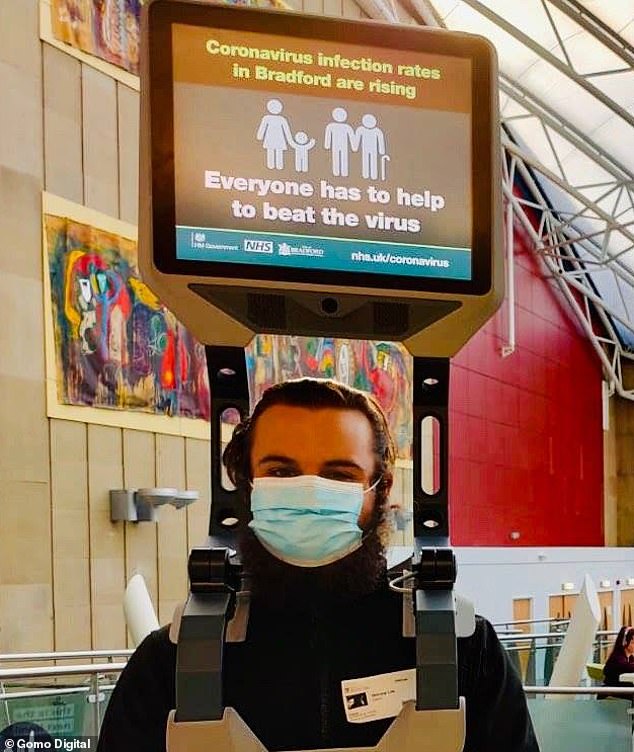
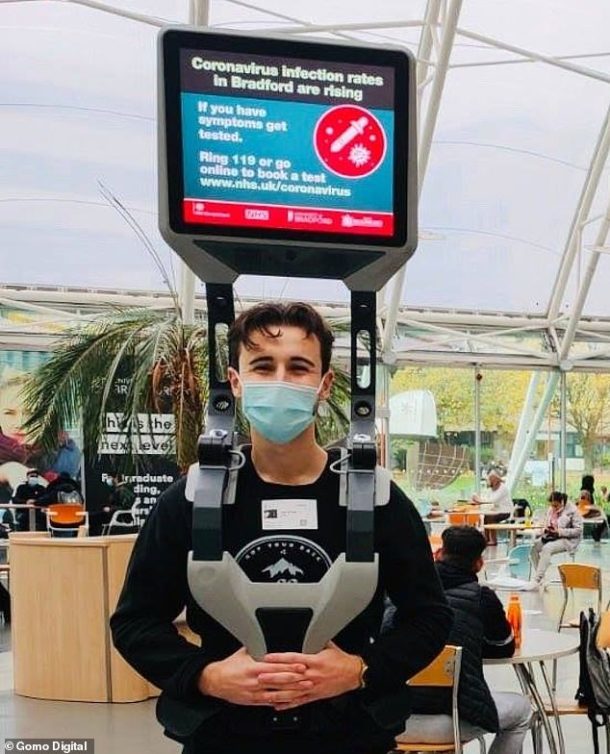
Britain’s bizarre ‘Robocop-like’ walking propaganda digital billboards (Image Credit: Gomo Digital)
21st Century News Wire | January 12, 2021
In one of the most desperate and bizarre moves yet, a local government in the UK has begun recruiting men to walking the streets with TVs strapped over their heads, supposedly to help police during a highly unpopular lockdown.
Bradford Council in Yorkshire announced their new ‘iWalkers’ scheme, where local council staff and volunteers are deployed onto the streets with a 19 inch screen weighing 18 lbs, mounted on their shoulders.
According to reports, the program ran for two days before it began to go horribly wrong. The government scheme was so ridiculous, residents thought it might have been satire at first, or a prank, not believing that the local government had lost the plot to such a degree. When they realized the plan was actually a real government initiative, the public backlash was severe, and so embarrassed council officials panicked and removed their Facebook post detailing their ‘exciting new program.’
A number of outrageous comments, both in person and online, were hurled at the walking Robocop-like human propaganda digital billboards
These real-life Teletubies were supposed to be walking the city and town streets, wearing masks, while their TV’s would be pushing out government propaganda on COVID, designed by a government behavioural insights team and applied behavioural psychologists – to nudge residents into tighter lockdown compliance, and to keep the public abreast of minute-to-minute ever-changing “coronavirus rules and restrictions.”
According to reports, the cost of Bradford’s COVID Teletubies is being paid for through Government funding of “Covid-19 communications.”
Local government officials denied they had deleted their new initiative because of public embarrassment, and instead claimed that it was suddenly taken down because of public comments that supposedly “crossed the line into abuse of people who are working hard to help residents and workers in Bradford District stay safe and stop the spread of the virus.”
The incident comes at a bad time for local councils who have recently decreed that they will be squeezing the working class even more by raising their council taxes (aka poll tax) – all of this amid a steep economic depression instigated by the reactionary COVID lockdown policies of the UK government.
Government officials tried to justify the expensive theme park-style stunt by saying that, “There are still many key workers in the city who may wish to get some information on testing where testing sites are close by and it’s really important that we have people out on the streets who can provide this.”
The Orwellian saga continues…
“Careless Talk Costs Lives” – Fresh Calls To Silence Pandemic Skepticism
OffGuardian | January 6, 2021
Throughout 2020, there has regularly been claimed to be a Left-biased pandemic zealotry in operation. We see Wales’ strict corona measures. Victoria. New Zealand. Most recently, two examples chill the blood.
Keir Starmer, appearing on the ITV’s Good Morning Britain, said…
we have to deal with the antivaxx campaigns because they will cost lives and if we need to pass emergency legislation to deal with them I would be prepared to work with the government on that.
George Monbiot said, today, we need to…
criminalise the spreading of blatant disinformation about the pandemic. As in wartime, careless talk costs lives.
No doubt the output of Off-Guardian over the last 12 months would fall into the brackets these gentlemen are referring to.
As if to underpin this apparent slant of the Left toward authoriranianism, Talkradio, oft touted as a Right Wing platform, was today deplatformed from Youtube. It was subsequently ‘replatformed’ after a UK minister from the Department for Digital, Culture, Media and Sportminister ‘inquired’ as to why.
Apart from raising the question of how much at the beck and call of government these supposedly ‘private’ and independent Silicone Valley tech companies are, it is an unsettling sign of potential things to come.
Police Demand Power to Force Entry Into Homes of Suspected Lockdown Violators
It went from “just wear the mask” to this

By Paul Joseph Watson | Summit News | January 6, 2021
Police are demanding new powers to force entry into the homes of suspected lockdown violators after Prime Minister Boris Johnson announced a new national lockdown in England.
The call was made by David Jamieson, the police and crime commissioner for the West Midlands police, England’s second biggest force.
“For the small minority of people who refuse entry to police officers and obstruct their work, the power of entry would seem to be a useful tool,” said Jamieson.
“I have raised this issue with the policing minister previously and clarity on the power of entry would help police officers enforce the new Covid regulations more easily,” he added.
As we previously highlighted, police are already breaking into people’s homes without warrants under the guise of enforcing lockdown restrictions, so any new law will just codify the process.
Since most of the country was already under a de facto full lockdown, the new national lockdown was announced by Boris Johnson primarily to hand police more draconian powers.
The government has already stated that the new measures will continue until the end of March at the earliest, meaning the next 3 months will be replete with examples of police abusing their powers to target people for simply trying to live their lives.
As we reported earlier, senior Scotland Yard officials have already said they will adopt more “hardline” measures to enforce the lockdown, including interrogating people on the street and handing out more fines.
This despite the fact that Brits were previously informed that police officers wouldn’t be able to attend crimes such as burglaries due to budget cuts.
What is left to say?
By Dr Malcolm Kendrick | December 30, 2020
I have not written much about COVID19 recently. What can be said? In my opinion the world has simply gone bonkers. The best description can be found in Dante’s Inferno, written many hundreds of years ago.
In it, Dante describes the outcasts, who took no side in the rebellion of angels. They live in the vestibule. Not in heaven, not in hell, forever unclassified. They reside on the shores of the Acheron. Naked and futile, they race around through a hellish mist in eternal pursuit of an elusive, wavering banner, symbolic of their pursuit of ever-shifting self-interest.
I find this description of the desperate pursuit of an elusive wavering banner rings rather true. This, it seems, is pretty much the place we have arrived at. Which banner have you decided to follow?
The ‘COVID19 s the most terrible infection ever, and we must do everything in our power to stop it, whatever the cost’ banner.
Or the ‘What on earth are we doing? This is no worse than a bad flu, and we are destroying the world economy, stripping away basic human rights and killing more people than we are saving’ banner.
There may be others.
Between these two, main, completely incompatible positions, lies the truth. It is in pretty poor shape. It has been crushed, and bent out of shape, smashed, and left as a broken heap in the corner. I search where I can, to find the fragments, in an attempt to bring together a picture that makes some kind of sense.
But what to believe? Who to believe?
I feel somewhat like Rene Descartes. In order to find the ineluctable truth he scraped everything away until he was left with ‘Cogito, ergo sum’. ‘I think, therefore I am.’
I have stripped away at the accuracy of PCR COVID19 testing. I found myself left with nothing I could make any sense of. I hacked down to establish the way that COVID19 deaths are recorded. All I found were assumptions and difficulties.
Did someone die with COVID19, of COVID19 – or did it have absolutely nothing whatsoever to do with COVID19? Who knows? I certainly don’t, and I wrote some of the death certificates myself.
Have we overestimated deaths, or underestimated deaths? I do not know … and so it goes on.
So, what do I know? I know that COVID19 exists – or I am as certain of this as I can be. Was it a natural mutation from a bat, or was it created in a laboratory? Well, I suppose it doesn’t really matter. It’s here, and there is no chance that any Government, anywhere, would ever admit responsibility for creating the damned thing. So, we will never know. If you asked me to bet, I would say it was created in a lab, then escaped by accident.
Is it deadlier than influenza? Well, it is certainly deadlier than some strains of influenza. Indeed, most strains. However, Spanish flu was estimated to have killed fifty million, when the world’s population was about a fifth of what it is now. So, COVID19 is definitely less deadly than that one. About as deadly as the influenzas of 1957 and 1967. Probably.
Will it mutate into something worse? Who knows.
Will the current vaccines work on mutated strains? Who knows.
Can it be transmitted by asymptomatic carriers? Who knows.
How effective are the current vaccines going to be? Who knows.
What are we left with?
At the beginning, I kept relatively quiet on how deadly COVID19 would prove to be. Because I didn’t know. The figures raged up and down. The infection fatality rate become a battle scene, with warriors lined up on either side to defend their positions.
I even got attacked by factcheckers, the self-appointed know-it-alls who are, it seems, capable of judging on all matters of scientific dispute. Truly, the Gods have descended to live amongst us. Those who can determine what is true, and what is not. No need for any further clinical trials, or any more scientific studies of any sort, ever. We just need to ask the Fact Checkers for the answer, to any given question.
Anyway, it appeared that tens of thousands died in some countries, almost none in others. What I was waiting to see, was the impact on the one outcome that you cannot alter, or fudge. The outcome that is overall mortality i.e. the chances of dying, of anything.
I did this because, when it comes to recording deaths from a specific illness, things can go in and out of fashion. A couple of years ago I looked at deaths from sepsis. At one time this was a condition of far lower priority. Doctors didn’t routinely search for it, or routinely record it, on death certificates.
Sepsis is an infection that gets into the blood, toxins are released, and people die. Everyone knew it happened. Or at least I hope they did.
Then, all of a sudden, there was a gigantic push to look for it more diligently, diagnose it more, treat it better. I think this was generally a good thing. Sepsis is eminently treatable, if you think to look for it, and lives can be saved. We now have initiatives like ‘Sepsis six’ and warnings that pop up on computers. ‘Have you considered sepsis,’ and suchlike. I love it … not. Because I do not love being told how to think, and do my job, by a computer algorithm programmed with ‘zero risk’ as their touchstone. But, hey ho.
In 2013, in the UK, a report was published by the health ombudsman ‘Time to Act – severe sepsis, rapid diagnosis and treatment saves lives.’ As the report stated.
‘Sepsis is a more common reason for hospital admission than heart attack – and has a higher mortality.’ The UK Sepsis Trust 1
That last statement is somewhat disingenuous, as many people with sepsis are very elderly, often with multiple morbidities, and suchlike. They were probably going to die, shortly, from something else.
Anyway. With all this activity, with all this increased sepsis recognition and treatment, you would expect the rate of deaths from sepsis to fall. It did not. The rate has gone up, by around 30% since 2013. Does this mean there is far more sepsis going about? Or, that it is just more often written on death certificates? I suggest the latter. I use this example, simply to make it clear that even the cause of death written on a death certificate is far from rock solid evidence.
With COVID19, this is a massive problem. In the UK, and several other countries if you have had a COVID19 positive test (which may, or may not, be accurate) and you die within twenty-eight days of that positive test, you will be recorded as a COVID19 death. I do not know much for sure about COVID19, but I do know that is just complete nonsense.
There are so many cases where – even if the COVID19 test was accurate – COVID19 would have had nothing whatsoever to do with the death. Another thing known, or at least we probably know, is that the vast majority of people who die had many other things wrong with them.
In the US, the Centre of Disease Control (CDC) found that ninety-four per cent of people who died of COVID19 ‘related deaths’ had other significant diseases (co-morbidities) 2. This ninety-four per-cent figures would only be the co-morbidities that were known about – who knows what lurked beneath? Especially as people stopped doing post-mortems (i.e., autopsies in the US).
So yes, they had COVID19 (or at least they had a positive test – which may not be the same thing), but they were often very old, and already severely ill. Using an extreme example, someone with terminal cancer who is a week from death, catches COVID19 in hospital, and dies. What killed them? The statistics say COVID19. I say, bollocks.
When I started in medicine, ‘bronchopneumonia’ (a bad chest infection) used to be known as the ‘old man’s friend.’ For those who were very old, and frail, often demented, lying in care homes, often incontinent, a chest infection represented a reasonably painless way to die.
Very often we would not actively treat it, instead we allowed for a peaceful death. Indeed, this still happens. Less so now, as someone, somewhere, often a relative from a country far, far, away – who has not visited for years – is far more likely to sue you.
Did they really die of bronchopneumonia? You could argue yes, you could argue no. Yes, it was the thing that finally pushed them over the edge. No, they were already slowly dying as their body gave out. In the end, what does anyone actually die of? My Scottish grannie, who lived to one hundred and two, used to say ‘they die frae want of breath.’ Entirely accurate, but, alas, also completely useless.
So, what you need to do, is look beyond what is written on death certificates. You need to look at what is happening to the overall mortality. Whilst you can argue endlessly, pointlessly, about specific causes of death. What you cannot argue about is whether or not someone is alive, or dead. Even I usually get this one right. No pulse, no breathing, no reaction of the pupils to light, no response to pain… and suchlike. Yup, dead. Now… what they die of? Um… let me think.
Thus, I have tended to look to EuroMOMO. The European Mortality Monitoring project. As they say, of themselves:
‘The overall objective of the original European Mortality Monitoring Project was to design a routine public health mortality monitoring system aimed at detecting and measuring, on a real-time basis, excess number of deaths related to influenza and other possible public health threats across participating European Countries.
Mortality is a basic indicator of health. Therefore, understanding its epidemiology is fundamental for effective public health planning and action.
Mortality monitoring becomes pivotal during influenza or other pandemics for several reasons. In a severe pandemic, mortality monitoring can be a robust way to monitor the pandemics progression and its public health impact when other systems are failing, due to an overburdened health care sector. Decision makers will require data on the pandemics impact and on deaths by age and geographical area in various stages of the pandemic. Mortality monitoring can provide such estimates, which will be important to guide and prioritize health service response and decision-making, i.e. use of antivirals and vaccines.’ 3
Here are the data that you can therefore, pretty much, fully rely on. It is where I go to see what is really happening across Europe. Not all of Europe, as some countries do not participate. However, there are more than enough, to get a good picture. It encompasses key countries such as Spain, Italy, the UK (split into four separate countries), Sweden and suchlike.
Here is the graph of overall mortality for all ages, in all countries. The graph starts at the beginning of 2017 and carries on to almost the end of 2020.

As you can see, in each winter there is an increase in deaths. In 2020, nothing much happened at the start of the year, then we had – what must have been – the COVID19 spike. The tall pointy bit around week 15.
It started in late March and was pretty much finished by mid-May. Now, we are in winter, and the usual winter spike appears. It seems to be around the same size as winter 2017/18. It also seems to have passed the peak and is now falling. But it could jump up again. [The figures in the most recent weeks can always be a bit inaccurate, as it can take some time for all the data to arrive]
Two things stand out. First, there was an obvious ‘COVID19 spike’. Second, what we are seeing at present does not differ greatly from previous years. The normal winter spike in deaths.
If we split this down into individual countries, this reasonably clear pattern falls apart.
Here are the figures from England

Unlike the first graph, the scale on the left is not absolute numbers. It is a thing called the Z-score. Which means standard deviation from the mean. Sorry, maths. If the Z-score goes above five, this means something significant is happening. The red, upper, dotted line is Z > 5. As you can see, despite the howls of anguish from England about COVID19 overwhelming the country, we are really not seeing much at all.
What of Sweden, that pariah country? They did not fully lock-down, the irresponsible fools (all they did was follow WHO guidance – by the way), and we are now told they are suffering terribly, they should have enforced far more rigid lockdown, their ‘experiment’ failed etc. etc. COVID19 shall have its vengeance. Or to quote Arnie – I’ll be back.

As you can see, nothing much happening in Sweden either.
Then, if you look further, there are anomalies all over the place. Northern Ireland, which is part of the UK, and did exactly the same things as the rest of the UK with regard to lockdown, masks etc. At least it did in the earlier part of the year. However, it shows a completely different pattern to England. Or, to be fully accurate, it shows no pattern at all. No waves, and nobody drowning.

What of Slovenia?

As you can see absolutely nothing happened earlier in the year in Slovenia. Now, it has the biggest spike of all – apart from, maybe, Switzerland. Earlier in the year it was held up as a great example of how brilliantly effective masks were. Now… you don’t hear so much about masks. Maybe masks only work in months beginning with M. [Maybe, whisper it, they don’t work at all].
So, what have I learned from euroMOMO? First that it appears to have made absolutely no difference if a country locked down hard, and early, or did not. Everyone points at Norway and Finland as examples of great and early government action, and how wonderful everything would have been if we had done the same.
Well, look up at Northern Ireland. Then look at Finland

Spot the difference. There is none.
Of course, much of the most heated debate surrounded what happened during the so-called first wave. Who dealt with it well, or badly. Now, everyone in Europe is doing much the same things. Lockdown, restrictions on travel, restrictions on meeting other people, everyone wearing masks, etc. etc. Yet some countries are having a new wave, and others are not.
There is a special prize for anyone who can match up the severity of restrictions in various countries, to the Z-score. I say this, because no correlation exists.
So, again, what have I learned about COVID19? I learned that all Governments are floundering about, all claiming to have exerted some sort of control over this disease and ignoring all evidence to the contrary. In truth, they have achieved nothing. As restrictions and lockdowns have become more severe, in many cases the number of infections has simply risen and risen, completely unaffected by anything that has been done.
The official solution is, of course, more restrictions. ‘We just haven’t restricted people enough!’ Sigh. When something doesn’t work, the answer is not to keep doing it with even greater fervour. The real answer is to stop doing it and try something else instead.
I have also learned that, in most countries, COVID19 appears to be seasonal. It went away – everywhere – in the summer. It came back in the autumn/winter, as various viruses do.
On its return it has been, generally, far less deadly. Much as you would expect. The most vulnerable died on first exposure, and far fewer people had any resistance to it, at all. Now, a number of people do have some immunity, and many of the vulnerable are already dead.
Which means that, in this so-called second wave, COVID19 is no greater an issue than a moderately bad flu season.
If I were to recommend actions. I would recommend that we stop testing – unless someone is admitted to hospital and is seriously ill. Mass testing is simply causing mass panic and achieves absolutely nothing. At great cost. We should also just get on with our lives as before. We should just vaccinate those at greatest risk of dying, the elderly and vulnerable, and put this rather embarrassing episode of mad banner waving behind us.
Hopefully, in time, we will learn something. Which is that we should not, ever, run about panicking, following the madly waved banners… ever again. However, I suspect that we will. This pandemic is going to be a model for all mass panicking stupidity in the future. Because to do otherwise, would be to admit that we made a pig’s ear of it this time. Far too many powerful reputations at stake to allow that.
1: https://www.ombudsman.org.uk/sites/default/files/Time_to_act_report.pdf
10 Facts From the UK Government Pfizer Vaccine Guidance that Promote “Vaccine Hesitancy”
By Johnny Vedmore |
Unlimited Hangout| December 29, 2020
Official government guidance has been released in the United Kingdom to assist healthcare professionals in administering the Pfizer/BioNTech vaccine BNT162b2. While the UK government goes to war against supposed misinformation, the official narrative is clearly based on very little to no supporting data from incomplete clinical trials. This article examines the document “Reg 174 Information for UK Healthcare Professionals” and narratives being pushed in the mainstream media that directly contradict that document.
Healthcare professionals globally have begun the controversial campaign to vaccinate large swathes of their respective populations with various experimental medical products. The vanguard of the mainstream pro-vax extremists have been busy enacting mass censorship tactics and committing blatant acts of digital book burning on a scale never before seen in the internet era. So-called “trusted sources” have become indistinguishable from the state-run media apparatus of your bog-standard dictatorship with the usual MSM outlets working non-stop to skew any information that threatens their hyper-aggressive official narrative. Throughout 2020, our basic civil liberties have been quickly stripped away by countless unelected officials from a wide array of unaccountable global power structures, all of them connected to a small group of elites who are sitting aloft the COVID-19 money train and using the heavily exaggerated epidemic to achieve their own long term goals.
Any useful data, scientific paper, or other credible research contradicting the official narrative is being purposely hidden from view. Too many uncomfortable, yet ultimately necessary, questions for vaccine companies such as Moderna, AstraZeneca, Pfizer, and their many collaborators, are being heavily censored by those pushing their own various COVID-related agendas. The promised “war on truth” is in full swing throughout all nations globally and their respective state media machines are nearly all towing their official government lines. Mainstream talk shows and podcasts worldwide are also in lockstep, and have often been caught publicly guilt-tripping their easily swayed audiences to help push them deeper into queues for mass medical trials for vaccines and other products that lack research studies on their long term effects. This inconvenient lack of completed research will not stop the money men from pumping this milky white liquid into the arms of hundreds of millions of people worldwide.
At this point in the process, the medical professionals who are administering these heavily rushed vaccines are being given the opportunity to defer responsibility and accountability for their actions to the government’s vaccine-related guidance. As the Stanley Milgram experiments have proven, when the option to defer responsibility is present, then roughly 65% of participants will follow the orders they have received regardless of the risk to their subjects. In 1974, Stanley Milgram detailed the behaviour of his participants in his famous study and suggested that people have two basic states of behaviour when they are in a social situation: “The autonomous state”, where people direct their own actions and ultimately take responsibility for the results of those actions and “the agentic state”, where people allow others to direct their actions and then pass off the responsibility for the consequences to the person giving orders, in essence acting as agents of another person’s will.
The majority of the people who are injecting these experimental drugs into their trusting patients are not likely to question the official guidance, as the overwhelming majority will often simply be in an agentic state. Thus, it should be in the best interest of anyone thinking of receiving an mRNA vaccine to first study the guidance offered by the various government sources. And, when one does study the official guidance given to healthcare professionals, one will find many different glaring contradictions and shocking admissions.
While all official bodies are attacking any inconvenient fact as misinformation, they are all busy defrauding the global population with their own misinformation campaigns that surely would have inspired awe in the likes of Joseph Stalin. So, let’s study their own words and examine the NHS guidance given to the medical professionals in the UK for the administration of the recently approved Pfizer-BioNTech vaccine.
An Introduction to Reg 174 Information for UK Healthcare Professionals (#1-4)
The short ten page official guidance being given to UK healthcare professionals contains many interesting admissions. In fact, the document, released in early December 2020 to accompany the vaccine rollout, appears to advise healthcare practitioners not to risk giving the experimental injection to the majority of the people who are due to receive the vaccine, particularly “prioritized” populations. Those in charge are pushing to vaccinate as much of the population as possible, before any critical public questions can be asked and answered, a situation that has left the safety and ethics of the vaccination campaign questionable at best and inhumane at worst.
In going through the Reg 174 document, it becomes very clear that there are many issues and recommendations that are being hidden from the general public. Here are ten of the most notable causes for concern contained within the official UK guidance document.
The authorisation to produce and supply this experimental vaccine in the UK was given by the UK Department of Health and Social Care, led by Matt Hancock – the UK Secretary of Health, and also by the Medicines & Healthcare products Regulatory Agency (MHRA). While the MHRA is part funded by the Department of Health and Social Care for the regulation of medical devices, the costs of medicine regulations are met through fees paid by the pharmaceutical industry. The agency’s financial reliance on Big Pharma has led to suggestions by some Members of the UK Parliament that the MHRA is not actually independent. Being in associated roles at the MHRA since 1985, June Raine was officially appointed as CEO in September 2019 and had previously been the Director of Vigilance and Risk Management in the Medicines Division.
2. The official Phase III safety trials will not be completed until 2023
Section 1 of the medical guidance clearly states that this vaccine guidance refers specifically to the “Pfizer/BioNTech COVID-19 mRNA Vaccine BNT162b2 concentrate for solution for injection.” On 2 December 2020, the MHRA became the first medicines regulator in history to approve an mRNA vaccine for human use, granting emergency authorisation for BioNTech and Pfizer’s BNT162b2 COVID-19 vaccine for widespread use only a week after its first Phase III eight-week trial had finished. However, the Phase III trials for BNT162b2 will not actually be fully completed until January 2023 meaning that, if you’re ready to take the vaccine now, then you should be informed that the safety trials for these experimental vaccines have at least two more years before the results are in. Regardless of that fact, Raine told reporters “no corners have been cut in approving it” and that “the benefits outweigh any risk”.
3. Will you be truly “protected” from COVID-19?
The official guidance clearly states that individuals may not be protected until at least 7 days after their second dose of the vaccine. This fact has again been ignored by various reckless pro-vax media campaigns where powerful elites such as Tony Blair have contradicted this specific recommendation, suggesting recently in an interview that people should only be given a single dose of any vaccine. Mr Blair told BBC Radio 4’s Today programme that “Does the first dose give you substantial immunity, and by that I mean over 50 percent effectiveness? If it does, there is a very strong case for not, as it were, holding back doses of the vaccine.” Blair, writing in the Independent, stated that the current vaccination strategy needed to be “altered and radically accelerated”. In responding to Blair’s call for radical acceleration, Professor Wendy Barclay, chair of virology at Imperial College London and member of the UK government’s NERVTAG, said: “I think that the issue with [Mr Blair’s suggestion] is that the vaccine is on the basis of being given in two doses, and the efficacy is on that basis.” Barclay went on to point out that “To change at that point, one would have to see a lot more analysis coming out from perhaps the clinical trial data.”
It is very important to pay attention to the wording of Reg 174 because the Pfizer vaccine purportedly boosts the immune system, rather than stopping the transmission of the virus. This would suggest that you will not be fully “protected” from COVID-19 and that you will still be able to catch the virus and could still suffer complications. The official guidance also states that “Immunocompromised persons, including individuals receiving immunosuppressant therapy, may have a diminished immune response to the vaccine,” with the guidance admitting “No data are available about concomitant use of Immunosuppressants.”
Reg 174 goes on to make this most pertinent of points when it states “As with any vaccine, vaccination with COVID-19 mRNA Vaccine BNT162b2 may not protect all vaccine recipients.” The guidance also states clearly that “administration of COVID-19 mRNA Vaccine BNT162b2 should be postponed in individuals suffering from acute severe febrile illness and that individuals receiving anticoagulant therapy or those with a bleeding disorder that would contraindicate intramuscular injection, should not be given the vaccine unless the potential benefit clearly outweighs the risk.”
4. The complicated multistage dilution and thawing process of the vaccine vials opens the major possibility of human error
In investigating the official instructions for the vaccine’s administration, we can clearly see that there are plenty of opportunities for potential human error. Section 2 of this document describes the distributed vaccine as coming in “a multidose vial and must be diluted before use.” Confirming that each vial contains 0.45 ml (which equates to 5 doses of 30 micrograms) of BNT162b2 RNA embedded in lipid nanoparticles. The delicate preparation process will be repeated 100s of millions of times globally and the multidose vial will be stored frozen and must be thawed prior to dilution. The guidance describes the process for preparing the frozen vials stating that they should be transferred to temperatures of between 2 °C to 8 °C to thaw or, alternatively, the frozen vials may also be thawed for 30 minutes at temperatures up to 25 °C for immediate use. Once thawed, the undiluted vaccine can be stored for up to 5 days at 2 °C to 8 °C, and up to 2 hours at temperatures up to 25 °C. The thawed vial must then come to room temperature and be gently inverted 10 times prior to dilution.
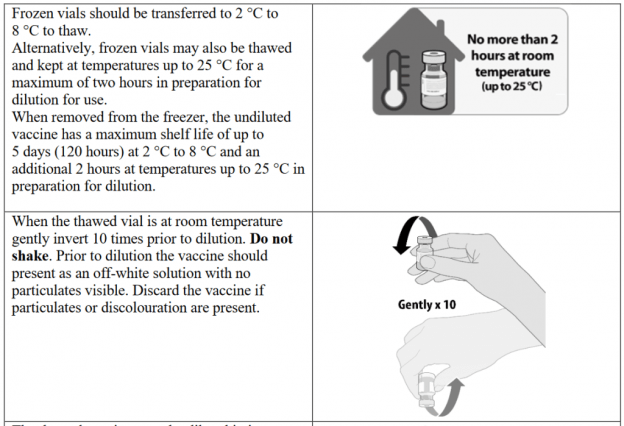
Some of the featured diagrams and instructions found in Reg 174
The complicated thawing and dilution process will obviously leave room for individual error. Healthcare practitioners are also warned not to shake the vials and instead to gently turn them 10 times. Prior to dilution, the vaccine should present as an off-white solution with no particulates visible. The guidance states that you must discard the vaccine if particulates or discolouration are present. The thawed vaccine must be diluted in its original vial with 1.8 mL sodium chloride 9 mg/mL (0.9%) solution for injection, using a 21 gauge or narrower needle and aseptic techniques and this complex, multistage process isn’t completed there.
The healthcare professional should then equalise vial pressure before removing the needle from the vial by withdrawing 1.8 mL of air into the empty diluent syringe. Then they should gently invert the diluted solution 10 times, again being careful not to shake the solution. The official guidance continues: “The diluted vials should be marked with the dilution date and time and stored between 2 °C to 25 °C. After dilution, the vial contains 5 doses of 0.3 mL.” The healthcare professionals are then told to “withdraw the required 0.3 mL dose of diluted vaccine using a sterile needle and syringe and discard any unused vaccine within 6 hours after dilution.”
The instructions must be followed precisely to safely administer the mRNA vaccine; there are no data available on potential consequences for the vaccine recipient if anything goes wrong during this tedious and complex multistage process. On 19 December 2020, video emerged of an official drive-thru vaccination hub which had begun operating out of a car park of Hyde Leisure Centre in Greater Manchester. The video in question, shared by No Comment TV on YouTube, shows people being vaccinated outdoors at Hyde Leisure Centre by gloveless staff and in less than sterile conditions. In an article in the Manchester Evening News four days prior to the videos release the local news site stated that “The first batch of the Pfizer/BioNTech vaccine arrives in the borough on Tuesday, with vaccinations starting at Hyde Leisure Centre on Wednesday, December 15.”
No Data Available (#5-10)
When reading Reg 174, you will soon notice a recurring theme throughout the document. The guidance clearly states on multiple occasions that there are no data available concerning some of the most important questions surrounding the mRNA vaccine. As previously noted, the actual Phase III section of the safety trials will not be completed until January 2023, meaning that two years of trials are still to be run before the vaccine can be confirmed as safe, effective and ethical.
5. The safety and efficacy of COVID-19 mRNA Vaccine BNT162b2 in children under 16 years of age have not yet been established
Although the guidance states that the safety and efficacy of the COVID-19 vaccine has not been established in children, it doesn’t mean that children have not been included within the studies. In fact, in the official Pfizer study entitled “Protocol C4591001”, one of the two main study groups included children as young as 12 years old. The inclusion of children in trials but not the guidance raises the important question, why were children included in the trial? If the vaccine is not to be given to those under the age of 16 years old, then why include children as young as 12 in the trials for an experimental vaccine technology never before authorised for use in humans?
The mainstream media, instead of raising concerns about the involvement of children in the Pfizer clinical trials, have been fully supportive of the move to test experimental pharmaceuticals on minors. CNN reported on children as young as 12 being involved in trials in an October 2020 article entitled “This 12-year-old is happy to be testing a Covid-19 vaccine” while Microsoft News recently announced that “China begins Covid test trials on children as young as age three.”
6. No data are available on the use of COVID-19 mRNA Vaccine BNT162b2 in persons that have previously received a full or partial vaccine series with another COVID-19 vaccine
We are currently witnessing the very first of many tailor-made vaccines being rolled out for general use, so don’t expect the COVID-19 jabs to be the only vaccines coming our way. With a 20 to 1 return on investment on many of these new technologies, most pharmaceutical giants will surely be lobbying governments across the globe for the next “necessary” vaccination program. The idea of multiple COVID-19 vaccinations throughout the year is already being presented as a very possible outcome for the future of humanity. Yet, no studies have been completed showing the risk of taking different types of vaccines. There have also been suggestions that people will have to have the same vaccine that they had previously taken every six months or so. This will leave Astrazeneca, Pfizer and Moderna picking up repeat vaccine contracts worth billions in secured future revenue before there are any real data on the results of the vaccines.
7. No interaction studies have been performed and there are no, or a limited amount of, data from the use of COVID-19 mRNA Vaccine BNT162b2
Admissions like these should be a cause for concern for anybody reading the official guidance. While officials and carefully chosen “trusted sources” are telling you that “no corners have been cut” in the race to approve these vaccines, it is also true that no full length studies have been completed either. These two facts are juxtaposed and obviously contradict the official narrative that is being thrust upon the general public by all of those involved.
It is clear that the officials have no real data on what will happen next and that there is a tsunami of ethical questions that are not being answered. In the absence of data, there will be speculation.
8. It is unknown whether COVID-19 mRNA Vaccine BNT162b2 is excreted in human milk and It is unknown whether COVID-19 mRNA Vaccine BNT162b2 has an impact on fertility
It is vital to note the potential dangers posed by the BNT162b2 to unborn and newborn babies as well as the reproductive organs in general. There are so many parts of the Pfizer/BioNTech clinical trials that have not yet been completed. Dr. Peter Klatsky, the Director of Fertility Preservation at the Bay Area’s Spring Fertility, talking about the coming animal trials which are to be performed over the coming months was quoted in SFGate as saying, “It will reassure me an awful lot if the protein expression is not seen on the placenta. That the mRNA isn’t making it to the placenta in animals,” he said. “I don’t expect to see any.” The article goes on to explain that it will be about another 9 months until the data has been collected and analyzed.
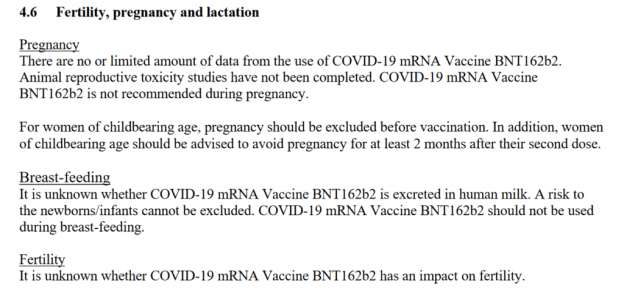
Section 4.6 of the official guidance recommends pregnant women should not recieve the BNT162b2 vaccine
Big names in mainstream media have also been caught recklessly promoting the vaccine to pregnant women, such as Karen Weintraub writing for USA Today, whose recent article quickly states, “Although there are very little data on how pregnant and nursing mothers will respond to a COVID-19 vaccine, professional organizations and individual doctors say the benefits are very likely to outweigh the risks.” Even though the clinical trials intentionally excluded pregnant women, Weintraub went on to state that “23 women in the Pfizer-BioNTech trial and 13 in Moderna’s became pregnant during the trial.”
While the UK’s official guidance is left sounding ambiguous, on the European continent, the European Medicines Agency (EMA) states that “the Pfizer vaccine should be considered on a case by case basis for pregnant women”, but they also reserve the right to alter the guidance if more data becomes available. It seems there is no longer any erring on the side of caution with some regulators when it comes to the COVID-19 vaccinations.
9. Non-clinical data reveal no special hazard for humans based on a conventional study of repeat dose toxicity but animal studies into potential toxicity to reproduction and development have not been completed
Animal studies have not been completed and, as referred to in the previous section, the data on those animal trials will not be available for another 9 months. It is, of course, a very rare decision to approve an experimental medical technology before any animal studies have been completed. This should be a great cause for concern for any free thinking man or woman. The fact that they have had to use what they refer to as “non-clinical” data in these studies is also in conflict with the idea that the trials were conducted to the highest professional standard. The document also fails to clearly define what non-clinical data actually means.
10. In the absence of compatibility studies, this medicinal product must not be mixed with other medicinal products
Possibly the most fascinating admission in the entire document is the absence of any compatibility studies when somebody is given the vaccine while on any other medication or medical treatment. The guidance clearly states “this medicinal product should not be mixed with other medical products.” This completely jaw dropping sentence will lead many to assume that if you are on any medication at all, then you shouldn’t be given the vaccine. Whether this refers to the mixing of other medical properties directly together with the vaccine, or simultaneous dosing of any other medical product is unclear from the official guidance.
The Mail Online and The Guardian reported in 2019 that a staggering 1 in 4 people in England – nearly 12 million people – were taking what was described as “addictive” prescription medicines such as antidepressants, sleeping pills and opioid painkillers, saying that “the NHS must take action”. Those statistics throw into question the mass rollout of a vaccination with no compatability studies. This makes the fact that elderly care home residents, followed by those aged over 80, will be the first to recieve the experimental Pfizer vaccine an extremely risky strategy. Also in 2019, Age UK reported that nearly 2 million older people were on more that 7 prescription medicines and were at “risk of side effects that are severe in some cases, and occasionally even life threatening.” This worrying issue has been barely reported by the “trusted news sources”.
A Conclusive Lack of Real Data
After examining the official guidance, one fact becomes glaringly obvious — there is little to no data on the official Pfizer vaccine in key areas. In the clinical trials, children as young as 12 years old were used as unnecessary guinea pigs. There also wasn’t enough care taken to avoid pregnant women being involved in the initial clinical trials and under the cover of unyielding and uneducated mainstream propaganda, the safety of some of the most vulnerable people involved in the vaccine trials have been ignored by Pfizer and the politicians who have successfully pushed for the public vaccination campaign to essentially replace mass clinical trials. The stage has been set for a potential disaster on an unimaginable scale. It isn’t only the participants of the trials who are risking their health for the sake of big pharmaceutical companies’ hyperinflated profit margin, but it is also the medical professionals who could be risking their futures by collaborating in these risky experimental trials, which will certainly see many people dead and irreversibly injured.
In one section of Reg 174, the Big Pharma giant lays out the risk to people’s health from the Pfizer/BioNTech vaccine. The most common adverse reaction in participants 16 years of age and older was pain at the injection site, which affected a massive 80% of those taking part in the Pfizer trials. Fatigue came a close second with 60% of trial participants becoming sluggish and tired. Half of those involved in the studies suffered from a headache as the experimental vaccine went to work while myalgia was experienced by 30% of vaccine recipients, though the results do not indicate whether the myalgia was acute (short-term) or chronic (long-term). Almost a third of participants came down with chills, while just under 1 in 5 people suffered from arthralgia (joint pain) and 1 in 10 from pyrexia (increased body temperature).
Adverse reactions reported in clinical trials are listed in the study in decreasing order of frequency and seriousness. Just under 1 in 10 people who take the vaccine will suffer from the very common and common adverse reactions referred to in the latter paragraph, such as headaches, myalgia and chills, but the more serious issues are classified as uncommon – including Lymphadenopathy (which causes swollen or enlarged lymph nodes) and nervous system disorders – which may affect up to 1 in 100 people. Rare adverse reactions that could affect up to 1 in 1000 people and very rare adverse reactions that would affect less than 1 in 10,000 of the vaccine recipients were not included in Pfizer’s self-reported safety information. It has obviously been decided that this information should be kept out of the public domain as much as possible to avoid any further vaccine hesitancy.
Not only does the official guidance actively hide the types of rare and very rare adverse effects, but they have also been leaving out some of the adverse reactions reported during the clinical trials. As I write this, the Reg 174 guidance for healthcare professionals is on version 10.1 of the document and, since its release, they have yet to admit to the potential of a certain uncommon adverse reaction to the vaccine being a specific nervous system disorder. Structural nervous system disorders include brain or spinal cord injury, Bell’s palsy, cervical spondylosis, carpal tunnel syndrome, brain or spinal cord tumors, peripheral neuropathy, and Guillain-Barré syndrome. However, previous versions of the guidance gives no clue as to what type of nervous system disorders they were referring to. However, recent articles in the USA Today, heavily promoted by the Microsoft Network, suggested that the Bell’s palsy some people came down with in the vaccine trials wasn’t related to the Pfizer jab. The article states that on Dec. 10, the FDA’s Center for Biologics Evaluation and Research held the 162nd meeting of the Vaccines and Related Biological Products Advisory Committee to discuss the emergency use authorization of the Pfizer-BioNTech COVID-19 vaccine. The USA Today piece even goes on to admit that , “a 53-page briefing noted that there had been four cases of Bell’s palsy among the vaccinated group and none among the placebo group.”
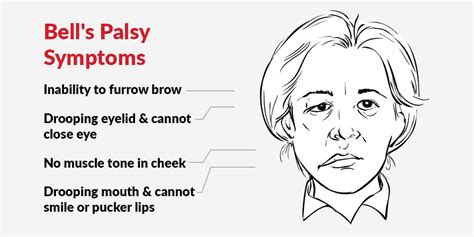
Bell’s palsy causes drooping facial muscles similar to the effects of a stroke, image source PTHealth.com
Even though Miriam Fauzia, who wrote the USA Today piece, claims that the Bell’s palsy was not related to the experimental Pfizer vaccine, the 53-page briefing she sources clearly states, “Among non-serious unsolicited adverse events, there was a numerical imbalance of four cases of Bell’s palsy in the vaccine group compared with no cases in the placebo group, though the four cases in the vaccine group do not represent a frequency above that expected in the general population.” While it is true that 1 to 4 people in 10,000 will develop Bell’s palsy within the general population, it should be noted that the 4 cases in the vaccine trials and none in the placebo group makes for a statistical anomoly that must be examined more thoroughly. Instead, the mainstream media moved quickly to discredit the Bell’s palsy links to the Pfizer vaccine using various misleading tactics to achieve their aims.
Many mainstream outlets were caught spouting the same misleading information with articles entitled “Why you shouldn’t worry about a connection between Bell’s palsy and COVID-19 vaccines,” from Business Insider and a Reuters article from 14 December 2020 entitled, “Fact check: Photo does not show three recipients of Pfizer’s COVID-19 vaccine that developed Bell’s palsy.”
In the case of the Reuters article, which is described as written by “Reuters Staff” rather than a specific journalist, the focus was not on the four Pfizer clinical trial participants who developed Bell’s palsy but instead the article discredits a random post on social media of three people with Bell’s palsy unconnected to the Pfizer vaccine. These type of misinforming mainstream media articles are commonly found to be using obvious fallacies to mislead their readership and with no individual taking responsibility for writing the misinforming piece, a trick repeated by many other media companies complicit with the official narrative. The Reuters article even goes on to admit that: “According to the FDA’s briefing document dated December 10, Bell’s palsy was reported in four vaccine participants and none in the placebo group, out of the 44,000 total participants of the late-stage vaccine trial.” However, the title of the Reuters article would mislead even some of the most keen eyed observers.
The mainstream media has been creating a flood of misleading stories, but it appears as though they have been given carte blanche to continue to do so, probably because they are sticking so tightly to the official narrative. It’s a narrative that is thick with irony, for it is the “trusted sources” who are being caught systematically misleading the general population again and again while also declaring a propaganda war against “fake news”.
The official guidance noted in Reg 174 doesn’t only highlight the serious lack of real data gained from Pfizer’s clinical trials for its Covid-19 vaccine so far, but it also exposes the wealthy medical professionals involved in these experimental vaccine development programs as complacent, reckless and very naive. It’s no secret that children are, more often than not, incapable of giving informed legal consent for such a risky and unethical enterprise. But the pro-vax extremists are using every tactic to coerce and manipulate children and their guardians into becoming human guinea pigs for Big Pharma. Pregnant women are also treated as acceptable collateral damage to advance the new science of gene, mRNA and DNA manipulation, a science and technology that pushes a sinister transhumanist agenda.
Don’t be fooled by the carefully worded vacuous celebrities, self-serving politicians, Big Pharma, and the mainstream medias authoritarian style misinformation campaigns. Keep your humanity intact and read their own words. The government guidance to healthcare professionals clearly states on multiple occasions that there are “no data available”.
Johnny Vedmore is a completely independent investigative journalist and musician from Cardiff, Wales. His work aims to expose the powerful people who are overlooked by other journalists and bring new information to his readers. If you require help, or have a tip for Johnny, then get in touch via johnnyvedmore.com or by reaching out to johnnyvedmore@gmail.com
Emergency Hospitals Dismantled Despite Claim Hospitalisations Worse Than ‘First Wave’
The hospitals have been almost completely empty for the duration of the health crisis

By Steve Watson | Summit News | December 29, 2020
A report has confirmed that emergency hospitals in the UK are being dismantled and removed, despite government claims that hospitalisations from coronavirus have hit a level HIGHER than they were during the first wave of the pandemic back in March and April.
The reports in the Daily Mail and the London Telegraph note that the facilities, known as ‘Nightingale hospitals’, set up at huge conference centres and other warehouse spaces are “being quietly taken apart” because there are not enough staff to run them.
Despite the seven facilities throughout the UK costing as much as £220million to set up and equip, the hospitals have been almost completely empty for the duration of the health crisis.
Indeed, just 57 Covid-19 patients were admitted to NHS Nightingale London between April and the start of May, according to Department of Health records. The facility was then put back into ‘standby’, and left empty.
The report states that the ExCeL Centre, which hosts the London facility, has confirmed that 90 per cent of the hospital has already been removed, including stripping 4000 beds and hundreds of additional of ventilators.
Videos of the facilities being dismantled first surfaced in the Summer:
The government has repeatedly pushed the narrative that the lockdowns have been necessary to ‘protect the NHS’, yet now it is taking apart the hospitals it says were set up to alleviate the strain.
It has been claimed that a third of major hospital trusts in England are now experiencing more Covid-19 patients than at the peak of the first wave. In the East and South West, more than half of all hospitals say they have more patients now than earlier in the year.
National Health Service data claims that over 20,000 beds are now occupied by COVID patients, up from 17,700 recorded last week, and surpassing the almost 19,000 recorded in mid April.
Throughout the crisis, we have been told that hospitals are on the brink of being overwhelmed, yet reports have continued to emerge suggesting that hospitals are up to four times emptier than usual.
Despite the claims that there are not enough NHS staff to man the facilities, there has been a resurgence of nurses posting dancing tik-tok videos:
France Accused of ‘Hysteria Over COVID Variant’ After Nearly 15,000 Truckers Tested Negative
21st Century Wire | December 29, 2020
Before Christmas, sensational reports of a new COVID “variant” in the UK prompted European neighbors France, Netherlands and Belgium – to close their international borders for fear of a dangerous new viral wave. As a result, ferries were unable to leave the Port of Dover until Christmas morning, with some 6,000 hauliers remaining in Kent over the subsequent days, and with many spending Christmas Day and Boxing Day parked, waiting to cross the English Channel. What was all the fuss about? Is there really a new “mutant strain” which UK Health Secretary Matt Hancock claims is still ravaging through the British Isles?
As part of this bio-security theatre, military personnel were then deployed to Kent, including a massive cohort of 1100 British troops, 30 French firefighters, and 60 Polish soldiers – all to supposedly to provide aid and services to the drivers, and to “speed up testing to 600 per hour” carried out at nearby Manston airfield.
As it turns out, all of this was completely unnecessary.
UK Transport Secretary Grant Shapps tweeted: “Update on Kent lorry situation: 15,526 #Coronavirus tests now carried out. Just 36 positive results, which are being verified (0.23%). Manston now empty and lorries should no longer head there please.”
What the Government and Mainstream Media will not tell the public is that if the highly dubious PCR Testing was used, then that tiny reported number of 36 ‘positive cases’ could have easily fallen within the margin of false positive errors – meaning all 15,000 plus drivers may have been ‘COVID free’ – an incredible but very telling data point – all but proving that the virus is likely to be severely over-hyped right now in the UK.
As 21WIRE already reported last week, Hancock’s claims of a new ‘dangerous and more transmissible’ virus were totally unfounded and based on sloppy science from the UK government’s NERVTAG science advisory committee.
Because of the near nonexistent COVID cases within this giant trucker sample, critics are now railing against France and other European countries for panicking and closing their borders based on irrational fear of an non-existent “mutant strain” of COVID-19. But the UK authorities have no business pointing the finger at anyone….
MSN reported on Dec 25th…
The French authorities slapped restrictions on hauliers crossing the Channel following the [alleged] emergence of the VUi202012/01 coronavirus mutation which is believed to spread faster than other strains.
The UK and France agreed to a testing regime to allow trucks to start flowing again on the Dover-Calais link.
The Standard has been told that out of the first 1,500 tests none came back positive.
A Whitehall source criticised the “over hasty” action by the French authorities, adding: “All of this trouble – there have been 1,500 tests – no positives.”
The EU’s Transport Commissioner Adina VÄlean criticised Emmanuel Macron’s government over the weekend’s freight ban.
She tweeted: “I am pleased that at this moment, we have trucks slowly crossing the Channel, and I want to thank UK authorities that they started testing the drivers at a capacity of 300 tests per hour.
“I deplore that France went against our recommendations and brought us back to the situation we were in in March when the supply chains were interrupted.”
Mind you, that’s more than a bit rich for anyone in the UK Government-Media Complex to accuse France of over-reacting – when it was Matt Hancock and the fawning mainstream press who for weeks shamelessly pumped-out incessant fear-based claims of an allege COVID “mutant strain” – absent of any actual evidence to back-up their wild assertions. Lesson learned?
SEE MORE:
UK ‘Variant Fears’ Are Over-Hyped Says Leading US Microbiologist
Rhodes Scholars Surge in Biden’s Potential Cabinet
By Matthew Ehret | Strategic Culture Foundation | December 27, 2020
With Trump’s ascension to the presidency in 2016, the Rhodes Scholars that had permeated the U.S. Deep State over many years found themselves choking on humble pie as they were removed from the drivers’ seat of world affairs for the first time in decades. The paradigm of post-nation state unipolarism that had been carefully built up over the post-WWII period had somehow been successfully challenged by an outsider as the republic was slowly returned to its patriotic traditions as a nation committed to non-interventionism, industrial progress and protectionism.
In the last few days, it has become clear that these Oxford-trained Rhodes Scholars have re-emerged as leading voices in Biden’s cabinet, and since a general understanding of this problem is so lacking today (leading many patriots to be duped into believing that the evil Chinese are at the heart of their woes), I think some preliminary words are needed as a matter of historical context.
Cecil Rhodes’ Vision Revisited
Every year since its creation in 1902, over 30 talented young American scholars have been rewarded each year with the privilege of an all-expenses paid brainwashing in the halls of Oxford University on the dime of the riches left to posterity by the deceased race patriot diamond magnate Cecil Rhodes before being re-deployed back to their home nations.
Rhodes’ early disciples included such luminaries as Lord Alfred Milner, Sir Halford Mackinder, George Parkin, W.T. Stead and the Canadian oligarch Vincent Massey (to name a few). His early backers included high level figures among the British intelligentsia including Prince Edward Albert and Lord Nathaniel Rothschild who saw that a new strategy was needed to halt the spread of American System policies around the world in the wake of Lincoln’s victory over the South during the Civil War.
At the time, anyone with half a brain knew that the unipolar days of the British Empire were coming to an end as a new multipolar system of win-win cooperation was emerging… and this was a prospect deemed intolerable by many devout social Darwinists among the British ruling class.
These early Rhodians interfaced closely with London’s Fabian Society throughout the 20th century and became the new disciplined elite that gradually infiltrated every branch of society. This new breed of imperial managers exerted its influence in much the same way earlier Jesuit operations had been formed and deployed across Europe beginning in the 16th century.
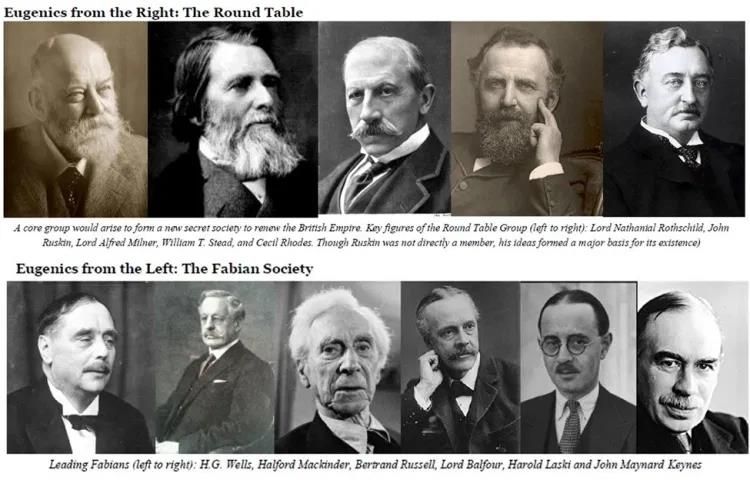
For anyone confused as to the purpose of this Rhodes Scholarship program, one need look no further than Rhodes’ 1877 Confessions of Faith and 7 wills which called for domination of the “inferior races” to Anglo-Saxon superiority, and the ultimate recapturing of America and the creation of a new Church of the British Empire:
“Let us form the same kind of society, a Church for the extension of the British Empire. A society which should have its members in every part of the British Empire working with one object and one idea we should have its members placed at our universities and our schools and should watch the English youth passing through their hands just one perhaps in every thousand would have the mind and feelings for such an object, he should be tried in every way, he should be tested whether he is endurant, possessed of eloquence, disregardful of the petty details of life, and if found to be such, then elected and bound by oath to serve for the rest of his life in his Country. He should then be supported if without means by the Society and sent to that part of the Empire where it was felt he was needed.’
In another will, Rhodes described in more detail his intention: “To and for the establishment, promotion and development of a Secret Society, the true aim and object whereof shall be for the extension of British rule throughout the world. The colonization by British subjects of all lands where the means of livelihood are attainable by energy, labour, and enterprise and especially the occupation by British settlers of the entire Continent of Africa, the Holy Land, the Valley of the Euphrates, the islands of Cyprus and Candia, the whole of South America, the islands of the Pacific not heretofore possessed by Great Britain, the whole of the Malay Archipelago, these aboard of China and Japan, [and] the ultimate recovery of the United States of America as an integral part of the British Empire.”
Describing his thinking to his disciple W.T. Stead, Rhodes wrote: “Please remember the key of my idea discussed with you is a Society, copied from the Jesuits as to organisation”.
A Calamitous 20th Century
As generations passed, the continuity of purpose that transcended individual lives of players on the stage was maintained by certain organizations that grew out of the original Rhodes/Milner Round Table movements and which had branches in every part of the Anglo-Saxon part of the British Empire. By 1919 after the Round Table had taken control of Canadian and British governments during 1911 and 1916 coups, this group created the Royal Institute for International Affairs (aka: Chatham House). By 1921, an American branch was set up called the Council on Foreign Relations (CFR) staffed with Rhodes Scholars and Fabians which has maintained a continuity of intention to the present day. This organization spawned dozens of influential sub organizations which always interface with a form of “central command”.
A young student of Harvard’s William Yandell Elliot (himself a Rhodes Scholar who operated the Oxford Branch of Harvard) was none other than Sir Henry Kissinger who stated gushingly at a May 10, 1981 Chatham House event:
“The British were so matter-of-factly helpful that they became a participant in internal American deliberations, to a degree probably never practiced between sovereign nations… In my White House incarnation then, I kept the British Foreign Office better informed and more closely engaged than I did the American State Department… It was symptomatic”.

While the Rhodes Scholar hives managed to permeate ivy league schools, media outlets, private corporations, elected offices and the civil service during the 20th century as laid out by Professor Carrol Quigley’s posthumously published The Anglo-American Establishment, the prize of the presidency remained an elusive trophy… until the day that one of Quigley’s students returned from Oxford and became Governor of Arkansas.
Clinton Opens the Floodgates
With Clinton’s 1992 presidential victory, Rhodes Scholars like Strobe Talbott (Assistant Secretary of State and co-architect of Perestroika) and Robert Reich (Secretary of Labor), were joined by Rhodies Ira Magaziner, Derek Shearer (Senior Economic Advisors), Susan Rice (Assistant Secretary of State for African Affairs), Kevin Thurme (Health and Human Services Chief of Staff), George Stephanopoulos (Communications Director) and dozens of other Rhodes Scholars. These individuals were funneled into positions of influence aiming to oversee the “end of history” celebrated by neocon thinker Francis Fukuyama as the Soviet Union disintegrated.
While some Rhodies remained in positions of power during the period of the Straussian controlled opposition of 2000-2008, the Rhodes Hives again enjoyed vast policy-shaping influence under the Obama-age where the architecture for one world government was built on the wreckage of troublesome nation states like Libya, Syria and Ukraine.
Despite the set back caused by a populist deplorable who wrestled the reins of power away from these self-professed experts in 2016, a Rhodie is a stubborn creature if nothing else, and as we have discovered in past months, both Talbott and Rice have been revealed to be two figures at the heart of the Russiagate plot designed to undo the results of 2016. While still serving as Brookings Institute President in 2015-17, it was Talbott who interfaced with MI6’s Sir Richard Dearlove and Christopher Steele in the months before the elections by cooking up and circulating the dodgy dossier and it was Rice who was revealed to be at the center of the “unmasking” entrapment operation conducted on a bewildered Michael Flynn in January 2017.
Revenge of Rice and the Rhodies
With the recently announced appointment of Susan Rice as director of Biden’s Domestic Policy Council, it has become apparent that the Rhodies are drooling at the prospect of correcting the “aberration” of Trump by re-ascending to the inner sanctum of Washington D.C., bringing in droves of Clinton-Obama era unipolar zombies with them.
Beyond Rice, other Rhodes Scholars emerging into positions of control include National Security Advisor Jake Sullivan who graduated from Oxford’s Magdalene College and worked under Strobe Talbott at the Brookings Institute’s Center for the Study for Globalization at Yale in 2000. During this time, Rice had also come to work as Senior Fellow at Brookings followed by a stint as UN Ambassador from 2009-2013 and National Security Advisor from 2013-2017, while Sullivan went onto become Biden’s top security aid during the Obama years.
Describing her love of Oxford, Rice delivered remarks at Rhodes House in 1999 saying:
“To be at Rhodes House tonight with so many friends, benefactors and mentors is a personal privilege. It is like a coming home for me for much of what I know about Africa was discovered within these walls, refined at this great university with generous support of the Rhodes Trust.”
It is worth keeping in mind that as she spoke those words, Rice had recently demonstrated her imperial worldview by coordinating the destruction of a Sudanese pharmaceutical factory in 1998 and threatening South Africa with economic destruction unless it gave up its desires for producing generic and affordable AIDS medication in the same year. Her work to carve up Sudan, promote military intervention across the Arab and African worlds under R2P and supranational organization’s like Soros’ International Criminal Court (ICC) that issued an arrest warrant for President Bashir would have made Cecil Rhodes proud. We should not forget that the Sudan-Libya-Egypt alliance under the combined leadership of Mubarak, Qadhafi and Bashir, had moved to establish a new gold-backed financing system outside of the IMF/World Bank to fund large scale development.
Pete Buttigieg
As of this writing, Rhodes Scholar Eric Garcetti (LA Mayor) has been pulled from the Biden cabinet due to a growing mountain of scandals, and corruption in his local state which have turned him into political poison for the time being.
The other Rhodes Scholar mayor Pete Buttigieg, has been more fortunate however and has been given the keys to Transport portfolio as of December 15, although had first been poised to take the position of US Ambassador to China. While many Trump supporters are being induced to hate and fear China as the “natural enemy of the USA”, it was in fact Buttigieg who demonstrated that his disdain for Trump was only paralleled by his disdain for China when he said in May 2020: “Beijing sees an opportunity to call into question the American project and liberal democracy itself. One thing they’re banking on is four more years of Trump.”
As I laid out in my previous report, Soros himself has repeatedly labelled the two greatest threats to his “open society” as 1) Xi Jinping’s China and 2) Trump’s USA.
Another Rhodie named Bruce Reed who had originally entered Washington as part of the first 1992 Rhodes Scholar infusion as the Clinton-Gore campaign manager and later director of Clinton’s Domestic Policy Council, has been tapped as the top tech advisor to Biden where he has openly called for cracking down on free speech online by cancelling Federal Internet law Section 230. This law currently keeps website owners free of prosecution for content published on their sites. It’s cancellation would crush what dwindling free speech exists on social media. The argument advanced by Reed has been that Section 230 has been used by Russian and Chinese operatives to infiltrate the information ecosystem and manipulate western elections. With its repeal, Facebook and other social media sites will be forced to censor all “illicit” thought crimes under fear of federal prosecution.
Reed had earlier teamed up with Biden in drafting the infamous 1994 crime bill which placed countless petty criminals to long-term sentences, benefiting the prison cheap labor complex. During the Obama years Reed worked as Biden’s Chief of Staff and lead handler.
Blinken, Rhodes and Soros
While Biden’s pick for Secretary of State Anthony Blinken is not himself a Rhodes Scholar, he is a life-long friend and classmate with Robert Malley (a Rhodes Scholar who had formerly acted as Special Assistant to Obama serving as “point man in the middle east” at the NSC). Earlier, Malley had been special assistant to Bill Clinton on Arab Israeli Affairs and was always deeply enmeshed with George Soros’ operations from day one of his entry into politics. Since 2016, Malley has acted as President and CEO of the International Crisis Group (ICG) founded by George Soros and Lord Malloch Brown in 1994 as a tool to promote global humanitarian wars under the guise of Responsibility to Protect (R2P). Joining Soros, Malloch-Brown and Malley at the ICG, we should not be surprised to find none other than… Jake Sullivan.
Additionally, Blinken’s father Donald Blinken made a name for himself as Soros’ point man in Hungary from 1994-1998 where he served as US Ambassador facilitating the growth of Soros’ Open Society Foundation. He was later rewarded by the Hungarian speculator with a “Donald and Vera Blinken Open Society Archive” (OSA) at Budapest’s Central European University. The Soros-funded university was created in the wake of the collapse of the Soviet Union and Blinken was instrumental in that operation.
President Viktor Orbán knew exactly what he was doing when he expelled this foreign anti-nation state brainwashing operation from Hungary’s borders in 2018. At the time, Central European University President Count Michael Ignatieff screamed “This is unprecedented. A U.S. institution has been driven out of a country that is a NATO ally.”
A Segue on Count Ignatieff
It is noteworthy that Ignatieff is himself the son of Rhodes Scholar globalist George Ignatieff and great grandson of Count Nikolai Pavlovich Ignatiev (founder of the Russian Okhrana secret police) whose family was rewarded handsomely for services rendered to London-centered oligarchy during the overthrow of the Czarist system in Russia (sort of a precursor to today’s modern Color Revolutions). This story is partially told in Cheney Revives Parvus’ Permanent War Madness by Jeff Steinberg (2005).
As a sidenote, Michael Ignatieff’s great grandfather on his maternal side is none other than George Parkin, the first controller of the Rhodes Trust from 1902-1922 and the man whose Oxford lectures and books inspired Cecil Rhodes and Milner to devote their lives to the cause of Empire. Michael is also a global board member of Soros’ Open Society Foundations headed by none other than Mark Malloch Brown (as of December 4, 2020).
As I laid out in my recent report, not only did these two upper level managers come to light as coordinators of the Dominion/Smartmatic vote fraud operation underway within the USA, but both have also pioneered the new age of regime change color revolutions beginning with Marcos’ 1986 ouster during the Peoples’ Power revolution in the Philippines, through the Balkans, Georgia, Ukraine, Kyrgyzstan, Belarus, Moldova, Bolivia, etc.
Some Final Thoughts
While the Rhodes Trust has been close to the causal nexus of much of recent world history, no one should assume that every Rhodes Scholar is guilty by association. It is an undeniable fact that some Rhodes Scholars have broken with their training and have gone on to live useful lives and I see no reason to assume, for instance, that actor/singer Kris Kristofferson played a nefarious role in anything (though some of his film choices were a bit weak).
Similarly, Canada’s John Turner did some very useful things in his short stint as Canadian Prime Minister which earned him the ire of many unipolarists then promoting NAFTA, Maastricht and the Euro. Even Bill Clinton was induced to break from his profile on a few occasions and support some good things that ran contrary to the world government agenda under the positive influence of Commerce Secretary Ron Brown (whose convenient death in 1996 alongside 34 journalists and business executives in Croatia ended that pesky issue- a story for another time).
The key thing to hold in mind is that longer waves of history are shaping the present more than most historians would care to admit. Anyone taking an intention-driven approach to historical analysis will come to recognize quickly enough that events that took place centuries ago have an active impact on the events playing out today.
How and why is this so? Because history is shaped by IDEAS. Good ideas that are in tune with the truthful nature of reality vs bad ideas that are out of tune with said reality. But this battle over ideas (and ideas about ideas e.g.: Plato’s higher hypothesis) is where the causal nexus of universal history is found. With this in mind, we can see clearly how certain people use their influence to conspire and create cultural and political institutions that transmit those ideas and organizing principles across many generations. Sometimes we find these forces to be acting in harmony with natural law (as in the case of Benjamin Franklin and his international network of co-thinkers) and sometimes very much in defiance of natural law.
Today’s battle between the opposing paradigms of the multipolar alliance led by Russia and China on the one hand vs the unipolarist/post-nation state worldview on the other has everything to do with these longer forces of history. The only way to comprehend the color revolution playing out within the USA, or the anomalous emergence of Rhodes Scholars shaping the possible Biden presidency, is by recognizing this higher reality. This exercise may cause you to think about thinking differently, and at first may be uncomfortable, but just as the figure released from the cave who slowly accustoms his/her eyes to the light of the sun and reality, the satisfaction of enjoying a higher order of truthfulness is incomparably more pleasant to a life believing in the shadows cast by an elite class of puppeteers.
Developers of Oxford-AstraZeneca Vaccine Tied to UK Eugenics Movement
By Jeremy Loffredo and Whitney Webb |
Unlimited Hangout| December 26, 2020
The developers of the Oxford-AstraZeneca vaccine have previously undisclosed ties to the re-named British Eugenics Society as well as other Eugenics-linked institutions like the Wellcome Trust.
On April 30th, AstraZeneca and Oxford University announced a “landmark agreement” for the development of a COVID-19 vaccine. The agreement involves AstraZeneca overseeing aspects of the development as well as manufacturing and distribution while the Oxford side, via the Jenner Institute and Oxford Vaccine Group, researched and developed the vaccine. Less than a month after this agreement was reached, the Oxford-AstraZeneca partnership was awarded a contract from the US government as part of Operation Warp Speed, the public-private COVID-19 vaccination effort dominated by the US military and US intelligence.
Though the partnership was announced in April, Oxford’s Jenner Institute had already begun developing the COVID-19 vaccine months before, in mid-January. According to a recent BBC report, it was in January that the Jenner Institute first became aware of how serious the pandemic would soon become, when Professor Andrew Pollard, who works for both the Jenner Institute and heads the Oxford Vaccine Group, “shared a taxi with a modeler who worked for the UK’s Scientific Advisory Group for Emergencies.” During the taxi ride, “the scientist told him data suggested there was going to be a pandemic not unlike the 1918 flu.” Due to this sole encounter, we are told, the Jenner Institute then began to pour millions into the early development of a vaccine for COVID-19 well before the scope of the crisis was clear.
For much of 2020, the Oxford-AstraZeneca vaccine was treated as an early front-runner, though its lead would later be marred by scandals related to its clinical trials, including the death of participants, sudden trial pauses, the use of a problematic “placebo” with its own host of side effects and the “unintentional” mis-dosing of some participants that skewed its self-reported efficacy rate.
The significant issues that emerged during trials have provoked little concern from the vaccine’s two lead developers, despite critical attention from even mainstream media of its complications. The lead developer of the Oxford-AstraZeneca vaccine, Adrian Hill, told NBC on December 9th that the experimental vaccine should be approved and distributed to the public before the conclusion of the safety trials, saying,”to wait for the end of the trial would be the middle of next year. That’s too late, this vaccine is effective, available at large scale and easily deployed.”
Sarah Gilbert, the other lead researcher on the vaccine, seemed to believe that pre-mature safety approval was likely, telling the BBC on December 13 that the chances of rolling out the vaccine by the end of the year are “pretty high.” Now, the UK is expected to approve the Oxford-AstraZeneca vaccine shortly after Christmas, with India also set to approve the vaccine next week.
While the controversies surrounding the vaccine’s trials did ultimately undermine its previous frontrunner status, the Oxford-AstraZeneca vaccine remains heavily promoted as the vaccine of choice for the developing world, as it is cheaper and has much less complicated storage requirement than its main competitors, Pfizer and Moderna.
Earlier this month, Dr. Richard Horton, the editor-in-chief of the Lancet medical journal, told CNBC that “The Oxford AstraZeneca vaccine is the vaccine right now that is going to be able to immunize the planet more effectively, more rapidly than any other vaccine we have” in large part because it is a “vaccine that can get to lower middle-income countries.” CNBC also quoted Andrew Baum, global head of health care for Citi Group, as saying that the Oxford-AstraZeneca vaccine “is really the only vaccine that is going to suppress or even eradicate SARS-CoV-2, the virus that causes COVID-19, in the many millions of individuals in the developing world.”
In addition to longstanding claims that the Oxford-AstraZeneca vaccine will be the vaccine of choice for the developing world, this vaccine candidate has also been treated by several outlets in the mainstream and even independent media as “good for people, bad for profits” due to the partnership’s “explicit intention of supplying [the vaccine] around the world on a not-for-profit basis, meaning that the poorest nations on the planet will not have to worry about being shut out of a cure due to lack of funds.”
However, investigation into the vaccine’s developers and the realities of their “no-profit pledge” reveals a very different story than that which has been spun for most of the year by corporate press releases, experts and academics tied to the vaccine and the mainstream press.
For instance, mainstream media has had little, if anything, to say about the role of the vaccine developers’ private company – Vaccitech – in the Oxford-AstraZeneca partnership, a company whose main investors include former top Deutsche Bank executives, Silicon Valley behemoth Google and the UK government. All of them stand to profit from the vaccine alongside the vaccine’s two developers, Adrian Hill and Sarah Gilbert, who retain an estimated 10% stake in the company. Another overlooked point is the plan to dramatically alter the current sales model for the vaccine following the initial wave of its administration, which would see profits soar, especially if the now obvious push to make COVID-19 vaccination an annual affair for the foreseeable future is made reality.
Yet, arguably most troubling of all is the direct link of the vaccine’s lead developers to the Wellcome Trust and, in the case of Adrian Hill, the Galton Institute, two groups with longstanding ties to the UK Eugenics movement. The latter organization, named for the “father of eugenics” Francis Galton, is the re-named UK Eugenics Society, a group notorious for its promotion of racist pseudoscience and efforts to “improve racial stock” by reducing the population of those deemed inferior for over a century.
The ties of Adrian Hill to the Galton Institute should raise obvious concerns given the push to make the Oxford-AstraZeneca vaccine he developed with Gilbert the vaccine of choice for the developing world, particularly countries in Latin America, South and Southeast Asia and Africa, the very areas where the Galton Institute’s past members have called for reducing population growth.
In the final installment of this series on Operation Warp Speed, the US government’s vaccination effort, and race, the Oxford-AstraZeneca vaccine’s ties to Eugenics-linked institutions, the secretive role of Vaccitech, and the myth of the vaccine’s sale being “non-profit” and altruistically motivated are explored in detail.
GlaxoSmithKline and the Jenner Institute
The Edward Jenner Institute for Vaccine Research was initially established in 1995 in Compton in Berkshire as a public-private partnership between the UK government, via the Medical Research Council and the Department of Health, and the pharmaceutical giant GlaxoSmithKline. Following a “review by the [institute’s] sponsors,” it was relaunched in 2005 in Oxford under the leadership of Adrian Hill, who—prior to that appointment—held a senior position at the Wellcome Trust’s Centre for Human Genetics. Hill, the lead developer of the Oxford-AstraZeneca COVID-19 vaccine, still leads a research group at Wellcome aimed at “understand[ing] the genetic basis of susceptibility to different infectious diseases, especially. . . severe respiratory infections,” which conducts most of its studies in Africa. The UK’s Medical Research Council has also become a collaborator with the Wellcome Trust, specifically on vaccine-related initiatives. The Wellcome Trust, discussed at greater length later in this article, was originally created with funding from Henry Wellcome, who founded the company that later became GlaxoSmithKline.
Hill’s partner at the Jenner Institute and the other co-developer of the Oxford COVID-19 vaccine is Sarah Gilbert. Gilbert also hails from the Wellcome Trust, where she was a “program director,” and is a student of Hill’s. Together, Gilbert and Hill have worked to position the institute to be the center of all future vaccination efforts undertaken in response to global pandemics.

Professor Sarah Gilbert at Oxford, Photo by John Cairns
The Jenner Institute’s relocation to Oxford was largely facilitated by the Medical Research Council, which donated £1.25 million between 2005 and 2006, after the decision was made to replace the institute’s original sponsors (GlaxoSmithKline, the Medical Research Council, the Department of Health) with the University of Oxford and the Institute for Animal Health, now called the Pirbright Institute. The involvement of Pirbright meant that the relaunched Jenner Institute became unique in developing vaccines for both humans and livestock.
The relaunched Jenner Institute has come to dominate publicly funded vaccine development in the UK as well as the testing of vaccines produced by the world’s largest pharmaceutical companies via clinical trials and has overseen prominent safety trials for vaccines of high media interest in recent years. Some of the Jenner Institute–conducted trials later drew controversy, such as those using South African infants in 2009 in which seven infants died.
An investigation conducted by the British Medical Journal found that the Hill-led Jenner Institute had, in the South African instance, knowingly misled parents about the negative results of and questionable methods used in animal studies as well the vaccine being known to be ineffective. The vaccine in question, an experimental tuberculosis vaccine developed jointly by Emergent Biosolutions and the Jenner Institute, was scrapped after the controversial study in infants confirmed what was already known, that the vaccine was ineffective. The trial, largely funded by Oxford and the Wellcome Trust, was subsequently praised as “historic” by the BBC. Hill, at the time the study was conducted, had a personal financial stake in the vaccine.
Similar instances of dodgy practices in efficacy trials and the effects of increased dosages have led vaccine experts to criticize the COVID-19 vaccine developed by Hill and Gilbert. Hill and Gilbert hold a considerable financial stake in the Oxford-AstraZeneca COVID-19 vaccine. While the vaccine reportedly has an efficacy of over 90 percent, those figures—often cited in mainstream reports—are self-reported by the vaccine’s developers and manufacturers (i.e., the Oxford team and AstraZeneca), which is significant given that Hill and other Jenner Institute scientists have previously been caught manipulating trial results to benefit a vaccine product in which they were personally invested.
The prominence of the Jenner Institute in vaccine development and testing has largely come through Hill’s additional leadership role at the UK’s Vaccines Network, which chooses what vaccines to develop, how to develop them, and which firms should receive “targeted investments” from the UK government. The Vaccines Network also plays a key role in identifying “what vaccine technologies could play an important role in future outbreaks.” Two of the main backers of the UK’s Vaccines Network are the Wellcome Trust and GlaxoSmithKline.
Unsurprisingly, the Vaccines Network has steered many millions of pounds toward the Hill-run Jenner Institute, with completed projects including a “plug and display” virus-like particle platform for rapid-response vaccination. Also funded by the Vaccines Network were the Jenner Institute’s initial studies of novel chimpanzee adenovirus vaccines for coronavirus (in this case, MERS), the same viral vector used for the Oxford-AstraZeneca vaccine. In addition to the Vaccines Network, the Jenner Institute also coordinates the efforts of the EU’s Vaccines Network equivalent, MultiMalVax.

Professor Adrian Hill at the Jenner Institute, Photo by John Cairns
The Jenner Institute also has a close relationship with GlaxoSmithKline and the Italian biotech Okairos, which was acquired by GlaxoSmithKline in 2014. Soon after it was acquired, Okairos, and its new owner GlaxoSmithKline, became key players in the 2014 experimental Ebola vaccine push, an effort that mirrors the current COVID-19 vaccine development rush in many key ways. The rushed safety trials for that vaccine were overseen by Adrian Hill and the Jenner Institute and funded by the UK government and the Wellcome Trust. GlaxoSmithKline and Okairos are the only firms represented on the Jenner Institute’s Scientific Advisory Board.
The Jenner Institute, along with GlaxoSmithKline-Okairos and a small French biotech called Imaxio, have been developing an experimental malaria vaccine since 2015, with human trials of that vaccine announced on December 12, 2020. Those trials will be conducted on 4,800 children in Africa over the course of 2021, in many of the same countries where Hill’s research group at the Wellcome Center for Human Genetics has been studying genetic susceptibility to several diseases. “A lot more people will die in Africa this year from malaria than will die from Covid,” Hill recently said in regard to the soon-to-begin trials.
Currently, the Jenner Institute is funded by the Jenner Vaccine Foundation, but the foundation’s documents note on several occasions a considerable influx of money from Wellcome Trust Strategic Awards. A “special review panel” from the Wellcome Trust actually lobbied the Jenner Institute to apply for further “strategic core funding” from the trust after visiting the institute and appraising its work. The Jenner Institute frames its funding from Wellcome as the key guidance behind its development decisions, which are made “based on the successful model of Wellcome Trust Strategic Award support.”
The Jenner Institute’s foundation, however, is not the only source of income for its lead researchers. Hill and Gilbert have been working to commercialize many of the institute’s vaccines through their own private company, Vaccitech. Though media reports often describe the vaccine as being a joint effort between AstraZeneca and the University of Oxford, Vaccitech is a key stakeholder in that partnership, given that the vaccine candidate relies on technology developed by Hill and Gilbert and owned by Vaccitech. A deeper look into Vaccitech offers a clue as to why the company’s name has been absent from nearly all media reports on the Oxford-AstraZeneca vaccine, as it demolishes the much-touted claim that the vaccine is “nonprofit” and offered at low cost for charitable reasons.
Vaccitech: doing well by going “good”?
The official reason Sarah Gilbert and Adrian Hill created Vaccitech in 2016 per The Times is because “Oxford’s researchers [are] encouraged to form companies to commercialize their work.” Vaccitech, like other “commercialized” Oxford research enterprises, was spun out of the Jenner Institute via the university’s commercialization arm, Oxford Science Innovations, which is currently Vaccitech’s largest stakeholder at 46 percent. Hill and Gilbert are reported to maintain a 10 percent stake in the company.
The largest investor in Oxford Science Innovations, and by extension one of the largest shareholders in Vaccitech, is Braavos Capital, the venture-capital firm started in 2019 by Andrew Crawford-Brunt, Deutsche Bank’s long-time global head of equity trading at its London branch. Through its stake in Oxford Science Innovations, Braavos owns about 9 percent of Vaccitech.
Prior to COVID-19, Vaccitech’s main focus, especially last year, was the development of a universal vaccine for the flu. Vaccitech’s efforts in this regard were praised by Google, which is also invested in Vaccitech. At the same time, the Bill & Melinda Gates Foundation was funding research to develop a universal flu vaccine, reportedly because the field of influenza vaccinology was not yet able “to design a flu vaccine that would protect broadly against the strains of flu that infect people every winter and those in nature that could emerge to trigger a disruptive and deadly pandemic,” according to a STAT News report from last year. The Gates Foundation effort originally partnered with Google’s cofounder Larry Page and his wife Lucy.
To fully finance Hill and Gilbert’s Vaccitech, and specifically its quest to develop a universal flu vaccine, Oxford Science Innovations sought £600 million from “outside investors,” chief among them the Wellcome Trust and the venture-capital arm of Google, Google Ventures. This means that Google is poised to make a profit from the Oxford-AstraZeneca vaccine at a time when its video platform YouTube has moved to ban COVID-19 vaccine–related content that shines a negative light on COVID-19 vaccines, including the Oxford-AstraZeneca candidate. Other investors in Vaccitech include Sequoia Capital’s Chinese branch and the Chinese pharmaceutical company Fosun Pharma. In addition, the UK government has put an estimated £5 million into the company and is also expected to make a return on the Oxford-AstraZeneca vaccine.

Vaccitech’s homepage showing company co-founders Adrian Hill and Sarah Gilbert. From vaccitech.co.uk
Information on the profit motive behind the Oxford-AstraZeneca vaccine has been muddied due to the extensive media promotion of the claim that Hill and Gilbert will not be collecting royalties on the vaccine and that AstraZeneca is not making a profit off the vaccine. However, this is only true until the pandemic is “officially” declared over, and the virus is labeled a persistent or seasonal condition that will require the mass administration of COVID-19 vaccines at regular intervals and possibly annually. Sky News reported that the determination of when the pandemic is over “will be based on the views of a range of [unspecified] independent bodies.” At that point, both Vaccitech and Oxford will obtain royalties from AstraZeneca’s sales of the vaccine.
Those tied to the vaccine have been at the center of promoting the idea that the COVID-19 vaccine will soon become an annual affair. For instance, in early May, John Bell—an Oxford medical professor and an “architect” of the Oxford-AstraZeneca partnership—told NBC News, “I suspect we may need to have relatively regular vaccinations against coronaviruses going into the future,” adding that the vaccine would likely be needed every year like the flu vaccine. NBC News failed to note that the Oxford-AstraZeneca vaccine in which Bell is involved stands to significantly benefit financially if that does come to pass.
More recently, Bell told The Week that, “should there prove to be a market for regular vaccinations against coronavirus in the future, ‘there is some money to be made.’” Such sentiments have been echoed by Pascal Soriot, the CEO of AstraZeneca, who told Bloomberg last month that the company stood to make a “reasonable profit” once the pandemic was declared over and COVID-19 deemed a seasonal illness requiring regular vaccinations. On this matter, Vaccitech’s CEO, Bill Enright, stated that Vaccitech investors would receive a “big chunk of the royalties from a successful vaccine as well as ‘milestone’ payments” if and when the pandemic is declared over and COVID-19 vaccines become a seasonal event.
Vaccitech, in particular, appears quite certain that this possibility is slated to become reality. For all subsequent iterations of the Oxford-AstraZeneca vaccine, Vaccitech will reacquire a much larger percentage of rights to the vaccine, rights it is currently splitting with Oxford for the first iteration. Sky News has noted that the technology that Vaccitech owns “could drive the second generation of COVID-19 vaccines” and that it “has [already] received £2.3 million of public funding to develop it.”
US government officials such as Anthony Fauci have also signaled that the COVID-19 vaccine will require annual shots. Notably, the government, through Health and Human Service’s BARDA, has poured over $1 billion into the Oxford-AstraZeneca vaccine development. In addition to government officials, several recently published mainstream media reports have claimed that the “expert” consensus “seem[s] to be leaning toward an annual shot like the flu vaccine” with regards to the COVID-19 vaccine. For instance, Dr. Charles Chiu, a professor of infectious diseases at the University of California–San Francisco, recently told Salon, “This may end up being a vaccine that’s not a one-time thing or even a two-time thing. . . it may end up being what we call either a seasonal vaccine, or vaccine that needs to be administered every couple of years.”
Such hints about an annual COVID-19 vaccine from 2021 onward have recently become commonplace from the leading COVID-19 vaccine manufacturers themselves. For instance, on December 13th, Pfizer CEO Albert Bourla was quoted by the Telegraph as saying, “How long this [vaccine] protection lasts is something we don’t know … I think it is a likely scenario that you will need periodical vaccinations.” Pfizer also recently issued a statement that noted that “we don’t know how the virus will change, and we also don’t know how durable the protective effect of any vaccination will be,” adding that its vaccine would be suitable “for repeated administration as booster shots” in the event that the vaccine only induces an immune response for a few months.
Then, this past Tuesday, Moderna released information that suggested immunity from its COVID-19 vaccine would only last several months, with Forbes writing that “the duration of neutralizing antibodies from the Moderna vaccine will be relatively short, potentially less than a year,” an outcome that would favor the push for an annual COVID-19 shot. The developer of the Pfizer COVID-19 vaccine, Ugur Sahin of BioNTech, also stated on Tuesday that “The virus will stay with us for the next 10 years… We need to get used to the fact there’ll be more outbreaks.” He later added that “if the virus becomes more efficient… we might need a higher uptake of the vaccine for life to return to normal,” implying that these regular outbreaks he foresees occurring over the next ten years would be correlated with increased vaccine administration.
Quotes from the developers of the Oxford-AstraZeneca vaccine themselves also point to a pandemic-dominated future and a desire for the crisis to be prolonged so that the vaccine can be widely distributed. Gilbert told the UK Independent in August that she believes COVID-19 is just the beginning and that COVID-like pandemics will become more frequent in the near future. The Jenner Institute vaccine team seems so determined to create the COVID vaccine that, in June, Hill was quoted by the Washington Post in June as stating that he wanted the pandemic to stick around, saying, “We’re in the bizarre position of wanting COVID to stay, at least for a little while. But cases are declining.” He also stated that his team was in “a race against the virus disappearing.”
With the vaccine developers, “medical experts,” government officials, and the CEOs of major vaccine manufacturers all agreeing that a seasonal COVID-19 vaccine is an increasingly likely outcome, it is worth considering a possible ulterior motive regarding the initial “nonprofit” model being used by the Jenner Institute/Vaccitech and AstraZeneca for their joint COVID-19 vaccine.
Given that vaccine guidance in several countries states that each dose of the multidose COVID-19 vaccine must be produced by the same manufacturer as previous doses, the implication is that in the event of a need for periodic COVID-19 vaccine variants, those who initially received the Oxford-AstraZeneca vaccine would likely be required to receive that same “brand” of vaccine seasonally. In other words, those who initially received the Oxford-AstraZeneca vaccine would likely be required, not just to receive a second dose of the same “brand,” but continue receiving that same “brand” of vaccine every year. Notably, no interaction studies have yet been conducted on the interactions between the COVID-19 vaccines and other medications as well as other vaccines.
If this turns out to be the case, it would certainly behoove the Oxford-Vaccitech-AstraZeneca team to want their vaccine to be the most widely used one in the first year in order to guarantee the largest market for subsequent annual COVID-19 vaccines. This could be a possible motive behind the efforts of the Oxford-AstraZeneca partnership “to supply the entire world with the Oxford jab” and to supply the vaccine “to the most vulnerable groups to COVID-19.” This vaccine has already been purchased, even before regulatory approval, by governments around the world, including in Europe, North America, Australia and most Latin American countries.
The Wellcome Trust
Adrian Hill currently holds a senior position at the Wellcome Trust’s Centre for Human Genomics. The Wellcome Trust is a scientific charity based in London, established in 1936 with funds from pharmaceutical magnate Henry Wellcome. As previously mentioned, Wellcome founded the pharmaceutical company that eventually became the industry giant GlaxoSmithKline. Today, the Wellcome Trust has a $25.9 billion endowment and engages in philanthropic endeavors, including funding clinical trials and research.
Hill has been closely tied to Wellcome for decades. In 1994, he participated in the founding of the Wellcome Centre for Human Genetics and was awarded a Wellcome Trust Principal Research Fellowship the following year. He became a Wellcome professor of human genetics in 1996.
The Wellcome Centre for Human Genetics website boasts of the large-scale genetic mapping they’ve conducted in Africa. The center also publishes papers that explore genetic dispositions in relation to male fertility and “reproductive success.” The crossroads between race and genes is important in the center’s work, as an entire working group at the center, the Myers Group, is dedicated to mapping the “genetic impacts of migration events.” The center also funded a paper that argued that so long as eugenics is not coercive it’s an acceptable policy initiative. The paper asks, “Is the fact that an action or policy is a case of eugenics necessarily a reason not to do it?” According to Hill’s page on the Wellcome Trust site, race and genetics have long played a central role in his scientific approach, and his group currently focuses on the role genetics plays in African populations with regard to susceptibility to specific infectious diseases.

The Wellcome Genome Campus, which houses the Wellcome Centre for Human Genetics, is located on the grounds of Hixton Hall, in Cambridgeshire, England.
Of even greater concern, last year Science Mag reported that Wellcome was accused by both a whistleblower and the University of Cape Town South Africa of illegally exploiting hundreds of Africans by “commercializing a gene chip without proper legal agreements and without the consent of the hundreds of African people whose donated DNA was used to develop the chip.” Jantina de Vries, a bioethicist at the University of Cape Town South Africa told the journal that it was “clearly unethical.” Since the controversy, other African institutions and peoples such as the indigenous Nama peoples of Namibia have demanded that Wellcome return the DNA it collected.
The Wellcome Centre regularly co-funds the research and development of vaccines and birth control methods with the Gates Foundation, a foundation that actively and admittedly engages in population and reproductive control in Africa and South Asia by, among other things, prioritizing the wide-spread distribution of injectable long-acting, reversible contraceptives (LARCs). The Wellcome Trust has also directly funded studies that sought to develop methods to “improve uptake” of LARCs in places such as rural Rwanda.
As researcher Jacob Levich wrote in the Palgrave Encyclopedia of Imperialism and Anti-Imperialism, LARCs afford women in the Global South “the least choice possible short of actual sterilization.” Some LARCs can render women infertile for as long as five years, and, as Levich argues, they “leave far more control in the hands of providers, and less in the hands of women, than condoms, oral contraceptives, or traditional methods.”
One example is Norplant, a contraceptive implant manufactured by Schering (now Bayer) that can prevent pregnancy for up to five years. It was taken off the US market in 2002 after more than fifty thousand women filed lawsuits against the company and the doctors who prescribed it. Seventy of those class action suits were related to side effects such as depression, extreme nausea, scalp-hair loss, ovarian cysts, migraines, and excessive bleeding.
Slightly modified and rebranded as Jadelle, the dangerous drug was promoted in Africa by the Gates Foundation in conjunction with USAID and EngenderHealth. Formerly named the Sterilization League for Human Betterment, EngenderHealth’s original mission, inspired by racial eugenics, was to “improve the biological stock of the human race.” Jadelle is not approved by the FDA for use in the United States.
Another scandal-ridden LARC is Pfizer’s Depo-Provera, an injectable contraceptive used in several African and Asian countries. The Gates Foundation and USAID have collaborated to fund this drug’s distribution and introduce it into the health-care systems of countries including Uganda, Burkina Faso, Nigeria, Niger, Senegal, Bangladesh, and India.
Andrew Pollard, director of the Oxford Vaccine Group, where Hill’s Jenner Institute resides, is enmeshed with the Gates Foundation. His employer, the University of Oxford, has received $11 million for vaccine development research from the foundation over the past three years and $208 million in grants over the past decade. In 2016, the Gates Foundation gave $36 million to a team of researchers that was headed by Pollard for vaccine development. In addition, Pollard’s private laboratory is funded by the Gates Foundation. Given this, it should come as no surprise that the Global Alliance for Vaccine Initiative (GAVI), a public-private partnership founded and currently funded by the Bill & Melinda Gates Foundation, plans to distribute the Oxford-AstraZeneca COVID-19 vaccine to low-income, predominantly African and Asian, countries once it’s approved.
The Galton Institute: Eugenics for the Twenty-First Century
Both the Wellcome Trust and Adrian Hill share a close relationship with the most infamous eugenics society in Europe, the British Eugenics Society. The Eugenics Society was renamed the Galton Institute in 1989, a name that pays homage to Sir Francis Galton, the so-called father of eugenics, a field that he often described as the “science of improving racial stock.”
In the case of the Wellcome Trust, the Trust’s library is the guardian of the Eugenics Society historical archives. When the Wellcome Trust first set up its Contemporary Medical Archive Center, the first organizational archive it sought to acquire was tellingly that of the Eugenics Society-Galton Institute. Wellcome’s website describes the Eugenics Society’s original purpose as “to increase public understanding of heredity and to influence parenthood in Britain, with the aim of biological improvement of the nation and mitigation of the burdens deemed to be imposed on society by the genetically ‘unfit’.” It also states the interests of the society’s members “ranged from the biology of heredity, a subject that developed rapidly during the first half of the 20th century, to the provision of birth control methods, artificial insemination, statistics, sex education and family allowances.” Lesley Hall, Wellcome’s senior archivist, has referred to Francis Galton, a racist eugenicist, as an “eminent late nineteenth century polymath” in her discussion of the Eugenics Society archive held at Wellcome.
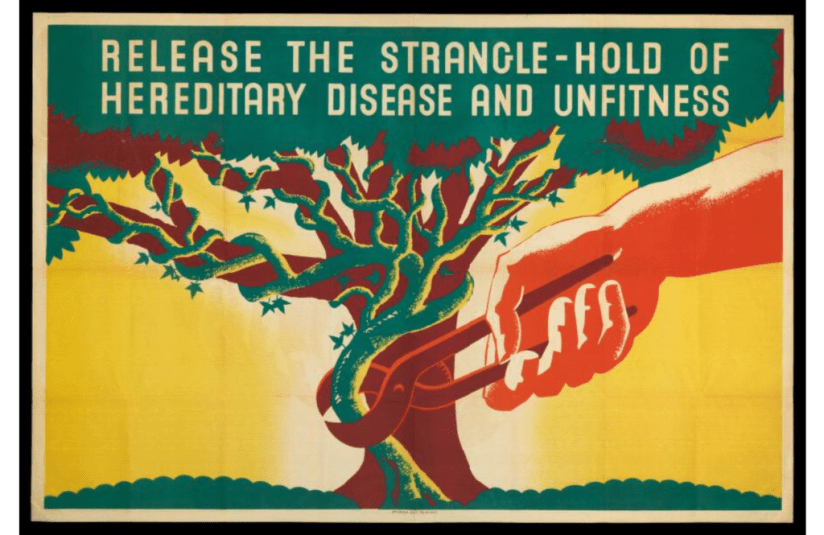
A poster published by the Eugenics Society-Galton Institute in the 1930S, from the Wellcome Library
Several top governance positions at the former British Eugenics Society, now the Galton Institute, include individuals who originally worked at The Wellcome Trust, including the Galton Institute’s president Turi King. Dr. Elena Bochukova, a current Galton Council Member and Galton lecturer, previously worked under the direction of Adrian Hill at the Wellcome Trust Center for Human Genetics. The Galton Institute’s Senior Genetics Researcher, Dr. Jess Buxton, was previously a ‘genetics researcher’ at the Wellcome Trust and then went on to carry out independent research financed by Wellcome. Her research, which is particularly race oriented, includes creating the first genetic sequence map of a native Nigerian. Moreover, Adrian Hill himself spoke at the Eugenics Society-Galton Institute at the celebration of their 100th anniversary in 2008.
The Galton Institute publishes what they now call the Galton Review, previously titled the Eugenics Review, where various members of the self-proclaimed “learned society” publish papers focused on population issues, genetics, evolutionary biology, and fertility.
A look at early issues of the Eugenics Review shines a light on Galton’s original ambitions. In the 1955 issue titled “The Immigration of Colored People,” an author asks, “What will become of our national character, good workmanship etc. in the course of a few decades if this immigration of negroes and negroids continues unchecked?” The article ends with an appeal to readers to write their parliamentary representatives and urge them that in view of “racial betterment or deterioration” something must be done urgently to “check the present influx of africans and other negroids.”
Today, it appears that the Galton Institute continues to see the immigration of racial minorities into European cities as an unchecked threat. Mike Coleman, an Oxford professor of demographics and a fellow at the institute runs an anti-immigration organization and advocacy group called MigrationWatch—whose mission is to preserve the European culture of the UK by lobbying the government to stem legal immigration and publishing data that supposedly demonstrates the biological and cultural threat of increasing immigration.
A 1961 issue of the Eugenics Review titled “The Impending Crisis” claims the function of the institute’s upcoming conference is “to honor Margaret Sanger” and describes the population crisis as “quantity threatening quality.”
Sanger, known as the “pioneer of the American birth control movement,” was a staunch advocate for promoting “racial betterment” and the key architect of the Negro Project, which she claimed “was established for the benefit of the colored people.” But as medical ethics fellow at Harvard Medical School, Harriet Washington, argues in her book Medical Apartheid, “The Negro Project sought to find the best way to reduce the black population by promoting eugenic principals.” Sanger was an American member of the British Eugenics Society.
Another early member of the Galton Institute was John Harvey Kellogg, prominent business man and eugenicist. Kellogg founded the Race Betterment Foundation and argued that immigrants and nonwhites would damage the American gene pool. Yet another example is Charles Davenport, a scientist known for his collaborative research efforts with eugenicists in Nazi Germany and his contributions to Nazi Germany’s brutal racial policies, who was vice president of the Galton Institute in 1931.
Another more recent member of the Galton Institute was David Weatherall, for whom the Weatherall Institute of Molecular Medicine at Oxford is named. Weatherall was a member of the Galton Institute when it was still named the Eugenics Society and he remained a member until his death in 2018. Weatherall, who was knighted by the British monarch in 1987 for his contributions to science, addressed the Galton Institute on numerous occasions and gave a senior lecture on genetics at the institute in 2014, of which no transcript or video is available. As an Oxford professor, Weatherall was Adrian Hill’s doctoral adviser and eventually his boss when Hill began working at the Weatherall Institute conducting immunogenic research in Africa. A key fixture of the Weatherall Institute of Molecular Medicine since its founding is Walter Bodmer, a former president of the Galton Institute.
While the Galton Institute has attempted to distance itself from its past of promoting racial eugenics with surface-level public relations efforts, it has not stopped family members of the infamous racist from achieving leadership positions at the institute. Emeritus professor of molecular genetics at the Galton Institute and one of its officers is none other than David. J Galton, whose work includes Eugenics: The Future of Human Life in the 21st Century. David Galton has written that the Human Genome Mapping Project, originally dreamt up by Galton’s former president Walter Bodmer, had “enormously increased . . . the scope for eugenics . . . because of the development of a very powerful technology for the manipulation of DNA.”
This new “wider definition of eugenics,” Galton has said, “would cover methods of regulating population numbers as well as improving genome quality by selective artificial insemination by donor, gene therapy or gene manipulation of germ-line cells.” In expanding on this new definition, Galton is neutral as to “whether some methods should be made compulsory by the state, or left entirely to the personal choice of the individual.”
Who gets the safest vaccines?
Considering the degree to which the players and institutions behind the Oxford-AstraZeneca vaccine (including the lead developer) are tied and connected to institutions that have been instrumental in the rise and perpetuation of racial eugenics, it’s concerning that this particular vaccine is being portrayed by scientists and media alike as the COVID-19 vaccine for the poor and the Global South.
The Oxford-AstraZeneca vaccine sells at a fraction of the cost of its COVID-19 vaccine competitors—running between 3 and 5 dollars per dose. Moderna and Pfizer cost 25 to 37 dollars and 20 dollars per dose, respectively. As CNN recently reported, the Oxford-AstraZeneca vaccine will “be far easier to transport and distribute in developing countries than its rivals,” several of which require complicated and costly cold supply chains. When the Thomson Reuters Foundation asked several experts which COVID-19 vaccine could “reach the poorest soonest,” all declared a preference for the Oxford-AstraZeneca candidate.
There is also the added fact that a host of safety issues have come to surround the vaccine. Recently, on November 21, a forty-year-old participant in AstraZeneca’s clinical trial who lives in India sent a legal notice to the Serum Institute of India alleging that the vaccine caused him to develop acute neuroencephalopathy, or brain damage. In the notice, the participant said he “must be compensated, in the least, for all the sufferings that he and his family have undergone and are likely to undergo in the future.”
In response, the Serum Institute claimed the participant’s medical complications are unrelated to the vaccine trial and said it would take “legal action” against the brain-damaged participant for maligning the company’s reputation, seeking damages in excess of $13 million. “This is the first time I have ever heard of a sponsor threatening a trial participant,” Amar Jesani, editor of the Indian Journal of Medical Ethics, said of the incident. The Serum Institute has received at least $18.6 million from the Bill & Melinda Gates Foundation and has a deal with AstraZeneca to manufacture a billion doses of the vaccine.
Other manufacturers chosen by Oxford-AstraZeneca to produce their vaccine are also no strangers to controversy. For instance, their manufacturing partner in China, Shenzhen Kangtai Biological Products, has been at the center of controversy for years, especially after 17 infants died from its Hepatitis B vaccine in 2013. The New York Times cited Yanzhong Huang, a senior fellow for global health at the Council on Foreign Relations, as saying: “Imagine if a similar scandal is reported again in China… It’s not just going to undermine the confidence of the company manufacturing the vaccine, it’s also going to hurt the reputation of AstraZeneca itself and their vaccine, too.”
In another example, the manufacturing partner chosen to produce the vaccine in the US is the scandal-ridden company with ties to the 2001 anthrax attacks, Emergent Biosolutions. Emergent Biosolutions, previously known as BioPort, has a long track record of knowingly selling and marketing products that were never tested for safety and efficacy, including its anthrax vaccine BioThrax and its biodefense product Trobigard. The current head of quality control for Emergent Biosolutions’ lead manufacturing facility in the US has no expertise in pharmaceutical manufacturing and is instead a former high-ranking military intelligence official who operated in Iraq, Afghanistan and beyond.
The issues raised by their decision to partner with manufacturers with dark histories of product safety issues are compounded by the adverse reactions reported in the Oxford-AstraZeneca trials as well as the ways in which those trials have been conducted. In September, AstraZeneca was forced to pause its experimental COVID-19 vaccine trial after a woman in the UK developed a “suspected serious reaction” that the New York Times reported was consistent with transverse myelitis. TM is a neurological disorder characterized by inflammation of the spinal cord, a major element of the central nervous system. It often results in weakness of the limbs, problems emptying the bladder, and paralysis. Patients can become severely disabled, and there is currently no effective cure.
Concern over an association between TM and vaccines is well established. A review of published case studies in 2009 documented thirty-seven cases of TM associated with various vaccines, including hepatitis B, measles-mumps-rubella, diphtheria, pertussis, tetanus, among others in infants, children, and adults. The researchers in Israel noted, “The associations of different vaccines with a single autoimmune phenomenon allude to the idea that a common denominator of these vaccines, such as an adjuvant, might trigger this syndrome.” Even the New York Times article on the AstraZeneca trial pause notes past “speculation” that vaccines might be able to trigger TM.
In July, an Oxford-AstraZeneca trial participant developed symptoms of TM, and the vaccine trial was paused at that time. An “independent panel” ultimately concluded the illness was unrelated to the vaccine, and the trial continued. Yet, as Nikolai Petrovsky from Flinders University told the Australian Broadcasting Corporation, these panels are typically made up of “biostatisticians and also medical representatives from the sponsor drug company running the trial.” Then, in October, a trial participant in Brazil died, though in that case, AstraZeneca suggested that the person was part of the control group and thus hadn’t received the COVID-19 vaccine.
According to Forbes, the AstraZeneca vaccine was ineffective at stopping the spread of coronavirus in their animal trials. All six monkeys injected with AstraZeneca’s COVID-19 vaccine became infected with the disease after being inoculated. All the monkeys were put to death, which means that it will remain unknown whether those monkeys would have suffered other adverse effects.
Another concern is that trial administrators gave the trial control group (for both human and animal trials) Pfizer’s Nimenrix, a meningitis vaccine, as opposed to a saline solution, which is regarded as the gold standard for controls because researchers can be sure the saline solution won’t cause any adverse reactions. Using Pfizer’s meningitis vaccine as the control placebo allows AstraZeneca to downplay any adverse reactions in its COVID-19 vaccine group by showing that the control group suffered adverse reactions as well. “The meningitis vaccine in the AstraZeneca trial is what I would call a ‘fauxcebo,’ a fake control whose real purpose is to disguise or hide injury in the vaccine group,” said Mary Holland, general counsel at Children’s Health Defense.
Eugenics under another name
Despite these safety concerns and clinical trial scandals, close to 160 countries have purchased the Oxford-AstraZeneca vaccine, and now reports are suggesting that India, the country with the second largest population on Earth, is likely to approve this vaccine by next week.
As documented here, while the vaccine may be heralded as “vital for lower-income countries,” the Oxford-AstraZeneca project is no mere philanthropic pursuit. Not only is there a significant profit motive behind the vaccine, but its lead researcher’s connection to the British Eugenics Society adds another level of warranted scrutiny.
For those encountering stories of eugenicists, it’s common to dismiss such activity as that of “conspiracy theories.” However, it’s undeniable that several prominent individuals and institutions that remain active today have clear ties to eugenicist thinking, which was not so taboo just a few decades ago. Unfortunately, this holds true for the individuals and institutions associated with the Oxford-AstraZeneca COVID vaccine, who, as demonstrated in this article, immerse themselves in studies of race science and population control – primarily in Africa while working closely with institutions that have direct and longstanding links to the worst of the Eugenics movement.
As this series has shown, there are many concerns regarding the points where race and the COVID-19 vaccination campaign in the US and abroad intersect, both publicly and privately. Part I of this series raised questions about the policy-shaping role of the Johns Hopkins Center for Health Security, which suggested that the US government make COVID-19 vaccines available to ethnic minorities and the mentally challenged first. Part II explained how in order to allocate COVID-19 vaccines in the US, health agencies are using a program created by Palantir, a company with a record of helping the US agencies target ethnic minorities through immigration policy and racist policing.
Furthermore, there are plans in place to exercise what could reasonably be described as economic coercion to pressure people to “voluntarily” get vaccinated. Such coercion will be obviously be more effective on poor and working communities, meaning communities of color will be disproportionately affected as well.
Considering these facts, and the case for scrutinizing the safety of Oxford-AstraZeneca’s “affordable” vaccine option made above, any harm caused by vaccine allocation policy in the US and beyond is likely to disproportionately affect poor communities, especially communities of color.
As such, the public should take all vaccine rollout policy with a grain of salt, even when they come cloaked in language of inclusion, racial justice, and public health preservation. As the co-founder of the American Eugenics Society (later renamed “Society for the Study of Social Biology”) Frederick Osborn put it in 1968, “Eugenic goals are most likely to be attained under a name other than eugenics.”
Featured Video

John Mearsheimer: New World Order Arrived & Europe Is Left Behind
or go to
Aletho News Archives – Video-Images
Book Review
Sunset on Net Zero: A Heretic’s Guide to the Futile CO2 Target
By Ronald Paul Barmby (Author) – October 3, 2025
SUNSET ON NET ZERO describes in detail why Net Zero CO2 is pointless and unachievable. It explains in understandable terms the up-to- date thoughts of the greatest minds of today in physics, meteorology, economics, engineering, and the geosciences.
Net Zero CO2 is pointless because we have now confirmed by satellites that 90% of CO2 warming has already happened. CO2 is not an existential threat but clouds, El-Niño, and human habitation are significant drivers of global warming that are often ignored.
Net Zero CO2 is unachievable because the green technology alternatives are unreliable and unaffordable. Wind and solar power triple electricity costs, building fully electric vehicles produces at least one-half of CO2 emissions they are meant to avoid, and heat pumps will leave you dangerously cold in the winter. Green hydrogen, air capture CO2, and carbon capture and storage are prescriptions for national bankruptcy. The supply of key metals and minerals required to achieve Net Zero need to be at least doubled—some much more—and are often controlled by a very few. Net Zero comes with huge environmental and agricultural costs.
We have been through similar climatic temperature changes before, more recently than you think. Our efforts to control it are futile.
Blog Roll
 Aletho News
- FDA Ordered to Pay Over $570,000 in Fight Over Pfizer COVID Vaccine Records
- USAID turned to Facebook to drive demand for Covid vaccines in Global South – files
- Britain’s shadow security network expands into south Lebanon
- The ADL Has a Foreign Policy, and You Are Not Supposed to See It
- Former Qatari PM says ‘Israel’ has security ties with all Gulf states
- The Sound of Silence in the Strait of Hormuz
- Poland’s call for a no-fly zone in Ukraine means NATO direct war with Russia
- John Mearsheimer: New World Order Arrived & Europe Is Left Behind
- Naqab demolition notices top 1,000; settlers demolish Jaloud homes
- Israel is Using the ‘Gaza Ceasefire’ to Commit Ethnic Cleansing
- If Americans Knew
- An error has occurred; the feed is probably down. Try again later.
- No Tricks Zone
- Physicists: Doubling CO2 Has A Smaller Impact On Ocean ‘Acidification’ Than Existing Internal Variability
- Alarmist Climatologists In Shock! 2026 Atlantic Hurricane Season Sees Lowest Count In 101 Years
- New Study: Modern Temps Are Among The Coldest Of The Last 10,000 Years In East Central Europe
- Germany’s Renewable Energies Lead to 1.4 Billion Euro Electric Power Trade Deficit
- Argentina’s Perito Moreno Glacier Joins Antarctica and Arctic In Defying Doomsday Melt Claims
- New Study: Barents Sea Temperatures Were Warmer And Sea Ice Less Extensive In The 1700s Than Today
- German Authorities Start Initiative To Evaluate Public Register For Climate “Disinformation” Spreaders!
- Zonal Asymmetry of Temperature Change in the Antarctic Circumpolar Current
- New Study: The Net Fossil Fuel Contribution To Rising Atmospheric CO2 Has Been Zero For 500 Years
- Germany’s Green Energy Transition Becoming Increasingly Expensive…Another 6 Trillion Euros!

