Israel connects BDS with terrorism while cracking down on German banks
RT | April 10, 2016
Israel’s Public Security Minister has linked the Boycott, Divestment and Sanctions (BDS) movement with terrorism and is threatening German banks using tactics previously employed against Al-Qaeda.
Netanyahu-appointee Gilad Erdan has threatened to coerce German banks to prohibit BDS activists from fundraising through their accounts, not through Israeli legislation, but the laws of other countries where Erdan has “increased awareness among decision-makers in Europe and North America of the anti-Semitic, anti-democratic, and discriminatory nature of the BDS movement, which seeks Israel’s destruction and often has ties to terror-supporting organizations.”
To bring about this “increased awareness,” a taskforce headed by Erdan was launched last year at the cost of 100 million Israeli shekels ($25.5 million) that has been successful in impacting the laws, policies, and enthusiasm for enforcement in a number of countries, particularly the US and UK, where a number of anti-BDS restrictions have employed “anti-democratic” and “discriminatory” methods to clamp down on the movement.
Erdan’s Friday statement in the Jerusalem Post urged the banks to “carefully consider the potential legal, reputational, and ethical consequences of facilitating the activities of BDS groups.”
In response, the bank’s spokesman said “We expressly point out again that Commerzbank adheres to the applicable compliance guidelines and regulations regarding the conduct of an account.”
Ironically, while Erdan is threatening BDS activists with one set of laws, the global grassroots movement is actually trying to pressure Israel to “comply with international law” through the boycott of products and companies that profit from the violation of the rights of Palestinians, particularly violent land grabs.
Inspired by the BDS movement that helped end South African apartheid, supporters of this campaign, which includes Jewish activists contrary to the accusations of anti-semitism, believe it is the only way to push for a solution to the Palestinian-Israeli conflict.
Here are the countries Erdan is counting on to be Israel’s enforcers in its global crackdown on the “terrorist” boycotters.
US
Legislation has been introduced at local, state, and federal levels targeting BDS movements.
At least 16 anti-BDS initiatives were introduced in the US in 2015, including the Trade Promotion Authority legislation that discourages European governments from taking part in BDS activities by threatening to cut off their ability to engage in free trade with the US.
Illinois passed an anti-BDS state law that created a blacklist of foreign companies from which the state pension must divest its funds. South Carolina bans state business with companies engaged in boycotts.
Other anti-BDS bills have been introduced in Congress, New York, New Jersey, and Pennsylvania. New York state currently has legislation on the table, just in time for the New York primary, that would ban state business with companies involved in boycotting Israel, including international banks.
Canada
Earlier this year, Canada passed a motion condemning “any and all attempts” to promote BDS. The country’s new leader Justin Trudeau said the movement had “no place on Canadian campuses” and fully supported Israel’s 2014 Operation Protective Edge against Gaza, despite his “liberal” outlook.
UK
The UK recently banned local authorities and public bodies from participating in BDS. This includes councils, universities, and student unions. The move was welcomed by Conservative MP Eric Pickles who said the BDS movement was an attempt “by the irresponsible left to demonize Israel.”
The UK has had its fair share of BDS victories in the past. Leicester City Council adopted the boycott policy in 2014 along with the National Union of Students the following year.
France
BDS is banned in France as part of a general law that classifies the boycott of a nation or its citizens as a hate crime. It is illegal for councils or legal bodies to boycott Israeli goods.
Last November, a small group of French activists were found guilty of provoking discrimination after holding a small rally calling for the boycott of Israeli goods. They were sentenced to pay €12,000 in damages to the plaintiffs, as well as legal fees.
Germany
While Germany doesn’t have a specific law banning the BDS movement, DAB Bank in Munich announced in February that it would cancel BDS-Kampagne’s account as of next week. DAB is owned by French BNP Paribas.
‘UK firm helps Israel kill Palestinians’
Protesters slam UK firm over profiting from Israeli war crimes
Press TV – April 9, 2016
Scores of pro-Palestinian activists in the UK have demonstrated outside the headquarters of an arms manufacturing company, accusing it of benefiting from Israel’s deadly crackdown against Palestinians.
The protesters gathered in front of the UK headquarters of aerospace manufacturer Thales, in Crawley, on Friday and expressed their anger against the company’s partnership with Israel’s Elbit Systems to develop a surveillance drone, nicknamed Watchkeeper, used by the regime against Palestinians.
The rally was held by the Sussex Stop Arming Israel campaign and was supported by other human rights groups, including the Inminds. The main messages of the protest were “Stop Arming Israel” and “Thales profits from Israeli war crimes.”
“Thales UK has a billion pound contract with Israel’s largest arms company Elbit Systems to develop a fleet of drones. Human Rights Watch has documented [the drones] as being used by Israel to deliberately target Palestinian civilians in Gaza,” said Inminds chair Abbas Ali.
“It’s sickening that Elbit markets this killer drone as being extensively ‘field tested’ in ‘real life’ situations — using the slaughter of Gaza’s people as a marketing ploy to gain a competitive advantage,” he added.
The Watchkeeper drone, which is produced through a joint venture dubbed UAV Tactical Systems, is modeled on Elbit’s Hermes 450, a UAV that has been used in action by the Israeli military. According to the Sussex group, the drone is developed under a contract awarded by the UK’s Ministry of Defense.
Thales UK is a subsidiary of the French company Thales, and is currently considered as the UK’s second largest military company.
Tel Aviv is under fire by rights groups for its indiscriminate attacks against Palestinian civilians. In one instance of Israel’s brutality, at least 2,140 Palestinians, including 557 children, lost their lives during the regime’s offensive against the Gaza Strip in the summer of 2014.
The aggression also left 11,100 Palestinians wounded, including 3,374 children and 2,088 women, and displaced over 170,000 others.
Netherlands referendum: What does the Dutch vote mean for Britain’s EU debate?
RT | April 6, 2016
Dutch citizens are taking part in a referendum on an EU-Ukraine treaty, but pundits say the vote marks an important test of public opinion on the EU. RT explains what is happening in the Netherlands and how it could affect Britain.
People of the Netherlands are being asked to decide whether to back a treaty which seeks to strengthen ties with Ukraine. That’s what the referendum is technically about, at any rate.
But pundits say the vote, which is only the third referendum in Dutch history, is really a litmus test on the EU.
What is the Netherlands’ referendum about?
Dutch voters will decide whether or not to approve a treaty between the EU and Ukraine. The agreement seeks to strengthen economic and political ties between the 28-nation bloc and Kiev.
The treaty also proposes a number of defense and security agreements.
Why is it taking place?
In September, a group of young satirists at the website GeenStijl collected over 450,000 signatures to force the Netherlands to hold a non-binding referendum concerning the EU’s planned association agreement with Kiev.
Under Dutch law, any petition that gains more than 300,000 is enough to trigger such a vote.
“Have you ever been asked what you think of such an expansion of the EU?” asked the website at the time, noting this is one of the major gripes among the Dutch population.
Is that all there is to it?
The Dutch people view the referendum as a test of public opinion on the EU, with many voters using it as a chance to protest against the bloc’s expansion and what they consider top-down decision making.
Will it impact Britain’s referendum on the EU?
UK Independence Party (UKIP) leader Nigel Farage believes the ‘Leave’ campaign will be emboldened by a Dutch rejection of the treaty.
However he also accepted a ‘Yes’ vote on Wednesday would be a blow to the Brexit campaign.
Writing in Breitbart on Tuesday, Farage said: “I have a feeling that what [GreenStijl ] have achieved in the Netherlands could serve as a useful template for even more radical change in our democracy in the not too distant future.”
Pro-Israel lobby tells Prince Charles not to visit Iran
RT | April 6, 2016
Israel lobby group We Believe in Israel (WBII) is calling on Prince Charles to reconsider an upcoming visit to Iran, which it accuses of anti-Semitism.
The grassroots pro-Israel group started an online petition in response to reports the Prince of Wales is planning to visit Iran in autumn. The trip would be the first official visit of a UK royal to the Islamic Republic in over 40 years.
The Foreign Office and Clarence House are discussing a tour with Tehran, the Sunday Times reported last month.
The visit follows an international deal struck in 2015 after years of talks, which saw Western sanctions against Iran lifted in exchange for it abandoning its nuclear ambitions.
Prince Charles’ visit would mark a significant thaw in relations, and could lead to new trade ties.
WBII however has unequivocally called on the Foreign Office and Clarence House to abandon the plans.
“We do not consider it appropriate for a member of the Royal Family to visit Iran and give credibility to the Iranian regime,” the WBII petition reads.
WBII Director Luke Akehurst said he is “disturbed” by the prospect of a royal visit to Iran, noting the regime’s alleged ties to terror groups, its senior figures’ denial of the Holocaust and calls for the destruction of Israel.
“We find the proposed visit particularly strange as there has never been an official Royal visit to Israel, the only democracy in the region,” said Akehurst, the Jewish Chronicle reports.
In 2004, Prince Charles made an unofficial visit to the city of Bam in southeastern Iran in his capacity as president of the British Red Cross after an earthquake killed 40,000 people in the region.
Queen Elizabeth II paid the last official royal visit to Iran in 1974, five years before the Islamic Revolution deposed Shah Reza Pahlavi and installed a theocratic government.
Disgraceful BBC Panorama Propaganda Hides Grim Truth About Britain
By Craig Murray | April 5, 2016
Richard Bilton of the BBC today exposed himself as the most corrupt and bankrupt of state media shills – while pretending to be fronting an expose of corruption. There could not be a more perfect example of the western state and corporate media pretending to reveal the Panama leak data while actually engaging in pure misdirection.
In a BBC Panorama documentary entitled Tax Havens of the Rich and Powerful Exposed, they actually did precisely the opposite. The BBC related at length the stories of the money laundering companies of the Icelandic PM and Putin’s alleged cellist. The impression was definitely given and reinforced that these companies were in Panama.
Richard Bilton deliberately suppressed the information that all the companies involved were in fact not Panamanian but in the corrupt British colony of the British Virgin Islands. At no stage did Bilton even mention the British Virgin Islands.
Company documents were flashed momentarily on screen, in some cases for a split second, and against deliberately unclear backgrounds. There is no chance that 99.9% of viewers would notice they referred to British Virgin Islands companies. But instantly reading a glimpsed document is an essential skill for a career diplomat, and of course I happen to know immediately what BVI or Tortola mean on a document. So I have been back and got screenshots of those brief flashes.
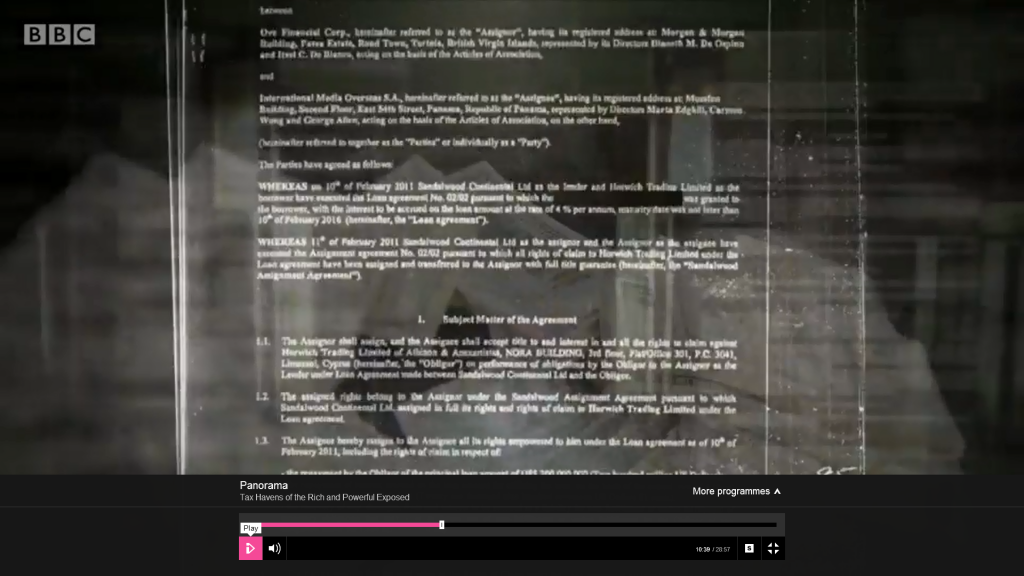

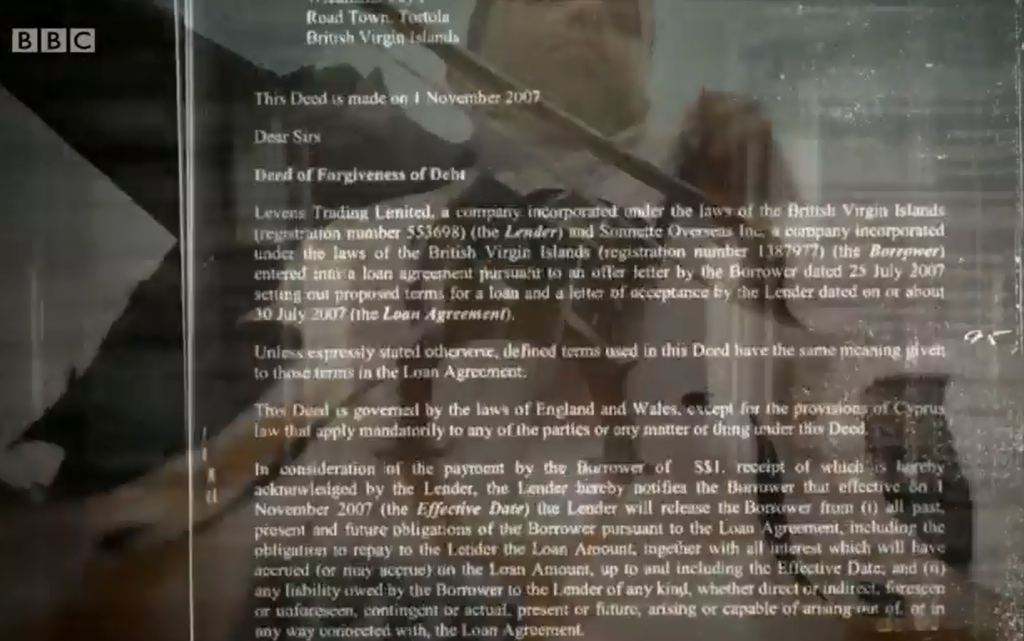
Is it not truly, truly, astonishing the British Virgin Islands were not even mentioned when the BBC broadcast their “investigation” of these documents?
In deliberately obscuring the key role of the British money-laundering base of British Virgin Islands in these transactions, the BBC have demonstrated precisely why the entire database has to be released to the scrutiny of the people, rather than being filtered by the dubious honesty of state and corporate journalists. The BBC targeting of two very low level British minions at the end of their programme does not alter this.
The BBC could also address why their Pacific Quay HQ in Glasgow is leased for £100 million from a hidden ownership company in the Cayman Islands.
Jeremy Corbyn Calls on British PM to Tackle Tax Avoidance
teleSUR – April 5, 2016
Labour Party leader Jeremy Corbyn slammed David Cameron on the tax avoidance scandal saying the “unfairness and abuse must stop.”
The leader of Britain’s main opposition party called on the government Tuesday to tackle tax havens, saying it was high time British Prime Minister David Cameron stopped allowing “the super rich elite [to] dodge their taxes.”
“There cannot be one set of tax rules for the wealthy elite and another for the rest of us,” Labour Party leader Jeremy Corbyn said at the launch of the party’s campaign for local elections next month.
“The unfairness and abuse must stop… I say this to the government and to the chancellor, no more lip service, the richest must pay their way.”
After leaked documents from a Panamanian law firm revealed how the world’s powerful use secretive offshore company structures to stash their wealth, Cameron has come under pressure to clamp down on tax evasion in British-linked territories after the “Panama Papers” implicated his father, Ian Cameron, in running an offshore tax-evasion fund.
British collusion with sectarian violence: Part one
By Dan Glazebrook | RT | April 3, 2016
In the first of a four-part series, Dan Glazebrook and Sukant Chandan look at the recent spate of revelations about the involvement of British security services in facilitating the flow of fighters into Syria.
Over 13 years ago, in March 2003, Britain and the US led an illegal and unprovoked war of aggression against Iraq, a fellow UN member state. Such a war is deemed to be, in the judgment of the Nuremberg trials that followed World War Two, “not only an international crime” but “the supreme international crime differing only from other war crimes in that it contains within itself the accumulated evil of the whole.”
The mainstream narrative surrounding this war, and the endless catastrophes it bequeathed to Iraq, is that it was the result of a series of unfortunate ‘intelligence failures’: the British government had been led to believe that Iraq posed what Tony Blair called a “clear and present danger” to international security by intelligence that subsequently turned out to be false.
Blair told us that the Iraqi government had an active nuclear weapons program, had acquired uranium from Niger, had mobile chemical weapons factories that could evade UN weapons inspectors, and had stocks of chemical weapons able to hit British troops in Cyprus within 45 minutes.
All of these claims were false, and all were blamed on ‘intelligence failings’, creating an image of an intelligence service totally incapable of distinguishing between credible information and the deluding ravings of crackpots and fantasists, such as the notorious Curveball, the source of many of the various made-up claims later repeated in such grave and reverent tones by the likes of Tony Blair and Colin Powell.
In fact, we now know that sources such as Curveball had already been written off as delusional, compulsive liars by multiple intelligence agencies long before Blair and co got their hands on their outpourings – and the British government was fully aware of this.
The truth is, there were no intelligence failings over the Iraq war. In fact, the intelligence services had been carrying out their job perfectly: on the one hand, making correct assessments of unreliable information, and on the other, providing the government with everything necessary to facilitate its war of aggression. The Iraq war, then, represented a supreme example not of intelligence failure, but intelligence success.
Fast forward to today, and we are again hearing talk of ‘intelligence failings’ and the supposed incompetence of the security services to explain a debilitating Western-sponsored war in the Middle East: this time in Syria.
Earlier this year, British Foreign Minister Philip Hammond admitted that 800 British citizens had gone to join the anti-government terrorist movement in Syria, with at least 50 known to have been killed fighting for Al-Qaeda or Islamic State (IS, formerly ISIS/ISIL). The British security and intelligence community, we are to believe, were simply unable to stop them.
Opportunist political opponents blame such shocking statistics on incompetence, while the government and its supporters increasingly weave them into an argument for greater powers and resources for the security services. Both are wrong; and a closer look at some of these so-called ‘intelligence failings’ makes this very clear.
In December 2013, it emerged that MI5 had tried to recruit Michael Adebolajo, one of the killers of Fusilier Lee Rigby, just a few weeks before Rigby’s murder. Adebalajo had been on the radar of both MI5 and MI6 for over 10 years. He had been under surveillance in no less than five separate MI5 investigations, including one set up specifically to watch him. He was known to have been in contact with the senior leadership of Al-Qaeda in the Arab Peninsula, based in Yemen, and he had been arrested in Kenya on a speedboat on the way to Somalia with five other youths, where he was suspected of hoping to join Al Shabaab.
The Kenyans were furious when they handed him over to the Brits only for him to be turned loose, presumably to continue with his recruitment activities.
The following month, 17-year-old Aseel Muthana left his family home in Cardiff to join rebel fighters in Syria. His brother Nasser had left three months earlier, and his family were worried that Aseel would try to join him. So they confiscated his passport, and informed the police of their concerns. The police kept the family under close scrutiny. They even arrived at his house at 5pm the day he left for Syria, to be told he hadn’t been seen since the night before. He boarded a flight at 8.35pm that night, using alternative travel documents issued by the Foreign Office. His family were horrified that he had been allowed to travel, without a passport, despite all their warnings.
A similar case occurred in June 2015, when three sisters from Bradford traveled to Syria – it is thought to join IS – taking their nine young children with them. Again, the family had been under intense scrutiny from the police ever since their brother went to join IS in Syria earlier that year. And far from being unaware of the risk of their being recruited, counter-terrorist police were, it appears, deeply complicit in their recruitment.
A letter from the family’s lawyers said they were “alarmed” by the police allegedly having been actively promoting and encouraging contact with the brother believed to be fighting in Syria: “It would appear that there has been a reckless disregard as to the consequences of any such contact [with] the families of those whom we represent,” the lawyers said, and continued: “Plainly, by the NECTU [North East Counter Terrorism Unit] allowing this contact they have been complicit in the grooming and radicalizing of the women.”
October 2014 saw the trial of Moazzam Begg, for various terrorism-related offences. Begg had admitted to training British recruits in Syria – but in his defense, he made the incendiary claim that MI5 had explicitly given him the green light for his frequent visits in a meeting they had arranged with him. MI5 admitted it was true, and the trial collapsed.
Six months later, BBC Radio 4 broadcast an interview with Aimen Dean, a founding member of Al-Qaeda who was subsequently recruited by MI6 as a spy. Part of his work for MI6, he said, involved encouraging young impressionable Muslims to go and join the ranks of Al-Qaeda.
Then in June 2015, Abu Muntasir, known as the godfather of British jihadists, thought to have recruited “thousands” of British Muslims to fight in Afghanistan, Kashmir, Burma, Bosnia and Chechnya, gave an interview to the Guardian, repenting his actions. He explained that he came back from fighting in Afghanistan to “create the link and clear the paths. I came back [from war] and opened the door and the trickle turned to a flood. I inspired and recruited, I raised funds and bought weapons, not just a one-off but for 15 to 20 years. Why I have never been arrested I don’t know.”
That same month, a second trial collapsed, for much the same reasons as Begg’s. Bherlin Gildo was arrested in October 2014 on his way from Copenhagen to Manila. He was accused of attending a terrorist training camp and receiving weapons training as well as possessing information likely to be useful to a terrorist. The Guardian reported that the prosecution “collapsed at the Old Bailey after it became clear Britain’s security and intelligence agencies would have been deeply embarrassed had a trial gone ahead.”
In January 2016, it was revealed that Siddhartha Dhar traveled to Syria in September 2014 while on police bail for terrorism offences – the sixth time he had been arrested for terror-related offences, and not long after MI5 had reportedly tried to recruit him. Police had demanded he hand in his passport, but did not follow it up; this was despite the fact that he had revealed – live on BBC morning television no less – that he would “love to live in the Islamic State.” He later posted pictures of himself posing with guns in Raqqa, and is suspected of being the so-called ‘new Jihadi John’, appearing in an IS video executing suspected spies. The original ‘Jihadi John’ – British-Kuwaiti Mohammed Emwazi – had also been well known to the British security services, having – just as Adebolajo and Dhar – apparently been offered a job by MI5.
Is this all just a ‘catalogue of blunders’, more ‘intelligence failings’ on a massive scale?
These cases demonstrate a couple of irrefutable points. Firstly, the claim that the security services would have needed more power and resources to have prevented the absconding is clearly not true.
Since 1995, the Home Office has operated what it calls a ‘Warnings Index’: a list of people ‘of interest’ to any branch of government, who will then be ‘flagged up’ should they attempt to leave the country. Given that every single one of these cases was well known to the authorities, the Home Office had, for whatever reason, decided either not to put them on the Warnings Index, or to ignore their attempts to leave the country when they were duly flagged up. That is, the government decided not to use the powers already at its disposal to prevent those at the most extreme risk of joining the Syrian insurgency from doing so.
Secondly, these cases show that British intelligence and security clearly prioritize recruitment of violent so-called Islamists over disruption of their activities. The question is – what exactly are they recruiting them for?
At his trial, Bherlin Gildo’s lawyers provided detailed evidence that the British government itself had been arming and training the very groups that Gildo was being prosecuted for supporting. Indeed, Britain has been one of the most active and vocal supporters of the anti-government insurgency in Syria since its inception, support which continued undiminished even after the sectarian leadership and direction of the insurgency was privately admitted by Western intelligence agencies in 2012. Even today, with IS clearly the main beneficiaries of the country’s destabilization, and Al-Qaeda increasingly hegemonic over the other anti-government forces, David Cameron continues to openly ally himself with the insurgency.
Is it really such a far-fetched idea that the British state, openly supporting a sectarian war against the Ba’athist government in Syria, might also be willfully facilitating the flow of British fighters to join this war? Britain’s history of collusion with sectarian paramilitaries as a tool of foreign policy certainly suggests this may be so. This history, in Ireland, Afghanistan and the Arab peninsula, and its role in shaping British policy today, will be the subject of the articles to follow.
Dan Glazebrook is a freelance political writer who has written for RT, Counterpunch, Z magazine, the Morning Star, the Guardian, the New Statesman, the Independent and Middle East Eye, amongst others. His first book “Divide and Ruin: The West’s Imperial Strategy in an Age of Crisis” was published by Liberation Media in October 2013. It featured a collection of articles written from 2009 onwards examining the links between economic collapse, the rise of the BRICS, war on Libya and Syria and ‘austerity’. He is currently researching a book on US-British use of sectarian death squads against independent states and movements from Northern Ireland and Central America in the 1970s and 80s to the Middle East and Africa today.
UK activist probed over remarks on Daesh, Israel links

Labour activist Bob Campbell
Press TV – April 4, 2016
A member of Britain’s Labour Party has reportedly invited an investigation after an Internet post declaring that the Takfiri terrorist group of Daesh is controlled by Israel.
Writing on his Facebook page, Labour activist Bob Campbell has suggested that Tel Aviv had the terror group attack the countries, which had thrown various forms of support behind Palestinians, namely France, Japan, Indonesia, and Belgium.
“How many more attacks have to take place before the world fully understands that ISIS is run by Israel?” he finally asked, referring to the Takfiri group by another acronym.
Labour lawmaker Tom Blenkinsop, who represents Middlesborough, where Campbell lives, has reportedly ordered an investigation into the comments and suspended the activist pending the probe.
In remarks to The Independent, however, Campbell, himself, has denied being suspended from the party.
After writing the status on Facebook, he created another post saying Daesh has not attacked Israel “because the dog doesn’t bite its own tail.” Previously, he had also posted pictures comparing the Holocaust to the situation in the Tel Aviv-blockaded Gaza Strip, captioned “Holocaust the sequel… Please stop Israel,” and posted pictures depicting Israeli Prime Minister Benjamin Netanyahu being hung from a tree and an Israeli flag adapted with an image of a rat featuring the words, “The real plague.”

A facebook post by Bob Campbell, a member of Britain’s Labour Party, featuring an Israeli flag with an image of a rat and the words, “The real plague.”
Campbell, however, has also distanced himself from anti-Semitism and qualified the posts as “anti-Zionist” rather than anti-Semitic. “I post lots of pro-Jewish posts but I [also] post anti-Zionist posts.”
Members of party have in the past enraged Israel by making various anti-Tel Aviv remarks.
As Saudi and Allies Bombard Yemen US Clocks up $33 Billion Arms Sales in Eleven Months
By Felicity Arbuthnot | Dissident Voice | April 1, 2016
Sometimes even to the most towering cynic, American hypocrisy is more than breathtaking.
As they lambast their latest “despot”, Syria’s President al-Assad — a man so popular in his country and the region that the US Embassy in Damascu had, by the end of 2006, devised a plan to oust him — arms sales to countries where human rights are not even a glimmer on the horizon have for the US (and UK) become an eye watering bonanza.
The latest jaw dropper, as Saudi Arabia continues to bombard Yemen with US and UK armaments dropped by US and UK-made aircraft, is sales worth $33 Billion in just eleven months to the Gulf Cooperation Council (GCC) according to Defense News.
The GCC, a political and economic alliance of six Middle East countries, comprises of Saudi Arabia, Kuwait, the United Arab Emirates, Qatar, Bahrain and Oman. It was established in the Saudi Capital, Riyadh, in May 1981.
Weapons sold to the alliance since May 2015 have included: “… ballistic missile defense capabilities, attack helicopters, advanced frigates and anti-armor missiles, according to David McKeeby, a spokesman for the State Department’s Bureau of Political-Military Affairs.”
“In addition, the U.S. government and industry also delivered 4,500 precision-guided munitions to the GCC countries in 2015, including 1,500 taken directly from U.S. military stocks – a significant action given our military’s own needs,” he added, stressing: “that the US government would like to continue to strengthen partnerships with Kuwait and Qatar through defense sales and other security cooperation activities.”
A metaphor for our times that “partnerships” are “strengthened” with lethal weapons, not in trade of goods, foods, medical, educational or intellectual exchanges.
A fly or two in the oil of the wheels of the US arms trade is the two year delay in approval of sales 40 F/A-18 Super Hornets to Kuwait and Qatar and also 72 F-15 Silent Eagles to Qatar.
Suspicion has been voiced that this has something to do with a pending US-Israel military financing deal, a suggestion emphatically denied by Washington.
In the meantime as Yemen continues to be blitzed, with the UN stating that eighty percent of the population are in need of humanitarian assistance, 2-4 million are displaced and approaching four thousand dead.
It seems Saudi and its allies have more than enough ordinance to continue the slaughter and more than enough US and UK military advisors to help them in the decimation.
Felicity Arbuthnot is a journalist with special knowledge of Iraq. Author, with Nikki van der Gaag, of Baghdad in the Great City series for World Almanac books, she has also been Senior Researcher for two Award winning documentaries on Iraq, John Pilger’s Paying the Price: Killing the Children of Iraq and Denis Halliday Returns for RTE (Ireland.)
Featured Video

The American Retreat from Vietnam
or go to
Aletho News Archives – Video-Images
From the Archives
Secret document reveals plans for civil war in Lebanon, Israeli false flags, and invasion
By Randi Nord | Geopolitics Alert | April 5, 2019
Beirut – During his visit with US Secretary of State, Mike Pompeo, Lebanese President Michael Aoun reportedly received a US-Israeli document detailing plans for creating a civil war in Lebanon with covert false flag operations and possible Israeli invasion.
Although the source of the document is Israeli and created in partnership with Washington, no one knows who presented it to Aoun. The Lebanese TV station, Al-Jadeed, initially reported the document on Lebanese TV and a video on its website. Geopolitics Alert translated the report for this article. … continue
Blog Roll
 Aletho News
- ‘Distance yourselves from Israel’: IRGC urges US population to question govt policies
- America’s Greenland deal has a radioactive backstory
- The RAF Fairford ‘terror plot’: Unpacking escalation in the UK echo-chamber
- EU Council Advances Chat Control 2.0 Scanning Proposal
- Ex-Greek MEP files complaint against Israeli spyware firm over alleged Pegasus surveillance
- Troubling ideas throughout the Torah, Talmud, Mishneh Torah and Tanya
- ‘Grave, alarming’: Iran mission on Trump’s UNGA ‘annihilation’ threats
- Najaf airport to reopen to Iranian flights within 24 hours: Ambassador
- From ‘How Will This End For Iran’ to ‘When America Walks Away’: A tale of two Economist covers
- Tehran blasts ‘baseless’ speculation linking Iran to alleged bomb plot at UK air base
- If Americans Knew
- Israel Has Kidnapped Another American Teenager
- US arms sales to Israel worth $21.6 billion in 20 months
- Three Palestinians Killed in Israeli Attacks on Gaza
- Revealed: German “Anti-Semitism Expert” Driving Crackdown on Palestine Solidarity is Former Israeli Spy
- Egypt’s Warning to Israel Before Oct 7
- Israel’s siege signals another cruel winter for 1.8 million Gazans – Daily Update
- Netanyahu Asked UAE Leader to Deny Report on Oct. 7 Warning in Secret Visit, Sources Say
- CNN Chief Int’l Correspondent Clarissa Ward on Journalists in Gaza
- Democratic Party Consultants Surround Troy Jackson with Pro-Israel Donors
- Christian Leader Responds To Netanyahu’s Claims Regarding Palestinian Christians
- No Tricks Zone
- New Study: Earth And Venus Surface Warmth Largely Explained By Convection And Lapse Rate, Not CO2 Or Radiation
- 2025 Nature Paper Claiming Worsening Global Drought Gets RETRACTED …Heavily Flawed
- New Study: ‘Global Drought Shows No Detectable Recent Acceleration Under Climate Warming’
- Economic Masterminds: German Socialists Suggest Taxing Productivity Gains Stemming From Using AI
- The South China Sea Has Not Been Cooperating With The Climate Change Narrative
- Energy Crisis: Germany Enters Heating Season With Historically Low Gas Reserve Fill Levels
- New Study: The Antarctic Ice Sheet Gained Mass From 2020-2024 Due To Staggering Snow And Ice Accumulation
- Study: Ocean Heating Rates From Thousands Of Years Ago ‘Dwarf’ Modern Ocean Heating Rates
- Climate Extremists Target, Attack Large-Scale Power Grid Infrastructure In Germany!
- New Study: Antarctic Ice Melt Has Contributed Less Than 1 Centimeter To Sea Level Rise In The Last 30 Years

