Russia Checks Western Lies on Syria
By Finian Cunningham | Sputnik | September 25, 2015
You have to hand it to Russia. In recent weeks, one move after another by Moscow over the Syrian crisis could be accompanied by the audible word “check”, leaving Washington and its minions grappling with disorientation about how to respond to the Russian moves.
At the heart of the West’s disorientation what is being exposed is its glaring criminal deceptions over Syria.
This week, Russian foreign ministry spokeswoman Maria Zahkarova probed the Western rationale towards Syria with this incisive proposition.
She said that if Washington insists that Syrian President Bashar al-Assad should stand down, then the United States government should henceforth remove its signature from the 2012 Geneva Communiqué. The same logical ultimatum applies to Britain and France.
That communiqué, signed three years ago by international governments, as well as the United Nations, European Union and Arab League, clearly states that “the political future of Syria must be determined by the Syrian people themselves”.
The binding document had followed lengthy negotiations between Russia, China and the Western powers, and it was signed in Geneva in the summer of 2012 under the auspices of then UN Secretary General Kofi Annan. Hillary Clinton was the US Secretary of State at the time.
Nowhere in the Geneva accord is it mentioned that Syria’s Assad should relinquish power.
It merely endorses a political process of dialogue among Syrian parties, the outcome of which is to be mandated by the Syrian people. In fact, two years after the communiqué was signed the Syrian people voted by a huge majority to re-elect Assad as the country’s leader.
Yet Western powers continue to assert that Assad “has to go”.
Germany’s Chancellor Angela Merkel this week appeared to break the Western ranks when she said that Bashar al-Assad must be part of the political negotiations to solve the Syrian conflict.
Nevertheless, Washington, Britain and France remain implacable in their insistence that the Syrian president has to stand down. In other words, these Western powers are unilaterally demanding regime change in spite of the fact that they signed up to the Geneva Communiqué, which makes no such stipulation. With typical unreasonable arrogance, Washington and its allies appoint themselves to over-ride the sovereign right of the Syrian nation.
Last week, while in London, Clinton’s successor John Kerry repeated the American demand that “Assad must go”. Speaking alongside his British counterpart Philip Hammond, Kerry said he was open to talks with Russia on the Syrian crisis, but that the bottom-line for Washington and London was that the Syrian leader had to vacate office.
“We’re prepared to negotiate. Is Assad prepared to negotiate, really negotiate? Is Russia prepared to bring him to the table?” said Kerry.
The New York Times elucidated further Washington’s intentions. It reported: “[American] officials indicated that the larger goal was to draw the Russians into a political process that would ultimately replace Syria’s government of President Bashar al-Assad, a longtime ally of the Kremlin.”
Maria Zakharova, the Russian foreign ministry spokesman, has subsequently nailed that Western lie on Syria. If Washington insists on Assad’s removal, then the US government should repudiate the Geneva Communiqué. “Otherwise,” said Zakharova, “the US is deceiving everybody.” Check!
This follows the move earlier this month when Russia placed its support full square behind the Assad government. Moscow has delivered military aid to Damascus in line with legal bilateral agreements.
Russian President Vladimir Putin explained that the Syrian government is the primary offensive force against the terrorist networks tearing Syria apart.
Therefore, if Washington and its Western allies claim to be fighting against terrorism in Syria, then they should have no objection to Russia’s support for the government in Damascus. Check!
Again, the Russian move deftly exposes another Western deception.
Since Moscow beefed up its military support for Syria, Washington, London and Paris have been reeling from their own contradictions. The West says it is alarmed that Moscow is “shoring up the Assad regime”.
But if these powers were genuinely in the business of “degrading and defeating” the so-called Islamic State and other jihadist terror groups, then why should they be alarmed by Russia supporting the principal force – the Syrian government – in the battle against the terrorists?
Russian Foreign Minister Sergei Lavrov pointed out that the West’s logic is “upside-down”. He has also commented that the West’s “anti-terror” coalition bombing Syria and Iraq does not appear to be genuine in its ostensible aims. After a year of US-led air strikes on Syria and Iraq, the terror groups seem to be stronger than ever.
Clearly, the West’s “anti-terror” strategy is ineffective, suggesting that the real aim of the West is to further weaken the Syrian state.
Scrabbling around to find some cover for its naked upside-down logic, Washington, London and Paris are now saying that they fear that Russia’s military intervention in Syria “may lead to an escalation of the conflict” or to a clash with the US-led coalition.
John Kerry and his Western counterparts have even resorted to this oxymoron. Kerry said the “root cause” of the refugee crisis assailing Europe is the “conflict in Syria” and that is, in his view, further “rationale” for the removal of President Assad. How convoluted can you get?
The four-year-old conflict in Syria is so obviously the driver for millions of Syrian refugees. But the “root cause” that Kerry so deceptively misplaces is the criminal covert war of regime change that Washington has launched on that country, along with the collusion of Britain, France, Turkey and the Gulf Arab dictatorships of Saudi Arabia and Qatar.
That US-led regime-change war has involved unleashing thousands of terrorist mercenaries on Syria. It’s a well-worn American strategy played time and again in different parts of world down through the decades. Ukraine and Yemen are two other current case studies of Washington’s covert state-sponsored terrorism. Fiendishly, Western propaganda in the form of “Western news journalism” helps to mask what should be transparent criminality committed by Washington and its so-called allies and clients.
Deciphering the West’s lies and deceptions is not always an easy task.
But thanks to Russia’s logical policy, the West’s lies in Syria are at last being nailed. We might even say “Checkmated!”
How the anti-war movement can stop the UK government bombing Syria
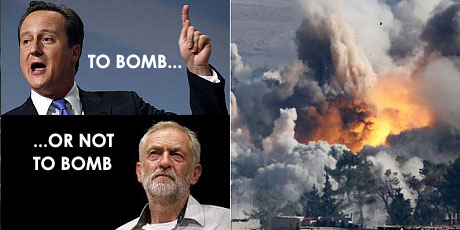
The stakes are high, but with enough pressure from below, David Cameron’s plan to bomb Syria can be defeated.
By Chris Nineham | Stop the War Coalition | September 24, 2015
WE HAVE the biggest opportunity since the start of the Iraq war to make a real change in foreign policy. The aggressive, interventionist policy that has done so much damage is now at the heart of a great contest in British society.
Jeremy Corbyn is facing a massive onslaught from all sections of the establishment. No one can envy him this experience, and the prime question is how we defend him from these attacks and build support for the policies that got him elected as Labour party leader with such a huge majority.
When the right wing is this hysterical, the establishment this panicked, and the media this vitriolic, you know there is just a chance something good might be in reach.
In the next few weeks and months there are going to be a series of stand-offs around foreign policy issues, including almost certainly a vote in parliament on bombing Syria, the outcome of the Iraq war inquiry report, and of course the madness of renewing Trident.
Few mainstream commentators have the wherewithal to understand Corbyn’s victory. They first speculated about left-wing entryism, then they focussed on his ‘style’, now they’ve decided to ignore the scale of his mandate.
Of course Jeremy is different, he wears jumpers and shockingly he tends to say what he thinks. But whatever the media would like to think, his success is not about the way he does what he does, it is about the issues he has brought to the forefront of British politics.
The real nightmare for the establishment is that millions of people agree with him about austerity, about war, and about the shocking state of official politics.
What alarms the mainstream is the energy and enthusiasm generated by his campaign to become leader of the Labour party, much of it due to the protest movements that he has supported so tirelessly over decades, including crucially the anti-war movement.
A return to protest
But if the Corbyn surge was powered partly at least by the movements, we have to make sure that what he has achieved in turn reinvigorates protest.
We know that Corbyn can’t do it alone. And we know too that there are a lot of people around him who — to put it politely — don’t agree with him. Within days of his leadership victory, there were very public briefings against him by a serving UK army general, two of his cabinet ‘colleagues’, including the shadow foreign secretary Hilary Benn, and Sadiq Khan, Labour’s newly selected candidate for London mayor.
Quite simply, Jeremy Corbyn is going to need all the help he can get.
It is clear also, that despite the disasters of the last fourteen years, the British political establishment is desperate to maintain its role as chief cheerleader for US military interventionism. And having scented rebellion against Corbyn among Labour MPs, they have a new confidence about winning a vote to bomb Syria, and at the same time damaging the party’s anti-war leader.
A plan of action: stopping the bombing of Syria
The main task must be to extend the enthusiasm and energy generated by his campaigning over the past months into every local community, workplace and college.
The more people are actively engaged in the campaign to stop the drive to war in Syria, and in the anti-austerity movement, the more we will be defending Jeremy Corbyn under such relentless attack.
How can we do this?
For the anti-war movement, we need to get onto the streets in every area and onto campuses with leaflets, petitions, posters, badges, etc, drawing people into an ever-widening network of activists for peace.
We need to re-invigorate local anti-war groups and start new groups where none exist. While organising locally, the untimate focus will be on parliament and the need to break the consensus that always takes Britain into disastrous wars on the coat tails of the United States.
In 2013, mass pressure on MPs, coupled with the memory of Tony Blair’s catastrophic war on Iraq, delivered an unprecedented defeat for the government, as David Cameron tried to bounce parliament into supporting the bombing of Syria’s Assad regime.
Now Cameron hope that by switching the target to ISIS, he can reverse that defeat and take the UK into yet another pointless war that will serve no purpose, other than to create more death and chaos, and drive more refugees to flee the war zone.
We need to implement immediately a comprehensive lobbying of MPs:
- Use the online lobby tool to contact MPs
- Send letters to MPs’ constituency offices
- Get letters in local newspapers
- Organise group visits to MPs’ regular surgeries to deliver petitions collected locally
There needs to be a particular focus on MPs who have vowed publicly to defy Jeremy Corbyn, so they understand the scale of the opposition to waging war in Syria.
War and the refugee crisis
The links between the refugee crisis and the wars our government so enthusiastically backs need to be underlined continually in our campaigning.
It is scandalous that David Cameron thinks promising to take twenty thousand refugees over five years is an adequate response to the migration or 60 million people fleeing war, conflict and poverty.
It is also outrageous that he wants to respond to people fleeing war-torn countries by intensifying the bombing of Syria — one of the main causes of the crisis.
The most effective thing that the West could do to end this misery is to de-escalate, stop arming regional dictators and aggressors and encourage a negotiated settlement in Syria. We need to develop and promote these arguments everywhere.
Isis is clearly a horrible organisation whose presence makes our arguments harder. We have to tackle the debate head on by having the most high profile possible public meetings and forums we can in each area.
A plan of action: the anti-austerity movement
Stop the War has always contrasted the vast government expenditure on the military and weapons of mass destruction, and the draconian austerity cuts to public and welfare services. Billions are spent on the UK war machine at the same time that brutal cuts in benefits are driving some desperate victims to suicide.
The protests at the Conservative Party conference from 3 October will help shape the political landscape over the next months. Tens of thousands will be protesting there, not just on the opening day – 4 October – but for the whole week. The anti-war message needs to be heard loud and clear by the movement, by the media and by the politicians.
Time is tight — the flashpoints are imminent, and we need to act now.
Within a few days of Jeremy Corbyn becoming Labour leader over 120 new members joined Stop the War Coalition, an indication that the movements that underpinned his victory are recognised as central to defending him.
The stakes are high. With enough pressure from below, David Cameron’s government’s plan to bomb Syria can be defeated for a second time, which would be a long term humiliation for the warmongers.
We also need a big campaign and protest over the scandalous delay in publishing the Iraq war inquiry report, blocked it appears by those — like Tony Blair and Jack Straw — likely to be criticised by Chilcot. With Jeremy Corbyn declaring that Tony Blair should be held to account for alleged war crimes, there is a real prospect that Blair could be driven out of public life once and for all.
Next year parliament will vote on the renewal of Trident nuclear weapons system, at a projected cost of over £100billion. The Campaign for Nuclear disarmament is already mounting a concerted campaign to get MPs to vote against. A huge protest movement before parliament votes will intensify that pressure.
The moment a vote on bombing Syria is announced, Stop the War will call a protest, but the success, the scale, and the impact of that protest depends on what we all do in the next few weeks. Its up to us.
Syria drone strikes: ‘Pre-authorized targeted killings’ face legal challenge
RT | September 24, 2015
Legal action will be brought against Prime Minister David Cameron after he revealed an RAF drone was used to kill two British militants fighting for Islamic State (IS, formerly ISIS/ISIL) in Syria. The attack went ahead despite parliament voting against strikes in 2013.
The Prime Minister disclosed the nature of the strikes in September, claiming they had been carried out as an “act of self-defense” and that he had sought parliament’s permission to kill the militants.
Reyaad Khan and Rahul Amin both died, along with another jihadist, who was not of British origin.
Now Green Party MP Caroline Lucas and Baroness Jones are working with human rights charity Reprieve to make the first steps toward a judicial review.
A pre-action letter to the Attorney General and the Defense Secretary states the government failed to publish its “targeted killing policy” which is in breach of international law.
“The Raqqa strike, and the intention of the government to pre-authorize targeted killings in the future in countries where the UK is not at war, is of concern to the claimants and many others,” they wrote.
“The concern is heightened by the lack of clarity about the circumstances in which the government reserves the right to kill British citizens outside of an armed conflict.”
The letter claims the way the government rationalized the attack has raised further questions about the legality of its military operations overseas.
It says the government claims the attack was justified due to “potential,” “direct,” “likely” or “imminent” threats to the UK.
“Such a lack of clarity as to the test which is being applied by the government in deciding whether to pre-authorize the targeted killing of British nationals or individuals overseas raises real and serious concerns over the lawfulness of the government’s past and expected resort to the use of lethal force,” it says.
“It is unclear what, if any, policies, procedures and/or safeguards are in place to ensure that this ‘new departure’ is only exercised in accordance with domestic and international law.”
The UK is currently taking part in US-led coalition airstrikes in Iraq against IS, but not in Syria.
However, the killing of Khan was justified, Cameron said, because he had been plotting “barbaric” attacks in Britain.
Cameron is expected to stage a second vote in the House of Commons to approve further action in the country, but will not do so until he is sure of victory after his embarrassing 2013 defeat.
Parents of Saudi juvenile set for ‘crucifixion’ plead for mercy, amid UK and US silence
Reprieve | September 24, 2015
The family of a juvenile sentenced to ‘crucifixion’ in Saudi Arabia have appealed to the Saudi authorities to spare him, as pressure mounts on the US and the UK to intervene.
Speaking to AFP, Mohamed al-Nimr said he hoped the King would save his son, student Ali al-Nimr, who was 17 when he was arrested in 2012 in the wake of protests in the Eastern Province. Ali was tortured into signing a false ‘confession’, which was then used to convict him, and it emerged last week that the unusually harsh sentence had recently been upheld without Ali’s knowledge. With legal avenues now exhausted, Ali could be executed at any moment, with no prior notification of his family. Mr al-Nimr said “we hope that the king will not sign” the execution order for his son.
The appeal comes as the UK and the US – strong allies of the Saudi government – faced questions on their failure to speak out about the case. Questioned yesterday by AP, US State Department spokesman Mark C Toner refused to say he’d welcome a commutation of the sentence, saying that he was “not aware of the case.”
The UK government has so far limited itself to a brief statement last week that “We continue to raise our human rights concerns with the Saudi authorities, including their use of the death penalty.” The Ministry of Justice has also faced criticism after it indicated that it would continue with an ongoing bid to provide prison services to the Saudi government.
In contrast, the French government yesterday joined UN experts in calling for the death sentence to be commuted, because Ali was a juvenile at the time of his arrest. The French Foreign Ministry said it was “concerned by the situation of Ali Mohammed al-Nimr, who was sentenced to death even though he was a minor at the time of the events […] We call for the execution to be called off.” The group of independent United Nations human rights experts on Tuesday asked the Saudi authorities “to immediately halt the scheduled execution”, and to ensure a “fair retrial” of Ali.
Commenting, Maya Foa, director of Reprieve’s death penalty team, said: “Saudi Arabia’s plans to behead and crucify Ali al-Nimr, a juvenile, for attending a protest are an outrage – the French government and UN experts are right to be calling for it to be cancelled. It’s deeply troubling that the UK and the US – both close allies of the Saudi government – are staying silent. The international community must stand firm against this utterly unjustified sentence, and call on the Saudi authorities to change course.”
Who’s watching the watchdog?: Ofcom & the manufacture of consent
By Afshin Rattansi | RT | September 21, 2015
It will come as no surprise to anyone that a watchdog set up to hound mainstream UK broadcast media finds RT’s output difficult to deal with. Doubtless today’s Ofcom rulings will see other media outlets relishing RT being brought to heel.
But anyone who takes the trouble to look at the detail will see such outlets are on very flimsy ground.
Not only does Ofcom concede that RT has a mission to bring valuable diversity of perspective, the watchdog also makes clear that its musings on ‘Ukraine’s Refugees’ – one of the shows found to be in breach of the Code – are not the result of a complaint from any our many viewers. In fact, Ofcom took it upon itself to complain after “routine monitoring” of RT.
Personally, I am delighted that the program gave a voice to those caught in the violence that would otherwise have gone unheard and unmentioned by mainstream media, which has been steadfastly supporting the post-coup government in Kiev.
I’d also note that Ofcom’s attention is not always misdirected. Does anyone remember what they came out with before the incumbent, Sharon White, took the reins? A four-year inquiry by Ofcom, the results of which recently became public, uncovered nearly 50 breaches of statutory regulation by mainstream channels the BBC, CNN and CNBC. Thanks to Ofcom we know that these outlets had been screening politically-lobbied content without informing viewers.
As usual, there is a background to today’s stories that you may find goes unreported elsewhere.
Dodgy editorial procedures from the BBC, CNN and CNBC aren’t as good a story as RT being ‘guilty’. Mainstream transgressions are forgotten as soon as they are revealed. The Independent, which so brazenly referred to the BBC’s Code-breaching content as “propaganda” in a headline in mid-August, had already blissfully moved on when reporting on the Corporation’s plan to expand its foreign broadcasting barely a fortnight later.
Does anyone seriously think that big UK broadcasters adequately report on those opposing mainstream political opinion? That’s why so many BBC journalists were taken aback when UKIP and Jeremy Corbyn appeared on the scene.
The BBC wouldn’t even allow charities to ask for money to save those in Gaza because of pressure from those against the Palestinian side in the conflict that rages on in the Middle East. Alex Salmond, former leader of the Scottish National Party (SNP), told us on Saturday’s edition of RT’s Going Underground that he was appalled by the anti-independence bias of the BBC in the run-up to the Scottish Independence Referendum. He branded the BBC “a disgrace to public broadcasting.”
Needless to say, the mainstream Scotsman newspaper duly ran a report that he shouldn’t be criticizing the BBC on RT – as if RT, the internet’s favorite television news station, should be boycotted as part of a UK mainstream McCarthyite witch hunt against the channel.
Meanwhile Corbyn, who had just won Labour’s leadership in a landslide, was summarily branded by the UK press as the Kremlin’s “useful idiot” for criticizing Western interventionist policy on RT – in an interview in which he mentioned Russia not once.
And while we’re about it, why are the so-called liberal radio, print and internet media so keen to promote the highly-contentious adjudications of Ofcom against RT? They don’t call for the BBC to be shut down because it runs fraudulent competitions as part of Comic Relief, Sport Relief and Children in Need? Again, Ofcom did good work on this, investigating shady behavior. The regulator revealed “the BBC deceived its audience by faking winners of competitions and deliberately conducting competitions unfairly.”
License-Fee payers were duly ordered to stump up hundreds of thousands of pounds for BBC failures. Thanks to Ofcom, the whole thing ended up costing mainstream channels more than £11 million (now US$17 million) in 2008.
But when it comes to political controversies where the UK government is following US State Department policy, things are a little different. There are almost too many mainstream UK TV reports to choose from when it comes to proving the double standards of Ofcom over the politically-contentious issue of Ukraine. […]
You can see just how “impartial” their coverage of Ukraine is here and here.
The fact is that Ukraine was destabilized by the West – we know this because Victoria Nuland, assistant secretary of state for European and Eurasian Affairs at the State Department said so:
But that side of the story was absent from scores of mainstream broadcasts which it seems Ofcom decided not to watch or ‘monitor’.
Ukraine, though, is not the only tragedy we should be focusing on.
The Syrian refugee crisis was caused by destabilization of the Middle East by Western powers. Do you see reporters telling you that side of the story when they file reports on refugees? Could it be that without this context, mainstream journalists are, yet again, softening up public opinion for war? Today, establishment media is no longer reporting on WHY there are refugees – merely that there ARE refugees.
There is a terrible irony here as they skirt standards of impartiality. Broadcasters are, in effect, using the tragedy of dead children washing up on beaches to prepare the public to support a war that will lead to more dead children washing up on beaches.
If Britain and the US deploy their troops to depose President Assad of Syria it will be a part of a broader interventionist strategy. That’s why reporting needs to be accurate and more balanced on Syria and Ukraine – so that Americans and Brits can decide for themselves on the evidence whether military action is warranted. RT will show both sides of the argument, but – more importantly – give you the other side of the story, the one you’d be hard-pressed to get from the British or American MSM. Then you can make up your own mind.
One of the world’s greatest journalists, John Pilger, expressed his fear on RT’s Going Underground that the embrace of elites and media on the issue of Ukraine is pushing the world towards nuclear war.
It is a concern shared by the ‘Bulletin of Atomic Scientists’ which moved their Doomsday clock closer to midnight as Obama officials engineered the coup d’état in Ukraine.
What’s needed now is an urgent conference involving journalists, unions and NGOs to fight censorship in Britain. It must not involve compromised NGOs such as Index on Censorship, the Committee to Protect Journalists etc., who have proved time and time again to be one-sided about censorship. It should implore Ofcom to uphold the principle that news, in whatever form, must be reported with due accuracy and presented with due fairness to all positions, not just the ones belonging to the foreign policy establishment.
On a personal level, I almost empathize with Ofcom’s position. It is understandable that, fed on a constant diet of mainstream UK media, they might find it hard to digest RT. I hope, in time, they will join the hundreds of millions around the world who tune in to watch RT on TV, YouTube and online in appreciating journalism that gives a place to those who are, too often, robbed of a voice.
‘I’m a Trade Unionist, Not a Terrorist’: UK in Workers’ Union Spying Row
Sputnik – 22.09.2015
The British government, along with large multinational corporations, are trying to wash away the rights of workers and create a culture of fear among the country’s workforce through a series of systematic spying and blacklisting campaigns, a former blacklisted worker has told Sputnik.
As the government tries to usher through a new Trade Union Bill, described by critics as one of the most oppressive in the Western world, multinational corporations have been accused of taking part in extensive spying and intimidation tactics aimed at effectively locking vocal workers’ rights campaigners out of their professions.
The controversial bill has drawn the ire of trade unionists all over the country, with officials particularly angered by proposals which would require 50 percent of members to vote in favor of taking strike action for an event to be considered legal.
There are also fears that fines of up to £20,000 may be issued for unions whose members don’t wear identifying armbands during pickets.
Conservative business secretary Sajid Javid said the proposals would stop workers making “endless threats” at the expense of “hardworking people,” while union officials have seen it as an attack on trade unions and workers’ rights.
“The Tory government at the moment are trying to introduce the new Trade Union Bill, which even some Conservative MPs have said is the most restrictive legislation for trade unions in the whole of western Europe,” Dave Smith, former trade union representative and member of the Blacklist Support Group told Sputnik.
“The British government is never neutral when it comes to disputes between trade unions — it’s always on the side of big business.”
Some aspects of the Conservative’s bill even raised eyebrows with Tory MP David Davis saying some of the aspects resembled oppressive measures implemented by former Spanish dictator Francisco Franco.
“I agree with most of the Trade Union Bill. I think it’s very sensible… but there are bits of it which look OTT, like requiring pickets to give their names to the police force,” Davis told the Guardian.
“What is this? This isn’t Franco’s Britain, this is Queen Elizabeth II’s Britain.”
‘Spying and Blacklisting Still in Practice’
On top of the government proposals for trade unions, Dave Smith raised concerns over historical spying and intimidation tactics, which over the years has seen many trade union representatives placed on a blacklist, shared and used by multinational corporations to effectively lock some workers out of employment.
It was also revealed that undercover police units took part in spying and intelligence, gathering exercises on a number of unions and various members over the space of 40 years in order to identify leading figures in the movement and place them on employment blacklists.
While officially such practices are illegal, Dave Smith told Sputnik that he believes “there is no question about it whatsoever” that spying and blacklisting is still going on.
“They [large companies] were lying to everyone and lying to parliament for forty years, so why should we believe them now?”
Mr Smith, who is the co-author of the book, ‘Blacklisted: the Secret War between Big Business and Union Activists’, said he was first placed on a blacklist in the early nineties merely for campaigning over unpaid wage disputes and raising health and safety concerns in the construction industry.
“People got added to the list for doing fairly standard trade union activities — standing up for workers’ rights, standing up for unpaid wages, standing up for safety. That’s why I got on it,” Smith said.
“What they used to do, is as well as keeping files on you, every time you applied to work on a big building site, the big multinationals would check to see if your name was listed or not. And if you were on the black list you were just sacked or you weren’t offered a job.”
Despite being a qualified engineer, Smith said he was eventually forced to change professions to help pay his mortgage, because he couldn’t manage to find employment, even during the UK’s building boom of the late ’90s — early 2000s.
Blacklisting ‘Systematic’
He said the practice of placing some workers on an industry blacklist was endemic in Britain, and affected thousands of workers over the years — in some cases, ruining people’s lives.
“I’ve seen people whose blacklist files have got entries from the 1960s. This isn’t just one or two rogue managers having a quiet word with each other in a pub spreading a bit of gossip about you — this is systematic.”
“This is [a case of] directors of a multinational company keeping files on people and deliberately stopping people from getting work because of their trade union activities. I’m not a terrorist, I’m not a criminal — I’m a trade unionist. They’re deliberately stopping us because they don’t want trade union activists on their building sites.”
Mr Smith said that such practices, which he believes are to a degree still in operation today, created an environment of fear, where workers are now hesitant to stand up for their rights amid attacks from David Cameron’s Conservatives.
“The whole purpose was not only to victimize the activists but to discourage anyone else from standing up for their rights as well. It’s to scare everybody else and create that climate of fear.”
MI5 Paying British Muslims ‘Decent Money’ to Spy on Mosques
Sputnik – 21.09.2015
Britain’s intelligence agency is paying Muslims to spy on people living in their own community to try and avert terrorist attacks from homegrown Islamist extremists, the Guardian has revealed.
An anonymous source told the newspaper that MI5 is employing people across the UK in Muslim communities on temporary contracts to gather intelligence on specific targets attending the same mosque. The source also stated that they knew of one Muslim informant who had been paid £2,000 by the security services to spy on a specific mosque for six weeks.
“It’s been driven by the [intelligence] agencies, it’s a network of human resources across the country engaged to effectively spy on specific targets. It’s decent money.”
But MI5’s method of paying money to Muslims to spy on people in their own communities has come under criticism. Salman Farsi, spokesman for the UK’s largest mosque in East London suggested that the offer of money could corrupt the intelligence:
“If there’s money on the table, where’s the scrutiny or the oversight to ensure whether someone has not just come up with some fabricated information? Money can corrupt.”
Following the terror attack in London in 2007, the government spent millions on its ‘Prevent’ program to counter radicalization — but eight years later it has been accused of failing to prevent terrorism and radicalization, instead alienating Muslim communities in the UK further.
According to the Islamic Human Rights Commission: “The Prevent regime of attempting to stop young Muslims from being radicalized is not working and is simply alienating Muslims in Britain by serving as a cover for intelligence gathering on the community.”
But with around 650 young men, women and children who have fled the UK to join ISIL militants in Iraq and Syria and 3,000 radicalized terrorists being monitored by the MI5 — it appears that the British government’s approach to preventing terror isn’t working — and could be the reason behind this new push for for more powers.
The UK government and intelligence agency MI5, however, appear to agree on one thing — big Internet and social media companies should do more to help the authorities by reporting suspect users and sharing swathes of encrypted data with intelligence officers.
In what seems to be another round in the public relations exercise pushing for more support for the government’s Communications Data Bill or Snooper’s Charter, as it is also known, the head of the MI5 told British media that Internet and social media companies should inform the authorities if any users are a cause for concern.
“Some of the social media companies operate arrangements for their own purposes under their codes of practice which cause them to close accounts.”
Andrew Parker also wants the companies to pass on those account details to the intelligence agencies.
The Snooper’s Charter, would grant police and intelligence services more power to intercept and monitor almost every channel of terrorist communication online and offline. It could also force Internet companies to hand over users’ private data.
UK Home Secretary Theresa May is seeking support from Internet and telecoms companies for the controversial surveillance bill, whilst the head of MI5 publicly calls for more powers to monitor potential threats amid revelations his officers are paying Muslim informants ‘decent money’ to spy on their own mosques.
Anonymous general who predicts anti-Corbyn mutiny should be named by GCHQ – SAS veteran
RT | September 21, 2015
A former SAS soldier has blasted the anonymous British Army general who predicted a military coup if Jeremy Corbyn is elected prime minister. He said the comments threaten democracy and that the military has no excuses for declining to investigate.
Ben Griffin, who served in the Parachute Regiment and the Special Air Service in Iraq and Afghanistan and is now a member of anti-war group Veterans for Peace UK, told RT the general’s comments published in the Sunday Times are an affront to democracy.
“Why is this General cowering behind a reporter?” he said.
“He should go public with his statement. He is threatening the democratic will of the British people and he exposes the lie that the armed forces exist to protect our freedoms.”
After calls for an investigation began, the Ministry of Defence (MoD) is reported to have told the Independent newspaper it would not launch a leak investigation due to there being too many generals to investigate.
There are around one hundred generals currently serving in the British Army.
Asked if this excuse was feasible, Griffin pointed out that the government had something of a monopoly on surveillance.
“GCHQ could tell the MoD today which general it was,” he said, referring to the government’s world-leading signals intelligence agency.
“GCHQ collect the metadata of all phone calls and emails so they will have a record of which generals have been in touch with the journo who wrote the story,” he added.
The general in question, who is said to have served in Northern Ireland in the 1980s and 1990s, told the Sunday Times a Corbyn general election victory in 2020 would precipitate “mass resignations at all levels and you would face the very real prospect of an event which would effectively be a mutiny.”
“Feelings are running very high within the armed forces,” the individual said. “You would see a major break in convention with senior generals directly and publicly challenging Corbyn over vitally important policy decisions such as Trident, pulling out of NATO and any plans to emasculate and shrink the size of the armed forces.”
He appeared to pledge a military rebellion, with the army directly intervening in democracy.
“The Army just wouldn’t stand for it,” the general claimed.
“The general staff would not allow a prime minister to jeopardize the security of this country and I think people would use whatever means possible, fair or foul to prevent that.
“You can’t put a maverick in charge of a country’s security.”
UK Labour leader to unveil rail nationalization plan
Press TV – September 20, 2015
UK Labour Party leader Jeremy Corbyn is set to announce his plan for the full renationalization of the railways as his first major policy, reports say.
Corbyn will make the announcement at the Labour conference in Brighton next week, the Guardian says.
He will put forward plans for this to be one of the first acts of any Labour government led by him in 2020, meaning a third of the railways would be in public hands by the end of his first parliament in 2025, the report added.
Corbyn is not likely to have any difficulty getting the proposal through party conference which has voted for rail renationalization many times.
The Labour chief’s policies include spending more on public services like schools and hospitals, scrapping nuclear weapons, renationalizing industries like the railways, according to reports.
Since 1983, he has been member of parliament for the London constituency of Islington North. He is also a member of the Socialist Campaign Group, the Palestinian Solidarity Campaign, Amnesty International, the Campaign for Nuclear Disarmament and the Stop the War Coalition.
During his three decades in parliament, Corbyn has spent much of his time championing causes such as the Stop the War coalition, campaigning against the private finance initiative and supporting peace efforts in the Middle East.
British General Threatens ‘Mutiny’ Against Corbyn Leadership
Sputnik | 20.09.2015
An unnamed senior general in the British military threatened that a government headed by new Labour party leader Jeremy Corbyn would face a “mutiny” from the military.
The general said that Corbyn could face “mass resignations at all levels” if he were to become prime minister. The statement is tied to Corbyn’s views on funding the British military’s Trident submarines or leave NATO.
“The general staff would not allow a prime minister to jeopardise the security of this country and I think people would use whatever means possible, fair or foul to prevent that,” the general told the Sunday Times.
According to the Guardian, previous attempts by the military to destabilize the British government took place in the 1960s and 1970s against Prime Minister Harold Wilson.
The Labour party’s new shadow Foreign Secretary previously said that the party would not back a withdrawal from NATO or scrapping the Trident program.
The fate of aircraft carriers is less clear, however, as the Guardian noted because there are members of the military who question their usefulness in modern warfare.
David Hirsh vs. Jeremy Corbyn
David Hirsh (left) and Jeremy Corbyn (right)
By Gilad Atzmon | September 19, 2015
In an open letter published in the Jewish Chronicle, notorious hard core Zionist David Hirsh advises the opposition leader what to do if he seeks ‘the trust of Jewish voters.’ As usual, Hirsh has produced an obscure document that reveals little other than the delusional level of Judeo-centrism symptomatic of Hirsh and his ilk.
Hirsh lists Corbyn’s ‘crimes:’ “You worked for Press TV, the Iranian regime’s propaganda channel and you recommend Russia Today, Putin’s version. You appear in cosy pictures with Hugo Chavez, with Hamas, with Gerry Adams (days after the Brighton bombing) and with Hezbollah. You said that Nato is the aggressor in Ukraine and that Daesh is no worse than the USA. You were the national chair of Stop the War even when it appeared to endorse the killing of British soldiers. You celebrated the anniversary of the Iranian revolution.”
Yet, despite this roster, Corbyn won the Labour leadership in a landslide victory that left the Blairites and the usual Sabbos Goyim far behind, isolated and humiliated. How did this happen? Simple, for the vast majority of Labour members, Corbyn’s ‘crimes’ were not a problem, quite the opposite. Labour party members made Corbyn their leader because they agree with the rationale behind his arguments and affiliations. They chose Corbyn as their leader because they are not happy with the Jewish Lobby hijacking their country’s politics.
Hirsh cites Fascism as a prime concern; but you would expect a Jewish academic to know what Fascism was and is. “You don’t have to be for starting a war with Daesh and Assad; but you do have to make it clear that in principle you side with those struggling against fascism and for democracy.” To this Jewish academic both Asad and Daesh are ‘Fascists.’ I guess that within the solipsistic kosher universe, Fascism is basically everything that Jews hate. But the true definition of Fascism is slightly more nuanced. Fascism is a pretty clear worldview. It is secular, nationalist, socialist and led by a strong government that is often authoritarian. Daesh, or any other Islamic system of government, can never be Fascist by definition.
The fact that Hirsh doesn’t understand Fascism is a little surprising, but let us see what anti Semitism means to the Jewish academic. “There has always been a temptation to imagine Jews as powerful, selling the oppressed to the exploiters for silver. The image of Jews as enablers of injustice, twisters of words and doers of evil runs deep.”
I don’t see how Corbyn is involved with any of the above, and, from an intellectual perspective, I can’t understand why is it more ‘conspiratorial’ to say that Jews are ‘too powerful’ than to claim that Jews are not powerful at all. The question of whether Jews are powerful can easily be measured statistically and demographically. However, if Jewish power is defined as the power to prevent us from looking into Jewish power then the ‘anti Semitism slur’ is the means used to effectuate such power.
“Antisemitism” Hirsh continues, “mobilises around vile myth instead of around rational critique.” I am puzzled again, is it really ‘irrational’ to examine or criticize the politics and culture of the most powerful people in our society? Was Max Weber’s search into the role of Protestants in capitalism irrational? Would examination of the cultural and ideological roots of the British aristocracy be irrational? Zionism was a promise to make Jews like all other people. At a minimum, Zionist Jews should insist that Jewish culture and politics be subject to the same criticism and scrutiny as other cultures.
Hirsh wants Corbyn to show that he understands “the distinction between criticism of Israel and antisemitism.” But this is a false distinction. The Jewish Chronicle that published Hirsh’s letter and rallied against Corbyn for two months claimed to speak in the name of the “majority of British Jews.” But the Jewish Chronicle is not exactly an Israeli paper, it is actually a Jewish paper. The BOD that also claims to represent British Jewry and was highly critical of Corbyn is not an Israeli body either, it is a British Jewish institution. Hirsh’s false distinction ignores the fact that Israel actually defines itself as the Jewish State and it seems that the vast majority of Jewish institutions support Israel and its existence as the Jews only State. The distinction between Jews and their state is far from obvious. In fact, the only person to offer a useful tool to address the topic by making categorical distinctions among Jews, Judaism and Jewishness is yours truly (The Wandering Who?, Zero Books).
Hirsh’s missive seems to express the wish that Corbyn becomes a Zionist Jew like Hirsh: “you say you hate antisemitism. So support those who fight for peace, not Hamas and Hezbollah who fight for victory over the Jews rather than peace with Israel.”
Corbyn won the Labour leadership in spite of a vile Jewish campaign against him run by the Jewish Chronicle and other Jewish outlets. Corbyn won the Labour leadership in part because he sees friends in Hamas and Hezbollah.
Seemingly, Hirsh wants to reinstate to role of the Jews in the party. “At the moment, lots of Jews feel locked out of the party; both the Labour Party and also the carnival of joy and optimism. Your new Labour Party does not feel like a safe place for Jews.”
I suppose that Hirsh may be correct in his observation. But Corbyn has nothing to do with it. The Jewish sense of rejection is clearly self-inflicted and a direct outcome of the usual pre-traumatic stress syndrome (Pre-TSD). British Jewish community leaders may want to look in the mirror and admit to themselves that once again they have managed to corner themselves.
Hirsh writes to Corbyn “you can bring lots of us back,” but he knows that this is a lie. Corbyn cannot bring anyone back. The Jewish hate fest against Corbyn and Labour is not going to stop or fade. However, Corbyn’s victory does indicate a sharp decline of Jewish power. Jewish history teaches us that when Jewish power declines, it happens very fast and the consequences are often tragic. Let us hope that this time things will be different, but for that to happen Jews must learn to self reflect. Instead of telling Corbyn what to do in order to appease the Jews, Hirsh and Jewish community leaders ought to ask themselves why the opposition to Jews is growing. If Jewish community leaders fail to find the answers, I would be happy to make my way to Golders Green and give them a brief lecture in exchange for a bag of shekels.
Featured Video
Dan Dicks with James Corbett on Solutions Watch
or go to
Aletho News Archives – Video-Images
From the Archives
Secret document reveals plans for civil war in Lebanon, Israeli false flags, and invasion
By Randi Nord | Geopolitics Alert | April 5, 2019
Beirut – During his visit with US Secretary of State, Mike Pompeo, Lebanese President Michael Aoun reportedly received a US-Israeli document detailing plans for creating a civil war in Lebanon with covert false flag operations and possible Israeli invasion.
Although the source of the document is Israeli and created in partnership with Washington, no one knows who presented it to Aoun. The Lebanese TV station, Al-Jadeed, initially reported the document on Lebanese TV and a video on its website. Geopolitics Alert translated the report for this article. … continue
Blog Roll
 Aletho News
- Sheikh al-Asadi warns of Iraqi government compliance with US demands
- How to MAKE THE CONSPIRATORS PAY for their crimes! Dan Dicks with James Corbett on Solutions Watch
- There’s a drought in academia: A drought in honest research on the subject of drought and other weather extremes
- Department of War Awards $20.7 Billion Contract to Raytheon for Air-to-Air Missiles
- ‘Distance yourselves from Israel’: IRGC urges US population to question govt policies
- America’s Greenland deal has a radioactive backstory
- The RAF Fairford ‘terror plot’: Unpacking escalation in the UK echo-chamber
- EU Council Advances Chat Control 2.0 Scanning Proposal
- Ex-Greek MEP files complaint against Israeli spyware firm over alleged Pegasus surveillance
- Troubling ideas throughout the Torah, Talmud, Mishneh Torah and Tanya
- If Americans Knew
- New Report: “Scholasticide and Genocide in Gaza: Assessment, Testimonies and Legal Analysis”
- Ex-Biden officials are desperate for a Gaza scapegoat
- Israeli “settlers” Invade Al-Aqsa; Pour Boiling Water on 75-Year-Old
- Israel Has Kidnapped Another American Teenager
- US arms sales to Israel worth $21.6 billion in 20 months
- Three Palestinians Killed in Israeli Attacks on Gaza
- Revealed: German “Anti-Semitism Expert” Driving Crackdown on Palestine Solidarity is Former Israeli Spy
- Egypt’s Warning to Israel Before Oct 7
- Israel’s siege signals another cruel winter for 1.8 million Gazans – Daily Update
- Netanyahu Asked UAE Leader to Deny Report on Oct. 7 Warning in Secret Visit, Sources Say
- No Tricks Zone
- Two More Paleo Reconstructions Affirm Meters-Higher Sea Levels Across Ireland, Brazil 7000-6000 Years Ago
- New Study: Earth And Venus Surface Warmth Largely Explained By Convection And Lapse Rate, Not CO2 Or Radiation
- 2025 Nature Paper Claiming Worsening Global Drought Gets RETRACTED …Heavily Flawed
- New Study: ‘Global Drought Shows No Detectable Recent Acceleration Under Climate Warming’
- Economic Masterminds: German Socialists Suggest Taxing Productivity Gains Stemming From Using AI
- The South China Sea Has Not Been Cooperating With The Climate Change Narrative
- Energy Crisis: Germany Enters Heating Season With Historically Low Gas Reserve Fill Levels
- New Study: The Antarctic Ice Sheet Gained Mass From 2020-2024 Due To Staggering Snow And Ice Accumulation
- Study: Ocean Heating Rates From Thousands Of Years Ago ‘Dwarf’ Modern Ocean Heating Rates
- Climate Extremists Target, Attack Large-Scale Power Grid Infrastructure In Germany!

