Cameron dodges MPs’ questions on drones policy
Reprieve | September 9, 2015
The Prime Minister today said he would not discuss with MPs the details of the Government’s targeted killing programme, the existence of which was revealed this week.
On Monday, Mr Cameron revealed that he had ordered several drone strikes in Syria, and was prepared to take similar action elsewhere, saying: “I will always be prepared to take that action, and that’s the case whether the threat is emanating from Libya, Syria or from anywhere else.”
The apparent secret shift to a programme of drone strikes outside of declared warzones has caused concern, with MPs and legal experts calling on the government to reveal the legal advice it has received.
Covert US drone strikes in countries such as Pakistan and Yemen – where the US is not at war– are thought to have resulted in the deaths of hundreds of civilians, and have been criticized as counterproductive by senior military personnel. Research last year by human rights organization Reprieve found that repeated US attempts to target just 41 people resulted in 1,147 deaths.
US military personnel who have criticized the drone programme include Army General Stanley McChrystal, former head of the US military’s Joint Special Operations Command. He told the BBC last year that US strikes cause a “tremendous amount of resentment” in countries such as Yemen, and “what seems like a panacea to the messiness of war is not that at all.”
Commenting, Kat Craig, legal director of Reprieve’s Abuses in Counter-Terrorism team, said:
“The prime minister has adopted wholesale a US-style drone policy, under which he is allowed to use lethal force anywhere around the world without oversight. This is an alarming change in government policy, and crucial questions remain unanswered. What safeguards, if any, are in place? What are the limits of the assassination programme? And has the Prime Minister given any thought at all to criticism levied by top military officers in the US that their own drone programme is flawed, and failing?
“A limited inquiry by the ISC – which has a poor record on holding the government to account – is not good enough. MPs and the public deserve to know the true extent of Cameron’s drone programme.”
‘Oops, it was us’: Military concedes British sub, not Russian, damaged UK trawler in April
RT | September 8, 2015
The UK Ministry of Defence admits that a submarine that damaged a British trawler in April this year was one of its own, not Russian. Earlier, Fleet Street was awash with speculation that a ‘hostile Russian sub’ had nearly destroyed the fishing vessel.
“… the RN [the Royal Navy] has now confirmed that a UK submarine was, in fact, responsible for snagging the KAREN’s [fishing vessel] nets,” Penny Mordaunt, minister of state for the Armed Forces, said in a statement.
The fishing vessel KAREN sustained damage to its nets and deck equipment while in the Irish Sea after it was dragged violently by unidentified vessel.
“It is standing Ministry of Defence [MOD] policy not to comment in detail on submarine operations but, exceptionally, I can say that this incident occurred because the [UK] submarine did not correctly identify the KAREN as a fishing vessel with nets in the water, and thus did not give her the berth she would otherwise have had.”
According to Mordaunt, if the British submarine was aware of the incident at the time, “which it was not,” then the protocols … “would have required the submarine to surface and remain on scene while the matter was investigated.”
She added that the MoD has already contacted the KAREN’s owners “to discuss appropriate compensation.”
 Before the official statement, British media was abuzz with speculation about which country owned the vessel that damaged the KAREN. Many media reports were certain it must have been a ‘Russian submarine’.
“There has been Russian activity. There have been Allied exercises going on, the Russians have been taking an interest in it. The question mark now is what kind of a submarine was it?” Dick James, chief executive of the Northern Ireland Fish Producers’ Organization told the Telegraph back in April.
Later, the Mirror in its article “Fishing trawler seconds from tragedy after being dragged down by ‘Russian submarine’ caught in nets” also cited James.
“This [the incident] does raise the possibility of Russian submarines spying in the area,” local Councilor Dermot Curran told Down News.
Russian subs have a recent history of being ‘spotted’ in the waters near European countries. In January this year Britain’s MoD was forced to ask the American military for assistance in searching for a Russian submarine off the Scottish coast.
In May 2015, the Latvian National Armed Forces said they had detected two “Russian warships and a submarine” near their border. In March, they also claimed to have detected two Russian submarines, a research vessel and a destroyer off the Latvian coast.
The biggest-ever search for a ‘hostile Russian vessel’ was launched by Sweden in October 2014. The ‘Big Game’ started when Swedish media cited local fishermen and witnesses who said they had spotted a ‘Russian sub’ near the Stockholm Archipelago.
The Swedish Navy’s efforts to trace the elusive foreign activity cost €2.2 million (US$2.8 million). Stockholm even announced it was ready to use force if it detected any foreign submarine in its waters.
The sub was eventually located, although it wasn’t quite what Swedish authorities expected. It was Russian, but dated from the 1900s. The vessel reportedly sank during WWI or WWII, according to experts.
READ MORE:
‘Begging’ for help: UK asks US to assist in search for Russian sub off Scotland
2 Russian warships & submarine detected near Latvian border – armed forces
Sweden ready to use force to surface foreign sub as search continues
Finally found? Sunken ‘Russian sub’ located off Swedish coast
‘Stop arming Israel!’ Campaigners launch blockade ahead of London arms fair
RT | September 8, 2015

Anti-arms campaigners set up a blockade in the Dockland’s area of east London on Monday to disrupt one of the world’s largest arms fairs and highlight Britain’s role in arming repressive regimes worldwide.
Protesters gathered outside the Excel center in the Dockland’s area of east London on Monday morning as part of a week of action called Stop the Arms Fair.
The campaigners occupied a space adjacent to the center in an effort to disrupt the Defence & Security Equipment International (DSEI) arms fair scheduled to take place at the venue next week. One of the largest arms fairs in the world, it is expected to attract more than 1,000 global arms firms and 30,000 attendees.
Monday’s day of action focused specifically on Britain’s role in arming Israel. It consisted of talks and thought provoking workshops, and was attended by scores of anti-arms trade campaigners from across Britain, who displayed colorful banners, flags, and quilts, and even sported face paint.

Campaigners said the DSEI arms fair provides a platform for Israeli and international arms firms’ to profit from oppression and destruction.
As the day progressed, a truck carrying a dark green military vehicle attempted to make its way into the Excel center. However, it was obstructed by activists who blocked the road, forcing it to stop. Several campaigners mounted the truck, while others surrounded it.
Police later warned the campaigners they would face arrest if they refused to let the truck pass. In defiance, protestors formed a tight-knit circle in front of the vehicle and staged a traditional Palestinian dance.

The protesters, who remained peaceful throughout the blockade, were eventually dispersed by police. One campaigner was arrested at the site.
Sarah Waldron of Campaign Against Arms Trade (CAAT), who attended the protest, condemned the British government’s sale of arms to Israel.
“In one week one of the world’s biggest arms fairs will be taking place just across the road and the UK government has consistently facilitated weapon sales to the Israeli government who will have a massive pavilion at this fair where their biggest arms companies will be displaying their battle tested weapons,” she told RT.
“The UK government has a very confused attitude to democracy and human rights. On the one hand, it talks of wanting to promote democracy in the Middle East and, on the other, it’s inviting the companies and the governments that are causing violence and conflict in these regions.”
Simon Morris of Occupy Democracy, who also attended the protest, said Occupy campaigners planned to safeguard the protest site.
“The occupy method is to take a space and hold it. We hold it to either facilitate discussions or have a meeting point where people can come down and talk about the issues,” he said.

“We intend to be here from Monday this morning up until Saturday and we intend to be living here continuously in tents holding the space for other people to come and speak.”
“Part of our list of demands, part of what we wish to change in the world, is the shift away from a huge amount of military spending and war, which causes misery and mayhem around the world,” he added.
“If our country had a more democratic system, like direct democracy, we’d see a lot less conflict, a lot less spending on military hardware, and a lot more peace in the world.”
Hilary, a Pro-Palestine campaigner who has spent time in the Occupied Territories, said she was angry with the British government.
“We don’t want Israeli arms companies here. We don’t want Britain to be selling arms to Israel or components for weapons and we don’t want to be buying arms, buying drones to fuel more conflicts in countries around the world,” she said.

Stop the Arms Fair is set to continue until Saturday. It will feature a mixture of creative activities and direct action throughout the week to raise awareness about the destructive impact of the global arms trade.
Activists will argue Britain must redirect spending from arms to renewables and from warfare to welfare. They will also highlight the link between the global arms trade and the global refugee crisis, and host a mass day of action in opposition the DSEI fair.
Photos © Sarah Jane Brennan / RT
Operation Flavius and the Killer Cameron
By Craig Murray | September 8, 2015
Exactly twenty years ago the European Court of Human Rights found that the British Government had acted illegally in shooting dead three IRA members in Gibraltar, even though the court accepted that the government had a genuine belief that they were planning a bombing attack. Indeed the court accepted the victims were terrorists, and refused compensation to their families on those grounds. But the court refused to accept there was no possibility of foiling the plot through methods other than summary execution.
In the light of the decision that Operation Flavius contravened Article 2 of the European Convention on Human Rights, it is difficult to understand how the government can claim its killing of British men in Syria, with no trial, is anything other than murder. I personally find it difficult to imagine technically how men journeying in a car in Syria were imminently able to instantly wreak havoc in the UK so that it was impossible to prevent by any method other than their execution without trial. The level of certainty required for that decision would involve sufficient knowledge of what was to happen in the UK to stop it here. If there was vagueness about what was actually to happen in the UK, there cannot have been the certainty about the threat claimed. It is a logical impasse.
Frankly in twenty years of experience working with British security services their level of accuracy (remember Iraqi WMD) was never that good. And everybody is fortunately now deeply sceptical about the continual claims by the security services that there are thousands of dedicated Islamic terrorists in the UK conducting hundreds of plots every year, and yet miraculously never actually managing to kill anybody.
Just in case anybody had not worked out yet that the Guardian is a disgraceful neo-con rag, it has an article by its “legal correspondent” Joshua Rozenberg, married to the even more rabid Zionist militarist Melanie Phillips (who still believes the Iraqi WMD exist, hidden in the bed of the Euphrates). Rozenberg assures us it is absolutely legal for the British government to kill us without trial if it wants. He even suggests the murdered Mr Khan would not object:
“If he was waging war on British troops and civilians, he can hardly complain the UK’s armed forces were one step ahead of him.”
Astonishingly for a lawyer, the disgraceful Rozenberg does not seem to notice that the opening “if” is rather important. “If Mr Jones was engaged in insurance fraud, he can hardly complain at being banged up for twenty years”, so according to Mr Rozenberg we can dispense with all that nonsense about trials and evidence and just take the government’s word for it. Not to mention that the government has now instituted summary execution without trial in a country that does not even have the death penalty.
As I have argued, it is not unusual for British people to go to fight abroad. There were British citizens in the Israeli Defence Forces participating in the massacre of Palestinian civilians in Gaza last year. Our neo-con governments of both blue and red Tories have positively encouraged the mercenary companies Executive Outcomes/Sandline/Aegis of Tony Buckingham and Tim Spicer. There are Britons fighting now in the Ukraine. We started by positively encouraging factions in the Syrian civil war, with the Saudis and CIA arming and training them and some of those factions helped constitute ISIL. There is no evidence at all that Islamic State had any interest in attacks in the UK until we started to attack it. (That is not to say it is not a very bad organisation and did not commit actions against UK citizens in its “Caliphate area”. But it did not threaten the UK).
For the government to claim the right to kill British people through sci-fi execution, based on highly unreliable secret intelligence and a secret declaration of legality, is so shocking I find it difficult to believe it is happening even as I type the words. Are we so cowed as to accept this?
NATO overcharged by £460m for fuel during Afghan war, MoD investigates
RT | September 7, 2015
Military police are examining claims that a defense contractor overcharged the armed forces by hundreds of millions of pounds for fuel during the war in Afghanistan.
An audit by NATO, which ran the operations in Afghanistan, suggests the alliance was overcharged by £460 million (US$700 million) by contractor Supreme Group.
Britain is thought to have paid for about 10 percent of the fuel used in Helmand Province, southern Afghanistan, during the conflict, meaning it could have been ripped off by up to £46 million, sources told the Telegraph newspaper.
On Sunday, the Ministry of Defence (MoD) confirmed an investigation was underway.
In December 2014, the Amsterdam-based Supreme Group’s food business was found guilty of overcharging the US military for supplies during the Afghan war and paid fines of $389 million, the most ever paid by a defense contractor.
Supreme won and ran lucrative contracts for British and US forces in both Iraq and Afghanistan during the wars and currently provides fuel for the Royal Air Force (RAF) and food to the MoD on a global scale.
“We are committed to getting the maximum value for money for the taxpayer and will always seek to recover any overpayments,” a spokesman for the MoD told the Telegraph.
“We are aware of the allegations of overcharging by Supreme and we have referred the matter to the Ministry of Defence Police Criminal Investigation Department.”
“The issue continues to be addressed by NATO through follow-on reviews and investigations into the matter by Allied Command Operations,” a NATO spokesman told the paper.
“Part of unduly paid costs have already been recovered. The recovery process continues. This however remains a complex and lengthy process, whose specific details cannot be revealed until its completion.”
Outsourcing services previously controlled by the military has increasingly become a part of the MoD’s cost cutting measures.
Guardian journalists can read minds
OffGuardian | September 7, 2015
In the daily media march to war with Syria, as Tony Abbott, Andrew Mitchell and the former arch-bishop of Canterbury all start tooting their war horns – it’s important to savour the little things.
Like complete and utter dishonesty in the media. For example The Guardian’s article on Ban Ki Moon says this in the subhead:

But then neatly side-steps the fact he never actually said this:

I don’t think anymore need be said.
The Usual Warmongers
By Craig Murray | September 7, 2015
To many of us who have been in conflict zones without a sanitised cordon around us, and actually seen the effects close-up (and that excludes almost all of the political class), it is astonishing that the neo-cons constantly seek to promote war, any war. They just cannot sit comfortably unless we are blowing somebody, somewhere, limb from limb.
Little Aylan Kurdi and his family were fleeing Kobani, a town the US Air Force have been bombing relentlessly for weeks. Bombs are entirely agnostic over who they kill, and have not made life notably better for the population.
Yet the news media are now insistently beating the drum for British bombing in Syria. Who should be bombed exactly – ISIL or Assad – appears unimportant, so long as there is bombing. Indeed, the Murdoch Sky News, the Mail and the Blairites are contriving to build a narrative that Jeremy Corbyn, the SNP and bleeding hearts like myself are responsible for the death of little Aylan and hundreds like him, by unreasonable and inhuman opposition to a bit more bombing.
It is very reminiscent of the entirely fake narrative of a (non-existent) tank column sweeping down to massacre every civilian in Benghazi, to halt which we had to murder, by bombing, many thousands of civilians in Sirte, several hundred miles away and containing no tank columns. The people of Benghazi went on to show their gratitude by killing the US Ambassador, while Libya disintegrated into a violent mess with no effective government that could control activities like drug and people smuggling.
That worked well, didn’t it? Of course we should try something similar in Syria.
ISIL is a bastard child of the Iraq War. A bastard child of Bush and Blair. Its weapons are almost entirely American. Some have been captured from Iraqi forces, others were gifted to it by the Saudi/CIA sponsors of its original constituent parts. The countless deaths of children we inflicted by bombing in the Iraq war will fuel it for another two generations.
Never mind old bean. Nothing a spot more bombing won’t sort out, eh?
The Guardian: “bomb Assad and save the refugees”
By BlackCatte | OffGuardian | September 4, 2015
The Guardian is currently providing us with a good example of what is often called the “problem-reaction-solution” method of controlling public discourse.
Step One: Find, create, emphasise, or de-contextualise a problem
In this case, the “refugee crisis”, currently screaming from the front pages of most mainstream media outlets. The unanimity and hysteria should immediately alert us to a potential agenda. Yes, of course there are thousands of refugees and their plight is appalling. Yes the way they are being received by the EU is predictably callous and racist. But this is what happens when you start imperialist wars, and even the Guardian admits it’s not new. The MSM has been content to ignore the plight of displaced Libyans since 2011, displaced Iraqis since 2003, displaced Syrians and Ukrainian since 2014.
So we need to ask why the western media are suddenly headlining this ongoing human tragedy? Why the blatant attempts to create mass hysteria through manipulation of basic human emotions – fear (of the alleged incoming hordes of displaced people) and outrage (for their plight)?
Is it because the media and its masters are suddenly discovering their humanity and conscience? Well, it’s always possible, but I think we’d be unwise to make that a first assumption. And in fact, a more likely answer presents itself in the Guardian’s response to the crisis it has chosen this moment to define…
Step 2: Reaction
First thing to note is how, in the media narrative, the plight of these displaced people is entirely removed from any real geopolitical context. Note that nowhere in its prurient and emotive rolling coverage of overturning dinghies, private funerals, mass-marches, tent-camps in shopping malls, endless “personal stories” from unsourced individuals, does the Guardian refer to the fact that western war mongering created this crisis in its entirety.
Likewise, in the latest “Guardian View“, the anonymous author offers only elision, flimsy images of unspecified ‘conflicts’ and ‘repressive and failed states’…
There is a wide arc of conflict-ridden, repressive and failed states running from the Middle East, round the Horn of Africa and along the southern Mediterranean coast. There are tens of millions of people living in that region who might reasonably decide that the only future for them and their families lies in Europe….
He mentions Libya has “unravelled” but avoids discussion of how and why. He implies – without compromising himself enough to actually state – that the Syrian refugees are fleeing Assad, not “coalition” bombs….
The optimism of the Arab spring is spent. Colonel Gaddafi was a tyrant, yet Libya has unravelled violently in the aftermath of his removal. The refusal to intervene against Bashar al-Assad gave the Syrian president permission to continue murdering his people
Apparently in New Guardianspeak drone attacks, air strikes and the funding of insane jihadists = “reluctance to intervene”, and it’s our wimpy pacifism that’s causing all the problems out there – not our bombs, drones and lunatic jihadists.
(Not just in Guardianspeak either – in fact a disturbingly similar “this is because we did nothing” meme is being sold by Boris Johnson in the Telegraph. This ‘coincidence’ of opinion pieces is even more suggestive of a pre-planned agenda rollout).
Which neat bit of reality-inversion leads us nicely on to….
Step 3: Solution
“Much more must be done,” screams the Guardian’s headline. But what does this “more” actually mean? The anonymous author – assigned the task of selling this ‘solution’ to the Guardian’s core readership – sets it out obliquely, but obviously enough.
Although it is essential in discussion of the current crisis to remember the legal distinction between refugees – seeking sanctuary from imminent danger – and the wider category of people who migrate in search of a better future for themselves and their families, it is also important to acknowledge that, in places where economic activity, law and order are breaking down, the line between the two categories is technically and ethically hard to draw.
Translation: the problem isn’t going away until we fix the failed states that the refugees/migrants are fleeing from, and of course…
Since Syria’s plight is the most immediate moral and strategic problem, that is where Europe must begin the search for solutions.
Ah, and what might the ‘solutions’ entail, oh non-agenda-driven anonymous Guardian sage?
The increase in refugee numbers heading for the EU describes a collapse of hope among millions of Syrians, many displaced in neighbouring countries, that their home will be safe again in their lifetime. To begin restoring that hope will inevitably mean international intervention of some kind.
“Intervention of some kind”? By western armed forces you mean? Yes indeed he does…
The establishment of credible safe havens and the implementation of a no-fly zone must be on the table for serious consideration. Russia, as the state with most influence over Assad, must somehow be convinced to rein him in. EU powers must be prepared to spend more of their efforts and resources fostering the conditions for ceasefire.
“Implementing a no-fly zone” in a foreign country is basically a declaration of war against that country. So, by amazing coincidence, the solution to the current refugee crisis being so mercilessly hyped in the media, is the very same war with Syria that the PTB have been trying to sell to the masses since 2012. Incredible isn’t it! And about as convincing as a snake oil salesman turning up at your door day after day touting the same cure for different diseases. Want to save the Kurds? Bomb Syria! Want to stop ISIS? Bomb Syria! Want to save the helpless refugees?…
But this time they are hoping we’ll forget our earlier scepticism and buy it, because we’ll be so scared the ‘disposessed’ hordes will get us…
The need for Europe to develop a coherent account of its place in the wider world has often been discussed as the goal once internal matters are settled, but that moment keeps being deferred. Yet the rest of the world is not waiting. Its fearful dispossessed are rattling Europe’s gates.
Right there is the heart of the message. ‘The EU has to get behind the US agenda, support and even assist with an invasion of Syria, maybe also implement other as yet unspecified legislation to bring us inline with the US – or be swamped by the ‘fearful dispossessed’.’
Fear porn in other words, but carefully laced with faux compassion. Everything else you read or see in the MSM is about planting this idea the collective mind. They are trying to create the meme that the refugee crisis is suddenly (and inexplicably, but never mind that), so huge and so impossible to manage, so threatening to European security, to domestic economies and everything else we care about that bombing Assad and thereby starting a proxy war with Russia actually looks like the better alternative.
This – and not any kind of compassion – is why the MSM is wall-to-wall with increasingly implausible, hysterical and unexamined refugee stories. This is why pictures of a little boy’s funeral “emerge” inexplicably on to the pages of the Guardian. The fact his family were not fleeing from Syria, but from Turkey – a NATO member, currently brutalising its own Kurdish population – is not going to make any difference at all.
It’s not a well-deserved crisis of conscience over displaced people, however much we might like to think it is. It’s the final push to get us to approve the Empire’s longstanding bid to wipe out yet another centre of opposition to its hegemony.
update
If there was the smallest doubt about the real agenda behind the “refugee crisis”media meme it’s been entirely eliminated in the hours since this piece was published. Since then we have had BBC revelations that UK ministers are looking to put British troops on the ground in Syria, followed by Jonathan Freedland in the Guardian, echoing the anonymous editorial quoted above almost word for word.
After a few paras of requisite and formulaic sentiment about poor dead little Aylan Kurdi, and a few more of drivel about how austerity Britain with its 40% cuts in public services will find a magic money well to help the displaced people, Freedland delivers the kicker
Action for refugees means not only a welcome when they arrive, but also a remedy for the problem that made them leave. The people now running from Syria have concluded that it is literally uninhabitable: it is a place where no one can live. They have come to that conclusion slowly, after four years of murderous violence. To make them think again would require action a thousand miles away from the level of the district council, an international effort to stop not just the killers of Isis but also Bashar al-Assad’s barrel bombs.
It doesn’t matter that little Aylan’s family had been living in Turkey for three years, or that the Turks have a worse human rights record than Syria when it comes to the Kurds. It’s irrelevant that the barrel bombs are no more Assad’s than the poison gas the tame media also lied about last time they wanted to prime us for war.
Over 100k sign UK online petition calling for Israeli PM’s arrest
Press TV – September 5, 2015
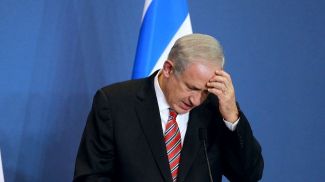 More than 100,000 people in the United Kingdom have now signed a petition demanding the arrest of Israeli Prime Minister Benjamin Netanyahu for war crimes against Palestinians when he visits London later this month.
The petition, which was published on the website of the British Parliament on August 7, calls upon the British government to apprehend the 65-year-old chairman of Israel’s Likud party upon arrival in London next Wednesday for the massacre of thousands of Palestinians during the Israeli military’s 50-day onslaught against the blockaded Gaza Strip last year.
The petition garnered 100,021 signatures as of Saturday morning.
“Under international law, he should be arrested for war crimes upon arrival in the UK for the massacre of over 2,000 civilians in 2014,” the petition says, referring to the Israeli prime minister’s scheduled September visit.
After 10,000 signatures, the British government must respond to the petition, and after 100,000 signatures, it will be considered for debate in the parliament.
The British government has, in return, stated that “under UK and international law, visiting heads of foreign governments, such as Prime Minister Netanyahu, have immunity from legal process, and cannot be arrested or detained.”
Israel started its military campaign against the impoverished Gaza Strip in early July 2014. The offensive ended on August 26, 2014. Nearly 2,200 Palestinians, including 577 children, lost their lives in Israel’s war. Over 11,100 others – including 3,374 children, 2,088 women and 410 elderly people – also sustained injuries.
The Great Wealth Transfer to the London Elite
By Craig Murray | September 2, 2015
The Guardian has a fascinating piece on house prices which deserves to be read and studied in detail. In London in 2013 the median house price had reached 300,000 while the median salary was 24,600. House prices are 12.2 x salary. That means it is in practice impossible for working people, without inherited wealth, to buy a house.
But the point is, that it should be equally impossible to rent a house. Landlords look for a rental return of approximately 6% of rental value. So that would put median rent in London at around 18,000 pa, which is a realistic figure. But nobody on a salary of 24,600 before tax can pay 18,000 pa in rent. So we should be at a stage where it is impossible for Londoners who have not inherited homes to live there at all.
Very little of the apparent gravity-defying power of the London property market is due to foreign buyers. Their major effect is very much concentrated on the top end of the market. Very few wealthy foreign buyers are purchasing semis in Plumstead or Acton. For prices to be this distorted from the potential of local buyers to pay would require literally hundreds of thousands of foreign purchasers in all segments of the market. They just do not exist.
No what is causing this incredible distortion is the conjunction of buy to let and state housing benefit. The state pays out 18 billion pounds a year in housing benefit, and the vast majority of that goes straight into the pockets of private landlords in the South East of England. State housing benefit underpins the entire system.
Now the brilliance of the trick is that, as it is labeled a benefit, the left fight to keep housing benefit as though it benefited poor people. In fact this is a great illusion. It does nothing of the sort. What would truly benefit poor people is lower rent or affordable homes. Housing benefit goes straight into the pockets of the landlord class.
The landlord class of course encompasses the political class, many of whom (including Cherie Blair, famously) are also landlords. As housing benefit is paid for from general taxation, the entire system is a massive transfer of wealth from the poor to the rich, and above all from the North and West to the South and East. The landlord class benefit not only from the taxpayer giving them enormous rents, but from the possession of artificially inflated property on which they can raise further money for more speculation.
The problem is national but is much worse in London and the South East of England. The reason that IDS has not made a serious assault on housing benefit is that it puts money straight into the pockets of most of his Tory chums. The largest benefit recipients in the UK are the great landlords.
The policy mix to tackle this must include building much more council housing, but must also include a phasing out of the payment of state housing benefit to private landlords. Let me put this simply – given a 6% rental return, pumping in 18 billion pounds of state money a year to rents adds 288 billion pounds to property values. Let me say that again because it is very, very important but not that easy to follow.
Given a 6% rental return, pumping in 18 billion pounds of state money to rents adds 288 billion pounds to property values. That explains how you reach the apparently impossible situation of median property at twelve times median income.
The landlord class will endeavour to ensure that any phasing out of such benefit causes maximum dislocation pain to tenants. But correcting the situation is an economic necessity. Ultimately property values have to halve, and rents too. That will provide pain to not just the landlord class but the entire Ponzi economy that Blair built. The ratio of property prices to income almost trebled in the Blair/Brown years, and is the aspect of their economic charlatanry which still overhangs us.
Seen from Edinburgh, another reason to escape to Independence as quickly as possible. The problem is not nearly so acute in Scotland. In England the situation can continue for a while. The Conservative government is delighted with this massive transfer of money to the rich. But once interest rates start to rise, it will bring a crash of gigantic proportions.
Featured Video
Dan Dicks with James Corbett on Solutions Watch
or go to
Aletho News Archives – Video-Images
From the Archives
Secret document reveals plans for civil war in Lebanon, Israeli false flags, and invasion
By Randi Nord | Geopolitics Alert | April 5, 2019
Beirut – During his visit with US Secretary of State, Mike Pompeo, Lebanese President Michael Aoun reportedly received a US-Israeli document detailing plans for creating a civil war in Lebanon with covert false flag operations and possible Israeli invasion.
Although the source of the document is Israeli and created in partnership with Washington, no one knows who presented it to Aoun. The Lebanese TV station, Al-Jadeed, initially reported the document on Lebanese TV and a video on its website. Geopolitics Alert translated the report for this article. … continue
Blog Roll
 Aletho News
- Sheikh al-Asadi warns of Iraqi government compliance with US demands
- How to MAKE THE CONSPIRATORS PAY for their crimes! Dan Dicks with James Corbett on Solutions Watch
- There’s a drought in academia: A drought in honest research on the subject of drought and other weather extremes
- Department of War Awards $20.7 Billion Contract to Raytheon for Air-to-Air Missiles
- ‘Distance yourselves from Israel’: IRGC urges US population to question govt policies
- America’s Greenland deal has a radioactive backstory
- The RAF Fairford ‘terror plot’: Unpacking escalation in the UK echo-chamber
- EU Council Advances Chat Control 2.0 Scanning Proposal
- Ex-Greek MEP files complaint against Israeli spyware firm over alleged Pegasus surveillance
- Troubling ideas throughout the Torah, Talmud, Mishneh Torah and Tanya
- If Americans Knew
- New Report: “Scholasticide and Genocide in Gaza: Assessment, Testimonies and Legal Analysis”
- Ex-Biden officials are desperate for a Gaza scapegoat
- Israeli “settlers” Invade Al-Aqsa; Pour Boiling Water on 75-Year-Old
- Israel Has Kidnapped Another American Teenager
- US arms sales to Israel worth $21.6 billion in 20 months
- Three Palestinians Killed in Israeli Attacks on Gaza
- Revealed: German “Anti-Semitism Expert” Driving Crackdown on Palestine Solidarity is Former Israeli Spy
- Egypt’s Warning to Israel Before Oct 7
- Israel’s siege signals another cruel winter for 1.8 million Gazans – Daily Update
- Netanyahu Asked UAE Leader to Deny Report on Oct. 7 Warning in Secret Visit, Sources Say
- No Tricks Zone
- Two More Paleo Reconstructions Affirm Meters-Higher Sea Levels Across Ireland, Brazil 7000-6000 Years Ago
- New Study: Earth And Venus Surface Warmth Largely Explained By Convection And Lapse Rate, Not CO2 Or Radiation
- 2025 Nature Paper Claiming Worsening Global Drought Gets RETRACTED …Heavily Flawed
- New Study: ‘Global Drought Shows No Detectable Recent Acceleration Under Climate Warming’
- Economic Masterminds: German Socialists Suggest Taxing Productivity Gains Stemming From Using AI
- The South China Sea Has Not Been Cooperating With The Climate Change Narrative
- Energy Crisis: Germany Enters Heating Season With Historically Low Gas Reserve Fill Levels
- New Study: The Antarctic Ice Sheet Gained Mass From 2020-2024 Due To Staggering Snow And Ice Accumulation
- Study: Ocean Heating Rates From Thousands Of Years Ago ‘Dwarf’ Modern Ocean Heating Rates
- Climate Extremists Target, Attack Large-Scale Power Grid Infrastructure In Germany!

