Hottest Month Claims
By Ken Haapala | Science and Environmental Policy Project (SEPP) | August 29, 2015
Divergence: It is summertime in the US, and temperatures are warmer. Several readers have asked TWTW for comments on the recent claims that July 2015 was the hottest month ever and similar announcements by certain US government entities, including branches of the National Oceanic and Atmospheric Administration (NOAA) and the National Aeronautics and Space Administration (NASA). These entities are making strong public statements that the globe continues to warm, and the future is dire. A humorist could comment that the closer we are to the 21st session of the Conference of the Parties (COP-21) of the United Nations Framework Convention on Climate Change (UNFCCC) to be held in Paris from November 30 to December 11, the hotter the globe becomes.
However, there are three significant forms of divergence that are being demonstrated. One divergence is the increasing difference between atmospheric temperatures and surface temperatures. The second divergence is the growing difference between temperatures forecast by models and observed temperatures, particularly atmospheric temperatures. This leads to the third divergence, the difference between the activities of what can be called the Climate Establishment and what is observed in nature.
The atmospheric temperatures are reported by two independent entities: the largely NASA-financed UAH entity at the University of Alabama in Huntsville, and Remote Sensing Systems (RSS) in California. The surface temperatures are reported by NOAA, NASA, and Hadley Centre of the UK Met Office, combined with those of the Climatic Research Unit (CRU) of the University of East Anglia. These measurements depend, in part, on the historic record maintained by NOAA’s National Climatic Data Center (NCDC). Unfortunately, for more than two decades, the historic record of the surface temperatures has been adjusted numerous times, without adequate records of the details and the effects. The net effect is an inflation of a warming trend, particularly obvious in the US where excellent historic records continue to exist. The UAH data have been adjusted, but the adjustments and effects have been publically recorded.
The divergence between the temperatures forecasted by the global climate models and the observed temperatures is becoming extremely obvious, particularly with the observed atmospheric temperatures. The adjustments to surface temperatures lessen this divergence somewhat, particular with the latest adjustments by the NCDC, where superior measurements taken by fixed or floating buoys were inflated to correspond with earlier, inferior measurements taken by ships. The director of NCDC, Tom Karl, was a lead author in the paper announcing this change. As a result, we should see announcements that sea surface temperatures, and global surface temperatures, are increasing, although the increase may be strictly an artifact of human adjustments rather than an occurrence in nature.
The questionable adjustments in reported surface temperatures leads to the third form of increasing divergence – the differences between what is reported by the Climate Establishment and what is occurring in nature. The Climate Establishment can be defined as those who embrace the findings of the UN Intergovernmental Panel on Climate Change (IPCC), particularly the assertion of a high confidence, a high degree of certainty, that human emissions of carbon dioxide and other greenhouse gases are causing unprecedented and dangerous global warming. Simply because data is adjusted to reflect the IPCC view, does not mean that the IPCC view is occurring.
The greenhouse effect takes place in the atmosphere, yet it is not being observed in the atmosphere. The satellite data, independently verified by four sets of weather balloon data, clearly shows it is not. There has been no significant warming for about 18 years. These data are the most comprehensive temperature data existing and are largely independent of other human influences that bias surface data such as urbanization, including building of structures and impervious surfaces, and other changes in land use. Those who broadcast claims of the hottest year ever, based on adjusted surface data, are actually emphasizing the divergence between science practiced by the Climate Establishment and Nature, and are not engaged in a natural science.
Unfortunately, many government entities and government-funded entities are involved in the Climate Establishment. The leaders of such government entities and funding entities demonstrate a lack of concern for institutional credibility, no respect for the scientific bases on which such institutions were built, including those who came before them and those who will replace them, and will leave their institutions in an inferior condition, rather than strengthen them.
It is important to note that not all government-funded entities are so involved. The National Space Science & Technology Center (NSSTC) at the University of Alabama in Huntsville (UAH), which is largely funded by the federal government (NASA) is a notable exception.
SNP dubs belated Chilcot inquiry ‘ludicrous’
Press TV – August 30, 2015
The Scottish National Party (SNP) has called on the British government to set a deadline for the much-delayed report of the Iraq war inquiry.
SNP said it was unacceptable that the inquiry has not reported after six years and a cost of nearly 16 million dollars.
The ruling Scottish party, which on its website described the delays as ludicrous, called for a definitive answer to what it called the failures of the Iraq war.
It added that the current Conservative government is also responsible for the Labour-initiated war as Conservatives overwhelmingly backed the invasion of Iraq.
The so-called Chilcot inquiry, named after John Chilcot who chairs the Iraq war investigation, began in 2009 and has repeatedly delayed its report under the pretext that it needs to interview all individuals implicated in the US-led invasion of the country.
The last of the hearings of the inquiry was held more than four years ago.
Chilcot has already declined to set out a timetable for his Iraq inquiry despite a threat of legal action by families of British troops killed in the unpopular US-led war.
Earlier this month, Lawyers representing 29 families said they would move to the London High Court, if the Chilcot inquiry fails to give a publication deadline in two weeks.
“There have been outrageous delays to date and it seems as though those delays would simply be interminable,” Matthew Jury, a lawyer representing the families said.
The US-led invasion of Iraq began in 2003 and lasted for over 8 years. The war, which was initiated under the false pretense of weapons of mass destruction, took the lives of 179 UK personnel and nearly 4,500 US soldiers.
The number of Iraqi civilian deaths has been estimated to be over one million by some sources.
Purge of Corbyn voters unmasks Labour
By Jonathon Cook | The Blog From Nazareth | August 27, 2015
The British political and media elite have been agreed on one thing this summer: the need to character-assassinate Jeremy Corbyn, the only half-decent politician (make that, human being) running for the Labour leadership.
If Corbyn wins, it would be the first time in living memory that the UK has had a Labour leader who is actually of the left. It is a prospect terrifying our supposedly liberal media, including the BBC and most of the Guardian’s senior staff, from Polly Toynbee to Jonathan Freedland.
Because all indications are that Corbyn will win in a fair fight, the caretaker Labour leadership is trying to stitch up the election to ensure he loses. Corbyn’s entry into the race has led to a tripling of Labour’s membership, as those who had grown disillusioned with Labour politics or joined the Greens consider returning to the Labour fold. You would think the Labour party would be cock-a-hoop. Think again.
The problem is that, if Labour admits Corbyn is actually harnessing massive support from the real left, it would also have to concede that long ago it departed from its roots, becoming just another wing of the neoliberal elite. And more significantly, it would also have to be prepared to contemplate changing course, opening itself up to the possibility that someone with social democratic convictions might again lead the party.
Neither is about to happen, so Labour is finding the flimsiest of excuses to purge itself of any voters it can identify as likely to back Corbyn in the leadership vote. Farcically, among those is Mark Serwotka, the leader of one of the UK’s biggest trade unions, after he said he would consider affiliating his PCS civil servants union with Labour if Corbyn wins.
Below is a great article from Kerry-anne Mendoza, another of those purged. She’s not a Tory mischief-maker or a Militant entryist. She’s an old-fashioned Labour supporter. Her mistake was to tweet her local Labour MP before the last election to say she would be voting Green after becoming fed up with the neoliberal takeover of Labour. That was the pretext to bar her from the coming leadership vote.
As she points out, she’s exactly the kind of voter the Labour party needs if it ever wants to form a government again. Instead she’s been cast out.
Notice also how the self-righteous New Labour elites characterise her – a long-standing Labour supporter who became disillusioned with the party – as an “infiltrator”. They were so sure of themselves they even included her in a list of people they had barred from the vote that they then issued to the media. The list ended up being published uncritically by the Guardian.
If despite all this, Corbyn does win, there can be no doubt it will be far from the end of the story. The Labour party establishment will make the job of leading the party impossible, and Corbyn will face an even more intense campaign to discredit him from all parts of the media.
If there is any consolation to be drawn from these events, it is this: the pervasive myth that Britain still enjoys pluralism in its politics and media may finally be unmasked.
Government refuses to help tortured British student in UAE
Reprieve | August 24, 2015
The Prime Minister and the Foreign Office have refused to support a British student’s request to be released from a UAE prison, it’s been revealed – despite the fact that he was tortured into a false ‘confession’ by Emirati police.
Ahmad Zeidan, from Reading, was arrested in December 2013 in the emirate of Sharjah, along with seven other young men. During eight days of incommunicado detention, he was tortured by police into signing a document in Arabic – a language he doesn’t read or write. During a trial in which he faced a potential death sentence, the document was presented as his ‘confession’, and he was sentenced to nine years. He lost a subsequent appeal, while his allegations of police torture – common in the UAE – were never fully investigated.
The leaders of the Emirates recently granted a traditional Ramadan pardon to just under 900 prisoners across the UAE, including 200 prisoners in Sharjah jail, where Ahmad is held. The amnesty saw Ahmad’s co-defendants – none of whom are British – released, leaving him the sole remaining defendant from the December 2013 arrests to be still in prison. It’s now emerged that the Foreign Office refused to support a request by Ahmad for inclusion in the pardon – an apparent contradiction of an official UK policy to request clemency when a miscarriage of justice, such as a forced confession, has occurred.
It’s also been revealed that David Cameron met with the leader of the UAE, the Crown Prince of Abu Dhabi in July this year, shortly before the pardon was announced. In a letter to human rights organization Reprieve, which is assisting Ahmad, the Foreign Office admitted that the Prime Minister had not raised the case at the meeting, saying “these specific issues were not discussed.”
Speaking to the Press Association, Ahmad said his experience had been “extremely traumatizing, for both me and my family. It’s taking a toll on me every single day, mentally and physically.” He added: “The torture at the beginning was one thing, that I live with every day; it’s now another mountain of pain I have to go through, knowing the UK government is doing nothing.” He appealed to ministers to “get me out of what I’m going through.”
Commenting, Maya Foa, head of the death penalty team at Reprieve, said: “Ahmad Zeidan has suffered a staggering miscarriage of justice at the hands of the UAE. His brutal torture and the use of a bogus ‘confession’ – signed in a language he doesn’t read or write – are more than enough reason for the British government to request his release. It is deeply disappointing that ministers have not yet done this – particularly as his co-defendants, from other countries, have now all been released. The UK government must use our strong ties with the Emirates to call for an end to Ahmad’s nightmarish ordeal, so that he can return to Britain and concentrate on his future.”
Let’s Bomb Libya Again!
By Brian CLOUGHLEY – Strategic Culture Foundation – 15.08.2015
The British prime minister, David Cameron, places great emphasis on how he is regarded by the public at home and internationally. His personal promotion machine is extensive and highly-paid and his staff feed the media diligently with what they imagine to be positive slants on his character and actions (and with carefully selected photographs of his pretty wife). They provide advance copies of his speeches to favoured journalists with the annoying consequence that news broadcasts rarely report what the prime minister has just said on a topic. They are futuristic and use the infuriating phrase “the prime minister will say today that” he will propose something or other.
The reason for this is that if there should be adverse reaction to whatever sparkling new initiative he wants to put forward to the public, then the spin-doctors can make hasty amendments in order to avoid upsetting people. It is school playground stuff, but then a great deal of British politics is playground oriented.
Unfortunately for his image, Cameron sometimes says things without first putting a finger in the water to test the temperature, and he also says things that betray his appalling ignorance of life.
One of the unrehearsed things he said that he may well regret in future concerns his unscripted policy on bombing people. It was reported on 27 July that he said “he was ready to order air strikes on Islamist militant targets in Libya and Syria to prevent attacks on the streets of Britain as he stepped up his rhetoric against Islamic State insurgents.” From this it is clear the British prime minister wants his country to go to war again and bomb Libya as it did last time he ordered air strikes on that ill-fated country.
It was Cameron who was responsible for Britain’s enthusiastic participation in the 2011 aerial bombing and rocketing that destroyed Libya. In March 2011 he declared that “Tough action is needed to ensure that people in Libya can lead their lives without fear and with access to the basic needs of life. That is what the Security Council requires, that is what we are seeking to deliver.” And he and his fellow thugs delivered catastrophe.
When the US-NATO onslaught ceased, after the murder of Libya’s president, we were told that the war had been successful in achieving democracy by bombing. It might be summed up in the sniggering proclamation of Ms Hillary Clinton, on CBS on 20 October 2011 that so far as the killing of Gaddafi was concerned “We came, we saw, he died.” What a truly civilised statement from the likely next president of the United States.
Two weeks before Ms Clinton’s humorous observation Mr Cameron said “I’m an optimist about Libya; I’ve been an optimist all the way through and I’m optimistic about the National Transitional Council and what they are able to achieve. I think when you look at Tripoli today, yes, of course, there are huge challenges — getting water to that city, making sure there is law and order — but actually so far, the cynics and the armchair generals have been proved wrong.”
The “cynics and armchair generals” — who might be better described as experienced realists — were right in predicting that the country’s collapse was inevitable; just as they had been right about forecasting chaos in Iraq and Afghanistan. On the other hand, two highly placed intellectuals, Ivo Daalder, who was the US Permanent Representative on the NATO Council during the US-NATO war, and Admiral James G (“Zorba”) Stavridis, who was at that time US Supreme Allied Commander Europe (the military commander of NATO), agreed wholeheartedly with Cameron and wrote in 2012 in the journal Foreign Affairs that:
“NATO’s operation in Libya has rightly been hailed as a model intervention. The alliance responded rapidly to a deteriorating situation that threatened hundreds of thousands of civilians rebelling against an oppressive regime. It succeeded in protecting those civilians and, ultimately, in providing the time and space necessary for local forces to overthrow Muammar al-Gaddafi.”
According to these expert analysts, Libya was liberated and became a free country thanks to US-NATO. And they were supported by columnists like Nicholas Kristof of the New York Times who wrote that “Libya is a reminder that sometimes it is possible to use military tools to advance humanitarian causes.” What a bunch of buffoons. Their statements would be hilarious were they not so obscenely bizarre, because Libya has collapsed into anarchic ruin — as forecast by the “armchair generals” so despised by Cameron and all the others who have never heard a shot fired in anger.
In April 2015 the saintly International Red Cross observed that “The violence shows no sign of abating. Libya remains a patchwork of conflict, fuelled by a plethora of armed groups with varying allegiances and diverse agendas. Thousands have been killed; hundreds of thousands more have been displaced. The humanitarian situation continues to deteriorate.”
The unelected rabble that is supposed to be a government in Libya has its very own set of Guantanamo Bays in which Human Rights Watch reported that “the Libyan Army and the Interior Ministry’s Counter Terrorism Unit are holding about 450 “security detainees” in connection with the current conflict. Of those visited, 35 detainees told Human Rights Watch that they were tortured on arrest, under interrogation, or during their detention. Thirty-one said interrogators forced them to “confess” to crimes; four said that the authorities then broadcast their “confessions” on TV, leading to reprisal attacks on their families. All of the detainees Human Rights Watch interviewed said they had not been given access to lawyers, taken before a judge, or formally charged despite many months of detention.” From what freedom-loving democracy could the Libyans have learned to keep people in detention indefinitely without trial?
There have been no comments on the anarchic shambles in Libya by such as Nicholas Kristoff who rejoiced in 2011 that he had “Just arrived in Tripoli, Libya, after a wild ride from the Tunisian border. But Tripoli is festive, joyful and reasonably secure, its streets full of shoppers and honking cars, celebrating the end of Ramadan and the end of dictatorship. People are hugely welcoming to an American, and very grateful.”
When Gaddafi ruled Libya its citizens had ample water from many sources, not least being his “Great Man-Made River” which brought water from southern aquifers to the dense population of the coastal north. But the US-NATO blitz damaged or destroyed so many power stations and pipeline facilities that this supply has all but ceased.
Amnesty International reports savage religious persecution (unknown in Gaddafi’s time) and records that “the international community has stood and watched as Libya has descended into chaos since the 2011 NATO military campaign ended, effectively allowing militias and armed groups to run amok.” The Christian organisation Open Doors records that “Since the downfall of Gaddafi, the situation for Christians in Libya has deteriorated. The government claims all Libyans are Sunni Muslims; it is illegal to bring Arabic Bibles into the country or to evangelise.”
So much for David Cameron’s idiotic statement that “I’ve been an optimist all the way through” about Libya. This is the man who declared in 2011 that his bombing would ensure that Libyan citizens would have “access to the basic needs of life.”
During their war on Libya, Obama and Cameron jointly declared that “We are convinced that better times lie ahead for the people of Libya.” Tell that to the millions of Libyans whose lives have been wrecked by NATO’s “model intervention” as it’s described by the two imbeciles, Daalder and Stavridis, who did so much to destroy a nation.
Yet David Cameron imagines that more bombing will solve all the problems, and on 26 July the UK’s Daily Telegraph, whose editors and journalists are in the pockets of Cameron’s spin-doctors, was happy to disclose that “Mr Cameron has ordered officials to begin planning for a new intervention in Libya, which has become a haven for Isil jihadists.” Cameron “was asked if there was a case for strikes on Isil in Libya, where the gunman who massacred Britons in Tunisia was trained,” and replied “That is my job, my duty as Prime Minister if there is a specific threat and you can act to stop it, you should act to stop it wherever it is and you are allowed under international law to do exactly that. I think that is very important.”
The reason Libya has become a haven for fanatical loonies is because it was struck mercilessly in a seven month aerial blitz that destroyed its government and social infrastructure. And the solution, according to those who attacked it in 2011, is to bomb, bomb and bomb again.
We live in a world of madness.
Alert: 21st Aug 2015 – Demand Freedom For Amer Jubran & Muhammed Allan
inminds – August 20, 2015
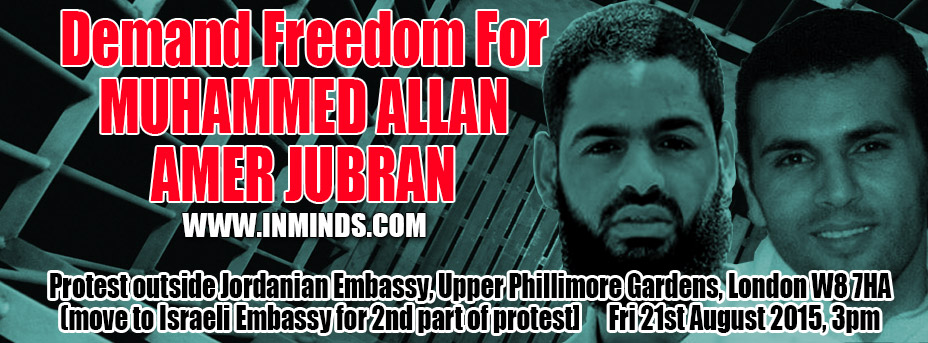
Date: Friday 21st August 2015 3pm-5:30pm
Location: Jordanian Embassy, Upper Phillimore Gardens, London W8 7HA (few minutes walk from High Street Kensington tube station), move to Israeli Embassy around 4:30pm
Facebook: https://www.facebook.com/events/947233385320459
Assalaamu Alaikum
Please join us as we hold two vigils this friday for Palestinian prisoners. At 3pm we will be outside the Jordanian Embassy demanding freedom for Palestinian father and human rights activist Amer Jubran who is facing a 10 years prison sentence in Jordan at the behest of Israel for refusing to betray the Lebanese resistance against Israel. Then at around 4:30pm we will move to the Israeli Embassy a few streets away to demand the unconditional and immediate release of Palestinian lawyer and hunger striker Muhammed Allan.
Muhammed Allan is again in a comma, breathing through a respirator, after having suffered brain damage whilst in Israeli custody. Muhammed launched his hunger strike on 15 June 2015 to protest Israel’s illegal practice of Administrative detention – of caging Palestinians indefinitely without charge or trial. He has been caged by Israel without charge since 6th Nov 2014 on never ending rolling detention orders. Allan ended his hunger strike after 65 days on 19th Aug after the Israeli Supreme Court on health grounds ordered the suspension of the administrative detention order against him. But Israel is still threatening to reimpose his administrative detention and imprisonment should he recover, its imperative at this time that we maintain the pressure and demand his immediate and unconditional release.
LATEST UPDATES ON MUHAMMED ALLAN
(courtesy Samidoun Palestinian Prisoners Solidarity Network)
20th Aug: Reports state Palestinian hunger striker Muhammad Allan again in a coma, on respirator
http://samidoun.net/2015/08/reports-state-palestinian-hunger-striker-muhammad-allan-again-in-a-coma-on-respirator/
19th Aug: Breaking News: Reports state Muhammad Allan has ended his strike after decision of the Israeli Supreme Court
http://samidoun.net/2015/08/breaking-news-reports-state-muhammad-allan-has-ended-his-strike-after-decision-of-the-israeli-supreme-court/
18th Aug: Muhammad Allan regains consciousness, pledges to continue hunger strike
http://samidoun.net/2015/08/muhammad-allan-regains-consciousness-pledges-to-continue-hunger-strike/
17th Aug: Muhammad Allan rejects attempt to forcibly deport him from Palestine as Supreme Court considers case
http://samidoun.net/2015/08/take-action-muhammad-allan-rejects-attempt-to-forcibly-deport-him-from-palestine-as-supreme-court-considers-case/
17th Aug: Israeli Supreme Court to hear petition for release of hunger striker Mohammed Allan
http://samidoun.net/2015/08/israeli-supreme-court-to-hear-petition-for-release-of-hunger-striker-mohammed-allan/
16th Aug: Palestinian doctor denied access to Muhammad Allan as he faces life-threatening infection
http://samidoun.net/2015/08/palestinian-doctor-denied-access-to-muhammad-allan-as-he-faces-life-threatening-infection/
14th Aug: Muhammed Allan on ventilator in coma; Palestinian prisoners under Israeli lockdown
http://samidoun.net/2015/08/action-alert-muhammed-allan-on-ventilator-in-medical-crisis-palestinian-prisoners-under-israeli-lockdown/
AMER JUBRAN – BACKGROUND
Palestinian activist Amer Jubran has a long history of being targeted for his activism on behalf of Palestine, first in the US and then in Jordan.
In the US he formed the “New England Committee to Defend Palestine” and in November 2002, two days after leading a demonstration in Boston calling for justice in Palestine, the FBI stormed Amer Jubran’s home and arrested him under the Patriot Act initially holding him without charge. When public outcry made it difficult to continue holding him they initiated deportation proceedings against him and he was deported to Jordan in January 2004 where he continued his activism for Palestine.
In Jordan he was under constant surveillance of the notorious Jordanian secret police. On 5th May 2014, 20 armed me in black uniforms stormed his home where he lived with his wife and four young children, smashing the doors and windows. The secret police abducted Amer, and for months he was interrogated at an undisclosed location without charge and without access to a lawyer.
Finally in August 2014 Amer Jubran was charged under a new law that didn’t exist when he was arrested, that makes “harming the relationship with a foreign government” a crime of “terrorism”. Last month on 29th July 2015 we was sentenced by a military court to 10 years hard labour, reduced from a 15 year sentence. Following his visit to Lebanon to speak an an Anti-Apartheid week function he was accused of working with the Lebanese resistance Hizbullah against Israel, hence ‘harming’ Jordan’s relationship with a friendly country. During his interrogation he was told by the secret police that any decision made about him involves “our American and Israeli friends”. Amer says it “all started when I refused to be a sell-out and work against the Lebanese resistance. I was told then that I will be sent behind the sun for such a refusal. And frankly it is very easy for me to disappear behind the sun rather than to be well, outside but a sell-out and traitor. “. Essentially he is being persecuted and imprisoned because he refused to work for Israeli /Jordanian intelligence as an infiltrator and informant against the resistance.

BACKGROUND – ADMINISTRATIVE DETENTION
Muhammad Allan was on hunger strike to protest against Israel’s practice of Administrative detention. Administrative detention is a practice used by Israel to imprison Palestinians indefinitely without charge or trial. Prisoners are given rolling detention orders which can be anything from 1-6 months, renewable indefinitely. Such practice is against international law.
For example administrative detainee Mazen Natsheh has been locked up cumulatively for nearly 10 years without charge or trial. Muhammad Allan has in total been caged for 3 years under different administrative detention orders without charge or trial.
Detention orders are based on so called “secret information” which never needs to be produced, either to the detainee nor their lawyer. Administrative detention is often used to arbitrarily jail Palestinians where there is no evidence for a trial. It is also used for punishment as in the case of 8 Palestinian MPs who are currently caged in Israeli dungeons to punish them for their political stance.
Palestinian prisoners rights group Addameer have documented “many cases where the detainees themselves will say that administrative detention is actually far worse than a fixed sentence, be that five years, ten years, 20 years, or whatever and why. With a fixed sentence, you know when you’re going home, a prisoner knows when he goes home. It could be ten years or 15 years down the line, but they know when they’re going home. Not with an administrative detention..” They have documented “many cases where prisoners or detainees have been literally leaving the prison, walking out of the prison with their bags in their hand after their administrative detention order has expired [with their family waiting on the other side] and the Israelis have handed that detainee another administrative detention order and they have to go back into the cell to recommence another administrative detention order. Now, this is a form of psychological torture for not only the detainee [but also] their families.”
Israel has on average issued over 2000 detention orders every year (between 2007 and 2011). Today there are around 450 administrative detainees. Most of them, like Muhammad Allan, having been transferred from the West Bank into Israel in contravention of Article 76 of the Fourth Geneva Convention, with their families being prevented from visiting them.
On 18th August 2015, 250 Palestinian prisoners held under administrative detention in the “Negev” prison in the Naqab desert in the south of Palestine announced they will launch an open-ended hunger strike to defeat administrative detention. Their statement reads “the growing use of administrative detention.. represents a clear and explicit violation of all international conventions and human rights principles, where we are arrested for extended periods, for years continuously, at the mercy of a so-called “secret file,” where we have no right to defend ourselves. Administrative detention is a sword hanging over our necks, that eats away our flesh and blood and years of our lives without trial and without mercy.”
LIVE UPDATES DURING PROTEST
We will, inshAllah, be tweeting live from the protest with live photos being uploaded to our twitter and facebook page. So if you can’t join us on the day, please help us by sharing the photos as they get uploaded.
https://www.facebook.com/inmindscom
https://twitter.com/InmindsCom
If you support this activity please share this alert widely, thank you.
JazakAllah,
Abbas Ali
Palestinian Prisoners Campaign
http://www.inminds.com/caged
http://fb.com/inmindscom
http://twitter.com/InmindsCom
http://youtube.com/user/inminds
US ‘shamefully’ refuse to release Shaker Aamer from Guantanamo despite UK pressure

Shaker Aamer © Wikipedia
RT | August 20, 2015
American authorities are “shamefully” refusing to release Shaker Aamer, the last British resident detained at Guantanamo Bay, despite calls from Prime Minister David Cameron for the prisoner to be freed, a lawyer has claimed.
Aamer’s legal counsel Ramzi Kassem called on the British government to pressure the White House further after President Barack Obama promised to “prioritize” his case in January.
Kassem also blasted the US government for refusing to allow Aamer access to independent doctors, despite concerns over the neutrality of army medical personnel.
The New York-based lawyer said the physical condition of Aamer, who has been imprisoned without trial for 14 years, “deteriorates with each passing day.”
Kassem filed a 26-page motion at a court in Washington calling for the British resident to be examined by two independent doctors and an army doctor to gauge how Aamer is coping with post-traumatic stress.
The Department of Defense has rejected the request, claiming it is too “difficult.”
Aamer’s last independent assessment took place in October 2013, when Californian psychiatrist Dr. Emily Keram described he had been mentally “destroyed” by interrogators, who allegedly subjected him to sleep deprivation and beatings.
Law professor Kassem expressed dismay at the reluctance of US authorities to release Aamer.
“It is truly shameful that we have to litigate every step of the way despite the prime minister’s demand and the president’s pledge to prioritize Shaker’s case,” he said.
“The UK government must press the White House to make good on its promise. The only thing more shameful are the arguments the US government is making in court to prevent Shaker’s examination.”
Cameron raised the issue with Obama on his official visit to the US earlier this year.
Obama promised to “prioritize” the case in January, but Aamer’s legal team claim nothing has been done to progress his case.
Writing in the Guardian last Friday, Aamer’s UK lawyer Clive Stafford Smith claimed the US military has deliberately ignored Obama’s order in breach of the constitution.
“President Obama, it seems, has personally ordered Aamer’s release, and his subordinates have ignored and thwarted his order,” Smith wrote.
“The contravention of the president’s orders indicates that there is a profound problem with the state of democracy in America.”
Kassem slammed the US government for not taking Aamer’s physical and mental health seriously.
He condemned the United States’ “self-servingly attempts to dismiss Mr. Aamer’s reliably-diagnosed and grave ailments as only ‘minor long-term impairments.’”
Aamer has never been charged with a crime or faced trial since he arrived at the high security prison in Cuba.
In describing his treatment at Guantanamo Bay, Aamer said he was stripped of his pride.
“I was not a human being any more. I meant nothing to them. I lost my dignity, my pride,” he said.
“I had to take off my underwear and hand it to them. I had sleep deprivation for 11 days. That made me crazy. They poured cold water over me. They kept me standing for 20 hours a day. I had to hold my hands and arms out.
“All of the statements I made at Bagram were during the sleep deprivation. I would have said anything. I told them, ‘I will tell you I am Bin Laden if you want me to,’” he said.
Aamer was arrested in 2001 in Afghanistan and subsequently moved to Guantanamo Bay, where in 2007 the US military claimed he was a “close associate” of Osama Bin Laden and a “recruiter, financier, and facilitator” for Al-Qaeda.
The Saudi citizen has always insisted he was only in the country to perform charitable work and said he confessed to being a jihadist while being tortured at the hands of the CIA.
Iraq Inquiry: Five Year, £10 Million Whitewash of Blair Regime?
By Felicity Arbuthnot | Dissident Voice | August 17, 2015
Bereaved UK families who lost sons and daughters in the illegal invasion of Iraq have now threatened legal action against Sir John Chilcot who headed the near two year long, £10m Iraq Inquiry (30th July 2009 – 2nd February 2011) if a date for release of Inquiry findings is not announced publicly within two weeks. Further, suspicions over the reason for the approaching five years near silence from Sir John are raised by a detailed investigation by journalist Andrew Pierce.
Writing in the Daily Mail he highlights the seemingly close relationship between Sir John Chilcot and Tony Blair.
Pierce refers to Blair’s first appearance before the Inquiry five years ago when “the Chairman, Sir John Chilcot treated him with almost painful deference.” What few realized was that Sir John, a former career civil servant, “could, in fact, have greeted Blair as an old friend.”
They first met in 1997 when Blair was still Leader of the Opposition, at the discreet Travellers Club in Central London, founded in 1819 as: “A meeting place for gentlemen who had travelled abroad, their visitors and (for) diplomats posted in London.” It continues to host: “distinguished members of the Diplomatic Service, the Home Civil Service …”
The meeting took place just months before Blair became Prime Minister. “John Chilcot, at the time, was the most senior civil servant at the Northern Ireland Office … Civil servants often meet Opposition politicians for briefings (prior to) elections but they are usually held in Whitehall Departments where (official) minutes are taken.” A meeting at the ultra discreet Club ensured “it was not made public.”
On becoming Prime Minister (May 2nd,1997) Tony Blair “worked closely with Chilcot on the Northern Ireland peace process.”
On Chilcot’s retirement he was “knighted by a grateful Blair … into the fourth most senior order of British chivalry.”
However, points out Andrew Pierce, Sir John never really left Whitehall, undertaking numbers of roles on public committees “often at the behest of the Blair administration.”
Moreover, in 2004 Lord Butler was charged with convening an Inquiry “into the role of the (UK) intelligence services in the Iraq war. Blair chose the Members of the Inquiry’s five strong Committee.”
Foxes guarding hen houses cannot fail to come to mind. “Surprise, surprise, Chilcot was one of the first asked to serve on it …”
Unexpectedly, however, the Butler Review as it was named: “Provided devastating evidence that (Blair’s) Downing Street, with collusion of intelligence chiefs ‘sexed up’ the threat” from Saddam Hussein”, yet “concluded that no one should be held responsible.”
“In short, it let Blair off the hook.”
When Blair’s successor as Prime Minister, Gordon Brown – former Chancellor of the Exchequer who wrote the £mega million cheques for the illegal invasion, thus also part of the crime of enormity – established the Chilcot Inquiry in 2009, it was originally to be held “behind closed doors.” Uproar from opposition MPs, from senior military figures and the public forced it into the open.
However, Philippe Sands, QC., Professor of International Law at University College, London and barrister with Matrix Chambers, a legal firm established, ironically, by Tony Blair’s barrister wife Cherie, quickly questioned the suitability of Sir John to lead the new Inquiry.
Sands questioned what it was in his “role in the Butler Inquiry that caused the Prime Minister to conclude he was suitable?” He cited a first hand observer who had described Chilcot’s “obvious deference to governmental authority, a view he had heard repeated several times. More troubling is evidence I have seen for myself.”
He was also dismissive of Sir John’s questioning of Law Lord, Lord Goldsmith, the former Attorney General, who had ruled that the Iraq invasion would be illegal – only to change his mind when Blair wrote on the top left hand side of the page: “I really do not understand this.”
Professor Sands – author of Lawless World in which he accuses former President George W. Bush and Tony Blair of conspiring to Invade Iraq in violation of international law – also cited “Sir John’s spoon-fed questions” to the former Attorney General “designed to elicit a response” demonstrating “the reasonableness of his actions and those of the government.”
In context, in Lawless World Sands cites a five page long “extremely sensitive” memo relating to a meeting between George W. Bush and Tony Blair at the White House on January 31st, 2003. The memo was written by David Manning, Blair’s Chief Foreign Policy Advisor at the time, who was also present.
Content included Bush mooting the idea of painting a U-2 spy-plane in UN colours and flying it low over Iraq in the hope of Iraq reacting by shooting it down, providing a pretext for the US and UK to attack and invade.
It also confirms Bush and Blair agreeing to invade regardless of whether weapons of mass destruction were found by the UN weapons inspectors. This contradicts Blair’s statement to Parliament after his return that Iraq would be given a final chance to disarm.
Giving a further lie to Blair’s Parliamentary assurances, Bush is paraphrased as saying:
The start date for the military campaign was now pencilled in for 10th March. This was when the bombing would begin.
In an opinion which should surely be George W. Bush’s epitaph he told Blair he “thought it unlikely there would be internecine warfare between different religious and ethnic groups” after the invasion.
In spite of the erased and ruined lives in millions, the ruins of Iraq, of much of Baghdad “the Paris of the 9th century”, of many of historical gems that have survived assaults over millennia but not Bush and Blair, it seems likely Chilcot’s Inquiry, if it eventually appears, will prove another dead end.
As Sir Christopher Meyer, former UK Ambassador to Washington pointed out:
When Downing Street set up the Inquiry into ‘phone hacking (by) newspapers, it was a Judicial Inquiry, led by a Judge (with) powers to compel witnesses to answer all questions put to them. Chilcot does not have that power. A Judge should be running this Inquiry, not a retired civil servant.
Prime Minister David Cameron has paid lip service to exasperation, but as commented on before in these columns, regards Blair as a “mentor” and in opposition aspired to be “heir to Blair.” He has also refused Sir John correspondence between Bush and Blair (held in government archives) which Sir John has been reported as regarding as essential to his findings. Current speculations are, unless the families of the bereaved win out, is that the world will see nothing until late 2016.
Another reason for the inordinate delay is the decision of the Inquiry to write to every witness criticized in order to allow them to respond. How very cosy. Imagine that in a Court of Law!
However, if any of the above has you wondering, there is far worse to come.
According to a recent report although “as many as one hundred and fifty (government) Ministers, civil servants and senior military figures have been sent details of criticism, including draft pages of the Report”, due to the structure of the Inquiry, “Ministers and officials accused of wrongdoing in (the) Chilcot Inquiry will never be named.”
Indeed:
One former Labour Minister is now said to be going through hundreds of pages of the report ‘with a fine toothcomb’. The ex-Minister has also been offered free legal advice from the Government.
A £ ten million stitch-up?
Reg Keys, speaking for one of the bereaved UK families threatening action against Sir John Chilcot’s team, who ran against Tony Blair in his Durham constituency of Sedgefield as an Independent Parliamentary candidate in 2005, and whose son, Lance Corporal Tom Keys was killed in Iraq in 2003, has had enough. Tony Blair “should be dragged in shackles to a War Crimes Court” he says.
In a memorable speech on the 2005 election night, Blair and his wife standing with frozen faces, as Keys vowed: “I’ll hold Blair to account.” Unlike Blair, Reg Keys speaks the truth.
Europe’s Forgotten History: From Human Zoos to Human Trophies Displayed in Museums Today
By Garikai Chengu | CounterPunch | August 17, 2015
Global outrage was sparked when the Zimbabwean lion, Cecil was killed as a trophy; but to this day, Britain and America continue to display in museums human remains that are human trophies of their massacres and subjugation of indigenous populations.
Britain has recently revealed that it is currently negotiating with Zimbabwe over the repatriation of human remains, belonging to fighters from Zimbabwe’s struggle against British colonisers, currently displayed in the Natural History Museum of London.
On Tuesday, Zimbabwean president, Robert Mugabe, said in a speech that the Zimbabwean liberation war fighters, “whose heads were decapitated by the colonial occupying force, were then dispatched to England, to signify British victory over, and subjugation of, the local population.”
That Thursday night, the British Foreign Office confirmed that “remains of Zimbabwean origin” were on display in a museum in London.
President Mugabe also remarked that, “surely, keeping decapitated heads as war trophies, in this day and age, in a national history museum, must rank among the highest forms of racist moral decadence, sadism and human insensitivity.”
Prior to European and American colonialism, the first museums were founded in Africa and played an essential role in many African civilisations. In fact, museums have been a part of human history for more than 2,000 years.
The tradition of collecting and displaying intriguing items began in Black Ancient Egypt. Most rising Western cultures from the Roman Empire onwards then displayed exotic animals and flora in their museums. The word “museum” comes from the Greek mouseion, meaning “temple built for the muses and museums”, which were originally designed to promote art, science and ingenuity. After the European Dark Ages, the next step in the evolution of museums occurred as a result of the ingenuity of the Black African Moors who conquered and civilized parts of Europe. The study of the natural world was once again encouraged by the Black Moors establishing “curiosity cabinets” across Europe after a millennium of Western ignorance.
Prior to the 19th century, museums tended to be small and private, open only to the aristocracy of a given nation. During the 19th century, the modern museum as we know it began to take shape. With plunder streaming in from all corners of the British Empire, the modern museum was born.

The British Museum, London.
The British Museum was created largely as a repository for artifacts looted from Africa between the 17th and 19th centuries. Such plunder includes many artifacts from Ancient Egypt which prove that the Ancient Egyptians, who established the first museum, were themselves dark-skinned Afroancestrals.
Across the world, one of the consequences of British colonialism was the violent appropriation of cultural artifacts, sacred and precious objects; and one of the legacies is their ongoing display in British museums. For centuries, the museums of Great Britain have served to bolster national white pride and glorify British imperial culture, by displaying a wide array of artifacts looted and plundered during European slavery and colonialism.
One example of the rather grim history of colonial racial terrorism is the long European history of human zoos, which featured Africans and conquered indigenous peoples, displayed in the same way as animals. Men, women and children would be kidnapped, locked up in cages and exhibited in front of European large audiences. Many people died after short stints in captivity and they lived in tortuous conditions. Visitors to the human zoos would often poke the African children with sticks, throw food at them and audiences were permitted to subject the captives to various degrading acts for a fee.
The primitive practice of putting indigenous people on display began during the modern period when explorers like Columbus and Vespucci lured natives back to Europe to be flaunted and paraded like trophies.
In the late 1800’s, Europe had been filled with human zoos in cities like Paris, Hamburg, Antwerp, Barcelona, Warsaw, Milan, and London. Thirty-four million people visited the 1931 World Fair for human zoos in Paris. New York was not morally exempt from such racist and degrading practices. New York City saw these popular exhibits continue into the twentieth century, even after the ends of both World Wars. Millions of Americans attended these spectacles.
Prior to the Second World War, human Zoos in America were at their height and the New York Times reported at the time, “few expressed audible objection to the sight of a human being in a cage. The crowd loved it… It is absurd to make moan over the imagined humiliation and degradation that they suffer.” At a time when America and Britain accepted human zoos as perfectly normal, Adolf Hitler was the one to ban them.
By creating the first mass contact between Whites and Blacks, and by promoting the spectacularization of “The Other”, human zoos were a key factor in the progressive shift in the West from scientific to popular racism.
The primitive European and American practice of exhibiting Africans in zoos continued well into the 1950s. During the 1960s, the baton of state-sanctioned racism towards Africans was passed from Europe’s human zoos into its museums. In fact, historically, museums in Britain have held some of the most reprehensible images of Blacks as barbarians and savages, and the most degrading images of Black women.
A 20 year-old South African woman known as Sarah Baartman would be emblematic of the dark era that gave rise to the popularity of human zoos. She was taken by an exotic animal-dealer to London in 1810. Sarah had a genetic characteristic known as steatopygia; large buttocks and elongated labia. Thousands of British men, women and children would come to human zoos to gawk at her naked body. Sarah’s days were punctuated by rape and scientific examinations. In 1815, Sarah died in abject poverty and her skeleton, sexual organs and brain were put on display at the Museum of Mankind in Paris where they remained for almost a century until 1974. In 2002, President Nelson Mandela formally requested the repatriation of her remains.
If you add up the attendance for every English Premier league football, rugby, basketball and cricket game in Britain this year, the combined total will come to about 30 million people. That’s a big number, but 49 million people will visit British museums this year. Museums are important sites for contestation over grand narratives of history, especially nationalist and imperial history. For more people to see the British state openly flaunting stolen loot in a museum this year than those who will watch sport, shows that cultural imperialism and true primitive racial attitudes are deeply entrenched in British statehood.
During the “Great Scramble” for control over the continent in the late 19th century, art counted among the highest prizes of imperialist plunder. Britain still unashamedly displays thousands of stolen African artifacts worth hundreds of billions of pounds in the British Museum, Liverpool Museum and elsewhere. Many other invaluable stolen artifacts from Africa, Asia and South America are in private British hands. Notably the Benin bronzes, ivories and other ancient works looted by British colonialists, especially during the reprisal attacks launched by the Queen’s soldiers against natives trying to resist imperialism in 1897.
The British Museum has long presented an array of African objects throughout its rooms, and its new African Galleries are second to none. Its ancient Egyptian collection is stunning. And they should be: while African collections in Germany, France and Belgium hold several important pieces, no other nation could match the British when it came to plundering so many art objects of a conquered people over so long a time period.
The British Museum, controls a quarter of a million artifacts from Africa alone, and maintains that looting those artifacts “was legal at the time.” As ever when the West perpetrates a crime against other people, they have a perversely fantastic way of asserting that their actions are completely bona fide, entitled and legal. Arthur Torrington OBE of the British Museums and Libraries Archives Council candidly admits that museums do not “want to accept the objects were stolen because if they do it for one, they’ll have to do it for all.”
The modern British museum may literally have been built on the backs of oppressed indigenous populations and its rooms filled with plundered goods from Europe’s colonial conquests; but in this day and age, the ongoing display of stolen loot and human trophies is unjustifiable in a modern, civilized society.
Garikai Chengu is a scholar at Harvard University. Contact him on garikai.chengu@gmail.com.
Palestinian photographer’s visa problem exposes British government’s double standards
MEMO | August 15, 2015
Palestinian Hamdi Abu Rahma is a gifted photographer whose work in Gaza has been highly acclaimed around the world. He is also now at the centre of a political storm after he was told that he could not travel to Britain in order to take part in the renowned Edinburgh International Festival. Scottish politicians and supporters have accused the British government of trying to damage the reputation of the festival by its “overly bureaucratic and insensitive decision” to refuse Abu Rahma a visa.
The row has erupted as Prime Minister David Cameron prepares to roll out the red carpet for Israeli leader Benjamin Netanyahu. The timing is particularly sensitive, as an online petition calling for Netanyahu to be arrested for war crimes when he arrives in London next month has already attracted more than half of the 100,000 needed to trigger a parliamentary debate.
Now that the decision to reject the young Palestinian’s visa application has been challenged by members of the Scottish Government, as well as festival organisers and pro-Palestinian activists, there are hopes that the UK Visa and Immigration agency will think again.
Already widely travelled to show his work at exhibitions around the globe, this is the first time that Abu Rahma has had a visa application rejected without warning. Some observers are particularly surprised since the focus of his photography is about the power of non-violent resistance in Palestine, which he has captured through his camera lens.
“The UK government refused to give me a visa today and the reason for refusal was that I didn’t show any bank statements or documentation to demonstrate my ability to support myself during my visit,” he said in a prepared statement. “Despite sending complete evidence of the sponsorship provided to fund my trip and all contact details of my sponsors, proving that all my travel and accommodation costs have been met, they still refused my application.”
Abu Rahma pointed out that he has travelled extensively in order to tell the Palestinian story through his photographs but Britain is the first country that has refused him entry. “We all know the real reason for this refusal,” he said. “Britain knows very well what my trip is about. I am not going there to claim asylum or beg in the streets. I am going there to educate the British people and pose some questions.” Such questions as: “Have you ever asked Israel why they kill and murder innocent men, women and children in Palestine? Do you know why Israel occupies Palestinian land illegally and destroys our homes, and why it allows colonial settlers to move into our homes illegally against international law?”
Expressing his “deep disappointment” at being unable to travel to Britain on this occasion, the young photographer thanked his friends across the country for their support and for being willing to host him in their homes.
Phil Chetwynd, one of the festival organisers who invited Abu Rahma said: “The Network of Photographers for Palestine raised the money through crowdfunding to finance Hamdi’s visit earlier this year.” All of his travel and subsistence expenses are covered by this, he explained. “I pledged to provide accommodation throughout the visit. Last month I tried to contact the visa office in Amman to back-up Hamdi’s application, but the process is so obscure that they didn’t seem to have a mechanism to add information to that already submitted by the applicant. It seems that the FCO has tendered out the whole process to another organisation.”
Despite the visa ban organisers have said that they will still exhibit Hamdi’s photographs and will ask a performer from another show to read out the speech that he has prepared. As news spread of the visa ban, an additional exhibition of his work may now also be shown at “Welcome to the Fringe: Palestine day at Out Of The Blue (OOTB)”. Other events organised for Hamdi to speak in Inverness, Dundee and Glasgow may still go ahead via a live link-up to his home in Gaza.
According to Sofiah MacLeod, the chair of the Scottish Palestine Solidarity Campaign, the visa rejection came as “no surprise”. She pointed out that the Cameron government is preparing to welcome the “war criminal” Benjamin Netanyahu to London in September. “As the petition calling on Netanyahu to be arrested for war crimes nears 55,000 signatories, the government’s visa denial to Abu Rahma will only strengthen our resolve to oppose its complicity in Israel’s ethnic cleansing project against the Palestinians.” MacLeod is adamant that Palestinian voices, including Abu Rahma’s, will be heard at this year’s Edinburgh Festival in “unprecedented” numbers. “We already know that the Israeli government has received our message loud and clear that it is not welcome during the festival, or at any other time.”
Scottish Parliamentarian Joan McAlpine of the SNP raised the issue with Sarah Rapson, the Director General of UK Visas and Immigration within hours of hearing about Abu Rahma’s visa being rejected. In a letter seen by MEMO, she told Rapson: “While I understand that immigration is a reserved matter, culture is not. I am the co-convenor of the Scottish Parliament’s Cross Party Group on Culture. I certainly feel that this decision is damaging to culture and the world’s greatest art festival in Edinburgh.”
McAlpine called for a rethink on what appeared to be “an overly bureaucratic and insensitive decision” adding: “I am particularly concerned that the decision means festival goers will miss the opportunity to hear this artist discuss his award-winning work, which of course has implications for freedom of expression.”
This is not the first time that Palestinian artistes have encountered difficulties at the hands of the UK Border Agency. Ali Abukhattab and Samah Al-Sheikh, a married couple also based in Gaza, were due to appear at the Institute for Contemporary Art in June 2013 as part of the Shubbak festival. They were to read from their own works and discuss how Palestinian writers in Gaza have responded to the ongoing Israeli siege and internal political situation.
Al-Sheikh, a short story writer and novelist, and Abukhattab, a poet and critic, are both established writers whose works have appeared in collections and anthologies. Both are also active in promoting the arts in Gaza, but that was not enough for the British government. In an increasingly familiar scenario for artists and writers seeking to visit this country, their visa applications were also rejected.
In April 2012, a tour by Palestinian Oud player Ahmad Al-Khatib and other musicians was delayed because of visa issues raised by the UK Border Agency. Discrimination by immigration officials has also hampered other Arab artists visiting the UK, including Iraqi poet Sabreen Kadhim, and even those only in transit through Britain’s airports, such as Syrian painter Tammam Azzam.
In an age when racial and religious discrimination is increasingly — and thankfully — more unacceptable, the fact that Arab artistes can still face what looks like systematic institutionalised discrimination is a huge concern. Instead of welcoming an alleged war criminal to London, perhaps David Cameron could look into this situation and start to treat all would-be visitors to Britain with fairness and justice.
Featured Video
Dan Dicks with James Corbett on Solutions Watch
or go to
Aletho News Archives – Video-Images
From the Archives
Secret document reveals plans for civil war in Lebanon, Israeli false flags, and invasion
By Randi Nord | Geopolitics Alert | April 5, 2019
Beirut – During his visit with US Secretary of State, Mike Pompeo, Lebanese President Michael Aoun reportedly received a US-Israeli document detailing plans for creating a civil war in Lebanon with covert false flag operations and possible Israeli invasion.
Although the source of the document is Israeli and created in partnership with Washington, no one knows who presented it to Aoun. The Lebanese TV station, Al-Jadeed, initially reported the document on Lebanese TV and a video on its website. Geopolitics Alert translated the report for this article. … continue
Blog Roll
 Aletho News
- Sheikh al-Asadi warns of Iraqi government compliance with US demands
- How to MAKE THE CONSPIRATORS PAY for their crimes! Dan Dicks with James Corbett on Solutions Watch
- There’s a drought in academia: A drought in honest research on the subject of drought and other weather extremes
- Department of War Awards $20.7 Billion Contract to Raytheon for Air-to-Air Missiles
- ‘Distance yourselves from Israel’: IRGC urges US population to question govt policies
- America’s Greenland deal has a radioactive backstory
- The RAF Fairford ‘terror plot’: Unpacking escalation in the UK echo-chamber
- EU Council Advances Chat Control 2.0 Scanning Proposal
- Ex-Greek MEP files complaint against Israeli spyware firm over alleged Pegasus surveillance
- Troubling ideas throughout the Torah, Talmud, Mishneh Torah and Tanya
- If Americans Knew
- New Report: “Scholasticide and Genocide in Gaza: Assessment, Testimonies and Legal Analysis”
- Ex-Biden officials are desperate for a Gaza scapegoat
- Israeli “settlers” Invade Al-Aqsa; Pour Boiling Water on 75-Year-Old
- Israel Has Kidnapped Another American Teenager
- US arms sales to Israel worth $21.6 billion in 20 months
- Three Palestinians Killed in Israeli Attacks on Gaza
- Revealed: German “Anti-Semitism Expert” Driving Crackdown on Palestine Solidarity is Former Israeli Spy
- Egypt’s Warning to Israel Before Oct 7
- Israel’s siege signals another cruel winter for 1.8 million Gazans – Daily Update
- Netanyahu Asked UAE Leader to Deny Report on Oct. 7 Warning in Secret Visit, Sources Say
- No Tricks Zone
- Two More Paleo Reconstructions Affirm Meters-Higher Sea Levels Across Ireland, Brazil 7000-6000 Years Ago
- New Study: Earth And Venus Surface Warmth Largely Explained By Convection And Lapse Rate, Not CO2 Or Radiation
- 2025 Nature Paper Claiming Worsening Global Drought Gets RETRACTED …Heavily Flawed
- New Study: ‘Global Drought Shows No Detectable Recent Acceleration Under Climate Warming’
- Economic Masterminds: German Socialists Suggest Taxing Productivity Gains Stemming From Using AI
- The South China Sea Has Not Been Cooperating With The Climate Change Narrative
- Energy Crisis: Germany Enters Heating Season With Historically Low Gas Reserve Fill Levels
- New Study: The Antarctic Ice Sheet Gained Mass From 2020-2024 Due To Staggering Snow And Ice Accumulation
- Study: Ocean Heating Rates From Thousands Of Years Ago ‘Dwarf’ Modern Ocean Heating Rates
- Climate Extremists Target, Attack Large-Scale Power Grid Infrastructure In Germany!

