Bush’s Foiled NSA Blackmail Scheme
By Dennis J Bernstein | Consortium News | June 21, 2013
In early 2003, as the U.S. and British governments were seeking international acquiescence to their aggressive war on Iraq, an unexpected cog thrown into the propaganda machine was the disclosure that the National Security Agency was spying on UN Security Council members in search of blackmail material.
The revelation received little attention in the mainstream U.S. news media, which was almost fully on board the pro-war bandwagon, but the disclosure received wide international attention and stopped the blackmail scheme. U.S. President George W. Bush and British Prime Minister Tony Blair were forced to abandon a UN resolution and invade Iraq with a ragtag “coalition of the willing.”

Former British Prime Minister Tony Blair.
Several months later, the identity of the leaker was revealed, a young woman named Katharine Gun who worked as a linguist at the NSA’s UK counterpart, British Government Communications Headquarters. Gun lost her job and was charged under British secrecy laws, but the case was dropped because the court would have required the Blair government to disclose that it also had twisted the arms of legal advisers to extract an opinion endorsing the invasion.
Now, a decade later, Edward Snowden, a young American systems analyst working for the NSA, has leaked documents revealing a global surveillance network and prompted another international debate – about government spying vs. personal privacy. Katharine Gun joined Pacifica’s “Flashpoints” host Dennis J Bernstein to discuss both cases.
DB: What exactly was your position when you decided to leak a certain document?
KG: My title was linguist analyst. I was a Mandarin Chinese speaker. We translated interceptions and produced reports for the various customers of GCHQ, which are normally the Foreign Office or MI-5 and MI-6.
DB: Can you explain the document you released and the significance of the timing?
KG: It was released at the end of January 2003, just before the invasion of Iraq. I saw an email that had been sent from the NSA to GCHQ. It was a request for GCHQ to help the NSA intercept the communications of six nations that sat on the Security Council at that time. It was to intercept their domestic and office telecoms in order to obtain all the information we could about the delegates, which the U.S. could then use to achieve goals favorable to U.S. interests. They called for the whole gamut of information, which made me think they would potentially use the information to blackmail or bribe the U.N. delegates.
DB: This bugging took place at the United Nations?
KG: Presumably, yes. Or it could involve the United Nations headquarters or also their domestic residence.
DB: The idea was to get the necessary information one way or the other to influence the key members to support the U.S. quest for war in Iraq?
KG: Yes. At the time, if you were not working for the intelligence services or the foreign offices of the U.S. or U.K. you would probably assume that the goal of [President George W.] Bush and [Prime Minister Tony] Blair at that time was to work diplomatically to reach a solution. But we now know, after several leaks over the years about the run-up to the war in Iraq, that war was the agenda all along. When I saw the email it made me think, “This is evidence that war is the agenda.” That’s why I decided the public needed to know.
DB: GCHQ is the British Government Communications Headquarters, the equivalent to the NSA [National Security Agency]. You were working there in the lead-up to the Iraq War. Can you remind us what governments were bugged?
KG: Six nations, smallish countries: Angola, Cameroon, and Pakistan, I think. Mexico was mentioned, and possibly Chile as well. They were countries that are generally not known for their big powerful positions at the U.N.
DB: What went through your mind leading up to the decision to leak this information? This big decision changed history a bit. How did you make this courageous decision that also changed your own life?
KG: I was very concerned. I had informed myself about the realities of Iraq and the situation there because I grew up during the first Gulf War and the following years of sanctions. It was in the back of my mind that Iraq was a country that was virtually destroyed, and that the people were living in impoverished conditions. It made me think that another attack on them would not be fair and justified because there was nothing about Iraq that was a threat to either the U.S. or the U.K.
So when I saw the email and realized what was going on behind closed doors was an attempt to get the U.N. to authorize what would then have become a pre-emptive strike on a country, I thought the public should know about this because it angered me.
DB: What happened after you made this information available? What happened with your position? Were you intimidated, attacked?
KG: Initially I tried to remain anonymous, but when I realized the information revealed in the newspaper at the time was identifiable to GCHQ, I decided I didn’t want to lead a double life at GCHQ and pretend I had nothing to do with it. I confided to my line-manager and said it was my leak. Then I was arrested under suspicion of breaking the Official Secrets Act, questioned, and released on bail for eight months.
In November 2003, much to our surprise, they decided to charge me, despite having waited so long. After discussions with my legal team, which included Liberty, an organization very similar to the U.S. ACLU, we decided I would plead non-guilty, because I personally felt that although I did the act, I didn’t feel guilt, because I didn’t feel I had done anything wrong. Our defense would have been to establish the defense of necessity, which is not yet tested in a court of law. My legal team then asked for all the legal advice leading up the war, and at that point, the prosecution decided to drop all charges against me.
DB: What do you think made them decide to prosecute you, and what information made them drop the charges? Were they trying to backpedal? Were they trying to make sure no other folks in positions like you would do it again?
KG: It’s speculation on my part because obviously they haven’t disclosed. I suspect one of the reasons they charged me was to make an example of my actions to try to deter people from it. On the other hand, when they dropped the charges, I suspect there may have been a variety of reasons. When we asked for the legal advice from the then-Attorney General, at that time his legal advice had not been fully disclosed.
During the run-up to the war, Blair asked for legal advice, obviously. The first draft was about 13 pages long. The language was very cautious – it didn’t say there was a definite reason for war. There were many legal terms of caution, but at some point Blair was told the legal advice was not good enough. He needed a watertight case. The Attorney General then re-drafted his advice, and condensed it to a single page that was then issued to the House of Commons.
That is what persuaded all the MPs in the House of Commons to vote for Britain’s involvement in the war. Eventually information came out, not from myself, but from other means and it became apparent that the legal advice had not been at all watertight to start with.
DB: Daniel Ellsberg said your most important and courageous leak is the only one made in time to avert an imminent possible war. Was your desire to avert war?
KG: Yes, I was hoping the British ministers would see the truth and question the actions of Blair and the secret negotiations he was having with Bush at the time. I wanted more transparency on the issue. I wanted people to question what was going on and to generally challenge this bandwagon for a preemptive strike against a country that was already very impoverished and no threat to anybody whatsoever.
DB: Did you ever hear from folks who based on your revelations, learned they were bugged?
KG: No.
DB: So there were no thank yous coming across from that part of the world?
KG: No. At the time of the leak, my name didn’t come out. Eight months later my name was made public.
DB: Did it change your life?
KG: I lost my job. The secure, full-time, long-term employment was no longer possible. That has made an impact, primarily financially, on my life and my family’s life.
DB: We are now seeing extraordinary NSA leaks from Edward Snowden in the British Guardian. What are your thoughts on this?
KG: I think Snowden is probably is a lot more clued-up than I was at the time. My leak was a single issue. Snowden has had a long period of time working within the U.S. intelligence services. He’s obviously a very technically savvy professional. I admire him for taking this tremendous step, which he thought out very carefully and methodically. He has made some very good points. These kinds of issues should be in the public domain because it involves innocent members of the public. We, the public, should be able to have a measure of a say in these matters.
DB: We hear that people like you, who were leaking before the war, and Snowden now, are putting people’s lives in jeopardy, endangering the people. We hear that secrecy is necessary to prevent terrorist attacks, and that many have been prevented by this kind of secrecy, investigation, wiretapping and bugging that’s going on now.
KG: There is absolutely no evidence that my leaks in any way endangered anybody else.
DB: But you were accused of that.
KG: Yes, they love to throw accusations around, there’s no doubt about that. But in my case, the majority of views supported my actions. In Snowden’s case, people who have a fair and just understanding of the issues at-large are supportive of his actions, as they would be of Private Manning, who is currently on trial.
DB: Did you lose any friends or associates, over this?
KG: Ironically, not really. Many of my friends and colleagues from GCHQ have also left GCHQ, partly to progress in their professions. They didn’t see much chance for their linguistic skills progressing much further within GCHQ and I continue to be in touch with them.
DB: If you had it all to do over again, would you?
KG: That’s a difficult question. Now I’m married and have a child. I would hope that I would still do it, but perhaps I would be more savvy about how I did it. Snowden was very clued-up and seems to know exactly what he should be doing – how to stay safe and keep out of the way of being unjustly arrested and tried without due process of law.
DB: Your language skills. Are you using them now?
KG: Not now. I’m only fluent in Mandarin Chinese. I speak some Japanese and am now trying to learn Turkish.
DB: That may in handy in the next decade or so. Thank you for talking to us.
~
Dennis J Bernstein is a host of “Flashpoints” on the Pacifica radio network and the author of Special Ed: Voices from a Hidden Classroom. You can access the audio archives at www.flashpoints.net.
Related articles
- A British Precursor to Snowden Case (consortiumnews.com)
- British spy agency has access to global communications, shares info with NSA (alethonews.wordpress.com)
British spy agency has access to global communications, shares info with NSA
RT | June 21, 2013
The British spy agency GCHQ has access to the global network of communications, storing calls, Facebook posts and internet histories – and shares this data with the NSA, Edward Snowden has revealed to the Guardian in a new leak.
GCHQ’s network of cables is able to process massive quantities of information from both specific targets and completely innocent people, including recording phone calls and reading email messages, it was revealed on Friday.
“It’s not just a US problem. The UK has a huge dog in this fight,” Snowden told the Guardian. “They [GCHQ] are worse than the US.”
The Government Communications Headquarters agency has two different programs, aimed at carrying out this online and telephone monitoring – categorized under ‘Mastering the Internet’ and ‘Global Telecoms Exploitation.’ Both have been conducted in the absence of any public knowledge, reports the Guardian.
“If you remember, even the NSA said that they did not record phone calls, but according to these latest revelations by Edward Snowden, that up to ‘600 million’ telephone events last year were recorded a day by the GCHQ,” said RT’s Tesa Arcilla from London.
“There’s no doubt as to what the objectives of these programs were, having put them in place,” she said, emphasizing the titles.
The agency is able to store the volumes of data it amasses from fiber-optic cables for up to 30 days in an operation codenamed Tempora. The practice has been going on for around 18 months.
GCHQ which was handling 600m telephone ‘events’ a day, according to the documents, had tapped into over 200 fiber-optic cables and had the capacity to analyze data from over 46 of them at a time.
The cables used by GCHQ can carry data at 10 gigabits per second, which in theory, means they could deliver up to 21petabytes of information per day. The program is continuing to develop on a daily basis with the agency aiming to expand to the point it is able to process terabits (thousands of gigabits) of data at once.
By May last year, some 300 GCHQ-assigned analysts and 250 from the NSA had been specially allocated large quantities of data to trawl through as a result of the operations.
The Guardian reports that 850,000 NSA and outside contractors had potential access to the databases. However, the paper does not explain how it came to such an enormous figure
“These revelations reveal the scale of and the scope of cooperation between UK and US intelligence services,” said RT’s Gayane Chichakyan from Washington. “From these revelations we learned how dramatically it has expanded over the years.”
“The document shows the FISA court lets the NSA use data snagged ‘inadvertently.’ They basically give a warrant to target suspects,” she said, recalling Lieutenant General Keith Alexander’s quote after a 2008 visit to the Menwith RAF base in England: “Why can’t we collect all the signals all the time? Sounds like a good summer project for Menwith,” he had said.
The GCHQ project was first trialed in 2008. The intelligence organization has been labeled an ‘intelligence superpower’ on account of its technical capabilities, which by 2010 gave it the strongest access to internet communications out of the ‘Five Eyes’ – an international intelligence sharing alliance, including Australia, Canada, New Zealand, the UK and US, brought into existence in 1946.
The mass-surveillance has seen the interception of data from transatlantic cables that also carry data to western Europe through ‘intercept partners’ commercial companies that had entered into private agreements with GCHQ. Many have been paid off for their cooperation.
GCHQ feared that exposure of the names of the companies involved could lead to “high-level political fallout,” and took measures to ensure names were kept secret. Warrants had reportedly been issued to compel the companies to cooperate so that GCHQ could engage in spying through them.
“They have no choice,” said a Guardian intelligence source.
Snowden previously warned that he would be releasing further information pertaining to mass security operations carried out on the unwary public, stating in a previous Q & A with the Guardian that the “truth is coming, and it cannot be stopped.”
UK Supreme Court votes to lift sanctions on Iranian bank
Tehran Times | June 19, 2013
LONDON – The UK Supreme Court has ruled in favor of Bank Mellat, Iran’s largest private bank, in a result which will see it removed from the United Kingdom’s sanction list.
The appeal was heard by nine out of the Supreme Court’s twelve judges after the UK’s highest court was forced to enter closed session for the first time in its history, in order to receive secret evidence from the security services.
Her Majesty’s Treasury imposed sanctions against the bank in 2009 alleging that the bank’s activities supported the Iranian nuclear program, but Wednesday’s ruling found no evidence to support this claim. The UK Supreme Court result follows similar success for the bank at the European Court in January of this year in respect of sanctions which had been imposed on the bank by the EU Council.
The ruling is a blow to the controversial system of “secret courts” which have allowed the security services to provide evidence to the Supreme Court behind closed doors for the first time in its history.
The Supreme Court reluctantly entered into closed session in March, effectively barring the bank from accessing the evidence against it. Zaiwalla & Co Solicitors, the London-based international law firm representing the bank, had argued against the imposition of closed courts on the grounds that it contravenes the British common law principle of open justice. The failure of the Treasury to produce compelling evidence, despite the controversial new powers, puts the spotlight back on the Justice and Security Bill, which expanded the system of closed courts to civil cases.
The ruling sends a strong message to the UK government that political expediency is not a sufficient legal justification for sanctions placed against Iranian private businesses which operate out of Iran. The Supreme Court is now expected to order the British government to pay Bank Mellat all of its legal costs and damages for the wrongful listing of Bank Mellat.
After initial failure to challenge sanctions before the English High Court and the Court of Appeal, Bank Mellat turned to Zaiwalla & Co in 2010 and has since gone from strength to strength in the European and now Supreme Court. The firm, led by Sarosh Zaiwalla, have shown that even in cases of national security, the UK government must abide by the rule of law, with the some of the justifications for the sanctions considered “arbitrary”, “discriminatory” and even “irrational”.
Sarosh Zaiwalla, senior partner at Zaiwalla & Co said, “Today’s ruling is a victory for the rule of law as much as it is for Bank Mellat.
“The judgment will put enormous confidence in the independence of the British judiciary and sets an example that even controversial disputes can be resolved by applying the principle of rule of law through the British courts.
“Nevertheless, the reading of the closed judgment clearly contravenes the British principle of open justice, the bank’s success demonstrates just how unjustified closed sessions are.”
Britain seeking to lure kids into army by setting up military schools
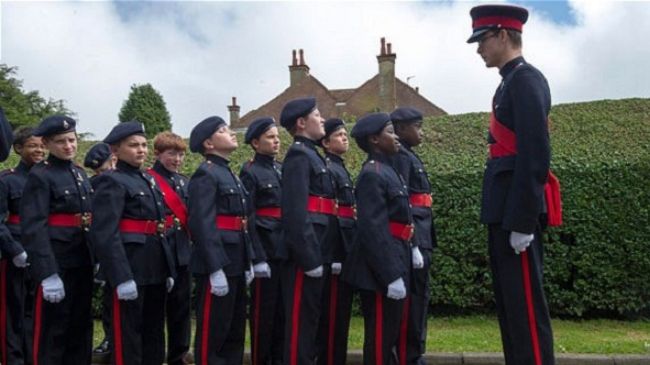
Press TV – May 23, 2013
The British government has approved plans for opening controversial military-style state schools as a likely new method to lure British children into the armed forces.
The UK Education Secretary, Michael Gove is proposing a system of a chain of state-funded “free schools” that impose an influential Armed Forces culture at the same time that the United States government plans to do.
The revelation came as the Department for Education granted approval for one military-style school in Oldham – the first of its kind in Britain.
According to the plans, The Phoenix Free School will open from September 2014, which will be staffed by former members of the Armed Forces and led by an active Army captain.
Meanwhile, two campaign groups announced in April that the UK government continues to recruit 16 and 17-year-olds to its armed forces irrespective of the fact that most countries in the world had stopped the practice a long time ago.
The argument stated that while under-18s are banned in Britain from many activities considered harmful — including drinking alcohol and smoking — they are allowed to risk their lives in military exercises.
UK spyware used against Bahraini activists – court witness
RT | May 12, 2013
UK spy technology was used against British citizen in Bahrain, new evidence filed in a UK high court has claimed. Activists are calling for a judicial review of the UK’s failure to hold firms accountable for sales of spy software to repressive regimes.
The evidence submitted contains a witness statement from Bahraini activist and writer Ala’a Shehabi, 30. She has both Bahraini and British citizenship, and is one of the founding members of Bahrain Watch, an independent research and advocacy organization set up following a security crackdown in the country in February 2011.
Shebabi became one of the targets of the FinSpy malware emails, developed by UK firm Gamma International, the Guardian reported.
The activist claimed she received four phishing emails from what appeared to be authentic email accounts after being released after detention.
The FinSpy software reportedly allows for surveillance of emails, social media messaging and Skype calls, and can retrieve files saved on an infected computer’s hard drive. It also can remotely operate microphones and cameras on computers and mobile phones.
“I have real concerns about the Bahraini regime having effective unfettered access to my computer, reading my emails and monitoring my calls. Not only is this a gross invasion of my privacy, I am concerned that it could put in danger from the Bahraini authorities myself, my family members and other activists,” the paper quoted Shehabi as saying.
In her witness statement, she claims that the first infected email was supposedly from Kahil Marzou, the deputy head of Bahrain’s main opposition party. Other emails purported to have come from an Al Jazeera journalist.
“It upset me a lot, scared me and made me feel quite paranoid. I am very concerned that it appears that a product of a British company,” she stressed.
The campaign group Privacy International (PI) in November reported that Gamma International is selling surveillance technology without a proper license. The technology sold is being used by 25 countries to spy on activists, who are later targeted by repressive regimes – a situation that “amounts to criminal conduct” on the part of the tech firms, the activist group said in an 186-page report it sent to Her Majesty’s Revenue and Customs (HMRC).
In the spring and summer of 2012, Bahraini activists, including Shehabi, received emails containing malware. After the University of Toronto’s CitizenLab investigated the case, it found evidence connecting the malware to FinSpy.
With this new witness statement, privacy rights groups are seeking to force the UK government to review exports of surveillance technology. The activists are pushing for a judicial review of the government’s apparent failure to investigate whether the sale of technology to repressive regimes is a breach of export-license controls.
In April, Privacy International filed an application for judicial review of HMRC over its role in allowing the export of advanced surveillance technology used by repressive regimes worldwide – including Bahrain – to spy on dissidents.
Privacy International’s lawsuit is over the government’s refusal to disclose whether it investigated UK-based Gamma International (GI). GI’s FinSpy software has allegedly been used by some two dozen countries worldwide.
“In the wrong hands, today’s surveillance technologies can have devastating effects, and the public, especially victims targeted by this surveillance, have a right to know what the UK government is doing about it,” said Eric King, head of research at Privacy International.
Gamma International, an Anglo-German company registered in the British Virgin Islands, denied reports it had sold to oppressive regimes, and maintained that it complies with export controls.
The UK’s Department for Business, Innovation and Skills advised Gamma International that FinSpy products have been controlled by EU legislation since 2000 and “require a license” in order to be sold outside the EU. This would require the tech firm to disclose the names of export customers.
Bahrain’s human rights violations
Bahrain’s human rights situation is “critical in the wake of the brutal crackdown on pro-democracy protesters that erupted in February 2011,” Human Rights Watch reported in December.
Police regularly use violence to disperse crowds of protesters, while Bahrainis, led by the country’s Shia Muslim majority, are continuing to protest, demanding greater rights and freedoms from the ruling Sunni minority.
More than 80 people have died in unrest since the pro-democracy protests begun in the February 2011 uprising, with thousands arrested and imprisoned and severe violence reportedly employed during the course of the arrests. Physical and psychological torture of prisoners to sign false confessions has also been reported.
New laws were passed in Bahrain in April making it illegal to insult the country’s king and national symbols, charges that carry five-year jail sentences.
Related article
What UKIP stands for: A look
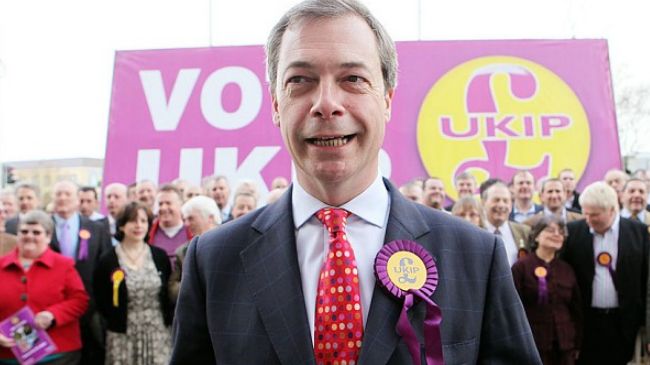
UKIP leader Nigel Farage
Press TV – May 12, 2013
The UK Independence Party has gone from being a joke in the British political landscape to the fourth – or even third – best-supported party after their gains in the recent local elections, where they won a quarter of seats they had sent out a candidate to seize.
Here is a review on the newly-emerging far-right party, which has been repeatedly accused of racism, anti-Islamic bias and lobbying in favor of the Zionists in the British establishments and internationally.
UKIP has been a pro-Israeli regime propagandist and has been lobbying for an end to what it claims to be a despicable anti-Semitism in European history.
The party considers the regime as a victim versus the Palestinian and Middle Eastern resistance movements and considers the Israeli regime’s frequent aggressions against Palestinian civilians in line with Tel Aviv’s right to defend itself.
The party also frowns on the idea of punishing the regime through sanctions or cancellation of trade ties for disproportionate use of force against Palestinians and war crimes in the Gaza Strip, including the 2008 Gaza War in which the regime massacred over 1,000 Palestinians.
The party has also claimed that “Israel has maintained an impeccable human rights record” and has set up a “Friends of Israel” fan club in a bid to secure “true friendship” with Tel Aviv.
This is while, the party’s secretary Michael Zuckerman has boasted of “tremendous support for Israel within UKIP”.
In return for its efforts, UKIP leader Nigel Farage has earned the title of “a good friend of Israel” from Zionist media.
On the other hand, UKIP is understandably an outspoken enemy of Iran, against which it is prepared to use “military means”, and its Commons Norwich North once candidate Glen Tingle has said Britain “should blow them [Iran] up”.
UKIP European Parliament member Gerard Batten has also leveled accusations of terrorism and non-civilian nuclear work against Iran, labeling the country as “barbaric, pro-terrorist and anti-Semitic”.
UKIP has also pledged to provide strategic military support to any party that enters a conflict with Iran over its nuclear program, if the party comes to lead the British government.
This is while, Farage almost u-turned on that attitude in an interview in October 2012 saying Britain needs to sit down and talk with Iran over its nuclear program.
Farage has criticized the Iraq war, because of the waste of money and British soldiers’ lives to destabilize a Middle Eastern country, and also, because the invasion served Iran by removing Iraq’s former dictator Saddam, who had fought an imposed war against Iran between 1980 and 1988.
In the same interview on Iran, he also went on to describe the military campaigns in Afghanistan and Iraq as achieving absolutely “nothing”.
UKIP has been probably most notorious in its Islamophobic attitudes.
Back in May 2012, a candidate for UKIP compared Islam’s holy book Qur’an to Adolf Hitler’s political manifesto Mein Kampf, saying Muslims are “Fascist”.
This comes as Fascism has been the word used by UKIP opponents to describe its political creed especially after UKIP parliament candidate Steve Moxon embraced Norwegian mass-murderer Andres Breivik as a sensible and “convincing” anti-Islam “scholar”.
Meanwhile, UKIP’s former leader Lord Pearson notoriously invited Dutch MP Geert Wilders to the House of Lords to show his sacrilegious anti-Islam film to the British peers while the party’s 2011 candidate for Leicester South parliamentary by-election, Abhijit Pandya, once labeled Islam as “morally flawed and degenerate”.
Farage, himself, was one of the lead campaigners in 2010 for imposing a ban on the Islamic veil, known as burqa, also dismissing the application of Islamic Sharia Law in British major cities as “most certainly … not desirable”, though he has recently tried to distance himself from such comments, considering future expediency.
While the UKIP’s direct attacks on Islam have decreased recently in a bid to appeal to more British voters, the party’s continued Islamophobic approach was exposed by the militant English Defense League back in April after the EDL revealed on Facebook that they enjoy a mutual stance with UKIP on hatred of Islam.
EDL leader Tommy Robinson also explicitly said in an interview on April 4 that he supports UKIP and would vote for them, laying bare UKIP’s true anti-Islam nature.
And finally on Falklands, there is nothing to choose between UKIP and other major British political parties as they welcomed the result of the recent Falklands Islands referendum, with deputy party leader Paul Nuttal saying it led to a “resounding” result that “should surely put an end to Argentina’s frankly arrogant and unfounded claims” over the South Pacific territory.
Related articles
BBC Helps Pave Road to War on Syria
News Unspun | May 8, 2013
The Syrian conflict has been accompanied by a distinct media narrative. Within this narrative – which poses a binary division between the forces engaged in the conflict, identifying the players as good (the rebels, who must receive ‘our’ support) and bad (the government) – the role the West must play is that of potential saviour, whose aim is to cautiously observe the conflict so that it may intervene to ‘fix’ the situation, as The Guardian’s Simon Tisdall put it:
So what can Obama do? As Vladimir Putin was expected to make plain to John Kerry in Moscow on Tuesday, he cannot count on Russian (or, therefore, Chinese or UN security council) support to fix Syria.
This sentiment, that the West can put right the Syrian situation, is inherent to most reporting of the conflict. The BBC recently reported that ‘the pressure to act has intensified in recent days after emerging evidence that Syria has used chemical weapons such as the nerve gas sarin’. This statement presents the existence of a ‘pressure to act’ as a given, though the source of such pressure is unidentified. From where is this pressure emerging? As a BBC report points out, public opinion in France, the UK, the US, and Germany is by majority opposed to the possibility of intervention in the conflict through sending arms and military supplies to the Syrian opposition. The BBC is not then speaking on behalf of the public majority. Pressure towards military intervention, to some extent considered a desirable option by the UK government (if it can ‘achieve the result [they] want’, as Cameron put it in an interview with Nick Robinson), is, however, increasingly mounting within the media itself.
Chemical Weapons ‘Evidence’
It is also important to note that the ’emerging evidence’ referred to above is not conclusive despite the wording of this report. The BBC reported again on Monday 6 May that ‘Western powers have said their own investigations have found evidence that government forces have used chemical weapons’. Again, this is simply not the case. ‘Western powers’, regardless of their true intentions, have in fact been very cautious in public about how precisely they present their claims, underscoring the lack of conclusive evidence they have found and that there exists the possibility that chemical weapons had been used by the Syrian government. This misrepresentation by the BBC emerges in a context in which the use of chemical weapons has been signified by the UK and US as the point at which they may become militarily involved in the Syrian conflict. As such these details, so easily misrepresented by the BBC, are of high consequence.
(There are other examples of BBC reports dangerously getting important facts wrong about such issues: just over a year ago, for example, a BBC news report stated that the ‘International Atomic Energy Agency (IAEA) released a report with new evidence showing Iran was secretly working towards obtaining a nuclear weapon’ – in this case the report said no such thing.)
Journalists Pushing for Intervention
In recent reports, certain BBC journalists have appeared more hawkish than government officials themselves. Take for example a question put to Cameron by the BBC’s Nick Robinson:
Do you ever fear that a terrible thing is happening in our world and that Western leaders cannot or will not act because of a fear of another Iraq?
Cameron responded with ‘I do worry about that’, before clarifying that what he has concluded from the ‘Iraq lesson’ is that the UK should only enter into conflicts it can win, that ‘the ability is there’. This is at a far remove from the implication of Robinson’s question that past ‘mistakes’ might prevent the West from playing a righteous humanitarian role. Yet Robinson’s leading question provides the basis for the seemingly unambiguous headline: ‘Cameron fears Iraq effect holding West back in Syria’.
There is a prevailing trend of journalists taking up the position of presenting the case for military intervention in Syria and proactively pushing government representatives to commit to intentions for military action. On the Andrew Marr show on 5 May Jeremy Vine asked Defence Secretary Phillip Hammond a number of questions which demonstrated this pressure by the media for the UK to become involved in the Syrian conflict. When Hammond appeared cautious regarding the prospect of military intervention, stating that the UK would need to engage in discussion with the UK’s ‘allies and partners’, Vine admonished, ‘you’re talking about having a series of meetings’. Another brief exchange emphasises Vine’s apparent desire to see the UK intervene:
Phillip Hammond: ‘Frankly that [the potential use of chemical weapons] is not what’s delivering the tally of 70,000 that have been killed… the majority of these people have been killed by conventional weapons’.
Jeremy Vine: ‘More reason to do something then…’
These comments reflect the consistency of BBC reporting which seems aimed towards creating a case for war. When Carla Del Ponte, of the UN’s Independent International Commission of Inquiry on Syria, told reporters that there were ‘strong, concrete suspicions’ that the rebels – perhaps not as virtuous as would be convenient for States considering providing military support – may have used chemical weapons, the tone of BBC reporting did not suggest that the pressure for military action should be alleviated.
Analysis of Attacks on Syria: Real and Imagined
Taking the case a step further, Jonathan Marcus, the BBC’s diplomatic correspondent, discussed the various ways in which the US could attack Syria. His assessment reads more like a military strategy report than an analysis of events for a news provider. Surgical airstrikes, Marcus said, ‘could be carried out by cruise missiles launched from aircraft well outside Syrian airspace or from warships or submarines in the Mediterranean’, while a wider air campaign, ‘might have to be preceded by a significant effort to destroy missiles, associated radars and command systems and might well involve losses’. Why it is in the public interest that such analysis is brought to us by journalists is unclear. Through Marcus’s piece, which is nothing more than speculation of military strategy on an as yet non-existent, illegal military intervention, the idea of an attack on Syria from outside is normalised further.
The reporting on the air strikes that Israel has carried out on Syria also reveals how normalised warfare has become in BBC reporting, with very little discussion of casualties or of the chaos inflicted on the people who were bombed. What was important, in this story, it seems, is that Israel was protecting itself from weapons that were supposedly being transported. This is summed up in the BBC’s Q&A page on the Israeli airstrikes: in answer to the question ‘Why would Israel attack?’ we are told that ‘the statements from unnamed officials suggest Israel’s actions are defensive.’ If the Syrian government had, for example, attacked the Israeli air force within Israel, to prevent airstrikes on its own territory, it is extremely unlikely that this would be overwhelmingly reported as an act of defence. Yet when Israel bombs another country, BBC journalists and editors happily report such actions as ‘defensive’ measures.
Jonathan Marcus writes that Israel’s airstrikes are ‘designed to send a powerful signal’ (the headline: ‘Israeli air strikes: A warning to Syria’s Assad’). It is worth at this point noting that following the last Israel attack on Syria, in early 2013, Marcus also wrote that this was ‘in one sense pre-emptive, but also a warning’. It was also portrayed as a ‘signal’. That such attacks are continuously reported as warnings and signals, as seemingly rational, and therefore it seems permissible, actions, goes further to normalise them. We might wonder how many attacks Israel would have to inflict on another country before Jonathan Marcus stops referring to the attacks as ‘signals’ and ‘warnings’?
In their seeming urgency to present a case for war, BBC reporters have neglected factual accuracy of reported events. Scepticism towards the unsupported claims of Western governments, insistence upon proof, is also lacking. We are presented with a simplified narrative, of ‘good versus evil’, in which the possibility of misconduct on both sides of the conflict is considered improbable. This style of reporting very much takes its lead from the positions of Western governments. Whitehouse spokesman Jay Carney outlined the position of the US: ‘We are highly sceptical of suggestions that the opposition could have or did use chemical weapons. We find it highly likely that any chemical weapon use that has taken place in Syria was done by the Assad regime, and that remains our position’. The supposed instincts of the US or UK government, despite the inconclusive nature of the evidence, as to the righteousness of the Syrian rebels is not proof of the reality and should not be considered by journalists as such.
Related article
Featured Video
Dan Dicks with James Corbett on Solutions Watch
or go to
Aletho News Archives – Video-Images
From the Archives
$1.5bn up in smoke: US THAAD missile stockpile dries up defending Israel against Iran
By Ivan Kesic | Press TV | July 2, 2025
According to American media, defense news outlets, and independent analysts, the 12-day Israeli military aggression against Iran significantly depleted the US stockpile of THAAD (Terminal High Altitude Area Defense) interceptor missiles.
Citing official sources, American magazine Newsweek reported on Friday that the US transferred a substantial portion of its advanced missile defense capabilities to support the Israeli regime, an effort with questionable results and a critical impact on US strategic reserves.
THAAD, developed by Lockheed Martin arms manufacturing company, is a key component of Israel’s multi-layered air defense architecture. It is designed to intercept medium-range ballistic missiles, including those launched from Iran and Yemen.
The US-made system is capable of targeting short-, medium-, and intermediate-range ballistic missiles during their terminal phase, whether inside or outside Earth’s atmosphere.
THAAD uses a “hit-to-kill” method, relying on kinetic energy rather than explosive warheads to destroy incoming threats, intercepting at altitudes of up to 150 km and ranges between 150-200 km.
Operated exclusively by American personnel, the US military maintains eight THAAD batteries with an estimated 350–400 interceptors in total. The eighth battery was activated during the June 20 Israeli aggression against Iran and is capable of intercepting hypersonic missiles. … continue
Blog Roll
 Aletho News
- Zionist Bought Senate Blocks Information About American Citizens Killed By Israel
- While Gaza dominates the UN, these are the people keeping it alive
- New Report: “Scholasticide and Genocide in Gaza: Assessment, Testimonies and Legal Analysis”
- ‘THAAD Delusion’: Iran war exposes US missile shield limits – The Atlantic
- Moscow issues warning to NATO over Russian exclave
- Yes, the Iran war has destroyed Trump’s presidency
- The fallacy of US delusions about Iran’s economic collapse
- Hezbollah denies Syria cell link, warns of Israeli plan to sow discord
- The legacy of US sanctions, war, and occupation in Iraq
- Iraqi resistance group rejects disarmament, vows to maintain support for Lebanon
- If Americans Knew
- Mamdani releases plan to combat antisemitism and hate crimes in New York City
- Iran’s Revolutionary Guards Publish Letter to the American People
- DMFI launches $1 million ad campaign supporting Virginia’s Elaine Luria
- US Senate blocks resolution seeking report on Americans killed by Israel
- Israeli Attacks Kill Ten Palestinians in Gaza
- Massacre at Minab: The School That Became a Grave
- Israeli media: The IDF Shows It Doesn’t Turn a Blind Eye; It Actively Emboldens Settler Havoc
- As settlers ravage West Bank, Israeli forces kill 10 in Gaza – Daily Update
- New Report: “Scholasticide and Genocide in Gaza: Assessment, Testimonies and Legal Analysis”
- Ex-Biden officials are desperate for a Gaza scapegoat
- No Tricks Zone
- Green Energy Debacle: German Expert Professor Fritz Vahrenholt Warns Of Severe Economic And Social Consequences
- Two More Paleo Reconstructions Affirm Meters-Higher Sea Levels Across Ireland, Brazil 7000-6000 Years Ago
- New Study: Earth And Venus Surface Warmth Largely Explained By Convection And Lapse Rate, Not CO2 Or Radiation
- 2025 Nature Paper Claiming Worsening Global Drought Gets RETRACTED …Heavily Flawed
- New Study: ‘Global Drought Shows No Detectable Recent Acceleration Under Climate Warming’
- Economic Masterminds: German Socialists Suggest Taxing Productivity Gains Stemming From Using AI
- The South China Sea Has Not Been Cooperating With The Climate Change Narrative
- Energy Crisis: Germany Enters Heating Season With Historically Low Gas Reserve Fill Levels
- New Study: The Antarctic Ice Sheet Gained Mass From 2020-2024 Due To Staggering Snow And Ice Accumulation
- Study: Ocean Heating Rates From Thousands Of Years Ago ‘Dwarf’ Modern Ocean Heating Rates

