The Soros family has waged a years-long political war against Donald Trump and his supporters, with George Soros calling Trump a “danger to the world” and characterizing his ideas as a “threat to democracy.” Trump has alleged that “district attorneys hand-picked and personally funded by” Soros are behind the ongoing effort to put him behind bars.
Last month, George Soros’ Open Society Foundations soft power empire announced a dramatic scaling back of funding for operations in Europe, sparking an outcry from liberal activists, NGOs, and think tanks regarding the impact the end of the financial gravy train will have on their operations.
Alexander Soros, the 37-year-old son of the Hungarian-born US billionaire who took the reins at the OSF in June, responded with a manifesto-style appeal this week explaining the shift in focus under his leadership, assuring that the OSF isn’t really “leaving Europe,” and that the region “remains of huge strategic importance.”
Shift in Focus to Eastern Europe and US
Rather, Soros indicated, the shift in funding is the result of a shift in focus, from Western to Eastern Europe and the United States.
“The future of accountable, democratic government in Europe is now being determined not just in Paris and Berlin but also in Warsaw, Kiev and Prague,” he wrote. “This isn’t about funding levels – it’s about priorities as the focus of funding shifts back to the continent’s east,” Soros Jr. noted, recalling that, after all, his father’s soft power meddling in nations’ political affairs began in Eastern Europe in the 1980s.
Spending in Ukraine won’t be affected by the cuts, Soros assured, recalling with “pride” the $250 million in cash funneled into the country since the 2014 Euromaidan coup, and which played “such an important role in Kiev’s resilience” amid the ongoing NATO-backed proxy war against Russia.
The OSF will also continue to “support” operations in Moldova and the Western Balkans, per Soros, and Central European University – the Vienna-based school booted out of Budapest in 2019 amid allegations of meddling in Hungary’s politics.
The reorganization will also include a redoubling of Soros foundations’ efforts against Donald Trump and MAGA-style Republicans, Soros indicated, expressing concerns over the impact Trump’s possible return to power in 2024 would have on the OSF’s global agenda.
“As someone who spends up to half their time working on the continent and thinks former United States President Donald Trump – or at least someone with his isolationist and anti-European policies –will be the Republican nominee, I believe a MAGA-style Republican victory in next year’s US presidential election could, in the end, be worse for the EU than for the US. Such an outcome will imperil European unity and undermine the progress achieved on many fronts in response to the war in Ukraine,” Soros opined.
Accordingly, he noted, the OSF is being “adapted” to “be able to respond to whatever scenarios might emerge, on both sides of the Atlantic.”
Soros Jr. did not elaborate on concrete adjustments in OSF operations, nor the possible “scenarios” he mentioned. However, if the Soros soft power empire’s previously disclosed efforts are anything to go by, the strategy may include pouring even more of the estimated $1.5 billion per year that’s currently been shelled out from the financier’s hedge fund profits for OSF initiatives into US politics.
Trump’s “America First” approach to foreign policy, which the billionaire began discussing decades before ever running for office, sparked alarm with Soros’ liberal globalist vision of world affairs in 2016, when he began pumping millions of dollars into Hillary Clinton’s presidential campaign and super PACs affiliated with her candidacy.
After Trump’s surprise victory, Soros and his allies began plotting an anti-Trump “resistance movement,” which soon manifested itself in a series of street protests, court challenges to his domestic policies, low key communications with members of his administration, support for hawks in Congress lobbying a neoliberal foreign policy, and cash to fuel the conspiracy theory that Trump was a Kremlin agent. Soros’ open meddling in American politics led to petitions from Trump’s supporters demanding that the financier be declared a “domestic terrorist,” stripped of his assets, and expelled from the country.
As the Trump presidency progressed, the Soros empire turned its focus to lower key soft power campaigns, like lobbying tech giants to regulate social media, and campaign funding to dozens, if not hundreds, of of liberal prosecutors, gubernatorial candidates, and various other state and local officials in the 2018 and 2020 elections.
The effort has apparently paid off, with Trump’s defeat in 2020 allowing Soros to push his domestic agenda through into the next administration. An investigation last year found that a Soros dark money-linked think tank had influenced Biden administration policy across nearly two dozen different policy areas.
Earlier this year, after Trump made clear that he would be running for president in 2024, an unprecedented four criminal indictments totaling close to 100 felony counts were leveled against him, with charges ranging from the mishandling of classified governments, to his alleged attempts to overturn the 2020 election, to suspected falsification of records related to hush money payments to a porn star.
Trump, his supporters, and even some of his Republican primary challengers almost immediately connected Soros’ soft power influence operations to the historically unprecedented political “witch hunt” against the GOP frontrunner.
“Manhattan DA Alvin Bragg, who was hand-picked and funded by George Soros, is a disgrace. Rather than stopping the unprecedented crime wave overtaking New York City, he’s doing Joe Biden’s dirty work,” Trump said in March following his first indictment.
And although Soros has denied funding Bragg’s campaign, or even “knowing” the prosecutor, media investigations have confirmed that the billionaire donated at least a million dollars to the candidate, who had established himself as a Trump opponent, in 2021.
“I expect that Trump will be found guilty at least in some cases, and will be in jail by election day in November 2024, though that is not the general expectation today,” George Soros said in an interview last month. “If I am right, he is unlikely to win the election. But if I am wrong, the US will face a constitutional crisis that is likely to bring on an economic crisis as well,” he added.
With a little more than a year between now and election day, it remains to be seen what tricks Alexander Soros and the revamped OSF may be able to pull to stop Trump from entering the White House a second time.
September 3, 2023
Posted by aletho |
Civil Liberties, Full Spectrum Dominance | European Union, Open Society Foundation, Ukraine, United States |
Leave a comment
By Uriel Araujo | September 2, 2023
Russia’s Gazprom has said it would ship 42.4 million cubic meters of gas to Europe – such a volume is in line with recent days. There are concerns regarding the future of gas shipments to Europe, however. Last month, Ukrainian energy minister Herman Galushchenko ruled out the prospect of Kiev participating in new Russian gas transit talks pertaining to a five year agreement which will expire at the end of 2024. He added that by 2024 Europeans should be ready to manage without Russian gas. This is the latest chapter of a long dispute.
Writing for Politico in September 2022, energy correspondent America Hernandez highlighted that Russian energy giant Gazprom and Ukraine’s Naftogaz were in a battle regarding arbitration and payments for gas shipments through Ukraine – and this threatened gas transit to Europe. Here, some context is needed.
Despite the ongoing confrontation, Gazprom (Russia’s state-owned energy corporation) has been honoring a pre-conflict 2019 transit agreement: the 2019 deal, which runs until the end of 2024, allows Gazprom to export over 40 billion cubic meters of gas a year via Ukraine – and this earns Kiev about $7 billion.
Gazprom chief Alexei Miller, however, warned in July 2023 that the Russian energy giant could stop exporting if Kiev did not cease its campaign to seize Russian state assets. Ukraine has been in fact fighting a legal war to make Moscow pay over $5 billion as compensation for Ukraine’s state energy firm Naftogaz losses pertaining to the annexation of Crimea after the 2014 referendum. Naftogaz’s lawyers have been filing enforcement petitions in several jurisdictions internationally. According to Elena Chachko, a Harvard Law School’s Rappaport Fellow, Ukrainian endeavors to combine warfare and lawfare are an attempt to set a precedent in their own way: “The Ukrainians have been pretty active and pretty sophisticated in how they leverage various legal avenues to attack the Russians. They’ve been very creative.” She adds: “The route of arbitration is one they’ve been very sophisticated in utilizing to impose sanctions on Russia in a sort of indirect way”.
Moreover, in July 2023, mentioning a Hague court ruling favoring Ukraine’s claims for compensation, which Moscow is to appeal, Naftogaz CEO said: “We don’t expect Russia to pay voluntarily. It will take time to enforce it and monetize it, and we will be targeting Russian sovereign assets abroad.” In other words, under the justification that there is a European court decision, Ukraine is illegally seizing Russian assets.
Gazprom ceased to supply gas through Yamal-Europe and the (now gone) Nord Stream and pipelines, thus making the transit line through Ukraine the one and only route to supply Russian gas to Central and Western European countries.
By telling Europeans to be ready to go on without Russian gas, Ukraine’s energy minister Herman Galushchenko is providing music to Washington’s ears. In December 2021, there was an energy crisis in Europe already and I wrote on how the US war on the Nord Stream 2 project made perfect sense from an American perspective: Washington wanted neither to lose leverage on the European continent nor to have Moscow having more leverage there. Moreover, the US created obstacles to Russian-European energy and gas cooperation so as to promote its own resources to European markets. Washington would thus have Europeans buying more and more of American liquified natural gas (LNG) – despite the fact that it is more expensive and despite the fact that Russia lies at the “doorstep” of Europe. These American geoeconomic and private (and even shady) interests play an important role here – in addition to US-led NATO geopolitical goals pertaining to encircling Russia. One cannot make sense of the current conflict without taking those into consideration.
In any case, by refusing to transit Russian gas, which Europeans need, Kiev is basically blackmailing the European bloc, as it hopes to see an ever-larger supply of NATO-provided weaponry and aid. It remains to be seen how European powers will play along.
The hard truth is that the Western strategy to isolate Moscow from global energy markets has been a failure. Of course crude oil supplies to the West have dropped, but overall Russian hydrocarbon exports are back to pre-conflict levels, while India has occupied the share of Western nations when it comes to Russian exports. With rising de-industrialization, the US’ own subsidy war against the EU, and with sanctions having backfired, it would seem that sooner or later Europe will have no choice but to gradually ease sanctions against the Russian energy resources it badly needs. The framework for that could involve lots of good diplomacy and the de-escalation of tensions. Right now, truth be told, Ukraine’s blackmail handicaps this prospect.
September 2, 2023
Posted by aletho |
Aletho News | Russia, Ukraine |
Leave a comment
The NATO-Russian proxy war in Ukraine has been trending towards a stalemate since the beginning of the year after Moscow’s growing edge in the “race of logistics”/“war of attrition” ensured that it won’t be defeated. NATO is unlikely to be defeated either, however, since it’ll probably intervene directly – whether as a whole or via a Polish–led mission that draws in the bloc via Article 5 – to freeze the Line of Contact in the event that Russia achieves a breakthrough and threatens to sweep through Ukraine.
The counteroffensive’s spectacular failure and the subsequently vicious blame game between the US and Ukraine strongly suggest that talks with Russia will resume by year’s end for freezing the conflict. Ahead of that happening, these wartime allies are frenziedly trying to convince their respective people that the other is responsible for this debacle simultaneously with formulating an attractive post-conflict vision of the future. The first is served by their vicious blame game while the second will now be discussed.
Republican presidential candidate Vivek Ramaswamy, who’s now polling third after winning last week’s debate and had earlier attracted enormous media attention for his outspokenness on sensitive issues, just published his “Viable Realism & Revival Doctrine” in an article for The American Conservative. Of relevance to this piece is his plan for ending the NATO-Russian proxy war. Liberal–globalist policymakers and their media allies responded with fury, and it’s not difficult to see why.
Ramaswamy describes the conflict as a “no-win war” that’s needlessly depleted Western stockpiles to China’s benefit. With a view towards more effectively containing the People’s Republic in the Asia-Pacific, he therefore suggests extricating the US from its proxy war with Russia as soon as possible. To that end, he proposes recognizing the new ground realities in Eastern Europe, ending NATO expansion, refusing to admit Ukraine to the bloc, lifting sanctions, and having Europe shoulder the burden for its own security.
The explicit goal is to “get Putin to dump Xi”, and that’s why he says that the quid pro quo is “Russia exiting its military alliance with China.” Ramaswamy is convinced that his plan will “elevate Russia as a strategic check on China’s designs in East Asia” if it’s implemented into practice, but the problem is that no such “military alliance” exists between those two. Moreover, it’s unrealistic to imagine that the US will “get Putin to dump Xi” since they’re good friends and their countries are strategic partners.
Having clarified that, this plan does have its merits. From the Russian side, it ensures that country’s objective national security interests and gives it the chance to rely on the EU for preemptively averting potentially disproportionate economic dependence on China upon the lifting of sanctions. On the home front, Ramaswamy’s plan appeals to the pragmatic policymaking faction whose influence is on the rise as proven by the success over the summer of their policy towards India that was detailed here.
The timing couldn’t have been better. The US is looking for a “face-saving” way to resume peace talks as previously explained, and the rising influence of pragmatic policymakers could lead to them overruling the liberal-globalists’ objections to this, though their rivals could still try to sabotage this. The enormous media attention that Ramaswamy has already generated, not to mention what he’s now receiving as a result of his proposal, could reshape the national discourse on the proxy war’s endgame.
Americans are becoming fatigued with this conflict but no one had yet articulated an attractive post-conflict vision of the future until now. Irrespective of Ramaswamy’s political future, his plan serves to spark a wider conversation at all levels about the pragmatism of compromising with Russia in order to free the US up for more effectively containing China in the Asia-Pacific. This can in turn facilitate the resumption of talks with Russia, especially if it emboldens pragmatic US policymakers.
The vicious blame game between the US and Ukraine over the counteroffensive’s failure leads to the inevitable one over who’s responsible for losing this proxy war, with all of this preceding America’s formulation of an attractive post-conflict vision of the future for its people and policymakers alike. The first dynamic is continually intensifying and making more headlines by the day, while the second is also presently unfolding but mostly in silence, and it’s this dynamic that Ramaswamy’s plan contributes to.
Accepting the impossibility of Russia abandoning its mutually beneficial cooperation with China and acknowledging that lifting the sanctions likely won’t happen either, the rest of his proposals could form the parameters of a potential Russian-American deal for ending their proxy war in Ukraine. That former Soviet Republic wouldn’t join NATO, nor would that bloc expand any further, and the West would de facto recognize the new ground realities in Eastern Europe while the EU bears the burden for its security.
Russia would obviously have to agree to some regional compromises too in that scenario, such as Ukraine’s privileged post-conflict relationship with NATO and the hard security guarantees that the Anglo-American Axis will likely provide, but these could be acceptable if its other interests are met. If there’s any movement in this direction, then it shouldn’t be maliciously spun as Russia conspiring to facilitating the US’ containment of China, but seen for what it truly is: Russia putting its interests first.
August 31, 2023
Posted by aletho |
Economics, Militarism | China, NATO, Russia, Ukraine, United States |
Leave a comment
By Lucas Leiroz | August 31, 2023
Kiev’s propaganda continues to spread baseless narratives about the so-called “counteroffensive”. Ukraine’s Minister of Foreign Affairs, Dmitri Kuleba, during a recent meeting with European diplomats, stated that the Ukrainian attacks on the Rabotino region are a key point to “open the way” towards Crimea. According to him, by attacking villages in the Zaporozhye region, the Ukrainians are “expelling” the Russians and forcing them to retreat to Crimea, taking the fighting deeper into the oblast. With that, it would be possible to start a real battle for Crimea soon, with Kiev having chances to retake it.
“Having entrenched on its [Robotyne’s] flanks, we are opening the way to Tokmak and, eventually, Melitopol and the administrative border with Crimea”, he said, thus calling Rabotino a “strategically important” village.
On the same occasion, Kuleba admitted the Ukrainian difficulties in the overhyped “counteroffensive”, indicating the Russian-made minefields as one of the main reasons for the “slow progress” of the counterattack. Kuleba also admitted losses to Russian air power, saying Moscow “plans to dominate the air” with its drones, helicopters and planes. However, in the end, Kuleba lied once again by saying that despite the problems, Kiev is “gradually succeeding”.
“The number of minefields and fortifications is unprecedented. Russian drones, helicopters and planes dominate the air. But we are gradually succeeding”, he added.
Indeed, instead of “slow”, it would be more appropriate to say that there is simply no Ukrainian progress. So far, the counteroffensive has been an absolute failure and it is unlikely to be any reversal of this scenario. Western experts have already begun to admit that Ukraine’s losses in the attempted counterattack are practically irreversible and that it will not be possible for Kiev to achieve its objectives set when the operation was launched in early June.
It must be remembered that one of these objectives was precisely to invade and possibly retake Crimea, in addition to the newly reintegrated Russian territories. Since 2014, Crimea has been a permanent strategic objective for Ukrainian forces. Unable to launch attacks in the region, Kiev affected the Crimean oblast for eight years through sabotage and boycotts. After the start of the Russian special operation, Ukraine hardened its actions, adopting real terrorism against Crimea, mainly through drone attacks against civilian targets.
Obviously, these terrorist incursions were not enough to “retake” the peninsula, so several of Kiev’s officials promised that the long-awaited “reconquest” would come with the spring-summer counteroffensive. However, the failure of Ukrainian military moves prevented any relevant territorial success from being achieved, with no hope of reaching Crimea.
Failing in all its strategic objectives, Kiev has launched a series of recent attacks in the southern region of Zaporozhye,mainly in the villages of Rabotino and Verbove. In fact, these villages are close to Tokmak, which would allow a more privileged position for the Ukrainian troops, if victorious, to eventually reach regions such as Melitopol and even Crimea itself. The problem is that Kiev has virtually no chance of achieving this since it is just overrating its territorial gains.
Ukrainian forces have recently crossed the first Russian line of defense in the Zaporozhye region. However, they are still being held back by the Moscow’s artillery. Indeed, no territorial control has yet been fully guaranteed by Ukraine. Furthermore, to cross the first Russian line, the Ukrainians suffered many heavy losses, with hundreds killed, in addition to a lot of NATO-provided equipment destroyed. As reported by the Russian authorities, Rabotino is almost completely destroyed, with great material damage to the village, but the military situation is not yet under Ukrainian control.
Even if the Ukrainians eventually take the village completely, they will still be encircled by the Russian forces that are stationed around it, which will prevent them from launching any relevant moves towards Melitopol or Crimea. In this scenario, the Ukrainians will also be extremely weakened as they will have lost many troops to control Rabotino, which will prevent them from moving forward in the face of Russian numerical superiority.
Ukraine seems to insist on violating an elementary concept of military sciences, which is to preserve soldiers’ lives over territories. If troops remain alive, territories can be captured later – but if soldiers die, no territorial gains can be secured. Ukraine ignores this, as it fights to serve interests that are not its own, but those of NATO – which has no hope of Ukrainian victory.
In practice, Kiev is just launching another one of its “suicide missions” encouraged by the Western media. In fact, there is no concrete military objective in the Ukrainian attitudes, only propagandistic actions focused on increasing the support of Western sponsors and public opinion. By mentioning Crimea as the target behind the Ukrainian attacks on Rabotino, Kuleba is simply making propaganda and trying to justify Kiev’s insistence on taking the village, despite so many losses.
Lucas Leiroz, journalist, researcher at the Center for Geostrategic Studies, geopolitical consultant.
You can follow Lucas on Twitter and Telegram
August 31, 2023
Posted by aletho |
Militarism | Russia, Ukraine |
Leave a comment
Apparently, the Ukrainian government wants to disguise the dictatorial aspect of the regime by pretending to be a democracy. According to information reported by Western media, Kiev plans to organize elections next year. The news is surprising, as the country has been under martial law since February 2022, which would legitimize the postponement of the elections. However, the aim is believed to be to increase Zelensky’s popularity and improve his public image.
The information was published by the Spanish newspaper El Pais on August 28th. Anonymous sources familiar with the matter were consulted by journalists and said that elections will strengthen Zelensky, thus motivating a circumvention of the norms imposed by martial law.
Until recently, Zelensky ruled out elections, but now there are signs that he and his team are changing the strategy. In an interview with local TV a few days ago, Zelensky said: “The logic is that if you are protecting democracy, you must also protect it during the war. And one way to protect it is elections”. In the same vein, Ruslan Stefanchuk, the head of the Ukrainian parliament, stated in July that updates to Ukrainian martial law “would take place soon” as “democracy cannot stop”. Some analysts believe he was commenting on the possibility of calling elections even in times of war.
There are some additional reasons why Kiev is planning these measures. First, it is necessary to remember that the Ukrainian neo-Nazi regime is not sovereign, and all its decisions are taken under the direct influence of foreign agents. And recently there has been pressure from some Americans for Ukraine to implement “more democratic” policies to justify Western support. American politicians have already expressed, including in a personal meeting with Zelensky, their desire to see elections in Ukraine next year, which explains Ukraine’s readiness to revise its martial law.
“After a meeting with Zelensky in Kyiv on Wednesday, two senators from the Democratic Party, Elizabeth Warren and Richard Blumenthal, as well as Republican Lindsey Graham, stressed that they considered it necessary for Ukrainian democracy to hold elections despite the country being at war. The Democratic position has a lot to do with the upcoming presidential election in the United States, which will be held in November 2024. The Republican Party has numerous prominent members (including former President Donald Trump) who have criticized military support for Kyiv, and who, since last spring, have used the argument that Ukraine is not so different from Russia, since the country has suspended democracy under the pretext of war”, El Pais’ article reads.
However, some sources also believe that the main reason for Kiev to take this action is a matter of domestic politics. Zelensky’s popularity has fallen recently, not just because of the conflict, but also because the Ukrainian president has failed to fulfill his main promise during the previous election campaign: to fight corruption. So, instead of thinking about concrete solutions to the corruption problem, Zelensky apparently plans to regain his popularity through new elections. The Ukrainian political scenario does not allow for the existence of a solid opposition coalition, given that many parties were banned and opposing politicians arrested, so it could be “easy” for Zelensky to achieve victory.
In this regard, Mark Savchuk, a political commentator and adviser to the Ukrainian National Anti-Corruption Office, told journalists:
“Zelenskiy is a great public relations man, especially with the international community, and we are lucky for that, but if there is now talk of going to the polls it is because of Ukrainian internal issues that he does not want to be aired abroad (…) Only in the judiciary have there been improvements, but neither Zelenskiy nor his team are prepared [to fight corruption]. Ordinary Ukrainians see that this is still a corrupt country, they experience it on a daily basis and there are always new stories about it in the news (…) Their team is inept and corrupt. We have a serious corruption problem and they believe that their popularity will slip, so they want to take advantage of their charisma now electorally.”
However, it will not be so easy to organize elections in the midst of the conflict. There are many difficulties to be faced by Ukrainian citizens in an election scenario. In all regions affected by the hostilities it will be virtually impossible for citizens to vote, as the possibility of moving around is severely limited due to the intensity of the fighting. This will restrict the voting area to only some western regions of Ukraine, where the population is more influenced by pro-NATO media and tends to support the regime – despite growing criticism of Zelensky’s administrative ability.
In practice, there are two risks for Zelensky with the plan to hold a new election. One of them is Zelensky losing the dispute. Although the Ukrainian opposition has been practically neutralized by the regime’s dictatorial policies, it has become increasingly clear that Western sponsors plan to replace Zelensky, which makes it possible for Washington to create the necessary conditions for another candidate to win. The other risk is that, even if he wins, Zelensky remains unpopular, with his victory looking like a mere bureaucratic procedure, given the absence of relevant opponents. In this scenario, the plan to make Ukraine look “more democratic” would fail.
However, in either case, Ukraine’s real problem will not be solved: the country will continue to work as a proxy for the US and fight an unwinnable war against a much stronger enemy, causing unnecessary suffering for the Ukrainian population.
Lucas Leiroz is a journalist and a researcher at the Center for Geostrategic Studies, geopolitical consultant.
You can follow Lucas on Twitter and Telegram.
August 31, 2023
Posted by aletho |
Aletho News | Ukraine, United States |
Leave a comment
The US proxy war against Russia is likely to become an open war within the next year, former Fox News host Tucker Carlson said on Wednesday. The ruling Democrats need the war to keep power and too many Republicans are willing to go along, he added.
“They will do anything to win,” Carlson said in an hour-long interview with radio host Adam Carrolla. He argued that another coronavirus lockdown is unlikely, as too many people would refuse to comply, so “they’re going to go to war with Russia, that’s what they’re going to do.”
“There will be a hot war between the US and Russia in the next year,” Carlson said. “I don’t think we’ll win it.”
“We’re already at war with Russia, of course, we’re funding their enemies,” he added. The US has allocated over $130 billion for Kiev over the past 18 months for weapons, military equipment, ammunition, and the salaries of government officials.
“I think that could easily happen,” the former cable TV host continued. “I think we could ‘Tonkin Gulf’ our way into it, where all of a sudden missiles land in Poland, ‘The Russians did it! Our NATO ally has been attacked! We’re going to war’! I can see that happening very easily.”
In August 1964, the US fabricated an incident with the North Vietnamese navy in the Gulf of Tonkin as a pretext to deploy ground troops in South Vietnam. The scenario Carlson described already happened as well, when a Ukrainian air-defense missile struck a village across the Polish border last November, killing two local civilians. Warsaw and Washington were quick to debunk Kiev’s claim that it had been a Russian strike, however.
Carlson argued that the US could “force a peace in Ukraine tonight” by cutting off Kiev’s funding.
“Otherwise, and I would bet my house on it, we are going to war with Russia,” he said. “And, of course, the stakes are everything. Life on the planet. These are the two biggest nuclear arsenals in the world, facing off against each other.”
The US has “already lost control of the world – the American empire is in freefall right now – and we’re going to lose the US dollar, and when that happens we’re going to have real poverty here, like Great Depression-level poverty. And it comes from this war,” Carlson told Carolla. He added that most Americans may not be able to see that, but it’s “super obvious” when one leaves the US, even for a short while.
Moreover, he argued, the US “crushed” the German economy “when the Biden administration blew up Nord Stream” last September, and its Ukraine policies have done a lot to undermine Western Europe, Washington’s only real ally in the world.
Carlson has just returned from Hungary, where he took part in a conference and interviewed Prime Minister Viktor Orban for his new show on X, formerly Twitter. Carlson made Elon Musk’s social media platform his new home after Fox News canceled his top-rated evening show in April, for reasons that have never been made public.
August 30, 2023
Posted by aletho |
Militarism | Russia, Ukraine, United States |
Leave a comment
Ep. 20 Hungary shares a border with Ukraine. We traveled to Budapest to speak with the country’s prime minister, Viktor Orbán.
August 30, 2023
Posted by aletho |
Russophobia | Hungary, Ukraine, United States |
Leave a comment
Divisions are brewing among EU member states as the bloc’s leadership seeks a total of €86 billion ($93.2 billion) in additional funding, including financial support for Ukraine and salary increases for EU bureaucrats.
Brussels’ request for additional funding to fill the gaps of the EU budget and provide assistance to Ukraine has sowed discord among EU leaders who are seeing their domestic budgets dwindling and skepticism over the Kiev regime’s ability to win, according to the Western mainstream press.
EU member states have called for reductions and a longer approval timetable, while Ukraine’s botched counteroffensive makes war skeptics in both the Old Continent and the US even more doubtful about additional military support.
The EU’s €86 billion package consists of €66 billion ($71.6 billion) for the union’s budget and €20 billion ($21.6 billion) in military assistance for Kiev (stretched over four years). The package also contains €17 billion in grants for Kiev, while around €19 billion are meant to cover interest costs on joint EU borrowing; about €2 billion have been requested for the EU administration’s salary increases; €15 billion would be spent on issues related to rising migration and funding for external countries; and €10 billion would cover the EU’s other endeavors.
Per Germany and the Netherlands, it’s a tricky time for Brussels to increase its internal spending when its member states are tightening their belts due to rising interest rates, economic slowdown and still swirling inflation.
“Essentially, what is happening is that the EU is asking for a top-up from member states for its own increased expenses, including increasing its own officials’ salaries, as part of a total long-term budget plan that also includes aid to Ukraine,” Dr. Roslyn Fuller, director of the non-profit think tank Solonian Democracy Institute and the author of the book “Beasts and Gods: How Democracy Changed Its Meaning and Lost Its Purpose,” told Sputnik.
“While the increase to salaries ‘only’ accounts for €2 billion [$2.2 billion] of this package (compared to a reported €19 billion to cover higher interest on loans), there is definitely a perception of European ‘fat cat’ officials in society at large, so increasing their salaries, while many others have seen their purchasing power drop dramatically due to inflation, will certainly not be popular, and this has become a bit of a sticking point.”
The Eurozone has yet to overcome inflation hurdles, with some nations, like Italy, suffering from the European Central Bank’s (ECB) aggressive rate hikes or facing nothing short of deindustrialization, like Germany, over the EU’s energy embargo slapped on Russia in the aftermath of the latter’s special military operation in Ukraine.
“Although Germany is the major economic hub of the EU, and has been particularly hard-hit by energy shortages, it is also a major weapons manufacturer, and thus spending on military aid is not bad news for the German economy. If you look at a company like Rheinmetall AG, for example, its stocks haven’t been higher in the last quarter century than they have been since 2022,” said Fuller.
While Rheinmetall AG apparently feels good, many other German companies are suffering from energy uncertainty. Some big German enterprises, including BASF and Lanxess, closed facilities and relocated their businesses, opening the door to deindustrialization.
As per the International Monetary Fund (IMF), Germany is the only G7 economy which is projected to contract in 2023. What’s more, the nation has already slid into a technical recession and is lagging behind its Western rivals in terms of economic growth. Thus, unsurprisingly, Berlin has no appetite at replenishing the EU coffers at the expense of its dwindling national wealth.
Hence, Berlin’s opposition to Brussels’ latest hefty package.
Meanwhile, inflation in the Eurozone dropped to 5.3% in July, down from 5.5% in the previous month, but is still higher than the European Central Bank’s 2% threshold.
“Although any conflict is obviously a drain on resources, we have so far experienced a much softer economic downturn than anyone was expecting in early 2022. This is likely because Western states were flooded with money and had ultra-low interest rates during the early part of the pandemic. Savings rates were also very high during the pandemic. This created a huge financial cushion that allowed people to absorb the increased costs of energy and inflation far better than was expected,” Fuller remarked.
Still, even though the relatively warm winter of the 2022/2023 helped Europe to weather its own energy sanctions on Russia, it’s unclear what the future has in store for the Old continent during the 2023/2024 winter season.
Tom Luongo, a geopolitical and financial analyst, suggested in his July interview with Sputnik that Europe’s financial cushion could collapse very quickly. According to him, an impending crisis may soon flood “the Potemkin villages” of the EU economy.
Per Luongo, there’s a greater chance that the next global recession, if it does take place, would emanate from Europe due to a commodity wave, prompting a new wave of inflation, and the banking collapse. The first harbinger of the impending trouble was Switzerland’s Credit Suisse bank collapse in March 2023.
While the future of the European economic bloc is still murky, one thing is clear: the EU is not expecting the Kiev regime’s victory any time soon and needs to prolong its agony as long as possible.
“Since the EU is locking in funding for four years, they clearly aren’t planning on victory any time soon, and people eventually grow weary with protracted wars,” Fuller stressed.
August 29, 2023
Posted by aletho |
Economics, Militarism | European Union, Germany, Ukraine |
Leave a comment
The Zaporizhia Summer Blockbuster
It has been a while since I published anything long-form commenting on the ongoing Russo-Ukrainian War, and I confess that writing this article gave me a modicum of trouble. Ukraine’s much anticipated grand summer counteroffensive has now been underway for about eighty days with little to show for it. The summer has seen fierce fighting in a variety of sectors (to be enumerated below), but the contact line has shifted very little. I have been reluctant to publish a discussion of the Ukrainian campaign simply because they have continued to hold assets in reserve, and I did not want to post a premature commentary that went to press right before the Ukrainians showed some new trick or revealed a hidden ace up their sleeve. Sure enough, I wrote the bulk of this article last week, right before Ukraine launched yet another major attempt to force a breach in the Orikhiv sector.
At this point, however, the appearance of some of Ukraine’s last remaining premier brigades, which had previously been held in reserve, confirms that the axes of Ukraine’s attack are concretized. Only time will tell if these precious reserves manage to achieve a breach in the Russian lines, but enough time has passed that we can sketch out what exactly Ukraine has been trying to do, why, and why it has failed to this point.
Part of the problem with narrating the war in Ukraine is the positional and attritional nature of the fighting. People continue to look for bold operational maneuver to break the deadlock, but the reality seems to be that for now some combination of capability and reticence has turned this war into a positional struggle with a plodding offensive pace, which far more resembles the first world war than the second.
Ukraine had aspirations of breaking open this grinding front and reopening mobile operations – escaping the attritional struggle and driving on operationally meaningful targets – but these efforts have so far come to naught. For all the lofty boasts of demonstrating the superior art of maneuver, Ukraine still finds itself trapped in a siege, painfully trying to break open a calcified Russian position without success.
Ukraine may not be interested in a war of attrition, but attrition is certainly interested in Ukraine.
For those that have been following the war closely, what follows will probably not be new information, but I think it is worth thinking holistically about Ukraine’s war and the factors that drive their strategic decision making.
For Ukraine, the conduct of the war is shaped by a variety of disturbing strategic asymmetries.
Some of these are obvious, like Russia’s much larger population and military industrial plant, or the fact that Russia’s war economy is indigenous, while Ukraine is entirely reliant on western deliveries of equipment and munitions. Russia can autonomously ramp up armaments production and there are abundant signs from the battlefield that the Russian war economy is beginning to find its groove, with new systems like the Lancet present in increasing abundance, and western sources now admitting that Russia has successfully serialized a domestic version of the Iranian Shahed Drone. Furthermore, Russia has the asymmetrical capacity to strike Ukrainian rear areas to an extent that Ukraine cannot reciprocate, even if they are given the dreaded ATACMs (these will give Ukraine the range to strike operational depth targets in the theater, but they can’t hit facilities in Moscow and Tula the way Russian missiles can strike anywhere in Ukraine).
With significant Russian asymmetries in population size, industrial capacity, strike capability, and – let us be blunt – sovereignty and decision-making freedom, an attritional-positional struggle is simply bad math for Ukraine, and yet that is precisely the sort of war in which it has become trapped.
What is important for us to understand, however, is that the strategic asymmetry goes beyond physical capacities like population base, industrial plant, and missile technology, and extends into the realm of strategic objectives and timelines.
Russia’s war has been deliberately framed in a fairly open-ended way, with goals largely tied to the idea of “demilitarizing” Ukraine. In fact, Russia’s territorial objectives remain rather nebulous beyond the 4 annexed oblasts (though it is safe to say that Moscow would like to acquire far more than just these). All that to say, Putin’s government has deliberately framed the war as a military-technical enterprise focused on destroying the Ukrainian armed forces, and has shown itself to be perfectly free to give up territory in the name of operational prudentia.
In contrast, Ukraine has maximalist goals that are explicitly territorial in nature. The Zelensky government has been open about the fact that it aims – however fanciful this may be – to restore the entirety of its 1991 territories, including not just the four mainland oblasts but also Crimea.
The confluence of these two factors – Ukrainian territorial maximalism combined with asymmetrical Russian advantages in a positional-attritional struggle – forces Ukraine to seek a way to break open the front and restore a state of operational fluidity. Remaining locked in a positional struggle is unworkable for Kiev, partially because Russia’s material advantages will inevitably shine through (in a fight between two big guys swinging big bats at each other, bet on the bigger guy with the bigger bat), and partially because a positional war (which amounts essentially to a massive siege) is simply not an efficient way to retake territory.
This leaves Ukraine with no choice but to unfreeze the front and try to restore mobile operations, with an eye towards creating some asymmetry of their own. The only feasible way to accomplish this is to launch an offensive aimed at severing critical lines of Russian communication and supply. Contrary to some suggestions that were popular this spring, a large Ukrainian offensive against Bakhmut or Donetsk simply did not fit the bill.
Frankly, there are only two suitable operational targets for Ukraine. One is Starobils’k – the beating heart at the center of Russia’s Lugansk front. Capturing or screening Svatove and then Starobils’k would create a genuine operational catastrophe for Russia in the north, with cascading effects all the way down to Bakhmut. The second possible target was the land bridge to Crimea, which could be cut by a thrust across lower Zaporizhia towards the Azov coast.
It was probably inevitable that Ukraine would select the Azov option, for a few reasons. The land bridge to Crimea is a more self-contained battlespace – an offensive in Lugansk would occur under the shadow of the Belgorod and Voronezh regions of Russia, making it relatively more difficult to put significant Russian forces out of supply. Perhaps even more significant, however, is Kiev’s complete obsession with Crimea and the Kerch Bridge – targets that hold hypnotic sway in a way that Starobils’k never could.
Again, this may sound like fairly intuitive review, but it’s worth contemplating how and why Ukraine ended up launching an offensive that was widely telegraphed and expected. There was no strategic surprise whatsoever – a definitely real video of GUR chief Budanov smirking didn’t fool anyone. The Russian armed forces certainly weren’t fooled, as they spent months saturating the front with minefields, trenches, firing emplacements, and obstacles. Everyone knew that Ukraine was going to attack toward the Azov Coast, specifically with an eye towards Tokmak and Melitopol, and that’s exactly what they did. A frontal attack against a prepared defense without the element of surprise is generally considered a poor choice, but here is Ukraine not only attempting such an attack but even launching it against a backdrop of global celebration and phantasmagorical expectations.
It’s impossible to make sense of this without understanding the way that Ukraine is shackled by a particular interpretation of the war to this point. Ukraine and its supporters point to two successes in 2022 where Ukraine was able to retake a substantial swathe of territory, in Kharkov and Kherson oblasts. The problem is that neither of these situations is portable to Zaporizhia.
In the case of the Kharkov offensive, Ukraine identified a sector of the Russian front that had been hollowed out and was defended only by a thin screening force. They were able to stage a force and achieve a measure of strategic surprise, due to the thick forests and general paucity of Russian ISR in the area. This is not to mitigate the scale of Ukraine’s success there; it was certainly the best uses of forces available to them and they did exploit a weak section of front. This success is hardly relevant to circumstances in the south today; mobilization has ameliorated Russia’s force generation problems so that they no longer have to make hard choices about what to defend, and the heavily fortified Zaporizhia frontline is nothing like the thinly held front in Kharkov.
The second case study – the Kherson counteroffensive – is even less germane. In this case, Ukrainian leadership is rewriting history in record time. The AFU banged its head on Russian defenses in Kherson for months throughout the summer and autumn last year and took atrocious losses. An entire grouping of AFU brigades was mauled in Kherson without achieving a breakthrough, and this even with Russian forces in a uniquely difficult operational disposition where they had their backs to a river. Kherson was only abandoned months later due to concerns that the Kakhovka dam might fail or be sabotaged (for those keeping score, it did in fact end up failing), and due to Russia’s need at the time to economize forces.
Again, this can easily be misconstrued as arguing that Russia’s withdrawal from Kherson did not matter. Obviously, abandoning a hard-earned bridgehead is a major setback, and retaking west-bank Kherson was a boon for Kiev. But we need to be honest about why it happened, and it plainly did not happen because of Ukraine’s summer counteroffensive – to underscore this, recall that Ukrainian officials openly wondered if the Russian withdrawal was a trick or a trap. The question is simply whether Ukraine’s Kherson offensive is predictive of future offensive success. It is not.
So, we have one case where Ukraine identified a lightly defended section of front and ran through it, and another where Russian troops abandoned a bridgehead due to logistical and force allocation concerns. Neither is particularly relevant to the situation on the Azov coast, and in fact an honest reflection of the AFU’s Kherson Counteroffensive might have given Ukraine second thoughts about a frontal assault on prepared Russian defenses.
Instead, Kharkov and Kherson have both been presented as proof positive that Ukraine can shatter Russian defenses in a straight up fight – in fact, we still have no examples from this war of the AFU defeating strongly held Russian positions, particularly post-mobilization when Russia finally began to resolve its manpower deficiencies. But Ukraine is caught in the grip of its own particular story about this war, which has imparted unearned confidence in its ability to conduct offensive operations. Tragically for mobilized Ukrainian Mykolas, this has dovetailed with a second swagger-producing mythology.
A major selling point for the Ukrainian counteroffensive has been the assessed superiority of the AFU’s big-ticket donations from the west – the main battle tanks and infantry fighting vehicles. Since the first deliveries were announced, there has been no shortage of boasting about the many superior qualities of western models like the Leopards and Challengers. The suggestion has essentially been that skilled Ukrainian tankers are only waiting to be unleashed once they get behind the wheel of superlative western builds. My personal favorite motif has been the practice of dismissing Russian tanks as “Soviet Era” – neglecting to note that the Abrams (designed 1975) and the Leopard 2 (1979) are also Cold War models.
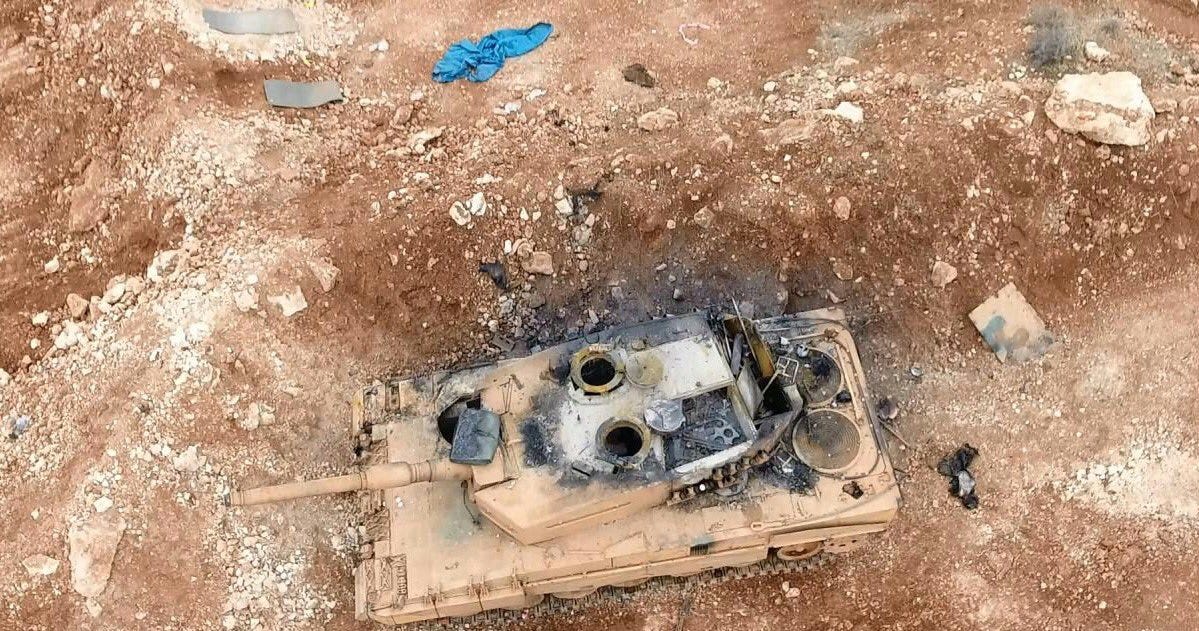
A burned out Leopard in Syria
It must be stated, again, that there is nothing wrong with western tanks. The Abrams and the Leopard are fine vehicles, but confidence in their game-changing capabilities stems from a mistaken assumption about the role of armor. It must be appreciated that tanks always have been and always will be mass-consumption items. Tanks blow up. They are disabled. They break down and are captured. Tank forces attrit – much faster than people expect. Given that the brigades prepared for Ukraine’s assault on the Zapo line were significantly understrength in vehicles, it was simply irrational to expect them to have an oversized impact. This is not to say that tanks aren’t important – armor remains critical to modern combat – but in a peer conflict one should always expect to lose armor at a steady clip, especially when the enemy retains fires superiority.
One can see, then how a measure of hubris can easily creep in to Ukrainian thinking, fueled by a healthy dose of desperation and strategic need. Reasoning from a distorted understanding of its successes in Kharkov and Kherson, emboldened by their shiny new toys, and guided by an overriding strategic animus that requires them to unlock the front somehow, the idea of a frontal attack without strategic surprise against a prepared defense really could seem like a good idea. Add in the good old fashioned trope about Russian incompetence and disorder, and you have the recipe for an imprudent roll of the dice by Ukraine.
So now we come to the operational minutia. For a variety of reasons, Ukraine has chosen to attempt a frontal assault on Russia’s fortified Zaporizhia front, with the intention of breaching towards the sea of Azov. How can this be accomplished?
We had a few clues early on, accruing from a variety of geographic features and alleged intelligence leaks. In May, the Dreizin Report published what was purported to be a Russian synthesis of Ukraine’s OPORD (Operational Order). An OPORD functions as a broad sketch of an operation’s intended progression, and the document shared by Dreizin was billed as a summary of Russia’s expectation for Ukraine’s offensive (that is, it is not a leak of Ukraine’s internal planning documents, but a leak of Russia’s best guess at Ukraine’s plans).
In any case, in a vacuum it was anybody’s guess as to whether Dreizin’s OPORD was authentic, but we’ve subsequently been able to cross-check it. This is because of the other, even more infamous leak from earlier this spring, which included the Pentagon’s combat power build plan for Ukraine.
NATO was very generous and built Ukraine a mechanized strike package from scratch. However, because this mechanized force was cobbled together with a variety of different systems from all corners of the NATO Cinematic Universe, Ukraine formations are uniquely identifiable by their particular combination of vehicles and equipment. So, for example, the presence of Strykers, Marders, and Challengers indicates the presence of the 82nd Brigade in the field, and so forth.
Thus, despite Ukrainian pretensions of operational security, it’s actually been trivially easy for observers to know which Ukrainian formations are in the field. There have been a few deviations from the script – for example, the 47th Brigade was supposed to field the Frankenstein Slovenian M55 tanks, but in the end the decision was made to send the underpowered M55’s to the northern front and the 47th was deployed with a contingent of Leopard Tanks originally operated by the 33rd Brigade. But these are minor details, and on the whole we’ve had a good sense of when and where specific AFU formations get on the field.
Based on identifiable units, the Dreizin OPORD looks very close to what we actually saw at the onset of the Ukrainian offensive. The Dreizin OPORD called for an assault by the 47th and 65th Brigades on the Russian lines south or Orikhiv, in the sector bounded by Nesterianka and Novoprokopivka. Directly in the middle of this sector is the town of Robotyne, and sure enough that’s where the first big AFU assault came overnight on June 7-8, spearheaded by the 47th Brigade.
Now, from this point it becomes difficult to evaluate the Dreizin OPORD simply because Ukraine’s attack became instantaneously derailed, but one thing we can say is that Dreizin’s source was correct about the order that Ukrainian units would be introduced into battle. Based on this, we can flesh out the OPORD and feel pretty safe wagering that this is what the Ukrainians were hoping to achieve:

Ukraine’s Dream: The Drive to the Sea
The intention seems to have been to force a breach in the Russian line using a concentrated armored assault by the 47th and 65th Brigades, after which a follow on force of the 116th, 117th, and 118th would begin the exploitation phase, driving for the Azov Coast and the towns of Mikhailivka and Vesele to the west. The objective was clearly not to get bogged down in urban fighting attempting to capture places like Tokmak, Berdyansk, or Melitopol, but to bypass them and cut them off by taking up blocking positions on the main roads.
Simultaneously, a lesser – but no less critical – thrust would come out of the Gulyaipole area and drive along the Bilmak axis. This would have the effect of both screening the main advance to the west and wedging the Russian front open, splintering the integrity of the Russian forces caught in the middle. Overall, this is a fairly sensible, if ambitious and uncreative plan. In many ways, this was really the only option.
So what went wrong? Well, conceptually it’s easy. There is no breach. The bulk of the maneuver scheme is dedicated to exploitation – reaching such and such a line, taking up this blocking position, masking that city, and so forth. But what happens when there’s no breach at all? How can such a catastrophe occur, and how can the operation be salvaged when it comes untracked in the opening phase?
Indeed, this is precisely what has happened. Ukraine finds itself stuck on the edge of Russia’s outermost screening line, spending substantial resources trying to capture the small village of Robotyne, and/or bypass it to the east by infiltrating the gap between it and the neighboring village of Verbove. So instead of that rapid breach and turning maneuver towards Melitopol, we get something like this:
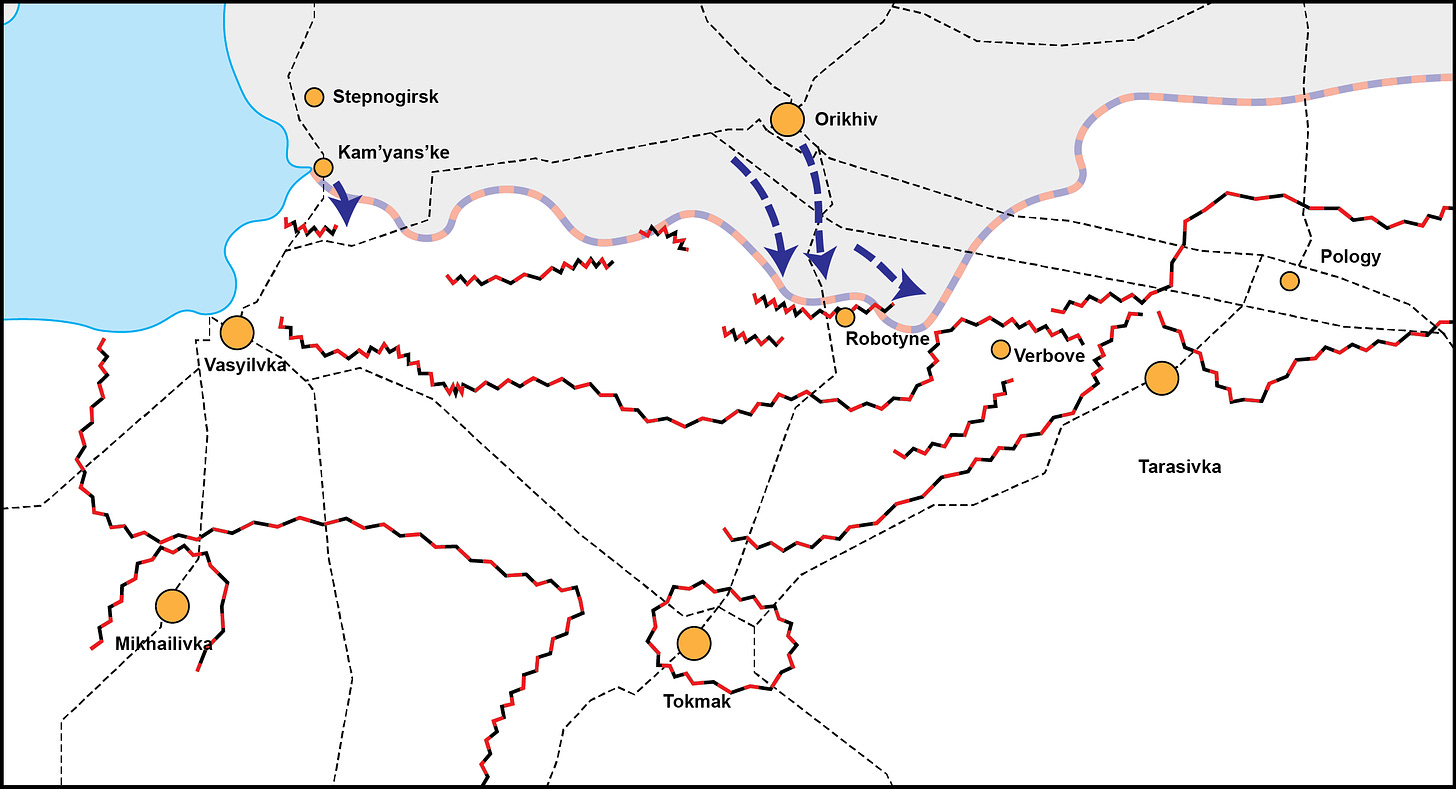
Ukrainian Counteroffensive with Mapped Russian Defensive Lines
We could be generous and say that Robotyne is the last village before the Ukrainian attack reaches the main Russian defensive belt, but we’d be lying – they will also have to clear the larger town of Novoprokopivka, two kilometers to the south. Just for reference, here’s a closer look at the mapped Russian defenses in the battlespace, based on the excellent work of Brady Africk.
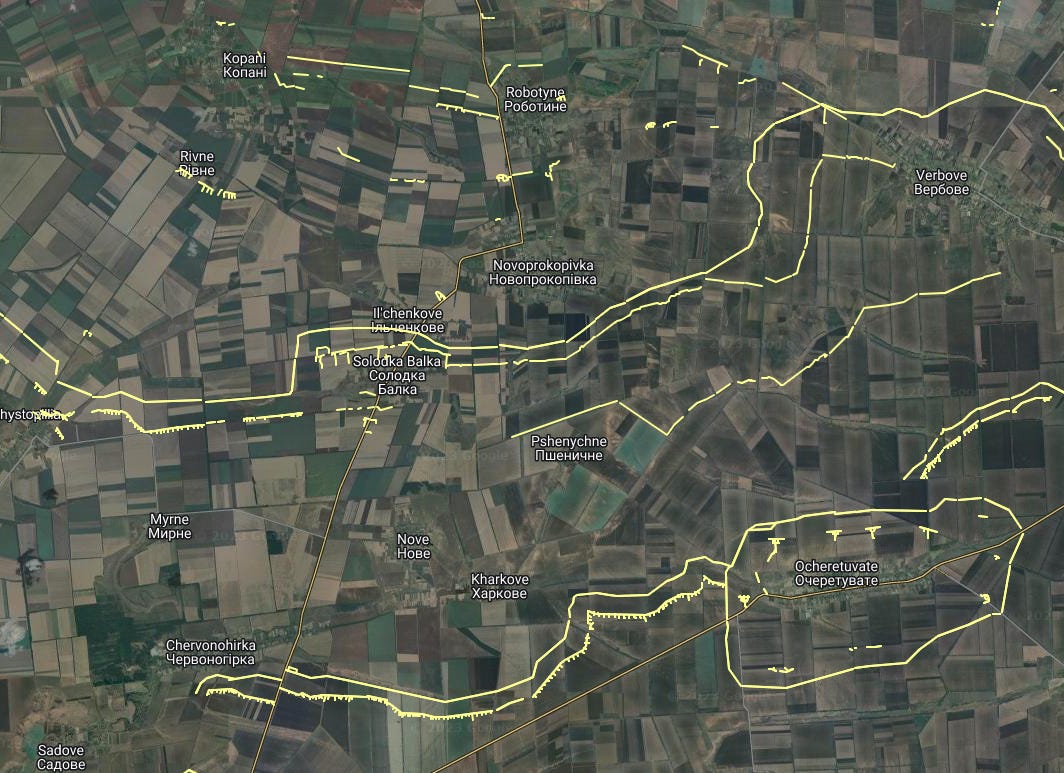
Russian defenses in the Robotyne Sector
The discussion about these emplacements can get a little muddled, simply because it’s not always clear what is meant by that popular phrase “first line of defense.” Clearly there are some defensive works around and in Robotyne, and the Russians chose to fight for the village, so in some sense Robotyne is part of the “first line” – but it is more proper to speak of it as part of what we would call a “screening line”. The first line of continuous fortifications across the front is several kilometers further south, and this is the belt that Ukraine has yet to even reach, let alone breach.
As of this moment, it appears that Russian troops have lost total control of Robotyne but continue to hold the southern half of the village, while Ukrainian troops in the northern half of the village remain subject to heavy Russian shelling. We should probably at this point consider the village to be continuously contested and a feature of the gray zone.
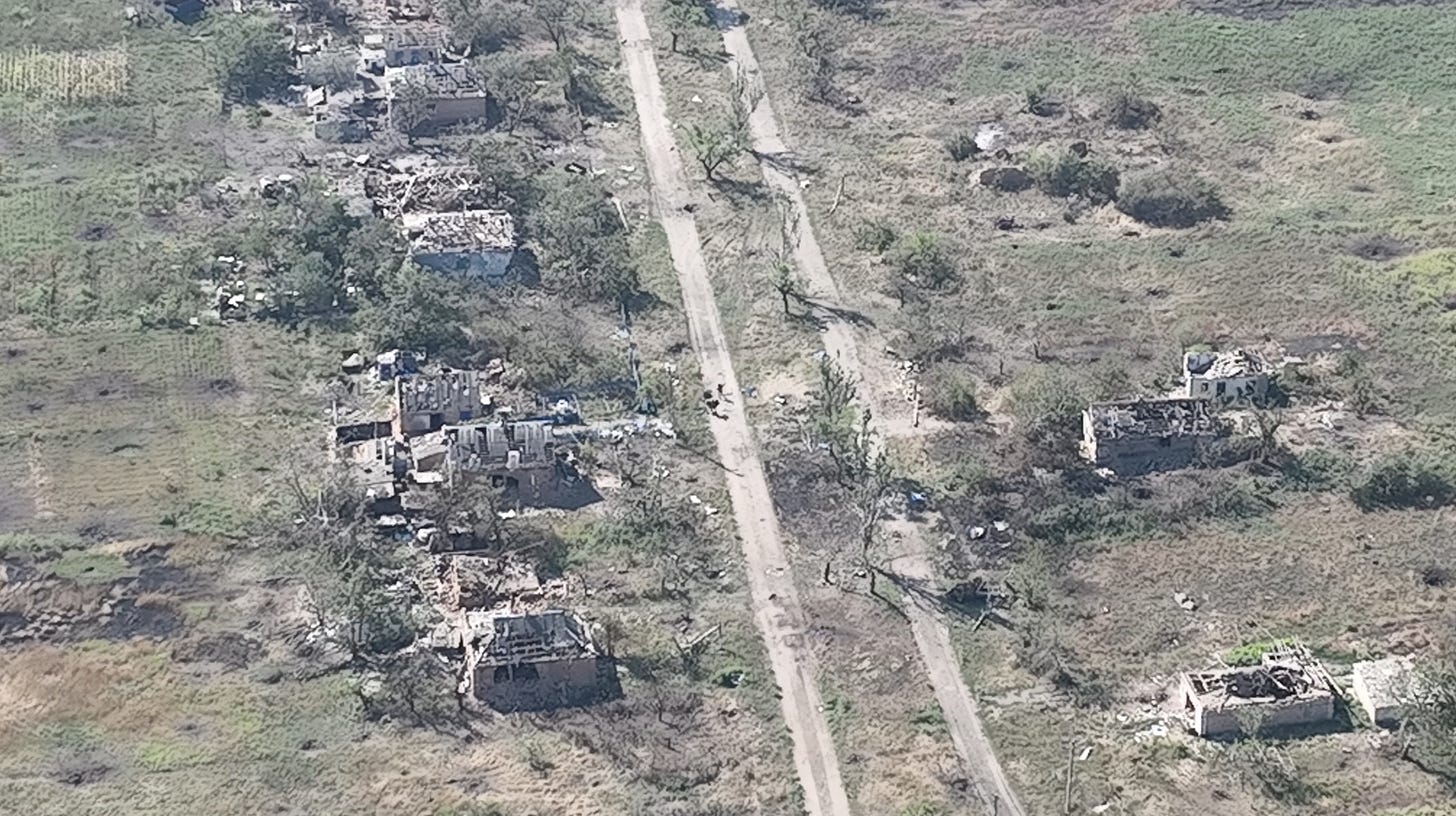
Robotyne, in all its glory
Now, a quick note about Robotyne itself and why both sides are so determined to fight for it. It seems rather odd on the surface, given that the Russian preference in 2022 was to make tactical withdrawals under their fires umbrella. This time though, they are fiercely counterattacking to contest Robotyne. The value of the village lies not only in its location on the T-0408 Highway, but also its excellent perch on top of a ridge. Both Robotyne and Novoprokopivka lie on a ridge of elevated ground which is as much as 70 meters higher than the low-lying plain to the east.
What this means is fairly simple; if the AFU presses forward in attempts to bypass the Robotyne-Novoprokopivka position by pushing into the gap between Robotyne and Verbove, it will be vulnerable to fire on the flanks (particularly by ATGMs) by Russian troops on the high ground. We already have seen footage of this, with Ukrainian vehicles being taken in the flank by fire from Robotyne. I am highly skeptical that Ukraine can even attempt an earnest assault on the first defensive belt until they have captured both Robotyne and Novoprokopivka.
This would all be a tough nut to crack under ideal circumstances, with a variety of engineering problems to mediate, obstacles designed to funnel the attacker into firing lanes, perpendicular trenches to allow enfilade fire on advancing Ukrainian columns, and robust defenses on all the major roadways. But these are not the best of circumstances. This is a tired force that has exhausted much of its indigenous combat power, which is attempting to organize the attack using a piecemeal and understrength assault package.
Several factors conspired against the Ukrainian offensive, and synergistically they have created a bona fide military catastrophe for Kiev. Let us enumerate them.
At this point, we need to acknowledge something that everybody missed about Russia’s defense. I previously expressed high confidence that Ukraine’s forces would be unable to breach the Russian defenses, but I mistakenly believed that the Russian defense would function according to the classic Soviet defense-in-depth principles (elucidated in great detail by the writings of David Glantz, for example).
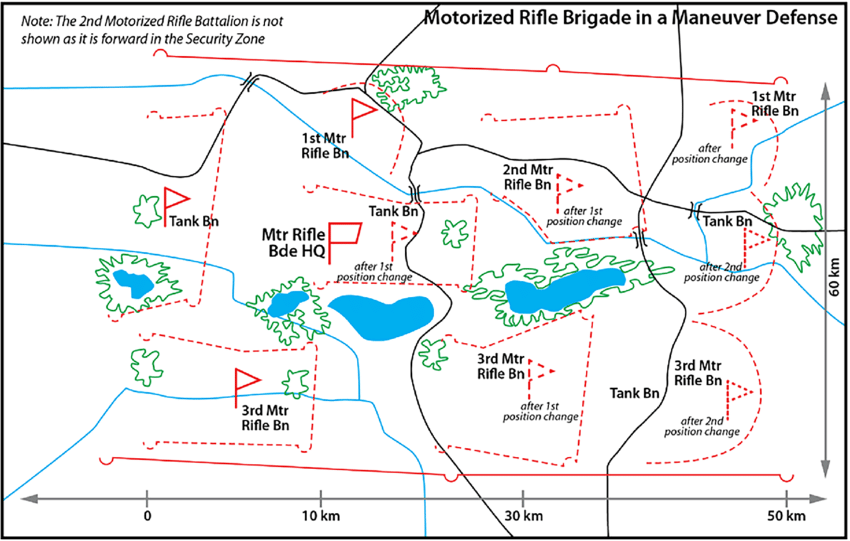
Idealized Defense in Depth by a Motor Rifle Brigade
Such a defense, put simply, is open to the idea that the enemy will breach the first or even second lines of defense. The purpose of the multilayered (or “echeloned” in the classic terminology) defense is to ensure that the enemy force gets stuck as it tries to break through. It may penetrate the first layer, but as it goes it is continually chewed up by the subsequent belts. The classic example is the Battle of Kursk, where powerful German panzers broke into the Soviet defensive belts but subsequently became stuck as they were ground down. You can think of this as being analogically similar to a Kevlar vest, which uses a web of fibers to stop projectiles: rather than bouncing off, the bullet is caught and its energy is absorbed by the layered fibers.
I was actually quite open to the idea that Ukraine would generate some penetration, but I anticipated them getting stuck in the subsequent belts and sputtering out.
What was missing from this picture – and this is a credit to Russian planning – was an unseen defensive belt forward of the proper trenches and fortifications. This forward belt consisted of extremely dense minefields and strongly held forward positions in the screening line, which the Russians evidently intended to fight for fiercely. Rather than breaking through the first belt and getting stuck in the interstitial areas, the Ukrainians have been repeatedly mauled in the security zone, and the Russians have consistently counterattacked to knock them back when they do manage to get footholds.
In other words, while we expected Russia to fight a defense in depth that absorbed the Ukrainian spearheads and shredded them in the heart of the defense, the Russians have actually shown a strong commitment to defending their forwardmost positions, of which Robotyne is the most famous.
On paper, Robotyne was expected to function as part of a so-called “crumple zone”, or “security zone” – a sort of lightly held buffer that puts the enemy through pre-registered fires before they bump into the first belt of continuous and strongly held defenses. Indeed, a variety of aerial and satellite surveys of the area taken before Ukraine went on the attack showed Robotyne laying well forward of the first solid and continuous Russian fortification belt.
What was missed, it seemed, was the extent to which the Russian defenders had mined the areas on the approach to Robotyne and were committed to defending within the security zone. The scale of the mining certainly seems to have surprised the Ukrainians, and creates a strain on Ukraine’s limited combat engineering capabilities. Even more importantly, the dense mines have created predictable avenues of approach for the Ukrainian forces, which force them to repeatedly run through the same gauntlet of fires and Russian standoff weaponry.
The signature image of the first great assaults on the Zapo Line has been columns of unsupported maneuver assets, being raked with Russian fires, both ground based (rocketry, ATGMs, and tube artillery) and from air platforms like the Ka-52 Alligator attack helicopter. One of the more startling aspects of these scenes was the way Ukrainian forces would come under heavy fire while still in their marching columns, taking losses before they ever deployed into firing lines to begin their assault proper.
There are myriad reasons for this. One is the now blasé issue of Ukrainian munition shortages. Consider the following items of interest. In the runup to Ukraine’s counteroffensive, Russia waged a heavy counter-preparatory air campaign that knocked out large AFU ammunition dumps. Ukraine’s initial assaults collapse in the face of heavy and unsuppressed Russian fires. The United States decides to transfer cluster munitions to Ukraine because, in the words of the president, “they’re running out of ammunition.” Add in the degradation of Ukrainian air defense, which allows Russian helicopters to operate with great effect along the contact line, and you have a recipe for disaster. Lacking the tubes to suppress Russian fires or the air defense to chase away Russian aircraft, the AFU opened their offensive by disastrously pushing forward unsupported maneuver elements into a hail of fire.
It’s crucial to understand that the Russian toolbox is fundamentally different than it was during the battle for Kherson last year, due to the rapidly expanding production of a variety of Russian standoff weapons – most notably the Lancet and the UMPK glide modifications for gravity bombs.
The Lancet in particular has been a star performer – there are claims that the trusty little loitering munition is responsible for nearly half of Russia’s artillery kills – and has filled a crucial capability gap that troubled the Russian army episodically throughout the first year of the war. Contrary to some western assessments that Russia simply could not manufacture drones in sufficient quantities, production of the Lancet has been successfully ramped up in a short period of time, and mass production of other systems like the Geran are coming online as well.

The Zala Lancet
The proliferation of the Lancet and similar systems means, in a nutshell, that nothing within 30km of the contact line is safe, and this in turn disrupts the AFU’s deployment of critical support assets like air defense and engineering, magnifying their vulnerability to Russian mines and fires. In fact, we’ve increasingly seen Ukrainian artillery use decline in the Robotyne area due to the threat of lancets (they seem to be transferring tubes to other fronts), and the AFU is favoring the use of HIMARS in the suppressive role.
Because the AFU failed to breach the Robotyne sector on their first attempt, they’ve been forced to continually move up additional units and resources to hammer on the position. This has particular implications, both in the sense that AFU forces must continually traverse the same lines of approach to contact, and in the fact that they are using the same rear area to assemble and stage their assault forces.
This makes the burden on Russian ISR (Intelligence, Surveillance, Reconnaissance) significantly easier, since the AFU has no effective way to disperse or hide the assets that they are bringing forward to the assault. Staged Ukrainian forces and material have been hid repeatedly in the villages immediately behind Orikhiv, like Tavriiske and Omeln’yk, and Russia is able to strike rear area infrastructure like ammunition depots because – to put it simply – there are only so many places these these assets can be staged when you are repeatedly assaulting the same 20km wide sector of front.
We recently had Ukrainian Deputy Minister of Defense Hanna Malair complaining that the 82nd Brigade – newly deployed to the Orikhiv sector – had been hit with a series of Russian airstrikes in its staging areas. According to her, this was because of poor OPSEC revealing the brigade’s location to the Russians. But this really makes very little sense; the entire area of operations around Orikhiv is perhaps 25km deep (from Kopani to Tavriiske) and 20 km wide (from Kopani to Verbove). This is a small area that has seen a huge amount of military traffic along the same roads throughout the summer. The idea that Russia needs insider information to know that they ought to surveil and attack targets in this area is absurd.
It actually takes significantly less damage to “destroy” an operational level unit than people think. A unit can become a combat scratch off at 30% losses (with some variance depending on how those are allocated). This is because when people hear the term “destruction”, they think that means total losses. Sometimes that’s how the word is used in colloquial conversation, but what matters for officers trying to manage an operation is whether or not a formation is combat capable of the tasks being asked of it – and those capabilities can vanish much more quickly than people realize.
This is particularly the case for the Ukrainian mech package, for a variety of reasons. For one, as we discussed in previous articles, these brigades started the fight well understrength (remember, for example, that the Ukrainian 82nd Brigade has only 90 Stryker AFVs, while an American Strkyer Brigade is supposed to have 300). Additionally, the cobbled together nature of these brigades – and the total lack of indigenous sustainment systems like repair and maintenance – means that the Ukrainians will naturally have to cannibalize these vehicles. They’ve already started designating “donor” vehicles that are written off completely to be stripped down for parts. The nexus of these two facts is that Ukraine’s mechanized brigades are understrength on vehicles to begin with, and will have an abysmally poor recovery rate, with hidden attrition behind the scenes due to cannibalization.
What this means is that when we heard admissions by mid-July that Ukraine had already lost 20% of its maneuver assets, there is an associated catastrophic decline in combat capability. The lead brigades – which chewed through 50% or more of their maneuver vehicles – can no longer shoulder combat tasks appropriate for a brigade, and the Ukrainians are forced to feed in their second echelon units prematurely.
At this point, partial elements of at least ten different brigades have been deployed in the Robotyne sector, with the 82nd likely to join them soon. Given that the NATO combat power build plan only included 9 NATO trained brigades, plus a few reconstituted Ukrainian formations, it’s safe to say that blooding all of them over a 71 day fight just to break into the screening line was not in the plan.
I’ve seen a variety of analysts and writers lately arguing that the insertion of additional Ukrainian units into the Robotyne sector signals the next phase of the operation.
This is nonsense. Ukraine is still mired in the first phase. What has happened is instead that the attrition of their first echelon brigades has forced them to commit their second (and third) wave to complete the tasks of the opening phase. The initial attack, led by the 47th Brigade, was intended to create a breach in the Russian screening line around Robotyne and advance to the main Russian belt further to the south. They failed, and the additional brigades earmarked for exploitation – the 116th, 117th, 118th, 82nd, 33rd, and more – are now being systematically fed in to keep the pressure on.
These brigades have not been destroyed, of course, simply because they are not being committed in their entirety, but rather as subunits. Nevertheless, at this point Ukrainian losses make up the better part of a whole brigade, distributed around the broader package, and over 300 maneuver elements (tanks, IFVs, APCs, etc) have been scratched off.
We need to say this very explicitly. Ukraine has not moved on to the next phase of their operation. They are stuck in the first phase, and have been forced to prematurely commit portions of the second echelon that was earmarked for later action. They are slowly but surely burning through the entire operational grouping, and so far they have not breached Russia’s screening line. The great counteroffensive is turning into a military catastrophe.
Now, this does not mean that the operation has failed, simply because it is still ongoing. History teaches us that it is unwise to make definitive pronouncements. Luck and human factors (bravery and intelligence, cowardice and stupidity) always have something to say. However, the trajectory is undeniably towards abject failure at the current moment.
So far, the AFU has shown some adaptability. In particular, we’ve recently seen them shift away from pushing forward unsupported columns of mechanized assets – instead they’ve been leaning on small dismounted units, trying to slowly push forward into the space between Robotyne and Verbove. The move towards dispersal is intended to reduce loss rates, but it also reduces the probability of a dramatic breakthrough even further and marks the temporary abandonment of decisive breaching action in favor of – once again – creeping positional warfare.
We would be remiss if we failed to note that there have been meaningful Russian losses in all of this. We know that the Russian forces in the Robotyne sector have required rotation and reinforcement, including with elite VDV and Naval Infantry units. Russia has taken counterbattery losses, it has lost vehicles in counterattacking action, and men have been killed holding their trenches. The initial assault groups that the Ukrainians threw in had a lot of combat power, and the fighting was very bloody for both sides. It’s not a one-sided shooting gallery, but a high intensity war.
But therein is the crux of the matter – Ukraine seems unable to escape the attritional and positional war that it finds itself in. It sounds all well and good to proclaim a return to “maneuver” warfare, but if there is an inability to breach enemy defenses, this is only an empty boast, and the nature of the struggle remains attritional. When the question becomes “will we breach before we run out of combat power”, you are not maneuvering. You are attriting.
In my series of articles on military history, we’ve looked at a variety of cases where armies tried desperately to unlock the front and restore a state of operational maneuver, but when there is no technical capacity to do so, these intentions do not matter one bit. Nobody wants to be trapped on the wrong side of attritional mathematics, but sometimes what you want does not matter at all. Sometimes attrition is imposed on you.
In the absence of the capabilities required to successfully breach Russia’s prodigious defenses – more ranged fires, more air defense, more ISR, more EW, more combat engineering, more more more – Ukraine is trapped in a rock fight. Two fighters are swinging bats at each other, and Russia is a bigger man with a bigger bat.
Amid a clear misfire and growing strategic disappointment, two new suggestions have increasingly crept into the conversation – “copes”, if you will, that are utilized as a narrative comfort to explain why the Ukrainian operation is actually going just fine (despite nearly universal acknowledgment in the west that the results have been lackluster at best). I would like to briefly address each of these in turn.
You frequently see it argued that all the AFU has to do is break open the Russian screening line, and the remainder of the defenses will fall like dominos. The general thrust of this argument is that the Russians lack reserves and that the subsequent defensive lines are not adequately manned – just break open the first line, and the rest will fall apart.
This is probably a comforting thing to tell oneself, but it’s rather irrational. We could talk, for example, about Russia’s doctrinal schema for defense in depth, which prescribes liberal allocation of reserves at all depths of the defensive system, but it’s probably more fruitful to point at more immediate evidence.
Let us simply consider Russia’s behavior over the last six months. They have spent a tremendous amount of effort constructing echeloned defenses – are we really to believe that they did all this only to waste all their combat power fighting in front of these defenses? Nor is there any evidence that Russia is having trouble supplying the front with manpower at the present moment. We’ve seen continued rotations and redeployments amid an overall process of military enlargement in Russia. Indeed, of the two belligerents, it is Ukraine that seems to be scraping the barrel for manpower.
This is the more fantastical story, and it represents a radical ad-hoc shift of the goalposts. The argument is that Ukraine doesn’t actually need to advance to the sea and physically cut the land bridge, all it has to do is get the Russian supply routes within firing range to cut off Russian troops. This theory has been advanced liberally on Twitter X and by personalities like Peter Zeihan (a man who knows nothing about military affairs).
There are many problems with this line of thought, most of which stem from an inflated notion of “fire control.” To put it simply, being “in range” of artillery fire does not imply effective area denial or severed supply lines. If that were the case, Ukraine would be unable to attack out of Orikhiv at all, since the entire axis of approach is within Russian firing range. In Bakhmut, the AFU continued to fight long after their main supply routes came under Russian shelling.
The simple fact is that most military tasks are conducted within range of at least some of the enemy’s ranged fires, and the idea that Russia will collapse if the AFU manages to put a shell on the Azov coastal highway is fairly ridiculous. In fact, Russia’s main rail line is already within range of Ukrainian HIMARS, and the Ukrainians have successfully launched strikes on coastal cities like Berdyansk. Meanwhile, Russia strikes at Ukrainian sustainment infrastructure with regularity – yet neither army has collapsed yet. This is because ranged fires are a tool to improve attritional calculus and further operational goals – they do not magically win wars just by tagging the enemy’s supply roads.
Let’s be charitable though, and indulge this line of thinking. Suppose the Ukrainians managed to advance – not all the way to the coast, but far enough to bring Russia’s main supply routes within range of artillery. What would they do? Wheel up a battery of howitzers, park them at the very front line, and begin firing nonstop at the road? What do you think would happen to those howitzers? Counterbattery systems would surely set upon them. The idea that you can just haul up a big gun and start taking potshots at Russian supply trucks is really quite childish. Putting enemy forces out of supply has always required physically blocking transit, and that’s what Ukraine will have to do if they want to cut Russia’s land bridge.
I am cognizant of the fact that I would be raked over the coals if I failed to discuss a secondary area of Ukrainian effort, farther to the east in Donestk oblast. Here, the Ukrainians have worked their way a good distance up the highway out of the town of Velyka Novosilka capturing several settlements.
The problem with this “other” Ukrainian attack is that it is, in a word, inconsequential. This axis of advance is operationally sterile in a very fundamental way, as it involves pushing groups up a narrow corridor of road that doesn’t lead anywhere important. As in the Robotyne sector, the AFU is still quite some distance from any of the serious Russian fortifications, and to make matters worse the road and settlements on this axis lay along a small river. Rivers, as we know, flow along the floor of the terrain, which means the roadway sits at the bottom of a wadis/embakement/glacis, choose your terminology. In fact, the road network as such consists of nothing except a single-lane roadway on either side of the river.
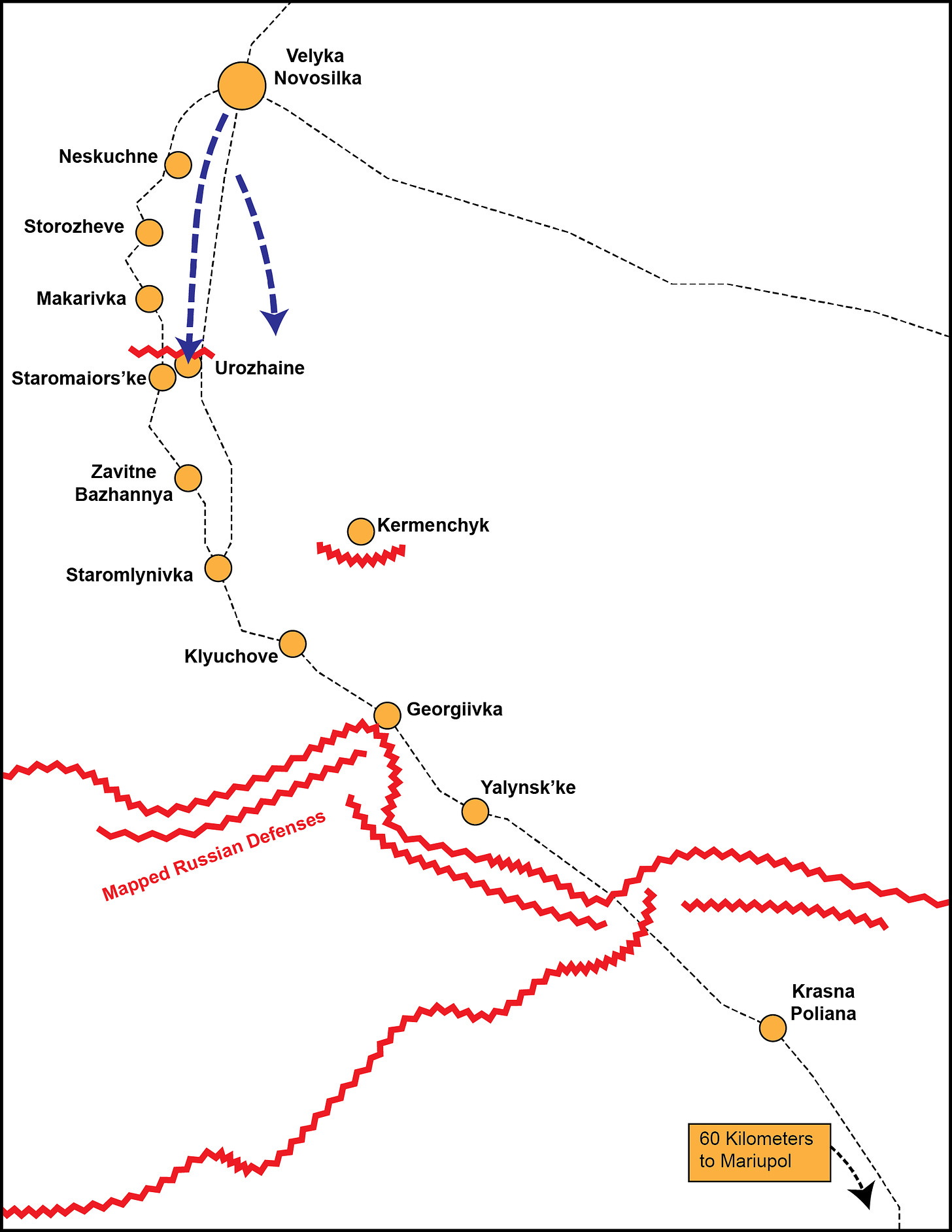
The Sideshow in the East
My reading of this axis is essentially that it was intended as a feint to create some semblance of operational confusion, but when the primary effort on the Orikhiv axis turned into a colossal misfire, the decision was made to continue to press here simply for narrative purposes. Ultimately, this is simply not an axis of advance that can exert a meaningful influence on the wider war. The forces deployed here are relatively miniscule in the grand scope of things, and they aren’t going anywhere important. Certainly, a thin, needlelike penetration is not going to drive more than 80 kilometers down a single lane road to the sea and win the war.
One of the surest signs that Ukraine’s counteroffensive has taken a cataclysmic turn is the way Kiev and Washington have already begun to blame each other, conducting a postmortem while the body is still warm. Zelensky has blamed the west for being too slow to deliver the requisite equipment and ammunition, arguing that unacceptable delays allowed the Russians to improve their defenses. This strikes me as rather obscene and ungrateful. NATO built Ukraine a new army from scratch in a process that already required greatly truncating the training times.
On the other hand, western experts have begun to blame Ukraine for supposedly being unable to adopt “combined arms warfare”. This is really a very nonsensical attempt to use jargon (incorrectly) to explain away problems. Combined arms simply means the integration and simultaneous use of various arms like armor, infantry, artillery, and air assets. Claiming that Ukraine and Russia are somehow cognitively or institutionally incapable of this is extremely silly. The Red Army had a complex and extremely thorough doctrine of combined arms operation. One professor at the US Arms School of Advanced Military Studies said: “The single most coherent core of theoretical writings on operational art is still found among the Soviet writers.” The idea that combined arms is some foreign and novel concept to Soviet officers (a caste that includes the Russian and Ukrainian high command) is ridiculous.
This issue is not some sort of Ukrainian doctrinal obstinacy, but a combination of structural factors rooted in the insufficiency of Ukrainian combat power and the changing face of warfare.
It’s frankly a little silly to say that Ukraine needs to learn about “combined arms” when they are very simply lacking important capabilities that would make a successful maneuver campaign possible – namely, adequate ranged fires, a functioning air force (and no, F-16’s will not fix this), engineering, and electronic warfare. The issue very fundamentally is not one of doctrinal flexibility, but of capability. By way of analogy, this is a bit like sending a boxer out to fight with a broken arm, and then critiquing his technique. The problem is not his technique – the problem is that he’s injured and materially weaker than his opponent. So too, the problem for Ukraine is not that they are incapable of coordinating arms, the problem is that their arms are shattered.
Secondly – and this, I admit, is rather shocking to me – western observers do not seem open to the possibility that the accuracy of modern ranged fires (be it Lancet drones, guided artillery shells, or GMLRS rockets) combined with the density of ISR systems may simply make it impossible to conduct sweeping mobile operations, except in very specific circumstances. When the enemy has the capacity to surveil staging areas, strike rear area infrastructure with cruise missiles and drones, precisely saturate approach lines with artillery fire, and soak the earth in mines, how exactly can it be possible to maneuver?
Combined arms and maneuver are predicated on the ability to rapidly concentrate enormous fighting power and attack with great violence at narrow points. This is probably impossible given the density of Russian surveillance, firepower, and the many obstacles they have put up to deny Ukrainian freedom of movement and scleroticize their activity. The main examples of maneuver in recent western memory – the campaigns in Iraq – have only tenuous relevance to circumstances in Zaporizhia.
Ultimately, we have returned to a war of mass – particularly massed ISR assets and fires. The only way Ukraine can maneuver the way they want is to break open the front, and they can only do this with more of everything – more mine clearing equipment, more shells and tubes, more rocketry, more armor. Only mass can crack open a suitable breach in the Russian lines. Otherwise, they are stuck in a positional creep through the dense Russian defenses, and criticizing them for being unable to grasp some sort of magical western notion of “combined arms” is the strangest sort of finger pointing.
So, whence goes the war from here? Well, the obvious question to ask is whether we believe Ukraine will ever have a more potent assault package than the one they started the summer with. The answer clearly seems to be no. It was like pulling teeth to scrape together these understrength brigades – the idea that, following on a defeat in the Battle of Zaporizhia, NATO will somehow put together a more powerful package seems like a stretch. More to the point, we have American officials saying fairly explicitly that this was the best mechanized package Ukraine was going to get.
It does not seem controversial to say that this was Ukraine’s best shot at some sort of genuine operational victory, which at this point seems to be slowly trickling away into modest but materially costly tactical advances. The ultimate implication of this is that Ukraine is unable to escape a war of industrial attrition, which is precisely the sort of war that it cannot win, due to all the asymmetries that we mentioned earlier.
In particular, however, Ukraine cannot win a positional-attritional war because of its own maximalist definition of “winning.” Since Kiev has insisted that it will not give up until it returns its 1991 borders, an inability to dislodge Russian forces poses a particularly nasty problem – Kiev will either need to admit defeat and acknowledge Russian control over the annexed areas, or it will continue to fight obstinately until it is a failed state with nothing left in the tank.
Trapped in a bat fight, with attempts to unlock the front with maneuver coming to naught, what Ukraine needs most is a much bigger bat. The alternative is a totalizing strategic disaster.
August 29, 2023
Posted by aletho |
Militarism | Russia, Ukraine |
Leave a comment
The Kyiv Post reported on Zelensky’s latest TV interview here, the highlights of which will be shared below and then analyzed in the larger context of the NATO-Russian proxy war in Ukraine:
* Zelensky is tacitly walking back his envisaged maximalist endgame by already declaring victory
– “It’s already clear that he [Putin] has not occupied us as he wanted. We did it, [we defended against his attack], this is already a great victory for the people.”
* He’s preparing the public for freezing the conflict along the lines of the Israeli-Palestinian one
– “We are ready to fight for a long time without losing people. It can be so. Minimize casualties following Israel’s example. You can live like that.”
* Ukraine believes that it’ll lose Western support if it invades Russia’s pre-2014 territory
– “There would be a big risk that we would be definitely left alone and on our own.”
* The “Israeli model” will likely characterize US-Ukrainian ties for the indefinite future
– “From the US, we probably have the Israeli model, where there are weapons, technologies, training, and financial aid.”
* Hard and soft security guarantees are actively being pursued
– “With the United States, it will be a more powerful bilateral treaty, with Britain – a strong one. There are states that simply do not have weapons, but they have finances, serious sanctions in case of repeated aggression.”
* An official NATO intervention could trigger World War III
– “We don’t need them, because it would be a NATO war, and that would mean the Third World War.”
* Ukraine might abandon military means for reconquering Crimea
– “I believe that it’s possible to politically push for the demilitarization of Russia on the territory of the Ukrainian Crimea. That would be better. Any combat would still have losses [casualties], wherever it is. Everything must be calculated.”
* Elections can be held next year if the West foots the bill and observers are sent to the trenches
– “If you [allies] are ready to give me 5 billion because I can’t just take 5 billion from the state budget. It seems to me that this is the amount needed to hold elections at a normal time. And in wartime, I don’t know what this amount is, that’s why I said – if the US and Europe give us financial support.
I’m sorry, I’m not asking for anything. I will not hold elections on credit. I will not take money from weapons and give it for elections either. The most important thing: let’s take risks together. The observers should then be in the trenches, they will need to be sent to the front line”
* Ukraine is now allegedly producing NATO weapon systems
– “We have domestic artillery on the battlefield today, using NATO-standard 155mm shells, which have never been seen before in Ukraine. We now have production and production of not one system, but several systems.”
These highlights show how drastically the conflict’s dynamics have shifted in the nearly three months since the counteroffensive began.
The first takeaway from Zelensky’s interview is that the counteroffensive failed, which is why he’s preparing the public for freezing the conflict. This is being achieved by already declaring victory, suggesting that Crimea can be reconquered through political means instead of military ones on the pretext of saving his soldiers’ lives, and referencing the Israeli-Palestinian conflict as a future model. Ahead of that scenario, he wants to reassure his people that the West will still ensure their security.
To that end, he brought up the “Israeli model” as the likely way forward for US-Ukrainian relations together with a mix of hard and soft security guarantees from other NATO countries. Zelensky also appears aware of the Western public’s growing concerns that he’s leading everyone to World War III, which might be why he explicitly ruled out invading Russia’s pre-2014 territory together with denying that he has any interest in NATO formally intervening in his side’s support.
About that, it’s already involved in this conflict via the arms, intelligence, logistics, mercenary, training, and other forms of support that it’s provided to the Ukrainian Armed Forces, but this is still below the level of dispatching uniformed troops to kill Russian soldiers. It also can’t be discounted that he’s worried about Poland unilaterally intervening in Western Ukraine, which readers can learn more about here and here, and that could be another reason why he warned that NATO troops could lead to World War III.
As for holding the now-delayed parliamentary elections sometime next year and not delaying the upcoming presidential ones that are scheduled for spring, this is a direct result of the pressure that Senator Lindsey Graham exerted on Zelensky during their meeting in Kiev last week. It’s the latest evidence that the failed counteroffensive is widening preexisting differences between the US and Ukraine all across the board, in this case over superficial commitments to “democracy”.
Readers can learn more about the latest difficulties in their ties by reviewing the following analyses:
* “A Vicious Blame Game Is Breaking Out After The Counteroffensive Predictably Failed”
* “US Policymakers Are Caught In A Dilemma Of Their Own Making After The Failed Counteroffensive”
* “The NYT & WSJ’s Critical Articles About Kiev’s Counteroffensive Explain Why It Failed”
In sum, both sides know that the counteroffensive failed, but neither wants to take responsibility for this.
A ceasefire of some sort therefore appears inevitable. The problem, however, is that freezing the conflict entails considerable reputational damage to the American and Ukrainian leaderships. Neither has yet to feel comfortable enough that their people fully blame the other for this debacle, hence why they remain reluctant to take the first step in what might then become a fast-moving process. It’s for this reason why they continue blaming each other and will likely continue doing so for the next few months at least.
President Putin made it clear on three occasions in mid-June that he was still interested in politically resolving the proxy war, but Zelensky’s latest claim that Ukraine is allegedly producing NATO weapon systems means that his reputation might also be damaged if he agrees to a ceasefire. After all, the special operation was partly commenced to demilitarize Ukraine and specifically eliminate the threat that NATO’s clandestine expansion there posed to Russia’s objective national security interests.
With Ukraine now openly producing NATO weapons systems, President Putin either has to ensure that these facilities are destroyed before agreeing to a ceasefire or informally freezing the conflict otherwise he stands to “lose face” among his domestic audience by tolerating this latent military threat. It might also be the case that Zelensky is just bluffing and could have lied about this just to make his Russian counterpart look bad in the event of a ceasefire, however, though nobody can really say for sure.
In any case, the Ukrainian leader’s latest TV interview drove home the point that the conflict’s dynamics have drastically shifted. Zelensky is clearly preparing his people for a ceasefire, but he’s also talking about security guarantees from NATO and his country’s alleged production of its weapon systems, both of which will rankle Russia. The US’ recent elections pressure on him is for purely soft power purposes, but it still shows that their differences on a host of issues are growing after the failed counteroffensive.
Looking forward, observers can expect the aforesaid to widen, but not to the point of rupturing their relations. The US-Ukrainian blame game will intensify during this period too as each side prepares their people for the seemingly inevitable scenario of freezing the conflict. As this is happening, Russia might also begin preparing its own people for the same, which could move the conflict towards the Israeli-Palestinian model by sometime next year unless something serious happens to derail this trajectory.
August 29, 2023
Posted by aletho |
Aletho News | NATO, Russia, Ukraine, United States |
Leave a comment
The Russian Army is actively using advanced drones in its special military operation zone in Ukraine, amid Kiev’s bungled counteroffensive, which has claimed the lives of thousands of Ukrainian soldiers.
The Ukrainian Armed Forces (UAF) no longer have a drone advantage over Russian troops, a US magazine has reported, adding that the time when Kiev had better unmanned aerial vehicles (UAVs) than Moscow did has passed.
The magazine quoted Ukrainian drone pilot Nikolai Voroshnov as saying that the UAF is “starting to fall behind significantly” in terms of drone warfare.
He specifically referred to the “effective” Russian jamming aimed at tackling Ukrainian drones. “Six months ago, this was not the case: we could fly anywhere, as we wanted. Now, if you enter at a low altitude, the [Russian] anti-drone [systems] will definitely work on you,” Voroshnov said.
The US media outlet noted in this regard that “the Kremlin successfully has institutionalized the acquisition of small drones, including speedy first-person-view (FPV) racing drones […] that operators can fit with explosives and fly directly into enemy vehicles and trenches.”
According to the magazine, the Russian military is “buying FPV drones by the hundreds and training regular troops to fly them via virtual-reality headsets”. The UAF, in contrast, “largely still rely on donations to buy FPV drones—and volunteers to operate them,” the news outlet added.
The magazine also mentioned the Russian Armed Forces’ new tactics that stipulate close interaction between various types of drones and fighter bombers carrying satellite-guided glide-bombs.
“It all starts with aerial reconnaissance by Russian Orlan, Zala or Supercam drones carrying day-night cameras. The recon drones spot Ukrainian forces, and then the Lancets, FPV drones and fighter-bombers zero in,” the news outlet pointed out.
The developments unfold against the backdrop of the Ukrainian Army’s futile attempts to break through the Russian defensive lines, a counteroffensive that President Vladimir Putin said brought no result, causing huge losses in the UAF’s men and materiel.
According to the Russian Defense Ministry’s estimates, Ukraine has lost about 43,000 troops and 4,900 units of military equipment since the beginning of the counteroffensive on June 4.
August 29, 2023
Posted by aletho |
Aletho News | Russia, Ukraine |
Leave a comment
The war can only end when it helps Biden reelection
I am surely not the only one who has noticed that the defensive propaganda lines that are flowing out the Democratic Administration have become more than ordinarily ridiculous of late. One is astonished at the melding of fact and fiction to create narratives that depict the White House and all that pertains to it as forging a new and more wonderful country. Wasn’t “Build Back Better” the battle cry, whatever that is supposed to mean? And the spin is endless, even when a clueless Joe Biden belatedly winds up in Maui to relate to the tragedy in which at least 1,000 died, only to be greeted by surviving local residents saluting the president with their middle fingers upraised. As the president looked out over the destruction of an entire city by fire he reminisced by recalling his long ago “almost” encounter with a fire in his kitchen. Locals who were screaming for help from government were, in fact, getting almost nothing while the nation’s Chief Executive was in the Oval Office gloating over sending another $23 billion to the arch crook Volodymyr Zelensky of Ukraine, money to fight a war that Biden encouraged and has blithely entered into.
Washington politicians characteristically have no morals and are driven only by their desire to perpetuate their party’s dominance so that the corruption that makes so many of those who adhere to the process rich, including Joe Biden continues. How do 500,000 dead Ukrainians and Russians matter if a myth about the United States and its values can be exploited to obtain electoral victory for Biden in 2024? As the greatly esteemed monster Madeleine Albright once put it, “I think it is worth it!”
I would suggest that our political class and the parasites that surround it are approaching depths not yet plumbed when I occasionally peruse articles or listen to speeches produced by the Washington DC spin machine. But even by that measure, I was appalled by a recent article that appeared in Politico and which immediately received considerable replay in other publications frequented by the inside-the-Beltway crowd.
Politico was acquired by Axel Springer, a German publisher in 2021, Europe’s largest newspaper and magazine conglomerate. Ideologically, some have described Springer publications’ political bias “as leaning left of center or moderate” but my personal exposure to the group since my army days in Germany has led me to believe that it is actually much more conservative than that. All employees at Springer, to include Politico, are expected to support the European Union, NATO, Israel, the war against Ukraine, the open society, and free market policies.
The article is entitled “Here Are 3 Ways to End the War in Ukraine. One Might Actually Work” with a subtitle “Putin has a veto over two endgames for Ukraine. But there’s a third that would bypass him.” The piece was penned by one Tom Malinowski, an assistant secretary of State for democracy, human rights and labor in the Obama administration before serving as a Democratic Party congressman from New Jersey’s 7th district between 2019 and 2023. He is currently under investigation by the Office of Congressional Ethics over “substantial reason to believe” that he had violated federal laws relating to conflicts of interest. He had reportedly traded and failed to disclose approximately $1 million of stock in medical and technical companies that would be receiving taxpayer assistance as part of the COVID-19 pandemic response, which would inevitably result in a large surge in stock values.
Malinowski is currently a senior fellow at the McCain Institute, one of those foundations funded by defense industries where politicians go to hide and get rich between terms in elected office. The Institute is a Washington DC based allegedly “nonpartisan think tank established in cooperation with Arizona State University.” Its declared mission is to “fight for democracy, human dignity, and security for a world that is free, safe, and just for all people.” Inevitably, it is rather selective in terms of who exactly benefits from its largesse and one might recall that its eponymous founder Senator John McCain hardly ever saw a war he didn’t like and once dismissed Vladimir Putin’s Russia as a “gasoline station pretending to be a real country.” McCain was also a major player in the “regime change” operation in Ukraine in 2014, suggesting that his judgement about America’s relationship with the rest of the world just might be a little flawed.
Malinowski is inevitably fully on board with the White House view of why the United States has gone whole hog in a proxy war against Russia that uses Ukraine as its instrument of choice . He says in his first paragraph that “’Ukraine will never be a victory for Russia — never,’ President Joe Biden said in a speech in Poland this year, and rightly so. For the war in Ukraine to end on terms consistent with American interests and ideals, Ukraine must be seen to have won, and Russia’s invasion must go down in history as a decisive failure, enough to deter other authoritarian powers from launching similar wars of aggression in the future.”
Malinowski poses his “3 Ways” as follows: first, for “its armed forces to take back all the territory Russia has unlawfully seized since its first invasion in 2014 — including Crimea. This would be a fantastic outcome. It is still possible. And the United States should do everything possible to support it, including, if Congress approves more funding, by providing the more advanced weapons Ukraine has requested.”
If Malinowski thinks armed victory by Ukraine is “still possible” he is delusional, but he does not seriously expect that outcome, except for the “more funding” part. His Second Way, also a “red herring” to disguise where he really wants to go, would be “through a diplomatic agreement. Earlier this month, 40 countries, including China and the United States, met in Saudi Arabia to discuss President Volodymyr Zelensky’s 10-point plan for peace, which would require the withdrawal of all Russian troops from Ukraine, the return of abducted children and justice for war crimes. Any settlement based on that plan would, of course, be wonderful. But Russia under Putin has never ended its wars at the negotiating table; at best it has frozen them, keeping its options open. Russia has shown zero interest in making concessions that would come close to the minimal requirements of Ukraine and its allies. As long as his military avoids total collapse, and he believes there is a chance of political change in the West, Putin will likely keep sacrificing Russians to stay in the fight.”
So Malinowski’s Second Way is a deliberately designed dead end and he, of course, blames it all on Putin. His actual “solution” would be the Third Way: “So if Russia manages to stymie plans A and B, where would that leave us by, say this time next year? Should Ukraine and its allies simply carry on, hoping for a breakthrough in 2025 or beyond? Given what’s at stake — not just the survival of Ukraine but of the whole international order — that would be risky. It would make success dependent on events we cannot predict or control, including on the outcome of elections in Western countries, including the United States. And while we have no right to tell Ukrainians to stop fighting before their country is whole, we also have no right to expect them to keep fighting at any cost. Fortunately, there is a third possible way to satisfy the need for Ukrainian success and Russian failure, over which Putin would have no veto.”
Malinowski requires that “the United States would give the Ukrainian military whatever it needs to advance as far as possible in its counteroffensive. At an appropriate point next year, Ukraine would declare a pause in offensive military operations and shift its primary focus to defending and rebuilding liberated areas while integrating with Western institutions. Then, at its July, 2024 summit in Washington, NATO would invite Ukraine to join the Western alliance, guaranteeing the security of all territory controlled by the Ukrainian government at that point under Article 5 of the NATO treaty… This would be a defensive pact, but not a commitment to take direct part in any future offensive operations Ukraine might choose to undertake. Ukraine joining NATO could itself be how the war ends, consistent with Biden’s current policy — and at a time and on terms set by Ukraine and its allies, not by Russia. Gaining security within NATO as a strong, pluralistic, democratic state would absolutely count as a victory for Ukraine — arguably as big as quickly regaining Crimea. It might make it politically possible for Zelensky, if he so chooses, to emphasize nonmilitary strategies for reclaiming any parts of his country still under Russian occupation, which Ukraine’s allies would also continue to support — potentially including anything from diplomacy and sanctions to blockade and sabotage… Adding a democratic Ukraine in NATO would mark the utter and permanent defeat of Putin’s crusade to absorb it into a Russian empire… Yes, Russian forces could try to go on the offensive again, but the likely futility of attacking fortified Ukrainian positions now backed by the threat of NATO firepower would be a strong deterrent. Meanwhile, sanctions on Russia would remain; its economic and military strength would continue to erode; and Putin could only watch as his frozen assets abroad are drawn down to pay for Ukraine’s reconstruction.”
It is easy to see what is wrong with the Malinowski Third Way apart from it being an open door to initiating a nuclear World War III. And one might suggest that it is also possible to discern the US domestic politics that are driving it. How the war in Ukraine ends all depends on Zelensky behaving rationally, which he is not renowned for, and he is quite capable of joining NATO before using a false flag or otherwise provoking an incident with Russia that would require NATO Article 5 intervention. Also, all the other parties involved would have to act predictably and sanely, including the US, which is unlikely. Zelensky in particular is desperate to draw the US and NATO into his war and will do whatever it takes to arrive at that point and his non-negotiable demand for full restoration of all Ukrainian territory including Crimea, endorsed by Malinowski, is a deal breaker that in any event Russia could not accept.
Even the up-until-now supportive US mainstream media is beginning to see the light and is admitting both that the highly touted Ukrainian counteroffensive has been a failure and that Ukraine has no ability to defeat Russia no matter how many weapons are put in the pipeline at great cost to sustain it. And there is also the fraud from the Biden regime that is taking place with reports that even the normally biddable CIA has been warning to no avail that the war is unwinnable. The fact that as many as half a million Ukrainians and Russians have already been killed or wounded is starting to hit home with both Americans and Europeans and will increase demands to end the fighting as unconditionally as necessary.
A final but very important point that must be made is the deliberate timing of Malinowski’s “3rd Way” which very conveniently presents Joe Biden with a great military victory just before the US presidential election, erasing all memories of the disgraceful withdrawal from Afghanistan. It apparently matters not that in doing so it continues a bloody and pointless war and destroys Ukraine as a state and as a people. Online substack observer Simplicius the Thinker describes how “Democrats will need all the help they can get. If a plan could be designed and packaged in a way where it can be sold as a major ‘victory’ then certainly Democrats will attempt to drag it out until the eve of the election to try to use ‘Biden’s major Ukrainian victory’ as a huge final hour boost.” Joe and Malinowski apparently believe that victory in an election is more important that finding the sanity to take steps to save hundreds of thousands of lives and they will continue to do whatever it takes to “win.” Sickening.
Philip M. Giraldi, Ph.D., is Executive Director of the Council for the National Interest, a 501(c)3 tax deductible educational foundation (Federal ID Number #52-1739023) that seeks a more interests-based U.S. foreign policy in the Middle East. Website is councilforthenationalinterest.org, address is P.O. Box 2157, Purcellville VA 20134 and its email is inform@cnionline.org.
August 29, 2023
Posted by aletho |
Corruption, Militarism | Russia, Ukraine, United States |
Leave a comment