THE PLANNING OF THE UKRAINE INVASION FROM THE RUSSIAN POINT OF VIEW (MAYBE)
By Gaius Baltar | SONAR | April 19, 2023
Recently I heard an “expert” offer the opinion that Putin and the Russian Army had made a serious mistake when they organized the “special military operation” (SMO) in the Ukraine the way they did. It would have been far better to just send the army into Lugansk and Donetsk to defend them rather than make an ill-advised dash toward Kiev.
Instead of following this belated advice from that expert, the Russians chose to move fast into northern and southern Ukraine. Why did they do that? There are many theories; some good, some illogical, and some completely incoherent. I thought it might be a good idea to step back and look at the situation before the SMO from the Russian point of view. Russians tend to be practical and logical people and the General Staff of the Russian Armed Forces probably more so than most. Their plan must have had logical reasons based on what they saw at the time. So, how did the Russians see the situation before the SMO, at the end of 2021? Let’s put ourselves in their shoes and come up with a theory. Note that this is not a theory of what did happen, only of what the Russians may have thought that might happen when they planned their SMO.
The defensive lines and the siege of the Donbass
The first thing the Russians must have noticed was the construction of the massive Ukrainian defensive lines around the Lugansk and Donetsk republics. The Ukraine Government had made no secret of their plan to capture the republics and the Ukrainian Army should have had an “offensive posture” rather than defensive. It makes perfect sense to construct defensive lines while planning an attack to prevent disruptive counterattacks, but the Ukrainian defenses went far beyond that. They were truly massive and built over a period of 8 years. We know how strong they were because it has taken the Russians more than a year to break through them.
The Russians must have taken a look at those defenses and reached the following conclusion: Their purpose is to contain the Russian Army if necessary – even if a large part of the Russian Army is used against them.
The second thing the Russians must have noticed was the absolute determination of the Ukrainians to attack the republics, even if this ensured a Russian response. We saw that determination when the Russian Government recognized their independence just before the war started. According to the OCSE artillery monitoring map, Ukrainian artillery attacks on the republics decreased right after the recognition of independence, but then increased again – most likely after having received orders from Kiev to keep going. At that point in time Russian involvement was ensured, but the Ukrainians still kept attacking the republics.
The Russians would have connected those two things; the determination to attack and the massive defenses. They must have come to the following conclusion: “They want us to attack through the Donbass, and then they are going to use those defensive lines to contain us. Why?”
The trap
Having observed all this the Russians must have started to think about the Ukrainian plans. They would have assumed that those plans were not just Ukrainian plans, but NATO plans as well. So, what were the Ukrainians and NATO planning?
The Russians must have made the following deduction: “The Ukrainians and NATO want us to attack through the Donbass and clash against those lines. Why would they want that? It must be because it is a precondition for some kind of plan on their part – some kind of larger plan. What is that larger plan?”
Then they must have thought about what it would take to confront the Ukrainian army in the Donbass and take on the defensive lines. What would that require? It would require a large force and a lot of time. That would mean that a considerable part of the Russian Army would be tied down there for quite some time. Was that perhaps the precondition for the larger Ukrainian/NATO plan? Was the whole thing perhaps about forcing the Russian Army to attack through the Donbass and taking on the defensive lines – specifically to tie it down – to keep it busy while the Ukrainians and NATO carried out the rest of their plan?
After having considered this, the Russians must have asked themselves the following question: “What do the Ukrainians and NATO want more than anything?” And since it’s actually the Americans and the British running the show: “What do the Americans and the British want more than anything?” The question isn’t hard to answer. What the Americans, the British, and the Ukrainians want more than anything is Crimea. Crimea is the key to “dominating” the Black Sea, and capturing it would be a dagger into the belly of Russia.
After having run through this logic, the Russians would have come to the conclusion that the Ukrainian attack on the Donbass republics and the defensive lines was a trap to tie them down. Then they started planning countermoves.
The Russian plan
The first thing the Russians may have thought about when planning the countermove was timing. How long after the war started would the Ukrainians move on the Crimean peninsula? They wouldn’t do it right away because they would want the Russian Army to be well and truly engaged in the Donbass before making a move. They would also not want to tip the Russians off by assembling a big force near Crimea before the Russians engaged the defensive lines in the Donbass. This would mean that the area north of Crimea, i.e. Kherson and Zaporizhzhia oblasts, would be lightly defended for a while.
After having reached this conclusion, the Russians put together a plan to preempt the Ukrainian/NATO plan. The plan had one main objective and two secondary objectives.
Objective 1 (main objective): To capture Kherson and Zaporizhzhia oblasts to create a buffer zone between Crimea and the rest of Ukraine. This objective had to be reached extremely fast while the area was still lightly defended. This operation was all-important at that point in time, far more important than anything happening in the Donbass or the Kiev area. Capturing Kherson was not enough to create the buffer zone because the Ukrainians had to be prevented from attacking the Crimean Bridge. The Zaporizhzhia coast line is only 150 kilometers from the bridge so Zaporizhzhia oblast had to be taken immediately as well.
Objective 2 (secondary objective): While a large part of the Ukrainian Army was positioned in the Donbass, there was still a large force kept back, possibly for the Crimean operation. This part of the Ukrainian army would have to be kept from engaging the Russian forces going after Kherson and Zaporizhzhia. The only way to do that was to threaten something that had to be defended at all cost, even at the cost of the Crimea plan. There was only one location the Ukrainians would defend at all cost outside the Donbass – Kiev itself. The Russians therefore decided to advance on Kiev in an extremely threatening manner. The forces they used were not sufficient to take Kiev outright but enough to hold the area north of the city and seriously threaten it. The Ukrainians would have no choice but to take the threat seriously and move forces toward Kiev, including the forces intended for the Crimean operation. This would prevent the Ukrainians from responding to the Russian occupation of Kherson and Zaporizhzhia oblasts.
Objective 3 (secondary objective): To force Ukraine to negotiate peace on Russian terms. The Russians most likely assumed that if the Kherson/ Zaporizhzhia buffer operation was successful the Ukrainians might want to negotiate. They would want to negotiate not only because Kiev was threatened, but primarily because their main objective, the capture of Crimea, had been thwarted. This part of the plan was partly successful because the Ukrainians were ready to sign a treaty before the Americans and the British intervened.
The conclusion from this (perhaps dubious) mind-reading of the Russian General Staff is that the main objectives of the initial Russian operation were Kherson and Zaporizhzhia, not Donbass, Kiev, or a treaty with the Ukrainians. When the negotiations fell through, the Russians moved back to their contingency plan with the main objective of destroying the Ukrainian Army.
It is important to keep in mind that this is not a theory intended to explain what happened. It is only a theory to explain the Russian plan based on what the Russians may have been thinking at the time. It’s highly speculative and perhaps wrong, but it explains a lot nevertheless – including Ukrainian and Western reactions to the Russian operation.
The Ukrainian plan
Let’s describe the theoretical Ukrainian/NATO plan before moving on. The plan, according to this hypothetical Russian pre-war theory, had three main objectives:
- To tie down the Russian Army in the Donbass using the massive defensive lines and a good part of the well-trained and well-equipped Ukrainian Army.
- To carry out a surprise attack on the Crimean peninsula, occupy it and turn the Black Sea into a NATO-controlled area – and putting massive pressure on Putin as a bonus. For this a significant part of the Ukrainian army was held back from the Donbass.
- To bog down and bleed the Russian Army in the Donbass with the goal of engineering a regime change in Russia. The sanctions blitz was planned as an integral part of that goal.
It’s April 2023 and so far none of these objectives have been achieved. Let’s assume that this theory is correct and this was actually the plan – and let’s look at what the Ukrainians and the West have been up to since it failed. Again, this is highly speculative.
The obsession with the plan
If we look at what the Ukrainians and the West have been doing in this war, a pattern seems to emerge: They still seem to be carrying out the initial plan, even though it failed. Almost every decision they make seems to be in accordance with the plan, or more specifically, in accordance with a pathological denial of the failure of the plan. Let’s look at a few examples:
The obsession with Crimea: The Ukrainians and the West are still planning to take Crimea, even though it is impossible. Still, the capture of Crimea is alive in their minds and a realistic option. Zelensky even at one point said that the Ukraine had started the liberation of Crimea … “in their minds.” Occupying Crimea was a part of the plan and abandoning Crimea means that the plan has failed.
The attack on the Crimean Bridge: Destroying the bridge was a part of the plan, and even after the Crimea was out of Ukraine’s grasp and the Russians had secured a land corridor to Crimea, the bridge was still a priority. It had to be attacked because that was a part of the plan. Now that itch has been scratched and they have, so far, not had the need to try again.
The obsession with Bakhmut: The Ukrainian Army has probably lost close to 40,000 soldiers defending Soledar and Bakhmut. The enclosed area is a kill zone for Russian artillery which the Ukrainians supply with endless cannon fodder. Even the Americans have doubts that hanging on to the city is the right option and the Ukrainians may even be willing to sacrifice their spring offensive to hold on to it just a little bit longer. More and more military experts are shaking their heads and talk about Bakhmut as a Ukrainian obsession, which it is. Holding Bakhmut prevents the last part of the plan from failing, i.e. to hold the Russian army on the other side of the defensive lines. If the Russians break through, the plan will have failed completely. Therefore Bakhmut must be defended.
The obsession with the sanctions: One of the biggest shocks of the war was the failure of the Western economic sanctions. The response of the West to the failure has been interesting. They didn’t cancel the sanctions or freeze them or rethink them. Instead they keep on sanctioning everyone and everything even though it is clearly pointless and even counterproductive. The situation is becoming increasingly surreal but they can’t stop. If they stop, the plan will have failed.
The initial panic
There is one other issue which the failure of the Ukrainian/NATO plan may explain. Every significant person in the West expected the Russians to invade the Ukraine before it happened. This was, in fact, what many of them wanted. One would have expected them to show indignation, to condemn the brutish Russians, and so on and so forth. The initial reaction in the West went far beyond that. There was extreme anger, panic and hysteria. There were even threats of using nuclear weapons. I always thought these reactions were far more extreme than the Russian invasion warranted. Why completely lose your mind over something you knew was going to happen? I suspect all the anger, the panic and the threats were because the Russians thwarted the Western Crimea plan. They were going to trick the Russians but the Russians tricked them instead. The Westerners were humiliated and nothing motivates anger and threats of nukes more than humiliation.
The anger and obsession with the failed plan in the Ukraine and the West are without doubt the result of the psychology and personality of the incredibly uniform Western and Ukrainian leadership class. They don’t accept personal failure easily, or the intrusion of reality into their plans. But that is a matter for another essay, and a long one at that.
Finally, remember that this is all speculation – a thought exercise if you will – but who knows…
Via col Vento in the United States of Amnesia: Whistleblowers, Leaks and Fratricide
Michael Hoffman’s Revelation of the Method | April 19, 2023
Fratricide is Satanism
Satanic activities are not the domain of one political wing. One of the most wicked black magic sacrifices occurred in the early 20th century, in a mass immolation known as the First World War, a useless fratricide, tantamount to an open air Satanic ritual, placating the devil with human sacrifices and approved by the churches.
Each church hierarchy among the belligerents declared that God was on the side of their army, and then dispatched young men in the flower of youth to cross oceans and trenches and butcher other young men in the flower of youth.
World War I was fought between traditional monarchies and conservative governments deeply entrenched in Christendom and nonetheless behaving diabolically. It was Churchianity in charge, not Christianity, and it reflected a self-deception that is quintessentially demonic.
In Ukraine at this moment another fratricide is underway—a civil war between Slavic people. It would be an understatement to say that the Cryptocracy is not generally fond of Slavs. The Cryptocracy’s aversion to Slavic people is one of the destabilizing facts that remans secret in what is otherwise the age of the Making Manifest of All that is Hidden (Revelation of the Method).
In 1941 Adolf Hitler stated, “The Slavs are a mass of born slaves who feel the need for a master” (cf. Manfred Henningsen, “The Politics of Purity and Exclusion” in Björn H. Jernudd (ed.), The Politics of Language Purism, [1989], p. 48). Hitler proceeded to kill millions of Slavs in combat in the course of his invasions of Slavic nations (Poland and later Russia).
Hitler’s occult beliefs (documented in our book, Adolf Hitler: Enemy of the German People) were partly the result of his initiation into “Theosophy,” an occult system that taught a “root races” ideology in which the “Aryan race” was held to be superior.
There are exceptions to Nazi racial animus toward Slavs. Hitler was an admirer of Józef Pilsudski (1867-1935), the Polish leader who vanquished the Bolshevik army in 1920. These individual cases do not however, nullify the fact that Hitler killed more Slavic people than any other leader of the 20th century, an act whose theurgic dimension is overlooked.
The Nazis’ post-war plans for Eastern Europe entailed deportations to gain “living space” for German settlers, with Poles, Russians and “western” Ukrainians targeted for mass extrusion to Siberia (cf. Czeslaw Madajczyk, “Vom ‘Generalplan Ost’ zum ‘Generalsiedlungsplan,” in Rössler, Der “Generalplan Ost”: Hauptlinien der nationalsozialistischen Planungsund Vernichtungspolitik [1993], p. 13).
As Hitler was useful, so too are Putin, Zelensky and Biden. The current fratricide in Ukraine is exceedingly pleasing to hidden forces beholden to esoteric doctrines and the very public Neocon element in the United States which, in spite of being wrong about every war the U.S. has fought in the 21st century, continues to drive foreign policy in Washington, under both Democrats and Republicans, feeding cash and war materiel to Zelensky’s regime in pursuit of maximum carnage between the Ukrainians and the Russians.
NATO’s Unsung Crimes
Prior to the anti-Slav abattoir in Ukraine, beginning with the Clinton administration, US General Wesley Kanne Clark commanded NATO forces in Slavic Serbia, bombing trains, buses and civilian centers in cities and killing thousands of civilians. Forces under his command also destroyed ancient Serbian churches and monasteries. There was no war crime trial because Clark attributed the killing and destruction to “collateral damage.” That’s the magic wand our government waves to dispense with prosecution by the International Court of Justice where the US is determined to prosecute Putin and absolve Zelesnsky.
On April 23, 1999 Clark’s NATO forces intentionally bombed a Serbian radio and TV station in Belgrade, killing 16 reporters and staff members. NATO excused the attack by asserting the barbaric doctrine that killing journalists is justified if they engage in propaganda: “NATO defended the air strike by saying the TV station was a legitimate target because of its role in what NATO called ‘Belgrade’s campaign of propaganda” (BBC, October 24, 2001).
These facts are down the Memory Hole’s greased chute. The New York Times and the corporate media generally don’t report crimes like those of NATO as part of any annual “This Day in History” memorial. To learn about them the enterprising researcher has to dig, and the American people are too distracted by digital and televised phantasmagoria to take up the spade.
Jack Teixeira’s Intel Leak and the Disclosure of Ukraine War Secrets
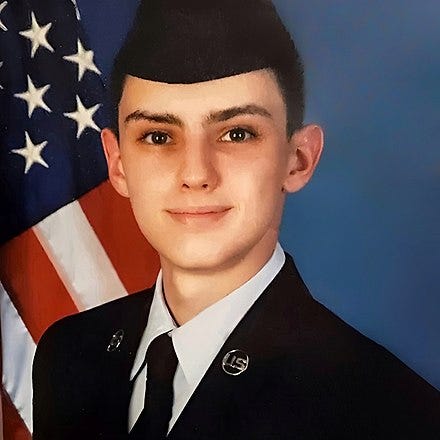
The recent disclosure of secret U.S. government files has resulted in reporting almost exclusively confined to the question of how the government’s security was breached. The secrets themselves contained have been mostly ignored or underplayed. The two most substantive revelations are the fact that US combat troops are stationed in Ukraine and the US intends to ensure that the fratricidal slaughter continues throughout 2023.
Glenn Greenwald: “There will be no negotiations, there will be no diplomatic settlement, there will be nothing but ongoing grinding, endless war that you will pay for beyond the $100 billion already authorized.”
The leak of NSA and CIA secrets has been treated as a grave criminal act by the media who were chiefly responsible for the apprehension of 21-year-old Massachusetts Air National Guardsman Jack Teixeira, as the result of a report published in the Washington Post of April 12, which led the FBI directly to the leaker.
The New York Times in an April 16 article, “Finding the Pentagon Leak Suspect,” also boastes of its role in assisting law enforcement in apprehending the whistleblower.
These facts should in the future dissuade any whistleblower gullible enough to trust that the Post and the Times will keep secret their revelations of government-perpetrated felonies.
“Why… would self-proclaimed journalism outlets do the job of the FBI and hunt down the leaker and boast of the fact that they were the ones who found him even before the FBI did?…
“There aren’t many ways to define the function of a free press and what journalism is without referencing the way in which journalists are supposed to bring transparency to the most powerful institutions… The idea of journalism, ostensibly, in theory, is to bring transparency to what the most secretive and powerful institutions are doing in the dark. Exactly what this leak did…
“One of the ways, arguably the only real way, that we, as journalists, now have to show the public what these institutions of power are doing in the dark is through leaks. Leaks of the things that they don’t want you to see, oftentimes being classified information.
“Classified information is not some sacred text. Classified information is nothing more than a document or a piece of information that the government has stamped on that word “classified” or “top-secret,” because they want to make it illegal for you to learn about it. That’s the effect of calling a document classified or top secret. And one of the things I learned in working with many large archives of government secrets and classified material is that, more often than not, when the government calls something classified or top secret, it’s not because they’re trying to protect you. It’s because they’re trying to protect themselves.
“They’re trying to make it illegal for anybody to show what it is that they’re saying and doing in the dark because what they’re saying and doing in the dark is composed of deceit, corruption, or illegality. And that’s why the most important journalism over the last 50 years…the Pentagon Papers, through the WikiLeaks reporting, the Snowden reporting… have taken place when people have been able to show you, the public, documents and other information that people inside the government wanted you not to see and made it illegal for anyone to show it to you”.
The spin-doctoring about leaks and the “need” for the Deep State to keep the truth about their treacherous machinations from the public, is an exercise in the artifice of political theater. The media, when it suits their purposes, appropriate to themselves the illustrious appellation of “patriot.” With the Federal government in the hands of tyrannical social engineers who keep the Cryptocracy’s esoteric grand design for the subjugation of our nation on schedule, leaking government secrets is now derided as unconditionally iniquitous—almost—though not quite.
We qualify our observation due to the fact that the media routinely leak the secrets the Deep States wants revealed. They pretended that an “unauthorized” CIA leaker revealed that Hunter Biden’s laptop was “Russian disinformation,” when in fact the CIA ordered CNN to make the information public, disguised as an unauthorized leak. There are good leaks and bad leaks. The ethical metric is decided by determining whether the leak favors the Deep State or undermines it. The contents of Hunter’s laptop was anathema to the ruling class so their intelligence arm ordered the media to brand it a fake conjured by Putin. The media can’t confess that they take orders from government intelligence agents hence, their subservience is disguised as a report about a clandestine fact disclosed without permission; in other words a “good” leak. There were many of those while Trump was president.
Young Jack Teixeira is a whistleblower who sounded an alarm about the propagators of World War III who occupy the US government, which seems somewhat newsworthy apart from the debate about leaks, yet it is not. Furthermore, to anticipate a criticism, the documents he released do not endanger our men and women in uniform. No sensitive intelligence on personnel in harm’s way was disclosed.
The facts about the gradual introduction of US special forces into Ukraine are incendiary; so too the knowledge that the Biden administration has no peace plan or ceasefire in mind, only more slaughter in the Slavic civil war’s ever larger butcher’s bill.
“Land of Felony”
If the American people were not so distracted and alchemically processed the revelation that Under Secretary of State Victoria Nuland and President Biden both declared the Nordstream Pipeline would be destroyed as indeed it was, by US agents, as well as the secrets contained in Mr. Teixeira’s leak, would awaken them and cause them to rise and work for the prosecution of the criminals in the District of Corruption.
Yet, as we take the occult pulse of programmed Americans we discover that they are exhausted rather than energized by the steady stream of shocking revelations of crime and corruption that flood our TVs and computer screens in this era.
Nineteen children were killed in Uvalde, Texas while the cops stood around and let it happen a few yards from where they stood.
Ho-hum.
Then there’s the Nashville massacre. It’s been nearly a month since a trans-gender individual shot to death three children and three adults at a Christian school in that city. Prior to the massacre the perpetrator reportedly issued a manifesto which we the people have not been allowed to see. Notice that not one sentence of that document has been leaked. It’s locked down tighter than Joe Biden’s soul.
It has in the interim however, been dismissed as a nothingburger by David B. Rausch, Tennessee’s top cop. Rausch, director of the Tennessee Bureau of Investigation, said that what police found isn’t so much a manifesto spelling out a target, as a series of rambling writings indicating no “clear” motive.
Nothing to see here folks, you can go back to sleep.
Sooner or later the manifesto will be released, possibly in redacted form, at some point in time sufficiently distant from the March 27 killings to dull the edge of public outrage.
Moreover, the delay of the release may itself be a psychological warfare ruse to discredit conspiracy theorists—and anyone else who is skeptical toward government. If the manifesto really is a “nothingburger,” why wouldn’t the authorities release it within a few days after the shootings? By suppressing it they build tension among the masses over the suspicion that some substantial secret is being withheld. If, when it is released, it is found to be a tissue of trivia, every skeptic from Elon Musk to Tucker Carlson will be made to look overwrought and foolish.
Tennessee news media have added the following concerning the alleged analysis and investigation of the manifesto: “The writings remain under careful review not only by Metro police, but also by the FBI’s Behavioral Analysis Unit based in Quantico, Virginia.”
The FBI’s “Behavioral Analysis Unit” has legendary status for discovering the mental secrets of monstrous murderers. This detail of their “crime-fighting” expertise exerts as much star power as did J. Edgar Hoover’s one-time polished image as a nemesis of the Mafia. Both are myths. The “Behavioral Unit” is a reference to miscreants inside the FBI who manipulate the behavior of Americans by directing, as we document in Twilight Language, ritual and mass murders subsequently blamed on the “lone nut” patsies who people “Arlington Road.”
One historical datum that is via col vento in the United States of Amnesia is the truth that the FBI was a participant in the terrorism it grouped under the title it concocted, “University and Airline Bomber” (“Unabomber”), crimes which were wholly attributed to LSD-experiment victim and scapegoat Ted Kaczynski. The details are in our book, Secret Societies and Psychological Warfare.
Ambrose Bierce, a Union veteran of the Civil War battles of Shiloh and Kennesaw Mountain, was a columnist for the San Francisco Examiner, renowned for his caustic wit. In Mexico to cover Pancho Villa’s rebel army he wrote home, “If you hear of my being stood up against a Mexican stone wall and shot to rags, please know that I think it is a pretty good way to depart this life. It beats old age, disease, or falling down the cellar stairs.” He disappeared in Mexico in 1914.
It would take a wordsmith of the caliber of Bierce to adequately account for the criminal politics in which our nation is at present sunk, and which would probably not have surprised the man who wrote, “My country ’tis of thee, sweet land of felony.”
Copyright ©2023 by Independent History and Research
Just how many US troops and spies do we have in Ukraine?
By Kelley Beaucar Vlahos | Responsible Statecraft | April 18, 2023
Congressman Matt Gaetz (R-Fla.), who has flooded the docket in recent months with resolutions designed to get U.S. troops out of overseas missions he believes have not been approved by Congress, is now demanding that Biden tell the American people just how many American military personnel are operating in Ukraine today.
His new Privileged Resolution of Inquiry, which forcing Biden to notify the House of the exact number of U.S. military inside Ukraine and to hand over “copies of any and all documents outlining plans for military assistance to Ukraine,” comes a week after leaked Pentagon documents showing previously unreported U.S. Special Forces inside the war zone.
According to the document there were 97 special forces from NATO countries operating in Ukraine as of March, including 14 U.S. special forces. When asked by the Guardian newspaper for confirmation/clarification, the Department of Defense said, “We are not going to discuss or confirm classified information due to the potential impact on national security as well as the safety and security of our personnel and those of our allies and our partners.” The Pentagon has not denied the authenticity of the documents, however.
While “14 special forces” sounds like a drop in the bucket, these revelations are a drip-drip of other pieces of information over the last year that, when added up, leave more questions than answers, and the bottom line is that the American people have a right to know, says (Ret.) Lt. Col. Daniel Davis.
“It is entirely appropriate that the American people know, authoritatively, whether any U.S. troops are engaged in military operations within Ukraine — and to demand a change if we don’t like the answer,” Davis told me yesterday when I asked him about the Gaetz resolution.
“American history is rife with too many examples of presidents secretly employing U.S. troops without the consent or knowledge of our people. It almost always goes sideways when presidents go covert with our troops.”
We know from reporting last year, beginning in June 2022, that the CIA had a strong presence in Ukraine, engaging a network of commandos and spies among European partners set up to provide critical weapons and military intelligence to Ukraine. According to the New York Times, “even as the Biden administration has declared it will not deploy American troops to Ukraine, some C.I.A. personnel have continued to operate in the country secretly, mostly in the capital, Kyiv, directing much of the massive amounts of intelligence the United States is sharing with Ukrainian forces.”
Ken Klippenstein and Jim Risen reported in October 2022 that “there is a much larger presence of both CIA and U.S. special operations personnel and resources in Ukraine” than publicly known. They reported for the Intercept that several former and current intelligence officers told them that the covert operations were being conducted “under a presidential covert action finding,” for which only a handful of Congressional lawmakers have been notified.
In November, the administration announced it was sending a team of military “weapons inspectors” into Ukraine to keep track of weapons shipments, but that they would be away from the fighting. Also that month, the DoD confirmed that it would be setting up a new joint forces command called the Security Assistance Group Ukraine, or SAGU, based out of U.S. Army Europe and Africa headquarters in Wiesbaden, Germany and led by a 3-star general to “handle weapons shipments and personnel training.”
In February of this year, the Washington Post reported that the Pentagon wanted to revive pre-Ukraine war orders that would allow them to insert commandos in the form of “control teams” to direct Ukrainian operatives to counter Russian disinformation and monitor troops movements on the ground. This would require the U.S. personnel to be in Ukraine or in a neighboring country. Washington had been operating such teams in Ukraine under Section 1202 of the 2019 National Defense Authorization Act until the invasion last year.
Nick Turse, who has written extensively about U.S. covert operations in other parts of the globe, said the recent leak showing special ops forces in Ukraine “is hardly a surprise. ”
“U.S. Special Operations forces deploy throughout the world, often with next to no transparency or real oversight,” he said when asked about the Gaetz resolution. “Under little-known authorities, special operators conduct shadowy missions — sometimes indistinguishable from combat — unbeknownst to the American people and most members of Congress.”
What we don’t know much about is how many trainers and intelligence personnel might be working under contract for the U.S. government on the ground in Ukraine. There have been hints that they are there. Of course, some American experts, like Alexander Vindman, who are frustrated that the U.S. military is not more directly involved, have been calling on Biden to send contractors into the fight from the beginning.
Others have said “operational contractors” should be inserted into Ukraine, not to fight, but to help the Ukrainians train and operate the sophisticated weaponry Washington is sending over there. Are they there now? It is hard to tell. We know there are plenty of private military contractors in Ukraine today from all over the West working in extraction, training, and humanitarian aid, but they are, as far as we know, freelancing, not on the U.S. dole.
The use of contractors, whether they be Americans or third party, has been widespread since the U.S. launched a Global War on Terror after 9/11. According to the Congressional Research Service, as of the end of 2022, there were approximately 22,000 contractor personnel working for the DoD throughout the US Central Command’s area of responsibility.
“It is highly probable that contractors are a significant part of the U.S. personnel presence in Ukraine,” speculated Ted Carpenter, who wrote about the topic recently for Responsible Statecraft.
“My expectation is that they would be used for the operation and maintenance of the more advanced (and twitchy?) weapons systems that NATO has given to Kyiv,” he shared on Monday. “Another interesting question is how many DIA (Defense Intelligence Agency) and Pentagon personnel, as well as contractors, might be helping Ukraine with targeting information for attacks on Russian forces. Some of the operations have seemed far too sophisticated for the known capabilities that Ukraine possessed when the invasion began.”
Responsible Statecraft has put in a request to the DoD press office to ask just how many contractors might be in Ukraine today. In the meantime, Gaetz said in a statement he will press on with his own quest for a clear number of U.S. troops there. “There must be total transparency from this administration to the American people when they are gambling war with a nuclear adversary by having special forces operating in Ukraine.”
US Lawmaker Introduces Bill to Force Biden to Provide Data on Ukraine Aid, Conflict
Sputnik – 17.04.2023
WASHINGTON – US Congressman Matt Gaetz said in a statement that he has introduced a resolution to force the Biden administration to relay information about plans for US military assistance to Ukraine, as well as about the number of US servicemembers operating in the country.
“Today, US Congressman Matt Gaetz introduced a Privileged Resolution of Inquiry, forcing President Joe Biden to transmit to the House of Representatives copies of any and all documents outlining plans for military assistance to Ukraine. Additionally, the resolution directs Secretary of Defense Lloyd Austin to disclose the number of United States Armed Forces, including special operators, deployed to Ukraine without Congressional authority,” the statement said on Monday.
Biden and Austin would be required to provide the requested information within two weeks of the bill’s adoption, the statement said.
Documents leaked in recent months that appear to show classified US military information revealed that at least 14 members of the US special forces were deployed in Ukraine.
There is a small US military element in Ukraine, but no servicemembers engaged in combat operations, Deputy Pentagon Press Secretary Sabrina Singh said on Monday. However, US officials have declined to comment on the veracity of the seemingly leaked materials.
“The Biden Administration and other allied countries have been misleading the world on the state of the war in Ukraine. There must be total transparency from this administration to the American people when they are gambling war with a nuclear adversary by having special forces operating in Ukraine,” Gaetz’s statement said.
The resolution would better inform Congress and the country on the “true state” of the US military’s involvement in the Ukraine conflict, the statement added.
Orban: Conflict in Ukraine to End Once US, Europe Stop Backing Kiev
Sputnik – 14.04.2023
BUDAPEST – Ukraine is a non-existent country in financial terms, and as soon as the US and Europe stop supporting it, the conflict will end, Hungarian Prime Minister Viktor Orban said on Friday.
“In fact, Ukraine is a non-existent country in financial terms. The fall in economic indicators is huge, which is completely understandable… Obviously, Ukraine cannot finance itself. The question is whether we support Ukraine,” Orban told a Hungarian broadcaster.
He added that “the moment America and Europe answer ‘no’ to this question,” the conflict will end.
Europe spends tens of billions of dollars to support Ukraine, this cannot continue indefinitely, the Hungarian leader stressed.
China reiterates Ukraine stance
RT | April 14, 2023
Beijing will continue promoting peace talks to settle the conflict between Russia and Ukraine, Chinese Foreign Minister Qin Gang said during a joint press conference with his German counterpart Annalena Baerbock on Friday.
“One point I want to emphasize is that China’s role in the Ukraine issue, our proposition, boils down to one point, that is, to persuade and promote talks,” Qin told journalists in Beijing on Friday.
All sides involved in the conflict should remain “objective and calm” in order to find a solution to the crisis, he added. According to the minister, the Chinese authorities “won’t do anything to add fuel to the fire” in Ukraine.
Qin also rejected Western claims that Beijing is supplying or planning to supply arms to Russia amid the fighting.
“Regarding the export of military items, China adopts a prudent and responsible attitude,” he insisted, adding that the country “will not provide weapons to relevant parties of the conflict, and manage and control the exports of dual-use items in accordance with laws and regulations.”
Baerbock, for her part, stuck to the Western line that Beijing should put pressure on Moscow to bring the fighting in Ukraine to an end.
“It’s good that China has signaled its commitment to a solution, but I have to say frankly that I wonder why the Chinese position so far does not include a call on the aggressor Russia to stop the war,” she said.
Russian President Vladimir Putin “would have the opportunity to do so at any time, and the people in Ukraine would like nothing more than to finally be able to live in peace again,” the German foreign minister said.
Chinese Foreign Ministry spokesperson Wang Wenbin also said on Friday that Qin made it clear to Baerbock during their talks “that the only way to resolve the Ukrainian crisis is to promote the peace process and negotiations.”
Since the outbreak of the conflict in Ukraine last February, Beijing has been reluctant to give in to Western pressure to condemn Russia or join the international sanctions against it. Instead, the neighbors have boosted political and economic cooperation, which they both now describe as “strategic.” Moscow and Beijing signed dozens of deals in various areas when Chinese President Xi Jinping visited Russia last month.
What are the Russians saying about the intelligence leak in the USA?
By Gilbert Doctorow | April 13, 2023
The Russians took an immediate interest in the intelligence leak scandal in the USA because so many of the documents deal with the readiness of their own and Ukrainian military forces for the long awaited “counterattack” by Kiev which may be decisive in the outcome of the war. They were instantly asking whether there was not some intrigue here, an attempt to loll them into overconfidence given that the situation of the Ukrainian side was portrayed in these documents as unpromising to dire, especially as regards air defense and supply of munitions. However, on close examination, the intelligence experts who have appeared on Russian state television now are saying they have no doubt the documents are genuine and there was no reason to believe they were issued as disinformation for Moscow. Now they have redirected their attention to other aspects of the leak.
The first among these questions being asked in Moscow is: what was the intent of the leakers who are assumed by consensus to be Americans from within the 1,000 or so persons who had access to these top secret documents online, on specially programmed computers. In this matter, I was particularly impressed by one explanation that was set out at length by a panelist on yesterday’s Evening with Vladimir Solovyov show. The leak is viewed as an attempt to discredit Joe Biden. To discredit the biological Joe Biden and also what the Russians are calling the “collective Joe Biden,” meaning the team of assistants who do the thinking for Joe and feed him his lines to read.
The documents leaked show that the Biden Administration, through Lloyd Austin, through Antony Blinken is lying day after day about the real situation of the Ukrainian military. Even yesterday Austin spoke on camera after talking to his Ukrainian counterpart Reznikov and insisted that everything is just fine in Ukraine, that they have received the assistance they need and are ready to proceed with the counter-offensive.
The next level of analysis of the documents that I hear from the Russian intelligence experts and also from their counterpart in Israel Yakov Kedmi, who appears regularly on the Solovyov show, is that the documents demonstrate the vast flow of information coming in to the CIA every day from their illegal espionage, wiretapping and the like. They also demonstrate the low level of analytical competence of the CIA and other US intelligence analysts who are poring over this information flow. This comes out from the uncritical acceptance by the American intelligence reports of casualty figures and other highly relevant statistics they are receiving solely from one source, Kiev, and are passing on to the top leadership at face value.
The normal, historical and universal problem with intelligence is that the sources and summaries are good but they are wasted on incompetent political leaders who pay no attention or do not comprehend what they are being told by their subordinates responsible for intelligence. The American situation seems still more damaging: not only are the political bosses who are receiving the intelligence dimwits but the information being handed to them is of poor quality.
The Russians are not at all pleased with this situation. It strengthens the argument on their side by those who say that insanity rules in the USA, that you have to be prepared for every eventuality in escalation of the war.
©Gilbert Doctorow, 2023
Chinese Foreign Ministry Calls on US to Explain Military-Biological Activities Abroad

Sputnik – 12.04.2023
BEIJING – China has called on the United States to explain its military-biological activities abroad and observe its international obligations, Chinese Foreign Ministry spokesman Wang Wenbin said on Wednesday.
Earlier in the day, Russia’s upper house approved the final report of a parliamentary commission on the US biological program in Ukraine. The lower house approved the document on Tuesday. The paper is a result of the commission’s one-year investigation.
“We reiterate our calls on the United States to faithfully observe their international obligations and provide comprehensive explanations on its military-biological activity within the country and abroad,” Wang told a press conference.
According to Konstantin Kosachev, deputy speaker of Russia’s upper house of parliament, there are at least 30 US biological laboratories in Ukraine. The official also said that that the Pentagon was the main commissioner of studies at such laboratories, which may be used for military purposes, including against Russia.
The war, the separation of the world, or the end of an Empire?
By Thierry Meyssan | Voltaire Network | April 11, 2023
Many are those who predict a World War. Indeed, some groups are preparing for it. But the States are reasonable and, in fact, consider rather an amicable separation, a division of the world into two different worlds, one unipolar and the other multipolar. Perhaps we are actually witnessing a third scenario: the “American Empire” is not struggling in the trap of Thucydides; it is collapsing like its former Soviet rival died.
The American “Straussians,” the Ukrainian “integral nationalists,” the Israeli “revisionist Zionists” and the Japanese “militarists” are calling for a generalized war. They are alone and they are not mass movements. No state has yet committed itself to this course.
Germany with 100 billion euros and Poland with much less money are rearming massively. But neither of them seems eager to take on Russia.
Australia and Japan are also investing in armaments, but neither of them has an autonomous army.
The United States is no longer able to replenish its military and is no longer able to create new weapons. They are content to reproduce the weapons of the 1980s in an assembly line fashion. However, they maintain their nuclear weapons.
Russia has already modernized its armies and is organizing itself to renew the ammunition it uses in Ukraine and to mass produce its new weapons, which no one can compete with. China, for its part, is rearming to control the Far East and, in the long term, to protect its trade routes. India thinks of itself as a maritime power.
It is therefore difficult to see who would and could start a World War.
Contrary to their speeches, French leaders are not at all preparing for a high-intensity war [1]. The military programming law, established for ten years, plans to build a nuclear aircraft carrier, but reduces the size of the army. It is a question of giving ourselves the means of projection, but not of defending our territory. Paris continues to reason as a colonial power while the world is becoming multipolar. It is a classic: the generals prepare for the previous war and ignore the reality of tomorrow.
The European Union is implementing its “Strategic Compass”. The Commission coordinates the military investments of its member states. In practice, they all play the game, but pursue different goals. The Commission, on the other hand, is trying to take control of decisions on the financing of armies, which until now have depended on their national parliaments. This would make it possible to build an empire, but not to declare a generalized war.
Clearly everyone is playing a game, but apart from Russia and China, none is preparing for a high-intensity war. Rather, we are witnessing a redistribution of the cards. This month, Washington is sending Liz Rosenberg and Brian Nelson, two specialists in unilateral coercive measures [2], to Europe with the mission of forcing the Allies to comply. In the words of former President George Bush Jr. during the war “against terrorism”: “Whoever is not with us is against us”.
Liz Rosenberg is efficient and unscrupulous. She is the one who brought the Syrian economy to its knees, condemning millions of people to poverty because they dared to resist and defeat the Empire’s surrogates.
The Hollywood western discourse a la George Bush Jr. of good guys and bad guys has failed with Türkiye, which has already experienced the 2016 coup attempt and the 2023 earthquake. Ankara knows that it has nothing good to expect from Washington and is already looking to the Shanghai Cooperation Organization. Yet the same discourse should succeed with the Europeans, who remain fascinated by the power of the United States. Of course this power is in decline, but so are the Europeans. No one has learned any lessons from the sabotage of the Russian-German-French-Dutch gas pipelines, North Stream. Not only did the victims take the blame without saying anything, but they are about to receive further punishment for crimes they did not commit.
The world should therefore be divided into two blocs, on the one hand the US hyperpower and its vassals, on the other the multipolar world. In terms of the number of states, this should be half and half, but in terms of population, only 13% for the Western bloc against 87% for the multipolar world.
The international institutions can no longer function. They should either fall into lethargy or be dissolved. The first examples that come to mind are the effective exit of Russia from the Council of Europe and the empty seats of Western Europeans in the Arctic Council during the year of the Russian presidency. Other institutions are no longer relevant, such as the Organization for Security and Cooperation in Europe (OSCE), which was supposed to organize East-West dialogue. Only the attachment of Russia and China to the United Nations should preserve them in the short term, as the United States is already thinking of transforming the Organization into a structure reserved exclusively for the Allied Nations.
The Western bloc should also reorganize itself. Until now, the European continent was dominated economically by Germany. In order to be certain that Germany would never get closer to Russia, the United States wanted Berlin to be content with the western part of the continent and leave the center in the hands of Warsaw. So Germany and Poland armed themselves to impose themselves in their respective zones of influence, but when the American star faded, they would fight against each other.
When the Soviet Empire fell, it abandoned its allies and vassals. Having seen its inability to solve the problems, the USSR first stopped supporting Cuba economically, then dropped its vassals of the Warsaw Pact, and finally collapsed on itself. The same process is beginning today.
The first U.S. Gulf War, the 9/11 attacks and their host of wars in the broader Middle East, the expansion of Nato and the Ukrainian conflict will have offered only three decades of survival to the American Empire. It was backed by its former Soviet rival. It has lost its raison d’être with its dissolution. It is time for it to disappear too.
Translation: Roger Lagassé
Zelensky and team stole at least $400 million of Western aid – Seymour Hersh
RT | April 12, 2023
Ukrainian President Vladimir Zelensky and his senior officials are skimming American taxpayer dollars by the hundreds of millions, investigative journalist Seymour Hersh claimed on Wednesday. The alleged grift even includes schemes involving trade with Russia itself.
Zelensky and his entourage embezzled at least $400 million from US funds meant for diesel procurement last year, Hersh claimed in a new article on Substack, citing a CIA estimate.
Meanwhile, Kiev has allegedly been buying diesel fuel, which is essential for the war effort, from Russia itself – and in the process skimming large sums of US funds earmarked for diesel payments.
Reports had earlier surfaced about how oil products originating in Russia had made their way to Ukraine through Bulgaria and Latvia. The scheme involving the Baltic state, which was reported in detail by the Latvian television program Neka Personiga, may have violated the EU’s anti-Russian sanctions.
An expert cited by Hersh compared the level of corruption in Ukrainian procurement to what was seen in Afghanistan, when a US-backed government was in charge in Kabul. According to his sources, ministries in Kiev compete to set up front firms in order to export weapons and ammunition, with the relevant officials profiting from kickbacks. The US government , meanwhile, has stated that it has seen no evidence of Western-supplied weapons in Ukraine being diverted elsewhere.
Hersh cited an intelligence source who referred to the January meeting between Zelensky and CIA Director William Burns. The US official allegedly presented a list of 35 generals and ministers known to the CIA to be corrupt. Senior Ukrainian officials also complained that Zelensky “was taking a larger share of the skim money than was going to the generals,” the source explained, comparing the meeting to a scene from a 1950s mob movie.
Hersh contends that the Ukrainian leader’s response was to fire staff from the Cabinet of Ministers, regional administrations, and other parts of the Ukrainian government. Kiev claimed the move was part of its anti-corruption strategy. Defense Minister Aleksey Reznikov, who became mired in a scandal over purchases of overpriced food for troops, was widely expected to be sacked at the time, but he survived the purge.
Hersh’s sources blamed Secretary of State Antony Blinken and National Security Adviser Jake Sullivan for the ongoing crisis in the US government, which allegedly suffers from discord between the White House and intelligence community. The two top foreign policy officials have shown “strident ideology and lack of political skill” over the Ukraine conflict, according to the sources.
One Particular Pentagon Doc Exposes The Unprofessionalism Of The US’ Intel Community
BY ANDREW KORYBKO | APRIL 12, 2023
Vice News reported on one of the recently leaked Pentagon documents in their article titled “Leaked Pentagon Docs Share Wild Rumor: Kremlin Plans to ‘Throw’ Putin’s War While He’s Getting Chemo”. Someone in the US’ Intelligence Community (IC) spied on a high-profile target in Kiev who claimed to have heard from a Kremlin source that two top Russian military officials planned to sabotage the special operation around 5 March while President Putin allegedly underwent chemotherapy.
Instead of reasonably questioning that outlandishly conspiratorial claim, they felt it fitting to pass it along to the Pentagon, which explains why it ended up in one of the leaked documents. This was extremely unprofessional because the allegation should have been closely scrutinized first in order to ascertain its veracity so as not to inadvertently mislead major US military figures. The very fact that it wasn’t shows that there are serious problems in terms of how the US’ IC operates.
For example, it could have been the case that Russia used a double agent to plant this ridiculous rumor for the purpose of deceiving its opponents into getting their guard down around that time. Another explanation is that the supposed source really does work for Ukrainian intelligence but just told his handlers whatever he thought they wanted to hear so that they’d keep getting paid. A third possibility is that the Ukrainian official knew he was being spied on by the US and invented the story to mislead it.
In any case, the scenario that they speculated about didn’t unfold since those two top Russian military officials didn’t sabotage the special operation around 5 March like the report claimed would happen. Nevertheless, major US military figures were still exposed to this ultimately false information, which could have influenced their relevant calculations in this conflict. This only happened because the US’ IC is so unprofessional that they didn’t try to confirm the information first before passing it along to them.
Casual observers of foreign affairs might be under the naïve impression that whatever government officials tell one another in secret supposedly has some degree of truth to it, ergo why they’re inclined to extend credence to the claims made in whatever leak it might be, whether this one or others. In reality, they lack the proper understanding of how the US’ IC operates, which results in them also being misled and falling under false impressions such as the one pushed in that particular document analyzed above.
Russia or Ukraine attempted to manipulate the predicted end US recipient of this false information as was previously explained. If the alleged source was a double agent, then Moscow planted this story to mislead Kiev and Washington into getting their guard down at that time, but it could also have just been Kiev manipulating its patron to make its major military officials think that the Kremlin is in chaos. Either way, the end result is that this false information was pushed up the stovepipes to Pentagon leaders.
It can therefore be regarded as an immensely successful disinformation operation at least with respect to exposing its intended target to this conspiracy theory, though it remains unclear whether they acted on it in any way. Even so, it could have indirectly influenced them by contributing to other details that major US military officials considered when making various decisions related to how they’re waging this proxy war.
The takeaway is that casual observers should reflect on the lesson contained within this piece in order to better understand the way that the US’ IC operates, which is surprisingly unprofessional as revealed by this particular document contained in the latest leaks. Wishful thinking was obviously at play, which is why someone felt it fitting to pass along this ultimately false information to Pentagon leaders. This should never have happened and shows that there are serious problems in terms of competence.
Featured Video

Death Spikes & Rising Cancer In Our Youth Explained
or go to
Aletho News Archives – Video-Images
From the Archives
Politicians lie
By Mazin Qumsiyeh | Popular Resistance | August 18, 2013
There is no way to say this truth nicely: Politicians lie. That includes Japanese, American, Egyptian, Israeli, and Palestinian politicians! Is there something more common sense than that? Yet, so many citizens around the world believe their own politicians or wistfully acknowledge lies but think it is part of the job needed to run things. They believe even when politicians contradict themselves blatantly. This phenomenon is rather remarkable. It is a dissonance and disconnect from reality that many seem oblivious to. It is very dangerous because it can lead to accepting rationales for going to war. These can be deadly wars that lead to millions of lives lost as happened in what was called World War 1 and WW2. Even when incredible and declassified evidence abound, politicians continue to lie and old mythologies refuse to die. Here are just a few of the countless lies told to us over the past few decades… continue
Blog Roll
 Aletho News
- From Unipolar Universalism to Multipolar Civilizational Distinctiveness
- RSF military group defects, joins Sudanese army: State media
- Ireland goalkeeper refuses to play ‘Israel’ as squad weighs boycott
- China pushes back against US on Cuba, Iran
- Ukrainian Soldiers, Potential Mercenaries: Have Gun, Will Travel!
- Burnham’s UN debut… A masterclass in British disinformation
- Iran flights continue despite US aviation sanctions
- Global Tipping Points Lead the World Into a State of Entropy
- The day-after at the White House: USA and Xi Jinping
- The Geopolitical Balance in the Red Sea: The UAE Being Displaced by New Players
- If Americans Knew
- Deconstructing Netanyahu’s pants-on-fire UN rant – Daily Update
- Trump betrayed voters with his campaign lies and prioritized a foreign country once he took office
- Netanyahu calls Israel’s war in Gaza ‘opposite of genocide’ in UN speech to near-empty hall
- Settler Kidnappings: Torture, Sexual Abuse and Terrorisation of Palestinian Abductees as Israel Deepens Annexation of West Bank
- Gaza winter nears as 162,000 tents become unusable, raising fears of humanitarian crisis
- Netanyahu says, “It’s the opposite of genocide”; UN says Gaza economy is world’s ‘most severe crisis on record’ – Daily Update
- Israel’s US-Backed Assault on Gaza Has Created the ‘World’s Most Severe Economic Crisis on Record’: UN
- ‘Protecting U.S. Citizens’… From Israel
- ‘This is where I live now, the back of a truck’: a day in the life of a grandmother in Gaza
- In UN Speech, Iran’s President Displays Pictures of Children Killed by US, Brings Attention to Israel’s Nuclear Arsenal
- No Tricks Zone
- New Study: Earth And Venus Surface Warmth Largely Explained By Convection And Lapse Rate, Not CO2 Or Radiation
- 2025 Nature Paper Claiming Worsening Global Drought Gets RETRACTED …Heavily Flawed
- New Study: ‘Global Drought Shows No Detectable Recent Acceleration Under Climate Warming’
- Economic Masterminds: German Socialists Suggest Taxing Productivity Gains Stemming From Using AI
- The South China Sea Has Not Been Cooperating With The Climate Change Narrative
- Energy Crisis: Germany Enters Heating Season With Historically Low Gas Reserve Fill Levels
- New Study: The Antarctic Ice Sheet Gained Mass From 2020-2024 Due To Staggering Snow And Ice Accumulation
- Study: Ocean Heating Rates From Thousands Of Years Ago ‘Dwarf’ Modern Ocean Heating Rates
- Climate Extremists Target, Attack Large-Scale Power Grid Infrastructure In Germany!
- New Study: Antarctic Ice Melt Has Contributed Less Than 1 Centimeter To Sea Level Rise In The Last 30 Years

