By rejecting China’s peace plan West pushes Beijing closer to Russia
By Lucas Leiroz | February 28, 2023
On the first anniversary of the Russian special military operation in Ukraine, China presented a peace plan, aimed at re-establishing diplomacy and bilateral negotiations. Consisting of twelve points, the proposal reflects the stance of neutrality of the Chinese government, which has refused to support anti-Russian resolutions at the UN, maintaining a strong direct dialogue with Moscow which allows it to develop more realistic proposals, unlike the Western unilateral demands of Russia’s retreat. However, the West does not seem interested in peace, having immediately rejected Beijing’s project.
Beijing calls for an end to hostilities and for the two parties to return to peace talks immediately. Defense of civilians and prisoners of war (POWs) is also a central topic of the project, as well as the safety and stability of the nuclear power plants. In addition, Beijing also advocates the banning of all unilateral sanctions, thus enabling the resumption of economic cooperation and the possibility of a rapid reconstruction of the zones affected by the conflict.
The points of the proposal are: 1. Respecting the sovereignty of all countries; 2. Abandon the Cold War mentality; 3. Ceasing hostilities; 4. Resuming peace talks; 5. Resolving the humanitarian crisis; 6. Protecting civilians and prisoners of war (POWs); 7. Keeping nuclear power plants safe; 8. Reducing strategic risks; 9. Facilitating grain exports; 10. Stopping unilateral sanctions; 11. Keeping industrial and supply chains stable; 12. Promoting post-conflict reconstruction.
As we can see, China proposes a broad diplomatic platform, indicating essential topics for achieving any peaceful solution to the conflict. It is not possible to point out any biased aspect to either side during the analysis of the proposal. These are points that, despite the proximity between Russia and China, reveal a true position of neutrality, seeking to meet, as much as possible, the interests of both sides.
However, as expected, the plan did not please Western governments, which rejected the measure without even establishing forums for prior discussion. According to several Western politicians and experts, the Chinese objective was simply to propose a “pro-Russian peace”, ignoring Ukraine and the Ukrainian people.
For example, according to Clayton Allen and Anna Ashton, analysts linked to the Eurasia Group, a consulting agency and think tank that advises several Western governments, the Chinese twelve points are biased in favor of Moscow and echo the “Russian justifications for the invasion”.
“Although several of the 12 points revealed Chinese concerns over actions primarily associated with Russia, it continued to echo Russia’s justifications for invasion and can largely be framed by Russia as supporting Moscow’s positions (…) China’s approach suggests that they are walking a diplomatic tightrope of strengthening ties to Russia – a key geostrategic ally and counterbalance to the West – while avoiding a position that is seen as openly hostile to Western aims”, they said.
This assessment seems extremely exaggerated. Proposing peace means seeking the best solution for both sides, but obviously also involves meeting the interests of the winning side, which, in this case, is the Russian one. The fact that Moscow seems to “benefit” from this plan is due to the evident reality that Russian troops have an advantage on the battlefield and it would be absolutely unrealistic to think of “peace” seeking to fulfill the Ukrainian objective of withdrawing Russian forces from the liberated regions. What Ukraine and the West understand by “peace” is the recapture of Russian territories, including Crimea, which obviously will not be accepted.
However, worse than that, NATO members and allies not only refused to consider the proposals but began to spread rumors about a possible Chinese intention to send weapons to Russia. According to the Western narrative, the Chinese peace project was a mere excuse to advance cooperation with Moscow and boost bilateral military relations, with plans to supply Russia with weapons in case of rejection of the proposal.
Beijing has denied the allegations, calling them “disinformation”, but at the same time Chinese officials seem aware of the danger caused by Western bellicosity. In a recent statement, Mao Ning, the spokesperson for the Chinese Foreign Ministry, informed that the Chinese attitude towards Ukraine is completely peaceful, but recalled that while supplying the Kiev regime with weapons, Washington also acts in a destabilizing way in Taiwan, thus posing a security risk to both Russia and China.
“On the Ukraine issue, China has been actively promoting peace talks and the political settlement of the crisis (…) [However] In addition to pouring lethal weapons into the battlefield in Ukraine, the US has been selling sophisticated weapons to the Taiwan region in violation of the three China-US joint communiqués”, Mao said.
What seems to be happening is yet another “self-fulfilling prophecy” on the part of the West. Believing in its own baseless narrative that China wants to send weapons to Russia, the US takes unnecessary preventive measures whose side effects can be precisely the increase of Russian-Chinese military cooperation. If before there was no plan on the part of Beijing to send arms to the Russian side, it is possible that this will happen now, since the peace proposals have been exhausted and the Chinese are aware that these same forces that push Ukraine towards a proxy war against Russia may soon act against Beijing in Taiwan.
In their anti-Russian and anti-Chinese paranoia, the US and the EU make the wrong decisions and put global peace at risk. Beijing is trying to resolve the situation diplomatically, but Western forces also need to prioritize peace.
Lucas Leiroz is a researcher in Social Sciences at the Federal Rural University of Rio de Janeiro; geopolitical consultant.
China reboots ‘no limit’ partnership with Russia
BY M. K. BHADRAKUMAR | INDIAN PUNCHLINE | FEBRUARY 28, 2023
The ‘butterfly effect’ of the visit by the Member of the Political Bureau of the Central Committee of the Communist Party of the People’s Republic of China and Director of the Office of the Foreign Affairs Commission of the CPC Central Committee Wang Yi to Moscow on February 21-22 is already discernible. It can influence a much larger complex system still.
The two sides agreed to consolidate and develop the Russia-China comprehensive strategic partnership of coordination for a new era and to continue to closely coordinate their foreign policy efforts; the Ukraine crisis situation, which is at a tipping point, has further tilted in Russia’s favour; and, Chinese diplomacy on the post-pandemic rebound is signalling aperiodic long-term behaviour that can generate ‘deterministic chaos’ in Eurasia and Asia-Pacific.
Wang Yi had meetings with the Secretary of Russia’s Security Council Nikolai Patrushev — as coordinators of the mechanism of China-Russia Strategic Security Consultation — and with Foreign Minister Sergey Lavrov and President Vladimir Putin.
The Russian readout said that “The parties praised the current state of Russian-Chinese relations, which continue to expand dynamically in the context of sharp changes in the international arena… They underscored the importance of further strengthening close foreign policy coordination… They also reiterated the futility of attempts by third countries to impede the healthy, dynamic progress of Russian-Chinese relations, to restrain the development of our countries through sanctions and other illegitimate means.”
Wang Yi conveyed to Putin that the “Russia-China relationship has stood the test of the drastic changes in the world landscape and become mature and tenacious, standing as firm as Mount Tai… Although crises and chaos often emerge, challenges and opportunities exist at the same time, and this is the dialectics of history.”
He said China is ready to work with Russia “to maintain strategic resolve, deepen political mutual trust, strengthen strategic coordination, expand practical cooperation and defend the legitimate interests of both countries, to play a constructive role in promoting world peace and development.”
Putin expressed “the warmest words of gratitude” to Wang Yi for the booming bilateral trade (which reached US$185 billion last year.) In the conditions under sanctions, for Russia, this is a crucial lifeline. Putin mentioned cooperation in the international arena as particularly important “for stabilising the international situation” and stressed that the Russian side is expecting a visit by President Xi Jinping.
The Ukraine situation figured prominently in Wang Yi’s meting with Lavrov where he dwelt on China’s “vision of the root causes of the Ukraine crisis” and China’s approaches to a political settlement. The Russian readout said Lavrov “commended Beijing’s constructive policy and reaffirmed the high level of proximity of our assessments of this agenda.”
The Chinese readout said Putin and Wang Yi “exchanged in-depth views on the Ukraine issue. Wang Yi appreciated Russia’s reaffirmation of its readiness to solve problems through dialogue and negotiations. China will, as always, uphold an objective and just position and play a constructive role in the political settlement.”
Significantly, a day after Wang Yi returned to Beijing from Moscow, the Foreign Ministry issued a statement titled ‘China’s Position on the Political Settlement of the Ukraine Crisis’. Presumably, Wang Yi sensitised the Russian side beforehand, as the foreign ministry in Moscow lost no time on the same day to effusively compliment “our Chinese friends.”
The Chinese statement, couched in principles of neutrality, distinctly tilted in Russia’s favour. The core issues highlighted by Moscow in its December 2021 proposal for dialogue with the NATO and the US (which the latter ignored) find mention in the Chinese statement.
Significantly, the Chinese statement strongly rejected the unilateral sanctions and maximum pressure by the US and EU against Russia and the West’s “long-arm jurisdiction” against other countries. No wonder, the western capitals have taken a dim view of the Chinese statement and see it as loaded in favour of Russia.
The Chinese statement, issued on the first anniversary of the Russian operations in Ukraine, has factored in that the conflict has existential overtones for Moscow and Russia’s defeat is simply unthinkable as that would fundamentally shift the global strategic balance against China. Interestingly, there is a pointed reference in the Chinese readout on Wang Yi’s talks with Patrushev (Russia’s highest-ranking security official) to the effect that “Both sides believed that peace and stability in the Asia-Pacific region should be firmly defended and that the introduction of the Cold War mentality, bloc antagonism and ideological confrontation should be opposed.”
The Chinese statement on Ukraine followed the release of two major foreign policy documents in Beijing on successive days. The first one dated February 20 is a frontal attack on the US foreign policies, titled ‘US Hegemony and Its Perils’.
The 4,080-word document is a veritable iteration of thoughts and perspectives that are frequently articulated in Putin’s speeches and writings through the past 15-year period since his famous speech at the 2007 Munich Security Conference where the Russian leader spoke on international security problems in a unipolar world characterised by “one type of situation, namely one centre of authority, one centre of force, one centre of decision-making,” a world in which there is “one master, one sovereign.”
The second document issued in Beijing on February 21 is titled ‘The Global Security Initiative Concept Paper’. In 3,580 words, it lays out the guardrails and guiding principles of Chinese foreign policy and stresses the priorities of cooperation in the world community.
Chinese foreign policy is shifting gear. Although the Ukraine crisis and the Taiwan problem cannot be compared, Beijing senses that the weakening of Russia is a vital segment of the US strategy to isolate and confront China, and therefore, the outcome of the conflict in Ukraine is going to be profoundly consequential for China. Indeed, a Russian defeat in Ukraine will constitute a severe setback for China too.
Wang Yi’s visit testifies that China is willing to step up solidarity with Russia at a juncture when any residual hopes of improving ties with the US have been dashed and that relationship is in free fall. Wang Yi’s meeting with Biden last week on the sidelines of the Munich Security Conference did not go well. Meanwhile, the US officials are reportedly confabulating with Taiwan’s foreign minister and National Security Advisor.
President Biden has rejected any mediatory role for China in Ukraine. All things taken into account, the probability is that China may step up its support for Russia. The big question is whether this would take the form of military help. The CIA director William Burns stated last week that “we’re confident that the Chinese leadership is considering the provision of lethal equipment. We also don’t see that a final decision has been made yet, and we don’t see evidence of actual shipments of lethal equipment.”
Yesterday, when asked about US National Security Advisor Jake Sullivan’s warning Sunday that there would be ‘real costs’ for China if it went forward with providing lethal aid to Russia, Foreign Ministry spokesperson Mao Ning did not give a direct answer. “The US is in no position to point fingers at China-Russia relations. We do not accept coercion or pressure from the US,” she said.
Interestingly, the Kremlin spokesman Dmitry Peskov also chose not to answer a related question as to whether Russia had asked China to provide any equipment for its special military operation.
The forthcoming visit by Xi Jinping to Moscow, likely to take place next month, will be a defining moment. There is a palpable sense of disquiet in the West, as China’s manufacturing capability exceeds that of the US and Europe combined. Russia is deferring the big offensive in Ukraine, pending Xi’s visit.
NATO is de facto at war with Russia – Kremlin
RT | February 28, 2023
The US-led collective West must change its approach to global security and finally take Moscow’s concerns into consideration, before talks on the New START nuclear agreement can be renewed, Kremlin spokesman Dmitry Peskov has insisted.
Speaking to the Izvestia newspaper for an interview published on Tuesday, Peskov said relations with the United States and Europe have “changed radically” since President Vladimir Putin formulated draft security treaties that were sent to Washington, Brussels and Vienna in late 2021, only to hear that “they were not ready to talk about anything with us.”
“If they wanted, they could have sat down at the negotiating table [back then, before the decision to launch a military operation in Ukraine],” he said. “There would have been very complex, positional, sometimes irreconcilable talks, but they would have been under way. But they refused.”
With the failed attempt at dialogue, tensions continued to soar between Moscow and the West in the lead up to the conflict in Ukraine. Peskov argued that NATO is now fully involved in the hostilities, noting “their intelligence is working against us 24 hours a day, their weapons… are supplied to Ukraine for free to shoot at our military, not to mention that they shoot at Ukrainian citizens.”
“The moment when NATO de facto became a participant in the conflict in Ukraine, the situation changed,” the spokesman continued. “In fact, the NATO bloc is no longer acting as our conditional opponent, but as our enemy.”
“President Putin was and remains open to any contacts that can help Russia achieve its goals in one way or another,” Peskov continued. “Preferably peacefully, at the negotiations table, but when this is not possible, also by military means, as we are seeing now.”
Peskov touched on the New START treaty, a US-Russian accord intended to limit both nations’ nuclear stockpiles and allow them to monitor each other’s military facilities to confirm compliance. Amid the conflict in Ukraine, however, Moscow and Washington have accused each other of failing to facilitate such inspections.
Last week, Russian President Vladimir Putin announced that Moscow intended to formally suspend its obligations under the pact, with Peskov explaining “the conditions must somehow change.” During the New START negotiations, the nuclear arsenals of France and Great Britain were left out of the equation, even though they are “significant enough for the entire system of European strategic security,” he said.
“These countries – France, Britain, the United States – are members of an organization which is de facto at war with us… you need to call a spade a spade,” Peskov added, noting how Western states nevertheless keep “repeating like a mantra that they do not want to be participants in the conflict.”
Putin has also accused NATO specialists of helping Kiev to launch drone attacks against Russian airfields hosting long-range bombers, which are part of Moscow’s system of nuclear deterrence. He blamed Washington and NATO’s proxy war against Russia for destroying the foundation of trust on which the treaty was initially built.
China Compellingly Appears To Be Recalibrating Its Approach To The NATO-Russian Proxy War
By Andrew Korybko | February 26, 2023
If the military-strategic dynamics decisively shift in NATO’s favor due to the bloc dispatching more modern arms to Kiev at the expense of its members’ minimum national security needs like Stoltenberg implied might happen, then peace would be ruled out and Russia’s defeat would become possible. In that scenario, China might arm Moscow in order to maintain its balance of power with NATO despite the maximum sanctions this could prompt the West to impose against it in order to avert the worse scenarios of nuclear escalation or Russia’s “Balkanization”.
State Of Affairs
China has hitherto done its utmost to remain completely away from the NATO-Russian proxy war that’s being waged between them in Ukraine, yet a fast-moving spree of developments over the past few days compellingly suggests that it’s recalibrating its approach to the New Cold War’s top conflict. The present analysis will begin by highlighting those aforesaid events before explaining the larger context in which they’re occurring, which should show the reader that something big is going on behind the scenes.
Diplomatic Developments In This Direction
Director of the Office of the Foreign Affairs Commission of the Communist Party of China (CPC) Central Committee Wang Yi met with Russian President Putin in the Kremlin last week after visiting several countries and participating in the Munich Security Conference. Their talks were significant since the Russian leader rarely meets with anyone who isn’t his counterpart, and he wouldn’t have made an exception to his informal rule simply to discuss the details of President Xi’s upcoming springtime visit.
China then unveiled its 12-point peace plan for resolving the Ukrainian Conflict on the one-year anniversary of Russia’s special operation. It was predictably praised by Russia, but what few expected is that it also piqued Zelensky’s interest – who said he’s eager to meet with President Xi to discuss it– despite Biden rubbishing it. On the same day, the Wall Street Journal (WSJ) then reported that France, Germany, and the UK are considering a NATO-like pact with Kiev to encourage it to resume peace talks.
Less than 24 hours afterwards on Saturday, it was announced that Belarusian President Lukashenko will be traveling to China from 28 February-2 March, following which French President Macron said that he plans to go there too sometime in early April. This fast-moving spree of developments proves that China is serious about negotiating at least a ceasefire to the Ukrainian Conflict, to which end President Xi will likely share his views on this with his two aforementioned counterparts during their visits.
Speculation About Chinese Arms Shipments To Russia
At the same time, however, American officials began warning that China is supposedly seriously considering the dispatch of lethal aid to Russia. Secretary of State Blinken was the first to make this claim after meeting with Director Wang in Europe. Biden and CIA chief Burns then said the same on Friday, the one-year anniversary of Russia’s special operation, though the first said he doesn’t anticipate it happening while the second didn’t dismiss that scenario.
It’s difficult to discern the veracity of those accusations, but America is adamant about convincing everyone that this is a real possibility, which is why it’s considering publicly sharing related intelligence according to the WSJ in a report that they published on Thursday. While it’s unclear whether the information that they might release would be purely facts, artificially manufactured falsehoods, or a combination thereof, an intriguing development on Saturday sheds some light into Chinese thinking.
The Scandal Surrounding The G20 Finance Ministers’ Joint Statement
China sided with Russia in rejecting the third and fourth paragraphs of the G20 Finance Ministers’ joint statement after their meeting in Bangaluru. These two parts of that document – which referenced anti-Russian UNGA Resolutions, the difference of opinion over the Ukrainian Conflict within this group, and upholding the principles of the UN Charter – were taken from the G20 Bali Leaders’ Declaration that they previously agreed to in mid-November.
Russian Foreign Ministry spokeswoman Zakharova said in a statement that she condemned the efforts of the US, EU, and the rest of the G7 in attempting to destabilize the G20’s work by including those two paragraphs in that joint statement, which is why only a summary and outcome document was released. Moscow’s stance on opposing the spirit of the same text that it earlier agreed to just a quarter-year ago suggests that it did the latter because it couldn’t count on anyone else to support its refusal at the time.
The “New Détente” & Its Unexpected Derailment
In order to not appear “isolated” and prompt speculation about the future of its strategic partnership with China, Russia went along with India’s compromise solution that the White House Press Secretary later praised Prime Minister Modi for pioneering. Beijing couldn’t be relied upon back then for jointly resisting that deliberately ambiguous (but well-intended from Delhi’s perspective) wording since President Xi used that event as the opportunity to initiating a “New Détente” with the West.
Readers can learn more about everything that China and the US did in pursuit of exploring a series of mutual compromises aimed at establishing a “new normal” in their ties from then up until the eve of the balloon incident in early February by reviewing the preceding hyperlink embedded above. It’s beyond the scope of the present piece to explain that concept at length but simply enough in this context to reference it so that folks understand why Russia didn’t object to the last G20 document’s wording.
The unexpected derailing of the “New Détente” brought about by the aforementioned balloon incident, which readers can learn more about in detail here and here, appears in hindsight to have decisively shifted China’s “deep state” dynamics in the direction of more confidently challenging the US. Regardless of whoever one believes was responsible for that black swan event, it abruptly worsened bilateral ties and suddenly placed them on the trajectory of seemingly inevitable intense competition.
Stoltenberg’s Statement Of Relevance To China’s Changing Calculations
While work on China’s peace plan far predated the balloon incident, the latter appears to have inspired Beijing to do its utmost in ensuring that this document lays the basis for a tangible process instead of remaining a public relations stunt like it otherwise might have been if the “New Détente” was still viable. Two statements in between that incident and the unveiling of its peace plan from NATO Secretary General Stoltenberg and Zelensky added a sense of urgency to China’s efforts in this respect.
Regarding the first, he belatedly admitted that his bloc is in a so-called “race of logistics”/“war of attrition” with Russia, which suggested that the US-led West’s Golden Billion might seriously consider dispatching even more arms to Kiev at the expense of their own minimum national security needs. They can’t sustain the pace, scale, and scope of their armed support to that proxy army without doing so, but NATO might take this risk in order to avert the scenario of Russia soon dealing a decisive defeat to Kiev.
If NATO dispatches more modern arms to its proxies at the expense of its members’ own minimum national security needs, then it could shift the military-strategic dynamics away from Russia’s favor where they’ve recently been for the past few months. The scenario of Russia’s ultimate defeat and subsequent “Balkanization” like former President Medvedev warned would happen in that case couldn’t be ruled out then, thus spiking the chances of a dramatic escalation (including nuclear) to avert that.
For its part, China wants to avert the scenario of either side becoming desperate enough that they dramatically escalate the conflict in order to stave off the scenario of their crushing defeat, hence why it’s very serious about promoting its peace plan at this precise moment in time. If it’s unsuccessful in doing so, then Beijing might actually dispatch lethal aid to Russia in order to restore the balance of power between it and NATO, which would raise the odds of a stalemate instead.
Zelensky’s Statement Of Relevance To China’s Changing Calculations
This possibility directly leads to what Zelensky said around a week after Stoltenberg’s belated acknowledgement of the true military-strategic dynamics of this proxy war that the Golden Billion had tried to cover up until that point. The Ukrainian leader declared that “if China allies itself with Russia, there will be a world war”, which coincided with Blinken introducing this scenario into the global information ecosystem.
Large parts of Zelensky’s country, both that which his side still controls as well as what it lost to Russia but still claims, have already been destroyed by this conflict. He knows very well that the rest of it would suffer a similar fate in the event that this proxy war rages on, which he likely expects to happen if Russia isn’t decisively defeated by NATO’s potential influx of modern arms that might soon be dispatched out of desperation at the expense of its members’ own minimum national security needs.
From his perspective, the only way that Russia wouldn’t lose in this scenario is if China starts dispatching lethal aid to its strategic partner irrespective of whether it’s equivalent in pace, quality, scale, and/or scope to what NATO could soon give Kiev. Nevertheless, after the unexpected derailing of the Sino-American “New Détente” due to the balloon incident black swan, Zelensky might have assessed this as more likely than ever since Russia’s possible loss could directly lead to China’s maximum “containment”.
His ominous prediction might have been interpreted by the People’s Republic as signaling a desire to seriously explore a peaceful solution for averting this scenario that would likely result in his country’s further destruction, however, which could have emboldened Beijing to double down on its peace plan. Behind-the-scenes diplomacy between them in the run-up to China’s unveiling of its 12-step proposal might have in hindsight been responsible for Zelensky’s interest in it and in meeting with President Xi.
After all, the Ukrainian leader’s reaction was completely unexpected for most observers, which instead predicted that he’d dismiss China’s peace plan outright just like Biden did. Seeing as how Belarus previously hosted last spring’s talks that were sabotaged by the UK at the US’ behest, it makes greater sense why Lukashenko announced a day after Zelensky’s interest in this proposal that he’ll be visiting Beijing next week to discuss the “international situation” according to his country’s official media.
The Possible Convergence Of French/European & Chinese Interests
Macron’s interest in China’s peace plan directly stems from Zelensky’s, without whose potential participation nothing of tangible substance can be accomplished, but also from his country’s national interests too. If the People’s Republic dispatches lethal aid to Russia and thus averts the scenario of its strategic partner’s defeat in the event that NATO first sends a lot of modern arms at the expense of its members’ minimum national security needs as was earlier explained, then the EU could seriously suffer.
A protracted conflict risks further retarding its already very slow economic recovery and could potentially even plunge it into a full-blown recession, which might possibly entail far-reaching socio-political consequences, especially from the existing elite. This strategic assessment also helps explain the WSJ’s recent report about the French-German-British NATO-like security pact that they’re considering extending to Kiev to encourage it to resume peace talks likely to avert that aforesaid scenario.
That said, the timing of his planned trip sometime in early April reveals a lot about how China and the EU view the evolution of the military-strategic dynamics in this conflict. NATO-backed Kiev and Russia are both reportedly planning large-scale offensives, which are each expected to commence sometime in the weeks preceding Macron’s visit to Beijing. By then, all parties will have a clearer idea of whether the military-strategic dynamics have shifted or if the stalemate appears likely to remain.
From there, France can either lead the EU’s efforts to encourage Zelensky to seriously entertain China’s peace plan or eschew doing so, whether unilaterally, due to US pressure, or because Beijing decided to dispatch lethal aid to Russia in the event that the military-strategic dynamics decisively shifted against it. In the best-case scenario that Macron decides to support President Xi’s proposals, the latter might then soon embark on a trip to Moscow and Kiev to meet with his Russian and Ukrainian counterparts.
Bullet Point Review
A lot of insight has thus far been shared in the present analysis, which might understandably be overwhelming for most readers, hence the need to summarize everything to enhance comprehension. What will thus follow are two bullet point lists, with the first chronologically ordering the many events that were touched upon in this analysis, while the second will detail the gradual recalibration of China’s approach to the NATO-Russian proxy war. A six-paragraph wrap-up will then conclude the analysis.
———-
* 15-16 November: President Xi initiates his envisaged “New Détente” by meeting with his American and other Western counterparts at the G20 Summit in Bali to discuss repairing their troubled ties.
* 2-4 February: The balloon incident, which actually began in late January, becomes public and abruptly derails the “New Détente” after Blinken indefinitely postpones his planned trip to Beijing in response.
* 13 February: NATO chief Stoltenberg belatedly acknowledges that his bloc is engaged in a so-called “race of logistics”/“war of attrition” with Russia.
* 14-22 February: Director Wang travels to Europe and Russia to promote China’s forthcoming 12-point peace plan for ending the Ukrainian Conflict.
* 19 February: Blinken introduces the scenario of China dispatching lethal aid to Russia into the global information ecosystem.
* 20 February: Zelensky ominously builds upon Blinken’s narrative by predicting that China arming Russia could trigger World War III.
* 22 February: Director Wang meets with President Putin at the Kremlin, which represents one of the extremely rare instances where the Russian leader hosted someone who wasn’t his counterpart.
* 23 February: The WSJ keeps Blinken’s narrative alive by reporting that the US might publicly share related intelligence alleging proving that China is seriously considering sending lethal aid to Russia.
* 24 February: China unveils its peace plan; Russia praises it; Zelensky signals interest; the WSJ reports on leading EU states’ NATO-like pact proposal with Kiev; and Biden & Burn speculate on Chinese arms.
* 25 February: Lukashenko announce that he’ll travel to Beijing next week; Macron says that he’ll follow in early April; and China joins Russia in rejecting part of the G20 Finance Ministers’ joint statement.
———-
Now here’s how the abovementioned sequence of events shifted China’s strategic calculus:
* True Neutrality: The latest phase of the New Cold War that began after Russia was provoked into launching its special operation saw China initially take a truly neutral stance towards it.
* “New Détente”: The combination of globalization’s consequent destabilization, growing US “containment” pressure, and economic slowdown at home inspired China to reach out to the US.
* Uncertainty: The unexpected derailing of the “New Détente” after the balloon incident prompted uncertainty about Sino-US ties, thus leading China to wait for signals from the US before proceeding.
* Peacemaker: Anti-Chinese hardliners’ rising influence convinced Beijing that the “New Détente” is dead while the NATO chief’s “race of logistics” quip convinced it to seek peace in Ukraine pronto.
* Anti-NATO Ally?: If its peace efforts fail, China might evolve into Russia’s anti-NATO ally by arming the latter to avert its defeat and preempt it from escalating (including via nuclear means) in that event.
———-
Concluding Thoughts
China assesses that NATO might dispatch more modern arms to Kiev at the expense of its members’ minimum national security needs out of desperation to prevent its proxy’s defeat after the conflict’s military-strategic dynamics shifted towards Russia’s favor over the past months. That could decisively flip the aforesaid dynamics in NATO’s favor, thus risking the scenario of Russia’s defeat, its “Balkanization”, China’s further “containment”, and Moscow’s possible escalations to preempt this.
The unexpected derailing of the “New Détente” after the balloon incident, which led to anti-Chinese hardliners exerting more influence over the US’ policy formulations, convinced China that it’ll never succeed in negotiating a series of mutual compromises aimed at establishing a “new normal”. Realizing that NATO’s possibly successful “containment” of Russia will inevitably lead to that bloc and its collection of “Balkanized” proxy states focusing on China in that scenario, Beijing decided to act first.
Director Wang promoted his country’s 12-point peace plan during his latest European trip, including in a rare private meeting with President Putin, while other Chinese diplomats operated behind the scenes to brief Zelensky about it and ensure that he doesn’t publicly dismiss it outright after its unveiling. The Ukrainian leader’s unexpected interest in this proposal directly led to Macron announcing his upcoming trip to Beijing in early spring, which follows Lukashenko’s next week.
The time between these two visits will almost certainly see Russia and NATO-backed Kiev’s reportedly planned large-scale offensives commencing, which will in turn provide greater clarity about the state of military-strategic affairs between them, particularly whether they decisively shifted or not. A continued stalemate or decisive Russian advance could convince Zelensky to seriously consider a ceasefire, after which President Xi might soon thereafter visit Moscow and Kiev to help negotiate this right away.
If the military-strategic dynamics decisively shift in NATO’s favor due to the bloc dispatching more modern arms to Kiev at the expense of its members’ minimum national security needs like Stoltenberg implied might happen, then peace would be ruled out and Russia’s defeat would become possible. In that scenario, China might arm Moscow despite the maximum sanctions this could prompt the West to impose against it in order to avert the worse scenarios of nuclear escalation or Russia’s “Balkanization”.
China truly doesn’t want to become a party to the Russian-NATO proxy war, but it’ll practically have no choice if its strategic partner faces the credible scenario of defeat since the People’s Republic would have to preemptively ensure its national security needs related to averting Russia’s “Balkanization”. It’s impossible to predict how else the Golden Billion might react in that scenario apart from imposing maximum sanctions against China, but it would definitely lead to clearer divisions in the New Cold War.
Putin Says NATO Countries Indirectly Involved in Ukraine’s Crimes Against Civilians

Sputnik – 26.02.2023
MOSCOW – Weapon supplies to Ukraine free-of-charge by NATO countries makes them an accomplice, albeit indirectly, to crimes committed by Kiev against civilians in the regions that broke away from it in the east, Russian President Vladimir Putin said on Sunday.
“It is not a simple military cooperation, as they [NATO countries] do not get money in return. They are unilaterally supplying weapons [to Ukraine], which means that they are involved — at least indirectly — in the crimes committed by the Kiev regime, including the shelling of residential areas in Novorossiya and Donetsk,” Putin said on national television.
The president also said that Russia should keep an eye on NATO member states’ nuclear potentials because the alliance had declared a strategic defeat of Russia as its main goal.
Western countries have been supplying Ukraine with various types of weapon systems, including air defense missiles, multiple launch rocket systems, tanks, self-propelled artillery, and anti-aircraft guns since Russia launched its special military operation in Ukraine a year ago.
China Actually Has A Decent Chance Of Negotiating A Russian-Ukrainian Ceasefire
By Andrew Korybko | February 25, 2023
Most observers are convinced that the Russian-NATO proxy war in Ukraine will be a protracted struggle due to each side’s polar opposite envisaged end game in this conflict, yet China actually has a decent chance of negotiating a Russian-Ukrainian ceasefire after the positive reaction to its official peace plan. It was expected that Moscow would praise Beijing’s pragmatic 12-step proposal yet few could have foreseen that Kiev would also be interested in it too.
Zelensky reacted by saying that “China started talking about Ukraine, and I think this is a good thing. But it actually begs the question, what will these words be followed with? The steps next are important”, after which he announced that he has plans to meet with Chinese President Xi in the coming future. Approximately 24 hours later, his Belarusian counterpart Lukashenko disclosed that he’ll be traveling to the People’s Republic on a state visit from 28 February-2 March.
It can’t be known for sure, but it compellingly appears as though he’ll discuss reviving the peace talks that his country hosted last spring but which were ultimately sabotaged by the UK at the US’ behest. Should that be the partial purpose behind his trip at this particular point in time, it would likely then be the case that President Xi might soon visit Eastern Europe in an attempt to personally encourage his Russian and Ukrainian counterparts to resume this process or at least reach a ceasefire.
The Chinese leader was invited by President Putin late last year to visit Russia sometime this spring, and its top diplomat’s latest trip to Moscow last week was interpreted as paving the way for that event, especially after he met with his country’s host in the Kremlin. In light of Zelensky’s unexpected interest in China’s peace plan and his announcement that he intends to meet with President Xi, the latter would likely visit Kiev during the same regional sojourn and might also make a pit stop in Minsk too.
The fast-moving sequence of diplomatic events that followed the release of China’s peace plan on Friday – Russia’s praise of it, Zelensky’s unexpected interest, his announcement that he hopes to soon meet President Xi, and then Lukashenko’s trip to Beijing next week – extends credence to this prediction. The very fact that the Ukrainian leader didn’t dismiss it outright like his American counterpart and other Western ones did is worthy of explanation since it defied many observers’ predictions.
Zelensky might seriously be concerned about his Golden Billion patrons’ military-industrial reliability amidst the NATO chief’s belated admission that this de facto New Cold War bloc is in a “race of logistics”/”war of attrition” with Russia. In that scenario, it makes sense why he might intend to diversify from his near total dependence on its US leader by gradually engaging China, which is also occurring in the context of France, Germany, and the UK reportedly offering Ukraine a defense pact.
The Wall Street Journal (WSJ) broke the story on Friday, which was the one-year anniversary of Russia’s special operation and the same day that the previously mentioned sequence of diplomatic events began rapidly unfolding. This adds another dimension to everything since that development could serve as a compromise for allaying Kiev’s fears, both in the substantive but also soft power sense, that seriously exploring a ceasefire would amount to a tacit admission of defeat that’ll only embolden Moscow.
Europe has been the second-most directly affected party to the Ukrainian Conflict other than the former Soviet Republic itself within which this Russian-NATO proxy war is being fought so there’s a certain logic to its three most powerful countries coordinating their own possible peace plan. The US successfully reasserted its unipolar hegemony over the EU at the expense of the bloc’s objective interests, but while the UK immediately benefited from this, it too risks blowback over the long-term.
The combination of the collective Franco-German-British security pact with Kiev and China’s peace proposal could create the optics required for Zelensky to comparatively climb down from his absolutist-maximalist demands of Russia with a view towards pragmatically negotiating a ceasefire. Of course, this probably wouldn’t happen until both their reportedly planned offensives have been launched and there’s more clarity about their success or lack thereof, but it appears to be a credible scenario.
In that event, the Ukrainian leader might remain reluctant to recognize the ground realities that Russia demands as the condition for resuming the peace process, but President Xi’s diplomatic intervention in the coming future, should he ultimately visit Kiev, could greatly increase the chances of a ceasefire. He wouldn’t meet with Zelensky just for a photo-op, especially since the Chinese leader has only traveled abroad on three occasions and only in just the last half-year since the pandemic began three years ago.
The only reason why President Xi would visit Kiev to meet with Zelensky is if the latter is serious about there being a tangible outcome to this trip in terms of de-escalating his country’s conflict with Russia. The Ukrainian leader’s interest in China’s peace plan and the announcement that he plans to meet with his counterpart, which occurred against the backdrop of a reportedly proposed collective Franco-German-British security pact to Kiev and Lukashenko’s upcoming trip to Beijing, makes this possible.
To be clear, no prediction is being put forth confidently stating that this fast-moving sequence of diplomatic developments will successfully result in a Russian-Ukrainian ceasefire, but just that it nevertheless can’t be ruled out right now for the reasons that were explained. A lot can still happen and the US can always attempt to sabotage this process, which it’ll likely try to do (potentially even via a false-flag provocation) if a breakthrough appears imminent, so nobody should get their hopes up.
Biden team has ‘deeply rooted hatred for Russia’ – US congressman

RT February 24, 2023
Senior officials at the US State Department are attempting to get the country “involved in another world war” with Russia, Arizona Congressman Paul Gosar tweeted on Friday. Gosar, Twitter CEO Elon Musk, and former president Donald Trump, have all named Victoria Nuland as the most dangerous among this group in recent days.
Responding to an RT article on Musk accusing Nuland of “pushing this war” in Ukraine, Gosar declared that the billionaire “is correct.”
“Both Nuland and Blinken have a deeply rooted irrational hatred of Russia, and they seek to get the US involved in another world war,” he continued. “These are dangerous fools who can get us all killed.”
In a follow-up tweet, Gosar wrote that “as a non-soldier, Nuland is quite willing to endorse violence and war.” The Republican lawmaker then quoted the article, which stated that Nuland had “endorsed regime change in Russia, celebrated the US’ destruction of the Nord Stream pipelines, and called for the indefinite flow of arms into Ukraine.”
As assistant secretary of state for European and Eurasian Affairs in 2014, Nuland was largely responsible for orchestrating the pro-Western coup that unseated democratically elected president Viktor Yanukovich. Nuland traveled to Kiev and promised military aid to the rioters, and was recorded plotting to install a successor to Yanukovich.
As Biden’s secretary of state, Blinken has promised to keep weapons flowing into Ukraine “for as long as it takes,” and advised Kiev in December not to seek the kind of negotiated settlement that would liken to a “phony peace.”
Gosar has been a persistent critic of the Biden administration’s Ukraine policy since Russia’s military operation began a year ago on Friday. However, although the Republican Party now controls the House of Representatives, there is little the Arizona congressman can do to change the administration’s course. A significant bipartisan majority supports continued military aid to Ukraine, with only 11 Republicans, Gosar included, sponsoring legislation that would cut funding for Kiev.
These Republicans are all allies of former president Donald Trump. In a campaign video released on Tuesday, Trump blamed the situation in Ukraine on Nuland and “others like her” in the Biden administration. Nuland, he said, was “obsessed with pushing Ukraine towards NATO,” adding that the conflict would have “never happened if I was your president.”
State Department globalists responsible for Ukraine coup – Trump
RT | February 21, 2023
Former US president Donald Trump has blamed “warmongers and ‘America Last’ globalists” at the State Department for pushing Ukraine toward conflict. Trump, who is running for office in 2024, promised to rid Washington of “warmongers, frauds and failures” if elected again.
In a campaign video released on Tuesday, Trump warned that “World War III has never been closer than it is right now,” and laid the blame on “all the warmongers and ‘America Last’ globalists in the Deep State, the Pentagon, the State Department and the national security industrial complex.”
The former president singled out Victoria Nuland, the US Deputy Secretary of State for Political Affairs, whom he said was “obsessed with pushing Ukraine towards NATO.”
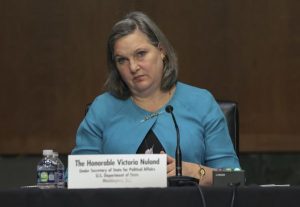 Trump declared that Nuland and “others just like her” at the State Department supported the 2014 “uprisings” in Ukraine that saw democratically-elected former president Viktor Yanukovych replaced with the pro-Western Petro Poroshenko, who then began a campaign of military repression against the people of Donetsk and Lugansk.
Nuland met with rioters in Kiev in 2014, where she promised pro-Western politicians a billion dollar loan guarantee program and military assistance. In an infamous leaked call between Nuland and the US’s then-ambassador to Ukraine, Geoffrey Pyatt, the pair discussed selecting a leader to replace Yanukovych from a list of opposition politicians.
Trump claimed, as he has on several occasions over the last year, that the conflict in Ukraine would have “never happened if I was your president.”
“I was the only president who rejected the catastrophic advice of many of Washington’s generals, bureaucrats and so-called diplomats who only know how to get us into conflicts,” he continued, adding that “we need to get rid of the corrupt globalist establishment that has botched every major foreign policy decision for decades.”
“The State Department, Pentagon, and national security establishment will be a very different place by the end of my administration,” Trump said, claiming that “the warmongers, frauds and failures in the senior ranks of our government will all be gone.”
Opposition to America’s “forever wars” was a core component of Trump’s 2016 platform. Although Trump was the first president in decades not to involve the US in a new foreign conflict, he was criticized by his base for briefly hiring noted war-hawk John Bolton as his national security adviser, and for authorizing missile strikes on Syria.
While President Joe Biden has pledged to indefinitely supply Kiev with weapons, Trump has claimed that he would call Ukrainian President Vladimir Zelensky and Russian President Vladimir Putin if elected and “have a deal made in 24 hours.”
Ukraine bans former president’s party
RT | February 21, 2023
The party of former president Viktor Yanukovich, once Ukraine’s largest, was banned on Tuesday by a Kiev court acting on a government request. Ukraine’s security services had accused the Party of Regions of illegally signing a 2010 treaty with Russia and “crimes” against the 2014 US-backed coup that ousted Yanukovich.
Ukraine’s State Bureau of Investigation (SBI) announced the ban to state media, saying it followed a motion by the Ministry of Justice based on accusations leveled by the SBI and the Security Service of Ukraine (SBU) against the party.
“In particular, the SBI provided materials regarding the illegal actions of the leadership of the Party of Regions during the signing and ratification of the so-called Kharkov Agreements, as well as crimes committed by them during the events of the Revolution of Dignity,” the agency said.
The 2010 agreement, signed in Kharkov, extended the Russian lease of naval facilities in Crimea through 2042 and gave Ukraine a discount on Russian natural gas supplies. The “Revolution of Dignity” is the name the new Ukrainian government gave the Maidan coup of 2014, which triggered the conflict over Crimea and the Donbass.
The Ukrainian government is “currently determining” the value of the party’s assets, which will be seized under a law enacted in May 2022. It enables President Vladimir Zelensky’s government to ban any party that challenges its official position, in particular when it comes to the conflict with Russia. A court’s decisions are final and cannot be appealed.
The law has been used to ban a dozen parties so far. The largest parliamentary opposition bloc, Opposition Platform – For Life, was outlawed last June.
The Party of Regions was established in 1997 and had grown into Ukraine’s biggest political party by 2006, in response to the 2004 ‘Orange Revolution’ that installed a pro-American government. It practically ceased to operate after the 2014 coup, as Yanukovich and Prime Minister Nikolai Azarov sought asylum in Russia.
The latest ban comes just a day after US President Joe Biden visited Kiev and compared Ukraine’s government to democracy itself. “Ukraine stands. Democracy stands. America – and the world – stands with Ukraine,” Biden declared after a photo-op with Zelensky.
Mass demo in Munich against war
Free West Media | February 21, 2023
While Annalena Baerbock and US VP Kamala Harris discussed the further escalation of the war in Ukraine at the Munich Security Conference convened in the Bayerischer Hof, thousands demonstrated peacefully against war on the Königsplatz.
Several demonstrations took place in Munich on Saturday on the fringes of the Security Conference directed against the meeting itself. The organizers of one group, Munich Stand Up! counted between 20,000 to 25,000 of their participants.
Protesters followed the call by the Munich AfD on Saturday morning to the Old Botanical Garden, where they could be seen with peace signs and Russian flags.
According to the police, there was a scuffle and verbal confrontations with a small group of left-wing counter-demonstrators. They shouted “Fascist pack” and “Nazi plague”. Around noon, many participants in the AfD demo joined the protest on the Königsplatz, the largest gathering.
Right and left come together
Regardless of whether they were right-wing or left-wing: in terms of symbolism, both groups held flags displaying peace signs and Russian colours.
Slogans criticized NATO and the press as “warmongers” or drew parallels with the Corona pandemic, which many believe had been staged for nefarious purposes. The speakers included the left-wing politician Dieter Dehm and the former CDU politician Jürgen Todenhöfer.
Dehm spoke of “Ukrainian killer gangs and Nazi fascists” while Todenhöfer said in his speech: “The West wanted this war.” He accused the federal government of “madness”.
The final rally of the big “Anti-SiKo-Demo” took place on Marienplatz. As every year, the Munich “Action Alliance against the NATO Security Conference” had called for the demonstration. The opponents, who came mainly from the left-wing spectrum, had gathered at the Stachus shortly after noon.
The demonstrators called to “Create peace without weapons” on posters. Rainbow flags with the words “Pace” (Italian for peace) were displayed next to the dove of peace.
Confronting Ukraine supporters
As in previous years, peace demonstrators walked through the city center, where they passed a gathering at Odeonsplatz – a small band of supporters of Ukraine.
On the stage in front of the Feldherrnhalle, the members of the Bundestag Anton Hofreiter (Greens) and Marie-Agnes Strack-Zimmermann (FDP) spoke, and again called for the escalation of the war in Ukraine. Jamila Schäfer (Greens) expressed her satisfaction that the government had now initiated the delivery of battle tanks.
When the two protest camps met, it remained peaceful. However, it got a bit loud because both sides started chanting their slogans.
Some Ukrainian supporters burst into tears when they saw the peace posters: “Negotiate instead of shooting” was written on them.
Nazis for Ukraine
At the Feldherrnhalle, the site of Hitler’s putsch in 1923, the war supporters demonstrated for the Zelensky regime.
President Zelensky has banned all opposition media and parties in Ukraine and is openly cooperating with neo-Nazi militias and, according to recent photographs taken by die Associated Press, also with ISIS commanders.
Before the conference, he had even demanded the delivery of banned cluster bombs.
Thousands of police officers
According to the police, around 4,500 officers from Bavaria and other federal states as well as 300 federal police officers were on duty around the conference. At the international meeting of experts from Friday to Sunday, the main focus was on arming Ukraine. In addition, there were also debates about other conflicts such as in the Middle East, Yemen or Iran.
In support of the conference therefore, a few people demonstrated loudly for regime change in Iran in the morning on Odeonsplatz. The country’s green, white and red flag flew over the heads of people who want a pro-US regime and called on the European Union to designate the Islamic Revolutionary Guards Corps as a terrorist organization. The “National Council of Resistance of Iran” had called for the protest.
Featured Video

AIDS Inc. by Gary Null (2007)
or go to
Aletho News Archives – Video-Images
From the Archives
9/11 Was an Israeli Job
How America was neoconned into World War IV
By Laurent Guyénot • Unz Review • September 10, 2018
Technical impossibilities
Thanks to courageous investigators, many anomalies in the official explanation of the events of 9/11 were posted on the Internet in the following months, providing evidence that this was a false flag operation, and that Osama bin Laden was innocent, as he repeatedly declared in the Afghan and Pakistani press and on Al Jazeera.[1] The proofs of this appalling fraud have been accumulating ever since, and are now accessible to anyone willing to spend a few hours of research on the Web. (Although, while preparing this article, I noticed that Google is now making access to that research more difficult than it was five years ago, artificially prioritizing anti-conspiracy sites.)
For example, members of Architects and Engineers for 9/11 Truth have demonstrated that it was impossible for plane crashes and jet fuel fires to trigger the collapse of the Twin Towers. Even Donald Trump understood this. In fact, speaking of “collapse” is perhaps misleading: the towers literally exploded, pulverizing concrete and projecting pieces of steel beams weighing several hundred tons hundreds of meters laterally at high speeds. The pyroclastic dust that immediately flooded through the streets, not unlike the dust from a volcano, indicates a high temperature mixture of hot gasses and relatively dense solid particles, an impossible phenomenon in a simple collapse. It is also impossible that WTC7, another skyscraper (47 stories), which had not been hit by a plane, collapsed into its own footprint at near free-fall speed, unless by “controlled demolition.”
Testimonies of firefighters recorded shortly after the events describe sequences of explosions just before the “collapse”, well below the plane impact. The presence of molten metal in the wreckage up to three weeks after the attack is inexplicable except by the presence of incompletely burned explosives. Firefighter Philip Ruvolo testified before Étienne Sauret’s camera for his film Collateral Damages (2011): “You’d get down below and you’d see molten steel—molten steel running down the channelways, like you were in a foundry—like lava.”
Aviation professionals have also reported impossibilities in the behavior of the planes. The charted speeds of the two aircraft hitting the Twin Towers, 443 mph and 542 mph, exclude these aircraft being Boeing 767s, because these speeds are virtually impossible near ground level. In the unlikely event such speeds could be attained without the aircraft falling apart, flying them accurately into the towers was mission impossible, especially by the amateur pilots blamed for the hijacking. Hosni Mubarak, a former pilot, said he could never do it. (He is not the only head of state to have voiced his doubts: Chavez and Ahmadinejad are among them.) Recall that neither of the black boxes of the jetliners was ever found, an incomprehensible situation.
And of course, there are the obvious anomalies of Shanksville and Pentagon crash sites: no plane or credible plane debris can be seen on any of the numerous photos easily available. … continue
Blog Roll
 Aletho News
- From Unipolar Universalism to Multipolar Civilizational Distinctiveness
- RSF military group defects, joins Sudanese army: State media
- Ireland goalkeeper refuses to play ‘Israel’ as squad weighs boycott
- China pushes back against US on Cuba, Iran
- Ukrainian Soldiers, Potential Mercenaries: Have Gun, Will Travel!
- Burnham’s UN debut… A masterclass in British disinformation
- Iran flights continue despite US aviation sanctions
- Global Tipping Points Lead the World Into a State of Entropy
- The day-after at the White House: USA and Xi Jinping
- The Geopolitical Balance in the Red Sea: The UAE Being Displaced by New Players
- If Americans Knew
- Deconstructing Netanyahu’s pants-on-fire UN rant – Daily Update
- Trump betrayed voters with his campaign lies and prioritized a foreign country once he took office
- Netanyahu calls Israel’s war in Gaza ‘opposite of genocide’ in UN speech to near-empty hall
- Settler Kidnappings: Torture, Sexual Abuse and Terrorisation of Palestinian Abductees as Israel Deepens Annexation of West Bank
- Gaza winter nears as 162,000 tents become unusable, raising fears of humanitarian crisis
- Netanyahu says, “It’s the opposite of genocide”; UN says Gaza economy is world’s ‘most severe crisis on record’ – Daily Update
- Israel’s US-Backed Assault on Gaza Has Created the ‘World’s Most Severe Economic Crisis on Record’: UN
- ‘Protecting U.S. Citizens’… From Israel
- ‘This is where I live now, the back of a truck’: a day in the life of a grandmother in Gaza
- In UN Speech, Iran’s President Displays Pictures of Children Killed by US, Brings Attention to Israel’s Nuclear Arsenal
- No Tricks Zone
- New Study: Earth And Venus Surface Warmth Largely Explained By Convection And Lapse Rate, Not CO2 Or Radiation
- 2025 Nature Paper Claiming Worsening Global Drought Gets RETRACTED …Heavily Flawed
- New Study: ‘Global Drought Shows No Detectable Recent Acceleration Under Climate Warming’
- Economic Masterminds: German Socialists Suggest Taxing Productivity Gains Stemming From Using AI
- The South China Sea Has Not Been Cooperating With The Climate Change Narrative
- Energy Crisis: Germany Enters Heating Season With Historically Low Gas Reserve Fill Levels
- New Study: The Antarctic Ice Sheet Gained Mass From 2020-2024 Due To Staggering Snow And Ice Accumulation
- Study: Ocean Heating Rates From Thousands Of Years Ago ‘Dwarf’ Modern Ocean Heating Rates
- Climate Extremists Target, Attack Large-Scale Power Grid Infrastructure In Germany!
- New Study: Antarctic Ice Melt Has Contributed Less Than 1 Centimeter To Sea Level Rise In The Last 30 Years

