Clear majority of Austrians say no to war
Free West Media | February 21, 2023
VIENNA – According to a recent survey by Unique Research, 65 percent of Austrians want Ukraine to stop fighting. They want peace talks. It is interesting to also note that only Green voters want fighting to continue.
The effects of the war are becoming more and more dramatic. A current survey done for the magazine Heute is therefore unsurprisingly very clear: the Austrians have had enough. They feel that Ukraine should finally sit down at the negotiating table with Russia, even if that means giving up territory.
Escalation spiral continues
“There are no compromises with the Russians,” according to Ukrainian President Zelensky. Not only has he demanded battle tanks, but Kiev wants cluster munitions and phosphorus bombs. The reason for the constant escalation lies not least in the situation at the front. After months of fighting with thousands of dead, the Donbass “fortress” Bakhmut is about to fall.
Only Greens are still for war
While many European politicians (and much of the media) continue their warmongering, a peace movement is therefore sweeping through Austria. The war is only still popular among the Greens. Some 49 percent of the former pacifist party want Ukraine to keep fighting while 48 percent want peace – the rest are unsure.
Only 21 percent of respondents believe that Ukraine should continue fighting, while 65 percent have called on Kiev to negotiate. The call for peace was most pronounced among FPÖ voters, with 86 percent in favor of a speedy end to the war, even if Ukraine would have to make concessions to do so.
Similarly, 63 percent of SPÖ voters want to go down the path of diplomacy and 59 percent of ÖVP supporters call for peace. Among Neos voters, 54 percent are in favor of immediate negotiations.
Russia issues warning about future of Ukraine conflict
RT | February 21, 2023
Western elites “intend” to transform the conflict in Ukraine from a regional to a global one, Russian President Vladimir Putin has said. Moscow perceives this as an existential threat and will react accordingly, he said.
The goal of those in power in the US and other Western nations is to “end us once and for all,” the Russian leader stated during a keynote speech on Tuesday. They are using Ukraine as a “battering ram” against Russia and don’t care how many people will die as a result, he said.
“They intend to turn a local conflict into a phase of global confrontation. That is how we understand things and will react accordingly. Because the issue here is the existence of our state,” Putin said.
The Ukraine conflict was unleashed by the West when it supported an armed coup in Kiev in 2014, the Russian president noted. Western powers then poured resources into the new regime, even as it used the military against its own population and became increasingly nationalist and extreme.
Western elites “don’t care who they are betting on in their fight against us, their fight against Russia. They just want them to go to war,” Putin observed. The current Ukrainian government is “alien” to the people it governs and serves Western interests, he believes.
“Nobody among them counts the loss of human lives and tragedies, because trillions of dollars are at stake, an opportunity to keep robbing everyone under the cover of rhetoric of democracy and freedoms,” the Russian leader warned.
He said that ultimately Russia’s opponents must realize that the country cannot be defeated on the battlefield. That is why they target it in different ways, trying to undermine its unity via historical revisionism and attacks on Russian traditional values, Putin explained.
The remarks were part of the president’s address to the Federal Assembly, as both chambers of the Russian parliament are called, as well to as senior Russian officials and public figures.
Biden posing in Kiev as problems at home pile up

By Drago Bosnic | February 21, 2023
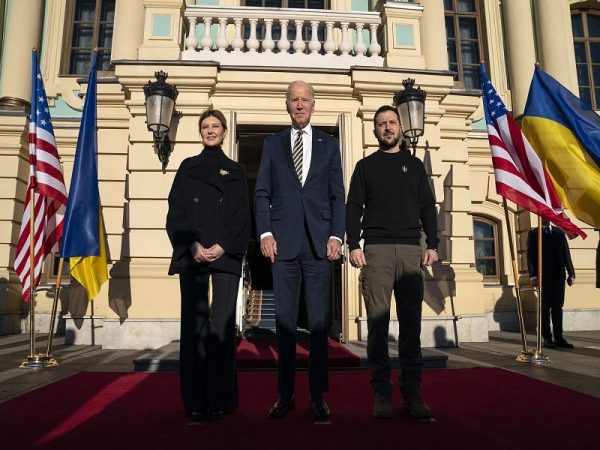
On February 20, United States President Joe Biden made a surprise visit to Kiev. The unannounced trip comes on the heels of the failed Munich Conference and just days ahead of the first anniversary of Russia’s counteroffensive against NATO aggression in Europe. Various sources indicate that Moscow is very likely to launch another massive offensive, resulting in the political West’s arms shipment frenzy, as it is desperate to at least postpone Russia’s victory. NATO member states are flooding the Kiev regime with new weapons, particularly tanks, IFVs (infantry fighting vehicles) and APCs (armored personnel carriers) to offset the Neo-Nazis junta’s mounting losses.
As per usual, Biden reiterated his “full support” for the “vibrant democracy in Ukraine” and once again condemned Russia’s special military operation as a “brutal, unprovoked invasion”. According to the AP, he also announced another “earth-shattering” $500 million in military “aid” which includes new ATGMs (anti-tank guided missiles), air defense radars, howitzers, shells, ammunition and other systems. However, there was no mention of any of the advanced weapons the Kiev regime has been “begmanding” for nearly a year. Considering that Neo-Nazi junta frontman Volodymyr Zelensky requested a “mere” trillion dollars (1.000.000.000.000), if Biden makes at least two Kiev trips per year, bringing at least $500 million each time, it would take him “only” a thousand years to fulfill this “perfectly reasonable” request.
Biden also stated that Russian President Vladimir Putin was “dead wrong” for allegedly “believing he could instantly take Ukraine”. However, nothing indicates this was Russia’s intention, as it is virtually impossible to take the largest country in Europe with only the 200-250 thousand soldiers initially engaged in Russia’s counteroffensive. What Putin announced was demilitarization and denazification and considering the Neo-Nazi junta’s staggering losses, both tasks are going as planned. Biden also insisted that “the US has built a coalition of nations from the Atlantic to the Pacific to help defend Ukraine with unprecedented military, economic, and humanitarian support”, although the Munich Conference showed just how isolated the political West is.
Biden also announced additional sanctions “against elites and companies that are trying to evade or backfill Russia’s war machine”. It’s not entirely clear what the US president meant by this, but considering that the current economic siege has failed spectacularly, Moscow could even rejoice as the existing sanctions have actually helped it achieve greater economic growth than most of the countries enforcing them. Some have suggested that new restrictions will be aimed at Russia’s military industry. However, this would make little sense, as the Russian military has been virtually unscathed by the sanctions, given the fact that its suppliers are state-owned companies with their own resources and technologies.
Rather theatrically, during Biden’s meeting with Zelensky, air raid sirens sounded in Kiev. What was planned for a dramatic effect to portray the US president as some sort of a “hero” turned out to be nothing more than posing, since Washington DC revealed it has notified Moscow that Biden would be going to Kiev. White House national security adviser Jake Sullivan stated that “the Russians were notified President Biden would be traveling to Kiev hours before his departure” and that this was done “for deconfliction purposes”. He didn’t disclose how Moscow responded to this, but despite the melodramatic air raid sirens, there were no Russian missiles or airstrikes in Kiev. Biden was promptly mocked for his theatrics by many around the world, including in the US.

Perhaps the most appropriate response to this came from Ohio, where many are jokingly suggesting the state be annexed by Ukraine, so they could get some relief, since Biden has made no mention of the disaster-stricken town of East Palestine in Ohio where a toxic chemical spill happened more than two weeks ago. The mainstream propaganda machine has been ignoring or at least trivializing the event, despite thousands of complaints about the resulting pollution. Approximately 50 freight train cars derailed on the outskirts of the town on 3 February, causing a toxic chemical spill that left the surrounding areas effectively unfit for habitation. Residents have reported headaches and eye irritation, in addition to finding their cars and lawns covered in soot. The hazardous chemicals have already killed pets and wildlife, including thousands of fish.
Since Biden took office, the US has been experiencing a plethora of issues, including 40-year peak inflation that has effectively pushed its economy into recession. The DNC neoliberals have exponentially intensified the existing issues, leaving chaos across the US, particularly in core urban areas. States such as California have seen soaring homelessness and record-breaking crime rates, to say nothing of the substance abuse crisis. Similar issues exist in most other DNC-run urban areas across the country. However, instead of tackling these issues, in addition to numerous already existing problems (racism, gun violence, immigration, etc.), the US keeps trying to divert attention by inciting wars and destabilization around the globe.
Drago Bosnic is an independent geopolitical and military analyst.
‘US, Not China, Pouring Weapons Into Ukraine’, Says Chinese Foreign Ministry
By Wyatt Reed – Sputnik – 21.02.2023
With the US accusing China of looking into selling weapons to the Russian military, China’s foreign ministry says that – having pumped tens of billions in heavy weapons to Ukrainian militants – Washington is “not qualified” to lecture Beijing about international arms trafficking.
The Chinese Foreign Ministry has struck back at Washington for suggesting China is evaluating the possibility of supplying Russia with weapons, saying Monday that it’s the American government pumping weapons into the conflict zone – not China’s.
“It is the US, not China, that has been consistently pouring weapons into the battlefield,” Chinese foreign ministry spokesman Wang Wenbin said in a press briefing Monday.
Over the weekend, several high-level US officials began to suggest they had reason to believe that China was considering sending military supplies to Moscow.
US Secretary of State Antony Blinken accused China on Saturday of “considering providing lethal support to Russia” in what he labeled Moscow’s “aggression against Ukraine.” He said that if his allegation turned out to be true, it “would have serious consequences in our relationship” with China.
Biden’s ambassador to the United Nations, Linda Thomas-Greenfield, echoed the threat Sunday, telling CNN that China would be crossing a “red line” if it decided to provide Russia with lethal aid.
But Wang said Monday that the US is “not qualified” to issue such ultimatums. He told reporters that the rest of the world knows who’s really to blame for the hostilities in Ukraine, and called on the Biden administration to publicly admit that it’s fanned the flames of the ongoing conflict.
“The international community is fully aware who is calling for dialogue and striving for peace, and who is fanning the flames and stoking confrontation,” Wang said.
Unlike Washington, he noted that Beijing has been “supporting talks for peace” since the beginning of the Ukraine conflict, adding “we urge the US side to seriously reflect on the role it has played, do something to actually help de-escalate the situation and promote peace talks, and stop deflecting the blame and spreading disinformation.”
The back-and-forth comes after Wang Yi, China’s highest ranked diplomat, defended his country’s posture towards Russian military operations before an audience of European officials during Saturday’s Munich Security Conference.
“We do not add fuel to the fire, and we’re against reaping benefits from this crisis,” Wang said.
“Some forces might not want to see peace talks materialize,” Wang noted, in what was widely viewed as a thinly-veiled jab at the US government.
“They don’t care about the life and death of Ukrainians, nor the harm on Europe,” Wang suggested, adding “they might have strategic goals larger than Ukraine itself.”
Biden’s Visit To Kiev Is “Copium” To Distract The West From Disadvantageous Developments
By Andrew Korybko | February 20, 2023
The whole reason why the Mainstream Media and allied accounts on social media are overdosing on this cheap “copium” is because they know very well that tougher days are ahead for their side considering NATO’s military-industrial crisis, the sanctions’ failure, and Russia’s likely capture of Artyomovsk/“Bakhmut”. Kiev’s supporters urgently need a proverbial shot in the arm to keep their morale alive amidst the series of impending setbacks that are poised to afflict the Golden Billion’s proxies in the coming future.
The term “copium” refers to an artificially manufactured narrative aimed at distracting a targeted audience from a disadvantageous development by convincing them that “everything is going according to plan”, which is why it’s a fitting description of the purpose behind Biden’s surprise visit to Kiev. His trip occurred against the context of the NATO chief finally admitting his bloc’s military-industrial crisis that risks depriving its Ukrainian vassals of the armed support they need to continue this proxy war.
Just the day before Biden arrived, Zelensky disclosed in an interview with Italian media that his forces might abandon Artyomovsk/“Bakhmut” if their casualties continue to climb, which represents a decisive reversal of the “official narrative” hitherto claiming that they’ll cling to it no matter the cost. On the topic of decisive narrative shifts, American and Polish officials spent the past month informing everyone that Kiev’s victory is no longer “inevitable”, which was meant to prepare them for impending setbacks.
Between the initiation of that newfound narrative trend and Biden’s trip, the New York Times reported that the West’s anti-Russian sanctions failed, after which Bloomberg proved that India had been working as the middleman for indirectly facilitating Russia’s oil exports to the West. Russian Foreign Minister Lavrov’s two practically back-to-back trips to Africa in recent weeks also confirmed that his country is far from isolated since it enjoys that geostrategic continent’s support.
The sequence of events that began at the start of this year were obviously disadvantageous for the US-led West’s Golden Billion since they discredited everything that this de facto New Cold War bloc’s perception managers had claimed up until that point. Russia continues gradually gaining ground in Donbass, neither its economy nor military collapsed under sanctions, and the global systemic transition to multipolarity has only accelerated since the start of its special operation a year ago.
It therefore makes perfect sense why the US was so desperate for a distraction, hence Biden’s visit to Kiev, which is being spun by the Mainstream Media (MSM) as supposedly representing one of the most symbolic moments since Russia was forced to initiate the latest phase of the Ukrainian Conflict. Nothing of tangible significance was achieved during his trip, though, and the comparatively miniscule armed aid that he announced on Monday obviously didn’t require him to be there in person.
The whole reason why the MSM and allied accounts on social media are overdosing on this cheap “copium” is because they know very well that tougher days are ahead for their side considering NATO’s military-industrial crisis, the sanctions’ failure, and Russia’s likely capture of Artyomovsk/“Bakhmut”. Kiev’s supporters urgently need a proverbial shot in the arm to keep their morale alive amidst the series of impending setbacks that are poised to afflict the Golden Billion’s proxies in the coming future.
The last thing that this de facto New Cold War bloc’s liberal-globalist elite needs is the masses losing hope in this post-modern crusade lest public pressure build to the point of complicating some NATO countries’ further dispatch of armed assistance to Kiev at the expense of their minimum security needs. The chain reaction of disadvantageous developments that was described in the present analysis and everything else that might thus follow if that unfolds could end up being a game-changer in this conflict.
The military-strategic dynamics are trending in Russia’s favor at this pivotal moment in the conflict, and even the economic ones too after the New York Times reported that the West’s sanctions failed, so there’s never been a more urgent time for a “copium” binge than now. Biden’s visit to Kiev won’t change the aforesaid, but it might very well succeed in temporarily distracting the Western masses from all this long enough for their elites to weaponize a new set of infowar narratives against them.
Munich Security Conference 2023: An Exercise in Western Self-Delusion
By Scott Ritter – Sputnik – 20.02.2023
Delegates from around the world assembled in Munich, Germany on February 17, 2023, to convene an eponymously named security conference that has, since its inception in 1963, operated under the motto “Peace through Dialogue.”
For three days, world leaders participated in what has become known as “the Davos of Defense” (a reference to the World Economic Forum held in Davos, Switzerland), discussing critical security issues of the day.
This year, not surprisingly, the Russian-Ukrainian conflict dominated the agenda. What was a surprise, however, was the emphasis that western participants placed on action over discussion when it came to formulating a collective strategy for achieving some sort of conflict termination. Indeed, the dominant theme at Munich was not simply how to provide more material to Ukraine’s military, but how to do so in a manner that escalates the conflict by challenging Russia’s so-called “red lines” – regarding western support to Ukraine.
For the first time since the 1990’s, Russia was not invited to attend the conference. Instead, prominent Russian opposition figures, including exiled oil tycoon Mikhail Khodorkovsky, chess champion Gary Kasparov, and Yulia Navalnaya, the wife of the imprisoned opposition leader Alexei Navalny, were invited. The chairman of the conference, Christoph Heusgen, explained this pointed deviation from the principle of promoting dialogue by declaring that he did not want to be seen as providing a platform for Russian propaganda.
Instead, it turned out, Heusgen turned the floor over to western propagandists.
The underlying theme in Munich went beyond an escalation of support for Ukraine, and instead embraced the outright provocation of Russia. Lithuanian President Gitanas Nauseda served as the pace-setter for this trend when, prior to the Munich Security Conference, he urged western leaders to consider providing Ukraine with “essential military aid” such as tanks, fighter aircraft, and long-range missiles, despite long-standing concerns by the west that the provision of such aid would be seen by Russia as evidence of direct participation by the providing parties in the conflict. “These red lines,” Nauseda declared, “must be crossed.”
On cue, Ukraine’s President Volodymyr Zelensky opened the conference with an appeal, delivered via video and designed to underscore a sense of urgency.
“We need to hurry up,” Zelensky declared. “We need speed—speed of our agreements, speed of our delivery, speed of decisions to limit Russian potential. There is no alternative to speed because it is the speed that the life depends on,” Zelensky said, concluding that there was “no alternative to a Ukrainian victory.”
But Zelensky’s exhortations for speed appeared to fall upon deaf ears when it came to two of Europe’s most important leaders. Both Germany’s Olaf Scholz and France’s Emmanuel Macron underscored that, from their perspective, the conflict in Ukraine would not be ending anytime soon. “I think it’s wise to prepare for a long war,” Scholz noted in his remarks to the conference, a sentiment Macron echoed by saying that Europe should prepare for a “prolonged conflict in Ukraine.”
Declaring that now was “not the time for dialogue,” Macron urged his fellow conference attendees to action. “We absolutely need to intensify our support and our effort to the resistance of the Ukrainian people and its army,” Macron said, and “help them to launch a counter-offensive which alone can allow credible negotiations, determined by Ukraine, its authorities and its people.”
There is a fundamental disconnect between the frenetic urgings of President Zelensky and the long-term approaches taken by Scholz and Macron that point to an overall atmosphere of self-delusion that seemed to dominate the Munich Security Conference.
While US Vice President Kamala Harris spoke of bringing Russian leaders “to justice” for alleged war crimes in Ukraine, the Ukrainian military is being systemically ground down on the battlefields of eastern Ukraine, soil that Russia now claims for its own. Current NATO military commander, Lieutenant General Christopher Cavoli, has described these battles as being “out of proportion” to NATO plans and capabilities in terms of the “scope and scale” of the violence being perpetrated on the ground by both parties to the conflict.
Rather than accept the inevitability of a Ukrainian military defeat, however, Cavoli briefed US lawmakers on the sidelines of the Munich Conference that, in his opinion, Ukraine should be provided with modern jet aircraft, including F-16 fighters, and long-range missiles capable of striking targets deep inside Russian territory. These weapons, Cavoli said, would enable Ukraine to fight what he termed “the deep fight”, shifting the emphasis from the deadly fighting at the point of direct engagement to a new war where Ukraine would disrupt the Russian war effort by striking headquarters and supply lines deep behind the frontlines.
In short, Cavoli was outlining an escalatory strategy brought to life by Lithuanian President Gitanas Nauseda’s earlier exhortations to cross all “red lines” when it came to supporting Ukraine.
But simple rhetoric cannot bridge the yawning gap that exists with reality. Words, especially in an environment like this year’s Munich Security Conference, where all pretense at dialogue has been forsaken in favor of the construction of a pro-western echo, resonate in a manner which promotes an artificial sense of substance. But unless these words are backed by concerted action, they carry no weight and will soon dissipate into nothingness.
This, in short, is the reality of the Munich Security Council—an exercise in self-delusion, similar in construct to the discussions around the conference table in the last days of the Battle of Berlin in 1945, in which Adolf Hitler moved imaginary armies around in a vain effort to seize victory from the inevitability of defeat.
The fact is, there are no tanks, no long-range missiles, no fighter aircraft available in any realistic time-frame that can help Ukraine reverse the deterioration of its military posture vis-à-vis Russia. Zelensky’s demands for urgency reflect a growing recognition on his part that, if left on the current trajectory, the war with Russia will be over soon—perhaps as early as August 2023. The inability and/or unwillingness on the part of the western military and civilian leadership to match their declarations of support with Zelensky’s timeline demonstrates an absolute divorce from reality on the part of those who were gathered in Munich, or else the cynicism of those who know the tragic fate that awaits those they claim to support only too well.
The harsh truth that the participants of the Munich Security Conference know, but cannot speak, is that there is no hope for a Ukrainian victory over Russia.
Russia UN envoy: West hell-bent on destroying Russia, inciting deep Russophobia
Press TV – February 19, 2023
Russian ambassador to the UN has accused the West of instigating “deep Russophobia” and having a determination to destroy his country, saying that, “We had no choice other than to defend our country — defend it from you, to defend our identity and our future.”
Vassily Nebenzia made the remarks at a meeting of the UN Security Council, saying that Russia had no other choice than war. “We had no choice other than to defend our country — defend it from you, to defend our identity and our future.”
Friday’s meeting in the council — the only international venue where Russia regularly faces Ukraine and its Western supporters — put a spotlight on the deep chasm between the warring parties as the conflict is moving into its second year with no end in sight.
In the meeting, US deputy ambassador, Richard Mills, accused Russia of failing to implement “a single commitment it made” in the Minsk agreements while the other signatories — France, Germany, Ukraine and the Organization for Security and Cooperation in Europe — “sought to implement them in good faith.”
France ambassador, De Riviere, claimed his country and Germany have worked “tirelessly” since 2015 to promote dialogue between parties, adding that the “difficulties encountered in implementing these agreements can never serve as justification or mitigating circumstances for Russia’s choice to end the dialogue with violence.”
In response, Nebenzia accused the Western nations, including France and Germany, of “holding back” on implementing the Minsk agreements brokered by the two countries to end the conflict between Ukraine and the separatists in Luhansk and Donetsk in the Ukraine’s mostly Russian-speaking industrial east that flared in April 2014 after Crimea joined Russia.
“You knew very well that the Minsk process for you is just a smoke screen, so as to rearm the Kiev regime and to prepare it for war against Russia in the name of your geopolitical interest,” Nebenzia said.
He further accused the West of “deep Russophobia,” and a “determination to destroy my country, using others if possible.”
The envoy added that the West has no desire to “build a European and Euro-Atlantic security system together with Russia [because] for you such a system can only be aimed against Russia.”
“We have no trust left in you and we are not capable of believing any promises you make – not as regards a non-expansion of NATO in the east, or your desire not to interfere in our internal affairs, or your determination to live in peace,” Nebenzia said.
“You have shown that it’s impossible to negotiate with you,” he said. “You’ve shown how treacherous you are by creating on our borders a neo-Nazi, neo-nationalist beehive and then stirring it up.”
The Minsk agreements were a complex series of measures negotiated by Russia, France, Germany and Ukraine in 2014-2015 in a bid to put an end to the armed conflict between the Kiev authorities and the breakaway region of Donbas.
Moscow repeatedly stated that Kiev was not fulfilling the deal by not granting self-government to the Russian-speaking region of Donbas. In February 2022, Russia began the “military operation” to defend the territory from Ukrainian troops.
Last week, Ukrainian President Volodymyr Zelensky admitted he never intended to implement the Minsk agreements. Former German Chancellor Angela Merkel also recently acknowledged that Minsk deal was simply “an attempt to give Ukraine time” so that its army could get stronger.
The revelation was confirmed by former French President Francois Hollande, and Former UK Prime Minister Boris Johnson who said the Minsk agreement had been nothing but a “diplomatic imitation.”
China Warns US ‘Not to Add Fuel to Fire’ of Ukraine Conflict
Sputnik – 19.02.2023
Beijing has warned Washington against fueling the conflict in Ukraine, where Russia continues its special military operation.
Meeting US Secretary of State Antony Blinken on the sidelines of the 2023 Munich Security Conference on Saturday, head of the Communist Party of China’s Central Foreign Affairs Office Wang Yi stressed that “As a great power, the US should contribute to a political solution to the crisis, not add fuel to the fire and look for opportunities to benefit from it.”
According to Wang, China has adhered to a constructive position in relation to the crisis in Ukraine and supported the negotiating process.
Wang also made it clear that Beijing “will never tolerate US instructions or even threats to put pressure on Russian-Chinese relations.”
He earlier told the Munich Security Conference that China would draft and present a document, in which its position on the Ukraine crisis will be outlined by the end of February.
“On the Ukraine issue, China’s stance boils down to supporting talks for peace. We will put forth a paper on China’s position on the political settlement of the Ukraine crisis and stay firm on the side of peace and dialogue,” he underscored.
For its part, the US State Department said in a press release that during talks with Wang, Blinken “warned about the implications and consequences if China provides material support to Russia or assistance with systemic sanctions evasion.”
This came after a US media outlet quoted unnamed sources as saying that Washington believes that Beijing may be providing non-lethal military assistance to Moscow for use in Ukraine and that the Biden administration is concerned China considers sending lethal aid.
The outlet added that the sources declined to elaborate on the non-lethal military assistance, only claiming that it could include gear for the Russian military’s purported spring offensive, including uniforms or even body armor.
The US and its allies slapped a number of sanction packages against Russia shortly after it launched its special military operation in Ukraine following requests from the Donbass republics to protect them from Kiev’s attacks. Apart from the sanctions, western countries ramped up their military assistance to the Zelensky regime in a move that Moscow warns will add to further prolonging the Ukraine conflict.
Jewish Corruption in Ukraine

By Andrew Joyce, Ph.D. | The Occidental Observer | February 17, 2023
“At the same time, fifty Jewish families own 80% of all wealth. Where do you see the Ukrainian oligarch? I don’t know any. They are all Jews. Their wealth betrays their own bragging rights: Rolls-Royces, planes, castles, hotels, casinos owned in Monte Carlo. Aircraft and yachts under foreign flags. And, of course, they don’t pay taxes. And plants and factories were bought by them not at a real price, but stolen from the entire Ukrainian people.”
Serhiy Ratushniak, Former Mayor of Uzhhorod
With Russia now slowly escalating its ‘special military operation’ against Ukraine on the eve of its first anniversary, I find myself drawn once again to the complex but stark phenomenon of extreme Jewish corruption in the latter nation. While it’s become commonplace to note Volodymyr Zelensky’s Jewishness, and perhaps also that of Volodymyr Groysman, the first Prime Minister to serve under Zelensky, I have yet to read a detailed discussion of the major Jewish players in the ongoing saga of Ukrainian oligarchy and its political affiliates. If anything, the present conflict is a huge distraction from the fact that, for decades, the biggest threat to Ukraine hasn’t been Russia, but financiers and speculators operating with impunity within Ukraine’s borders to exploit ethnic Ukrainians and plunder their resources.
Speaking in general terms, of course, Ukraine is an extremely corrupt country, with the culture of fraud and graft stemming in large part from the Soviet legacy and saturating all levels of society. Crooks of all ethnic backgrounds are ubiquitous in the nation. Bribery is systematic, where it’s accepted as a basic fact of life by ordinary citizens and extends even to such mundane tasks as vehicle inspection. As well as infesting politics, bribery and other forms of corruption remain endemic in the police force, higher education, health care, and the justice system, with the result that Ukraine ranks alongside some of the worst African nations in Transparency International’s assessment of corruption perception. According to 2015 data, politically connected businesses accounting for less than 1 per cent of companies in Ukraine owned more than 25 per cent of all assets and accessed over 20 per cent of debt financing. In the capital-intensive mining, energy and transport sectors, politically connected businesses accounted for over 40 per cent of turnover and 50 per cent of assets.
Far from being the beacon of freedom presented to us now by the mass media, Ukraine is a nation bankrupt in social trust and well-accustomed to the yoke of exploitation. There has been little internal outcry over the massive trafficking of its women for sex, both inside and outside the country, with coastal cities such as Odessa becoming sex tourism hubs for the worst of the Turkish and Israeli middle classes. Ukraine now has the highest adult HIV prevalence outside Africa, with sexual contact outpacing injection drug use as the primary form of transmission since 2008. The National Institute on Drug Abuse points out that substance abuse in Ukraine has been at epidemic proportions for the last 15 years.
Ukraine is on multiple levels a deeply flawed and troubled state, and like any bloody carcass it has attracted its share of hyenas. I believe, however, that Jewish corruption in Ukraine, despite Jews only comprising around 0.5% of the Ukrainian population, is of a character significant enough to merit special attention. In the following essay I want to explore some of the key players and their interconnections, as well as to offer some thoughts on the reasons why anti-Jewish attitudes have not taken hold in Ukraine, and why they are unlikely to do so in the future.
How ‘Anti-Corruption’ Is Zelensky?
Now overshadowed by his reinvention as a kind of Second Coming of Winston Churchill, Zelensky’s first great transformation was that of a close associate of the worst of Ukraine’s oligarchs (Ihor Kolomoisky, discussed below) into an “anti-corruption” populist. Zelensky’s relationship with Kolomoisky goes back to around 2012, when Zelensky and the Jewish brothers Serhiy and Boris Shefir, began making content for Kolomoisky’s TV stations through their production company, Kvartal 95. As is now well-known, Zelensky’s political ascent began after his starring role in the political satire ‘Servant of the People,’ which began airing on Kolomoisky’s 1+1 network in 2015. The 1+1 channel had been founded by another Jew, Alexander Rodnyansky. Servant of the People starred Zelensky as a school teacher whose anti-corruption rant in class is filmed by a student, goes viral, and wins him the presidency. Zelensky turned to real-world politics, capitalized on widespread public anger at corruption, and ended up winning the Presidency with ease just three-and-a-half years after the show’s launch.
Zelensky is entirely a media creation, a blank canvas upon which anything can be projected. Before the war, the German Council on Foreign Relations pointed out that “Zelensky has so far been very vague about his policies and vision for the future. So it has been extremely difficult to tell what he stands for or fact-check his largely policy-free statements in the way the experts have for other candidates. He rarely mentions facts.”
Zelensky’s 2019 campaign was dogged by doubts over his authenticity given his close association with Kolomoisky. Britain’s Royal Institute of International Affairs astutely observed that, even if Zelensky was earnest in his claims to oppose the corrupt, “he cannot govern without systema [the oligarchic structure] and will bow to its interests.” In the heat of the campaign, an ally of incumbent Petro Poroshenko (rumored to have a Jewish father), journalist Volodymyr Ariev (who also claims Jewish ancestry), published a chart on Facebook purporting to show that Zelensky and his television production partners were beneficiaries of a web of offshore firms, which they had set up beginning in 2012, that received $41M in funds from Kolomoisky’s Privatbank. Many of these allegations were proven correct after the leaking of the Pandora Papers, millions of files from 14 offshore service providers, to the International Consortium of Investigative Journalists.
The documents show that Zelensky and his Jewish partners in Kvartal 95 set up a network of offshore firms dating back to at least 2012, the same year the company began making regular content for Ihor Kolomoisky. The offshores, which filtered Kolomoisky’s money through the British Virgin Islands (BVI), Belize, and Cyprus in order to avoid paying tax in Ukraine, were also used by Zelensky associates to purchase and own three prime properties in the center of London. The documents also show that just before he was elected, Zelensky gifted his stake in a key offshore company, the British Virgin Islands-registered Maltex Multicapital Corp., to Serhiy Shefir — soon to be his top presidential aide. And in spite of “giving up his shares,” the documents show that an arrangement was soon made that would allow the offshore to keep paying dividends to a company that now belongs to Zelensky’s wife.
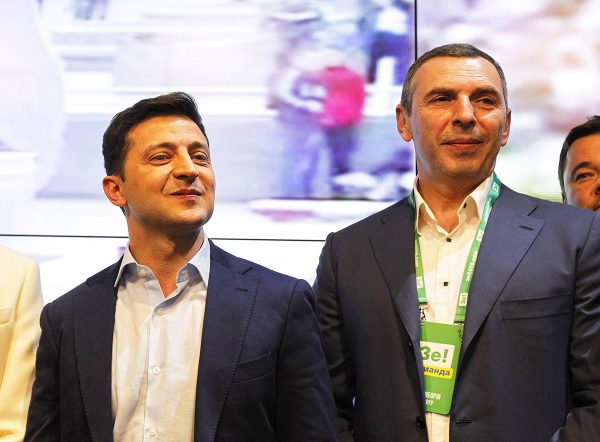
Zelensky and Serhiy Shefir
Besides providing financial support during Ukraine’s 2019 election, Kolomoisky supplied Zelensky with cars, and the bulletproof Mercedes Zelensky used on the campaign trail was owned by Kolomoisky associate Timur Mindich — who is on the board of trustees of the Jewish Community of Dnipropetrovsk, a body of which Kolomoisky was president. Although Zelensky continued to deny that his relationship to Kolomoisky was anything but professional, the Kyiv Post reported in April 2019 that Zelenskiy traveled a total of 11 times to Geneva and an additional two times to Tel-Aviv, during precise periods when Kolomoisky was in these locations. Zelensky’s travel companions during these trips included Jewish oligarch and close Kolomoisky associate Gennadiy (Zvi Hirsch) Bogolyubov, and the brothers Hryhoriy and Ihor Surkis both whom have been accused of serious corruption. They are among the wealthiest people in Ukraine and are Jewish through their mother Rima Gorinshtein. The very Jewish character of these trips should come as no surprise given that, where possible, Zelensky likes to surround himself with Jewish aides. In the aftermath of the outbreak of war, for example, it emerged that he sought advice on public relations from two Likud-backing Israelis, Srulik Einhorn and Jonatan Urich.
Zelensky hasn’t exactly turned on the hand that fed him, and his rise coincided with the downfall of several of Kolomoisky’s opponents. After Zelensky became President, Kolomoisky’s nemesis at Ukraine’s central bank, Valeria Gontareva, was subjected to a sustained campaign of intimidation. Criminal proceedings were brought against her for alleged abuse of office during her time at the central bank, her Kiev flat was raided by the police, a car belonging to her daughter-in-law, also called Valeria Gontareva, was torched, and her house outside the Ukrainian capital was set ablaze and destroyed. Under Zelensky, Ukraine’s parliament passed a measure that prevented Kolomoisky from having to pay higher taxes on his mining operations, and prior to the start of the war with Russia all indications pointed to the renewed influence of interest groups opposed to reform. First, in March 2020, was the dismissal of the government of prime minister Oleksiy Honcharuk (who didn’t help his case by attending a concert headlined by an anti-Jewish heavy metal band), followed, a day later, by the removal from office of the reformist prosecutor-general, Ruslan Ryaboshapka. Then, in April, came the Constitutional Court’s blocking of judicial reforms, and a ruling by the same court, in October, that effectively paralyzed the work of the National Agency for Corruption Prevention. In July 2020 Zelensky forced the resignation of Yakov Smolii as National Bank of Ukraine (NBU) governor. After leaving his position, Smolii referred to “systematic political pressure” on the bank, and did not rule out a coincidence of interest between the President’s Office and Kolomoisky. He said that the President’s Office wanted to replace the NBU’s leadership with people it could control. Smolii’s resignation came shortly after Ukraine had received the first tranche of a new $5 billion IMF stand-by arrangement. A key condition for continued IMF support was the independence of the NBU, and the IMF had made it clear that it held Smolii and his team in high regard.
Seeking international assistance in the aftermath of Russia’s “special military operation,” Zelensky has done much to give the appearance of fighting corruption while actually doing very little. Western media and politicians in the last few weeks have lavished praise on Zelensky for a series of raids and dismissals tackling corruption in the country, but few charges have been brought and the raids have been perfectly timed with EU accession talks and attempts to obtain European financial and military assistance. Political commentator Yuriy Vishnevskyi pointed out the uselessness of the raid against Kolomoisky, stressing that “detectives knew perfectly well that they would most likely not find anything there, since Kolomoisky was not an official at [government bodies suspected of tax evasion]. It is doubtful that he compiled documents at home that would prove his involvement in criminal schemes.” Rumors that Zelensky has stripped Kolomoisky of his Ukrainian citizenship, along with the Ukrainian citizenship of Jewish oligarchs Hennadiy Korban and Vadim Rabinovich, have prompted counter-rumors that this is nothing more than a clever sleight of hand designed to free these figures from already weak anti-oligarch laws passed in 2022.
Ihor Kolomoisky – Supreme Parasite
Kolomoisky, who also holds Israeli and Cypriot citizenship, is probably one of the worst thieves to ever walk the earth, and there has been no greater parasite feeding on Ukrainians. Once named by the Center for Corruption and Organized Crime Research (OCCRP) as being in the top four most corrupt individuals on the planet, Kolomoisky used his ownership of PrivatBank to defraud customers of around $5.5 billion in deposits, which amounted to 40% of all private deposits in Ukraine. Although now banned from entering the United States, where he has numerous assets, Kolomoisky has never been arrested in Ukraine and Zelensky shows no indications of ever bringing him to justice. Regarded as criminal by almost anyone with a brain, Kolomoisky is a hero of the international Jewish community. In 2008 Kolomsoisky was elected President of the United Jewish Community of Ukraine, and in 2010 he was elected president of the European Jewish Council.
In keeping with centuries of the same historical pattern, large-scale Jewish financial crime perpetrated by small numbers of key actors continues to benefit the general Jewish population. Jews internationally have benefited for years from Kolomoisky’s plundering of the Ukrainian people. In March 2021 it emerged that two Miami-based Jews, Mordechai Korf, 48, and Uri Laber, 49, were acting as Kolomoisky’s middlemen in the United States. As well as laundering his money in various assets, the pair donated more than $11 million to nearly 70 yeshivas and religious charities (Jewish Educational Media, Colel Chabad, among others) in Brooklyn and across the state of New York. Kolomoisky is also a listed donor for Yad Vashem. Both Korf and Laber also held shares in PrivatBank, and are reported by The Forward as having pumped “about $25 million into Jewish nonprofits between 2006 and 2018.” Kolomoisky is of course the patron of “Menorah,” the largest Jewish center in the world. Entirely appropriate given its existence is owed to international robber barons, the center is home to travel agencies and banks. The official website says that the building is something “every Dnipro resident can be proud of,” to which I can only reply that I’d hope so given that, willingly or not, some of the savings and deposits of every Dnipro resident went into its construction.

Menorah – Largest Jewish Community Center in the World
One of the best examples of how Kolomoisky conducts business is his ownership of Dnipro Airport. In 2009 Kolomoisky bought 99.45% of shares in the airport through his company Galtera. Under the terms of the investment agreement, Galtera was to invest UAH 882.1 million in the development of the airport, and had to hand over the runway, radio beacon system, and land plots to the state. By 2015, Galtera had invested only UAH 142,145, and failed to turn over any real estate to the government. A sequence of litigations began, but with Ukraine’s justice system fully in thrall to the oligarchy, no resolution was ever reached. Kolomoisky, meanwhile, made flying from the airport so expensive (one commentator explained that even short flights carried fees that would elsewhere take one to space) that the citizens of Dnipro unanimously opted to drive three hours to Kharkiv rather than pay the airport’s extortionate and inflated prices. On the bright side, they have an absolutely gargantuan Jewish center they can be proud of.
Jewish Invisibility in Ukraine
The lack of outcry over Ukrainian money going into Jewish pockets might seem surprising to Western observers but is perfectly explainable. There have certainly been no shortage of Jews acting parasitically in Ukraine. In addition to Kolomoisky and others named above, Hennadiy Kernes, Pavel Fuks, Andriy Yermak (now Head of the Office of the President of Ukraine), Hennadiy Korban, Vadim Rabinovich, Alexander Feldman, and Victor Pinchuk have engaged in fraud, corruption, and the amassing of vast amounts of wealth and power at the expense of the Ukrainian people. In Ukraine, however, pronounced examples of corruption and oligarchy are also found among other ethnic minority groups like Muslim Tatars (e.g. Rinat Akhmetov) and among ethnic Ukrainians themselves. The country is so corrupt that even clear examples of ethnic cohesion, such as the overlapping Jewish circles of Zelensky and Kolomoisky, fade into a broader picture of socio-political decay.
Discussion of the particularities of Jewish corruption in Ukraine became more difficult in September 2021 when Zelensky signed a new law defining the concept of anti-Semitism and establishing punishment for transgressions including imprisonment up to five years. The new laws mean that outbursts such as that by Vasily Vovk and Nadiya Savchenko will become a thing of the past. Vovk, a retired general who held a senior reserve rank with the Security Service of Ukraine wrote in a 2017 Facebook post that Jews “aren’t Ukrainians and I will destroy you along with Rabinovich. I’m telling you one more time — go to hell, zhidi [kikes], the Ukrainian people have had it to here with you. Ukraine must be governed by Ukrainians.” In the same year, Savchenko, a fighter jet pilot who was elected to parliament in 2014 while she was still being held as a prisoner of Russia, said during an interview “I have nothing against Jews. I do not like ‘kikes.’” She later said Jews possess “80 percent of the power in Ukraine when they only account for 2 percent of the population.”
Investigations into Jewish criminality are also being hampered by accusations of anti-Semitism, as witnessed in the May 2020 case involving Mykhailo Bank, a senior police official in the Ivano-Frankivsk region of Ukraine. As part of an investigation into “transnational and ethnic organized groups and criminal organizations,” Bank wrote to Yakov Zalischiker, the head of the Jewish community in the city of Kolomyia, demanding the names all Jewish community members as well as those of foreign Jewish students staying in the city. Reading between the lines, one assumes that Bank had good reason to believe that these “transnational and ethnic organized groups and criminal organizations” were Jewish. Unfortunately for Bank, he was singled out by Eduard Dolinsky, Ukraine’s incarnation of the ADL’s Jonathan Greenblatt, who portrayed the demand as implying an impending Holocaust. “This is called stigmatization,” complained Dolinsky. “They [the National Police] did not send such a letter to the Greek Catholics or the Orthodox to compile lists in connection with the fight against organized crime. They turned to the Jews. This shows deep xenophobia.” The case was further amplified by the involvement of Jewish politician Igor Fris, who personally lobbied Zelensky about the matter. The head of the Department of Strategic Investigations of the National Police of Ukraine, Andriy Rubel, and the head of the National Police, Ihor Klymenko, were both forced into groveling apologies. Within weeks Bank was spontaneously “discovered” to have been involved in corruption and was quickly fired.
Finally, since Kolomoisky was one of the main funders of Ukrainian ultra-nationalist groups like Right Sector, was linked with the Svoboda party, and was involved with the Azov Battalion, Ukrainian ultra-nationalism has a strangely non-ethnic quality; or rather, it is concerned more with defining itself as being against Russia than in pushing for any kind of “Ukraine for Ukrainians” platform. As such, Ukrainian ultra-nationalism has become a kind of aggressive civic nationalism, harmless to Jews and other minorities but incendiary enough to play a part in provoking the massive conflict currently absorbing the attention of the world.
What kind of Ukraine will emerge from the ruins remains to be seen. What seems certain is that luxury homes in Florida, London, Geneva, and Tel Aviv will long continue to host those who’ve fattened themselves on Ukrainian money, and who continue to hoard their stolen profits while tens of thousands of body bags continue their somber transit to the graveyards of Kiev and Moscow.
NATO’s Unsustainable Bluff
By Scott Ritter – Sputnik – 16.02.2023
On November 16, 2022, the chairman of the Joint Chief of Staff, General Mark Milley, at the conclusion of the seventh session of the Ukraine Contact Group (UCG) tasked with identifying and fulfilling military support requirements for Ukraine in its ongoing conflict with Russia, issued a very pessimistic assessment of the situation on the ground.
Noting that, for the moment, “Russia right now is on its back,” Milley warned that the Russian decision to incorporate nearly 20% of Ukrainian territory into its own borders, combined with the then-ongoing mobilization of 300,000 reserves, meant the conflict would not end any time soon. “[T]he probability of a Ukrainian military victory, defined as kicking the Russians out of all of Ukraine, to include what they claim is Crimea… is not high, militarily,” Milley noted.
What a difference three months make.
On February 14, 2023, on the eve of a 10th meeting of the UCG, Mark Milley seemed to have a change of heart, telling reporters that Russia has “lost” in the Ukraine conflict. As it approaches the one-year mark, Joint Chiefs chairman gen. singling out Russian President Vladimir Putin, Milley declared that Putin “thought he could defeat Ukraine quickly, fracture the NATO alliance, and act with impunity. He was wrong,” Milley said, adding that Russia has paid an “enormous price on the battlefield” as a result.
The American military chief continued. “Russia is now a global pariah and the world remains inspired by Ukrainian bravery and resilience. In short, Russia has lost—they’ve lost strategically, operationally, and tactically.”
Milley might want to consult with specialists the next time he opts to opine on matters pertaining to the conflict in Ukraine. Far from a “global pariah,” Russian diplomats are being welcomed with open arms in geopolitically vital regions of the world, such as Africa. This strong diplomatic showing, when combined with a strong Russian economy, which the International Monetary Fund expects to expand 0.3% in 2023 and 2.1% in 2024, despite stringent US and European-backed economic sanctions, points to a strategic victory by Russia.
As for Milley’s assessments regarding the state of play operationally and tactically, he would do well to heed recent comments by US Army General Christopher Cavoli, NATO’s Supreme Allied Commander Europe, to a Swedish defense conference this past January. Cavoli noted that both the scale and intensity of the combat ongoing in Ukraine made it clear that the NATO alliance was not prepared to fight a large-scale ground war in Europe.
“The magnitude of this war is incredible,” Cavoli said. “If we average out since the beginning of the war, the slow days and fast days, the Russians have expended on average well over 20,000 artillery rounds per day. The scale of this war is out of proportion with all of our recent thinking,” Cavoli noted, adding, “it is real, and we must contend with it.”
Cavoli’s emphasis on artillery is critical in parsing out Milley’s assertions that Ukraine had the upper hand operationally and tactically, given the major role played by artillery in the ongoing conflict in Ukraine. While the intent of the 10th gathering of the UCG, convened on February 14, Saint Valentine’s Day, was to focus on the provision of high-value items to Ukraine, such as tanks and aircraft, the conference quickly diverted into the realm of reality, where the critical shortage of artillery ammunition arose as the primary problem facing Ukraine. While the United States had already delivered more than one million 155mm artillery shells to the Ukrainian Army, the scale of the fighting alluded to by General Cavoli means that Ukraine is firing off in a single day the total number of shells the US can produce in a month. At this rate, Ukraine is expected to run out of ammunition by the end of the summer.
Pro-hint to General Milley—if your opponent is firing many times the amount of artillery as you are, and you run out of ammunition, the operational and tactical advantage belongs to them, not you.
And while NATO Secretary General Jens Stoltenberg’s recognition that Ukraine and NATO were facing an existential crisis when it came to artillery ammunition, there was no ready solution on the horizon the rectify the problem, especially in a time frame that would alter the dire logistical reality that come this summer, the Ukrainian Army will lose the ability to resist the Russian Army.
Two decades of singular focus on low-intensity combat in Iraq and Afghanistan has atrophied both US and European production lines for artillery ammunition. It would take years to start up new production lines, and even then, the private defense industries involved would be loath to do so without long-term contracts which, given the moment-by-moment aspect of NATO aid to Ukraine, is not forthcoming.
Meanwhile, Russia’s defense industry is chugging along on all cylinders, not only producing ammunition in sufficient quantities to meet its prodigious expenditure rates in Ukraine, but also build stocks sufficient to supply an expanding Russian military, expected to grow to over 1.5 million in the next several years.
Russia, unlike Ukraine, isn’t running out of ammunition any time soon, a fact which, in a war defined by artillery firepower, means it holds the operational and tactical edge over their Ukrainian opponents.
The issue is larger than simply the Russian-Ukrainian conflict. As General Cavoli alluded, not only has NATO stripped away its existing stockpile of artillery ammunition, it lacks the industrial capacity to replenish these stocks in the foreseeable future. According to former NATO Deputy Assistant Secretary General Jamie Shea, the trans-Atlantic alliance has “largely used up the available stocks” in supplying Ukraine, and now must focus on replenishing its own depleted stocks before the issue of meeting Ukraine’s urgent demands can be addressed.
Ukraine rolled into the Saint Valentine’s Day meeting with high expectations, dreaming of tanks and fighter aircraft. Instead, it left a jilted lover, told by its NATO allies that the well has literally run dry.
And if this situation holds for the next several months, General Milley might have to eat his words, since Russia is apparently on the course to achieve a decisive strategic, operational, and tactical military victory over Ukraine and its NATO sponsors.
Russia issues space warning
RT | February 16, 2023
The US and its allies are exposing civilian space assets to potential attack by utilizing them for military purposes, a senior Russian diplomat has warned. The warning came after NATO unveiled plans for a space monitoring fleet that will use commercial and military satellites for its missions.
Konstantin Vorontsov, deputy director of the non-proliferation and weapons control directorate in the Russian Foreign Ministry, said on Thursday that the US is weaponizing space and blurring the boundaries between military and civilian infrastructure in orbit.
American use of spacecraft to benefit other nations on the battlefield “is in fact a form of participation in [conflicts] by proxy,” Vorontsov said, adding that “quasi-civilian space infrastructure” in particular could face “retaliation.”
“At the very least, such provocative use of civilian satellites is questionable under the [1967] Outer Space Treaty,” he stated.
Vorontsov’s warning came at a round table discussion in the Russian parliament which focused on the legacy of the Reagan-era Strategic Defense Initiative, and how it influences current US military planning.
Ahead of the announcement of NATO’s new space project on Wednesday, Secretary General Jens Stoltenberg said that the US-led bloc will use commercial satellites as a military booster.
“This will improve our intelligence and surveillance, and support NATO missions and operations,” Stoltenberg said, adding that this would allow for “better navigation, communication, and early warning of missile launches.”
The NATO chief revealed the project as he reported on what the organization was doing to assist Ukrainian forces against Russia.
The fusion between civilian and military equipment in the Ukrainian conflict came to the forefront last week, when SpaceX announced that it was restricting the functionality of its Starlink space internet system, meaning Kiev’s troops could not use it to pilot drones.
CEO Elon Musk explained that Starlink was a commercial product not intended for military purposes, and that he did not want it to be used to escalate the hostilities, potentially unleashing a “third world war.”
The system remains available to the Ukrainian military for communication, even though SpaceX as a private company could simply switch off the terminals, he added.
Featured Video

AIDS Inc. by Gary Null (2007)
or go to
Aletho News Archives – Video-Images
From the Archives
Clash of Civilization, Iran Part II
By Jamal Kanj – Intifada-Palestine.com – January 14, 2011
Israel’s survival kit is: perpetuate conflict, insecurity to rationalize collective hate and finally playing victim.
Devoid of conflict, Israel implodes internally; without hate, Zionism loses its justification; and playing eternal victim to continue blackmailing the West. Absence of this holy trinity, Israel ceases to exist.
From its inception, the house of Zion has mastered exploiting adversarial powers to advance Israel’s cause. For instance, their influence over the Democratic Party in the US began with President Truman’s bid for 2nd term election in 1948.
Responding to strong opposition from Secretary of State General George Marshall and Department experts urging against recognition of Israel, President Truman replied: “I’m sorry gentlemen but I have to answer to hundreds of thousands [Jewish voters] who are anxious for the success of Zionism. I do not have hundreds of thousands of [voting] Arabs among my constituents”
Zionists influence over liberal American politics was matched with the doctrinal school of Conservative theoreticians aligning the Republican Party’s platform with Israel’s objectives. The Neoconservative Zionists, coined Zioncons, invented the “Clash of Civilization” concept to fight Israel’s wars. … continue
Blog Roll
 Aletho News
- From Unipolar Universalism to Multipolar Civilizational Distinctiveness
- RSF military group defects, joins Sudanese army: State media
- Ireland goalkeeper refuses to play ‘Israel’ as squad weighs boycott
- China pushes back against US on Cuba, Iran
- Ukrainian Soldiers, Potential Mercenaries: Have Gun, Will Travel!
- Burnham’s UN debut… A masterclass in British disinformation
- Iran flights continue despite US aviation sanctions
- Global Tipping Points Lead the World Into a State of Entropy
- The day-after at the White House: USA and Xi Jinping
- The Geopolitical Balance in the Red Sea: The UAE Being Displaced by New Players
- If Americans Knew
- Deconstructing Netanyahu’s pants-on-fire UN rant – Daily Update
- Trump betrayed voters with his campaign lies and prioritized a foreign country once he took office
- Netanyahu calls Israel’s war in Gaza ‘opposite of genocide’ in UN speech to near-empty hall
- Settler Kidnappings: Torture, Sexual Abuse and Terrorisation of Palestinian Abductees as Israel Deepens Annexation of West Bank
- Gaza winter nears as 162,000 tents become unusable, raising fears of humanitarian crisis
- Netanyahu says, “It’s the opposite of genocide”; UN says Gaza economy is world’s ‘most severe crisis on record’ – Daily Update
- Israel’s US-Backed Assault on Gaza Has Created the ‘World’s Most Severe Economic Crisis on Record’: UN
- ‘Protecting U.S. Citizens’… From Israel
- ‘This is where I live now, the back of a truck’: a day in the life of a grandmother in Gaza
- In UN Speech, Iran’s President Displays Pictures of Children Killed by US, Brings Attention to Israel’s Nuclear Arsenal
- No Tricks Zone
- New Study: Earth And Venus Surface Warmth Largely Explained By Convection And Lapse Rate, Not CO2 Or Radiation
- 2025 Nature Paper Claiming Worsening Global Drought Gets RETRACTED …Heavily Flawed
- New Study: ‘Global Drought Shows No Detectable Recent Acceleration Under Climate Warming’
- Economic Masterminds: German Socialists Suggest Taxing Productivity Gains Stemming From Using AI
- The South China Sea Has Not Been Cooperating With The Climate Change Narrative
- Energy Crisis: Germany Enters Heating Season With Historically Low Gas Reserve Fill Levels
- New Study: The Antarctic Ice Sheet Gained Mass From 2020-2024 Due To Staggering Snow And Ice Accumulation
- Study: Ocean Heating Rates From Thousands Of Years Ago ‘Dwarf’ Modern Ocean Heating Rates
- Climate Extremists Target, Attack Large-Scale Power Grid Infrastructure In Germany!
- New Study: Antarctic Ice Melt Has Contributed Less Than 1 Centimeter To Sea Level Rise In The Last 30 Years

