Donetsk reveals number of civilians killed in 2022
RT | December 30, 2022
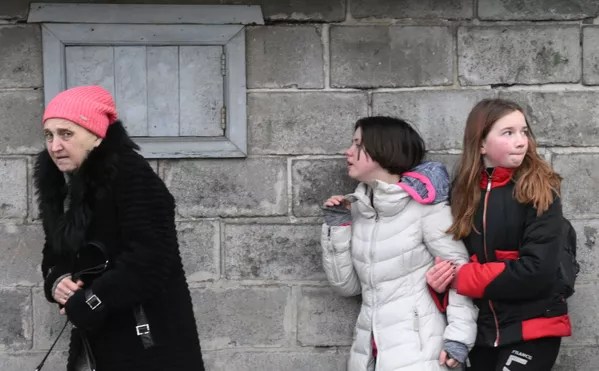
Some 1,091 civilians were killed and more than 3,500 injured in 2022 amid the ongoing hostilities in the Donetsk People’s Republic (DPR), a regional human rights ombudswoman said on Friday. The total civilian death toll of the DPR since the beginning of the conflict in then-east Ukraine back in 2014 has reached 5,441, official figures show.
Over the past year, the Ukrainian military has repeatedly subjected the city of Donetsk to artillery and missile attacks, deliberately targeting residential areas away from any military installations to inflict damage on civilians, the office noted.
“Such a deliberate atrocity against the civilian population is nothing more than an admission of the Ukrainian militants in their own powerlessness on the battlefield, where our defenders beat them again and again,” the DPR’s ombudswoman, Darya Morozova, said in a statement. The sole goal of the Kiev “criminals” and their attacks against the republic’s cities is an attempt to strike fear in the hearts of the local population, Morozova noted, adding that it was impossible to “break the spirit of Donbass.”
A sharp increase in the civilian death toll comes as years-long low-intensity hostilities in the then-Ukrainian east devolved into a major conflict between Moscow and Kiev.
Russia sent troops into Ukraine on February 24, citing Kiev’s failure to implement the Minsk agreements, brokered by Germany and France, and designed to give the regions of Donetsk and Lugansk special status within the Ukrainian state. Former Ukrainian president Pyotr Poroshenko has since admitted that Kiev’s main goal was to use the 2014 ceasefire to buy time and “create powerful armed forces.”
The admission has also been amplified by former German chancellor Angela Merkel and French President Francois Hollande, who have separately stated the Minsk agreements were never intended to actually be fulfilled but were merely a ruse to buy time for Ukraine’s military buildup.
Moscow demands that Ukraine officially declare itself a neutral country that will never join any Western military bloc. Kiev insists the Russian offensive was completely unprovoked.
In September, four formerly Ukrainian regions, the DPR and the Lugansk People’s Republic (LPR), as well as Kherson and Zaporozhye, overwhelmingly supported joining Russia during referendums, getting formally incorporated into the country shortly after.
Lavrov’s interview with the Great Game programme, December 28, 2022
Russian Ministry of Foreign Affairs | December 28, 2022
Question: Several years ago, I spoke with former US Secretary of State Henry Kissinger. At that time I had just returned from Moscow and told him that if the US and NATO policy of ignoring Russia’s concerns – with a satisfying smack on the head – continued, Russia would have to use force. Kissinger said if we did this, we would suffer big damage and all of NATO would unite against us.
He was right – the collective West united in response to the special military operation and has shown even greater solidity than many expected. Russia stands proudly and confidently; Moscow does not look like a city that has wavered or that doubts its correctness and strength.
What do you think about the possibility of military escalation, on the one hand, and serious talks next year, on the other?
Sergey Lavrov: You are right that the collective West has closed ranks. But this was not because every country in the alliance felt it wanted to. They were rallied, by the United States, primarily. Their mentality of domination has not been moderated in any sense.
A couple of weeks ago, I noted a statement by a Stanford professor to the effect that the US needed to be a global policeman to save the world. Not only NATO but also the EU, as an association that only recently claimed strategic autonomy, has fully conformed to the West’s uniform policy. Centres for coordinating actions by NATO and the EU are being set up, neutral states (Finland and Sweden) are being included. A mobility programme began to be introduced long before that. It provides for using transport and other infrastructure in non-NATO countries for moving NATO’s equipment eastward, closer to our borders.
Recently, some in the Great Game discussed the global changes taking place in the EU and Europe as a whole, and a shift in the centre of gravity in favour of Europe, primarily Poland, the Baltic states. the Czech Republic and Slovakia. Europe’s grandees are lost in this situation. Four years ago, President of France Emmanuel Macron spoke about the need for Europe to rely on its own forces and to have its own army. A strategic compass was created as a step to strategic autonomy. He talked about NATO being braindead, in expressing his disappointment with the processes imposed from overseas. Now this talk is over. Mr Macron said at one time, it would be necessary to create a system of security in Europe with consideration for the interests of all countries, including Russia. But he was quickly rebuked by the junior members of the alliance. Everyone sees this as the normal course of events.
As for how Russia was perceived throughout these years, including the time you met with Mr Kissinger, our Western colleagues used to say that “Russia needs to know its place.” They said this with pleasure. This is an accurate observation. This “pleasure” was felt practically in the years after the USSR. First, they patted us on the shoulder in the direct and figurative sense of the word. They believed we were in the “the golden billion’s” pocket and were becoming part of the Western globalisation system. Now it is called a system of rules that must underlie the world order. We were seen as an ordinary junior partner that had the resources needed by the West and to which the West would transfer technology while preserving its position in its own coordinate system. The tune is set by the Western leaders, primarily the US and its closest allies in Europe, that have straightened their shoulders and think they have the right to dictate how Europe is developed.
A recent article by Henry Kissinger was widely commented on. We took note of his evaluations and forecasts, including the options for a final settlement. Surprisingly, no one paid attention to the line that said, “As the world’s leaders strive to end a war in which two nuclear powers contest a conventionally armed country.” It’s probably a Freudian slip, but Henry Kissinger is a wise person and never says anything for nothing.
But this is a candid statement about who is fighting against whom. We are at war with the collective West led by the United States which is a nuclear power. This war was declared years ago after the coup in Ukraine which was orchestrated by the United States and supported by the EU, and after no one planned to act on the Minsk agreements (as we now know for sure). Angela Merkel confirmed this.
Several years prior to her stepping down as chancellor, in a conversation with President Vladimir Putin, when he, for the umpteenth time, reminded her what was written in black and white about the importance of resolving special status-related issues in a direct dialogue between Kiev, Donetsk and Lugansk, Merkel said that this was a case of “constructive ambiguity.” Allegedly, Russia was overseeing things in Donbass, so it was supposed to sort things out with Kiev as well. This was not an epiphany or an attempt to jump on the Russophobic “train” that was picking up speed. It was a deeply rooted stance.
Experts from the Presidential Executive Office and the Foreign Ministry drafted an approved text of agreements that confirmed the principled provisions of the Minsk agreements for the Normandy Four summit held in Paris in December 2019. A ceasefire and the disengagement of forces along the entire line of contact was the number one provision. This was agreed upon by everyone.
When the four leaders sat down at a table in the Elysee Palace and the parties took their seats along the perimeter, President of Ukraine Zelensky said that he would not act on or sign a document on disengaging forces along the entire line of contact. The most he was willing to do was pick three pilot sites and try to see if disengagement would work there. We had our suspicions right away, but we chose to clarify the reason behind the metamorphosis occurring on the way from the consensus achieved by the experts and the destruction of this consensus at the heads of state level. The Americans sent a signal that if Zelensky were to disengage forces along the entire line of contact, the Russians would never give Donbass back.
Question: Do you know for a fact that he received this kind of advice or instruction from the United States?
Sergey Lavrov: I’m not sure about the name of the person who conveyed that. But they told him what I just said: if he disengaged the forces, he would drastically reduce his chances of taking these territories back. They wanted to take them back through military force for one, and only one, reason. They were unwilling to fulfil the Minsk agreements in part concerning the terms and conditions for restoring Ukraine’s territorial integrity which were quite straightforward: the Russian language, their own local police (like the state police in the United States), and central authorities holding mandatory consultations when appointing judges and prosecutors, as well as special economic relations with neighbouring Russian regions.
The Republika Srpska in Bosnia and Herzegovina has that. This is also included in an agreement on the creation of a Community of Serb Municipalities in Kosovo reached by Pristina and Belgrade in 2013 with lots of ceremony and EU mediation. Almost the same rights were granted to the Serbs in northern Bosnia and Herzegovina, the same as in the Minsk agreements for the Russians living on the territories in question.
Zelensky refused to restore Ukraine’s territorial integrity which he could do by providing to a portion of the people the rights enshrined in numerous international conventions and the constitution which still spells out the obligation of the state to ensure the rights of ethnic minorities, and the Russians are mentioned separately. Plan B has been in existence since 2019 in Paris. From time to time, certain Ukrainian leaders have let it out that the Minsk agreements were not in their interest and said military force must be used to take it back.
The Ukrainian tragedy goes back quite a while. They are now trying to cancel the portion of it that clarifies what is going on now and many other things as well. Russian culture in Ukraine has been cancelled for many years now. Laws to this end were adopted back when President Poroshenko was in office and continue to be pumped out under President Zelensky. A couple of years ago, they approved a law on the Ukrainian language as the state language. This caused alarm even at the CoE Venice Commission, the European Union, and the OSCE. But the most these venerable institutions could do at the time was tell the Ukrainians they could keep the law, but should update the applicable legislation on ethnic minorities.
A few weeks ago, the Verkhovna Rada adopted the law on ethnic minorities in the second reading. This is Ukrainian lawmaking at its best. It says that the state guarantees the rights of all minorities to the extent defined in the applicable legislation. The new law on ethnic minorities includes everything that was restricted before that (education, media and culture) as the basis for the rights that the Kiev regime is willing to grant to ethnic minorities. The Romanian leadership is in uproar. They are now talking vociferously about the need for consultations and that no one asked them what they thought. The attitude towards the Hungarians and the way Kiev treats the Hungarian minority is well known. Needless to say, Russians are treated even worse than the Hungarians.
Forgive me for digressing before taking your question. The issue is about approving or not approving the neo-colonial international order, which President Vladimir Putin spoke about. The West is covering it in a shroud of respect for its rules-based order. When this term came into use, I asked my Western colleagues (we were still talking back then) to give us a list of these rules. No wonder no one has ever given us any reference material that would show the specific rules or the code of conduct. The answer is simple. These rules mean that everyone must do as the United States says.
Remark: These rules have been put forward by the West but they were never approved by the UN.
Sergey Lavrov: They have never been approved by anyone. No one has seen them. When they first introduced this into the international discourse, we immediately raised our concern and tried to engage them in rational discussion. However, they were unwilling to do anything of the sort.
These rules were best expressed in a statement made by a professor from Stanford University, who said that the United States had to be the global policeman to save the world. In many of America’s doctrinal documents, Russia is referred to as an immediate threat. That not because we are going to attack anyone somehow but because we have challenged this world order. China is next in line. It poses the most formidable and systemic long-term challenge, and it is the only country capable of surpassing the United States in almost all areas. In terms of nuclear weapons stockpiles and the development of nuclear capabilities, Beijing will soon be on a par with Moscow and Washington.
You can look for the answer to the question about the possibility of escalation in various statements and analyses by political scientists. The Russian authorities have not voiced an intention to take an escalation-based approach. We are committed to ensuring that the special military operation’s objectives are achieved. As President Vladimir Putin said, our indisputable priority is the four new regions of the Russian Federation. An end must be put to the threat of Nazification they have been exposed to for many years. We need to ensure security for all people living there, and their rights must be respected.
Another very important objective is to ensure that no threats to our security are created or remain on the Ukrainian territory. Now they say that the West did not try to urge Ukraine to engage in military action against Russia, however, I regard oppressing Russian-speaking people in Ukraine to be genuine aggression.
Question: I would like to clarify one issue. When you talk about the four regions, do you refer to their administrative borders or the part of their territory, as of today, that Russia has brought under its control?
Sergey Lavrov: No, I am talking about the borders of these regions as part of the Russian Federation, in keeping with our country’s Constitution. It is an obvious thing.
Question: Do you mean that Russia needs to liberate these regions?
Sergey Lavrov: Of course. It is required by the public vote held in each of the four regions. This happened long ago in the Donetsk and Lugansk people’s republics, while in the Zaporozhye and Kherson regions it was in autumn 2022.
Question: What you expect to achieve by the end of the negotiating process, or the recognition of this fact by Ukraine – are these prerequisites for launching the talks?
Sergey Lavrov: President of Russia Vladimir Putin has said many times that we never reject any proposal to achieve diplomatic agreements. The terms on which we agree to discuss them are well known. The fact that four territories belong to the Russian Federation is an indispensable condition for talks. But this is not all that must be discussed.
The second large block of problems, in addition to the destinies of the people who do not want to live under the current regime with its open Nazi and racist views is the security of the Russian Federation that has been subjected to numerous threats created on Ukrainian territory. Now some people are saying that this is not at all the case, that these exercises in Ukraine, including in the Black Sea, were “military cooperation for peaceful purposes.” The territory of Ukraine was actively developed. There were plans (we are aware of these as well) to establish a naval base in the Sea of Azov. You know that at that time this was a sea of two states. The construction of an Anglo-Saxon naval base would have radically changed the security situation. In the same way, there were plans to create a military base in then Ukrainian Crimea before the coup and the referendum in order to neutralise our capabilities in the Black Sea.
We do not launch spontaneous, offensive or striking operations unlike Ukraine. As a rule, Ukraine does this regardless of its losses. Its main goal is to produce a media effect there and then. The West would have continued to endlessly extoll its current leaders as representatives of genuine democracy. Vladimir Zelensky would be portrayed as a hero of the times, and he should have everything he wants for this reason. Yet, his requests are sometimes rejected. There are smart people in the West, who understand that these people and this regime should not be given some categories of arms.
“Anonymous specialists from the Pentagon have said more than once that they don’t have the right to prohibit Zelensky from striking the territories that are internationally recognised as part of Ukraine, including Crimea. There is some anonymous but credible evidence that American specialists were directly involved in modernising multiple launch rocket systems to extend their range to 1,000 kilometres. Nobody hides the fact that information from military and civil satellites belonging to US owners are actively used in real time for adjusting fire. US specialists are directly involved in targeting. We asked the Americans through the channels our Embassy still has, whether a decision to transfer a Patriot battery means the presence of US experts, considering the expertise needed to use it. We were given a lengthy explanation that this was not planned because the US didn’t want to and would not fight against Russia directly. It will take several months to prepare the Patriots for action, until the Ukrainian military master this technology. But there are dozens and maybe even hundreds of American military personnel there, and they were in Ukraine even before the coup. CIA employees occupied at least one floor in the Ukraine Security Service building. Now they have a big military attaché office. Obviously, military experts are not just visiting the Defence Ministry of Ukraine. They are giving direct consultative services (and probably doing more than that). There is also a group of specialists that (as the Pentagon explained in the US Congress) have controlled how American weapons were being used for months now. So, when some members of Congress tried to demand the creation of a special mechanism for this purpose, the Pentagon reassured them that they were monitoring all this. This is a rather interesting situation. There are many facts indicating that Western weapons are surfacing in Europe (maybe now in other regions as well). I asked my staff to make an open source compilation to show our interlocutors what is being swept under the rug at this point.
We are in no hurry. President of Russia Vladimir Putin talked about this. We would like to finish, as soon as possible, the war the West was preparing for and eventually unleashed against us through Ukraine. Our priority is the lives of the soldiers and civilians that remain in the zone of hostilities. We are patient people. We will defend our compatriots, citizens and lands that belonged to Russia for centuries, proceeding from these priorities.
Question: You quite rightly said that the West is waging a war against us through Ukraine and not only. The West and the United States hypocritically claim (since they are not officially sending their troops to openly fight against Russia on Ukrainian territory) that they are not a party to this conflict. Therefore, without fear of a third world war, including a nuclear one, they can send Ukraine any type of weapons, provide them with intelligence and advise on the battlefield. We can see that both the number and quality of weapons the West provides to Ukraine is growing. The West is overcoming its own taboos established several months ago.
What is Russia doing and what will it do in 2023 to convince the West to abandon this dangerous logic and stop this trend?
Sergey Lavrov: I believe that we must continue our policy outlined by Russian President Vladimir Putin on the ground to strengthen our capabilities, both technologically and from the viewpoint of military personnel who, after the partial mobilisation, have undergone serious training. A significant part of them is already there but most are not on the frontline where professionals, contract soldiers are fighting. A significant part of them is in reserve.
We will continue to strengthen our deployment. This decision was made in September 2022. The commander of the joint force was appointed. We are engaged in actions that will allow us to operate much more effectively in these territories in the very near future. I have no doubts about this.
We also pay attention to what you said – pumping Ukraine with large quantities of advanced Western weapons. I follow the discussion in our society, and on your programme, and in other political circles and formats.
Retired military professionals say that the supply of Western weapons needs to be cut off. I mean railways, bridges and tunnels. I believe this issue cannot be ignored by professionals. They have been paying attention to it for quite some time. They are responsible for taking professional decisions on the methods of obstructing and, ideally, blocking these supplies. One such method has been used and is still being used, which is inflicting damage on infrastructure, including energy infrastructure that enables the supply of these weapons. I believe there are also other plans for achieving the same objective.
We have scarce opportunities for talking to the West now. There is no particular desire to do this when you read statements by foreign ministers, prime ministers or presidents about the need to address the issue of security of Europe to protect it against Russia. They used to say “without Russia” and now they say “against Russia.” The idea of French President Emmanuel Macron to create a European political community boils down, roughly speaking, to the OSCE without Russia and Belarus. This was proposed by a man who a bit later said it was important to stay open to opportunities for building security institutions with Russia. Yet, the European political community will be gaining in strength. They have scheduled a regular summit for spring and are trying to drag all our neighbours, except Belarus, into it.
Considering this, we have no particular desire to talk to the West. When a concrete situation emerges where the West openly commits unlawful actions, then we ask questions. According to recent reports, Greece plans to transfer its S-300 missile systems to Ukraine. We asked our ambassador to contact the Greek Foreign Ministry and Defence Ministry and remind them that the systems in question had been transferred to Greece. You might remember that they had to be delivered to Cyprus but the West did all it could to not allow this to happen, given the insularity of Cyprus and it not being a NATO member. As a result, a compromise was reached that suited everyone. Greece bought this system. Under the contract for this deal, Greece may not transfer missiles to anyone without our approval. We reminded the Greeks about this. They said they remembered their obligations. We are closely following things like this, all the more so as the same provision prohibiting the transfer of our weapons to anyone applies to the majority of weapons in Eastern Europe – the member countries of the former Warsaw Treaty – where they were produced under licence. We need to be on our guard. Many unlawful actions are being committed under the slogan “Let’s Save Ukraine,” because “Ukraine Is Europe” and “Europe Is Ukraine.”
Question: Is the United States mistaken in thinking that it is safe, need not worry about any escalation or a direct armed clash with Russia and can render any and all military assistance to Ukraine until it enters a direct war against Russia?
Sergey Lavrov: President of Russia Vladimir Putin spoke about this at the recent expanded meeting of the Defence Ministry Board. He formulated our position as the Supreme Commander-in-Chief (I won’t add anything to it) on the new systems of our Navy, which have been put into operation now.
Question: Dimitri Simes started our conversation by saying that the West has closed ranks. I think the outgoing year has revealed an even more important trend. This is the formation of a global majority – the countries of the East and South, which do not accept Western hegemony and refused to side with the West against Russia. I perceive this year as the moment of truth in relations with the West and with non-West. Will our turn to the global majority be a strategic rather than opportunistic trend in Russian foreign policy that will be preserved and strengthened in 2023? What will Russia do in 2023 to promote its ties to the global majority and its role in world affairs?
Sergey Lavrov: I agree with those analysts reviewing the outgoing year who note that the discord between the West that claims hegemony and control over compliance with “its rules” everywhere, on the one hand, and the global majority, on the other, is an objective phenomenon. It was brewing and would have come to the surface eventually. We could no longer tolerate how Russians were being humiliated in Ukraine and how threats to our security were created there. We launched the special military operation that served as a catalyst and sharply accelerated this process.
It seems to me that after sanctions imposed on Russia following the coup against it and after the Crimean referendum, the majority of non-Western states had already realised that the system they were in with other countries was unreliable. This is a system of international currency, finance, globalisation, logistics chains, insurance for international shipments, freight rates and technological products that are produced by a handful of states. This applies to the same conductors on which the Americans are now trying to impose a veto. They have sanctioned Chinese companies that produce conductors in an obvious bid to slow down the development of the PRC. Everything happened much faster.
Many countries had to make a choice then and there. It was probably difficult, considering how deeply they were intertwined in the globalisation system. It was created by the Americans and discredited by them because Washington proved to be an unreliable curator and operator of this system.
Yes, we have heard the Chinese authorities saying that they are against hegemony and for building a fair world order, and the Indian authorities saying that they will be guided by the interests of India and that it is useless trying to convince them to abandon their national interests in favour of American geopolitical interests. Türkiye and Algeria, as well as Venezuela, Cuba, Nicaragua, Mexico, Argentina and Brazil have not joined the sanctions either. The emergence of a new world order will certainly gain momentum and is already gaining momentum. It will objectively be a whole historical era.
I noticed that somebody said during one of your shows that globalisation is giving way to regionalisation, and that there will be several large blocks formed around regional leaders. These blocks will create the instruments and mechanisms that replace globalisation instruments and mechanisms that are being abused by those who created them. The debate focused on whether the United States was aware of that process. Somebody said that it was and that the Americans would like to accelerate the regionalisation of the global economy and international relations in general. However, China, which is also aware of the importance of regionalisation and is not against regionalisation as such, is creating its own instruments and structures but would like this process to take as much time as possible.
I thought that it was an interesting opinion. It should be carefully analysed. If the Americans really wanted to accelerate regionalisation, they would have wanted to agree on the terms as much as possible and as soon as possible. The sooner you negotiate and come to certain terms, the better the chance that you will preserve the instruments you have been using globally.
There is no doubt that the process is underway. And the choice is not between the global majority and the West; we will choose those who are reliable partners and honour agreements, who hold a promise when it comes to long-term projects and will not only look for short-term benefits.
I discussed this with my American colleagues back when we had channels for a regular dialogue. Many officials in the US administration admitted at the beginning of the pandemic that democracy as it is understood in the West has its limitations and that there are certain advantages in the system which the Americans describe as autocracy. Ultimately, autocracy is a centralised state with a strong vertical system of power, which can quickly take decisions that are implemented throughout the national territory. If we compare how different countries dealt with Covid-19, we will see that there are advantages in both systems. Our Chinese comrades have ultimately admitted that their decision to completely close off the country was not entirely correct, because it prevented the development of herd immunity. They are working now to rectify their mistake. However, the United States had the largest number of Covid cases by far.
I discussed the matter with former US Secretary of State Condoleezza Rice. I asked if presidential and parliamentary election campaigns, held every two years, interfered with governing their vast, great and diverse country, even though it is a melting pot that turns all its citizens into Americans. She said that they did. They have a cumbersome system, but this is their problem, and they know how to address it. However, this has also become a problem for the rest of the world, because the Americans need to invent an external problem, threat or goal for every election campaign. Given the US weight on the international stage, global processes become hostage to and are strongly influenced by the Americans’ discussions of domestic issues and political infighting. Autocratic states, as defined by the United States, with a centralised system of government at least have the advantage of a more predictable horizon, like in China. One can argue if it does or does not comply with the principles of democracy, but who said that American democracy is the best form of government?
Winston Churchill could have been right, in part, when he said that “democracy is the worst form of Government except for all those other forms that have been tried from time to time.” The world is changing, and we can still see something new invented in this domain.
Question: They ascribe another interesting statement to Winston Churchill, who reportedly said: “The best argument against democracy is a five-minute conversation with the average voter.” I would like to say that anyone who wants to comprehend how wrong US democracy is should talk to an average member of the US Congress, and much will become clear.
Several days ago, you said that, according to the US media, including The New York Times, some people in the Biden administration are seriously thinking about launching a pre-emptive strike against the top Russian leadership. I called Washington and spoke with two people in the US administration on condition of anonymity.
Sergey Lavrov: I also quoted an anonymous source.
Question: They said that they could not vouch for all officials of the large US administration, but that, of course, there are no plans to hit the top Russian leadership, and that there can be no such plans. Do you believe, on the basis of what you know, that someone with real authority in Washington is planning a strike against the Russian leadership?
And my second question. US Secretary of State Antony Blinken and National Security Adviser Jake Sullivan have repeatedly said that Washington is warning Russia that it should not go down a certain road because this would cause the most serious repercussions. Would you like to use this opportunity and to tell the US administration what would happen if someone tried to conduct such a strike?
Sergey Lavrov: I quoted an anonymous source, but, unlike you, I don’t know him (you know your anonymous sources). I know that they called him a high-ranking source.
Question: Did The New York Times advertise him?
Sergey Lavrov: Yes.
Question: Does this mean that The New York Times took him seriously?
Sergey Lavrov: We are used to thinking that it is serious journalism. Although there are more and more indications that this is not always so, we, nevertheless, stick to this concept. I would like to deliberately exaggerate this anonymous leak because this source (he or she or it, using the current politically correct language) said that such a threat had been voiced and that, in principle, the Kremlin should not feel safe. The source said something along these lines. There was nothing specifically about Vladimir Putin, but everything was clear. I decided to deliberately emphasise this statement, made against the backdrop of constantly chattering talking heads who can obviously do nothing else but talk, but they aren’t very good at thinking. Alexey Danilov from Kiev, for example …
Question: National Security and Defence Council Secretary Alexey Danilov.
Sergey Lavrov: Yes, he is a great expert on foreign affairs. There is also Mikhail Podolyak …
Question: An adviser to the Head of the Office of the President of Ukraine.
Sergey Lavrov: Every day, they say that they will take back Crimea, and that the Kremlin should know that they will reach it and drop their bombs there.
The US administration did not respond in any way to a similar but slightly less vulgar statement by an anonymous source in Washington. Journalists did not ask White House Press Secretary Karine Jean-Pierre what they think about this at a briefing. When they asked about Crimea, an anonymous Pentagon source said that they could not forbid the Ukrainians from using their armed forces against a territory they consider to be part of Ukraine. This highlights a serious change in their position.
In April 2014, after the coup and the referendum in Crimea (I have already talked about it, it is not a secret), we gathered in Geneva ‒ US Secretary of State John Kerry, myself, EU’s leading diplomat Catherine Ashton and Andrey Deshchitsa, who acted as a foreign policy curator for the putschists. We sat down and discussed a one-page document that included, as the main statement, support of Ukraine’s federalisation and the start of the process involving all Ukrainian regions. It was a completely natural development for the EU delegate and John Kerry. The paper was still there later; however, it did not gain any status either. Concurrently, John Kerry and I had lengthy bilateral conversations. During one of them, he said that they were well aware of the fact that Crimeans’ choice was sincere and there was no doubt about it. And yet, that choice had to be formalised, through another referendum, with invited representatives from the OSCE, the UN and others. The first referendum had been conducted in haste. I explained to him that the rush was due to the fact that the putschists had thrown their “friendship trains” at Crimea, with armed militants, the Right Sector and other neo-Nazi ultra-radical groups that stormed the Supreme Council of Crimea. The local population did not want to wait for another aggressive provocation.
US President Joe Biden keeps saying that Ukraine must win in order to prevent the third world war. He said something to that effect only recently. I don’t understand this kind of reasoning because first, he says they will not directly confront Russia otherwise it will trigger world war three and later, he adds that Ukraine must win to prevent the world war. We don’t have a dialogue channel. Chairman of the Joint Chiefs of Staff Mark Milley occasionally calls Chief of the General Staff of the Russian Armed Forces Valery Gerasimov. US Secretary of Defence Lloyd Austin has spoken to our Defence Minister Sergey Shoigu maybe a couple of times. That is all good and helpful. But it comes down to us having to be careful.
Question: Back when Hillary Clinton was US Secretary of State, she formulated the underlying principle of American diplomacy, which remains in effect to this day – the United States “can walk and chew gum at the same time.” In this case, if applied to US-Russian relations, it means the United States is containing Russia, providing all-out support to Ukraine and trying to help Ukraine “defeat Russia on the battlefield,” while at the same time it wants to discuss with Russia issues that are of interest to them. Now they are interested in talking with Russia about the resumption of START-3 inspections at nuclear facilities. The United States argues that we are both nuclear superpowers and the inspections are essential for strategic stability. In my opinion, this is very hypocritical. I see the main threat to strategic stability in the hybrid war that the United States is waging against us, not in inspections or a lack thereof. In any case, do you think we need this? True, it is one of the opportunities for dialogue with the United States; but in the context the United States is proposing, should we agree?
Sergey Lavrov: When I was young, I was perfectly comfortable walking and chewing gum at the same time. This is an American metaphor. But we use other idioms, including “the cat would eat fish but not wet her feet.”
You are absolutely right. They are interested in the resumption of inspections. Naturally, we are analysing the situation. According to our assessment, they need this to be able to know what to expect “just in case” – for all the mantras about nuclear war being unacceptable, and we are still one hundred percent committed to this. We recently reaffirmed our commitment in a special statement. I am referring to the Russia-initiated statements by the five nuclear states that there could be no winners in a nuclear war and no such war should ever be started. In June 2021, at Russia’s initiative, presidents Joe Biden and Vladimir Putin at the summit updated and reaffirmed the statements signed by Ronald Reagan and Mikhail Gorbachev in the late 1980s.
They want to do these inspections. They send signals to us; we receive calls from representatives of the National Security Council who want to resume everything. We quote the treaty to them – exactly in the vein of your assessment that stability is not ensured by inspections. The preamble to this treaty says that the Russian Federation and the United States, will be working “to forge a new strategic relationship based on mutual trust, openness, predictability, and cooperation.” All of the above has been derailed by the United States. They have as good as labelled Russia an enemy. There is no trust, and they say so directly to us.
In the preamble, the parties also recognise the existence of the interrelationship between strategic offensive arms and strategic defensive arms. And that was the farthest the Americans were willing to go to signal their understanding of our concerns about their missile defence plans, plans to create a global missile defence system. Well in any case, this interrelationship is enshrined in the treaty. Even in the previous period, before the current events, we highlighted that connection during consultations on the treaty’s implementation. The treaty further adds that this interrelationship will become more important as strategic nuclear arms are reduced. They said, it is just the preamble. We pointed out that after ratifying the treaty, our State Duma issued a statement that the treaty could not have been ratified unless it mentioned the close inseparable interrelationship between offensive and defensive strategic arms. This is not “just a preamble” to something unimportant; it is a legal fact. Of course, they are violating this obligation. A global missile defence system is being built along the perimeter of Russian and Chinese borders. All this “not to worry, it’s all against Iran and North Korea” talk is a thing of the past. Nobody remembers this anymore. It is openly declared that the anti-missile systems are there to “deter” Russia and China.
In this situation, if the only important part they see in this treaty is “you let us come and see,” this is not too fair. From a technical point of view, the sanctions have seriously hampered our ability to carry out cross inspections. Even if Russia is (hypothetically) given permission for aircraft to fly across all the countries on the way to Geneva, the members of the delegation and the crews, as we have found, will have problems paying for their hotel, food, and refuelling of the aircraft. None of this can be guaranteed. “Let’s just resume the inspections, and then we will solve things as we go.” The technical side is treated like a minor, even immaterial issue.
A strategically important issue is that they have undermined all the foundations this treaty relied on. Despite that, as we spelled this all out to our American colleagues, we said that we were fully committed to our obligations under the treaty as long as they could be implemented on an equal footing: we will provide them with the information as required by the treaty in a timely and complete manner and will send appropriate notices.
Question: Continuing the theme of real threats to strategic stability, Joe Biden said Ukraine must win on the battlefield to prevent a third world war. What do you think the US will do when Ukraine loses on the battlefield? This seems inevitable to me. They have convinced themselves that this war is not only (and not so much) for Ukraine, but for American leadership, for the notorious “rules-based international order,” that is for American hegemony. What will they do when Ukraine loses?
Sergey Lavrov: Your question has cornered me. I usually try to think before I say something. Even so, I let things slip sometimes, I confess. When a person says such things, they probably have something up their sleeve; if they really mean what they say, that is.
There is increasing talk on the need to start negotiating. But then Russia is accused of refusing, while President Vladimir Putin has repeatedly stated that there have been no serious proposals.
The Istanbul episode clearly showed that Ukraine was immediately scolded then: “Too early. You haven’t yet exhausted Russia to the point the United States would deem acceptable.” Now they don’t even blink when saying Kiev is “ready” to talk and Russia isn’t, amid Kiev’s declarations that Ukraine will never sit down at the negotiating table until they have their “native Ukrainian-Crimean” land and others back, until Russia “capitulates,” and pays “reparations.” Only then will we be accepted into some new “party.” After a tribunal, naturally. And in February 2023, they will put together some new ranks. It will be interesting to see.
Most processes have long been taken outside the UN framework. The French and the Germans have created some new platforms on international humanitarian law. Then they created an EU-led Alliance for Multilateralism. When asked why they couldn’t do this at the UN, a format as multilateral as possible, they said the old members were retrogrades, while they were progressive multilateralists.
Joe Biden later convened the Summit for Democracy, assuming the right to decide which democracy is more democratic. The criterion for being a democracy in the American interpretation is not just being loyal to the United States, but to the US Democratic Party. Linguistically understandable. Then came the European Political Community forum. The US recently hosted a US-Africa Summit. Unlike us, (Russia invited every African country to the first such summit and to the second one in mid-2023), the Americans themselves decided what Africa was, as a geographical concept. Six or seven countries were left out, because the governments were not “legitimate” enough, i.e., not appointed through elections. At the same time, the Ukrainian government came to power as a result of a bloody coup.
Question: As someone who has just arrived from Washington, I can argue with you. If the Biden administration decided that a country is not part of Africa, then it isn’t, full stop. You are challenging the basic premise. If someone has made a decision that a certain country is not part of Africa, why does Moscow object?
Sergey Lavrov: I’d like to finish the list of their bizarre manipulations with the possibility of creating another security forum excluding Russia. Vladimir Zelensky has put forward a 10-point plan, and Dmitry Kuleba is already appointing supervisors from the Western camp for each of the ten points. They will start handing out instructions soon.
Question: Let’s get back to Henry Kissinger. Many years ago he wrote that leaders rarely lie to each other. Things are different in public diplomacy, where telling the truth and nothing but the truth in dealings with the counterparty is not something that diplomats are expected to do. When leaders talk to each other, though, they don’t usually lie to each other, because they know they will have to deal with each other again and minimal trust is a bedrock principle of diplomacy.
Now, it appears that we have arrived at a point where trust is nonexistent, and Washington and Brussels are bragging about the fact that there is no trust in relations with Russia and cannot be any. Things that were discussed during talks with the President or with you are made public. They say warnings were issued during the Georgia crisis of 2008 to the effect that it was necessary to get Mikheil Saakashvili “out of the way.” Remarks are being ascribed to President Putin and you which (as it turned out later) you never made.
I have a question for you: how are you supposed to deal with your former US colleagues in these circumstances? For better or worse, the United States remains a great power, and you have to deal with them in order to maintain token public dialogues and a confidential dialogue that is still ongoing. What do you wish for in this regard? Not a rhetorical wish, but a serious wish to policymakers in Washington, so that a serious dialogue could start in the new year?
Sergey Lavrov: We are not going to make any wishes with regard to the dialogue. They are well aware of the fact that it was not us who broke off the dialogue. We are not going to ask them to resume it. That’s not who we are. We respond only to sensible offers when we receive an offer to meet.
There were several informal proposals during this period. Each time we agreed to meet. One of them materialised when Director of the Central Intelligence Agency William Burns met with Head of the Foreign Intelligence Service Sergey Naryshkin in Ankara. The meeting was supposed to be confidential, but every piece of information under discussion was leaked to the public domain. Few things are kept secret these days, although we always try to keep up our end of the deal. More attempts were made to set up a meeting which also included references to Washington-issued instructions. We never said no. But eventually these attempts tapered off.
My wish is for them to be a little more democratic, not in the way they understand it, but in the way it is understood in the international arena. When we are talking about democratising international relations, we are not talking about some supernatural or breakthrough approaches. We are talking about the importance of having these relations rely on the UN Charter, according to which the UN is based on the sovereign equality of states. There’s no need for anything other than that. All we need to do is act in line with this commitment, which the United States (in conjunction with Russia) wrote with its own hands in this fundamental document. Otherwise, they feel entitled (I cited these examples and everyone is aware of them) to suddenly decide that the security of the United States has deteriorated abruptly or seriously depends on what is going on in Yugoslavia; or, someone suddenly begins to suspect Saddam Hussein of doing some kind of research in the field of WMD; or Muammar Gaddafi is all of a sudden not “good” enough or maybe knows too much about funding a presidential campaign in France in a given year. That is all they need to get going. An expeditionary force is then sent to a country lying 10,000 miles away from the United States. They levelled Libya. Now they are trying to put it back together again. Just like the Americans insisted at some point that Sudan must be divided into two parts. Then they started complaining that neither part is listening to them. Now, they demand that sanctions should be imposed against Sudan and South Sudan and are, in fact, imposing them.
Hundreds of thousands of people were killed in Iraq and cities were razed to the ground. No weapons were found. Tony Blair in his memoirs said that they made a mistake, but it can happen to anyone. All of that was done to the countries located on the other side of the ocean. I’m not even talking about the reasons the Americans came up with for intervening the Dominican Republic or Grenada. President Reagan was talking about a threat to the lives of US citizens. Just a threat. There were thousands of Americans there. They invade countries, topple governments, etc.
In our case with the Russians and the Russian-speaking people in Ukraine, their rights, language, education, media and culture were trampled on under the law. Then, there was the coup. The putschists then said that the Russian language must be banned and outlawed, and Russians should be driven out of Crimea. We went ahead and signed the Minsk agreements, which covered a small portion of the territories that are now under dispute. Not a single law was adopted in Ukraine under President Poroshenko or President Zelensky without the United States providing strong advice. Nothing would have happened if the West, primarily the United States, had complied with these overall simple agreements. There would have been no putsch or the coup if the Germans, French and Poles, who acted as guarantors of the deal signed by President Yanukovych and the opposition, had insisted on the putschists ending this mayhem and following up on the agreement. There would have been elections there five to six months down the road and the opposition would have won. Things were clear. Why did they have to do it? I have only one answer to that question. If this were the case, the theory put forward by Zbigniew Brzezinski would have come under revision and risk. Then, provided that the existing agreements were fulfilled, and everything remained within the 1991 borders, this would have created an environment for Russia and Ukraine to maintain good relations (it’s a fantasy, but I think it’s not far from the truth).
What they did instead was put Russophobes in place, break the deal with President Yanukovych and start doing what they keep doing now, namely, legitimising the Nazi theory and promoting Nazi practices via battalions into everyday life.
When US Congress was approving the US military budget, as it does every year, they imposed a ban on any kind of help, including military and financial, to Azov. Each time, the Pentagon objects to this and pushes for having this ban removed from the US budget. This speaks volumes.
Question: What is your forecast for the next year? I am not asking you to fantasise, it is not what a minister should do. Just what you can share in terms of your own expectations.
Sergey Lavrov: We must always be realistic. I am not a pessimist, although they say that a pessimist is simply a well-informed optimist. As for the glass, whether it is half full or half empty – it is also important which liquid is there.
My expectations are realistic. I am confident that with our resilience, patience and sense of purpose, we will defend the noble goals that are crucially important for our people and our country. We will do it consistently, while remaining ready for an equal dialogue and agreements that will ensure a truly equitable and indivisible security in Europe.
This includes respect for Russia’s interests. It is not something we have made up and now demand to be implemented. It is what all Western leaders put their names to in Istanbul in 1999 and in Astana in 2010, and also in the Russia-NATO Council documents. What they told us was untrue, to put it diplomatically.
Top German general calls for an end to Ukraine war
Free West Media | December 30, 2022
The longtime military policy advisor to NATO, Helmut W. Ganser sees the chance of an early end to the war in winter, especially for military reasons. With this, Ganser explicitly contradicted NATO Secretary General Stoltenberg, who has spoken out against peace negotiations.
Ganser is a retired brigadier general and was, among other things, deputy head of the military policy department in the Federal Ministry of Defense and military policy advisor to the German Permanent Representative to NATO. Born in 1948, he worked in the command staff of the German armed forces from 1992.
He argued for a cessation of hostilities: “Military-political reason speaks for an early end to this costly war”. A victory for Kiev is unrealistic, he said. “After Moscow’s initial failures in Ukraine, some observers “overreacted” and overestimated Ukraine’s chances of victory.
Militarily, there is currently a stalemate situation, while at the same time the ammunition consumption on both sides is exceptionally high.
The West has reached its limits in this war since their ammunition depots are being depleted. This applies in particular to Germany. Ganser was quoted in the German ipg-journal for international politics.
Counter-offensives by Kiev only result in losses and are unsuccessful
Russia currently occupies well under 20 percent of Ukraine’s territory. After considerable losses of terrain and the retreat to the east bank of the Dnieper, the Russian army “substantially shortened and consolidated the front”.
“Attempts at further extensive counter-offensives by Kiev […] are likely not only to result in extremely heavy losses, but will also be to no avail,” according to Ganser.
He added that the wide Dnieper river posed “a significant barrier to possible counter-attack operations by Ukrainian forces in the southern part of the front”.
High ammo consumption
At the moment there is a stalemate situation, but there is a risk of a longer war of attrition and position, with occasional thrusts and counter-thrusts. At the same time, the consumption of ammunition on both sides is unusually high. The West is also reaching its limits here, Ganser warned.
“The western side can no longer intervene in the blocked stocks of the ammunition depots of their armed forces and deliver unlimited supplies. […] Ammunition supplies for the M777 howitzers and the long-range HIMARS rocket launchers are also reaching their limits in the US,” said the psychologist and political scientist.
Be sure to take fears of nuclear escalation seriously
The danger of a nuclear escalation also speaks in favor of peace negotiations. Although this is not desired by either side, the risk still exists. “One cannot yet speak of nuclear detente,” he underscored. US President Joe Biden had also warned of a nuclear war and has used the term “Armageddon”.
Peace talks should therefore take place as soon as possible, albeit behind closed doors. “To present warnings of a nuclear escalation as exaggerated fears is irresponsible,” Ganser said.
The solution to this lies with Moscow and Washington, the two actual players. Without Western support, Kiev would have lost the war long ago. “On the geopolitical level, this is a Russian-American conflict.”
The war is very costly for Ukraine
The Chairman of the Joint Chiefs of Staff at the Pentagon, General Mark Milley, has also made a similar statement: Russia and Ukraine must mutually recognize “that a military victory is not achievable and that the winter months should be used for negotiations”.
But there are many critics of this proposal, which Ganser contradicted. “The argument that is heard again and again that the West must bring the Russian military to its knees with the help of Ukraine, because otherwise Putin will be the next to attack the NATO East Europeans, is simply a weak analysis.” After this war of attrition, Russia will first have to deal with military reform. In addition, NATO is building up forces on its eastern flank.
“The widespread counter-argument, including from NATO Secretary General Jens Stoltenberg, that Moscow is only interested in an operational pause in order to attack again in the spring, may be correct. But even the Ukrainian army, with Western help, would use a ceasefire to bolster its defensive and counterattack capabilities.”
Over 3,000 Killed Civilians Found in Mariupol: Russian Investigative Committee
Samizdat – 30.12.2022
MOSCOW – Russia has found more than 3,000 killed civilians in Mariupol after taking control over the city, the Russian Investigative Committee told Sputnik.
“In April alone, the bodies of 51 civilians were found at the positions abandoned by the Ukrainian troops, and after the complete liberation and examination of the city, their number amounted to over 3,000,” the committee said.
The investigators added that the Ukrainian military “artificially created obstacles for evacuation [of citizens] from the city” after the Russian armed forces had organized humanitarian corridors.
“Unable to leave the city and moving in search of food, civilians became a living target for Ukrainian punishers who killed them with various types of weapons,” the Russian Investigative Committee told Sputnik.
The Russian investigators proposed the creation of a special DNA database of those killed, citing difficulties in identifying the victims.
In addition, the Russian Investigative Committee initiated a criminal case against Gen. Valery Zaluzhny, the commander-in-chief of the Ukrainian armed forces, Gen. Oleksandr Pavlyuk, the commander of the operations of Ukraine’s joint forces, and other military leaders accused of the war crimes in Mariupol. The case was initiated under the article on the use of prohibited means and methods of warfare.
Ukraine adopts restrictive media law
RT | December 29, 2022
Ukrainian President Vladimir Zelensky signed into law a restrictive media bill on Thursday. The long-debated legislation introduces heavy state regulations, as well as officially forbids covering Russia in a positive way.
The legislation greatly empowers Ukraine’s media regulator, the National Council on Television and Radio Broadcasting. Half of the Council’s members are directly appointed by the Ukrainian president, with another half selected by the country’s parliament, Verkhovna Rada.
Under the new rules, the regulator is able to impose fines on all types of media, as well as hand them mandatory notices. The Council will be able to revoke licenses from printed media, as well as block online outlets for publishing restricted materials and refusing to take them down.
The new legislation also delves into the online media field, which has remained effectively unregulated in Ukraine. The final version of the bill has not imposed a mandatory registration for online media outlets, introducing a “voluntary” one instead. Those that opt to secure said registration will be shielded from extrajudicial blockage, while outlets without it can be subjected to 14-day bans after a number of “serious” violations.
Online media outlets with opaque structure, those not having easily distinguishable owners or reporters, can be easily banned by the regulator as well.
A sizable part of the legislation is devoted to tackling purported “Russian propaganda” and effectively outlaws any positive coverage of Moscow’s actions that challenge the official stance of Kiev. The bill also reinforces a ban on all Russian media outlets, which have been already de-facto outlawed in the country. Moreover, the legislation prohibits the media from publishing information somehow “discrediting” the Ukrainian language and denying or whitewashing the “criminal nature” of the Soviet-era “totalitarian regime.”
The media bill was first introduced back in 2020, but passing it was put into motion only after the ongoing conflict between Kiev and Moscow broke out in late February. The bill passed its first reading in late August, with the final version adopted early this month. The legislation has been repeatedly criticized by Ukrainian opposition figures, journalists, and international rights groups alike over the assertive role of the government and potential damage to freedom of speech in the country.
Zelensky to meet Klaus Schwab at the WEF in Davos
Free West Media | December 29, 2022
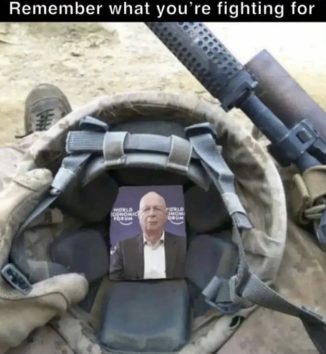 When the World Economic Forum (WEF) starts again in Davos next January, Vladimir Zelensky will be present too. He hopes to secure funding for the reconstruction of Ukraine.
Zelensky has already confirmed his participation. His government is currently preparing for the illustrious meeting in Davos, the President reported.
Among other things, another meeting is planned with the CEO of BlackRock, Larry Fink, with whom Zelensky has already exchanged views on post-war reconstruction in Ukraine.
“Specialists of this company are already helping Ukraine to structure the fund for the reconstruction of our country,” said Zelensky, who had a video call with Fink in September.
Zelensky did not reveal whether he would take part in person or virtually at the WEF from January 16 to 20.
Since May 2022, the forum has been all about the Ukraine war. In his welcome speech at the time, WEF founder and chairman Klaus Schwab described it as a “turning point in history” that “will reshape our political and economic landscape in the years to come”.
Demographic expert warns Ukraine will experience “catastrophic drop” in birth rate
By Ahmed Adel | December 29, 2022
The birth rate of Ukraine is expected to drop to catastrophic levels in 2023 and lead to the country’s population dropping to 35 million in the coming years. This is a demographic crisis that Ukraine will find extremely difficult to escape from, even if the war was to end tomorrow.
“Next year will see a catastrophic drop in the birth rate, and there is a risk that by 2030 the population of Ukraine will drop to 35 million,” said Professor Ella Libanova, Academician-Secretary at The National Academy of Sciences of Ukraine and Director of M.V. Ptukha (Institute for Demography and Social Studies).
She added that the main factor is the war as it contributes to a high mortality rate, stress, overload, poor nutrition, and a lack of medical care, all of which has an effect on reproduction and birth rates.
The expert noted that a Ukrainian woman would need to give birth to 2.13 – 2.15 children in her lifetime to maintain Ukraine’s current population of approximately 43.1 million. According to her, in 2021, the average birth rate in Ukraine was 1.1, and in 2022 it will be “even less”.
Libanova said that many of the people that have left Ukraine are “young women of active reproductive and working age, which means that they are not working in Ukraine today and not giving birth to children here.”
“It is clear that the purely quantitative effect is negative. But given the catastrophic decline of the economy due to the war, most likely these women would not have found work in Ukraine, and their presence would have increased pressure on the labor market,” the professor explained.
According to M.V. Ptukha, the population of Ukraine has decreased every year since 1994. The current population is estimated at 43.1 million, but it is recalled that in the 2001 All-Ukrainian Census, nearly 48 million people lived in Ukraine.
The United Nations High Commissioner for Refugees (UNHCR), as of August 9, found that more than 10.5 million people fled Ukraine to go into neighbouring countries. Since then, more than 4.4 million people have returned to their homes.
Although many people have returned to their homes, Libanova stressed that Ukrainian women still abroad will be less incentivised to return “because each new month of their stay […] deepens their adaptation – their knowledge of the language improves, their children go to schools and universities, and mothers take on work.”
At the same time, according Oleg Soskin, a former adviser to the President of Ukraine, Kiev is becoming a ghost city due to the massive exodus of people leaving.
“Rent in Kiev is falling and there is no longer demand. This means that migrants in Kiev are starting to leave, and there are 400,000 of them. Kiev is slowly becoming a ghost city thanks to Klitschko and all the people like Zelensky, Yermak and Shmyhal,” he said on his YouTube channel.
Soskin urged Ukrainians to leave towns and villages where production has stopped working and where there is no water, electricity, and heating systems.
“Manufacturing is going down, the economy is going down, banks are almost unable to hold out. Therefore, devaluation, inflation. Don’t linger in ghost towns,” he advised.
Following the Kiev regime’s terrorist attack on the Crimean bridge, Russia began launching missile attacks against Ukrainian infrastructure. The targets of the retaliatory strikes were energy facilities, defence industry, military command, and communications. The knock-on effects of such strikes mean electricity cuts and other inconveniences to citizens.
Soskin also highlighted that Ukrainians are being taken off city streets and forced to the front lines, which points out that Zelensky is becoming an “undisguised dictator in the eyes of the people.”
“Zelensky says what is democracy, what is freedom, and that we do not have a dictatorship, but in fact we are a dictatorship,” he said, before revealing that he receives videos of Ukrainians being forced off the streets of Dnieper, Chernivtsi, Krivoy Rog and other cities so that they can fight on the front lines.
Along with Kiev becoming a “ghost city”, people being forced off the streets to fight on the front lines, and Ukrainian women in Europe unlikely to return to their country, Ukraine faces a significant demographic crisis that will only worsen with its deepening economic crisis.
According to the Washington Post, at a closed-door meeting at the National Bank of Ukraine in December, central bank officials warned that if Russia’s attacks intensified, “people could flee Ukraine in droves, taking their money with them and crash the national currency as they seek to exchange their Ukrainian hryvnia for euros or dollars.”
“The Ukrainian government could be left without international reserves to pay for critical imports and unable to meet its foreign debt obligations — a doomsday scenario known as a balance-of-payments crisis,” the report added.
With such a dire economic situation, it is only inevitable that Ukrainian couples will have fewer children, and much later in life, even if wartime factors are suddenly excluded. This is a crisis that Ukraine cannot avoid now, even if the war is to end tomorrow.
Ahmed Adel is a Cairo-based geopolitics and political economy researcher.
Belarus shoots down Ukrainian missile – MOD
RT | December 29, 2022
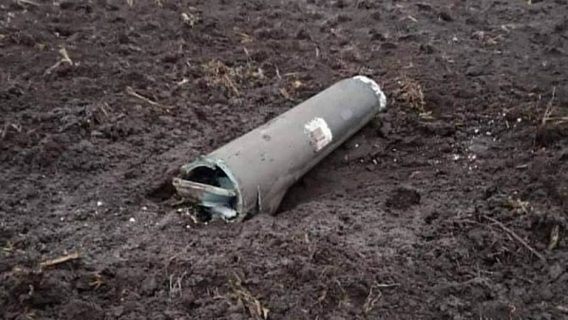
Belarusian forces intercepted and destroyed a Ukrainian S-300 anti-air missile on Thursday, the Defense Ministry said.
According to the MOD, parts of the missile fell on agricultural land near the village of Gorbakha in the country’s southwestern Brest Region, which shares a border with Ukraine. There were no casualties.
Belarusian President Alexander Lukashenko has been briefed about the incident, state news agency Belta said.
Photos posted on social media show missile parts lying in the middle of a field.
The incident comes as officials in Minsk accuse Kiev of amassing troops and setting up firing positions across the border. The Belarusian government restricted movement in several border areas last week, citing tensions with Ukraine.
On November 15, a falling missile killed two people in eastern Poland, not far from the border with Ukraine. Warsaw said that the projectile was probably an S-300 fired by Ukrainian forces as they were trying to fend off a Russian attack, and that there was no evidence that the fallen missile was launched by Russian troops.
Kiev initially accused Moscow of attacking Polish territory, but later said that further investigation was needed to determine what happened. Ukrainian President Vladimir Zelensky described the incident at the time as an attack on NATO. Russia denied that the missile that hit Poland was fired by its forces.
US Patriot Missiles in Ukraine: A Desperate & Dangerous Escalation
By Brian Berletic – New Eastern Outlook – 28.12.2022
US appears to be in the process of transferring its Patriot air defense missile system to Ukraine. CNN in its article, “Exclusive: US finalizing plans to send Patriot missile defense system to Ukraine,” claims the US will approve and then quickly ship the system or systems into Ukraine in just days after the decision is made.
Paradoxically, CNN admits that training the large numbers of Ukrainians necessary to operate the system will take months. This has left analysts speculating that in fact NATO personnel already familiar with the system will operate it merely posing as “Ukrainians.”
This represents a significant escalation. While Western forces are believed to be covertly operating across Ukraine against Russian forces in a variety of roles, Western personnel operating an ever-growing number of sophisticated weapons may lead to mission creep in terms of other sophisticated Western weapons including Western aircraft and tanks entering the conflict with Western operators behind the controls.
The decision to send Patriot missiles follows a now steady tempo of Russian missile and drone strikes across Ukraine targeting military and dual-use infrastructure including the power grid. The Western media admits Ukraine’s own Soviet-era air defense systems are dwindling in number and running low on interceptor missiles.
The Financial Times in its article, “Military briefing: escalating air war depletes Ukraine’s weapons stockpile,” admits:
… ammunition and spares for the S300 and Buk systems, the mainstay of Ukraine’s air defences, are dwindling. Ukrainian officials have confirmed a claim by British military intelligence that Russia has been firing X-55 nuclear missiles — with the nuclear warhead replaced by an inert one — simply to exhaust Ukrainian air defences.
The article notes that buying additional ammunition and spare parts for the systems is not practical. It also notes efforts by the West to provide Ukraine their own air defense systems, however such systems suffer from similar problems in terms of limited quantities and limited access to ammunition.
Financial Times cites the German “Gepard” mobile anti-aircraft gun as being “highly effective.” No evidence was provided to substantiate that claim and ironically, shortly after the article was published, shortages of ammunition for Gepard systems were reported as was Switzerland’s unwillingness to supply additional ammunition to Ukraine.
Germany’s Rheinmetall company has announced it would expand ammunition production to compensate for Switzerland’s decision according to Anadolu Agency, but production would not begin until June at the earliest and Ukraine would not begin receiving ammunition until at least July and only if the German government places an order for the 35mm rounds the Gepard fires.
IRIS-T and NASAMS, two Western short to medium range air defense missile systems have been provided to Ukraine, albeit in small numbers that will increase incrementally over the course of several years. This represents a rate far too slow to replace Ukraine’s dwindling Soviet-era air defense systems.
Considering this reality, the decision by the US to transfer Patriot missile systems to Ukraine may not be because Washington believes they can make a difference, but simply because the US and its allies have nothing else more appropriate or numerous to send in its place.
But even the Patriot air defense system is plagued with problems ranging from its own critical shortage of ammunition to its inability to provide defense against drones and cruise missiles, the very systems they will be tasked with protecting Ukrainian skies against.
Patriot Missiles: Too Few, Too Feeble
Far from “Russian propaganda,” the Patriot’s shortcomings have been reported by the Western media for years. Al Jazeera in an early 2022 article, “Saudi Arabia may run out of interceptor missiles in ‘months’,” would admit to Saudi stockpiles of Patriot interceptor missiles running low and the inability of the US to manufacture enough to replace them.
The Wall Street Journal would report in March 2022 that additional missiles were eventually acquired, but not because the US was able to manufacture more, and instead because the US convinced Saudi Arabia’s neighbors to transfer missiles from their own stockpiles to Saudi air defense forces.
Faced with a growing shortage of missiles, Lockheed Martin pledged in 2018 to double annual missile production from 250 to 500, according to Defense News. By 2021, Camden News would report that Lockheed was on course to reaching its 500 missiles per year goal by 2024 after building a new 85,000 square foot expansion to existing production facilities.
However, even at 500 missiles a year, and if every single missile was subsequently sent directly to Ukraine, it would not be nearly enough to match the number of cruise missiles, drones, and other long-range precision weapons Russia is using as part of its ongoing special military operation.
The New York Times in an article titled, “Russia Is Using Old Ukrainian Missiles Against Ukraine, General Says,” cites Ukrainian sources who claim Russia is likely building at least 40 cruise missiles a month. Over the course of a year that works out to 480 cruise missiles. Considering the Patriot missile system falls far short of 100% effectiveness, the idea that 500 Patriot missiles could protect Ukraine against 480 Russian cruise missiles is unrealistic.
Annual missile production for Russia is likely higher, however. From October onward alone, the BBC reports that Russia has fired over 1,000 missiles and drones at targets across Ukraine. This is twice the number of missiles Lockheed plans on producing annually.
This reality is so obvious that Western analysts have commented publicly about their doubts regarding any impact Patriot missiles will have. Breaking Defense in its article, “Patriot missile system not a panacea for Ukraine, experts warn,” would cite a missile defense expert with the Center for Strategic and International Studies, Tom Karako, who called the transfer of Patriot missiles to Ukraine “a political gesture of support.”
The article would also note, citing Karako, that:
“We need to be careful about these scarce, precious assets,” Karako said. “While we’re only sending one battery, once it’s there, it’s probably not going to come back. And if they start expending munitions, they’re going to ask for more, right? And we don’t have just tons and tons of PAC-2s and PAC-3s [missiles] lying around that we can afford.
Karako would also point out that Patriots are needed for “deterring a Taiwan conflict,” highlighting the fact that the steady depletion of Western weapon stockpiles in its proxy war with Russia is not happening in a geopolitical vacuum and impacts the West’s ability to menace other nations in other regions of the planet – especially in East Asia.
The same article also pointed out how expensive Patriot missiles are versus the relatively cheap drones they would be attempting to intercept. But that’s even if the Patriot missile system can intercept them.
NBC News in a 2019 article titled, “Why U.S. Patriot missiles failed to stop drones and cruise missiles attacking Saudi oil sites,” would note how US-provided Patriot missile systems failed against cruise missiles and “triangular” drones used by Yemen against Saudi oil production facilities.
Despite Patriot missile batteries guarding the facilities, Saudi forces resorted to small arms fire in a failed attempt to down the drones. One attack temporarily disrupted half of Saudi Arabia’s daily oil output.
The article claims:
Drones and missiles can be detected by radar, but they tend to have small radar signatures and can fly close to the ground, sharply reducing the detection range and thus opportunities to fire on them from far away. They also are easy to maneuver, allowing them to hit the coverage gaps between radars and Patriot batteries. And drones and cruise missiles are often cheaper than a $2 million or $3 million Patriot missile, meaning the supply of Patriots can be depleted much faster than the bevy of drones launching attacks.
NBC News is describing precisely the threats Patriot missile systems transferred to Ukraine will face, but on a much larger and more sophisticated scale.
The article discusses extensive measures the US is taking to counter threats the Patriot is not well-suited to defend against – measures that only began being fielded as of 2021 – but not measures the US is prepared or even able to send to Ukraine in large numbers.
The US and its NATO allies have long neglected ground-based air defense systems in favor of achieving and maintaining air superiority over any potential battlefield through the use of warplanes. Several decades of fighting “small wars” against adversaries lacking anything resembling an air force has only compounded the problem.
Just as it will take years and large amounts of money to solve the current weapons and ammunition shortage the West faces as it continues to arm Ukraine, creating air defense systems in both the quantities and quality Ukraine’s requirements demand will take more time than Ukraine has, and more resources than the West may care to spend.
While it is common knowledge that wars are won through superior logistics, military technology, and strategy, one would be hard-pressed to recall when any war was won by “a political gesture of support.”
Lock Up the White House Silverware!
Volodymyr Zelensky is in town!
BY PHILIP GIRALDI • UNZ REVIEW • DECEMBER 27, 2022
In my humble opinion the surfacing of Ukrainian President Volodymyr Zelensky in Washington last week was possibly the most disgusting example of the corruption of our country and its values since Israeli President Benjamin Netanyahu arranged for a similar invitation to address a rapturous Congress back in 2015. Zelensky’s “surprise” visit had in fact been arranged over the course of several months and was a carefully choreographed performance intended to pay political dividends for both the White House, for the Democratic Party in Congress and for Zelensky and his political supporters at home. He met privately with President Joe Biden in the White House, where he presumably received most of what he was seeking as well as a pledge of total support until “Ukraine wins.” He subsequently was invited to address a Joint Session of Congress, a privilege that was most definitely not arranged at short notice, with House of Representatives Speaker Nancy Pelosi predictably calling on all Congressmen to attend. The session began with a three minute standing ovation from the assembled Representatives and Senators.
So the creepy little con-man was enabled to have his say in a video link that reached a global audience. That it consisted of a gaggle of lies to justify the rapid passage of hundreds of billions of dollars from the struggling American taxpayer to a nation renowned only for its reputation as the most corrupt in Europe was not noted by the audience. As it has been from the start Joe Biden’s war, it is inevitable that the Democrats in Congress should leap around and fill the chamber with cheers every time Zelensky opened his mouth to emit yet another inanity. But to their shame, many Republicans joined in on the celebration of the odd diminutive man Zelensky, whose beatification was passionately embraced by the national media to make sure no one missed out on the importance of the event. The New York Times report on the visit began by describing Zelensky’s status as “a national hero and global superstar, having forged a leadership style blending personal daring with deft messaging to rally his people at home and his allies abroad.” In part, that message included describing his struggle as engaging in a battle pitting “good against evil.”
Nevertheless, those Republicans whose heads were not wedged up their keesters did boycott the event, to the tune of only 86 out of 213 being present. It seems that some Republicans are against the war generally speaking while others actually believe that the billions going to Ukraine should be audited to determine whether it is being stolen or not. Congressmen Matt Gaetz and Lauren Boebert attended but played with their cell phones and did not rise and applaud the stirring rhetoric coming from Zelensky, who was basically seeking many new weapons and lots more money justified not as “charity” but as an “investment” so he and Ukraine could work to bring rule of law, global security, democracy and freedom to the world. In the aftermath, one particularly delusional commentator has enthused how “There can be no more compelling or effective leader of the democratic free world today than Ukrainian President Volodymyr Zelensky. Fate has called upon him to rise to a level of courage and clarity few figures in history have demonstrated.”
In his speech, Zelensky clearly forgot to mention how he has eliminated freedom of speech and association in his own country as part of his war agenda, while also banning opposition parties and media and even harassing the Russian Orthodox Church. But the tweetosphere inevitably ignored those issues and erupted instead over the alleged bad behavior by some Republicans in not supporting such a great leader. One Michael Beschloss (@BeschlossDC), who is the anointed NBC television network’s Presidential Historian, tweeted, “For any members of Congress who refused to clap for Zelenskyy, we need to know from them exactly why.” Independent journalist Glenn Greenwald (@ggreenwald) responded sarcastically to Beschloss, “Haul them before a Committee and force them to pledge allegiance to Ukraine and Zelensky or else face long-term imprisonment in a supermax. Refusing to clap for a foreign leader on command is a form of treason.”
And politicians too were inevitably prone to bombastic misrepresentation. Congressman Don Beyer of Virginia tweeted how “This disrespect is embarrassing. It embarrasses you, your constituents, the body we serve in, and our country. Huge numbers of President Zelensky’s people have been killed in a bloody war they did not seek. We must be able to debate foreign policy without mocking human suffering.”
Another lunkhead Democrat Representative Jake Auchincloss of Massachusetts declared war, asserting that “We’re in a global struggle between democracy and autocracy. And Ukraine is fighting on the frontlines of that struggle. Our support for Ukraine is sending a message to Moscow, it’s sending a message to Beijing. And it’s sending a message to other authoritarian regimes.” Auchincloss was apparently unaware that it is the United States government that has itself become more autocratic/despotic in that it is generally accepted that the president now has extralegally assumed the authority to allow war crimes to be committed in places like Syria, Afghanistan and Libya while also torturing people to death in secret prisons. The president and his Attorney General Merrick Garland are also rooting out “domestic terrorists” who generally speaking are white people who oppose Democratic Party policies.
Clearly, neither Beyer nor Auchincloss understands that a principled “debate” on foreign policy is not taking place at all in America, largely due to the ability of their party and colleagues to manage and control the process whereby it is possible to start an illegal/unconstitutional war that just might go nuclear without any real pushback from critics or the public. When it comes to controlling the narrative on Ukraine, the normally inept Biden Administration has unleashed the most effective propaganda machine that has ever existed, even if one is taking into consideration George W. Bush’s many lies relating to Afghanistan/Iraq. It is interesting to note that nor did Beyer find Zelensky’s macho sporting of a “wartime uniform” featuring combat style sweatshirt and fatigue cargo pants, which Tucker Carlson described as befitting the “manager of a strip club,” as disrespectful of the august body that he was addressing.
Nor was Beyer apparently affronted when Pelosi and Vice President Kamala Harris unfurled and waved a huge Ukrainian flag at the speaker’s rostrum. And speaking of Zelensky’s performance itself, one has to wonder who wrote Zelensky’s speech? He has neither the experience nor the smarts necessary to appeal to the most basic instincts of the American people, so one might rather expect that the piece was written and the presentation coached by the usual neocon handlers that have presumably surrounded him since his ascent to power.
The chinless and gutless wonder Senate Minority Leader Mitch McConnell made up for the lack of ardor exhibited by some of his colleagues by saying on the day before Zelensky’s arrival that arming Kiev to “defeat” Russia tops the agenda of “most Republicans.” He elaborated that “Making sure the Defense Department can deal with the major threats coming from Russia and China, providing assistance for the Ukrainians to defeat the Russians, that’s the number one priority of the United States right now, according to most Republicans.” Mitch calls defeating the Russians the number one priority for the United States, not the open southern border nor the economy suffering from inflation, shortages and recession. And then there is Senator he/she Lindsey Graham, who clearly endorsed that hardline in spades, calling for the “assassination of Russian President Vladimir Putin,” an act that would surely initiate World War 3.
I rather suspect that the passion unleashed for the Jewish Zelensky is at least in part engineered by the usual suspects among the politically powerful Jewish groups, lobbyists and media personalities, where criticism of Ukraine, which has a large Jewish population, is considered a capital offense. Jewish media in the US hailed the impending news of the Zelensky visit, enthusing in seasonal fashion over how “Ukraine’s survival” under Zelensky had been a “modern day Hanukkah miracle.”
Hatred of Russia (and of course Iran) is also a sine qua non among such groups and media outlets and they will twist every argument to urge US military intervention in both those countries. That is precisely what Zelensky himself does when he calls for NATO intervention even when he is the one who bombs neighboring Poland. In the current situation, you will not find the totally “reliable” New York Times debunking the ridiculous claim that throwing hundreds of billions of dollars at Zelensky and his band of thieves is in any way related to US national security requirements. No one was threatening the United States and the war that erupted in February was clearly negotiable on two major issues: implementation of the Minsk accords of 2014-5 over autonomy for Donbas and demands for neutrality for Ukraine, i.e. no joining NATO. It was the United States that encouraged Ukraine’s abrupt tilt towards and west and refused to negotiate in any seriousness with Russia over issues that were vital to that country’s actual security.
So did the Zelensky bit of kabuki theater largely engineered by the White House and Nancy Pelosi succeed in getting everything the Ukrainians wanted? Probably not, as offensive missile systems that could be used to strike deep into Russia are still on hold, but the money and other weapons are now in the pipeline. And there surely will be more to come, certain to include US military “advisers” on the ground. No matter how it turns out, the Ukraine is a tragedy writ large and the fools sitting complacently on Capitol Hill are largely to blame for not recognizing that US interests do not necessarily coincide with the aspirations of Volodymyr Zelensky and his fellow accomplices. Maybe in two years’ time when the whole house of cards has collapsed and Americans, feeling a great deal of economic and political pain, begin to wonder what took place, it will be time to throw all the bums out and replace them with folks who really care about what happens to this country.
Philip M. Giraldi, Ph.D., is Executive Director of the Council for the National Interest, a 501(c)3 tax deductible educational foundation (Federal ID Number #52-1739023) that seeks a more interests-based U.S. foreign policy in the Middle East. Website is councilforthenationalinterest.org, address is P.O. Box 2157, Purcellville VA 20134 and its email is inform@cnionline.org.
Ukraine to hike transit fees for Russian oil to EU – Transneft
RT | December 27, 2022
Ukraine will raise transit fees for Russian oil running via the Druzhba pipeline through its territory to the EU on January 1, Russian oil exporter Transneft announced on its website on Monday.
It is expected that Kiev will increase tariffs for transporting crude to Hungary and Slovakia by €2.10 per ton to €13.60 ($13.90), bringing the total hike to 18.3%.
In November, Bloomberg reported that Ukraine was mulling a tariff hike on Russian oil transit starting next year, citing a letter from Ukrtransnafta, the operator of Ukraine’s oil pipeline network. The Ukrainian operator had attributed the need for the price hike to the “continued destruction of Ukrainian energy infrastructure” which had resulted in “a significant shortage of electricity, an increase in its costs, a shortage of fuel, and spare parts.”
Transneft spokesman Igor Demin confirmed to the Russian media that the company had received the letter and was studying it.
Ukrainian oil transit fees have already been raised twice this year. The last hike in April reportedly brought the total increase to 51% on an annual basis.
Druzhba, one of the longest pipeline networks in the world, carries crude some 4,000 km from Russia to refineries in the Czech Republic, Germany, Hungary, Poland and Slovakia.
Russian president offers negotiations while US senator calls to “take Putin out”
By Drago Bosnic | December 26, 2022
On December 25, during an interview on Rossiya-1 state television, President Vladimir Putin stated that the Russian Federation is ready to negotiate a peace deal to end the conflict in Ukraine. However, he once again reiterated his position that the political West is the power pole that Moscow is willing to initiate peace talks with, as the Kiev regime cannot be considered sovereign enough to negotiate an acceptable end to the conflict. The president of Russia also added that the Eurasian giant never refused initiatives for negotiations and that it was the other way around.
“We are ready to negotiate with everyone involved about acceptable solutions, but that is up to them – we are not the ones refusing to negotiate, they are,” Putin said and added: “I believe that we are acting in the right direction, we are defending our national interests, the interests of our citizens, our people. And we have no other choice but to protect our citizens.”
However, although Russia is ready to negotiate, it doesn’t think peace talks are necessary at all costs. Instead, Moscow’s primary goal is its security. This doesn’t only include a negotiated settlement that would halt NATO’s crawling encroachment on Russia’s western borders, but would also ensure the neutral status of Ukraine. Still, this status cannot be secured just by simply signing deals with the political West. The experience regarding this has been extremely negative, to say the least, as the belligerent power pole is infamous for its tendency to break deals ever since the (First) Cold War ended.
During the interview, Putin also reiterated his position that the United States and the North Atlantic Alliance are waging a proxy war against Russia by using Ukraine as a pawn. He also said that the political West is trying to “tear Russia apart” and essentially destroy it. “At the core of it all is the policy of our geopolitical opponents, aiming to tear Russia apart, the historical Russia,” Putin said. “They have always tried to ‘divide and conquer’… Our goal is something else – to unite the Russian people,” he concluded.
The parties to the conflict don’t appear to be any closer to peace talks, however. On the contrary, this scenario seems further from reality than ever before. While the US keeps arming the Kiev regime, including with “Patriot” SAM (surface-to-air missile) systems that are earmarked to be transferred to the Neo-Nazi junta forces as soon as possible, the Russian military seems to be preparing for another massive push. The Kiev regime simply doesn’t seem to have any intention of negotiating a peace deal, as proven by the Neo-Nazi junta’s frontman Volodymyr Zelensky. Last Wednesday he made a speech before the US Congress and boastfully declared that “absolute victory” is the “only acceptable outcome” and that he vehemently rejects any talks which would include territorial concessions.
Zelensky’s statements were soon supported by the controversial US South Carolina Republican senator Lindsey Graham. However, he went even further than Zelensky and made several remarks that couldn’t possibly be further from the most basic diplomatic etiquette. During a live Fox News interview, Graham called for Russian President Vladimir Putin to be assassinated. “How does this war end? When Russia breaks, and they take Putin out. Anything short of that, the war’s gonna continue,” Graham said on Wednesday’s America Reports on Fox. The first part of the comment also reaffirms Putin’s belief that the political West wants to “tear Russia apart”.
He also stated that the Russian military will supposedly “fail in Ukraine”, because “the US is in it to win it, and the only way you’re gonna win it is to break the Russian military and have somebody in Russia take Putin out to give the Russian people a new lease on life.” Graham further called on the US and NATO to continue arming the Kiev regime forces “completely, all in without equivocation” and that sending additional long-range missiles to the Neo-Nazi junta would “help dislodge Russian forces from the Donbas, and even Crimea.” He also added that “larger drones would kill tons of Russians without losing any Ukrainians in the endeavor” and concluded that giving Zelensky everything he’s asking for is “essential”.
This wasn’t the first time Graham publicly called for Vladimir Putin to be killed. He made similar remarks back in early March. This even prompted an official rebuke from the Biden administration. At the time, the White House Press Secretary stated “that is not the position of the United States government and certainly not a statement you’d hear come from the mouth of anybody working in this administration.” However, this obviously didn’t stop Graham from repeating the threat.
On the contrary, he essentially also added a call for a coup in Russia. To make matters worse, Graham is not alone in this. In early October, former US National Security Advisor John Bolton called Putin “a legitimate military target” and also called for a coup in Moscow. With such comments coming from the top of the US political establishment, it’s hard to imagine how Russia could ever hope to start negotiations with the belligerent thalassocracy.
Drago Bosnic is an independent geopolitical and military analyst.
Featured Video

AIDS Inc. by Gary Null (2007)
or go to
Aletho News Archives – Video-Images
From the Archives
Clash of Civilization, Iran Part II
By Jamal Kanj – Intifada-Palestine.com – January 14, 2011
Israel’s survival kit is: perpetuate conflict, insecurity to rationalize collective hate and finally playing victim.
Devoid of conflict, Israel implodes internally; without hate, Zionism loses its justification; and playing eternal victim to continue blackmailing the West. Absence of this holy trinity, Israel ceases to exist.
From its inception, the house of Zion has mastered exploiting adversarial powers to advance Israel’s cause. For instance, their influence over the Democratic Party in the US began with President Truman’s bid for 2nd term election in 1948.
Responding to strong opposition from Secretary of State General George Marshall and Department experts urging against recognition of Israel, President Truman replied: “I’m sorry gentlemen but I have to answer to hundreds of thousands [Jewish voters] who are anxious for the success of Zionism. I do not have hundreds of thousands of [voting] Arabs among my constituents”
Zionists influence over liberal American politics was matched with the doctrinal school of Conservative theoreticians aligning the Republican Party’s platform with Israel’s objectives. The Neoconservative Zionists, coined Zioncons, invented the “Clash of Civilization” concept to fight Israel’s wars. … continue
Blog Roll
 Aletho News
- Mauritius denies landing permit to flight from Israel, forcing cancellation: Tour operator
- Israeli finance minister calls for genocidal war on West Bank, annexation of south Lebanon
- 12 Things Your Psychiatrist Was Trained Not to Tell You
- From Unipolar Universalism to Multipolar Civilizational Distinctiveness
- RSF military group defects, joins Sudanese army: State media
- Ireland goalkeeper refuses to play ‘Israel’ as squad weighs boycott
- China pushes back against US on Cuba, Iran
- Ukrainian Soldiers, Potential Mercenaries: Have Gun, Will Travel!
- Burnham’s UN debut… A masterclass in British disinformation
- Iran flights continue despite US aviation sanctions
- If Americans Knew
- Israel forces Gazans to live in constant peril – Daily Update
- Deconstructing Netanyahu’s pants-on-fire UN rant – Daily Update
- Trump betrayed voters with his campaign lies and prioritized a foreign country once he took office
- Netanyahu calls Israel’s war in Gaza ‘opposite of genocide’ in UN speech to near-empty hall
- Settler Kidnappings: Torture, Sexual Abuse and Terrorisation of Palestinian Abductees as Israel Deepens Annexation of West Bank
- Gaza winter nears as 162,000 tents become unusable, raising fears of humanitarian crisis
- Netanyahu says, “It’s the opposite of genocide”; UN says Gaza economy is world’s ‘most severe crisis on record’ – Daily Update
- Israel’s US-Backed Assault on Gaza Has Created the ‘World’s Most Severe Economic Crisis on Record’: UN
- ‘Protecting U.S. Citizens’… From Israel
- ‘This is where I live now, the back of a truck’: a day in the life of a grandmother in Gaza
- No Tricks Zone
- New Study: Earth And Venus Surface Warmth Largely Explained By Convection And Lapse Rate, Not CO2 Or Radiation
- 2025 Nature Paper Claiming Worsening Global Drought Gets RETRACTED …Heavily Flawed
- New Study: ‘Global Drought Shows No Detectable Recent Acceleration Under Climate Warming’
- Economic Masterminds: German Socialists Suggest Taxing Productivity Gains Stemming From Using AI
- The South China Sea Has Not Been Cooperating With The Climate Change Narrative
- Energy Crisis: Germany Enters Heating Season With Historically Low Gas Reserve Fill Levels
- New Study: The Antarctic Ice Sheet Gained Mass From 2020-2024 Due To Staggering Snow And Ice Accumulation
- Study: Ocean Heating Rates From Thousands Of Years Ago ‘Dwarf’ Modern Ocean Heating Rates
- Climate Extremists Target, Attack Large-Scale Power Grid Infrastructure In Germany!
- New Study: Antarctic Ice Melt Has Contributed Less Than 1 Centimeter To Sea Level Rise In The Last 30 Years

