Ukraine could stage false flag operation on nuclear power plant to force Western intervention
By Ahmed Adel | January 25, 2023
The Ukrainian military are storing Western weapons in nuclear power plants in the hope that Russia will strike them. However, as Russia is unlikely to make this mistake, it cannot be ruled out that Kiev will stage a false flag operation to force direct Western intervention and increase the supply of weapons.
According to the director of the Russian Foreign Intelligence Service, Sergey Naryshkin, HIMARS missiles and other foreign air defence systems, as well as large-calibre artillery ammunition, are deployed at Ukrainian nuclear power plants.
“There is credible information that Ukrainian troops are stockpiling the Western-supplied weapons and ammunition on the territory of nuclear power plants,” Naryshkin said, according to a statement on the intelligence service’s website.
According to the intelligence chief, several cars loaded with “lethal cargo” were delivered by rail to the Rovno Nuclear Power Plant in western Ukraine during the last week of December alone.
“They rely on the calculation that the Russian Armed Forces would not strike nuclear power plants because they realise the danger of a nuclear disaster,” Naryshkin said.
He expressed the hope that no one in Kiev would deliberately think of blowing up the nuclear power plants in a false flag operation. False flag operations are often used by international terrorists, as seen on a frequent basis during the peak of the Syrian war, or by the US to justify their own invasions and interventions.
The Ukrainian Armed Forces often receive weapons that are of very poor quality. This fact alone heightens the risk of an accidental explosion, something that could unleash a nuclear catastrophe and be blamed on Moscow.
Alarmingly, in addition to nuclear power plants, the Ukrainian military also uses residential buildings to house Western weapons. Ukrainian soldiers are fully aware of the fact that the Russian military does not strike civilian populations. The Russian military does not strike at nuclear plants, especially as any spill over can directly affect Russian citizens.
Ukrainian soldiers on the other hand have consistently used civilians as human shields, even before the Russian military operation began in 2022, as reported by the United Nations. The Ukrainian military is desperate for more weapons, tanks, howitzers, and ammunition, and such an incident could unite the West in providing Kiev with what it demands.
Ukraine’s nuclear plants are located near the border with Romania, Slovakia and Poland. Therefore, delivering military equipment from the West is a relatively straightforward process. According to intelligence data, only in the last week of December, several railway wagons with “lethal cargo” were delivered from abroad via the Rafalovka railway station to the Rivne nuclear power plant, located only 170km from the Polish border.
None-the-less, according to Andrei Golovatyuk, a colonel in the Russian army reserve, Moscow will certainly find a way to destroy ammunition and Western weapons stores without endangering the lives and health of the civilian population.
“They are doing this on purpose so that the Russian armed forces cannot shell their weapons depots. But our army will certainly not do that to avoid damaging the nuclear power plant,” he added.
Mykhailo Podolyak, an adviser to Ukraine President Volodomyr Zelensky, claimed that his country has never used nuclear power plants to store weapons.
“Ukraine has never stored any weapons on NPP territory, as falsely claimed by Russia’s Foreign Intelligence Service. On the contrary, the Russian Federation seized the Zaporizhzhia nuclear power plant and keeps its military there,” he said on Twitter, alluding that a military presence and weapons storage is the same thing.
Podolyak said that Kiev remained “open to inspecting bodies, including the IAEA” and that “Russian lies are aimed to justify their provocations.”
However, it does question what kind of “justification” Russia gets for its military operation by claiming that Ukraine stores weapons in nuclear power plants. Moscow obviously gains no “justification” and rather its justification is hinged on Kiev’s unrelenting fascistic policies towards minorities since 2014.
Rather, it is more likely that Podolyak is making nonsensical statements as Kiev is stunned that their false flag operation cannot be implemented because Moscow has already called it out. The Kiev regime is currently desperate for Western weaponry, particularly tanks, and was likely hoping that a nuclear incident could force the issue, or even better, force a direct intervention.
Podolyak tweeted on January 21 that “Today’s indecision is killing more of our people. Every day of delay is the death of Ukrainians. Think faster.”
However, even if US and German-made tanks start arriving in Ukraine, the situation is already too late for the Ukrainian military because it struggles to maintain a semblance of order in the face of Russia’s unrelenting onslaught. Rather, Kiev is responsible for the death of Ukrainians as it refuses to find a peace with Moscow. Therefore, it cannot be entirely discounted that as Ukraine becomes more desperate, it may resort to reckless measures, such as false flag operations on nuclear power plants.
Ahmed Adel is a Cairo-based geopolitics and political economy researcher.
EU’s financial support for Ukraine now just shy of €50bn
By Jerome Hughes | Press TV | January 24, 2023
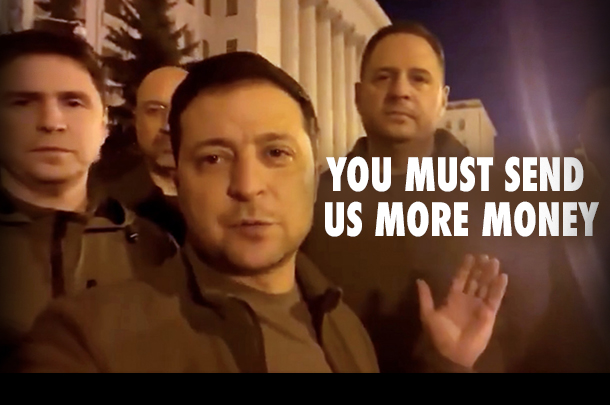
Brussels – Ukrainian officials took part in a meeting of EU foreign affairs ministers on Monday via video link. An additional €500m military aid package for Kiev was confirmed, but the EU is at pains to point out that’s just a drop in the ocean compared to what the bloc has already provided since last March.
Just a few days ago in the European Parliament, the strategy was condemned.
Workers have taken to the streets of Brussels to demand peace negotiations.
EU foreign ministers adopted a fresh round of sanctions against Iran on Monday over alleged human rights abuses. The grounds for such sanctions are vehemently rejected by Tehran. Critics say the West’s policy towards Russia and Iran is being driven by Washington.
Analysts say the EU’s access to markets in these countries is being hampered due to influence from the United States, and ultimately it is ordinary citizens who are paying the price.
Also on Monday, Palestinian Prime Minister Mohammad Shtayyeh updated EU foreign ministers on the appalling situation in the occupied territories. There was absolutely no discussion on the EU side regarding possible sanctions against Israel.
A top British think tank has revealed Russia’s cyberwarfare dominance over Ukraine
Why has Western media ignored its report?
By Felix Livshitz | RT | January 23, 2023
On November 30, the Royal United Services Institute (RUSI), an elite military think tank, and lobby group, with deep ties to the UK government, published a landmark report entitled ‘Preliminary Lessons in Conventional Warfighting from Russia’s Invasion of Ukraine: February–July 2022’. While desperate to portray the operation as a failure, even the normally Russophobic RUSI can’t ignore Moscow’s total cyberwarfare dominance over Kiev.
Complete superiority
Buried in the document is a long section on the electronic warfare aspect of the Russia-Ukraine conflict. It found that within weeks of February 24, Moscow’s forces quickly established total dominance in this sphere by deploying extensive jamming infrastructure. Once achieved, Kiev’s most sophisticated cyber systems were not only totally confused, but absolutely crippled.
Before the attack, Ukraine had for some years been receiving the best Western reconnaissance and strike drones – Unmanned Aerial Vehicles (UAVs) – IMF debt could buy.
These systems, RUSI states, were envisioned to be “critical to competitiveness” in a hypothetical future battlefield, by providing “situational awareness and target acquisition” second to none. However, as it turned out, the “attrition rates” of these high-tech drones were “extremely high” from February to July due to Russian electronic warfare prowess, and thy were destroyed completely at around 90%.
“The average life expectancy of a quadcopter remained around three flights. The average life expectancy of a fixed-wing UAV was around six flights … even when UAVs survived, this did not mean that they were successful in carrying out their missions,” the report records. “UAVs could fail to achieve their missions because the requirements to get them in place … prevented timely target acquisition before the enemy displaced. Many missions failed to find targets because there was no target at the specified location.”
A “more common” means of “mission failure” was “disruption of a UAV under control through electronic warfare, the dazzling of its sensors or the denial of its navigational systems from determining the accurate location of a target.”
“In other instances, the Russians successfully struck the ground control stations of the UAV. In aggregate, only around a third of UAV missions can be said to have been successful.”
Russia’s dominance in electronic warfare had further damaging implications for the precision weapons shipped to Ukraine from London, Washington, and other Western backers too. Moscow’s cyber divisions effectively “defeated” most of the precision weapons used by Kiev.
RUSI is a prominent and highly influential firm, and its publications typically generate enormous media interest – when these reports paint Russia in an overwhelmingly negative light, and talk up the need for Moscow to be countered through highly aggressive political, diplomatic, intelligence and military postures, that is.
Unheeded prophecies
Aside from a single article in America’s Forbes magazine, this assessment has remained unacknowledged by any mainstream journalist or pundit for well over a month. It is not the first time a RUSI report has mysteriously received no recognition in recent memory. In late January, the think tank published an assessment of the value of Western arms shipments to Kiev.
It concluded there was little point in sending vehicles or weaponry of any kind to Ukraine, in the event fighting broke out with Russia, due to Moscow’s “operational art,” military doctrine, and “strategic thinking.” These long-held philosophies mean that the Kremlin and its armed forces chiefs consider battle an extension of diplomacy, and therefore leverage “superiority in long-range fires to achieve decisive effects against an opponent, which could in turn achieve strategic results.”
Among the “strategic results” sought is a battlefield where “massed ground formations in direct confrontations” are not deployed. Instead, by “inflicting enough damage to alter an opponent’s course of action, or signal that Russia’s intent is genuine, Russian strategic goals can be achieved without conflict.”
This would be secured by using long-range missiles in a “non-contact” military engagement – “the minimum level of force necessary to promote Russia’s regional goals and limit the need to deploy ground forces.” In other words, exactly what has unfolded over the course of the past year.
“Armoured vehicles, short-range anti-tank weapons and air defence systems can only be useful in one scenario, one which is likely to be preceded by a harrowing and extensive period of non-contact warfare designed to prevent the Ukrainian armed forces from operating effectively at all,” RUSI forecast. “Their use will only be possible once all initiative has been lost and the situation is unlikely to be turning in Ukraine’s favour.”
The report’s conclusion was that the weaponry the West had sent and planned to send to Ukraine “does nothing to improve Ukraine’s odds of deterring Russia, or even defending against a Russian invasion once it has begun,” and any attempt to arm Kiev was “not likely” to defend “Ukraine’s sovereignty.”
Russia and West on verge of ‘real war’ – Lavrov
RT | January 23, 2023
The current situation in Ukraine shows that the conflict between Russia and the West can no longer be defined as a “hybrid war” but is instead approaching being a real one, Russian Foreign Minister Sergey Lavrov said on Monday.
Speaking at a press conference following a meeting with his South African counterpart, Naledi Pandor, Lavrov also noted that this “almost real” war was something that the West “has been preparing for a long time against Russia.” The minister claimed that Western powers are seeking to destroy everything Russian, from the language to the culture that had existed in Ukraine for centuries, and even forbid people from speaking their native language.
Lavrov went on to point out that such practices have become commonplace throughout Ukraine and that the country’s last two presidents, Pyotr Poroshenko and current leader Vladimir Zelensky, have both turned into “presidents of war” and “Russophobic leaders” after gaining power, despite running their presidential campaigns under the promise of establishing peace.
The minister also recalled that Ukraine has adopted laws that prohibit using the Russian language in education, media, and even in everyday life. “And this is all supported by the West,” Lavrov said, adding that this support extends to neo-Nazi marches with swastikas and symbols of banned Nazi divisions being held across the country.
He also accused the West of turning a blind eye to the fact that Kiev’s forces continue to deliberately choose targets and carry out attacks in such a way as to terrorize the civilian population. “The West knows perfectly well that the Ukrainian regime deliberately bombs cities and towns using Western-supplied weapons,” the minister said.
Lavrov reiterated Moscow’s position that it has not carried out attacks in Ukraine against civilian infrastructure, and that the damage to it is attributable to Kiev’s regular practice of deploying heavy weapons and air defense systems in residential areas.
Despite the spiraling tensions, Lavrov noted that Moscow remains open to negotiations with Kiev, and warned that those who refuse talks should understand that the longer they are delayed, the harder it will be to find a solution.
The minister also asked the Ukrainian government to explain, perhaps through a third party, how it sees the situation in the country playing out and the possibility of negotiations with Russia.
Corruption thriller: Zelensky’s deputy minister arrested
Free West Media | January 22, 2023
Just 14 days after the President of the Ukrainian National Bank (who is said to have embezzled 5,42 million euros) applied for asylum in Austria, Deputy Minister Wassyl Losynsky was arrested.
Those who are familiar with the EU Court of Auditors’ report on Ukraine from autumn 2021 will not be particularly surprised by the current events in Kiev: Deputy Minister Wassyl Losynsky has been arrested for accepting a six-figure bribe.
“The National Anti-Corruption Bureau searched the home of Deputy Minister for Municipal, Territory and Infrastructure Development Vasyl Losynsky and arrested him,” Ukrayinska Pravda reported.
The ministry has already responded to the report and fired the top official. Losynsky is accused of having received a bribe of 400 000 euros when buying electricity generators. The investigations have been ongoing since September, the government employee apparently wanted to enrich himself by the fact that his compatriots were facing an electricity crisis.
Warrant issued for the Ukrainian bank boss
The latest chapter in the corruption thriller was exposed just 14 days after Austrian daily the eXXpress reported on the President of the Ukrainian National Bank who had fled to Austria. Kyrylo Shevchenko (50) is currently hiding in Vienna because the government in Kiev has accused him of having embezzled 5,42 million euros. In the Ukraine, an arrest warrant has been issued for the bank manager.
As reported, Shevchenko has now applied for asylum in Austria.
The Ukrainian bank boss, who managed the national bank of the warring country until October 4, has excellent international connections: Shevchenko was invited by US Treasury Secretary Janet Yellen on April 21 of the previous year to Washington, right after the start of the Russian operation.
He is not the only Ukrainian fleeing justice: President Zelensky suspended the Constitutional Court’s chairperson Oleksandr Tupytsky in 2020 in an effort to overturn the court’s October decision on corruption.
In December 2020, the Ukrainian parliament reauthorised the government’s decision, ignoring the court. Tupytsky, the former President of the Ukrainian Constitutional Court and declared opponent of the Ukrainian leader, currently also lives undisturbed in Vienna.
Allegations against the Ukrainian Minister of Defense
According to official information, the Ukrainian Defense Minister Oleksiy Reznikov is suspected of overpriced food purchases for the army, the daily newspaper Die Welt reported. Resnikov has been summoned to appear before parliament, Vice-Chair of the Rada Committee on National Security, Defense and Reconnaissance Marjana Besugla told national broadcaster Suspilne Media on Saturday.
In addition, the Court of Auditors announced a special audit in the Ministry of Defense.
Earlier, media reports in Kiev caused a stir that the Defense Ministry was buying food to feed its soldiers at prices up to three times higher than retail prices in stores. The contract for 13 billion hryvnia – 300 million euros – is not about feeding the soldiers at the front, but enriching kleptocrats in the rear.
Ukraine was granted EU candidate status in June, four months after the war began. The requirements for accession include the rule of law and progress in the fight against corruption, where Ukraine, despite numerous efforts in recent years, still ranks among the lowest in the world.
Press spokesman also fired
Ukrainian presidential advisor Oleksiy Arestovych was forced to resign after stating that the recent strike on an apartment building in Dnepropetrovsk was caused by a Ukrainian SAM missile, not a targeted Russian attack. He quickly became another casualty of Kiev’s information war.
On the evening of January 14, Arestovich said the partial destruction of a residential building in the city was the result of a projectile shot down by Ukrainian air defenses which fell on it. Following this, he was sharply criticized by government supporters and put on the infamous Ukrainian Myrotvorets kill list.
On January 16, Ukrainian legislator Alexey Goncharenko reported that a petition was launched to fire him.
Notably, Arestovych has slammed the political war the Ukrainian leader has waged on Ukraine’s Russian speaking population and Orthodox Church: “Zelensky has declared war on Christianity. This is when [the Ukrainian secret service, the SBU] entered…the Ukrainian Church of the Moscow Patriarchate…”
US urges Ukraine not to ‘fixate’ on defending key city
RT | January 21, 2023
The US believes that Ukraine should “refocus” on preparations for a new offensive, suggesting fierce battles for the eastern city of Artyomovsk (called Bakhmut by Ukraine) may be “hampering” Kiev, according to multiple news outlets, citing a senior US official. The comments cut against months of Western media reports that described the town as a key, strategic area.
Speaking to a small group of reporters on Friday, a top official in the administration of President Joe Biden (who refused to be named or cited verbatim) said that Ukraine “should not fixate on defending the city of Bakhmut at all costs,” according to AFP. Instead, Kiev was advised to use the time to prepare a large counter-offensive against Russia.
The strong focus on the city is “hampering Ukraine in the more important task” of organizing a spring offensive to reclaim territory lost to Moscow, the official reportedly added, noting that “time favors Russia” due to its superior troop numbers and artillery.
In a similar report on Friday, Reuters also indirectly quoted a senior Biden administration official advising Kiev to wait “until the latest supply of US weaponry is in place and training has been provided,” apparently referring to the $2.5 billion arms package approved in Washington this week. The aid includes a large number of artillery rounds, munitions for the US-supplied HIMARS multi-launch rocket platform, and, for the first time, Stryker combat vehicles – but no tanks. A small number of Ukrainian troops are also undergoing training at a US base in Germany, with some learning how to operate the Patriot missile defense battery authorized for Kiev in December.
The official allegedly said that Western weapons that will be needed for a “mobile offensive force” for future battles are currently “pouring into Ukraine,” adding that Kiev should not waste its limited resources on the “strategically unimportant target,” according to Reuters.
While much of the Western press – including outlets such as PBS, NBC, CBS, the New York Times, and others – have repeatedly deemed the city a key hub of major strategic importance, US officials have voiced an altogether different view in recent days.
Even if Moscow successfully captures the city, “it’s not going to strategically change the dynamics on the battlefield. It’s not going to set the Ukrainians back to a degree where they’re all of a sudden on the back foot and they’re losing,” National Security Council spokesman John Kirby said earlier on Friday.
The city of Artyomovsk has become a stronghold of the Ukrainian army in the years since the 2014 coup in Kiev. It is part of a 70-kilometer-long defense line created by the Ukrainian forces during the intervening years. Russia claims sovereignty over the city along with the rest of the Donetsk People’s Republic, which joined Russia in October after a referendum. Kiev rejected the vote as a “sham.”
The city remains a major logistics hub for Ukrainian forces in the region and has emerged as a focal point of the conflict in recent months. Russian troops have achieved several victories in the area over the last several weeks, taking the city of Soledar and the strategic village of Klescheevka among several other settlements as they seek to encircle Artyomovsk.
While it remains unclear whether Kiev will heed the advice, the comments from US officials came on the heels of a Friday report by Der Spiegel, which cited Germany’s Federal Intelligence Agency (BND) as being “alarmed” over heavy losses suffered by Ukrainian troops in the area. Earlier this week, British newspaper The Times also reported that Kiev had sent poorly equipped troops with little combat experience to defend Artyomovsk.
‘US, British Snipers Sent to Potemkin Island Near Kherson’
Samizdat – 21.01.2023
Ukrainian servicemen have told Russian security forces that snipers from the United States and the United Kingdom have been sent to Potemkin Island (Ostriv Velykyi Potomkin) near Kherson to kill civilians in order to pass them off as victims of the Russian Armed Forces, a Russian law enforcement source told Sputnik.
“According to information received from sources in the Armed Forces of Ukraine, an American-British group of mercenaries, mostly snipers, drove to Bolshoy Potemkin Island in the Kherson region in order to terrorize the Russian-speaking population,” the source said.
“The victims of the mercenaries’ murders are supposed to be passed off as those killed by the Russian army.”
In early January, a video started circulating on Ukrainian websites showing how Ukrainian militants allegedly raised the Ukrainian flag on Potemkin Island, controlled by Russian troops. Subsequently, the footage was reported to have been filmed in a “gray zone.”
A Sputnik correspondent visited the island on December 5 and confirmed that it was under the control of Russian troops. One of the Russian soldiers on the island told Sputnik in an interview that the Ukrainian video showing the alleged raising of the Ukrainian flag was a fake.
Earlier Friday, French media reported that the US officials were also urging the Ukrainian regime to prepare for a counteroffensive against Russian forces as opposed to clinging to the town of Bakhmut.
The latest comes as reports detailed on Wednesday that the Biden administration was considering providing Ukraine with weapons necessary to target the Crimean Peninsula.
US and allies must address Russia’s security concerns and their past deceptions on Donbass, the Kremlin says
RT | January 20, 2023
US-Russia relations are at their lowest point ever amid the crisis in Ukraine, Kremlin spokesman Dmitry Peskov said on Friday. As the conflict deteriorates, the only way to reverse it is for Western nations to acknowledge their mistakes and change their policies, he added.
Despite initial hopes that under President Joe Biden the US would engage Russia diplomatically, the last two years “have been very bad for our bilateral relations,” the official told journalists. They are now “probably at their lowest point, historically” he added, and “there is no hope for improvement anytime soon.”
The Ukraine hostilities – the focus of the confrontation between Russia and Western nations – are in “an upward spiral” according to Peskov.
“We can see a growing indirect, and sometimes direct involvement of NATO nations in this conflict,” he stated. The nations that back Kiev are acting under “a delusion that Ukraine has any chance to win on the battlefield,” he explained.
Asked how the vicious circle could be broken, Peskov suggested that the US and its allies had to mentally turn the clock back to the end of 2021, “when Russia was suggesting a discussion of its concerns at the negotiations table” only to be dismissed.
Western repentance for its “cynicism” was also in order, he added.
“Germany, France and Ukraine were playing a swindle game with the Minsk agreements. Now is payback time,” he said, referring to the roadmap for Ukraine reconciliation, which the three nations signed with Russia in 2015.
Angela Merkel, Francois Hollande and Pyotr Poroshenko, the leaders at the time of Germany, France and Ukraine respectively, have since stated that the deal they negotiated with Russia was meant to give Kiev time to rebuild its military.
Moscow considers these admissions to be evidence that the negotiations were conducted in bad faith and that the Ukrainian government and its backers had always intended for the Minsk agreements to fail and for the Donbass standoff to be resolved by military means. Russia claimed that its military campaign in Ukraine launched last February preempted an offensive planned by Kiev with NATO’s help.
Ukraine, Germany, and France “lied to the people of Donbass, as they had a terrible fate planned for them, which Russia prevented,” Peskov explained.
Orthodox bishop denounces Ukrainian crimes at UNSC
By Lucas Leiroz | January 20, 2023
The Russian Orthodox Church went to the UN to denounce Ukrainian crimes. At a meeting of the Security Council on January 17, invited by the Russian diplomatic representation at the UN, an Orthodox bishop linked to the Moscow Patriarchate commented on the situation of the Orthodox Church in Ukraine in the face of the persecutions imposed by Kiev’s neo-Nazi regime. This was the first time that a representative of the Orthodox clergy has addressed the UNSC.
The bishop chosen for the interaction was Chairman of the Department of External Relations of the Church of the Patriarchate of Moscow, Metropolitan of Volokolamsk, Anthony. He made it clear to all diplomats of the UNSC that the Orthodox Church is currently experiencing serious political and religious oppression under the Ukrainian government. Metropolitan Anthony said that the Russians are “extremely concerned about the blatant violations of the universal and constitutional rights of Orthodox believers in Ukraine”.
The bishop exposed some shocking data about the Ukrainian reality. Due to the ban on Orthodoxy recently imposed by the Zelensky regime, thirteen Ukrainian bishops were actually deprived of their own Ukrainian citizenship. With this measure, the neo-Nazis intend to coerce the clergy to stop disobeying the dictatorial norms aimed at banning the Church. Currently, Ukrainian clerics are trying to resist the regime’s impositions, continuing to offer liturgical services and protecting local traditions.
However, if bishops continue to lose their nationality, they will certainly be forced into exile, which will further complicate the situation for Orthodox believers in Ukraine. The bishop also highlighted that these revocations of citizenship are decreed irregularly, without any legal procedure that legitimizes them, thus violating the country’s constitution.
Another data informed by him concerns the process of expropriation of the Russian Church. Metropolitan Anthony reported in his speech that last year alone 129 churches belonging to the Patriarchate of Moscow were captured by the Ukrainian regime’s agents. Part of these expropriated churches are then used for non-religious purposes, while others are given to the ultranationalist and non-canonical sect called “Patriarchate of Kiev”, which is widely supported by the Maidan Junta, as it adopts the anti-Russian neo-Nazi ideology of the Ukrainian state. It is important to remember that the Ukrainian Orthodox believers are canonically linked to the Patriarchate of Moscow, therefore these acts of the Kiev regime are an attack against the religion of the Ukrainian people itself.
The head of foreign affairs of the Russian Church also emphasized the importance of understanding the current situation of the Church as a kind of mass political repression. He told the UNSC delegates that since last year the SBU (Ukrainian intelligence agency) agents constantly carry out violent operations in Orthodox churches, during which the clergy are publicly humiliated, and the temples desecrated. He compared the oppression suffered today with that of the early years of the Soviet Union.
These recent attacks have taken place officially, as the Ukrainian state has started a banning campaign against all institutions linked to Russia. However, illegally, since 2014 there has been strong persecution against the Orthodox Church in regions with an ethnic Russian majority. Neo-Nazi militias destroyed temples and killed clergy and believers in Donbass during hostilities against resistance forces. There are several photos and videos circulating on the internet showing the oppression to which the Orthodox Church has been subjected in Ukraine.
According to Metropolitan Anthony, since the Orthodox Church is the majority faith of both Russians and Ukrainians, it can serve as a basis for peaceful dialogue towards the end of hostilities. The recent Russian initiative, rejected by Kiev, to establish a temporary ceasefire during the Orthodox Christmas is an example of this. However, from the moment that one of the sides begins to deliberately oppress the Church, the possibility of dialogue ceases. Therefore, the international society must pay attention to the situation of the Church in Ukraine and demand changes in Kiev’s position.
Furthermore, the reports made by the bishop should also generate discussions in the western world, since it is unacceptable that the regime which promotes ethnic and religious persecution continues to receive money and weapons from the West. Although NATO has already made it clear several times that it has no humanitarian concern and that it is willing to do anything to “defeat” Russia, it is important that the costs of this war are known by Western public opinion.
Lucas Leiroz is a researcher in Social Sciences at the Rural Federal University of Rio de Janeiro; geopolitical consultant.
Featured Video

Broke Princes: Saudi Arabia’s Powder Keg
or go to
Aletho News Archives – Video-Images
From the Archives
Registered Israeli foreign agent driving contrived campus antisemitism crisis
By Wyatt Reed | The Grayzone | December 17, 2023
Lawsuits accusing top US universities of harboring antisemitism all originate from one source: a corporate law firm that fielded the pro-settler ex-US ambassador to Israel, and which was registered as a foreign agent of an Israeli principal as recently as 2021.
The firm now represents professional Israel lobby activists posing as victimized “Jewish students” and seeking to crush the free speech rights of Palestine solidarity activists. … continue
Blog Roll
 Aletho News
- Israeli Soldiers Inadvertently Prove Their Own Genocidal Guilt
- Ukraine arrests woman who exposed Azov battalion’s ‘torture chamber’
- Did Israel lose the midterms?
- How Iran defeated Trump’s Israel First GOP
- De-escalating the conflict: What the OSCE, the UN, and Europe are (not) doing to prevent war
- Desperate For A Renewed Iran War, Israel Dusts Off The WMD Deception.
- US Elections Offer Choice Between ‘Bad and Worse’ as Both Parties Serve War Lobby – ex-UN Expert
- Ghalibaf warns US government not to betray voters who rejected war
- Broke Princes: Saudi Arabia’s Powder Keg
- Albania’s Crisis: Rama, Israeli Investments and the Demand for Accountability
- If Americans Knew
- An error has occurred; the feed is probably down. Try again later.
- No Tricks Zone
- New Study: The Net Fossil Fuel Contribution To Rising Atmospheric CO2 Has Been Zero For 500 Years
- Germany’s Green Energy Transition Becoming Increasingly Expensive…Another 6 Trillion Euros!
- Sudden Stratospheric Warming, Powerful El Niño Combination May Lead To Extreme Europe Cold, Energy Crisis!
- Two New Studies Find Thwaites Glacier Melt Cannot Be Driven By Human Activity Or A Warming Ocean
- E-Cars Reduce CO2 Emissions By Only 41% Compared To Internal Combustion Engine Vehicles
- Predictions Made By Renowned Climate Professor Over Past Decades Have Been Proven To Be Poor
- New Study Suggests Large Regions Of The Pacific Ocean Have Been Cooling For The Last 80 Years
- Germany’s Green Energy Debacle: High Energy Costs Force Kahla Porzellan to Close After 182 Years!
- New Study: 50 Years Of The Most Aggressive ‘Net Zero’ Policies Can Only Affect The Global Climate By 0.03°C
- US September “Heat” Was No Record…Many Records Set Decades Ago

