Orban’s minister takes a jab at US
Free West Media | January 12, 2023
BUDAPEST – Hungary and Serbia want peace in Ukraine as soon as possible. Above all, they are against the negative effects of the EU’s anti-Russian sanctions on their economies. That is the conclusion of recent talks between Hungarian Foreign Minister Péter Szijjártó and his Serbian counterpart Ivica Dacic. Szijjártó pointed out how the two countries were experiencing the terrible consequences of the war – economically as well as in terms of safety due to their proximity to Ukraine.
Other countries, thousands of kilometers away from the conflict zone, do not have to face the same impact, he argued.
“It may not look so serious to them, but those who promote an escalation or prolong the war are acting against our national interests,” said the Orban minister, alluding to the US and its ongoing massive support for Ukraine. “Neither the Hungarians nor the Serbs are responsible for this war, but both peoples are paying for it. That is why we are interested in ending the armed conflict as soon as possible,” Szijjártó stressed.
Last month, the Hungarian Prime Minister Viktor Orbán had warned that the Ukraine crisis would continue as long as the US supported the Kiev regime with money and weapons.
There was a real danger that the Ukraine conflict could drag on for decades and Washington is responsible for the escalation, he said. “Ukraine can only fight as long as the USA supports it with money and weapons. If the Americans want peace, there will be peace,” Orban told the newspaper Magyar Nemzet.
“It is not in our interest to cut off all our economic relations with Russia. We look at these issues through the Hungarian prism and not through that of other countries,” he noted.
Ex-French soldier requests asylum in Russia
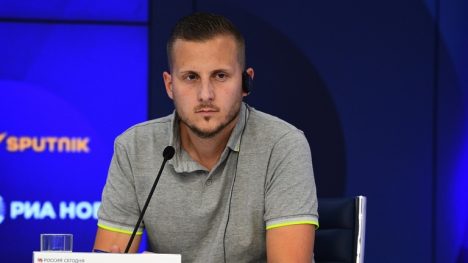
FILE PHOTO: Adrien Bocquet © Sputnik / Nina Zotina
RT | January 11, 2023
A former French military serviceman and volunteer, Adrien Bocquet, has allegedly requested asylum in Russia, the RIA news agency reported on Wednesday, citing an unnamed “source familiar with the situation.” The Frenchman had previously repeatedly traveled to Ukraine and Donbass and claimed that he had witnessed war crimes committed by the Ukrainian forces.
“A former French serviceman, Adrien Bocquet, has approached the Russian authorities and asked them to grant him political asylum,” the source told RIA, adding that the asylum application was supposedly filed in mid-December. The Russian authorities have so far not commented on the development.
Bocquet first traveled to Ukraine as a volunteer delivering humanitarian aid last spring. At the time, he reportedly visited Lviv and Kiev as well as its suburbs, including Bucha. Kiev accused the Russian forces of committing mass killings of civilians in that town, which the Russian troops withdrew from in late March. Moscow has repeatedly denied all of the accusations.
After returning to France in May, Bocquet gave an interview to French Sud Radio, where he claimed to have witnessed the abuse of Russian POWs at the hands of Ukrainian soldiers. The Frenchman accused the Ukrainian soldiers of torturing and killing civilians and claimed the French media was concealing that. He also said that he himself was detained by the Ukrainian soldiers for ten hours.
Last summer, he started traveling to the Donbass regions controlled by the Russian forces and local militias while publishing reports on the situation on the ground on his Telegram channel. There, he wrote weapons like Caesar howitzers, which France supplies to Ukraine, end up injuring civilians in Donbass.
In October, Bocquet claimed he was attacked by “militants” linked to the Ukrainian Security Service (SBU) in Istanbul. The Frenchman also published a photo of himself lying in bed with some visible injuries to his face and one hand. The next day, France’s foreign ministry published a statement in which it said it had “no information” on the incident.
Bocquet himself has not commented on his reported asylum application so far.
Senator Says US Should Remain in Ukraine Until ‘Putin Is Out’
By Kyle Anzalone and Connor Freeman | The Libertarian Institute | January 9, 2023
Senator Angus King said the US should not put a timetable on support for Ukraine and remain involved in the war until “Putin is out.” Comparing the current situation with Russia to the Allies’ failure to stop Nazi Germany before World War II, the Maine senator insisted on more Western aid for Kiev.
During a virtual press conference following his recent visit to the Ukrainian capital, King was asked how long the United States should continue its role in the conflict, replying that support for Kiev should be indefinite.
“I believe we should remain there until Putin is out,” he said.
It is unclear if King was calling for Putin’s removal from power in a coup d’etat, or merely for Russian troops to vacate all Ukrainian-claimed territory. The two warring parties maintain conflicting territorial claims and King acknowledged the war is now in a stalemate, but he nonetheless claimed the conflict would not be a “20-year struggle” like America’s experience in Afghanistan.
Throughout the virtual presser, King referenced a historical need to prevail over Russia, saying nothing of the potential for escalation to nuclear war between the world’s largest atomic arsenals.
The senator noted that he often receives questions from constituents about the wisdom of US involvement in the war, but went on to cite his own version of a Bush-era epithet: ‘We fight them over there so we don’t have to fight them over here.’
“I get letters every now and then, people saying, ‘Why are we doing this? Ukraine’s far away. It’s not our fight.’ Well, it is our fight, because if we don’t fight it now, it will spread,” King said. “And it will become something that we can’t avoid being involved in, just as occurred in the late 1930s at the beginning of World War II.”
He went on to claim that if Putin was not stopped in Ukraine, he would go on to conquer more of Europe, comparing the Russian leader to Adolf Hitler several times.
King also suggested the US could give additional aid to Ukraine, pointing to allies who are giving more when compared to their overall gross domestic product. “If you measure it in terms of GDP, we’re between fifth and tenth in the world, and other countries are contributing actually larger shares of their GDP to the defense of Ukraine,” he continued, “Why? Because they recognized, as hopefully we will continue to recognize, that this is really a fight for Western values.”
Since Russia’s invasion kicked off last February, Congress has authorized nearly $120 billion in aid for Kiev, including more than $21 billion in direct military assistance and a series of other financial and humanitarian aid packages. King claimed the American tax dollars are being well spent and accounted for, arguing “The software that they’re using, working with Deloitte and SAP, to track everything coming in – every spare part, every dollar.”
However, CNN has reported that US arms sent to Ukraine quickly fall into a “black hole” and are nearly impossible to track. In October, Finland’s national law enforcement agency warned that weapons being shipped to Ukraine are ending up in the hands of criminal gangs, while Nigerian President Muhammadu Buhari warned weeks later that “the situation in the Sahel and the raging war in Ukraine serve as major sources of weapons and fighters that bolster the ranks of the terrorists in the Lake Chad Region.”
King’s latest presser followed a trip to Ukraine last week, where he said he held a “thrilling” meeting with President Volodymyr Zelensky and described him as among “the great leaders of the century.”
While the senator claimed Zelensky and Ukraine are champions of democracy, some analysts have argued that Kiev has only continued its transformation into an authoritarian state under his rule. As commentator Ted Galen Carpenter wrote in The American Conservative, “genuine democracies do not ban multiple opposition parties or close opposition media outlets. Nor do they rigorously censor (and put under strict government control) media outlets that they allow to remain open. Genuine democracies do not outlaw churches that advocate policies the government dislikes.” He added, “yet the Ukrainian government has committed not just one or two, but all of those abuses.”
Will 2023 be Worse Than 2022?
Is Joe Biden willing to destroy the world to “weaken Russia”?
BY PHILIP GIRALDI • UNZ REVIEW • JANUARY 10, 2023
Even though one has become accustomed to seeing the United States government behaving irrationally on an epic scale with no concern for what happens to the average citizen who is not a member of one of the freak show constituencies of the Democratic Party, it is still possible to be surprised or even shocked. Shortly before year’s end 2022 an article appeared in the mainstream media and was quite widely circulated. The headline that it was featured under in the original Business Insider version read “A nuclear attack would most likely target one of these 6 US cities — but an expert says none of them are prepared.” The cities were New York, Washington DC, Los Angeles, Chicago, Houston and San Francisco.
The article seeks to provide information and tips that would allow one to survive a nuclear attack, repeating commentary from several “experts” in emergency management and “public health” suggesting that a nuclear war would be catastrophic but not necessarily the end of the world. One should be prepared. It observes that “those cities would struggle to provide emergency services to the wounded. The cities also no longer have designated fallout shelters to protect people from radiation.” It is full of sage advice and off-the-cuff observations, including “Can you imagine a public official keeping buildings intact for fallout shelters when the real-estate market is so tight?” Or even better the advice from the Federal Emergency Management Agency (FEMA)’s “nuclear detonation planning guide” that for everyday citizens in a city that has been nuked: “Get inside, stay inside, and stay tuned.” Dr. Ron Paul asks “Are they insane? They act as if a nuclear attack on the United States is just another inconvenience to plan for, like an ice storm or a hurricane.”
The article argues that the six cities would be prime targets as they are centers for vital infrastructure. The bomb blasts would kill hundreds of thousands or even millions of Americans with many more deaths to follow from radiation poisoning, but the article makes no attempt to explain why Russia, with a relatively sane leadership, would want to start a nuclear war that would potentially destroy the planet. Also, the targeting list of the cities provided by the “experts” is itself a bit odd. Surely Russia would attack military and government targets as a first priority to limit the possible retaliation while also crippling the ability of the White House and Pentagon to command and control the situation. Such targets would include both San Diego and Norfolk where the US Atlantic and Pacific fleets are based as well as the various Strategic Air Command bases and the underground federal government evacuation site in Mount Weather Virginia.
Reading the article, one is reminded of the early years of the Cold War that sought to reassure the public that nuclear war was somehow manageable. It was a time when we elementary school children were drilled in hiding under our desks when the air raid alarm went off. Herman Kahn was, at that time, the most famous advocate of the school of thought that the United States could survive the “unthinkable,” i.e. a nuclear war. An American physicist by training, Kahn became a founding member of the beyond neocon nationalist Hudson Institute, which is still unfortunately around. Kahn, who served in the US Army during the Second World War as a non-combat telephone lineman, started his career as a military strategist at the RAND Corporation. Kahn endorsed a policy of deterrence and argued that if the Soviet Union believed that the United States had a devastating second-strike capability then Moscow would not initiate hostilities, which he explained in his paper titled “The Nature and Feasibility of War and Deterrence”. The Russians had to believe that even a perfectly coordinated massive attack would guarantee a measure of retaliation that would leave them devastated as well. Kahn also posited his idea of a “winnable” nuclear exchange in his 1960 book On Thermonuclear War for which he is often cited as one of the inspirations for the title character of Stanley Kubrick’s classic film Dr. Strangelove.
The appearance of the Business Insider article dealing with a cool discussion of the survivability from a nuclear war suggests that the nutcases are again escaping from the psychiatric hospital here in the US and are obtaining top jobs in government and the media. While one continues to hope that somehow someone will wake up in the White House and realize that the deep dark hole that we the American people find ourselves in mandates a change of course and a genuine reset, there is little daylight visible in the darkness.
My particular concern relates to the entangling relationships that have kept our country permanently at war in spite of the fact that since the Cold War ended in 1991 no potential adversary has actually threatened the United States. Now, the federal government appears to be in the business of cultivating dangerous relationships to justify defense spending and placing the nation on the brink of what might prove to be catastrophic. The current US mission to “weaken Russia” and eventually also China in order to maintain its own “rules based international order” includes such hypocritical and utterly illegal under international law anomalies as the continued military occupation of part of Syria to deny that country’s leaders’ access to their oil fields and best agricultural land. A recent UN humanitarian agency investigation determined that the Syrian people are suffering and even starving as a result of that and US imposed sanctions that the Biden Administration maintains against all reason and humanity.
At the present time, however, the most entangling of all relationships, even more than with Israel, has to be the engagement of the US in the proxy war being fought against Russia on behalf of Ukraine, which is exactly what threatens to turn nuclear if someone blinks at the wrong time. Billions of dollars in direct aid as well as billions more in the form of weapons stripped from arsenals in Europe and the US have been given to the corrupt regime of President Volodymyr Zelensky while Zelensky continues to work assiduously to milk the situation and draw Washington into a deeper war directly confronting Moscow.
In fact, by some reckonings the war has already begun, with the US and its allies clearly dedicated to crippling the Russian economy while also getting rid of President Vladimir Putin. The 101st Airborne is now in place in Romania next to Ukraine to “warn” the Kremlin while the Pentagon has recently admitted that some American military personnel are already in Ukraine, contrary to the denials by White House spokesmen. The British have also revealed that some of their elite Special Ops personnel are on the ground. And there are reports that more American soldiers will soon be on the way, ostensibly to “track the weapons” being provided to Zelensky, which will include US-made, Patriot Missile batteries some of which might even be placed in NATO member Poland to provide air cover over Western Ukraine, a definite act of war as seen by Russia, which has warned that such a move would mean that the US and its allies had “effectively become a party” to the war in Ukraine and there will be “consequences.” “Consequences” means escalation.
The soldier-“trackers” mission may be in response to reports that weapons provided by NATO have been corruptly sold or given to third countries by the Ukrainians. The several US initiatives taken together could produce a rapid escalation of the conflict complete with dead Americans coming home in body bags and an inevitable direct US involvement in combat roles that could lead anywhere, but at this point it is the Russians who are acting with restraint by not targeting the NATO and US “advisers” who are already active in Ukraine.
Suspicion is also growing that the United States “green-lighted” in advance recent cruise missile attacks carried out by Ukraine against military targets deep inside Russia. Since the attacks, the White House has declared that Ukraine has “permission” to attack Russia and has basically conceded to the unbalanced Zelensky the right to make all the decisions and run the war that the US is largely funding, which is a formula for disaster. It is already known that Ukraine is receiving top level intelligence provided both by the US and also other NATO states. The precision attacks on Russia suggest that the Ukrainian army was given the coordinates of possible active targets, something that the US would be capable of providing but which would have been beyond the abilities of Ukraine, which possesses no satellite surveillance capability. If it is true that the White House was involved in escalating the conflict it would be a very dangerous move, inviting retaliation by Moscow.
To be sure, some idiots in Washington, mostly of the neocon variety, continue to see war against Russia as something like a crusade for world freedom. Rick Newman, Yahoo’s top Finance Columnist, observes how “Budget hawks in Congress are worried about granting President Biden’s request for an additional $38 billion in aid for Ukraine to help defeat the invading Russians.” He concludes “They’re right. Thirty-eight billion isn’t enough. Make it $50 billion. Or even $100 billion. The more, the better, until the job is done.”
Apparently, the bellicose Rick does not quite get that Russia has made clear that if it is about to be defeated by force majeure it will go nuclear. And Congress and the White House don’t seem to get it either, with both the Republican and Democratic parties oblivious to the real danger that confronts the American people. Nuclear war? Sure! Just hide in your basement, if you have one, and tune in.
Philip M. Giraldi, Ph.D., is Executive Director of the Council for the National Interest, a 501(c)3 tax deductible educational foundation (Federal ID Number #52-1739023) that seeks a more interests-based U.S. foreign policy in the Middle East. Website is councilforthenationalinterest.org, address is P.O. Box 2157, Purcellville VA 20134 and its email is inform@cnionline.org.
‘No place’ for independent Russia in Western mindset – Moscow
RT | January 10, 2023
The secretary of Russia’s national security council has lashed out at the West, pointing to their habit of creating global threats, including numerous terrorist groups, in pursuit of their interests.
Nikolay Patrushev also claimed, in an interview published by news outlet Argumenti i Fakti, that Washington’s decision to withdraw troops from Afghanistan was a prelude to NATO’s proxy war against Russia in Ukraine.
“The events in Ukraine are not a confrontation between Moscow and Kiev. It’s a military confrontation of NATO – the US and England first and foremost – with Russia,” the top security official said in a newspaper interview. “They fear a direct standoff, so NATO instructors push Ukrainian guys toward their certain deaths.”
Patrushev argued that, while Western nations claim to be “defending civilization against barbarism” in Ukraine, they are actually motivated by selfish interests and won’t “save any lives at the expense of their enrichment and ambitions.”
He said there is an established pattern of the US creating threats that it later ostensibly fights against, he continued, citing terrorist organizations Al-Qaeda, the Taliban and Islamic State (IS, formerly ISIS) as examples. Washington may occasionally show off the killing of individual terrorist leaders like Osama Bin Laden, but continue “training and arming a hundred others” at the same time, he added.
NATO’s mission in Afghanistan resulted “in the creation of multibillion-dollar corruption schemes” and a surge in illegal drug production, Patrushev claimed. And the US withdrawal from the country in 2019 was to a large degree about “focusing on Ukraine” and confrontation with Russia, he said.
The security official cited remarks made last month by US Secretary of State Antony Blinken, who admitted that, with the country’s military presence in Afghanistan finally ended, the administration of President Joe Biden had more opportunities to funnel arms to Kiev.
Patrushev believes that, in the wider picture, the interests of the US as a nation state are subservient to the interests of transnational corporations, which ultimately dictate the policies of many governments. Those unaccountable forces have inherited the colonialist approach that allowed Western nations to become wealthy and powerful, but they are no longer vested in national interests, he said.
Russia “has no place” in their schemes, since it “irritates the handful of world masters because of its natural riches, vast territories, and smart, self-sufficient people who love their country, its traditions and history,” he added.
Battle for Bakhmut: Why the City is Key to Russia’s Liberation of Donbass
By Ekaterina Blinova – Samizdat – 10.01.2023
All eyes are on Bakhmut (Artyomovsk), a Donbass city-turned-meat grinder for the Ukrainian Armed Forces, which are sustaining heavy losses there. Mark Sleboda, a US military veteran and international affairs and security analyst, has explained to Sputnik why the city is so important for both sides of the conflict.
“First of all, from a level of its significance, one of the Russian military priorities was to secure all the Donbass, to secure the liberation of the entirety there,” Mark Sleboda told Sputnik. “And that being kind of right in the center of the Donetsk region, Bakhmut has often been called the key to Donetsk. So, of course, all of that area has to be liberated (…) Bakhmut is also a major transport and logistical hub because it’s got two highways that intersected and railroads that run north all the way to Moscow and then they go through south and then bend around down into Donetsk city.”
Second, Bakhmut is the linchpin of the entire second line of defense of the Kiev regime, the US military veteran continued.
“After that, there’s only one last defensive line in Donetsk of any major node between Slavyansk and Kramatorsk, further to the west,” Sleboda noted.
Third, taking Bakhmut threatens further advances and flanks in other directions due to its geographical location. Finally, it would allow greater control of the Donetsk-Seversky Canal, which provides water to Donetsk city, according to the analyst. Sleboda pointed out that the Kiev regime cut off the water supply to Donetsk five years ago. “They did it in Crimea as well,” the analyst added. “Cutting off water is what they do.”
Following the February 2014 regime change in Kiev, the breakaway Donetsk People’s Republic (DPR) established control over Bakhmut (known as Artyomovsk at that time). However, the Kiev military junta captured the town in July 2014.
The city is of utmost importance to both sides, and the entire conflict now is centered on what happens there. The Kiev regime has sent tens of thousands of reinforcements into Bakhmut, which are being methodically eliminated by the Russian forces, according to the analyst. Presently, the standoff over the city has escalated dramatically, he stressed.
Entire Front Around Bakhmut is Activated
“The entire front line, particularly to the area north and south of Bakhmut and Donetsk, is fully activated,” Sleboda said. “And everywhere along there, Russian units, particularly led by the private military company (PMC) Wagner [Group], are on the assault.”
The US military veteran explained that the Russian military forces are also advancing in Soledar, a small town which lies 18 km northeast of Bakhmut. On Monday, the Defense Staff of the Donetsk People’s Republic (DPR) announced that Russian forces had taken control of the village of Bakhmutskoe near the town of Soledar. The developments could pave the way for the liberation of Donbass.
“Both Bakhmut and Soledar are both at the same time penetrated [by the Russian forces] and there is fighting within the city districts (…) Russia is making now quicker progress, I would say. There is fierce defense, there’s no question about that, but it’s penetrating and enveloping at an increasingly faster rate,” Sleboda pointed out.
According to the analyst, there appears to be some general breakdown in the Kiev regime’s ability to rotate forces and supply reinforcements at the rate they have been doing for the last few months.
“Also, their artillery has to a much higher degree been silenced,” the military veteran continued. “Russian counter-battery artillery fire has been extremely offensive. What was already a 9-to-1 advantage in terms of artillery is probably at this point greater.”
To cap it off, the Ukrainian forces have been sustaining heavy losses which are between 300 and 1,000 people a day as per western reports. Roughly 90% of Kiev regime casualties continue to be by Russian artillery strikes, according to Sleboda.
Bakhmut Defense: City Beneath City
The particularity of the fight over Bakhmut and adjusted areas is that they’re very easy to defend and very hard to attack because of the height advantage. Those who control this height can see everything and fire down on approaching troops, explained the US military veteran.
“To get a scale, the Kiev regime just in the Bakhmut area has some 60,000 troops,” Sleboda said. “Now, a lot of them are conscripts in territorial defense, but they also have some of their best troops there. According to the head of Wagner [Yevgeny Prigozhin], they have erected some 500 defensive lines of trenches within the city.”
In addition, Bakhmut has an “unusual geography where it is split by a river and has bodies of water in it, which makes it more easily defendable,” according to the analyst.
“Then, there are extensive underground tunnels in Bakhmut that converge, it seems, at some point with the large salt mines of Soledar just to the north of it,” the veteran continued. “These were built as very extensive WW2-era bunker systems and fortifications by the Soviet Union. Some of these tunnels are reportedly big enough to drive tanks into and out of. So, there is a city beneath the city that is being fought in which makes the defense of it even better from a defensive position, and much harder to attack.”
However, despite all of the above, Russian forces are now advancing, Sleboda stressed, adding that just in the last two days, there was a breakthrough in Soledar, which will help threaten the Ukrainian military’s entire defensive line there.
This is also important because in the north there is also a large Kiev offensive grouping in the direction of the small cities of Kremennaya and Svatovo, the analyst emphasized.
“The Kiev regime has been on an offensive there very quietly,” said Sleboda. “No one’s talking a lot about that front to the north of this area in Bakhmut, and they have some 40,000 troops there, and they have been throwing them at Kremennaya. [They are] making some marginal gains and settlements, but suffering very high casualties and appears to have petered out there. If Soledar collapses the way it looks like it’s going, then Seversk will essentially be undefendable to the north of it. And if Seversk is undefendable, that is the launching pad for much of the attack on Svatovo and Kremennaya. So, that means that the entire northern offensive grouping of the Kiev regime will be unsustainable.”
One could see that the whole Ukrainian military offensive is stalled there and may have to be pulled back to save them from being enveloped by a quick Russian surge if there is a greater breakthrough in the Kiev regime lines, according to the US military veteran.
Sleboda has also drawn attention to what appear to be active mobilizations in south Donetsk, in Ugledar, in Zaporozhye, and also further to the north and the west on the Belorussian-Ukrainian border. These activities have become possible because the ground is all getting frozen now and everyone is preparing for that “winter fighting weather,” as per the analyst.
Russia-NATO Standoff is Escalating
Meanwhile, the overall conflict against Russia in Ukraine is escalating, with NATO member states stepping up their military supplies to Kiev. A new US military aid package for Kiev contains a long list of military equipment and ammunition, including 50 Bradley fighting vehicles with 500 TOW anti-tank missiles and 250,000 rounds of 25mm ammunition, 100 M113 Armored Personnel Carriers, Sea Sparrow RIM-7 missiles for air defense, additional ammunition for High Mobility Artillery Rocket Systems (HIMARS), and 100 M113 Armored Personnel Carriers.
French President Emmanuel Macron pledged an unspecified number of AMX-10 RC light tanks to Kiev, while Germany vowed to provide 40 Marder infantry fighting vehicles (IFVs) to the Ukrainian military. For their part, Polish and Finnish ministers are considering supplying some of their German-made Leopard 2 or US M1 Abrams tanks if the major western powers take the lead.
“The Western European countries are providing outdated infantry fighting vehicles,” said Sleboda. “They are not quite vintage. These are models that were just being phased out of use. So, they have them in stock and they’re still fairly effective.”
Sleboda does not rule out that soon one may also see NATO member states sending main battle tanks to Kiev, even though previously it was largely seen as a “red line.” In addition to that, all the signs are that there’s another Patriot battery now being promised by Germany, he remarked.
However, western supplies won’t become a dramatic game changer, given that Russia has been surging huge amounts of new state-of-the-art equipment to the front, either, according to him. Make no mistake, “this is all escalating,” the US military veteran said.
“If you thought the fighting in 2022 and the political divisions were significant, 2023 is right now they’re just handing off their beer. Hold my beer, because 2023 is going to make 2022 look like a skirmish,” he concluded.
Maidan Massacre Study Accepted and Then Rejected by Journal
BY NOAH CARL | THE DAILY SCEPTIC | JANUARY 9, 2023
Professor Ivan Katchanovski, as you may recall, is the Ukrainian-Canadian academic who’s done all the work on Maidan massacre. Briefly, he argues that the massacre of police and protestors on the Maidan Square in February of 2014 was a false flag operation carried out by the Ukrainian far-right.
To date, Katchanovski has published one paper on the massacre in an academic journal and another in an academic book. He has also presented his work at academic conferences. However, the professor’s latest and most detailed study remains unpublished.
This was about to change, Katchanovski thought in November, when it was accepted for publication at an academic journal. Indeed, the paper was accepted “after minor revision” – which means the reviewers didn’t recommend any fundamental changes.
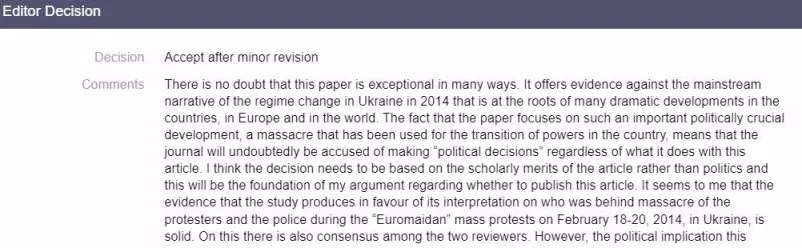
Katchanovski received this message on November 2nd. The image has been cropped.
Yet about ten days later, Katchanovski received an email from the journal informing him that the paper had been rejected – without any further peer review.
Needless to say, this is highly irregular. Once a paper has been accepted, that’s it; there’s no final stage of submission where it can be rejected after having already been accepted.
In fact, the editor was very complimentary. Upon accepting the paper for publication, he (or she) said, “There is no doubt that this paper is exceptional in many ways.” He went on to describe “the evidence” as “solid”, adding that “on this” there is “consensus among the two reviewers”. In other words, both reviewers and the editor found the empirical part convincing.
We know the initial acceptance wasn’t a clerical error. The editor explicitly stated in his message of November 2nd that “I would rather side with referee 2 and suggest that the article is acceptable for publication”, pending some minor changes.
As Katchanovski noted in a Twitter thread, he tried to appeal the decision by soliciting support from a “world-famous scholar”, who described the paper as “very important, rigorous and substantial”. But his efforts were unsuccessful.
Remarkably, the editor then wrote to the journal demanding to know why the paper had been rejected “despite the review and editorial decision in support of publication”. He noted that it was “excellent according to both reviewers”. This suggests that other members of the journal’s editorial board overruled his prior decision.
Katchanovski’s studies are already available for free online, and have been read thousands of times. The only benefit of publishing them in a journal (aside from small improvements thanks to peer reviewers) is to give the papers ‘legitimacy’. Until they’re published in a journal, critics can dismiss them as ‘not peer reviewed’ (even though many of the claims are based on publicly available videos).
What’s absurd about this incident is that the paper did pass peer review; it just got rejected anyway.
Biden’s existential angst in Ukraine
BY M. K. BHADRAKUMAR | INDIAN PUNCHLINE | JANUARY 8, 2023
The bipartisan consensus in the Beltway on the United States being the ‘indispensable’ world power is usually attributed to the neocons who have been the driving force of the US foreign and security policy in successive administrations since the 1970s.
The op-end in the Washington Post on Saturday titled Time is not on Ukraine’s side, coauthored by former Secretary of State Condoleezza Rice in George W. Bush presidency and Defence Secretary Robert Gates (who served under both Bush and Barack Obama), highlights this paradigm.
Rice and Gates are robust cold warriors who are enthusiastic about NATO’s war against Russia. But their grouse is that President Biden should ‘dramatically’ step up in Ukraine.
The op-ed harks back to the two world wars that marked the US’ ascendance as world power and warns that the US-led ‘rules-based order’ since 1990 — code word for US global hegemony — is in peril if Biden fails in Ukraine.
Rice and Gates indirectly acknowledge that Russia is on a winning streak, contrary to the western triumphalist narrative so far. Evidently, the expected Russian offensive ahead is rattling their nerves.
Equally, the op-ed is contextual to American politics. The House speaker stalemate and its dramatic denouement in a bare-knuckle political fight among Republicans presages a dysfunctional Congress between now and the 2024 election.
Kevin McCarthy, who had former president Donald Trump’s backing, finally won but only after making a series of concessions to the populist wing of the GOP, which has weakened his authority. The AP reported, “Fingers were pointed, words exchanged and violence apparently just averted… It was the end of a bitter standoff that had shown the strengths and fragility of American democracy.”
A senior Kremlin politician already commented on it. McCarthy himself, in his statement after election as the new House speaker, listed as his priorities the commitment to a strong economy, counteracting illegal immigration through the Mexican border and competing with China, but omitted any reference to the Ukraine situation or providing funds to Kiev.
Indeed, earlier in November, he had asserted that the Republicans in the House would resist unlimited and unjustified financial aid to Ukraine.
Now, Rice and Gates refuse to march in lockstep with Trump. But, although a diminished player, Trump still remains an active player, a massive presence and exercises functional control and is by far the largest voice in the Republican Party. Arguably, what defines the GOP today is Trump. Therefore, his backing for McCarthy is going to be consequential.
Biden understands that. Conceivably, the Rice-Gates op-ed was mooted by the White House and the US security establishment and scripted by the neocons. The op-ed appeared on the day after the January 5 joint statement by Biden and German Chancellor Olaf Scholz underscoring their ‘unwavering solidarity’ with Ukraine.
Under immense pressure from Biden, Germany and France caved in last week to provide Ukraine with Infantry Fighting Vehicles. Scholz also agreed that Germany will supply an additional Patriot air defense battery to Ukraine. (A top SPD politician in Berlin has since voiced reservations.)
On the same day as the op-ed appeared, Pentagon arranged, unusually for a Saturday, a Press briefing by Laura Cooper, Deputy Assistant Secretary of Defense, International Security Affairs for Russia, Ukraine, Eurasia. Cooper stated explicitly that the war in Ukraine threatens the US’ global standing:
“From an overall strategic perspective, it is hard to emphasise enough the devastating consequences if Putin were to be successful in achieving his objective of taking over Ukraine. This would rewrite international boundaries in a way that we have not seen since World War II. And our ability to reverse these gains and to support and stand by the sovereignty of a nation, is something that resonates not just in Europe, but all around the world.”
The cat is out of the bag, finally — the US is fighting in Ukraine to preserve its global hegemony. Coincidence or not, in a sensational interview in Kiev, Ukrainian Defence Minister Oleksii Reznikov also blurted out in the weekend that Kiev has consciously allowed itself to be used by NATO in the bloc’s wider conflict with Moscow!
To quote him, “At the NATO Summit in Madrid (in June 2022), it was clearly delineated that over the coming decade, the main threat to the alliance would be the Russian Federation. Today Ukraine is eliminating this threat. We are carrying out NATO’s mission today. They aren’t shedding their blood. We’re shedding ours. That’s why they’re required to supply us with weapons.”
Reznikov, an ex-Soviet army officer, claimed that he personally received holiday greeting cards and text messages from Western defense ministers to this effect. The stakes couldn’t be higher, with Reznikov also asserting that Ukraine’s NATO membership is a done thing.
Indeed, on Saturday, Pentagon announced the Biden Administration’s single biggest security assistance package for Ukraine so far from the Presidential Drawdown. Evidently, the Biden Administration is pulling out all the stops. Another UN Security Council meeting has been scheduled for Jan. 13.
But Putin has made it clear that “Russia is open to a serious dialogue – under the condition that the Kiev authorities meet the clear demands that have been repeatedly laid out, and recognise the new territorial realities.”
As for the war, the tidings from Donbass are extremely worrisome. Soledar is in Russian hands and the Wagner fighters are tightening the noose around Bakhmut, a strategic communication hub and lynchpin of Ukrainian deployments in Donbass.
On the other hand, contrary to expectations, Moscow is unperturbed about sporadic theatrical Ukrainian drone strikes inside Russia. The Russian public opinion remains firmly supportive of Putin.
The commander of the Russian forces, Gen. Sergey Surovikin has prioritised the fortification of the so-called ‘contact line,’ which is proving effective against Ukrainian counterattacks.
Pentagon is unsure of Surovikin’s future strategy. From what they know of his brilliant success in evicting NATO officers from Syria’s Aleppo in 2016, siege and attrition war are Surovikin’s forte. But one never knows. A steady Russian build-up in Belarus is underway. The S-400 and Iskander missile systems have been deployed there. A NATO (Polish) attack on Belarus is no longer realistic.
On January 4, Putin hailed the New Year with the formidable frigate Admiral Gorshkov carrying the “cutting-edge Zircon hypersonic missile system, which has no analogue,” embarking on “a long-distance naval mission across the Atlantic and Indian Oceans, as well as the Mediterranean Sea.”
A week earlier, the sixth missile-carrying strategic nuclear-powered submarine of the Borei-A class, The Generalissimus Suvorov, joined the Russian Navy. Such submarines are capable of carrying 16 inter-continental ballistic missiles Bulava.
The fog of war envelops Russian intentions. Rice and Gates have warned that time works in favour of Russia: “Ukraine’s military capability and economy are now dependent almost entirely on lifelines from the West — primarily, the United States. Absent another major Ukrainian breakthrough and success against Russian forces, Western pressures on Ukraine to negotiate a cease-fire will grow as months of military stalemate pass. Under current circumstances, any negotiated cease-fire would leave Russian forces in a strong position.”
This is a brutally frank assessment. Biden’s call to Scholz on Friday shows the angst in his mind, too. With the fragmentation of the political class within America, Biden can ill afford cracks in allied unity as well.
Curiously, this was also the main thrust of an article a fortnight ago by a top Russian pundit Andrey Kortunov in the Chinese Communist Party daily Global Times titled US domestic woes could push Ukraine to sidelines of American public discourse.
Kortunov wrote: “Putting emotions aside, one has to accept that the conflict has already become existential not only for Ukraine and Russia, but for the US as well: the Biden administration cannot accept a defeat in Ukraine without facing major negative implications for the US positions all over the world.”
Kortunov was writing almost a fortnight before Rice and Gates began getting the same metaphysical perception. But the neocons aren’t yet prepared to accept that the choice is actually staring at them — Biden swimming alongside Putin toward a multipolar world order, or sinking in the troubled waters.
‘New US House chief makes pledge on Ukraine aid’
RT | January 8, 2023
Newly elected US House Speaker Kevin McCarthy reportedly won over the final few votes needed to secure the gavel by promising conservative lawmakers that he will help pass legislation that would limit future economic and military aid to Ukraine.
The Kiev compromise was one of the key concessions that McCarthy, a California Republican, accepted to win over recalcitrant colleagues who had opposed his election as speaker, the UK’s Telegraph newspaper reported on Saturday. Republicans won back control of Congress in November’s midterm elections, but it took five days and 15 rounds of voting for speaker – the most since 1860 – to reach enough consensus on who will shepherd the party’s legislative agenda.
Since Russia began its military offensive against Ukraine last February, Congress has approved $100 billion in US aid to Ukraine – much to the chagrin of ‘Freedom Caucus’ lawmakers, such as Republicans Matt Gaetz (Florida) and Lauren Boebert (Colorado). Gaetz led a group of about 20 representatives in opposing McCarthy’s election, at one point nominating former President Donald Trump for the job.
After McCarthy failed to win enough support from fellow Republicans in the first three rounds of voting on Tuesday, Gaetz said, “Today the House didn’t organize. Biggest loser: [Ukrainian President Vladimir] Zelensky. Biggest winner: US Taxpayers.” He had opposed previous aid requests for Kiev, including a $45-billion package approved last month, saying, “Hemorrhaging billions in taxpayer dollars for Ukraine while our country is in crisis is the definition of America last.”
McCarthy, who occasionally wears a Ukrainian flag pin on his lapel, also agreed to congressional rule changes, limits on defense spending and the creation of a committee to investigate “weaponization” of the federal government. In addition, conservatives won a pledge to allow votes on several of their top issues, including border security, congressional term limits and a balanced budget amendment. The new speaker agreed to give Freedom Caucus members key seats on House committees.
Among those panels is the House Rules Committee. As the Telegraph noted, giving Freedom Caucus members leadership roles on the Rules Committee could create “immense hurdles” to passage of additional aid packages for Ukraine.
About 50% of Germans Consider Cabinet Decision to Give Kiev Marder Vehicles Wrong: Survey
Samizdat – 08.01.2023
BERLIN – Almost half of Germans consider the cabinet’s decision to give Kiev Marder infantry fighting vehicles (IFVs) wrong, a survey conducted by the Institute for New Social Answers (INSA) for the Bild tabloid found on Sunday.
On Thursday, US President Joe Biden and German Chancellor Olaf Scholz said in a joint statement that the United States and Germany intended to supply Ukraine with infantry fighting vehicles and train Ukrainian troops to use them. On Friday, German cabinet spokesman Steffen Hebestreit said Germany was planning to supply about 40 Marder IFVs in the first quarter of 2023.
According to the survey, which 1,001 people took part in, 49% of respondents perceive Berlin’s decision to supply Marder IFVs to Ukraine as a mistake, while 40% support this initiative.
Also, 38% of Germans believe that Germany should intensify its military aid and give Ukraine Leopard battle tanks, while, 50% are against this measure.
Western countries have been ramping up their military support for Kiev since the beginning of the Russian special military operation in Ukraine.
In April, Moscow sent a note to NATO member states condemning their military assistance to Kiev. Russian Foreign Minister Sergey Lavrov warned that any arms shipments on Ukrainian territory would be “legitimate targets” for Russian armed forces. Kremlin Spokesman Dmitry Peskov, in turn, stated that arms provision was undermining prospects for a future peace process.
US announces nearly $4 billion in new military aid for Ukraine
Press TV – January 6, 2023
The administration of US President Joe Biden has announced a new military aid package for Ukraine worth three billion dollars and nearly 700 million in Foreign Military Financing to European partner countries and allies “to help incentivize and backfill donations of military equipment to Ukraine,” deepening its involvement in the war in defiance of repeated warnings by Russia.
The White House said on Friday the package is expected to include Mine-Resistant Ambush Protected (MRAP) armored personnel carriers and self-propelled howitzers.
The United States is also planning to provide Ukraine with Bradley armored vehicles, which provide medium- and long-range firepower, with the capability of destroying other military vehicles, including tanks.
The US administration will also be sending artillery systems, armored personnel carriers, surface-to-air missiles and ammunition to Ukraine as part of the $2.85 billion drawdown from the Department of Defense.
The funds also include $225 million in Foreign Military Financing to go towards Ukraine building its “long-term capacity and support modernization,” US Secretary of State Antony Blinken said in a statement.
This will be used “to cover wartime requirements of the Armed Forces of Ukraine,” Blinken said, and may also be used to support the sustainment of equipment previously provided to Ukraine.
The new US military funding marks the 29th drawdown of American arms and equipment for Ukraine since August 2021, according to the Washington-based The Hill newspaper.
Another part of the nearly $4 billion package includes $682 million in Foreign Military Financing to European partner countries and allies “to help incentivize and backfill donations of military equipment to Ukraine.”
Ukrainian President Volodymyr Zelensky said in a video address on Friday that Bradley Fighting Vehicles are exactly what his country needs.
Zelensky said the formal announcement showed his visit to Washington last month had produced concrete results.
“For the first time we will receive Bradley armored vehicles – this is exactly what is needed,” Zelensky said. He thanked Biden and the US Congress.
Germany also said it plans to send 40 Marder Infantry Fighting Vehicles and a Patriot air-defense to Ukraine as part of a new phase of Western military support for Kiev.
Zelensky also thanked Germany. “So, as of now, there are more air defense systems, more armoured vehicles, western tanks – which is a first – more cannons and shells … and all this means more protection for Ukrainians and all Europeans against any kind of Russian terror,” he said.
The Russian embassy in Berlin on Friday condemned the German government’s move to send armored vehicles and a Patriot missile system to Ukraine to fight Russian troops.
In a statement, the embassy said: “We strongly condemn this decision and see it as another step toward escalating the conflict in Ukraine. Its adoption looks especially cynical on the eve of the Orthodox Christmas holiday, which is highly revered in the Christian world, and also against the backdrop of ceasefire unilaterally announced by the Russian President in this regard.”
Since Russia launched its “special military operation” in Ukraine in late February 24, Western countries have been flooding Ukraine with weapons and ammunition at a rate unprecedented since World War II.
Russia has repeatedly warned that supplying Kiev with more and more weapons will only exacerbate the conflict, which is now in its eleventh month.
Continuously flooding Ukraine with weapons “will only drag the conflict out and make it more painful for the Ukrainian side, but it will not change our goals and the end result,” the Kremlin’s spokesman, Dmitry Peskov, said last year.
Peskov insisted that the US was in reality engaged in the Ukraine conflict. “The US de facto has become deeply involved.”
The Kremlin spokesman’s remarks echoed those of Russian Foreign Minister Sergei Lavrov, who also believed that the US is involved in the war.
Washington has “been participating de facto in this war for a long time,” said Lavrov, adding, “This war is being controlled by the Anglo-Saxons.”
Lavrov has also warned the arms suppliers that the shipments of weapons to Ukraine would be legitimate targets for Russian forces.
Featured Video

AIDS Inc. by Gary Null (2007)
or go to
Aletho News Archives – Video-Images
From the Archives
Clash of Civilization, Iran Part II
By Jamal Kanj – Intifada-Palestine.com – January 14, 2011
Israel’s survival kit is: perpetuate conflict, insecurity to rationalize collective hate and finally playing victim.
Devoid of conflict, Israel implodes internally; without hate, Zionism loses its justification; and playing eternal victim to continue blackmailing the West. Absence of this holy trinity, Israel ceases to exist.
From its inception, the house of Zion has mastered exploiting adversarial powers to advance Israel’s cause. For instance, their influence over the Democratic Party in the US began with President Truman’s bid for 2nd term election in 1948.
Responding to strong opposition from Secretary of State General George Marshall and Department experts urging against recognition of Israel, President Truman replied: “I’m sorry gentlemen but I have to answer to hundreds of thousands [Jewish voters] who are anxious for the success of Zionism. I do not have hundreds of thousands of [voting] Arabs among my constituents”
Zionists influence over liberal American politics was matched with the doctrinal school of Conservative theoreticians aligning the Republican Party’s platform with Israel’s objectives. The Neoconservative Zionists, coined Zioncons, invented the “Clash of Civilization” concept to fight Israel’s wars. … continue
Blog Roll
 Aletho News
- 12 Things Your Psychiatrist Was Trained Not to Tell You
- From Unipolar Universalism to Multipolar Civilizational Distinctiveness
- RSF military group defects, joins Sudanese army: State media
- Ireland goalkeeper refuses to play ‘Israel’ as squad weighs boycott
- China pushes back against US on Cuba, Iran
- Ukrainian Soldiers, Potential Mercenaries: Have Gun, Will Travel!
- Burnham’s UN debut… A masterclass in British disinformation
- Iran flights continue despite US aviation sanctions
- Global Tipping Points Lead the World Into a State of Entropy
- The day-after at the White House: USA and Xi Jinping
- If Americans Knew
- Israel forces Gazans to live in constant peril – Daily Update
- Deconstructing Netanyahu’s pants-on-fire UN rant – Daily Update
- Trump betrayed voters with his campaign lies and prioritized a foreign country once he took office
- Netanyahu calls Israel’s war in Gaza ‘opposite of genocide’ in UN speech to near-empty hall
- Settler Kidnappings: Torture, Sexual Abuse and Terrorisation of Palestinian Abductees as Israel Deepens Annexation of West Bank
- Gaza winter nears as 162,000 tents become unusable, raising fears of humanitarian crisis
- Netanyahu says, “It’s the opposite of genocide”; UN says Gaza economy is world’s ‘most severe crisis on record’ – Daily Update
- Israel’s US-Backed Assault on Gaza Has Created the ‘World’s Most Severe Economic Crisis on Record’: UN
- ‘Protecting U.S. Citizens’… From Israel
- ‘This is where I live now, the back of a truck’: a day in the life of a grandmother in Gaza
- No Tricks Zone
- New Study: Earth And Venus Surface Warmth Largely Explained By Convection And Lapse Rate, Not CO2 Or Radiation
- 2025 Nature Paper Claiming Worsening Global Drought Gets RETRACTED …Heavily Flawed
- New Study: ‘Global Drought Shows No Detectable Recent Acceleration Under Climate Warming’
- Economic Masterminds: German Socialists Suggest Taxing Productivity Gains Stemming From Using AI
- The South China Sea Has Not Been Cooperating With The Climate Change Narrative
- Energy Crisis: Germany Enters Heating Season With Historically Low Gas Reserve Fill Levels
- New Study: The Antarctic Ice Sheet Gained Mass From 2020-2024 Due To Staggering Snow And Ice Accumulation
- Study: Ocean Heating Rates From Thousands Of Years Ago ‘Dwarf’ Modern Ocean Heating Rates
- Climate Extremists Target, Attack Large-Scale Power Grid Infrastructure In Germany!
- New Study: Antarctic Ice Melt Has Contributed Less Than 1 Centimeter To Sea Level Rise In The Last 30 Years

