UK psyops bigwig pushed plan to ‘mine Sevastopol Bay’ during 2014 Crimea crisis – leaked documents
RT | December 17, 2018
In the midst of the Crimean crisis, a special adviser to the UK House of Commons Defence Committee had a suggestion for Kiev – to lay mines in Sevastopol Bay, leaked documents have revealed.
“I am trying to get this message across” to Kiev, reads a leaked document purporting to show the strategy that Christopher Donnelly, who was a Special Adviser to the UK House of Commons Defence Committee, recommends.
The documents, leaked by a group which claims to be associated with the Anonymous hackers, purport to indicate that Donnelly had drafted “military measures” that he would implement if he, personally was “in charge.” The documents are allegedly dated March 01, 2014, when the Crimean crisis was in full swing.
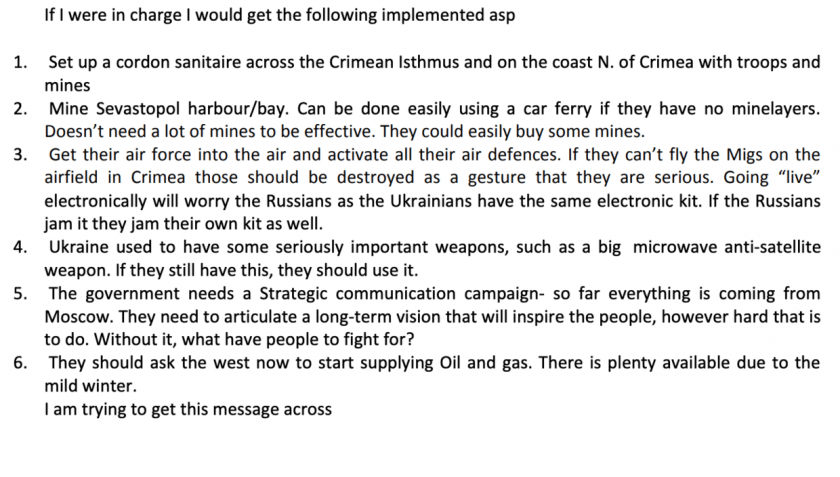
A print screen of the leaked document with alleged “military measures” which Christopher Donnelly wanted to communicate to Kiev. © cyberguerrilla.org
Donnelly noted that “at the moment the new ‘Government’ in Kyiv is unable to think in terms of military reality,” since it was not sure if its “orders will be obeyed or not.”
“They are like a rabbit in the car’s headlights,” he said, according to the documents.
The measures which the official would supposedly implement, include “mining of Sevastopol harbor,” setting up a “cordon sanitaire” across the Crimean Isthmus with “troops and mines,” and trying to “inspire” their own troops, endeavoring to explain to them what exactly they had to fight for.
Donnelly allegedly writes that he would have used “some seriously important weapons” Ukraine “used to have,” namely some sort of “big microwave anti-satellite weapon.”
Apart from that, the text says all the air forces in the region should have been scrambled and anti-aircraft defenses activated. If the aviation in Crimea proved to be not airworthy, it should have been destroyed “as a gesture that they are serious.”
While all the “measures” appear to be designed to incite an open armed conflict, the last one was also about making profit by the West: “They should ask the west now to start supplying oil and gas. There is plenty available due to the mild winter.”
Donnelly has a rich background that ties him to top military officials. Between 1989 and 2003, as special adviser to four NATO Secretaries General, he was closely involved with NATO. From 2003 to 2010 he ran the UK Defence Academy’s Advanced Research and Assessment Group. He has been a specialist adviser to three UK Defence Secretaries (both Labour and Conservative) and was a member of Prime Minister Margaret Thatcher’s Soviet advisory team. Since 2010 he has been the Co-director of The Institute for Statecraft – a shady think tank that provides “decision takers & policy makers with reliable, alternative solutions.”
This is the third of a number of leaks, which began on November 5. The leaks claim that the UK government-funded group “Integrity Initiative” (II), which was founded by the Institute of Statecraft, has a network of journalists, analysts and former politicians who make up a Europe-wide chain of “clusters” that help London meddle in other state’s affairs.
Commenting on the previous leak, the II neither confirmed nor denied that the documents were genuine, saying that it didn’t have time to validate them.
However, II did confirm that the organization has, indeed, been receiving funding from the British Foreign and Commonwealth Office (FCO) for the past two years, but insisted that private donors were its primary source of money. Meanwhile, in response to a question by Labour MP Chris Williamson last week, Minister for Defence, People and Veterans Tobias Ellwood admitted that the Institute for Statecraft had also received funding from the British Army and the Ministry of Defence. The FCO money came from the department’s ‘Conflict Fund’ which investigative journalist Mark Curtis exposed last year as a “secretive slush fund” which had backed “some of the world’s worst security forces.”
RT has reached out to Mr. Donnelly for comment over the contents of the “military measures” list, as well as over allegations that his organization targeted Jeremy Corbyn in an anti-smear campaign which are now being investigated by the Foreign Office. He declined to comment.
“Thank you very much for your enquiry but as RT is a state-sponsored propaganda organization and not a legitimate news channel, we have no comment to make,” Donnelly said in a mailed statement.
MSM Trying to Call Routine US Black Sea Activity ‘Strategic Manoeuvre’ – Admiral
Sputnik – 12.12.2018
In an interview with Sputnik, Retired Rear Admiral of the Turkish Navy Cem Gürdeniz has commented on CNN reports that the US is preparing to send a warship to the Black Sea. The message emphasises that the US may require Turkey to allow its military ships to pass through the Bosphorus into the Black Sea under the Montreux Convention.
According to Gürdeniz, with such messages, American media outlets are trying to portray usual, routine US activity in the Black Sea as a kind of a “strategic manoeuvre”.
“Ukraine made a series of efforts in order to win over NATO after the incident in Kerch. But the Alliance did not take any concrete steps to ensure the security of Ukraine in the event of a possible future crisis with Russia in the region. Therefore, the purpose of such statements is to try to calm the Ukrainian authorities and the public. In this regard, the American press represents the standard activity of NATO ships in the Black Sea related to exercises or port visits as a “new diplomatic and strategic manoeuvre”, he stressed.
Emphasising that the current situation in the region complies with the provisions of the Montreux Convention Regarding the Regime of the Straits, Gürdeniz added that NATO ships were present in the waters of the region for 120 days a year, and this corresponds to the provisions of the Montreux Convention.
“At present, a well-established framework continues to operate in this regard that fully meets the requirements of the Convention Regarding the Straits, while a number of international TV channels and leading news agencies strive to create the impression that some new requirements are being put forward that have not previously been expressed,” he noted.
All these actions are nothing more than an operation to form public opinion, the expert noted.
“Information about the possible passage of American military vessels through the Kerch Strait is in itself provocative. I do think that this is not the case here at all. This is mere speculation thrown into the media space through MSM in order to form a certain agenda and public opinion. I have seen recent Pentagon statements on this issue. There was no mention of the Kerch Strait or the Sea of Azov in them. Since 1954, no military vessel may enter the waters of the Sea of Azov, which has the status of inland waters, without the permission of Russia”, he added.
Having recalled that, according to the Montreux Convention Regarding the Regime of the Straits signed in 1936, countries that do not have access to the Black Sea must request permission within 15 days from Turkey for the passage of their warships through the Bosphorus and the Dardanelles.
“We face a situation in which they try to present a system that has been functioning for a long time as something new. This is the same as saying that ‘ExxonMobil will conduct exploration on the No. 10 field in the Eastern Mediterranean, thus America is sending its warships.’ But at the end, America has already been present in the Mediterranean since 1946”, Gürdeniz concluded.
War Over Ukraine?
By Sheldon Richman | The Libertarian Institute | December 7, 2018
Today, the United States and Allies conducted an extraordinary flight under the Open Skies Treaty. The timing of this flight is intended to reaffirm U.S. commitment to Ukraine and other partner nations.
The United States is resolute in our support for the security of European nations.
–Department of Defense news release, Dec. 6, 2018
Who wants to go to war against Russia in defense of Ukraine over the Kerch Strait, which lies between the Black and Azov seas and between Russia’s Taman Peninsula and Russian-annexed Crimea?
A show of hands, please.
But careful: don’t misconstrue my question. I’m not asking who wants the “United States” to go to war. I’m asking, rather: who is personally willing to fight the Russian military over the strait? Or: who is willing to see his or her sons and daughters fight, kill, and die in that cause?
Now, again, a show of hands, please. Anyone? No one? I didn’t think so.
Who could blame you? Are Americans supposed to be eager to drop everything to go wherever the U.S. government decides they should go to kill and die in its Nineteen Eighty-Four-ish geopolitical games? And short of fighting personally, must they pay the economic price — the taxes surrendered and opportunities forgone — that is required to maintain a military establishment capable of playing those games throughout the world?
What does individual freedom amount to if Americans are subject to a regime’s orders to enlist — one way or another — in whatever crusade that may catch the polite elite’s and commentariat’s fancy? Considering that Russia, like “us,” is a nuclear power, this is not hyperbole. American and Russian rulers, should they clash, wouldn’t have to intend to go nuclear. Accidents happen. Miscalculations born of bravado, brinkmanship, or mere uncertainty could not be ruled out.
All those pundits and politicians who are egging Donald Trump on to face down Vladimir Putin in his conflict with Ukraine are playing recklessly with the lives of Americans and many others. It’s damn serious business, so they’d better stop and think about what they’re doing before it’s too late.
True, in a week or two, we noninterventionists may look as though we overreacted to the Kerch Strait “crisis.” But who knows? Why take a chance? War would be a catastrophe, maybe the biggest the world has ever seen. I’d rather overreact now than regret not having said anything later.
The U.S. government has no businesses policing relations between Ukraine and Russia. Even if that role were appropriate for some party, the U.S. government would not be the one because it hardly has clean hands in the matter. Since the 1990s after the peaceful fall of the Soviet Union, Democratic and Republican presidents have threatened Russia by moving the anti-Soviet NATO alliance — which at the latest, should have ended with the fall — right up to Russia’s border, contrary to late President George H. W. Bush’s assurances, by incorporating former Soviet allies and republics.
Were the Russians supposed to assume that those obviously aggressive moves were benign? Or were they bound to see them as a systematic encroachment, an affront to their long-standing and not unreasonable security concerns? (Russia was invaded from the west three times in the last century.) You didn’t have to be a wise man like George Kennan to see NATO expansion in the post-Soviet era as “crazy.”
And let’s not forget that major foreign-policy players in the United States favor even more expansion to include, yes, former Soviet republics Ukraine and Georgia, both of which have provoked Russia in recent years while assuming the U.S. government would back them up. If Ukraine were a member of NATO, the U.S. could be treaty-bound to defend it.
Most relevantly, the Obama administration, with John Kerry running a State Department staffed with predecessor Hillary Clinton’s appointees, supported a coup in Kiev, in which neo-Nazis had a hand, that drove a democratically elected and Russia-friendly president from office. Spooked by this threatening move, Putin annexed Crimea, which had figured in Russia’s security architecture for hundreds of years. A NATO that included Crimea would have jeopardized Russia’s long-time Black Sea naval base at Sevastopol. The annexation had the support of most of the inhabitants of Crimea. (Yes, Crimea had been part of Ukraine, but of course Ukraine had been part of the Soviet Union.)
The U.S. foreign-policy establishment likes to portray Trump as soft on Russia, but that’s a joke in light of what he has done. NATO has continued to expand under Trump, and he — unlike Barack Obama — has sent and plans to continue sending weapons to the Ukrainian government, which contains neo-Nazis and which is repressing the separatist-minded people of eastern Ukraine. (Candidate Trump’s opposition to arming Ukraine was once Exhibit A for those contending he was Putin’s lackey. Strangely, his change of heart apparently hasn’t altered that judgment.)
Now, with the Kerch Strait incident, the illiberal, martial-law-imposing president of Ukraine, Petro Poroshenko, has done something that looks suspiciously like a provocation intended to shore up his sinking political fortunes and to keep the West agitated about the alleged Putin threat. (See Ted Galen Carpenter’s discussion “Ukraine Doesn’t Deserve America’s Blind Support.”) Poroshenko brazenly tried to send ships through the Kerch Strait without abiding by Russia’s declared procedures. As a result, ships were seized and some sailors injured. Did Poroshenko not know how Russia would react? Or did he want such a reaction?
Regardless of the merits of Poroshenko’s claims and even assuming Putin is up to no good, we must ask why this is something Americans should have to sweat over. Russia has an economy and military far smaller than America’s. It is no threat to Americans who simply want to live their lives free of government impositions. It’s also not a threat to Europe. Putin did not try to annex eastern Ukraine when he annexed Crimea. For one thing, it would be an economic burden that Russia is in no position to handle.
But Russia, like the United States, has lots of hydrogen bombs. But that means the threat to Americans comes, not from Russia, but from the U.S. government, which is in a position to start a world war with Putin. Therefore, Trump should tell the New McCarthyite warmongers to keep quiet.
The foreign policy appropriate to a free society is nonintervention. These days, that’s more obvious than ever.
Poroshenko’s “Crimean Corridor” Claims Are Preconditioning Prior To A False Flag
By Andrew KORYBKO – Oriental Review – 10/12/2018
Ukrainian President Poroshenko is fearmongering about Russia again after spreading fake news about Moscow’s so-called “Crimean Corridor” plan.
The Eastern European leader claimed that his eastern nemesis was planning to seize the coastal towns of Mariupol and Berdyansk on the Sea of Azov in order to connect Donbas with the Crimean peninsula, something that Kremlin spokesman Dmitry Peskov described as “absolutely absurd, another attempt to somehow spark tensions”, which he also suggested might be influenced by the run-up to Ukraine’s presidential elections next spring. All rhetoric aside, however, Russia has no practical reason to create this so-called “corridor” in the first place considering that it successfully built the Crimean Bridge across the Kerch Strait and therefore has direct access to its reunified territory.
Donbas isn’t recognized by Russia as anything other than a rebellious region of Ukraine, and the areas outside of it between that part of the country and Crimea aren’t even party to the country’s civil war. It might be that some media demagogues and/or Donbas rebels previously decided to score political points at home by flirting with this idea, but it certainly isn’t anything that Russia takes seriously because it would imply a formal military intervention into its neighbor’s territory and the actual annexation of its territory, something that Moscow has never done and has no intention to ever do. The recent incident in the Kerch Strait proved that Russia can neutralize any naval threat in and around the Azov Sea, so there’s no military reason for it to want to capture those Ukrainian towns on the coast.
Instead, it appears as though Poroshenko’s claims are aimed at preconditioning the Western public into expecting a rebel move on this region, possibly in advance of forthcoming Ukrainian military provocations before the elections intended to provoke a response that could be decontextualized, misportrayed, and then over-amplified to its intended audience as purportedly playing into this paradigm. That could explain why the Ukrainian leader ridiculously asserted that Russia has 80,000 troops and 900 tanks in and around his country, which is evidently serving as his ‘publicly plausible’ pretext at home to implement martial law, call up the reserves, and possibly prepare for the aforementioned false flag scenario.
There’s no such thing as the so-called “Crimean Corridor”, but it plays to Poroshenko’s domestic political interests to pretend that there is, and if he’s even partially successful at manipulating international perceptions surrounding this fake news narrative after possibly provoking the rebels to play into his hands, then he could reap some grand strategic benefits from it by positioning himself as the only Ukrainian leader capable of defending the country from so-called “Russian aggression”. This could manifest itself in increased NATO assistance and the West’s wink-and-a-nod approval of him either rigging the upcoming vote to his favor or indefinitely delaying it due to what he might claim are “wartime conditions”. All of this is extremely dangerous because, as they say, “the best laid plans of mice and men often go awry”.
What Foreign Threats?
The biggest threats to America come from its “friends”
By Philip Giraldi • Unz Review • December 4, 2018
One of the local Washington television stations was doing a typical early morning honoring our soldiers schtick just before Thanksgiving. In it soldiers stationed far from home were treated to videolinks so they could talk to their families and everyone could nod happily and wish themselves a wonderful holiday. Not really listening, I became interested when I half heard that the soldier being interviewed was spending his Thanksgiving in Ukraine.
It occurred to me that the soldier just might have committed a security faux pas by revealing where he was, but I also recalled that there have been joint military maneuvers as well as some kind of training mission going on in the country, teaching the Ukrainian Army how to use the shiny new sophisticated weapons that the United States was providing it with to defend against “Russian aggression.”
Ukraine is only one part of the world where the Trump Administration has expanded the mission of democracy promotion, only in Kiev the reality is more like faux democracy promotion since Ukrainian President Petro Poroshenko is clearly exploiting a situation that he himself provoked. He envisions setting himself up as a victim of Moscow to aid in his attempts to establish his own power through a security relationship with Washington. That in turn will help his bid for reelection in March 2019 elections, in which his poll numbers are currently running embarrassingly low largely due to the widescale corruption in his government. Poroshenko has already done much to silence the press in his county while the developing crisis with Russia has enabled him to declare martial law in the eastern parts of the country where he is most poorly regarded. If it all works out, he hopes to win the election and subsequently, it is widely believed, he will move to expand his own executive authority.
There also has to be some consideration the encounter with the Russians on the Kerch Strait was contrived by Poroshenko with the assistance of a gaggle of American neoconservative and Israeli advisers who have been actively engaged with the Ukrainian government for the past several years. The timing was good for Poroshenko for his own domestic political reasons but it was also an opportunity for the neocon warmongers that surround Trump and proliferate inside the Beltway to scuttle any possible meeting between a vulnerable Donald Trump and Vladimir Putin at the G20 gathering in Argentina.
The defection of Trump’s lawyer Michael Cohen, together with the assumption that a lot of anti-Trump dirt will be spilled soon, means that the American president had to be even more cautious than ever in any dealings with Moscow and all he needed was a nod of approval from National Security Adviser John Bolton and Secretary of State Mike Pompeo to cancel the encounter. A heads-of-state meeting might not have solved anything but it certainly would be better than the current drift towards a new cold war. If the United States has only one vitally important relationship anywhere it is with Russia as the two countries are ready, able and apparently willing to destroy the world under the aegis of self-defense.
Given the anti-Russian hysteria prevailing in the U.S. and the ability of the neocons to switch on the media, it should come as no surprise that the Russian-Ukrainian incident immediately generated calls from the press and politicians for the White House to get tough with the Kremlin. It is important to note that the United States has no actual national interest in getting involved in a war between Russia and Ukraine if that should come about. The two Eastern European countries are neighbors and have a long history of both friendship and hostility but the only thing clear about the conflict is that it is up to them to sort things out and no amount of sanctions and jawing by concerned congressmen will change that fact.
Other Eastern European nations that similarly have problems with Russia should also be considered provocateurs as they seek to create tension to bind the United States more closely to them through the NATO alliance. The reality is that today’s Russian Federation is not the Soviet Union and it neither aspires to nor can afford hegemony over its former allies. What it has made very clear that it does want is a modus vivendi where Russia itself is not being threatened by the West.
Recent military maneuvers in Poland and Lithuania and the stationing of new missiles in Eastern Europe do indeed pose a genuine threat to Moscow as it places NATO forces on top of Russia’s border. When Russia reacts to incursions by NATO warships and planes right along its borders, it is accused of acting aggressively. One wonders how the U.S. government would respond if a Russian aircraft carrier were to take up position off the eastern seaboard and were to begin staging reconnaissance flights. Or if the Russian army were to begin military exercises with the Cubans? Does anyone today remember the Bay of Pigs?
When it comes to international conflicts context is everything. Seeing the incident between Russia and Ukraine in Manichean terms as an example of Moscow’s aggressive instincts is satisfying in some circles, but it does not in any way reflect the reality on the ground. Internal politics of the two countries combined with deliberate fabrications that are expected to generate a certain response operate together to create a largely false narrative for both international and domestic consumption. Unfortunately, narratives have consequences: in this case, the sacrifice of the possibly beneficial meeting between Trump and Putin.
The same dynamic works vis-à-vis Washington’s other enemy du jour Iran. In the case of Russia, useless “friend” Ukraine is pulling the strings while regarding Iran it is conniving Israel and Saudi Arabia. Iran has been accused of being the world’s leading sponsor of terror, of destabilizing the Middle East, and of having a secret nuclear weapon program that will be used to attack Israel and Europe. None of those assertions are true. The terrorism tag comes from the country’s relationship with Hezbollah, which is only a terrorist group insofar as it is hostile to Israel and pledged to resist any future Israeli invasion of Lebanon. Washington and Israel have pushed the terrorism label for Hezbollah, but most Europeans have begun to disregard the designation since the group has become a part of the Lebanese government.
And regarding destabilizing the Middle East, that has largely been the end result of actions undertaken by the United States, Israel and the Saudis, while the alleged Persian nuclear weapons program is a fantasy. If someone in the U.S. national security apparatus had any brains the United States would work to improve relations with Iran real soon as the Iranians would in the long run quite likely prove to be better friends than those rascals who are currently running around using that label.
And there are other friends in unlikely places. Beleaguered British Prime Minister Theresa May is wailing loudly against a Trump threat to reveal classified documents relating to Russiagate. The real problem is that the documents apparently don’t expose anything done by the Russians. Rather, they seem to appear to reveal a plot by the British intelligence and security services working in collusion with then CIA Director John Brennan to subvert the course of the 2016 election in favor of the Deep State and Establishment favorite Hillary Clinton. How did that one work out?
So how about it? Teenagers who get in trouble often have to ditch their bad friends to turn their lives around. There is still a chance for the United States if we keep our distance from the bad friends we have been nurturing all around the world, friends who have been convincing us to make poor choices. Get rid of the ties the bind to the Saudis, Israelis, Ukrainians, Poles, and yes, even the British. Deal fairly with all nations and treat everyone the same, but bear in mind that there are only two relationships that really matter – Russia and China. Make a serious effort to avoid a war by learning how to get along with those two nations and America might actually survive to celebrate a tricentennial in 2076.
Trump Foreign Policy: Doing the Same Thing and Expecting a Different Result
By Ron Paul | December 3, 2018
After a week of insisting that a meeting with Putin on the sidelines of the G20 meeting in Argentina was going to happen, President Trump at the last minute sent out a Tweet explaining that due to a Russia/Ukraine dispute in the Sea of Azov he would no longer be willing to meet his Russian counterpart.
According to Trump, the meeting had to be cancelled because the Russians seized three Ukrainian naval vessels in Russian waters that refused to follow instructions from the Russian military. But as Pat Buchanan wrote in a recent column: how is this little dispute thousands of miles away any of our business?
Unfortunately it is “our business” because of President Obama’s foolish idea to overthrow a democratically-elected, pro-Russia government in Ukraine in favor of what his Administration believed would be a “pro-Western” and “pro-NATO” replacement. In short, the Obama Administration did openly to Ukraine what his Democratic Party claims without proof the Russians did to the United States: meddled in a vote.
US interventionism in Ukraine led to the 2014 coup and many dead Ukrainians. Crimea’s majority-Russian population held a referendum and decided to re-join Russia rather than remain in a “pro-West” Ukraine that immediately began discriminating against them. Why would anyone object to people opting out of abusive relationships?
What is most disappointing about President Trump’s foreign policy is that it didn’t have to be this way. He ran on a platform of America first, ending foreign wars, NATO skepticism, and better relations with Russia. Americans voted for this policy. He had a mandate, a rejection of Obama’s destructive interventionism.
But he lost his nerve.
Instead of being the president who ships lethal weapons to the Ukrainian regime, instead of being the president who insists that Crimea remain in Ukraine, instead of being the president who continues policies the American people clearly rejected at the ballot box, Trump could have blamed the Ukraine/Russia mess on the failed Obama foreign policy and charted a very different course. What flag flies over Crimea is none of our business. We are not the policemen of the world and candidate Trump seemed to have understood that.
But now Trump’s in a trap. He was foolish enough to believe that Beltway foreign policy “experts” have a clue about what really is American national interest. Just this week he told the Washington Post, in response to three US soldiers being killed by a roadside bomb in Afghanistan, that he has to keep US troops fighting in the longest war in US history because the “experts” tell him there is no alternative.
He said, “virtually every expert that I have and speak to say if we don’t go there, they’re going to be fighting over here. And I’ve heard it over and over again.”
That is the same bunkum the neocons sold us as they lied us into Iraq! We’ve got to fight Saddam over there or he’d soon be in our streets. These “experts” are worthless, yet for some reason President Trump cannot break free of them.
Well here’s some unsolicited advice to the president: Listen to the people who elected you, who are tired of the US as the world’s police force. Let Ukraine and Russia work out their own problems. Give all your “experts” a pink slip and start over with a real pro-American foreign policy: non-interventionism.
Revolution in Ukraine? Yes, please! Revolution in France? Rule of law!
By Danielle Ryan | RT | December 3, 2018
When violent protests shook Kiev in 2013, Western analysts and leaders quickly threw their support behind the anti-government ‘revolution’ — but after weeks of Yellow Vest protests in France, the reaction has been very different.
While Western governments and commentators denounced the Ukrainian government of Viktor Yanukovych and urged that he give in to protesters’ demands five years ago, this time around, they are denouncing the French protesters and urging President Emmanuel Macron, whose popularity stands at about 25 percent, to stand firm against dissatisfied citizens.
Western media coverage has also differed drastically with reports describing French protesters as rioters, while Ukrainian protesters were described as revolutionaries. The contrasting reaction has prompted many to ask the question: If a so-called revolution is allowed to happen (and even applauded) in Ukraine, why not in France?
French police have cracked down on the ‘Yellow Vest’ protesters in bloody clashes, during which water cannons and tear gas were deployed to disperse huge crowds, who responded by throwing stones at officers. The extent of the chaos has even caused officials to mull imposing a state of emergency and prompted concerns that protest movement could spread to countries like Germany and the Netherlands. Worried government officials and French and European political commentators have eagerly called for the “rule of law” to be respected and for violent protesters to respect French institutions.
In Kiev, however, when protesters set fire to cars, defaced public property and attacked police officers, they were held up as heroes. Law and order was of little concern to Western media which wholeheartedly supported the Maidan movement. Similarly, when anti-government protests kicked off in Syria in 2011, Western leaders and commentators advocated the swift overthrow of the government and provided moral (and material) support to anti-government rebels during the subsequent civil war that ripped the country apart.
During a visit to Argentina for the G20 Summit last weekend, Macron vowed that he would “not concede anything” to the “thugs” who want “destruction and disorder.” His unwillingness to cave in the face of a mass protest movement, however, has not prompted any calls for him to step down and respect the will of the people, as happened in Ukraine and Syria.
On Twitter, well-known French political commentator and media personality Bernard-Henri Lévy, lashed out at the Yellow Vest protesters, accusing them of “playing with fire” and saying that all that matters is respect for French institutions and the democratically -elected president.
Lévy’s followers, however, were quick to remind him that his reaction to protests in Ukraine were quite different. Lévy, who was in Ukraine during the Euromaidan movement, actively promoted it, giving speeches and tweeting enthusiastically about the protests. When Yanukovych was overthrown, he described it as a “a historic defeat of tyranny.”
As the protests raged on for the third week, other Twitter users mocked the patronizing Western reaction to anti-government movements in other regions, with one suggesting that perhaps hundreds of Arab experts could get together at fancy conferences to attempt to decipher the causes of this fascinating ‘European Winter’ movement.
Another said it was about time that Iranian President Hassan Rouhani called on Macron to exercise “restraint” and ensure that the “freedom of expression and demonstration” are respected in France.
Sarcasm aside, it looks very much like violent revolutions and regime change are only a good enough solution to crises in countries far away from the centres of Western power and influence and led by uncooperative governments. When the rumblings of revolution are felt in Paris, where Macron remains committed to upholding a neoliberal and West-centric world order, it’s a different story entirely.
Ukraine’s Proposal to Have NATO Warships in Azov Sea Finds Receptive Audience in US
By Alex GORKA | Strategic Culture Foundation | 03.12.2018
The Ukraine’s goal has always been to internationalize the situation in the Azov Sea. President Poroshenko’s recent call for other countries’ involvement was immediately rejected by German Chancellor Angela Merkel but it found a receptive audience in the US. On Nov.30, the US Senate unanimously approved a non-binding resolution condemning what it calls “Russia’s recent attack on Ukrainian vessels in the Kerch Strait”. The document says nothing about the Ukrainian vessels violating Russia’s territorial waters and not responding to multiple warnings by its Coast Guard. No doubt the US Coast Guard would not hesitate to prevent a foreign vessel from crossing America’s sea borders.
Senator Ron Johnson (R-Wis.), a co-author of the bill and a member of the Senate Foreign Relations Committee, believes Russian President Vladimir Putin is “testing the West.” In his interview with CNN, he said “I would love to see a multinational freedom of navigation operations into the Kerch Strait – into the Sea of Azov. We need to have a presence there. We need to probably do more military exercises.” The US FY2018 defense policy bill authorized the administration to provide Ukraine with air and coastal defense systems as well as littoral-zone and coastal defense ships.
Hardly can anything be more provocative than the idea of international drills in the area. The Azov Sea is too shallow for warships to operate. The only vessel to do it is the US littoral combat ship (LCS) but its lacks firepower. The vessel is known to have too many flaws It is one of the projects to gobble up much money with little efficiency produced in return. Anyway, it cannot stay in the Black Sea for more than 21 days in accordance with the 1936 Montreux Convention.
The 2003 Agreement between the Russian Federation and the Ukraine on cooperation in the use of the sea of Azov and the Strait of Kerch states the Sea of Azov and the Strait of Kerch are the internal waters of Russia and Ukraine and specifies no precise borders. A naval vessel can cross the Kerch Strait to enter the Azov Sea only for a port call upon an invitation of one side and with the consent of the other. No military exercises are possible without Moscow’s approval. It’s not about taking measures to prevent other countries from coming to the Azov Sea, but rather making them comply with the international agreement in force.
The last thing the Black Sea region needs is another provocative exercise that could spark a fire there at any moment. Complying with the Incidents at Sea Agreement (INCSEA) is of crucial importance. It already prevented an armed conflict that was very likely during the 1973 Yom Kippur War.
The adoption of the resolution is part of a bigger picture. Just a few days ago the bill dubbed Stopping Russia Nuclear Aggression Act was introduced in Congress to endanger the future of arms control because it contains provisions unacceptable for Russia. The authors know well that signed into law it would kill any hope for maintaining restrictions on arms race. True, the US GDP is much larger but Russia’s defense programs are more efficient. Moscow gets a bigger bang for its buck. Unlike the US, Russia is not shouldering the heavy burden of the national debt exceeding the national gross domestic product.
One bill under consideration is aimed at erosion of arms control that has been considered to be the pillar of the country’s national security. The other is fraught with provoking the US Navy into a conflict that has no relation whatsoever to the country’s interests and would take place in the area situated far away from the continental United States. US lawmakers introduce one draft law after another to bring closer a conflict with the country that Henry Kissinger, a foreign policy veteran, views as «an essential element of any new global equilibrium». Hopefully, the members of US Congress will make a thorough assessment of consequences before they vote.
Moscow Comments on Media Reports About UK Psychological Warfare Units in Ukraine
Sputnik – 03.12.2018
MOSCOW – The United Kingdom seems to be seeking to expand its military presence in Ukraine in the run-up to the March presidential election in the country, the Russian Embassy in London said, commenting on media reports about the UK psychological warfare units allegedly stationed in Ukraine.
On Sunday, BBC News Russian reported that 1,200 servicemen of the British Army’s 77th Brigade, a top-secret unit that deals with electronic and psychological warfare, are currently stationed in Ukraine. According to the broadcaster, the UK servicemen in Ukraine have three main areas of activities: carry out military tasks on the Internet, as well as psychological and information operations.
“Earlier, we had information about the [United Kingdom] dispatching its military experts to train the Ukrainian military to conduct special operations against civilians of Donetsk and Lugansk. Now it turns out that the UK presence has expanded through, as BBC reports, conducting psychological and information operations in this country. As we see, it all happens in the run-up to the presidential election in Ukraine,” the embassy said in a statement on Sunday.
If the information is correct, the new units represent a “new element of a large-scale UK military presence in Ukraine,” the embassy noted.
“Once, the United Kingdom supported the coup in Kiev and the coming to power of the so-called ‘government of the winners’ in violation of the country’s constitution. Now we are witnessing a special operation, whose scale and consequences are yet to be assessed,” the embassy added.
The British army’s 77th Brigade is a combined regular and army reserve unit responsible for using “legitimate non-military levers” as a means “to adapt behaviors of the opposing forces.”
Berlin should not be ‘drawn into war’ with Russia by Kiev over Kerch crisis – German ex-FM Gabriel
RT | December 2, 2018
Germany can’t afford being plunged into a war with Russia amid the Kerch Strait crisis, the country’s former Vice Chancellor alarmed, blasting Ukraine’s suggestion that Berlin deploy its warships to the troubled Azov Sea.
Former German Vice Chancellor and Foreign Minister Sigmar Gabriel has spoken out about the recent Kerch Strait incident, criticizing Kiev’s attempts to raise stakes in the political row with Moscow. At any rate, Germany “should not be drawn into a war against Russia,” Gabriel told Tagesspiegel newspaper.
He also denounced Ukraine’s call to shut international ports for Russian vessels based in Crimea, calling the suggestion “a new edition of gunboat diplomacy.”
In a separate interview with N-TV broadcaster, the retired politician also accused Ukraine of trying to ignite a direct confrontation between Russia and Germany. “I think that in no case should we let ourselves be drawn into a war through Ukraine,” Gabriel stressed, adding “this is what Ukraine has tried [to do].”
Gabriel’s remarks came after Ukrainian President Petro Poroshenko suggested that Berlin provide military assistance to Kiev. “We need increased presence warships from Germany and allied nations in the Black Sea to send a message and deter Russia,” he told Funke media group.
Berlin, however, ruled out a possibility of its warships being sent to Crimean shores. “We do understand Ukrainian concerns,” Foreign Minister Heiko Maas responded last week, adding, “but what we do not want is militarization of this conflict.”
Earlier, Poroshenko had also called NATO to deploy military vessels to the Crimean coast “in order to back Ukraine and ensure security.”
Kiev’s pleas for help had also apparently fallen on deaf ears as NATO provided a tight-lipped response, with the spokeswoman Oana Lungescu saying the bloc already has a sizeable naval presence in the Black Sea.
As the story developed, Russian President Vladimir Putin predicted the Ukrainian conflict will go on as long as “a party of war” stays in power in Kiev. Ukraine’s government is craving war to rip profits from it and to blame their own domestic failures on some “aggressors.”
Tensions between Russia and Ukraine soared after the incident in the Kerch Strait last weekend. At the time, several Ukrainian Navy ships tried to sail through the strait without seeking the proper permission, Moscow said. Responding to the border violation, Russia’s border guard have seized the vessels and detained their crews.
While Kiev branded the incident an act of “aggression” on Moscow’s part, Russia believes the whole affair to be a deliberate “provocation” which allowed Kiev to declare a so-called “partial” martial law ahead of Ukraine’s presidential election.
G20 Summit – US-Russia Diplomacy Sabotaged, Again
Strategic Culture Foundation | 30.11.2018
US President Trump has belatedly announced that he won’t meet Russia’s Vladimir Putin at the G20 summit this weekend. The abrupt cancellation is said to be due to the naval incident between Ukraine and Russia last week.
It is reprehensible that the urgent need for diplomacy between Washington and Moscow is being relegated – yet again – this time by an incident which bears the hallmarks of a deliberate provocation stunt orchestrated by the Kiev regime.
The cancelled meeting between Trump and Putin follows a pattern of on-off hesitancy between the two leaders, primarily from the American side.
This zigzagging in even limited diplomacy between the two biggest nuclear powers is lamentable, especially given the mounting tensions in their bilateral relations, which have appalling implications for world peace.
Nearly two years into Donald Trump’s presidency, the American leader has only met Russian counterpart Vladimir Putin in one full meeting. That was in Helsinki in July earlier this year, when the two men appeared to form a cordial rapport and agreed to work together on several global issues, including arms control.
Notably, following the Helsinki meeting, Trump was assailed by American politicians and media for being a “traitor” for daring to extend the basic courtesy of talking with Putin. The Soviet Union may have disappeared nearly three decades ago, but red-baiting in American politics is an enduring ideology.
Three other brief meetings have previously been held on the sidelines of multilateral gatherings. Those occasions were at the last G20 summit held in Hamburg in July 2017, then at the APEC conference in Vietnam later the same year, and also during the recent World War One commemoration in Paris earlier this month. Such glancing encounters are astoundingly inappropriate given the imperative need for earnest dialogue. Meanwhile Trump has received several other world leaders at the White House over the past two years.
The pair were to hold a bilateral meeting this weekend during the G20 summit in Argentina’s capital Buenos Aires. Only this week, Trump’s national security advisor John Bolton was telling media that the two leaders were due to discuss a range of issues, including arms controls.
On the eve of the G20 conference, Trump reneged. He said his decision was based on a briefing by his intelligence agencies on the Kerch incident last weekend, when three Ukrainian naval vessels were detained by Russian security forces. Russia claims that it interdicted the Ukrainian warships because they violated its maritime territory with menacing intent.
Trump has however backed the dubious Ukrainian version of events, claiming that Russian forces acted aggressively.
There is reliable evidence that the Kiev regime orchestrated the incident by dispatching its armed vessels to the Kerch Strait between Crimea and Russia’s mainland in order to provoke a Russian security response.
It is unseemly that Washington has rushed to back the Ukrainian narrative. President Putin has dismissed the incident as an electoral ploy ordered by the Kiev regime aimed at boosting President Poroshenko flagging support among Ukrainian voters. Poroshenko’s rapid imposition of martial law in Ukraine suggests a scripted attempt to escalate tensions. So too were his dramatic calls to sundry Western media outlets for NATO intervention to “defend Ukraine”.
European leaders and NATO have also sided with the Ukrainian claims accusing Russia of aggression.
The Western response is a typical knee-jerk reaction to blame Russia instead of assessing the facts.
Immediately following the naval clash in the Kerch Strait, US politicians and media have been pressuring Trump to “stand up to Putin” over alleged “Russian aggression”. Republican and Democrat lawmakers urged the president to call off his meeting with Putin in Buenos Aires. Now, it seems, Trump has caved in under the pressure.
This is deplorable. US-Russian relations are being held hostage by an anti-Russia agenda that has been virulent ever since Trump’s election in 2016 and in spite of his vows to normalize bilateral relations.
The Kerch incident falls into a long-running litany of provocative claims made against Moscow, from allegations of meddling in US elections, to alleged violations by Russian military in Syria, to allegations of a poison assassination plot in England, to alleged breaches of the Intermediate-range Nuclear Forces treaty. It is evident that Russia is being abused by Trump’s domestic political opponents to undermine his presidency and thwart any normalization of bilateral relations.
This is all the more deplorable because there is a paramount need for comprehensive dialogue between Washington and Moscow on a host of vitally important issues, from arms control to establishing an understanding on preventing security conflicts.
The obligation for diplomacy between the US and Russia is more urgent than at any time since the Cold War. Moscow has repeatedly signaled that it wants to rectify misunderstandings and pursue open negotiations for the sake of international security. There is an acknowledgement from the Trump White House that it also realizes the urgency of such dialogue. Yet continually, the chance for dialogue is being scuppered by an anti-Russia political agenda.
By not meeting Putin in Buenos Aires, another essential opportunity to restore bilateral US-Russia relations is being scotched. The diversion from diplomacy is dangerously fueling tensions.
But what is all the more reprehensible is that Trump is in effect giving a green light to the Kiev regime to pursue its reckless efforts to provoke more conflict with Russia.
President Trump is evidently not in control of his own ship of state. He is being buffeted off course by Russophobia among his political opponents at home and is being towed along by a rogue regime in Kiev. The implications for world peace could not be more perilous.
US, Europe & NATO risk all-out war by backing unhinged Kiev regime
By Finian Cunningham | RT | November 28, 2018
With the US, EU and NATO all bolstering claims of “Russian aggression” – in face of contrary evidence – the real danger is that the Kiev regime will be emboldened to carry out more reckless provocations leading to all-out war.
It seems indisputable that the three Ukrainian Navy vessels were dispatched last Sunday in order to instigate a security response from Russian maritime border forces. In contrast to normal procedures for passage clearance through the Kerch Strait, the Ukrainian warships refused to communicate with Russian controls and acted menacingly inside Russia’s Black Sea territorial limits.
At a United Nations Security Council emergency meeting on Monday, the US, Britain and France pointedly refused to take on board Russia’s legal argument for why it felt obliged to detain the Ukrainian boats and 24 crew. The Western powers automatically sided with the version of events claimed by President Petro Poroshenko – that the Ukrainian Navy was attacked unlawfully by Russia.
The US, EU and NATO denounced Russia’s “aggression” and demanded that the Ukrainian vessels and crew be repatriated immediately, even though under Russian law there is a case for prosecution.
It is the West’s refusal to acknowledge facts that is part of the problem. Russia is continually accused of “annexing” Crimea in 2014 instead of the Western powers recognizing that the Black Sea peninsula voted in a constitutionally held referendum to secede from Ukraine and join the Russian Federation. Crimea was prompted to take that historic step because the US, EU and NATO had only the month before backed an illegal coup in Kiev against the elected Ukrainian government. That coup brought to power the present Kiev regime led by Poroshenko and a parliament dominated by neo-Nazi parties.
So, the problem here is a refusal by Western supporters of the dubious Kiev regime to accept the legal, historic reality that Crimea is part of Russia’s territory. Ships passing through the Kerch Strait between Russia’s mainland and Crimea are obliged to notify Russian maritime controls of passage. Russia has since reopened the strait to civilian cargo transport following the naval skirmish at the weekend.
When the Ukrainian Navy vessels violated legal procedures and entered Russian territorial limits, their action was aggressive, not Russia’s response.
Furthermore, there are already emerging signs that the Ukrainian naval transport was orchestrated for the purpose of inciting an incident.
Some of the detained crew members have admitted carrying out orders which they knew would be seen by Russia as provocative.
It has also been reported by US government-owned Radio Free Europe that the Ukrainian secret services (SBU) have confirmed that its officers were among the crew on the boats. The vessels were also armed. If the transfer was an innocent passage, why were secret services involved?
Recall that Ukrainian secret services have previously been caught staging sabotage operations in Crimea.
Another major background factor is the increasing NATO military buildup in eastern Ukraine and the Black Sea.
When Russian President Vladimir Putin officially opened the 19km bridge linking Russia’s mainland with Crimea in May earlier this year, there were calls in US and Ukrainian media for the structure to be sabotaged. Moscow has understandably stepped up security controls around the vital infrastructure, which cost $3.7 billion and is the longest bridge in Europe.
In recent months, the US and Britain have ordered increasing military deployment to the region under the guise of “training” and “assistance” to the Kiev regime forces.
Earlier this year, in July, the NATO alliance held naval drills, Sea Breeze, along with Ukrainian forces in the Black Sea. That’s in spite of the fact that Ukraine is not a member of NATO, although it is aspiring to join the 29-member US-led bloc at some time in the future.
It was the following month, in August, that Russia began stepping up its controls and searches of vessels through the Kerch Strait linking the Black Sea to the Sea of Azov. The latter leads to ports under the control of the Kiev regime such as Mariupol, which is adjacent to the breakaway Donetsk People’s Republic. The DPR and Luhansk People’s Republic broke away following the coup in Kiev in 2014 and have been under military attack for the past four years despite the so-called Minsk peace treaties. These are more facts that the Western backers of the Kiev regime refuse to deal with.
More NATO buildup continued in September with the supply of two gunboats by the US to the Ukrainian Navy for deployment in the Sea of Azov. Pentagon-linked publication Defense One described that supply as part of efforts by Washington and Kiev to develop a “mosquito navy” in order to skirmish with Russian forces.
Only four days before the latest naval clash, Britain’s Defense Minister Gavin Williamson announced the Royal Navy was to send HMS ‘Echo’ to patrol with Ukrainian special forces to “defend freedom and democracy.” Williamson said: “As long as Ukraine faces Russian hostilities, the United Kingdom will be a steadfast partner.”
This is background to the simmering tensions in the Black Sea between Ukraine and Russia. The situation has arisen because of Western interference in Ukraine – primarily the coup in Kiev in February 2014. Yet, in all discussions about events since then, the Western powers are in denial of facts and their culpability. The recent militarization of the Black Sea by the NATO alliance is a stark provocation to Russia’s national security, but again the Western powers bury their collective heads in the sand.
Given the reckless indulgence by the US, Europe and NATO of the Kiev regime amid its ongoing violations against the populace in eastern Ukraine, its refusal to abide by the Minsk agreements, and its continual inflammatory and unhinged rhetoric against Russia, it should not be surprising if this same regime feels emboldened to provoke an armed confrontation with Moscow.
Arguably, the Kiev regime and its adulation of World War II Nazi collaborators never had any legitimacy in the first place. It continues to demonstrate its lack of legitimacy from the immense social problems in Ukraine of poverty, corruption, human rights violations, neo-Nazi paramilitaries running amok, and now martial law being imposed.
It remains to be seen if the recent naval provocation was carried out with the tacit approval of Washington and other NATO powers as a pretext for further militarization against Russia. The initial misplaced condemnations of Russia have subsided to more measured calls from US President Donald Trump and French Foreign Minister Jean-Yves Le Drian for “restraint” and “dialogue.”
That might suggest Kiev’s failing President Poroshenko and his security services acted alone to order the naval confrontation as a desperate throw of the dice to escalate NATO and EU support for his shaky regime against Russia.
Trump’s comments hoping that Kiev and Russia would “straighten things out” sound like Washington is not behind the provocation and has no desire for a wider conflict. Just as well, because such a development is a gateway to all-out war.
Nevertheless, such a catastrophe is always a serious risk when Western powers indulge this unhinged Kiev regime.
Featured Video
Dan Dicks with James Corbett on Solutions Watch
or go to
Aletho News Archives – Video-Images
From the Archives
Secret document reveals plans for civil war in Lebanon, Israeli false flags, and invasion
By Randi Nord | Geopolitics Alert | April 5, 2019
Beirut – During his visit with US Secretary of State, Mike Pompeo, Lebanese President Michael Aoun reportedly received a US-Israeli document detailing plans for creating a civil war in Lebanon with covert false flag operations and possible Israeli invasion.
Although the source of the document is Israeli and created in partnership with Washington, no one knows who presented it to Aoun. The Lebanese TV station, Al-Jadeed, initially reported the document on Lebanese TV and a video on its website. Geopolitics Alert translated the report for this article. … continue
Blog Roll
 Aletho News
- There’s a drought in academia: A drought in honest research on the subject of drought and other weather extremes
- Department of War Awards $20.7 Billion Contract to Raytheon for Air-to-Air Missiles
- ‘Distance yourselves from Israel’: IRGC urges US population to question govt policies
- America’s Greenland deal has a radioactive backstory
- The RAF Fairford ‘terror plot’: Unpacking escalation in the UK echo-chamber
- EU Council Advances Chat Control 2.0 Scanning Proposal
- Ex-Greek MEP files complaint against Israeli spyware firm over alleged Pegasus surveillance
- Troubling ideas throughout the Torah, Talmud, Mishneh Torah and Tanya
- ‘Grave, alarming’: Iran mission on Trump’s UNGA ‘annihilation’ threats
- Najaf airport to reopen to Iranian flights within 24 hours: Ambassador
- If Americans Knew
- New Report: “Scholasticide and Genocide in Gaza: Assessment, Testimonies and Legal Analysis”
- Ex-Biden officials are desperate for a Gaza scapegoat
- Israeli “settlers” Invade Al-Aqsa; Pour Boiling Water on 75-Year-Old
- Israel Has Kidnapped Another American Teenager
- US arms sales to Israel worth $21.6 billion in 20 months
- Three Palestinians Killed in Israeli Attacks on Gaza
- Revealed: German “Anti-Semitism Expert” Driving Crackdown on Palestine Solidarity is Former Israeli Spy
- Egypt’s Warning to Israel Before Oct 7
- Israel’s siege signals another cruel winter for 1.8 million Gazans – Daily Update
- Netanyahu Asked UAE Leader to Deny Report on Oct. 7 Warning in Secret Visit, Sources Say
- No Tricks Zone
- New Study: Earth And Venus Surface Warmth Largely Explained By Convection And Lapse Rate, Not CO2 Or Radiation
- 2025 Nature Paper Claiming Worsening Global Drought Gets RETRACTED …Heavily Flawed
- New Study: ‘Global Drought Shows No Detectable Recent Acceleration Under Climate Warming’
- Economic Masterminds: German Socialists Suggest Taxing Productivity Gains Stemming From Using AI
- The South China Sea Has Not Been Cooperating With The Climate Change Narrative
- Energy Crisis: Germany Enters Heating Season With Historically Low Gas Reserve Fill Levels
- New Study: The Antarctic Ice Sheet Gained Mass From 2020-2024 Due To Staggering Snow And Ice Accumulation
- Study: Ocean Heating Rates From Thousands Of Years Ago ‘Dwarf’ Modern Ocean Heating Rates
- Climate Extremists Target, Attack Large-Scale Power Grid Infrastructure In Germany!
- New Study: Antarctic Ice Melt Has Contributed Less Than 1 Centimeter To Sea Level Rise In The Last 30 Years

