CrossTalk: Ukraine’s Destinies
RT | April 6, 2016
The Netherlands is holding an advisory referendum on a key treaty between the European Union and Ukraine. This vote is important for a number of reasons – it is a unique opportunity to face head-on what many call the EU’s democracy deficit. Also, we will find out if the West’s institutionalized anti-Russia bias reflects the popular will.
CrossTalking with Ben Aris, Gilbert Doctorow, and Joost Niemoller.
See also:
Dutch Voters Reject Ukraine Deal
Consortium News | April 7, 2016
Dutch voters struck a blow against the E.U.’s Ukrainian association agreement – and the incessant Russia-bashing that has surrounded it – creating hope for less belligerence in Europe, writes Gilbert Doctorow. – Read article
Netherlands referendum: What does the Dutch vote mean for Britain’s EU debate?
RT | April 6, 2016
Dutch citizens are taking part in a referendum on an EU-Ukraine treaty, but pundits say the vote marks an important test of public opinion on the EU. RT explains what is happening in the Netherlands and how it could affect Britain.
People of the Netherlands are being asked to decide whether to back a treaty which seeks to strengthen ties with Ukraine. That’s what the referendum is technically about, at any rate.
But pundits say the vote, which is only the third referendum in Dutch history, is really a litmus test on the EU.
What is the Netherlands’ referendum about?
Dutch voters will decide whether or not to approve a treaty between the EU and Ukraine. The agreement seeks to strengthen economic and political ties between the 28-nation bloc and Kiev.
The treaty also proposes a number of defense and security agreements.
Why is it taking place?
In September, a group of young satirists at the website GeenStijl collected over 450,000 signatures to force the Netherlands to hold a non-binding referendum concerning the EU’s planned association agreement with Kiev.
Under Dutch law, any petition that gains more than 300,000 is enough to trigger such a vote.
“Have you ever been asked what you think of such an expansion of the EU?” asked the website at the time, noting this is one of the major gripes among the Dutch population.
Is that all there is to it?
The Dutch people view the referendum as a test of public opinion on the EU, with many voters using it as a chance to protest against the bloc’s expansion and what they consider top-down decision making.
Will it impact Britain’s referendum on the EU?
UK Independence Party (UKIP) leader Nigel Farage believes the ‘Leave’ campaign will be emboldened by a Dutch rejection of the treaty.
However he also accepted a ‘Yes’ vote on Wednesday would be a blow to the Brexit campaign.
Writing in Breitbart on Tuesday, Farage said: “I have a feeling that what [GreenStijl ] have achieved in the Netherlands could serve as a useful template for even more radical change in our democracy in the not too distant future.”
Dutch Voters Reject Ukraine Deal
By Gilbert Doctorow | Consortium News | April 7, 2016
On this overcast Thursday morning in Brussels, the political capital of Europe, rays of bright sunshine are breaking through from the east as the latest results of vote counting in neighboring Netherlands suggest that Wednesday’s referendum against the European Union’s Association Agreement with Ukraine won two out of every three votes and passed the 30 percent participation requirement of all eligible voters to be considered valid.
If those results are confirmed by the official results – to be released on April 12 – this referendum marks a resounding defeat for the Brussels-led conspiracy to pursue Russia-bashing policies of sanctions and information warfare without consulting public opinion at home.
To change metaphors and speak in terms of Dutch folklore, it is the first crack in the dam that many of us have been waiting for, the opportunity for common sense to prevail over the illogic, hubris and plain pigheadedness of those who control the E.U. institutions in Brussels, and afar from Berlin and Washington.
While the referendum was formally just “advisory,” both the public statements of parliamentarians and the acknowledgements of the Dutch government ahead of the voting indicated that it will force a new vote in parliament on ratification and likely send Prime Minister Mark Rutte to Brussels hat in hand, requesting a renegotiation of the Association Agreement.
As such, it may bring the E.U. foreign policy machinery to a shuddering halt and open the illogic of all its policies towards its eastern borderlands over the past several years to public scrutiny and, possibly, to revision.
However, whether this was the decisive moment when the E.U. is brought to its senses or just the first of a series of knock-out blows directed at the political correctness and group think that have been driving policy ever since the coup d’etat in Ukraine on Feb. 22, 2014, its importance cannot be overstated.
We have been hearing for more than a year that the Russia-bashing policies – the sanctions in particular – were opposed by a growing minority of E.U. member states. Among the dissenters named at one point or other have been Italy, Hungary and Slovakia. Then came Bavaria, within Germany, whose minister-president Horst Seehofer just months ago flouted the policies of Chancellor Merkel and paid court to Russian President Vladimir Putin in Moscow. On Wednesday, the president of Austria did the same.
And yet, despite all the fine words to reporters about how the sanctions violate the basic economic interests of their countries and of Europe as a whole, none of these statesmen broke ranks when the sanctions repeatedly came up for renewal. The significance of Wednesday’s vote in The Netherlands was that this time the people spoke, not their elected or appointed officials. This was a consultation to remember.
In effect, the referendum played out at two levels. At the domestic level, it was a power struggle between the mainstream centrist parties in The Netherlands who stand for a “go with the flow” approach on E.U. decisions and decision-making, versus the Euroskeptic extremes on the left and especially on the right.
On the right, Geerd Wilders and his Freedom Party want to put a stick in the gears of the E.U. machinery and halt the slow-motion, seemingly unstoppable move towards greater union, indeed towards federalism that have gained momentum ever since the onset of the financial crisis in 2008. In that sense, the vote foreshadows the campaign fight of the parliamentary elections that will take place in The Netherlands in 2017.
At the same time, the referendum had a geopolitical dimension going way beyond the spoils of office, as a proxy battle in The Netherlands between those who favor a pro-U.S./pro-NATO approach versus those seeking improved relations with Moscow.
In both dimensions, the particulars of the E.U.’s Association Agreement with Ukraine that runs several thousand pages were not the real issue on the ballot. All of which begs the question of what exactly Prime Minister Rutte will eventually be asking the E.U. Commission to renegotiate.
The signs are multiplying that the E.U. consensus on foreign policy driven by German Chancellor Angela Merkel is nearing collapse. Within Germany itself, her detractors are becoming ever bolder. Earlier this week, the German newspapers were carrying on their front pages news of former Chancellor Helmut Kohl’s invitation to Hungarian Prime Minister Viktor Orban to visit him at his home next week.
This move is seen as a direct rebuke to Merkel and her policy of open-arms to refugees from Syria and the Middle East, a policy that Orban led a number of new Member States in opposing.
The next big test for the European Union, and the next opportunity to deal a severe blow to its complacent leadership in Brussels will be the Brexit referendum in the U.K. at the end of June.
NB: the issues in the referendum were the featured topic in RT’s Cross Talk show released on 6 April during which I expanded on these points and on the criminal folly of EU policy on Ukraine:
For a video discussion about the Dutch referendum, see https://www.youtube.com/watch?v=PCAsC_dw8wY
Gilbert Doctorow is the European Coordinator, American Committee for East West Accord, Ltd. His latest book Does Russia Have a Future? (August 2015) is available in paperback and e-book from Amazon.com and affiliated websites. For donations to support the European activities of ACEWA, write to eastwestaccord@gmail.com. © Gilbert Doctorow, 2016
Biden pledges Ukraine additional $335mn in military assistance
RT | April 1, 2016
The US has promised Kiev an additional $335 million in security aid to help Ukraine boost its military strength. Washington also made it clear to the Ukrainian president that to unlock the next tranche of IMF money, Kiev should push ahead with political reforms.
US Vice President Joe Biden held a luncheon with Ukrainian President Petro Poroshenko, who is currently visiting Washington as part of a nuclear summit comprising more than 50 world leaders. Poroshenko seized the rare opportunity to touch base with Obama administration officials.
According to an official statement on Poroshenko’s website, Biden has indicated Washington’s readiness to provide Kiev with additional $335 million in security assistance, which would be used to reform Ukraine’s Armed Forces, National Guard and border control.
Last year, the House Armed Forces Committee suggested providing some $300 million aid on the Ukrainian government and offered to “provide appropriate security assistance and intelligence support, including training, equipment, and logistics support, supplies and services, to military and other security forces.”
At the same time, Kiev also heavily relies on a financial assistance from the International Monetary Fund (IMF). Having received $6.7 billion from the fund’s $17.5 billion bailout package in 2015, the third tranche has now been stalled.
Plagued by corruption and deep political crisis, Kiev has been failing to fulfill reforms to unlock the next tranche of the loans worth $1.7 billion. To secure its lenders’ confidence, Ukraine must implement reforms and made scant progress in stamping out corruption.
Meeting with Poroshenko Thursday, Biden reminded that Kiev would not receive international economic assistance unless it forms a new government, “oriented on reforms and cooperation with the IMF,” Poroshenko’s office said.
For his part, Poroshenko responded that setting up “an effective anti-corruption system” was his government’s priority.
Ukraine’s corruption was one of the main topics of Biden’s trip to Kiev in December 2015.
“Corruption siphons off resources. We know this. You know this,” he told Ukrainian MPs, saying that “corruption eats Ukraine like cancer.” At the time, he assured Kiev of the Washington’s support and announced allocation of additional $190 million from the US budget to help conduct structural reforms in Ukraine and fight corruption in the first place.
While in Washington, Poroshenko also tried to lure more investment to his country’s economy while meeting with US Secretary of Commerce Penny Pritzker.
Read more:
Obama signs NDAA, approving $800 million aid to ‘moderate’ Syrians, Kiev
Ukraine to boost nuclear energy production despite ageing reactors
RT | March 30, 2016
Australia and Ukraine are about to agree delivery of uranium for Ukrainian nuclear power plants, according to Australia’s Foreign Minister Julie Bishop. But experts question the safety of Ukraine’s plans to increase nuclear energy production.
The contract will be signed before the Nuclear Security Summit in Washington. “Ahead of the Summit I will sign a cooperation agreement to supply uranium to Ukraine for use in power generation. This complements similar agreements Australia has with countries including Canada, China, France, India, Japan, ROK, Russia, the UK and the USA,” Bishop said in a statement.
Ukrainian President Petro Poroshenko has said Kiev is going to increase the share nuclear has in the country’s energy sector.
“Just a year ago, nuclear power accounted for 48 percent and was steadily falling. In less than a year we have increased it to 56 percent,” he said in January.
Ukraine is heavily dependent on nuclear energy, with 15 reactors generating more than half of its electricity. Kiev gets most of its nuclear services and nuclear fuel from Russia.
Germany’s Environment Minister Barbara Hendricks has warned Ukraine against expanding nuclear energy, saying it should understand the dangers. Germany is planning to shut down its last nuclear plant by 2022.
According to Ukrainian energy expert Aleksey Pasyuk, the planned service life of the majority of the nuclear power plants in Ukraine is over, but they are still being used. Some of them are running experimental fuel in reactors, he said. Pasyuk added that such experiments could lead to a catastrophe.
“Rather than focus on projects that could produce alternative types of generation, the government has plans to invest in costly projects to support the operation of nuclear power units on the verge of operational capabilities,” Pasyuk told Korrespondent.net.
“Their operation is already an experiment. Furthermore, the South Ukrainian nuclear power plant is using Westinghouse fuel. So many experiments at the same time is too much,” said the expert.
Ukraine’s 1986 Chernobyl meltdown was one of the worst nuclear power plant disasters of all time. More than 300,000 people were evacuated from the town of Pripyat near to the Chernobyl Nuclear Power Plant because of nuclear contamination.
Kerry Balks at Supplying MH-17 Data
By Robert Parry | Consortium News | March 25, 2016
Secretary of State John Kerry has rebuffed a request from the father of the only American citizen killed aboard Malaysia Airlines Flight 17 for Kerry to disclose the radar and other data that he cited in 2014 in claiming to know the precise location of the missile launch that allegedly downed the airliner over eastern Ukraine killing 298 people.
In a letter to Kerry dated Jan. 5, 2016, Thomas Schansman, the father of American-Dutch citizen Quinn Schansman, asked Kerry to turn over that data to aid the investigation seeking to identify who was responsible for shooting down the plane on July 17, 2014. In a letter dated March 7, 2016, but just delivered to Thomas Schansman on Thursday, Kerry expressed his condolences and repeated his claim to know where the missile launch originated, but did not provide new details.
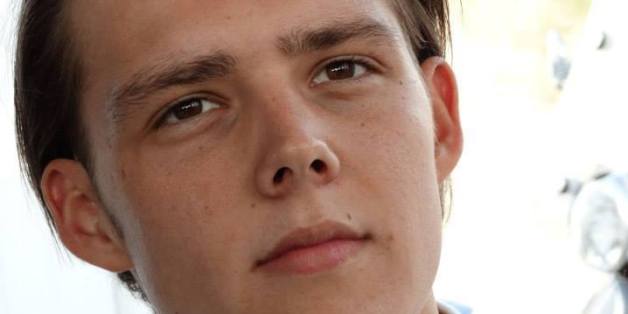
Quinn Schansman – (Photo from Facebook)
Kerry wrote, “The assessment I provided to the media three days following the shoot down remains unchanged, and is corroborated by the findings of the Dutch Safety Board [DSB]. Flight 17 was shot down by a BUK surface-to-air missile fired from separatist-controlled territory in eastern Ukraine.”
But Kerry’s assertion is not entirely correct. Despite Kerry’s claim on July 20, 2014 – three days after the shoot-down – to know the location of the missile launch, the Dutch Safety Board reported last October that it could only place the likely launch site within a 320-square-kilometer area that included territory under both government and rebel control. (The safety board did not seek to identify which side fired the fateful missile).
Why the U.S. government has dragged its heels about supplying the evidence that Kerry claimed to possess just days after the tragedy has become a secondary mystery to the allegations and counter-allegations about whodunit. That Kerry would not even elaborate on that information in response to the father of the lone American victim is even more striking.
In an email to me with Kerry’s letter attached, Thomas Schansman wrote, “the message is clear: no answer on my request to hand over satellite and/or radar data to DSB or public.”
Plus, Kerry’s credibility has come under a darkening cloud because of recent disclosures undermining his repeated claims on Aug. 30, 2013, that “we know” that Syrian government forces were responsible for the Aug. 21, 2013 sarin gas attack outside Damascus. Despite Kerry’s assertions of certainty in that case, he presented no verifiable evidence and it has since been confirmed that the U.S. intelligence community lacked “slam dunk” proof.
Nearly a year after his “we know” performance regarding the Syria-sarin case, Kerry staged a reprise expressing similar certainty about the MH-17 case – again dumping the blame on the target of an intensive U.S. propaganda campaign, this time Russia, which was backing the rebels in eastern Ukraine. Kerry again failed to supply supporting evidence.
Cracks in the Story
Also, some of Kerry’s MH-17 assertions have shown cracks as more information has become available. For instance, despite Kerry’s putting the blame on the ethnic Russian rebels and their supporters in Moscow, Western intelligence now says the only functioning Buk anti-aircraft missiles in the area were under the control of the Ukrainian military.
According to Dutch intelligence – and implicitly corroborated by U.S. intelligence – Ukraine’s Buk batteries were the only anti-aircraft missiles in the area capable of hitting a commercial airliner flying at 33,000 feet. That information was contained in a little-noticed Dutch intelligence report last October citing information from the Netherlands’ Military Intelligence and Security Service (MIVD).
MIVD made its assessment in the context of explaining why commercial aircraft continued to fly over the eastern Ukrainian battle zone in summer 2014. MIVD said that based on “state secret” information, it was known that Ukraine possessed some older but “powerful anti-aircraft systems” and “a number of these systems were located in the eastern part of the country.”
MIVD added that the rebels lacked that capacity, having only short-range anti-aircraft missiles and a few inoperable Buk missiles that had been captured from a Ukrainian military base. “During the course of July, several reliable sources indicated that the systems that were at the military base were not operational,” MIVD said. “Therefore, they could not be used by the Separatists.”
U.S. intelligence, which had eastern Ukraine under intensive overhead surveillance in summer 2014, implicitly corroborated MIVD’s conclusion in a U.S. “Government Assessment” released by the Director of National Intelligence on July 22, 2014. It listed weapons systems that Russia had provided the rebels but made no mention of a Buk missile battery.
In other words, based on satellite imagery and other intelligence reviewed both before and after the shoot-down, U.S. and other Western intelligence services could find no proof that Russia had ever given a Buk system to the rebels or introduced one into the area. If Russia had provided a Buk battery – four 16-foot-long missiles hauled around by trucks – it would have been hard to miss.
There was also logic to support the notion that a Ukrainian team may have been responsible for the MH-17 shoot-down. At the time, the Ukrainian military was mounting an offensive against the rebels, who had resisted a U.S.-backed coup on Feb. 22, 2014, which ousted elected President Viktor Yanukovych, who had strong support among Ukraine’s ethnic Russian minority in the east.
As the Ukrainian offensive claimed territory that the rebels had held, the Ukrainian military moved several Buk anti-aircraft missile batteries toward the front, presumably out of concern that Russia might directly intervene to save the rebels from annihilation. Plus, on July 16, 2014, a Ukrainian warplane was shot down apparently by an air-to-air missile believed fired by a Russian jet, giving reason for the Ukrainian anti-aircraft batteries to be on edge the next day, looking for Russian aircraft possibly intruding into Ukraine’s airspace.
But this evidence – that the only operational Buk batteries were under control of the Ukrainian military – did not fit the U.S. propaganda needs of blaming Russia and the rebels. Any indication that the post-coup Ukrainian government was responsible would instead put the U.S.-backed Kiev regime in a negative light.
So, it makes sense in a “strategic communications” kind of way for Kerry and other U.S. officials to leave the conventional wisdom – blaming Russian President Vladimir Putin for the 298 deaths – in place for as long as possible. Kerry told Thomas Schansman that he and the other families of victims should expect a long wait before the perpetrators are brought to justice.
Expressing Condolences
In the letter to Thomas Schansman, Secretary Kerry wrote, “As a father myself, I can only begin to imagine the pain and loss you have endured with your son’s tragic passing. My heart goes out to you and your family.”
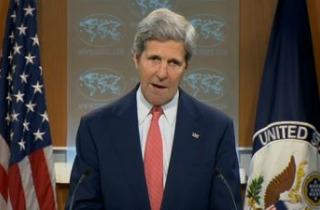
Kerry denounces RT as “propaganda bullhorn”
Kerry then added, “This investigative work is not easy, and bringing those responsible to justice will not be a quick process. However, Quinn, your family, and the families of all the others who died that day deserve such justice, and we will continue to do everything possible to achieve it.”
But the “everything” doesn’t apparently include releasing the data that Kerry claimed to have just days after the crash.
On July 20, 2014, Kerry appeared on NBC’s “Meet the Press” and declared, “we picked up the imagery of this launch. We know the trajectory. We know where it came from. We know the timing. And it was exactly at the time that this aircraft disappeared from the radar.”
In the letter asking Kerry to release that data, Thomas Schansman noted Kerry’s similar comments to a news conference on Aug. 12, 2014, when the Secretary of State said about the Buk anti-aircraft missile suspected of downing the plane: “We saw the take-off. We saw the trajectory. We saw the hit. We saw this aeroplane disappear from the radar screens. So there is really no mystery about where it came from and where these weapons have come from.”
Yet where the missile launch occurred has remained a point of mystery to the Dutch-led investigation. Last October, the Dutch Safety Board put the missile launch in a 320-square-kilometer area. Almaz-Antey, the Russian arms manufacturer of the Buk systems, conducted its own experiments to determine the likely firing location and placed it in a much smaller area near the village of Zaroshchenskoye, about 20 kilometers west of the DSB’s zone and in an area under Ukrainian government control.
Earlier this month, Fred Westerbeke, the head of the Dutch-led Joint Investigation Team, told the families of the victims that the inquiry had yet to pin down the missile launch site, saying “In the second half of the year we expect exact results.” In other words, on the second anniversary of the shoot-down, the investigators looking into the MH-17 shoot-down still might not know what Kerry claimed to know three days afterwards.
[For more on this topic, see Consortiumnews.com’s “Flight 17 Shoot-Down Scenario Shifts”; “The Danger of an MH-17 Cold Case”; and “The Ever-Curiouser MH-17 Case.”]
Investigative reporter Robert Parry broke many of the Iran-Contra stories for The Associated Press and Newsweek in the 1980s. You can buy his latest book, America’s Stolen Narrative, either in print here or as an e-book (from Amazon and barnesandnoble.com.
Soros Disruption: American-Style
By Wayne MADSEN – Strategic Culture Foundation – 20.03.2016
Eastern Europeans and Arabs are all-too-familiar with the political street hooliganism sponsored by global «provocateur» George Soros and his minions. Lately, middle-class Americans have had a taste of the type of violent protest provocations during the current US presidential campaign that have previously been visited upon governments from Macedonia and Moldova to Syria and Libya.
Recently, Donald Trump campaign rallies have seen highly-coordinated and well-planned political demonstrations in Chicago, Cleveland, St. Louis, Dayton, and other cities. The rallies were disrupted by highly-coordinated and well-planned protesters waving freshly-printed protest signs before awaiting television cameras. Such «rent-a-mob» actions are trademark signs of the involvement of George Soros and the «godfather» of political street violence, Gene Sharp, in disrupting the normal political process.
One of the favored methods proposed by Sharp and embraced by Soros-financed groups is the taunting of individuals. Sharp’s advice to taunt speakers is being played out in the US presidential campaign: «instead of predominantly silent and dignified behavior… people may mock and insult officials, either at a certain place or by following them for a period». Sharp suggests that taunting individuals, such as presidential candidates, be combined with a refusal to disperse when either asked or ordered to do so. Sharp claims that these methods are «non-violent». However, when the US Secret Service, charged with protecting presidential candidates from assassination or bodily harm, order protesters to leave a campaign venue and there is a subsequent refusal to do so, violence is a certainty.
Soros and Sharp honed their street revolution tactics on the streets of Belgrade in the Bulldozer Revolution that overthrew Serbian president Slobodan Milosevic on October 5, 2000. Two Soros-financed and Sharp-inspired groups, OPTOR! and the Center for Applied Nonviolent Action and Strategies (CANVAS), as well as their leader Srdja Popovic, a so-called «pro-democracy» agitator, have all been unmasked as US intelligence assets. Popovic has received funding from the CIA-linked US Institute of Peace, a creation of neo-conservatives to advance the type of undemocratic political street disruptions first seen in Serbia and that soon expanded to Ukraine, Georgia, Egypt, Venezuela, Russia, Macedonia, and other countries. Today, Soros-inspired political violence has targeted Trump rallies across the United States.
Popovic first began to infiltrate American politics by ostensibly supporting the Occupy Wall Street movement. As his ties to the CIA and Goldman Sachs later showed, his intent and that of his financiers were to derail the anti-capitalist popular movement.
Several veteran «agents provocateurs» of the Occupy Wall Street movement who are now part of the Bernie Sanders presidential campaign have been enlisted by groups like Unbound Philanthropy, an immigrant rights group, to disrupt Trump rallies. Together with the Soros-financed group Black Lives Matter, these professional street hooligans have carefully, and in compliance with the Sharp model, staged their demonstrations to achieve maximum media coverage while achieving the maximum level of disruption to the primary election process.
Unbound Philanthropy is funded by Obama’s deep-pocketed friend and frequent vacation host in Hawaii, William Reeves, a former JP Morgan executive who now heads up BlueCrest Capital. In some cases, the political protesters masquerade as Trump supporters by wearing pro-Trump shirts and hats in order to gain access to Trump campaign venues. This methodology of disruption employs another Sharp tactic, that of using false identities. Coupled with the tactic of «non-violent harassment» of individuals, the use of employing false identities to gain admittance to Trump rallies, followed by coordinated protests in the form of placard-waving «stand-ins», are textbook examples of Sharp tactics being employed with the financial support of Soros and his gang, which includes Reeves and pro-immigration Hispanic groups and Black Lives Matter. Many of the anti-Trump street actions are coordinated by MoveOn.org, another group financed principally by Soros and the Hyatt Hotels’ Pritzker family of Chicago. One member of the Pritzker family, Penny Pritzker, serves as the Secretary of Commerce in the Obama administration.
MoveOn.org, which has endorsed Sanders, is actually using its protests at Trump rallies as a fundraising gimmick. It promises to disrupt future Trump campaign rallies and it will use every weapon in the Sharp/Soros handbook.
Another Sharp/Soros tactic employed against Trump is the «speak-in». During a Trump campaign appearance in Dayton, a pro-Bernie Sanders protester jumped a barrier and rushed the stage in an attempt to grab the microphone from Trump. The Secret Service tackled the protester who was arrested by police. The protester previously took part in a 2015 protest at Wright State University in Dayton where he dragged a US flag on the ground. Destruction of property, including US flags, is another hallmark disruption tactic proposed by Sharp.
The Sharp definition of a «speak-in» is a «special form of nonviolent intervention… when actionists interrupt a meeting… or other gathering for the purpose of expressing viewpoints on issues which may or may not be related directly to the occasion». Soros classifies the action as «social intervention», with «psychological and physical aspects». Regardless of Sharp’s definition of such actions as «nonviolent», the Secret Service does not take lightly anyone lunging at a presidential candidate, especially after the assassination of candidate Robert F. Kennedy in Los Angeles in 1968 and the shooting and attempted assassination of candidate George Wallace in 1972. Soros’s operatives are dangerously playing with fire by bringing such violence-tinged street protest tactics to the American presidential political scene.
The stench of Popovic and Soros in the street operations against Trump, who has railed against Wall Street’s «free trade agreements» and neo-conservative «wars of choice», can be seen in the links between the street protest groups and corporate giants like Goldman Sachs.
Popovic and his CANVAS non-governmental organization (NGO) has received funding from a former Goldman Sachs executive named Muneer Satter.
Satter happened to work at Goldman Sachs with fellow corporate executive Heidi Cruz, the wife of Trump’s opponent for the Republican presidential nomination, Senator Ted Cruz of Texas. Although Satter retired from Goldman Sachs in 2012 he continues to serve as vice chairman of the Goldman Sachs Foundation. In 2012, the year that Satter retired from Goldman Sachs, the firm loaned more than $1 million to Cruz’s Texas US Senate campaign.
Satter also happens to be close to both President Barack Obama and anti-Trump GOP operative Karl Rove. Satter has donated to both Obama and Rove’s Crossroads political action committee. Satter was also the national finance co-chair of Mitt Romney’s 2008 and 2012 presidential campaigns.
This year, Satter joined the Senator Marco Rubio campaign as Illinois Finance Committee co-chairman. Such background players, Heidi Cruz and her Goldman Sachs friend Satter, as well as Rove, Romney, Reeves, Soros, the Pritzkers, and Popovic – a Central Intelligence Agency-linked foreign interloper in the United States political system – are the actual movers and shakers behind America’s presidential election. Their jobs and those of other deep-pocketed political financiers like Paul Singer, Haim Saban, Sheldon Adelson, Michael Bloomberg, Sam Zell, and Norman Braman, are to ensure that no «unfiltered outsiders» ever become the President of the United States. These and other wealthy backroom political maestros owe their undemocratic but massive political influence to insider politicians residing at 1600 Pennsylvania Avenue in Washington. They will do everything in their power to prevent an «unfiltered» candidate from becoming the next American president.
Australia Still Reluctant to Disclose MH17 Information
By James ONeill – New Eastern Outlook – 19.03.2016
When Malaysian Airlines Flight MH17 was shot down over Eastern Ukraine on 17 July 2014, Australian politicians and the mainstream media, especially the Murdoch newspapers, were quick to apportion blame. Responsibility for the disaster was immediately attributed to Russia, either directly or thorough Russian support for the so-called “separatists” in the Donbass region.
For the Australian politicians and media it was a case of “guilty as alleged” although at that time in the immediate aftermath of the disaster there was no evidence upon which to form any conclusions.
Three days after the crash the United States Secretary of State, John Kerry, appearing on NBC’s Meet the Press TV program said that the US had
“picked up the imagery of this launch. We know the trajectory. We know where it came from. We know the timing. And it was exactly at the time that this aircraft disappeared from the radar.”
Mr Kerry did not specify how the US had this information, but it was a reasonable inference at that time that the data had come from US satellites.
Since Mr Kerry’s remarks it has been established by independent investigators that the US had at least three satellites in geo-stationary orbit over Eastern Ukraine on 17 July 2014 Two of these satellites are of the SBIRS type (GEO-1 and GEO-2), and a Space Tracking and Surveillance System (STSS) satellite. Between them they are able to perform continuous surveillance of the area of interest.
Some commentators have endeavoured to downplay the significance of this by suggesting that factors such as cloud cover impeded surveillance capability. This is self-evidently nonsense. As one of their prime functions is to detect missile launches, their defensive capability would be hopelessly compromised if something as simple as cloud cover impeded their capacity to provide a timely warning of missile launches.
The capability of these satellites certainly includes the ability to detect and track the launch of a BUK missile, the weapon most commonly described as the cause of the disintegration of MH17. They can similarly track an air-to-air missile, which is the alternative hypothesis that has been advanced.
There has been a great deal of contradictory information from official sources about this satellite data, which is itself suspicious. For example, on 19 December 2015 the Dutch chief prosecutor and coordinator of the criminal investigation into the disaster, Mr Fred Westerbeke, told the Dutch daily newspaper NRC :
“Satellite images showing how on July 17 Flight MH17 was shot out of the sky by a rocket do not exist. There has been a misunderstanding about this… There is no conclusive evidence from intelligence services with the answers to all the questions.”
If Mr Westerbeke was correct, then it clearly contradicts the claims made by Mr Kerry 17 months earlier. But Mr Westerbeke then contradicted his own earlier statements in a letter to the families of the Dutch victims in February 2016. In that letter Mr Westerbeke stated:
“The US authorities have data generated by their own security forces, which could potentially provide information on a rocket trajectory. These data have been confidentially shared with the Dutch Military Intelligence and Security Service (DISS). The DISS and the Public Prosecutor are now investigating in what form the US state secret information can be used in the criminal investigation and what will be provided in a so-called official report to the Public Prosecution. That special report can be used as evidence by the Joint Investigation Team (JIT).”
It seems a reasonable inference on the basis of that statement that the secret US satellite data does disclose the required information. Specifically, it answers the major question: who fired the missile and from where?
The issue that is publically troubling the JIT is how to use sensitive intelligence data in a public forum such as a trial of accused persons. The undisclosed problem for the JIT is twofold. If, as is widely suspected, the satellite data show that the BUK missile was fired by Ukrainian forces, then that will contradict 20 months of relentless anti-Russian propaganda. The western media are not good at admitting the error of their ways.
The second problem is the agreement of 8 August 2014 whereby the members of the JIT agreed not to disclose any information unless all the parties agreed. As one of those parties, Ukraine, is a prime suspect, it is unlikely that the evidence will ever be revealed if it in fact implicates Ukraine.
It is still the case that the Australian government has never acknowledged the existence of the 8 August 2014 agreement. It has not bothered to tell the Australian public why it entered into such an agreement when the public interest would demand a transparent and full investigation of the worst disaster to be inflicted on Australians since the Bali bombings of 2002.
Given the existence of Mr Westerbeke’s letter to the families of Dutch victims it is difficult to understand why the Australian media are persisting with the claim that the Americans have refused to release the data. Paul Malone’s claim to that effect in the Canberra Times of 12 March 2016 is plainly wrong. It is possible of course that Mr Malone is aware of the facts, but the two problems identified above prevent him disclosing those facts.
Apart from detecting the launch of a missile, the satellite data can pinpoint the precise point from which the missile was fired. In the present case that is supremely important.
The Report of the Dutch Safety Board (DSB) into the MH17 disaster, published in October 2015 only went as far as to narrow the location of the launch site to an area of 320 square kilometers. This was territory contested by both Ukrainian and separatists forces. Despite the uncertainty and non-attribution of culpability in the DSB Report, Australian politicians falsely claimed that the report “proved” that Russian backed separatists were responsible.
Apart from a complete failure by the Australian media to correct this false information, they have also failed to address two further pieces of relevant evidence found in the DSB Report.
The first piece of evidence is found in the technical appendices of the DSB Report. Appendix T (from the Dutch Intelligence Services) has clearly not been read by any member of the Australian mainstream media. This appendix stated, inter alia:
- Although the separatists had captured a Ukrainian military base at Donetsk, the BUK systems located there were “not operational” and therefore “could not be used by the separatists.”
- Although there was information pointing to the fact that the separatists had been supplied with heavy weapons by the Russian Federation, there were no indications that these were powerful anti-aircraft systems.
- Although the separatists were trained to use weapons systems, there are no indications that they were being trained to use powerful anti-aircraft systems.
- There was no evidence of any intention by the separatists to shoot down a civil aircraft.
Reports in the mainstream media imply that the firing of a BUK missile is a matter of pointing it at the sky and pushing the proverbial button. As Appendix T makes clear however, extensive training in their use is required.
Not only must the crews be trained to a high level of proficiency, for which Appendix T notes there is no evidence in respect of the separatists, the firing of a BUK missile also requires the ancillary use of radar systems. Again, there is no evidence that the separatists had such radar equipment.
There was evidence however, that radar equipment of the Ukrainian armed forces was operational at the relevant time and in the relevant location. The Russian authorities at a press briefing given on 21 July 2014 disclosed this. Again, the Australian media ignored this evidence.
Contrary to the vague generality of the DSB Report as to the launch location, we have a report by the Russian manufacturer of the BUK missile, Almaz-Antey, released at the same time as the DSB Report.
Almaz-Antey produced a detailed analysis of the data. Their conclusion was that the BUK missile was launched from the Zaroschenskoe area, which was under the control of the Ukrainian armed forces at the time. This report has never been mentioned in the Australian mainstream media, probably because its conclusions do not fit the official narrative.
Thus, Mr Malone in the Canberra Times states that the JIT investigation is “widely expected” to “confirm that the missile was launched from separatist held territory.” It would only be “widely expected” by those reliant upon the constant stream of disinformation and concealment of evidence common to the mainstream media’s coverage of the MH17 disaster.
It was noted above that there was an alternative hypothesis about the cause of MH17’s crash, namely an air-to-air missile, presumably fired by one of the Ukrainian fighter aircraft identified in the area in the Russian briefing of 21 July 2014.
The Russian forensic expert Albert Naryshkin comprehensively advanced the air-to-air missile theory in July 2015. His report (available only in Russian) concluded that although the specific weapon could not be unequivocally identified, the specific nature of the missile damage to the aircraft meant that the most likely weapon was a Python air-to-air missile.
This particular weapon was adapted for use by the SU-25 Scorpion fighter that was the type of fighter observed by Russian radar data on 17 July 2014 and reported on at the 21 July 2014 briefing.
The merits or otherwise of this hypothesis are beyond the scope of this article. Suffice to say that it was not considered by the DSB and any mention of it is conspicuously absent from the Australian media.
Three further recent developments are worth noting. The first of these was the Coronial Inquest held in Melbourne in November 2015 in respect of the Australian victims. The inquest has been reported by John Helmer on his website. Suffice to note here that the coronial inquiry was deeply flawed. It was marked by secrecy, the suppression of evidence, conflicts of interest, and a manifest desire to simply parrot the official line regardless of other evidence that is progressively emerging.
It accepted without question the conclusions of the DSB Report, even though that Report is incomplete, does not ascribe culpability as it awaits the JIT investigation, and for the reasons mentioned below, is far from flawless.
The second development worth noting is that both the Dutch and the Russians have released letters addressed to the families of the victims.
The Russian statement is by the Deputy Head of the Federal Air Transport Agency of the Russian Federation, Oleg Storchevoy. Mr Storchevoy takes the opportunity to address some of the misinformation about what Russia has and has not done to assist the official inquiry.
He notes, for example, that Russian primary radar data was provided to the DSB, together with telephone conversations and other data, in August 2014. Russian primary radar data was in fact the only such data available, as the Ukrainians had for some reason switched off their radar at the critical time.
The Russian data supplied to the DSB confirmed increased activity by Ukrainian BUK missile systems within the conflict zone ahead of the tragedy. That evidence was ignored by the DSB.
It might be interpolated here that the separatists have no air force, so the need for anti-aircraft systems to be active remains obscure. No explanation has been forthcoming from the Ukrainians.
Mr Storchevoy also drew attention to the unprecedented cooperation offered by Almaz-Antey, the BUK manufacturer which again was ignored by the DSB.
Mr Storchevoy noted that Russia has repeatedly pointed out that the Dutch technical investigation was performed in an extremely non-transparent and biased manner. He said that the Dutch authorities should also explain how they distorted facts and concealed data, and ignored important data supplied by the Russians.
These and other questions posed by Mr Storchevoy are legitimate and deserve careful consideration and response. Perhaps needless to add, no report of Mr Storchevoy’s statement has appeared in the Australian mainstream media.
The second letter was written to the families of the Dutch victims by the head of the JIT inquiry, Mr Fred Westerbeke.
Mr Westerbeke’s letter discussed, inter alia, that conclusions about the technical analysis of the aircraft debris should be available in the latter half of 2016. Importantly, as noted above, he confirmed that the Americans had provided data about the missile trajectory although the form in which that data can be used is unsettled.
Mr Westerbeke also said that the analysis of other data, including intercepted telephone calls, location data from telephones, images (unspecified), witness statements and technical calculations would enable “certain inferences” to be drawn about the rocket’s track.
Reference was also made to the English blogger Eliot Higgins who operates under the name of “Bellingcat.” Despite repeated critical analysis of Higgins’ falsification of data and manifest other errors, he continues to be reported in the western mainstream media as a reliable source.
Why western intelligence agencies, with their vast resources, would defer to one man operating out of his house in Leicester is explicable only if Higgins is seen as a useful conduit for what is invariably anti-Russian propaganda.
Westerbeke obliquely dismisses Bellingcat as a resource, as “providing no evidence of direct involvement of members of a Russian unit” in the shoot down on MH17. The claim of Russian direct involvement is one of the more sensational of Bellingcat’s claims faithfully and uncritically reported in the western media.
In the light of the Westerbeke letter, the Australian Federal Police were asked whether they agreed with the contents of the Westerbeke letter. Westerbeke had signed the letter on behalf of the members of the JIT (which includes Australia).
They were also asked whether a similar letter would be sent to the Australian families. The AFP’s response was a non-answer, saying only that the queries had been forwarded to the JIT!
Information has also been sought from the Prime Minister’s on what compensation the Australian victim families might expect. Under the relevant Australian legislation victims of terrorism are eligible for compensation up to $75,000. That possibility was raised by a number of mainstream media outlets in Australia in July 2014. In order to be eligible the Prime Minister must declare that the deaths of the Australian citizens were as a result of a terrorist attack.
The government had announced on 9 October 2013 that payments would be made to the victim’s families of other terrorist attacks pursuant to the prime ministerial declaration. The payments have been applied retrospectively, starting with the events of 11 September 2001. To date there have been 10 such declarations, the latest being the Paris attacks of 13 November 2015.
The Australian government has not declared the shooting down of MH17 to be a terrorist act for the purposes of the legislation. The reasons for this are unknown, although comment has been sought from the Prime Minister’s office.
Australian victim families still have other remedies available under the provisions of the Montreal Convention of 1999. Under Article 21 of that Convention damages of (approximately) $215,000 are set.
Potential liability of the carrier, in this case Malaysian Airlines, is however unlimited unless it can prove that the death “was not due to the negligence or other wrongful act or omission of the carrier or its servants or agents.”
Given that the evidence appears to suggest that MH17 either flew over a war zone of its own volition or was directed to do so by Ukrainian air traffic control, discharging that onus may prove difficult.
Proceedings seeking various declarations have been launched in the New South Wales Supreme Court by Tim Lauschet (2015/210056) against Malaysian Airlines, but that case is still at a preliminary stage.
The only clear point to emerge in Australia in the 21 months since the disaster is that the government and the mainstream media are determined to, on the one hand deny the public vital information about the disaster, and on the other hand maintain the fiction that the disaster was the fault of Russian backed separatists.
That line serves to justify the sanctions imposed on Russia and the continuing demonization of President Putin. If only Prime Minister Turnbull’s plea for an intelligent and adult dialogue was sincere. If that were the case the Australian public would be better informed than they are. It seems a very vain hope.
James O’Neill is an Australian-based Barrister at Law.
Britain to Sign Deal Providing Ukraine With Military Training, Intelligence
Sputnik – 18.03.2016
London will sign a new 15-year-long defense deal with Kiev, pledging to provide Ukraine with military training and intelligence to allegedly protect it from Russia, media reported Thursday.
Under the agreement, UK troops will take part in more joint drills and train larger numbers of Ukrainian troops, according to the paper. The countries will also share intelligence and expertise, it was reported in the article.
“The UK will stand firm with Ukraine as they defend their territorial integrity. This new defence agreement sets out that commitment as we enhance our training of Ukrainian armed forces,” UK Defence Secretary Michael Fallon said, as quoted by The Telegraph newspaper.
UK troops have previously carried out drills in Ukraine, however, Ukrainian President Petro Poroshenko has repeatedly called for more military aid from the Western states, including the United Kingdom.
The Ever-Curiouser MH-17 Case
By Robert Parry | Consortium News | March 16, 2016
The curious mystery surrounding the shoot-down of Malaysia Airlines Flight 17 over eastern Ukraine on July 17, 2014, gets more curious and more curious as the U.S. government and Dutch investigators balk at giving straightforward answers to the simplest of questions even when asked by the families of the victims.
Adding to the mystery Dutch investigators have indicated that the Dutch Safety Board did not request radar information from the United States, even though Secretary of State John Kerry indicated just three days after the crash that the U.S. government possessed data that pinpointed the location of the suspected missile launch that allegedly downed the airliner, killing all 298 people onboard.
Although Kerry claimed that the U.S. government knew the location almost immediately, Dutch investigators now say they hope to identify the spot sometime “in the second half of the year,” meaning that something as basic as the missile-launch site might remain unknown to the public more than two years after the tragedy.
The families of the Dutch victims, including the father of a Dutch-American citizen, have been pressing for an explanation about the slow pace of the investigation and the apparent failure to obtain relevant data from the U.S. and other governments.
I spent time with the family members in early February at the Dutch parliament in The Hague as opposition parliamentarians, led by Christian Democrat Pieter Omtzigt, unsuccessfully sought answers from the government about the absence of radar data and other basic facts.
When answers have been provided to the families and the public, they are often hard to understand, as if to obfuscate what information the investigation possesses or doesn’t possess. For instance, when I asked the U.S. State Department whether the U.S. government had supplied the Dutch with radar data and satellite images, I received the following response, attributable to “a State Department spokesperson”: “While I won’t go into the details of our law enforcement cooperation in the investigation, I would note that Dutch officials said March 8 that all information asked of the United States has been shared.”
I wrote back thanking the spokesperson for the response, but adding: “I must say it seems unnecessarily fuzzy. Why can’t you just say that the U.S. government has provided the radar data cited by Secretary Kerry immediately after the tragedy? Or the U.S. government has provided satellite imagery before and after the shootdown? Why the indirect and imprecise phrasing? …
“I’ve spent time with the Dutch families of the victims, including the father of a U.S.-Dutch citizen, and I can tell you that they are quite disturbed by what they regard as double-talk and stalling. I would like to tell them that my government has provided all relevant data in a cooperative and timely fashion. But all I get is this indirect and imprecise word-smithing.”
The State Department spokesperson wrote back, “I understand your questions, and also the importance of the view of these families so devastated by this tragedy. However, I am going to have to leave our comments as below.”
Propaganda Value
This lack of transparency, of course, has a propaganda value since it leaves in place the widespread public impression that ethnic Russian rebels and Russian President Vladimir Putin were responsible for the 298 deaths, a rush to judgment that Secretary Kerry and other senior U.S. officials (and the Western news media) encouraged in July 2014.
Once that impression took hold there has been little interest in Official Washington to clarify the mystery especially as evidence has emerged implicating elements of the Ukrainian military. For instance, Dutch intelligence has reported (and U.S. intelligence has implicitly confirmed) that the only operational Buk anti-aircraft missile systems in eastern Ukraine on July 17, 2014, were under the control of the Ukrainian military.
In a Dutch report released last October, the Netherlands’ Military Intelligence and Security Service (MIVD) reported that the only anti-aircraft weapons in eastern Ukraine capable of bringing down MH-17 at 33,000 feet belonged to the Ukrainian government.
MIVD made that assessment in the context of explaining why commercial aircraft continued to fly over the eastern Ukrainian battle zone in summer 2014. MIVD said that based on “state secret” information, it was known that Ukraine possessed some older but “powerful anti-aircraft systems” and “a number of these systems were located in the eastern part of the country.”
The intelligence agency added that the rebels lacked that capability: “Prior to the crash, the MIVD knew that, in addition to light aircraft artillery, the Separatists also possessed short-range portable air defence systems (man-portable air-defence systems; MANPADS) and that they possibly possessed short-range vehicle-borne air-defence systems. Both types of systems are considered surface-to-air missiles (SAMs). Due to their limited range they do not constitute a danger to civil aviation at cruising altitude.”
One could infer a similar finding by reading a U.S. “Government Assessment” released by the Director of National Intelligence on July 22, 2014, five days after the crash, seeking to cast suspicion on the ethnic Russian rebels and Putin by noting military equipment that Moscow had provided the rebels. But most tellingly the list did not include Buk anti-aircraft missiles. In other words, in the context of trying to blame the rebels and Putin, U.S. intelligence could not put an operational Buk system in the rebels’ hands.
So, perhaps the most logical suspicion would be that the Ukrainian military, then engaged in an offensive in the east and fearing a possible Russian invasion, moved its Buk missile systems up to the front and an undisciplined crew fired a missile at a suspected Russian aircraft, bringing down MH-17 by accident.
That was essentially what I was told by a source who had been briefed by U.S. intelligence analysts in July and August 2014. [See, for instance, Consortiumnews.com’s “Flight 17 Shoot-Down Scenario Shifts” and “The Danger of an MH-17 Cold Case.”]
But Ukraine is a principal participant in the Dutch-led Joint Investigative Team (JIT), which has been probing the MH-17 case, and thus the investigation suffers from a possible conflict of interest since Ukraine would prefer that the world’s public perception of the MH-17 case continue to blame Putin. Under the JIT’s terms, any of the five key participants (The Netherlands, Ukraine, Australia, Belgium and Malaysia) can block release of information.
The interest in keeping Putin on the propaganda defensive is shared by the Obama administration which used the furor over the MH-17 deaths to spur the European Union into imposing economic sanctions on Russia.
In contrast, clearing the Russians and blaming the Ukrainians would destroy a carefully constructed propaganda narrative which has stuck black hats on Putin and the ethnic Russian rebels and white hats on the U.S.-backed government of Ukraine, which seized power after a putsch that overthrew elected pro-Russian President Viktor Yanukovych on Feb. 22, 2014.
Accusations against Russia have also been fanned by propaganda outlets, such as the British-based Bellingcat site, which has collaborated with Western mainstream media to continue pointing the finger of blame at Moscow and Putin – as the Dutch investigators drag their heels and refuse to divulge any information that would clarify the case.
Letter to the Families
Perhaps the most detailed – although still hazy – status report on the investigation came in a recent letter from JIT chief prosecutor Fred Westerbeke to the Dutch family members. The letter acknowledged that the investigators lacked “primary raw radar images” which could have revealed a missile or a military aircraft in the vicinity of MH-17.
Ukrainian authorities said all their primary radar facilities were shut down for maintenance and only secondary radar, which would show commercial aircraft, was available. Russian officials have said their radar data suggest that a Ukrainian warplane might have fired on MH-17 with an air-to-air missile, a possibility that is difficult to rule out without examining primary radar which has so far not been available. Primary radar data also might have picked up a ground-fired missile, Westerbeke wrote.
“Raw primary radar data could provide information on the rocket trajectory,” Westerbeke’s letter said. “The JIT does not have that information yet. JIT has questioned a member of the Ukrainian air traffic control and a Ukrainian radar specialist. They explained why no primary radar images were saved in Ukraine.” Westerbeke said investigators are also asking Russia about its data.
Westerbeke added that the JIT had “no video or film of the launch or the trajectory of the rocket.” Nor, he said, do the investigators have satellite photos of the rocket launch.
“The clouds on the part of the day of the downing of MH17 prevented usable pictures of the launch site from being available,” he wrote. “There are pictures from just before and just after July 17th and they are an asset in the investigation.” According to intelligence sources, the satellite photos show several Ukrainian military Buk missile systems in the area.
Why the investigation’s data is so uncertain has become a secondary mystery in the MH-17 whodunit. During an appearance on NBC’s “Meet the Press” on July 20, 2014, three days after the crash, Secretary Kerry declared, “we picked up the imagery of this launch. We know the trajectory. We know where it came from. We know the timing. And it was exactly at the time that this aircraft disappeared from the radar.”
But this U.S. data has never been made public. In the letter, Westerbeke wrote, “The American authorities have data, that come from their own secret services, which could provide information on the trajectory of the rocket. This information was shared in secret with the [Dutch] MIVD.” Westerbeke added that the information may be made available as proof in a criminal case as an “amtsbericht” or “official statement.”
Yet, despite the U.S. data, Westerbeke said the location of the launch site remains uncertain. Last October, the Dutch Safety Board placed the likely firing location within a 320-square-kilometer area that covered territory both under government and rebel control. (The safety board did not seek to identify which side fired the fateful missile.)
By contrast, Almaz-Antey, the Russian arms manufacturer of the Buk systems, conducted its own experiments to determine the likely firing location and placed it in a much smaller area near the village of Zaroshchenskoye, about 20 kilometers west of the Dutch Safety Board’s zone and in an area under Ukrainian government control.
Westerbeke wrote, “Raw primary radar data and the American secret information are only two sources of information for the determination of the launch site. There is more. JIT collects evidence on the basis of telephone taps, locations of telephones, pictures, witness statements and technical calculations of the trajectory of the rocket. The calculations are made by the national air and space laboratory on the basis of the location of MH17, the damage pattern on the wreckage and the special characteristics of the rockets. JIT does extra research on top of the [Dutch Safety Board] research. On the basis of these sources, JIT gets ever more clarity on the exact launch site. In the second half of the year we expect exact results.”
Quinn Schansman, a dual U.S.-Dutch citizen killed aboard Malaysia Airlines Flight 17 on July 17, 2014. (Photo from Facebook)
Meanwhile, the U.S. government continues to stonewall a request from Thomas J. Schansman, the father of Quinn Schansman, the only American citizen to die aboard MH-17, to Secretary Kerry to release the U.S. data that Kerry has publicly cited.
Quinn Schansman, who had dual U.S.-Dutch citizenship, boarded MH-17 along with 297 other people for a flight from Amsterdam to Kuala Lumpur on July 17, 2014. The 19-year-old was planning to join his family for a vacation in Malaysia.
In a letter to Kerry dated Jan. 5, 2016, Thomas J. Schansman noted Kerry’s remarks at a press conference on Aug. 12, 2014, when the Secretary of State said about the Buk anti-aircraft missile suspected of downing the plane: “We saw the take-off. We saw the trajectory. We saw the hit. We saw this aeroplane disappear from the radar screens. So there is really no mystery about where it came from and where these weapons have come from.”
Although U.S. consular officials in the Netherlands indicated that Kerry would respond personally to the request, Schansman told me this week that he had not yet received a reply from Kerry.
Investigative reporter Robert Parry broke many of the Iran-Contra stories for The Associated Press and Newsweek in the 1980s. You can buy his latest book, America’s Stolen Narrative, either in print here or as an e-book (from Amazon and barnesandnoble.com
US State Dept Pledges to Retain Sanctions Until Russia Returns Crimea
Sputnik — 16.03.2016
 Washington will not lift the sanctions imposed after the reunification of Crimea with Russia until Moscow decides to “return Crimea to Ukraine,” the spokesman for the US State Department said.
Crimea, which has a predominately ethnically-Russian population, seceded from Ukraine to rejoin Russia two years ago following a referendum on March 16 in which over 96 percent of voters supported the move.
“We will not accept the redrawing of borders by force in the 21st century. Sanctions related to Crimea will remain in place as long as the occupation continues. We again call on Russia to end that occupation and return Crimea to Ukraine,” John Kirby said in a statement Wednesday.
He added that Washington remains committed to “a united, sovereign Ukraine.”
In 2014, the United States, the European Union and some of their allies imposed a series of economic sanctions targeting key Russian sectors as well as a number of individuals and entities over Russia’s reunification with Crimea and its alleged interference in the conflict between Kiev and independence supporters in eastern Ukraine, denied by Moscow.
Featured Video
Dan Dicks with James Corbett on Solutions Watch
or go to
Aletho News Archives – Video-Images
From the Archives
MMR (Measles, Mumps and Rubella) – Vaccine Risk Statement
MMR Vaccine (Measles, Mumps, and Rubella) Is It Safer Than Measles, Mumps and Rubella?
Physicians for Informed Consent | December 2024
… It has not been proven that the MMR vaccine is safer than measles, mumps, and rubella. The vaccine package insert raises questions about safety testing for cancer, genetic mutations, and impaired fertility. Although VAERS tracks some adverse events, it is too inaccurate to measure against the risk of measles, mumps, and rubella. Clinical trials do not have the ability to detect less common adverse reactions, and epidemiological studies are limited by the effects of chance and possible confounders. Safety studies of the MMR vaccine are particularly lacking in statistical power. A review of more than 60 MMR vaccine studies conducted for the Cochrane Library states, “The design and reporting of safety outcomes in MMR vaccine studies, both pre- and post-marketing, are largely inadequate.”19 Because permanent sequelae (aftereffects) from measles, mumps, and rubella are so rare (especially in children with normal levels of vitamin A and infected after birth),6,15-17 the level of accuracy of the research studies available is insufficient to rule out the possibility that the MMR vaccine causes greater death or permanent disability than measles, mumps, and rubella. – Read full article
Blog Roll
 Aletho News
- The fallacy of US delusions about Iran’s economic collapse
- Hezbollah denies Syria cell link, warns of Israeli plan to sow discord
- The legacy of US sanctions, war, and occupation in Iraq
- Iraqi resistance group rejects disarmament, vows to maintain support for Lebanon
- Sheikh al-Asadi warns of Iraqi government compliance with US demands
- How to MAKE THE CONSPIRATORS PAY for their crimes! Dan Dicks with James Corbett on Solutions Watch
- There’s a drought in academia: A drought in honest research on the subject of drought and other weather extremes
- Department of War Awards $20.7 Billion Contract to Raytheon for Air-to-Air Missiles
- ‘Distance yourselves from Israel’: IRGC urges US population to question govt policies
- America’s Greenland deal has a radioactive backstory
- If Americans Knew
- As settlers ravage West Bank, Israeli forces kill 10 in Gaza – Daily Update
- New Report: “Scholasticide and Genocide in Gaza: Assessment, Testimonies and Legal Analysis”
- Ex-Biden officials are desperate for a Gaza scapegoat
- Israeli “settlers” Invade Al-Aqsa; Pour Boiling Water on 75-Year-Old
- Israel Has Kidnapped Another American Teenager
- US arms sales to Israel worth $21.6 billion in 20 months
- Three Palestinians Killed in Israeli Attacks on Gaza
- Revealed: German “Anti-Semitism Expert” Driving Crackdown on Palestine Solidarity is Former Israeli Spy
- Egypt’s Warning to Israel Before Oct 7
- Israel’s siege signals another cruel winter for 1.8 million Gazans – Daily Update
- No Tricks Zone
- Two More Paleo Reconstructions Affirm Meters-Higher Sea Levels Across Ireland, Brazil 7000-6000 Years Ago
- New Study: Earth And Venus Surface Warmth Largely Explained By Convection And Lapse Rate, Not CO2 Or Radiation
- 2025 Nature Paper Claiming Worsening Global Drought Gets RETRACTED …Heavily Flawed
- New Study: ‘Global Drought Shows No Detectable Recent Acceleration Under Climate Warming’
- Economic Masterminds: German Socialists Suggest Taxing Productivity Gains Stemming From Using AI
- The South China Sea Has Not Been Cooperating With The Climate Change Narrative
- Energy Crisis: Germany Enters Heating Season With Historically Low Gas Reserve Fill Levels
- New Study: The Antarctic Ice Sheet Gained Mass From 2020-2024 Due To Staggering Snow And Ice Accumulation
- Study: Ocean Heating Rates From Thousands Of Years Ago ‘Dwarf’ Modern Ocean Heating Rates
- Climate Extremists Target, Attack Large-Scale Power Grid Infrastructure In Germany!

