Ukrainian Democracy: A Barrier to Washington’s Goals
What Do Ukrainians Really Want?
By Nick Alexandrov | CounterPunch | February 28, 2014
When Ukraine is the topic, the major U.S. media outlets agree: “Europe and the United States have made a priority of fostering democracy in the former Soviet republics,” David M. Herszenhorn wrote in the New York Times. The Washington Post asserted that Ukraine is “a country that has been struggling to become a genuine democracy” with help from Western powers, who keep it “from becoming an autocratic Kremlin colony, like neighboring Belarus.” “Ukraine is the crossroads between a free and an authoritarian Europe,” the Wall Street Journal concurred, while Yale professor Timothy Snyder urged, in a CNN piece, Europe and America to back the Ukrainian protesters—“a chance to support democracy,” he emphasized. Marvelous. But in the real world, Ukrainian democracy is not merely something Washington has failed to support, but is actually incompatible with U.S. governmental aims.
U.S. officials are quite open about their opposition to Ukrainian self-determination and well-aware how unpopular Washington’s preferred policies are. Nearly a decade ago, for example, the U.S. House of Representatives’ Subcommittee on Europe met for a hearing on “Ukraine’s Future and U.S. Interests.” Rep. Doug Bereuter (R-NE) opened the session, noting that “a recent survey conducted by a center for economic and political research suggests that up to 40 percent of Ukrainians believe that relations with Russia should be a priority.” Meanwhile, “28 percent gave preference to the EU,” and “2 percent said that relations with the U.S. should be a foreign policy priority. Another survey suggested that almost two-thirds of the population would consider supporting a political union with Russia,” Bereuter concluded. “So,” he went on, “I think that United States policy must remain focused” on incorporating Ukraine “into European and Euro-Atlantic structures.” Rep. Robert Wexler (D-FL) spoke next, reiterating that U.S. policy should “further Ukraine’s integration in Euro-Atlantic institutions;” Steven Pifer, the former Ambassador to Ukraine, drove the point home, outlining “the United States Government’s vision for Ukraine”: “increasingly close ties to Europe and Euro-Atlantic institutions.” This vision persisted over the following decade. The Atlantic Council’s Damon Wilson, speaking before the U.S. Senate’s Subcommittee on European Affairs—the topic was “Ukraine at a Crossroads”—in February 2012, explained that “Ukraine’s genuine European integration” remained a major objective.
And recent commentary and news coverage depicts European integration as something most Ukrainians desire. In early February, Secretary of State Kerry, at the Munich Security Conference, remarked that Ukrainians should be permitted “to associate with partners who will help them realize their aspirations”—Europe and the U.S. obviously being the partners, integration to be deepened via what the Times’ Herszenhorn referred to as “sweeping political and trade agreements” that Ukrainian President Viktor Yanukovych “refused to sign” last November, resulting in “a broken promise between a leader and his citizens,” and then the uprisings. Now Al Jazeera reports that the acting president, Oleksander Turchinov, has “made clear that Kiev’s European integration would be a priority,” thereby giving Ukrainians what we’re told they want.
But British and U.S. governmental studies reveal the Ukrainian public is ambivalent about European integration. Britain’s Foreign and Commonwealth Office, for example, funded a “scoping study” through the British Embassy in Kyiv a year ago, titled “A blueprint for enhancing understanding of and support for the EU-Ukraine Association Agreement [AA] including DCFTA [Deep and Comprehensive Free Trade Area] in Ukraine.” The AA was one of the key “sweeping political and trade agreements” Yanukovych refused to sign. British officials, in their report, stressed that “support for the AA is not overwhelming amongst the population at large,” observing that “opinion polls show that about 30% of respondents are in favour of European integration, 30% for the Customs Union [Moscow-led integration], and about 30% are undecided.” This bleak situation called for a propaganda offensive, or “a national public awareness ‘Campaign of Arguments,’” as the British dubbed it, which was to “be aimed at the general public as its primary target audience.” British advisers urged PR teams “to formulate advertising slogans, global and targeted messages,” and to play up “the European civilizational model” and other benefits the AA allegedly would bring. This “civilizational model” today entails “massive attacks on public services, wages, pensions, trade unions, and social rights” under imposed “draconian austerity policies,” Asbjørn Wahl wrote in January’s Monthly Review—a reality the British indoctrination scheme’s outline studiously avoided, it’s hardly worth mentioning.
The propaganda barrage may have been successful to some extent. But as the year progressed, the U.S. government had a hard time finding evidence of overwhelming Ukrainian support for European integration. The International Republican Institute (IRI), for example, polled Ukrainians last September: “If Ukraine was able to enter only one international economic union, with whom should it be?” Forty-two percent of respondents chose the EU, while 37% preferred the Russian Customs Union. IRI then asked, “How would you evaluate your attitude towards the following entities?” Fifty percent of respondents felt “warm” towards Russia; 41% felt “warm” towards Europe—and just 26% were fond of the U.S. IRI figures resembled those USAID published in a December 2013 report. Its authors found it “interesting to note that Ukrainians are split on whether the country should join the European Union or the Customs Union. Thirty-seven percent would like Ukraine to take steps to join the European Union, 33% prefer the Customs Union and 15% say Ukraine should join neither of these blocs.” Furthermore, “34% say that Ukraine should have closer economic relations with Russia, 35% say it should have closer economic relations with Europe and 17% say it should have good relations with both.” A Kyiv International Institute of Sociology poll reinforced these findings: “Ukraine is split practically 50/50 over the accession to the European Union or the Customs Union,” Interfax-Ukraine summarized the study’s conclusions.
Reviewing this data forces us to ask: Who is Washington’s chief enemy in Ukraine? Is it Russia, bent on killing Ukraine’s budding democracy? Is it the tyrant Yanukovych? The U.S. policy record points to a different conclusion, one a Johns Hopkins Center for Transatlantic Relations study—included in the official transcription of the Senate’s 2012 “Ukraine at a Crossroads” hearing—discusses in the context of Ukraine’s potential NATO membership. “The main obstacle” to Ukraine’s joining the organization “is not Russian opposition,” its authors emphasized, “but low public support for membership in Ukraine itself.” Again: on this and other issues, the Ukrainian people are “the main obstacle” to U.S. foreign policy aims. We should bear this fact in mind as the crisis deepens in Eastern Europe.
Nick Alexandrov lives in Washington, DC.

Russian senators vote to use stabilizing military forces on Ukrainian territory
RT | March 1, 2014
Russia’s Federation Council has unanimously approved President Vladimir Putin’s request to use Russian military forces in Ukraine. The move is aimed to settle the turmoil in the split country.
The upper house of the Russian parliament has voted in favor of sending troops to the Autonomous Republic of Crimea, which would ensure peace and order in the region “until the socio-political situation in the country is stabilized.”
The debate in the Federation Council has revealed that Russian MPs are united on the issue, with many of them sharing concerns on the recent events in Ukraine. The common notion was that since power was seized in Kiev, the situation has only been deteriorating with radical nationalists rapidly coming to power and threatening the lives of those opposing their actions, most notably the Russian citizens living in Ukraine.
The developments follow an appeal by the Prime Minister of the Autonomous Republic of Crimea, Sergey Aksyonov, who requested that Russia help cope with the crisis and ensure “peace and calm” in the region.
Crimeans began protesting after the new self-proclaimed government in Kiev introduced a law abolishing the use of other languages in official circumstances in Ukraine. More than half the Crimean population are Russian and use only this language in their everyday life. The residents have announced they are going to hold a referendum on March 30 to determine the fate of the Ukrainian autonomous region.
Putin on Saturday requested the Federation Council to use the Army for normalizing the socio-political situation in Ukraine in connection with the “extraordinary situation” there. The events in Ukraine indicate there is a “threat to the lives of citizens of the Russian Federation… and the personnel of the armed forces of the Russian Federation on Ukrainian territory,” the Russian president said.
According to Putin’s spokesman, Dmitry Peskov, the president has not yet made a decision on sending the troops to Ukraine.
Moreover, taking the decision to use the Armed Forces in Ukraine does not mean that it will be carried out immediately, Grigory Karasin, Putin’s official representative in the Federation Council, has said.
“The approval, which the president will receive, does not literally mean that this right will be used promptly,” Karasin said.
Russian citizens are among the victims of the turmoil gripping Ukraine, the speaker of the Federation Council, Valentina Matvienko, has said. In Crimea, there were Russian casualties during the storming of the local Interior Ministry building by gunmen overnight, she added.
“During the attempts to seize the building of the Interior Ministry in Crimea some were injured, there were victims also, the people are being threatened, and in this situation they are naturally voicing concerns for the security of their lives and families. This compelled the government of Crimea to ask Russia for help,” Matvienko said.
The speaker’s words coincided with the statement issued by Russian Federal Migration Service noting that some 143,000 Ukrainians have sought asylum in Russia. The number represents a sharp rise in such requests, the authority said.
The new Ukrainian authorities have been formed “under the dictate of Maidan” and “continue to use force in the forming of the decision-making structures,” Karasin said.
“We are particularly concerned with the situation in the Autonomous Republic of Crimea, where, in accordance with the international treaty, the Black Sea Fleet is stationed; where 1.5 million Russian people live,” Putin’s representative stressed.
The Crimean population “resents” the attempts to seize local administration buildings and the threats thrown at regional authorities, and demands stability, he said.
At the same time, Karasin said he believes the international community and those states that backed the February 21 agreement between the opposition and the legitimate Ukrainian government “have the power” to influence the self-proclaimed Kiev authorities to bring the situation back to “constitutional ways.”
The Russian Foreign Ministry also said that Moscow is expecting that the international community will influence the self-proclaimed Kiev regime to normalize the situation in the country.
People of Crimea express desire to join Russia: Report
Press TV – March 1, 2014
People in the port city of Sevastopol in the Autonomous Republic of Crimea have been voicing support for the notion of Crimea joining Russia, a report says.
“In Sevastopol, where Russia’s Black Sea fleet has a base, residents speak unabashedly of wanting Crimea to return to Russia,” reads a report by Reuters on February 28, referring to the fact that the now autonomous Crimea was once part of the former Soviet Union.
“Crowds rally daily in front of city hall, and voted with roars of approval this week for Russian citizen, Alexei Chaliy, as their de facto mayor, chanting: ‘A Russian mayor for a Russian town.’”
Crimea, an autonomous region within Ukraine, has been the focal point of concern ever since Ukrainian politics became chaotic. Ukraine has been experiencing unrest since November 2013, when now-ousted Ukrainian President Viktor Yanukovych refrained from signing an Association Agreement with the EU in favor of closer ties with Russia.
The Ukrainian parliament ousted Yanukovych and named Oleksandr Turchynov, the legislature’s speaker, as interim president on February 23.
When Russia confirmed on Friday that it had moved its troops already based in Ukraine’s Crimea region to protect its naval fleet, a move Moscow said was in compliance with Russian-Ukrainian agreements, it was met with warnings from Ukraine’s new authorities as well as Western officials, who warned against “provocations” on the Crimean peninsula, where the Autonomous Republic of Crimea is also located.
As the crisis was brewing in Ukraine, US and European officials repeatedly expressed support for the anti-government Ukrainian protesters. The protests took violent forms as an increasing number of the protesters resorted to violence in confronting Ukrainian security forces.
The Reuters report said that while the anti-government protesters who “brought down” the Yanukovych administration in Ukraine are “heroes in the capital (Kiev) and the West,” in Crimea, “they are compared to the nationalist militias sometimes accused of siding with Nazi troops against Soviet forces during World War Two.”
The report quoted a resident of Sevastopol as saying, “Crimea has historically never belonged to Ukraine. We want historical justice. This is an exclusively Russian city. It was and will remain so.”
Ukraine’s Interior Minister Arsen Avakov recently claimed that Russian troops, backed by armored personnel carriers, entered the Belbek airfield near Sevastopol. Russia’s Interfax news agency, however, quoted an unnamed source as saying that the country’s Black Sea Fleet forces did not seize the airfield or take any other action there.
Referring to the calls by the people of Crimea for the autonomous region to join Russia, the Reuters report said that, “Moscow has not responded directly to calls… but a number of Russian lawmakers have visited Crimea, and are given a hero’s welcome.”
Art of drills: 10 NATO war games that almost started armed conflicts
RT | February 28, 2014
The world’s largest military alliance seems annoyed about Russia’s “lack of transparency” over military drills at a very “delicate time.” NATO, however, has its own long history of war games all over the globe.
Western politicians have leveled criticism at Russia for planned drills on its own territory, seemingly glossing over the many joint military exercises Western powers, namely the US and NATO forces, have conducted on foreign soil over the years.
South Korea
This week, US and South Korean forces began their annual joint military drills, which will last until mid-April. The Foal Eagle exercise is conducted near Iksan and Damyan, South Korea.
The drills prompted a stern reaction from North Korea, which slammed the exercises as “a serious provocation” that could plunge the region into “a deadlock and unimaginable holocaust.”
Israel
The US joined Greece, Italy, and Israeli forces at Ovda air base in southern Israel for the ‘Blue Flag’ air-training drills in November 2013. The drills were called the “largest international aerial exercise in history,” by Israeli news outlet Haaretz.
According to Israel National News reports the exercises are geared towards “simulating realistic engagements in a variety of scenarios, based on Israel’s experience with air forces of Arab armies in previous engagements.”
Poland and Latvia
NATO’s ‘Steadfast Jazz’ training exercise was held in November 2013, in Latvia and Poland. The drills included air, land, naval, and special forces.
Over 6,000 military personnel from around 20 NATO countries and allies took part in the largest NATO-led drills of their kind since 2006.
Bulgaria
In October, NATO also held anti-aircraft drills in Bulgaria, along with the Greek and Norwegian air forces. The exercises were held to test responses in conditions of radio interference, according to the Bulgarian Ministry of Defense.
Persian Gulf
In May 2013, the US joined 40 other countries in the Persian Gulf for maritime war games. The US Navy said the mass exercises are aimed at “enhancing capability to preserve freedom of navigation in international waterways.”
The drills provoked a sharp response from the Iranian government who voiced concerns at how the maneuvers came in the run-up to the Iranian elections.
Japan
In August 2012, US Marines joined Japanese troops for military drills in the western Pacific. The drills were held in part in Guam, a US holding, just as an old territory dispute reemerged between Japan and China over islands in the East China Sea.
“China will not ignore hostile gestures from other nations and give up on its core interests or change its course of development,” the Chinese Communist Party stated in response to the drills, warning the US and Japan not to “underestimate China’s resolve to defend its sovereignty.”
Jordan
The US joined 16 other nations in May 2012 for military exercises in Jordan near the Syria border. The ‘Eager Lion’ drills included 12,000 soldiers from the participating countries, Turkey, France, and Saudi Arabia among them.
Denying accusations that the violence in Syria had nothing to do with the drills, the US claimed it was “designed to strengthen military-to-military relationships through a joint, entire-government, multinational approach, integrating all instruments of national power to meet current and future complex national security challenges.
Vietnam
In August 2010, the US Navy joined Vietnamese forces for drills in the South China Sea, to the dismay of China. Sovereignty claims in the South China Sea have long been a subject of debate and animosity among Taiwan, the Philippines, Brunei, Vietnam, and Malaysia, though China’s territorial declarations have been the most aggressive.
Ukraine
Ukraine welcomed a fleet of NATO warships for a two-week period of military drills in July 2010. Operation ‘Sea Breeze-2010’ focused on joint anti-terror exercises, despite Kiev’s decision not to enter the NATO alliance. Some 3,000 international military personnel were said to be a part of the drills.
Ukraine began hosting the Sea Breeze exercises in 1997, as part of its commitment to join the alliance. In 2009, the Ukrainian parliament voted against the drills, curtailing then-President Viktor Yuschenko’s efforts to seek NATO membership.
Georgia
In May 2009, 15 NATO countries held a series of controversial military exercises in Georgia less than a year after it launched an offense against its breakaway region of South Ossetia. Russia called the maneuvers “dubious provocation” saying it may encourage the country’s regime to carry out new attacks.
Crimea parliament announces referendum on Ukrainian region’s future
RT | February 27, 2014
The parliament of Ukraine’s Autonomous Republic of Crimea has announced it will hold a referendum to determine the region’s future amid the turmoil in the country.
The region’s parliament said the all-Crimean referendum is about “improving the status of autonomy and expanding its powers.”
“According to the underlying principles of democracy, the presidium of the Crimean parliament considers that the only possible way out of the situation on the ground is applying the principles of direct rule of the people. We are confident that only by holding an All-Crimean referendum on the issue of improving the status of the Autonomy and expanding its powers Crimeans will be able to determine the future of the Autonomy on their own and without any external pressure,” Oksana Korniychuk, the press secretary of the head of the parliament, said in a statement on Thursday.
As a result of “the unconstitutional seizure of power in Ukraine by radical nationalists supported by armed gangs,” Crimea’s peace and order is “under threat,” the spokeswoman stressed.
The Wednesday clashes near the parliament’s building in Simferopol, which led to two deaths and about 30 injuries is “a result of rampant political extremism and violence gripping the country,” which could bring Ukraine to “complete chaos, anarchy and economic catastrophe,” Korniychuk said.
The Autonomy’s parliament thus takes “full responsibility for the future of Crimea,” relying on the will of its people, she said.
Korniychuk spoke hours after an unknown group of people barricaded themselves inside the building of the Crimean parliament and installed Russian flags there. The group, however, allowed MPs inside, including the speaker of the parliament, Vladimir Konstantinov. The MPs then held their session as planned.
Hundreds of protesters gathered near the building on Thursday, demanding a referendum on the status of Crimea be held. They held banners reading “Crimea for peace!” and “Crimea for a referendum!”
The demonstration came a day after two rivaling rallies of ethnic Russians and ethnic Crimean Tatars clashed near the parliament. While the pro-Russian rally demanded the parliament dismiss the new Ukrainian government as “illegitimate,” the Tatars spoke out against a split. Some of the demonstrators openly demanded Crimea be returned to Russia, from which it was separated in 1954, while others shouted “Crimea is Ukraine!”
Related articles


USA declares war on democracy
By Dr. Kevin Barrett | Press TV | February 26, 2014
Atlanta, February 26, 2014 – Since the days of President Woodrow Wilson – that is, for roughly 100 years – the USA has been on a self-styled crusade to “make the world safe for democracy.”
Colossal wars, hot and cold, were fought against German kaisers and fuhrers, Russian communists, and Third World nationalists. The American people were told they were “defending democracy.”
Americans slaughtered 3.5 million Vietnamese, and nearly another million Cambodians, to “defend democracy” in Southeast Asia.
They murdered millions of Iraqis through wars and sanctions to “defend democracy” in the Middle East.
According to André Vltchek and Noam Chomsky’s book On Western Terrorism, the US government has murdered between 55 and 60 million people since World War II in wars and interventions all over the world. If we believe the imperial propagandists, this American Holocaust has been one big defense of democracy.
But now, on the eve of the 100th anniversary of World War I, the US has embarked on a new crusade – to make the world UNSAFE for democracy.
In Ukraine, Venezuela, and Thailand, the US is spending billions of dollars to unconstitutionally eject democratically-elected governments. In Palestine, the US has been trying to overthrow the democratically-elected Hamas government ever since it came to power. In Egypt, the US – under Zionist pressure – recently overthrew the only genuinely democratic government in 5,000 years of recorded history. In Syria, the US insists that the people must not be given the opportunity to re-elect Assad, no matter how many international observers and safeguards ensure honest elections. And in Turkey, the US is undermining the democratically-elected Prime Minister Erdogan in favor of CIA puppet Fethullah Gulen.
Taking the long view, the US is working patiently to destroy democracy in Iran, Russia, and Latin America.
Why does the US government hate democracy?
Because the international bankers who own the US government and run the US empire cannot always buy enough votes to impose their will on every country. So democracy is fine – as long as voters elect the New World Order candidate. But if they vote for a candidate who doesn’t suit the oligarchs, get ready for a coup!
The banksters will overthrow any government that stands up to them – even in the USA. The “termination with extreme prejudice” of the presidency of John F. Kennedy sent a message to all future US presidents.
Mayer Rothschild famously said “Give me control of a nation’s money and I care not who makes its laws.” But that was an exaggeration. The New World Order banksters seek to overthrow democratically-elected governments all over the world precisely because they DO care who makes and enforces the laws.
The NWO banksters are destroying Ukraine as a geostrategic move against Russia, where Putin has reined in the Russian-Zionist oligarchs and put a major roadblock in the path of the banksters’ world government project. Yes, Ukrainian President Yanukovich won a free and fair democratic election. But democracy means nothing to the psychopathic pharaohs of finance and their Neocon hired guns.
The banksters (and the Western governments they control) are also trying to overthrow President Nicolas Maduro of Venezuela, who took office after the CIA assassinated Hugo Chavez. President Maduro overcame the banksters’ attempts to defeat him in last year’s elections; he is now the constitutional, democratically-elected President of Venezuela. But that hasn’t stopped the banksters from trying to overthrow him in a pseudo-populist coup.
In Thailand, the banksters and their local kleptocracy are trying to overthrow the democratically-elected government of Prime Minister Shinawatra. Apparently Shinawatra’s attempts to fund education, medical care, and infrastructure, and institute a minimum wage, offended the oligarchs.
In Ukraine, Venezuela, and Thailand, as in Syria and Egypt before them, the banksters are adding violence to their “color revolution” game plan for destroying democracy. This may seem incongruous, since the NWO intellectual hired gun Gene Sharp, the so-called “Machiavelli of non-violence,” designed the original color revolutions as purportedly peaceful and democratic uprisings.
But Sharp’s so-called color revolutions, beginning with Georgia’s Rose Revolution of 2003 and Ukraine’s Orange Revolution of 2004, were never genuine people’s revolutions. They were bankster takeover attempts from the beginning. George Soros would funnel Rothschild money to ambitious, power-hungry apparatchiks, who would inundate their target countries with propaganda and hire rent-a-mobs to dress in a particular color and make a spectacle of themselves in the public square, in hopes of duping naive young people into joining the “revolution” – whose real goal is always to install a NWO puppet leader.
But now the pretense of nonviolence and democracy has evaporated. The New World Order’s smiling Mickey Mouse mask has fallen away, revealing the bloodthirsty grin of satanic banksters bent on establishing an Orwellian one-world dictatorship.
In Syria, the “peaceful uprising” of March 2011 became a pretext for sending in heavily armed thugs and terrorists on a destabilization mission. In Egypt, the bankster-generated “uprising” last summer was a manufactured excuse for a violent coup d’état. In Thailand, Venezuela and Ukraine, the banksters are paying hooligans to stage violent protests, destroy public property, fight police, and incite mayhem – in hopes of violently overthrowing democratically-elected governments.
This is pure fascism.
Fascism is fake populism. Self-styled fascist “revolutionaries” are paid to dress up in colors or uniforms, goose-step around the public square, overthrow democratically-elected governments… and institute a veiled dictatorship of the rich, in which corporate and governmental power merge.
That is what Mussolini did in 1922. It is what Hitler did in 1933. And it is what the neoconservatives, and their bankster sponsors, are doing today… all over the world. The 9/11 Reichstag Fire, which turned the world’s sole superpower decisively toward total fascism, was the gunshot that set off the avalanche.
The end-game: A global fascist dictatorship that would make the Third Reich look like a walk in the park.
There is only one way to defeat these monsters. All great fortunes, beginning with the trillion-dollar treasure hordes of the Rothschilds and their friends, must be confiscated and returned to the public treasury. All of the big banks must be nationalized, and their operations must be made completely transparent. All major financial transactions must be taxed and closely regulated. And all of the biggest corporations, starting with those that own the mainstream media, must be broken into small pieces by anti-trust action.
This revolution – the overthrow of the global oligarchy – is the only revolution that matters.
Call It Democracy
BRUCE COCKBURN
“Call It Democracy”
Padded with power here they come
International loan sharks backed by the guns
Of market hungry military profiteers
Whose word is a swamp and whose brow is smeared
With the blood of the poor
Who rob life of its quality
Who render rage a necessity
By turning countries into labour camps
Modern slavers in drag as champions of freedom
Sinister cynical instrument
Who makes the gun into a sacrament –
The only response to the deification
Of tyranny by so-called “developed” nations’
Idolatry of ideology
North South East West
Kill the best and buy the rest
It’s just spend a buck to make a buck
You don’t really give a flying fuck
About the people in misery
IMF dirty MF
Takes away everything it can get
Always making certain that there’s one thing left
Keep them on the hook with insupportable debt
See the paid-off local bottom feeders
Passing themselves off as leaders
Kiss the ladies shake hands with the fellows
Open for business like a cheap bordello
And they call it democracy
See the loaded eyes of the children too
Trying to make the best of it the way kids do
One day you’re going to rise from your habitual feast
To find yourself staring down the throat of the beast
They call the revolution
IMF dirty MF
Takes away everything it can get
Always making certain that there’s one thing left
Keep them on the hook with insupportable debt
Related article

Why Does Ukraine Seem So Much Like Syria?
By Daniel McAdams | Ron Paul Institute | February 19, 2014

In Ukraine, US-backed rebels seize weapons from a military depot and begin firing on police — killing at least ten. The rebel groups occupy and torch government buildings, trade union headquarters, the central post office, and political party headquarters. They occupy local government facilities in other cities and physically attack local authorities. Their goal is to overthrow the elected government.
Reports of rebel reinforcements arriving, with “bulky backpacks near the scene of the latest protests,” are suspiciously reminiscent of the “Internet in a Suitcase” project funded by the US government to provide tools for “activists” in regime-change candidate countries. The US has similarly trained and equipped the Syrian rebels.
US-backed rebels are photographed all over Ukraine with weapons, sometimes photographed shooting at police. In Syria, the US covertly provided the weapons and approved Saudi Arabia, Qatar, and other “friends of Syria” to provide even more. A Russian official has accused the US of arming the Ukrainian opposition.
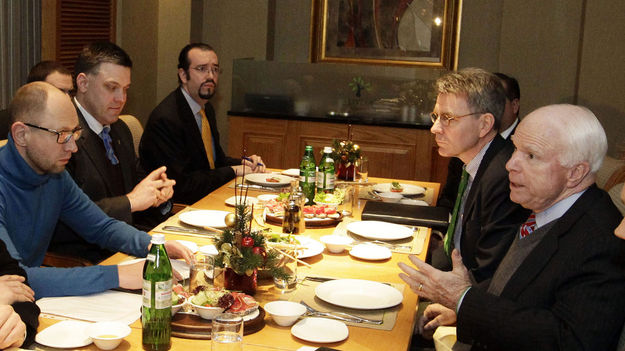
As in Syria, where US Ambassador Robert Ford adopted the rebels from the beginning of the insurrection, US officials have beat a steady path to the Ukrainian rebels to offer their support and assistance. Senator John McCain has even dined with Svoboda Party president Oleh Tyahnybok, shown here in a rather different pose. US Assistant Secretary of State Victoria Nuland was recorded plotting the overthrow and replacement of the Ukrainian government with the US Ambassador to Ukraine, Geoffrey Pyatt.
Pyatt, a man surely devoid of any sense of self-reflection, boldly proclaimed that his recorded plotting to overthrow of the Ukrainian government was merely “helping to build bridges between the government and the opposition.” Of course in a strict sense that is true: he is actively engaged in building a bridge to government power for the Ukrainian opposition.
The Syrian rebels are presented as a moderate group of would-be democrats seeking political reform; Ukrainian rebels are presented as a bunch of pro-Western, pro-EU “peaceful demonstrators.” In both cases the real power on the streets has been radical extremists with whom US officials have had considerable contact.
In Syria, President Assad responded early on to the unrest with offers of compromise, including agreeing to hold a constitutional referendum which put an end to generations of one-party rule. In Ukraine, President Yanukovich granted amnesty to violent protesters, rescinded legislation seen as inhibiting protest, fired his government at the request of the opposition and even offered to name opposition leaders to a new interim government. Each move toward compromise and appeasement of the opposition was met with increased violence and escalating demands on the part of the rebels, most recently in Ukraine after opposition leaders met with US and EU officials at a security conference in Munich.
President Obama sternly warns the Ukrainian government against restoring order: “We expect the Ukrainian government to show restraint, to not resort to violence in dealing with peaceful protesters.” He cryptically hinted at possible US escalation, stating: “We’ll be monitoring very carefully the situation, recognizing that, along with our European partners and the international community, there will be consequences if people step over the line.”
He similarly warned Syrian president Assad against taking action to defend the country against armed rebels fighting for its overthrow.
Another red line drawn? This time on Russia’s doorstep?
Here again is the million dollar question: What would Washington do if rebels intent on overthrowing the Obama regime raided military weapons depots, killed at least ten police officers and wounded dozens of others, set Washington D.C. on fire, occupied key government buildings including the US Capitol complex, and demanded a change in the Constitution favoring their ascendance to power?
Obama warned the Ukraine government to make sure the “Ukrainian military does not step in to resolve issues that could be resolved by civilians.” The US military was called in to quell a far less significant protest in Seattle over the World Trade Organization meeting there in 1999.
The US Capitol area has been on “lockdown” innumerable times over such “threats” as a mentally disturbed woman driving erratically — who was unarmed and shot dead by police.
One need not side with either opposing group in Ukraine to point out the choking hypocrisy of the US position.
But what is truly remarkable are the many similarities between what has been happening in Syria and what is now happening in Ukraine. It almost seems as if the same hand with the same playbook is plotting both regime change operations.
Threats of sanctions against Ukraine look like blackmail – Lavrov
RT | February 20, 2014
Threats of sanctions against the Ukrainian government look like blackmail, and a demand for early elections is a way to force Kiev towards the EU, Russian Foreign Minister Sergey Lavrov said. The sanctions will only encourage extremists, he added.
Lavrov on Thursday blasted the sanctions against Ukraine, some of which have already been imposed by the US, and are now being eyed by the EU, as “double standards.” Such actions will only encourage extremists to continue violence in the country, he said.
“The [Ukrainian] opposition cannot or does not want to dissociate itself from extremists. The US lays all the blame on the Ukrainian government – this is a double standard,” Lavrov said.
“The EU is also trying to discuss the imposing of sanctions, at the same time there are uninvited missions coming to Ukraine. Such actions resemble blackmail,” the minister said.
Not only are such threats “inappropriate,” but also will aggravate the conflict in Ukraine, Foreign Ministry spokesman, Aleksandr Lukashevich, has said.
There is “no doubt” there is a “plain coup attempt” going on in Ukraine, with armed rioters widely using firearms, the spokesman added.
“We strongly condemn the actions of radicals and extremists, who are mostly responsible for violence and bloody riots. Serious responsibility also lies with the opposition, who have been unable to fulfill the agreements reached with the government,” Lukashevich said.
The so-called Maidan leaders must “immediately stop bloodshed” and “continue seeking a peaceful resolution to the crisis without threats or ultimatums,” he stressed.
Moscow is not interfering in the internal conflict in Ukraine, Lukashevich said, adding that there are plenty of “false flag reports,” such as Russian riot police taking part in quelling the riots, which are distributed over social networks and by “some politicians.”
“As regards to the accusations of Russia, there is a proverb saying that guilty mind is never at ease. We are deeply concerned with what is happening and how the Western states are commenting on it and are trying to affect it. In Western media, the situation is presented in an extremely perverted way, some simple mantras are hammered into heads like that the West is calling on the government to keep its hands off Maidan,” Lavrov said.
However, the Western politicians and media prefer not to go into detail on what is happening on Maidan.
“Police pelted with Molotov cocktails, the killings, the seizure of buildings – none of that is being commented on or explained,” the minister said.
The individual sanctions that the US and the EU are trying to impose are “absolutely illegitimate” from the point of view of the international law, the Russian Foreign Ministry said.
The only legitimate sanctions can be imposed by the UN Security Council, the ministry stressed.
Related articles


Ukraine crisis: EU Parliament’s MP urges to impose sanctions on Russia
Voice of Russia | February 19, 2014
A member of the ruling faction in the European Parliament has come up with an initiative to impose sanctions against Russia that he said was supporting Ukraine’s regime. Russia has been in a waiting stance ever since the escalation on Tuesday, when Ukraine’s capital Kiev descended into more chaos.
This came today from Poland’s MEP Jacek Sariush-Volsky of the center-right European People’s Party at a press conference in the EU parliament.
However, a spokesperson with the European Commission ruled out the possibility of sanctions against Russia ahead of the EU foreign chiefs’ meeting on February 20.
Conversely, the spokesman said that the 28 foreign policy heads of EU member countries were going to engage in consultations with Russia in order to clear up all controversies that exist between Moscow and Brussels on the possible outcome of an association deal between Ukraine and the EU.
Russia blames ‘extremists’ for Ukraine crisis, suggests attempted coup
Russia has apportioned all blame for the deteriorating situation in Ukraine on the extremists. This is according to President Putin’s spokesman Dmitry Peskov.
“The president believes that the ongoing situation in Ukraine is the fault of the extremists,” Mr. Peskov said today.
He added Russia wished that its Ukrainian partners would “ensure the settlement of the situation that has taken shape as soon as possible.”
“Moscow strongly condemns violence of radical elements, who in the breach of all agreements previously reached actually used the implementation of the conditions on amnestying previously detained people and returned to violent actions immediately,” Peskov told reporters.
“Besides, their actions can be treated and are treated in Moscow solely as an attempt at a state coup,” Peskov said. “Together with the seizure of state organizations in various cities of Ukraine, the seizure of law enforcement facilities and attempts to seize arms occurs as well,” he said.
Russia biding its time on Ukraine
Moscow is keeping tabs on Ukraine but will not interfere with the crisis for now, President Putin’s spokesman has said Wednesday. Russia has been in a waiting stance ever since the escalation on Tuesday, when Ukraine’s capital Kiev descended into more chaos as death toll rose to 25 people.
“The Kremlin is closely watching the ongoing situation in Ukraine, and we will definitely speak on it a bit later,” Putin’s spokesman Dmitry Peskov said today in an interview with online magazine Slon.
“The idea is not to intervene in the Kiev unrest. We’ve said that many times, the Kremlin will stay true to this stance.”
Militants’ actions in Kiev on Fe 18-19 not spontaneous, but staged – Russian diplomat
Chairman of the Federation Council’s International Affairs Committee Mikhail Margelov believes that militants’ actions on Kiev streets on February 18-19 are not spontaneous, but staged.
The senator noted the common delusion that the so-called Maidan and its battle squad is not stage-managed, it is Cossak outlaws and “national power”. “The very events at Grushevsky Street disproved it: the militants dealt with law enforcers’ attacks too skillfully, refilled armory of shields, casks and clubs, and added cocktail bombs to convert it into napalm. The course of street riots February 18-19 showed that the militants fight in the so-called “Halych format” — it came to gunfire, and there are fatalities on both sides. There is evident organized nature behind the fighting,” Margelov believes.
In addition, he said that “after a fragile truce, the Maidan gains momentum in provinces: in Lvov, Ternopol, Ivano-Frankovsk”. “They not only occupy state offices there, but storm police wards and dismantle Berkut officers,” the Russian senator stated.
Margelov expressed confidence that “debacles and shooting that John Kerry dubbed “fight of the Ukrainian majority for Europe’s democratic future” are fairly staged and managed by experienced specialists in street fighting”. “Klitschko and Yatsenyuk hardly possess such military talents,” he assumed, adding that the job of these politicians is “to compose joint plans with the West to make up an oppositionist government and carry out a constitutional reform, which ought to be followed by western financial aid”.
Chairman of the Federation Council’s International Affairs Committee says it’s early to make any forecasts yet. “It would be a great achievement to stop the street mayhem and start a responsible political dialogue. Still, even this may not consolidate the Ukrainian society. It’s split: I cannot remember a single Ukrainian parliament that hadn’t fistfights,” the senator concluded.
Related article

Moscow blames radicals for deadly clashes in Ukraine, EU leaders ponder sanctions against government
RT | February 19, 2014
Moscow believes the deadly clashes in Kiev were an attempt at a coup by radicalized protesters. EU leaders have quite an opposite view, calling for sanctions against Ukrainian government officials.
In a statement issued on Wednesday, Russia’s Foreign Ministry described the violence in Ukraine as an attempt at a coup d’etat and a “brown” revolution, accusing European politicians and institutions of “refusing to admit that all of the responsibility for the actions of radical forces in Ukraine rests with the opposition.”
“The Russian side is demanding the leaders on the streets to stop the violence in their country, immediately resume dialogue with the lawful government without threats and ultimatums,” the statement reads.
The Kremlin has also interpreted the violence in Ukraine as a coup attempt. President Putin’s spokesman said that “from the point of view of the Russian leadership”, all of the responsibility for the bloodshed could be laid at the door of “the extremist forces.”
Twenty-six people were killed overnight in the most violent clashes yet to have occurred between security forces and protesters since the opposition took to the streets of Kiev in November 2013. Ten of the casualties are Ukrainian police officers, who died of gunshot wounds, as did the rest of the victims, the Interior Ministry reported.
It added that up to 700 people were injured, more than 70 of those being policemen.
The Ukrainian Health Ministry officially confirmed that a journalist from the local Vesti newspaper, Vyacheslav Veremey, died in Kiev after a gunshot wound.
The Ukrainian Ministry of the Interior believes the casualties in the clashes could have been killed by the radicals, because the police do not use fire arms.
“Taking into consideration the nature of the dead civilians’ wounds and also the nature of the weapons, which have been confiscated, we can assume that these wounds were inflicted by violent protesters,” a statement at the Ministry’s website says. “Police officers and interior troops do not use fire arms. Law enforcers are only using non-lethal weapons.”
Some of the European leaders have not been convinced and have been quick to lay the blame for the violence on the Ukrainian president. The Swedish Foreign Minister said on Twitter that blood was on Yanukovich’s hands.
British Foreign Secretary William Hague was less emotional, but also accused the government of allowing the bloodshed to happen.
Several EU leaders have already spoken of introducing sanctions against the Ukrainian leadership, who they view as responsible for the crisis.
Germany, which previously refused to back Washington’s calls for sanctions against Ukraine’s government, could soon have a change of heart, according to German Foreign Minister Frank-Walter Steinmeier .
“Whoever is responsible for decisions that lead to bloodshed in the center of Kiev or elsewhere in Ukraine will need to consider that Europe’s previous reluctance for personal sanctions must be rethought,” he said, according to AP.
Polish Prime Minister Donald Tusk said on Wednesday he would be pressing European Union leaders to impose sanctions on Ukraine’s government.
“I will today hold talks with the leaders of the biggest EU countries and institutions, and persuade them to impose sanctions – personal and financial,” Tusk told a special session of the Polish parliament, Reuters reports. “I hope that such a stance from Poland will help the EU as a whole in taking fast decisions.”
Belgian Foreign Minister Didier Reynders has also supported sanctions against the Ukrainian government, according to Itar-Tass.
Earlier, US Ambassador to Ukraine Geoffrey R. Pyatt blamed Viktor Yanukovich for the escalation of the crisis.
“From this moment on, the USA holds Yanukovich responsible for everything that happens in Ukraine,” he told the Zerkalo Nedeli newspaper, following a meeting with Foreign Minister Leonid Kozhara.
Moscow believes that this accusatory position of the US could have, in fact, contributed to the escalation of violence Kiev has been witnessing, and, holding the president solely responsible for the crisis, is giving carte blanche to extremist radical forces out on the streets.
The Russian Foreign Ministry said on Tuesday it considered the crisis “a direct result of the permissive policy exercised by those western politicians and European structures, who from the very beginning turned a blind eye to the aggressive actions of the radical forces in Ukraine.”
Victoria Nuland’s ‘Ukraine-gate’ Deceptions
By Daniel McAdams | Ron Paul Institute | February 9, 2014
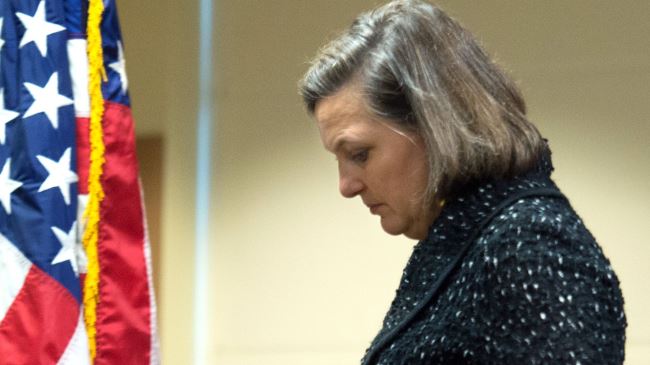
“That’s some pretty impressive tradecraft,” said Assistant Secretary of State Victoria Nuland of the interception and leak of her now-infamous call to US Ambassador to Ukraine Geoff Pyatt. The call consisted of the two plotting to install a US puppet government in Ukraine after overthrowing the current, democratically elected government.
Tradecraft means “spycraft.” In other words, Nuland was crediting a foreign intelligence service with impressive use of technology to be able to hack into her call to the ambassador. Everyone knew she was talking about Russia, partly because the Administration had been blaming Russia from the moment the recording was made public.
However, Nuland knew all along that this was not the case, and she did nothing while the Administration continued to escalate the accusations against Russia.
Jay Carney, White House Spokesman, “It says something about Russia,” that they would tap the telephone call. State Department Spokeswoman Jan Psaki was even harsher, calling it “a new low in Russian tradecraft.”
But the telephone call between the two, we learned yesterday, was not conducted on a secure, encrypted telephone line that the State Department requires for such sensitive conversations and communication. Rather, the call was made over unsecured cell phones and thus easily intercepted with basic equipment that is widely available to anyone. Therefore it was not “impressive tradecraft” at all that led to the capture and release of the conversation.
Nuland and Pyatt obviously knew that at the time, being the two parties to the call. They then either sat by and allowed US government official one after the other accuse Russia of going to great lengths to hack the call without admitting this fact, or they did inform their superiors but Administration officials decided to ignore this critical fact and push accusations against Russia anyway. You never want a serious crisis to go to waste, as it is said.
RPI contacted a former State Department official to clarify security procedures for such a telephone conversation between high-level personnel. The official was clear:
I know well the seriousness of using an open line (aside from anodyne conversation) for high-level classified information that would clearly be embarrassing, if not damaging, not only for the US but also the EU. For using an open line for discussing highly sensitive national security matters, both [Nuland and Pyatt] should be reprimanded, at the very least.
So this was a serious security violation.
The former official continued:
Assuming the telecon was made on insecure line, I find it curious, if not thought provoking, that Nuland’s profanity has managed to overshadow both the apparent security violation as well as the potential damage to national security of the substance of the conversation itself.
Indeed, the fallout from “Ukraine-gate” is astounding but sadly not surprising. The mainstream media in the US has focused solely on the Russian angle (now discredited) and on the salty language and particularly the false supposition that Nuland was using sailor’s language to indicate a serious rift with the EU on Ukraine policy. In fact, US and EU policy toward Ukraine is identical: regime change. The dispute is merely over velocity and is therefore cosmetic rather than substantive: should we travel 100 miles per hour or only 75 miles per hour toward regime change?
As far as we have seen, there has been virtually no discussion of the substance of the telephone conversation in the US media. But the conversation was a confirmation of all theretofore denied accusations of US involvement in the current unrest in Ukraine. It was not simply US well-wishing toward the opposition parties. It was not simply a bit of advice and a wink toward the opposition. It was wholesale planning and brokering a post-regime change governing coalition in Ukraine, with the UN being ordered to come in and “glue” the deal.
More precisely, as the Oriental Journal points out:
They agreed to nominate Bat’kyvshchina Party leader Arseniy Yatseniuk as Deputy Prime Minister, to bench Udar Party leader Vitaly Klitschko from the game for a while and to discredit neo-Nazi Svoboda party chief Oleh Tiahnybok as “Yanukovych’s project”
Shortly after “Ukraine-gate” broke, Sergei Glazyev, advisor to Russian president Putin claimed that the US was spending $20 million per week on the Ukrainian opposition, including supplying the opposition with training and weapons.
Nuland replied that such claims are “pure fantasy.”
Perhaps, but that is just what Nuland had said previously about claims that the US was meddling in the internal affairs of Ukraine. And then the tape came out. That was just what she said about Russia’s “impressive tradecraft” in intercepting the telephone call. Then we discover that she was discussing highly sensitive issues over completely unsecured telephones.
Is the US training and funding the Ukraine opposition? Nuland herself claimed in December that the US had spent $5 billion since the 1990s on “democratization” programs in Ukraine. On what would she like us to believe the money had been spent?
We know that the US State Department invests heavily — more than $100 million from 2008-2012 alone — on international “Internet freedom” activities. This includes heavy State Department funding, for example, for the New Americas Foundation’s…
…Commotion Project (sometimes referred to as the “Internet in a Suitcase”). This is an initiative from the New America Foundation’s Open Technology Initiative to build a mobile mesh network that can literally be carried around in a suitcase, to allow activists to continue to communicate even when a government tries to shut down the Internet, as happened in several Arab Spring countries during the recent uprisings.
“Commotion Project.” What an appropriate name for what is happening in Ukraine.
It is not a far leap from the known billions spent on “democratization” in Ukraine, to the hundreds of millions spent on developing new tools for regime-changers on the ground to use against authorities in their home countries, to the State Department from the US embassy in Kiev providing training and equipment to those seeking the overthrow of the Ukrainian government.
The apparent goal of US policy in Ukraine is to re-ignite a Cold War, installing a US-created government in Kiev which signs the EU association agreement including its NATO cooperation language to effectively push the Berlin Wall all the way to the gates of Moscow and St. Petersburg.
NATO has expanded to central Europe, despite US assurances in the 1980s that it would not do so. The US rolled over Russia in its deceptive manipulation of a UN Security Council resolution on Libya to initiate an invasion. The US continues to arm jihadists seeking to overthrow the secular Assad government in Russia-allied Syria. The US and EU have absorbed the Baltics, leaving their large ethnic Russian populations to dangle in non-person limbo. The US and EU had all but absorbed Georgia. Now the US is clearly in the process of absorbing Ukraine, with its strategic importance to Russia, its proximity, and its nearly 10 million ethnic Russian minority.
Surely there is a point to where Russia will take steps to concretely limit its losses. In December Russian president Vladimir Putin said in a meeting with his Ukrainian counterpart Viktor Yanukovich that Russia and Ukraine should resume comprehensive military cooperation. Other bilateral defense agreements are already in place.
What would have to happen to trigger a Ukrainian request to its close neighbor for assistance putting down a bloody and illegal coup d’etat instigated by foreign governments? Will serious US miscalculation of Russian resolve over Ukraine lead to a tragedy of almost inconceivable proportions? What if this time Russia does not blink?
Related article
Featured Video
Can the U.S. Afford to Annihilate Iran?
or go to
Aletho News Archives – Video-Images
Book Review
The Genetic Deception — now in paperback (Second Edition)
Lies are Unbekoming | October 2, 2026
The genes the field promised were never there.
The genetic story of disease is a cover story.
The twenty-first century runs on it. Paediatric clinics. Cancer centres. Forensic laboratories. Family-planning counsel. It is used to explain illness, to assign blame, to foreclose questions. It protects the industries whose products and practices are what actually caused the harm.
It isn’t true.
In 2010, Jonathan Latham and Allison Wilson looked at over seven hundred genome-wide association studies covering some eighty common diseases. The genes the field had promised were not there. The field invented a term, “missing heritability”, to explain the absence, and has quietly worked to bury the finding ever since.
The Genetic Deception is a book about what Latham and Wilson found. What the field did with it. And what the public was told instead. … continue
Blog Roll
 Aletho News
- Iranian crew declared Dena training vessel ‘unarmed’ to US warship before deadly torpedo strike: Report
- Iran’s NPT debate moves beyond parliament
- Houthis condemn Saudi claims of attack on Medina
- Fatuous False Flags
- Are Europe’s Smallest Nations Dragging the Continent into War?
- EU draws up contingency plans for possible Merz exit
- G7 caves to US blackmail, announces ‘massive’ release of diesel reserves
- Reporting of the RAF Fairford arrests blows the idea of a ‘free press’ out of the water
- US increasing Middle East military buildup – AP
- Flydubai scenario: Netanyahu’s plot to drag US to war with Iran, stay in power
- If Americans Knew
- The Israeli Right Portrays Islam as Murderous. It Serves a Political Purpose
- Jordan Has Had Enough: King Abdullah’s Scathing Warning to Israel
- Israeli Colonizers (i.e. Settlers) Kill Palestinian Man Near Salfit
- New Google Maps images reveal massive scale of devastation in Gaza
- Jewish supremacy, anti-Palestinian bigotry on display in Israel – Daily Update
- Israeli Soldiers Abduct At Least 22 Across Occupied West Bank
- Eight Palestinians Killed in Israeli Attacks on Gaza
- Israeli former leaders and security chiefs threaten legal action over ‘Jewish terrorism’
- Israel map in LA Times ad includes all land from the river to the sea
- Inside Lebanon’s 200-page dossier on Israeli war crimes
- No Tricks Zone
- Green Energy Debacle: German Expert Professor Fritz Vahrenholt Warns Of Severe Economic And Social Consequences
- Two More Paleo Reconstructions Affirm Meters-Higher Sea Levels Across Ireland, Brazil 7000-6000 Years Ago
- New Study: Earth And Venus Surface Warmth Largely Explained By Convection And Lapse Rate, Not CO2 Or Radiation
- 2025 Nature Paper Claiming Worsening Global Drought Gets RETRACTED …Heavily Flawed
- New Study: ‘Global Drought Shows No Detectable Recent Acceleration Under Climate Warming’
- Economic Masterminds: German Socialists Suggest Taxing Productivity Gains Stemming From Using AI
- The South China Sea Has Not Been Cooperating With The Climate Change Narrative
- Energy Crisis: Germany Enters Heating Season With Historically Low Gas Reserve Fill Levels
- New Study: The Antarctic Ice Sheet Gained Mass From 2020-2024 Due To Staggering Snow And Ice Accumulation
- Study: Ocean Heating Rates From Thousands Of Years Ago ‘Dwarf’ Modern Ocean Heating Rates