On Tuesday Khaled Mesmar, head of the Political Committee of the Palestinian National Council, reported that an official statement issued by Washington had been received demanding that if another membership bid was put to the United Nations, then all financial aid to the Palestine Liberation Office in Washington would be cut.
Mesmar stated that the threat was issued officially via the American Administration envoy which visited Ramallah recently and met with the Palestinian president Mahmoud Abbas.
The initial bid for membership was blocked in September 2011 when the UN Security Council was put under pressure by the American delegation not to vote for it.
Mesmar reported that the Palestinian leadership would withold its UN bid for statehood if Israel stopped building settlements and released the Palestinian prisoners that were detained before the Oslo’s agreement of the 1993.
Illegal settlements have been the major obstacle to all negotiations. Despite settlements being illegal under the fourth Geneva convention and being in defiance of UN resolutions and the world court, Israel refuses to halt their construction, making negotiations impossible.
The US is demanding that the Palestinian Authority resumes talks without pre-conditions. Mesmar stated that rather than the halting of settlement construction being a Palestinian pre-condition, it is a commitment that Israel must undertake in accordance with the rule of law.
The importance of a fresh UN bid has taken on huge significance since last October, when UNESCO voted to admit Palestine as its newest member. The US immediately cut off all aid to UNESCO. The chairman of the House Foreign Affairs Committee referred to the vote which passed with a 107 to 14 majority, as “reckless and anti-Israel”
July 11, 2012
Posted by aletho |
Ethnic Cleansing, Racism, Zionism, Illegal Occupation, Progressive Hypocrite, Timeless or most popular | International Middle East Media Center, Obama, Palestine, United Nations |
Leave a comment
Special envoy Kofi Annan and Syrian President Bashar al-Assad met on Monday and agreed to initiate another ceasefire plan between the government and the opposition. The following is an account of what was said at the meeting.
The meeting between Syrian president Bashar al-Assad and the international envoy to Syria Kofi Annan on Monday began with the usual pleasantries. They were joined by the [Head of the United Nations Supervision Mission in Syria] General Robert Mood and Annan’s political advisor Martin Griffith.
The international envoy began by indicating that he had followed the recent media appearances by the Syrian president, from the German television to the Turkish Cumhuriyet newspaper.
“It seems, Mr. President, that you are intensifying your media appearances in this period,” he remarked.
“This is true for two reasons. First, I am someone who prefers action and then words. Second, we noticed an extensive blackout of the facts in addition to the distortion and misrepresentation of many matters. So I saw it as my duty to speak,” Assad replied, smiling.
Annan understood. He replied saying he completely understands the difference between the events on the ground and the prevailing image that reflects the imagined scenarios of several agendas and impressions.
Annan then turned to the officially prepared statement: “Mr. President, I felt it was my duty following the conference we held in Geneva and a few days before my briefing the United Nations Security Council (UNSC) on July 20 and 21, to come to you, meet with you, and present what we have achieved and what should be followed-up,” Annan said.
It was obvious from the introduction that Annan deliberately left out Friday’s opposition “Friends of the Syrian People” Paris conference and the escalation in rhetoric during and after that meeting.
He even went further, seizing the opportunity of his and the UN’s repeated commitment to his six-point peace initiative to stress to the Syrian president that the outcome of the Geneva convention was out of concern for this initiative, and nothing else.
“No doubt, Mr. President, you know that what happened in Geneva is different from some of the interpretations and explanations, which sought to add issues that had nothing to do with the conference or distorted its decisions,” he added. Annan’s remarkable position seems identical to the Russian stance on Western perspectives that followed the meeting.
Annan then spoke about the situation on the ground and the international monitoring mission in Syria. He pointed out the tragic situation in some regions and the need to practically achieve the essence of his mission, namely the second point concerning cessation of violence.
Assad responded by saying he is fully aware and responsive to the situation. He then presented his guest with a brief presentation of his mission since 12 April 2012. He explained how the ceasefire was reached and respected by the official armed forces for 24 hours, before it was broken by the armed insurgents, as noted in the international observers’ reports. While Assad was explaining, chief observer Mood nodded in agreement several times.
Annan listened to his host’s message, concluding that the truth of the matter confirms the need to work on a ceasefire, since the volatile situation began to spill outside Syria. Then he named Lebanon as a worrying arena for the repercussions of the Syrian situation.
“Let us try again and put a specific mechanism for a ceasefire starting from one of the more volatile regions, then move to the next,” Annan suggested. Again, Assad was completely responsive.
“We are a state, a government, and official authorities. Therefore, if you agree with us and we gave our word to abide by the ceasefire, we will be responsible for this and you can refer to us for implementation. But who will you negotiate with on the other side?” Assad asked his guests.
Annan replied, aided by Mood. They explained that the international observers, during their mission, were able to conduct a semi-comprehensive survey of armed groups active in those areas.
“We now know the main groups at least and we know those who are responsible for them. It is true that they do not have a unified command or clear structure. But we know the key people. Therefore we believe we could work with them step by step,” they said.
In this context, it was clear that the international officials had classified the side opposing the Syrian regime as an “armed opposition.” This was later indicated in Annan’s official press release.
On this point, Annan was reminded that the insurgents were the ones who aborted several similar attempts, especially in Homs.
“Some time ago, your observers witnessed attempts by some fighters to leave al-Khalidiya neighborhood in Homs to surrender themselves and their weapons. But other fighters stopped them from doing so. Your observers also witnessed how armed fighters blocked the attempt to rescue some of the residents trapped in al-Dayyan and al-Hamidiya neighborhoods in Homs,” they were told. This was confirmed by Griffith who had observed these events.
The international officials did not deny their hosts’ words. “Nevertheless, due to the current situation, let us try again. Our observers will reach an agreement with the armed groups in any area where we choose to work. In return, we want you to make a goodwill gesture at any of the mutually agreed starting points. Your gesture would be for a unilateral ceasefire from your side, a short time before the mutual deadline. Even if it is for four hours, for example,” Annan suggested.
Here, Annan was reminded that the ceasefire proposed in his six-point initiative is related to putting an end to the arming, financing, and weapons smuggling. Annan was listening to this sensitive point without reacting, until he was interrupted by a direct question.
“What do you think of what the US Secretary of State Hillary Clinton said two days ago [Sunday], when she called on the armed groups to launch an assault on the government’s forces? Is such a position consistent with the substance of your mission?” Annan was asked.
After a few seconds of silence, he replied saying, “Of course not. These are dangerous words. But let us try. Let us agree on this mechanism and proceed to try to implement it on the ground, step by step.”
As for the possible time-frame for such an operation, the two sides discussed several ideas, opinions, and suggestions. They concluded by agreeing on a preliminary deadline of three months, beginning from the first step to be implemented in the plan. In the meantime, both sides will work on releasing a joint statement of progress, once every two weeks.
Annan moved from the situation on the field to discuss the question of a national dialogue between the government and the opposition. “If we moved ahead in resolving the security issue and reached the dialogue phase, can you name your representative in this process to negotiate with the opposition, as a sort of liaison officer to follow the second part of the UN’s mission?” he asked.
Assad smiled and immediately replied, “We had decided on this before you asked us. Since the formation of the current government, we named someone to be in charge of the issue. He will be our representative in this process. He is the National Reconciliation Minister Dr. Ali Haidar.”
Annan inquired about Haidar and was told by Assad that he had been chosen for several reasons. “First, he is not from the loyalist camp. He is actually from the opposition. He is also the head of a party known for its honesty in Syria and abroad. Third, he was hurt during the bloody events. His son was killed by the insurgents but he ignored his wound and accepted the mission towards a genuine national reconciliation,” Assad said.
Annan acknowledged Assad’s explanation, but added that “we would have preferred if you named someone who is close to you and who would be in direct contact with you to follow-up on the dialogue process.”
Assad smiled again, saying that “Dr. Haidar and I sat next to each other all through my university years when I studied ophthalmology. Do you need someone closer than this?”
“In any case,” he continued, “I think your problem will be on the other side, not ours. Will you be able to name someone who represents the opposition?” Annan could not hold his laughter. He seconded Assad’s words and added, “I completely understand this difficulty. I saw them at the last conference in Cairo.”
The formal meeting concluded, but there was still time for some closing remarks. Getting ready to leave, Annan asked his host, “How long do you think this crisis will continue?”
“As long as the […] regime funds it,” Assad replied. But Annan was not surprised by the answer. “Do you think they are behind all the funding?” he inquired.
“They are behind many things that happen in our region. They believe they will be able to lead the whole Arab world today and in the future,” Assad said.
The international envoy concluded by remarking, “But it seems to me that they lack the population needed for such an ambition.” This made everyone laugh.
July 10, 2012
Posted by aletho |
Aletho News | al-Akhbar, Annan, Bashar al-Assad, Kofi Annan, Syria, United Nations |
Leave a comment
By Mairead Maguire | June 29, 2012
People around the world are deeply concerned about the ongoing crisis in Syria.
While we are being presented with some perspective of what is occurring on the ground to the people of Syria, the door seems closed to others. We search for voices we can trust, voices which point to a peaceful, lasting solution to the conflict. We search for truth because it is truth which will set the Syrian people free. Truth is difficult to find, so through the haze of conflicting narratives we must inevitably hear the voices and wisdom of men and women of peace in Syria.
Many may believe that there is a fight going on in Syria for ‘democracy’ and ‘freedom’. We can be seduced into thinking there is a magic wand or instant formula to mix that will create a democratic country, but there are none. If it is a democracy a people want they must strive for it in their own way. It is said the Greek idea of democracy was that people would be equally valued. This is something every society has to strive for at every point in its history; it itself is a ‘revolutionary’ concept and a nonviolent revolutionary action. Strive to value everyone equally. It is an idea, a motivation for a better world that doesn’t require blood; it requires the hard work of people and the nurturing of a community spirit; a constant growing of peace and it starts within each human heart.
Who are the voices of peace in regard to the crisis in Syria? Many of them we cannot hear from where we are standing. They are the mothers and fathers and children who want to leave their homes to walk to market or to school without fear. They are the people, who have been working hard for Syria, for the idea of Syria as a secular and modern country.
There are some Syrian voices that have been heard consistently since the beginning of the crisis. Many of them are anonymous and they speak to us about injustices and atrocities. Numbers are given and fingers are pointed. The blame may be apportioned correctly or it may not. Everything is happening too quickly; commentators and politicians are making decisions with haste and looking only in one corner for support for their certainty. But in the heat of the madness of violent ethnic/political conflict we must listen and ask questions and hear and speak with some uncertainty because it is certainty that can take a people and a country in a rush to war.
The face of the Mufti of Syria is hardly known in the western world, but if we have learned anything from past conflict, it is the importance of all inclusive dialogue. He and many other Syrians who have peace in their hearts should be invited to sit with a council of elders from other countries, to tell of their stories and proposals for ways forward for the Syrian people. The United Nations was not set up to provide an arena for the voices and games of the powerful; rather it should be a forum for such Syrian voices to be heard. We need to put ourselves in the shoes of the Syrian people and find peaceful ways forward in order to stop this mad rush towards a war the mothers and fathers and children of Syria do not want and do not deserve.
We all know there are imams, priests and nuns, fathers, mother, young people all over Syria crying out for peace and when the women in hijabs shout to the world after a bombing or a massacre in Syria ‘haram, haram’ let us hear and listen to them.
We are sure there are many heroes in Syria among them, christian patriarchs, bishops, priests, and religious. A modern hero of peace, one whose name we do know and whose voice we have heard is Mother Agnes Mariam*. In her community her voice has been clear, pure and loud. And it should be so in the West. Like many people in Syria she has been placed in life threatening situations, but for the sake of peace she has chosen to risk her own existence for the safety and security of others. She has spoken out against the lack of truth in our media regarding Syria and about the terror and chaos which a ‘third force’ seems to be spreading across the country. Her words confront and challenge us because they do not mirror the picture of events in Syria we have built up in our minds over many months of reading our newspapers and watching the news on our televisions. Much of the terror has been imported, we learn from her. She can tell us about the thousands of christian refugees, forced to flee their homes by an imported Islamist extreme. But Mother Agnes Mariam’s concerns, irrespective of religion, are for all the victims of the terror and conflict, as ours must be.
In all our hearts we know War is not the answer for Syria (Nor for Iran). Intervention in Syria would only make things worse. I believe all sides are committing war crimes and the provision of arms will only result in further death. The US/UK/NATO and all foreign governments should stay out of Syria and keep their funding and troops out of Syria.
We should support those Syrians who work for peace in Syria and who seek a way of helping the 22 million or so people of Syria to resolve their own conflict without furthering the chaos or violence.
* Mother Agnes Mariam of the Cross is a Greek-Catholic (Melkite) nun of Lebanese / Palestinian descent and has lived and worked in Syria for 18 years. She restored the ancient ruined monastery of St. James the Mutilated at Qara, in Homs province where she founded an order which serves the local and wider community. In 2010 the monastery welcomed 25,000 visitors both Syrian and international.
~
Mairead Maguire is a Nobel Peace Laureate with The Peace People.
The Peace People, 224 Lisburn Road, Belfast BT9 6GE, Northern Ireland
Phone: 0044 (0) 28 9066 346
Email: info@peacepeople.com www.peacepeople.com
June 29, 2012
Posted by aletho |
Militarism | Agnes Mariam, Mairead Maguire, Syria, United Nations |
Leave a comment
BETHLEHEM – Israeli forces have killed nearly 2,300 Palestinians and injured 7,700 in Gaza over the last five years, the UN Office for the Coordination of Humanitarian Affairs said Thursday.
Some 27 percent of the fatalities in Gaza were women and children, the UN agency said in a report highlighting the effects of Israel’s blockade.
The land, sea and air blockade of Gaza entered its sixth year on Thursday.
Under the blockade, exports have dropped to less than 3 percent of 2006 levels.
“The continued ban on the transfer of goods from Gaza to its traditional markets in the West Bank and Israel, along with the severe restrictions on access to agricultural land and fishing waters, prevents sustainable growth and perpetuates the high levels of unemployment,
food insecurity and aid dependency,” UNOCHA said.
Israel’s naval blockade has undermined the livelihood of 35,000 fishermen, and farmers have lost around 75,000 tons of produce each year due to Israeli restrictions along Gaza’s land border, it added.
Meanwhile, Israeli restrictions on imports have led to the growth of the smuggling trade. At least 172 Palestinians have been killed working in tunnels under Gaza’s border with Egypt, the report said.
Despite the risks, young men are still drawn to tunnel work in Gaza, where more than half the youth is unemployed and 44 percent of people are food insecure.
Mark Regev, spokesman for Israeli Prime Minister Benjamin Netanyahu, said Thursday that the blockade was necessary because Gaza’s ruling party Hamas is a “terrorist organization.”
“All cargo going into Gaza must be checked because Gaza is controlled by Hamas, an internationally recognized terrorist organization,” Regev told Reuters in response to a petition by 50 aid groups, including six UN agencies, calling on Israel to lift the blockade.
June 15, 2012
Posted by aletho |
Subjugation - Torture, Timeless or most popular, War Crimes | Benjamin Netanyahu, Blockade of the Gaza Strip, Gaza, Hamas, Israel, Mark Regev, United Nations |
Leave a comment
[The] 108 bodies were laid out by the Free ’Syrian’ Army [1] in a mosque in Houla. According to the rebels, these were the remains of civilians massacred on 25 May 2012 by pro-government militia known as ‘Shabbihas’.
The Syrian government appeared completely shocked by the news. It immediately condemned the killings, which it attributed to the armed opposition.
While the national news agency, SANA, was unable to provide details with certainty, the Syrian Catholic news agency, Vox Clamantis, immediately issued a testimony of some of the events formally accusing the opposition [2].
Five days later, the Russian news channel Rossiya 24 (exVesti) aired a very detailed 45-minute report, which remains to date the most comprehensive public inquiry [3].
The West and Gulf States who are working towards a “regime change” in Syria and have already recognized the opposition as a privileged interlocutor, have adopted the FSA’s version of events without waiting for the report from the United Nations Supervision Mission (UNSMIS).
As a sanction, most of them have resorted to a prearranged measure, namely the expulsion of Syrian ambassadors to their respective countries. This does not represent a rupture of diplomatic relations, as the rest of the accredited Syrian diplomatic personnel will remain stationed where they are.
The United Nations Security Council adopted a presidential statement condemning the massacre without indicating who was responsible. It furthermore reminded the Syrian government of its responsibilities, namely the protection of its people using proportionate measures, that’s to say without the use of heavy weapons [4].
Contrary to this, the High Commissioner for Human Rights Navi Pillay endorsed the allegations blaming the Syrian authorities, and demanded that the case be transferred to the International Criminal Court.
French President François Hollande and his Foreign Affairs Minister Laurent Fabius have announced their intention to convince Russia and China not to obstruct a future Security Council’s resolution authorizing the use of force, while the French press is accusing Russia and China of protecting a criminal regime.
Responding to these charges, Russia’s First Deputy Minister of Foreign Affairs Andrey Denissov expressed regret over France’s “basically emotional reaction” – devoid of analysis. He reiterated that the steadfast position of his country, in this case as for others, is not to support governments, but peoples (it being understood that the Syrian people elected President al-Assad at the last constitutional referendum).
The United Nations Supervision Mission went to Damascus at the request of the Syrian government. It was received by the opposition who control this zone, and was able to establish various observations to be used in writing its status report.
At an internal press briefing, the President of the Syrian investigation Commission into the massacre read a brief statement revealing the initial elements of the current investigation. According to him, the massacre was carried out by the opposition as part of an FSA military operation in the area.
Aware that the findings of the UN Supervision Mission report may backfire on them, the Western countries requested that the Human Rights Council in Geneva (which is under their control) set up another investigation Commission. A report from this body could be produced quickly in order to impose a version of events before the Supervision Mission is able to draw its own conclusions.
How can we know what happened in Houla?
Two main factors are impeding the work of investigators. The Syrian government lost control of Houla many weeks ago. Syrian magistrates are therefore unable to go to Houla, and even if some journalists are able to do so, this is only with the permission of and under close surveillance by the FSA.
There is however one exception: a team from Rossiya 24, the 24-hour Russian news channel was able to move around the area without an escort, and produce an exceptionally detailed report.
The official Syrian Commission claims to have collected several witness statements, but has declared that these shall only be presented to the press once the final report has been established. At present, the identity of these witnesses remains protected by investigation secrecy. However, several of the accounts were broadcast on public television on 1st June.
The investigators are also in possession of videos provided exclusively by the FSA.
Lastly, since the FSA amassed the bodies in a mosque and began burying them the very next day, it was not possible for UN observers to carry out forensic assessments on many of the dead.
Voltaire Network ’s conclusions
Houla is not a town, but an administrative area made up of three villages, each with about 25,000 residents but which today lie largely abandoned. The Sunni market town of Tal Daw has been under rebel control for many weeks. The Free “Syrian” Army had imposed its rule there. The national Army was securing transport routes by maintaining several posts on roads within the area, but did not venture beyond these roads.
Certain individuals kidnapped children and attempted unsuccessfully to extort ransoms. [5] In the end, these children were killed a few days before the Houla massacre, but their bodies were brought by the Free “Syrian” Army to be laid out amongst the others.
In the evening of 24 May, the Free “Syrian” Army launched a very large-scale operation to reinforce its control over the region, and to make Tal Daw its new base.
In order to do this, 600-800 combatants from various districts gathered in Rastan and Saan and proceeded to launch simultaneous attacks on the military bases. At the same time, a team was fortifying Tal Daw by installing five anti-tank missile batteries, and purging the town of some of its inhabitants.
The first victims in Tel Daw were a dozen people related to Abd al-Muty Mashlab – a legislator of the recently elected Baas party who was appointed Secretary of the National Assembly; following this, the family of a senior official – Mouawyya al-Sayyed – was killed. Subsequent targets were families of Sunni origin who had converted to Shiite Islam.
Other victims included the family of two journalists for Top News and New Orient News, press agencies associated with Voltaire Network. Many people, including children, were raped before being killed.
With only one of the Army’s bases having fallen, the assailants changed strategy. They transformed a military defeat into a communication operation, attacking the al-Watani hospital and setting fire to it. They took corpses from the hospital morgue and transported them along with those of other victims to the mosque, where the bodies were filmed.
The theory of a single massacre perpetrated by pro-government militia does not stand up to the facts. There were battles which took place between loyalists and rebels, as well as several massacres of pro-government civilians at the hands of the rebels.
Then, a scenario was staged by the Free “Syrian” Army where corpses originating from these various earlier situations were mixed together.
Indeed, the existence of the “Shabbihas” is a myth. Whilst there are certainly individuals in favour of the government who are armed and capable of committing acts of revenge, there is no structure or organized group that could be termed as a pro-government militia.
Political and diplomatic implications
The expulsion of Syrian ambassadors by Western countries is a measure that was planned well in advance and therefore well-coordinated. Westerners were waiting for a massacre of this type before carrying out this action. They ignored numerous previous massacres that they knew had been perpetrated by the Free “Syrian” Army, and seized on this one believing that it had been committed by pro-government militia.
The idea of a coordinated expulsion did not emanate from Paris, rather from Washington. Paris in principle gave its agreement, without having examined the legal implications. For in practice, Lamia Chakkour is also the Syrian Ambassador to UNESCO, and cannot therefore (according to the terms of the accord de siège) be expelled from French territory. Further to this, even if she were not accredited to UNESCO, her French-Syrian dual nationality means that she cannot be expelled from French territory.
These expulsions were coordinated by Washington to create the illusion of a general movement in order to put pressure on Russia. Indeed, the US is looking to test the new international balance of power, to size up Russia’s reactions and to find out how far they will go.
The choice of the Houla affair, however, has been a tactical error. Washington seized upon the affair without checking the details, thinking that nobody would be able to verify it. This was forgetting that Russia has moved into the country – with over 100,000 Russians currently residing in Syria.
Of course, they did not deploy a high-tech anti-aircraft defense system just to discourage NATO from bombarding Syria; they also set up information bases including troops that are able to move around rebel controlled areas.
In this way, Moscow was able to shed light on the facts within a few days. Their specialists succeeded in identifying the 13 members of the FSA guilty of these killings and gave their names to the Syrian authorities. With this, not only did Moscow not waver, it has hardened its stance.
For Vladimir Putin, the fact that the West wanted to make the Houla massacre into their symbol shows that they are out of touch with the reality on the ground. Having withdrawn the officers in charge of the Free “Syrian” Army, the only information available to the West comes from their drones and satellites observing what is happening. They have become vulnerable to the lies and vaunting of the mercenaries they have deployed on the terrain.
For Moscow, this massacre is just another tragedy like many others that Syrians have been enduring for the last year. But hasty instrumentation on the part of the West shows that they have failed to develop a new collective strategy since the fall of the Islamic district of Baba Amr. In essence, they are but acting on guesswork, which is allowing others to gain the upper-hand.
Translated from French by Katy Stone.
[1] Voltaire Network has chosen to write FSA with ’Syrian’ in inverted commas to indicate that this militia is largely composed of foreigners, and that it’s commander is not Syrian.
[2] “Irreversible divisons in Syria,” VoxClamantis, 26 May 2012.
[3] Global Research translated to English the transcript of extracts from this programme, see “Opposition Terrorists “Killed Families Loyal to the Government”“, Voltaire Network 1 June 2012.
[4] “Syria: What the Security Council Said”, by Thierry Meyssan,Voltaire Network, 6 June 2012.
[5] This is currently a security problem in the country. Many of the thugs that had been recruited to swell the ranks of the Free “Syrian” Army were demobilized due to lack of funding. Remaining in the possession of arms provided by the West, they are turning to crime – mainly kidnappings for ransom.
June 10, 2012
Posted by aletho |
Deception, False Flag Terrorism, Mainstream Media, Warmongering, Timeless or most popular, War Crimes | François Hollande, International Criminal Court, Syria, Thierry Meyssan, United Nations, United Nations Security Council |
Leave a comment
The US has hinted at taking actions against the Syrian regime bypassing the authority of the UN Security Council. This comes as pressure is piling up on Damascus following massacre in Houla that claimed over 100 lives.
US Ambassador to the UN Susan Rice has said that if the council does not take swift action to pressure Syrian authorities to end 14-month crackdown on the anti-government uprising, the Security Council members may have no choice but to consider acting outside the UN.
“Members of the international community are left with the option only of having to consider whether they are prepared to take actions outside of the Annan plan and the authority of this council,” Rice said on Wednesday after the 15-member council met in a closed door session to discuss last week’s massacre.
The United Nations is conducting its own investigation of who exactly is responsible for the bloodshed in the town of Houla. However the US and its allies seem to have come to their own conclusion, saying that the Assad government is solely responsible for the violence.
Rice did not specify what “actions” she meant. However the US and European countries had earlier imposed their own sanction on Syria outside the UN. So there are fears that her words could mean the threat of military action.
The US envoy said the worst but most probable scenario in Syria is a failure of Annan’s peace plan and a spreading conflict that could create a major crisis not only in Syria but also in the entire region.
“The Syrian government has made commitments. It has blatantly violated those commitments, and, I think it’s quite clear, as we have said for many weeks if they continue to do so there should be consequences,” Rice said.
Meanwhile, Syria’s Ambassador to the UN Bashar Jaafari has stated Wednesday that the massacre in the town of Houla was carried out by “professional terrorists” who were seeking to ignite a sectarian conflict in the country.
“Many Syrian innocents got killed because of this misbehavior of these outsiders. The Syrian people need one clear-cut message that the international community, if there is an international community, is there to help settling the conflict in Syria,” he said referring to last Friday’s violence.
Russia’s envoy tot the UN Vitaly Churkin stated that both the authorities and opposition leaders should understand that the current situation in Syria is unacceptable.
Kosovo pattern in Syria?
Susan Rice’s comment became a disturbing reminder of what happened in 1999 when the US and NATO intervened in the former Yugoslavia without a UN Security Council mandate.
“The precedent is already there – we’ve mentioned Kosovo. It’s exactly what happened – you had an allegation of a massacre, which was the village of Racak; you had a UN decree that was severely bullied by the US ambassador who was leading the observation mission on the ground; you had claims that it was brutal unprovoked massacre of innocent civilians by government troops. Serbia was blamed, presented with the ultimatum and then bombed,” historian and author Nebojsa Malic told RT.
“We have the same pattern repeating itself in Syria.”
Blogger Rick Rozoff believes that the US has warned Russia and China that it will push forward military action no matter what.
“Ambassador Rice is basically telling Russia and China and other members of the Security Council that if they do not go along with Western plans for more stringent sanctions and other actions against Syria, the US and its NATO allies reserve a right to act outside the Security Council as they did with Yugoslavia 13 years ago and launch military actions against Syria,” Rozoff told RT.
May 31, 2012
Posted by aletho |
False Flag Terrorism, Militarism, Progressive Hypocrite | Politics of Syria, Susan Rice, Syria, United Nations, United Nations Security Council, United States |
Leave a comment
The Houla Massacre is to be brought before a rare gathering of the UN Human Rights Council. But what kind of findings will be presented? Anti-war campaigner Marinella Corregia worries the HR commissioner talks only to its sources: the opposition.
The meeting, set for Friday, has been called by 21 of the 47 council members. The request was officially submitted by Qatar, Turkey, the US, Saudi Arabia, Kuwait, Denmark and the EU.
The UN Under-Secretary-General for Peacekeeping Hervé Ladsous said there are strong suspicions that pro-regime fighters are responsible for some of the 108 in Syria’s Houla massacre, and that heavy weapons were illegally fired by Syrian government forces. But he added “I cannot say we have absolute proof.” Ladsous also told reporters he sees no reason to believe that “third elements” — outside forces — were involved in what was one of the bloodiest single events in Syria’s 15-month-old uprising, though he did not rule this out.
It also appears that entire families were shot in their homes. Local residents have blamed the executions on Shabbiya, a paramilitary group that “essentially supports the government forces,” says Rupert Colville, spokesman for the UN Commissioner for Human Rights.
UN Human Rights Council ‘own’ sources?
What worries Marinella Corregia, an activist from the “No War Network,” is the sources the UN Commissioner for Human Rights uses to draw their reports, as their opinions do not seem in accord with UN monitors’ prudence. General Robert Mood, who heads the observing mission, has not yet pointed to anyone for the killings.
Marinella Corregia called the spokesman for the UN Commissioner for Human Rights, Rupert Colville, to get some answers. This is the conversation they had as reported by the peace activist:
Marinella Corregia: Who spoke with the local people you quote? The UN observers?
Rupert Colville: The UN observers are another body.
MC: So which witness sources do you have and how did you speak with them?
RC: Our local network, whom we spoke on the phone. I cannot say more; I have to protect them.
MC: How could they recognize that the killers were Shabbiya? Weren’t their faces covered?
RC: Our local contacts in Syria say they were Shabbiya. Try to be less cynical.
MC: But no doubt from your side? It seems that many of the children were from Alawite pro-government families…
RC: We are asking for an investigation. I don’t say we are certain. We have also been asking for international investigations for the past months in Syria; but it has never been done and that is why we rely on our sources.
MC: So it is not the UN that says that pro-government groups killed the children, it is your sources saying that.
RC: Yes, many people, our sources point the finger at the Shabbiya [militia group].
More questions than answers as Houla investigation continues
But who are these contacts? Corregia says that so far the UN Council on Human Rights used reports made up by their own commission of three envoys, working independently from UN monitors. The commission has never set foot on Syrian soil; their sources, as listed by the anti-war campaigner, appear to be: “the opposition groups [the UN Human Rights Council] spoke to on the phone; the opposition they met in Turkey; and other ‘activists’ they met in Geneva.”
“So the bottom line: no actual witnesses!” points out Marinella Corregia, who is sure the body treats the Houla incident “just the same way.”
Houla reports filed so far stand no criticism, continues the activist, – instead of giving answers, they just raise more questions:
“Who talked to the residents, since the UN Human Rights Council is in Geneva? Are they true residents or the ones like the face-covered lady interviewed by Al Jazeera? The ‘survivor’ in question says she was hiding as her children were being slaughtered – how is it possible that a mother hides at a moment like this?”
“How was it possible that immediately after “Shabbiya” and the “army’s artillery” accomplished the massacre people were not afraid to collect bodies, film them and then send the video to international media?”
“How could survivors identify Shabbiya militia if they say killers were masked? By ‘green military dress’?”
“Why does a video show that some dead children have their hands tied? Did the killers take time to tie the hands of the children before killing them? Or were the hands tied later by those who filmed the massacre in order to call for more blame if possible?”
“Why does the man in the video, while showing the children and screaming ‘Allah Akbar!’, treat them with no respect, like puppets?”
“Why in one of the videos, showing the ‘government’ shelling, are people escaping carrying Syria’s flag, not the opposition’s one?”
“Is it true, as some sources say, that the majority of the people who were killed came from Alawites pro-government families or neutral Sunnis and some others from the opposition? Is it also true that the people were shouting pro-Assad slogans?”
UN Human Rights Council’s rulings mostly adds political weight to the efforts taken by other UN’s bodies, notably the UN Security Council. The Security Council – and prior to it the UN monitors in Syria – is yet to deliberate a final opinion who is responsible for the Houla massacre. But some political leaders seem to know their answer: Syrian diplomats have already been expelled from the US, the UK, France, Germany and other countries across the world.
May 31, 2012
Posted by aletho |
Deception, False Flag Terrorism, Mainstream Media, Warmongering, Timeless or most popular | Houla, Syria, UN Human Rights Council, United Nations, United Nations Human Rights Council |
Leave a comment
TEHRAN – In a letter to the UN Security Council, the Iranian ambassador to the UN has said that the belligerent remarks made by Israeli officials against the Islamic Republic pose threat to world peace.
In the letter, which was addressed to Agshin Mehdiyev, Azerbaijan’s UN ambassador who holds the rotating Security Council presidency for May, Iran’s Ambassador Mohammad Khazaei vigorously condemned the recent belligerent remarks by Israeli Defense Minister Ehud Barak and other Tel Aviv officials against Iran and called them “provocative, unwarranted and irresponsible.”
Barak said on May 22 that a military strike against the Iranian nuclear facilities is not out of the question.
Such remarks, which are clear breaches of the principles of the UN Charter and international law, stymie international efforts to promote world peace and security, Khazaei stated.
“Iran is a leading nation in rejecting and opposing all kinds of weapons of mass destruction, including nuclear weapons. As a State party to the Treaty on the Non-Proliferation of Nuclear Weapons, the Islamic Republic of Iran has on many occasions, including in relevant international forums, officially declared that nuclear weapons as the most lethal and inhumane weapons have no place in the defense doctrine of the country. Furthermore, since 1974 Iran has spared no efforts in the realization of the nuclear-weapon-free zone in the Middle East within the United Nations framework and the Non-Proliferation Treaty Review Conferences,” the letter said.
Iran has never started a war against any country and will never do so, nevertheless, the Islamic Republic, given its natural right as well as Article 51 of the UN Charter which provides for the right of countries to engage in self-defense against an armed attack – reserves the right to defend itself against any potential threat, Khazaei noted.
“It is ironic, however, that such inflammatory remarks and baseless allegations against Iran’s peaceful nuclear program is uttered by officials of a regime that has an unparalleled record of crimes and atrocities amounting to crimes against humanity and its clandestine development and unlawful possession of nuclear weapons which is the unique threat to regional as well as international peace and security,” Khazaei concluded in the letter.
May 28, 2012
Posted by aletho |
Mainstream Media, Warmongering, War Crimes, Wars for Israel | Ehud Barak, Iran, United Nations |
Leave a comment
‘Get some new lawyers.’ — 1999: Then US Secretary of State Madeleine Albright to UK Foreign Secretary Robin Cook on his assertion that the bombing of Balkan States was illegal under international law.

In this sixteenth anniversary year of Madeleine Albright stating her endorsement of half a million child sacrifices at the altar of the UN Embargo on Iraq as a “price worth it”, this silent holocaust is to be commemorated annually.
In New Haven, Ct., On 12th May, marking the day of Albright’s infamous broadcast, a banner was unfurled and a minute’s silence held as the Middle East Crisis Committee, the Council on American-Islamic Relations (CT), the Tree of Life Education Fund and We Refuse to be Enemies, inaugurated the first Iraq Genocide Memorial Day.
Stanley Heller, Chair of the Middle East Crisis Committee commented: “This horrific loss of life was ignored for six years until the US Ambassador to the UN appeared on ’60 Minutes’ and admitted the deaths of half a million children … We in the Middle East Crisis Committee call for May 12th to be marked as Iraq Genocide Memorial Day.”
Iraq’s children of course, continued to die at an average of six thousand a month until the illegal 2003 invasion wrought further apocalyptic disaster. Currently many hospitals are assessed as even more woeful than under the embargo, thus they continue to die in a near forgotten tragedy of UN-US-UK making. Soaring cancers and birth deformities linked to weapons used in the 1991 bombings, twelve years of subsequent bombings, 2003 and the following years have exacerbated and compounded a tragedy of enormity.
As others accused of crimes against humanity and the peace end up at the International Criminal Court (but so far, only if black or Eastern European, it seems) Albright gathers a bizarre collection of “humanitarian” awards.
One of the strangest is surely the Freedom Award from the International Rescue Committee, initiated by Albert Einstein which: “responds to the world’s worst humanitarian crises and helps people survive and rebuild their lives (offering) lifesaving care and life-changing assistance …” Endorsing infanticide hardly falls within the IRC’s lofty stated aspirations.
Two years after her statement on disposable children, Albright, now having abandoned further tarnishing the United Nations fine founding aspirations, to become US Secretary of State, declared (February 1998) : “Iraq is a long way from (here), but what happens there matters a great deal here. For the risks that the leaders of a rogue state will use nuclear, chemical or biological weapons against us or our allies is the greatest security threat we face.”
A year later, the 1999 razing of much of the Balkans became known as “Madeleine’s war.” The largely unrecognized nation of Kosova, carved from that decimation is now rated one of the most corrupt and lawless countries in the region and high in world ranking, according to December 2011 findings by Transparency International.
Talking after the virtual destruction of Iraq as a nation state, it’s records, government institutions bombed, looted, stolen, she told Jim Lehrer in September 2003: “ … I think we actually … kept him (Saddam Hussein) in a strategic box. We bombed very much if you remember all the maps, always in terms of North and South — covers a great portion of Iraq. I think we had him in the box.” No mention that both the bombing and the “box” were comprehensively illegal.
As ever, the majority of “bombed” victims were Iraq’s children for whom her contempt was seemingly boundless: small rural shepherds and goat herders tending the family flocks on the vast flat tundra, with no place to hide.
One politician with whom she had sparred did take a stand in vast contrast. Robin Cook, Britain’s Foreign Secretary resigned in protest two days before the invasion. His resignation speech in Parliament on 18th March 2003 was a searing indictment of stark double standards on dealing with Iraq. Deliberate selective perception which could now equally apply to threats to Iran:
“I have heard it said that Iraq has had not months but twelve years in which to complete disarmament, and that our patience is exhausted”, he began.
“Yet it is more than thirty years since (UN) Resolution 242 called on Israel to withdraw from the occupied territories.
“We do not express the same impatience with the persistent refusal of Israel to comply.”
He talked of: “ … the strong sense of injustice throughout the Muslim world at what it sees as one rule for the allies of the US and another rule for the rest.”
Britain’s credibility was not: “helped by the appearance that our partners in Washington are less interested in disarmament than they are in regime change in Iraq.
“That explains why any evidence that inspections may be showing progress is greeted in Washington not with satisfaction but with consternation: it reduces the case for war.
And as Iran now, he pleaded that: “Inspections be given a chance (that the UK was) “being pushed too quickly into conflict by a US Administration with an agenda of its own.
He asked for the halt of: “commitment of troops in a war that has neither international agreement nor domestic support” and ended: “I intend to join those tomorrow night who will vote against military action. It is for that reason alone, and with a heavy heart, that I resign from the government.”
On the first anniversary of the invasion he stated in Parliament: “It seems only too likely that the judgment of history may be that the invasion of Iraq has been the biggest blunder in British foreign and security policy in the half century since Suez. “In truth we would have made more progress in rolling back support for terrorism if we had brought peace to Palestine rather than war to Iraq.”
Robin Cook died of a heart complication whilst hill walking on remote Ben Stack in Scotland, coincidentally within a swathe of land owned by the Duke of Westminster, a Major General and at the time Assistant Chief of Defence Staff, who visited British held Basra a number of times after the invasion.
His death was on the 6th August, 2005, Hiroshima Day and the fifteenth anniversary of the imposition of the all denying embargo on Iraq. A price Robin Cook had clearly not thought “worth it.”
It has to be hoped that Iraq Genocide Memorial Day spreads worldwide both in memory of those abandoned by the inspiring words committed to in the UN Charter, the numerous hidden casualties, dead and alive – and as a reminder that for a great swathe of the world, mortifyingly, it is the West which appears to be increasingly despotic.
– Felicity Arbuthnot is a journalist with special knowledge of Iraq. Author, with Nikki van der Gaag, of Baghdad in the Great City series for World Almanac books, she has also been Senior Researcher for two Award winning documentaries on Iraq, John Pilger’s Paying the Price: Killing the Children of Iraq and Denis Halliday Returns for RTE (Ireland.)
May 19, 2012
Posted by aletho |
Illegal Occupation, Militarism, Supremacism, Social Darwinism, Timeless or most popular, War Crimes | Balkans, International Rescue Committee, Iraq, Madeleine Albright, Robin Cook, United Nations, United States |
Leave a comment
 Members of the Palestinian media today demonstrated in Gaza City to draw attention to violence against journalists, particularly the case of Mohammad Othman, shot by Israeli soldiers while covering the Al Nakba commemoration at the Erez crossing a year ago.
The protestors gathered outside the Palestinian Centre for Human Rights, where they held a press conference, then marched to the UNESCO Offices.
Mohammad Othman was targeted by Israeli soldiers at the Erez checkpoint while he was carrying out his professional duties as a journalist. He received severe wounds to his back, and required medical treatment in Turkey. He still suffers the effects of his injuries.
Despite attempts by the journalists union to have the person/s responsible for his injuries held to account, the Israeli authorities have not investigated the matter, or held anyone responsible.
The protestors called on the Palestinian Human Rights Centre and the United Nations to take up the matter, as the deliberate shooting by Israeli forces of a journalist carrying out his professional duties is a crime that must be investigated, and punished.
“Israeli impunity for such crimes against journalists must end,” they said. “Othman was only taking pictures in his professional capacity when he was brutally and deliberately shot.”
May 16, 2012
Posted by aletho |
Illegal Occupation, Subjugation - Torture | Erez Crossing, Gaza, Human rights, Israel, United Nations |
Leave a comment
After three years of discussions, the UN has agreed a document meant to protect local populations against land grabbing. It should help ensure the right to food.
When big investors buy up land, small farmers are often driven from the land that feeds them. On Friday (11.05.2012) the 128 countries in the UN Committee on World Food Security unanimously adopted policies to protect the local population.
The voluntary guidelines specify how soil and land use rights, fisheries and forests should be handled. They are intended to increase transparency in land investment, give residents a greater say and especially to strengthen the position of the local small farmers. Often, they have only informal land rights – and no official land titles.
“The key point is that all rights for people to use land and other resources should be recognized, and that these people have proof. And they cannot easily lose these rights overnight because someone else may have more money or more influence,” said Babette Wehrmann, responsible for climate, energy use and rights at the FAO.
Up to 83 million hectares of land have been sold or leased to investors since 2000 – especially in Africa. The International Land Coalition, an alliance of non-governmental and intergovernmental organizations, operates a website on which land investments can be followed. However, because many deals are not disclosed, the land-matrix database is far from complete, the ILC’s Michael Taylor says. Even so, some trends can be identified: African countries are of particular concern, including Sudan, Ethiopia, Mozambique, Tanzania, Madagascar, Zambia and the Democratic Republic of the Congo.
Targeted investments in countries with weak legislation
These countries are particularly vulnerable “because they have weak policies and weak land ownership legislation. The international investors sought out the most vulnerable countries where it was worthwhile to invest because of the fertile ground,” says Frank Brassel, rural development expert at Oxfam.
According to the country matrix the major investors include India, China and the United States, Saudi Arabia and the United Arab Emirates. Even these countries have now agreed to the voluntary guidelines.
The ILC sees more risks than opportunities for local people in the land deals that are currently being negotiated, Taylor said. It would make most sense for investors to work with small farmers. Many countries are now worrying about new approaches to strengthen farmers’ rights, Taylor says.
“Countries such as Madagascar and Ethiopia have begun to issue certificates to confirm the ownership of land, and while they are not the same as a (legal ownership) title, they still ensure ownership of the land and only cost a fraction of the price,” says Taylor. “In Madagascar, the cost for a small farmer who wants to certify his land has fallen from 600 dollars to 15 dollars, or about 12 euros.”
This certificate assures the farmers that they can continue to cultivate “their” land. Because if big investors oust the local population, they lose twice: First, they can no longer grow anything, and second, the products are then mostly exported. So-called “flex crops” are especially popular – plants such as palm oil, soya beans and sugar cane – that can be sold according to market demand as a biofuel or food, says Taylor.
Local farmers are often forced off their land
And it would be a mistake to think that investors are looking for idle land, says Kerstin Nolte, an expert on land grabbing at the German Institute of Global and Area Studies (GIGA).
“Investors are, of course, looking for land that is very fertile and is close to infrastructure. And that is usually populated,” says Nolte. “This means that it often involves expulsions.”
Nolte traveled to Zambia, Kenya and Ghana for field studies. In Zambia, traditional local authorities decide which family cultivates which piece of land.
“When the chief performs his role well in the traditional sense, then he will negotiate with the investor and consult with his people. These chiefs are only slightly better off, which means they do not have very much money, property or land” Nolte said. “That means the system is very susceptible to corruption, both because there’s no one monitoring the chief and because there are a lot of money or valuables coming in from the outside.” Nolte says that this has led to much communal land in Zambia being transferred to commercial agriculture.
The rapid growth of land grabbing in recent years has depended in particular on the fact that food prices have risen dramatically since 2007. “This has led to two major groups seeing that it pays to invest in land: the first are the Gulf countries and emerging economies such as China and India. They want to secure their future food supply by buying or leasing huge areas of land in weaker countries,” Brassel said.
“The other group is traditional investors, who have also seen that it pays to invest in land, for food and for biofuel, as both promise to be lucrative businesses for the future.”
The largest land grabbers are not necessarily foreign investors. “We hear from our member organizations working in countries such as these it is the local elites who are responsible for the largest land scarcity. The cumulative effect of many people acquiring small plots of land for speculative purposes may be greater than that of two investors who purchase vast areas of land,” Taylor said.
More transparency?
The experts agree the voluntary guidelines of the UN member states are now an important first step to strengthen the situation of the local population and create more transparency. The guidelines can help to set a certain standard for the local population.
Although they are voluntary, the guidelines could put a lot of positive developments into motion, Brassel says. Oxfam has seen positive effects of the 2004 voluntary guidelines for the human right to food, he says. Even so, Oxfam would have liked to expand the newly adopted guidelines against land grabbing. “We should have not only applied the guidelines to land, but also to water resources,” he said.
“We would have liked a statement at the beginning that says, in the next three years we will have a moratorium on large land investments to be able to apply these guidelines on-site in the most affected countries first.”
The protection of small farmers now depends on the extent to which the individual states consider the voluntary guidelines to be binding.
May 13, 2012
Posted by aletho |
Civil Liberties, Economics | Africa, Democratic Republic of Congo, Land grabbing, United Nations, Zambia |
Leave a comment
The head of a UN observer mission to Syria, Major General Robert Mood, escaped unharmed when a blast went off as his convoy entered a restive southern town on Wednesday, Syria’s Addounia TV reported.
The explosion in Deraa wounded six Syrian soldiers, including an officer, who were escorting the UN convoy, while 12 other monitors traveling with the Norwegian general were uninjured in the attack, said an AFP photographer.
The attack was “a graphic example of violence that the Syrian people do not need,” said UN observer chief Major General Robert Mood.
“It is imperative that violence in all its forms must stop,” Mood, who was unhurt in the attack, was quoted by observer spokesman Neeraj Singh as saying.
“We remain focused on our task,” Singh told AFP.
The blast, caused by an explosive device planted in the ground, went off after four UN vehicles passed the entrance to Deraa safely, the photographer said.
The attack came as one of Syria’s main armed rebel leaders threatened to resume attacks on President Bashar Assad’s forces, a pan-Arab newspaper reported.
The statement from Free Syrian Army (FSA) chief Colonel Riyadh Asaad will deal a further blow to the fragile UN-backed ceasefire agreement that both sides are accused of disregarding.
“We will not stand with folded arms because we are not able to tolerate and wait while killings, arrests, and shelling continue despite the presence of the (United Nations) observers who have turned into false witnesses,” Asaad said, according to the London-based Asharq al-Awsat newspaper.
“Our people are also demanding we defend them in the absence of any serious steps by the Security Council which is giving the regime a chance to commit more crimes,” he added.
Explosive devices are a common technique used by the Free Syrian Army, Colonel Asaad said, but it was uncertain whether his group was behind the attack on the UN convoy.
“Bombings are not part of our ethics and we don’t need them. Our aim is to target military vehicles and we only use explosive devices,” he said.
The UN has noted violations to the ceasefire from the government and armed rebels, who are suspected of carrying out a series of bombings in recent weeks, as well as political assassinations.
The armed Syrian opposition is highly fragmented and there are militant groups in the country who say they do not take orders from Asaad.
Syrian National Council spokesperson Ausama Monajed told Al-Akhbar in March that Asaad’s fighters only accounted for “maximum five percent” of all armed groups.
The UN Security Council unanimously adopted a Russian-European drafted resolution last month that authorized an initial deployment of up to 300 unarmed military observers to Syria for three months, to be known as UNSMIS.
But despite an initial pause in fighting on April 12, a promised ceasefire has not taken hold. Nor has the carnage in Syria stopped, despite a parliamentary poll on Monday which the government promoted as a milestone on its path to reform but most opposition groups dismissed as a sham and boycotted.
International mediator Kofi Annan called on both Syrian government forces and opposition fighters to put down their weapons and work with the unarmed observers to consolidate the fragile ceasefire that took effect in April.
The newspaper quoted Asaad as saying the Free Syrian Army had devised a new strategy to make its attacks more effective.
Asaad said the FSA had pulled out of cities to give the Annan plan a chance to succeed.
“The Free Syrian Army is still on the ground in most Syrian territories, and its departure from the cities was to spare civilians military operations and in order not to give the regime an excuse to say that we do not want a ceasefire,” he added.
(Reuters, AFP, Al-Akhbar)
May 9, 2012
Posted by aletho |
Aletho News | Asharq al-Awsat, Bashar al-Assad, Daraa, Free Syrian Army, Kofi Annan, Syria, United Nations, United Nations Security Council |
Leave a comment

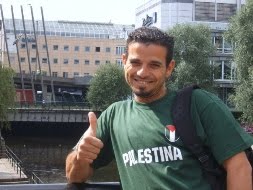 Members of the Palestinian media today demonstrated in Gaza City to draw attention to violence against journalists, particularly the case of Mohammad Othman, shot by Israeli soldiers while covering the Al Nakba commemoration at the Erez crossing a year ago.


 Aletho News

