US now openly admits its goal in Syria is to make it ‘difficult’ for Moscow and Damascus to defeat terrorists
By Nebojsa Malic | RT | March 10, 2020
The State Department’s special envoy for Syria has just admitted that the US aims to defend jihadist militants in Idlib against ‘Russian aggression,’ proving once again that the swamp in Foggy Bottom is alive and well.
Russia and the Syrian government “are out to get a military victory in all of Syria,” Ambassador James Jeffrey told reporters on a conference call out of Brussels on Tuesday. “Our goal is to make it very difficult for them to do that by a variety of diplomatic, military, and other actions.”
To illustrate these methods, Jeffrey cited the US threat to respond “in a very savage military way” against any chemical attacks, which he described as “a favorite tactic of the Syrian regime in making advances.” This is factually untrue, since the alleged attacks always happen after Syrian Army victories, as a pretext for US intervention.
Jeffrey also noted that there are US and coalition troops in parts of Syria – officially there to fight Islamic State (IS, formerly ISIS), but in actuality “guarding” the oil fields. He tellingly described their presence as “a complication” for the Syrian government.
Jeffrey and US ambassador to Turkey David Satterfield were in Brussels after Turkish President Recep Tayyip Erdogan’s visit, to discuss ways the US and NATO can help Ankara protect its pet militants in their last remaining redoubt – Syria’s Idlib province.
But while Satterfield described Idlib as containing “three million-plus innocent civilians, the majority of whom are women and children,” and accused “Russian aggression” of seeking to displace them, listen to how Jeffrey chose to describe the situation, when asked by a CNN reporter if NATO was considering sending in ground troops:
“I think you can forget ground troops. Turkey has demonstrated ably that it and its opposition forces are more than capable of holding ground on their own.”
This is either appallingly ignorant or downright delusional, as the Syrian army had successfully rolled up the Turkish-backed militants and the ceasefire Ankara agreed to in Moscow last week confirmed that.
The real revelation here is that the militants are described as Turkey’s “opposition.” Contrast this with the words of Colonel Myles Caggins, spokesman for the anti-ISIS coalition’s military arm, just three weeks ago: “Idlib province seems to be a magnet for terrorist groups, especially because it is an ungoverned space in many ways,” Caggins told Sky News. “There are [a] variety of groups there — all of them are a nuisance, a menace and a threat to… hundreds of thousands of civilians who are just trying to make it through the winter.”
Bear in mind that Jeffrey doubles as Washington’s special envoy to the coalition against IS, that infamous Schroedinger entity that either doesn’t exist any more – when US President Donald Trump seeks to claim victory against the self-proclaimed caliphate – or is about to make a resurgence big time and requires US military presence in perpetuity to prevent that, as the State Department and the Pentagon prefer to see it.
Needless to say, this entrenched insistence on legacy policies doesn’t do much for Trump’s promise to pull out US troops from “endless wars” in the Middle East.
Neither Jeffrey nor Satterfield, nor any of the reporters asking them questions, mentioned even once the existence of Hayat Tahrir al-Sham – the latest incarnation of the notorious Al-Nusra, an Al-Qaeda affiliate whose fighters dominate the ranks of the militants in Idlib. Listening to them, one might think it doesn’t exist!
Jeffrey and Satterfield openly admit that an outright Syrian victory over these terrorists would deny the “international community” – as they style the US and its allies – the leverage to insist on regime change in Damascus. Which is incredibly rich in irony given that the sole legal pretext on which the US has any troops in Syria, in open violation of international law, is a congressional authorization to use force against… Al-Qaeda.
If You Like War, You’ll Love Joe
By Arshad Khan | CounterPunch | March 10, 2020
Like a cat with nine lives, Joe Biden keeps returning to the presidential race with a consistency akin to his votes for war — hard to find a war Joe did not like.
He voted for the Iraq war, still running in one form or another with American troops on the ground — despite a vote in the Iraqi parliament for their withdrawal. As Obama’s vice-president, his hands are soiled with the bombings and killings in Yemen; extending the Afghan war by increasing US force levels there; the airstrikes in Syria; and the death and destruction in Libya that included the wanton bombing of the hugely expensive system to transport water from the south to the capital, Tripoli.
It has been calamitous for these countries. They have suffered millions of dead and wounded, many, many more millions displaced, and a refugee problem that is straining EU ties and its policy of open borders. Economic migrants from Africa used to come to a previously prosperous Libya, work a while, then return home. With Libyan opportunities gone, they continue on to Europe from where it is difficult to return home, so they stay becoming permanent immigrants.
In fact, if we examine Europe’s refugee problem, a good portion of the blame rests with US wars. The migrants are from Afghanistan and its spillover in Pakistan; they come from Iraq, from Somalia, from Syria, from Libya, and from adjoining countries.
How much of all this included Joe Biden? Over 30 years practically everything, particularly for someone who proudly proclaims himself a ‘patriot’ … read support for every war. Yet during the Vietnam war he received student draft deferments, then asked to be reclassified because of asthma when he was a teen.
Accused of plagiarism in law school, he claimed he was confused about the rules for citation. He was given an F, and had to retake the course — the F later expunged from his transcript. He was also caught lifing phrases from others in his speeches causing him to drop out of the 1988 presidential nomination race. What is worrisome is that the last was carefully contrived to build a persona, as David Greenberg described in Slate (“The Write Stuff”, August 25, 2008). It is worth reading for it indicates a habit of mind that is lacking in ethics, perhaps just the kind corporate elites would prefer in the White House.
Poor Bernie. What chance does he have against the choice of corporate bulldozers and their associated media, the latter now painting him as a Russian agent? As propagandists maintain, the more ridiculous the story, the more believable it is in the public marketplace.
Before the current crop of Buttigiegs and the if-he-can-run-so-can-I types and, of course, Bernie and Warren splitting the progressive vote, Joe Biden had never won a presidential primary despite many, many attempts. South Carolina was the first, and now he has topped that with nine more on Super Tuesday this week.
In Joe’s dotage, unable to complete sentences or quotes, changing Super Tuesday into a ‘Super Thursday’, the onset of dementia has to be obvious. But then how many actually hear him speak or watch debates?
Nothing left but to hunker down and prepare ourselves for four more years of Trump. An addled, demented nominee is unlikely to be much of a challenge.
Arshad M. Khan is a former professor who has, over many years, written occasionally for the print and often for online media outlets.
All-star warmonger Lindsey Graham urges NATO to ‘get more involved’ in Idlib, Syria to stop ‘Syrian aggression’
RT | March 10, 2020
Veteran chickenhawk Lindsey Graham once again beat his over-used war drum, this time because he wants NATO to get involved in Idlib, Syria to stop “Syrian aggression.” Yes, when will Syria stop intervening in its own country?
The South Carolina senator said that he fully supports US President Donald Trump’s efforts to “get NATO more involved in Syria,” arguing that the defensive alliance should aid Turkey as it “defends Idlib against Russian/Syrian aggression.” He further argued that the “fall” of Idlib would result in a humanitarian crisis felt around the world, which is why NATO should be more “supportive” of its Turkish ally.
The senior statesman apparently doesn’t seem particularly fazed by the fact that Idlib is part of Syria – making accusations of “Syrian aggression” slightly nonsensical. The province is now home to the last bastion of extremist jihadist militias, some of which are directly affiliated with Al-Qaeda.
This is hardly the first time that the US hawk has demanded direct intervention in Idlib. In February, he called on the Pentagon to impose a no-fly zone over the Syrian province, claiming it would help stop the “destruction” of Idlib by Syrian, Iranian, and Russian forces.
As far back as September, Graham was issuing statements warning over “the wholesale massacre” of civilians in Idlib, insisting that “we either act now [in Syria] or pay a heavy price later.”
The senator’s melodramatic representation of a terrorist-infested Syrian province being under siege by the Syrian military shouldn’t come as a surprise to US political observers. Graham has been portrayed as part of former Arizona Senator John McCain’s “foreign policy club” – a euphemism for hardcore neocon interventionism.
Last week, Turkey and Russia brokered a ceasefire in the region, ending the fighting between Syrian and Turkish forces. But this hasn’t stopped the United States from trying to raise the stakes in northwestern Syria. The US reportedly offered to provide Turkey with ammunition to help in the conflict in Idlib. Turkish Foreign Minister Mevlut Cavusoglu said on Tuesday that Washington also offered land, sea, and air intelligence regarding the northwestern region. Although US “assistance” remains moderate at the moment and Graham’s fantasy of a NATO operation in Idlib seem unlikely, the warmongering section of US politics remains strong and its efforts to get Washington into more bloody conflicts with the blessings of the military-industrial complex are not likely to stop any time soon.
Intra-Afghan dialogue gets kickstarted
By M. K. BHADRAKUMAR | Indian Punchline | March 10, 2020
Three significant things about Ashraf Ghani’s swearing-in ceremony in Kabul on Monday augur well for the implementation of the US-Taliban pact signed in Doha on February 29.
One, the US officials, civilian and military, made a full court appearance at the ceremony in Kabul, affirming their reconciliation with Ghani. The US special representative for Afghan reconciliation Zalmay Khalilzad and US General Scott Miller, the commander of the US-led international force in Afghanistan, attended Ghani’s inauguration, apart from the EU, UN and western diplomats.
Two, Pakistan Prime Minister Imran Khan felicitated Ghani. He wrote on his Twitter page,“[I] look forward to working with him [Ghani]. Pakistan will do everything it possibly can to bring peace and stability in our region.”
Islamabad and Washington held back from congratulating Ghani when his election victory was formally announced last month. Now they are moving in tandem to engage with the Ghani presidency.
Three, Ghani announced in his speech at the ceremony that he will issue an order on Tuesday itself on the release of the Taliban prisoners. Ghani expressed the hope that the Taliban will reciprocate by significantly reducing violence. Thereby, Ghani is signalling that he will not block intra-Afghan dialogue.
Furthermore, he added that the government’s negotiating team for the intra-Afghan dialogue will also be finalised by Tuesday.
What may be even more significant than the above is that the Taliban is not creating a ruckus over Ghani’s inauguration. A senior figure in the Taliban leadership, Amir Khan Motaqi who is based in Qatar sounded optimistic that peace negotiations with the Afghan government will be “easier” than the Taliban’s marathon talks with the United States (which took around a year and a half).
“We will reach a conclusion with Afghans in a better way – of course with Afghans who consider other Afghans’ interests and do not consider foreigners’ interests,” Motaqi said. Another senior Taliban figure, Anas Haqqani, who was freed from Bagram prison last November, called the release of 5,000 Taliban prisoners important and urged the speedy formation of the negotiating team from Kabul so that the intra-Afghan dialogue can commence on March 10, as envisaged under the Doha pact of February 29.
In sum, Ghani’s induction or his change of heart — depending on how one views it — gives traction to the US-Taliban pact signed in Doha.
Contrary to doomsday predictions that the political rift in Kabul between Ghani and the former chief executive Abdullah over the disputed election results — Abdullah held his own inaugural ceremony in Kabul on Monday — would undermine the US-Taliban pact, the opposite seems to be happening.
Ghani’s brinkmanship in recent weeks served its real purpose, which was to get US support for his presidency and also carve out for himself an influential role in the inter-Afghan dialogue.
Pakistan and the Taliban have wisely kept away from getting embroiled in the Ghani-Abdullah rift and left it to Khalilzad to pacify Ghani.
Ghani apparently didn’t need much persuasion to do the two things that are Khalilzad’s top priority — release of the prisoners and the launch of the intra-Afghan dialogue. It is a fair guess that Khalilzad has struck some sort of deal with Ghani regarding the uncertain future role of the latter’s presidency.
The Taliban’s flexibility to hold talks with the Afghan government could be one factor here. Conceivably, Pakistan would have persuaded the Taliban to show flexibility.
If so, this is brilliant a tactic on the part of Islamabad and the Taliban. For, once the intra-Afghan dialogue begins, a new dynamic will appear in any case, and, given the fragmentation in the opposite camp, with so many cliques and factions jostling for position, Taliban would have the inherent advantage of being the only cohesive group at the negotiating table.
US President Donald Trump acknowledged these ground realities when he said on March 6 while talking to reporters at the White House that the Taliban could “possibly” overrun the Afghan government after foreign troops withdraw from the country as part of the Doha agreement.
As Trump put it, “Countries have to take care of themselves. You can only hold someone’s hand for so long.” Asked if the Taliban could eventually seize power from the current US-backed government, Trump said it is “not supposed to happen that way but it possibly will.”
This is of course a hypothetical scenario, since it will not be in Pakistan and Taliban’s interest to grab power forcibly in Kabul. It is useful to remember how much the Taliban hankered after US and UN recognition for its regime in Kabul in the nineties.
Significantly, the joint statement on the US-Taliban pact agreed by Special Envoys and Special Representatives of the European Union, France, Germany, Italy, Norway, the United Kingdom, the United Nations and the United States of America on the occasion of the signing of the U.S.-Taliban Agreement in Qatar spells out the expectations regarding the Afghan transition and it is quite obviously based on the understanding reached between Khalilzad and the Taliban.
The following paragraphs merit attention:
- “Reaffirmed that the Islamic Emirate of Afghanistan is not recognised by the international community, and furthermore, the international community will not accept or support the restoration of the Islamic Emirate of Afghanistan.”
- “Welcomed the Taliban committing to join a political process and their prospective role in a new post-settlement Afghan Islamic government as determined by the intra-Afghan negotiations.”
However, there is the “known unknown”— how far the fragile Afghan state structure will hold through the stresses and strains of the period ahead — negotiations with the Taliban and a period of profound transition to an entirely new beginning of state-building.
Importantly, Abdullah’s coalition which opposes Ghani is also a coming together of non-Pashtun groups — Tajik, Hazara and Uzbek. The ethnic overtone is ominous.
When asked whether the Afghan government had the ability to defend itself from fighters after foreign forces pull out, Trump was brutally frank: “I don’t know. I can’t answer that question. We’ll have to see what happens.”
Indeed, what happens next will also significantly depend on Abdullah’s future moves. He and his associates have thrown their weight behind the intra-Afghan dialogue but it is unlikely they will accept Ghani’s leadership to navigate the peace process.
To be fair, Khalilzad tried hard for a Ghani-Abdullah reconciliation, but it didn’t work. The bitterness lingers because this was a patently rigged election and Ghani doesn’t have a legitimate mandate to rule.
Meanwhile, the drawdown of the US troops has begun. Washington is unlikely to get entangled in Afghan domestic politics. To quote Trump, “We can’t be there for the next 20 years. We’ve been there for 20 years and we’ve been protecting the country but we can’t be there for the next – eventually, they’re going to have to protect themselves.”
Washington’s focus is going to be on the reduction in violence (ceasefire) and on verifiable evidence of the Taliban’s commitment to severe links with al-Qaeda.
The bottom line is, as the sensational report by New York Times on Sunday — A Secret Accord with the Taliban: When and How US Would Leave Afghanistan — confirms, the Doha pact is only the tip of the iceberg.
A matrix of understanding between the US, Pakistan and the Taliban provides the underpinning for the incoming Afghan peace process and the road map leading to a transition, based on their mutual recognition of the legitimate interests of all three protagonists.
Hung jury results in mistrial for former CIA tech accused of handing ‘Vault 7’ docs to WikiLeaks
Assange trial rehearsal?
RT | March 10, 2020
Federal prosecutors were unable to convince a jury on any of the spying-related charges against an ex-CIA engineer accused of stealing reams of classified material – in what may be a dry run for the case against Julian Assange.
In a significant blow to prosecutors on Monday, jurors failed to come to a verdict on eight central counts against former CIA software engineer Joshua Schulte, who was charged for stealing thousands of pages of classified information on the agency’s secret hacking tools and passing them to WikiLeaks – what later became its ‘Vault7’ release, the largest breach of classified material in CIA history.
While Schulte was found guilty of contempt of court and making false statements to investigators, a hung jury on the remaining eight charges – including illegal gathering and transmission of national defense information – prompted District Judge Paul Crotty to order a mistrial and dismiss the jurors on the case, who had deemed themselves “extremely deadlocked” in a note to the judge.
The split verdict came after nearly a full week of messy deliberations, which saw one juror removed for researching the facts of the case against Crotty’s orders. She was never replaced, however, leaving a short-handed panel to deliver a final decision.
The former technician left his job in the CIA’s Langley headquarters in 2016 and was charged some two years later for his alleged role in the Vault 7 leak. But prosecutors had difficulty tying Schulte to the disclosure throughout his four-week trial, with jurors often mystified by a complicated maze of technical evidence.
The case may offer parallels to that of WikiLeaks co-founder Julian Assange, who faces 17 charges under the World War I-era Espionage Act and up to 175 years in prison over his role in the publication of the Iraq and Afghan war logs in 2010. Assange is accused of helping leaker Chelsea Manning (then known as Bradley) “hack” into military computers to obtain classified material, but if extradited from the UK to stand trial in an American courtroom, prosecutors would likely produce similar technical forensics to prove his involvement, precisely what the government was unable to do in Schulte’s case.
Arguing that the CIA’s computer network had widely known vulnerabilities, including poor password protections, Schulte’s defense insisted prosecutors had failed to prove his role in the breach. They noted it was possible another actor gained access to his work station, pointing to another CIA employee identified only as “Michael” as a potential culprit.
The CIA later placed the employee on administrative leave for refusing to cooperate with the investigation, which suggested the government had “doubt about the case against Mr. Schulte,” defense attorney Sabrina Shroff said in her closing argument on Monday.
Prosecutors are likely to demand a retrial for Schulte, and he still stands accused of possessing child pornography, allegedly stored on devices found during a search of his home. He will be tried separately on those charges, facing a total of 15 counts.
Joe Biden: Father of the Drug War’s Asset Forfeiture Program
By Chris Calton – Mises Institute – 03/06/2020
In 1991, Maui police officers showed up at the home of Frances and Joseph Lopes. One officer showed his badge and said, “Let’s go into the house, and we will explain things to you.” Once he was inside, the explanation was simple: “We’re taking the house.”
The Lopses were far from wealthy. They worked on a sugar plantation for nearly fifty years, living in camp housing, to save up enough money to buy a modest, middle-class home. But in 1987, their son Thomas was caught with marijuana. He was twenty-eight, and he suffered from mental health issues. He grew the marijuana in the backyard of his parents’ home, but every time they tried to cut it down, Thomas threatened suicide. When he was arrested, he pled guilty, was given probation since it was his first offense, and he was ordered to see a psychologist once a week. Frances and Joseph were elated. Their son got better, he stopped smoking marijuana, and the episode was behind them.
But when the police showed up and told them that their house was being seized, they learned that the episode was not behind them. That statute of limitations for civil asset forfeiture was five years. It had only been four. Legally, the police could seize any property connected to the marijuana plant from 1987. They had resurrected the Lopes case during a department-wide search through old cases looking for property they could legally confiscate.
Asset forfeiture laws once applied only to goods that could be considered a danger to society—illegal alcohol, weapons, etc. But with the birth of the modern war on drugs, lawmakers pushed for something with more teeth, which they achieved with the 1970 passage of the Racketeering Influence and Corrupt Organizations (RICO) Act. Although many are familiar with the story of the steady expansion of civil asset forfeiture laws, many overlook the fact that presidential candidate Joe Biden helped put these laws on previously apathetic law enforcement agents’ radar and, worse, played a significant role in broadening their application. Biden has effectively aided and abetted the police state’s sustained assault on American subjects’ property rights.
Expanding Asset Forfeiture, Phase I: The RICO Act of 1970
In 1970, the targets of asset forfeiture were wealthy crime bosses. It was prosecutor G. Robert Blakey, who had worked under Attorney General Robert Kennedy and various congressmen, who set about broadening its scope. He helped draft a bill for a new legal concept, “criminal forfeiture,” which would allow police to seize the illegally acquired profits of a convicted criminal.
The assets that could be seized would now consist of anything that was funded with money connected to criminal activity. To appease those who were worried about abuses of power, Blakey assured them that prosecutors would have to prove beyond a reasonable doubt that the criminal was guilty of a crime before the assets could be seized. There was nothing to worry about; only legitimate bad guys would suffer.
The new policy was passed as part of the Racketeering Influence and Corrupt Organizations (RICO) Act in 1970. Blakey was a fan of the 1931 movie Little Caesar, and the acronym was crafted to honor Blakey’s favorite character from the movie, the gangster Rico Bandello.
The RICO Act wasn’t designed to be part of the war on drugs; it was just meant to target criminals. But when Richard Nixon took office, the RICO Act was one of a number of new tools that the members of his newly created Bureau of Narcotics and Dangerous Drugs (precursor to the Drug Enforcement Administration (DEA)) could use to fight his drug war. Combined with other legal innovations, such as no-knock raids and mandatory minimum sentences, Nixon and his administration would cure America of the drug menace.
Still, the pesky “conviction” requirement stood in the way of law enforcement’s ability to seize criminal assets. In 1978, Jimmy Carter’s director of the Office of Drug Abuse (the title “drug czar” is often retroactively applied), Peter Bourne, decided that the law needed to be changed. Bourne learned of an incident at the Miami International Airport in which a suitcase had been left on the baggage carousel for three hours before police picked it up and found $3 million inside. If drug kingpins could afford to abandon so much money, they must be flush with enough cash to hardly worry about criminal forfeiture laws.
So, at Bourne’s urging, Congress modified the RICO Act to allow the DEA to confiscate assets without a conviction. The burden of proof wasn’t entirely gone (yet), but the government only needed an indictment, rather than a full conviction, to justify asset seizure. After all, the government knew who a lot of these kingpins were, but the criminals continued to get rich while the DEA struggled to build cases against them.
Even then, though, real estate was off limits. Asset forfeiture had evolved from the seizure of dangerous items into criminal profit following a conviction, and now into criminal profit (and its “derivative proceeds”) without the conviction requirement. But real estate—such as the Lopes house—still couldn’t be touched.
But through the 1970s, the RICO Act was still largely ignored by prosecutors. Blakey was holding seminars out of Cornell University, which were attended by federal law enforcement agents and prosecutors, urging them to take advantage of the RICO Act in the war on drugs. He made few inroads. The law was unwieldy, and prosecutors were overworked. More often than not, it wasn’t worth their time. While Blakey was proselytizing the virtues of his law to little effect, he was unwittingly gaining an ally in Congress: Senator Joe Biden.
Expanding Asset Seizure, Phase 2: Biden and the Comprehensive Crime Control Act of 1984
Biden, a young Senator from Delaware, had to do something to show that despite his “liberal” reputation, he could be just as tough on crime as his Republican colleagues. He took notice of the RICO Act, and he realized that law enforcement agencies were not taking advantage of it, particularly in waging the drug war. He turned to the General Accounting Office and asked them to produce a study on the potential uses of RICO for drug enforcement.
The report showed that the RICO Act granted enormous powers to police to confiscate drug-related assets but that these powers were not being taken advantage of: “The government has simply not exercised the kind of leadership and management necessary to make asset forfeiture a widely used law enforcement technique,” the report stated. By the time the report came in, Ronald Reagan was settling into office and getting ready to renew the war on drugs.
Reagan brought the FBI into the drug war, and he gave the director, William Webster, a mission. His agents would use the powers of the RICO Act to find drug rings and take away their assets. Drug cartels must be rendered unprofitable. As the 1980s progressed, the war on drugs would be the country’s biggest political issue. Politicians from both parties would work to show that they could out–drug warrior their opponents. One Democratic representative from Florida, Earl Hutto, said, “In the war on narcotics, we have met the enemy, and he is the U.S. Code.”
Biden brought the RICO law to the attention of the federal government, Reagan enlisted the FBI to use it against drug traffickers, and both parties would now work to dismantle any limitations that the law might still impose.
The drug war became a contest of political one-upmanship. Reagan’s Justice Department fought for all kinds of new powers. Attorney General Edwin Meese and Assistant Attorney General William Weld (yes, that Bill Weld) railed against the limitations on their legal prerogative. Weld went so far as to argue in favor of the legality of using the Air Force to shoot suspected drug-smuggling planes out of the sky, a policy that even his boss was unwilling to endorse.
But Meese, Weld, and everyone else seemed to agree that forfeiture laws didn’t go nearly far enough. By requiring an indictment, the government still had to meet some standard of reasonable guilt before seizing property, which allowed far too many criminals that law enforcement knew to be guilty (but couldn’t build a case against) to keep their ill-gotten gains. To take things further, the Justice Department argued that law enforcement should be allowed to take “substitute” property: they knew that they wouldn’t be able to take everything that had been paid for with drug money, so it stood to reason that they should be able to take legally acquired assets of equal value (however that might be determined). And finally, with real estate off limits, the government was unable to seize marijuana farms, drug warehouses, and criminal homes.
The Comprehensive Forfeiture Act fixed all of these problems. Biden introduced the new bill in 1983, and its provisions became law the next year. Under this law federal agents had nearly unlimited powers to seize assets from private citizens. Now the government only needed to find a way to let local and state police join the party.
Biden’s bill was passed as part of the 1984 Comprehensive Crime Control Act. In addition to a slew of new powers for prosecutors, the burden of proof for asset seizure was lowered once again (agents had to only believe that what they were seizing was equal in value to money believed to have been purchased from drug sales). More significantly, the bill started the “equitable sharing” program that allowed local and state law enforcement to retain up to 80 percent of the spoils.
The law took effect in 1986, the year before Thomas Lopes pled guilty to charges of growing a marijuana plant in his parents’ backyard. In 1987, when Thomas faced the judge, the government had just made it so that his local police had an enormous incentive and unchecked authority to seize property from private citizens, so long as they could show any flimsy connection to drugs. By 1991, the Maui police were running out of easily seized property, so they started combing through case files within the five-year limit to find new sources of enrichment for their precinct using the expanded RICO powers. One such file brought the Lopes home to their attention.
But the Lopeses are only one example out of millions. In the year their home was confiscated by police for a minor, four-year-old drug charge, $644 million in assets were seized. In 2018 alone, the Treasury Department’s Forfeiture Fund saw nearly $1.4 billion in deposits . The Lopes story merely illustrates that criminals (regardless of how one might feel about drug laws) are hardly the only people falling victim to this policy.
The decades-long abuse of this policy has reached such extreme proportions that people on all sides of the political aisle have been turning against it. At this writing (February 20, 2019 for the original version of this article), the Supreme Court has unanimously voted in favor of Tyson Timbs , whose $42,000 Land Rover was seized in 2015 following a conviction for selling $400 in heroin. The court is asserting that asset forfeiture constitutes a fine and that the Eighth Amendment—which protects citizens from excessive fines—applies to both state and local governments. The consequences of the ruling remain to be seen, but it seems nearly certain that the unanimous decision was motivated by the increasing outrage against the civil asset forfeiture policies.
In the fight against the egregious violation of property rights that is asset forfeiture, Americans must not forget who promulgated these laws and birthed a new paradigm of government aggression against private persons that is proving difficult to overturn.
References
Baum, Dan. 1996. Smoke and Mirrors: The War On Drugs and the Politics of Failure. Boston: Little, Brown and Company.
Chris Calton is a 2018 Mises Institute Research Fellow and an economic historian. He is writer and host of the Historical Controversies podcast.
See also his YouTube channel here.
US marines arrive on Yemen’s Socotra to support UAE forces
MEMO | March 9, 2020
A new batch of US Marines arrived on the Yemeni island of Socotra on Saturday, according to local sources, installing Patriot defence systems.
Sanaa Post reported that the American soldiers were received by the “occupying” UAE forces at their headquarters on the island.
There is speculation that the US intends to establish its own military base amid reports that America had sent military experts to equip observation points to deploy radars and air defence points on the strategically located island overlooking the Arabian Sea and the Indian Ocean.
US forces had previously arrived on Socotra in December of last year and reportedly started installing a Patriot missile system in order to protect the Saudi and Emirati forces on the island at the time.
According to the sources, on 21 December of last year, Saudi Crown Prince Mohammed Bin Salman ordered the UN-recognised, exiled Yemeni government of President Abd Rabbuh Mansur Hadi to lease the entire island to the UAE for a period of about 95 years. Saudi and Emirati forces began to arrive on the island in April 2018, the Saudi deployment was reportedly coordinated with the Yemeni government, whilst the UAE arrived without prior coordination with the Saudi-backed Yemeni authorities.
Saudi arms imports increased by 130%
MEMO | March 9, 2020
The global arms industry has enjoyed a major boon period over recent years with the rise of tension and military conflict across the globe.
The US has seen the largest financial windfall from the sale of arms while Saudi Arabia continues to be the world’s largest importer of arms according to a new report released today by the Stockholm International Peace Research Institute (SIPRI).
According to SIPRI, which keeps the only publicly available database on the transfer of arms, “arms imports by countries in the Middle East increased by 61 per cent between 2010-14 and 2015-19, and accounted for 35 per cent of total global arms imports over the past five years.”
Saudi Arabia has seen a 130 per cent increase compared with the previous five-year period making it the world’s largest arms importer in 2015-19. The volume of weapons purchased by Riyadh accounted for 12 per cent of the global arms imports in that period.
The USA and the UK remain the main source of arms for the kingdom. A total of 73 per cent of Saudi Arabia’s arms imports came from America while 13 per cent of its arsenal were supplied by UK, despite major concerns in both countries over Riyadh’s military intervention in Yemen.
The United Arab Emirates (UAE), which has been militarily involved in Libya as well as Yemen over the past five years, was the eighth-largest arms importer in the world between 2015-19. The US supplied two-thirds of the arms imported by Abu Dhabi.
SIPRI noted that in 2019, when foreign military involvement in Libya was condemned by the United Nations Security Council, the UAE had major arms import deals ongoing with a number of other countries including, the UK, Australia, Brazil, Canada, China, France, Russia, South Africa, Spain, Sweden and Turkey.
Turkish arms imports were 48 per cent lower between 2015-2019 than in the previous five-year period, even though its military was fighting Kurdish rebels and was involved in the conflicts in Libya and Syria. The SIPRI report explained that the reason for this decrease was due to delays in deliveries of some major arms; the cancellation of a large deal with the USA for combat aircraft; and developments in the capability of the Turkish arms industry.
The main supplier of weapons worldwide is still the US, which has increased its arms exports by 23 per cent, according to SIPRI.
Anti-Interventionist Think Tank’s Debut is a Dud
By Gareth Porter | Consortium News | February 28, 2020
Given the current epochal political upheaval against entrenched political-economic elites driven in part by popular discontent over endless U.S. wars, the debut of the anti-interventionist Quincy Institute on Wednesday should have been an explosive event.
But it seemed more like a toy pop gun than a political bombshell.
Perhaps that was the intention of Quincy’s leadership. The organization, whose full name is the Quincy Institute for Responsible Statecraft, has eschewed an all-out attack on the national security elite in favor of the catch-phrase “realism and restraint.” That doesn’t raise the flag of political struggle against the existing policymaking system but rather suggests it will merely nibble at its edges.
So, one shouldn’t be shocked that Quincy’s first policy event was a partnership with Foreign Policy magazine, whose editorial slant is decidedly aligned with the interests of the dominant national security elite. It was Foreign Policy magazine that advanced the idea of having former CIA Director Gen. David Petraeus as the big name draw for the conference, according to people familiar with the origins of the conference.
Quincy needed a way to highlight the weaknesses of the status quo elite’s ideas and the power of its own alternative, and a debate between Petraeus and a highly articulate opponent of his position and argument would have done that. That was a talking point for the defense of Petraeus as a representative of the war system offered by one Quincy officer in advance of the conference.
But Petraeus was not about to agree to any such exercise. He is used to speaking from a position of power and not having to defend against sharp rebuttals and tough arguments. A one-on-one debate with an articulate opponent would have exposed him even more clearly as a vacuous windbag.
Softballs for Petraeus

Foreign Policy’s Editor-in-Chief Jonathan Tupperman. (Twitter)
Instead of witnessing such a riveting confrontation, the audience got Petraeus being fed softball questions from FP Editor-in-Chief Jonathan Tupperman and giving carefully memorized answers, including what he called “five big ideas we should have learned” (examples: “Ungoverned spaces will be exploited by Islamist extremists;” “The United State has to lead.”) [This from Petraeus who once said the U.S. was right to partner with al-Qaeda in Syria.]
That format allowed Petraeus to answer Tupperman’s question whether the United States can continue to use military force to maintain the “liberal world order” in light of the popular support for President Donald Trump and Democratic presidential contender Senator Bernie Sanders by claiming smugly, “I’m for restraint as well,” then adding the lamest line of the day (which he apparently thought was clever): “We should be for more restraint until we shouldn’t be.”
Then the Petraeus segment was over, with Tupperman observing that there was no time left for audience questioning of the man still venerated in a regime of worshipful media coverage of Iraq and Afghanistan as the man that had saved us from defeat in Iraq and had been successful in Afghanistan until he wasn’t successful. The mysterious failure of Tupperman to have left time for questions averted any possibility of someone in the audience recalling how Petraeus had played a crucial role in the unfolding of sectarian violence in Iraq by arming and training a sectarian Shiite militia — the Wolf Brigade — that was then sent into virtually every major Sunni population center in 2004-05.
Then Representative Ro Khanna, the smartest and most articulate congressional advocate for a non-interventionist viewpoint, laid out in an exchange with Cato Institute supporter Will Ruger a sharp critique of U.S. military interventions in the Middle East, starting with the enormous boost that U.S. interventions gave to the previously weak al Qaeda, which went from a presence in three countries before 9/11 to 23 countries today.
Debate Stifled
It was a thoughtful and persuasive case for a sharp turn in U.S. policy. But there was no real debate with Petraeus. In the absence of debate, the conference lacked any dramatic moment announcing the arrival of a powerful new voice for radical change in U.S. policy.
Much of the rest of the conference, moreover, had a tenor and pace reminiscent of many dozens of Washington think tank events on national security policy attended by this writer for years before giving them up a few years ago. That’s because it consisted of brief and almost always polite exchanges between advocates of new policies and representatives of centrist think tanks that are deeply enmeshed in those policies and the institutional interests underlying them.
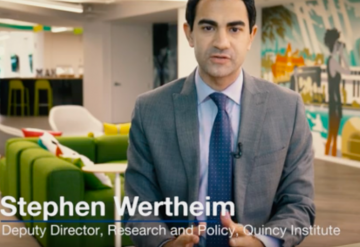 The closing session pitted Quincy Institute Deputy Director Stephen Wertheim against Rosa Brooks of New America and Tom Wright of the Brookings Institution, both of whom rejected the very idea of ending America’s existing wars. They argued that the U.S. troops in Iraq and Syria are really “counter-terrorism operations” rather than “wars.” Brooks even uttered the word identifying her as a member of the national security elite in good standing by calling for a “robust” policy.
The panel billed as “A New Vision for America’s Role in the World” didn’t actually offer that at all. That phrase turned out to be simply a convenient catch-all for the views of foreign policy advisers to both Bernie Sanders (Matt Duss) and former Vice President Joe Biden (former NSC official Julianne Smith), neither of whom articulated anything resembling a new policy vision.
Ironically, on the day that Politico’s “Morning Defense” reported Sanders’ clear lead in the Democratic race had triggered fears among military contractors of “an unprecedented threat to the status quo,” the most daring suggestion from Duss was that Sanders was for diplomacy with Iran.
Military ‘Wants Out’
There were a few moments that unexpectedly elevated the discussion well above the usual humdrum Washington think tank chatter. In a panel on the Middle East independent journalist Mark Perry, who has long had access to senior military officers on background, reported that his military contacts “want out” of the wars in the Middle East.
He added, moreover, that Trump has those officers’ trust, because they believe he wants out, too. But Perry’s most important contribution was to challenge the whole idea that the United States is capable of accomplishing anything positive with its serial military interventions in the Middle East. “We can’t do this,” said Perry, “so what are we doing?”
No Full, Unfettered Analysis
The lesson of Quincy’s debut seems reasonably clear: You can’t hope to disrupt the national security elite’s grip on policy by playing by the establishment’s rules. Foreign Policy was never going to agree to a format that would permit a direct confrontation over the key issues, much less, a full, unfettered analysis of the system of power that underlies that elite’s public role in defending America’s endless wars.
An organization devoted to attacking its illicit and increasingly unpopular policies can only gain traction by offering an analysis that will appeal to the anti-elite sentiments that have already shaken the U.S. political system to its foundations.
That would mean going beyond “realism and restraint” and talking about the need for fundamental change in the system of national security institutions themselves. Of course, taking that lesson on board might not be in line with the thinking of major funders. It could imply a major reorganization and even a much smaller staff. But if it doesn’t heed the lesson of its initial conference, Quincy is likely to find that the real action in bringing about change in U.S. foreign and policy is coming from political forces involved in the larger national power struggle.
Syria Debacles Epitomize Perpetual Perfidy of U.S. Foreign Policy
By James Bovard | Future of Freedom Foundation | March 6, 2020
Turkey is ratcheting up its invasion of Syria and trying to drag NATO into Erdogan’s personal rehabilitation scheme. Threats and counter-threats are flying as thickly as the bombs and bullets. It remains to be seen whether U.S. policymakers will blunder deeper into this quagmire.
Last October, the Washington establishment was aghast when President Trump appeared to approve a Turkish invasion of northern Syria. The U.S. was seen as abandoning the Kurds, some of whom had allied with the U.S. in the fight against ISIS and other terrorist groups. But the indignation over the latest U.S. policy shift in the Middle East is farcical considering the long record of U.S. double-crosses. Rather than the triumph of American idealism, recent U.S. policy has been perpetual perfidy leavened with frequent doses of idiocy.
Almost none of the media coverage of the Turkish invasion and flight of Kurdish refugees mentioned that President George H. W. Bush had urged the Kurds and other Iraqis to “take matters into their own hands and force Saddam Hussein, the dictator, to step aside” during the U.S. bombing campaign in 1991 in the first Gulf War. After it became clear that the U.S. military could not protect the Kurds from Saddam’s backlash, U.S. policymakers basically shrugged and moseyed along. As a CNN analysis noted in 2003, “Bush refrained from aiding Kurdish rebels in the north, although he finally sent troops and relief supplies to protect hundreds of thousands of fleeing Kurds who were in danger of freezing or starving to death. Bush has never regretted his decision not to intervene.” George H.W. Bush’s abandonment and betrayal of the Kurds did nothing to deter the media and political establishment from posthumously sainting him after he died in late 2018.
U.S. meddling in the Middle East multiplied after the 9/11 attacks. Even though most of the hijackers were Saudis who received plenty of assistance from the Saudi government, the George W. Bush administration seized the chance to demonize and assault Saddam Hussein’s Iraqi regime. President Bush portrayed his invasion of Iraq as American idealism at his best. In his May 1, 2003 “Mission Accomplished” speech abroad the USS Abraham Lincoln, Bush hailed “the character of our military through history” for showing “the decency and idealism that turned enemies into allies.” Speaking three weeks later at a Republican fundraiser, Bush bragged, “The world has seen the strength and the idealism of the United States military.” Washington Post columnist David Ignatius declared in late 2003 that “this may be the most idealistic war fought in modern times.” The torture scandal at Abu Ghraib and elsewhere in Iraq has not been permitted to deter the recent semi-canonization of George W. Bush by the establishment media.
The Bush administration and their media allies produced one smokescreen after another to sanctify the war. Almost all the pre-invasion broadcast news stories on Iraq originated with the federal government. PBS’s Bill Moyers noted that “of the 414 Iraq stories broadcast on NBC, ABC and CBS nightly news, from September 2002 until February 2003, almost all the stories could be traced back to sources from the White House, the Pentagon, and the State Department.” A 2008 report by the Center for Public Integrity found that “in speeches, briefings, interviews and other venues, Bush and administration officials stated unequivocally on at least 532 occasions that Iraq had weapons of mass destruction or was trying to produce or obtain them or had links to al-Qaida or both.” The report concluded that the “false statements – amplified by thousands of news stories and broadcasts” created “an almost impenetrable din for several critical months in the run-up to war.” Bush’s falsehoods on Iraq proved far more toxic than anything in Saddam’s arsenal. But the exposure of the official lies did not deter Defense Secretary Donald Rumsfeld from equating criticizing the Iraq war with appeasing Adolph Hitler in 2006.
The chaos from the 2003 invasion of Iraq was still spiraling out of control when the Bush administration began seeking pretexts to attack Iran, which Bush had designated part of the “Axis of Evil” in his 2002 State of the Union address. Bush officials and subsequent administration chose to champion the Iranian terrorist group, Mujahideen-e-Khalq (MEK). That organization sprang up in the 1960s and proceeded to kill Americans in the 1970s and to kill large numbers of Iranians in the subsequent decades. A 2004 FBI report noted that MEK continued to be “actively involved in planning and executing acts of terrorism.” NBC News reported in early 2012 that MEK carried out killings of Iranian nuclear scientists and that it “financed, trained and armed by Israel’s secret service.”
That was the same year that a stampede of Washington hustlers took huge payoffs to publicly champion de-listing the MEK as a terrorist organization. As Trita Parsi noted in the New York Review of Books, MEK “rented office space in Washington, held fundraisers with lawmakers, or offered US officials speaking fees to appear at their gatherings. But the MEK did this openly for years, despite being on the US government’s terrorist list.” Federal law prohibited taking money from or advocating on behalf of any designated terrorist group. But, as a 2011 Huffpost headline reported, “Former U.S. Officials Make Millions Advocating For Terrorist Organization.” Former FBI boss Louis Freeh, former CIA boss Porter Goss, co-chair of the 9/11 Commission Lee Hamilton, former attorney general Michael B. Mukasey, former Homeland Security Secretary Tom Ridge pocketing $30,000 or more for brief speeches to pro-MEK events. Glenn Greenwald rightly scoffed that the advocacy for MEK “reveals the impunity with which political elites commit the most egregious crimes, as well as the special privileges to which they explicitly believe they — and they alone — are entitled.” Greenwald pointed that average people were scourged by the same law the pooh-bahs brazenly trampled: “A Staten Island satellite TV salesman in 2009 was sentenced to five years in federal prison merely for including a Hezbollah TV channel as part of the satellite package he sold to customers.”
Thanks in part to the torrent of insider endorsements, the Obama administration canceled the MEK’s terrorist designation in 2012. While Washington poohbahs continue portraying the group as idealistic freedom fighters devoted to democracy, a simple online search shows that the Farsi translation of the group’s name is “holy warriors of the people,” as Ted Carpenter noted in his new book, Gullible Superpower. Trump administration officials have gurgled about MEK’s possible role in ruling Iran after the current government is toppled. But MEK remains odious to the Iranian people regardless of the group’s PR successes inside the Beltway.
The prior pratfalls of U.S. Middle East policy did nothing to stymie the outrage over Trump asserted that he was withdrawing U.S. troops from eastern Syria. Congress showed more indignation about a troop pullback than it had shown the loss of all the American soldiers’ lives in pointless conflicts over the past 18 years. The House of Representatives condemned Trump by a 354 to 60 vote, and Rep. Eliot Engel (D-NY), chairman of the House Foreign Affairs Committee, proclaimed, “At President Trump’s hands, American leadership has been laid low, and American foreign policy has become nothing more than a tool to advance his own interests.” Sen. Richard Blumenthal (D-Conn.) said he felt “horror and shame” over Trump’s action. Boston Globe columnist Stephen Kinzer aptly described Congress’s protest as “a classic example of ‘buffet outrage,’ in which one picks and chooses which horrors to condemn.”
President Barack Obama had promised 16 times that there would be no “U.S. boots on the ground” in Syria; when Obama betrayed that promise, Congress did nothing. Trump’s plans to have fewer U.S. boots on the ground in Syria — or at least in part of it — somehow became the moral equivalent of giving Alaska back to Russia. Pundits attacked politicians who supported the troop pullback as “Russian assets” – i.e., traitors.
Syria offers another reminder that “material support of terrorism” is a federal crime unless you work for the CIA, State Department, Pentagon, or White House. After President Barack Obama, former Secretary of State Hillary Clinton, and former Secretary of State John Kerry all publicly declared that Syrian president Assad must exit power, the U.S. armed terrorist groups to topple Assad. The Obama administration’s beloved, non-existent “moderate Syrian rebels” achieved nothing. The Kurdistan Workers’ Party, the PKK, a prime beneficiary of the U.S. occupation, has been considered a terrorist group by the U.S. government since 1997. Evan McMullin, a 2016 presidential candidate, admitted on Twitter: “My role in the CIA was to go out & convince Al Qaeda operatives to instead work with us.” Such absurdities spurred Rep. Tulsi Gabbard, D-Hawaii, to introduce The Stop Arming Terrorists Act in 2017 to prohibit any U.S. funding of terrorist groups. Gabbard’s bill was mostly ignored and never enacted though her outspoken criticism of U.S. policy did spur Hillary Clinton and others to vilify her.
Prominent politicians and much of the media blamed Trump for the attacks on civilians that followed the Turkish invasion, carried out mainly by groups allied with the Turkish government. U.S.-armed terrorist groups involved in the Turkish invasion have freed Islamic State prisoners. A Turkish think tank analyzed the violent groups committing atrocities in Syria after the start of the Turkish invasion; “Out of the 28 factions, 21 were previously supported by the United States, three of them via the Pentagon’s program to combat DAESH. Eighteen of these factions were supplied by the CIA.” A prominent Turkish journalist observed after his government invaded Syria: “The groups that were educated and equipped by the United States west of the Euphrates are now fighting against the groups east of the Euphrates that have been also educated and equipped by the United States.” This is nothing new: in 2016, Pentagon-backed Syrian rebels have openly battled CIA-backed rebels in Syria. A prominent Assad opponent who organized a conference of anti-Assad groups financed by the CIA was denied political asylum in 2017 because he provided “material support” to the Free Syrian Army, which meant he had “engaged in terrorist activity,” according to the Department of Homeland Security. A press backlash spurred a reversal on that decision but the media mostly ignored the other contradictions in U.S. policy in Syria.
Members of Congress were indignant that Syrian civilians suffered as the result of Trump’s troop pullback. But both Congress and most of the American media ignored the Syrian women, children, and men who died as a result of U.S. policies that intensified and prolonged that nation’s civil war. This is typical inside the Beltway scoring: the only fatalities worthy of recognizing are those that are politically useful.
Despite Trump’s sporadic declarations on Syria, the U.S. continues to have more than 50,000 troops deployed in the Middle East. The sooner those troops come home, the less likely that our nation will be dragged into another quagmire. The perennial follies and frauds of Middle East policy provide one of the strongest arguments for the United States to mind its own business.
Featured Video
or go to
Aletho News Archives – Video-Images
Book Review
The Zeolite Book — First Edition, 2026, Paperback
The volcanic mineral medicine will not patent — for the toxic burden medicine will not name
Lies are Unbekoming – October 30, 2026
 Zeolite is old. It is in Roman concrete that has held for two thousand years. It’s in the water filters of ancient cisterns. It’s in the stomachs of Pacific livestock whose keepers knew, somehow, that this grey crumbling rock made the animals healthier. It’s in Soviet clinical protocols from the 1960s. It’s in the standard emergency response to the Chernobyl explosion.
In 1986, after the Chernobyl reactor failure, the Soviet Union manufactured and distributed natural zeolite at industrial scale — for soil remediation, for livestock feed, for human consumption, for the cleanup itself. Karl Hecht, who had been director of the Institute for Experimental and Clinical Pathophysiology at the Charité of Humboldt University Berlin, spent the six decades after that building the clinical research base — on silicon’s role in human health, on zeolite’s clinical safety, on its applications in ageing. In 2018, Pavelić and colleagues published a comprehensive clinical safety review of natural clinoptilolite in Frontiers in Pharmacology. In 2019, Mastinu analysed its binding affinities. In the Western medical literature, these works sit largely uncited.
What has not been treated at book length, until now, is how a volcanic mineral with six decades of Soviet clinical work behind it, two major peer-reviewed Western reviews, and ongoing clinical use across the former Eastern Bloc, remains almost entirely absent from Western medical practice — and what the toxic burden it’s meant to address actually is.
The Zeolite Book gathers the Soviet clinical record, the Western peer-reviewed studies, three contemporary practitioner voices, and three serious counterviews into one honest treatment. That’s why the book runs to seven appendices. 288 pages, four parts, three practitioner voices, three counterviews, seven appendices. The honest treatment is the argument.
Blog Roll
 Aletho News
- London tourism expo promotes Israeli agency linked to theft of Palestinian land
- Dockworkers launch global strike against Israeli and US military shipments
- Europe facing gas price shock – Gazprom chief
- Ukraine continues recruiting people with disabilities
- Weaponized Journalism: 2021 Sayer Ji Interview with NPR
- Beyond Netanyahu: what Israel’s election means for Palestinians
- Lithuania plans universal conscription
- Lies, Damn Lies, and Ukraine News
- Financial Times rejects Nordic demands to correct Putin call story – media
- The Case for Less Unity in Europe
- If Americans Knew
- DAILY UPDATE: Latest essential news on Palestine, Israel, & region
- The Long Arm of AIPAC
- Genocidal intent behind Hebron assault, rights group says
- This week, Israel killed 8-year-old who survived bombing that wiped out her family
- DAILY UPDATE: Latest essential news on Palestine, Israel, & region
- Israeli soldier poses at damaged Lebanon church, sparking anger
- New Report. Manufacturing the Great Replacement: Is Israel behind one of the largest racist influence campaigns ever documented?
- ‘Arab voice doesn’t count’: Jewish Israeli blocs reject Palestinian support
- Whether Bibi Stays or Goes, the ‘Special Relationship’ Must End
- AIPAC Isn’t Retreating. Here’s How It’s Already Shaping the Next Congress.
- No Tricks Zone
- Germany’s Green Energy Transition Becoming Increasingly Expensive…Another 6 Trillion Euros!
- Sudden Stratospheric Warming, Powerful El Niño Combination May Lead To Extreme Europe Cold, Energy Crisis!
- Two New Studies Find Thwaites Glacier Melt Cannot Be Driven By Human Activity Or A Warming Ocean
- E-Cars Reduce CO2 Emissions By Only 41% Compared To Internal Combustion Engine Vehicles
- Predictions Made By Renowned Climate Professor Over Past Decades Have Been Proven To Be Poor
- New Study Suggests Large Regions Of The Pacific Ocean Have Been Cooling For The Last 80 Years
- Germany’s Green Energy Debacle: High Energy Costs Force Kahla Porzellan to Close After 182 Years!
- New Study: 50 Years Of The Most Aggressive ‘Net Zero’ Policies Can Only Affect The Global Climate By 0.03°C
- US September “Heat” Was No Record…Many Records Set Decades Ago
- Latest European Green Energy Debacle; Portugal’s Largest Flagship Solar Park Insolvent!

