Lies, Newsweek and Control of the Media Narrative: First-Hand Account
A mafia runs editors. Freedom of the press is dead. Journalists and ordinary people must stand up.
By Tareq Haddad | December 14, 2019
Introduction
Until several days ago, I was a journalist at Newsweek. I decided to hand my resignation in because, in essence, I was given a simple choice. On one hand, I could continue to be employed by the company, stay in their chic London offices and earn a steady salary—only if I adhered to what could or could not be reported and suppressed vital facts. Alternatively, I could leave the company and tell the truth.
In the end, that decision was rather simple, all be it I understand the cost to me will be undesirable. I will be unemployed, struggle to finance myself and will likely not find another position in the industry I care about so passionately. If I am a little lucky, I will be smeared as a conspiracy theorist, maybe an Assad apologist or even a Russian asset—the latest farcical slur of the day.
Although I am a British citizen, the irony is that I’m half Arab and half Russian. (Bellingcat : I’m happy to answer any requests.)
It is a terribly sad state of affairs when perfectly loyal people who want nothing but the best for their countries are labelled with such preposterous accusations. Take Iraq war veteran and Hawaii congresswoman Tulsi Gabbard for example, who was the target of such mud slinging for opposing U.S. involvement in Syria and for simply standing up to the Democratic Party’s most corrupt politician, Hillary Clinton. These smears are immature for a democracy—but I, in fact, welcome such attacks.
When the facts presented are utterly ignored and the messengers themselves are crucified in this way, it signals to right-minded people who the true perpetrators of lies are and where the truth in fact lies.
That truth is what matters most to me. It is what first drove me to journalism while I was working in Jersey’s offshore finance industry after completing my degree from Binghamton University’s School of Management in upstate New York. I was so outraged when I grew to realize that this small idyllic island I love and had grown up on since the age of nine, a British Crown dependency fifteen miles off the coast of France, was in fact a hub for global tax evasion. This realization came to me while the British people were being told that austerity had to continue—public funding for schools, hospitals, policing and all matter of things were to be slashed—all while the government “recovered” after bailing out the banks following the 2008 crash. That austerity lie was one I could no longer stomach as soon as I came to understand that my fairly uninspiring administrative role was in fact a part of this global network of firms to help multinational companies, businessmen, politicians and members of various royal families in avoiding paying trillions in tax—all under a perfectly legal infrastructure that the government was fully aware of, but kept quiet about.
In my naivety, as I left that industry and began my journalism training, I wrote a piece that detailed some of this corruption in hopes of changing the public awareness around these issues and in hopes that they no longer continued—albeit I did so in a manner of writing and sophistication I would be embarrassed of presently—but to my disappointment at the time, the piece was hardly noticed and the system remains little changed to now. Nonetheless, since that moment, I have not once regretted speaking truthfully, most especially for my own mental well being: I would not have been able to regard myself with a grain of self-respect had I continued to engage in something I knew was a lie. It is the very same force that compels me to write now.
There is also another, deeper force that compels me to write. In my years since that moment when I decided to become a journalist and a writer, although I suspect I have known it intrinsically long before, I have come to learn that truth is also the most fundamental pillar of this modern society we so often take for granted—a realization that did not come to us easily and one that we should be extremely careful to neglect. That is why when journalistic institutions fail to remember this central pillar, we should all be outraged because our mutual destruction follows. It may sound like hyperbole, but I assure you it’s not. When our record of where we come from is flawed, or our truth to put it more simply, the new lies stack on top of the old until our connection to reality becomes so disjointed that our understanding of the world ultimately implodes. The failure of current journalism, among other factors, is undoubtedly linked to the current regression of the Western world. In consequence, we have become the biggest perpetrators of the crimes our democracies were created to prevent.
Of course, for those who pay attention, this failure of mainstream journalism I speak of is nothing new. It has been ongoing for decades and was all too obvious following the Iraq war fiasco. The U.S. and U.K. governments, headed by people who cared for little other than their own personal gain, told the people of their respective countries a slew of fabrications and the media establishment, other than a handful of exceptions, simply went along for the ride.
This was something that consumed my interest when I was training to be a journalist. How could hundreds of reputable, well-meaning journalists get it so wrong? I read numerous books on the issue—from Noam Chomsky’s Manufacturing Consent and Philip Knightley’s The First Casualty to work by Chris Hedges, the Pulitzer-prize-winning former foreign correspondent for the New York Times who was booted out for opposing that war (who I disagree with on some things, for the record)—but still, I believed that honest journalism could be done. Nothing I read however, came close to the dishonesty and deception I experienced while at Newsweek. Previously, I believed that not enough journalists questioned the government narrative sufficiently. I believed they failed to examine the facts with close enough attention and had not connected the dots as a handful of others had done.
No. The problem is far worse than that.
Syria
In the aftermath of the Iraq war and during my time studying this failure of the media since, I was of course extremely aware of the high likelihood that the U.S. government narrative on Syria was a deception. For starters, there were the statements made by the retired four-star general, General Wesley Clark, to Democracy Now!’s Amy Goodman in 2007, four years prior to the beginning of the Syria conflict. The following is worth watching to in full.
Nonetheless, once I joined IBTimes UK in 2016, after training with the Press Association and working at the Hull Daily Mail (both of whom I am eternally indebted to for giving me an excellent foundation for starting my career) I solidly understood that journalism was not the profession of making unverifiable claims. I, or any journalist for that matter, could not out-right say that the nature of the Syrian conflict was based on a lie, no matter how strongly we suspected it. To do so, we would need unshakeable evidence that pointed to this.
Through the years, good journalists did document evidence. Roula Khalaf, who will soon take over from Lionel Barber as the editor of the Financial Times, wrote one such piece alongside Abigail Fielding-Smith in 2013. It documented how Qatar provided arms and funded the opposition of Bashar al-Assad’s legitimate government to the tune of somewhere between $1 and $3 billion from the outset of the conflict, rubbishing claims that it was a “people’s revolution” that turned violent. Footage captured by Syrian photographer Issa Touma—made into a short film titled 9 Days From My Window in Aleppo—similarly showed how Qatar-funded jihadists from the Al-Tawhid Brigade were present in the streets of Syria’s capital from the very outset of the war.
“Fighters re-enter my street,” Touma says as he films covertly out of his window. “They look different. They are heavily armed men with beards. I had only heard about them before. This is Liwa al-Tawhid. National television calls them terrorists. The international press calls them freedom fighters. I don’t care what they call it—I refuse to chose a side. But it’s a lie that the revolution started peacefully everywhere. At least in my street, Al Said Ali Street, it started with guns. It didn’t start peacefully at all.”
Veterans of the trade Seymour Hersh and Robert Fisk also poked holes in the U.S. government narrative, but their treatment by other journalists has been one of the most shameful episodes in the history of the press.
Hersh—who exposed the My Lai Massacre during the Vietnam War, the clandestine bombing of Cambodia, the torture at Abu Ghraib prison, in addition to telling the world the real story of how Osama Bin Laden died—was shunned from the industry for reporting a simple fact: Bashar al-Assad’s government is not the only actor with access to chemical weapons in Syria. After a sarin attack in the Damascus suburb of Ghouta in 2013, he was further smeared for reporting that Barack Obama withheld important military intelligence: samples examined in Britain’s Porton Down did not match the chemical signatures of sarin held in the Syrian government’s arsenals.
Fisk, writing days before the Syrian conflict escalated, in a piece that asked Americans to consider what they were really doing in the Middle East as the ten-year anniversary of 9/11 approached, also raised important questions, but he too was largely ignored.
I also did my best to document evidence that poked holes in the narrative as best I could. In 2016, I wrote how Egyptian authorities arrested five people for allegedly filming staged propaganda that purported to be from Syria. Though I’m not aware of any evidence to suggest that the two are connected and I make no such claims, these arrests came to light after The Bureau of Investigative Journalism and The Sunday Times revealed that a British PR firm, Bell Pottinger, was working with the CIA, the Pentagon and the National Security Council and received $540 million to create false propaganda in Iraq a month prior.
The following year, after the alleged chemical weapons attack in Khan Sheikhoun, I documented the intriguing story of Shajul Islam, the British doctor who purported to have treated the alleged victims and appeared on several television networks including NBC to sell the case for retaliation. He gushed with heroism, but it was not reported he was previously charged with terror offences in the U.K. and was in fact considered a “committed jihadist” by MI6. He was imprisoned in 2013 in connection with the kidnapping of two Western photo-journalists in northern Syria and was struck off Britain’s General Medical Council in 2016. Why he was released without sentencing and was allowed to travel back to Syria remains a mystery to me.

I also refused to recycle the same sloppy language used, inadvertently or not, by a number of other publications. Al Qaeda and their affiliates had always been referred to as terrorists as far as I was aware—why the sudden change to “rebels” or “moderate rebels” for the purposes of Syria? Thankfully, the news editor I worked with most frequently at the time, Fiona Keating, trusted my reporting and had no problems with me using the more appropriate terms “anti-Assad fighters” or “insurgents”—though one could arguably say even that was not accurate enough.
When buses carrying civilian refugees hoping to escape the fighting in Idlib province were attacked with car bombs in April of 2017, killing over 100, most of them women and children, I was disappointed with the Guardian and the BBC for continuing with their use of this infantile word, but this was not the language I felt to be appropriate in my report.

At roughly the same time, in light of the Khan Sheikhoun attack, confronted with an ever-growing list of irregularities and obvious falsifications—such as increasing evidence that the White Helmets were not what they purported of being, or the ridiculousness that the Western world’s de facto authority on Syria had become 7-year-old Bana al-Abed—I wrote an opinion piece that came short of calling the narrative around the Syrian conflict a lie, but simply pleaded that independent investigations of the alleged chemical weapons attack were allowed to take place before we rushed head first into war. I still believed honesty would prevail.
That piece was ultimately declined by IBTimes—though I covertly published it in CounterPunch later—but the rejection email I received from the editor-in-chief at the time makes for interesting reading.

I was sad to hear that asking for an independent investigation into a chemical weapons attack was an “incendiary theory,” but I was forced to move on.
By that summer, I was let go alongside a number of other journalists from the publication after the Buzzfeed-style model of click-bait-aggregation journalism was heavily punished by a new Google algorithm and had largely failed: page views plummeted and editors couldn’t seem to understand it was because we weren’t doing any real journalism. Having felt frustrated with the industry, I decided not to pursue another position in reporting and decided to move to mainland Europe in hopes of pursuing my other passion—literature—with aspirations of being able to write more freely.
Fast forward to 2019, I decided to return to journalism as I was feeling the pressure to have “a grown-up job” and could not count on my ability to be a novelist as a means of long-term career stability. So when I joined Newsweek in September, I was extremely thankful for the opportunity and had no intention of being controversial—the number of jobs in the industry appeared to be shrinking and, besides, the Syrian conflict appeared to be dying down. As soon as I arrived, Newsweek editor-in-chief Nancy Cooper emphasized original reporting and I was even even more pleased. I wanted to come in, get my head down and start building my reputation as a journalist again.
Then on October 6, President Donald Trump and the military machine behind him threw my quiet hopes of staying well clear of Syria into disarray. He announced the decision to withdraw U.S. troops from the country and green-lit the Turkish invasion that followed in a matter of days. Given my understanding of the situation, I was asked by Newsweek editors to report on this.

Within days of the Turkish invasion into Syria beginning, Turkey was accused of using the incendiary chemical white phosphorus in an attack on Ras al-Ayn and, again, having pitched the story, I was asked to report on the allegations. This spurred a follow-up investigation on why the use of the substance—a self-igniting chemical that burns at upwards of 4,800 degrees Fahrenheit, causing devastating damage to its victims—was rarely considered a war crime under the relevant weapons conventions and I was commended by Nancy for doing excellent journalism.
It was while investigating this story that I started to come across growing evidence that the U.N.-backed body for investigating chemical weapons use, the Organisation for the Prohibition of Chemical Weapons (OPCW), issued a doctored report about an alleged chemical attack in Douma in April of 2018, much to the anger of OPCW investigators who visited the scene. Once Peter Hitchens of the Mail on Sunday published his story containing a leaked letter that was circulated internally from one of the disgruntled OPCW scientists, I believed there was more than enough evidence to publish the story in Newsweek. That case was made even stronger when the letter was confirmed by Reuters and had been corroborated by former OPCW director-general Dr. Jose Bustani.
Although I am no stranger to having story ideas rejected, or having to censor my language to not rock the ship, this was a truth that had to be told. I was not prepared to back down on this.
Let me be clear: there is evidence that a United Nations body—whose jurisdiction was established after the world agreed to never repeat the horrors of World War I and World War II, such as German forces firing more than 150 tons of chlorine gas at French colonial troops in Ypres—is being weaponized to sell the case for war.
After OPCW experts found trace levels of chlorine when they visited Douma—i.e. no different than the levels of chlorine normally present in the atmosphere—or raised concerns that the canisters may have been tampered with or placed, both of which were reflected in their original reports, they made protestations because this information was withheld from the final report that was released to the world’s media. Instead, the final wording said chlorine was “likely” used and the war machine continued.
This is not a “conspiracy theory” as Newsweek sadly said in a statement to Fox News—interestingly the only mainstream publication to cover my resignation. Real OPCW scientists have met with real journalists and explained the timeline of events. They provided internal documents that proved these allegations—documents that were then confirmed by Reuters. This is all I wanted to report.
Meanwhile, OPCW scientists were prevented from investigating Turkey’s alleged use of white phosphorus. This flagrant politicization of a neutral body is opening the world up to repeating the same horrors we experienced in those two devastating wars.
This is unacceptable and I resigned when I was forbidden from reporting on this. … Continue reading
The American Empire and its Media
Swiss Propaganda Research | July 2017 (updated: December 2019)
Largely unbeknownst to the general public, executives and top journalists of almost all major US news outlets have long been members of the influential Council on Foreign Relations (CFR).
Established in 1921 as a private, bipartisan organization to “awaken America to its worldwide responsibilities”, the CFR and its close to 5000 elite members for decades have shaped US foreign policy and public discourse about it. As a well-known Council member famously explained, they transformed the American republic into a global empire, albeit a “benevolent” one.
Based on official membership rosters, the following illustration depicts for the first time the extensive media network of the CFR and its two major international affiliate organizations: the Bilderberg Group (mainly covering the US and Europe) and the Trilateral Commission (covering North America, Europe and East Asia), both established by Council leaders to foster elite cooperation at the global level.
 Click to enlarge 🔎
In a column entitled “Ruling Class Journalists”, former Washington Post senior editor and ombudsman Richard Harwood described the Council and its members approvingly as “the nearest thing we have to a ruling establishment in the United States”.
Harwood continued: “The membership of these journalists in the Council, however they may think of themselves, is an acknowledgment of their active and important role in public affairs and of their ascension into the American ruling class. They do not merely analyze and interpret foreign policy for the United States; they help make it. (…) They are part of that establishment whether they like it or not, sharing most of its values and world views.”
However, media personalities constitute only about five percent of the overall CFR network. As the following illustration shows, key members of the private Council on Foreign Relations have included:
- several US Presidents and Vice Presidents of both parties;
- almost all Secretaries of State, Defense, and the Treasury;
- many high-ranking commanders of the US military and NATO;
- some of the most influential Members of Congress (notably in foreign & security policy);
- almost all National Security Advisors, CIA Directors, Ambassadors to the U.N., Chairs of the Federal Reserve, Presidents of the World Bank, and Directors of the National Economic Council;
- many prominent academics, especially in key fields such as Economics and Political Science;
- many top executives of Wall Street, policy think tanks, universities, and NGOs;
- as well as the key members of both the 9/11 Commission and the Warren Commission (JFK)
Harvard economist and Kennedy supporter, John K. Galbraith, confirmed the Council’s influence: “Those of us who had worked for the Kennedy election were tolerated in the government for that reason and had a say, but foreign policy was still with the Council on Foreign Relations people.”
Princeton University professor and former CFR member Stephen F. Cohen described the Council as “America’s single most important non-governmental foreign-policy organization”, whose primary role is to “define the accepted, legitimate, orthodox parameters of discussion.” According to Cohen, “the CFR really is what the Soviets used to call the very top-level of the Nomenklatura.”
And no less than John J. McCloy, the longtime chairman of the Council and advisor to several US presidents, recalled about his time in Washington: “Whenever we needed a man we thumbed through the roll of the Council members and put through a call to New York [i.e., the CFR headquarters].”
 1945 to 2017: CFR members in key positions of the American Empire
Click to enlarge 🔎
German news magazine Der Spiegel once described the CFR as the “most influential private institution of the United States and the Western world” and a “politburo of capitalism”. Both the Roman-inspired logo of the Council (top right in the illustration above), as well as its slogan (ubique – omnipresent), appear to emphasize this ambition.
In his famous article about “The American Establishment”, political columnist Richard H. Rovere noted: “The directors of the CFR make up a sort of Presidium for that part of the Establishment that guides our destiny as a nation. () [I]t rarely fails to get one of its members, or at least one of its allies, into the White House. In fact, it generally is able to see to it that both nominees are men acceptable to it.”
Until recently, this assessment indeed was justified. Thus, in 1993 former CFR director George H.W. Bush was followed by CFR member Bill Clinton, who in turn was followed by CFR “family member” George W. Bush. In 2008, CFR member John McCain lost against CFR candidate of choice, Barack Obama, who received the names of his entire Cabinet already one month prior to his election by CFR Senior Fellow (and Citigroup banker) Michael Froman. Froman later negotiated the TPP and TTIP trade agreements, before returning to the CFR as a Distinguished Fellow.
It was not until the 2016 election that the Council couldn’t, apparently, prevail. At any rate, not yet.
***
Update 2019: Other presidential candidates ostracized by CFR-compliant media include, for instance, former Libertarian anti-war Congressman Ron Paul (2008, 2012) and Democratic Congresswoman Tulsi Gabbard (2020). Gabbard had been a CFR term member from 2014 to 2019, before turning anti-war.
In 2019, it came to light that deceased billionaire and sex trafficker Jeffrey Epstein had been a member (until 2009) and donor of both the Council on Foreign Relations and the Trilateral Commission.
Update 2018: In January 2018, shortly before his internet access was cut off, Wikileaks founder Julian Assange shared the above media chart on Twitter (account now run by his campaign). (Archive)
***
References
- Council on Foreign Relations:
- Board of Directors and Membership Roster
- Membership rosters, 1922 to 2013 and 2016
- CFR members in U.S. Administrations, 1900 to 2014
- Prominent CFR members (photo gallery, 2013)
- Bilderberg conference: participant lists 1954 to 2014 and 2015-2017
- Trilateral Commission: membership lists of 1973; 1978; 1985; 1995; 2005; 2010; 2017
- Laurence H. Shoup (2015): Wall Street’s Think Tank: The Council on Foreign Relations and the Empire of Neoliberal Geopolitics, 1976-2014, Monthly Review Press. (PDF)
- Wikipedia pages about the CFR, the Bilderberg Group, and the Trilateral Commission
Related articles
About the authors
Swiss Propaganda Research (SPR) is an independent research group investigating geopolitical propaganda in Swiss and international media. You can contact us here.
US & Russia won’t go to war over Syria
By Mikhail Khodarenok | RT | December 15, 2019
To avoid any potential incidents, Americans should simply withdraw and end the unlawful presence of their forces in Syria. And abstain from alarmist headlines foreshadowing a shooting war.
American commanders in Syria are scrambling to protect their forces from an expected surge in activity by military units from Turkey, Russia, Iran and the Syrian government. They believe these countries pose a greater danger than Islamic State (IS, formerly ISIS) forces, the New York Times reports.
Anonymous sources, questionable statements
According to anonymous Department of Defense officials, “commanders have requested guidance outlining how American forces might deal with an attack from the assortment of armed groups, including Russian-backed Syrian government forces that have, in the past, tried to seize territory held by the United States.”
This statement seems fairly questionable, since any commander of a unit deployed to a war zone has clear-cut instructions from their superiors on what to do in a particular situation. Claiming otherwise, especially about an army as organized and efficient as the one the US has, would probably be unjustified from any possible point of view. Naturally, the directives coming from the HQ are top secret. If we assume their content was revealed to the NYT by a military source, the US should first focus on finding who in the DoD is leaking top secret information.
Also according to the NYT, “For now, the American command heavily relies on the instincts of junior commanders on the ground, cautionary phone calls to officials from Russia and Turkey and overhead surveillance — susceptible to failure in poor weather — to help avoid close encounters with other forces in the Euphrates River Valley, where most American troops are based.”
Firstly, it is not only the American command that are taking measures to prevent any incidents. The commanders of the Russian armed forces deployed in Syria are doing the same just as diligently (perhaps even more so). Starting from 2015, both the American and the Russian military command have been doing their best to prevent any clashes on the ground or in the air. To ensure this, special communication channels have been established to facilitate exchange of information regarding combat operations and other activities of the troops.
Secondly, you can never rely on the instincts of junior commanders in matters of such grave importance. If you do, an error of judgment by one of the lieutenants could have disastrous consequences – including an accidental nuclear strike.
Thirdly, all the means and methods of reconnaissance available are usually employed in the combat area: human-gathered intelligence, special reconnaissance, signals intelligence, aerial and space reconnaissance, reconnaissance by special forces. The term “overhead surveillance,” employed by the NYT, is therefore not entirely correct.
No positive agenda
The NYT quotes Jennifer Cafarella, Research Director at the Institute for the Study of War in Washington, as saying that “These forces are at risk without a clear understanding of what they are expected to achieve, and without the political support of their nation, if or more likely when, one of these American adversaries decided to attack them. These guys are deployed in one of the most risky, complex and rapidly evolving environments on the planet.”
I definitely agree with this assessment – combat and operational goals of the American forces in Syria are extremely ambiguous. Even high ranking US officials have a hard time explaining what sort of military and political objectives they are pursuing. The US military presence in Syria has no positive agenda. And the few American units that are stationed in the Syrian Arab Republic right now, are there illegally.
Interestingly enough, the NYT quotes a source in the Defense Department who said that “the Russian military is far more reliable in navigating the difficulties of such a contested battlefield,” whereas Turkish-backed fighters are often poorly managed by the Turkish military.
We have to keep in mind that Turkey is a NATO country and America’s closest ally in the region. And if there are tensions between allies, Ankara and Washington should settle their differences without dragging Russia into it.
It’s not ‘the regime’, it’s the legitimate government
The New York Times also quotes Gen. Kenneth F. McKenzie, the head of the military’s Central Command, who said that protecting the oil fields might ultimately draw a larger challenge from Syrian Army troops west of the Euphrates. “I’d expect at some point the regime will come forward to that ground,” General McKenzie said.
It’s not “the regime.” It’s the legitimate Syrian government’s army. If they “come forward,” they will be coming forward into their own territories.
And the Americans are not really concerned with protecting Syrian oil – they are openly stealing the country’s natural resources. At this point, the Syrian state doesn’t gain anything from these oilfields, which hampers the government’s efforts to restore the economy.
We might expect an interesting situation when the Syrian army and border patrol forces regain total control over the country’s eastern border. And that will happen soon.
Americans will have to find new ways to smuggle the oil
If the Syrian troops reach the eastern border and manage to gain a foothold there, thus giving the Syrian state full control over the nations’ boundaries, it would lead to a curious situation: in order to continue with their oil smuggling operation and retain their profits, the Americans would have to find a different way to export the oil.
Currently, there are only two viable channels – the official route, through Damascus and then over the Mediterranean Sea, and in Syria’s east, through its border with Iraq. But if both routes are controlled by Assad’s forces, the Americans would have to negotiate a new way out with the government in Damascus. Another potential outcome is that the Americans remain in control of Syria’s oil fields and refineries, but unable to export the final product and sell it on the global market.
So, in order to “protect their forces from an expected surge in actions by military units from Turkey, Russia, Iran and the Syrian government,” the US needs to take a radical yet straightforward approach – withdraw from Syria and put an end to America’s illegal presence in the country.
Also, they should probably abstain from heating up the situation in the region by publishing articles that speak of a potential military face-off between Russia and the United States.
Mikhail Khodarenok is a military commentator for RT.com. He is a retired colonel. He served as an officer at the main operational directorate of the General Staff of the Russian Armed Forces.
Pentagon Test Fires 2nd INF-Banned Missile Over Pacific Ocean
By Tyler Durden – Zero Hedge – 12/14/2019
A week after Russia’s President Putin said he is ready to extend the New START nuclear arms reduction pact with the United States “without preconditions” by year’s end, in an attempt to save it after the recent collapse of the Intermediate-Range Nuclear Forces (INF) treaty, the Pentagon has conducted another test of a previously banned ballistic missile.
Thursday’s test-firing marks the second missile to be tested which would have fallen under the INF ban, which the Trump administration withdrew from earlier this year. The first test had taken place in August, during which time Putin said Russia will be forced to deploy banned missiles if the US does.
Video footage of this week’s test, like the one in August, was made public. The ground-launched missile reportedly few over the Pacific Ocean.
“The Department of Defense conducted a flight test of a conventionally-configured ground-launched ballistic missile at approximately 8:30 a.m. Pacific Time, today, Dec. 12, 2019, from Vandenberg Air Force Base, California,” Pentagon spokesman Lt. Col. Robert Carver said.
Carver indicated the missile tested “terminated in the open ocean after more than 500 kilometers of flight. Data collected and lessons learned from this test will inform the Department of Defense’s development of future intermediate-range capabilities.” Crucially, the INF Treaty had specifically banned land-launched missiles with a range of 500 to 5,500 kilometers.
The other interesting element to the timing is that it came a mere two days after a rare visit by Russian Foreign Minister Sergei Lavrov to the White House, where arms control treaties were reportedly discussed with President Trump.
Few other details of the launch were given, per the AP:
The prototype missile was configured to be armed with a non-nuclear warhead. The Pentagon declined to disclose specifics beyond saying thew missile was launched from a “static launch stand” at Vandenberg Air Force Base in California and landed in the open ocean.
A statement by Defense Secretary Mark Esper has many worried the new tests and collapse of arms control treaties could trigger a new arms race with Russia.
Esper was asked at a briefing Thursday specifically about the possibility of placing US missiles in Europe, long a “worst-fear” scenario which the INF protected against. He responded:
“Once we develop intermediate-range missiles, and if my commanders require them, then we will work closely and consult closely with our allies in Europe, Asia, and elsewhere with regards to any possible deployments.”
For Moscow’s part, addressing a Russian defense meeting last week, Putin made an apparent appeal to the West, saying that he hopes to avoid a new arms race with the US and its allies, and vowed to in good faith refrain from deploying intermediate and shorter range missiles there where there are none.
“Russia is not interested in triggering an arms race or deploying missiles where there are none,” Putin said. He also invited the US and European countries to join a Russian proposed moratorium on such new deployments and weapons. So far only France has greeted the proposal positively. Indicating the offer is conditional, he warned, “No reaction from other partners followed. This forces us to take measures to resist the aforesaid threats.”
UN Renews Agency Helping Palestinian Refugees in Defiance of US
teleSUR | December 13, 2019
With 169 votes in favor, nine abstentions, and two votes against, the United Nations General Assembly (UNGA) Friday extended the mandate for the United Nations Relief and Works Agency for Palestine Refugees in the Near East (UNRWA) until June 30, 2023.
“The General Assembly… expresses special commendation to the Agency for the essential role that it has played for almost seven decades since its establishment in providing vital services for the well-being, human development and protection of the Palestine refugees and the amelioration of their plight and for the stability of the region,” the UN resolution states.
Favorable reactions to the UNGA decision were immediate, especially among those who know from their own experience the consequences of the Israeli military occupation.
“We welcome the decision to renew the international mandate to UNRWA and we see it as another failure to hostile U.S. policies to the Palestinian rights,” the Hamas spokesperson Sami Abu Zuhri said.
Established in 1949, the UN humanitarian agency provides housing, education, health, relief services, and microfinance assistance to more than 5 million Palestinian refugees who are currently living in Jordan, Lebanon, Syria, the Gaza Strip, and East Jerusalem.
Palestine Liberation Organization (PLO) spokeswoman Hanan Ashrawi also praised the vote and said it was the UN’s responsibility to combat the U.S. and Israeli attacks on Palestinian refugees.
“All attempts at trying to limit the mandate of the UNRWA, defund it or attack it have failed, and we hope that the international community will continue to come to the rescue,” she said.
The U.S. and Israel, which have been leading a smear campaign accusing UNRWA of mismanagement and anti-Israeli incitement, voted against the resolution entitled “Assistance to Palestine Refugees.”
The nine abstentions came from Cameroon, Canada, Guatemala, Kiribati, Marshall Islands, Federated States of Micronesia, Nauru, Palau, and Vanuatu.
US threatens Iran over attacks on military bases in Iraq
Press TV – December 14, 2019
US Secretary of State Mike Pompeo has threatened Iran with “decisive” action over a series of attacks on American military bases in Iraq.
In a statement released on Friday, Pompeo claimed that Iran was providing “lethal aid and support to third parties in Iraq and throughout the region.”
“We must… use this opportunity to remind Iran’s leaders that any attacks by them, or their proxies of any identity, that harm Americans, our allies or our interests will be answered with a decisive US response,” he said.
This came one day after two Katyusha rockets targeted a compound near Baghdad International Airport, which houses US troops. It was the 10th such assault since late October.
Another attack Monday on the same base wounded five members of Iraqi counter-terrorism forces, two of them critically.
Pompeo’s remarks came in the wake of a report by The Wall Street Journal which said Saudi Arabia is quietly seeking to mend ties with Iran amid economic concerns and doubts about Washington’s backing for Riyadh.
The fresh US threat against Iran can be viewed as a signal of support for Saudi Arabia to prevent a thaw in the kingdom’s relations with the Islamic Republic.
Possible friendly ties between Riyadh and Tehran will put America’s interests in danger as it can no longer milk Saudi Arabia to protect it against an alleged threat from Iran.
“Riyadh’s newfound interest in better relations with regional rivals comes as Saudi officials question how much backing it has from the US and other allies,” the WSJ report said.
The US, backed by the UK, invaded Iraq in 2003 under the pretext that the former regime of Saddam Hussein possessed weapons of mass destruction. No such weapons, however, were ever found in the country.
The invasion plunged Iraq into chaos and led to the rise of terrorist groups.
The US and a coalition of its allies further launched a military campaign against purported Daesh targets in Iraq in 2014, but their operations in many instances have led to civilian deaths.
Now, the US is weighing deploying up to 7,000 additional troops to the Middle East in the face of what it calls a renewed Iranian threat.
Former Spy Details Israel’s Main Motive Behind Epstein’s Sexual Blackmail Operation
MintPress speaks with Ari Ben-Menashe, a former Israeli spy who worked closely with Robert Maxwell, Ghislaine Maxwell’s father, as part of their work with Israeli military intelligence and had frequent encounters with Jeffrey Epstein.
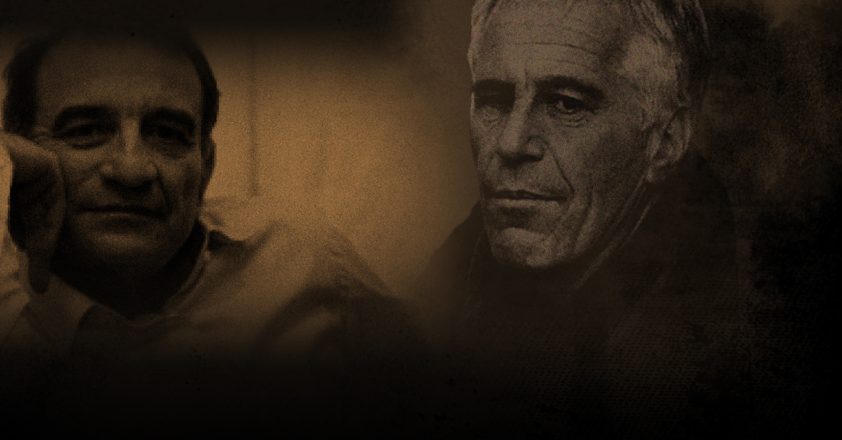
A graphic shows Ari Ben-Menashe, left, and Jeffery Epstein, right. Credit | Claudio Cabrera
By Whitney Webb | MintPress News | December 13, 2019
MONTREAL — In recent weeks, renewed attention has been brought to the allegations that Jeffrey Epstein and Ghislaine Maxwell’s sex trafficking and sexual blackmail operation was run on behalf of Israeli military intelligence. Those claims revolve around statements made by a former Israeli military intelligence official turned public relations consultant Ari Ben-Menashe, whose allegations regarding the Epstein scandal were reported by MintPress this past October.
Ben-Menashe’s claims related to Epstein first surfaced in an interview between Ben-Menashe and Zev Shalev of the independent news outlet, Narativ. As detailed in a MintPress summary and commentary of that interview, Ben-Menashe claimed to have seen Jeffrey Epstein in the office of Robert Maxwell, Ghislaine Maxwell’s father, several times in the 1980s.
At the time, Ben-Menashe was in close contact with Robert Maxwell regarding their work mutual work with Israeli military intelligence. Maxwell, in addition to heading a media empire and being a one-time member of U.K. parliament, was a longtime operative for Israeli intelligence, so much so that his 1991 funeral was attended by no less than six serving and former heads of Israeli intelligence as well as several high-ranking Israeli politicians and prime ministers.
Maxwell is alleged to have recruited Jeffrey Epstein for Israeli intelligence and later introduced Epstein to Ben-Menashe and another operative, Nicholas Davies. Epstein was introduced to Ben-Menashe as having been pre-approved by leading figures in Israel’s military intelligence directorate, known as Aman.
MintPress recently conducted its own interview with Mr. Ben-Menashe as part of an ongoing investigation on the life and connections of the now-infamous Jeffrey Epstein.
Part of that interview is provided below with relevant commentary, particularly regarding claims related to the relationship between Epstein and former Israeli Prime Minister Ehud Barak, Epstein’s trip to Tel Aviv immediately prior to his first arrest, and the reasons for Israeli military intelligence’s interest in orchestrating and financing a major sexual blackmail operation targeting top U.S. politicians.
“Israel Requested that Epstein Target Clinton”
MintPress News first asked Ben-Menashe about Robert Maxwell, a known asset and operative for Israeli intelligence, having recruited Jeffrey Epstein. Ben-Menashe confirmed this to MintPress and also noted that, after their initial meeting, Epstein was frequently present in Maxwell’s office in London.
During the 1980s, as MintPress previously reported, Epstein claimed to have been an intelligence operative and so-called “bounty hunter” in the world of shadow finance. During this time, he was known to have developed close relationships with several British arms dealers, particularly Sir Douglas Leese. Thus, Epstein appeared to frequently be traveling between the Middle East and London, which is also supported by Epstein’s now-infamous Austrian passport which he was believed to have carried during this period of time.
Ben-Menashe told MintPress that he had not only met Epstein after Epstein had been recently recruited by Israeli military intelligence, but had seen him on several occasions thereafter as Epstein “used to be in [Robert Maxwell’s] office [in London] quite often” and would arrive there between trips to and from Israel.
In addition, Ben-Menashe revealed his understanding of why Epstein was eventually shepherded into acting as a professional sexual blackmailer on behalf of Israeli military intelligence. Per Ben-Menashe, there were concerns among Israeli intelligence figures that, following the Reagan Era, a new president would push for Israel to make peace with the Palestinians, something those officials sought to avoid by any means necessary.
ABM – Here’s the thing… Mr. Carter… as in President Carter… the Israelis feared that Mr. Clinton, when he was campaigning for President, will be a repeat of Mr. Carter. He wanted to press them for peace with the Palestinians and all that stuff. They feared… Clinton wasn’t that… but they feared he was that… And I think Mr. Epstein was sent early on to catch up with President Clinton.
MintPress News (MPN) – Well, that’s interesting because the first year Clinton was in office, Epstein was already attending donor dinners at the White House and making White House visits as well.
ABM – Yeah, that’s right. That’s right. I believe his biggest client was Mr. Clinton catch, or catch, or whatever, and he had a few other congressmen and what not but Clinton was, was his biggest catch.
Thus, Ben-Menashe argues, when Bill Clinton’s candidacy in the 1992 U.S. Presidential election became clear, efforts were made to target him via sexual blackmail and Jeffrey Epstein was chosen for that purpose. Bill Clinton was eventually blackmailed by the state of Israel and his administration was also targeted by Israeli espionage as part of the “Mega” spy scandal. Epstein’s involvement in the Clinton administration and his visits to the White House date back to Clinton’s first year in office. More information on the Epstein-Clinton relationship can be found in this MintPress report.
In addition, MintPress also asked Ben-Menashe if he was aware of Ghislaine Maxwell being directly involved with her father’s intelligence-related activities prior to his death in 1991. Ben-Menashe noted that Ghislaine accompanied her father so frequently, including on a now-infamous 1989 party on Maxwell’s yacht where Donald Trump and several key figures in the PROMIS software scandal were in attendance, that she was involved in his intelligence-related activities to some extent. However, he stopped short of saying how involved she was or what she has specifically been involved in prior to her father’s death.
When did Epstein really meet Ehud Barak?
One of the more controversial ties between Epstein and powerful politicians is that between Epstein and former Israeli Prime Minister Ehud Barak. Barak has claimed to have only met Epstein in 2002 and, from that point on, their relationship was very public, with Barak frequently visiting and even spending the night at residences owned by Epstein, including apartments where he housed the underage girls that he exploited. Barak also visited Epstein’s now-infamous island and recruited him to help fund the Israeli intelligence-connected company, Carbyne911.
However, there appear to be indications that Epstein and Barak may have met much earlier than Barak has since claimed. Given that Ben-Menashe claimed to have learned of Epstein’s recruitment by Israeli military intelligence in the 1980s, MintPress asked if one of the people involved in his recruitment was Ehud Barak. Barak served as head of Israel’s military intelligence directorate, Aman, from April 1983 to January 1986.
Ben-Menashe could not recall the exact year when he first became aware of Epstein’s recruitment by Israeli military intelligence but stated that it was “most likely” during Ehud Barak’s tenure as the head of Aman. Yet, even if Epstein’s recruitment did not take place while Barak headed Aman, it is highly likely — per Ben-Menashe — that Epstein had met Barak during this time because “Robert Maxwell became buddies with Ehud Barak… and he [Robert Maxwell] probably introduced them, the young man [Epstein] to Mr. Barak” if the two were not already acquainted.
Since the Epstein scandal broke, Ehud Barak has insisted that he did not meet Epstein until the year 2002 and claimed that the two had been introduced by former Israeli Prime Minister Shimon Peres. Ben-Menashe dismissed the possibility that this claim was true, emphatically stating that he was “sure they had met before” and that he did not believe that their first meeting was in 2002.
Epstein’s 2008 Trip to Tel Aviv
Just a few months before he was sentenced to prison for the first time in June 2008, Jeffrey Epstein had made a sudden visit to the Israeli capital of Tel Aviv. In April of that year, the Palm Beach Daily News reported that Epstein was staying at the Tel Aviv Hilton and quoted an Epstein spokesman as saying that he was “spending Passover, meeting with Israeli research scientists, and taking a tour of military bases.”
Sometime prior to Epstein’s sentencing on June 30 of that year, Alexander Acosta –then-U.S. Attorney for the Southern District of Florida– signed off on a lenient sentence for Epstein who was charged with soliciting sex from a minor. That legal arrangement has since been nicknamed the “sweetheart deal.” Acosta later told Trump transition officials prior to his nomination for Secretary of Labor that his decision to approve the “sweetheart deal” came after he had been told to back off in the Epstein case because Epstein “belonged to intelligence.”
Though Acosta did not specify from whom he had received this information, former CIA agent Phil Giraldi has made a convincing case that they originated from Epstein’s then-lawyer Alan Dershowitz, a close associate of Epstein with ties to high-ranking Israeli politicians, and Barry Krischer, then-Florida State Attorney for Palm Beach who recently received an award from the Anti-Defamation League (ADL) for his “outstanding contribution to the legal profession and to the community at large.”
As detailed in a previous MintPress report on Epstein’s ties to Israel published this past August, the ADL’s long-time top funders have close ties to Epstein and his sexual blackmail network, particularly the Bronfman family of Seagrams fame.
Ben-Menashe told MintPress that Epstein’s 2008 Tel Aviv visit was likely “blowing smoke” and involved Epstein “trying to make himself important maybe not to get arrested” and “hoping that the Israelis would help him.” He then added that “At the time they probably did” help Epstein, but added that “the second time around [i.e. 2019], well… it would be a harder sell.”
Whitney Webb is a MintPress News journalist based in Chile. She has contributed to several independent media outlets including Global Research, EcoWatch, the Ron Paul Institute and 21st Century Wire, among others. She has made several radio and television appearances and is the 2019 winner of the Serena Shim Award for Uncompromised Integrity in Journalism.
Will Pelosi have the Votes to Impeach?
By Renée Parsons | OffGuardian | December 13, 2019
Despite an inadequate performance last week by Constitutional law experts before the House Judiciary Committee, Chair Jerrold Nadler released a unilateral committee report on Saturday entitled “Constitutional Grounds for Presidential Impeachment.” The Report came the day after Speaker Nancy Pelosi’s press conference in which she directed the formation of Articles of Impeachment.
As has become apparent to any objective observer; that is one who prefers facts over fiction, the Democrats remain locked in an imaginary world struggling to maintain relevance, a stature of standing that no longer exists.
Presumably with no Quid Pro Quo, no allegation of criminal conduct, no legally substantial evidence or factual basis and no bipartisan support, in defiance of previous impeachment norms, the Democrats are hell bent on making public jackasses out of themselves.
In a hearing with Constitutional legal experts expected to score big legal points in support of impeachment, the witnesses instead turned out to be smug, hyper partisan activists as they were consistently unpersuasive and unimpressive.
All three displayed not a wit of objectivity or neutrality while touting their own personal political agenda with a foreign policy ax to grind, leaving the unmistakable impression that their testimonies were nothing short of conflated.
Condescending as if pontificating to a class of mediocre law students, Professor Noah Feldman had suggested in 2017 that Presidential tweets could be grounds for impeachment, indicative of the depth of his thinking as he repeatedly impressed himself with his own rhetoric.
Professor Pamela Karlan opened with a shrillness that grew into a hyperbole spewing divisiveness among the American people and went on to revisit the Russiagate and foreign electoral influence myth ad nauseam. Those dim witted Democrats on the committee repeated the mantra as if held in a spellbound trance whenever “Russiagate” was mentioned. There was no mention of Israel interference in US elections. Testimony of Professor Michael Gerhardt.
Stating that he had not voted for Trump in 2016, GWU Law Professor Jonathan Turley who is a registered Democrat (as is yours truly) opened with a brilliant statement as he set the tone for an extraordinarily compelling testimony throughout the day, carefully explaining to the Democrats why they had not met a credible legal threshold for impeachment.
Factually concise with rational, impartial explanations, Turley effectively disputed Democratic claims that an abuse of power stemming from a presumed effort to help one’s own re-election is “inferred” and does not constitute proof of intent or direct knowledge of what was in the President’s mind.
However, it did not appear that any of the Democrats had the acute sensibility to understand Turley’s point as there is an edge of lunacy to the collective Democratic mind these days.
What the Democrats fail to grasp is the double-standard that every politician makes decisions based on what is best for their reelection just as the Dems are hoping to benefit electorally in 2020 with the farcical impeachment.
After his testimony, Mr. Turley tweeted. “Before I finished my testimony, my home and office were inundated with (death) threatening messages and demands that I be fired from GW.”
While it was surprising that there was no Democratic Star on either the Intel or Judiciary Committees who stepped forward to make a credible, cogent case for impeachment, it was somewhat surprising that the Republicans had an energetic array of participating Members not limited to Intel ranking member Devin Nunes (Calif), Judiciary ranking minority Rep. Doug Collins (NC), Rep. Jim Jordan (Oh), Rep. John Ratcliffe (Texas) and Rep. Mark Gaetz (R-Fla) all of whom can be expected to continue their Bulldog approach as the Committee begins preparing Articles of Impeachment.
For instance, Rep. Martha Roby (R-Ala) asked the defining question regarding the purpose of the hearing with “no fact witnesses” via a process that has been “insufficient, unprecedented and grossly inadequate.” Roby pointed out that the Dems had apparently not considered: that a constitutional law panel should come “only after specific charges have been made known and underlying facts presented in full due to an exhaustive investigation. How does anyone expect a panel of law professors to weigh in on legal grounds for impeachment prior to knowing what the grounds brought by this Committee are going to be?
At her news conference the day after the Judiciary committee hearing, Pelosi was asked by a reporter “Do you hate President Trump?” Pelosi responded with a shaky false piety as if she knows the votes are not there:
We don’t hate anybody. Not anybody in the World. And as a Catholic, I resent your using the word ‘hate’ in a sentence that addresses me. I don’t hate anyone. I was raised in a way that is full – a heart full of love and always pray for the president, And I still pray for the president. I pray for the president all the time, So don’t mess with me when it comes to words like that.
It is a curiosity that with the 2020 election a scant twelve months away, the Democrats have not made the case for the urgency of why impeachment needs to occur right now, immediately, before the Christmas holidays when the Spirit of Good Cheer, Universal Love and Peace for all Americans should take precedence over the Democrat’s divisive animosity, pitting one American against another.
In 2018, thirty-one new Democrats were elected to the House; predominately from districts that voted for Trump in 2016 assuring a tough 2020 re-election campaign.
Let’s assume that every one of those 31 newbies have been paying very close attention to the Intel and Judiciary committee hearings with two questions in mind:
Is there sufficient legal evidence to convince my constituents to support Articles of Impeachment and is this flawed impeachment campaign worth losing my seat in Congress?
Did any of those 31 notice when the Constitutional law experts were asked by Rep. Matt Gaetz “Can you identify one single material fact in the Schiff Report? – all four remained silent.
House Majority Whip James Clyburn (D-0SC) has already indicated that he does not intend to ‘whip’ the Dems in preparation for an Impeachment vote on the House floor and that the Dems “expect to lose some votes.”
Let’s do the math: With 233 Dems and 197 Republicans, if 18 of the 31 House newbies do not vote to impeach, the Democratic Motion to approve Articles of Impeachment will fail with a tie of 215 votes. Whether the Dems lose 18 votes or less, the damage will be irreversible.
As the Democratic party appears to have lost whatever is left of its sanity and integrity, the question remains why are the Democrats willing to sacrifice losing some of those 31 House seats in 2020?
New sanctions to ban humanitarian trade with Iran: US Treasury
Press TV | December 13, 2019
The US Treasury Department has stressed that Washington’s newly announced sanctions targeting Iran’s air and maritime transport industries will lead to the restriction of trade related to humanitarian goods.
“US persons will be prohibited from engaging in transactions involving Islamic Republic of Iran Shipping Lines (IRISL) or E-Sail, including transactions for the sale of agricultural commodities, food, medicine, or medical devices,” the Treasury’s guidelines on Iran sanctions read.
“In addition, non-US persons that knowingly engage in certain transactions with IRISL or E-Sail, even for the sale to Iran of agricultural commodities, food, medicine, or medical devices, risk exposure to sanctions under additional authorities,” it added.

Screenshot showing a segment of the US Treasury Department’s guidelines on Washington’s new sanctions against Iran announced on December 11, 2019.
The announcement comes after the Trump administration announced Wednesday that it was targeting IRISL and Iran’s major airline, Mahan Air, over baseless allegations of Tehran supporting “terrorists” in the region.
The Wednesday order put IRISL and Mahan under US presidential Executive Order (EO) 13382, which allegedly targets “weapons of mass destruction proliferators”.
The Treasury’s guidelines on the new sanctions stressed that entities put under EQ 13382 would not be eligible for any humanitarian sanction exceptions.
The statement comes despite Washington’s claim that its sanctions do not affect Iran’s access to humanitarian goods.
US officials have, nonetheless, signaled on numerous occasions that Washington’s sanctions seek to harm Iran’s general population in a bid to force Tehran to accept Washington’s dictates.
Earlier this year, US Secretary of State Mike Pompeo said that Tehran had to listen to Washington “if they want their people to eat”.
The new bans mark the latest round of Washington’s wide sweeping sanctions against the country after the US government unilaterally pulled out of the 2015 Iran nuclear deal and re-imposed sanctions lifted under the deal last year.
Speaking on Thursday, US Special Representative for Iran Brian Hook boasted that US sanctions targeting Iran’s oil sector have led to more than $50 billion in revenue losses, have hindered Iran’s refined-oil products and have undermined foreign investment.
“Both upstream and downstream investments in Iran’s oil and gas sector have stopped,” Hook said.
“Foreign investors have almost entirely pulled out of Iran due to the risks and billions in investment has been lost,” he added.
Hook said that the wide sweeping oil sanctions seek to force Iran to negotiate with the US, a demand which Iranian officials have firmly rejected as long as Washington fails to uphold the previously negotiated nuclear deal agreement.
US-backed figure claims Iranians ‘understand’ Trump
Following Washington’s withdrawal from the 2015 nuclear deal, the US has since adopted a policy of “maximum pressure” against Tehran, coupling sanctions with stepped up regional provocations and military deployments aimed at Iran.
The US has also sought to provoke internal unrest in the country by supporting various destabilizing elements targeting the country, such as the terrorist Mujahedin Khalq Organization (MKO) and violent separatist groups.
According to observers, Reza Pahlavi, son of deposed Iranian king Mohammad Reza Pahlavi, is one of the main figureheads being “groomed” by Washington as part of its campaign to destabilize Iran amid recent foreign-backed riots in Iran.
In recent remarks to the US-based magazine Newsweek, Pahlavi expressed his support for Trump’s aggressive policies targeting the Iranian economy and called for stepped-up western intervention in Iran.
He also claimed that the Iranian people “understand and appreciate” the US-imposed sanctions and believe that the Iranian government is to blame for the “maximum pressure” targeting Iran.
Pahlavi’s remarks come despite numerous studies indicating that Iranian resentment against Washington has largely increased amid the US’ wide sweeping sanctions.
A recent study published by the University of Maryland’s Center for International and Security Studies at Maryland (CISSM) and the Toronto-based IranPolls shows that an overwhelming 86 percent of Iranians despise US policies.
The study’s results come despite stepped-up efforts by foreign media outlets to stir unrest in Iran and promote anti-government sentiment amid tightening US sanctions crippling the country’s economy.
Washington’s Proposed New Sanctions Against Turkey also Aimed Against Russia
By Paul Antonopoulos | December 13, 2019
With the world fixated on Turkish actions against Syria, Greece and Libya at the moment, the Committee on Foreign Affairs of the Senate of the United States Congress approved a bill, “Promoting American National Security and Preventing the Resurgence of ISIS Act,” spearheaded and thoroughly promoted by staunch anti-Syria/Venezuela/Iran/Russia Democratic Senator Robert Menendez who celebrated the bills passing on his Twitter. The Republican-led Senate Foreign Relations Committee voted 18-4 to send the bill for a vote in the full Senate.
The approval of the bill was widely reported in the mainstream media as an “anti-Turkey bill.” Senator Jim Risch, the panel’s Republican chairman, a fellow endorser of the bill with Menendez, said that the approval of this bill is because of the “drift by this country, Turkey, to go in an entirely different direction than what they have in the past. They’ve thumbed their nose at us, and they’ve thumbed their nose at their other NATO allies.”
According to the draft bill, the Turkish acquisition of the powerful S-400 missile defense system gives grounds to impose sanctions against this country, under the Countering America’s Adversaries Through Sanctions Act (CAATSA). In particular, the document restricts the sale of U.S. weapons to Turkey and imposes sanctions on Turkish officials responsible for supplying weapons towards their illegal military operation in Syria.
Turkey signed in December 2017 the first contract with Russia for the purchase of the S-400 for a value of $2.5 billion, which caused tension in relations between Ankara and Washington. The U.S. demanded that Ankara renounce that transaction and buy U.S. Patriot systems, and threatened to delay or cancel the sale of the F-35 fighters to Turkey. Ankara refused to make concessions and assured that its purpose of acquiring Russian systems remains firm.
What was missed, perhaps intentionally by the majority of the mainstream media is that this bill has a heavy anti-Russian/Syrian component to it. Although not as detailed and expansive as the Turkish section of the bill, it claims that “the Russian Federation and Iran continue to exploit a security vacuum in Syria and continue to pose a threat to vital United States national security interests,” without explaining what these security interests are, exactly as we have become accustomed to.
According to the bill, there will be a “list of each Russian person that, on or after such date of enactment, knowingly exports, transfers, or otherwise provides to Syria significant financial, material, or technological support that contributes materially to the ability of the Government of Syria to acquire defense articles, defense services, and related information.” Although the bill has not said which specific Russians, the nature of the bill means that there will be inevitable sanctions against Russia as it is a top weapon exporter to Syria, which will unlikely change despite of the new sanctions. Those in the eventual sanction list will face an American blacklist, which means a ban on entry, freezing of assets in the United States, a ban on doing business with this person for American citizens or companies. At the same time, the bill allows that the US President can consider each case separately and refuse to impose sanctions.
These proposed new sanctions that will have to pass the House of Representatives, which passed its own anti-Turkish sanctions bill by an overwhelming 403-16 vote in October, is part of a wider effort for the U.S. to keep pressurizing Russia’s economy. On December 9, the committees of both chambers of the U.S. Congress previously agreed on the military budget for 2020, which includes restrictions against the Nord Stream 2 and Turk Stream pipelines to bring Russian energy to Europe, infrastructures designed to raise Europe’s energy security. The U.S. bill that provides sanctions against companies participating in the laying of the Nord Stream 2 gas pipeline aims to obtain unilateral advantages in the gas area to the detriment of the interests of the countries of Europe. This prompted the chairman of the Board of Directors of the Russian-German Foreign Chamber of Commerce, Matthias Schepp, to explain that the new measures against Nord Stream 2 affect not only Russia, but, above all, European companies and Germany’s energy interests.
Washington is frustrated that European energy policy is decided in Europe, not in the U.S., which calls into question the cooperation between the U.S. and Europe. It is a very risky measure and Europe would need to have a blunt attitude of rejection of these measures imposed by the U.S., because its own economy is at risk.
Effectively, the “Promoting American National Security and Preventing the Resurgence of ISIS Act,” which strangely targets Russia who had a greater role than the U.S. in defeating ISIS terrorists, is just another way for Washington to warn other countries not to buy the S-400 or Russian military equipment or engage in energy diplomacy with Moscow. It is unlikely that this will deter states from conducting arms and energy deals with Russia as Moscow has been pioneering anti-sanction measures to protect financial transactions without punishment, and rather it demonstrates a Washington that is becoming increasingly desperate in the Era of Multipolarity.
Paul Antonopoulos is a Research Fellow at the Center for Syncretic Studies.
Can We Impeach the FBI Now?
By Peter Van Buren | The American Conservative | December 11, 2019
The release of Justice Department Inspector General Michael Horowitz’s report, which shows that the Democrats, media, and FBI lied about not interfering in an election, will be a historian’s marker for how a decent nation fooled itself into self-harm. Forget about foreigners influencing our elections; it was us.
The Horowitz Report is being played by the media for its conclusion: that the FBI’s intel op run against the Trump campaign was not politically motivated and thus “legal.” That covers one page of the 476-page document, but because it fits with the Democratic/mainstream media narrative that Trump is a liar, the rest has been ignored. “The rest,” of course, is a detailed description of America’s domestic intelligence apparatus, aided by its overseas intelligence apparatus, and assisted by its Five Eyes allies’ intelligence apparatuses. And the conclusion is that they unleashed a full-spectrum spying campaign against a presidential candidate in order to influence an election, and when that failed, they tried to delegitimize a president.
We learn from the Horowitz Report that it was an Australian diplomat, Alexander Downer, a man with ties to his own nation’s intel services and the Clinton Foundation, who set up a meeting with Trump staffer George Papadopoulos, creating the necessary first bit of info to set the plan in motion. We find the FBI exaggerating, falsifying, and committing wicked sins of omission to buffalo the Foreign Intelligence Surveillance Act (FISA) courts into approving electronic surveillance on Team Trump to overtly or inadvertently monitor the communications of Paul Manafort, Michael Cohen, Jared Kushner, Michael Flynn, Jeff Sessions, Steve Bannon, Rick Gates, Trump transition staffers, and likely Trump himself. Trump officials were also monitored by British GCHQ, the information shared with their NSA partners, a piece of all this still not fully public.
We learn that the FBI greedily consumed the Steele Dossier, opposition “research” bought by the Clinton campaign to smear Trump with allegations of sex parties and pee tapes. Most notoriously, the dossier claims he was a Russian plant, a Manchurian Candidate, owned by Kremlin intelligence through a combination of treats (land deals in Moscow) and threats (kompromat over Trump’s evil sexual appetites). The Horowitz Report makes clear the FBI knew the Dossier was bunk, hid that conclusion from the FISA court, and purposefully lied to the FISA court in claiming that the Dossier was backed up by investigative news reports, which themselves were secretly based on the Dossier. The FBI knew Steele had created a classic intel officer’s information loop, secretly becoming his own corroborating source, and gleefully looked the other way because it supported his goals.
Horowitz contradicts media claims that the Dossier was a small part of the case presented to the FISA court. He finds that it was “central and essential.” And it was garbage: “factual assertions relied upon in the first [FISA] application targeting Carter Page were inaccurate, incomplete, or unsupported by appropriate documentation, based upon information the FBI had in its possession at the time the application was filed.” One of Steele’s primary sources, tracked down by FBI, said Steele had misreported several of the most troubling allegations of potential Trump blackmail and campaign collusion.
We find human dangles, what Lisa Page referred to as “our OCONUS lures” (OCONUS is spook-speak for Outside CONtinental US) in the form of a shady Maltese academic, Joseph Mifsud, who himself has deep ties to multiple U.S. intel agencies and the Pentagon, paying Trump staffers for nothing speeches to buy access to them. We find a female FBI undercover agent inserted into social situations with a Trump staffer (pillow talk is always a spy’s best friend). It becomes clear the FBI sought to manufacture a foreign counterintelligence threat as an excuse to unleash its surveillance tools against the Trump campaign. … continue reading
US tests ground-launched ballistic missile that would’ve been banned by INF treaty
RT | December 12, 2019
The Pentagon has conducted a second test of a missile that would have been banned under the INF treaty with Russia, which the US abandoned earlier this year. A ground-based ballistic missile flew for over 500 kilometers.
The conventionally configured test missile was launched from Vandenberg Air Force Base in California on Thursday, the US Department of Defense confirmed in a statement, giving no further details.
“Data collected and lessons learned from this test will inform the Department of Defense’s development of future intermediate-range capabilities,” the statement said.
Thursday’s test follows the cruise missile launch in August, just days after the Intermediate-range Nuclear Forces (INF) Treaty expired due to the unilateral US exit.
Signed in 1987, at the height of the Cold War, the INF banned the US and the Soviet Union – later Russia – from fielding missiles with a range between 500 and 5,000 kilometers (310 and 3,400 miles).
The Trump administration accused Russia of possessing a missile that violated the treaty, something that Moscow has denied. Russian offers for NATO to inspect the allegedly offending missile system were ignored. Meanwhile, President Donald Trump and his advisers further rationalized their exit by calling the INF a “relic” of the Cold War, an “obsolete” treaty that no longer reflected strategic reality, because it did not apply to China or other countries with ballistic missile capabilities.
The new test comes just days after Russian Foreign Minister Sergey Lavrov visited Washington and discussed the possible extension of the New START nuclear reduction treaty with Trump and Secretary of State Mike Pompeo. Moscow has said it was willing to extend the treaty, which expires in February 2021, by five years to allow time for a new deal to be negotiated.
Washington has not signaled any interest in doing either, however. Trump has talked about a potential new nuclear deal that would include Russia, China and other countries, but the US has not offered a specific proposal to that effect.
Featured Video

Thomas Fazi: NATO’s Hybrid Warfare – Deception & Permanent War
or go to
Aletho News Archives – Video-Images
Book Review
UAE tortured, killed journalist for opposing Israel normalization
The Cradle | October 31, 2026
UAE security officers detained, tortured, and killed Emirati poet and news editor Habib al-Sayegh in August 2019, shortly after he published a column opposing UAE normalization with Israel, according to a newly published book.
“Princes and Thieves,” a book by investigative journalist Matthew Cole published on 25 October, alleges that UAE security officers raided Sayegh’s Abu Dhabi home shortly after the publication of the column, hooded him in front of his wife and took him to a detention facility where he was tortured to death.
His interrogators reportedly pulled out several of his teeth with pliers and beat him repeatedly with a sharp metal object.
On 11 August 2019, Sayegh criticized the UAE’s plan to normalize relations with Israel as part of the Abraham Accords in his weekly column for Khaleej newspaper. The column was titled “Israel Is Our Real Enemy and A Dangerous Project.”
Sayegh described Israel as “a real and natural enemy” while questioning “who authorized the normalizers to speak on behalf of everyone?”
Nine days after the column was published, Emirati state media announced his death, without stating a cause. … continue
Blog Roll
 Aletho News
- US Approves Sale of 500 Patriot Missiles to Ukraine, Deliveries May Take Years
- German Imperialism: An Urgent Explainer
- Backed by AAP, West Virginia Proposal Would Allow Dental Hygienists to Give HPV Vaccine to 9-Year-Olds
- Poland Is the Symptom and Europe Is the Patient
- UAE security forces tortured, killed journalist for opposing Israel normalization: Report
- They Compared the Spice to the Drug. The Spice Won — Again. (Part 2)
- Thomas Fazi: NATO’s Hybrid Warfare – Deception & Permanent War
- Wrong, AP and NPR: Europe’s 50,000 Heat Deaths Are a Computer-Model Estimate, Not a Real Body Count
- Questioning Your Doctor Is Now Considered A Psychological Problem (Seriously)
- London tourism expo promotes Israeli agency linked to theft of Palestinian land
- If Americans Knew
- An error has occurred; the feed is probably down. Try again later.
- No Tricks Zone
- Germany’s Green Energy Transition Becoming Increasingly Expensive…Another 6 Trillion Euros!
- Sudden Stratospheric Warming, Powerful El Niño Combination May Lead To Extreme Europe Cold, Energy Crisis!
- Two New Studies Find Thwaites Glacier Melt Cannot Be Driven By Human Activity Or A Warming Ocean
- E-Cars Reduce CO2 Emissions By Only 41% Compared To Internal Combustion Engine Vehicles
- Predictions Made By Renowned Climate Professor Over Past Decades Have Been Proven To Be Poor
- New Study Suggests Large Regions Of The Pacific Ocean Have Been Cooling For The Last 80 Years
- Germany’s Green Energy Debacle: High Energy Costs Force Kahla Porzellan to Close After 182 Years!
- New Study: 50 Years Of The Most Aggressive ‘Net Zero’ Policies Can Only Affect The Global Climate By 0.03°C
- US September “Heat” Was No Record…Many Records Set Decades Ago
- Latest European Green Energy Debacle; Portugal’s Largest Flagship Solar Park Insolvent!

