Republicans & Democrats agree: No war on Iran (without Congress at least)
RT | July 12, 2019
The House of Representatives has adopted the 2020 military spending bill, but with an amendment that blocks war on Iran without congressional approval – backed by President Donald Trump’s outspoken critics and supporters alike.
A bipartisan amendment to bar the executive branch from offensive action against Iran without explicit authorization from Congress was adopted with a 250-170 vote, with 27 Republicans joining the Democrats in support, and seven Democrats crossing the aisle in opposition.
Khanna made the point that Trump himself had campaigned against endless wars, but had advisers around him that were pushing him into a conflict with Iran.
“I believe he doesn’t want one,” Khanna said. After the amendment passed, he told reporters that it was “proof that opposition to war with Iran transcends partisan politics.”
Not surprisingly, the mainstream media outlets reported on the amendment’s passage as a rebuke of Trump by the Democrat-led House.
“The Democratic-controlled House votes to limit President Trump’s authority to make war against Iran,” said AP. “House votes to prevent Trump from entering an unauthorized war with Iran,” said the Washington Post. “The House voted to check President Trump’s authority to strike Iran by requiring him to get Congress’s approval first,” declared the New York Times.
Far from being a warmonger, however, Trump called off the strike against Iran last month – citing concerns over Iranian casualties – after Tehran shot down a US spy drone over the Straits of Hormuz. He has also opened dialogue with North Korea, ordered the US withdrawal from Syria, and his administration is currently conducting peace talks to conclude the 18-year-long conflict in Afghanistan.
Secretary of State Mike Pompeo and National Security Advisor John Bolton are considered hard-liners on the issue of Iran, as are many establishment Republicans in the House, including Liz Cheney (R-Wyoming), daughter of George W. Bush’s VP Dick Cheney, one of the architects of the 2003 Iraq invasion.
“A Cheney wanting us to get into war? Weird,” Gaetz joked to Fox, when asked about her objections to the amendment he and Khanna had proposed.
Another amendment, seeking to repeal the 2002 Authorization for Use of Military Force (AUMF) against Iraq, passed with a vote of 242-180. It was sponsored by Reps. Barbara Lee (D-California) and Justin Amash (I-Michigan), a former Republican.
The final vote on the 2020 National Defense Authorization Act (NDAA) passed by a vote of 220-197, along party lines. It authorizes $733 billion for the Pentagon in the next fiscal year, some $17 billion less than what the White House asked for.
How Real is the Trump Administration’s New Flexibility with North Korea?
By Gregory Elich | CounterPunch | July 12, 2019
Although widely derided by the Washington Establishment as an empty photo opportunity, the recent meeting between President Trump and Chairman Kim Jong Un at Panmunjom produced an agreement to resume working-level talks in the near future. According to the North Korean news agency KCNA, the two leaders discussed stumbling blocks in improving relations and easing tensions, and agreed to work towards a “breakthrough in the denuclearization of the Korean Peninsula and in the bilateral relations.”
The resumption of working-level talks comes as welcome relief after months of stalled progress since Trump pulled the plug on the Hanoi Summit due to North Korea’s failure to accede to the demand that it unilaterally disarm. At Hanoi, U.S. negotiators presented a plan that called for North Korea to denuclearize, while promising nothing in exchange. Nothing, that is, other than punishment in the form of “maximum pressure” sanctions. All that was on offer to the Democratic People’s Republic of Korea (DPRK, the official name for North Korea) was the vague mention of unspecified economic benefits after it had fully denuclearized.
In addition to denuclearization, the U.S. side widened the scope of talks at Hanoi by delivering a document to the North Koreans that demanded the dismantlement of chemical and biological warfare programs, as well as ballistic missiles and facilities. U.S. negotiators also wanted a detailed accounting of nuclear facilities, subject to intrusive U.S. inspections. For the North Koreans, to implement such a proposal would allow inspectors to map the bombing coordinates of its nuclear facilities, an obvious non-starter when the U.S. has yet to provide any semblance of a security guarantee.
In essence, what the U.S. offered at Hanoi was the Libya Model of denuclearization, in which obligations are loaded solely on its negotiating partner. That is not an approach that is going to work with North Korea, as among other reasons, its nuclear program is far more advanced than was the case with Libya’s. The DPRK has something substantial to trade, and it is not going to relinquish it for free.
The sanctions against the DPRK are designed to strangle its economy. The North Koreans regard sanctions relief as an essential element in the trade-off for denuclearization. The fate of small nations that the United States has attacked, such as Yugoslavia, Iraq, and Libya, did not go unnoticed in the DPRK. Those object lessons led the North Koreans to draw the logical conclusion that the only way for a small targeted nation to ensure its survival would be to develop a nuclear deterrent.
There has been much talk in the U.S. media about the Trump administration’s apparent intent to adopt a more flexible approach to negotiations. This has resulted in much hand-wringing among the Washington Establishment, panicked over a potential reduction in tensions, which it fears could have knock-on effects in sales of military hardware to Asian allies like South Korea and Japan. New pretexts would need to be developed to explain the military buildup in the Asia-Pacific that is aimed at China.
How real is this new flexibility? In a widely misread report in the New York Times, it is suggested that Trump may “settle” for a nuclear freeze, leaving the DPRK as a nuclear power. A careful reading of the article indicates, however, that the Trump administration does not envision a nuclear freeze as an end state, but rather as a “foundation for a new round of negotiations.” Talks “would begin with a significant – but limited – first step.” From there, U.S. negotiators would seek to persuade Kim to expand the range of nuclear facilities that would be dismantled.
On Trump’s return flight from South Korea, U.S. Special Representative for North Korea Stephen Biegun talked about U.S. plans for the next summit between Trump and Kim. Biegun said that the U.S. wanted a complete freeze on the DPRK’s weapons of mass destruction (WMD) programs while negotiations are underway. This is not different than what was stated in the New York Times report, leaving aside the misleading use of the word “settle” and the fretful comments the Times quoted from Establishment analysts.
Biegun’s choice of words is significant: ‘WMD,’ rather than ‘nuclear.’ John Bolton’s insistence on including chemical and biological weapons programs in any negotiated settlement remains very much to the fore. North Korea denies having any such operations and U.S. belief in their existence is predicated primarily on supposition, backed by weak and inconclusive indications. If the DPRK does not have a chemical or biological weapons program, then it cannot freeze what it does not have, and it cannot provide details on programs that remain a fantasy in the minds of Washington. It requires little imagination to anticipate how hawks in the Trump administration would seize upon North Korean denials as a means of sabotaging negotiations.
Whether North Korea has chemical and biological programs or not, it is likely to have misgivings about the United States adding demands while at the same time offering no concessions. When Libya denuclearized, it too faced an ever-expanding array of conditions, including visits by John Bolton and other U.S. officials, telling it how to vote at the United Nations and ordering it to cut military ties with Syria, Iran, and North Korea.
It is notable that at no time has any U.S. official mentioned what kind of security guarantee it could offer to the DPRK. Given the record of U.S. militarism in recent decades, it is difficult to conceive of any assurance the U.S. would provide that could be trusted. Whatever the U.S. may offer will need to be supplemented, and protection will have to come from elsewhere. Chinese President Xi Jinping alluded to the same during his recent visit to Pyongyang, when he stated, “China will take an active role in resolving North Korea’s security concerns.” In May, Russian Foreign Minister Sergey Lavrov announced that security guarantees are an “absolutely mandatory” component of any negotiated agreement with the DPRK. “Russia and China are prepared to work on such guarantees,” he added.
In his meeting with U.S. Secretary of State Mike Pompeo on May 14, Lavrov stressed the importance of providing security guarantees to the DPRK, but all Pompeo wanted to talk about was hitting North Korea as hard as possible with sanctions, without letup.
Much has been made of Stephen Biegun’s claim that the United States plans on a more flexible “simultaneous and parallel” approach to negotiations. When examined, there is less change than many suppose. Biegun is in line with the rest of the Trump administration, emphasizing that “in the abstract, we have no interest in sanctions relief before denuclearization.”
Since sanctions relief and security guarantees are off the negotiating table as far as U.S. officials are concerned, what are they ready to offer? According to Biegun, flexibility means the U.S. would consider agreeing to the two nations opening liaison offices in each other’s capitals, permitting some people-to-people talks, and humanitarian aid. That last point may mean that the United States would consider stopping its efforts to block humanitarian assistance. Or it could indicate a willingness by the U.S. to directly provide a token amount of aid while continuing to shut down independent aid operations in the DPRK.
To the North Koreans, this “flexibility” is a distinction without a difference. It remains the Libya Model. As such, it is a recipe for failure if the U.S. rigidly adheres to this strategy.
Complicating matters further is the rider the U.S. Senate attached to the National Defense Authorization Act for Fiscal Year 2020. If the rider makes it into the House version, then once the defense budget is signed into law, it would mandate secondary sanctions on any financial institution that does business with the DPRK. Current sanctions leave it to the discretion of the Treasury Department as to which firms to sanction. The Senate bill aims to cut off the North Korean economy from what little international trade it still has after sanctions, so as to inflict further harm on the population. Certainly, this also signals the Senate’s opposition to any negotiated settlement.
The North Koreans need two things in exchange for denuclearization: the lifting of sanctions and a security guarantee. What that security guarantee would look like is difficult to discern. A piece of paper is not going to do it. The DPRK needs a reliable means of assuring its security if it is going to denuclearize.
Across the entire U.S. Establishment, both within and outside the Trump administration, there is an unwavering belief that every action the DPRK takes towards denuclearization should be rewarded with “maximum pressure” sanctions.
It is a curious notion, this expectation that nothing need be offered to North Korea in exchange for meeting U.S. demands. Odder still is the conviction that the DPRK ought to be satisfied with being tormented by crippling sanctions for each concession it makes. But then, imperialism and arrogance go hand-in-hand. There is no reason, however, to expect the North Koreans to be servile. “North Korea wants actions, not words,” observes Christopher Green of the International Crisis Group. “I’m not sure the U.S. is mentally ready for it, even now.”
Whether or not North Korea denuclearizes depends entirely on the United States. If the Trump administration believes it can bully the DPRK into unilateral disarmament, then it is sadly mistaken. If on the other hand, it eventually comes to recognize that the only way to achieve its objective is to offer some measure of reciprocity, then denuclearization becomes an achievable goal. At this point, there is little indication that the U.S. is prepared to move beyond the former position.
Gregory Elich is a Korea Policy Institute associate and on the Board of Directors of the Jasenovac Research Institute. He is a member of the Solidarity Committee for Democracy and Peace in Korea, a columnist for Voice of the People, and one of the co-authors of Killing Democracy: CIA and Pentagon Operations in the Post-Soviet Period, published in the Russian language. He is also a member of the Task Force to Stop THAAD in Korea and Militarism in Asia and the Pacific. His website is https://gregoryelich.org
Israel’s Barak, US sex trafficking suspect Epstein ties exposed
MEMO | July 12, 2019
Former Israeli Prime Minister and election candidate Ehud Barak held a multi-million-dollar business partnership with Jeffrey Epstein, the US billionaire who was this week arrested for sex trafficking underage girls.
According to an exposé yesterday by Israeli daily Haaretz, Barak – who served as Israel’s Prime Minister between 1999 and 2001 and recently announced his formation of a new party, Democratic Israel, ahead of the country’s general election in September – held business ties with Epstein as recently as 2015.
Epstein is a US billionaire who made his fortune on Wall Street and is known to have close relationships with influential political figures, including former US President Bill Clinton and current US President Donald Trump.
In 2008 Epstein pleaded guilty to soliciting underage girls for prostitution, paying dozens of 14 and 15-year olds to perform sex acts over a period of six years. He spent 13 months in county jail, but was given lenient terms under which he was allowed to leave prison six days per week to go to work.
On Saturday, Epstein was arrested on fresh charges of sexually exploiting underage girls at his New York and Florida mansions, as well as “recruiting” other teenagers to carry out sex acts. He pleaded not guilty to sex trafficking and conspiracy to sex traffic minors.
Now Haaretz has exposed that Barak had close ties with Epstein as recently as 2015. It was previously known that the pair held connections, with an Israeli journalist last year reporting that, in 2004, Epstein gave Barak $2.3 million for “research”. The details of this research were never exposed, with Barak refusing to comment on his work as a “private citizen”.
The Israeli daily explained that, “in 2015, Barak set up a limited partnership [called Sum (E.B.)], in which he is the sole shareholder. That company invested in Reporty Homeland Security, established in 2014, becoming a major shareholder.” Last year Reporty, which provides geolocation technology for the emergency services, changed its name to Carbyne.

Former Israeli Prime Minister Ehud Barak [Ynhockey/Wikipedia]
“Barak is [and remains] the chairman of Carbyne and, according to reports by business media outlets, his personal investment in the company totals millions of dollars,” Haaretz explained, adding that it “has learned that Epstein financed a considerable part of the investment, thus becoming a partner in the project”. This means that a large part of the money used by Sum to buy Reporty/Carbyne stock was supplied by Epstein.
In a statement to the newspaper, Barak said that “since these are private investments, it wouldn’t be proper or right for me to expose the investors’ details”, but conceded that “a small number of people I know invest in [the company]”.
Israeli Prime Minister Benjamin Netanyahu has been quick to jump on the revelations in a bid to hamper Barak’s prospects of success in the upcoming election.
Netanyahu took to Facebook yesterday to demand: “Investigate Ehud Barak immediately.” However, as the Times of Israel points out, “the prime minister did not say what behavior on Barak’s part could be the subject of a criminal probe, as no action described in the report appeared illegal”.
For his part, Barak responded to Netanyahu’s calls for an investigation by pointing out the prime minister’s own legal woes, saying that Netanyahu, like Epstein, is “now neck-deep in criminality”. Netanyahu is slated to appear in court in October charged with fraud, bribery and breach of trust in connection with three corruption cases. If found guilty, he could face up to ten years in prison.
This political mudslinging has been seen as an attempt by Netanyahu to “go on the attack,” rather than the defence against the myriad corruption allegations against him. Netanyahu is famous for attacking his political rivals to boost his own popularity, labelling head of the Blue and White (Kahol Lavan) alliance Benny Gantz “mentally unstable” ahead of the last Israeli election in April.
Netanyahu and Barak have a long history of rivalry. Barak was Netanyahu’s commander in the elite Sayeret Matkal unit of the Israeli army, and as such is reportedly one of the few people Netanyahu both respects and fears. It is this history that has likely prompted Netanyahu’s attack on Barak over his connections to Epstein, as opposed to a belief that Barak is a serious electoral opponent – the latest election polls put Barak’s Democratic Israel party at only four seats, the minimum needed to sit in the Knesset, compared to the Likud party’s 33 seats.
US pours oil into fire in Gulf, mum’s the word for India
By M. K. BHADRAKUMAR | Indian Punchline | July 12, 2019
The illegal seizure of an Iranian oil tanker off Gibralter by the British Navy last Friday is fast acquiring farcical character. Britain acted at the behest of the US; in turn, the US probably acted at the behest of the ‘B Team’. So far, only one top US official has expressed joy over the incident — National Security Advisor John Bolton, who is of course the member-secretary of the B Team. None of the other three members of the B Team — Israeli PM Benjamin Netanyahu or either of the two Gulf Crown Princes (bin Salman and bin Zayed)) has waded into the controversy.
The original intention behind the Anglo-American operation was clearly to provoke the Iranians into some retaliatory action. But Iran refused to be provoked and is biding its time. Had Iran acted impulsively or rashly, a military conflagration might have ensued, which would have provided just the alibi for a large-scale US military strike at Iranian targets. Even Article 5 of the NATO Charter on collective security might be invoked. The B Team has been angling for just such a window of opportunity. The US defence secretary’s last visit to Brussels was a mission to rally NATO support for a military strike against Iran.
Now, Iran is savvy enough to figure out the Anglo-American game plan. Tehran is indignant and has warned of consequences, but all in good time. Since Iran refused to be provoked, Britain made a false allegation that Tehran made an abortive attempt to “intimidate” a British oil tanker. Tehran, of course, furiously denied the allegation. Meanwhile, there is a parallel move by the US to assemble a ‘coalition of the willing’ ostensibly to protect oil tankers in the Strait of Hormuz, an Iranian waterway. Therein hangs a tale.
The false allegation by Britain has been promptly seized by the US Navy to press ahead with its master plan to establish military escorts for shipping in the Strait of Hormuz. General Mark Milley, who has been nominated to become chairman of the US Joint Chiefs of Staff, has been quoted as saying on July 11 during testimony before the Senate Armed Services Committee in Washington that the Pentagon is working to put together a coalition “in terms of providing military escort, naval escort to commercial shipping.” In his words, “I think that that will be developing over the next couple weeks.” Milley characterised the project as an assertion of a fundamental principle of “freedom of navigation”, a coinage Washington uses arbitrarily in its “Indo-Pacific” rule book.
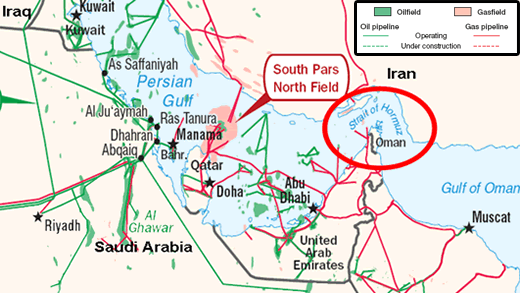
The Strait of Hormuz, located betweenIran and Oman connects the Persian Gulf with the Gulf of Oman and the Arabian Sea and is the world’s most important oil chokepoint.
It doesn’t need much ingenuity to figure out that the US intends to take control of the Strait of Hormuz — although the strait is Iranian-Omani waters under international law. As the narrowest point of the Strait of Hormuz is twenty-one nautical miles, all vessels passing through the Strait must traverse the territorial waters of Iran and Oman. The rights of passage for foreign vessels under international law will consequently be subject to either the rules of non-suspendable innocent passage or transit passage depending on the applicable legal regime.
The topic has come before the International Court of Justice. The ICJ confirmed the customary international law rule, used in international navigation, that foreign warships have the right of innocent passage in straits during peacetime, which means that during peacetime the coastal state could only prohibit the passage of any foreign-flagged vessel if its passage was non-innocent.
However, the grey area here (which the US wants to challenge) is that Iran has the legal right as a coastal state to prevent transit or non-suspendable innocent passage of ships if the ship that is in engaged in passage through the strait constitutes a threat or actual use of force against Iran’s sovereignty, territorial integrity, or political independence, or could be acting in any other manner in violation of the principles of international law embodied in the Charter of the United Nations.
In strategic terms, therefore, by precipitating the seizure of the Iranian oil tanker, the US and Britain are proceeding on a track to create a pretext to challenge Iran’s rights over the Strait of Hormuz and to take control of the strait. This is also contingency planning in advance insofar as under international law, if the US were to attack Iranian territory without a decision of the UN Security Council, the question would arise whether the provisions for transit passage under UNCLOS would continue to apply to the Strait of Hormuz or whether Iran could invoke the laws of war and take action against tankers, especially if they are deemed to be assisting the enemy.
Suffice to say, it is possible to see that what might have appeared as a maverick or silly act by Britain off Gibralter when it seized the Iranian tanker could actually be the tip of a calibrated project aimed at imposing effectively a naval blockade against Iran. Indeed, this forms the latest chapter in the US’‘maximum pressure’ policy against Iran.
By the way, a second leg of the current project is also to seize control of the strategic shipping lanes via the the Bab al-Mandab (off Yemen), which leads to the Suez Canal. (The narrow Bab al-Mandab connects the Red Sea with the Gulf of Aden and the Arabian Sea.)
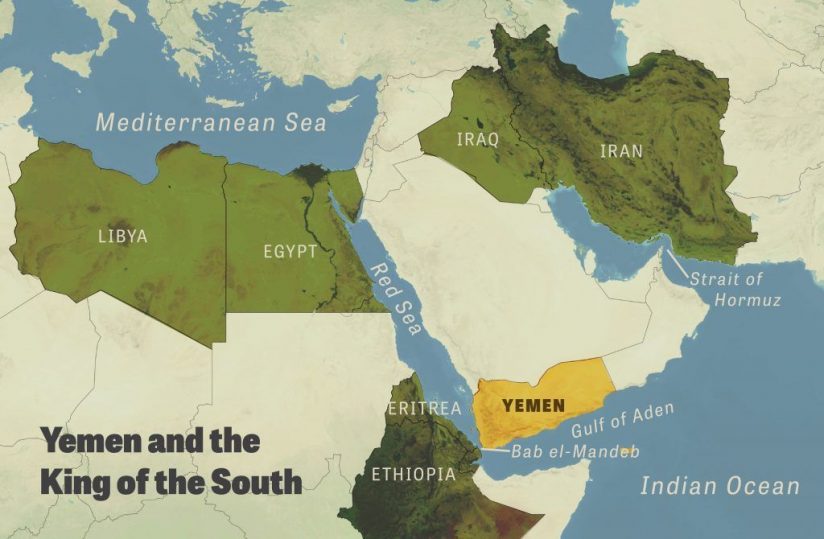
The chokepoint of Bab el-Mandab off Yemen connecting Indian Ocean to the Suez Canal via Red Sea
The US control of the Bab al-Mandab will mean that Iran’s use of the Suez Canal will come under intense US monitoring. The US has a military base in Djibouti facing the Bab al-Mandab. (Against this backdrop, the bitterly-fought war in Yemen falls into perspective, too.)
Of course, all this constitutes acts that are in gross violation of international law and the UN Charter and India should keep miles away from the Anglo-American project to impose naval blockade against Iran on whatever pretext.
Indeed, India will be called upon to take some tough decisions in the period ahead vis-a-vis the emergent situation in the Persian Gulf. First and foremost, India should stay clear of the US-led project to establish military escorts for ships in the Persian Gulf. There are reports that the Indian Navy has deployed two ships with helicopters in the Gulf of Oman. Presumably, this deployment will not form part of the US-led naval flotilla to intimidate and blockade Iran.
Second, there is a strong likelihood of the US invoking its privileges under the Logistics Exchange Memorandum of Agreement to gain access to Indian military facilities for the purpose of refuelling and replenishment of its ships. At the signing of the LEMOA in 2016, much criticism was expressed by Indian experts that it was a “strategic mistake”. In an impassioned plea, Bharat Karnad wrote in August 2016: “It (LEMOA) is, perhaps, the most serious strategic mistake made by the country in its nearly seven decades of independent existence.” Karnad’s criticism forewarning the serious consequences has turned out to be prescient. (here)
The LEMOA’s text remains secret. The Indian public doesn’t even know if India has an option to reject any US demarche for access to our military bases for their ships in a situation such as today’s when war clouds are gathering in our extended neighbourhood and Washington is stepping up preparations for a military operation against Iran, a friendly country with which India has had profound civilisational ties and common concerns in the contemporary regional setting.
The government will be betraying India’s medium and long-term national interests if it provides the US Navy with back-up facilities in its military bases at present under the LEMOA.
Third, most important, Delhi is maintaining deafening silence — for reasons best known to the policymakers — over the gathering storms in the Persian Gulf region. Damn it, over 7 million Indians live and work in that region. Even if one were to overlook that these Gulf-based NRIs give significant budgetary support to the Indian economy, running into billions of dollars annually through their remittances, the government owes it to its citizens to leave no stone unturned to ensure their physical safety and security. Tens of millions of their relatives in India depend on them critically for livelihood.
Shouldn’t the government say something to the effect that India opposes a war situation in the Persian Gulf and that the Trump administration should act with utmost restraint? If this is not a foreign policy issue of consequence for the Prime Minister to articulate, what else could be? Other countries such as Russia, China and the US’ close allies have spoken on the Persian Gulf crisis.
What explains the government’s cowardice? Fear of Trump? Are our elites far too compromised with the B Team? Faustian deal with Netanyahu (who is reportedly heading for Delhi to meet PM)? Or, plain Ostrich Approach of seeing no evil, hearing no evil or speaking no evil if it is about Uncle Sam? At any rate, what kind of impression of a regional power of India is it that the government is projecting? Shame on India!
Concord Management and the End of Russiagate?
By Daniel Lazare | Consortium News | July 12, 2019
Don’t look now, but a federal judge in Washington, D.C., has just shut down half of Robert Mueller’s Russian-interference case.
In February 2018, the special prosecutor indicted a St. Petersburg troll farm called the Internet Research Agency along with two other companies, their owner, Yevgeniy Prigozhin, and 12 employees. The charge: fraud, traveling to the United States under false pretenses, and using social media platforms such as Facebook and Twitter to “sow discord” and “interfere in US political and electoral processes without detection of their Russian affiliation.”
The charge was both legally dubious and heavy-handed, a case of using a sledge hammer to swat a fly. But Mueller went even further in his report, an expurgated version of which was made public in April. No longer just a Russian company, the IRA was now an arm of the Russian government. “[T]he Special Counsel’s investigation,” it declared on page one, “established that Russia interfered in the 2016 election principally through two operations. First, a Russian entity carried out a social media campaign that favored presidential candidate Donald J. Trump and disparaged presidential candidate Hillary Clinton. Second, a Russian intelligence service conducted computer-intrusion operations against entities, employees, and volunteers working in the Clinton campaign and then released stolen documents.”
“Prigozhin,” the report added, referring to the IRA owner, “is widely reported to have ties to Russian President Vladimir Putin.” A few pages later, it said that the IRA’s efforts “constituted ‘active measures’ … a term that typically refers to operations conducted by Russian security services aimed at influencing the course of international affairs.”
Thus, the IRA played a major role in the vast Kremlin conspiracy to alter the outcome of the 2016 election and install Donald Trump in office. But now Judge Dabney Friedrich has ordered Mueller to stop pushing such stories because they’re unfair to Concord Management and Consulting, another Prigozhin company, which astonished the legal world in May 2018 by hiring an expensive Washington law firm and demanding its day in court.
Silent on IRA-Kremlin Connection
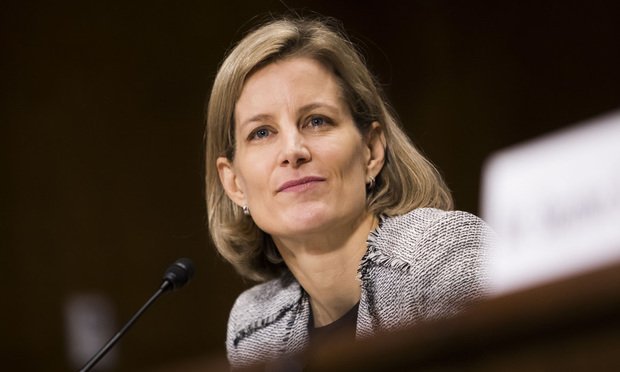
Judge Dabney Friedrich. (Twitter)
Contrary to internet chatter, Friedrich did not offer an opinion as to whether the IRA-Kremlin connection is true or false. Rather, she told the special prosecutor to keep quiet because such statements go beyond the scope of the original indictment and are therefore prejudicial to the defendant. But it may be a distinction without a difference since the only evidence that Mueller puts forth in the public version of his report is a New York Times article from February 2018 entitled “Yevgeny Prigozhin, Russian Oligarch Indicted by US, Is Known as ‘Putin’s Cook.’”
It’s a case of trial by press clip that should have been laughed out of court – and now, more or less, it is. Without the IRA, the only argument left in Mueller’s brief is that Russia stole some 28,000 emails and other electronic documents from Democratic National Committee computers and then passed them along to WikiLeaks, which published them to great fanfare in July 2016.
But as Consortium Newspointed out the day the Mueller report came out, that’s dubious as well. [See “The ‘Guccifer 2.0’ Gaps in Mueller’s Full Report,” April 18.] The reason: it rests on a timeline that doesn’t make sense:
- June 12, 2016: WikiLeaks founder Julian Assange announces that “leaks in relation to Hillary Clinton” were on the way.
- June 15: Guccifer 2.0, allegedly a stand-in for Russian military intelligence, goes on line to claim credit for the hack.
- June 22: Guccifer and WikiLeaks establish contact.
- July 14: Guccifer sends WikiLeaks an encrypted file.
- July 18: WikiLeaks confirms that it’s opened it up.
- July 22: The group releases a giant email cache indicating that the DNC rigged the nominating process in favor of Hillary Clinton and against Bernie Sanders.
But why would Assange announce the leaked emails on June 12 before hearing from the source on June 22? Was he clairvoyant? Why would he release a massive file just eight days after receiving it and as a little as four days after opening it up? How could that be enough time to review the contents and ensure they were genuine? “If a single one of those emails had been shown to be maliciously altered,” blogger Mark F. McCarty points out, “WikiLeaks’s reputation would have been in tatters.” Quite right. So if Mueller’s chronology doesn’t hold up, then Assange’s original statement that “our source is not the Russian government and it is not a state party” still stands – which it plainly does.
Going Up in Smoke
Bottom line: Russiagate is going up in smoke. The claim that Russian military intelligence fed thousands of emails to WikiLeaks doesn’t stand up to scrutiny while Mueller is not only unable to a prove a connection between the Internet Research Agency and the Kremlin but is barred from even discussing it, according to Friedrich’s ruling, without risking a charge of contempt. After 22 months of investigating the ins and outs of Russian interference, Mueller seems to have finally come up dry.

Reed Smith’s Pittsburgh office. (Wikimedia Commons)
“Revenge of the oligarchs” might be a good headline for this story. The IRA indictment initially seemed to be a no-lose proposition for Mueller. He got to look good in the press, the media got to indulge in yet another round of Russia-bashing, while, best of all, no one had to prove a thing. “Mueller’s allegations will never be tested in court,” noted Andrew C. McCarthy, a former federal prosecutor turned pundit for the rightwing National Review. “That makes his indictment more a political statement than a charging instrument.”
Then came the unexpected. Concord Management hired Reed Smith, a top-flight law firm with offices around the world, and demanded to be heard. The move was “a real head-scratcher,” one Washington attorney told Buzzfeed, because Concord was beyond the reach of U.S. law and therefore had nothing to fear from an indictment and nothing to gain, apparently, from going to court. But then the firm demanded to exercise its right of discovery, meaning that it wanted access to Mueller’s immense investigative file. Blindsided, Mueller’s requested a delay “on the astonishing ground,” according to McCarthy, “that the defendant has not been properly served – notwithstanding that the defendant has shown up in court and asked to be arraigned.”

Prigozhin: Forced Mueller to show his hand. (YouTube)
Prigozhin was forcing the special prosecutor to show what he’s got, McCarthy went on, at zero risk to himself since he was not on U.S. soil. What was once a no-lose proposition for Mueller was suddenly a no-lose proposition for Putin’s unexpectedly clever cook.
Now Mueller is in an even worse pickle because he’s barred from mentioning a major chunk of his report. What will he discuss if Democrats succeed in getting him to testify before the House intelligence and judiciary committees next week – the weather? If his team goes forward with the Concord prosecution, he’ll risk having to turn over sensitive information while involving himself in a legal tangle that could go on for years, all without any conceivable payoff. If he drops it, the upshot will be a public-relations disaster of the first order.
As skeptics have pointed out, the IRA’s social-media campaign was both more modest and more ineffectual than the Mueller report’s over-the-top language about a “sweeping and systematic” conspiracy would suggest. Yet after Facebook Vice President Rob Goldman tweeted that “the majority of the Russian ad spend happened AFTER the election,” he was forced to beg for forgiveness like a defendant in a Moscow show trial for daring to play down the magnitude of the crime.
But it wasn’t Goldman who shaved the truth. Rather, it was Mueller. Thanks to the unexpected appearance of Concord Management, he’s now paying the price.
Daniel Lazare is the author of “The Frozen Republic: How the Constitution Is Paralyzing Democracy” (Harcourt Brace, 1996) and other books about American politics.
‘Any lie will do’: Head of US international broadcast agency Lies to Congress about RT’s funding
RT | July 12, 2019
The CEO of the American agency that governs international broadcasting has made a powerful, if blatantly false, sales pitch for his fight against ‘Russian disinformation’… right after saying “any lie will do” for the Kremlin.
John Lansing, the CEO of the United States Agency for Global Media (USAGM), which supervises Voice of America and Radio Free Europe/Radio Liberty, among others, raised the alarm over Washington’s favorite shadowboxing opponent – ‘fake news’ allegedly spread by the Kremlin – at a recent House Committee on Appropriations hearing.
He is worried his agency isn’t getting enough government money to fight “Russian disinformation.”
As the main perpetrators, he named RT and Sputnik (no surprise there). Their goal, according to Lansing, is to “destroy the very idea of an objective, verifiable set of facts,” their modus operandi – “in a world where nothing is empirically truthful, any lie will do.”
He then set his own pants on fire by claiming that while he doesn’t know for certain how much the Russian government invests in those outlets, he knows “it’s more than the US government invests.” How much more? “I think it’s around the 10x factor, absolutely.”
Which is about a 19x factor away from the truth. USAGM’s 2019 budget is $808 million. The combined 2019 budget of the Russian media group that runs RT and Sputnik (as well as a few other outlets) is around $440 million – a far cry from the $8bn+ Lansing generously estimated.
Hiring the swamp: Meet new RFE/RL boss, a Russiagate-pushing neocon
By Nebojsa Malic | RT | July 11, 2019
Radio Free Europe/Radio Liberty, a US government-funded propaganda outfit, will soon get a new president – a NeverTrump neoconservative flack, who last worked at an outfit promoting the ‘Russiagate conspiracy.’
Jamie Fly is supposed to take over at RFE/RL in Prague on August 1, having reportedly been handpicked by board chair Kenneth Weinstein and endorsed by Secretary of State Mike Pompeo. He reportedly received unanimous support from the board, composed of Democrats and Republicans appointed under the Obama administration.
Fly’s name may not be familiar to the general public, but he is well known in Washington. His latest posting was at the German Marshall Fund of the United States (GMF), a quasi-non-governmental outfit that sponsors the Alliance for Securing Democracy (ASD), among other things. The ASD was set up by leading Democrats and neoconservatives in July 2017, and operates the notorious Hamilton68 dashboard, the shady analysis tool that sees “Russian bots and trolls” everywhere.
Journalist Glenn Greenwald, who has followed ASD since its inception, called Hamilton 68 “the single most successful media fraud & US propaganda campaign” he had seen in years of covering US politics.
The ASD was just one of the outfits that sprung up since 2016, driven by the allegations that Russia “meddled” with the US presidential election that were concocted and weaponized to help explain how President Donald Trump got into the White House instead of the establishment favorite Hillary Clinton – and fuel calls for Trump’s impeachment.
What they all had in common was seeing “Russians” all over social media, and demanding purges from Facebook, Twitter, YouTube and other platforms. Fly himself boasted, from his GMF/ASD perch, that his outfit was guiding Facebook in its crackdown on “Russian” pages and other “fringe” views in October 2018, and that it was “just the beginning.”
Meanwhile, RFE/RL was getting caught red-handed violating Facebook’s advertising rules by posting pro-NATO propaganda.
The rest of Fly’s work history is hardly better. Between 2013 and 2017, he worked as a foreign policy adviser to Senator Marco Rubio (R-Florida). Rubio, you may recall, currently champions “regime change” in Venezuela and seems to enjoy Trump’s favor even after voting against his efforts to secure the US-Mexico border.
Prior to working for Rubio, Fly was executive director at the Foreign Policy Initiative (FPI), an interventionist think-tank that operated between 2009 and 2017 and was co-founded by a trio of prominent neoconservatives. Dan Senor served as the chief spokesman for the US occupying authority in Iraq and later as a foreign policy adviser to Mitt Romney in 2012. The other two co-founders were Bill Kristol and Robert Kagan, formerly of the Project for the New American Century (PNAC) and authors of an infamous 1996 treatise advocating “benevolent global hegemony” by the US.
During the neoconservative-dominated George W. Bush administration, Fly worked at the National Security Council and at the office of the Secretary of Defense, under both Donald Rumsfeld and Robert Gates.
In other words, Jamie Fly is the perfect example of what Trump had called the “swamp” and vowed to “drain” in his 2016 campaign – a neoconservative Washington operative dedicated to policies and ideas that Trump got elected by denouncing and opposing. Yet in an administration whose foreign policy is run by Pompeo and National Security Advisor John Bolton, he should be a perfect fit.
The Death of Privacy: Government Fearmongers to Read Your Mail
By Philip Giraldi | Strategic Culture Foundation | July 11, 2019
It is discouraging to note just how the United States has been taking on the attributes of a police state since 9/11. Stories of police raids on people’s homes gone wrong are frequently in the news. In one recent incident, a heavily armed SWAT team was sent to a St. Louis county home. The armed officers entered the building without knocking, shot the family dog and forced the family members to kneel on the floor where they were able to watch their pet struggle and then die. The policemen then informed the family that they were there over failure to pay the gas bill. Animal rights groups report that the shooting of pets by police has become routine in many jurisdictions because the officers claim that they feel threatened.
Indeed, any encounter with any police at any level has now become dangerous. Once upon a time it was possible to argue with an officer over the justification for a traffic ticket, but that is no longer the case. You have to sit with your hands clearly visible on the steering wheel while answering “Yes sir!” to anything the cop says. There have been numerous incidents where the uncooperative driver is ordered to get out of the car and winds up being tasered or shot.
Courts consistently side with police officers and with the government when individual rights are violated while the Constitution of the United States itself has even been publicly described by the president as “archaic” and “a bad thing for the country.” The National Security Agency (NSA) routinely and illegally collects emails and phone calls made by citizens who have done nothing wrong and the government even denies to Americans the right to travel to countries that it disapproves of, most recently Cuba.
And traveling itself has become an unpleasant experience even before one sits down in the 17 inches of seat-space offered by major airlines, with the gropers of the Transportation Security Administration (TSA) acting as judge, jury and executioner for travelers who have become confused by the constantly changing rules about what they can do and carry with them. The TSA is now routinely “examining” the phones and laptops of travelers and even downloading the information on them, all without a warrant or probable cause. And the TSA even has a “little list” that identifies travelers who are uncooperative and flags them for special harassment.
Congress is considering bills that will make criticism of Israel a crime, establishing a precedent that will end freedom of speech, and the impending prosecution and imprisonment of Julian Assange for espionage will be the death of a truly free press. Americans are no longer guaranteed a trial by jury and can be held indefinitely by military tribunals without charges. Under George W. Bush torture and rendition were institutionalized while Barack Obama initiated the practice of executing US citizens overseas by drone if they were deemed to be a “threat.” There was no legal process involved and “kill” lists were updated every Tuesday morning. And perhaps the greatest crimes of all, both Obama and George W. Bush did not hesitate to bomb foreigners, bring about regime change, and start wars illegally in Asia and Africa.
The latest assault on civil liberties relates to what used to be referred to as privacy. Indeed, the United States government does not recognize that citizens have a right to privacy. Officials in the national security and intelligence agencies have reportedly become concerned that some new encryption systems being used for email traffic and telephones have impeded government monitoring of what information is being exchanged. As is often the case, “terrorism” is the principal reason being cited for the need to read and listen to the communications of ordinary citizens, but it should be observed in passing that more people in the US are killed annually by falling furniture than by acts of terror. It should also be noted that the federal, state and local governments as well as private companies spend well in excess of a trillion dollars every year to fight the terrorism threat, most of which is completely unnecessary or even counter-productive.
At the end of June senior Trump Administration officials connected to the National Security Council met to discuss what to do about the increasing use of the effective encryption systems by both the public and by some internet service providers, including Apple, Google and Facebook. Particular concern was expressed regarding systems that cannot be broken by NSA at all even if maximum resources using the Agency’s computers are committed to the task. It is a condition referred to by the government agencies as “going dark.”
Under discussion was a proposal to go to Congress and to ask for a law either forbidding so-called end-to-end encryption or mandating a technological fix enabling the government to circumvent it. End-to-end encryption, which scrambles a message so that it is only readable by the sender and recipient, was developed originally as a security feature for iPhones in the wake of the whistleblower Edward Snowden’s exposure of the extent to which NSA was surveilling US citizens. End-to-end makes most communications impossible to hack. From the law enforcement point of view, the alternative to a new law banning or requiring circumvention of the feature would be a major and sustained effort to enable government agencies to break the encryption, something that may not even be possible.
In the past, government snooping was enabled by some of the communications providers themselves, with companies like AT&T engineering in so-called “backdoor” access to their servers and distribution centers, where messages could be read directly and phone calls recorded. But the end-to-end encryption negates that option by sending a message out on the ethernet that is unreadable.
Phone security was last in the news in the wake of the 2015 San Bernardino, California, terrorist attack that killed 14, where the Department of Justice took Apple to court to access a locked iPhone belonging to one of the gunmen. Apple refused to create software to open the phone but the FBI was able to find a technician who could do so and the case was dropped, resulting in no definitive legal precedent on the government’s ability to force a private company to comply with its demands.
There is apparently little desire in Congress to take up the encryption issue, though the National Security Council, headed by John Bolton, clearly would like to empower government law enforcement and intelligence agencies by banning unbreakable encryption completely. It is, however, possibly something that can be achieved through an Executive Order from the president. If it comes about that way, FBI, CIA and NSA will be pleased and will have easy access to all one’s emails and phone calls. But the price to be paid is that once the security standards are lowered anyone else with minimal technical resources will be able to do the same, be they hackers or criminals. As usual, a disconnected and tone-deaf government’s perceived need “to keep you safe” will result in a loss of fundamental liberty that, once it is gone, will never be recovered.
Did Pedophile Jeffrey Epstein Work for Mossad?

* Left photo: Jeffrey Epstein and partner, Ghislaine Maxwell, with Donald and Melania Trump at Mar-a-Lago in 2000. Right photo: Ghislaine Maxwell at Chelsea Clinton’s wedding.
By Philip Giraldi • American Herald Tribune • July 11, 2019
The extent of Israeli spying directed against the United States is a huge story that is only rarely addressed in the mainstream media. The Jewish state regularly tops the list for ostensibly friendly countries that aggressively conduct espionage against the U.S. and Jewish American Jonathan Pollard, who was imprisoned in 1987 for spying for Israel, is now regarded as the most damaging spy in the history of the United States.
Last week I wrote about how Israeli spies operating more-or-less freely in the U.S. are rarely interfered with, much less arrested and prosecuted, because there is an unwillingness on the part of upper echelons of government to do so. I cited the case of Arnon Milchan, a billionaire Hollywood movie producer who had a secret life that included stealing restricted technology in the United States to enable development of Israel’s nuclear weapons program, something that was very much against U.S. interests. Milchan was involved in a number of other thefts as well as arms sales on behalf of the Jewish state, so much so that his work as a movie producer was actually reported to be less lucrative than his work as a spy and black-market arms merchant, for which he operated on a commission basis.
That Milchan has never been arrested by the United States government or even questioned about his illegal activity, which was well known to the authorities, is just one more manifestation of the effectiveness of Jewish power in Washington, but a far more compelling case involving possible espionage with major political manifestations has just re-surfaced. I am referring to Jeffrey Epstein, the billionaire Wall Street “financier” who has been arrested and charged with operating a “vast” network of underage girls for sex, operating out of his mansions in New York City and Florida as well as his private island in the Caribbean, referred to by visitors as “Orgy Island.” Among other high-value associates, it is claimed that Epstein was particularly close to Bill Clinton, who flew dozens of times on Epstein’s private 727.
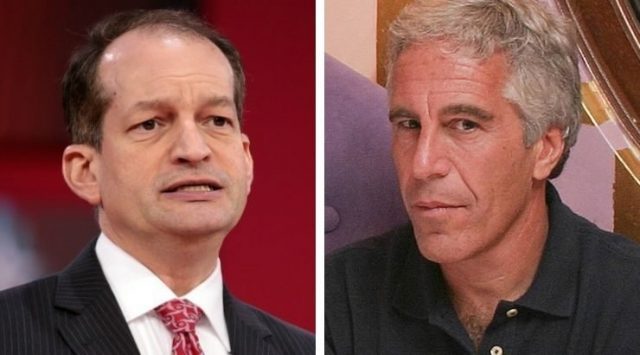
* Alex Acosta (L) Jeffrey Epstein (R)
Epstein was arrested on July 8th after indictment by a federal grand jury in New York. It was more than a decade after Alexander Acosta, the top federal prosecutor in Miami, who is now President Trump’s secretary of labor, accepted a plea bargain involving similar allegations regarding pedophilia that was not shared with the accusers prior to being finalized in court. There were reportedly hundreds of victims, some 35 of whom were identified, but Acosta deliberately denied the two actual plaintiffs their day in court to testify before sentencing.
Acosta’s intervention meant that Epstein avoided both a public trial and a possible federal prison sentence, instead serving only 13 months of an 18-month sentence in the almost-no-security Palm Beach County Jail on charges of soliciting prostitution in Florida. While in custody, he was permitted to leave jail for sixteen hours six days a week to work in his office.
Epstein’s crimes were carried out in his $56 million Manhattan mansion and in his oceanside villa in Palm Beach Florida. Both residences were equipped with hidden cameras and microphones in the bedrooms, which Epstein reportedly used to record sexual encounters between his high-profile guests and his underage girls, many of whom came from poor backgrounds, who were recruited by procurers to engage in what was euphemistically described as “massages” for money. Epstein apparently hardly made any effort to conceal what he was up to: his airplane was called the “Lolita Express.”
The Democrats are calling for an investigation of the Epstein affair, as well as the resignation of Acosta, but they might well wind up regretting their demands. Trump, the real target of the Acosta fury, apparently did not know about the details of the plea bargain that ended the Epstein court case. Bill and Hillary Clinton were, however, very close associates of Epstein. Bill, who flew on the “Lolita Express” at least 26 times, could plausibly be implicated in the pedophilia given his track record and relative lack of conventional morals. On many of the trips, Bill refused Secret Service escorts, who would have been witnesses of any misbehavior. On one lengthy trip to Africa in 2002, Bill and Jeffrey were accompanied by accused pedophile actor Kevin Spacey and a number of young girls, scantily clad “employees” identified only as “massage.” Epstein was also a major contributor to the Clinton Foundation and was present at the wedding of Chelsea Clinton in 2010.
With an election year coming up, the Democrats would hardly want the public to be reminded of Bill’s exploits, but one has to wonder where and how deep the investigation might go. There is also a possible Donald Trump angle. Though Donald may not have been a frequent flyer on the “Lolita Express,” he certainly moved in the same circles as the Clintons and Epstein in New York and Palm Beach, plus he is by his own words roughly as amoral as Bill Clinton. In June 2016, one Katie Johnson filed lawsuit in New York claiming she had been repeatedly raped by Trump at an Epstein gathering in 1993 when she was 13 years old. In a 2002 New York Magazine interview Trump said “I’ve known Jeff for fifteen years. Terrific guy… he’s a lot of fun to be with. It is even said that he likes beautiful women as much as I do, and many of them are on the younger side. No doubt about it – Jeffrey enjoys his social life.”
Selective inquiries into wrongdoing to include intense finger pointing are the name of the game in Washington, and the affaire Epstein also has all the hallmarks of a major espionage case, possibly tied to Israel. Unless Epstein is an extremely sick pedophile who enjoys watching films of other men screwing twelve-year-old girls the whole filming procedure smacks of a sophisticated intelligence service compiling material to blackmail prominent politicians and other public figures. Those blackmailed would undoubtedly in most cases cooperate with the foreign government involved to avoid a major scandal. It is called recruiting “agents of influence.” That is how intelligence agencies work and it is what they do.
That Epstein was perceived as being intelligence-linked was made clear in Acosta’s comments when being cleared by the Trump transition team. He was asked “Is the Epstein case going to cause a problem [for confirmation hearings]?” … “Acosta had explained, breezily, apparently, that back in the day he’d had just one meeting on the Epstein case. He’d cut the non-prosecution deal with one of Epstein’s attorneys because he had ‘been told’ to back off, that Epstein was above his pay grade. ‘I was told Epstein belonged to intelligence and to leave it alone.’”
Questions about Epstein’s wealth also suggest a connection with a secretive government agency with deep pockets. The New York Times reports that “Exactly what his money management operation did was cloaked in secrecy, as were most of the names of whomever he did it for. He claimed to work for a number of billionaires, but the only known major client was Leslie Wexner, the billionaire founder of several retail chains, including The Limited.”
But whose intelligence service? CIA and the Russian FSB services are obvious candidates, but they would have no particular motive to acquire an agent like Epstein. That leaves Israel, which would have been eager to have a stable of high-level agents of influence in Europe and the United States. Epstein’s contact with the Israeli intelligence service may have plausibly come through his associations with Ghislaine Maxwell, who allegedly served as his key procurer of young girls. Ghislaine is the daughter of Robert Maxwell, who died or possibly was assassinated in mysterious circumstances in 1991. Maxwell was an Anglo-Jewish businessman, very cosmopolitan in profile, like Epstein, a multi-millionaire who was very controversial with what were regarded as ongoing ties to Mossad. After his death, he was given a state funeral by Israel in which six serving and former heads of Israeli intelligence listened while Prime Minister Yitzhak Shamir eulogized: “He has done more for Israel than can today be said”

* Trump (left) with Robert Maxwell (right) at an event.
Epstein kept a black book identifying many of his social contacts, which is now in the hands of investigators. It included fourteen personal phone numbers belonging to Donald Trump, including ex-wife Ivana, daughter Ivanka and current wife Melania. It also included Prince Bandar of Saudi Arabia, Tony Blair, Jon Huntsman, Senator Ted Kennedy, Henry Kissinger, David Koch, Ehud Barak, Alan Dershowitz, John Kerry, George Mitchell, David Rockefeller, Richard Branson, Michael Bloomfield, Dustin Hoffman, Queen Elizabeth, Saudi King Salman and Edward de Rothschild.
Mossad would have exploited Epstein’s contacts, arranging their cooperation by having Epstein wining and dining them while flying them off to exotic locations, providing them with women and entertainment. If they refused to cooperate, it would be time for blackmail, photos and videos of the sex with underage women.
It will be very interesting to see just how far and how deep the investigation into Epstein and his activities goes. One can expect that efforts will be made to protect top politicians like Clinton and Trump and to avoid any examination of a possible Israeli role. That is the normal practice, witness the 9/11 Report and the Mueller investigation, both of which eschewed any inquiry into what Israel might have been up to. But this time, if it was indeed an Israeli operation, it might prove difficult to cover up the story since the pedophile aspect of it has unleashed considerable public anger from all across the political spectrum. Senator Chuck Schumer, self-described as Israel’s “protector” in the Senate, is loudly calling for the resignation of Acosta. He just might change his tune if it turns out that Israel is a major part of the story.
* Credit: Davidoff Studios/Getty Images
IRGC rejects US claim of Iran attempt to seize UK tanker in Persian Gulf
Press TV – July 11, 2019
Iran’s Islamic Revolution Guards Corps (IRGC) has dismissed a claim by US officials that its naval forces tried to stop a British tanker in the Persian Gulf.
Early on Thursday, two American officials, who were speaking to Reuters on the condition of anonymity, claimed that five boats believed to belong to the IRGC had approached the tanker British Heritage at the northern entrance of the Strait of Hormuz and ordered it to stop.
The Iranian boats dispersed, said one of the sources, after the UK’s Royal Navy frigate HMS Montrose, which had been escorting the tanker, “pointed its guns at the boats and warned them over radio.”
The other official also called the alleged incident an act of “harassment and an attempt to interfere with the passage.”
However, the IRGC rejected the US officials’ claim, stressing that Iranian boats were carrying out their normal duties.
“Patrols by the IRGC’s Navy vessels have been underway in the Persian Gulf based on current procedures and missions assigned to them with vigilance, precision and strength,” said the Public Relations Department of the IRGC Navy’s Fifth Naval Zone in a statement.
“In the past 24 hours, there has been no encounter with foreign ships, including British ones,” it added.
The statement further noted that the IRGC Navy’s fifth zone has the power to act “decisively and swiftly” and seize foreign vessels in the area it is tasked with patrolling if an order is issued to that effect.
Similarly, Britain claimed Thursday that three Iranian vessels had tried to block the passage of its tanker but backed off.
“HMS Montrose was forced to position herself between the Iranian vessels and British Heritage and issue verbal warnings to the Iranian vessels, which then turned away,” a British government representative said.
Zarif: Such claims have no value
Iran’s Foreign Minister Mohammad Javad Zarif also reacted to the allegations, saying they are merely meant to create tensions.
Those who make such claims attempt to “cover up their weak point,” he added. “Apparently the British tanker has passed. What they have said themselves and the claims that have been made are for creating tension and these claims have no value.”
The claims came two weeks after British marines illegally seized an Iranian oil tanker in the Strait of Gibraltar under the pretext that the vessel had been suspected of carrying crude to Syria in violation of EU sanctions against the Arab country.
Reports, however, said the seizure took place at the request of the US.
The Islamic Republic condemned the illegal seizure as “maritime piracy” and summoned the British ambassador on three occasions to convey its protest at the confiscation.
Iran, Russia say US ‘was isolated’ at IAEA’s special meeting
Press TV – July 11, 2019
Tehran says the UN nuclear watchdog’s special meeting held at Washington’s request to win the Board of Governors’ support for its anti-Iran claims turned into another failure for Americans.
“Another failure for the US at the mockery of the IAEA’s Board of Governors,” Iranian Foreign Ministry Spokesman Seyyed Abbas Mousavi tweeted on Wednesday in reference to an emergency meeting of the 35-member Board of Governors of the International Atomic Energy Agency (IAEA) to discuss Iran’s nuclear program, which wrapped up with no conclusion earlier in the day in Vienna.
“The US was once again isolated by its own hands,” Mousavi added.
“The legal strength of the JCPOA [the Iran nuclear deal], the active diplomacy and the fruitful political and ethical record of Iran block all the paths to arrogant deal-breakers,” he added.
The meeting was held a few days after Iran increased the level of its uranium enrichment to 4.5%, which is beyond the limit set by the JCPOA. The move was part of the second phase of the country’s May 8 decision to reduce its commitments under the multilateral 2015 nuclear deal in reaction to the US violations and Europe’s inaction.
The emergency meeting was held at the request of US Ambassador to International Organizations Jackie Wolcott. Iran later criticized the US’ request as a “sad irony” as Washington is the party that has violated the deal first by unilaterally pulling out of it and imposing sanctions on the Islamic Republic.
The US had approached various delegations before requesting to convene the special meeting but in the end had to make the request itself, says Iran’s ambassador to the IAEA Kazem Gharib-Abadi.
“We have been informed that the United States were seeking to have some formal outcome of this meeting, something like a resolution […] but because they haven’t been in a position to convince the others to have their support for their claim, regarding consideration of Iran’s ceasing its implementation of the JCPOA, there has been no conclusion,” he told Press TV following the special session.
“The majority of the members of the Board supported the JCPOA, multilateralism and deplored unilateral actions of the US,” he added.
The Iranian envoy earlier told the IAEA’s special meeting that “the sadistic tendency of the United States to use illegal, unilateral sanctions as an instrument to coerce sovereign states and private entities should come to an end.”
‘US practically isolated’
The Russian Ambassador to the IAEA, Mikhail Ulyanov, also tweeted after the meeting that the US “was practically isolated on this issue”.
Ulyanov told the assembled diplomats it was an “oddity” that the meeting had been called by the US, “the country that declared the JCPOA to be a ‘terrible deal’”.
He said “in practice, it turns out that Washington is aware of the importance of the Plan (JCPOA).”
Also in a statement to the meeting, the UK, France, and Germany said such issues “should be addressed by participants to the JCPOA, including through a meeting of the Joint Commission to be convened urgently.”
The E3 at the same time called on Iran to implement its commitments under the 2015 nuclear deal in full despite the fact that Iran’s decision to reduce its commitments under the deal was made after Europe’s failure to live up to its side of the bargain.
The European parties to the JCPOA were supposed to compensate for the US withdrawal from the deal in May 2018 and the impact of its sanctions on the Iranian economy. Back in January, the E3 officially announced a special payment mechanism, known as the Instrument in Support of Trade Exchanges (INSTEX), which was aimed at facilitating trade with Tehran despite the US bans.
However, it took a long time for the trade channel to become fully operational. The first transaction is set to take place soon, but Iran says without injection of sufficient money into the channel, it cannot help the country reap the benefits of the deal.
“Iran would only accept the European financial mechanism known as INSTEX if it covers all countries rather than just the current ten, if it covers all items in the sanctions, rather than just food stuffs and medicine, and if it is sufficiently funded,” Gharib-Abadi told Press TV on Wednesday.
“We have told them that if they are not ready to put money in the INSTEX, so you have to consider the import of the Iranian oil, so that the money can go to the INSTEX to fund it,” he added.
Another nail in Russiagate coffin? Federal judge destroys key Mueller report claim
RT | July 11, 2019
Special counsel Robert Mueller’s claim of “sweeping and systematic” Russian meddling in the 2016 US election just took another body blow, as a federal judge ruled that his indictment of a ‘troll farm’ is not actual proof of it.
Mueller’s charges against Concord Management & Consulting, the Russian company accused of running a “troll farm” and “sowing discord” on US social media in 2016, do not establish a link between that private company and the Russian government, US District Judge Dabney L. Friedrich pointed out.
Yet the special counsel’s much-publicized final report claims to have “established” and “confirmed” Russian government activities based in part on the indictment against Concord, which is a breach of prosecutorial rules, Friedrich said.
For example, Mueller’s report says that Concord CEO Yevgeny Prigozhin “is widely reported to have ties to Russian President Vladimir Putin.” That’s an assertion, not evidence.
Judge Friedrich’s ruling was issued on May 28, but only unsealed on July 1, and went largely unnoticed by the media until this week. That’s not surprising, given the commitment of the US political establishment to the ‘Russiagate’ narrative, journalist and author Daniel Lazare told RT.
“It’s quite a dramatic ruling,” Lazare said. “Essentially what it says is that half of Mueller’s case doesn’t make any sense, it has no evidence to back it up.”
The special counsel’s report argued that Moscow sought to meddle in the election by Concord’s “sowing discord” on social media while Russian intelligence stole Democrat emails and released them through WikiLeaks, but neither of those assertions is backed by actual evidence, and now the insinuated link between Concord and the Kremlin has been rejected, Lazare pointed out.
“Americans assume that Russians and Russia are the same thing. But they’re not, any more than an individual American and the Trump administration are the same thing,” he told RT.
The ruling is “a major blow to the entire ‘Russian Active Measures’ talking point,” journalist Aaron Maté argued on Twitter. The Internet Research Agency put out “juvenile clickbait mostly unrelated to the election,” and is a private entity whose connection with the Kremlin Mueller never established, he added.
“If Mueller was disingenuous in falsely trying to link it to Russian government, what else was he disingenuous about?”
In an investigative article published last week, Maté pointed out that the Mueller report used “qualified and vague language to describe key events,” indicating that the investigators have not established for certain if DNC emails were stolen by Russia or leaked by an insider, or how they made it into the hands of WikiLeaks.
He also noted that the federal authorities have based their investigation into the DNC emails and President Donald Trump’s alleged connections with the Kremlin entirely on claims of two entities contracted by the Democrats – cybersecurity company CrowdStrike, which actually redacted the evidence it gave to the feds – and British spy Christopher Steele, author of the infamous “dossier” used to spy on Trump campaign officials.
“The idea that this was a meddling operation by a foreign government, I think is just absurd,” former US diplomat Jim Jatras told RT, commenting on Mate’s revelations and Judge Friedrich’s ruling.
This should be the final nail in the coffin of ‘Russiagate,’ but it won’t be, Jatras added. Too many people in Washington have invested too much in Russiagate to admit they were ever wrong.
Featured Video

False Flags and the Dawn of Bioterrorism
or go to
Aletho News Archives – Video-Images
From the Archives
How 1960’s French Nuclear Tests Are Still Claiming Lives in Algeria
Sputnik – 15.02.2018
On February 13, 1960, France carried out its first nuclear test in Algeria’s southern Reggane region. According to official statistics, 17 nuclear tests were carried out in total over the next 6 years. The area remains affected, and local scientists say that radioactive contamination has caused genetic mutations and irreversibly changed the region.
There are no official statistics on the number of victims. The only figures can be found in the records kept by the French representative of the local church, which lists 42,000 victims of nuclear tests. Three years ago, the French Ministry of Defense issued a statement, putting the number at 27,000 people. The victims include French soldiers as well as local Algerians who lived in the surrounding areas. … continue
Blog Roll
 Aletho News
- Midterms Were ‘Vote of No Confidence’ in GOP, But Iran Has No Illusions About Democrats – Marandi
- Israeli Soldiers Inadvertently Prove Their Own Genocidal Guilt
- Ukraine arrests woman who exposed Azov battalion’s ‘torture chamber’
- Did Israel lose the midterms?
- How Iran defeated Trump’s Israel First GOP
- De-escalating the conflict: What the OSCE, the UN, and Europe are (not) doing to prevent war
- Desperate For A Renewed Iran War, Israel Dusts Off The WMD Deception.
- US Elections Offer Choice Between ‘Bad and Worse’ as Both Parties Serve War Lobby – ex-UN Expert
- Ghalibaf warns US government not to betray voters who rejected war
- Broke Princes: Saudi Arabia’s Powder Keg
- If Americans Knew
- Israeli Soldiers Inadvertently Prove Their Own Genocidal Guilt in Gaza
- In Gaza, the specter of famine is returning
- Major losses could spur Trump to escalate war before year’s end
- It’s the war, stupid. The hawks brought down the Republicans
- Providence Becomes Largest U.S. City to Divest From Israel in Landmark Vote
- DAILY UPDATE: Latest essential news on Palestine, Israel, & region
- Israel kills 19 Palestinians in Gaza during three-day bombing spree
- Trump: Netanyahu agreed to end $4 billion in US aid to Israel by end of 2026
- Israeli army twisted truth on Gaza, says former military press staffer
- Ms. Rachel announces campaign to get public figures to speak out about Gaza
- No Tricks Zone
- New Study: The Net Fossil Fuel Contribution To Rising Atmospheric CO2 Has Been Zero For 500 Years
- Germany’s Green Energy Transition Becoming Increasingly Expensive…Another 6 Trillion Euros!
- Sudden Stratospheric Warming, Powerful El Niño Combination May Lead To Extreme Europe Cold, Energy Crisis!
- Two New Studies Find Thwaites Glacier Melt Cannot Be Driven By Human Activity Or A Warming Ocean
- E-Cars Reduce CO2 Emissions By Only 41% Compared To Internal Combustion Engine Vehicles
- Predictions Made By Renowned Climate Professor Over Past Decades Have Been Proven To Be Poor
- New Study Suggests Large Regions Of The Pacific Ocean Have Been Cooling For The Last 80 Years
- Germany’s Green Energy Debacle: High Energy Costs Force Kahla Porzellan to Close After 182 Years!
- New Study: 50 Years Of The Most Aggressive ‘Net Zero’ Policies Can Only Affect The Global Climate By 0.03°C
- US September “Heat” Was No Record…Many Records Set Decades Ago

