US media intensify pretext for ousting Trump
By Finian Cunningham | RT | January 16, 2019
It’s no secret that since his election in 2016, powerful elements in the US political and media establishment have been running a non-stop campaign to remove Trump from the White House. Lately, the stakes have been raised.
Spearheading the media effort to defenestrate Trump are the New York Times and Washington Post. Both have been prominent purveyors of the “Russiagate” narrative over the past two years, claiming that Republican candidate colluded with Russian state intelligence, or at least was a beneficiary of alleged Russian interference, to win the presidency against Democratic rival Hillary Clinton.
Congressional investigations and a probe by a Special Counsel Robert Mueller, along with relentless media innuendo, have failed to produce any evidence to support the Russiagate narrative.
Now, the anti-Trump media in alliance with the Democratic leadership, the foreign policy establishment and senior ranks of the state intelligence agencies appear to have come up with a new angle on President Trump – he is a national security risk.
Ingeniously, the latest media effort lessens the burden of proof required against Trump. No longer has it to be proven that he deliberately collaborated with Russian President Vladimir Putin. Trump could have done it “unwittingly,” the media are now claiming, because he is a buffoon and reckless. But the upshot, for them, is he’s still a national security risk. The only conclusion, therefore, is that he should be removed from office. In short, a coup.
Over the past couple of weeks, the supposed media bastions have been full of it against Trump. An op-ed in the New York Times on January 5 by David Leonhardt could not have made more plain the absolute disdain. “He is demonstrably unfit for office. What are we waiting for?”
Follow-up editorials and reports have piled on the pressure. The Times reported how the Federal Bureau of Investigation – the state’s internal security agency – opened a counterintelligence file on Trump back in 2017 out of concern that he was “working for Russia against US interests.”
That unprecedented move was prompted partly because of Trump’s comments during the election campaign in 2016 when he jokingly called on Russia to release Hillary Clinton’s incriminating emails. Never mind the fact that Russian hackers were not the culprits for Clinton’s email breach.
Then the Washington Post reported former US officials were concerned about what they said was Trump’s “extraordinary lengths” to keep secret his private conversations with Russia’s Putin when the pair met on the sidelines of conferences or during their one-on-one summit in Helsinki last July.
The Post claimed that Trump confiscated the notes of his interpreter after one meeting with Putin, allegedly admonishing the aide to not tell other officials in the administration about the notes being sequestered. The inference is Trump was allegedly in cahoots with the Kremlin.
This week, in response to the media speculation, Trump was obliged to strenuously deny such claims, saying: “I have never worked for Russia… it’s a big fat hoax.”
What’s going on here is a staggering abuse of power by the US’ top internal state intelligence agency to fatally undermine a sitting president based on the flimsiest of pretexts. Moreover, the nation’s most prominent news media outlets – supposedly the Fourth Estate defenders of democracy – are complacently giving their assent, indeed encouragement, to this abuse of power.
The Times in the above report admitted, in a buried one-line disclaimer, that there was no evidence linking Trump to Russia.
Nevertheless, the media campaign doubled down to paint Trump as a national security risk.
The Times reported on January 14 about deep “concerns” among Pentagon officials over Trump’s repeated threats to withdraw the US from the North Atlantic Treaty Organization (NATO). The reporting portrays Trump as incompetent, ignorant of policy details and habitually rude to American allies. His capricious temper tantrums could result in the US walking away from NATO at any time, the newspaper contends.
Such a move would collapse the transatlantic partnership between the US and Europe which has “deterred Soviet and Russian aggression for 70 years,” claimed the Times.
The paper quotes US Admiral James Stavridis, the former supreme allied commander of NATO, calling Trump’s withdrawal whims “a geopolitical mistake of epic proportion.”
“Even discussing the idea of leaving NATO — let alone actually doing so — would be the gift of the century for Putin,” added Stavridis.
The Times goes on to divulge the media campaign coordination when it editorialized: “Now, the president’s repeatedly stated desire to withdraw from NATO is raising new worries among national security officials amid growing concern about Mr Trump’s efforts to keep his meetings with Mr Putin secret from even his own aides, and an FBI investigation into the administration’s Russia ties.”
Still another Times report this week reinforced the theme of Trump being a national security risk when it claimed that the president’s Middle East policy of pulling troops out of Syria was “losing leverage” in the region. It again quoted Pentagon officials “voicing deepening fears” that Trump and his hawkish National Security Advisor John Bolton “could precipitate a conflict with Iran”.
That’s a bit hard to stomach: the Pentagon being presented as a voice of sanity and peace, keeping vigilance over a wrecking-ball president and his administration.
But the New York Times, Washington Post and other anti-Trump corporate media have long been extolling the military generals who were formerly in the administration as “the adults in the room.”
Generals H.R. McMaster, the former national security adviser, John Kelly, Trump’s ex-chief of staff, and James Mattis, the former defense secretary until he was elbowed out last month by the president, were continually valorized in the US media as being a constraining force on Trump’s infantile and impetuous behavior.
The absence of “the adults” seems to have prompted the US media to intensify their efforts to delegitimize Trump’s presidency.
A new House of Representatives controlled by the Democratic Party has also invigorated calls for impeachment of Trump over a range of unsubstantiated accusations, Russian collusion being prime among them. But any impeachment process promises to be long and uncertain of success, according to several US legal and political authorities.
Such a tactic is fraught with risk of failing, no doubt due to the lack of evidence against Trump’s alleged wrongdoing. A failed impeachment effort could backfire politically, increase his popularity, and return him to the White House in 2020.
Given the uncertainty of impeaching Trump, his political enemies, including large sections of the media establishment, seem to be opting for the tactic of characterizing him as a danger to national security, primarily regarding Russia. Trump doesn’t have to be a proven agent of the Kremlin – a preposterous idea. Repeated portrayal of him as an incompetent unwitting president is calculated to be sufficient grounds for his ouster.
When the Washington Post editorial board urges a state of emergency to be invoked because of “Russian meddling in US elections”, then the national mood is being fomented to accept a coup against Trump. The media’s fawning over the Pentagon and state intelligence agencies as some kind of virtuous bastion of democracy is a sinister signal for a military-police state.
Benefiting Israel Tops Congressional Agenda
America Can Easily Be Moved
By Philip Giraldi • Unz Review • January 15, 2019
Israeli Prime Minister Benjamin Netanyahu famously was unaware that he was being filmed when he commented that “America is a thing you can move very easily, moved in the right direction.” His predecessor Ariel Sharon was even more to the point when he reportedly said “Every time we do something you tell me America will do this and will do that … don’t worry about American pressure; I tell you, we, the Jewish people, control America and the American people know it!”
If this were only chest thumping rhetoric one might just shrug and go about one’s business, but actions speak louder than words, even in the world of corrupt politicians, where nothing is ever as it seems to be. In the past year alone, the U.S. government has moved its Embassy in Israel to Jerusalem, has stopped criticizing the Netanyahu government’s expansion of illegal settlements, and is reportedly currently contemplating recognizing as legal Israel’s illegal occupation of the Syrian Golan Heights. All the moves were and are contrary to actual American interests.
Furthermore, Israel, a country having a European level standard of living to include free education and medical care, has received more than $250 billion in “aid” from Washington. It currently is receiving $3.8 billion yearly from the U.S. Treasury as a base figure guaranteed for ten years, with supplements for special projects and programs. Adding in trade arrangements favorable to Israel and the money it gets from American Jewish donors’ tax-exempt contributions, the real total per annum approaches and may even exceed $10 billion. Much of the donor money, including that from the Kushner Foundation, has gone to fund the illegal settlements on the West Bank in violation of U.S. law. And then there is the $2.7 billion given yearly to Egypt and Jordan, essentially bribes to maintain friendly relations with Israel.
The ultimate irony is that any aid to Israel is illegal in light of the fact that it has violated the Symington and Glenn amendments to the 1961 Foreign Assistance Act due to its undeclared nuclear weapons arsenal and its refusal to sign the Nuclear Non Proliferation Treaty. Both Congress and the White House have chosen to ignore that complication, one more demonstration of Jewish power in the United States. In truth, Ariel Sharon, if he was quoted correctly, had it right. Jewish Americans do control or at least exercise considerable influence over key sectors in the U.S. They are overwhelmingly disproportionately present on Wall Street, in the entertainment and news industries, in academia, in high value professions and in government at all levels. Their collective power both enriches and protects Israel at the expense of the U.S. taxpayer and genuine national interests. It also enables Israeli agents in the U.S., like the American Israel Public Affairs Committee (AIPAC), to avoid scrutiny and regulation under the Foreign Agents Registration Act of 1938.
Some federal government agencies exist largely to promote Israeli interests, most notably the Treasury Department’s Office for Terrorism and Financial Intelligence, which has only had Jewish Under Secretaries heading it since it was founded in 2004. It is currently run by Israeli Sigal Mandelker. The office has focused on punishing Iran, Israel’s principle enemy, throughout its existence.
Jewish power is most perniciously evident in U.S. foreign policy, where it has a strangle hold on relations between Washington and the Arab countries of the Middle East. Much of this leverage is derived from the fact that the principal donors to both the Democratic and Republican parties – Haim Saban and Sheldon Adelson-are both Jews having very strong ties to Israel. Saban is an Israeli and Adelson may have Israeli citizenship. With both parties more than willing to act on behalf of Israel, the United States has engaged in a number of wars that serve no national interest and which have, on the contrary, brought with them devastating consequences, including the rise of new terrorist groups.
To be sure, many American Jews are not convinced by the love affair with Israel, but they are hard to hear amidst the cacophony coming from the Jewish oligarchs and hundreds of pro-Israel organizations that are constantly singing the praises of Netanyahu and his kleptocratic regime. For many young Jews in particular, it is difficult to empathize with a country that deploys army snipers to shoot thousands of unarmed demonstrators or a government that engages in starvation policies and the arrests, beatings and killings of children. Not to mention a governing system that believes that only Jewish citizens have full rights.
The Jewish oligarchs who manipulate the politicians do so with money, though one should in no way minimize the essential mendacity of the politicians themselves who are willing to sell out the interests of their country in exchange for thirty pieces of silver. Senator Marco Rubio of Florida, who is not one of the brightest bulbs in congress, is a prime example of a legislator who has been bought and paid for by Israeli interests in the form of campaign donations from casino magnate Sheldon Adelson and vulture capitalist Paul Singer.
Rubio’s speech last week supporting Senate bill S.1 for 2019, which he sponsored, was remarkable and should serve as primary evidence for anyone who really wonders why we have a Senate at all. The bill itself should also be read in toto to learn the details of what largess we give to Israel in exchange for absolutely nothing in return. To put it succinctly, Rubio is all about protecting and nurturing Israel, which he sees as a good move since he has aspirations to become president. S.1 was, notably, the first Senate bill to be considered in 2019 after what once upon a time used to be referred to as the Christmas Recess. The full title of S.1 is the Strengthening America’s Security in the Middle East Act of 2019, which might be considered a bit of a fraud as it has nothing to do with the United States and is really all about giving Israel money and anything else it might desire, to include destroying the nonviolent Boycott, Divestment and Sanctions (BDS) movement that has targeted Israel’s apartheid. Rubio openly has admitted that the bill was crafted to help Israel and during his speech he registered his opposition to the impending pullout of U.S. troops from Syria because it would, according to him, “endanger” the Jewish state. Apart from that, the half hour presentation incorporated some remarkable oratory explaining S.1 including:
First of all, let me tell you what it doesn’t do. It doesn’t outlaw BDS. if you’re an American company and you want to boycott or divest from Israel, it doesn’t make it illegal. It doesn’t stop you from doing it. The only thing it says is if there is some city or county or state in this country who wants to support Israel, they have a right to say we are not going to buy services or goods from any company that’s boycotting or divesting from Israel. That’s all it does. It gives cities and counties like these 26 states the opportunity to have their elected officials who respond to the people of those states or cities or counties that elected them to make a decision that they are not going to do business with people who don’t do business with Israel and boycott Israel. In essence, it allows us to boycott the boycotters.
It would be difficult to find a more stupid justification for S.1 than that provided by Rubio. He does not understand that the “state” at all levels is supposed to be politically neutral in terms of providing government services. It is not supposed to retaliate against someone for views they hold, particularly, as in this case, when it involves opposition to the policies of a foreign government that many consider to be guilty of crimes against humanity. Rubio clearly believes that you can exercise free speech but government can then punish you by taking away your livelihood or denying you services that you are entitled to if you do not agree with it on an issue that ultimately has nothing to do with the United States. The ACLU has addressed the issue succinctly, arguing that “Public officials cannot use the power of public office to punish views they don’t agree with. That’s the kind of authoritarian power our Constitution is meant to protect against.”
In any event, the Senate bill failed in two tries last week with a vote of 56 in favor and 45 against followed by a 53 to 43 tally, with 60 votes being needed to advance for a final vote. It was supported by every Republican senator, but never fear, S.1 will surely pass when the government shutdown ends and Senate Majority Leader Mitch McConnell, himself a beneficiary of generous pro-Israel PAC donations, brings it up again for yet another vote. The Democrats who voted against S.1 to embarrass President Trump and protest the shutdown included Senate Minority Leader Chuck Schumer and Senator Ben Cardin who are unrestrained champions of Israel due to both their ethnic and religious ties. Schumer has described himself as Israel’s “shomer” or protector in the Senate while Cardin has been a key player in advancing any and all pro-Israel legislation. They and most other Democrats will support the bill as they are in thrall to Israel as much as are the Republicans.
Over at the U.S. House of Representatives there was also early action on behalf of Israel. H.R.221- Special Envoy to Monitor and Combat Anti-Semitism Act “To amend the State Department Basic Authorities Act of 1956 to monitor and combat anti-Semitism globally, and for other purposes” passed by a margin of 411 to 1 in a mere twelve minutes with only congressman Justin Amash voting “nay.” The bill, which was being pushed by the Israel Lobby, compels President Trump to name an anti-Semitism Special Envoy with Ambassadorial rank to “serve as the primary advisor to, and coordinate efforts across, the U.S. government relating to monitoring and combating anti-Semitism and anti-Semitic incitement in foreign countries.” Criticism of Israel is considered to be anti-Semitism.
Another recent and related story reveals the power of Israel and its friends as reflected by their ability to force potential dissidents to fall in line. Senator Rand Paul, a critic of foreign aid in general, rightly received praise for his willingness to step up and block approval of last year’s aid package for Israel. But even there he waffled, his office putting out a statement “While I’m not for foreign aid in general, if we are going to send aid to Israel it should be limited in time and scope so we aren’t doing it forever, and it should be paid for by cutting the aid to people who hate Israel and America.” Apparently Rand Paul believes that the people who hate Israel and America constitute an identifiable group receiving billions of U.S. Treasury dollars.
Senator Paul has also been involved in the current anti-BDS legislation declaring in an op-ed, that the bill would be damaging to first amendment rights. However, he did not back up his words with action, having voted both times in favor of S.1, and he also felt it necessary to preface his op-ed remarks with the usual sucking up to the Jewish state: “I am not in favor of boycotting Israel. Israel has been a good ally. I have traveled to Israel, and it was one of the best and most meaningful trips I have taken with my family. Standing at the Western Wall was special and powerful. Visiting old Jerusalem was incredible, and sailing on the sea of Galilee while a double rainbow glowed above us is something I will never forget. Israel is truly a unique and special place.”
It is disgraceful that the legislature of the United States of America in the midst of a government shutdown is giving first priority to bills granting billions of dollars-worth of benefits to Israel while also appointing an anti-Semitism Czar to interfere with the domestic politics of foreign nations. It is shameful that an American Senator should find himself compelled, if he wants to survive politically, to grovel before a domestic lobby representing a foreign nation. Still worse is the compulsion to apologize to that nation even while honorably critiquing legislation that would do significant damage to freedom of speech in America.
Rand Paul also knows perfectly well, as does every senator, that Israel is not and has never been an “ally” in any real sense and has instead used its considerable political power to corrupt America’s political culture and to entangle the United States in a series of unwinnable and inhumane wars in the Middle East. It is certainly his right to personally refuse to support BDS, but he surely understands that effective nonviolent pressure directed against Israel might well be the only way to deliver even a modicum of justice to the Palestinians. Senator Rand Paul clearly does not care about the Palestinians or about Washington’s misadventures in the Middle East when his more compelling need as an ambitious politician is to placate the powerful Jews who, as Ariel Sharon put it, “control America.” How disappointing. Is there anyone left standing who will actually defend the interests of the American people?
Philip M. Giraldi, Ph.D., is Executive Director of the Council for the National Interest, a 501(c)3 tax deductible educational foundation that seeks a more interests-based U.S. foreign policy in the Middle East. Website is www.councilforthenationalinterest.org, address is P.O. Box 2157, Purcellville VA 20134 and its email is inform@cnionline.org.
Don’t meddle in Venezuela, Moscow tells coup-cheering Washington
RT | January 16, 2019
Russia has criticized the US government for bullying Venezuela and encouraging its opposition to stage a coup against President Nicolas Maduro, who was sworn in for his second term last week.
“Nations should avoid meddling in other nations’ internal affairs,” Russian Foreign Minister Sergey Lavrov said on Wednesday. He said that Washington’s encouragement of opposition forces in Venezuela “has made them unwilling to seek reconciliation [with the president], which is regretful.”
Venezuela is currently in a political crisis, with the opposition-controlled National Assembly declaring President Maduro a “usurper” and its speaker, Juan Guaido, an “interim president” of the country. The move came after strong public support from Washington, which has been advocating toppling Maduro for quite some time.
Washington has targeted Maduro’s government with a series of crippling economic and personal sanctions, and reportedly considered a military intervention in the country.
The National Assembly’s mandate to represent Venezuelans remains in question. In 2017, the country reformed its parliament system by introducing a new body called the Constitutional Assembly, which is controlled by pro-government politicians. The opposition and its backers in Washington rejected the reform as a power grab and declared the new legislature illegal.
Explaining Russia’s position on the conflict, Lavrov said US involvement in Venezuela was “very alarming and indicated that the US policy of destabilizing governments it does not like remains a priority.”
Venezuela suffered years of economic and social hardships, which the opposition blames on Maduro’s poor governance. He blames the hardship on sabotage of big business and foreign interests, which want to see his socialist government ousted from power.
There’s More to Russia than Meets the Eye
By James V. DeLong | American Thinker | January 15, 2019
While I have only a concerned citizen’s knowledge of foreign affairs, I am baffled by the hysterical Russophobia of the MSM and the Democratic Party since the 2016 election.
As far as I can tell, there should be no real issues between Russia and the U.S. Ukraine or Crimea is freighted with questions of local ethnicity and brutal history and should be sorted out by the parties, or at most by Europe. We have no stake. As for the defense of Europe, it is not credible that Russia has designs on an entity that so outweighs it in population and wealth. Trump was right to point out that the Europeans themselves do not believe in the threat, since they are happy to shortchange defense while relying on Russia for natural gas. Why would the Russians send tanks when shutting a valve would cripple Germany?
I do not really understand why either nation is in Syria, and any Russian intervention in the 2016 election was trivial. In any case, of course the Russians want to influence our elections. We are the world’s 800-pound gorilla (or bull in the china shop), so everyone wants to influence our elections, and who can blame these people? People all over the world live and die depending on the self-centered whims of whoever holds power in the U.S. – just ask Moammar Gaddafi (“we came, we saw, he died“). Saudis, Israelis, Europeans, Brits, and many others have been meddling for decades and will continue to do so. So grow up, MSM.
Irritated by the repetitive triviality of the press, I began searching for sources that would broaden and deepen my perspective. Indeed, I found an avalanche of web material that rarely makes it through the gatekeepers in the U.S. The quality and honesty of these varies greatly, but, to help out readers who share my unease about the information they are getting from the MSM, or even from many U.S. conservative sites, I will list a few that are worth your attention because, in my estimation, they are intelligent observers who know what they are talking about and who are trying to tell their readers the truth as they see it.
Russia Observer is the site of Patrick Armstrong, a former analyst in the Canadian Department of National Defense. He writes a column on some current issue every week or so, plus a useful biweekly “SitRep” covering many issues in terse style. His orientation as follows:
[T]he predominant theme of my career was that we had a great opportunity when the USSR disappeared to make a more cooperative world. Instead, we have steadily turned Russia into an enemy – and a much more capable one than we casually assumed in the 1990s.
So here we are today. Paying for our arrogance, incompetence and maybe worse.
But I haven’t given up hope.
Everything Armstrong does is first-rate. His work also appears at Strategic Culture, a Russophile site that publishes dozens of authors of multifarious perspectives, but with a commonality that none is a fan of the U.S.
Irrussianality is the work of Paul Robinson, another Canadian, who teaches at the University of Ottawa. He writes every few days on “the relationship between Russia and the West; and the apparently irrational decision making processes which dominate much of international relations.” Again, everything he does is worthwhile. He also has an interesting blog roll, which I have only begun to explore.
Stephen F. Cohen is professor emeritus of Russian Studies at NYU and Princeton. He has been working the Russian beat at The Nation for several years, warning that something has gone seriously askew, and his new book of columns, War with Russia: From Putin & Ukraine to Trump & Russiagate, demands attention. To recommend the lefty Nation seems a bit droll, but virtue is where you find it.
What will you learn from these? Not long ago, Patrick Armstrong said, in Back to the USSR: How to Read Western News:
[H]as any Western news outlet reported, say, these ten true statements?
- People in Crimea are pretty happy to be in Russia.
- The US and its minions have given an enormous amount of weapons to jihadists.
- Elections in Russia reflect popular opinion polling.
- There really are a frightening number of well-armed nazis in Ukraine.
- Assad is pretty popular in Syria.
- The US and its minions smashed Raqqa to bits.
- The official Skripal story makes very little sense.
- Ukraine is much worse off, by any measurement, now than before Maidan.
- Russia actually had several thousand troops in Crimea before Maidan.
- There’s a documentary that exposes Browder that he keeps people from seeing.
I typed these out as they occurred to me. I could come up with another ten pretty easily. There’s some tiny coverage, far in the back pages, so that objectivity can be pretended, but most Western media consumers would answer they aren’t; didn’t; don’t; aren’t; isn’t; where?; does; not; what?; never heard of it.
Recently, at “The Blob Strikes Back,” Paul Robinson discussed Trump’s plan to withdraw from Syria:
The most recent [defense policy story] … could be well titled ‘The Blob Strikes Back’ – the ‘Blob’ being a derogatory term for the American security establishment, an amorphous being which defies easy definition and is decidedly hard to pin down, but which exerts enormous power and which seems to be impervious to outside realities, continuing along its chosen path regardless of all the disasters it confronts, and causes, along the way. … Starting wars is something the American security establishment can cope with; ending them is something which causes it real difficulties.
Stephen Cohen’s most recent column asks, “Do Russiagate Promotors Prefer Impeaching Trump to Avoiding War with Russia?“:
In large part due to … media malpractice, and despite the escalating dangers in US-Russian relations, in 2018 there continued to be no significant anti-Cold War opposition anywhere in mainstream American political life – not in Congress, the major political parties, think tanks, or on college campuses, only a very few individual dissenters. Accordingly, the policy of détente with Russia, or what Trump has repeatedly called “cooperation with Russia,” still found no significant supporters in mainstream politics, even though it was the policy of other Republican presidents, notably Eisenhower, Nixon, and Reagan. Trump has tried, but he has been thwarted, repeatedly again in 2018.
Agree or disagree, the points made by these authors are serious, and they deserve attention and discussion, not oblivion. They are not made in the MSM.
For those who wish to delve, here is one more recommendation.
Vladimir Putin has a website that prints English transcripts of his torrent of speeches, communiqués, and meetings. Putin is quite available; he meets frequently with groups of all stripes and holds news conferences that last for three or four hours. As with all politicians, total candor is improbable, but, on the other hand, he must use these events to communicate with Russia’s many constituencies, so one learns at least what he wants people to think he thinks, whether or not it is what he really thinks.
The Putin of these materials is not at all the thug of the MSM. One can read his remarks at the 2017 dedication of the Wall of Sorrow, a memorial to the victims of political repression, which, with other statements, expresses a clear understanding of need to keep green the memory of the Bolshevik tragedy.
Here one can read his 2018 Presidential Address to the Federal Assembly. Like a U.S. State of the Union address, it genuflects to multifarious interest groups, but it also places great emphasis on the importance of civil society. Putin is on the same page as the American conservatives who keep saying politics is downstream from culture. The speech also contains Putin’s view of the military balance, explaining why he thinks Russia can forestall any aggression by the U.S. while spending a tenth as much.
As stated above, agree or disagree, but it is better to read Putin’s own words than to have his thoughts filtered through the MSM. His speeches are far more substantive than what one gets from our own politicians. (In any case, whom are you going to believe – Chuck Schumer and Nancy Pelosi or Vladimir Putin? It’s not even close.)
Like Patrick Armstrong, I am appalled at the direction taken by Russian-American relations, but neither have I given up hope. Reading Armstrong and his confreres may help lead to a path out of this potentially deadly slough of misinformation.
James V DeLong is a retired lawyer, government official, and think-tank analyst.
Pyongyang Urges End of Foreign Military Exercises on Korean Peninsula – Envoy
Sputnik – 15.01.2019
Pyongyang calls for abandoning military exercises involving foreign forces on the Korean Peninsula, North Korean Ambassador to Russia Kim Hyun Joong said Tuesday.
“In order to eliminate military hostility between North and South Koreas in a fundamental way and turn the Korean Peninsula into a lasting and eternal peace zone, it is necessary to abandon conducting military exercises with foreign forces because North and South Korea agreed to follow the path of peace and prosperity,” Joong said at a dinner marking the occasion of the New Year at the Embassy of the Democratic People’s Republic of Korea in Moscow.
Joong went on saying that it was also necessary to abandon foreign strategic weapons on its territory.
The ambassador stressed that multilateral negotiations should be conducted with the aim to establish a system of peace on the Korean Peninsula through close cooperation with the countries that had signed an armistice agreement.
Pyongyang was ready to establish new relations with the United States in accordance with the spirit of the era and wishes of the people, the diplomat noted.
He further added that North Korean leader Kim Jong Un in his New Year’s speech declared his readiness to meet with US President Donald Trump once again.
The situation on the Korean Peninsula has improved since the beginning of this year. During this time, North Korean leader Kim Jon Un and South Korean President Moon Jae-in have held several meetings, while Kim even had a historic summit with US President Donald Trump. This summit yielded an agreement stipulating that North Korea would make efforts to promote the complete denuclearization of the peninsula in exchange for the United States and South Korea freezing their military drills as well as the potential removal of US sanctions.
READ MORE:
Trump Sends Letter to North Korean Leader Amid Preparations for Summit — Reports
‘NATO Has Outlived Its Usefulness & Should Go Into Dustbin of History’ – Scholar
Sputnik – January 15, 2019
On Monday, The New York Times cited unnamed senior administration officials as saying that US President Donald Trump has ostensibly questioned US membership in NATO and expressed a wish to withdraw the country from the bloc.
Radio Sputnik has discussed the report with Dr Joseph Cheng, Professor of Political Science at the City University of Hong Kong.
Sputnik: What are your thoughts on the report that US President Trump repeatedly expressed his wish to withdraw the country from NATO?
Dr. Joseph Cheng: Well, Trump as a businessman has approached this from the point of view of finances and of course until very recently only four other members of NATO paid the 2 percent of GDP — Britain, Poland, Greece, and Estonia — which he found unsatisfactory. But I believe there are other reasons why NATO has outlived its usefulness, including that, instead of serving as a defensive organisation against a no longer extent Soviet Union, it’s being used for wars of aggression such as the slaughter in Libya, which was orchestrated by Hillary Clinton with the approval of Barack Obama and John Brennan. It was a great atrocity of one of the most humane societies ever realised on the face of Earth.
And now I think the fact that there has been an encroachment on the Eastern Bloc nations [that] Ronald Reagan had solemnly agreed with Mikhail Gorbachev that they would not be weaponised, westernised, no attempt to be made become NATO nations that the United States has grossly violated, beginning with Bill Clinton. And therefore, I believe that withdrawing from NATO and allowing NATO to fall apart would be a good thing for the world, for Europe, for the United States altogether.Sputnik: Professor, the report by The New York Times details Trump’s alleged words dating back to last summer. Why is the media outlet reporting about this now?
Dr. Joseph Cheng: Well, that’s a great question. There has been a massive assault on Trump by the mainstream media and the Democrats because he is being far more successful than they had ever imagined. He has strengthened the American economy prior to the midterms, for example. He had a 50 percent approval rating according to the Rasmussen Poll. He even had a 40 percent approval rating from black Americans. This is devastating potentially to Democrats because if they lose the black vote on which they count having 90 to 95 percent, they are going to have great difficulty winning elections. This is another reason why they are opposing the wall. They want immigrants to come into the United States because they expect they are going vote Democratic. So I believe this is part of an ongoing effort to trash Trump, where the media is reporting only the Democratic version of events, which we know of course, was long since infiltrated by the CIA, in Operation Mockingbird beginning in the 1950s.
Sputnik: Professor, can Donald Trump actually withdraw the United States from NATO, like he withdrew from various other organisations?
Dr. Joseph Cheng: Well, of course, if the president the suggested that might be possible I would have to look at the legalities involving it, but certainly, some of his decisions of the past have been poor ones, withdrawing from the Iran agreement, for example, was not well founded. That was very-very troubling because it made it appear as though he was following an Israeli foreign policy rather than American. The three reasons he gave, namely that the treaty would expire in 2025 was meaningless because it could be renegotiated; that it didn’t cover Iranian military bases that would have been appropriate because it was only concerned with Iran’s nuclear programme and the fact that it didn’t cover Iran’s ballistic missile development was also inappropriate because every sovereign nation is entitled to its own self-defence. So he made a blunder with regard to the Iran deal. My personal opinion is, however, is that NATO has long since outlived its usefulness and should go into the dustbin of history.
Sputnik: How badly does Europe need the US in the bloc? Could they move to be more independent from the US?
Dr. Joseph Cheng: Well, I think that there are many reasons why Europe is growing more independent and, in fact, I think that there is a much more natural reliance between Europe and Russia for example than between Europe and the United States at this point in time; particularly on commercial and economic grounds. The Iran sanctions, for example, have threatened to cost Europe tens of billions of dollars in trade and commerce. So that is all very bad, detrimental to Europe to pursue a policy of sanctions on Iran that was not justified in the first place; where even American intelligence agencies as early as 2007 have concluded that Iran was not pursuing a nuclear weapons programme, which they reaffirmed in 2011 and D-D from the Mossad came on board in 2012 that Iran was not pursuing nuclear weapons, which means these sanctions which are harmful to Europe and to the rest of the world are a bad idea. And of course, pulling out of the Iran deal was not justified from the beginning. So, hopefully, he will display more wisdom in foreign policy than he has heretofore.
Russia-gate Evidence, Please
By Ray McGovern | Consortium News | January 15, 2019
For those interested in evidence — or the lack of it— regarding collusion between Russia and the presidential campaign of Donald Trump, we can thank the usual Russia-gate promoters at The New York Times and CNN for inadvertently filling in some gaps in recent days.
Stooping to a new low, Friday’s Times headline screamed: “F.B.I. Opened Inquiry Into Whether Trump Was Secretly Working on Behalf of Russia.” The second paragraph noted that FBI agents “sought to determine whether Mr. Trump was knowingly working for Russia or had unwittingly fallen under Moscow’s influence.”
Trump had been calling for better relations with Russia during his presidential campaign. As journalist Michael Tracy tweeted on Sunday, the Times report made it “not a stretch to say: the FBI criminally investigating Trump on the basis of the ‘national security threat’ he allegedly poses, with the ‘threat’ being his perceived policy preferences re: Russia, could constitute literal criminalization of deviation from foreign policy consensus.”
On Monday night CNN talking heads, like former House Intelligence Committee chair Mike Rogers, were expressing wistful hope that the FBI had more tangible evidence than Trump’s public statements to justify such an investigation. Meanwhile, they would withhold judgment regarding the Bureau’s highly unusual step.
Evidence?
NYT readers had to get down to paragraph 9 to read: “No evidence has emerged publicly that Mr. Trump was secretly in contact with or took direction from Russian government officials.” Four paragraphs later, the Times’ writers noted that, “A vigorous debate has taken shape among former law enforcement officials … over whether FBI investigators overreacted.”
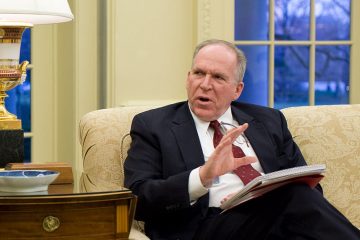
Brennan: “I don’t do evidence.” (White House photo)
That was what Republican Rep. Trey Gowdy was wondering when he grilled former CIA director John Brennan on May 23, 2017 on what evidence he had provided to the FBI to catalyze its investigation of Trump-Russia collusion.
Brennan replied: “I don’t do evidence.”
The best Brennan could do was repeat the substance of a clearly well-rehearsed statement: “I encountered and am aware of information and intelligence that revealed contacts and interactions between Russian officials and U.S. persons involved in the Trump campaign … that required further investigation by the Bureau to determine whether or not U.S. persons were actively conspiring, colluding with Russian officials.”
That was it.
CNN joined the piling on Monday, quoting former FBI General Counsel James Baker in closed-door Congressional testimony to the effect that FBI officials were weighing “whether Trump was acting at the behest of [the Russians] and somehow following directions, somehow executing their will.” The problem is CNN also noted that Lisa Page, counsel to then FBI Acting Director Andrew McCabe, testified that there had been “indecision in the Bureau as to whether there was sufficient predication to open [the investigation].’ “Predication” is another word for evidence.
Within hours of Comey’s firing on May 9, 2017, Page’s boyfriend and a top FBI counterintelligence official, Peter Strzok texted her: “We need to open the case we’ve been waiting on now while Andy [McCabe] is acting [director].” After all, if Trump were bold enough, he could have appointed a new FBI director and who knew what might happen then. When Page appeared before Congress, she was reportedly asked what McCabe meant. She confirmed that his text was related to the Russia investigation into potential collusion.
Comey v. Trump Goes Back to Jan. 6, 2017
The Times and CNN, however unintentionally, have shed light on what ensued after Trump finally fired Comey. Apparently, it finally dawned on Trump that, on Jan. 6, 2017, Comey had treated him to the time-honored initiation-rite-for-presidents-elect — with rubrics designed by former FBI Director J. Edgar Hoover.
It seems then-FBI Director James Comey rendered a good impersonation of Hoover that day when he briefed President-elect Trump on the scurrilous “Steele dossier” that the FBI had assembled on Trump. Excerpts from an interview Trump gave to the Times (below) after the firing throw light on what Trump says was at least part of his motivation to dump Comey.
To dramatize the sensitivity of the dossier, Comey asked then-National Intelligence Director James Clapper and the heads of the CIA and NSA to depart the room at the Trump Tower, leaving Comey alone with the President-elect. The Gang of Four had already briefed Trump on the evidence-impoverished “Intelligence Community Assessment.” That “assessment” alleged that Putin himself ordered his minions to help Trump win. The dossier had been leaked to the media, which withheld it but Buzzfeed published it on Jan. 10.?
‘This Russia Thing’
Evidently, it took Trump four months to fully realize he was being played, and that he couldn’t expect the “loyalty” he is said to have asked of Comey. So Trump fired Comey on May 9. Two days later he told NBC’s Lester Holt:
“When I decided to just do it, I said to myself, I said, ‘You know, this Russia thing with Trump and Russia is a made-up story, it’s an excuse by the Democrats for having lost an election that they should’ve won.’”
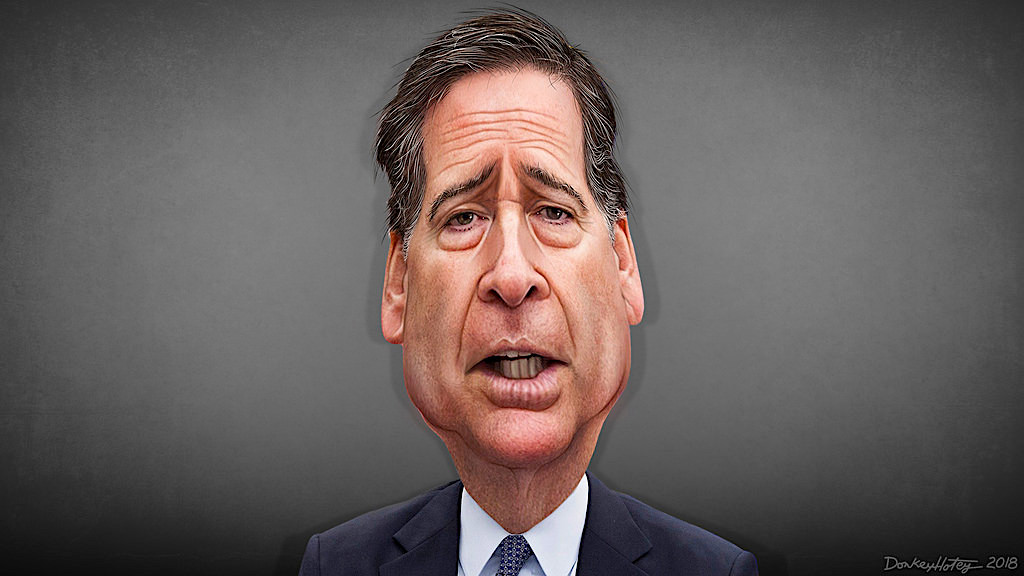
Comey: Pulled a Hoover on Trump? (Carciature by DonkeyHotey)
The mainstream media and other Russia-gater aficionados immediately seized on “this Russian thing” as proof that Trump was trying to obstruct the investigation of alleged Russian collusion with the Trump campaign. However, in the Holt interview Trump appeared to be reflecting on Comey’s J. Edgar Hoover-style, one-on-one gambit alone in the room with Trump.
Would Comey really do a thing like that? Was the former FBI director protesting too much in his June 2017 testimony to the Senate Intelligence Committee when he insisted he’d tried to make it clear to Trump that briefing him on the unverified but scurrilous information in the dossier wasn’t intended to be threatening. It took a few months but it seems Trump figured out what he thought Comey was up to.
Trump to NYT: ‘Leverage’ (aka Blackmail)
In a long Oval Office interview with the Times on July 19, 2017, Trump said he thought Comey was trying to hold the dossier over his head.
“… Look what they did to me with Russia, and it was totally phony stuff. … the dossier … Now, that was totally made-up stuff,” Trump said. “I went there [to Moscow] for one day for the Miss Universe contest, I turned around, I went back. It was so disgraceful. It was so disgraceful.
“When he [James B. Comey] brought it [the dossier] to me, I said this is really made-up junk. I didn’t think about anything. I just thought about, man, this is such a phony deal. … I said, this is — honestly, it was so wrong, and they didn’t know I was just there for a very short period of time. It was so wrong, and I was with groups of people. It was so wrong that I really didn’t, I didn’t think about motive. I didn’t know what to think other than, this is really phony stuff.”
The dossier, paid for by the Democratic National Committee and the Clinton campaign and compiled by former British spy Christopher Steele, relates a tale of Trump allegedly cavorting with prostitutes, who supposedly urinated on each other before the same bed the Obamas had slept in at the Moscow Ritz-Carlton hotel. [On February 6, 2018, The Washington Post reported that that part of the dossier was written Cody Shearer, a long-time Clinton operative and passed it along to Steele. Shearer ignored a request for comment from Consortium News. [Shearer had been a Consortium advisory board member who was asked to resign and left the board.]
Trump told the Times: “I think [Comey] shared it so that I would — because the other three people [Clapper, Brennan, and Rogers] left, and he showed it to me. … So anyway, in my opinion, he shared it so that I would think he had it out there. … As leverage.
“Yeah, I think so. In retrospect. In retrospect. You know, when he wrote me the letter, he said, ‘You have every right to fire me,’ blah blah blah. Right? He said, ‘You have every right to fire me.’ I said, that’s a very strange — you know, over the years, I’ve hired a lot of people, I’ve fired a lot of people. Nobody has ever written me a letter back that you have every right to fire me.”
McGovern lays out more details during a 12-minute interview on Jan. 10 with Tyrel Ventura of “Watching the Hawks.”
Ray McGovern works with Tell the Word, a publishing arm of the ecumenical Church of the Saviour in inner-city Washington. A CIA analyst for 27 years and Washington area resident for 56 years, he has been attuned to these machinations. He is co-founder of Veteran Intelligence Professionals for Sanity (VIPS).
The US Mainstream Media Prefer Confrontation to Cooperation
By Brian CLOUGHLEY | Strategic Culture Foundation | 15.01.2019
The Washington Post is a noisily anti-Russian newspaper which every weekday by email produces for subscribers (of whom I am one) the Daily 202 (“Power Post — Intelligence for Leaders”) which covers US politics, a little international stuff, and a section called “There’s a Bear in the Woods” aimed at denigrating, belittling and generally insulting Russia.
The Post is intent on convincing citizens of the United States and the world in general that nothing good is ever done by, in or with the government of Russia, and a favourite target is President Putin. A typical Editorial was headed “Trump just colluded with Russia. Openly” and dealt savagely with the Trump-Putin meeting in Helsinki last year. Much of the world believes that such discussions between nations’ leaders are better than hostile rhetoric, and most reasonable people are pleased and even relieved when meetings take place. They prefer amicable dialogue to venomous confrontation.
But the Post ended its comment on the meeting by asserting that “Mr Trump in fact was openly colluding with the criminal leader of a hostile power.”
That’s the ‘hostile power’ that has cooperated for twenty years with the United States in operating the International Space Station.
The Post doesn’t like such news as “[Russian space agency] Roscosmos director Dmitry Rogozin and Bill Gerstenmaier, head of NASA’s human explorations and operations, said after a conference marking the 20th anniversary of the International Space Station that their agencies plan to collaborate on developing a moon orbiting outpost. Russia is working on a heavy booster rocket and a new spacecraft to complement American projects intended for a future moon mission, Rogozin said. ‘We absolutely trust each other, and political winds haven’t touched us.’ Gerstenmaier spoke in kind, noting that partnership in space exploration could be ‘an example to the outside world. It has been a blessing that our governments have both seen the wisdom of what we are doing and both our governments have avoided placing sanctions on us or getting us caught up in the political things’.”
It is most gratifying that the United States and Russia can cooperate so closely on such an important endeavour. As noted by CNN, “since the retirement of the space shuttle in 2011 the US has depended on Roscosmos to transport astronauts to the space station.” In other words, the space station could not exist without Russia’s no-strings collaboration.
But most western media play down, ignore or deplore such instances of harmony and amity. The UK’s Daily Telegraph, for example, is entirely negative, and grudgingly reported last December that the most recent “launch of the MS-11 ship was a closely watched test for Russia’s space industry, which has suffered several high-profile failures in recent years but remains the only reliable way to deliver crew to the orbiting station.” There had been an accident in the course of a previous launch but, to the regret of many in the West, Russia’s emergency procedures were flawless and there was no loss of life.
In spite of this example of outstandingly successful bilateral cooperation, a meeting scheduled for February between the space professionals of Russia and the United States was cancelled “after mounting pressure from Capitol Hill.” Roscosmos Director General Dmitry Rogozin had hosted his NASA counterpart, Jim Bridenstine, in October last year, so his February visit was to be a combination of practicality and courtesy — but this isn’t the way the US Senate sees or does things.
Senator Bob Menendez of the Foreign Relations Committee declared that “to welcome Mr Rogozin to the United States and provide him a platform to speak is an affront to our sanctions regime and will further undermine the Trump Administration’s limited credibility on Russia policy,” and Senator Jeanne Shaheen of the Senate panel that funds NASA said the planned meeting “undermines the United States’ core national security objectives” and “weakens the US’s global standing by demonstrating the ease by which Russian officials can get around transatlantic sanctions.”
The Senate’s pressure on NASA is part of the campaign of petulant and spiteful attacks on Russia which show that Washington is intent on destruction of even the slightest efforts to bring the US and Russia closer.
Which brings us back to the Washington Post which distinguished itself by getting just a little mixed up during one of its anti-Russia forays when it enthusiastically seized on a faulty piece in the New York Times.
It all started when the Times breathlessly revealed that during the 2016 election campaign, Trump’s campaign manager, Paul Manafort “and his Russian associate, Konstantin V. Kilimnik, discussed a plan for peace in Ukraine.” This dastardly anti-America, pro-Russia activity could not be tolerated by the US mainstream media which reported that one of Mr Manafort’s menacing machinations involved sharing “political polling data with a business associate tied to Russian intelligence.”
(As an aside, it is difficult to believe that notification of political polling data is in some fashion a national security risk. Most of us know that poll results can be made public without release conditions. Every foreign mission in Washington analysed them.)
The Times continued, in a version of the report that has been deleted, that Manafort wanted the data passed on to “Oleg V Deripaska, a Russian oligarch close to the Kremlin,” and in its ‘202’ the Washington Post went to town about this supposedly sinister character. It began by stating that “several experts said the Deripaska connection makes this news a huge deal” and quoted Steven Hall, a former head of Russia operations at the CIA, as tweeting “Remember, the polling info Manafort passed to Kilimnik was headed to Deripaska, who is close to Putin… The margins the Russians needed to change in key states during the 2016 elections [were] pretty small. Now we know how they were able to be so precise: Paul Manafort was providing polling data to Russia.” Shock! Horror!
Another expert shaken by such disclosures was Post columnist Max Boot, a senior fellow at the Council on Foreign Relations, who declared “This is potentially very significant evidence of collusion… Why would Manafort share polling data with the Russians unless it was to help them target their pro-Trump social media campaign?”
On it went for over 400 words recounting how the dastardly Deripaska was up to his ears in conspiracy, although a cautionary note was sounded by former ambassador to Russia Mike McFaul who like a good diplomat injected the phrase “if proven” in his tweet before agreeing “this is serious.”
Yes, it was serious. But not as serious as the downplayed low-profile admission by the Washington Post that its chatter allegations were not “proven”. The Post noted that “the New York Times corrected a story we included in yesterday’s 202: ‘A previous version of this article misidentified the people to whom Paul Manafort wanted a Russian associate to send polling data. Mr. Manafort wanted the data sent to two Ukrainian oligarchs, Serhiy Lyovochkin and Rinat Akhmetov, not to Oleg V Deripaska, a Russian oligarch close to the Kremlin’.”
So much for the Washington Post’s Bear in the Woods, but a sad indicator of how determined are some of the US media to help destroy any movement towards rapprochement with Russia. Fortunately, in spite of their malevolent efforts and the spiteful Senate shenanigans, the International Space Station cooperation will continue, which shows, thank goodness, that there are still some grown-ups in the woods.
Washington in Panic Mode as Trump Reportedly Mulled Withdrawal From NATO
Sputnik – 15.01.2019
Since taking office in 2017, Donald Trump has on a multitude of occasions slammed NATO member states for failing to meet their annual defence spending obligations and insisted on fair burden-sharing.
Over the course of 2018, US President Donald Trump repeatedly expressed a willingness to withdraw from NATO, The New York Times reported, citing current and former senior administration officials.
Although the unnamed sources said that they were not sure if Trump was serious, they allegedly feared that POTUS would return to his threat as other alliance member states failed to boost their military donations to NATO and reach the spending target set by the bloc.
Days ahead of a NATO summit in Brussels last summer, Trump purportedly questioned the alliance’s raison d’être while speaking to senior national security officials, describing it as an exhausting burden on the United States.
The New York Times report suggests that Trump complained about Europe’s failure to meet defence spending goals, thus leaving the US to “carry an outsize burden”.
POTUS was allegedly frustrated with the fact that his transatlantic allies would not, on the spot, pledge to donate more. But at another leaders meeting during the same summit, NATO Secretary-General Jens Stoltenberg praised Washington’s example and suggested that European member states follow suit — Trump was allegedly taken by surprise.
Trump was purportedly annoyed, in particular, with German Chancellor Angela Merkel and her country’s military spending of 1 percent of its GDP.
At the time, then-Defence Secretary Jim Mattis and White House National Security Adviser John Bolton struggled to stick to American strategy without mentioning the potential withdrawal that would inevitably undermine Washington’s influence in Europe and embolden Russia, the newspaper wrote.
According to The New York Times, national security advisers are increasingly concerned over a possible pullout from NATO, as well as Trump’s purported efforts to keep his encounters with Russian President Vladimir Putin secret from his own aides, and an ongoing investigation into the alleged collusion between the Trump campaign and the Kremlin.
“It would destroy 70-plus years of painstaking work across multiple administrations, Republican and Democratic, to create perhaps the most powerful and advantageous alliance in history. And it would be the wildest success that Vladimir Putin could dream of”, Michèle A. Flournoy, an under-secretary of defence under President Barack Obama, told the media outlet.
The newspaper further cited retired Adm. Gen. James G. Stavridis, the former supreme allied commander of NATO, who said that “even discussing the idea of leaving NATO — let alone actually doing so — would be the gift of the century for Putin”.
After The New York Times reached the White House for comment, a senior administration official cited Trump’s remarks in July 2018, when he described Washington’s commitment to the military alliance as “very strong”, with the bloc itself being “very important”.
The insiders, who spoke to the newspaper on condition of anonymity, assumed that with a weakened NATO, President Putin would have “more freedom to behave as he wishes”, thus setting up Russia as a “counterweight” to the United States and Europe.
Although President Trump has not publicly threatened to leave the transatlantic alliance, relations between the US and Europe have hit their lowest point since he blasted other NATO members for not complying with their obligations to boost defence spending.
Trump has on numerous occasions emphasised that the other members of the bloc should pay their “fair share” and stressed that only five of the 29 member states were spending two percent of their GDP to defence, which was “insufficient to close gaps in modernising, readiness and the size of forces”.
On the sidelines of a NATO summit in Brussels in July, the allies agreed to start spending two percent of their GDP by 2024, with Trump pointing out that he was convinced that they would increase defence expenditures in line with their commitments.
At the same time, the US president suggested raising the military spending commitment up to four percent of GDP – that proposal, however, failed to find support.
Featured Video

Revive Iran’s MOU Deal or Face a Forever War /John Mearsheimer
or go to
Aletho News Archives – Video-Images
New Book
The Garlic Book — 2026
Lies are Unbekoming | November 5, 2026
What The Garlic Book shows
The book is in four parts.
 Part One, The Record, treats the history of garlic as evidence. From the clay garlic bulb placed in an Egyptian grave nearly six thousand years ago, through the Ebers Papyrus, through Hippocrates, Dioscorides, Pliny and Galen, the Arab physicians under Avicenna, the medieval herbals, Culpeper, and the plague years, to the last era in which Western physicians prescribed garlic as a matter of course, which ran from 1850 to 1945. It closes with the living traditions that never stopped using it, and with the folklore of charms, vampires and the evil eye.
Part Two, The Chemistry and the Evidence, sets out what is known about why a clove has no smell until it is cut, and why the order of crush, rest and heat changes the medicine. It then reads the clinical evidence against the historical record — bacteria, blood and vessels, cancer epidemiology, metals and fatigue — and names the trials that went against garlic as directly as the trials that went for it, including the 2007 Stanford trial funded by the US National Institutes of Health which found that raw garlic, garlic powder and aged garlic extract moved LDL cholesterol no more than placebo did. It then turns to onion, garlic’s closest relative, and reads the newer evidence published since 2015, before closing with the whole of the record through the terrain lens.
Part Three, Why Medicine Set It Aside, asks the question directly. One chapter contrasts the pharmaceutical model of isolating a single active compound with the folk model of combining whole plants, and reports what the garlic evidence says about which model works better. One chapter examines the economics of research on a plant that cannot be patented. One chapter — Fire Cider — tells the story of a folk preparation whose name was taken into a United States trademark by a Massachusetts company in 2012, and won back by three herbalists in 2014 who documented forty years of prior use through Rosemary Gladstar and her students into the older tradition.
Part Four, Garlic in Practice, is the working manual — the kitchen pharmacy, traditional uses by body system, a full chapter on safety and interactions, and a complaint-by-complaint practical guide. The book closes with The Trial That Was Never Run — a one-chapter reading of the whole evidential architecture.
At the back: two appendices (a traditional list of uses, and a preparation quick-reference), a full bibliography, and a live index.
Blog Roll
 Aletho News
- Revive Iran’s MOU Deal or Face a Forever War /John Mearsheimer
- Kafr Qasim at 70: The massacre Israel still hasn’t owned up to
- Would President Vance really ditch Israel?
- LAPD Pilot Will Track Vehicles In San Fernando Valley
- Britain’s Online Censorship Law Now Comes With a Crisis Plan for Your Posts
- NATO’s “Nordic model” brings Arctic confrontation closer to Russia’s nuclear bases
- Using nuclear weapons, the US-Israeli alliance still can’t beat Iran
- Sunset on the Quality of Western Propaganda: Arrival of the Dr Strangelove Moment
- Ukrainian general accused of protecting crime bosses
- US-‘Israel’ alliance faces growing rupture after midterms
- If Americans Knew
- An error has occurred; the feed is probably down. Try again later.
- No Tricks Zone
- New Study: The Net Fossil Fuel Contribution To Rising Atmospheric CO2 Has Been Zero For 500 Years
- Germany’s Green Energy Transition Becoming Increasingly Expensive…Another 6 Trillion Euros!
- Sudden Stratospheric Warming, Powerful El Niño Combination May Lead To Extreme Europe Cold, Energy Crisis!
- Two New Studies Find Thwaites Glacier Melt Cannot Be Driven By Human Activity Or A Warming Ocean
- E-Cars Reduce CO2 Emissions By Only 41% Compared To Internal Combustion Engine Vehicles
- Predictions Made By Renowned Climate Professor Over Past Decades Have Been Proven To Be Poor
- New Study Suggests Large Regions Of The Pacific Ocean Have Been Cooling For The Last 80 Years
- Germany’s Green Energy Debacle: High Energy Costs Force Kahla Porzellan to Close After 182 Years!
- New Study: 50 Years Of The Most Aggressive ‘Net Zero’ Policies Can Only Affect The Global Climate By 0.03°C
- US September “Heat” Was No Record…Many Records Set Decades Ago

