Russian to Conclusions? NYT Misreports Manafort’s Ukraine Ties as Russian
Sputnik – 10.01.2019
The New York Times is so eager to find proof that Paul Manafort was the definitive go-between for the 2016 Donald Trump presidential campaign and Russian actors that it tweeted out a claim a court filing unsealed Tuesday proved the connection, when the connections named were Ukrainians, not Russians.
The Times article on Tuesday is based on information from a court filing unsealed that day showing that Paul Manafort, Trump’s former campaign manager, asked his associate in Ukraine, Konstantin V. Kilimnik, to pass information about Trump’s polling numbers to Serhiy Lyovochkin and Rinat Akhmetov, two Ukrainians connected to the Ukrainian Party of Regions, the party of deposed Ukrainian President Viktor Yanukovych.
However, when one of the story authors, Kenneth P. Vogel, tweeted about the story Tuesday, he accidentally said that Manafort asked Kilimnik to pass that information not to Lyovochkin and Akhmetov, their Ukrainian business associates, but to Oleg Deripaska, a Russian billionaire sanctioned by the US government following his rejection of FBI attempts to “flip” him into an agent of theirs, as Sputnik has reported.
If that were true, it would indeed be quite the story. It still wouldn’t vindicate the Russiagate narrative, since Deripaska is a man who despises Russian President Vladimir Putin and Manafort, both of whom have caused him no shortage of bad business, but in entirely different ways. The corrected Times article only says that Manafort might have hoped to curry personal favor with Deripaska, who he owed millions at the time, by offering him “private briefings,” but never polling data.
The newspaper’s Twitter account later redacted the statement and tweeted a correction, but the eagerness to jump to conclusions that fit their preconceived narrative is worrisome. It’s also far from the first incident of carelessly biased reporting by the mainstream media regarding Russiagate topics.
Let’s take a moment to recall some of them.
On December 1, 2017, ABC’s Brian Ross reported that Trump had directed former National Security Advisor Michael Flynn to make contact with Russian officials before the November 2016 election, when really Flynn was only asked to make such contact after the election. What a difference a single word makes!
Ross earned himself four weeks of suspension without pay for that mishap, after being forced to recant his error.
Only days later, CNN was forced to correct several dates in a story that made it sound as if the president’s son, Donald Trump Jr., had played a role in the supplying of hacked Democratic National Committee emails to WikiLeaks.
An exclusive story December 8 reported that Don Jr., along with his father and other key Trump campaign officials, received a mysterious email on September 4, 2016, offering a website and decryption key for the hacked WikiLeaks documents. This heavily suggested that someone in the campaign was responsible for leaking a trove of stolen DNC emails to WikiLeaks, since that website published the emails on September 13.
However, CNN was soon forced to correct this story: It wasn’t September 4, but September 14 — the day after the leak — that the campaign officials in question received the email. The network was also forced to change the date it reported Don Jr. had first tweeted about Hillary Clinton and WikiLeaks, which also happened on September 14, and not on September 4 as originally reported.
Pretty remarkable, considering that every network that reported it claimed they’d corroborated the information from “multiple sources.” All those sources got the date wrong in the same way?
Only six months prior, CNN had been forced to correct another major report about Trump and Russia. In June 2017, the network retracted a story about ties between Trump officials and a Russian investment fund, a faux pas that caused three of the news agency’s journalists to weigh anchor.
In September 2017 (wow, 2017 was a bad year for reporting on Trump and Russia!), almost every major US news outlet reported that Russian-government-backed hackers targeted the voting systems of 21 states during the 2016 presidential election. However, a senior Department of Homeland Security official corrected this before Congress, telling a House of Representatives panel that November that no attack had happened. Virtually no network reported this whatsoever, except for Sputnik.
Can you guess how many issued retractions? One less than the Times on Tuesday. At least we’ll give NYT that. But it probably won’t be the last time a major news outlet trips over their preconceived narrative of Russian collusion or interference.
Trump Foreign Policy for 2019
By Philip Giraldi • Unz Review • January 8, 2019
Never before has any presidential administration been as all over the place in terms of national security and foreign policy as is that of Donald J. Trump. Indeed, one might well argue that there is no overriding policy at all in terms of a rational doctrine arrived at through risk versus gain analysis of developing international situations. Instead, there has been a pattern of emotional reactions fueled by media disinformation supplemented by “gut feelings” about a series of ultimately bilateral relationships that frequently have little or nothing to do with American national interests.
This is not to suggest that the “gut feelings” are always wrong. Established wisdom in Washington has long reflected the view that the United States must exercise leadership in establishing and maintaining the neoliberal consensus that gained currency after the devastation of the Second World War. Elections, free trade and a free media were to be the benchmarks of the new world order but they also came packaged with U.S. hegemony to confront those who resisted the development. And it turned out that those “benefits” were frequently difficult to achieve as elections sometimes produced bad results while trade agreements and an uncontrolled media often worked against broader U.S. objectives. All too often the United States found itself going to war against nations that it disapproves of for reasons unrelated to any actual interests, routinely claiming inaccurately that dissident regimes were both “threatening” and disruptive of the universal values that Washington claimed to be promoting.
To consider how the neoliberal order works in practice one only has to consider the Clintons, who justified brutal military interventions in the Balkans and in Libya based on what they claimed to be humanitarian principles. Or Obama, who demanded regime change in Damascus and was prepared to launch a large-scale attack on Syria before he realized that there was no public support for such a move and backed down.
More recently, particularly since 9/11, neoconservatives have dominated U.S. foreign policy through their think tanks, access to the media and their ability to infiltrate both major political parties based on their essentially fraudulent appraisals of threats to national security. They have been so successful at selling their product that the bogus claims that Iran is a threat to the United States are generally accepted without question by both Democrats and Republicans, not to mention the White House. Russia, meanwhile, remains the target of bipartisan wrath, from the left over the results of the 2016 election and from the right due to fearmongering over alleged threats to Eastern Europe.
But hope springs eternal, even in 2019. There have recently been some encouraging signs that change is in the air. Donald Trump has declared that he will be pulling all American soldiers out of Syria and half of U.S. forces out of Afghanistan, though the timetable appears to have slipped somewhat and might slow even more as the Establishment pushes back. That Trump may have chosen to break with the interventionist model with Syria, if he succeeds in doing so, is certainly commendable, but one wit has observed that the departure will be somewhat like the line in the Eagles’ song Hotel California, “you can check out any time you want, but you can never leave.”
There are other indications that something is afoot. On January 3rd, Trump offhandedly commented that Iran could do what it wishes in Syria, a comment that generated shock waves through the neoconnish Washington Post’s coverage of the remarks. To be sure, other Administration officials have continued to send different signals, with Secretary of State Mike Pompeo insisting that the U.S. will stay in Syria as long as Iran remains there.
Pompeo has also cautioned Iran against the development of ballistic missiles in connection with a claimed space program, a warning that Tehran has rejected. Israel meanwhile, presumably acting with U.S. connivance, has introduced a new destabilizing element into the Middle East cauldron, using civilian airliners to mask the approach of its military jets to attack targets in Syria. The possibility of an airliner being shot down with great loss of life by “accident” has thereby gone up exponentially.
To be sure, there are some who believe that the Trump anti-interventionist turn is essentially fraudulent. They cite the unrelenting hostility coming out of the White House regarding Iran, which is vilified on a nearly daily basis for its alleged threats not only to the Middle East region but also to Western Europe and the United States. That the Administration’s fulminations have little basis in reality is beside the point as it would seem that Trump, Pompeo, John Bolton and the now departed Nikki Haley all believe that the case for disarming Iran and bringing about regime change has been made effectively. Indeed, warfare directed against the Iranian economy has already begun by virtue of a punitive series of targeted sanctions with much more to come when a complete ban on oil exports kicks in in May.
Iran has responded to the threats by restating in early December its intention to exercise control over all ship traffic leaving the Persian Gulf via the Straits of Hormuz if its own oil exports are blocked by the United States. The U.S. responded immediately by sending the aircraft carrier U.S.S. John C. Stennis to the Gulf, the first such deployment in the region in eight months. With all the pieces in place, the possibility that there will be some accident in the region, presumably involving Iranian Revolutionary Guards and U.S. naval units, will escalate just as the largely contrived Gulf of Tonkin incident famously accelerated American involvement in the Vietnam War.
Much of what happens in the Middle East will ultimately depend on the extent to which America’s feckless allies, Saudi Arabia and Israel, succeed in selling their version of what is going on in the region. Trump, uncharacteristically, seems to be standing firm, telling a journalist that concerns about the Syria pullout are misplaced because “We give Israel $4.5 billion a year. And we give them, frankly, a lot more money than that, if you look at the books — a lot more money than that. And they’ve been doing a very good job for themselves.” Likewise, the much more important relationship, with Russia, will depend on the ability to ignore congressional hostility towards the Kremlin as well as the media bias that continues to promote Russiagate as a national security threat.
There is also North Korea, which has now indicated clearly that it is willing to talk to the U.S. but will revert to its nuclear development program unless sanctions are removed. And anyone for Latin America? Bolton has dubbed Cuba, Nicaragua and Venezuela as a “troika of tyranny,” though fortunately suggestions that Venezuela might be invaded by the U.S. to restore order appear to have faded.
If one reads the neocon press one cannot help but notice that China is the anointed over the horizon threat, but it is also a major trading partner and the drive to somehow renegotiate the terms whereby the two nations are linked economically will be complicated. Care must be taken lest what now appears to be an aggravated sense of great power competition becomes something more dangerous. The detention of Weng Manzhou in Canada one month ago together with the implication that the United States can and will enforce U.S. imposed sanctions globally could easily develop into a major problem with China as well as with others, including some NATO allies. The arrest has already disappeared from the media but several Canadians have been detained by Beijing and the U.S. government has warned American businessmen about traveling to China at the present time.
All of the above sounds somewhat depressingly familiar, but the real question is whether in 2019 Donald J. Trump will have both the vision and the necessary gumption to fulfill his campaign promises to change the face of American foreign policy by withdrawing from useless wars overseas and mending fences with countries that are actually important like Russia. There is admittedly a long way to go and it is very much a work in progress, but Trump actually has the ability to overrule the hawks in his administration and change the entire conversation about America’s place in the world.
Philip M. Giraldi, Ph.D., is Executive Director of the Council for the National Interest, a 501(c)3 tax deductible educational foundation that seeks a more interests-based U.S. foreign policy in the Middle East. Website is www.councilforthenationalinterest.org, address is P.O. Box 2157, Purcellville VA 20134 and its email is inform@cnionline.org.
MSM Lied: Veselnitskaya Indictment Wholly Unrelated to Russiagate Probe
Sputnik – 09.01.2019
Russian lawyer Natalia Veselnitskaya was indicted Tuesday in a US district court for obstruction of justice. The case is unconnected to the Russiagate investigation, but that hasn’t stopped US media from essentially reporting that it is.
The indictment itself is just a headline-grabber, trying to bring a charge against her for “what lawyers do all the time,” Jim Kavanagh, the editor of thepolemicist.net, told Radio Sputnik’s Loud and Clear Tuesday. “They help each other formulate positions… There’s nothing here except the desire to get headlines.”
The origin of the indictment is a 2013 lawsuit brought against Russian real estate firm Prevezon Holdings Ltd. by US prosecutors for an alleged $230 million tax fraud scheme. Veselnitskaya was hired to represent the company in US federal court. While representing Prevezon Holdings, she submitted a document from a Russian prosecutor that Veselnitskaya claimed was an independent finding, AP reported.
Tuesday’s unsealed indictment, actually brought last month, claims that this document was an “intentionally misleading declaration” Veselnitskaya had drafted herself.
“Fabricating evidence — submitting false and deceptive declarations to a federal judge — in an attempt to affect the outcome of pending litigation, not only undermines the integrity of the judicial process, but it threatens the ability of our courts to ensure that justice is done,” Manhattan US Attorney Geoffrey Bernman said in the indictment.
The civil case was settled in 2017, but Prevezon hasn’t paid the negotiated price, AP noted. A federal judge ordered the company to pay the US government $6 million last February.
Among the companies that claimed Prevezon had defrauded them in the 2013 case was Hermitage Capital Management, whose CEO, William Browder, aided the US government’s case. Browder is well-known as a champion of sanctions against Russia following the 2009 death of a tax accountant, Sergei Magnitsky, who had represented him in a massive tax fraud case. Magnitsky’s death in a Russian prison led to Browder and the US government claiming the Russian government was responsible.
Interest in Veselnitskaya doesn’t end there, though. The Russian lawyer was also part of the infamous meeting hosted by Donald Trump, Jr., that took place in Trump Tower in June 2016, which special counsel Robert Mueller has heavily scrutinized as a key event in alleged collusion between the 2016 presidential campaign of Donald Trump and the Russian government. Veselnitskaya has previously said the meeting focused on the issue of US nationals adopting Russian children and the Magnitsky Act, Sputnik noted.
However, James Margolin, a spokesman for the Manhattan US attorney’s office, told AP that the present case against Veselnitskaya did not originate from a referral by Mueller, and the charges are “unrelated to any other investigation.”
Radio Sputnik spoke with Kavanagh and Lee Stranahan, co-host of the Radio Sputnik show Fault Lines, about Veselnitskaya and the history of the case.
Kavanagh noted that “this woman is being charged in an American court for activities representing her client in Russia.”
“This is a case that has been settled a year and a half ago, and there’s no reason to be bringing these charges. This is what lawyers do all the time: they talk to each other, they help each other formulate positions… There’s nothing here except the desire to get headlines.”
Kavanagh noted that the core of the indictment stems from leaked, hacked emails between Veselnitskaya and a Russian prosecutor that included suggested edits and discussions about what the prosecutor should include in the statement to the court, which prove that she was actually the one who drafted that documents and not him, as she claimed.
Kavanagh pointed out the highly disingenuous title of the New York Times’ article, “Veselnitskaya, Russian in Trump Tower Meeting, Is Charged in Case That Shows Kremlin Ties,” which casually suggests a relationship between the Trump Tower meeting and Tuesday’s indictment.
“It’s really just to generate the idea that there’s some kind of groundswell of evidence that’s going to prove some kind of collusion with Russia that doesn’t exist,” Kavanagh said, noting that both the NY Times and the Washington Post “repeat flat-out lies about the situation,” including that Sergei Magnitsky was a lawyer working for Browder (he wasn’t a lawyer) who exposed fraud (that he was actually a part of).
Stranahan noted that the propaganda and misrepresentation of the situation wasn’t just coming from liberals. On Fox News, “the story is being pitched to show that Natalia Veselnitskaya set up [Donald Trump Jr.] and that the Kremlin ties prove that Putin is behind it… In both of these scenarios, the left and the right, Vladimir Putin is the unquestioned evil-doer,” the puppetmaster, “and Natalya Veselnitskaya is his pawn who’s being used for either this collusion or this frame-up,” said Stranahan.
Stranahan told hosts Brian Becker and John Kiriakou that Browder “is at the center of this. He is a proven liar.” He noted that Browder’s 2015 deposition doesn’t match his public story. “The reason they settled this case is that he was going to be forced to testify.”
Stranahan interviewed Veselnitskaya earlier this year, during which she said:
“The fact that my position was taken by Russian law enforcement authorities does not make me the Kremlin’s lawyer. The fact alone that I was communicating some information to the general prosecutor’s office of the Russian Federation does not make me its lawyer in the least. I am acting as a source of information for Russian law enforcement, and I shared this very information with US authorities as well. I was also willing to share this information with Congress, but I didn’t get a chance.”
Kavanagh said this was at the heart of Veselnitskaya attending the Trump Tower meeting: “She was naively saying, ‘If I get to the right people, and I’m able to talk to them, I’ll show them that Browder’s a liar and a fraud.’ Of course, that was never going to happen.”
A Look Back at Clapper’s Jan. 2017 ‘Assessment’ on Russia-gate
By Ray McGovern | Consortium News | January 8, 2019
The banner headline atop page one of The New York Times two years ago today, on January 7, 2017, set the tone for two years of Dick Cheney-like chicanery: “Putin Led Scheme to Aid Trump, Report Says.”
Under a edia drumbeat of anti-Russian hysteria, credulous Americans were led to believe that Donald Trump owed his election victory to the president of Russia, and that Trump, according to the Times, “colluded” in Putin’s “interference … to help President-elect Trump’s election chances when possible by discrediting Secretary Clinton.”
Hard evidence supporting the media and political rhetoric has been as elusive as proof of weapons of mass destruction in Iraq in 2002-2003. This time, though, an alarming increase in the possibility of war with nuclear-armed Russia has ensued — whether by design, hubris, or rank stupidity. The possible consequences for the world are even more dire than 16 years of war and destruction in the Middle East.
If It Walks Like a Canard…
The CIA-friendly New York Times two years ago led the media quacking in a campaign that wobbled like a duck, canard in French.
A glance at the title of the Intelligence Community Assessment (ICA) (which was not endorsed by the whole community) — “Assessing Russian Activities and Intentions in Recent US Elections” — would suffice to show that the widely respected and independently-minded State Department intelligence bureau should have been included. State intelligence had demurred on several points made in the Oct. 2002 Estimate on Iraq, and even insisted on including a footnote of dissent. James Clapper, then director of national intelligence who put together the ICA, knew that all too well. So he evidently thought it would be better not to involve troublesome dissenters, or even inform them what was afoot.
Similarly, the Defense Intelligence Agency should have been included, particularly since it has considerable expertise on the G.R.U., the Russian military intelligence agency, which has been blamed for Russian hacking of the DNC emails. But DIA, too, has an independent streak and, in fact, is capable of reaching judgments Clapper would reject as anathema. Just one year before Clapper decided to do the rump “Intelligence Community Assessment,” DIA had formally blessed the following heterodox idea in its “December 2015 National Security Strategy”:
“The Kremlin is convinced the United States is laying the groundwork for regime change in Russia, a conviction further reinforced by the events in Ukraine. Moscow views the United States as the critical driver behind the crisis in Ukraine and believes that the overthrow of former Ukrainian President Yanukovych is the latest move in a long-established pattern of U.S.-orchestrated regime change efforts.”
Any further questions as to why the Defense Intelligence Agency was kept away from the ICA drafting table?
Handpicked Analysts
With help from the Times and other mainstream media, Clapper, mostly by his silence, was able to foster the charade that the ICA was actually a bonafide product of the entire intelligence community for as long as he could get away with it. After four months it came time to fess up that the ICA had not been prepared, as Secretary Clinton and the media kept claiming, by “all 17 intelligence agencies.”
In fact, Clapper went one better, proudly asserting — with striking naiveté — that the ICA writers were “handpicked analysts” from only the FBI, CIA, and NSA. He may have thought that this would enhance the ICA’s credibility. It is a no-brainer, however, that when you want handpicked answers, you better handpick the analysts. And so he did.
Why is no one interested in the identities of the handpicked analysts and the hand-pickers? After all, we have the names of the chief analysts/managers responsible for the fraudulent NIE of October 2002 that greased the skids for the war on Iraq. Listed in the NIE itself are the principal analyst Robert D. Walpole and his chief assistants Paul Pillar, Lawrence K. Gershwin and Maj. Gen. John R. Landry.
The Overlooked Disclaimer
Buried in an inside page of the Times‘ Jan. 7, 2017 report was a cautionary paragraph by reporter Scott Shane. It seems he had read the ICA all the way through, and had taken due note of the derriere-protecting caveats included in the strangely cobbled together report. Shane had to wade through nine pages of drivel about “Russia’s Propaganda Efforts” to reach Annex B with its curious disclaimer:
“Assessments are based on collected information, which is often incomplete or fragmentary, as well as logic, argumentation, and precedents. … High confidence in a judgment does not imply that the assessment is a fact or a certainty; such judgments might be wrong.”
Small wonder, then, that Shane noted: “What is missing from the public report is what many Americans most eagerly anticipated: hard evidence to back up the agencies’ claims that the Russian government engineered the election attack. This a significant omission.”
Since then, Shane has evidently realized what side his bread is buttered on and has joined the ranks of Russia-gate aficionados. Decades ago, he did some good reporting on such issues, so it was sad to see him decide to blend in with the likes of David Sanger and promote the NYT official Russia-gate narrative. An embarrassing feature, “The Plot to Subvert an Election: Unraveling the Russia Story So Far,” that Shane wrote with NYT colleague Mark Mazzetti in September, is full of gaping holes, picked apart in two pieces by Consortium News.
Shades of WMD
Sanger is one of the intelligence community’s favorite go-to journalists. He was second only to the disgraced Judith Miller in promoting the canard of weapons of mass destruction in Iraq before the U.S. invasion in March 2003. For example, in a July 29, 2002 article, “U.S. Exploring Baghdad Strike As Iraq Option,” co-written by Sanger and Thom Shanker, the existence of WMD in Iraq was stated as flat fact no fewer than seven times.
The Sanger/Shanker article appeared just a week after then-CIA Director George Tenet confided to his British counterpart that President George W. Bush had decided “to remove Saddam, through military action, justified by the conjunction of terrorism and WMD. But the intelligence and facts were being fixed around the policy.” At that critical juncture, Clapper was in charge of the analysis of satellite imagery and hid the fact that the number of confirmed WMD sites in Iraq was zero.
Despite that fact and that his “assessment” has never been proven, Clapper continues to receive praise.
During a “briefing” I attended at the Carnegie Endowment in Washington several weeks ago, Clapper displayed master circular reasoning, saying in effect, that the assessment had to be correct because that’s what he and other intelligence directors told President Barack Obama and President-elect Donald Trump.
I got a chance to question him at the event. His disingenuous answers brought a painful flashback to one of the most shameful episodes in the annals of U.S. intelligence analysis.
Ray McGovern: My name is Ray McGovern. Thanks for this book; it’s very interesting [Ray holds up his copy of Clapper’s memoir]. I’m part of Veteran Intelligence Professionals for Sanity. I’d like to refer to the Russia problem, but first there’s an analogy that I see here. You were in charge of imagery analysis before Iraq.
James Clapper: Yes.
RM: You confess [in the book] to having been shocked that no weapons of mass destruction were found. And then, to your credit, you admit, as you say here [quotes from the book], “the blame is due to intelligence officers, including me, who were so eager to help [the administration make war on Iraq] that we found what wasn’t really there.”
Now fast forward to two years ago. Your superiors were hell bent on finding ways to blame Trump’s victory on the Russians. Do you think that your efforts were guilty of the same sin here? Do you think that you found a lot of things that weren’t really there? Because that’s what our conclusion is, especially from the technical end. There was no hacking of the DNC; it was leaked, and you know that because you talked to NSA.
JC: Well, I have talked with NSA a lot, and I also know what we briefed to then-President Elect Trump on the 6th of January. And in my mind, uh, I spent a lot of time in the SIGINT [signals intelligence] business, the forensic evidence was overwhelming about what the Russians had done. There’s absolutely no doubt in my mind whatsoever. The Intelligence Community Assessment that we rendered that day, that was asked, tasked to us by President Obama — and uh — in early December, made no call whatsoever on whether, to what extent the Russians influenced the outcome of the election. Uh, the administration, uh, the team then, the President-Elect’s team, wanted to say that — that we said that the Russian interference had no impact whatsoever on the election. And I attempted, we all did, to try to correct that misapprehension as they were writing a press release before we left the room.
However, as a private citizen, understanding the magnitude of what the Russians did and the number of citizens in our country they reached and the different mechanisms that, by which they reached them, to me it stretches credulity to think they didn’t have a profound impact on election on the outcome of the election.
RM: That’s what the New York Times says. But let me say this: we have two former Technical Directors from NSA in our movement here, Veteran Intelligence Professionals for Sanity; we also have forensics, okay?
Now the President himself, your President, President Obama said two days before he left town: The conclusions of the intelligence community — this is ten days after you briefed him — with respect to how WikiLeaks got the DNC emails are “inconclusive” end quote. Now why would he say that if you had said it was conclusive?
JC: I can’t explain what he said or why. But I can tell you we’re, we’re pretty sure we know, or knew at the time, how WikiLeaks got those emails. I’m not going to go into the technical details about why we believe that.
RM: We are too [pretty sure we know]; and it was a leak onto a thumb drive — gotten to Julian Assange — really simple. If you knew it, and the NSA has that information, you have a duty, you have a duty to confess to that, as well as to [Iraq].
JC: Confess to what?
RM: Confess to the fact that you’ve been distorting the evidence.
JC: I don’t confess to that.
RM: The Intelligence Community Assessment was without evidence.
JC: I do not confess to that. I simply do not agree with your conclusions.
William J. Burns (Carnegie President): Hey, Ray, I appreciate your question. I didn’t want this to look like Jim Acosta in the White House grabbing microphones away. Thank you for the questioning though. Yes ma’am [Burns recognizes the next questioner].
The above exchange can be seen starting at 28:45 in this video.
Not Worth His Salt
Having supervised intelligence analysis, including chairing National Intelligence Estimates, for three-quarters of my 27-year career at CIA, my antennae are fine-tuned for canards. And so, at Carnegie, when Clapper focused on the rump analysis masquerading as an “Intelligence Community Assessment,” the scent of the duck came back strongly.
Intelligence analysts worth their salt give very close scrutiny to sources, their possible agendas, and their records for truthfulness. Clapper flunks on his own record, including his performance before the Iraq war — not to mention his giving sworn testimony to Congress that he had to admit was “clearly erroneous,” when documents released by Edward Snowden proved him a perjurer. At Carnegie, the questioner who followed me brought that up and asked, “How on earth did you keep your job, Sir?”
The next questioner, a former manager of State Department intelligence, posed another salient question: Why, he asked, was State Department intelligence excluded from the “Intelligence Community Assessment”?
Among the dubious reasons Clapper gave was the claim, “We only had a month, and so it wasn’t treated as a full-up National Intelligence Estimate where all 16 members of the intelligence community would pass judgment on it.” Clapper then tried to spread the blame around (“That was a deliberate decision that we made and that I agreed with”), but as director of national intelligence the decision was his.
Given the questioner’s experience in the State Department’s intelligence, he was painfully aware of how quickly a “full-up NIE” can be prepared. He knew all too well that the October 2002 NIE, “Iraq’s Continuing Programs for Weapons of Mass Destruction,” was ginned up in less than a month, when Cheney and Bush wanted to get Congress to vote for war on Iraq. (As head of imagery analysis, Clapper signed off on that meretricious estimate, even though he knew no WMD sites had been confirmed in Iraq.)
It’s in the Russians’ DNA
The criteria Clapper used to handpick his own assistants are not hard to divine. An Air Force general in the mold of Curtis LeMay, Clapper knows all about “the Russians.” And he does not like them, not one bit. During an interview with NBC on May 28, 2017, Clapper referred to “the historical practices of the Russians, who typically, are almost genetically driven to co-opt, penetrate, gain favor, whatever, which is a typical Russian technique.” And just before I questioned him at Carnegie, he muttered, “It’s in their DNA.”
Even those who may accept Clapper’s bizarre views about Russian genetics still lack credible proof that (as the ICA concludes “with high confidence”) Russia’s main military intelligence unit, the G.R.U., created a “persona” called Guccifer 2.0 to release the emails of the Democratic National Committee. When those disclosures received what was seen as insufficient attention, the G.R.U. “relayed material it acquired from the D.N.C. and senior Democratic officials to WikiLeaks,” the assessment said.
At Carnegie, Clapper cited “forensics.” But forensics from where? To his embarrassment, then-FBI Director James Comey, for reasons best known to him, chose not to do forensics on the “Russian hack” of the DNC computers, preferring to rely on a computer outfit of tawdry reputation hired by the DNC. Moreover, there is zero indication that the drafters of the ICA had any reliable forensics to work with.
In contrast, Veteran Intelligence Professionals for Sanity, working with independent forensic investigators, examined metadata from a July 5, 2016 DNC intrusion that was alleged to be a “hack.” However, the metadata showed a transfer speed far exceeding the capacity of the Internet at the time. Actually, all the speed turned out to be precisely what a thumb drive could accommodate, indicating that what was involved was a copy onto an external storage device and not a hack — by Russia or anyone else.
WikiLeaks had obtained the DNC emails earlier. On June 12, 2016 Julian Assange announced he had “emails relating to Hillary Clinton.” NSA appears to lack any evidence that those emails — the embarrassing ones showing that the DNC cards were stacked against Bernie Sanders — were hacked.
Since NSA’s dragnet coverage scoops up everything on the Internet, NSA or its partners can, and do trace all hacks. In the absence of evidence that the DNC was hacked, all available factual evidence indicates that earlier in the spring of 2016, an external storage device like a thumb drive was used in copying the DNC emails given to WikiLeaks.
Additional investigation has proved Guccifer 2.0 to be an out-and-out fabrication — and a faulty basis for indictments.
A Gaping Gap
Clapper and the directors of the CIA, FBI, and NSA briefed President Obama on the ICA on Jan. 5, 2007, the day before they briefed President-elect Trump. At Carnegie, I asked Clapper to explain why President Obama still had serious doubts. On Jan. 18, 2017, at his final press conference, Obama saw fit to use lawyerly language to cover his own derriere, saying: “The conclusions of the intelligence community with respect to the Russian hacking were not conclusive as to whether WikiLeaks was witting or not in being the conduit through which we heard about the DNC e-mails that were leaked.”
So we end up with “inconclusive conclusions” on that admittedly crucial point. In other words, U.S. intelligence does not know how the DNC emails got to WikiLeaks. In the absence of any evidence from NSA (or from its foreign partners) of an Internet hack of the DNC emails the claim that “the Russians gave the DNC emails to WikiLeaks” rests on thin gruel. After all, these agencies collect everything that goes over the Internet.
Clapper answered: “I cannot explain what he [Obama] said or why. But I can tell you we’re, we’re pretty sure we know, or knew at the time, how WikiLeaks got those emails.”
Really?
Ray McGovern works with Tell the Word, a publishing arm of the ecumenical Church of the Saviour in inner-city Washington. During his 27-year CIA career he supervised intelligence analysis as Chief of Soviet Foreign Policy Branch, as editor/briefer of the President’s Daily Brief, as a member of the Production Review Staff, and as chair of National Intelligence Estimates. In retirement he co-founded Veteran Intelligence Professionals for Sanity (VIPS).
Trump Against the Pentagon? Possible Shifting of White House Alliances
By Caleb Maupin – New Eastern Outlook – 08.01.2019
The line from James Mattis that seemed to stand out the most was “Because you have the right to have a Secretary of Defense whose views are better aligned with yours on these and other subjects, I believe it is right for me to step down from my position.”
Mattis spent the prior paragraphs of his resignation letter describing the threats of terrorism, the importance of US military alliances, and the perceived danger of Russia and China. He then dropped the subtly worded bombshell sentence, indicating that Trump did not share these views which are considered to be the standard perspective of the global situation by US mainstream media.
The Mattis resignation coincided with the announced withdrawal of US troops from Syria and Afghanistan. Mattis is reported to have disagreed with the President’s decision. Shortly after the resignation, Trump visited US troops in Iraq and infuriated the military by signing “Make America Great Again” hats and announcing, falsely, that he had increased the troop’s pay by 10%.
The mainstream of American politics went into overdrive denouncing Trump for “giving a huge gift to Putin” and “abandoning the women” of Afghanistan. US Senator Lindsey Graham said “The only reason they’re not dancing in the aisles in Tehran and ISIS camps is they don’t believe in dancing.” Those who are familiar with contemporary US history should realize that Trump seems to be in an increasingly dangerous position as he has apparently earned the scorn of the Pentagon brass.
The struggle between the elected President as “commander-in-chief” of the US military and its uniformed brass is quite longstanding. Abraham Lincoln famously fired General George McLellan with the historic rebuff “If General McClellan does not want to use the Army, I would like to borrow it for a time.” Truman fired General Douglas Macarthur for threatening to drop atomic bombs on China without Presidential authorization.
The Pentagon and the Presidency
John F. Kennedy’s assassination can be widely interpreted in the context of a rivalry between the intelligence community and the Pentagon. Kennedy refused to send in the US military into Cuba after the failure of the Bay of Pigs invasion by exiled anti-Communists. Kennedy refused to escalate the Vietnam War and increasingly argued that the best way to defeat Communism was with a foreign policy of good will and charity. After Kennedy’s assassination his successor, Lyndon Johnson, did indeed escalate the Vietnam War, and eventually resigned as the war became unpopular.
While Jimmy Carter’s presidency is remembered as an era of Peace, it was also an era in which the intelligence agencies had the upper hand. With the United States public still traumatized by the Vietnam War, Carter presented a liberal, nearly pacifist image. However, Carter called openly himself a student of Zbeignew Brzezinski, the mastermind anti-communist who worked with the CIA to foment protest among the eastern bloc intellegensia and pioneered the use of Wahabbi terrorists as proxy fighters in Afghanistan.
Carter was loved by Langley, but hated in the Pentagon. The US Senate blocked Carter from ratifying the Strategic Arms Limitation Talks 2 agreement of 1979, with retired Generals and military linked voices in the media denouncing him as “soft.” Carter was also accused of having “lost” Iran after the victory of the 1979 Islamic Revolution.
The Pentagon loathed Carter’s soft-power approach and seemed almost unanimously behind Ronald Reagan who trounced him in the 1980 election. Reagan raised military spending. According to the Washington Post : “Reagan came along and brought…. an infusion of money. Defense spending hit a peak of $456.5 billion in 1987 (in projected 2005 dollars), compared with $325.1 billion in 1980 and $339.6 million in 1981, according to the Center for Strategic and Budgetary Assessments. Most of the increase was for procurement and research and development programs. The procurement budget leapt to $147.3 billion from $71.2 billion in 1980.”
Trump: On The Outs With Both Intel & the Generals?
The mutual distrust between Trump and the intelligence agencies has been apparent from early on. The media largely credits intel agencies with the steady stream of leaks to the media. Trump’s speech to the CIA shortly after taking office was described by New Yorker magazine as a “vainglorious affront.”
Trump echoed the Pentagon’s mantra of “Peace Through Strength” on the campaign trail. He raised military spending, and even let the Pentagon utilize the largest non-nuclear explosive device, the infamous MOAB, in Afghanistan. Trump arranged for Saudi Arabia to increase its purchases from US military contractors.
In the old feud between intel agencies and the Pentagon, Trump seemed solidly with the Pentagon. But in December, a series of bizarre tweets criticizing US military spending were apparently foreshadowing the withdrawal of forces from Syria and Afghanistan. With Mattis out, and Trump’s Iraqi holiday visit widely criticized, it now appears Trump is on the outs with the US military.
One particular passage from Mattis resignation letter is striking:
“It is clear that China and Russia, for example, want to shape a world consistent with their authoritarian model – gaining veto authority over other nations’ economic, diplomatic, and security decisions – to promote their own interests at the expense of their neighbors, America and our allies. That is why we must use all the tools of American power to provide for the common defense.”
This statement is loaded with hypocrisy and projection. Russia and China are rather loose and free societies compared to many US-aligned regimes such as Saudi Arabia or South Korea. Meanwhile, both Russia and China have been working to develop and eradicate poverty in neighboring countries. The Eurasian Economic Union and the One Belt, One Road initiative have involved massive spending by Russia and China to stabilize and raise living standards in nearby countries, not “promote their own interests” at their “expense.”
However, the structure of Mattis’ letter seems to indicate on some level that Trump does not agree with his assessment, and perhaps has another view of Russia and China and their role in the world.
This raises many questions, not just about what kind of conversations are taking place behind closed doors within the White House, but what the future of the current administration will be. After all, the US military and those who manufacture its weapons and tools are an extremely powerful constituency.
US Withdrawal from Syria: Postponing the Inevitable
Tim Hayward Blog | January 7, 2019
Peter Ford, former British Ambassador to Bahrain (1999–2003) and Syria (2003–2006), offers the following assessment:
At the start of the year the horizon seems to be dominated by the issue of the possible withdrawal of US troops. In reality however the more important action is elsewhere.
US withdrawal: on or not?
Every day that passes seems to bring fresh evidence that Trump’s decision is being walked back. But appearances can be misleading.
Trump’s ultra-hawkish National Security Adviser, John Bolton, is touring the Middle East apparently setting new conditions for the withdrawal with every stop he makes. We are currently told that the troops will not leave until the remnants of ISIS are mopped up, until there is certainty they cannot remerge, until Erdogan promises not to slaughter the Kurds, and until Israel’s security is absolutely assured.
It is certainly true that crushing those ISIS remnants could take some time, and as for ensuring that ISIS can never re-form that is a recipe for a never-ending US presence. The US allies, the Kurdish-dominated SDF, are currently retreating from parts of Eastern Deir Ez Zor because they are meeting hostility from Arab villagers, who resent the abduction of their young men and even children into the ranks of the SDF. While the departure of the sprinkling of 2000 US troops will hardly leave a vacuum as far as the fight against ISIS is concerned the departure of the SDF from certain areas certainly will. Only the government’s Syrian Arab Army (SAA) could enter these Arab areas, and that is precisely what some clan leaders are calling for (calls ignored of course by our media).
Extracting assurances from Erdogan is also likely to prove difficult, especially if (like Bolton, no doubt) you will perhaps not strain every sinew to extract them. Erdogan however has already said that he will have no need to invade if the Syrian Army interposes itself in a 40 mile deep buffer zone. To guard against this possibility of receiving yes for an answer Ambassador James Jeffrey, presidential envoy for Syria, is being dispatched to talk to the Kurds and deter them from pacting with Assad and the Russians.
The irony here is that it is the very presence of the US (and UK) forces which prevents the US conditions for withdrawal being met. While the US refuses to cooperate with the Syrian Army and Russia in fighting ISIS the holy warriors will always have somewhere to hide. And while the US keeps promising protection to the Kurds, and the Kurds believe them, then the YPG will go on infuriating the Turks and the Turkish threat will not go away.
But will the Kurds believe Jeffrey? Will they put their entire existence at the mercy of Trump’s whims and a frayed US tripwire? It seems not, at least to judge by reports that Kurdish negotiations with Damascus and the Russians are well advanced.
In this game for the prize of Kurdish affections Damascus holds most of the cards. To begin with the Kurds have never fought or wanted to fight the SAA and never wanted independence. They do want a measure of autonomy which they would like to see guaranteed in a new federal constitution. Damascus will have difficulty swallowing that, not least because other restive areas like the South might also want autonomy. Assad will probably reckon that he can clinch a deal with a few concessions rather than a federal constitution: use of Kurdish language in schools, incorporation of the peshmerga into the SAA. He can afford to sit on his hands indefinitely: the small US presence in the remote Syrian Far East is no existential strategic threat to him, while the endless lingering will be a constant embarrassment to Trump. Most crucially of all, the Kurds know now, if they hadn’t realised it before, that one day the US tripwire will indeed be removed and they will get no deal at all from Damascus if they do not strike one now.
We can expect to see bluster, smoke screens, reversals and and posturing on all sides in the coming days but ultimately it must be considered likely that at some point the Kurds, when they judge that no more concessions can be extracted from Assad, could ask the US to leave. Ah! That would upend everything. Actually they won’t even need to ask. All they have to do is conclude a deal. Then it will be game, set and match to Assad and the Russians. The real issue may soon become how to save American face and here we can expect to see some adroit Russian diplomacy. There is already talk of drafting UAE and Egyptian forces into Manbij, the key town under Turkish threat.
Before we reach that point however we must address two loose ends. Firstly Trump’s statement, when he was under fire and needed an excuse, that the Turks were going to deal with ISIS. This idea is a total nonsense but Bolton on the Turkey leg of his tour must go through the motions of exploring it with Erdogan. He will be told that for Turkish troops to cross over a hundred miles of hostile Kurdish territory to deal with ISIS in Deir Ez Zor Turkey would need the support of more US resources than are in the area already. Turkish generals are horrified at the idea. It will be quietly dropped. Anyway the preferred plan is for the US forces with the SDF to use all this new time at their disposal to do the necessary (except that, as mentioned, the SDF is something of a broken reed).
Secondly, and this is even more absurd, Bolton says the US is not going to withdraw its ‘a couple hundred’ troops from the ‘key’ Al Tanf enclave which straddles the Syrian/Jordanian/Iraqi borders, because of its strategic position blocking completion of the fabled ‘land bridge’ which we are told links Iran with Syria and Lebanon. It is quite simply grotesque that anyone with pretentions to being a strategist can appear seriously to believe this and that the media dutifully regurgitate the US talking points on it without question. While it is true that Al Tanf has been an important crossing point, all we are talking about here is bit of inconvenience. There are other crossing points a few miles to the North East. Anyway Iran airlifts most of its supplies to Damascus and Beirut and wouldn’t dream of ferrying sensitive equipment through Iraqi territory, pullulating with US troops and agents. Don’t they have maps in the Pentagon? It can perhaps be most charitably assumed that the Al Tanf gambit is part of the face-saving which has to be done, this time to be able to claim that the US has ensured that Iran will not become more ‘entrenched’ (what does this much bandied about word mean? They never tell us) and Israel’s concerns are not being overlooked.
Assad will not care less if the US wants to stay on in Al Tanf. The only settlement is the Ar Rukban encampment housing about 60,000 displaced persons, many of them ISIS and their families who fled from Raqqa. The US troops do not dare enter this encampment. Assad will be perfectly happy for the US to keep holding this tar baby and can lambast the US for blatant breach of international law, because after ISIS is gone the last vestige of any legal excuse for the US presence will also be gone. (Bolton tells us that the US constitution is basis enough, so now we know.)
Syria comes in from the cold
Meanwhile Syria’s rapprochement with much of the Arab world has proceeded apace. The President of Sudan visited. The UAE reopened its embassy. Bahrain says it will follow. Flights to Tunisia have resumed. It seems likely that Assad will be invited to the Arab Summit in March in Beirut and Syria will be readmitted to the Arab League. Italy is said to be close to reopening its embassy. The British Foreign Secretary, Jeremy Hunt, has sourly accepted that Assad is going to remain President ‘for a while’. Although reports that the British Embassy are being refurbished may turn out to be a false dawn, the day can surely not be far off when the UK informs Damascus that it proposes to reopen. However the issue will not be what concessions Syria must make to receive this favour but rather what concessions the UK must make if it is not to be even more totally excluded from the diplomacy around the Syrian question than it is already. The Syrians would be remiss not to require a lifting of sanctions as a minimum.
The economic war
The most important aspect of these rapprochements is the economic one. Syria’s immense battle ahead is economic recovery. The gains on the battlefield may be eroded if the government fails to get the country on its feet again. The problems seem never ending. One small example: 84,000 children are fatherless, the offspring resulting from rapes and forced temporary marriages by jihadis.
The Western media gleefully reckons that Syria needs $400 billion for reconstruction. The Western powers currently set their faces against contributing anything to this and indeed seek to push Syria deeper into the mire with punitive sanctions. A surer way of creating the conditions for a resurgence of ISIS could hardly be imagined.
Hence the importance of rapprochement with the Gulf countries. While Trump’s claim that Saudi would pay for recovery was probably another of Trump’s mis-statements, it is not fanciful to imagine the big Gulf development funds – the Saudi, Kuwaiti and Arab Development Funds, and some of the UAE funds – providing enough to make a good start. Syria in any case could not absorb huge amounts to begin with. Not least it would generate massive inflation.
Idlib
The Idlib issue, presently on hold, gets worse rather than better. Hayat Tahrir Ash Sham (HTS), the group everyone (except Qatar) considers terrorists, have fought and displaced other armed groups from a string of towns, some in the buffer zone which the Turks were supposed to have cleansed of the most radical groups. The groups in Idlib mount regular forays or artillery attacks into government-controlled areas, attracting air raids in retaliation.
Lest we forget
Within two days of each other John Bolton and Jeremy Hunt publicly reminded Syria that it must not run away with the idea that it could get away with more chemical attacks now that it seems to be in the ascendant. This seems to be the last lingering hope of all those who can never have too much Western military intervention in Syria, that an incident can be manufactured to justify heavy bombing. Unfortunately for them, the Syrians and Russians appear to be a step ahead: only the Russians seem to be doing any bombing. While a compliant media would dutifully echo possible Pentagon claims that any planes or helicopters were Syrian rather than Russian, or that black is white, this tactic does make that a tad more difficult.
There is broad international support for US withdrawal from Syria – but will Washington listen?
21st Century Wire | January 7, 2019
Forward by Daniel McAdams, Executive Director of the Ron Paul Institute:
The mainstream press coverage of President Trump’s announcement that he would be removing US troops from Syria has been unanimously apocalyptic. Journos who until a few days ago couldn’t care less about the Kurds (certainly not when US president after US president has used them as a cat’s paw and then abandoned them to their fate), were all of a sudden up in arms warning about an impending slaughter with the blood dripping squarely onto Trump’s hands.
In fact, US weapons, training, and backing had carved out a de facto super-sized Kurd-controlled section of northern Syria which it does not take a geopolitical expert to understand would incense NATO ally Turkey. Why prop up the Kurds and in the process infuriate Erdogan? The US-led regime-change program simply did not have many other boots on the ground to turn to. After years of arming jihadists whose masks slipped quickly thereafter to reveal al-Qaeda or ISIS markings, the game was up for the “Assad must go” crowd and the only move left was to pretend that a proxy Kurd militia was something called the “Syrian Democratic Forces.” When in fact it was nothing of the sort. It was simply the Kurds, rented by Washington.
And the bloodbath the media and neocons warned would come about should Trump dare reconsider another US forever war? More lies and bluster. The Kurds are re-considering their foolish refusal to partner more closely with the Syrian government against foreign-sponsored insurgencies. Just last week, they began negotiations with Damascus to reconcile and forestall a massive Turk incursion.
But the Kurds acting in their own best interest is a big problem for the neocons. Sen. Lindsey Graham, who has given himself credit for slowing Trump’s announced withdrawal from Syria, has gone on record claiming it would be a “major disaster” if the Kurds in Syria aligned themselves with the Syrian (aka their own) government. To Graham and his neocon cohort, the US can never leave any war. Undeclared wars are just fine with them, but declared peace is a “major disaster.”
Which brings us back to public opinion. With the neocons clogging up the airwaves with predictions of gloom and doom if the US ends its illegal occupation of Syria and with the mainstream media in its continuing Pravda-esque lock-step when it comes to the US global military empire, something quite remarkable has happened: the American people are happy that Trump plans to bring the troops home. According to a recent poll, more than half of Americans surveyed support the removal of US troops from Syria and Afghanistan.
Overseas, support for President Trump’s moves is also significant. The Baroness Caroline Cox of the UK House of Lords, has sent President Trump a letter, with former UK Ambassador to Syria Peter Ford, and on behalf of a network of “concerned parliamentarians, senior clerics, former ambassadors and academics,” congratulating the president on his announced pull-out.
The Baroness writes:
Your courage in doing the right thing, in the face of conflicting advice and an onslaught from ill-informed politicians, a blinkered media and brittle allies, commands respect. We salute you.
The letter continues with a call for the end of US sanctions on Syria, which, she writes “only hobble its economy, hamper refugee return, cause mass unemployment, hinder recovery and create conditions for a re-emergence of ISIS.”
She warns Trump that there’s nothing his critics (like Lindsey Graham) would like more than a resurgence of ISIS in the areas left by US troops so as to make Trump look wrong in withdrawing. An end of sanctions would help strengthen the Syrian government and better enable it to fight against ISIS.
Let’s hope President Trump heeds the wise counsel of very engaged experts like Baroness Cox. Perhaps next time Sen. Graham demands a meeting to harangue Trump on a troop pull-out he can beg off. Let Graham and Bolton stew in their own juices in some West Wing broom closet. Better yet…maybe Trump should consider some additional personnel changes.
This OpEd was originally published at the Ron Paul Institute for Peace and Prosperity. Below is the full text of the letter to President Trump…
OPEN LETTER OF THANKS TO PRESIDENT TRUMP FROM CO-FOUNDERS OF THE GLOBAL NETWORK FOR SYRIA (GNS)
The Honorable Donald John Trump,
President of the United States of America
White House, 1600 Pennsylvania Avenue NW
Washington DC 20500
United States of America.
December 31st 2018
Dear Mr President,
Please allow us to thank you for your bold decision to bring American forces home from Syria, mission accomplished.
Our Network of concerned parliamentarians, senior clerics, former ambassadors and academics has campaigned for just such an essential step on the way to bringing peace and stability back to Syria.
Your courage in doing the right thing, in the face of conflicting advice and an onslaught from ill-informed politicians, a blinkered media and brittle allies, commands respect. We salute you.
We urge you now to carry on as you have started by lifting sanctions on Syria. Keeping sanctions on Syria to keep it weak can only hobble its economy, hamper refugee return, cause mass unemployment, hinder recovery and create conditions for a re-emergence of ISIS. This will be a gift to your enemies, who long to see you proven wrong on the defeat of ISIS.
Continuing sanctions will also prevent American firms from benefitting from the multi-billion dollar recovery projects which will be funded by rich Arabs and otherwise benefit the Chinese and the Russians.
Congratulations, Mr President, on taking a momentous step which shows true statesmanship. We pray that you continue on this wise path and take the follow up steps essential so that your actions are not undermined.
Yours sincerely,
The Baroness Cox, Independent Member of the House of Lords, London
Peter Ford, British Ambassador to Syria, 2003-6
***
A copy of the original letter can be found here: Open Letter to President Tr… on Scribd
First Senate bill of 2019 would give Israel billions of dollars, combat BDS, and rebut Trump’s Syria withdrawal
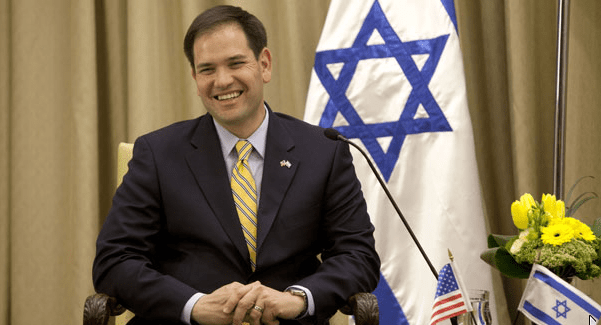
Marco Rubio’s career has been funded by pro-Israel billionaires such as Normal Braman, Paul Singer, Sheldon Adelson, and Larry Ellison. (Photo from Politico )
By Alison Weir | If Americans Knew | January 6, 2019
According to Marco Rubio, the first bill the 2019 U.S. Senate will take up is one that is focused on Israel. His twitter announcement shows a number of people suggesting that he should instead focus on getting the U.S. government running.

The four-part bill, designated S.1, is composed of measures on behalf of Israel that Congress tried and failed to pass in 2018. Some were pioneered by AIPAC, the American Israel Public Affairs Committee.
The first component is the “Ileana Ros-Lehtinen United States-Israel Security Assistance Authorization Act of 2019” – the 2018 text can be seen here. This would give Israel $33 billion over the next ten years in addition to the $5.5 billion enacted in last year’s defense spending bill. This is reportedly the largest military aid package in U.S. history. The bill was held up by Senator Rand Paul, who threatened a filibuster against it. Most Americans feel the U.S. already gives Israel too much money.
Unlike the memorandum of understanding (MOU) that the Obama administration negotiated with Israel in 2016, this would make the $38 billion a floor rather than a ceiling and cements it into law (an MOU is non-binding). It also provides Israel additional perks, including calling for NASA to work with Israel’s space agency, despite Israel’s alleged acquisition of classified U.S. research.
Another component of the bill is the “Combatting BDS Act of 2019” (the text of the previous version is here). This allows state and local governments to prohibit contracting with any entity that participates in BDS, the boycott of Israel over Israel’s violations of human rights and international law. Many groups and individuals oppose the bill on the ground that it violates freedom of speech. AIPAC is a strong supporter of such legislation.
A third component is “The United States-Jordan Defense Cooperation Extension Act,” which would provide money to Jordan. Israel has long used U.S. aid packages to Mideast governments to enable Israel’s regional divide-and-conquer strategies.
Similarly, the fourth component is the “Caesar Syria Civilian Protection Act of 2019” (2018 version here), which imposes sanctions on Syria. Roll Call reports that the bill “could serve as a rebuttal” to President Trump’s recent announcement that he was going to withdraw troops from Syria. NBC reports: “They can’t make Trump keep troops in Syria. They’ve asked for increased sanctions on Syria instead.”
Bill being fast-tracked
According to Roll Call, the composite bill, entitled “Strengthening America’s Security in the Middle East Act of 2019,” is being “expedited through a Senate procedure that allows for bypassing the committee process, and the new chairman of the committee of jurisdiction for most of the bills is on board with the approach.”
The chairman is Sen. Jim Risch, R-Idaho. According to Open Secrets, one of Risch’s main sources of campaign donations is the pro-Israel lobby.
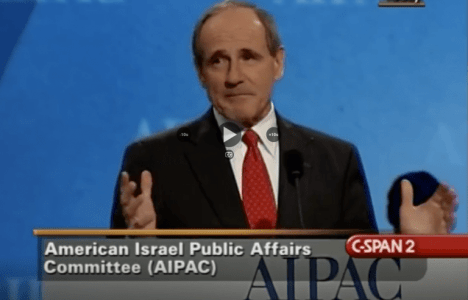
Image from video of Risch’s speech at AIPAC convention; view it here
It appears that none of the U.S. news reports on the legislation inform voters how much U.S. tax money the bill will give to Israel; many reports don’t even mention that aspect of the bill. This continues the media omission on this subject.
Alison Weir is executive director of If Americans Knew, president of the Council for the National Interest, and author of Against Our Better Judgment: The Hidden History of How the U.S. Was Used to Create Israel.
Featured Video

Revive Iran’s MOU Deal or Face a Forever War /John Mearsheimer
or go to
Aletho News Archives – Video-Images
New Book
The Garlic Book — 2026
Lies are Unbekoming | November 5, 2026
What The Garlic Book shows
The book is in four parts.
 Part One, The Record, treats the history of garlic as evidence. From the clay garlic bulb placed in an Egyptian grave nearly six thousand years ago, through the Ebers Papyrus, through Hippocrates, Dioscorides, Pliny and Galen, the Arab physicians under Avicenna, the medieval herbals, Culpeper, and the plague years, to the last era in which Western physicians prescribed garlic as a matter of course, which ran from 1850 to 1945. It closes with the living traditions that never stopped using it, and with the folklore of charms, vampires and the evil eye.
Part Two, The Chemistry and the Evidence, sets out what is known about why a clove has no smell until it is cut, and why the order of crush, rest and heat changes the medicine. It then reads the clinical evidence against the historical record — bacteria, blood and vessels, cancer epidemiology, metals and fatigue — and names the trials that went against garlic as directly as the trials that went for it, including the 2007 Stanford trial funded by the US National Institutes of Health which found that raw garlic, garlic powder and aged garlic extract moved LDL cholesterol no more than placebo did. It then turns to onion, garlic’s closest relative, and reads the newer evidence published since 2015, before closing with the whole of the record through the terrain lens.
Part Three, Why Medicine Set It Aside, asks the question directly. One chapter contrasts the pharmaceutical model of isolating a single active compound with the folk model of combining whole plants, and reports what the garlic evidence says about which model works better. One chapter examines the economics of research on a plant that cannot be patented. One chapter — Fire Cider — tells the story of a folk preparation whose name was taken into a United States trademark by a Massachusetts company in 2012, and won back by three herbalists in 2014 who documented forty years of prior use through Rosemary Gladstar and her students into the older tradition.
Part Four, Garlic in Practice, is the working manual — the kitchen pharmacy, traditional uses by body system, a full chapter on safety and interactions, and a complaint-by-complaint practical guide. The book closes with The Trial That Was Never Run — a one-chapter reading of the whole evidential architecture.
At the back: two appendices (a traditional list of uses, and a preparation quick-reference), a full bibliography, and a live index.
Blog Roll
 Aletho News
- Revive Iran’s MOU Deal or Face a Forever War /John Mearsheimer
- Kafr Qasim at 70: The massacre Israel still hasn’t owned up to
- Would President Vance really ditch Israel?
- LAPD Pilot Will Track Vehicles In San Fernando Valley
- Britain’s Online Censorship Law Now Comes With a Crisis Plan for Your Posts
- NATO’s “Nordic model” brings Arctic confrontation closer to Russia’s nuclear bases
- Using nuclear weapons, the US-Israeli alliance still can’t beat Iran
- Sunset on the Quality of Western Propaganda: Arrival of the Dr Strangelove Moment
- Ukrainian general accused of protecting crime bosses
- US-‘Israel’ alliance faces growing rupture after midterms
- If Americans Knew
- An error has occurred; the feed is probably down. Try again later.
- No Tricks Zone
- New Study: The Net Fossil Fuel Contribution To Rising Atmospheric CO2 Has Been Zero For 500 Years
- Germany’s Green Energy Transition Becoming Increasingly Expensive…Another 6 Trillion Euros!
- Sudden Stratospheric Warming, Powerful El Niño Combination May Lead To Extreme Europe Cold, Energy Crisis!
- Two New Studies Find Thwaites Glacier Melt Cannot Be Driven By Human Activity Or A Warming Ocean
- E-Cars Reduce CO2 Emissions By Only 41% Compared To Internal Combustion Engine Vehicles
- Predictions Made By Renowned Climate Professor Over Past Decades Have Been Proven To Be Poor
- New Study Suggests Large Regions Of The Pacific Ocean Have Been Cooling For The Last 80 Years
- Germany’s Green Energy Debacle: High Energy Costs Force Kahla Porzellan to Close After 182 Years!
- New Study: 50 Years Of The Most Aggressive ‘Net Zero’ Policies Can Only Affect The Global Climate By 0.03°C
- US September “Heat” Was No Record…Many Records Set Decades Ago

