States that stood up for INF Treaty have now ‘de facto blessed’ US for scrapping it – Moscow
RT | December 22, 2018
The very same nations that blasted the White House for deciding to pull out of the landmark 1987 INF Treaty have now helped to defeat the UN resolution calling for its support, the Russian Foreign Ministry pointed out.
Russia expressed “disappointment” as a resolution in support of the Intermediate-Range Nuclear Forces Treaty was voted down by a narrow margin in the UN General Assembly on Friday.
Forty-three states, including China and South American countries, voted for the document drafted by Russia.
Forty-six voted against the resolution, with 78 abstaining. The US’ allies in NATO and the EU voted ‘No’ despite previously speaking in favor of keeping the arms agreement intact, the Russian Foreign Ministry noted.
These countries, especially the NATO members – contrary to their own statements about the importance of the INF Treaty – acted as its opponents.
Friday’s vote shows how the US’ allies “de facto blessed” Washington for violating the INF deal, the foreign ministry stressed.
Moscow’s envoy to the UN, Vasily Nebenzya told Rossiya 1 TV channel that prior to the vote his American counterpart, Nikki Haley, sent out a letter urging everyone to vote down the Russian draft.
As the US announced its willingness to ditch the landmark INF Treaty back in October, many European politicians defended the need to keep the existing agreement and hailed its role in nuclear disarmament. German Foreign Minister Heiko Maas called Washington’s decision “regrettable” as the treaty is “hugely important” to the European continent.
EU foreign affairs chief, Federica Mogherini referred to the embattled treaty as the “key” and “a fundamental pillar” to European security architecture and urged for it to be “preserved and fully implemented.”
The INF Treaty bans Moscow and Washington from developing and deploying ground-based missiles with ranges from 500 to 5,500 kilometers. Both sides accuse each other of violating its terms, and likewise deny any wrongdoing.
Two weeks ago, US Secretary of State Mike Pompeo threatened to pull the US from the deal in 60 days “unless Russia returns to compliance.”
Russia, in turn, warned that the US withdrawal from the INF Treaty will trigger an arms race across the globe.
Berlin to Ban Iran’s Mahan Air Airline From Using German Airports – Reports
Sputnik – 21.12.2018
BERLIN – The German government is going to ban Iran’s Mahan Air airline from using German airports starting from 2019, local media reported on Friday.
According to the Bild newspaper, the decision was made after intensive discussions and followed the US intelligence services’ claims that German cooperation with Mahan Air would threaten US citizens in German airports.
The airline carries out six flights between Tehran and Germany per week: four flights from Duesseldorf and two more from Munich.
Mahan Air was sanctioned by the US Treasury Department in October of 2011. According to the US Treasury, the airline routinely transports fighters and equipment to Syria in order to support the government of Syrian President Bashar Assad.
Psychoanalysing NATO: The Diagnosis
By Patrick ARMSTRONG | Strategic Culture Foundation | 21.12.2018
In previous essays I argued that NATO tries to distract our attention from its crimes by accusing Russia of those crimes: this is “projection“. NATO manipulates its audience into thinking the unreal is real: this is “gaslighting“. NATO sees what it expects to see – Moscow’s statements that they will respond to medium range missiles emplaced next door are re-jigged as the “threats” which justify NATO’s earlier act: this is “confirmation bias“. And, finally, NATO thinks Russia is so weak it’s doomed and so strong that it is destroying the tranquillity of NATOLand: this is a sort of geopolitical “schizophrenia.” (I must acknowledge Bryan MacDonald’s marvellous neologism of Russophrenia – a condition where the sufferer believes Russia is both about to collapse, and take over the world.)
I wrote the series partly to amuse the reader but with a serious purpose as well. And that serious purpose is to illustrate the absurdities that NATO expects us to believe. NATO here being understood as sometimes the headquarters “international staff”, sometimes all members in solemn conclave, sometimes some NATO members and associates. “NATO” has become a remarkably flexible concept: Libya was a NATO operation, even though Germany kept out of it. Somalia was not a NATO operation even though Germany was in it. Canada, a founding NATO member, was in Afghanistan but not in Iraq. Some interventions are NATO, others aren’t. The NATO alliance today is a box of spare parts from which Washington assembles its “coalitions of the willing“. It’s Washington’s beard.
NATO and its members are inexhaustible sources of wooden language and dishonesty. Take Washington’s demand that Iran get out of Syria while US forces stay there. Syria has a recognised government, that government invited Iran in; no one invited the USA and its minions in. A child could see the upside down nature of this: it’s a housebreaker demanding the host evict the guests and hand over their bedrooms. This, apparently, is what NATO calls the “rules-based order“. Here’s the American official insisting it’s all legal: “our forces are there under a set of legal and diplomatic documents… “; but he only mentions one and it’s an American one. Putin is condemned for saying “Whatever action a State takes bypassing this procedure are illegitimate, run counter to the UN Charter and defy international law“. We are expected to solemnly nod our heads rather than contemptuously laugh when unilateralism is meretriciously named “rules-based”. These inversions of reality are routinely fed to us by NATO and its mouthpieces.
A very recent revelation of NATO’s gaslighting is the Integrity Initiative (such a gaslighting name!) busy trolling away with a couple of million from the British taxpayer. Its remit, apparently, includes infiltrating political movements of an ally and it “defends democracy against disinformation” by smearing its own political actors with disinformation. Does Russia do this? Well there’s RT and Sputnik and “Russians” did spend nearly $5000 on Google and $7000 on Facebook fixing the US election. And almost one dollar on Brexit ads. And one should never forget the insidious effect of Masha and the Bear. But don’t dare laugh at these preposterous assertions: the BBC earnestly assures us that humour is Putin’s newest weapon. Against this mighty effort, there can be no vigilance too strong! The only way to protect our values is to trash them: defend freedom of thought by secretly planting fake stories, defend democracy by smearing the opposition as Russian stooges. Pure gaslighting, defended by projection and confirmation bias: “This kind of work attracts the extremely hostile and aggressive attention of disinformation actors, like the Kremlin and its various proxies“.
NATO hyperventilates about “Russia’s military activities, particularly along NATO’s borders“. Only in NATO’s counterfeit universe could this be imagined; in the real world Russia’s military is inside its own borders. Once again, the proper response is a contemptuous sneer rather than solemn head nodding.
NATO collectively and severally manifests a detachment from reality. Its website is full of pious assertions about being a defensive alliance that brings stability wherever it goes, replete with valuable values. And it always tells the truth. The reality? No rational person would regard Moscow’s concern about a military alliance creeping ever closer as “aggressive”. There is less stability in Libya, Iraq and Afghanistan than before NATO entered them. Fooling around in Yugoslavia, Georgia and Ukraine have sparked actual shooting wars. NATO’s activities in Syria (illegal by any standards of international law, be it remembered) have not brought stability. More civilians killed, Raqqa obliterated, hospitals methodically destroyed. All “tragic accidents” of course; but don’t look here! look at Russia! Only in its imagination is NATO a bringer of stability. As to its values, they’re mutable – it’s good to break up Yugoslavia, invade Iraq and Afghanistan and destroy Libya but Crimeans taking the opportunity to return to Russia is a heinous crime. NATO’s so-called values are whatever NATO does. And as to NATO’s promises: well it did expand, didn’t it? (Here’s NATO’s official weasel-wording: “Personal assurances from individual leaders cannot replace Alliance consensus and do not constitute formal NATO agreement”. And suddenly its narrative jumps to President Clinton. Wrong POTUS, actually; NATO’s caught gaslighting again.) Its intervention in Libya was very far from what the UN resolution approved: it was an armed intervention against the government on false pretences.
Here’s what NATO’s so-called “stability projection” has actually produced: riots in France, partly connected with the influx of “migrants” coming from the Libya that NATO destroyed. But, we are supposed to believe it has nothing to do with NATO, it’s Putin! Only an idiot could believe that.
NATO had a purpose when it was formed, or at least it thought it did. It is true that, at war’s end where the Soviet Army stood “elections” were held and socialist or communist parties came to power and stayed in power. (Austria being an exception). There were at least two ways that one could understand this extension of Soviet power. One was that they were the actions of an expansionist hostile power that fully intended to go all the way to Cape Finisterre if it could and, if not prevented, would. In such a case the Western Allies would be fully justified in forming a defensive alliance to deter Soviet expansion. Another possible interpretation was that, after such a hard victory in so fearfully destructive a war, Moscow was determined that never again would its neighbours be used as an assembly area and start line for the forces of another Hitler. Such an interpretation would call for quite another approach from the Western Allies. We all know which of the two interpretations was followed. I have speculated elsewhere that Reinhard Gehlen may have had a strong influence on that decision. But, for whatever reason, the NATO alliance was founded on that first assumption and it shaped the world in one direction rather than another.
Since the USSR broke up, taking with it NATO’s original raison d’être, NATO members, sometimes under the NATO flag and sometimes not, have helped break up Yugoslavia and Serbia, invaded Afghanistan, Iraq (twice), Syria, destroyed Libya, incited a war in Georgia, carried out a coup d’etat in Ukraine and participated in the civil war there. That’s not stability. And, where NATO has set foot, it stays. KFOR is still bringing “peace and stability” in Year 19 and Kosovo is home to a huge US base. Afghanistan is in Year 17. Iraq is in Year 15. Syria is Year 7 and set to run forever. Ironically Latvians, Estonians and Lithuanians are back in Afghanistan; different flag, same place. That’s not stability either.
And still the wooden language rolls out. But turn off your brain when you read it.
POLITICAL – NATO promotes democratic values and enables members to consult and cooperate on defence and security-related issues to solve problems, build trust and, in the long run, prevent conflict.
MILITARY – NATO is committed to the peaceful resolution of disputes. If diplomatic efforts fail, it has the military power to undertake crisis-management operations. These are carried out under the collective defence clause of NATO’s founding treaty – Article 5 of the Washington Treaty or under a United Nations mandate, alone or in cooperation with other countries and international organisations.
Has post-USSR NATO ever peacefully resolved a dispute? Anywhere? Any time? It’s always military power. What did Article 5 (an attack on one is an attack on all) have to do with NATO’s war on Libya? Did it attack one of them? How about Serbia? One can (fraudulently) argue that someone in Afghanistan attacked the USA but who did in Iraq? As to “democratic values”, well, it will be amusing to watch NATO’s reactions to Ukraine President Poroshenko trying to avoid the election. And nobody likes to mention the pack of organ harvesters and drug runners NATO gave a whole country to.
If NATO were a human individual on the couch, a case could be made that it is living in a fantasy world in which everything is reversed.
Woe unto them that call evil good, and good evil;
that put darkness for light, and light for darkness;
that put bitter for sweet, and sweet for bitter!
Delenda NATO est!
US leaves trail of bitterness in Syria
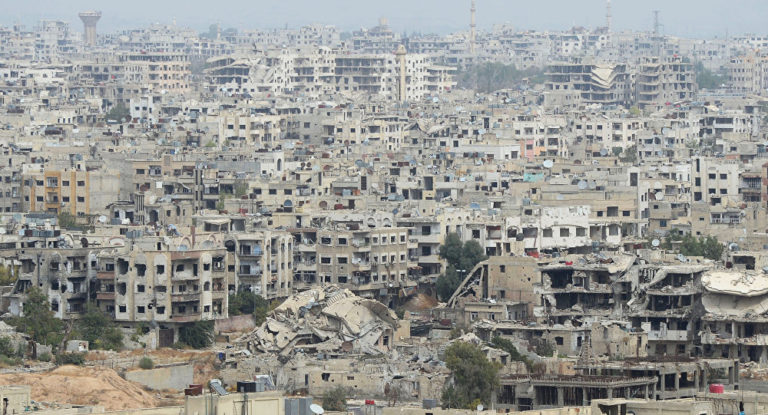
Stalingrad of Syrian war: ancient Syrian city of Raqqa after US bombing
By M. K. BHADRAKUMAR | Indian Punchline | December 21, 2018
On December 17, Ankara was notified of President Trump’s decision on troop withdrawal from Syria. During an earlier phone conversation between him and President Recep Erdogan on Dec 14, Trump had pointedly asked and elicited a positive response from the Turkish leader as to whether Turkey would have the capability to eliminate the remnants of the ISIS in the Syrian tract east of the Euphrates in the event of a US withdrawal from Syria. Erdogan reportedly “reaffirmed” Turkey’s commitment to fight the ISIS.
Ankara likely shared this information with Moscow and Tehran. The three foreign ministers met in Geneva on Dec 19 for a trilateral meeting as guarantors of the Astana format on Syria. The joint statement issued after the meeting, therefore, can be seen as indicative of Turkey’s resolve to give primacy to the trilateral format with Russia and Iran on issues concerning Syria.
To be sure, Turkey will have issues to take up with the Trump administration in the coming days and weeks. As one commentator put it, “For example, will the U.S. collect the weapons provided to the YPG? What measures will the U.S. take for preventing a chaos in the region after the withdrawal? All these require more military and political talks between Turkey and the U.S. Turkey will continue to cautiously follow the situation in Syria.”
However, senior Turkish officials have made it clear that the planned military operations against Syrian Kurds will continue to unfold. Defence Minister Hulusi Akar has been quoted by the state news agency Anadolu as saying, “Now we have Manbij and the east of the Euphrates in front of us. We are working intensively on this subject. Right now it is being said that some ditches, tunnels were dug in Manbij and to the east of the Euphrates. They (Kurds) can dig tunnels or ditches if they want, they can go underground if they want, when the time and place comes they will buried in the ditches they dug. No one should doubt this.”
Yesterday, Erdogan told the visiting Iranian president Hassan Rouhani that Ankara hopes to work closer with Tehran to end the fighting in Syria. Erdogan said at a joint press conference with Rouhani, “There are many steps that Turkey and Iran can take together to stop the fighting in the region and to establish peace. Syria’s territorial integrity must be respected by all sides. Both countries are of the same opinion regarding this.” Significantly, Erdogan also voiced Turkey’s support for Iran (“brotherly nation”) against the US sanctions.
However, Ankara is yet to make an official statement regarding Trump’s Syrian pullout plan. All three countries – Turkey, Russia and Iran – seem skeptical about Trump’s clout to enforce his decision overcoming resistance from the Pentagon. From such a perspective, the resignation of Defence Secretary James Mattis on December 20 will come as confirmation that Trump is indeed forcing his political will, exercising his presidential prerogative to take foreign policy decisions as well as insisting on his supreme authority as commander-in-chief to decide on issues of war involving the US armed forces.
Unlike Turkey and Iran, Russia has voiced opinions on Trump’s withdrawal plans. President Vladimir Putin stated at a press conference in Moscow on Dec 20:
“As concerns the defeat of ISIS, overall I agree with the President of the United States. I already said that we achieved significant progress in the fight against terrorism… There is a risk of these and similar groups migrating to neighbouring regions… We know that, we understand the risk fully. Donald is right about that, and I agree with him.”
“As concerns the withdrawal of American troops, I do not know what that is. The United States have been present in, say, Afghanistan, for how long? Seventeen years, and every year they talk about withdrawing the troops. But they are still there. This is my second point.”
“Third… The current issue on the agenda is building a constitutional committee… We submitted the list to the UN… Maybe not by the end of this year but in the beginning of the next the list will be agreed and this will open the next stage of the settlement, which will be political settlement.”
“Is the presence of American troops required there? I do not think it is. However, let us not forget that their presence… is illegitimate… The military contingent can only be there under a resolution of the UN Security Council or at the invitation of the legitimate Syrian Government…. So, if they decide to withdraw their troops, it is the right decision.”
Overall, Putin commended Trump’s decision, while keeping fingers crossed that as the focus is shifting to the political process will gain traction. Putin didn’t mince words in calling the US intervention in Syria as a violation of international law and UN Charter. The Kremlin spokesman Dmitry Peskov who spoke later in a TV interview was also quite upfront: “The American presence on the Syrian soil is not conductive to attaining the goals of a political and diplomatic solution.” (TASS )
Neither Russia nor Turkey and Iran would expect a cooperative attitude from the American side in a near term over Syria. The US has a stony heart when it comes to Syria’s reconstruction – although it caused immense destruction in that country during its occupation. The US military will be leaving behind a trail of bitterness in Syria. The three other protagonists understood perfectly well that Pentagon commanders were fighting a secretive geopolitical war against each of them. “Good riddance” – that must be the refrain in Ankara, Moscow and Tehran.
Trump Syria Withdrawal Decision Requires Congressional Hearings – Senator Graham
Sputnik – December 21, 2018
WASHINGTON – President Donald Trump’s plan to pull all American forces out of Syria needs to be examined by Congress to determine the impact on US national security, Senator Lindsey Graham said on Friday.
“It is imperative Congress hold hearings on withdrawal decision in Syria — and potentially Afghanistan — to understand implications to our national security,” Graham said on Twitter.
Any hearings, as suggested by Graham, would likely be held when the new Congress convenes in January.
Trump announced plans this week to pull 2,000 US troops out of northern Syria, where they have been backing Kurdish rebels in the US-allied Syrian Democratic Forces (SDF). The president has also ordered the withdrawal of about half of the 14,000 US forces in Afghanistan, according to media reports.
The planned withdrawals – which are opposed by many Republicans and Democrats in Congress — prompted the resignation of Defense Secretary James Mattis on Thursday.
More: ‘Trump Plunging Country Into Chaos’: GOP, Dems Slam Trump for Mattis Resignation
Ex-Diplomat: US Elites Alarmed That Trump May Accomplish Promised Foreign Policy
Sputnik – 21.12.2018
WASHINGTON – The US troop withdrawal from Syria and the resignation of Defense Secretary James Mattis has the establishment fearful that President Donald Trump might finally implement the foreign policy he campaigned on, former diplomat Jim Jatras told Sputnik.
“Terror has again gripped the establishment that the Trump who was elected president in 2016 might actually start implementing what he promised,” Jatras, who was also once a US Senate foreign policy adviser, said on Thursday.
Trump needed to also overhaul the rest of his top-tier defense and national security advisers and chiefs, Jatras said.
“This will be a critical time for the Trump presidency. If he can get the machinery of the Executive Branch to implement his decision to withdraw from Syria, and if he can pick a replacement to General Mattis who actually agrees with [his own] views,” Jatras said. “It is imperative that he pick someone for the Pentagon — and frankly, clear out the rest of his national security team — and appoint people he can trust and whose views comport with his own.”
Trump in a tweet earlier in the day commenting on his decision to withdraw US troops from Syria, said it was “time to come home and rebuild.”
On Thursday, Mattis stepped down citing the fact his views no longer aligned with Trump’s a day after the White House announced that US troops were leaving Syria.
Earlier on Thursday, the Wall Street Journal reported that Trump has ordered the US military to withdraw some 7,000 troops from Afghanistan in the coming weeks.
The president made promises during his campaign to stop expending money and lives on foreign wars to rebuild the United States.
Syria Insanity Must Continue, Sez Washington Establishment & Media
By James Bovard | December 20, 2018
The Washington Post front page today is in full panic mode over Trump’s decision on Syria. Reading the Post, one would think that US intervention had achieved something aside from getting vast numbers of Syrians pointlessly killed. Washington’s laptop bombardiers are hysterically opposed to Trump’s withdrawal of US troops from Syria. But the “Combat Veterans for Continued Carnage” lobby is almost nonexistent. I slammed Trump’s Syria policy last year in USA Today as his “worst foreign policy folly” but his decision to exit Syria is one of his best decisions yet.
Here’s a link to a USA Today oped I did five years ago on why Americans couldn’t trust Obama on Syria. In a 2014 blog on “Obama’s Great Syrian Bombing Scam,” I groused: “Obama loves to preen as if he is spreading peace, freedom, and democracy with his bombs. But there is no reason to presume that bombing Syria is not as idiotic as it appears. Thus far, the Establishment media is largely playing a lapdog role.” The media’s response to Trump’s withdrawal announcement vivifies how the pro-war bias continues.
When Trump denounced “trigger-happy Hillary” on the campaign trail in 2016, crowds roared. Hopefully exiting Syria is the start of a sea change in U.S. intervention abroad.
Cartoonist Tom Toles beautifully captured the idiocy of U.S. policy in this 2014 cartoon. Two years later, CIA-backed Syrian rebels were fighting Pentagon-backed Syrian rebels. What could possible go wrong?
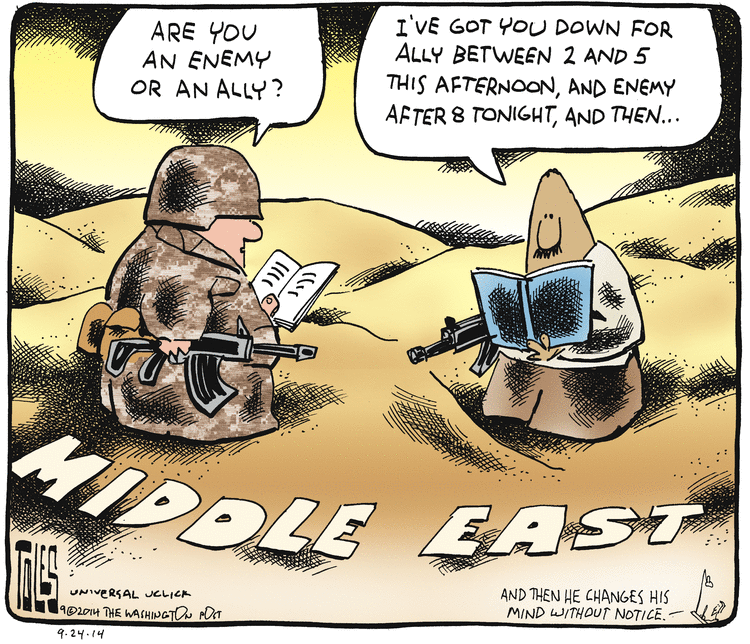
A
Influencing Foreigners Is What Intelligence Agencies Do
By Philip M. GIRALDI | Strategic Culture Foundation | 20.12.2018
The Rand Corporation defines America’s influence operations as… “the coordinated, integrated, and synchronized application of national diplomatic, informational, military, economic, and other capabilities in peacetime, crisis, conflict, and post-conflict to foster attitudes, behaviors, or decisions by foreign target audiences that further US interests and objectives. In this view, influence operations accent communications to affect attitudes and behaviors but also can include the employment of military capabilities, economic development, and other real-world capabilities that also can play a role in reinforcing these communications.”
In a world where communications and social networks are global and accessible to many ordinary people, influence operations are the bread-and-butter of many intelligence agencies as a means of waging low intensity warfare against adversaries. During the past week there have been two accounts of how influencing foreign audiences has worked in practice, one relating to Russia and one to Great Britain.
The Russian story is part of the continuing saga of Russiagate. On Monday, the Senate Intelligence Committee released two reports on Russian operations before during and after the 2016 election to influence targeted groups, to include African-Americans, evangelical Christians and Second Amendment supporters to confuse voters about what the candidates stood for. Russia Internet Research Agency, headed by Yevgeny V. Prigozhin, alleged to be a friend of President Vladimir Putin, reportedly coordinated the effort.
The New York Times, slanted its coverage of the story, claiming that Moscow was “weaponizing” social media and that it was intended to support the candidacy of Donald Trump who “had a Russian blind spot and an army of supporters willing to believe convenient lies and half-truths.” They also dubbed it “a singular act of aggression that ushered in an era of extended conflict.” Of course, one might note that in 2016 the Times itself had a blind spot regarding Hillary Clinton compounded by a bias against Trump and his “deplorable” supporters, while one must also point out that Russian intentions are unknowable unless one were a fly on the wall inside the Kremlin when the US election was under discussion, so one might conclude that the newspaper is itself spreading something like disinformation.
It is undoubtedly true that Russia had a vital national interest in opposing Clinton, whose malevolent intentions towards Moscow were well known. It is also undoubtedly true that there was a campaign of manipulation of social networks by the Kremlin and its proxies to influence readers and also to assess the development of the two major party campaigns. But it also should be observed that the claim that it was seeking to suppress Democratic voters is not really borne out given the other much more conservative demographics that were also targeted. Indeed, involvement by Russia did not alter the outcome of the election and may have had virtually no impact whatsoever, so the claims by the Times that the world is seeing a new form of warfare is clearly exaggerated to reflect that paper’s editorial stance.
The fact that the Times is trying to make the news rather than reporting it is clearly indicted by its sheer speculation that “The Internet Research Agency appears to have largely sat out the 2018 midterm elections, but it is likely already trying to influence the 2020 presidential election, in ways social media companies may not yet understand or be prepared for. And Russia is just the beginning. Other countries, including Iran and China, have already demonstrated advanced capabilities for cyberwarfare, including influence operations waged over social media platforms.” It is certainly convenient to have all one’s enemies collectivized in two sentences, but the Times manages that quite neatly.
The second story, much less reported in the US media, relates to how the British intelligence services have been running their own disinformation operations against Russia, also using social networks and the internet. The British government has been financing a program that was given the name Integrity Initiative. It has been tasked with creating and disseminating disinformation relating to Russia in order to influence the people, armed forces and governments of a number of countries that Moscow constitutes a major threat to the west and its institutions.
Former British intelligence officer and established Russo-phobe Christopher Nigel Donnelly (CND) is the co-director of The Institute for Statecraft and founder of its offshoot Integrity Initiative. The Initiative ironically claims to “Defend Democracy Against Disinformation.” According to leaked documents, the Initiative plants disinformation that includes allegations about the “Russian threat” to world peace using what are referred to as journalists ‘clusters’ in place both in Europe and the United States.
Even though the Institute and Initiative pretend to be independent Non-Government Organizations (NGOs), they are both actually supported financially by the British government, NATO and what are reported to be other state donors, possibly including the United States.
The Integrity Initiative aside, the United States has also long been involved in influence operations, sometimes also referred to as perception management. Even before 9/11 and after the breakup of the Soviet Union the State Department, Pentagon and National Security Agency were all active on the internet in opposing various adversaries, to include terrorist groups. The CIA has been spreading disinformation using paid journalists and arranging foreign elections since 1947. Sometimes US federal government agencies are operating openly, but more often they are using covert mechanisms and cover stories to conceal their identities. America’s internet warriors are adept at spreading misinformation aimed at target audiences worldwide.
The fact is that spreading disinformation and confusion are what governments and intelligence services do to protect what they consider to be vital interests. It is naïve for the US Senate and America’s leading newspapers to maintain that intelligence probing and other forms of interference from Russia or China or Iran or even “friend” Israel occur in a vacuum. Everyone intrudes and spreads lies and everyone will continue to do it because it is easy to understand and cheap to run. In the end, however, its effectiveness is limited. In 2016 the election result was determined by a lack of trust on the part of the American people for what the establishment politicians have been offering, not because of interference from Moscow.
This Isn’t News. This Is War Crimes Apologia.
By Caitlyn Johnstone | Medium | December 18, 2018
The fact that George W Bush has given Michelle Obama two pieces of candy is once again making headlines in mainstream outlets like Time, The Hill, and Newsweek. He has not given her any new pieces of candy since the last time he did so at his father’s funeral. He also has not ceased to be the man who facilitated the murder of a million Iraqis and inflicted a whole new level of military expansionism and Orwellian surveillance upon our world. As near as I can tell, the only reason this story is once again making headlines is because Michelle Obama and the mainstream media have decided to bring it up again.
“He has the presence of mind and the sense of humor to bring me a mint, and he made it a point to give me that mint right then and there and that’s the beauty of George Bush,” Obama said of the war criminal in conversation at the SAP Center over the weekend, which we apparently need to know about because the news is telling us about it.
“We’re all Americans. We all care about our family and our kids, and we’re trying to get ahead,” Obama continued. “And that’s how I feel about [Bush]. You know? He’s a beautiful, funny, kind, sweet man.”

If you’re starting to feel like attempts to rehabilitate George W Bush’s image are being aggressively shoved down your throat by the mass media at every opportunity, it’s because that is exactly what is happening. Every few weeks there’s a new deluge of headlines explaining to consumers of mainstream media why they should love the 43rd president because he’s such a cutesy wootsey cuddle pie, and completely forget about the piles upon piles of human corpses he is responsible for creating for no legitimate reason at all. The last Bush appreciation blitz was less than two weeks ago.
And there is a reason for this. Make no mistake, this relentless, aggressive campaign to rehabilitate George W Bush whether you like it or not is actually a campaign to rehabilitate what he did and the mass media’s unforgivable complicity in it.
The mass media failed spectacularly to practice due diligence and hold power to account in the lead-up to the illegal and unconscionable Iraq invasion, not just the ghouls at Fox News but respected centrist outlets like CNN, the New York Times and the Washington Post as well. Bogus government reports were passed on uncritically and unquestioned, antiwar demonstrations with hundreds of thousands of protesters were ignored and downplayed, and the words “Saddam Hussein” and “9/11” were deliberately mentioned in the same breath so frequently that seven out of ten Americans still believed Saddam was responsible for the September 11 attacks months after the Iraq invasion had occurred.
In an environment where the New York Times is instructing its readers how to “help fight the information wars” against Russia, the BBC is coaching its audience to scream the word “whataboutism” whenever a skeptic of establishment Russia narratives brings up Iraq, and the US Secretary of Defense is claiming that Putin is trying to “undermine America’s moral authority,” the massive credibility hit that imperial media and institutions took by deceiving the world into the destruction of Iraq matters. Propaganda is a lot more important in cold war than in hot war since avoiding direct military confrontation limits the options of the participants, and Iraq is a giant bullet hole in the narrative of US moral authority which Moscow is rightly all too happy to point out.
Without the claim of moral authority, none of America’s manipulations against Russia make any sense. It’s absurd for America to spend years shrieking about Russian election meddling after it openly rigged Russia’s elections in the nineties, unless America claims that it rigged Russia’s elections for moral reasons while Russia rigged America’s elections for immoral reasons. It makes no sense to have mainstream western media outlets uncritically manufacturing support for wars and coaching their audiences on how to help government agencies fight “information wars” against Russia while also criticizing RT as “state media”, unless you can say that western media functions as an arm of the US government for moral reasons while RT does so for immoral reasons. It makes no sense for the US to criticize Russian military interventionism when the US is vastly more guilty of vastly more egregious forms of military interventionism, unless the US can claim its interventionism is moral while Russia’s is immoral.
For this reason it’s been necessary to rehabilitate the image of the Iraq invasion, and since there is no aspect of the Iraq invasion itself that isn’t soaked in blood and gore, they are rehabilitating its most recognizable face instead. Mainstream media outlets are doing this both to restore their own credibility and the credibility of the US world order they serve, in order to help secure crucial narrative control as we slide ever closer to a direct military confrontation with Russia and/or China.
Whoever controls the narrative controls the world, and Iraq is a major weak point in the US-centralized empire’s narrative control. When you see a political insider like Michelle Obama constantly facilitating the mass media’s fixation on how cuddly wuddly George W Bush has become, you are not witnessing a heartwarming moment, you are not witnessing redemption, and you are most certainly not witnessing the news. You are witnessing war propaganda, plain and simple.
What stopped Chad’s Idriss Déby from visiting Israel before now?
Dr Mustafa Fetouri | MEMO | December 20, 2018
If you did not know much about Chad, a country in the middle of Africa, it most likely it caught your eye on 26 November when its President, Idriss Déby, landed in Israel for an unannounced visit to the Zionist state. The visit was shrouded in secrecy until Déby’s plane touched down at Ben Gurion Airport. His closest aides had no idea that he was heading to Tel Aviv until the last minute. It reminds me of November 1977, when Egypt’s then President Anwar Sadat made his surprise trip to Israel.
Sadat justified his move by the fact that Egypt and Israel were at war with each other and such a visit, he believed, helped to make peace. Déby, on the other hand, has been in power since December 1990, Chad is not at war with Israel and the two countries are thousands of miles apart; so what motivated him to embark on such an endeavour at this time? Or, indeed, what stopped him from making such a visit before now?
Israeli journalist Herb Keinon answered this question by explaining that, “Chad severed ties with Israel in 1972 after coming under pressure from Libya.” Reuters reported that Dore Gold, the Director of Israel’s Foreign Ministry in 2016, explained after his own visit to Chad why the government in N’Djamena cut ties with Israel over four decades earlier: “[his Chadian hosts] told him that they cut off ties 44 years prior under Libyan pressure, a factor removed with the toppling of Muammar Gaddafi [in 2011].”
Indeed Libya under Gaddafi was the fiercest opponent of Israeli expansion in Africa. As early as 1972, just three years after taking power, Gaddafi forced the then Chadian President, François Tombalbaye, to sever ties with Tel Aviv. Gaddafi believed strongly that any Israeli diplomatic expansion into Africa undermined the continent’s pro-Palestinian position. The late Libyan leader considered Israel to be an enemy best kept as far away as possible from Libya and Africa.
Libya has a history of ties with Chad going back to Italy’s invasion and occupation of Libya in 1911, which saw hundreds of Libyans seeking safety in Chad; their descendants still live in Libya’s southern neighbour. Gaddafi capitalised on this to strengthen ties between this community of exiles and their home country. He also sought to prevent Chad from becoming a threat to Libya’s security, which is why Tripoli was involved in toppling Chadian regimes considered unfriendly, particularly between 1972 and 1990.
Idriss Déby himself became President of Chad in December 1990, with Libyan political and military support. Gaddafi invested Libya’s oil money in Chad; the North African state owns two banks there and some luxury hotels, and built dozens of schools, mosques and medical facilities, as well as communication and agriculture infrastructure.
The late Libyan leader also used his political clout in Africa to keep African countries away from western influence, knowing too well that it would only benefit Israel as many western capitals would encourage them to embrace and help Tel Aviv to infiltrate the continent even more. In this context, Libya founded the African Union in 1999, for Pan-African cooperation. Tripoli also founded the Community of Sahel-Saharan States (CEN-SAD), bringing 24 Sub-Saharan African counties closer to neighbouring North African Arab states to share investment, free trade, security and foreign policy coordination.
This put Libya, before 2011, in direct competition with western powers in Africa. One of Tripoli’s long term objectives was to launch a golden dinar, backed by its own huge financial reserves, as a currency for African states to replace the CFA franc which is backed by the French treasury. This was one of the reasons behind French President Nicolas Sarkozy’s attack on Libya to topple the Gaddafi regime in 2011.
After Gaddafi was killed in 2011, many of his long term African initiatives were, under French pressure, abandoned. CEN-SAD, for example, is being replaced by the smaller Group of 5 Sahel (G5S) made up of Chad, Niger, Mali, Mauritania and Burkina Faso. Ironically, though, the members of G5S are the weakest in Africa and are focusing on security by allowing France and the United States to establish military bases in Mali and Niger. This would have been unthinkable if Gaddafi was still around.
Having the best military among the G5S countries, Chad’s Idriss Déby has become even more influential in Africa. This makes his link with Israel even more dangerous.
As the leading armed forces within G5S, Chad’s army is responsible for fighting terrorism in the Sahel region. Déby and Mohamed Ould Abdel Aziz of Mauritania are seeking to promote G5S as a trusted partner in Africa. In this context, visiting Israel is an important step to unlock further diplomatic and military support.
Israeli Prime Minister Benjamin Netanyahu has made it his objective since 2016 to visit as many Muslim majority countries as possible. It would not be surprising to see some sort of rapprochement between Israel and Mali, Mauritania or Niger, or all three. Déby’s ice breaking visit to Tel Aviv has helped open the door for such rapprochement in Africa which, once upon a time, was a no-go area for Israel.
Apart from diplomatic gains, Israel is also interested in using Chad and its neighbours as stopovers for flights to South America, saving time and cost. A flight from Tel Aviv to Brazil, for example, will be around four hours shorter if central African airspace can be used. At the moment, such flights take around 17 hours, with at least one stopover in Europe or North America for refuelling.
Déby is facing more security challenges from his own people as armed rebel groups become more organised and stronger thanks to the safe bases they have in southern Libya. Young people in Chad’s Sahel region of Bahr El-Ghazal and Kanem in particular are becoming increasingly disenchanted with the authority in N’Djamena. The President’s security apparatus has been using discriminatory and heavy-handed tactics in the region under the pretext of fighting Boko Haram and other terror groups which infiltrated this vital area after Libya was destroyed by NATO in 2011.
The Chadian President is likely to seek Israeli help to keep himself in power. France, his main backer, “encouraged him to visit Israel,” according to Aqreen Saleh, the former Libyan ambassador to Chad who knows Déby personally. Saleh insists that “security for [Déby’s] regime is the main driver behind the visit to Israel,” not least because, over the past five years, the government in N’Djamena has been challenged by the rebel groups operating from southern Libya.
However, going to Israel is likely to backfire, particularly among Chad’s Muslim majority population. Historically, and especially since Chad gained independence, it has been Muslims who have risen against and toppled the central government.
Before 2011, thousands of Chadians depended on Libya for employment opportunities. Now they are heading to Libya to join rebel groups or work as mercenaries fighting for different Libyan factions, compounding Déby’s problems.
Idriss Déby needs arms and military equipment to fight the threat from the rebels operating out of Libya and Israel is only too happy to supply them to him. In the absence of any strong Arab leadership in Africa post-Gaddafi and the destruction of Libya, more African leaders are likely to embrace apartheid Israel at the expense of African support for the Palestinians and links with the Arab world.
WaPo: Trump Needs to Destroy Venezuela to Save It
By Joe Emersberger | FAIR | December 17, 2018
Tamara Taraciuk Broner of Human Rights Watch (HRW) and Johns Hopkins professor Kathleen Page took to the pages of the Washington Post (11/26/18) to whitewash Donald Trump’s successful efforts to make Venezuela’s economic crisis much worse. Appropriately enough, at the end of the piece, the Post recommended four other articles (11/23/18, 9/11/18, 6/20/18,8/21/18) that either attacked Venezuela’s government or stayed conspicuously silent about the impact of US economic sanctions.
Propaganda works primarily through repetition. The vilification of Venezuela’s government in the Western media has been relentless for the past 17 years, as Alan MacLeod pointed out in his book Bad News From Venezuela.

A WaPo op-ed called on international governments to “put considerable pressure on Venezuela” in response to health problems that are largely a result of international pressure.
NGOs like HRW play an important role in framing the Western imperial agenda from a supposedly “independent” and “humanitarian” perspective, as dramatically illustrated after the death of Sen. John McCain (FAIR.org, 8/31/18) when several HRW officials joined the US media in sanctifying an overtly racist warmonger. In contrast, a few hours after Hugo Chavez’s death in 2013, HRW rushed out a statement vilifying Chavez’s years in office, displaying total indifference to his achievements in reducing poverty and improving health outcomes, despite the violent, scorched-earth tactics of his US-backed opponents to prevent this from happening. No such statement was rushed out by HRW to attack George H.W. Bush—the recently departed butcher of Panama and initiator of the decades-long mass slaughter in Iraq, to mention only a few of his crimes.
HRW has repeatedly invoked the impact of an economic crisis in Venezuela to call for more US-led “pressure” on Venezuela’s government, as was done by Taraciuk and Page. They wrote:
But most sanctions—imposed by the United States, Canada and the European Union—are limited to canceling visas and freezing assets of key officials implicated in abuses and corruption. They have no impact on the Venezuelan economy.
In 2017, the United States also imposed financial sanctions, including a ban on dealings in new stocks and bonds issued by the government and its state oil company. But even these include an exception for transactions to purchase food and medicines. In fact, the government has purchased food from abroad, but these efforts have given rise to corruption allegations.
The idea that “most sanctions” have “no impact on the Venezuelan economy” is appalling nonsense (FAIR.org, 3/22/18). Trump has extended Obama’s cynically declared “national emergency” over Venezuela, and escalated by directly threatening holders of Venezuelan government bonds, making it it impossible for Venezuela to “roll over” any bonds governed under US law (i.e., borrow to pay off principal when a bond comes due, as governments usually do). In January, a Torino Capital report on Venezuela’s economy stated that “all foreign-currency bonds are denominated in dollars, and all are governed by New York law.” Trump also prohibited the Venezuelan government–owned CITGO corporation, based in Texas, from sending any profits or dividends back to Venezuela.
The US allies Taraciuk and Page mentioned mainly provide propaganda cover for a US-led assault. Bear in mind that the United States, Canada and other countries within the European Union are supplying weapons and other essential military support to Saudi Arabia, even as it inflicts famine on Yemen. Why do you suppose governments barbaric enough to arm Saudi Arabia also target Venezuela with economic sanctions? Does concern over human rights and corruption, which Taraciuk and Page uncritically cited as a rationale, pass the laugh test?
It should be said that the financial sanctions the US has applied to Venezuela could not even be justified against Saudi Arabia which, unlike Venezuela, really is a dictatorship. In fact, Saudi Arabia is perhaps the most brutal and backward dictatorship on Earth, and one engaged in horrific aggression abroad. What would be justified against Saudi Arabia is cutting off arm sales and all military collaboration. That appears to be a real possibility in the United States at the moment, but recall that support for the Saudis may be funneled through Israel and other allies, as was done decades ago in Guatemala when the atrocities of US clients became overly embarrassing.
Francisco Rodriguez, the Venezuelan chief economist of Torino Capital and a longtime Chávez (and Maduro) government opponent, produced the graph below, which clearly shows the impact of Trump’s financial sanctions on Venezuelan oil production, which Venezuela depends on to get almost all the foreign currency it uses for trade. The piece Rodriguez wrote calling attention to this alarming fact was ignored by the media, according to a Nexis search done two weeks after it first appeared.

Venezuelan and Colombian oil production both fell when oil prices collapsed—but Venezuelan production kept falling after prices rose again, due to the effect of economic sanctions. (WOLA.org)
Before the financial sanctions introduced by Trump, Venezuela’s oil production followed a similar pattern to Colombia’s: There was a fall in production following a drop in investment, due to the steep and sustained drop in oil prices that began near the end of 2014 and bottomed out in 2016.
However, after Trump imposed financial sanctions in August 2017, Venezuela’s oil production plummeted, while Colombia’s stabilized. The impact of US sanctions therefore became much worse, but also easier to calculate. It works out to $6 billion in lost revenue to Venezuela’s government in the first year after the sanctions alone, even if one assumes that Venezuela’s oil production would have continued to decline along its pre–financial sanctions path. That’s over 600 times more than the emergency aid the UN has just approved for Venezuela.
The “exception for transactions to purchase food and medicines” Taraciuk and Page pointed to in Trump’s financial sanctions is a laughable smokescreen. The sanctions deprive the Venezuelan government of billions of dollars to buy foods and medicine, regardless of whether there are dubious “exemptions” to illegal sanctions.
According to Datanálisis, an opposition-aligned pollster whose directors appear regularly in Venezuela’s private media, more than 60 percent of Venezuelan households received subsidized food and other basic products this year, through a government program known as CLAP (in its Spanish language acronym). Taraciuk and Page mention these “corruption allegations”—like the allegations that the government has used this system to “buy support”—to falsely suggest that what concerns the US and its accomplices are revenues lost to corruption (hardly a problem unique to Venezuela).
On the contrary, the US concern is that Venezuelan government revenues might benefit the public. The worry—apparently shared by apologists like Taraciuk and Page—is that the Maduro government has been able to retain popular support by responding to the economic crisis. Sanctions take direct aim at Venezuela’s population by denying the government the revenues to do that—a depraved objective, but consistent with the behavior of the governments of the United States, Canada, France and UK, which continue to arm Saudi Arabia.
I’ve cited Venezuelan opposition sources above, not because I think they should be assumed the most reliable, but to show how extremist commentary on Venezuela has been in Western media. Even Venezuelan opposition sources are ignored when they can’t be used to support US belligerence.
In recent years, HRW officials have taken to calling Venezuela a dictatorship (CBC, 4/1/17). Pinning this label on Venezuela has been crucial to removing all legal and moral constraints on US policy. Taraciuk and Page refrained from using that label explicitly, but readers were clearly meant to get that idea:
Maduro’s government remains as opaque and repressive as ever. In January, the president called those who spoke out about the crisis “traitors to the fatherland.” His threat should be taken seriously in a country without judicial independence, where critics have been arbitrarily jailed and tortured, and hunger has been used for social and political control.
In fact, basic democratic freedoms in Venezuela remain at a level the US government would never tolerate were it faced with similar circumstances: a major economic crisis deliberately worsened by a foreign power that openly backs the most violent elements of the opposition. Just consider that, in far less dire circumstances, the liberal end of US opinion is either ignoring or viciously applauding the likelihood of Julian Assange being imprisoned in the United States for publishing government secrets.
Aggressive Maduro government critics appear constantly in Venezuela’s private media. Francisco Rodriguez traveled all over Venezuela in May, campaigning for opposition presidential candidate Henri Falcón, whom he advised on economic policy. Rodriguez made numerous appearances in Venezuela’s media during the campaign in which he lashed out at Maduro’s government (examples here, here and here).
Falcón (defying US threats) launched his presidential campaign with a 35-minute speech on Venezuelan state media. In that speech, Falcón repeatedly called Maduro the “hunger candidate,” and said that it is now common to see Venezuelans looking through trash for food. Falcón said democracy has been destroyed, and that all Venezuela’s institutions are “slaves” to the executive, that Maduro’s government has made Venezuela into a “hell,” that Venezuela faces the risk of civil war. Falcon pledged the release of all “political prisoners” and demanded that the election be held at a later date. The election was then moved back a month to May 20.
In an interview on a large private network during the campaign, Falcón said that Maduro’s government was an “unscrupulous monster,” but also “beatable” if voters turned out. Unfortunately for Falcón, much of the opposition leadership not only advocated abstention to discredit the election, but also hurled wild accusations at Falcon, saying he was in cahoots with Maduro.
About 23 minutes into the interview, Falcón advised government opponents that it’s foolish to wait for a “military invasion to save Venezuela.” The contradictions and absurdity of the opposition’s discourse, including the moderate faction, beggar belief. One shudders to think what would become of such opposition figures in Paris or Washington, but you will be shielded from such considerations reading Western media—and from understanding why Maduro easily prevailed in the 2018 election, despite an economic depression. Most importantly, you’ll be prevented from understanding how the Western media’s lies and distortions over the past 17 years have allowed the US to now pose a grave military threat to a democracy.
Do you believe it’s OUR goal? Putin says he knows ‘very well’ who seeks to rule the world
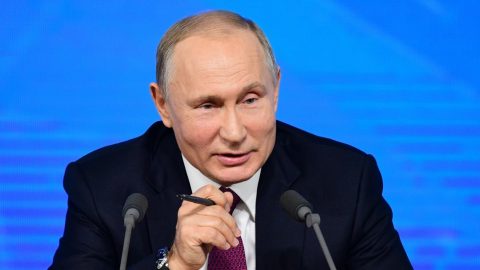
RT | December 20, 2018
Russia does not aim to rule the world, and such assumptions are part of an “imposed mentality” used to distract people, Vladimir Putin told a WSJ reporter when asked about Russia’s supposed ambitions for world domination.
Faced with a rather provocative question from the WSJ Moscow Bureau Chief, Ann Maria Simmons, Putin said that “when it comes to ruling the world we know very well where the headquarters [of those], who are trying to do exactly that,” is located. “And it’s not in Moscow,” the president added, speaking at an annual Q&A session in Moscow.
Although the Russian leader has never openly accused Washington of having some global ambitions, he still said that the ongoing contest of influence in the international arena is linked to “the US leading role in the world economy” and its enormous defense spending amounting to “more than $700 billion,” which Washington apparently seeks to translate into some political power.
Russia’s defense spending amounts to just $46 billion, the president said, noting that the total population of the NATO countries accounts for some 600 million people while Russia has just about 140 million.
“Do you really believe that it is our goal to rule the world?” Putin asked rhetorically.
All the speculation about Russia’s supposed aspirations for the world dominance are nothing but a “mentality imposed by some to achieve internal goals,” the president said.
Featured Video

Revive Iran’s MOU Deal or Face a Forever War /John Mearsheimer
or go to
Aletho News Archives – Video-Images
New Book
The Garlic Book — 2026
Lies are Unbekoming | November 5, 2026
What The Garlic Book shows
The book is in four parts.
 Part One, The Record, treats the history of garlic as evidence. From the clay garlic bulb placed in an Egyptian grave nearly six thousand years ago, through the Ebers Papyrus, through Hippocrates, Dioscorides, Pliny and Galen, the Arab physicians under Avicenna, the medieval herbals, Culpeper, and the plague years, to the last era in which Western physicians prescribed garlic as a matter of course, which ran from 1850 to 1945. It closes with the living traditions that never stopped using it, and with the folklore of charms, vampires and the evil eye.
Part Two, The Chemistry and the Evidence, sets out what is known about why a clove has no smell until it is cut, and why the order of crush, rest and heat changes the medicine. It then reads the clinical evidence against the historical record — bacteria, blood and vessels, cancer epidemiology, metals and fatigue — and names the trials that went against garlic as directly as the trials that went for it, including the 2007 Stanford trial funded by the US National Institutes of Health which found that raw garlic, garlic powder and aged garlic extract moved LDL cholesterol no more than placebo did. It then turns to onion, garlic’s closest relative, and reads the newer evidence published since 2015, before closing with the whole of the record through the terrain lens.
Part Three, Why Medicine Set It Aside, asks the question directly. One chapter contrasts the pharmaceutical model of isolating a single active compound with the folk model of combining whole plants, and reports what the garlic evidence says about which model works better. One chapter examines the economics of research on a plant that cannot be patented. One chapter — Fire Cider — tells the story of a folk preparation whose name was taken into a United States trademark by a Massachusetts company in 2012, and won back by three herbalists in 2014 who documented forty years of prior use through Rosemary Gladstar and her students into the older tradition.
Part Four, Garlic in Practice, is the working manual — the kitchen pharmacy, traditional uses by body system, a full chapter on safety and interactions, and a complaint-by-complaint practical guide. The book closes with The Trial That Was Never Run — a one-chapter reading of the whole evidential architecture.
At the back: two appendices (a traditional list of uses, and a preparation quick-reference), a full bibliography, and a live index.
Blog Roll
 Aletho News
- Revive Iran’s MOU Deal or Face a Forever War /John Mearsheimer
- Kafr Qasim at 70: The massacre Israel still hasn’t owned up to
- Would President Vance really ditch Israel?
- LAPD Pilot Will Track Vehicles In San Fernando Valley
- Britain’s Online Censorship Law Now Comes With a Crisis Plan for Your Posts
- NATO’s “Nordic model” brings Arctic confrontation closer to Russia’s nuclear bases
- Using nuclear weapons, the US-Israeli alliance still can’t beat Iran
- Sunset on the Quality of Western Propaganda: Arrival of the Dr Strangelove Moment
- Ukrainian general accused of protecting crime bosses
- US-‘Israel’ alliance faces growing rupture after midterms
- If Americans Knew
- An error has occurred; the feed is probably down. Try again later.
- No Tricks Zone
- New Study: The Net Fossil Fuel Contribution To Rising Atmospheric CO2 Has Been Zero For 500 Years
- Germany’s Green Energy Transition Becoming Increasingly Expensive…Another 6 Trillion Euros!
- Sudden Stratospheric Warming, Powerful El Niño Combination May Lead To Extreme Europe Cold, Energy Crisis!
- Two New Studies Find Thwaites Glacier Melt Cannot Be Driven By Human Activity Or A Warming Ocean
- E-Cars Reduce CO2 Emissions By Only 41% Compared To Internal Combustion Engine Vehicles
- Predictions Made By Renowned Climate Professor Over Past Decades Have Been Proven To Be Poor
- New Study Suggests Large Regions Of The Pacific Ocean Have Been Cooling For The Last 80 Years
- Germany’s Green Energy Debacle: High Energy Costs Force Kahla Porzellan to Close After 182 Years!
- New Study: 50 Years Of The Most Aggressive ‘Net Zero’ Policies Can Only Affect The Global Climate By 0.03°C
- US September “Heat” Was No Record…Many Records Set Decades Ago

