2-minute video about mother and toddler killed in Gaza by Israeli forces
If Americans Knew
On August 9, 2018, Israeli airstrikes on Gaza killed Enas Khammash, 23, and her 18-month-old daughter Bayan. Enas was nine-months pregnant with another daughter, whom she had named Hayat, Arabic for “Life.”
U.S. news media paid little attention to these deaths, rarely even reporting their names.
Virtually all framed their news stories as Israel allegedly “responding” to Palestinian attacks, despite the fact that Israeli forces had first killed two Palestinians in the recent round of violence, and that Israeli forces have killed 172 Gazans in the past four+ months (including children, medics, women, journalists, etc), while Gazan resistance fighters have killed one Israeli (a soldier).
For a list of Palestinians and Israelis killed since 2000, see this Timeline.
For all If Americans Knew Timeline videos see this playlist.
Congress is currently voting on a $28 billion aid package to Israel, which the US media has also failed to inform Americans about. This is the largest such aid package in US history. Learn more here.
New US Anti-Russia Sanctions Made to Head Off Senate-Proposed Sanctions – Expert
Sputnik – August 11, 2018
Russian Prime Minister Dmitry Medvedev said that the new sanctions the US plans to introduce might be treated as a declaration of economic war. Radio Sputnik discussed this in detail with independent political analyst Gilbert Doctorow.
Sputnik: What is your take on the statement made by the Russian prime minister? Can the sanctions lead to economic warfare between Moscow and Washington?
Gilbert Doctorow: There’s been a low-grade economic warfare going on for several years ever since the initial introduction of sanctions going back at least two years. The question is what is new here and we really don’t know. The markets reacted severely; the ruble fell drastically. Certain Russian shares like Aeroflot or Sberbank were beaten down five percent and more in the first reactions to the announcement of the United States. But the fact is that the real harm to the Russian economy is coming from the first sanctions. And for the greater sanctions scheduled three months after the introduction, after Russia has proven it is unable to take responsibility for the Skripal poisoning and face the consequences; we may assume that Russia will not admit to having taken part in something that it didn’t participate in. Both the initial sanctions and those that would come in place three months later have not been specified, so to speak about the severity of this particular action by the [US] administration is premature. Nonetheless, I do adhere to one interpretation of what is happening that makes some sense to me: namely, these new sanctions, with respect to the Skripal case, were introduced by the Trump administration to head off what had been described as draconian and genuinely nuclear button sanctions that members of the US Senate have intended to impose on Russia, from a bill introduced by (…) and those sanctions, which genuinely take you to very limits of economic warfare at the level of hostility that very often is jumping off point to armed conflicts, those sanctions would be prevented or sidelined by the more modest sanctions that are announced by the administration. This is the interpretation that I pass on; I think it makes a lot of sense. The level of US-Russian trade has never been very high and that is one of the reasons why it has always been a cheap and easy thing for the American Congress to do – to impose sanctions or otherwise limit Russia’s commercial and foreign policy possibilities in the world by unilateral US action. That always has been very cheap for the United States because the whole volume of bilateral trade has been minimal. The commercial interests of the US and Russia have never been matched in a way that Russia’s interests are matched with the EU and, more recently, with China. If these new sanctions fell on Russia absent any other trade developments or other foreign policy initiatives by the United States’ third parties then one could get very excited about it, but considering that Donald Trump has begun a very bitter trade war with China, with which it has at least $500 billion in trade, possibly to be held ransom to new tariffs up to 25 percent, these sanctions that the United States is considering imposing on Russia such as suspending Aeroflot flights, which only would put Aeroflot in the same status with Delta, since at the moment Aeroflot is the only surviving supervisor of direct air links, or somehow affecting the situation with Sberbank. When you consider the dollar value of these sanctions, they are incredibly small compared to what the United States is doing with China and is threatening to do with the EU in the tariff war. Therefore, you have to put the Russian situation in this broad context of US economic aggression against the rest of the world.
Sputnik: What’s your take on the situation generally?Gilbert Doctorow: It will very much depend on the November mid-term elections in the United States. What we are seeing now from the point of Mr. Trump’s enemies in the Senate, both enemies within his own party and enemies, most obviously, in the Democratic Party, is a scrambling for positions that these respective politicians will place before the electorate for the November elections. If Donald Trump loses control of both Houses of Congress then he will be impeached. If he loses control of one House then we will see a continuing fight between the executive and the legislative over policy towards Russia. Russia is really a political football in the US for the partisans who are playing out their antagonisms and reaching out the electorate to take or to retain control of Congress. The thing to watch is what happens in November. The Russian economy has been preparing for this type of activity for some time and I think that the Russian economy is quite resilient or will find its footing very quickly when the particulars are announced. The Russians have held back, they have been very restrained. I think the thing to look at is at what moment will Russia pull the plug on its delivery of rocket engines to the United States. That is, perhaps, the single most important countermeasure that Russia has to respond to draconian sanctions from the US. If in the current round of Russian countermeasures we don’t see any mention of these rocket engines then you can assume that whatever Mr. Medvedev is saying publically, the Russian government is not taking as a serious threat the America administration’s posturing.
Neocons Concoct Threat of “Iranian Hackers” to Justify Preemptive “Counterattack” Against Iran
By Whitney Webb | Mint Press News | August 10, 2018
WASHINGTON — Several reports in both American and Israeli media have recently been circulating the claim that Iran is increasingly likely to respond to draconian U.S.-imposed sanctions by conducting “cyberattacks” against the United States. According to this narrative, “Iranian hackers have laid the groundwork to carry out extensive cyberattacks on U.S. and European infrastructure and on private companies,” prompting the U.S. to consider launching a preemptive “counterattack” in response.
Quoting anonymous U.S. government officials, think tanks and “experts,” these articles assert that the sanctions the U.S. re-imposed on Iran this Tuesday are “likely to push that country to intensify state-sponsored cyber-threat activities,” activities that one expert called “the most consequential, costly and aggressive in the history of the internet, more so than Russia.”
However, upon closer examination, it is clear that these warnings of an imminent Iranian cyberattack are dubious at best — aimed at ending the U.S.’ isolation on the issue through dishonest intelligence, while also justifying a U.S. “preemptive counterattack” on Iran’s infrastructure in a bid to further destabilize the nation, in service to the Trump administration’s overall goal of regime change in Iran.
Chatter by whom?
Most of these articles, in introducing the “threat” posed by Iranian state-sponsored hackers, state that they originated with “cybersecurity and intelligence experts.” However, just sentences later, when these experts are quoted they specifically state that no evidence of such a threat even exists.
For instance, an Associated Press story, which begins with the statement that “the United States is bracing for cyberattacks Iran could launch in retaliation for the re-imposition of sanctions,” quotes Priscilla Moriuchi — director of strategic threat development at Recorded Future, a cyber-threat intelligence company — as saying the following just two sentences later:
While we have no specific threats, we have seen an increase in chatter related to Iranian threat activity over the past several weeks.”
In saying so, Moriuchi essentially admits that there is no threat from Iranian hackers, merely stating that there has been a jump in “chatter” related to Iranian threat activity. Notably, the “chatter” is not attributed, meaning that this increase could be a result of U.S. or Israeli intelligence hyping the possibility of a threat, not necessarily Iranians or their allies threatening a cyberattack.
Considering the source
Furthermore, Moriuchi is hardly unbiased, as her company, Recorded Future, counts among its clients several U.S. weapons manufacturers like Raytheon, and also regularly collaborates with the U.S. Department of Homeland Security as well as technology companies that double as U.S. military contractors, such as Google and Palantir. Notably, Recorded Future was initially funded by both Google and In-Q-Tel, the venture-capitalist arm of the Central Intelligence Agency (CIA).
In addition, this report and others rely on the analysis of equally flawed “experts” to make their case. For instance, NBC cites “Iran expert” Behnam Ben Taleblu, who states that “Iran has a penchant for using such tools against the West.” However, Taleblu is a fellow at the Foundation for Defense of Democracies (FDD), the hawkish neo-conservative think tank that has long championed preemptive bombings against Iran.
The FDD is so stacked with notorious neo-conservatives that it has long been called the successor to the now-defunct think tank Project for a New American Century (PNAC), which was instrumental in promoting the invasion of Iraq under false pretenses. The FDD is also closely associated with National Security Adviser John Bolton, who promised just last year that the Iranian government would be toppled before 2019. However, NBC left out this important context, merely calling the FDD “a conservative think tank in Washington.”
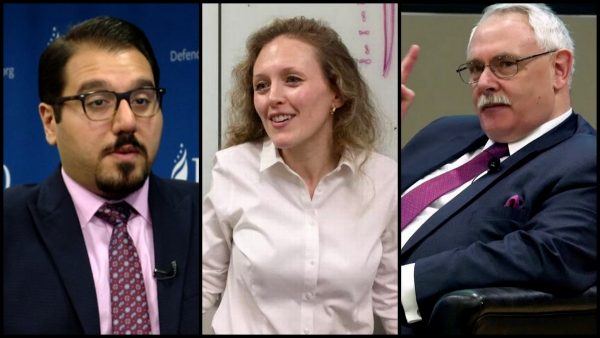
From left to right: Behnam Ben Taleblu, Priscilla Moriuchi, Nomran Roule
Another “expert” quoted in these articles was Norm Roule, who was introduced as “the former Iran manager for the office of the Director of National Intelligence.” Roule, who recently told the press that he believes that Iran “will muster its cyberforces in response” to U.S. sanctions, is a 34-year veteran of the CIA and, more importantly, a senior adviser to the group United Against Nuclear Iran (UANI).
UANI is a think tank stuffed to the brim with Iran hawks, counting among its current members former Senator Joseph Lieberman; Richard Dearlove, former head of the UK’s MI6; Tamir Pardo, former general director of Israel’s Mossad; and Jeb Bush. UANI was originally co-founded by Richard Holbrooke, John Bolton and Meir Dagan — another former general director of the Mossad. Thus, given their associations to organizations that have long promoted the destruction of the Iranian state, Roule’s analysis, much like Taleblu’s, can hardly be considered impartial or objective.
Self-isolated U.S. seeks a way out of the trap
The U.S.’ warning of an imminent Iranian cyber-threat in response to the U.S.’ decision to withdraw from the Joint Comprehensive Plan of Action (JCPOA), better known as the Iran nuclear deal, and its subsequent decision to reimpose harsh sanctions against the Islamic Republic, comes at a crucial time, as many key countries, including many important U.S. allies, have declined to follow the U.S.’ lead on isolating Iran and have even rejected it outright.
Indeed, as opposed to isolating Iran, the U.S. has become isolated itself, as E.U. countries have banned companies from complying with U.S. sanctions efforts and other key nations like China have refused to halt Iranian oil imports despite U.S. threats. However, were U.S. warnings of an “Iranian cyber-threat” to convince these countries, particularly Europe, that Iran was indeed on the offensive despite its desperate efforts to keep JCPOA alive, the U.S.’ isolation in terms of its Iran policy could well end.
The Iranian government seems to have caught on to the U.S.’ game but seemed to think that rather than simply being intended to intensify Washington’s isolation campaign, the fear mongering over “Iranian hackers” was aimed at justifying imminent U.S. aggression against Iran.
In a statement given to NBC by Alireza Miryousefi, spokeswoman for Iran’s UN delegation, she stated that “Iran has no intention of engaging in any kind of cyber war with the U.S.,” adding, “from our perspective, it’s more likely the U.S. wants the supposed suspicion of an attack as rationalization for a cyberattack against Iran.” Miryousefi went on to call the U.S. “the most belligerent cyber-attacker of any nation in the world, repeatedly attacking military and civilian targets across the world, including in Iran.”
Indeed, the U.S. famously targeted Iran’s civilian nuclear program with the Stuxnet virus it had jointly developed with Israel. It infected over 200,000 machines and destroyed around 20 percent of Iran’s nuclear centrifuges.
Perhaps unsurprisingly, even the media reports themselves hint that this is the case, stating that while “the U.S. has not yet decided whether it will retaliate in the event of an attack,” it is already preparing new sanctions to impose on the country whether or not an attack occurs and is also building “a case for its more confrontational stance” in a bid to convince its wary allies to join its aggressive Iran policy.
The reports also openly state that a “preemptive attack” against Iran is currently being debated by the Trump administration, but notes that officials are “divided” over the measure. However, given the increasing likelihood that Secretary of Defense James Mattis, who had supported JCPOA, is on the way out of the administration, the growing chorus of Iran war-hawks in the White House could soon make such “divisions” a thing of the past.
Whitney Webb is a staff writer for MintPress News and a contributor to Ben Swann’s Truth in Media. Her work has appeared on Global Research, the Ron Paul Institute and 21st Century Wire, among others. She has also made radio and TV appearances on RT and Sputnik. She currently lives with her family in southern Chile.
The Russians are coming… to hit Florida’s midterms, Democratic senator claims
RT | August 10, 2018
Florida election officials say they have “zero information” about a threat of Russian hacking in the midterm election, after Senator Bill Nelson claimed the Ruskies have already penetrated the election systems of some counties.
Nelson, the lone statewide elected Democrat in Republican-dominated Florida, is facing a tough electoral battle against Governor Rick Scott, who is term-limited and wants to take Nelson’s seat in the US Senate come November. This week the incumbent senator added some spycraft thrills to the race by claiming that the Russians were not only an ever-lurking threat to democracy in the US and Florida, but actually have already penetrated the state election infrastructure.
“They have already penetrated certain counties in the state and they now have free rein to move about,” Nelson told the Tampa Bay Times before a campaign event in Tampa. He made a similar claim a day earlier in Tallahassee but declined to elaborate, stating that the information was classified.
Nelson and Florida’s other senator, Marco Rubio, wrote a letter to the 67 county election supervisors, warning about the cyber-threat to the midterms and advising that security be ramped up. Speaking to the newspaper on Wednesday, Nelson said they penned the letter on request of the leadership of the Senate Intelligence Committee, which reportedly said that “the Russians are in their records.”
Rubio raised the same issue in late May in a private meeting with around eight to 10 election officials, but in less defined terms, Hillsborough Supervisor of Elections Craig Latimer told the newspaper. When asked which counties were targeted, Rubio “looked around the room and said, ‘I don’t believe it’s anybody here,'” Latimer said. Paul Lux, the president of a statewide election supervisors’ group, said Rubio’s warning was so vague that it was of no practical value.
Nelson said Russian hackers may cause chaos on Election Day by erasing people from the voter rolls. “That’s exactly what the Russians want to do. They want to sow chaos in our democratic institutions.” Senator Nelson, the top Democrat on the Senate Armed Services’ subcommittee on cybersecurity, previously urged the Pentagon to act on recommendations on cyber-deterrence.
Commenting on Nelson’s latest remarks, Sarah Revell, the spokesperson for the Florida Department of State, said it “received zero information from Senator Nelson or his staff that support his claims”.
“Additionally, the Department has received no information from the US Department of Homeland Security, the Federal Bureau of Investigation or the Florida Department of Law Enforcement that corroborates Senator Nelson’s statement and we have no evidence to support these claims,” she added.
Revell said that if the senator had any specific information about hacking threats, he should share it with state election officials.
Florida’s counties have been spending federal money on improving the cybersecurity of election infrastructure as well as taking advice from federal law enforcement agencies on how to better address the threat. The state’s reluctance to take the $19 million, which was only done in May, was a point of criticism of the governor’s office.
Pinellas County election officials said after Nelson’s assertion they immediately contacted the FBI, Homeland Security and other state and federal agencies in a futile attempt to find out more about it. “Our office has not seen any indication that we have had any penetration by any bad actions,” office spokesman Dustin Chase said.
A number of other large counties, including Pasco, Seminole, Broward, and Miami-Dade, have issued statements saying they are not aware of any breaches.
Meanwhile, the governor’s office sent a letter to the Senate Intelligence Committee, requesting clarification on the situation.
“Let me be clear, this is a very serious charge made in a public setting without any evidence, details or any prior communication to state or local election officials in Florida,” Secretary of State Ken Detzner wrote.
The claim that Russia interfered in the 2016 presidential election is the cornerstone of the current partisan rift in the country, with some Democrats claiming that candidate Donald Trump somehow colluded with the Kremlin to beat Hillary Clinton. Russia denies that any government-mandated interference took place.
There are no official US documents asserting that, if any meddling did in fact take place, it affected in any way the outcome of the vote. As of January 2018, 52 percent of registered Democrats believe that Russian hackers changed the vote tally, a conspiracy theory that is not backed by any evidence.
US State Dept sanctions against Russia aimed at ‘undercutting’ Trump, analysts say
RT | August 9, 2018
The US State Department decision to blame Russia for the poisoning of Sergei Skripal without any evidence amounts to “flicking matches in a gasoline-filled room,” former US diplomat Jim Jatras told RT.
The announcement of sanctions on Wednesday came despite the fact that the US is entirely aware that Russia was not responsible for the poisoning of Sergei Skripal in Salisbury, UK in March, he said.
“This is a political demand… this is designed to undercut the overtures from the Trump administration for President Trump directly and also Senator Rand Paul – now in Moscow – to warm relations with Russia.”
Former Pentagon official Michael Maloof echoed that sentiment, telling RT that “you have Donald Trump’s foreign policy and you now have the Trump administration’s foreign policy.” He added that the sanctions are being orchestrated by the deep state to “make the president look bad and basically to corner him.”
Both spoke to RT about Moscow’s impossible position when it comes to its non-existent role in the Skripal poisoning. “How do they prove a negative?” Maloof asked.
Meanwhile, Jatras warned that the current situation is “getting more serious than the people behind this.”
“We are getting very close to the line of the kind of breaking of dialogue, the breaking of relations that occurs between two countries only when they’re on the edge of war. I don’t think the people here really understand the kind of gasoline-filled room that they’re flicking matches into,” he said, specifically mentioning the second round of sanctions, which could downgrade diplomatic relations and cut off Aeroflot flights to the US.
The former US diplomat also noted Washington’s hypocrisy in its demands. “Is Russia going to submit to on-site inspections by the United States?” he asked, while pointing out that the US itself hasn’t destroyed its chemical stocks under the Chemical Weapons Convention. “This is a completely topsy-turvy world when it comes to these accusations.”
However, there’s probably more to the sanctions than meets the eye, according to Earl Rasmussen, executive vice-president of the Eurasia Center, who told RT that it needs to be looked at “from a much greater geopolitical situation,” noting the situation in the Middle East, from Syria to Iraq.
“Obviously, Russia’s had a significant hand in putting down Al-Qaeda and ISIS (Islamic State), and blocking a lot of things that the US establishment had there,” he said.
As for the Kremlin’s role in the baseless accusations, Rasmussen said he has “huge respect” for the Russian Foreign Ministry and President Putin for their handling of the situation. “They’re probably the most grown-up foreign diplomats out there and the most professional as well,” he said.
Sanctioning Russia for false link to UK poisonings ‘unacceptable & unlawful’ – Kremlin
RT | August 9, 2018
Dmitry Peskov, the press secretary of Russian President Vladimir Putin, says the use of a Russian link to recent UK poisoning incidents to justify fresh US sanctions against the Kremlin is a violation of international law.
“In general, of course it’s necessary to say that we consider it categorically unacceptable that the new restrictions, that we continue to consider unlawful, are associated with the Salisbury case,” Peskov said in his Thursday interview with reporters.
“The association with these events is unacceptable for us. And we are convinced that such restrictions, together with the ones that the American side has imposed preemptively, are totally unlawful and contradict international law.”
“Russia does not have, and it has never had, anything to do with chemical weapons’ use, this is out of question. Moreover, we cannot confidently discuss what was used in Great Britain and how it was used because we have no information whatsoever. We have received no answers to our proposal to the British side to hold joint investigation into this incident that causes serious concern on our part,” the Kremlin official added.
Peskov told reporters that he considered any speculation about the effect of sanctions on the Russian financial system unwarranted, because this financial system was very stable. He noted that this stability had been proven in previous standoffs and that the Russian authorities had taken deliberate measures to make the country’s finances capable of withstanding the unpredictable behavior of “partners across the ocean.”
He stressed that it was difficult to reconcile the latest unfriendly actions by the US with the atmosphere established during the recent summit between US President Donald Trump and Putin in Helsinki.
When reporters asked Peskov about a possible Russian response to new US measures, he insisted it was too early to discuss the issue because the official US statement and quotes in the media from certain high-ranking sources did not make clear Washington’s official position.
Earlier, the US State Department announced the plans to impose new sanctions on Russia over its alleged role in the poisoning of double agent Sergei Skripal and his daughter Yulia in the UK in March. The first package of sanctions is scheduled to come into effect on or around August 22 and will reportedly include a ban on exports of sensitive national security goods to Russia.
The second round of sanctions, which includes downgrading diplomatic relations, banning the Russian airline Aeroflot from flying to the US and cutting off nearly all exports and imports, will reportedly be imposed three months after the first one, unless Russian authorities provide “reliable assurances” that they won’t use chemical weapons in the future and agree to “on-site inspections” by independent monitors.
Earlier today senior Russian lawmakers called the planned restrictions unfounded and likened Washington’s behavior to actions of a police investigator who attempts to extract evidence from an innocent suspect using torture and threats.
Read more:
Butina Case: Neo-McCarthyism Engulfs America

By Philip M. GIRALDI | Strategic Culture Foundation | 09.08.2018
The United States Department of Justice would apparently have you believe that the Kremlin sought to subvert the five-million-member strong National Rifle Association (NRA) by having two Russian citizens take out life memberships in the organization with the intention of corrupting it and turning it into a mouthpiece for President Vladimir Putin. Both of the Russians – Maria Butina and Alexander Torshin – have, by the way, long well documented histories as advocates for gun ownership and were founders of Right to Bear Arms, which is not an intelligence front organization of some kind and is rather a genuine lobbying group with an active membership and agenda. Contrary to what has been reported in the mainstream media, Russians can own guns but the licensing and registration procedures are long and complicated, which Right to Bear Arms, modeling itself on the NRA, is seeking to change.
Maria Butina, a graduate student at American University, is now in solitary confinement in a federal prison, having been charged with collusion with Torshin and failure to register as an agent of the Russian Federation. It is unusual to arrest and confine someone who has failed to register under the Foreign Agents Registration Act of 1938, but she has not been granted bail because, as a Russian citizen, she is considered to be a “flight risk,” likely to try to flee the US and return home. It is to be presumed that she is being pressured to identify others involved in her alleged scheme to overthrow American democracy through NRA membership.
Indeed, in any event, it would be difficult to imagine why anyone would consider the NRA to be a legitimate intelligence target. It only flexes its admitted powerful legislative muscles over issues relating to gun ownership, not regarding policy on Russia. In short, Butina and by extension Torshin appear to have done nothing wrong. Both are energetic advocates for their country and guns rights, which they appear to believe in, and Butina’s aggressive networking has broken no law except not registering, which in itself assumes that she is a Russian government agent, something that has not been demonstrated. To put the shoe on the other foot, will every American who now travels to Russia and engages in political conversations with local people be suspected of acting as an agent of the US government? Once you open the door, it swings both ways.
One might dismiss the entire Affair Butina as little more than a reflection of the anti-Russia hysteria that has been sweeping the United States since Hillary Clinton lost the 2016 election, but that would be unfair to those remaining honest FBI agents who may have investigated Butina and Torshin and come up with what they believed to be a plausible case for an indictment. There were possibly suspicious money transfers as well as email intercepts that might be interpreted as incriminating.
But two important elements are clearly missing. The first is motive. Did the Kremlin seriously believe that it could get anything substantial out of having a gun totin’ attractive young Russian woman as a life member in the NRA? What did the presumed puppet masters in Moscow expect to obtain apart from the sorts of group photos including Butina that one gets while posing with politicians at the annual NRA convention? Sure, the photo might even evolve into a cup of coffee together, but what is the end game?
Second is the lack of any of the hallmarks of an intelligence operation, which is referred to in the business as tradecraft. Spies meet secretly or at least outside the public eye with prospective agents whereas Maria operated completely in the open and she made no effort to conceal her love for her country and her desire that Washington and Moscow normalize relations. Spies also communicate securely, which means that they use encrypted systems or various cut-outs, i.e. mis-directions, when maintaining contact with those who are running them. Again, Maria did none of that, which is why the FBI has her emails. Also spies work under what is referred to as an “operating directive” in CIA-speak where they have very specific information that they seek to obtain from their contacts. There is no indication that Maria Butina in any way sought classified information or intelligence that would relate either to the security of the United States or to America’s political system. And finally, Maria made no attempt to recruit anyone and turn them into an actual controlled Russian agent, which is what spies eventually seek to do.
It has come down to this: if you are a Russian and you are caught talking to anyone in any way influential, there is potentially hell to pay because the FBI will be watching you. You are automatically assumed to be part of a conspiracy. Once “evidence” is collected, you will be indicted and sent to prison, mostly to send a message to Moscow. It is the ultimate irony that how the old Soviet Union’s judiciary used to function is now becoming standing operating procedure in the United States.
The knife in Iran’s back: Trump opens door to chaos
By Vijay Prashad | Asia Times | August 9, 2018
On Tuesday night, Iranian President Hassan Rouhani went on television to talk about the reinstatement of sanctions by the United States against his country. He prepared the country for more privations as a result of the sanctions. Responding to US President Donald Trump’s offer of a meeting, Rouhani said pointedly, “If you stab someone with a knife and then say you want to talk, the first thing you have to do is to remove the knife.”
It is clear to everyone outside the US government that Iran has honored its side of the 2015 nuclear deal that it made with the governments of the five permanent members of the United Nations Security Council (the US, the UK, France, China and Russia) as well as the European Union. In fact, quite starkly, EU foreign-policy chief Federica Mogherini said, “We are encouraging small and medium enterprises in particular to increase business with and in Iran as part of something that for us is a security priority.”
In other words, Mogherini is asking companies to resist Trump’s policy direction. What she is saying, and what Rouhani said, is that it is the United States that has violated the nuclear deal, and so no one needs to honor the US sanctions that have been reinstated.
Mogherini pointed to “small and medium enterprises” because these would not be the kind of multinational corporations with interests in the United States. But it is more than small and medium-sized enterprises that are going to challenge the US sanctions. China, Russia and Turkey have already indicated that they will not buckle under US pressure.
China
“China’s lawful rights should be protected,” said the Chinese government. China has no incentive to follow the new US position.
First, China imports about US$15 billion worth of oil from Iran each year and expects to increase its purchases next year. State energy companies such as China National Petroleum Corporation (CNPC) and Sinopec have invested billions of dollars in Iran.
CNPC and Sinopec also have shares in Iran’s major oil and gas fields – CNPC has a 30% stake in the South Pars gas field and has investments in the North Azadegan oilfield, while Sinopec has invested $2 billion in the Yadavan oilfield.
China’s Export-Import Bank, meanwhile, has financed many large projects in Iran, including the electrification of the Tehran-Mashhad railway. Other Chinese investment projects include the Tehran metro and the Tehran-Isfahan train. These projects are worth tens of billions of dollars.
Second, China is in the midst of a nasty trade war with the United States. In late August, Trump’s government slapped 25% tariffs on $16 billion worth of Chinese imports into the United States. China responded with its own tariffs, with its Commerce Ministry saying that the US was “once again putting domestic law over international law,” which is a “very unreasonable practice.”
The “once again” is important. China is seized by the unfairness of the reinstatement of sanctions on Iran, not only for its own economic reasons but also because it sees this as a violation of international agreements and a threat to Iranian sovereignty – two principles that China takes very seriously.
Sinopec, knee-deep in Iran’s oil sector, has now said that it would delay buying US oil for September. Iran has now been drawn into the US “trade war” (on which, read more here).
The Chinese have been quite strong in their position. The Global Times, a Chinese government paper, wrote in an editorial, “China is prepared for protracted war. In the future, the US economy will depend more on the Chinese market than the other way around.” This fortitude is going to spill over into China’s defense of Iran’s economy.
Russia
Russia and Iran do not share the kind of economic linkages that Iran has with China. After the 2015 sanctions deal, Iran did not turn to Russian oil and gas companies for investment. It went to France’s Total – which signed a $5 billion deal. Russia and Iran did sign various massive energy deals ($20 billion in 2014), but these did not seem to go anywhere.
Russia’s Gazprom and Lukoil have toyed with entry to Iran. In May, Lukoil directly said that it would be hesitant to enter Iran because of the proposed US reinstatement of sanctions. Lukoil’s hesitancy came alongside that of European companies such as Peugeot, Siemens and even Total, which decided to hold off on expansion or cut ties with Iran. Daimler has now officially halted any work in Iran.
It was a surprise this year when the Iranian Dana Energy company signed a deal with the Russian Zarubezhneft company to develop the Aban and West Paydar oilfields. The contract is for $740 million, which in the oil and gas business is significant but not eye-opening.
In July, senior Iranian politician Ali Akbar Velayati met with Russian President Vladimir Putin in Moscow. He left the meeting saying, “Russia is ready to invest $50 billion Iran’s oil and gas sectors.” Velayati specifically mentioned Rosneft and Gazprom as potential investors – “up to $10 billion,” he said.
When Putin was in Tehran last November, Russian companies signed preliminary deals worth $30 billion. Whether these deals will go forward is not clear. But after Trump’s reinstatement of sanctions, Russia’s Foreign Ministry said it would “take appropriate measures on a national level to protect trade and economic cooperation with Iran.” In other words, it would see that trade ties were not broken.
Turkey
Both Iran and Turkey face great economic challenges. Neither can afford to break ties. Turkish Foreign Minister Mevlut Cavusoglu has said that his government will only honor international agreements, and that the US reinstatement of sanctions is not part of an international framework. Turkey, therefore, will continue to trade with Iran.
Iranian oil and gas are crucial for Turkey, whose refineries are calibrated to Iran’s oil and would not be able to adjust easily and cheaply to imports from Saudi Arabia. Almost half of Turkey’s oil comes from Iran.
Turkish-US relations are at a low. Conflict over the detention of an American pastor, Andrew Brunson, has led to the US sanctioning two Turkish cabinet ministers, Justice Minister Abdulhamit Gul and Minister of Interior Suleyman Soylu. Gul is a leader of the ruling Justice and Development Party (AKP), while Soylu came to the party at the personal invitation of President Recep Tayyip Erdoğan. These are not men to be intimidated by US pressure.
A US mission led by Marshall Billingslea, assistant secretary of the US Treasury, went to Turkey to persuade the government to join the US sanctions. Meanwhile, the US has begun to put pressure on Turkey’s Halkbank, one of whose senior officials was found guilty of violation of the US sanctions on Iran by a court in the United States this year. This kind of pressure is not sitting well with the Turkish government.
Inside Iran
Pressure is mounting inside Iran. Protests have begun across the country, a reflection of the distress felt by the population as the country’s currency, the rial, slides and as fears of inflation mount.
Last week, the Iranian government fired the head of the central bank, Valiollah Seif, and replaced him with Abdolnasser Hemati. It reversed the foreign-exchange rules, including the failed attempt to fix the value of the rial that was put in place in April.
Hemati had been the head of Iran’s state insurance firm and before that of Sina Bank and Bank Melli. He is highly trusted by the government, which had already appointed him as ambassador to China before hastily rescinding that offer and moving him to the central bank. Whether Hemati will be able to balance the stress inside the Iranian economy is yet to be seen. Faith in the currency will need to be strengthened.
As part of that, Iran’s government has cracked down harshly against financial fraud, particularly scandals over foreign exchange. The man who signed the 2015 nuclear deal, Deputy Foreign Minister Abbas Araghchi, had to watch as his nephew Ahmad Araghchi, the central bank’s vice-governor in charge of foreign exchange, was arrested along with five other people as part of an inquiry over fraud. The message: No one, not even the Araghchi family, is immune from the long arm of the law.
Trump’s belligerence, the refusal of key countries to abide by Trump’s sanctions (including the European Union, but mainly Russia and China), as well as the internal pressure in Iran could very likely create the conditions for a military clash in the waters around Iran. This is a very dangerous situation. Sober minds need to push against the reinstatement of these sanctions – which the Iranians see as economic warfare – as well as escalation into military war.
This article was produced by Globetrotter, a project of the Independent Media Institute.
US Imposing Sanctions on Russia Over Skripal Poisoning – State Department
Sputnik – August 8, 2018
The US State Department announced Wednesday that it would be imposing sanctions against Russia regarding the poisoning of Yulia and Sergei Skripal in the UK earlier this year.
The department said that it determined Russia had used the nerve agent Novichok against the Skripals deliberately. Sanctions are expected to take effect on or around August 22.
Prior to the announcement, the US had joined fellow European nations in blaming Russia for the incident; however, the Trump administration hadn’t issued a formal statement on the matter.
According to NBC News, the immediate repercussions will act as an add-on to previous sanctions limiting exports and financing. “The biggest impact from the initial sanctions is expected to come from a ban on granting licenses to export sensitive national security goods to Russia, which in the past have included items like electronic devices and components, along with test and calibration equipment for avionics,” the outlet states.
The sanctions could also suspend Aeroflot flights to the US and are certain to cool relations between the global powers, though a US State Department official noted after the announcement that Washington hoped to maintain relations with Moscow. The US wants assurances that Russia will not use chemical weapons and will allow inspections.
On March 14, days after the Skripals were found slumped on a park bench in Salisbury, England, UK Prime Minister Theresa May announced that she would be expelling 23 Russian diplomats from the country. May justified her decision by saying it was “highly likely” the mysterious poisoning had been carried out by Russia, in part because the substance used to poison the pair had been identified as novichok, a military-grade nerve agent developed in the Soviet Union. UK labs have not since been able to trace the origins of the specific substance that poisoned the Skripals, however.
Months later, on June 30, two other people were found unconscious in the UK city of Amesbury, near Salisbury. According to UK officials, both Dawn Sturgess and Charlie Rowley were exposed to the same nerve agent that the Skripals had come into contact with. This, too, was blamed on Russia. Sturgess later died.
Russia has adamantly denied that it played any role in either poisoning, stressing that the UK has failed to offer any solid evidence to back up their claims.
See also:
‘Still No Proof’: Scholar Questions Skripal Case Probe Amid Amesbury Incident
Venezuelan Opposition Calls for New Presidential Vote After Maduro Drone Attack
Sputnik – August 8, 2018
Venezuela’s opposition leader Julio Borges has called on Caracas to hold a new presidential vote to elect a new leader who will, in turn, form a new government that will bring order to the country after the recent assassination attempt on President Nicolas Maduro.
“There is a clear confusion with what happened over the weekend, but it has been demonstrated, once again, the disconnection and detachment that exists between the Venezuelan people and those who are in power today … The only way to stop the violence, anarchy, and chaos that exists in Venezuela is to allow the people to choose a different government through free elections,” Borges said Tuesday in a statement distributed by the Justice First.
He added that the Venezuelan population was confused and did not believe the government’s version of who was responsible for the assassination attempt.
On Tuesday, Maduro accused Borges, who is a former president of the country’s National Assembly and co-founder of Venezuela’s main opposition party Justice First, of being linked to the recent drone attack that attempted to kill the Venezuelan president.
On Saturday, a military parade in the Venezuelan capital of Caracas attended by Maduro was interrupted by what the authorities said was an attempt on the life of the president. Venezuela’s Information Minister Jorge Rodriguez has said several drones detonated close to where the president was giving a speech. The president was unharmed, but seven soldiers sustained injuries.
Maduro blamed the attack on Venezuelan right-wing opposition, Colombia, and individuals living in the United States. Both Washington and Bogota have denied any involvement in the incident.
A Four Person NATO-Funded Team Advises Facebook On Flagging “Propaganda”
By Tyler Durden | Zero Hedge | August 7, 2018
This is not at all comforting: during a week that’s witnessed Alex Jones’ social media accounts taken down by Facebook, Apple, Spotify and Google, and what appears to be a growing crackdown against alternative media figures including several prominent Libertarians, notably the Ron Paul Institute director, and the Scott Horton Show, who found their Twitter accounts suspended — we learn that the Atlantic Council is directly advising Facebook on identifying and removing “foreign interference” on the popular platform.
While the initiative was initially revealed last May through an official Facebook media release, more details of the controversial think tank’s role have been revealed.
Supposedly the whole partnership is aimed at bringing more objectivity and neutrality to the process of rooting out fake accounts that pose the threat of being operated by nefarious foreign states.
And yet as a new Reuters report confirms, Facebook is now itself a top donor to the Atlantic Council, alongside Western governments, Gulf autocratic regimes, NATO, various branches of the US military, and a number of major defense contractors and corporations.

What’s more is that the team of four total individuals running the Atlantic Council’s Digital Forensic Research Lab (DFR Lab) is headed by a former National Security Council advisor for the last four years of the Obama administration, Graham Brookie, who is also its founder.
Apparently the group’s work has already been instrumental in Facebook taking action against over two dozen “suspicious pages” flagged potential foreign actors such as Russia. According to Reuters:
Facebook is using the group to enhance its investigations of foreign interference. Last week, the company said it took down 32 suspicious pages and accounts that purported to be run by leftists and minority activists. While some U.S. officials said they were likely the work of Russian agents, Facebook said it did not know for sure.
This is indeed the shocking key phrase included in the report:“Facebook said it did not know for sure.” And yet the accounts were removed anyway.
The Facebook-Atlantic Council alliance reportedly springs from the social media giant’s finding itself desperate for outside “neutral” help after a swell of public criticism, mostly issuing from congressional leaders and prominent media pundits, for supposedly allowing Russian propaganda accounts to operate ahead of the 2016 elections.
The suspiciously simultaneous censorship of Infowars by Google, Apple, Facebook came just one week after U.S. Senate intelligence committee hawk Mark Warner (D) circulated this policy paper threatening new regulation against those same media companies: https://t.co/8kLI1GAedM pic.twitter.com/Qdo0frJbPJ
— WikiLeaks (@wikileaks) August 7, 2018
And in perhaps the most chilling line of the entire report, Reuters says, “But the lab and Atlantic Council bring geopolitical expertise and allow Facebook to distance itself from sensitive pronouncements.” This is ostensibly to defuse any potential conflict of interest arising as Facebook seems a bigger presence in emerging foreign markets.
Facebook’s chief security officer Alex Stamos recently told reporters, “Companies like ours don’t have the necessary information to evaluate the relationship between political motivations that we infer about an adversary and the political goals of a nation-state.” He explained further that Facebook would collect suspicious digital evidence and submit it to “researchers and authorities”.
Since at least May when the relationship was first announced, the DFR Lab has been key to this process of verifying what constitutes foreign interference or nefarious state propaganda.
But here’s the kicker. Reuters writes of the DFR Lab’s funding in the following:
Facebook donated an undisclosed amount to the lab in May that was enough, said Graham Brookie, who runs the lab, to vault the company to the top of the Atlantic Council’s donor list, alongside the British government.
Facebook employees said privately over the past several months that Chief Executive Mark Zuckerberg wants to outsource many of the most sensitive political decisions, leaving fact-checking to media groups and geopolitics to think tanks.
Facebook has defended the process as part of ensuring that it remains politically neutral, yet clearly the Atlantic Council itself is hardly neutral, as a quick perusal of its top donors indicates.

Among the DFR Labs partners include UK-based Bellingcat, which has in the past claimed “proof” that Assad gassed civilians based on analyzing YouTube videos and Google Earth. And top donors include various branches of the US military, Gulf sates like the UAE, and notably, NATO.
The Atlantic Council has frequently called for things like increased military engagement in Syria, militarily confronting the “Russian threat” in Eastern Europe, and now is advocating for Ukraine and Georgia to be allowed entry into NATO while calling for general territorial expansion of the Western military alliance.
Further it has advocated on behalf of one of its previous funders, Turkish dictator Recep Tayyip Erdoğan and gave a “Distinguished International Leadership” award to George W. Bush, to name but a few actions of the think tank that has been given authorization to flag citizens’ Facebook pages for possible foreign influence and propaganda.
Quite disturbingly, this is Mark Zuckerberg’s outside “geopolitical expertise” he’s been seeking.
‘Truth is treason in empire of lies’: Ron Paul on Big Tech censorship
RT | August 7, 2018
After the executive director of the Ron Paul Institute got suspended on Twitter, the former congressman from Texas told RT that social media crackdowns are part of a broader effort to silence dissent in the US.
While social media could be a “real delight” and very informative, the biggest role social networks are playing is “working with the government,” Ron Paul told RT on Tuesday. The government is indirectly regulating speech through companies like Twitter and Facebook, he added.
“You get accused of treasonous activity and treasonous speech because in an empire of lies the truth is treason,” Paul said. “Challenging the status quo is what they can’t stand and it unnerves them, so they have to silence people.”
Paul served in the House of Representatives for over 25 years before retiring in 2013 and setting up the Ron Paul Institute for Peace and Prosperity. The institute’s executive director, Daniel McAdams, found himself suspended from Twitter on Monday, apparently for retweeting a comment by radio show host Scott Horton.
Horton, who is also the editorial director of Antiwar.com, was suspended for criticizing journalist Jonathan M. Katz, after Katz complained to Twitter and got former former State Department employee and author Peter Van Buren banned from the platform.
“I’m just hoping that technology can stay ahead of it all and that we can have real alternatives to the dependency on Twitter and other companies that have been working hand in glove with the government,” Paul told RT.
“And if we, some of us, tell the truth about our government, they call us treasonous and say we’re speaking out of line and they’d like to punish us, and I think that’s part of what’s happening with social media,” he added.
Featured Video

Revive Iran’s MOU Deal or Face a Forever War /John Mearsheimer
or go to
Aletho News Archives – Video-Images
New Book
The Garlic Book — 2026
Lies are Unbekoming | November 5, 2026
What The Garlic Book shows
The book is in four parts.
 Part One, The Record, treats the history of garlic as evidence. From the clay garlic bulb placed in an Egyptian grave nearly six thousand years ago, through the Ebers Papyrus, through Hippocrates, Dioscorides, Pliny and Galen, the Arab physicians under Avicenna, the medieval herbals, Culpeper, and the plague years, to the last era in which Western physicians prescribed garlic as a matter of course, which ran from 1850 to 1945. It closes with the living traditions that never stopped using it, and with the folklore of charms, vampires and the evil eye.
Part Two, The Chemistry and the Evidence, sets out what is known about why a clove has no smell until it is cut, and why the order of crush, rest and heat changes the medicine. It then reads the clinical evidence against the historical record — bacteria, blood and vessels, cancer epidemiology, metals and fatigue — and names the trials that went against garlic as directly as the trials that went for it, including the 2007 Stanford trial funded by the US National Institutes of Health which found that raw garlic, garlic powder and aged garlic extract moved LDL cholesterol no more than placebo did. It then turns to onion, garlic’s closest relative, and reads the newer evidence published since 2015, before closing with the whole of the record through the terrain lens.
Part Three, Why Medicine Set It Aside, asks the question directly. One chapter contrasts the pharmaceutical model of isolating a single active compound with the folk model of combining whole plants, and reports what the garlic evidence says about which model works better. One chapter examines the economics of research on a plant that cannot be patented. One chapter — Fire Cider — tells the story of a folk preparation whose name was taken into a United States trademark by a Massachusetts company in 2012, and won back by three herbalists in 2014 who documented forty years of prior use through Rosemary Gladstar and her students into the older tradition.
Part Four, Garlic in Practice, is the working manual — the kitchen pharmacy, traditional uses by body system, a full chapter on safety and interactions, and a complaint-by-complaint practical guide. The book closes with The Trial That Was Never Run — a one-chapter reading of the whole evidential architecture.
At the back: two appendices (a traditional list of uses, and a preparation quick-reference), a full bibliography, and a live index.
Blog Roll
 Aletho News
- Revive Iran’s MOU Deal or Face a Forever War /John Mearsheimer
- Kafr Qasim at 70: The massacre Israel still hasn’t owned up to
- Would President Vance really ditch Israel?
- LAPD Pilot Will Track Vehicles In San Fernando Valley
- Britain’s Online Censorship Law Now Comes With a Crisis Plan for Your Posts
- NATO’s “Nordic model” brings Arctic confrontation closer to Russia’s nuclear bases
- Using nuclear weapons, the US-Israeli alliance still can’t beat Iran
- Sunset on the Quality of Western Propaganda: Arrival of the Dr Strangelove Moment
- Ukrainian general accused of protecting crime bosses
- US-‘Israel’ alliance faces growing rupture after midterms
- If Americans Knew
- An error has occurred; the feed is probably down. Try again later.
- No Tricks Zone
- New Study: The Net Fossil Fuel Contribution To Rising Atmospheric CO2 Has Been Zero For 500 Years
- Germany’s Green Energy Transition Becoming Increasingly Expensive…Another 6 Trillion Euros!
- Sudden Stratospheric Warming, Powerful El Niño Combination May Lead To Extreme Europe Cold, Energy Crisis!
- Two New Studies Find Thwaites Glacier Melt Cannot Be Driven By Human Activity Or A Warming Ocean
- E-Cars Reduce CO2 Emissions By Only 41% Compared To Internal Combustion Engine Vehicles
- Predictions Made By Renowned Climate Professor Over Past Decades Have Been Proven To Be Poor
- New Study Suggests Large Regions Of The Pacific Ocean Have Been Cooling For The Last 80 Years
- Germany’s Green Energy Debacle: High Energy Costs Force Kahla Porzellan to Close After 182 Years!
- New Study: 50 Years Of The Most Aggressive ‘Net Zero’ Policies Can Only Affect The Global Climate By 0.03°C
- US September “Heat” Was No Record…Many Records Set Decades Ago

