Peter Van Buren: Twitter Suspends Me Forever
By Peter Van Buren | We Meant Well | August 7, 2018
Some readers are aware I have been permanently suspended from Twitter as @wemeantwell.
This followed exchanges with several mainstream journalists over their support for America’s wars and unwillingness to challenge the lies of government. After two days of silence, Twitter sent me an auto-response saying what I wrote “harasses, intimidates, or uses fear to silence someone else’s voice.”
I don’t think I did any of that, and I wish you didn’t have to accept my word on it. I wish instead you could read what I wrote and decide for yourself. But Twitter won’t allow that. Twitter says you cannot read and make up your own mind. They have in fact eliminated all the things I have ever written there over seven years, disappeared me down the Memory Hole. That’s what censorship does; it takes the power to decide what is right and wrong away from you and gives it to someone else.
Hate what I write, hate me, block me, don’t buy my books, but please don’t celebrate handing over those choices to some company.
I lost my career at the State Department because I spoke out as a whistleblower against the Iraq War. I’ve now been silenced, again, for speaking, this time by a corporation. I am living in the America I always feared.
UPDATE: I’ve made a mistake. I was wrong to criticize the government, wrong to criticize journalists, wrong to oppose war. In fact, after much reflection, I have come to understand that I Love Big Brother.
Rick Gates Testifies That Manafort Worked to Help Ukraine ‘Enter the EU’
Sputnik – 08.08.2018
Rick Gates, Paul Manafort’s longtime business partner, took the witness stand in Manafort’s financial crimes trial for the second time on Tuesday, this time revealing that the former Trump campaign chair had worked on policies to help bring Ukraine closer to the European Union.
According to Vice News, on the stand, Gates moved away from offering details on alleged financial crimes the two committed in their heyday and instead shed some light on Manafort’s work as a campaign consultant for former Ukrainian President Viktor Yanukovych in 2010.
Gates claimed that Manafort had signed an annual $4 million advisory agreement to give life to campaign pledges that Yanukovych had campaigned on. One of the policies that Manafort was reportedly working on was called “Engage Ukraine,” a project meant to push Ukraine into the European Union, Vice reported.
“Engage Ukraine became the strategy for helping Ukraine enter the European Union,” the publication reported Gates telling prosecutors.
Although it’s unclear how long Manafort worked on this specific project, Gates stated that after Yanukovych resigned from office and fled to Russia in 2014, Manafort began to look elsewhere to replenish his income.
“They were out of power, so the income streams were more difficult to come by,” the 46-year-old said. Per Vice, it was after this that Manafort allegedly opted to tap US banks for a steady stream of income via loans.
This revelation is notable, considering that Yanukovych left Ukraine during the Maidan protests in Kiev, which painted the ousted official as being in favor of Russia and uninterested in integrating with the EU, an entity the protesters wanted to become closer with.
Protests began in November 2013 after Yanukovych declined to sign a free trade agreement with the EU, instead opting for close ties to Moscow. The perception that the former president was trying to establish stronger ties with Russia was further strengthened after Yanukovych accepted a $15 billion bailout from Russia that included cheaper gas prices. The bailout was to help boost the faltering Ukrainian economy.
In the Ukrainian capital, estimates suggest that some 400,000 to 800,000 demonstrators camped out in Kiev to demand that Yanukovych part ways with Russia and partner with the EU.
Yanukovych’s perceived closeness with Russia has also added fuel to the flames of speculation that it was somehow through this connection that Moscow allegedly sent tendrils into the Trump campaign. However, Gates’ testimony paints a picture of a lobbyist working to push Kiev West, not East. And he wasn’t alone: according to the New York Times, Gates also revealed that the Podesta Group and Mercury Public Affairs aided Manafort with “their policy consulting efforts.”
Gates, who previously pleaded guilty to charges of conspiracy and lying to the FBI, is considered a key witness for prosecutors trying to pin money laundering and conspiracy charges on Manafort. The Virginia trial focuses on Manafort’s alleged bank and tax fraud regarding income he earned in Ukraine and through lobbying efforts on behalf of the country.
A separate trial in Washington, DC, for charges of money laundering and obstruction of justice, is expected to begin in September 2018.
Charges against Manafort came out of special counsel Robert Mueller’s investigation into alleged Russian interference in the 2016 presidential campaign and collusion with the campaign of now-US President Donald Trump. Manafort was briefly Trump’s campaign chair in 2016.
The Russian government has repeatedly denied all charges of meddling and collusion, and the Mueller investigation into collusion has so far has turned up mostly financial crimes unrelated to the campaign.
Presidential Treason on Russia
By Jacob G. Hornberger | FFF | August 6, 2018
The U.S. national-security establishment and the U.S. mainstream press are now flinging the much-dreaded label “traitor” at President Trump. Commenting on one of Trump’s press conferences, former CIA Director John Brennan declared: “It was nothing short of treasonous.” The New York Times published an op-ed by its columnist Charles Blow entitled “Trump, Treasonous Traitor.” The Boston Globe weighed in with the following title of an op-ed by Globe columnist Michael A. Cohen: “Trump the Traitor.” Others are settling for “Manchurian candidate”, “shameful,” “indefensible,” “useful idiot,” “reckless,” and more. I haven’t yet heard the term “Fifth Columnist” hurled at Trump but I wouldn’t be surprised to see it happen.
What has Trump done to incur these infamous appellations? He has committed the cardinal sin of the U.S. national-security state: He has demonstrated a firm determination to establish normal and friendly relations with Russia. That’s not only a crime under the principles of the national-security establishment. It’s also heresy.
After all, “everyone” knows that Russia is an enemy of the United States. How do we “know” this? Well, because we are supposed to know it. No, there isn’t an official written decree. Nonetheless, everyone is supposed to know that Russia is “our” enemy, just as the citizens of Oceana were supposed to know when Eurasia was deemed an official enemy of Oceana in George Orwell’s novel 1984. Thus, it stands to reason: Any president who befriends Russia or any other official enemy of the U.S. national-security establishment is considered a traitor at worst and suspect at best.
As I indicated in three recent articles “The Deep State Went After JFK on Russia Too,” “Was Reagan a Traitor Too?” and “Three Other Presidents Targeted for Befriending Russia,” Trump isn’t the first president to incur the wrath of the U.S. national-security establishment for befriending Russia. They also targeted two U.S. presidents, John F. Kennedy and Ronald Reagan, and at least three foreign presidents, Jacobo Arbenz, Fidel Castro, and Salvador Allende, for committing the “crime” of befriending Russia (or the Soviet Union).
Let me share with you a fascinating story about John F. Kennedy’s “treason” that came up after his assassination.
For those of you who have read my book The Kennedy Autopsy and are currently viewing my new video-podcast series “The National Security State’s Assassination of John F. Kennedy,” you are familiar with what happened at Dallas’s Parkland Hospital immediately after the president was declared dead. Dr. Earl Rose, the Dallas County Medical Examiner, was going to conduct an autopsy on President Kennedy’s body. Rose was one of the most renowned forensics pathologists in the country.
Suddenly, a team of armed Secret Service agents informed Rose in no uncertain terms that they were not going to permit him to conduct the autopsy. When Rose stood his ground and reminded the agents that Texas law required the autopsy, they pulled back their coat pockets to brandish their guns, implicitly informing Rose and anyone else that they were prepared to kill anyone who got in their way. Saying that they were operating under orders and screaming, yelling, and issuing a stream of profanities, they forced their way out of Parkland with the body, which they then transported to Dallas Love Field where new President Lyndon Johnson was patiently waiting for it.
Within an hour or so of the president’s death, two of the treating physicians, Dr. Clark Kemp and Dr. Malcomb Perry, held a press conference, where they announced that President Kennedy had a small bullet-sized entry wound in the front of his neck and a large exit-sized wound in the lower back of his head. (This was obviously inconsistent with what would become the lone-nut theory of the assassination, which posited a shooter in the rear of the president.)
Meanwhile, Johnson was transporting the body in Air Force One to Andrews Air Force Base in Maryland, where he delivered it into the hands of the U.S. military, which conducted the autopsy at the morgue at Bethesda National Naval Medical Center on the evening of the assassination.
Thirty years after the assassination. Nurse Audrey Bell, who was in the Parkland Hospital trauma room where Kennedy was being treated, was interviewed by the Assassination Records Review Board. Bell told the ARRB that on the morning of November 23, she saw Dr. Perry and told him that he looked exhausted. Perry told her that he had received calls all night from Bethesda pressuring him to change his mind about the throat wound.
In 1977, the House Select Committee on Assassinations, which was reinvestigating the Kennedy assassination, conducted an interview of a man named James Gochenaur. The complete interview can be found here. Gochenaur related a conversation in 1970 that he had had with a Secret Service agent named Elmer Moore. Here is the pertinent part of the interview:
Gochenaur: Ok, what he told me was this, he said he had badgered Doctor Perry into changing his testimony, he did not feel good about that.
Gilbert: He, being Moore?
Gochenaur: Yes, Moore talked to Perry and, I guess, really laid it on the poor guy.
Gilbert: In what respect, what areas did he badger Perry with respect to.
Gochenaur: Ah, what Perry had seen, as he was doing his emergency operation, apparently.
Gilbert: Well, in what ways did he indicate to you that he had Perry distort the truth?
Gochenaur: In – I think that what he was trying to say was him to making a flat statement that there was no entry wound in the neck….
****
Gilbert: Well, did he, did he indicate to you in any way, or can you recollect as best you can, the exact words or substance that he used with respect to what he did to Perry?
Gochenaur: Apparently, well, he said that he had come back from San Francisco the day after the assassination. He went to Washington first. From Washington, he got some marching orders to go down and talk with the doctors at Parkland Hospital….
***
Gilbert: Ok. Now what did your conversation with him pertain to?
Gochenaur: Ah, basically, him venting his anger at Kennedy, and ah….
Gilbert: What was his anger based on? Did he say?
Gochenaur: Well, he said he was a traitor.
Gilbert: He said Kennedy was a traitor?
Gochenaur: Yeah.
Gilbert: This is what Elmer Moore said?
Gochenaur: Right.
Gilbert: Now, why he say [sic] — how did he explain that? What did he mean?
Gochenaur: Well, he prefaced it by saying that ah, well, he said, you know, no matter how strange things get here, we’ve got it better than they do. But he was giving everything away to the. That’s what he was saying.
Gilbert: He was saying Kennedy was giving things away?
Gochenaur: Yeah, to the Russians. Ok?
Gilbert: All right.
Gochenaur: And, ah, then he went on to say that ah, well, ah, one of the things that was pretty impressive to me was the fact that when I was talking with him, he said that ah, we had to do what we were told, in regards to, you know, the way the way they were investigating the assassination, or we get our heads cut off.
What every American should keep in mind is that from the day in the late 1940s that the federal government was converted from a limited-government republic to a national-security state, Russia has been considered an official enemy of the United States. Most U.S. presidents have accepted that and embraced it, just as Hillary Clinton would have. By doing his best to normalize relations with Russia, President Trump, like Presidents Kennedy, Reagan, Arbenz, Castro, and Allende, has now violated the core principle of the U.S. national-security state. Heaven help him if he doesn’t conform.
For more information, see:
The Kennedy Autopsy by Jacob Hornberger
JFK’s War with the National Security Establishment: Why Kennedy Was Assassinated by Douglas Horne
Regime Change: The Kennedy Assassination by Jacob Hornberger
The CIA, Terrorism, and the Cold War: The Evil of the National Security State by Jacob Hornberger
CIA & JFK: The Secret Assassination Files by Jefferson Morley
Altered History: Exposing Deceit and Deception in the JFK Assassination Medical Evidence by Douglas Horne (video)
Inside the Assassination Records Review Board by Douglas Horne
Neocons Demand ‘Crushing’ Sanctions on Russia
By Ron Paul | August 6, 2018
You can always count on the neocons in Congress to ignore reality, ignore evidence, and ignore common sense in their endless drive to get us involved in another war. Last week, for example, Senators John McCain (R-AZ), Lindsey Graham (R-NC), Bob Menendez (D-NJ), and others joined up to introduce what Senator Graham called “the sanctions bill from hell,” aimed at applying “crushing” sanctions on Russia.
Senator Graham bragged that the bill would include “everything but the kitchen sink” in its attempt to ratchet up tensions with Russia.
Sen Cory Gardner (R-CO) bragged that the new sanctions bill “includes my language requiring the State Department to determine whether Russia merits the designation of a State Sponsor of Terror.”
Does he even know what the word “terrorism” means?
Sen Ben Cardin (D-MD) warns that the bill must be passed to strengthen our resolve against “Vladimir Putin’s pattern of corroding democratic institutions and values around the world, a direct and growing threat to US national security.”
What has Russia done that warrants “kitchen sink” sanctions that will “crush” the country and possibly designate it as a sponsor of terrorism? Sen. Menendez tells us: “The Kremlin continues to attack our democracy, support a war criminal in Syria, and violate Ukraine’s sovereignty.”
There is a big problem with these accusations on Russia: they’re based on outright lies and unproven accusations that continue to get more bizarre with each re-telling. How strange that when US Senators like Menendez demand that we stand by our NATO allies even if it means war, they attack Russia for doing the same in Syria. Is the Syrian president a “war criminal,” as he claims? We do know that his army is finally, with Russian and Iranian help, about to defeat ISIS and al-Qaeda, which with US backing for seven years have turned Syria into a smoking ruin. Does Menendez and his allies prefer ISIS in charge of Syria?
And how hypocritical for Menendez to talk about Russia violating Ukraine’s sovereignty. The unrest in Ukraine was started by the 2014 US-backed coup against an elected leader. We have that all on tape!
How is Russia “attacking our democracy”? We’re still waiting for any real evidence that Russia was involved in our 2016 elections and intends to become involved in our 2018 elections. But that doesn’t stop the propagandists, who claim with no proof that Russia was behind the election of Donald Trump.
These Senators claim that sanctions will bring the Russians to heel, but they are wrong. Sanctions are good at two things only: destroying the lives of innocent civilians and leading to war.
As I mentioned in an episode of my Liberty Report last week, even our own history shows that sanctions do lead to war and should not be taken lightly. In the run-up to US involvement in the War of 1812, the US was doing business with both France and the UK, which were at war with each other. When the UK decided that the US was favoring France in its commerce, it imposed sanctions on the US. What did Washington do in response? Declared war. Hence the War of 1812, which most Americans remember as that time when the British burned down the White House.
Recent polls show that the majority of Americans approve of President Trump’s recent meeting with Russian President Vladimir Putin. Among Republicans, a vast majority support the meeting. Perhaps a good defeat in November will wake these neocon warmongers up. Let’s hope so!
Twitter suspends Ron Paul Institute executive’s account, one day after Big Tech blocks InfoWars
RT | August 7, 2018
 Several Libertarian figures, including the Ron Paul Institute director, have found their Twitter accounts suspended. It comes after tech giants went after right-wing journalist Alex Jones, banning his show from their platforms.
Radio host and editorial director of Antiwar.com Scott Horton, former State Department employee and author Peter Van Buren, and Dan McAdams, the executive director of the Ron Paul Institute for Peace and Prosperity, found their twitter accounts suspended on Monday, according to Antiwar.com.
Horton has been disciplined for the use of improper language against journalist Jonathan M. Katz, he said in a brief statement. McAdams was suspended for retweeting him, he said.
Past tweets in both accounts were available to the public at the time of the writing, unlike the account of Van Buren, which was fully redacted.
Horton and McAdams apparently fell victim of Twitter’s suspension algorithm after objecting to Katz’s quarrel with Van Buren over an earlier interview.
The suspensions come a day after Alex Jones, and his podcast InfoWars, was kicked out from several popular media platforms, including Facebook, YouTube and Spotify.
Silicon Valley giants were harshly criticized by the US political establishment for failing to prevent alleged Russian interference in the 2016 presidential election through their platforms. Critics say the pressured media giants are now engaged in political censorship, using their market dominance and lack of legislated neutrality requirements to target descent voices.
READ MORE:
Chilling precedent? InfoWars block exposes Big Tech as no friend of free speech
Institutionalizing Intolerance: Bullies Win, Freedom Suffers When We Can’t Agree to Disagree

By John W. Whitehead | The Rutherford Institute | August 06, 2018
“Whoever would overthrow the liberty of a nation must begin by subduing the freeness of speech.” ― Benjamin Franklin
What a mess.
As America has become ever more polarized, and those polarized factions have become more militant and less inclined to listen to—or even allow for the existence of—other viewpoints, we are fast becoming a nation of people who just can’t get along.
Here’s the thing: if Americans don’t learn how to get along—at the very least, agreeing to disagree and respecting each other’s right to subscribe to beliefs and opinions that may be offensive, hateful, intolerant or merely different—then we’re going to soon find that we have no rights whatsoever (to speak, assemble, agree, disagree, protest, opt in, opt out, or forge our own paths as individuals).
In such an environment, when we can’t agree to disagree, the bullies (on both sides) win and freedom suffers.
Intolerance, once the domain of the politically correct and self-righteous, has been institutionalized, normalized and politicized.
Even those who dare to defend speech that may be unpopular or hateful as a constitutional right are now accused of “weaponizing the First Amendment.”
On college campuses across the country, speakers whose views are deemed “offensive” to some of the student body are having their invitations recalled, being shouted down by hecklers, or forced to hire costly security details.
It’s not just college students who have lost their taste for diverse viewpoints and free speech.
In Charlottesville, Va., in the wake of a violent clash between the alt-right and alt-left over whether Confederate statues should remain standing in a community park, City Council meetings were routinely “punctuated with screaming matches, confrontations, calls to order, and even arrests,” making it all but impossible for attendees and councilors alike to speak their minds.
On Twitter, President Trump has repeatedly called for the NFL to penalize players who take a knee in protest of police brutality during the national anthem, which clearly flies in the face of the First Amendment’s assurance of the right to free speech and protest (especially in light of the president’s decision to insert himself—an agent of the government—into a private workplace dispute).
On Facebook, Alex Jones, the majordomo of conspiracy theorists who spawned an empire built on alternative news, has been banned for posting content that violates the social media site’s “Community Standards,” which prohibit posts that can be construed as bullying or hateful.
Even the American Civil Liberties Union, once a group known for taking on the most controversial cases, is contemplating stepping back from its full-throated defense of free (at times, hateful) speech.
The most controversial issues of our day—gay rights, abortion, race, religion, sexuality, political correctness, police brutality, et al.—have become battlegrounds for those who claim to believe in freedom of speech but only when it favors the views and positions they support.
“Free speech for me but not for thee” is how my good friend and free speech purist Nat Hentoff used to sum up this double standard.
This haphazard approach to the First Amendment has so muddied the waters that even First Amendment scholars are finding it hard to navigate at times.
It’s really not that hard.
The First Amendment affirms the right of the people to speak freely, worship freely, peaceably assemble, petition the government for a redress of grievances, and have a free press.
Nowhere in the First Amendment does it permit the government to limit speech in order to avoid causing offense, hurting someone’s feelings, safeguarding government secrets, protecting government officials, insulating judges from undue influence, discouraging bullying, penalizing hateful ideas and actions, eliminating terrorism, combatting prejudice and intolerance, and the like.
On paper—at least according to the U.S. Constitution—we are technically free to speak.
In reality, however, we are only as free to speak as a government official—or corporate entities such as Facebook, Google or YouTube—may allow.
Free speech is no longer free.
What we have instead is regulated, controlled speech, and that’s a whole other ballgame.
Remember, the First Amendment is a steam valve. It allows people to speak their minds, air their grievances and contribute to a larger dialogue that hopefully results in a more just world.
When there is no steam valve—when there is no one to hear what the people have to say—frustration builds, anger grows and people become more volatile and desperate to force a conversation.
Silencing unpopular viewpoints with which the majority might disagree—whether it’s by shouting them down, censoring them, muzzling them, or criminalizing them—only empowers the controllers of the Deep State.
Even when the motives behind this rigidly calibrated reorientation of societal language appear well-intentioned—discouraging racism, condemning violence, denouncing discrimination and hatred—inevitably, the end result is the same: intolerance, indoctrination and infantilism.
So where does that leave us?
We’ve got to do the hard work of figuring out how to get along again.
Frankly, I agree with journalist Bret Stephens when he says that we’re failing at the art of disagreement.
According to Stephens, “to disagree well you must first understand well. You have to read deeply, listen carefully, watch closely. You need to grant your adversary moral respect; give him the intellectual benefit of doubt; have sympathy for his motives and participate empathically with his line of reasoning. And you need to allow for the possibility that you might yet be persuaded of what he has to say.”
Instead of intelligent discourse, we’ve been saddled with identity politics, “a safe space from thought, rather than a safe space for thought.”
Safe spaces.
That’s what we’ve been reduced to on college campuses, in government-run forums, and now on public property and on the internet.
The problem, as I make clear in my book A Government of Wolves: The Emerging American Police State, is that the creation of so-called safe spaces—where offensive ideas and speech are prohibited—is just censorship by another name, and censorship breeds resentment, and resentment breeds conflict, and unresolved, festering conflict gives rise to violence.
Charlottesville is a prime example of this.
Anticipating the one-year anniversary of the riots in Charlottesville on August 12, the local city government, which bungled its response the first time around, is now attempting to ostensibly create a “safe space” by shutting the city down for the days surrounding the anniversary, all the while ramping up the presence of militarized police, in the hopes that no one else (meaning activists or protesters) will show up and nothing (meaning riots and brawls among activists) will happen.
What a mess.
Constitutional attorney and author John W. Whitehead is founder and president of The Rutherford Institute. His new book Battlefield America: The War on the American People (SelectBooks, 2015) is available online at http://www.amazon.com. Whitehead can be contacted at johnw@rutherford.org.
The Israeli Buffer Zone On The Syrian Territory Will Have To Wait
By Khaled AL-KASSIMI | ORIENTAL REVIEW | August 4, 2018
On May 18th 2017, 27 Syrian army vehicles drove within 18 miles of al-Tanf, which breached the U.S.-declared 34-mile radius of the army convoy’s operations resulting in the U.S. forces striking the Syrian Army. It should be noted that al-Tanf (an American military base) operated by U.S. special forces trains a number of rebel groups referred to by the U.S. as Vetted Syrian Opposition (VSO) also known as the Southern front which includes over 50 militant groups such as the Revolutionary Commando Army (RCA). When the U.S struck the Syrian army, the Wall Street Journal’s Yaroslav Trofimov reported that “The U.S. attack at al Tanf is significant not because the U.S. has once again struck Assad’s forces, but because it did so in defense of Syrian rebels”. It is important to remember these past events because on June 24th 2018, the U.S. announced that it will not be backing its proxies on the ground with air force – in contrast to last year. This event highlights that the Syrian Arab Army (SAA) and its allies have made substantial geostrategic gains in the past year.
While the Battle of Daraa is symbolically important – since it is the province where the Syrian (foreign) intervention by proxy first took place in 2011 with the help of Former U.S. ambassador to Syria Robert S. Ford – the Battle for southern Syria should not be analyzed as the “final” battle simply because the U.S. announced “that it will not back up its anti-government proxies in the south”. The SAA and its allies still have a long way to go in liberating areas located in Northern and Eastern Syria which remain under the control of the SDF (Syrian Democratic Forces) and extremist rebel factions – funded and trained by American officers. This is by no means an overstatement considering Major General Igor Konashenkov saying that Russia has intelligence that the Free Syrian Army is going to stage a “chemical attack” in the village of Haql al-Jafara and accuse the Syrian government of conducting it.

According to Syrian government military sources, almost a year ago in July 2017 a group of Israeli military and intelligence personnel travelled to Syria’s West Daraa countryside with the objective of meeting rebel commanders from the Southern Front such as Liwa Jaydour, Jaysh al-Ababil, and the Revolutionary Commando Army (RAC) to discuss future cooperation and collaboration in battles. Another meeting also took place on September 2017 in the Quneitra border town of Rafid between Israeli intelligence personnel and militia commanders concerning the establishment of a 50km buffer zone stretching east of Golan Heights into Syrian (Southern) territory – absorbing Quneitara, As Suwayda and Daraa. The Times of Israel on July 6th 2017 notes “Prime Minister Benjamin Netanyahu called Russian President Vladimir Putin on Thursday as part of ongoing Israeli efforts to convince Russia and the United States to establish a demilitarized buffer zone in southern Syria…Israel is pushing for an agreement that would prevent “Hezbollah or other Iranian-backed militias” from operating in the area, which would extend some 30 miles (48 kilometers) beyond the Israeli-Syrian border [sic] on the Golan Heights”.
On June 26th 2018 Russia declared the ceasefire it brokered on July 2017 between Jordan, Israel, and U.S in Southern Syria (de-confliction/de-escalation zone i.e No Fly Zone) as null since Israel targeted an Iranian weapon depot around Damascus Airport, and mercenaries also targeted a Syrian military command post in Suwayda (southernmost province in Syria). The Russian defense ministry took both of these events as clear action in violation of the agreement. With the ceasefire no longer in place, a Syrian-Russo offensive has begun regaining the southern geographical space of Syria. Recent reports reveal that some rebels are surrendering and that the SAA is making substantive gains in Izraa, Nahitah, Sama Al Hadeidat in Daraa and ongoing advances are underway to take Busra al sham in East Daraa. Questions that remain unanswered concern how long will the IDF “turn a blind eye” to the SAA regaining southern provinces such as Quneitara bordered with Israel and the Golan Heights?; and will the U.S. withdraw from its base in Al Tanf base which Al Muallem and Al Assad have vehemently opposed and categorized as colonialism?.
It should be highlighted that with the U.S. abandoning its proxies in Southern Syria, we can deduce that Israel will have to “pause” its “Greater Israel” ambitions in wanting to absorb Southern Syrian territory, and la pièce de résistance – claim the Golan Heights as Sovereign Israeli territory. During a visit to Israel’s northern border according to the Jerusalem Post (JP) on July 4th 2018, General Eisenkot discussed the readiness of the Northern Command with its commander Maj. Gen. Yoel Strick and the 366th Division’s commander Brig. Gen. Amit Fisher. “The IDF is monitoring the situation in Syria and is prepared for a variety of scenarios to preserve the security on Israel’s border,” read a statement given by the IDF’s Spokesperson’s Unit. On July 1st 2018 the Israeli government reinforced its border with the Golan Heights by positioning armored and artillery forces near the border with Syria in light of a situational assessment by the Northern Command.
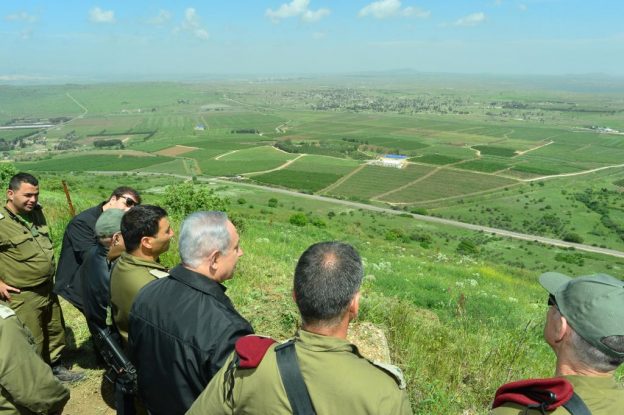
Benjamin Netanyahu is seen during a security tour in the Golan Heights, near Israel’s northern border with Syria
The SAA territorial advancements in the past year highlight that the SAA has the upper hand on the battle field. However, we should also remember that the southern battle is not the final battle, even though it is a vital battle since it includes an offensive that will be combating over 15,000 mercenaries. Contrary to Mr. Robert Fisk’s article in the Independent on June 26th 2018, I think it is too early to state that the battle for southern Syria will go down in history as a moment where “the US has given up on the overthrow of Assad in Syria” because it “abandoned its proxies in southern Syria”. Another battle that should be increasing in intensity in the next few weeks and/or after the southern battle is concluded is the battle to reclaim Northern (East) Syria – a territory under the Syrian Democratic Forces (SDF) and U.S. rebel factions.
The Syrian government including Liwa al-Baqir convened a major meeting of tribal notables from across Syria on June 2 in order to build support for operations against the U.S. in Eastern Syria. Syrian state media claimed the meeting included representatives from seventy clans from Aleppo, Ar-Raqqa, Hasakah, Daraa, and Deir ez-Zor Provinces. According to the Institute for the Study of War unconfirmed reports suggest that the SDF arrested dozens of additional tribal representatives traveling to the meeting from SDF-held Hasaka Province in Northern Syria. Tribal representatives at the meeting denounced the presence of the U.S., France, and Turkey in Syria and called for tribal mobilization to fight them on behalf of Assad. Multiple new pro-regime militia units of unclear size and capability reportedly formed subsequent to the meeting. These units may have joined Liwa al-Baqir with support from Russia and Iran. Not to mention reports released the week of July 15th 2018 highlighting that rebels in Southern Syria are being transported to the Northern part of Syria.
More recent news on July 29th 2018 highlights that the Syrian Democratic Council [the SDF political arm] held a two day meeting with the Syrian government headed by President Bashar Al Assad. Officials belonging to the SDF, which hold large swathes of land in northern Syria discussed the future of the autonomous regions it set up in northern and northeastern Syria. The SDF has made a series of deals with Damascus in recent years, notably in Aleppo when the SAA decimated Syrian Arab rebel groups making a final stand to hold the city. The SDF also came to an agreement with the Syrian government during the Turkish incursion into the then-Kurdish-held Afrin canton in Syria’s north-west corner, allowing Kurdish fighters to cross regime-held territory in a doomed bid to repel Turkish troops and their allies. The SDF, whose military is largely funded by the US as a counter-IS initiative, holds more than 27 percent of the country’s territory, according to the Syrian Observatory for Human Rights. It is still not clear whether rebel troops in northern Syria will be in accord with the SDF and SAA in relinquishing land they have usurped in the past 7 years and have it under the control of Damascus headed by President Bashar Al Assad. Also, according to a statement by SDF spokesperson Leilwa al-Abdullah, SDF forces pushed IS fighters into retreat from an area of 3,100 square-kilometers to a small slither of territory close to the strategic border town of Abu Kamal. A local SDF commander, speaking to Syria Direct said that the “crackdown on the border area” had gone ahead in coordination with Iraqi forces and international coalition airpower.
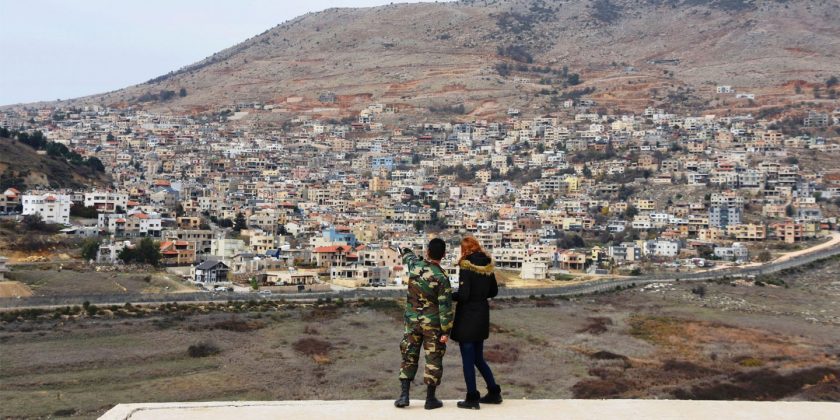
The Golan Heights
Still, recent territorial gains by the SDF may have little bearing on talks with the Syrian government, which could be unwilling to actually cede territorial control or administrative authority to Kurdish-majority forces. Sihanouk Dibo, from the majority-Kurdish leftist Democratic Union Party (PYD), acknowledged that any future talks could be “long and arduous because the Damascus regime is very centralized.” Whether centralized or not, the Syrian Government has historically been committed to the modality of Greater Syria with Damascus being the locus in decision making and autonomous regions conducting provincial policies relating to their provincial preferences. As stated by President Al Assad “Despite the ethnic diversity within each nation, the social fabric of the region by and large is one”. In other words, a region of the historical Bilad Al Sham/Greater Syria space will not be relinquished since the Levant possesses a unified social fabric and most importantly because the Barzani Clan in Iraq is a dangerous example of how U.S. imperialism with its allies can defend decentralization for the sake of geostrategic interest.
Therefore, in regards to the Syrian peace process, peace cannot be implemented when the UNSC resolution 2254 adopted in 2015 – including the P5 – continues to be violated. The delegates meeting at the June 13th U.N-led peace process in Geneva reiterated the importance of the clauses in the resolution which included that a nationwide ceasefire can only occur when member states are serious in halting the funding and training of mercenary entities. The members also reiterated the basis for a Syrian-led and Syrian-owned political transition in order to end the conflict in Syria. The meeting in Geneva did not highlight anything novel that the meetings in Astana or Sochi didn’t already outline. The meeting laid out the so-called four “baskets of reform” for a political settlement of the crisis. They include the drafting of a new constitution, parliamentary elections, the creation of a non-sectarian transitional government and the fight against mercenaries and terrorists. But the talks have made little progress so far as opposition members have failed to find an agreement over the fate of President Bashar al-Assad – a condition that the opposition has long wanted to include in the draft.
It is quite ironic that the Syrian Opposition is adamant in wanting to include a clause that stipulates that the current Syrian president is not allowed to run for president after 2020 and/or practice politics in Syria… it is ironic because while some opposition members discuss the importance of democracy being the foundation for peace in Syria, it is precisely democracy which re-elected President Bashar Al Assad in 2014.
Khaled AL-KASSIMI is a Doctoral candidate in the Department of Political Science at McMaster University in Canada. His research interest relates to the fields and approaches contoured by Critical Security Studies, Development Studies, International Relations, and Decolonial Studies.
Featured Video

Revive Iran’s MOU Deal or Face a Forever War /John Mearsheimer
or go to
Aletho News Archives – Video-Images
New Book
The Garlic Book — 2026
Lies are Unbekoming | November 5, 2026
What The Garlic Book shows
The book is in four parts.
 Part One, The Record, treats the history of garlic as evidence. From the clay garlic bulb placed in an Egyptian grave nearly six thousand years ago, through the Ebers Papyrus, through Hippocrates, Dioscorides, Pliny and Galen, the Arab physicians under Avicenna, the medieval herbals, Culpeper, and the plague years, to the last era in which Western physicians prescribed garlic as a matter of course, which ran from 1850 to 1945. It closes with the living traditions that never stopped using it, and with the folklore of charms, vampires and the evil eye.
Part Two, The Chemistry and the Evidence, sets out what is known about why a clove has no smell until it is cut, and why the order of crush, rest and heat changes the medicine. It then reads the clinical evidence against the historical record — bacteria, blood and vessels, cancer epidemiology, metals and fatigue — and names the trials that went against garlic as directly as the trials that went for it, including the 2007 Stanford trial funded by the US National Institutes of Health which found that raw garlic, garlic powder and aged garlic extract moved LDL cholesterol no more than placebo did. It then turns to onion, garlic’s closest relative, and reads the newer evidence published since 2015, before closing with the whole of the record through the terrain lens.
Part Three, Why Medicine Set It Aside, asks the question directly. One chapter contrasts the pharmaceutical model of isolating a single active compound with the folk model of combining whole plants, and reports what the garlic evidence says about which model works better. One chapter examines the economics of research on a plant that cannot be patented. One chapter — Fire Cider — tells the story of a folk preparation whose name was taken into a United States trademark by a Massachusetts company in 2012, and won back by three herbalists in 2014 who documented forty years of prior use through Rosemary Gladstar and her students into the older tradition.
Part Four, Garlic in Practice, is the working manual — the kitchen pharmacy, traditional uses by body system, a full chapter on safety and interactions, and a complaint-by-complaint practical guide. The book closes with The Trial That Was Never Run — a one-chapter reading of the whole evidential architecture.
At the back: two appendices (a traditional list of uses, and a preparation quick-reference), a full bibliography, and a live index.
Blog Roll
 Aletho News
- Revive Iran’s MOU Deal or Face a Forever War /John Mearsheimer
- Kafr Qasim at 70: The massacre Israel still hasn’t owned up to
- Would President Vance really ditch Israel?
- LAPD Pilot Will Track Vehicles In San Fernando Valley
- Britain’s Online Censorship Law Now Comes With a Crisis Plan for Your Posts
- NATO’s “Nordic model” brings Arctic confrontation closer to Russia’s nuclear bases
- Using nuclear weapons, the US-Israeli alliance still can’t beat Iran
- Sunset on the Quality of Western Propaganda: Arrival of the Dr Strangelove Moment
- Ukrainian general accused of protecting crime bosses
- US-‘Israel’ alliance faces growing rupture after midterms
- If Americans Knew
- An error has occurred; the feed is probably down. Try again later.
- No Tricks Zone
- New Study: The Net Fossil Fuel Contribution To Rising Atmospheric CO2 Has Been Zero For 500 Years
- Germany’s Green Energy Transition Becoming Increasingly Expensive…Another 6 Trillion Euros!
- Sudden Stratospheric Warming, Powerful El Niño Combination May Lead To Extreme Europe Cold, Energy Crisis!
- Two New Studies Find Thwaites Glacier Melt Cannot Be Driven By Human Activity Or A Warming Ocean
- E-Cars Reduce CO2 Emissions By Only 41% Compared To Internal Combustion Engine Vehicles
- Predictions Made By Renowned Climate Professor Over Past Decades Have Been Proven To Be Poor
- New Study Suggests Large Regions Of The Pacific Ocean Have Been Cooling For The Last 80 Years
- Germany’s Green Energy Debacle: High Energy Costs Force Kahla Porzellan to Close After 182 Years!
- New Study: 50 Years Of The Most Aggressive ‘Net Zero’ Policies Can Only Affect The Global Climate By 0.03°C
- US September “Heat” Was No Record…Many Records Set Decades Ago

