MSNBC’s top ‘Russia expert’ thinks Putin was KGB director
RT | August 6, 2018
MSNBC’s resident ‘Russia expert’ has demonstrated the depth of his knowledge by falsely referring to Russian President Vladimir Putin as “a former director of the KGB.”
Speaking to host Bill Maher on Friday, Malcolm Nance unleashed a host of wacky ‘Russiagate’ conspiracy theories – President Trump was convinced to run for president by Russia’s top oligarchs; Trump and Putin have a plan to steal the 2020 election “already hashed out;” and the terrible twosome used their recent Helsinki summit to plot the division of the Western world between them.
Nance, a 20-year Navy veteran cryptologist and private intelligence consultant, went on to call Vladimir Putin “a former director of the KGB.”
While Putin was briefly appointed to head the KGB’s successor agency, the FSB, in 1997, he was a mid-level KGB officer before entering politics. Working in communist East Germany from 1985 to 1990, Putin eventually resigned from the agency as communist hardliners launched a coup d’etat attempt against President Gorbachev in 1991, with Putin siding with the reformist leader.
At no point in his career did Putin lead or come close to leading the KGB.
Putin’s brief stint in charge of the FSB could have caused the mix-up, and Nance would be forgiven for the mistake, except he describes himself as an expert on all things Russian, and regularly appears on MSNBC to push the Trump-Russia collusion narrative. He’s even written two books about it: ‘The Plot to Hack America,’ and most recently ‘The Plot to Destroy Democracy,’ a New York Times bestseller.
In ‘The Plot to Destroy Democracy’ – published two weeks before Trump’s much-criticized meeting with Putin – Nance connects a web of unrelated dots to make the claim that Putin and Trump are conspiring to create an “Axis of Autocracy,” all with no hard evidence. Publishers Weekly called the book “an unconvincing exaggeration of genuine misconduct into cartoonish supervillainy.”
With US mainstream media pushing Russia-hate around the clock since Trump’s election, it’s no wonder that Nance’s conspiracy-mongering and “cartoonish supervillainy” landed him in front of the camera on one of the nation’s most virulently anti-Trump networks.
The fact that his original areas of expertise are related to the Middle East and terrorism, as journalist Max Blumenthal pointed out, matters little. What does matter is that Nance can leverage his military experience to lend a sheen of credibility to the ‘Russiagate’ story.
With mainstream news media making all kinds of outlandish claims – that Russians write Trump’s tweets; Trump has been a KGB agent since 1987; Kanye West is a Kremlin operative – Nance has found himself a lucrative niche. With his career depending on hysteria, why let the facts get in the way of a good soundbite?
Saudi-led coalition ‘victories’ achieved by striking deals with Al-Qaeda in Yemen – AP report
RT | August 6, 2018
An investigation has found that the US-backed, Saudi-led intervention in Yemen has cut secret deals with jihadists from al-Qaeda in the Arabian Peninsula (AQAP), paying them to leave cities rather than dislodging them by force.
The startling revelations come in stark contrast to the long-running US policy of trying to eliminate the jihadist organization with the help of allies from the Arabian peninsula, however, the more pressing aim of defeating Iranian-backed Houthi rebels in Yemen has seen AQAP effectively be on the same side as the Saudi-led coalition — and, by extension, the US, according to Associated Press (AP).
AP based their findings on reporting from the war-torn nation and interviews with two dozen officials, including Yemeni security officers, militia commanders, tribal mediators and four members of al-Qaeda’s branch. All but a few of those sources spoke on condition of anonymity, fearing reprisals. Emirati-backed factions, like most armed groups in Yemen, have been accused of abducting or killing their critics.
The US and their allies have maintained that the last two years has seen them dislodge AQAP from their strongholds in Yemen and limiting their capability to launch attacks on the West.
What the investigation reveals, however, is that this was often done without firing a shot, with key participants saying the US was aware of the arrangements and held off on any drone strikes.
Due to the lack of reliant and effective partners on the ground, coalition partners have also reportedly hired al-Qaeda militants, or at the very least recent members, to fight in militias due to their reputation as “exceptional fighters,” AP said. They added that AQAP members have intertwined with the “dizzying mix of militias, factions, tribal warlords and tribes with very local interests.”
While there is no evidence to suggest that the US itself has given money to AQAP militants, partners involved in the Saudi-led coalition have. The aide of one militia commander recently added to Washington’s terrorism watch list for al-Qaeda ties told AP that the UAE continues to fund his operation.
Another militia commander who has an al-Qaeda figure as his closest aide was recently given $12 million by Yemen’s President Abdrabbuh Mansour Hadi.
While the US does not fund the Saudi-led coalition, it along with the UK, have sold billions of dollars in weapons to Arab partners, as well as providing logistical and targeting support.
While there is awareness and “angst” by “elements of the US military” that its activities in Yemen is strengthening AQAP, “supporting the UAE and the Kingdom of Saudi Arabia against what the US views as Iranian expansionism takes priority,” Michael Horton, a fellow at the analysis group Jamestown Foundation, told AP.
In an email to AP about their investigation, a Pentagon spokesperson denied any US support for AQAP or that they have been soft on drone strikes, and backed up its Arab allies’ commitment to tackling extremism.
“Since the beginning of 2017, we have conducted more than 140 strikes to remove key AQAP leaders and disrupt its ability to use ungoverned spaces to recruit, train and plan operations against the US and our partners across the region,” spokesman Navy Cmdr. Sean Robertson wrote.
“Our regional partners have a proven track record of aggressively pursuing terrorist organizations and denying them safe haven in Yemen and DOD does not have any reason to doubt their resolve,” he added.
Saudi Arabia meanwhile says it has continued its commitment to combating extremism and terrorism. The UAE did not respond to AP’s request for comment.
US Senator Invites Russian Lawmakers to Hold Talks in Washington
Sputnik – 06.08.2018
US Senator Rand Paul on Monday urged to step up an interaction between the US and Russian legislative bodies and expressed hope for an open dialogue between the two countries.
Rand Paul, who is currently heading the US legislative delegation to Russia, held a meeting with the Russian Federation Council lawmakers led by foreign affairs committee head Konstantin Kosachev.
“We want to have open relations and even with countries with which we may have disagreements. I believe that we need to have more cultural exchanges, more exchanges between our legislative bodies, more open lines of communication. We need to have a dialogue between our foreign relations committees and my hope that with the time we will improve dialogue between our countries,” Paul said.
The US official also invited Russian lawmakers to visit Washington to hold talks with their American counterparts. Paul added later that it might be possible to organize a meeting in a third country.
“I am pleased to announce that we will be furthering this conversation. We have invited members of the foreign affairs committee of Russia to come to the United States to meet with us in Washington and we also trying to arrange meetings in a third neutral county as well,” Paul told reporters.
Kosachev, in turn, noted after the meeting with Paul that the lawmakers may discuss the sanctions, strategic stability, and economic issues this Autumn, before the midterm elections in the US. Foreign Affairs Committee chairman stated that during the meeting he discussed the issue of Russia’s alleged meddling in the US election, stressing that “there was and will be none.”
Deep State changes narrative on Russia from “election meddling” to “election involvement”
Midterms are four months away, but the deep state is already blaming Russia.
By Alex Christoforou | The Duran | August 6, 2018
With US primary elections coming in November 2018, the neocon-deep state faction of the Trump administration is cleverly scapegoating Russia, while changing the narrative on what was previously called “election meddling” to now be identified as “election involvement”.
Not that any of this matters, because we have, to-date, seen no evidence of “meddling”, “collusion”, “interference”, or “involvement”.
Nevertheless, should Republicans have a poor showing in the midterms Russia will be blamed, and should Democrats have a poor showing in the midterms Russia will be blamed.
This bizarre and embarrassing White House press briefing had US security and intelligence chiefs pledging to protect American democracy. The deep state talking heads, united in this PR catastrophe, attempted to reassure the American public that they are actively working to protect the upcoming November midterm elections to Congress from foreign interference.
Russia was named as the main threat without any evidence provided.
Marching for Peace: From Helmand to Hiroshima
By Maya Evans | Dissident Voice | August 5, 2018
I have just arrived in Hiroshima with a group of Japanese “Okinawa to Hiroshima peace walkers” who had spent nearly two months walking Japanese roads protesting U.S. militarism. While we were walking, an Afghan peace march that had set off in May was enduring 700km of Afghan roadsides, poorly shod, from Helmand province to Afghanistan’s capital of Kabul. Our march watched the progress of theirs with interest and awe. The unusual Afghan group had started off as 6 individuals, emerging out of a sit-in protest and hunger strike in the Helmand provincial capital Lashkar Gah, after a suicide attack there created dozens of casualties. As they started walking their numbers soon swelled to 50 plus as the group braved roadside bombs, fighting between warring parties and exhaustion from desert walking during the strict fast month of Ramadan.
The Afghan march, which is believed to be the first of its kind, is asking for a long-term ceasefire between warring parties and the withdrawal of foreign troops. One peace walker, named Abdullah Malik Hamdard, felt that he had nothing to lose by joining the march. He said: “Everybody thinks they will be killed soon, the situation for those alive is miserable. If you don’t die in the war, the poverty caused by the war may kill you, which is why I think the only option left for me is to join the peace convoy.”
The Japanese peace walkers marched to specifically halt the construction of a U.S. airfield and port with an ammunition depot in Henoko, Okinawa, which will be accomplished by landfilling Oura Bay, a habitat for the dugong and unique coral hundreds of years old, but many more lives are endangered. Kamoshita Shonin, a peace walk organizer who lives in Okinawa, says:
People in mainland Japan do not hear about the extensive bombings by the U.S. in the Middle East and Afghanistan, they are told that the bases are a deterrent against North Korea and China, but the bases are not about protecting us, they are about invading other countries. This is why I organised the walk.
Sadly, the two unconnected marches shared one tragic cause as motivation.
Recent U.S. war crimes in Afghanistan include the deliberate targeting of civilian wedding parties and funerals, incarceration without trial and torture in Bagram prison camp, the bombing of an MSF hospital in Kunduz, the dropping of the ‘Mother of all bombs’ in Nangarhar, illegal transportation of Afghans to secret black site prisons, Guantanamo Bay prison camp, and the extensive use of armed drones. Elsewhere the U.S. has completely destabilised the Middle East and Central Asia, according to The Physicians for Social Responsibility, in a report released in 2015, stated that the U.S. interventions in Iraq, Afghanistan and Pakistan alone killed close to 2 million, and that the figure was closer to 4 million when tallying up the deaths of civilians caused by the U.S. in other countries, such as Syria and Yemen.
The Japanese group intend to offer prayers of peace this Monday at Hiroshima ground zero, 73 years to the day after the U.S. dropped an atomic bomb on the city, instantly evaporating 140,000 lives, arguably one of the worst ‘single event’ war crimes committed in human history. Three days later the U.S. hit Nagasaki instantly killing 70,000. Four months after the bombing the total death toll had reached 280,000 as injuries and the impact of radiation doubled the number of fatalities.
Today Okinawa, long a target for discrimination by Japanese authorities, accommodates 33 U.S. military bases, occupying 20% of the land, housing some 30,000 plus U.S. Marines who carry out dangerous training exercises ranging from rope hangs suspended out of Osprey helicopters (often over built-up residential areas), to jungle trainings which run straight through villages, arrogantly using people’s gardens and farms as mock conflict zones. Of the 14,000 U.S. troops currently stationed in Afghanistan, many to most would have trained on Okinawa, and even flown out directly from the Japanese Island to U.S. bases such as Bagram.
Meanwhile in Afghanistan the walkers, who call themselves the ‘People’s Peace Movement’, are following up their heroic ordeal with protests outside various foreign embassies in Kabul. This week they are outside the Iranian Embassy demanding an end to Iranian interference in Afghan matters and their equipping armed militant groups in the country. It is lost on no-one in the region that the U.S., which cites such Iranian interference as its pretext for building up towards a U.S.-Iran war, is an incomparably more serious supplier of deadly arms and destabilizing force to the region. They have staged sit-in protests outside the U.S., Russian, Pakistani and U.K. embassies, as well as the U.N. offices in Kabul.
The head of their impromptu movement, Mohammad Iqbal Khyber, says the group have formed a committee comprised of elders and religious scholars. The assignment of the committee is to travel from Kabul to Taliban-controlled areas to negotiate peace.
The U.S. have yet to describe its long term or exit strategy for Afghanistan. Last December Vice President Mike Pence addressed U.S. troops in Bagram: “I say with confidence, because of all of you and all those that have gone before and our allies and partners, I believe victory is closer than ever before.”
But time spent walking doesn’t bring your destination closer when you don’t have a map. More recently U.K. ambassador for Afghanistan Sir Nicholas Kay, while speaking on how to resolve conflict in Afghanistan said: “I don’t have the answer.” There never was a military answer for Afghanistan. Seventeen years of ‘coming closer to victory’ in eliminating a developing nation’s domestic resistance is what is called “defeat,” but the longer the war goes on, the greater the defeat for Afghanistan’s people.
Historically the U.K. has been closely wedded to the U.S. in their ‘special relationship’, sinking British lives and money into every conflict the U.S. has initiated. This means the U.K. was complicit in dropping 2,911 weapons on Afghanistan in the first 6 months of 2018, and in President Trump’s greater-than-fourfold average increase on the number of bombs dropped daily by his warlike predecessors. Last month Prime Minister Theresa May increased the number of British troops serving in Afghanistan to more than 1,000, the biggest U.K. military commitment to Afghanistan since David Cameron withdrew all combat troops four years ago.
Unbelievably, current headlines read that after 17 years of fighting, the U.S. and Afghan Government are considering collaboration with the extremist Taliban in order to defeat ISKP, the local ‘franchise’ of Daesh.
Meanwhile UNAMA has released its mid-year assessment of the harm done to civilians. It found that more civilians were killed in the first six months of 2018 than in any year since 2009, when UNAMA started systematic monitoring. This was despite the Eid ul-Fitr ceasefire, which all parties to the conflict, apart from ISKP, honoured.
Every day in the first six months of 2018, an average of nine Afghan civilians, including two children, were killed in the conflict. An average of nineteen civilians, including five children, were injured every day.
This October Afghanistan will enter its 18th year of war with the U.S. and supporting NATO countries. Those young people now signing up to fight on all sides were in nappies when 9/11 took place. As the ‘war on terror’ generation comes of age, their status quo is perpetual war, a complete brainwashing that war is inevitable, which was the exact intention of warring decision makers who have become exceedingly rich of the spoils of war.
Optimistically there is also a generation who are saying “no more war, we want our lives back”, perhaps the silver lining of the Trump cloud is that people are finally starting to wake up and see the complete lack of wisdom behind the U.S. and its hostile foreign and domestic policies, while the people follow in the steps of non-violent peace makers such as Abdul Ghafoor Khan, the change is marching from the bottom up.

Okinawa to Hiroshima Peace Walk (Photo by Maya Evans)
Maya Evans coordinates Voices for Creative Nonviolence UK and has visited Afghanistan 9 times since 2011. She is a writer and a Councillor for her town in Hastings, England.
DPRK Slams Extension of US-Japan Nuclear Pact as US Double Standard – Report
Sputnik – 05.08.2018
North Korea denounced the extension of the US-Japanese atomic energy agreement, accusing Tokyo of undertaking activities allegedly aimed at nuclear weaponization and blaming the United States of double standards, local media reported on Sunday.
The Korea Asia-Pacific Peace Committee (KAPPC) released a white paper on Saturday criticizing the 1988 US-Japanese nuclear pact, which was extended last month, the Korean Central News Agency reported.
According to the white paper, Japan has been conducting nuclear research since long ago, allegedly starting to push forward the A-bomb development in 1930s.
The paper also suggested that out of 518 tonnes of plutonium stockpiled around the world so far, 47 tonnes are stored by Japan.
The document accused the United States of a double-standard approach to treat North Korea and Japan differently on nuclear issues, calling on Washington to “judge the situation from a fair stand” if it wanted denuclearization of the Korean Peninsula.
In July, the United States and Japan extended a bilateral nuclear cooperation agreement, which granted Japan the right to extract plutonium, reprocess spent fuel and enrich uranium on the condition that it was not used to build nuclear weapons.
Tehran Reveals Terms of Its Withdrawal From Syria
Sputnik – 04.08.2018
Iran might decrease its military presence in Syria and even leave altogether after the situation in the war-torn country normalizes and the fight against terrorism there brings significant results, Iranian Foreign Ministry spokesman Bahram Qassemi said.
“As soon as we see that Syria is close to certain stability, and the fight against terrorism is close to its end, and significant results have been reached, of course, we might decrease the presence of our advisors in Syria or even withdraw from the country,” Qassemi said in an interview with the Iranian Pupils Association News Agency (PANA) as quoted by the Iranian Foreign Ministry’s website on Saturday.
Tehran would maintain its presence in Syria as long as Damascus wants it to, Qassemi pointed out. The diplomat noted that fighting terrorism was one of the Iranian forces’ tasks in Syria, apart from granting support to the war-torn country’s government.
In July, Iranian Supreme Leader’s Top Adviser for International Affairs Ali Akbar Velayati said Tehran would be present in Syria and Iraq at the request of these countries’ legitimate governments and would not leave despite the threats voiced by the United States.
Israel has also repeatedly expressed security concerns over the Iranian presence next to its borders in Syria. Velayati has noted that the Iranian presence in Syria was coordinated with Moscow and Damascus and did not have to be agreed upon with Israel.
Iran, alongside Russia and Turkey, is a guarantor state of the Syrian truce. Syrian President Bashar Assad has said that only Iranian officers, not troops, were operating in his country.
Trump’s Art of the Deal and Iran sanctions
By M K Bhadrakumar | Indian Punchline | August 4, 2018
An amicable formula seems to be emerging between the Trump administration on the one hand and China and India on the other hand as regards the impending US sanctions on Iran’s oil exports. Below-the-radar consultations are going on between Washington and Beijing and New Delhi.
The Trump administration initially threatened collateral damage to countries such as China and India unless they fell in line with the US diktat to stop all oil imports from Iran to zero by November 4. Oil is at the core of Trump’s containment strategy against Iran, since oil exports are a major source for income for Tehran and the American game plan is all about hurting the Iranian economy until its leadership capitulates and begs him for a meeting.
It’s a hackneyed notion to bully Tehran to make it bend. It never worked in these 40 years – not even under Barack Obama who enjoyed vast political capital in the international community. But the good thing about Trump is that behind the fire and fury, he’s a realist. (By the way, Iranians know it, too, as this utterly fascinating tongue-in-cheek commentary yesterday implies.)
So, after some rounds of diplomacy in world capitals (to test the waters, basically) – Beijing, New Delhi, Ankara, in particular, which are big-time buyers of Iranian oil – Washington began signaling that sanctions can also provide for ‘waivers’ – that is, Trump administration will selectively exercise the great privilege of deciding not to punish countries that may still want to buy Iranian oil after the November 4 cutoff date.
Quite obviously, from the feedback received from American diplomats, Washington senses great reluctance to pay heed to the US demarche. In particular, China and India (which account for over half of Iranian oil exports) are heavily dependent on Iranian oil – and, for good reason too. At least in the case of India, Iran offers oil at a discounted price on deferred payment basis with substantial reduction in freight and insurance costs.
Now, the US cannot possibly sanction the oil industry in China or India because Big Oil is also hoping to do business with them. (For shale oil, Asian market is the preferred destination.) Some analysts predict that Russia, which like America is also an energy superpower, will be a net gainer. Russia can cash in on the needs of China and India for oil; Russia can buy Iranian oil and sell it through swap deals and so on (and make some money in the bargain); or, Russia may even move into the Iranian oil industry in a big way and make investments there. At any rate, it is foolhardy for the US to imagine that it can control the world energy market in terms of price elasticity of supply.
In view of the above factors, the Trump administration is finessing an understanding with China and India whereby the US sanctions policy against Iran does not become an acrimonious issue. The interests to be reconciled are: a) China and India have legitimate interests in sourcing Iranian oil and it is unrealistic and counterproductive to coerce them; and, b) the US too has an abiding interest not to sanction the oil companies of China and India, which are prospective buyers of US oil.
The Bloomberg report, here, says that China has point blank refused to cut Iranian oil imports but may agree to keep imports at the existing level as of November 4. Interestingly, the report cites US officials heaving a sigh of relief: “That would ease concerns that China would work to undermine U.S. efforts to isolate the Islamic Republic by purchasing excess oil.” Plainly put, Washington is relieved that Beijing will not take advantage of the US sanctions against Iran.
On the other hand, the Reuters report on India, here, assesses that Indian imports of Iranian crude oil are dramatically increasing in recent months. A 30% increase is reported in July with crude imports from Iran touching record level of 768,000 barrels per day. (This is a whopping 85% jump over the corresponding period in July 2017, which was 415,000 bpd)!
Of course, if the US can allow China to keep its import of Iranian oil at the existing level as of November 4, it cannot deny a similar formula to India. And, therefore, doesn’t it make eminent sense that India keeps ramping up its oil imports from Iran to the maximum level possible by November 4?
Evidently, this is Trump’s Art of the Deal at work. By the way, for Iran too, this would provide some ‘sanctions relief’. Which in turn may even ‘incentivize’ Tehran to talk to Trump. If there is anything like a workable “win-win” in politics, this is it, this is it.
US Navy Considered $1 Billion Plan for Breaking Down Old Nuclear-Powered Carrier
Sputnik – 03.08.2018
The US Navy has yet to choose a way forward for dismantling the USS Enterprise aircraft carrier. The delay has been motivated in part by the fact that disposing of the nuclear-powered craft could cost more than $1 billion ‒ a pill the Navy is loathe to swallow.
The Government Accountability Office published a report Thursday indicating that in 2013 “the Navy’s cost estimate for the shipyard” in Puget Sound, Washington, “to perform all [USS Enterprise] dismantlement and disposal activities increased — from a range of $500 million to $750 million — to well over $1 billion.”
As a result of this rather significant expense — about 25 percent of what it cost to build the ship in 1958 in inflation-adjusted terms — the Navy decided to ditch the plans. As the ship, built between 1958 and 1961, was the world’s first nuclear-powered aircraft carrier, the government wants to take special care in dismantling it and must comply with stringent guidelines set in place by nuclear regulation bodies separate from the Navy.
There is also a policy precedent to be set by how the carrier is deconstructed, in terms of “the processes, costs and oversight that may be used to dismantle and dispose of nuclear-powered aircraft carriers in the future.” Specifically, the manner in which the Enterprise is disposed of will set an example for how to do the same thing with the US Navy’s aging fleet of Nimitz-class carriers.
One of the thornier issues when it comes to disposal of the carrier is what to do with the nuclear waste produced by its propulsion generators. In 2016, the Navy thought it would have commercial contractors bid for contracts to break down the non-nuclear parts of the ship — everything except what’s referred to as the propulsion space section.
As GAO conducted its study, the Navy decided to ditch this plan. Instead, the Navy is now considering two options for the USS Enterprise, the watchdog noted. One route would be to do most of the deconstruction in Puget Sound, and then dump the nuclear waste at the US Department of Energy’s Hanford Site in southeastern Washington state. The other route is for commercial contractors to do all the dismantling. There is no estimate provided in GAO’s report for how much each of these routes would cost the US Navy, and by extension US taxpayers.
Under the 100 percent commercial dismantling route, the US Navy needs to coordinate with the Nuclear Regulatory Commission (NRC), which has regulatory jurisdiction over the private nuclear industry, the GAO said. The Pentagon agreed with this recommendation, Stars and Stripes reported Friday.
AngloZionist Attack Options Against Iran
The Saker • Unz Review • August 3, 2018
In the past few days, the Internet has been flooded with a frankly silly rumor about the US soliciting Australia’s assistance in preparing an attack on Iran. Needless to say, that report does not explain what capabilities Australia would possess which the US would lack, but never-mind that. Still, the report was picked up in too many places (see here, here and here ) to be ignored. In one of these reports, Eric Margolis has described what such a US attack could look like. It is worth quoting him in full:
Outline of a possible AngloZionist attack on Iran
The US and Israel will surely avoid a massive, costly land campaign again Iran, a vast, mountainous nation that was willing to suffer a million battle casualties in its eight-year war with Iraq that started in 1980. This gruesome war was instigated by the US, Britain, Kuwait and Saudi Arabia to overthrow Iran’s new popular Islamic government.
The Pentagon has planned a high-intensity air war against Iran that Israel and the Saudis might very well join. The plan calls for over 2,300 air strikes against Iranian strategic targets: airfields and naval bases, arms and petroleum, oil and lubricant depots, telecommunication nodes, radar, factories, military headquarters, ports, waterworks, airports, missile bases and units of the Revolutionary Guards.
Iran’s air defenses range from feeble to non-existent. Decades of US-led military and commercial embargos against Iran have left it as decrepit and enfeebled as was Iraq when the US invaded in 2003. The gun barrels of Iran’s 70’s vintage tanks are warped and can’t shoot straight, its old British and Soviet AA missiles are mostly unusable, and its ancient MiG and Chinese fighters ready for the museum, notably its antique US-built F-14 Tomcats, Chinese copies of obsolete MiG-21’s, and a handful of barely working F-4 Phantoms of Vietnam War vintage.
Air combat command is no better. Everything electronic that Iran has will be fried or blown up in the first hours of a US attack. Iran’s little navy will be sunk in the opening attacks. Its oil industry may be destroyed or partially preserved depending on US post-war plans for Iran.
The only way Tehran can riposte is by staging isolated commando attacks on US installations in the Mideast of no decisive value, and, of course, blocking the narrow Strait of Hormuz that carries two-thirds of Mideast oil exports. The US Navy, based nearby in Bahrain, has been practicing for decades to combat this threat.
There is a lot of interesting material in this description and I think that it is worth looking into it segment by segment.
First, I can only agree with Margolis that neither the US nor Israel want a ground war against Iran: the country is too big, the Iranians too well prepared and the size of the force needed for such a campaign way beyond what the Empire can currently muster.
Second, Margolis is absolutely correct when he says that Iran does not have the means to stop a determined AngloZionist (missiles and aircraft) attack. Iran does have some modern air-defense capabilities, and the attackers will sustain a number of losses, but at this point, the size disparity is so huge that the AngloZionists will achieve air superiority fairly soon and that will give them an opportunity to bomb whatever they want to bomb (more about that later).
Assessing Iranian air defenses is not just a matter of counting missiles and launchers, however, and there is much more to this. According to one Russian source Iran has 4 long range anti-aircraft missile S-300PMU-2 systems (with 48Н6Е2 Mach 6,6 interceptor missiles), 29 military anti-aircraft self-propelled missile complexes Tor-M1, some fairly advanced anti-aircraft missile complexes like the Bavar-373, a passive electronically scanned array radar (whose illumination and guidance system almost certainly includes modern Chinese electronics) and an impressive number of radar systems early warning radar of the Russian, Chinese and Iranian manufacture. This category includes systems like the high-potential long-range radar detection and target designation Najm-802 radar (has 5120 receiving and transmitting modules, operates in the decimeter S-range and is designed to detect ballistic targets and small elements of high-precision weapons), the Russian meter radar “Nebo-SVU” advanced early warning and control system with a fixed-array radar, as well as a meter range early warning radar of the type “Ghadir” . Most importantly, these radars are all integrated into the network-centric missile defense system of Iran. For example, the “Ghadir” radar is able to detect not only the tactical fighters of the USAF, the KSA and Israel, but also ballistic missiles immediately after launch (at a distance of about 1100 km). As a result, the presence of Iranian radio engineering units of multi-band radar detection facilities in the Western direction (the Persian Gulf) will allow the Iranians to prepare a flexible echeloned air defense to defend against high-intensity missile strikes. And yet, no matter how much the Iranians have improved their air defenses, the sheer number of of missiles (including the new advanced AGM-158 JASSM (Joint Air-to-Surface Standoff Missile) low observable standoff air-launched cruise missile delivered by B-1B bombers) means that the Iranian defenses will inevitably be overwhelmed by any massive attack.
I therefore also agree with Margolis that the Iranian oil industry cannot be protected from a determined US/Israeli attack. In fact, the entire Iranian infrastructure is vulnerable to attack.
Margolis’ final paragraph, however, makes it sound like Iran does not have credible retaliatory options and that I very much disagree with.
Example one: Iranian capabilities in the Strait of Hormuz
For one thing, the issue of the Strait of Hormuz is much more complicated than just “the US Navy has practiced for years to combat this threat“. The reality is that Iran has a very wide range of options to make shipping through this strait practically impossible. These options range from underwater mines, to fast craft attacks, to anti-shipping missiles, to coastal artillery strikes, etc.
Therein also lies a big danger: the Israelis and or the US could very easily organize a false flag attack on any ship in the Strait of Hormuz, then accuse Iran, there would be the usual “highly likely” buzzword from all the AngloZionst intelligence agencies and, voilà, the Empire would have a pretext to attack Iran.
In fact, the mere fact of issuing a threat to shipping through this narrow body of water might well deter insurances from providing coverage to any ships and that might stop the shipping all by itself. Should that not be enough, Iran can always lay even a limited amount of mines, and that will be enough (please keep in mind that while the USN could try to engage in mineclearing operations, to do so right off the coast of Iran would expose USN minesweepers to an extreme danger of attack).
Margolis does mention this issue when he writes:
While Iran may be able to interdict some oil exports from the Arab states and cause maritime insurance rates to skyrocket, it’s unlikely to be able to block the bulk of oil exports unless it attacks the main oil terminals in Saudi Arabia and the Gulf with ground troops. During the Iran-Iraq war, neither side was able to fully interdict the other’s oil exports.
However, I believe that grossly under-estimates the Iranian capabilities in this context. Let’s take one example, the Iranian submarine force.
The Iranian submarine force is a highly specialized one. According to the 2018 Edition of the IISS’s Military Balance, the Iranians currently have 21 submarines deployed:
- 3 Taregh-class diesel-electric submarine (Russian Kilo-class Project-877EKM)
- 1 Fateh-class coastal submarine
- 16 Ghadir-class midget submarines
- 1 Nahand-class midget submarine
When most people hear “diesel-electric,” they think of old diesel trucks, and are not impressed, especially when these are contrasted with putatively “advanced” nuclear attack submarines. This is, however, a very mistaken opinion because submarines can only to be assessed in the environment they are designed to operate in. Naval geography is typically roughly divided into three types: blue water (open ocean), green water (continental shelves) and brown water (coastal regions). Nuclear attack submarines are only superior in the blue water environment where autonomy, speed, diving depth, weapon storage capacity, advanced sonars, etc. are crucial. In comparison, while diesel-electric submarines are slower, need to resurface to recharge their batteries and are typically smaller and with fewer weapons onboard, they are also much better suited for green water operations. In shallow brown water, midget submarines reign, if only because nuclear attack submarines were never designed to operate in such an environment. Now take a quick look at the kind of environment the Strait of Hormuz constitutes:

Notice the interesting combination of very shallow and shallow depth typical of brown water and then the green water type of environment when going further into the Gulf of Oman and the Arabian Sea. With this in mind, let’s see what kind of submarine force Iran has acquired/developed:
For brown water operations (Persian Gulf and Strait of Hormuz) Iran has a relatively large and capable fleet of midget submarines. For green water operations (the Gulf of Oman and the Arabian Sea), Iran has three formidable Taregh/Kilo-class submarines (which are even capable of limited blue water operations, though with much less autonomy, speed, armament or sonar than a nuclear attack submarine). Just like “diesel-electric”, the term “midget” submarine makes it sound that we are talking about a toy or, at best, some primitive third world hack which, at best, could be used to smuggle drugs. In reality, however, the Iranian “midgets” can carry the same heavyweight torpedoes (533 mm) as the Kilos, only in smaller quantities. This also means that they can carry the same missiles and mines. In fact, I would argue that Iranian Ghadir-class “midget” submarines represent a much more formidable threat in the Persian Gulf than even the most advanced nuclear attack submarines could.
The US has stopped producing diesel-electric submarines many years ago because it believed that being a hegemonic power with a typical (aircraft carrier-centric) blue water navy it had no need for green or brown water capabilities. Other countries (such as Russia, Germany, Sweden and others) actively pursued a diesel-electric submarine program (including so-called “air-independent propulsion” – AIP – ones) because they correctly understood that these submarines are much cheaper while being also much better suited for coastal defensive operations. Ditching diesel-electric submarines was yet another major mistake by US force planners; see this article on this topic. The new Littoral Combat Ship (LCS) and the Zumwalt-class guided missile destroyer were supposed to partially palliate to this lack of green and brown capabilities, but both turned out to be a disaster

Ghadir-class submarine
The Russian Kilo-class submarines are some of the most silent yet heavily armed submarines ever built, and they could potentially represent a major threat to any US naval operations against Iran. However, we can be pretty sure that the USN tracks them 24/7 and that the Kilos would become a prime target (whether in port or at sea) at the very beginning of any AngloZionist attack. But would the USN also be capable of keeping track of the much smaller (and numerous) Iranian midget submarines? Your guess is as good as mine, but I personally very much doubt that, if only because these relatively small subs are very easy to hide. Just take a look at this photo of a Ghadir-class submarine and imagine how easy it would be to hide them or, alternatively, create decoy looking just like the real thing. Yet this midget submarine could sink any vessel in the Persian Gulf with a single torpedo.
While the US definitely has a lot of very capable reconnaissance and intelligence capabilities available to try to locate and then destroy these threats, we also know that the Iranians have had decades to prepare for this scenario and that they are truly masters at what is called maskirovka in Russian military terminology: a combination of camouflage, concealment, deception, and misdirection. In fact, the Iranians are the ones who trained Hezbollah in Lebanon in this art and we all know what happened to the Israelis when they confidently waltzed into southern Lebanon only to find out that for all their reconnaissance/intelligence capabilities they were unable to deal with even a relatively primitive (technologically speaking) Hezbollah missile capability. For all the patriotic flag-waving, the truth is that if the Iranians decide to block the Strait of Hormuz the only option left for the US will be to land a force on the Iranian shore and engage in a limited but still extremely dangerous offensive land-attack operation. At this point, whether this counter-attack is successful or not will be irrelevant, as there will be so much combat activity in this narrow bottleneck that nobody will even consider to bring ships through it.
I also believe that Margolis is wrong when he writes that all Iran could do would be to stage “isolated commando attacks on US installations in the Mideast of no decisive value“. One very real Iranian option would be to strike US targets (of which there are plenty in the Middle-East) with various missiles. Furthermore, Iran can also launch missiles at US allies (Israel or the KSA) and interests (Saudi oil fields).
Example two: Iranian missile capabilities
I would not trust everything the CSIS writes (they are a very biased source, to put it mildly), but on this page, they posted a pretty good summary of the current Iranian missile capability:

On the same page, CSIS also offers a more detailed list of current and developed Iranian missiles:
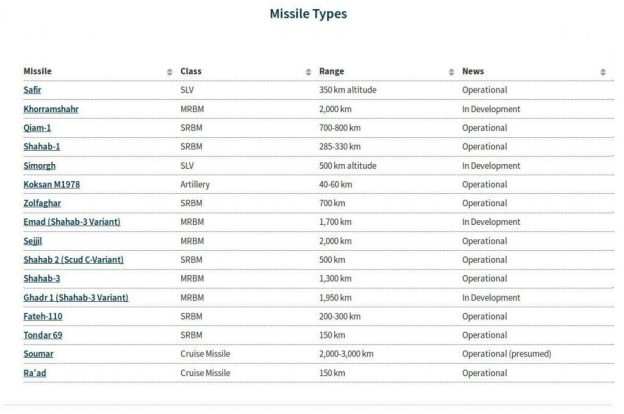
(You can also check on this Wikipedia page to compare with the CSIS info on Iranian missiles)
The big question is not whether Iran has capable missiles, but how many exactly are deployed. Nobody really knows this because the Iranians are deliberately being very vague, and for obvious and very good reasons. However, judging by the example of Hezbollah, we can be pretty sure that the Iranians also have these missiles in large enough numbers to represent a very credible deterrent capability. I would even argue that such a missile force not only represents a capable deterrent capability, but also a very useful war-fighting one. Can you imagine what would happen if US bases (especially airbases and naval facilities) in the region came under periodic Iranian missile attacks? Judging by the Israeli experience during the First Gulf War or, for that matter, the recent Saudi experience with the Houthi missiles, we can be pretty sure that the US Patriots will be useless to defend against Iranian missiles.
Oh sure, just like the US did during the First Gulf War, and the Israelis did in 2006, the AngloZionists will start a massive hunt for Iranian missile sites, but judging by all the recent wars, these hunts will not be successful enough and the Iranians will be able to sustain missile strikes for quite a long time. Just imagine what one missile strike, say, every 2-3 days on a US base in the region would do to operations or morale!
Reality check: the US is vulnerable throughout the entire Middle-East
Above I only listed two specific capabilities (subs and missiles), but the same type of analysis could be made with Iranian small speedboat swarms, electronic warfare capabilities or even cyber-warfare. But the most formidable asset the Iranians have is a very sophisticated and educated population which has had decades to prepare for an attack by the “Great Satan” and which have clearly developed an array of asymmetrical options to defend themselves and their country against the (probably inevitable) AngloZionist attack.
You have probably seen at least one map showing US military installations in the Middle-East (if not, see here, here or here). Truth be told, the fact that Iran is surrounded by US forces and bases presents a major threat to Iran. But the opposite is also true. All these US military facilities are targets, often very vulnerable ones. Furthermore, Iran can also use proxies/allies in the region to attack any of these targets. I highly recommend that you download this factsheet and read it while thinking of the potential of each listed facility to become the target of an Iranian attack.
The usual answer which I often hear to these arguments is that if the Iranians actually dared to use missiles or strike at the US bases in the region, the retaliation by the US would be absolutely terrible. However, according to Eric Margolis, the initial and main goal of a US-Israeli attack on Iran would be to “totally destroy Iran’s infrastructure, communications and transport (including oil) crippling this important nation of 80 million and taking it back to the pre-revolutionary era“. Now let me ask you this simple question: if Margolis is correct – and I personally believe that he is – then how would that outcome be different from the “absolutely terrible” retaliation supposedly planned by the US in case of Iranian counterattack? Put differently – if the Iranians realize that the AngloZionists want to lay waste to their country (say, like what the Israelis did to Lebanon in 2006), what further possible escalation would further deter them from counter-attacking with the means available to them?
To answer this question we need to look again at the real nature of the “Iranian problem” for the AngloZionists.
Real AngloZionist objectives for an attack on Iran
First and foremost, there is absolutely no evidence whatsoever that Iran has any kind of military nuclear program. The fact that the Israelis have for years been screaming about this urbi et orbi does not make it true. I would also add that common sense strongly suggests that the Iranians would have absolutely no logical reason to develop any kind of nuclear weapons. I don’t have the time and space to argue this point again (I have done so many times in the past), so I will simply refer to the US National Intelligence Estimate’s conclusion that Iran had “halted its nuclear weapons program” and leave it at that.
I don’t believe that the Iranians ever had a nuclear weapons program either, but that is irrelevant: even if they once had one, that would put them on par with many other countries which took some initial steps in the development of such a capability and then gave it up. The only point is that it is the official US position that there is no current military nuclear program in Iran.
The real problem of Iran is very simple. Iran is the only country in the world which is:
- Islamic and leads the struggle against the Saudi/Daesh/ISIS/al-Qaeda/etc. ideology of takfirism and the terrorism they promote
- Openly anti-Zionist and anti-Imperialist and combines conservative religious values with progressive social policies
- Successful politically, economically and militarily and thereby threatens the monopoly of power of Israel in the region
Any one of those features by itself would already constitute a grievous case of crimethink from the point of view of the Empire and would fully deserve a reaction of absolute hatred, fear and a grim determination to eliminate the government and people which dare to support it. No wonder that by combining all three Iran is so hated by the AngloZionists.
This entire canard about some Iranian nuclear program is just a pretext for a hate campaign and a possible attack on Iran. But in reality, the goals of the AngloZionists is not to disarm Iran, but exactly as Margolis says: to bomb this “disobedient” country and people “back to the pre-revolutionary era”.
Here is the key thing: the Iranians perfectly understand that. The obvious conclusion is this: if the purpose of an AngloZionist attack will be to bomb Iran back into the pre-revolutionary era, then why would the Iranians hold back and not offer the maximal resistance possible?
Because of the threat of a US nuclear retaliation?
US nuclear attack options – not much of an option in reality
Here again, we need to look at the context, not just assume that the use of nuclear weapons is some kind of magical panacea which immediately forces the enemy to give up the fight and to unconditionally surrender. This is far from being the truth.
First, nuclear weapons are only effective when used against a lucrative target. Just murdering civilians like what the US did in Japan does absolutely no good if your goal is to defeat your opponent’s armed forces. If anything, nuking your opponents “value” targets might only increase his determination to fight to the end. I have no doubt that, just as during the first Gulf War, the US has already made a typical list of targets it would want to strike in Iran: a mix of key government buildings and installations and a number of military units and facilities. However, in most cases, those could also be destroyed by conventional (non-nuclear) weapons. Furthermore, since the Iranians have had decades to prepare for this scenario (the US has always had Iran in its sights since the 1979 Revolution), you can be quite sure that all the peacetime facilities have been duplicated for wartime situations. Thus while many high-visibility targets will be destroyed, their wartime counterparts will immediately take over. One might think that nukes could be used to destroy deeply buried targets, and this is partially true, but some targets are buried too deep to be destroyed (even by a nuclear blast) while others are duplicated several times (say, for 1 peacetime military headquarters there would be 4, 5 or even 6 concealed and deeply buried ones). To go after each one of them would require using even more nukes and that begs the question of the political costs of such a campaign of nuclear strikes.
In political terms, the day the US uses a nuclear weapon against any enemy it will have committed political suicide from which the Hegemony will never recover. While a majority of Americans might consider that “might makes right” and “screw the UN”, for the rest of the world the first use of nuclear weapons (as opposed to a retaliatory counter-strike) is an unthinkable abomination and crime, especially for an illegal act of aggression (there is no way the UNSC will authorize a US attack on Iran). Even if the White House declares that it “had to” use nukes to “protect the world” against the “nuclear armed Ayatollah”, the vast majority of the planet will react with total outrage (especially after the Iraqi WMD canard!). Furthermore, any US nuclear strike will instantly turn the Iranians from villains into victims. Why would the US decide to pay such an exorbitant political price just to use nuclear weapons on targets which would not yield any substantial advantage for the US? Under normal circumstances, I would think that this kind of unprovoked use of nuclear weapons would be quite unthinkable and illogical. However, in the current political context in the US, there is one possibility which really frightens me.
Trump as the “disposable President” for the Neocons?
The Neocons hate Trump, but they also own him. The best example of this kind of “ownership” is the US decision to move its embassy to Jerusalem which was an incredibly stupid act, but one which the Israel Lobby demanded. The same goes for the US reneging on the Joint Comprehensive Plan of Action or, for that matter, the current stream of threats against Iran. It appears that the Neocons have a basic strategy which goes like this: “we hate Trump and everything he represents, but we also control him; let’s use him to do all the crazy stuff no sane US President would ever do, and then let’s use the fallout of these crazy decisions and blame it all on Trump; this way we get all that we want and we get to destroy Trump in the process only to replace him with one of “our guys” when the time is right“. Again, the real goal of an attack on Iran would be to bomb Iran back into a pre-revolutionary era and to punish the Iranian people for supporting the “wrong” regime thus daring to defy the AngloZionist Empire. The Neocons could use Trump as a “disposable President” who could be blamed for the ensuing chaos and political disaster while accomplishing one of the most important political objectives of Israel: laying waste to Iran. For the Neocons, this is a win-win situation: if things go well (however unlikely that is), they can take all the credit and still control Trump like a puppet, and if things don’t go well, Iran is in ruins, Trump is blamed for a stupid and crazy war, and the Clinton gang will be poised to come back to power.
The biggest loser in such a scenario would, of course, be the people of Iran. But the US military will not fare well either. For one thing, a plan to just “lay waste” to Iran has no viable exit strategy, especially not a short-term one, while the US military has no stomach for long conflicts (Afghanistan and Iraq are bad enough). Furthermore, once the US destroys most of what can be destroyed the initiative will be in the Iranians’ hands and time will be on their side. In 2006 the Israelis had to fold after 33 days only, how much time will the US need before having to declare victory and leave? If the war spreads to, say, Saudi Arabia, Iraq, and Syria, then will the US even have the option to just leave? What about the Israelis – what options will they have once missiles start hitting them (not only Iranian missiles but probably also Hezbollah missiles from Lebanon!)?
Former Mossad head Meir Dagan was fully correct when he stated that a military attack on Iran was “the stupidest thing I have ever heard”. Alas, the Neocons have never been too bright, and stupid stuff is what they mostly do. All we can hope for is that somebody in the US will find a way to stop them and avert another immoral, bloody, useless and potentially very dangerous war.
Featured Video

Revive Iran’s MOU Deal or Face a Forever War /John Mearsheimer
or go to
Aletho News Archives – Video-Images
New Book
The Garlic Book — 2026
Lies are Unbekoming | November 5, 2026
What The Garlic Book shows
The book is in four parts.
 Part One, The Record, treats the history of garlic as evidence. From the clay garlic bulb placed in an Egyptian grave nearly six thousand years ago, through the Ebers Papyrus, through Hippocrates, Dioscorides, Pliny and Galen, the Arab physicians under Avicenna, the medieval herbals, Culpeper, and the plague years, to the last era in which Western physicians prescribed garlic as a matter of course, which ran from 1850 to 1945. It closes with the living traditions that never stopped using it, and with the folklore of charms, vampires and the evil eye.
Part Two, The Chemistry and the Evidence, sets out what is known about why a clove has no smell until it is cut, and why the order of crush, rest and heat changes the medicine. It then reads the clinical evidence against the historical record — bacteria, blood and vessels, cancer epidemiology, metals and fatigue — and names the trials that went against garlic as directly as the trials that went for it, including the 2007 Stanford trial funded by the US National Institutes of Health which found that raw garlic, garlic powder and aged garlic extract moved LDL cholesterol no more than placebo did. It then turns to onion, garlic’s closest relative, and reads the newer evidence published since 2015, before closing with the whole of the record through the terrain lens.
Part Three, Why Medicine Set It Aside, asks the question directly. One chapter contrasts the pharmaceutical model of isolating a single active compound with the folk model of combining whole plants, and reports what the garlic evidence says about which model works better. One chapter examines the economics of research on a plant that cannot be patented. One chapter — Fire Cider — tells the story of a folk preparation whose name was taken into a United States trademark by a Massachusetts company in 2012, and won back by three herbalists in 2014 who documented forty years of prior use through Rosemary Gladstar and her students into the older tradition.
Part Four, Garlic in Practice, is the working manual — the kitchen pharmacy, traditional uses by body system, a full chapter on safety and interactions, and a complaint-by-complaint practical guide. The book closes with The Trial That Was Never Run — a one-chapter reading of the whole evidential architecture.
At the back: two appendices (a traditional list of uses, and a preparation quick-reference), a full bibliography, and a live index.
Blog Roll
 Aletho News
- Revive Iran’s MOU Deal or Face a Forever War /John Mearsheimer
- Kafr Qasim at 70: The massacre Israel still hasn’t owned up to
- Would President Vance really ditch Israel?
- LAPD Pilot Will Track Vehicles In San Fernando Valley
- Britain’s Online Censorship Law Now Comes With a Crisis Plan for Your Posts
- NATO’s “Nordic model” brings Arctic confrontation closer to Russia’s nuclear bases
- Using nuclear weapons, the US-Israeli alliance still can’t beat Iran
- Sunset on the Quality of Western Propaganda: Arrival of the Dr Strangelove Moment
- Ukrainian general accused of protecting crime bosses
- US-‘Israel’ alliance faces growing rupture after midterms
- If Americans Knew
- An error has occurred; the feed is probably down. Try again later.
- No Tricks Zone
- New Study: The Net Fossil Fuel Contribution To Rising Atmospheric CO2 Has Been Zero For 500 Years
- Germany’s Green Energy Transition Becoming Increasingly Expensive…Another 6 Trillion Euros!
- Sudden Stratospheric Warming, Powerful El Niño Combination May Lead To Extreme Europe Cold, Energy Crisis!
- Two New Studies Find Thwaites Glacier Melt Cannot Be Driven By Human Activity Or A Warming Ocean
- E-Cars Reduce CO2 Emissions By Only 41% Compared To Internal Combustion Engine Vehicles
- Predictions Made By Renowned Climate Professor Over Past Decades Have Been Proven To Be Poor
- New Study Suggests Large Regions Of The Pacific Ocean Have Been Cooling For The Last 80 Years
- Germany’s Green Energy Debacle: High Energy Costs Force Kahla Porzellan to Close After 182 Years!
- New Study: 50 Years Of The Most Aggressive ‘Net Zero’ Policies Can Only Affect The Global Climate By 0.03°C
- US September “Heat” Was No Record…Many Records Set Decades Ago

