USS Liberty Survivor Named US Delegate on Gaza Flotilla
By Joe Lauria | Consortium News | July 9, 2018
Joe Meadors, a survivor of the 1967 Israeli attack on the USS Liberty, has joined the 2018 Gaza Freedom Flotilla as the delegate from the United States. He will board the Al Awda (The Return), which left Corisca Sunday night for the final 1,000 miles to Gaza. Al Awda is one of four boats on the 75-day voyage from Scandinavia.
Meadors was a signalman on the bridge of the USS Liberty, a surveillance vessel operating in international waters of the Mediterranean Sea near Gaza during the 1967 Six-Day Arab-Israreli war.
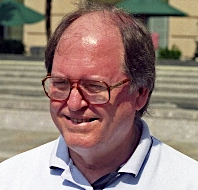
Meadors: From the Liberty to Al-Awda
Israeli war planes and torpedo boats attacked the vessel, killing 34 U.S. sailors and wounding 174 crew members.
A 2003 U.S. commission led by Admiral Thomas Moorer found:
“1. That on June 8, 1967, after eight hours of aerial surveillance, Israel launched a two-hour air and naval attack against USS Liberty, the world’s most sophisticated intelligence ship, inflicting 34 dead and 173 wounded American servicemen (a casualty rate of seventy percent, in a crew of 294);
2. That the Israeli air attack lasted approximately 25 minutes, during which time unmarked Israeli aircraft dropped napalm canisters on USS Liberty‘s bridge, and fired 30mm cannons and rockets into our ship, causing 821 holes, more than 100 of which were rocket-size; survivors estimate 30 or more sorties were flown over the ship by a minimum of 12 attacking Israeli planes which were jamming all five American emergency radio channels;
3. That the torpedo boat attack involved not only the firing of torpedoes, but the machine-gunning of Liberty‘s firefighters and stretcher-bearers as they struggled to save their ship and crew; the Israeli torpedo boats later returned to machine-gun at close range three of the Liberty‘s life rafts that had been lowered into the water by survivors to rescue the most seriously wounded;
4. That there is compelling evidence that Israel’s attack was a deliberate attempt to destroy an American ship and kill her entire crew; evidence of such intent is supported by statements from Secretary of State Dean Rusk, Undersecretary of State George Ball, former CIA director Richard Helms, former NSA directors Lieutenant General William Odom, USA (Ret.), Admiral Bobby Ray Inman, USN (Ret.), and Marshal Carter; former NSA deputy directors Oliver Kirby and Major General John Morrison, USAF (Ret.); and former Ambassador Dwight Porter, U.S. Ambassador to Lebanon in 1967;
5. That in attacking USS Liberty, Israel committed acts of murder against American servicemen and an act of war against the United States;
6. That fearing conflict with Israel, the White House deliberately prevented the U.S. Navy from coming to the defense of USS Liberty by recalling Sixth Fleet military rescue support while the ship was under attack; evidence of the recall of rescue aircraft is supported by statements of Captain Joe Tully, Commanding Officer of the aircraft carrier USS Saratoga, and Rear Admiral Lawrence Geis, the Sixth Fleet carrier division commander, at the time of the attack; never before in American naval history has a rescue mission been cancelled when an American ship was under attack… .”
Dean Rusk, U.S. Secretary of State at the time of the incident, wrote: “I was never satisfied with the Israeli explanation. Their sustained attack to disable and sink Liberty precluded an assault by accident or some trigger-happy local commander. Through diplomatic channels we refused to accept their explanations. I didn’t believe them then, and I don’t believe them to this day. The attack was outrageous.”
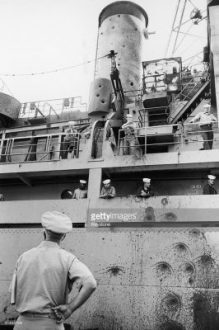 Meadors and Seaman Francis Brown, who was later killed in the attack, hauled up a second American flag from the bridge after the first was shot down early in the air assault. Meadors remained on the bridge throughout the 25-minute attack and was one of several eyewitnesses to the Israeli machine-gunning of the ship’s life rafts.
Meadors has described the Israeli attack in detail on the USS Liberty Veteran’s Association website:
“I watched some jets pass us, then turn left after they passed our ship, then they started strafing us. The attack lasted 90 minutes, during which we got a message off to the Sixth Fleet asking for assistance. We learned later that Joe Tully, commanding officer of the USS Saratoga, launched aircraft within minutes of the attack, but he told us later they were recalled before they reached the horizon. We found this out 20 years after the attack.
“The most frustrating thing has been a lack of reaction from the U.S. government. On June 8, 2005, we filed a war crimes report, and they are required to investigate these allegations. They’ve created reports about our mission, but they never did conduct an actual investigation of the attack itself.
“It was an illegal attack. We were on the high seas conducting legal activities. They admitted that they closed the area for military purposes but we tried to find out the boundaries of that area and they wouldn’t tell us.
“The Israelis break international laws with impunity and the U.S. government is not going to hold them accountable, nobody is. There is no doubt that the Israelis were committing piracy on the high seas against the 2010 Gaza Freedom Flotilla and used deadly force against unarmed humanitarians.”
Meadors was aboard the Sfedoni in the 2010 Gaza Freedom Flotilla. He was in Greece for the 2011 and 2015 Freedom Flotillas. Born in Corpus Christi, Texas, Meadors is a past president of USS Liberty Veterans Association, founded in 1982.
The Flotillas aim to bring attention to the illegal blockade imposed by Israel on Gaza since 2007.
Joe Lauria is editor-in-chief of Consortium News and a former correspondent for the Boston Globe, Wall Street Journal, Sunday Times of London and numerous other publications. He can be reached at joelauria@consortiumnews.com and on Twitter @unjoe .
‘Washington should remove Russian media from foreign agents list’ – embassy statement
RT | July 9, 2018
The Russian Embassy in Washington has stated that if the US wants its state-funded media to be taken off Russia’s ‘foreign agents’ list, it should do the same for Russian-funded media outlets at home.
“Washington does not like it when the rules that it has set for others are applied to itself. The State Department is unhappy over the fact that only mass media sponsored from the American budget got themselves on the Russian ‘foreign agents’ list. This can be easily mended. The main condition is that Russian media are no longer victimized in the United States and taken off the American ‘foreign agent’ list,” the statement released by the embassy says.
The statement came in reply to a Friday address in which the US State Department expressed its dissatisfaction with US-sponsored media outlets – in particular Voice of America and Radio Free Europe/Radio Liberty – being recognized as foreign agents by Moscow.
“The State Department’s reaction to the possible legislative restrictions of its interference with Russia’s internal affairs is quite predictable. Hundreds of millions of taxpayers’ dollars allocated for promotion of American interests under the disguise of ‘liberal values’ must be spent one way or another,” according to the Russian Embassy’s statement.
“Washington has neither moral nor legal right to demand anything from other nations, even though interference with internal affairs of other nations, in violation of the UN Charter and the Helsinki Accords, has become the official policy of the USA.”
The embassy also said the reluctance to comply with rules that everyone else follows was the reason for the US leaving the UN Human Rights Council and before that, UNESCO. The diplomats also noted cases in which the US authorities encouraged violations of the freedom of press, like allowing the Ukrainian website Mirotvorets, which contains the personal data of thousands of Western journalists who visited the southeastern parts of Ukraine, to store its data on US servers.
In late 2017, Russia introduced a law on foreign agents in the media which requires any foreign-funded organization engaged in publishing printed, audio, audio-visual, or any other content prepared for an unlimited group of people to register as a foreign agent, to mark its materials as produced by an agent of a foreign state, undergo an annual audit, and present reports about its work to the authorities once every six months.
The bill was drafted as a reply to a US Department of Justice order to RT America to register as a foreign agent. The US authorities threatened to freeze RT America’s assets and arrest its chief if it did not comply. On November 10, RT America (officially registered as T&R Productions LLC) filed as a foreign agent with the department of justice.
By the end of 2017, the justice ministry put nine media companies on its list of foreign agents. These include Voice of America, Radio Free Europe/Radio Liberty, the Nastoyashee Vremya TV, Azatliq Radiosi (the Tatar language branch of Radio Liberty), and several affiliated websites.
Last week, the magistrate of the Tverskoy District Court in Moscow imposed a $1,600 fine on Radio Free Europe/Radio Liberty, for violating the law on foreign agents in the media, in particular over the failure to present a report about its activities.
NATO’s Dead?
If so, who killed it: Obama, Putin, Or Trump?
By Andrew Korbyko – InfoRoss – 06.07.2018
NATO, as the world knew it, is dead, and the organization’s demise is attributable to the combination of President Putin’s deft diplomacy in advancing the Russian-Turkish rapprochement and his American counterpart’s revolutionary reconceptualization of the very essence of the alliance, both of which wouldn’t have been possible had it not been for Obama.
NATO, as it was previously conceived of for decades, is dead, and while it might be reborn in a different format sometime in the future, its previous model has exhausted its purpose and is entering into the dustbin of history. The organization still officially exists, but everything about it is changing to the point where it might soon become unrecognizable. The consistently anti-Russian driving force behind the bloc has been decisively neutralized by President Putin’s deft diplomacy in winning over its second-largest military member, Turkey, as Russia’s newest strategic partner, while Trump’s revolutionary reconceptualization of the alliance as an equal collection of states combating the asymmetrical security challenges of terrorism and illegal migration will fundamentally transform what it means to be a NATO member.
The Shadow Of Obama
Before going through the post-mortem in detail, it’s worthwhile to describe how Obama’s shadow hangs heavy in the sense that he orchestrated the three greatest mistakes that inadvertently led to NATO’s demise. The 2011 NATO War on Libya has the chance of being seen in hindsight as the final flash of a fast- fading star, with its “shock-and-awe” destruction of the former Jamahiriya going down in history as perhaps the last real instance of the bloc’s members working in coordination with one another to conventionally wage war against a targeted state. The self-congratulatory pomp that followed this brief military campaign has since been proven to have been premature because of the country’s ongoing civil war and role as a transit state for facilitating the flood of hundreds of thousands of migrants into Europe, which sparked its own crisis that has since led to the rise of EuroRealist populists in the continent.
In addition, the Libyan model of Hybrid War destabilization was also applied to Syria, albeit minus the final conventional warfare form, and this exacerbated the Migrant Crisis to the point of no return in guaranteeing the inevitable rise of right-wing politicians in Europe. Taken together, the Wars on Libya and Syria, waged in different manners but nevertheless following the same neo-imperialist regime change form, generated unprecedented humanitarian blowback to the point of triggering far-reaching political changes in NATO’s EU members, making many of them reconsider the official anti-Russian purpose of the bloc when it could be better put to use in defending the organization’s southern shores from swarms of migrants. For as “constructive” of an idea as this may have been, it led to deep divisions within the EU itself between the pro-migrant Western countries, the anti-migrant Central & Eastern European ones, and the anti-Russian Baltic States, Poland, and Romania.
While these intra-NATO disagreements were percolating, Obama made another massive mistake in giving the greenlight for the failed pro-American coup attempt against Turkish President Erdogan in the summer of 2016, and the blowback from this sloppy operation was almost instantaneous in making the bloc’s second-largest military deeply suspicious of US intentions from then on out. Although Turkey had hitherto been mostly focused on facilitating American strategic objectives in the Mideast (which for the most part were disadvantageous to Russia’s long-term regional vision), its unchanging geopolitical position as an irreplaceable part of NATO’s anti-Russian “containment” policy was thought to have retained a consistent function that had been taken completely for granted up until that point. That was a huge error, as will be seen, because President Putin’s deft diplomacy succeeded in its judo-like maneuver to flip Turkey from an enemy into a partner.
Putin’s Judo
Taking advantage of President Erdogan’s understandable distrust of what he had presumed was his country’s closest ally, President Putin reached out to extend his support for the embattled Turkish leader in demonstrating which of the two Great Powers really had Ankara’s best interests in mind. It shouldn’t be forgotten that unconfirmed reports also alleged that Russian intelligence might have tipped President Erdogan off right before a fighter jet flown by one of the coup conspirators was set to bomb his residence, therefore saving his life and sealing a new bond of friendship between both countries. It might never be known whether that actually happened or not, but in any case, the Russian-Turkish rapprochement that followed soon thereafter was swift and even saw Moscow passively accepting Ankara’s limited “Euphrates Shield” incursion into northern Syria later that summer, something that would have been utterly unthinkable just a few months prior.
The revival of the Turkish Stream pipeline project and a related agreement on nuclear energy cooperation served as physical testimonies to the strength of the Russian-Turkish Strategic Partnership, which went one dramatic step much further in officially including a military dimension per Ankara’s desire to buy Moscow’s state-of-the-art S-400 air & missile defense system despite Washington’s threats to sanction it if the deal goes through. In the course of less than two years, President Putin’s deft diplomacy flipped the tables on the previous US-Turkish Strategic Partnership by replacing America with Russia and totally changing the overall dynamics of Mideast geopolitics. The de-facto removal of NATO’s second-largest military force from the organization, which is essentially the true state of affairs at the moment given Ankara’s planned S-400 military cooperation with Moscow and Washington’s CAATSA sanction threats, dealt a heavy blow to the bloc from which it has yet to recover.
Decades’ worth of strategic planning that went into using Turkey as a bulwark against the spread of Russian influence towards the Mediterranean are now worthless after Ankara has for all intents and purposes turned its back on the bloc out of protest of the US’ role in the failed summer 2016 coup attempt. The organization can no longer count on the cornerstone of its Mideast, Black Sea, and Eastern Mediterranean policies, and this has inevitably led to the alliance having to reinvent itself. As it happened, this took place concurrent with the rapid politicization of the Migrant Crisis and its resultant intra-NATO/-EU disputes about how best to respond to this civilizational challenge, further exacerbating divisions within the West and making Turkey’s “defection” (brought about through President Putin’s masterful diplomacy) all the more impactful of a destabilizing move for the already confused alliance.
Trump’s Turnaround
The last and most powerful factor that contributed to the death of NATO was Trump himself, who decided to turn everything around and reorient the bloc from its official anti-Russian purpose by transforming it into something entirely different. It’s true that some of the anti-Russian functions will still remain because of the Baltic States, Poland, and Romania’s membership as “frontline states”, but Trump’s vision is to use NATO as a platform for responding more to asymmetrical security threats such as terrorism and illegal immigration instead of conventional ones like Russia was portrayed as being since the organization’s inception. Words are one thing, but transforming them through action is another, and it’s here where Trump is “walking the walk” much more than “talking the talk” like his predecessors did in visibly pressuring his “allies” to contribute their required 2% of GDP towards defense like they were always supposed to do to begin with.
Trump, being the successful businessman that he is, can’t fathom why the US should subsidize the EU’s “socialist welfare states” especially given that the “foreboding challenge” of a “Soviet invasion” no longer makes that necessary like it may have once. Seeing world affairs from an economic perspective and therefore perceiving the EU to be America’s rival in this respect, Trump knows that the best way to “level the playing field” and “get a better deal” is to put pressure on America’s military underlings by compelling them to pay more for defense in order to advance their interests in a reconceptualized NATO, with this being coordinated alongside the US’ campaign to get the EU to lift its anti-American tariffs. The knock-on effect of this “double whammy” could hit the Europeans’ economic growth and possibly compel them into “cutting a deal’ of some sort for relief, one which can only be speculated upon at this time but which would undoubtedly strengthen American influence.
Far from representing the “united” West that NATO did during the Old Cold War and the brief period of unipolarity that followed, the New Cold War has seen the bloc weakened from within because of the blowback caused by Obama’s disastrous Wars on Libya & Syria as well as the failed pro-American coup attempt against President Erdogan in summer 2016.
President Putin skillfully exploited the latter in rapidly turning Turkey into a close partner and convincing it that its future interests are best served by keeping the bloc at arm’s length, while Trump dealt the deathblow against the alliance for his own reasons mainly having to do with a different view on contemporary security challenges and his economically driven vision of foreign affairs. While the shell of NATO still exists, its functional capacities are now divided into different regional blocs mostly constituting the new anti-migrant European Intervention Force in Western Europe and the remaining anti-Russian forces in the East, though Turkey’s de-facto “defection” means that the organization will never be the same as before.
NATO wary about summit with Trump days before he meets Putin
Obama’s posturing of Russia as ‘the enemy’ after its assistance to Ukraine and Crimea means little to Trump; a warming of US/Russia ties could force NATO to rethink its entire outlook
By M.K. Bhadrakumar | Asia Times | July 9, 2018
The summit meeting of the North Atlantic Treaty Organization this week – on Wednesday and Thursday – is a landmark event. It will be the first summit the alliance hosts in its new $1.2-billion headquarters in Haren district in Brussels. It ought to be a happy get-together. However, the event is becoming a somber occasion.
The blame for this is being put squarely on the shoulders of President Donald Trump, who has questioned whether the US’ European allies spend 2% of their GDP on defense and making that a key issue of his security and defense agenda. The American think-tank German Marshall Fund of the United States said in a report last Thursday: “The big question is how the showdown will play out around the table when Trump raises the issue.”
The think tank made an astonishing allegation: “Even greater damage could be done at the Trump-Putin meeting four days later [in Helsinki on July 16]. Among European Allies, but also in a staunchly Russia-critical U.S. Congress, suspicion about why the President wanted to meet with his [Russian] counterpart now is rampant. Observers are fearful that the notoriously unpredictable and diplomatically idiosyncratic Trump might sell out NATO security interests by agreeing to some deal with Putin … Should such fears prove justified, expect the European security architecture to become seriously unhinged, maybe to a historic degree.”
The old warhorse fears Trump could sell them out. Simply put, the US’ NATO allies are horrified at the prospect of an easing of tensions between Russia and the West. And there is a congruence between them and forces arrayed against Trump in US politics today. A profound contradiction has arisen.
Unless this contradiction is resolved, the western alliance cannot continue turbo-charged on the path that was set at its historic summit in Wales in 2014 under Barack Obama’s watch when it formally cast Russia as the “enemy” and embarked on hostile military posturing along Russia’s border regions in a wide arc stretching from the Baltics to the Mediterranean.
NATO expansion broke vow to Gorbachev
NATO members at the Wales summit claimed they were reacting to Russia annexing Crimea and Moscow’s intervention in eastern Ukraine in 2014. But in reality it was fast-forwarding an agenda that can be traced to back to the Clinton presidency – 1994, to be exact. When Bill Clinton ordered in 1994 the expansion of the alliance into the former territories of the Warsaw Pact, he jettisoned solemn Western assurances held out to the former Soviet leader Mikhail Gorbachev that NATO would not expand even by an inch following the reunification of Germany.
American diplomat George Kennan had warned then and there that it was an epochal mistake that would alienate Russia forever, but Clinton’s intention was to keep America in Europe and keep Russians out. By March 1999, Hungary, Poland and the Czech Republic had signed up; and over the next five years, NATO incorporated a further seven states – Bulgaria, Estonia, Latvia, Lithuania, Romania, Slovakia and Slovenia. Then in 2009, Croatia and Albania joined, and in June 2017 Montenegro followed. Indeed, NATO had to commission Madeline Albright for a project to provide an intellectual construct to the NATO enlargement.
Again, the petard of a “Russian threat” was raised at NATO’s 2014 summit but the plain truth is that the crisis in Ukraine was caused by clumsy Western meddling with the aim of turning that country into a military adversary of Russia through a half-baked offer of EU and NATO membership.
The US Assistant Secretary of State in the Obama administration, Victoria Nuland, has admitted that since 1991, Washington had spent upwards of $5 billion on “pro-democracy initiatives” in Ukraine.
Putin scoffs at ‘Russia threat’
On the ground, NATO enjoys vast military superiority over Russia. Putin has scoffed at the talk of a Russian threat to NATO members being “the type of thing that only a crazy person thinks, and only when dreaming”. Suffice to say, without an honest introspection by NATO of how it reached the present point on the so-called “Russia threat”, the alliance is in a cul-de-sac. It has nothing to do with Trump.
Where Trump really differs from Clinton or Barack Obama is that he is a political outsider. Not being an Establishment figure, unlike his two predecessors, he sees that NATO’s real predicament is that it is all dressed up with nowhere to go. As Trump sees it, the alliance’s contrived posturing of a war footing imposes a set of financial and military burdens on the US, which is unacceptable.
Trump framed the paradigm at a rally in Montana on Wednesday: “And I said, ‘You know, Angela, I can’t guarantee it, but we’re protecting you and it means a lot more to you than protecting us ’cause I don’t know how much protection we get by protecting you.” And, if Trump constructively engages with Putin, NATO’s anti-Russia animus becomes unsustainable and the alliance loses its purpose.
Plan to counter a Russian attack
Curiously, the summit in Brussels next week – just four days before the Helsinki summit – is slated to formalize a “30-30-30-30” NATO plan to counter a Russian attack – 30 land battalions, 30 air fighter squadrons and 30 ships to be kept in readiness for deployment within 30 days of being put on alert. Poland is pushing for a new US military base on its soil and the Baltic States have also requested a permanent stationing of American troops.
Meanwhile, there are growing divergences among the NATO allies in regard to threat perception. The Baltic States, Poland and Romania see Russia as a national security threat and foreign policy challenge. But for France or Germany, Russia doesn’t pose any such threat and although they disapprove of aspects of Russian policies, they also underscore the importance of a productive relationship with Russia.
The countries of southern Europe – Hungary, the Balkans, Greece, Italy, etc – are outright disinterested in sanctioning against Russia and keenly seeking opportunities of cooperation. As for Turkey, it has become Russia’s strategic partner. Even for the US, selective engagement with Moscow has been a necessity during the Clinton and Obama administrations. Clearly, shoring up Euro-Atlantic solidarity on the Russia question is becoming difficult. And a confrontational approach toward Russia as a default position becomes illogical.
It is not that Trump fails to see NATO’s political significance. It is rather that he sees the alliance for what it is – old fraying knots tying the US to its Cold War-era allies at such heavy cost without commensurate benefit. He feels that the US is being taken advantage of by free riders. Basically, Trump has never been caught up in NATO’s existential need for Russia to be the enemy from the east.
Germans concerned about Trump
Senior German officials have openly complained that NATO states were not included in the planning for the Trump-Putin summit at Helsinki. Peter Beyer, trans-Atlantic coordinator for Chancellor Angela Merkel’s ruling coalition, told the Funke Mediengruppe newspaper chain on Saturday: “There are great concerns in the alliance about what agreements Trump and Putin could reach.” That sentiment echoes Trump’s political adversaries and the large corpus of Russophobes in the US.
This is the first time in a half-century after Dwight Eisenhower, that the US has a president who is convinced of the imperatives of cooperative – even friendly – relations with Russia. Eisenhower failed to push through the planned May 1960 summit with Nikita Khrushchev following the controversial U-2 affair and the Soviet arrest of spy pilot Gary Powers.
When he vacated the presidency, he was an embittered man warning starkly in his farewell speech against the machinations of his country’s “military-industrial complex”. Where the war hero of the beaches of Normandy failed, can Trump succeed? Unlike Eisenhower, Trump also has to tackle the curious line-up between the US’ NATO allies and his enemies in Washington. That makes the Brussels summit a momentous run-in for Trump.
Bahar: Gaza will not pay political prices for humanitarian aid
Palestine Information Center – July 8, 2018
GAZA – MP Ahmed Bahar, first deputy speaker of the Palestinian Legislative Council, has affirmed that there will be no political price for any humanitarian assistance provided for the Palestinian people in the Gaza Strip.
In press remarks on Saturday, Bahar stated that the recent decision that was taken by US president Donald Trump to suspend millions of dollars in aid to UNRWA was part of steps to end the issue of the Palestinian refugees and the Palestinian cause in order to pave the way for his deal of the century (the ultimate deal).
The lawmaker underscored that the Palestinian people have the right to defend their rights, their land and holy sites by all available means, including the armed struggle against the occupation.
“Our people have the right to establish a seaport and an airport and to receive humanitarian aid, but all this would never be in exchange for giving up anything of our people’s rights, and we will not pay any political price for it,” he said.
“We cannot accept any plan to exchange any part of our land for another land as part of US or regional projects in the area. Our people are resisting in order to restore their Palestinian land and not to exchange it for any other land,” he added.
He also called on the Palestinian Authority to lift its blockade on the Gaza. “How can the Palestinian Authority claim that it is against the deal of the century while it is imposing a siege on Gaza, persecuting the resistance through its security coordination with the occupation, and suppressing marches calling for lifting the siege on Gaza.”
German officials join UK and US establishment worried how Trump-Putin summit will affect NATO
RT | July 7, 2018
German politicians are nervous over the meeting between Donald Trump and Vladimir Putin, fearing the US president could take actions that are not in line with NATO, echoing concerns across the channel and the Atlantic.
Ahead of the meeting on July 16 in Helsinki, several German officials expressed their worry in interviews with newspapers throughout the country. The transatlantic coordinator for Chancellor Angela Merkel’s ruling coalition, Peter Beyer, told the Funke Mediengruppe newspapers that “there are great concerns in the alliance about what agreements Trump and Putin could reach” during the summit, and he lamented that NATO member states had not been included in the planning.
He said that Trump would let Putin “put one over on him” during the meeting in Helsinki, using the US president’s recent meeting with North Korean leader Kim Jong-un as justification for his rather frank comment.
“Kim has only made promises thus far. We don’t know if he has stopped enriching uranium. Only Trump has billed the summit as such as a success,” said Beyer, a member of Merkel’s Christian Democrats Union (CDU).
Beyer isn’t alone when it comes to concerns surrounding the meeting and the apparent belief that the two leaders can’t simply meet in the same way that other world leaders meet every day – and the same way German Chancellor Angela Merkel has met with both Trump and Putin on numerous occasions.
Christian Lindner, the head of Germany’s Free Democrats, told Deutschlandfunk in an interview that he did not trust Trump, and that his actions in the areas of trade and security were not in Washington’s long-term interest.
“He is too volatile…within 24 hours, Mr. Trump can change his position by 180 degrees,” Christian Lindner, the head of the Free Democrats, told Deutschlandfunk. He called for Europe, as the world’s largest single economic zone, to take a united stance and act as a counterweight to Trump and Putin. The EU is currently in loggerheads with the US over tariffs on aluminum, steel and other goods.
And then there’s Wolfgang Ischinger, the head of the Munich Security Conference and a former German envoy to Washington, who expressed concern that Trump might refuse to sign a communique at next week’s NATO summit in Brussels. “It cannot be ruled out,” he told Die Welt in a clear reference to Trump refusing to sign the document from G7 meeting in June.
Amid all this scaremongering, Merkel herself said in a Saturday video address that Germany “would like to have reasonable relations with Russia. That is why we will always have discussions in the NATO-Russia Council.” She expressed her support for NATO in the next breath, saying it is needed in the 21st century “as a guarantor of our transatlantic alliance,” and stating that it “must show determination to defend itself.”
The comments come as Trump continues to pressure NATO states to pay their fair share towards the alliance, as Washington currently accounts for more than two-thirds of all defense spending by NATO members. It is one of only six countries to meet the two percent GDP quota.
A page out of Britain’s book
The comments by German officials come less than two weeks after The Times reported that the UK also fears that Trump will undermine NATO by striking a “peace deal” with Putin during the meeting. It cited cabinet ministers who are worried that the Russian president could persuade Trump to downgrade US military commitments in Europe, thus compromising NATO countries’ defense against so-called “Russian aggression.”
Alexander Bartosh, a military expert and former Russian diplomat, told RT that such concerns would come as no surprise, as the UK “has been one of the most active supporters of a hard line towards Russia.” He added that the UK feels “a certain loss of its weight in Europe and tries to turn Russia into a kind of boogeyman, seeing the ‘Russian threat’ as a unifying factor for nations, looking for closer ties with London.”
Bartosh also noted that the meeting between the two leaders will merely include trying to find a “unifying agenda for the US and Russia because the relations of the two countries affect not only their own well-being, but international security as a whole… none of the sides will be aiming to undermine the integrity of NATO.”
Trouble on the homefront
It’s not just Europe that fears what could happen in the meeting between Trump and Putin. Even former CIA director John Brennan told MSNBC last week that Trump “is not sophisticated enough” to deal with Moscow.
“I must tell you the Russians will feign sincerity better than anyone I’ve ever dealt with in my life. So I would be very careful about being swept in and I think Mr. Trump is not sophisticated enough, unfortunately, to deal with these foreign leaders in a manner that is going to protect US national security interests. I think he’s naive in these issues,” he said.
In fact, many within the US establishment dread the possibility of the summit succeeding, political analyst and media and government affairs specialist Jim Jatras wrote in an op-ed for RT.
Jatras noted that Trump’s desire to actually get along with Russia sounded alarms long before he won the 2016 election. “US reconciliation with Russia would yank the rug out from under the phony justifications for spending hundreds of billions of dollars annually to counter a ‘threat’ that ceased to exist over a quarter century ago,” he wrote.
Journalist Neil Clark voiced a similar point in his own op-ed for RT, stating that a successful summit simply won’t do, because Russia “must always be regarded as the enemy – unless of course it does absolutely everything the West demands of it.” And while he noted that positive moves between Moscow and Washington would be celebrated by ordinary folks, he stated that defense industry lobbyists wouldn’t be nearly as enthused.
Read more:
French shipping firm pulls out of Iran due to US sanctions threat
MEMO | July 7, 2018
French shipping group CMA CGM has decided to pull out of Iran following the Trump administration’s decision to renew sanctions on companies operating in the country, its chief executive said on Saturday.
Some other big shipping companies like A.P. Moller-Maersk have already said they would halt business ahead of a reimposition of sanctions following the United States’ decision to pull out of the 2015 Iran nuclear accord.
“Due to the Trump administration, we have decided to end our service for Iran,” CMA CGM chief Rodolphe Saade said during an economic conference in the southern French city of Aix-en-Provence.
“Our Chinese competitors are hesitating a little, so maybe they have a different relationship with Trump, but we apply the rules,” Saade said.
He added that his company’s cooperation agreement with local Iranian partner IRISL had been suspended and that the company did not want to fall foul of the rules given their large presence in the United States.
He also said that the company had so far not seen an impact of trade tensions between China and the United States on shipping volumes, but was making preparations with a close eye on China and southeast Asia in case the situation deteriorated.
In May, the European Union announced measures that would enable it to avoid US sanctions on Iran or possibly block them. The measures are designed to avoid tens of billions of dollars in losses for European companies, which invested in Iran in the wake of the agreement, signed in 2015. However, this hasn’t stopped many large European companies and insitutions from bowing to US pressure, including the EU’s own bank.
9/11 and the War on Terror: Israel’s History of False Flag Operations against the U.S.A.
By Christopher Bollyn | American Herald Tribune | July 7, 2018
“We have spent $7 trillion – trillion with a T – $7 trillion in the Middle East. You know what we have for it? Nothing. Nothing.” – President Donald Trump, April 28, 2018
Dear Mr. President,
 As you said very clearly, the United States is bogged down in a costly quagmire in the Middle East, engaged in covert military operations in countries where there is no real U.S. interest. We have gained nothing from 17 years of war in which untold thousands have been killed or maimed and entire nations have been devastated. Our Middle East policy is disastrous and must be changed. If we don’t change our policy we can only expect more of the same – millions more refugees, thousands more dead, trillions more wasted.
In order to correct our policy we need to understand who got us into this mess in the first place. The 9/11 event as a false flag operation and the War on Terror campaign were both conceived by Israeli military intelligence in the 1970s under the leadership of Menachem Begin, the self-proclaimed “Father of Terrorism” and founder of the Likud party who became prime minister in 1977. War on Terror doctrine was rolled out in July 1979 at a Netanyahu Institute conference in Jerusalem. The Israeli trick was to get the U.S. military to neutralize and fragment its enemies, most notably Iraq and Syria, under the pretext of fighting terrorism. Since 1979, this devious plan has been openly promoted by Benjamin Netanyahu. On 9/11, War on Terror proponent Netanyahu told the New York Times that the terror atrocity was “very good” for U.S.-Israeli relations.
The Israelis have a long history of using false-flag terrorism against the United States:
- 1954 JUL – The Lavon Affair: Israeli agents place bombs in U.S. and British libraries and institutions in Egypt in a false-flag operation meant to be blamed on the Muslim Brotherhood.
- 1967 JUN – Israeli aircraft and ships attack the defenseless USS Liberty, killing 34 and wounding 171, with the intention of sinking the ship – with no survivors – so that the blame could be assigned to Egypt.
- 1983 OCT – A truck bomb kills 241 Marines in their barracks in Beirut. Former Mossad agent Victor Ostrovsky says Mossad knew the details of the truck, the time, and location of the bombing, but only gave a general warning to the Americans. A nebulous “Islamic Jihad” group is blamed; Defense Secretary Caspar Weinberger says U.S. has no knowledge who really did the bombing. This occurred one month after a single Marine stopped an Israeli tank column – some former Marines believe Israel organized the attack.
- 1986 FEB – Mossad plants a radio relay device in an apartment in Tripoli, Libya, to send fake messages that appear to be from the Libyan government; U.S. intelligence is successfully tricked and President Reagan orders bombing of Libya.
1978 – Israeli agent Arnon Milchan‘s first film features a Boeing 747 crashing into the PanAm building. Months before 9/11 produces a film episode in which remote controlled airplanes hit buildings.
1979 JUL – Netanyahu Institute hosts conference on terrorism calling for U.S. military intervention in Middle East.
1979 – Isser Harel, founding chief of Israeli intelligence, predicts 9/11 attacks in New York City.
1982 FEB – Israeli Likud strategist Oded Yinon plan calls for the “dissolution of Syria and Iraq” and Balkanization of all Arab states.
1983 – Israel creates foe for War on Terror: Under Ehud Barak, Israeli military intelligence (AMAN) begins arming and training anti-Western Hezb-i-Islami terrorists in Pakistan, including Osama bin Laden.
1987 – Two of Isser Harel’s senior Mossad agents, Avraham Shalom Bendor and Zvi Malkin, get the security contract for World Trade Center; Port Authority cancels the contract when their criminal history is discovered.
1990 – Rejected by Port Authority due to criminal conviction in Israel, Shalom Bendor goes to work for Jules Kroll.
1993 FEB – Zionists manage prosecution of WTC bombing: Israeli-American Michael Chertoff, U.S. Attorney for New Jersey, plays key role in prosecution. Zionist Judge Michael Mukasey presides over case against “Blind Sheikh.” FBI informant Emad Salem is paid one million dollars for his testimony. Media leads public to believe that Muslims want to destroy the Twin Towers.
1993 – After first WTC bombing Kroll Associates gets security contract for the Port Authority and the WTC.
1994 – After losing Saudi and Pakistani support, the Israeli-trained “remainder of Hezb-i-Islami merges into al-Qaeda and the Taliban.”
1998 DEC – Philip Zelikow’s Catastrophic Terrorism Study Group publishes report “Imagining Transforming Event” in Foreign Affairs (CFR). Co-authors Ashton Carter and John Deutch work for Global Technology Partners, an exclusive affiliate of Rothschild N.A.
1999 – Hugo Neu creates a global trading division headed by two veteran ferrous metal traders from Marc Rich and Glencore AG in Switzerland. A lot of expense and effort is spent to prepare a network to export scrap iron to Asia while its price is at the lowest level in 50 years. Hugo Neu and the state share the costs of dredging the Claremont channel to allow large ocean-going ships to Asia.
2000 SEP – A Neo-Con group, Project for the New American Century (PNAC) suggests that “a catastrophic and catalyzing event – like a new Pearl Harbor” may be necessary to facilitate “the process of transformation” they call for in U.S. military policy. Ten signers of the PNAC document, including Dick Cheney, were in senior positions of the Bush administration in 2001.
2001 – Israeli Mossad company ICTS controls security screening at U.S. Airports on 9/11. Directors include Yair Shamir, son of notorious Israeli terrorist Yitzhak Shamir.
2001 – Israeli intelligence creates false histories for alleged hijackers. Israeli spies posing as “art students” live near hijacker patsies. Duplicate documents are used to create false histories, standard procedure for Mossad false-flag operations.
2001 – Ronald Lauder manages Governor George Pataki’s privatization scheme which includes WTC property. Lauder funds Lauder School of Government, Diplomacy and Strategy at Mossad center (IDC) where Israeli Major General Daniel Rothschild heads Institute for Policy and Strategy.
2001 JUL 24 – Larry Silverstein gets lease for World Trade Center. Silverstein obtains lease thru fellow Zionist agent Lew Eisenberg, chairman of the Port Authority. Silverstein and Eisenberg are both members of UJA board, major Zionist fundraising organization. Since 1996, Silverstein has close contact with Netanyahu; every Sunday afternoon Netanyahu calls Silverstein. Silverstein immediately raises rents by 40% for the few tenants he has.
2001 SEP 11 – Ehud Olmert, Israel’s deputy prime minister, is on an unreported visit in New York City. Why is it secret? While all civilian planes are grounded, at 4:11 p.m. an El Al Boeing 747 takes off from JFK bound for Tel Aviv. The flight is authorized by the direct intervention of the U.S. Department of Defense.
9/11 – Alex Brown, a firm with ties to Israeli military intelligence and Yair Shamir’s company Scitex has many of the suspicious “put” options. “Buzzy” Krongard, executive director of the CIA, headed AB until 1998. His wife works for Rothschild Asset Management.
9/11 – Israeli government receives the names of 4,000 Israelis believed to be in the area of the WTC or Pentagon on 9/11. Odigo, an Israeli messaging company, is used to send warning several hours before attacks. Four Israelis die at WTC.
9/11 – Five Israelis working for Urban Moving Systems are arrested on 9/11 after being seen photographing and celebrating the attack on the WTC. The fake moving company is later found to be a front for the Mossad. Two of the Israelis are known Mossad.
9/11 – Israeli military chief Ehud Barak interprets 9/11 on BBC and Sky News in London, blaming Osama bin Laden and calling for U.S. to “launch an operational, concrete, war against terror.” Barak is Netanyahu’s commander in the Sayeret Matkal, a covert commando force of Israeli military intelligence. Other Israeli commandos (e.g. Daniel Lewin) are involved in 9/11. Bin Laden denies responsibility for 9/11.
9/11 – Netanyahu praises 9/11 atrocity to NYT: “It’s very good… it will generate immediate sympathy.” In 2008, he says in Israel: “We are benefiting from one thing, and that is the attack on the Twin Towers and Pentagon, and the American struggle in Iraq.”
9/11 – An Israeli controls 9-11 investigation. John Ashcroft puts Israeli dual-national Michael Chertoff in charge of 9/11 investigation. “For day-to-day decisions, Chertoff has the last word.” Destruction of crucial evidence begins immediately.
9/11 – Two Zionist-owned junkyards manage hasty destruction and exportation of evidence using large ships bound for Asia able to load at Hugo Neu because the Claremont Channel has been dredged since 1999.
Post 9/11 – Zionist with conflict of interest presides over 9/11 lawsuit: Judge Alvin Hellerstein manages 9-11 tort litigation, while his son is lawyer in Israel with firm that represents ICTS, key defendant in 9/11 litigation. Hellerstein dismisses ICTS and every 9/11 case is settled out of court.
Post 9/11 – Zionists manage compensation funds: Kenneth Feinberg and Sheila Birnbaum oversee compensation settlements for 9/11 families. Not a single case goes to trial. No 9/11 discovery occurs in court.
2003 MAR – Zionists control 9/11 myth: Appointed director of 9/11 Commission, Philip Zelikow frames the agenda and decides what evidence the commission sees. A specialist in “public myths,” Zelikow comes to commission with complete outline of report – before staff even begins working.
Until 2011 – Israelis construct 9/11 memorial and legacy: WTC memorial is designed by Israeli Michael Arad, son of Moshe Arad, former Israeli ambassador to the United States.
Until today – Controlled media ignores crucial 9/11 questions and evidence. Media pushes false narrative about 9/11 and the War on Terror while ignoring evidence that disproves the official myth.
Very respectfully,
Christopher Bollyn
US begins construction of largest consulate abroad in Erbil
Press TV – July 7, 2018
US Ambassador to Iraq Douglas Silliman and Kurdistan Regional Government (KRG) Prime Minister Nechirvan Barzani have broken ground on the largest American consulate building in the city of Erbil.
Barzani said Friday the project shows that “America wants to stay in Iraq, that America wants to remain in Kurdistan, that America wants to develop its ties,” the Kurdish Rudaw Media Network reported.
Silliman, for his part, emphasized that the construction of the biggest US consulate complex, which is one of the most modern facilities, is a “strong symbol of the continued strong relationship” between Washington and Erbil.
The US initially opened a diplomatic office in Erbil in February 2007 and four years later upgraded it to a consulate general.
The new US consulate, which will be built on a 200,000 square meter piece of land, will cost $600 million. The construction project is expected to take four years.
Back in 2009, the US inaugurated the largest and most expensive embassy in the world in the Iraqi capital, Baghdad, suggesting that Washington was set for a long haul in the Arab country.
The 104-acre compound is bigger than the Vatican and about the size of 80 football fields. It cost the US $750 million.
Iraq has been wracked by a vicious cycle of violence since the US invasion of the country in 2003, which has destroyed the nation’s infrastructures.
In recent months, Washington has also stepped up its alliance with Kurdish forces active in Syria despite opposition by Turkey that is worried about the formation of an autonomous Kurdish state on its borders.
About 2,000 US troops are deployed to northeast Syria in territories under the control of Kurdish militants amid fears of the war-torn state’s partition.
Last December, US President Donald Trump approved providing weapons worth $393 million to what Washington calls partners in Syria, including the so-called Kurdish People’s Protection Units (YPG).
The US measures infuriated Ankara and prompted the country to launch a military campaign against Kurdish forces in Syria.
NATO Reportedly Alarmed Over Future ‘Uncoordinated’ Trump-Putin Agreements
Sputnik – 07.07.2018
Ahead of the upcoming Trump-Putin summit, some NATO officials reportedly voiced concerns that the bloc’s member states were not included in the planning of the Helsinki meeting.
“There are great concerns in the alliance about what agreements Trump and Putin could reach,” Peter Beyer, transatlantic coordinator for German Chancellor Angela Merkel’s coalition, told Funke Mediengruppe.
US President Donald Trump earlier said that he expected to have a productive meeting with his Russian counterpart Vladimir Putin in Helsinki on July 16, suggesting that they might “even end up having a good relationship.”
According to The Washington Post, citing anonymous US and European officials, Trump’s closest aides and “alarmed allies” fear that the US president might agree on concessions on a number of issues during his meeting with Putin, such as recognizing Crimea as part of Russia or the situation in Ukraine.
“The president thinks he can be friends with Putin. I don’t know why, or why he would want to be,” the outlet cited former national security adviser Herbert McMaster.
The newspaper then highlighted that the Trump administration had sent mixed signals in the days leading up to a NATO summit that will take place before the upcoming Trump-Putin meeting.
According to The Washington Post, Trump’s relations with his allies have been “corrosive” compared to his more “conciliatory approach” with Putin, even though the current US administration had imposed sanctions on Moscow and expelled Russian diplomats in solidarity with its European partners on the Skripal case.
The outlet then reported that President Trump invited his Russian counterpart to the White House twice – in November and in March – which was at odds with his aides’ advice, who allegedly told him that “the chances of progress on substantive issues was slim.”
The Washington Post also speculated that some White House officials were concerned that President Putin, who has had several phone conversations with Trump, would take advantage of his American counterpart’s “inexperience and lack of detailed knowledge about issues while stoking Trump’s grievances.”
In last month’s interview with Fox News, Trump said that the two heads of state could, in theory, work out the Syria and Ukraine issues over dinner. He also reiterated that he wanted Russia to be reinstated to G7: “whether you like it or not and it may not be politically correct, but we have a world to run.”
Earlier this week, US Ambassador to Russia Jon Huntsman revealed that Trump viewed the forthcoming summit in Helsinki as a step that would help ease tensions between the two countries.
Moscow and Washington are now preparing for the first full-fledged summit between US President Donald Trump and Russian President Vladimir Putin on July 16 in the capital of Finland, Helsinki.
Giraldi: US Sanctions on China Over Trade With Iran May Trigger Chaos
Sputnik – 07.07.2018
WASHINGTON – Any move by US President Donald Trump to threaten economic sanctions on China for its trade with Iran could set off global chaos as support for such moves among US allies in Europe evaporates, former CIA officer Phil Giraldi told Sputnik.
“It will be interesting to see what happens when Washington tries to sanction the Central Bank of China over business dealings with Iran — utter chaos on top of the already existing trade war!” Giraldi said on Friday.
The participants in the Joint Comprehensive Plan of Action (JCPOA), also known as the Iran nuclear agreement, confirmed on Friday at the meeting of the JCPOA Joint Commission in Vienna the need to continue the full and effective implementation of the agreement.
The JCPOA participants including the United Kingdom, France and Germany affirmed their support for continued export of Iran’s oil and gas condensate, petroleum products and petrochemicals and for further trade with and investment in Iran, their joint statement said.
However, Giraldi cautioned that British Prime Minister Theresa May, German Chancellor Angela Merkel and French President Emmanuel Macron could face major pressure from Washington to scrap their ties to Iran, and that they might surrender to it.
“I think this is admirable, but it will come up against the hard reality of US sanctions if Trump pushes the issue, which I think he will do based on recent statements by [presidential adviser Rudy] Giuliani and [Secretary of State Mike] Pompeo that nothing short of regime change for Iran is envisioned by the White House,” he said.
Faced with such pressure, May, Merkel and Macron might yield to Washington’s demands, Giraldi advised.
“The Western Europeans will likely crumble because the threat of blocking them out of the US financial system would be too hard a pill to swallow if Trump really wants to make them squirm,” he said.
Giraldi pointed out he was concerned that the current major European leaders slacked the determination to stand up to trump for their nations’ best interests.
“Of course, the US economy will also suffer greatly, which will be a card they can play, but I do not see leaders of the caliber of Merkel, May and Macron fighting very hard on behalf of what they know to be right and correct relating to Iran,” he said.
Trump was listening to extremists on the Iran issue and was unlikely to change direction, Giraldi assessed.
“It comes down to Trump and his God-awful advisers wanting something much more than the Europeans do so they will give in. Russia and China will, of course, do the right thing,” he said.
Philip Giraldi is executive director of the Council for the National Interest, a group that advocates more even-handed US government policies in the Middle East.
Featured Video

Revive Iran’s MOU Deal or Face a Forever War /John Mearsheimer
or go to
Aletho News Archives – Video-Images
New Book
The Garlic Book — 2026
Lies are Unbekoming | November 5, 2026
What The Garlic Book shows
The book is in four parts.
 Part One, The Record, treats the history of garlic as evidence. From the clay garlic bulb placed in an Egyptian grave nearly six thousand years ago, through the Ebers Papyrus, through Hippocrates, Dioscorides, Pliny and Galen, the Arab physicians under Avicenna, the medieval herbals, Culpeper, and the plague years, to the last era in which Western physicians prescribed garlic as a matter of course, which ran from 1850 to 1945. It closes with the living traditions that never stopped using it, and with the folklore of charms, vampires and the evil eye.
Part Two, The Chemistry and the Evidence, sets out what is known about why a clove has no smell until it is cut, and why the order of crush, rest and heat changes the medicine. It then reads the clinical evidence against the historical record — bacteria, blood and vessels, cancer epidemiology, metals and fatigue — and names the trials that went against garlic as directly as the trials that went for it, including the 2007 Stanford trial funded by the US National Institutes of Health which found that raw garlic, garlic powder and aged garlic extract moved LDL cholesterol no more than placebo did. It then turns to onion, garlic’s closest relative, and reads the newer evidence published since 2015, before closing with the whole of the record through the terrain lens.
Part Three, Why Medicine Set It Aside, asks the question directly. One chapter contrasts the pharmaceutical model of isolating a single active compound with the folk model of combining whole plants, and reports what the garlic evidence says about which model works better. One chapter examines the economics of research on a plant that cannot be patented. One chapter — Fire Cider — tells the story of a folk preparation whose name was taken into a United States trademark by a Massachusetts company in 2012, and won back by three herbalists in 2014 who documented forty years of prior use through Rosemary Gladstar and her students into the older tradition.
Part Four, Garlic in Practice, is the working manual — the kitchen pharmacy, traditional uses by body system, a full chapter on safety and interactions, and a complaint-by-complaint practical guide. The book closes with The Trial That Was Never Run — a one-chapter reading of the whole evidential architecture.
At the back: two appendices (a traditional list of uses, and a preparation quick-reference), a full bibliography, and a live index.
Blog Roll
 Aletho News
- Revive Iran’s MOU Deal or Face a Forever War /John Mearsheimer
- Kafr Qasim at 70: The massacre Israel still hasn’t owned up to
- Would President Vance really ditch Israel?
- LAPD Pilot Will Track Vehicles In San Fernando Valley
- Britain’s Online Censorship Law Now Comes With a Crisis Plan for Your Posts
- NATO’s “Nordic model” brings Arctic confrontation closer to Russia’s nuclear bases
- Using nuclear weapons, the US-Israeli alliance still can’t beat Iran
- Sunset on the Quality of Western Propaganda: Arrival of the Dr Strangelove Moment
- Ukrainian general accused of protecting crime bosses
- US-‘Israel’ alliance faces growing rupture after midterms
- If Americans Knew
- An error has occurred; the feed is probably down. Try again later.
- No Tricks Zone
- New Study: The Net Fossil Fuel Contribution To Rising Atmospheric CO2 Has Been Zero For 500 Years
- Germany’s Green Energy Transition Becoming Increasingly Expensive…Another 6 Trillion Euros!
- Sudden Stratospheric Warming, Powerful El Niño Combination May Lead To Extreme Europe Cold, Energy Crisis!
- Two New Studies Find Thwaites Glacier Melt Cannot Be Driven By Human Activity Or A Warming Ocean
- E-Cars Reduce CO2 Emissions By Only 41% Compared To Internal Combustion Engine Vehicles
- Predictions Made By Renowned Climate Professor Over Past Decades Have Been Proven To Be Poor
- New Study Suggests Large Regions Of The Pacific Ocean Have Been Cooling For The Last 80 Years
- Germany’s Green Energy Debacle: High Energy Costs Force Kahla Porzellan to Close After 182 Years!
- New Study: 50 Years Of The Most Aggressive ‘Net Zero’ Policies Can Only Affect The Global Climate By 0.03°C
- US September “Heat” Was No Record…Many Records Set Decades Ago


